(Jordan V., Gerardo M.)
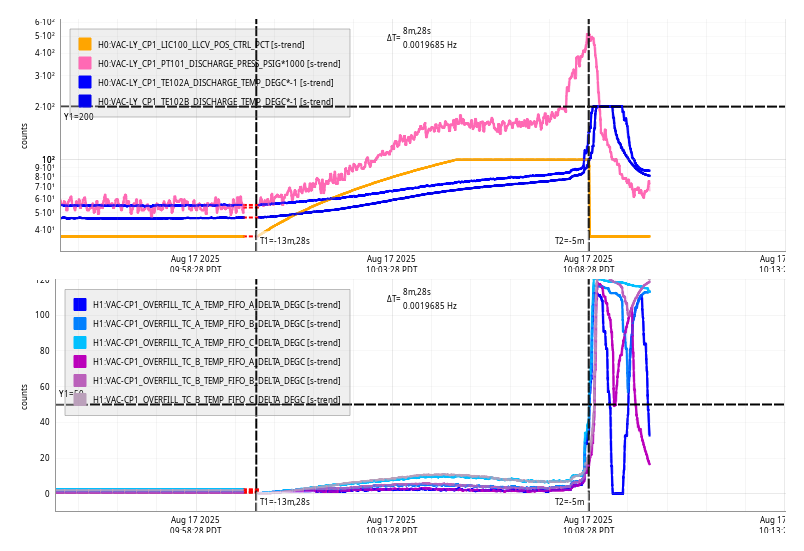
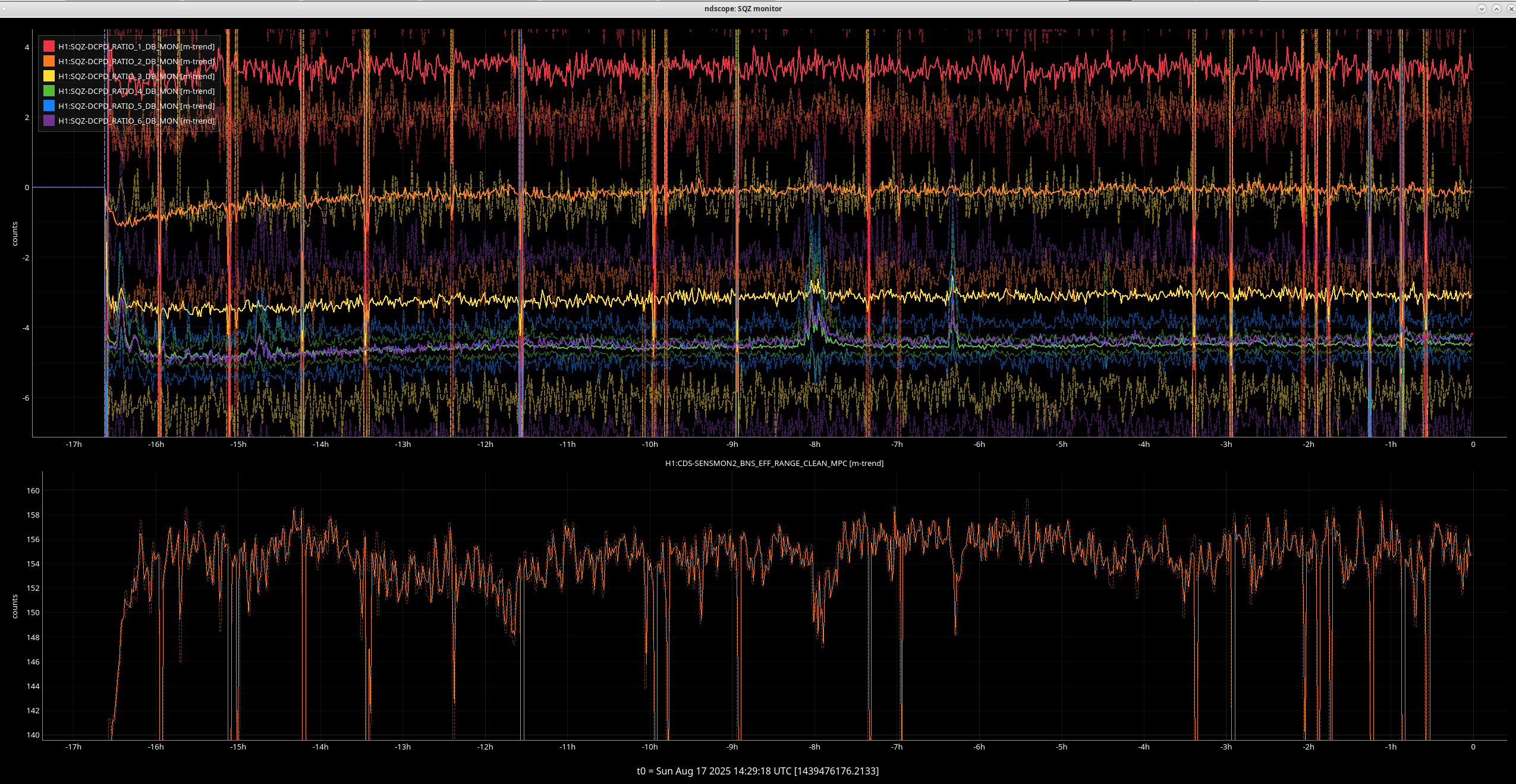
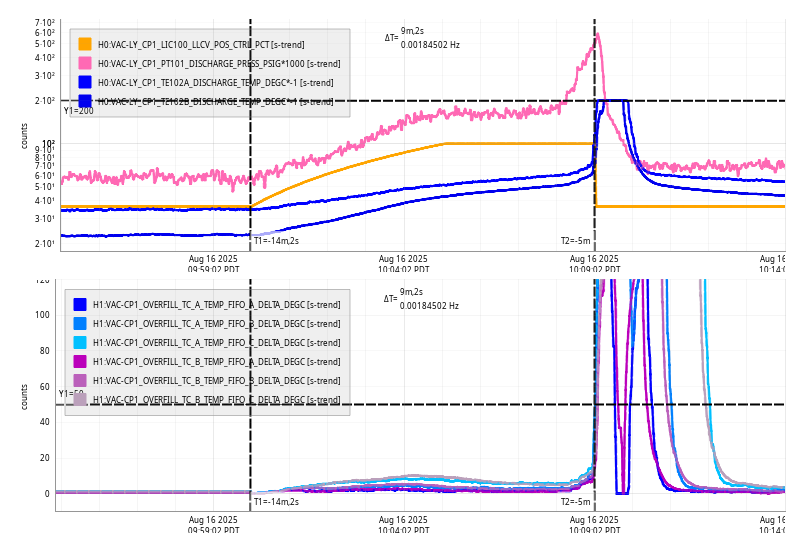
HAM3 annulus ion pump (AIP) railed today around 7:00 am this morning. We'll try to diagnose the system at the next opportunity. After the pump railed there is no noted effect inside the main vacuum envelope.
The AIP body was replaced last on 2015, see aLOG entry here.
Wed Jul 02 10:13:04 2025 INFO: Fill completed in 13min 1secs
FAMIS 26044, last checked in alog85153.
HAMs:
HAM4 has a new V3 line at the upper end of the frequency bandwith shown.
HAM7 V2 and V3 also appear a little louder just over 100 Hz.
HAM8s V3 line just over 100Hz has reduced by ~an order of magnitude.
BSCs:
ITMY_ST2 V2 has become a little noisier at high frequency.
BS_ST2 V3 has become a little noisier at high frequency.
ETMX_ST1 line at just under 60Hz has increased in both H1 and V3.
Tuesday morning I found that HWS ETMY camera control had stopped running at 06:27 PDT for unknown reasons. This was discovered when H1 went out of lock at the start of maintenance and the ETMY camera was not enabled. This was not an actual issue because the ETMY camera is turned off.
To bring attention if a camera controler stops running I made two changes the camera control system:
1) Added GPS times to the controller code (required loading python3-requests and python3-dateutil for gpstime)
2) Added run-status widgets to MEDM, if a camera controller's GPS falls behind by 5 minutes or more its MEDM shows a purple block
Attachment shows ETMY in a stopped state.
TITLE: 07/02 Day Shift: 1430-2330 UTC (0730-1630 PST), all times posted in UTC
STATE of H1: Lock Acquisition
OUTGOING OPERATOR: Oli
CURRENT ENVIRONMENT:
SEI_ENV state: CALM
Wind: 15mph Gusts, 8mph 3min avg
Primary useism: 0.01 μm/s
Secondary useism: 0.05 μm/s
QUICK SUMMARY:
Rough night continues after Maintenance Day with rung up violins and input alignment shift.
NOTE: Well, after getting H1 back to 60W, the violins are not rung up and better than how they looked at the end of my shift yesterday.
(Sheila & Todd are now looking at the Squeezer & I returned H1 to be able to "Observe WITH Squeezing".)
I noticed ETMX mode1 has been high ever since coming back from maintenance yesterday and we usually don't damp this mode. I took a high res spectra to confirm that it was this mode and not another close line causing this and it was so I tried to find some damping settings.
Nothing worked all that well, some tentative new settings are FM1+FM2+FM10 G=-50.
Called again due to the squeezer FC, same as last time. I've checked and the OPO temp maxes out H1:SQZ-CLF_REFL_RF6_ABS_OUT, and the adjustment I made earlier to FC1 and FC2 gets H1:SQZ-FC_TRANS_C_LF_OUT almost at 100. The FC is losing lock at atmost the same spot - it's getting to TRANSITION_IR_LOCKING and is saying that green is losing lock either right after loading in the LSC matrix, or after the same spot as before, after changing the DOF1 gain to 0.
I don't know what else to try, so I ran Ryan Short's script for changing the default guardian SQZ states so that we could go into Observing without squeezing until I can contact someone at 13:00UTC.
We've been approved to continue to do Observing without Squeezing until people are able to look at the issue when they get onsite
Got called again, this time because the SQZer unlocked and the filter cavity was having trouble relocking. Green could lock fine and it would find IR, but it would unlock before getting to IR_LOCKED. I did the normal thing of adjusting FC2, and later FC1, while trying to maximize H1:SQZ-FC_TRANS_C_LF_OUT, but it didn't help. It seemed like as soon as the gain was changed from 1 to 0 for the H1:SQZ-FC_LSC_DOF1 filter bank during TRANSITION_IR_LOCKING, green would lose lock. Does this make sense or is it just a coincidence?
I tried adjusting the opo temperature just in case, but that didn't seem to help either, at least I don't think it did? It kept going back to just green locked whenever we would get to IR locked. I just realized that we lost lock, and trending back it looks like we lost lock a few minutes before I started adjusting the opo temperature, so that makes sense why the FC guardian was being weird and kept going back to green locked.
Anyway, hopefully that worked, otherwise I'll be back.
H1 Manager called on me to help with a bunch of SDF diffs.
- Some ASC POP A offsets, which were accepted in safe earlier today (85490), so I went ahead and accepted them for Observe as well
- IMC PZT offset changes, which were made earlier when working on realigning the IMC (85476)
- ALSX camera offsets, which were changed earlier (85472)
- the SR3 and SRM dackill bypass times were lengthened temporarily for part of the work today, which I realize now should have been reverted oops need to fix when we're out of Observing tomorrow
- SQZ OPO servo's common board excitation had been left switched on (switch on the right from EXC A), so I just opened the switch
TITLE: 07/02 Eve Shift: 2330-0500 UTC (1630-2200 PST), all times posted in UTC
STATE of H1: Preventive Maintenance
INCOMING OPERATOR: Oli
SHIFT SUMMARY: H1 has not been fully locked since before the maintenance period this morning, although I don't believe anything done during maintenance is to blame.
After maintenance, violin modes were very rung up, so we've been spending long stretches in OMC_WHITENING (when we've been able to get there) damping. Nominal violin damping settings have been working, it's just been taking a while to bring them down. On all three occasions where we've been damping violins here this afternoon and evening, there have been random locklosses (from sources I haven't been able to determine) before reaching NOMINAL_LOW_NOISE. Jitter noise injections were being run during one of these locklosses, but that didn't appear to be the cause, reinforced by the fact that these were run again the next time in OMC_WHITENING and there was not a lockloss. In addition, a few minor earthquakes and DRMI taking it's usual long time to catch have been making lock acquisition take seemingly longer than usual. I'm not sure what else there is to try as alignment has generally looked good this evening and overall I've been able to make locking progress before an inevitable out-of-nowhere lockloss happens.
H1 is currently trying to lock DRMI.
M. Todd, S. Dwyer
This morning Sheila and I went out to HAM7 to move the OPO crystal to try and get rid of some loss, continuing from this work.
We got the translation stage driver out of the SQZ cabinet and after a bit of fiddling with the connector, we were able to see a response in the IR and Green transmission.
From here we moved the OPO to the right and then back to the left, measuring the NLG and Threshold Power at each position:
| Position | Max | OPO Therm. | Green Launch | Unamp. | Dark | NLG | P_thres[uW] | P_set [uW] | Notes |
|---|---|---|---|---|---|---|---|---|---|
| 0 | 0.0577 | 30.698 | 0.00663 | 0.0000232 | 8.73 | 90.35 | 80 | 8:58 AM | |
| 20 | 0.052 | 30.647 | 7.87 | 91.65 | 80 | 9:06 AM | |||
| 40 | 0.049 | 30.618 | 20.7 | 7.41 | 92.47 | 80 | 9:15 AM | ||
| 60 | 0.0477 | 30.593 | 19.85 | 7.22 | 92.87 | 80 | 9:21 AM | ||
| 0 | 0.0494 | 30.61 | 20.5 | 7.47 | 92.36 | 80 | 9:25 AM | ||
| -10 | 0.0498 | 30.612 | 20.6 | 7.53 | 92.24 | 80 | 9:33 AM | ||
| -20 | 0.0499 | 30.613 | 20.7 | 7.55 | 92.22 | 80 | 9:37 AM | ||
| -40 | 0.0502 | 30.616 | 20.8 | 7.59 | 92.13 | 80 | 9:41 AM | ||
| -60 | 0.0508 | 30.624 | 21 | 7.69 | 91.97 | 80 | 9:45 AM | ||
| -80 | 0.0512 | 30.63 | 21.2 | 7.75 | 91.86 | 80 | 9:52 AM | ||
| -100 | 0.0515 | 30.634 | 21.3 | 7.79 | 91.78 | 80 | 9:55 AM |
As you can you see when we "returned" to our starting position our NLG never returned to its starting point. Sheila and I went back into the control room to try and recover the NLG via adjusting the OPO temp, but in un-plugging the driver before digitally closing the connection, we think we kicked the OPO into a very different position than expected. To even get something sensible we had to change the OPO temp by over one degree celcius -- far more than should be necessary to get the Green and IR to be coresonant.
So after lunch, we back into the LVEA and connected the driver again as well as a function generator to the OPO PZT, reading the IR and Green transmissions onto a scope. We also increased the seed power to 2W so that we could see it on the scope more easily. Ensuring the connector was more properly setup, we moved the OPO a BUNCH to the left to get the Green and IR to be co-resonant. After awhile the driver would not let me move it to the left anymore, (though it would let me move to the right a couple steps but then NOT retrace my steps back left...), so we decided to leave it as it was. At the end of it we had moved 22 x 50 steps (+ 1 x 10 steps) to the left, and decided to do the rest of the actuation with the OPO temp.
We measured the NLG in the final position and it was disappointingly low but we decided to regroup and think about things.
| Position | Max | OPO Therm. | Green Launch | Unamp. | Dark | NLG | P_thres[uW] | P_set [uW] | Notes |
|---|---|---|---|---|---|---|---|---|---|
| -1110 | 0.00186 | 30.46 | 15.5 | 3.40E-4 | -2.70E-5 | 5.137 | 99.34 | 80 | |
| -1110 | 0.00280 | 3.48E-4 | -2.70E-5 | 7.539 | 121.06 | 105 |
More to come, and more to think about!
$python3 generate_measurement_data.py --WS PS4 --date 2025-06-24Reading in config file from python file in scripts../../../Common/O4PSparams.yamlPS4 rho, kappa, u_rel on 2025-06-24 corrected to ES temperature 299.2 K :-4.70052522573445 -0.0002694340454223 2.66508565972755e-05Copying the scripts into tD directory...Connected to nds.ligo-wa.caltech.edumartel runreading data at start_time: 1435423390reading data at start_time: 1435423770reading data at start_time: 1435424085reading data at start_time: 1435424665reading data at start_time: 1435425020reading data at start_time: 1435425335reading data at start_time: 1435425435reading data at start_time: 1435426070reading data at start_time: 1435426405Ratios: -0.46199911560110457 -0.4661225769446798writing nds2 data to filesfinishing writingBackground Values:bg1 = 9.235188; Background of TX when WS is at TXbg2 = 5.284960; Background of WS when WS is at TXbg3 = 9.145166; Background of TX when WS is at RXbg4 = 5.413446; Background of WS when WS is at RXbg5 = 9.219525; Background of TXbg6 = 0.642557; Background of RXThe uncertainty reported below are Relative Standard Deviation in percentIntermediate RatiosRatioWS_TX_it = -0.461999;RatioWS_TX_ot = -0.466123;RatioWS_TX_ir = -0.455904;RatioWS_TX_or = -0.461457;RatioWS_TX_it_unc = 0.092717;RatioWS_TX_ot_unc = 0.098001;RatioWS_TX_ir_unc = 0.097458;RatioWS_TX_or_unc = 0.092076;Optical EfficiencyOE_Inner_beam = 0.986610;OE_Outer_beam = 0.990080;Weighted_Optical_Efficiency = 0.988345;OE_Inner_beam_unc = 0.062698;OE_Outer_beam_unc = 0.063147;Weighted_Optical_Efficiency_unc = 0.088986;Martel Voltage fit:Gradient = 1636.767545;Intercept = 0.229197;Power Imbalance = 0.991154;Endstation Power sensors to WS ratios::Ratio_WS_TX = -1.077445;Ratio_WS_RX = -1.391120;
Ratio_WS_TX_unc = 0.058121;Ratio_WS_RX_unc = 0.042422;
========================================================================== Values for Force Coefficients ==============================================================================
Key Pcal Values :GS = -5.135100; Gold Standard Value in (V/W)WS = -4.700525; Working Standard Value
costheta = 0.988362; Angle of incidencec = 299792458.000000; Speed of LightEnd Station Values :TXWS = -1.077445; Tx to WS Rel responsivity (V/V)sigma_TXWS = 0.000626; Uncertainity of Tx to WS Rel responsivity (V/V)RXWS = -1.391120; Rx to WS Rel responsivity (V/V)sigma_RXWS = 0.000590; Uncertainity of Rx to WS Rel responsivity (V/V)
e = 0.988345; Optical Efficiencysigma_e = 0.000879; Uncertainity in Optical Efficiency
Martel Voltage fit :Martel_gradient = 1636.767545; Martel to output channel (C/V)Martel_intercept = 0.229197; Intercept of fit of Martel to output (C/V)
Power Loss Apportion :beta = 0.998895; Ratio between input and output (Beta)E_T = 0.993606; TX Optical efficiencysigma_E_T = 0.000442; Uncertainity in TX Optical efficiencyE_R = 0.994705; RX Optical Efficiencysigma_E_R = 0.000443; Uncertainity in RX Optical efficiency
Force Coefficients :FC_TxPD = 7.903342e-13; TxPD Force CoefficientFC_RxPD = 6.193451e-13; RxPD Force Coefficientsigma_FC_TxPD = 5.805084e-16; TxPD Force Coefficientsigma_FC_RxPD = 3.826232e-16; RxPD Force Coefficientdata written to ../../measurements/LHO_EndX/tD20250701/Comment regarding the missing signal on the EX Pcal MEDM:
We noticed that H1:CAL-PCALX_OFS_DRIVE_MON was not working as expected a few weeks ago. On this expedition to make ES measurements, Dripta and I used a few breakout boards to ensure that the "OFS drive monitor" signal was coming out of the Pcal chassis and into the ADC Chassis. We confirm that there was a signal coming out of the Pcal Interface Chassis back board (D1400149V1), the DB9 output labeled "To Fast ADC", pins 1 and 6 (not the same name but, by process of elimination, we assume that "OFS drive monitor" is, in the drawing, "InLoopOut±") , so we can rule out the Pcal chassis. Due to lack of time, however, we were not able to pinpoint the step at which this signal is lost.
Tony found the next step in our hunt: Page 3 of D1300226V13 shows the ADC side of "To Fast ADC", specifically, "ADC CHAN±00" is assigned, in the drawing, to InLoopOut± . I am tagging CDS for any insight on their side. Discussions and a follow-up plan are in progress to find the signal.
Jeff, Sheila, Elenna
Executive summary: Our input alignment has changed. We know this because the alignment onto IM4 trans has changed. This corresponds to the IMs 1-3 OSEMs showing a change, which corresponds with HAM2 being taken offline to change the power supply.
Today, an H1SEI23 power supply was replaced, and preceding this activity HAM2 and HAM3 were taken offline, 85475.
When HAM2 came back online, the OSEM readbacks on IMs 1-3 showed a change in both pitch and yaw. The table below summarizes how much each suspension's alignment has changed.
| IM | Pit change (urad) | Yaw change (urad) |
| 1 | 2 | 0 |
| 2 | 66.8 | 2.7 |
| 3 | 14.8 | 4.3 |
This shift in alignment is also apparent on IM4 trans, which shows the pitch offset has increased by 0.3 and yaw offset by 0.03 (uncalibrated).
We first noticed something had changed when we ran input alignment- I had to move PR2 by 5 microradians in both pitch and yaw just to get the lock to catch, and then the alignment offload further changed the PR2 sliders.
This change is further backed up by the fact that the POP A offsets have changed, and the PRG at 2 W seems to have decreased slightly.
We're not sure how bad of a problem this is. We have been able to lock and power up with no issues. We had a random unrelated lockloss, so I cannot yet see if the buildups at full power once thermalized have changed significantly.
The locking process is now much slower again, since the alignment offsets for the PRM have changed, and the convergence of the PRM ADS tends to set the rate at which we can engage ASC in full lock.
The first two attachments are screenshots show the shift in the IM alignment and IM4 trans alignment. I included the HAM2 ISI guardian state to show this change corresponds with HAM2 going offline.
The third attachment shows how the POP A offset has changed at full IFO 2 W. We can use this scope to adjust the POP A QPD offset and speed up locking, if we want to keep this input alignment.
The fourth attachment shows the ITMX green camera offset screen in full IFO at 2 W. I was watching this screen to confirm the new ITMX green camera offsets I set earlier today were ok. I think the set value differs from the live value here because of the new input alignment.
We sat at full power for 1 hour and had thermalized to a PRG of 49. Trending back to our last lock before maintenance it looks like we achieve about the same PRG in this amount of time, so there is minimal impact on the buildups. There might be a small reduction in the jitter coupling. We should check again when fully thermalized to be sure.
Since we are going to stay this way for at least tonight, I updated the POP A offsets to help shorten ENGAGE ASC FOR FULL IFO. SDF attached.
I ran my damp_regression_compare script (85369) on the suspensions that we swapped the satellite amplifiers for today, BS, PRM, PR3, SRM, and SR3. The results show a decrease in the OSEM noise of at least 2x!
Part of what the script does is save the channel data as a .mat file so it's quicker to run next time, so I'll post that as well as the results.
BS
Results: /ligo/svncommon/SusSVN/sus/trunk/BSFM/H1/BS/SAGM1/Results/allDampRegressCompare_H1SUSBS_M1_NoiseComparison_1435348334vs1435435046-1200.pdf
r12374
Data: /ligo/svncommon/SusSVN/sus/trunk/BSFM/H1/BS/SAGM1/Data/dampRegress_H1BS_M1_1435348334_1200.mat
/ligo/svncommon/SusSVN/sus/trunk/BSFM/H1/BS/SAGM1/Data/dampRegress_H1BS_M1_1435435046_1200.mat
r12373
PRM
Results: /ligo/svncommon/SusSVN/sus/trunk/HSTS/H1/PRM/SAGM1/Results/allDampRegressCompare_H1SUSPRM_M1_NoiseComparison_1435348334vs1435435046-1200.pdf
r12376
Data: /ligo/svncommon/SusSVN/sus/trunk/HSTS/H1/PRM/SAGM1/Data/dampRegress_H1PRM_M1_1435435046_1200.mat
/ligo/svncommon/SusSVN/sus/trunk/HSTS/H1/PRM/SAGM1/Data/dampRegress_H1PRM_M1_1435348334_1200.mat
r12375
PR3
Results: /ligo/svncommon/SusSVN/sus/trunk/HLTS/H1/PR3/SAGM1/Results/allDampRegressCompare_H1SUSPR3_M1_NoiseComparison_1435348334vs1435435046-1200.pdf
r12380
Data: /ligo/svncommon/SusSVN/sus/trunk/HLTS/H1/PR3/SAGM1/Data/dampRegress_H1PR3_M1_1435348334_1200.mat
/ligo/svncommon/SusSVN/sus/trunk/HLTS/H1/PR3/SAGM1/Data/dampRegress_H1PR3_M1_1435435046_1200.mat
r12379
SRM
Results: /ligo/svncommon/SusSVN/sus/trunk/HSTS/H1/SRM/SAGM1/Results/allDampRegressCompare_H1SUSSRM_M1_NoiseComparison_1435348334vs1435435046-1200.pdf
r12378
Data: /ligo/svncommon/SusSVN/sus/trunk/HSTS/H1/SRM/SAGM1/Data/dampRegress_H1SRM_M1_1435435046_1200.mat
/ligo/svncommon/SusSVN/sus/trunk/HSTS/H1/SRM/SAGM1/Data/dampRegress_H1SRM_M1_1435348334_1200.mat
r12377
SR3
Results: /ligo/svncommon/SusSVN/sus/trunk/HLTS/H1/SR3/SAGM1/Results/allDampRegressCompare_H1SUSSR3_M1_NoiseComparison_1435348334vs1435435046-1200.pdf
r12382
Data: /ligo/svncommon/SusSVN/sus/trunk/HLTS/H1/SR3/SAGM1/Data/dampRegress_H1SR3_M1_1435348334_1200.mat
/ligo/svncommon/SusSVN/sus/trunk/HLTS/H1/SR3/SAGM1/Data/dampRegress_H1SR3_M1_1435435046_1200.mat
r12381
Since a few of the before times I picked for some of the suspensions were during times where they had ISC control on, I've rerun them with a better starting time where there was no ISC control
BS
Results: /ligo/svncommon/SusSVN/sus/trunk/BSFM/H1/BS/SAGM1/Results/allDampRegressCompare_H1SUSBS_M1_NoiseComparison_1435154988vs1435435038-1200.pdf
r12436
Data: /ligo/svncommon/SusSVN/sus/trunk/BSFM/H1/BS/SAGM1/Data/dampRegress_H1SUSBS_M1_1435154988_1200.mat
/ligo/svncommon/SusSVN/sus/trunk/BSFM/H1/BS/SAGM1/Data/dampRegress_H1SUSBS_M1_1435435038_1200.mat
r12437
PRM
Results: /ligo/svncommon/SusSVN/sus/trunk/HSTS/H1/PRM/SAGM1/Results/allDampRegressCompare_H1SUSPRM_M1_NoiseComparison_1435154988vs1435435046-1200.pdf
r12438
Data: /ligo/svncommon/SusSVN/sus/trunk/HSTS/H1/PRM/SAGM1/Data/dampRegress_H1SUSPRM_M1_1435435046_1200.mat
/ligo/svncommon/SusSVN/sus/trunk/HSTS/H1/PRM/SAGM1/Data/dampRegress_H1SUSPRM_M1_1435154988_1200.mat
r12438
SRM
Results: /ligo/svncommon/SusSVN/sus/trunk/HSTS/H1/SRM/SAGM1/Results/allDampRegressCompare_H1SUSSRM_M1_NoiseComparison_1435154988vs1435435046-1200.pdf
r12441
Data: /ligo/svncommon/SusSVN/sus/trunk/HSTS/H1/SRM/SAGM1/Data/dampRegress_H1SUSSRM_M1_1435435046_1200.mat
/ligo/svncommon/SusSVN/sus/trunk/HSTS/H1/SRM/SAGM1/Data/dampRegress_H1SUSSRM_M1_1435154988_1200.mat
r12441
TITLE: 07/01 Day Shift: 1430-2330 UTC (0730-1630 PST), all times posted in UTC
STATE of H1: Observing at 131Mpc
INCOMING OPERATOR: Ryan S
SHIFT SUMMARY:
Maintenance Day.
Model changes, then DAQ restart at noon--
LOG:
TITLE: 07/01 Eve Shift: 2330-0500 UTC (1630-2200 PST), all times posted in UTC
STATE of H1: Preventive Maintenance
OUTGOING OPERATOR: Corey
CURRENT ENVIRONMENT:
SEI_ENV state: CALM
Wind: 18mph Gusts, 11mph 3min avg
Primary useism: 0.02 μm/s
Secondary useism: 0.05 μm/s
QUICK SUMMARY: H1 has just relocked following the maintenance period today, but currently waiting in OMC_WHITENING to damp some very rung-up violin modes. Meanwhile, Elenna is running jitter noise injections. I'm also aware of the OPO crystal move from today, so I'll be watching SQZ performance this evening and will adjust the temperature if need be.