Kyle R., Gerardo M., Richard M. (completes WPs #6332 and #6360) Initial pressure indication shortly after being energized was 3 x 10⁻³ torr (PT180 is a "wide-range" gauge). If real, this would be higher than expected for the ~17 hrs. of accumulation -> "burped" the accumulated gas into the connected pump setup while Gerardo monitored its pirani gauge -> it gave no indication of a change and remained steady at 1.9 x 10⁻³ torr which is as expected. Neither gauge is calibrated in this pressure region of interest. Noted PT180 responded as expected to being combined with local turbo -> Isolated temporary local pump setup, valved-in (exposed/combined) PT180 to site vacuum volume, vented locally mounted turbo and removed from PT180 hardware -> Installed 1 1/2" O-ring valve and 2.75" CF to NW40 adapter in place of the turbo and pumped to rough vacuum the space between the two 1 1/2" pump port valves.
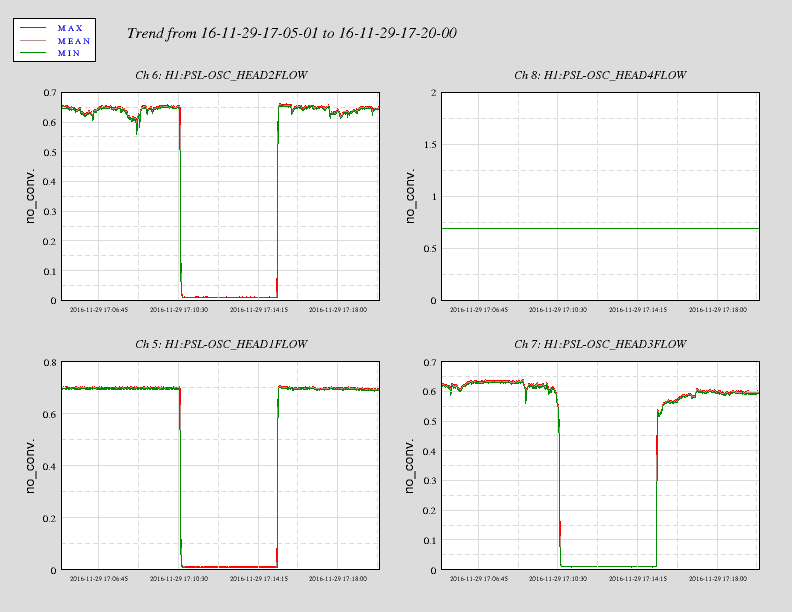
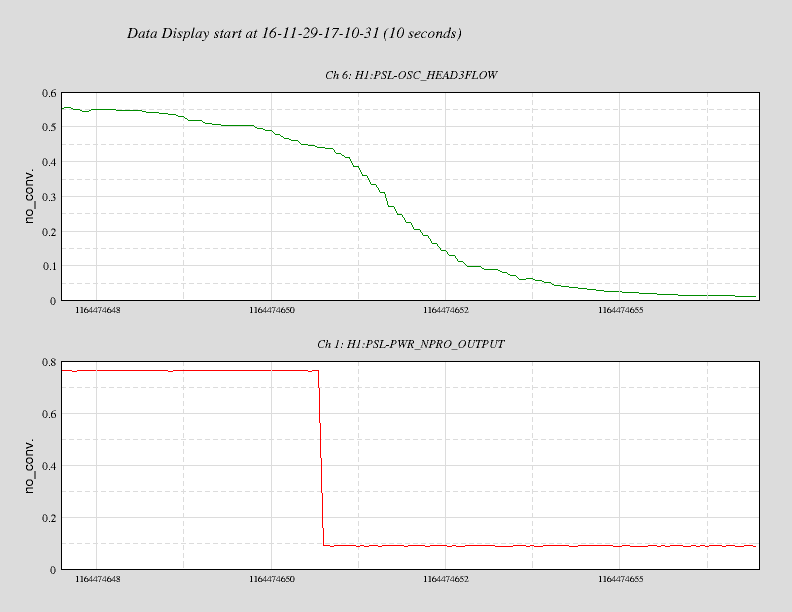
I was informed that the laser had tripped this morning. Not sure exactly why the laser tripped as TwinCAT indicated
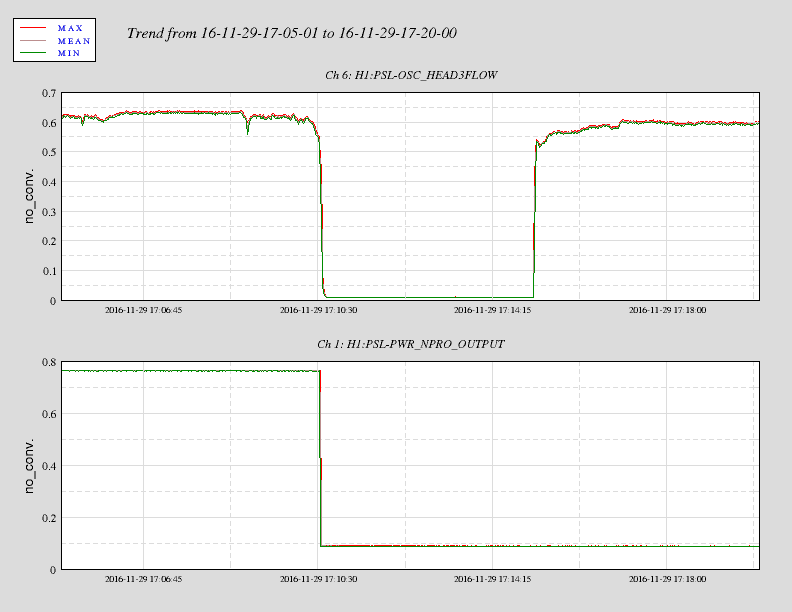
that the EPICS alarm was triggered. At first glance it looks like the flow in head 3 caused the trip. It reached
the trip value (0.4 lpm) roughly 2 seconds before heads 1 and 2.
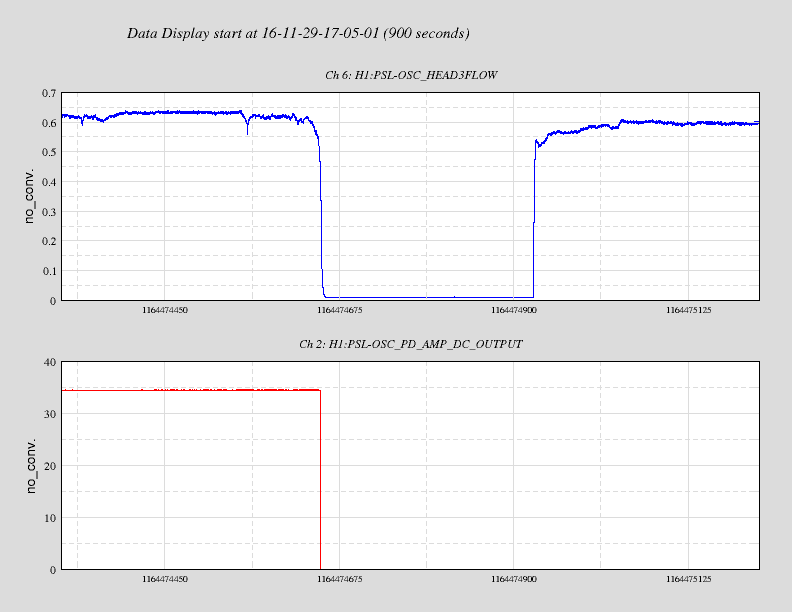
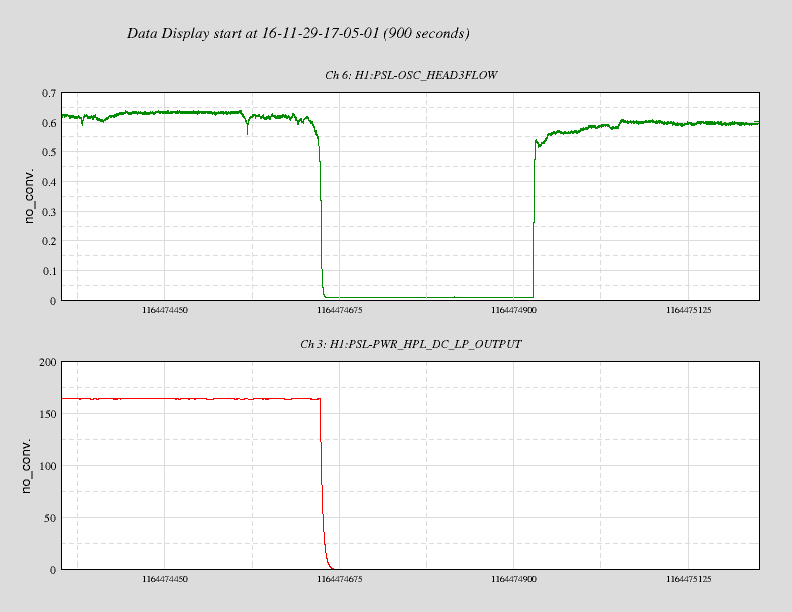
Attached are other trends of the laser power(s) versus the flow rate in head 3. There is some evidence to
suggest that the NPRO might have tripped first, triggering the power watchdog for the front end (mis-named
Head2NPROa.png).
Summary:
Average range: 70 Mpc
Duty Cycle: 35% (commissioning activities reduced observing time)
1080Hz glitching continuing
Mysterious noise at 10-30Hz for ~2 hours on Tuesday (22nd)
Hardware injections during observing time on Wednesday (1 CBC, 10 detchar safety injections)
Full DQ Shift report: https://wiki.ligo.org/DetChar/DataQuality/DQShiftH120161121
Hoping for a light Maintenance (since many activities done yesterday) & aiming for ending at noon. Cheryl handed over a locked H1 & it stayed locked for quite a while into Maintenance before dropping out....
H1 PSL appeared to trip (causing lockloss). Peter & Jeff B addressed and are looking into why it dropped out.
I have added MEDM overview screens for H1 SUS ETMX, ETMY to the CDS web screen shots pages.
This morning when the interferometer was down, I went to the ISCT6 table and removed the temporary digital camera or CAM17 (that was for the SRC Gouy phase measurement, see for example 29389). The beam for this camera is currently dumped by an additional razor blade dump on the table. The ethernet cable was re-routed and plugged to the OMCR camera which is the nominal cabling configuration. Additionally, I have left the base plate for the camera untouched in case we want to revisit the same measurement.
State of H1: locked in NLN in Observe
Commissioners: Sheila, Jenne (early in the shift)
Activities:
Violin Mode Damping:
Noise Tunings:
a2l:
Observe:
14:31UTC: H1 is in Observe
Manually put IMC_LOCK in ISS_DC_DECOUPLED, then H1 into Observe
Noise Tunings attachments:
Because we are probably not going to be able to close the pop beam diverter right away, I removed it from the CLOSE beam diverters state and added this state back into the normal path to nominal low noise, so that at least the AS and REFL beam diverters will be nominally closed for the start of the run.
State of H1: Initial Alignment just completed, working to lock full IFO
Commissioners: Jenne, Sheila
Activities:
Kiwamu and I installed the new piezo mirror mount. The frequency of the peak in quad diodes increased and was damped as expected, but the final arbitrator is DARM and we havent locked yet. I will put in a log with details when we do.
Robert, Kiwamu,
This is a summary of the recovery of the IMC alignment after the PSL PZT mirror mount swap today (for which I think Robert will make a separate report).
Synopsis-
IMC seems to have shifted its waist location horizontally by 0.25 mm based on the change seen by the suspension witness sensors. This apparently was large enough to reduce the amount of light at IMC-TRANS by a factor of two presumably due to a worse in-vac clipping in HAM2. Nevertheless, as of now, we seem to be able to lock the interferometer on DC readout without new issues.
Recovery process-
We temporarily placed an iris after the top periscope mirror and before the beam tubing. After the swap, we checked two existing irises that had been on the table and the new one at the top of the periscope to coarsely recover the alignment. Then checking the spot on the PSL wall coming out from the light pipe between the PSL and HAM1, we did a fine alignment. This was good enough to put us back to a position where we see the main light on IMC REFL camera. A final alignment was then done by engaging IMC ASC which automatically servoed the alignment to an optimum. The temporary iris was removed before we left the PSL.
After the successful lock of IMC and successful engagement of IMC ASC, we noticed that the IMC TRANS is smaller by a factor of two. This seems to be due to a slight change in the horizontal direction in the uncontrolled degree of freedom. Here is a table listing several changes in some relevant sensors.
| before | after | diff | |
| MC1 PIT witness | -3 | -2 | +1 urad |
| MC2 PIT witness | 510 | 507 | 0 |
| MC3 PIT witness | -841 | -842 | -1 urad |
| IM4 PIT | -0.33 | -0.34 | almost 0 |
| MC1 YAW witness | -1035 | -1043 | -8 urad |
| MC2 YAW witness | -672 | -672 | 0 |
| MC3 YAW witness | -996 | -987 | +9 urad |
| IM4 YAW | 0.25 | -0.08 | - 0.33 cnts |
As shown above, the only appreciable change is that in DOF2 of IMC YAW (highlighted by red texts). Using Kawazoe's formula (P1000135), one can find that this amounts to a lateral shift of the spot position by 0.25 mm toward HAM3 or away from PSL. [EDIT] Keita pointed out that the direction of the move that I initially reported was wrong. So the correct statement is that the beam shifted by 0.25 mm toward the PSL or away from HAM3.
Things we didn't optimize-
Two addenda.
Firstly, to cope with the fact that IMC TRANS decreased by a factor of two, I have edited the IMC_LOCK guardian and lowered all the FM_TRIG_THRESH_ON and _OFF values by a factor of two. In addition, I manually changed the IMC-MCL_TRIG_THRESH_ON and _OFF values by a factor of two as well. They don't seem to under control of any guardians. IMC locks fine with these new settings. The guardian is then checked into SVN.
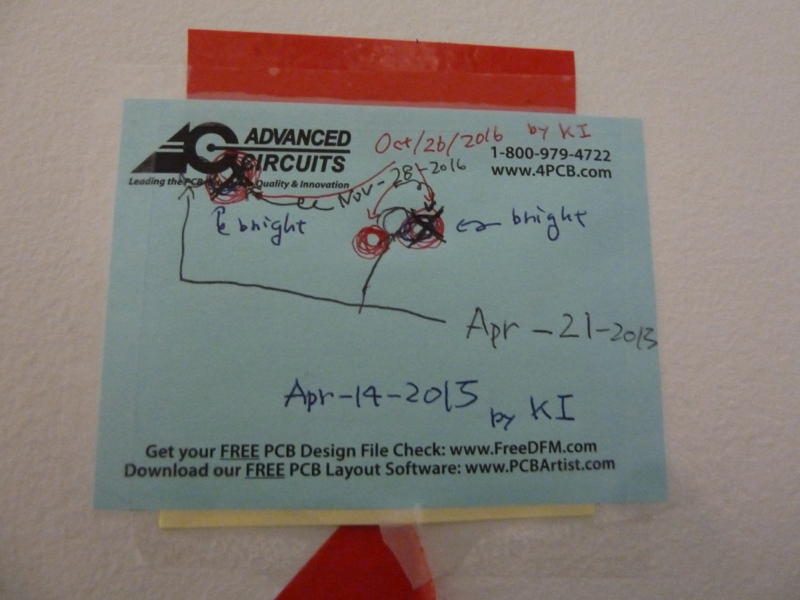
Secondly, the spot positions on the PSL wall seem to have shifted by 1-2 mm towards the West. No obvious change was found in the vertical direction. See the attached picture. The new positions are recorded with black 'X' marks as shown in the picture.
Jenne and I did a repeat of what we tried a few weeks ago after different PSL work: (30918) we restored the optics to their old values using the witness sensors, then moved the piezo to maximize build up without turning on the IMC WFS. This brought the spot back to its before position on IM4 trans, although the MC2 trans sum was low, so we think that as expected only the input beam has moved, not the mode cleaner optics or IMs. However, we can't fix the input beam change simply by moving the PZT.
We let the MCWFS run to increase the mode cleaner transmission, and watched the spots on both the ISS QPD and IM4 trans. We walked IM3 and IM2 in yaw to bring both QPDs back to the spot positions before this morning's PSL work, and now Cheryl is doing inital alingment.
To move this degree of freedom, we moved IM2 1.284 urad in yaw for every urad that we moved IM3. Since this is a degree of freedom that our inital alingment and ASC don't control, it may be a good idea to try moving this degree of freedom in full lock to see what impact it has on our noise and recycling gain. For the record, today we moved IM3 -2390 urad, and IM2 -3030 urad.
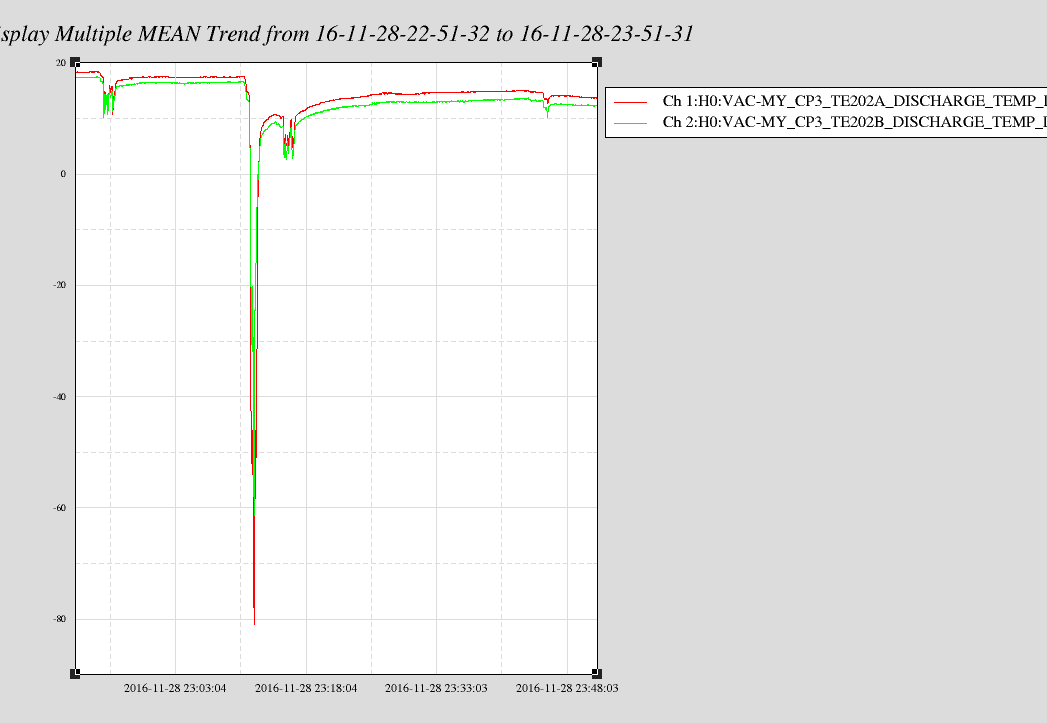
Significant exhaust temperature response (<-30C) 47 seconds after changing the manual mode %open value of the LLCV (liquid level control valve) from its as-found valve of 17 to 50 -> restored this value back to 17 following this exercise.
Here is the temp trend (in seconds). Not sure why the dip prior to fill. First I've seen that.
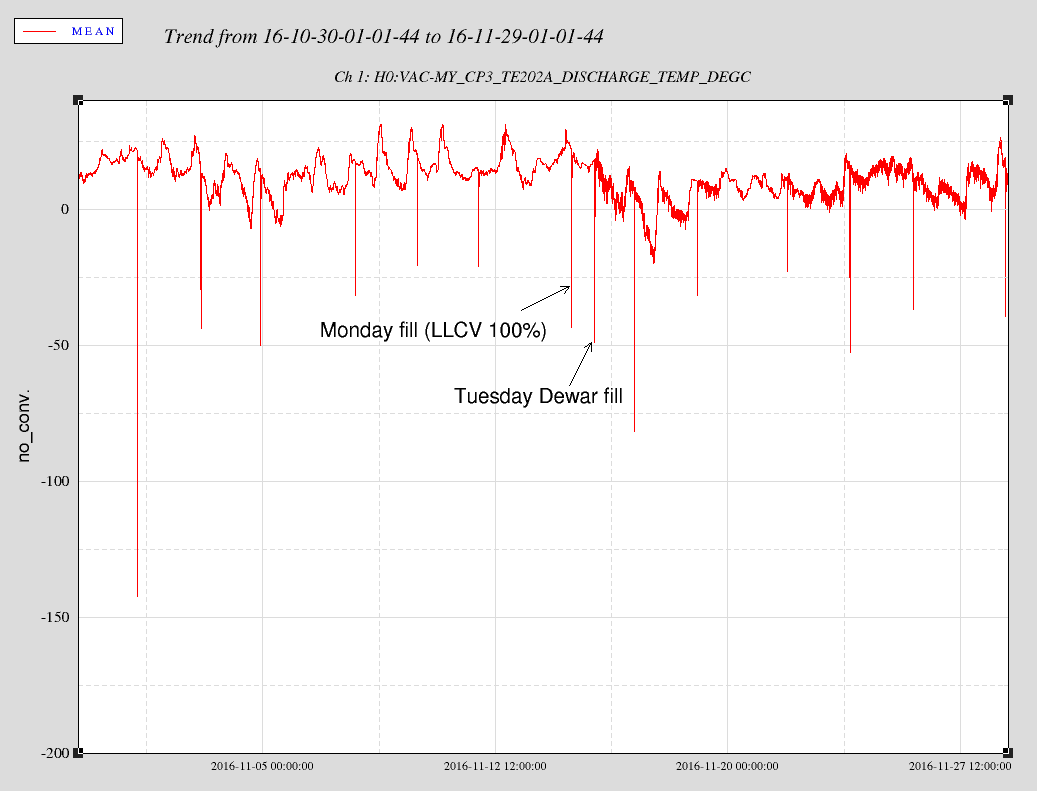
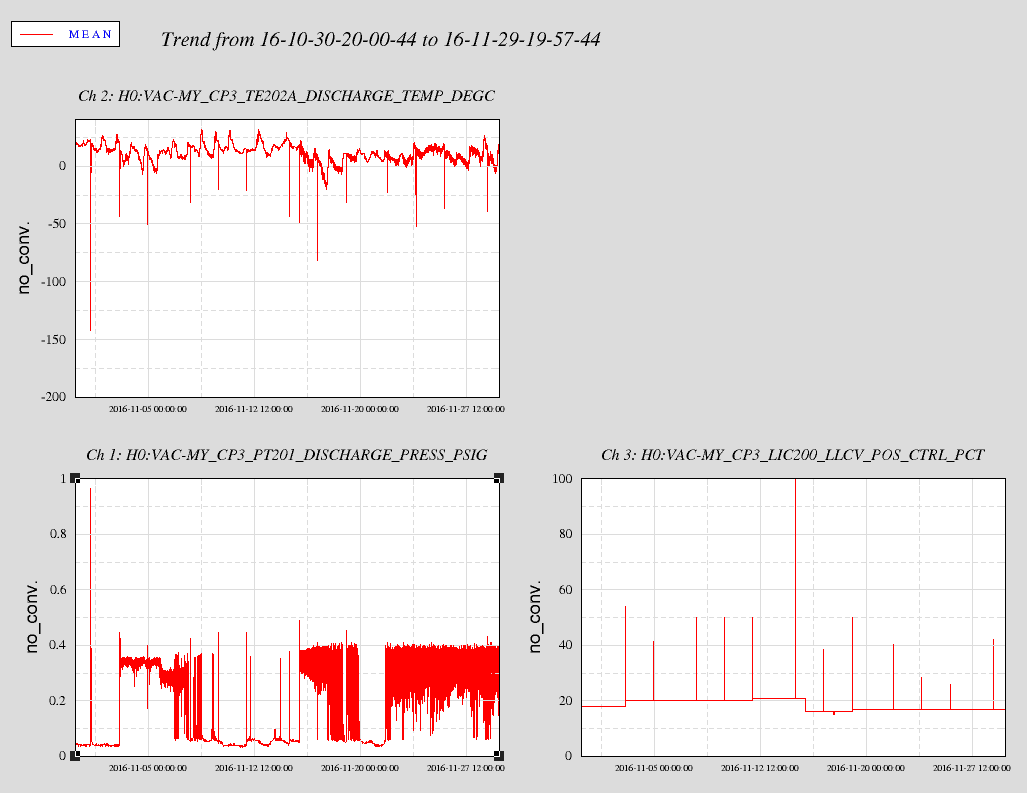
I trended CP3 exhaust TC temp gauges over 30 days to see if the dips noted above have always been there. Looks like it started on Nov. 15th. The only change to CP3 noted was a Dewar fill while LLCV was set high to 21%. LN2 was coming out the exhaust so I lowered to 16% while the LN2 truck was still filling Dewar. The previous day on the 14th I had filled CP3 by setting LLCV to 100% and noted this was too much flow. Is this an instability in pump reservoir where it burps every 20-40 minutes? Note that from Nov. 19-21 signal was smoother. Could be a function of LLCV setting and how full exhaust line is. Fills lately have been really fast.
CP3 exhaust is also noisy since Nov. 21st.
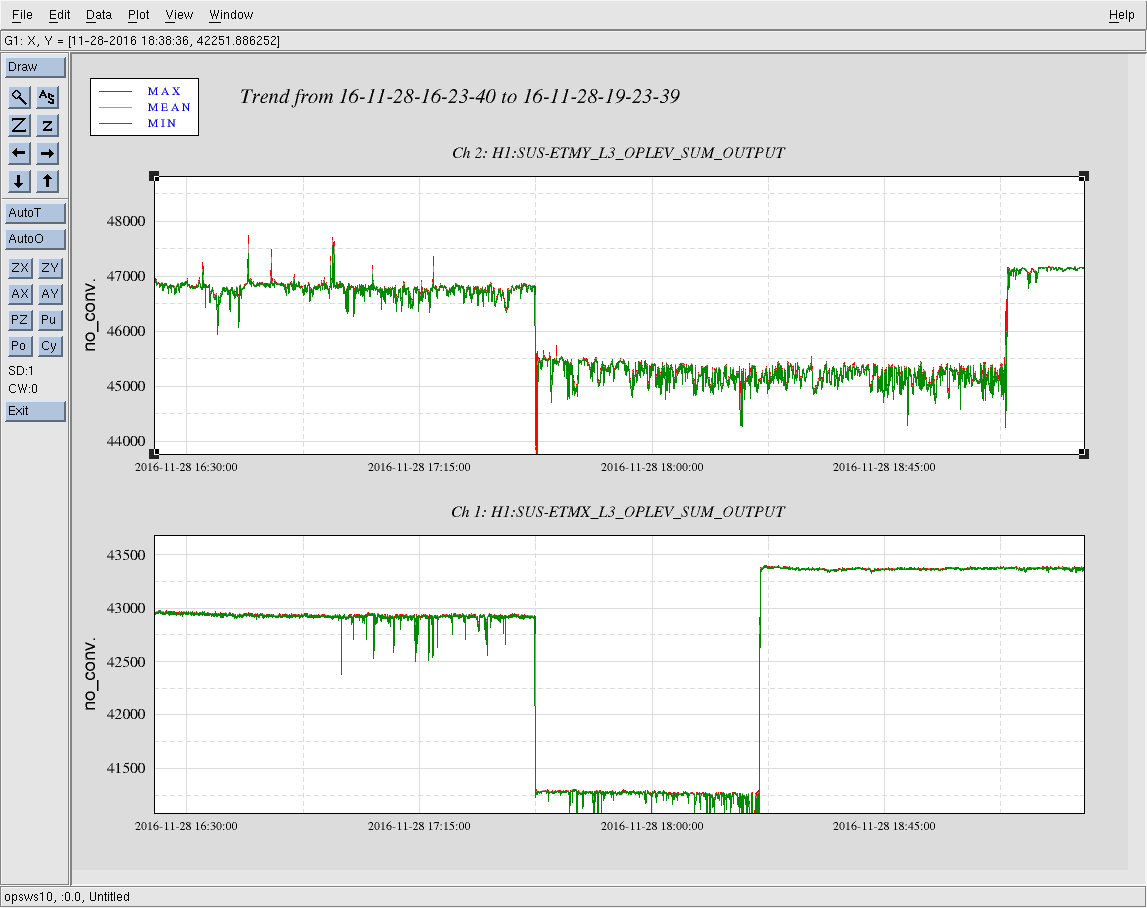
Following up on the DetChar report of ETMx oplev laser glitching causing problems, I confirmed (using the DetChar summary pages) that the laser was indeed showing signs of glitching. I also noticed the ETMy laser was also showing signs of glitching. I increased the power for both lasers to hopefully get them into a thermal state they are happy with. I used the Current Monitor (outputs a voltage to monitor the current delivered to the laser diode) port on the back of each laser as a guide. The changes were:
Seeing as I had to open the cooler for both lasers they will both need 4-6 hours to return to thermal equilibrium. At that point a determination can be made as to whether or not this helped at all. The attached 3 hour trend of the oplev SUM for both optical levers gives hope; after the power increase the SUM signal is quieter for both oplevs. I will leave WP 6348 open for now as more adjustment may be necessary to fix the glitching.
Further power adjustment for both lasers this morning as both were still showing signs of glitching (better than yesterday morning, but not gone). Changes are:
As before these lasers will need ~4 hours to return to thermal equillibrium before I can assess whether or not this latest tweak helped.
So far the bake looks successful. Pressure prior was 40 nTorr. Now it's at 8.5 nTorr and still falling.
After a hopeful initial outcome, looks like gauge is drifting back up.