Displaying reports 55461-55480 of 86130.Go to page Start 2770 2771 2772 2773 2774 2775 2776 2777 2778 End
Reports until 04:14, Wednesday 16 November 2016
H1 CAL (CAL)
darkhan.tuyenbayev@LIGO.ORG - posted 04:14, Wednesday 16 November 2016 (31528)
Testing silent (cancelled) calibration lines

Overview

We will test silent calibration lines over several days to see if we can extract temporal variation in UIM, PUM and TST actuation strengths with the help of cancelled calibration lines. Currently we set up three cancelled calibration lines, one for each of the actuation stages. This will help us to test possibility of using silent lines for tacking calibration of the actuation stages.

Details

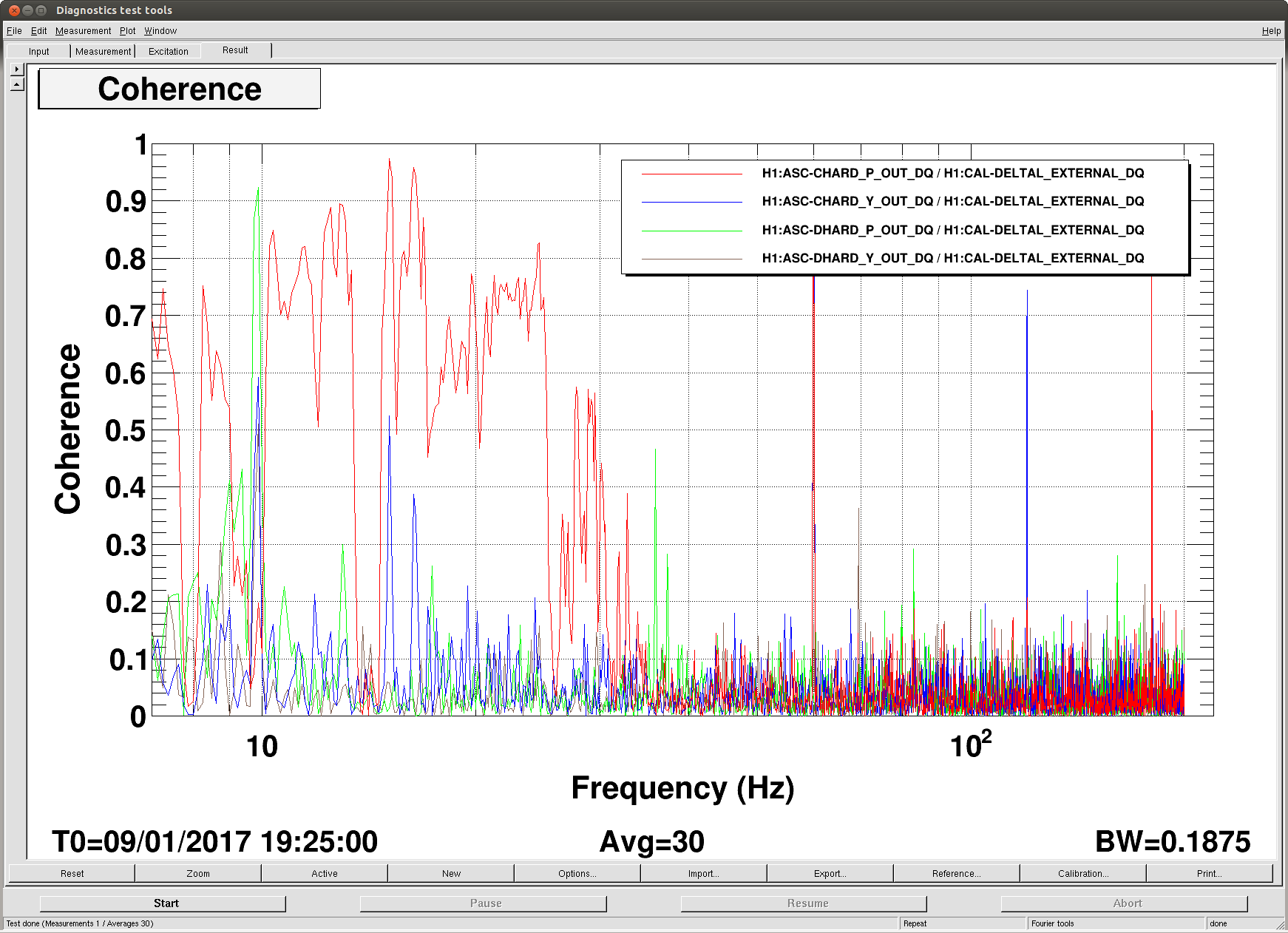
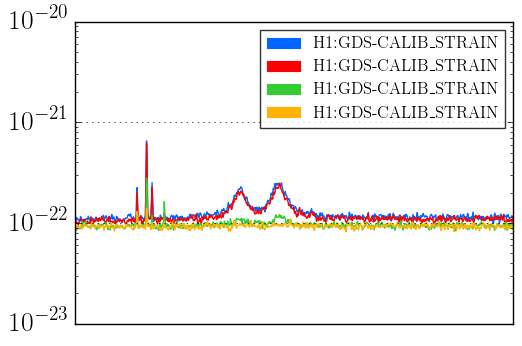
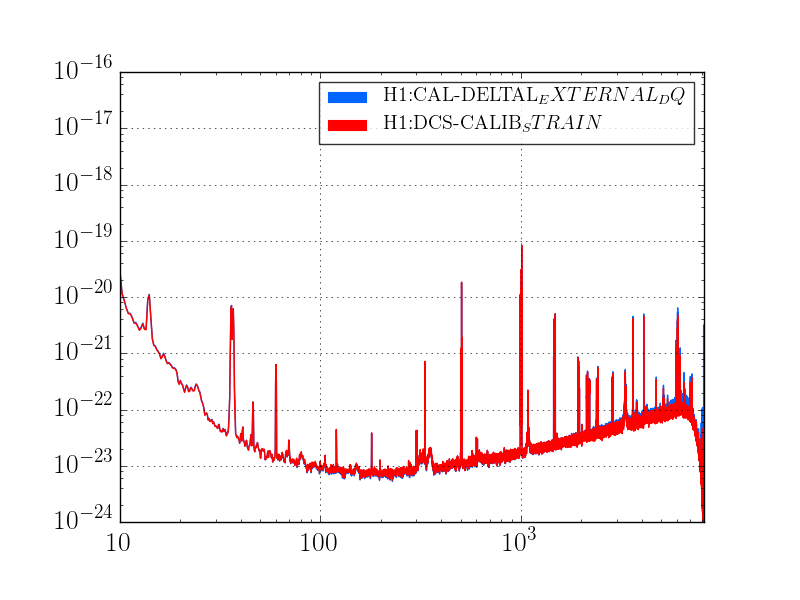
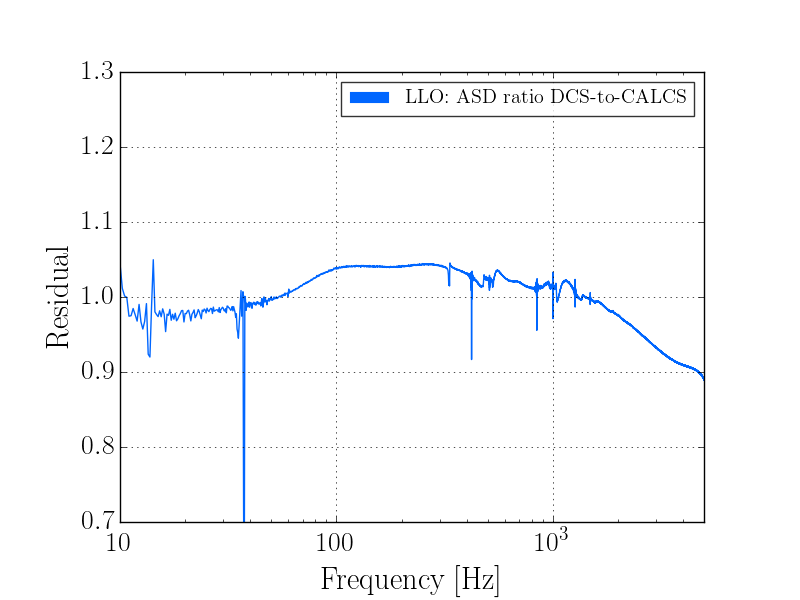
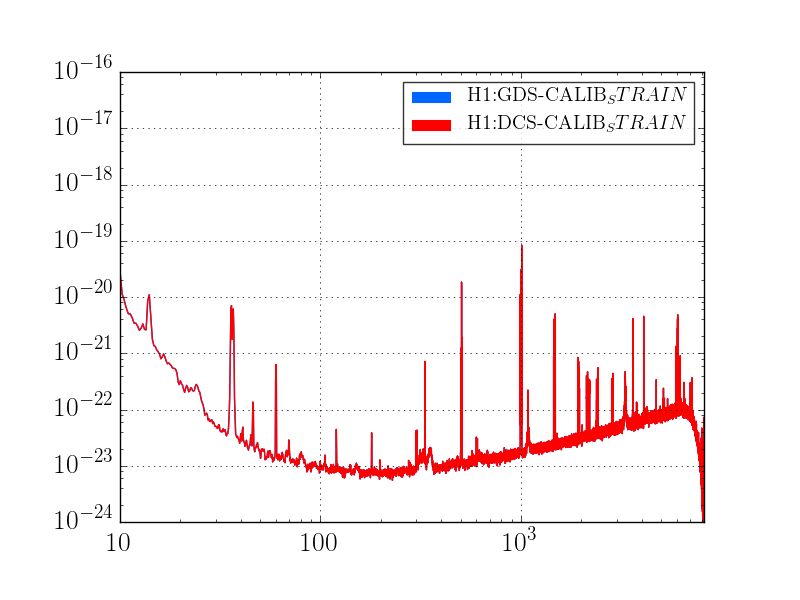
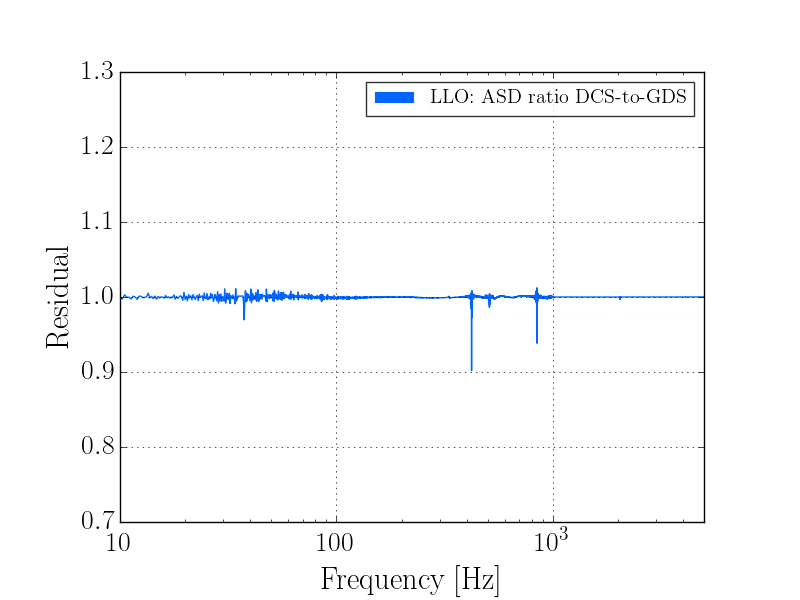
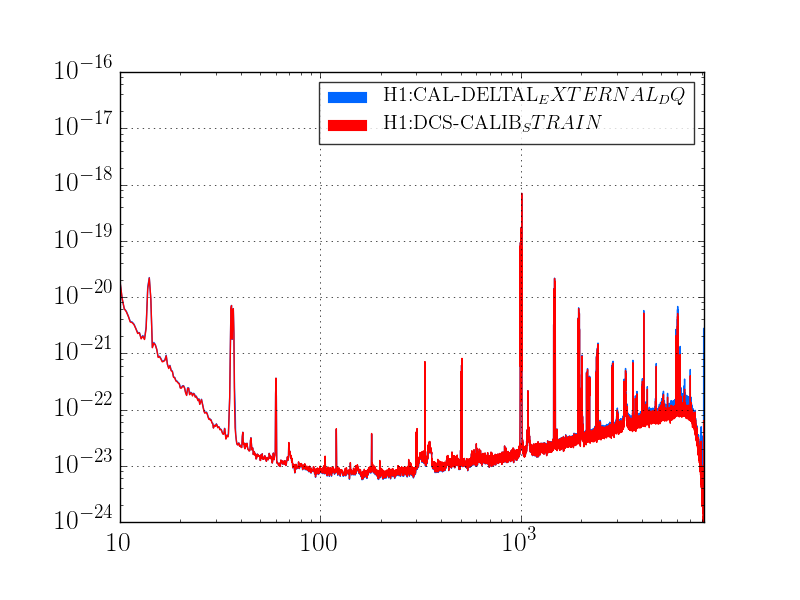
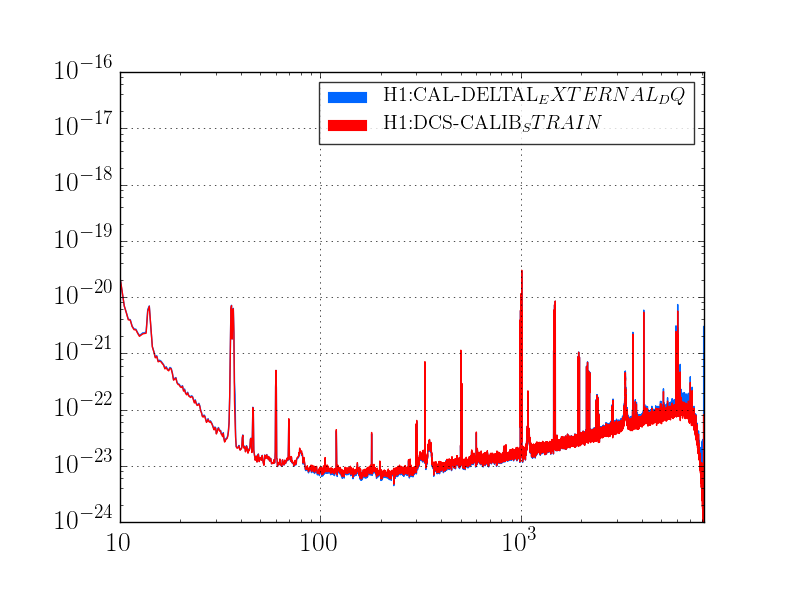
Earlier we tried to inject a line from TST actuation and cancel it using PcalY (see LHO alog 31526), but the line still appeared in the ΔLext. Today we adjusted amplitude and phase both in SUSETMY and PCALY. We also put lines into PUM and UIM stages and cancelled them with PCALY.

The oscillator settings have been accepted in SDF_OVERVIEW.

The settings for the cancelled lines are:

Oscillator       Freq (Hz)      SUS stage Amp (ct)      PcalY Amp (ct)
ETMY UIM          15.7           270.0                    4532.6
ETMY PUM          22.3           200.0                    1000.6
ETMY TST          30.1             0.458                   451.09

After the work on adjusting these lines was done Travis started taking PCALY2DARM and DARM OL TFs for which all of the calibration lines were turned off, including the cancelled ones.

Images attached to this report
LHO General
corey.gray@LIGO.ORG - posted 00:02, Wednesday 16 November 2016 (31516)
OPS Eve Shift Summary

TITLE: 11/16 Eve Shift: 00:00-08:00 UTC (16:00-00:00 PST), all times posted in UTC
STATE of H1: Lock Acquisition
INCOMING OPERATOR: Travis
SHIFT SUMMARY:

Started the shift with numerous activities (ASC insvestigatinos, ISI ITMy investigations, PI observing, & ITMy oplev OLGs).  Eventually made it to a stable state & have been in Observing ever since.  Can take H1 to NLN, but might want to -manually- skip the CLOSE BEAM DIVERTERS state, so we can monitor AS90/POP90.  We have been locked for 2+hrs with the REDUCE_RF9_MODULATION_DEPTH step, so perhaps we are good here (and don't have to worry about opening SRC1 P & Y loops as Sheila mentioned).  

Had almost 1hr of double coincidence during the shift.


LOG:

To Do List:

H1 ISC (ISC, OpsInfo)
sheila.dwyer@LIGO.ORG - posted 21:36, Tuesday 15 November 2016 - last comment - 12:27, Wednesday 16 November 2016(31525)
ASC changes, locking

Operator information:

I've added the Reduce RF9 modulation depth state back into the normal guardian path, but if you are having locklosses durring this state or right after you can try skipping it.  If you skip it, you might want to keep the beam diverters open so you can see that the SRC1 loops are OK (ie, the ratio of AS90/POP90 is staying reasonably high over the lock). You might need to open the SRC1 loops if you skip reducing RF9 modulation depth.  

I've also moved PR3 REFL WFS out of the normal path, so that it will be skipped for now if you just request nominal low noise. 

Comments related to this report
keita.kawabe@LIGO.ORG - 09:06, Wednesday 16 November 2016 (31534)

In the morning POPX DC PIT was routed to PRC2. Didn't make sense (POPX DC is controled by its own centering loop), so manually zero-ed it.

Should have had  no impact on anything as POPX DC is at least 4 orders of magnitude smaller than POPX RF over the entire frequency band.

Seems like this was puched in by hand last night.

Images attached to this comment
keita.kawabe@LIGO.ORG - 12:27, Wednesday 16 November 2016 (31542)

Combination of ASC-REFL_B_RF9I and 45I was routed to unused DC7 as a fake PRC2 on REFLB.

I measured the phase between this DC7 and PRC2 (which is POPX_I) in nominal low noise, and the YAW was out of phase for microseismic peak but not above 3Hz or so (first attachment left) though PIT was pretty good.

By changing the mixing ratio of REFLB RF9I and RF45I for YAW, the coherence between DC7 and PRC2 improves and the phase becomes saner (but never as good as PIT). The second attachment shows when the relevant input matrix components were [0.14, -0.08], i.e. 

DC7_YAW= 0.14*REFL_B_RF9I_YAW -0.08*REFL_B_RF45I_YAW.

(Nominally this was [0.14, -0.2].) The change was put in the guardian, I and Jenne were able to manually switch. Now PR3 is on REFL WFS instead of POPX.

This made ASAIR_B_RF90_I bouncier, but IFO seems to run. We'll run a2l and we'll also measure the sensing matrix

Images attached to this comment
H1 CAL (DetChar, ISC, OpsInfo, SUS)
jeffrey.kissel@LIGO.ORG - posted 18:49, Tuesday 15 November 2016 (31526)
Trial Cancelling Calibration Line installed at 30.1 Hz
J. Kissel for D. Tuyenbayev

Darkhan turned on both a PCALY and SUSETMY L3 calibration line at 30.1 Hz yesterday night. The idea is that these lines, driven at the same frequency but exactly opposite in phase, will cancel each other out and not cause any impact on the sensitivity. The hope is that we can use this scheme in the future -- tracking the residual of cancelling PCAL and ETM actuator lines, instead of driving them very loudly right next to each other.

We plan to leave this line in for a few days, and then we'll turn it off.

Currently -- because we haven't had too many long lock stretches, the phases of each line are not tuned well, so there may still be a pretty large residual. We'll continue to work on it as the duty cycle improves. Your patience is appreciated.
Images attached to this report
H1 DetChar
ansel.neunzert@LIGO.ORG - posted 18:23, Tuesday 15 November 2016 (31524)
Following up issues raised by DQ shift 11/15
Jenne, Young-Min, Ansel
 
Two issues raised by today's DQ shifter (Beverly Berger) were followed up.
 
Issue 1: The IMC bit was red, despite being locked. Beverly noted that the WFS control bit was also off, which seemed to be the underlying cause.
 
Follow up: The gain on the IMC WFS was changed from 0.1 to 0.04 on Nov 5 (alog 31246). This caused a threshold test against H1:IMC-ODC_WFS_GAIN_GT_EQ_TH to fail. To fix this issue, Jenne simply changed the threshold from 0.099 to 0.03 . 
 
Issue 2: Under ISC > LSC Saturations, Beverly noted that REFL 45 showed dark red during the lock around 15:00 UTC. It was not immediately clear what this meant.
 
Follow up: It appears that the rms for REFL A RF45 was considerably larger during this lock than the previous one (summary page plot, note difference between 15:00 and 11:00). Jenne tracked this down to PRCL1 FM3, which boosts gain below 10 Hz and was off during the lock stretch in question, unlike the previous lock. It is not clear why this happened, but during O2 something like this should be caught by the SDF difference monitor (the observe .snap file is set correctly, and a lack of FM3 would register as a difference).
H1 SEI
jenne.driggers@LIGO.ORG - posted 17:45, Tuesday 15 November 2016 (31523)
Last NN L4C placed

I have epoxied the final Newtonian noise L4C to the ground.  Note that it is in the walking path from the door to the LVEA over to the HAM6 area, so please be careful.  There is some tape, and a cone to help make it easier to see.

H1 GRD
sheila.dwyer@LIGO.ORG - posted 17:43, Tuesday 15 November 2016 (31522)
removed averaging from ENGAGE_ASC_PART2

Corey, Sheila

We used to average the value of the POP QPD before engaging the loop that feeds it back to PRM, and not engage the loop if the value was too large.  We have occasionally been getting bogus values from cdsutils average in guardian (30831), which was causing guardian to get stuck here and not engage the loop. 

Since we had set the thresholds to be +-1 anyway, I just removed the averaging and checking from the guardian completely, so this shouldn't happen anymore. 

H1 AOS
corey.gray@LIGO.ORG - posted 16:59, Tuesday 15 November 2016 (31520)
Ops EVE Shift Transition

TITLE: 11/15 EVE Shift: 0:00-08:00 UTC (16:00-0:00 PST), all times posted in UTC
STATE of H1: Lock Acquisition
OUTGOING OPERATOR: TJ
CURRENT ENVIRONMENT:
    Wind:  Gusts up to 20mph
    Primary useism:  Has been trending slowly up over last 24hrs (not to worrisome levels yet)
    Secondary useism:  --
QUICK SUMMARY:

Received handoff from TJ/Kissel.  And looks like we have a few items on the docket:

H1 OpsInfo
terra.hardwick@LIGO.ORG - posted 16:49, Tuesday 15 November 2016 (31519)
PI verbal alarm earlier

We've set the PI verbal alarm to trigger at 3 now that we're sitting at a lower power. Let me know if that's low enough for damping response time and/or if it's too low and getting triggered unnecessarily. 

H1 CDS (DAQ)
david.barker@LIGO.ORG - posted 16:32, Tuesday 15 November 2016 (31517)
CDS maintenance summary, Tuesday 15th November 2016

WP6314 h1oaf0 stability

Richard, Fil, Daniel, Jim, Dave:

h1oaf0 has been stable since 12:46 Mon 14th PST, no further work was done on this system

WP6312 adding new MD5 DAQ epics channels to the DAQ

Dave:

A new H1EDCU_DAQ.ini file was generated and installed during a DAQ restart at 12:11PST.

WP6315 updated frame-cpp on frame writers

Jim, Jonathan, Dave

The new code (which has been running on h1fw2 for the past week) was installed on h1fw0. Jonathan has test code to look at frames written by fw0 (new) and fw1 (old) to check they are identical. We will test for several days before the decision to upgrade fw1 is made.

WP6318 bug fix in h1susauxb123 model

Jeff:

New code for h1susauxb123.mdl to fix a bug. No DAQ restart required.

WP6324 Extend Remote Access controls to 24/7

Jonathan:

The RACCESS system is now operational 24/7 for the duration of ER10 and O2.

Testing new Hardware Injection data injestion

Keith, Dave, Jim:

New configurations of h1hwinj1 and h1guardian0 permit hw-injection users on h1hwinj1 to svn check-out the injection waveforms and schedules such that the guardian INJ_TRANS node can perform these injections. We had a minor local modification to the INJ_TRANS.py file which was removed and the guardian node code was updated to the latest SVN version. We discovered a slight discrepancy between the code and the schedule file which was resolved. System is ready for injection team to test.

H1 CDS
david.barker@LIGO.ORG - posted 16:18, Tuesday 15 November 2016 (31515)
default file access permissions were different on the newer debian workstations

It was found that the default UMASK on the newer Debian workstations were different from the Ubuntu12/14 machines (022 on debian, 002 on ubuntu). This meant that the default file permissions for new files on debian were 644 (rw-r--r--) and therefore not group writable. We are changing the default umask for user-type accounts to be 002 on all machines (via  pam_umask), and I have appended a line to everyone's .bashrc file to set "umask 002" as an OS-agnostic method of ensuring correct permissions.

If you want to check if your account is setup correctly, first check your umask setting by  typing the umask command

david.barker@zotws2: umask
0002

As a further check, create a new file and verify the correct permissions (rw-rw-r--)

david.barker@zotws2: touch testfile
david.barker@zotws2: ls -al testfile
-rw-rw-r-- 1 david.barker controls 0 Nov 15 16:15 testfile
 

and finally verify you belong to the controls group as your secondary group

david.barker@zotws2: groups
david.barker controls
 

H1 CDS (ISC, VE)
filiberto.clara@LIGO.ORG - posted 16:13, Tuesday 15 November 2016 (31509)
CDS - Tuesday Actitvies

WP 6323

The following items were removed from temporary power supplies and connected to 24V DC rack power:

1. Baffle Photodiode Amplifier Units (ITMX/ITMY)
2. RGA unit next to HAM4
3. EtherCAT hub - CU1128

WP 6292

A safety system controls chassis was installed at each end station. As of now, units are not powered on.

H1 CDS
david.barker@LIGO.ORG - posted 16:08, Tuesday 15 November 2016 (31513)
Control Room Operators are now controlling remote CDS login at all times for the duration of ER10 and O2

WP6324 Fred, Michael, Vern, Keita, Jim, Dave, Jonathan

Now we are in ER10, all CDS remote access logins are controlled by the operators at all times. Prior to this, operator permissions were only required during business hours (8am-4pm Mon-Fri) as the system was being tested.

For Yubikey holders, if you wish to log into LHO CDS remotely you will need to contact the control room operator (phone 509 372 8202) and request an access-permit to be opened for you. During your discussion with the operator, please be sure to cover why access is required, which internal machines you expect to need and the duration of your work. The operator and run management will determine if your task requires a full work-permit. Most access-permits will have a maximum duration of a week.

On a sysadmin note, on cdsssh I have opened sshd_config up to all Yubikey owners now that this is not the principal access control filter.

LHO General
thomas.shaffer@LIGO.ORG - posted 16:01, Tuesday 15 November 2016 (31511)
Ops Day Shift Summary

TITLE: 11/15 Day Shift: 16:00-00:00 UTC (08:00-16:00 PST), all times posted in UTC
STATE of H1: Lock Acquisition
INCOMING OPERATOR: Corey
SHIFT SUMMARY: Maintenance Day. Nothing too crazy today, maintenance actually ended a bit after noon and we were able to almost lock at nominal. Commissioners are currently investigating some SRC1 issues that have been preventing us from having >30min locks.
LOG:
        See attached

Non-image files attached to this report
LHO VE
kyle.ryan@LIGO.ORG - posted 15:59, Tuesday 15 November 2016 (31512)
Opened CP7's exhaust check-valve bypass-valve
I believe that all CP exhaust check-valve bypass-valves are now open?
H1 CAL
jeffrey.kissel@LIGO.ORG - posted 13:52, Tuesday 15 November 2016 - last comment - 15:11, Tuesday 15 November 2016(31504)
New Sensing Funciton Data Set; Calibration Lines turned Back ON
J. Kissel

Travis was able to grab a PCAL2DARM/DARMOLGTF sensing function transfer function set last night (see LHO aLOG 31485) -- for convenience I reiterate the location here:
/ligo/svncommon/CalSVN/aligocalibration/trunk/Runs/ER10/H1/Measurements/
PCAL/2016-11-15_H1_PCAL2DARMTF_4to1200Hz_fasttemplate.xml
DARMOLGTFs/2016-11-15_H1_DARM_OLGTF_4to1200Hz_fasttemplate.xml
and attach a screen shot. The data has been committed to the CalSVN.

It looks like the DARM cavity pole was low during this lock stretch, but otherwise the optical gain is ~5% low as we've seen in the last of measurement at 30 [W].

We'll get one more of these at 30 [w] for processing and get on with the analysis. Apologies for the delay in analyzing this data -- I'm really struggling for person power beyond me, given the current poor duty cycle and my needs to be the recovery team as well (Kiwamu's in Canada, Evan's helping out LLO).
Images attached to this report
Comments related to this report
jeffrey.kissel@LIGO.ORG - 15:11, Tuesday 15 November 2016 (31508)
I've re-read Travis's entry (LHO aLOG 31485) and found were not running SRC1 loops during the lock stretch in which this measurement was taken. The suspicion is that SRC1 alignment loops are going unstable, so turning them off would improve the duty cycle. That investigation is on-going. 
However, with the SRC1 degree of freedom uncontrolled, as we have found from 50 [W] experience, the DARM coupled cavity pole frequency drops and moves around much more, among other things. That's why we see the increased frequency-dependent discrepancy in the PCAL 2 DELTAL_EXTERNAL transfer function.

Unfortunately -- assuming we can figure out what's wrong with the SRC loops and fix it -- this means measurement won't be representative of the O2 configuration. We'll do what we can to salvage it, but ideally, we'd like to take it again.

In Summary:
SRC1 P&Y Loops OFF
Input Power Mean: 30.7 [W]
Images attached to this comment
H1 CAL (ISC, SUS)
jeffrey.kissel@LIGO.ORG - posted 02:00, Saturday 12 November 2016 - last comment - 15:51, Tuesday 15 November 2016(31433)
Third Round of ER10 Calibration Measurements Complete -- Now at 30 W IFO Input Power
J. Kissel

Getting one more round of calibration reference measurements for ER10/O2. The decision was made to run ER10 / O2 at 30 [W] (as opposed to the 25 [W] we'd been running all week), so I've made sure to get another round of transfer functions. 

In addition I've made a bunch more probing measurements of the L1 / UIM stage above 100 Hz, so that we can create an empirical model of the UIM actuator expanding on what was done in LHO aLOG 24917. Again, here, it's not that the UIM plays a big role in the response function at these frequencies, it's that the deviations at high frequency limit our ability to obtain a clean estimate of the actuation strength. Templates all listed below, analysis will come later.

Sensing Function Data:
/ligo/svncommon/CalSVN/aligocalibration/trunk/Runs/ER10/H1/Measurements/DARMOLGTFs/
2016-11-12_H1_DARM_OLGTF_4to1200Hz_fasttemplate.xml
/ligo/svncommon/CalSVN/aligocalibration/trunk/Runs/ER10/H1/Measurements/PCAL/
2016-11-12_H1_PCAL2DARMTF_4to1200Hz_fasttemplate.xml
We may take a few more of these, just because the IFO input power has changed. Yes, a 25 [W] to 30 [W] is a small change in optical gain, but we want to be sure if detuning comes into play by 30 [W], and also if the cavity pole changes. I've also been told to expect further DC alignment changes before the weekend's out which may also play a role in these kinds of sensing function parameter changes.

Actuation Function Data:
/ligo/svncommon/CalSVN/aligocalibration/trunk/Runs/ER10/H1/Measurements/FullIFOActuatorTFs/2016-11-12/
2016-11-12_H1SUSETMY_L1_iEXC2DARM.xml
2016-11-12_H1SUSETMY_L1_PCAL2DARM.xml
2016-11-12_H1SUSETMY_L2_iEXC2DARM.xml
2016-11-12_H1SUSETMY_L2_PCAL2DARM.xml
2016-11-12_H1SUSETMY_L3_iEXC2DARM.xml
2016-11-12_H1SUSETMY_L3_PCAL2DARM.xml
This should complete the three suites of measurements we usually do for the actuators. Given the preliminary analysis from Kiwamu (LHO aLOG 31427), I don't see a need for more data here.

Also, I gathered some undisturbed time in between the sensing function measurements and actuation function measurements between 2016-11-12 06:08 UTC and 06:30 UTC so these can be used to convert / compare back against 25 [W] lock stretches. Maybe. Recall the previous two attempts at these measurements to bordered by lock losses caused by the OAF computer crashing, so there may not be a lot of time then against which to compare.

Detailed High-frequency L1/ UIM Actuation Function Data:
/ligo/svncommon/CalSVN/aligocalibration/trunk/Runs/ER10/H1/Measurements/FullIFOActuatorTFs/2016-11-12/
2016-11-12_L1_iEXC2DARM_HFDynamicsTest_100-250Hz.xml
2016-11-12_L1_iEXC2DARM_HFDynamicsTest_250-350Hz.xml
2016-11-12_L1_iEXC2DARM_HFDynamicsTest_300-500Hz.xml
2016-11-12_L1_iEXC2DARM_HFDynamicsTest_90-400Hz_SweptSine.xml
2016-11-12_L1_PCAL2DARM_HFDynamicsTest_100-250Hz.xml
2016-11-12_L1_PCAL2DARM_HFDynamicsTest_250-350Hz.xml
2016-11-12_L1_PCAL2DARM_HFDynamicsTest_300-500Hz.xml
2016-11-12_L1_PCAL2DARM_HFDynamicsTest_90-400Hz_SweptSine.xml
The *not* labeled SweptSine are broad band injections. The idea is to export the data, filter it by coherence (0.95 should be good enough) and then take the ratio. The broad band TFs are better for characterizing the resonances. The hope is we can stitch all of these data sets together to form one sweeping meta-transfer function that completely maps out the UIM, in detail, out to ~500 Hz. 
Comments related to this report
jeffrey.kissel@LIGO.ORG - 15:51, Tuesday 15 November 2016 (31510)
I add a few details relevant to the optical plant regarding the lock stretch in which the sensing function measurements were taken:
SRC1 loops (P&Y) are ON
Input Power Mean: 29.5 [W]
Images attached to this comment
H1 SUS (DetChar, ISC, Lockloss, OpsInfo)
jeffrey.kissel@LIGO.ORG - posted 17:29, Thursday 10 November 2016 - last comment - 15:35, Tuesday 15 November 2016(31404)
Investigating H1 SUS ITMY's Excessive Ring Down Time
J. Kissel, H. Radkins

I'm continuing to investigate why ITMY's pitch mode (at 0.55 Hz) continues to ring much longer than the other QUAD's upon lockloss (see and example attached as 2016-11-08_2151UTC_ITMY_Oplev_Bad_TimeSeries.png). 

Today, I grabbed the open loop gain transfer functions of the M0 DAMP L, the M0 DAMP P, and the L2 OLDAMP P local damping loops on both H1 SUS ETMY and H1 SUS ITMY, to show that the identical settings are producing identical results for QUADs that are essentially physically identical. 

Indeed, the open loop gain transfer functions of both suspensions look the same.

We don't have too many lock loss data points yet since I made the change, but I did discover that the digital output limiter of all QUAD's L2 OLDAMP P bank were different (one as low as 5000, and one as high as 500000, and ITMY was in the middle at 10000). So, I've made all the limits the same, at 40000, in hopes that the problem is with the square-wave that ITMY gets sent during a lock loss. This change is NOT accepted in the SDF, because I'm unsure if it matters yet.

Still unclear what is going on here...

Hugh's taking a look at these same optical lever signals after every lock loss for the past month. Preliminary results show that this behavior is intermittent, but has definitely gotten worse in the past week or two. We hope he can trace this back to some event like a maintenance day to better try to address the problem.
Images attached to this report
Comments related to this report
jim.warner@LIGO.ORG - 15:35, Tuesday 15 November 2016 (31507)Lockloss, SUS

All of the BSCs have AC coupled loops installed on St2 for RX/RY (somewhat detailed in my post 28907 for ETMX), maybe it would be helpful to try turning this on for ITMY? The GS-13s see a lot of this motion. Attached trend has both ITMs oplevs and GS-13 pitch for each ISI ST2. ITMY St2 clearly gets more kick, just like the ITMY optic. Second attached plot are some spectra of  the ITMY GS13s, red is just before this lockloss and pink is during the lock loss.  Green is the ST2 RX motion during a quiet time this morning, showing where the ac couple loop gets suppression. Most of the motion comes from .46 hz SUS resonance, and the AC loop doesn't do anything there, but the 2 and 3.5 hz motion should be suppressed some. The attached PDF shows some design plots for the ITMY loops from my work on this in August.

Images attached to this comment
Non-image files attached to this comment
H1 CAL
jeffrey.kissel@LIGO.ORG - posted 16:48, Thursday 10 November 2016 - last comment - 16:39, Tuesday 15 November 2016(31403)
Second Round of ER10 Calibration Measurements Complete
J. Kissel

Though it's been a struggle between all of the H1OAF computer crashing, I've managed to squeak out one more round of calibration measurements today. The data's location is below; analysis to come.

The data lives here:
/ligo/svncommon/CalSVN/aligocalibration/trunk/Runs/ER10/H1/Measurements/
(1a) DARMOLGTFs/2016-11-10_H1_DARM_OLGTF_4to1200Hz_fasttemplate.xml
(1b) PCAL/2016-11-10_H1_PCAL2DARMTF_4to1200Hz_fasttemplate.xml

(2)
FullIFOActuatorTFs/2016-11-10/2016-11-10_H1SUSETMY_L1_iEXC2DARM.xml
FullIFOActuatorTFs/2016-11-10/2016-11-10_H1SUSETMY_L1_PCAL2DARM.xml
FullIFOActuatorTFs/2016-11-10/2016-11-10_H1SUSETMY_L2_iEXC2DARM.xml
FullIFOActuatorTFs/2016-11-10/2016-11-10_H1SUSETMY_L2_PCAL2DARM.xml
FullIFOActuatorTFs/2016-11-10/2016-11-10_H1SUSETMY_L3_iEXC2DARM.xml
FullIFOActuatorTFs/2016-11-10/2016-11-10_H1SUSETMY_L3_PCAL2DARM.xml
Comments related to this report
jeffrey.kissel@LIGO.ORG - 16:39, Tuesday 15 November 2016 (31518)
SRC1 loops (P&Y) are ON
Input Power Mean: 24.8 [W]
Images attached to this comment
H1 CAL
jeffrey.kissel@LIGO.ORG - posted 22:32, Monday 07 November 2016 - last comment - 17:07, Tuesday 15 November 2016(31303)
First Round of ER10 Calibration Measurements Complete
J. Kissel

I've taken the first round of all swept sine measurements typically done before an observing run:
(1) Sensing function, C
    (a) DARMOLGTF and Loop Suppression (IN1/IN2 and IN2/EXC); G and 1/(1+G)
    (b) PCAL2DARM (and PCAL2DELTAL); (C/1+G) and [m/m]
(2) Actuation Function, A
    (a) L1 to DARM & associated PCAL2DARM; (C A_uim)/(1+G) and (C/1+G)
    (b) L2 to DARM & associated PCAL2DARM; (C A_pum)/(1+G) and (C/1+G)
    (c) L3 to DARM & associated PCAL2DARM; (C A_tst)/(1+G) and (C/1+G)
where I've taken a separate PCAL2DARM or C/1+G transfer function with every corresponding excitation to destroy any covariance that had plagued us during O1. Also, I've worked to
    (i) reduce the template's measurement time by maximizing drive, 
    (ii) reducing the number of points over all, and
    (iii) keeping integration time in check,
such that each template only takes about 15 minutes. I've also modified the frequency vectors of the actuation functions to go out to 1 kHz, as LLO did for their O1 data sets. In doing so, I made sure to use frequency points that avoided any known high-frequency resonances from wire violin modes (characterized in LHO aLOG 24917). 

There's still some improvements to make, which I'll shoot for in the next round (so don't use/take these templates as cannon yet), but thanks to the high-duty cycle of the IFO, I had the opportunity to make really well-balanced templates tonight.

The data lives here:
/ligo/svncommon/CalSVN/aligocalibration/trunk/Runs/ER10/H1/Measurements/
(1a) DARMOLGTFs/2016-11-07_H1_DARM_OLGTF_4to1200Hz_fasttemplate.xml
(1b) PCAL/2016-11-07_H1_PCAL2DARMTF_4to1200Hz_fasttemplate.xml

(2)
FullIFOActuatorTFs/2016-11-07/2016-11-07_H1SUSETMY_L1_iEXC2DARM.xml
FullIFOActuatorTFs/2016-11-07/2016-11-07_H1SUSETMY_L1_PCAL2DARM.xml
FullIFOActuatorTFs/2016-11-07/2016-11-07_H1SUSETMY_L2_iEXC2DARM.xml
FullIFOActuatorTFs/2016-11-07/2016-11-07_H1SUSETMY_L2_PCAL2DARM.xml
FullIFOActuatorTFs/2016-11-07/2016-11-07_H1SUSETMY_L3_iEXC2DARM.xml
FullIFOActuatorTFs/2016-11-07/2016-11-07_H1SUSETMY_L3_PCAL2DARM.xml

While it'll be days before we have a model and a complete, traceable uncertainty budget, preliminary results show the *mean* of *one measurement* of PCAL's estimated displacement agrees with the front-end calibrated sensitivity to roughly 5% and 5 [deg]. This confirms that the > 50 Hz discrepancies between PCAL and DELTA L EXTERNAL seen while we were at 50 [W] (e.g. LHO aLOGs 30391 and 30431) were likely a function of the poorly controlled signal recycling cavity, and therefore time-dependent RSE cavity pole that was quite low.
Recall that the uncertainty of the PCAL estimation is around 1%. 

We're right on schedule, and things are looking up. We'll see how the modeling goes...
Images attached to this report
Comments related to this report
evan.hall@LIGO.ORG - 11:02, Tuesday 08 November 2016 (31312)ISC

DARM actuation spectra are attached.

We could do a bit better in offloading the microseism control from the PUM to the UIM.

Non-image files attached to this comment
jeffrey.kissel@LIGO.ORG - 17:07, Tuesday 15 November 2016 (31521)
SRC1 loops (P&Y) are ON
Input Power Mean: 23.5 [W]
Images attached to this comment
Displaying reports 55461-55480 of 86130.Go to page Start 2770 2771 2772 2773 2774 2775 2776 2777 2778 End