Displaying reports 58981-59000 of 86130.Go to page Start 2946 2947 2948 2949 2950 2951 2952 2953 2954 End
Reports until 13:27, Wednesday 22 June 2016
H1 TCS
peter.fritschel@LIGO.ORG - posted 13:27, Wednesday 22 June 2016 - last comment - 16:43, Wednesday 22 June 2016(27915)
Arm cavity Higher Order Mode (HOM) spacing at 37 W input

The attached plot shows the arm cavity higher order mode spacing as calculated by Aidan's on-line thermal simulation (TCS_SIM). At 37 W input, the HOM spacing in each arm cavity increases by 60 Hz (X arm) and 75 Hz (Y arm) - relative to the no power-loading case. The ring heater configuration was constant during this time: both cavities had 1 W (total) RH power on the ETM, and no RH power on the ITM. The plot shows that the HOM spacing increases by 30-40 Hz in going from 18 W to 37 W input. If the 15.5 kHz PI modes are stable at 18 W, then we can increase the ETM RH powers to reduce the HOM spacing by 30-40 Hz, and they should then be stable at 37 W. This requires additional RH power of 0.5 W (total, top + bottom).

Couple things to note:

The X-arm simulation output shows a long time constant, but the Y-arm does not. The simulation does include a low pass filter for the surface change due to laser beam self-heating, to simulate this heating time constant. However, this low-pass filter was only engaged for ITMX. I have turned on the filter (surfTF, in FM1) now for all 4 test masses.

The arm cavity power calculation used in the simulation seems to be off. At 37 W input, it is using about 75 kW for both arms, when it should be closer to 150 kW. Something to look into.

Images attached to this report
Comments related to this report
terra.hardwick@LIGO.ORG - 16:43, Wednesday 22 June 2016 (27924)

Around 20:00 UTC we increased the ring heater power on both ETMs from 0.5 --> 0.75 top and bottom. We've had a few longer locks at 37 W since then and the previously problematic 15.5 kHz peaks have remained low with the RH power increase. Eventually we were able to turn off all active damping and still no sign of PI. 

Power spectrum below shows the 15.5 kHz mode group as seen in the OMC DCPDs before RH increase kicking in and after RH increase. Note that in the before state, we were also actively damping with the ESDs. In the after state, we were not actively damping. 

Images attached to this comment
H1 SEI
hugh.radkins@LIGO.ORG - posted 09:45, Wednesday 22 June 2016 (27909)
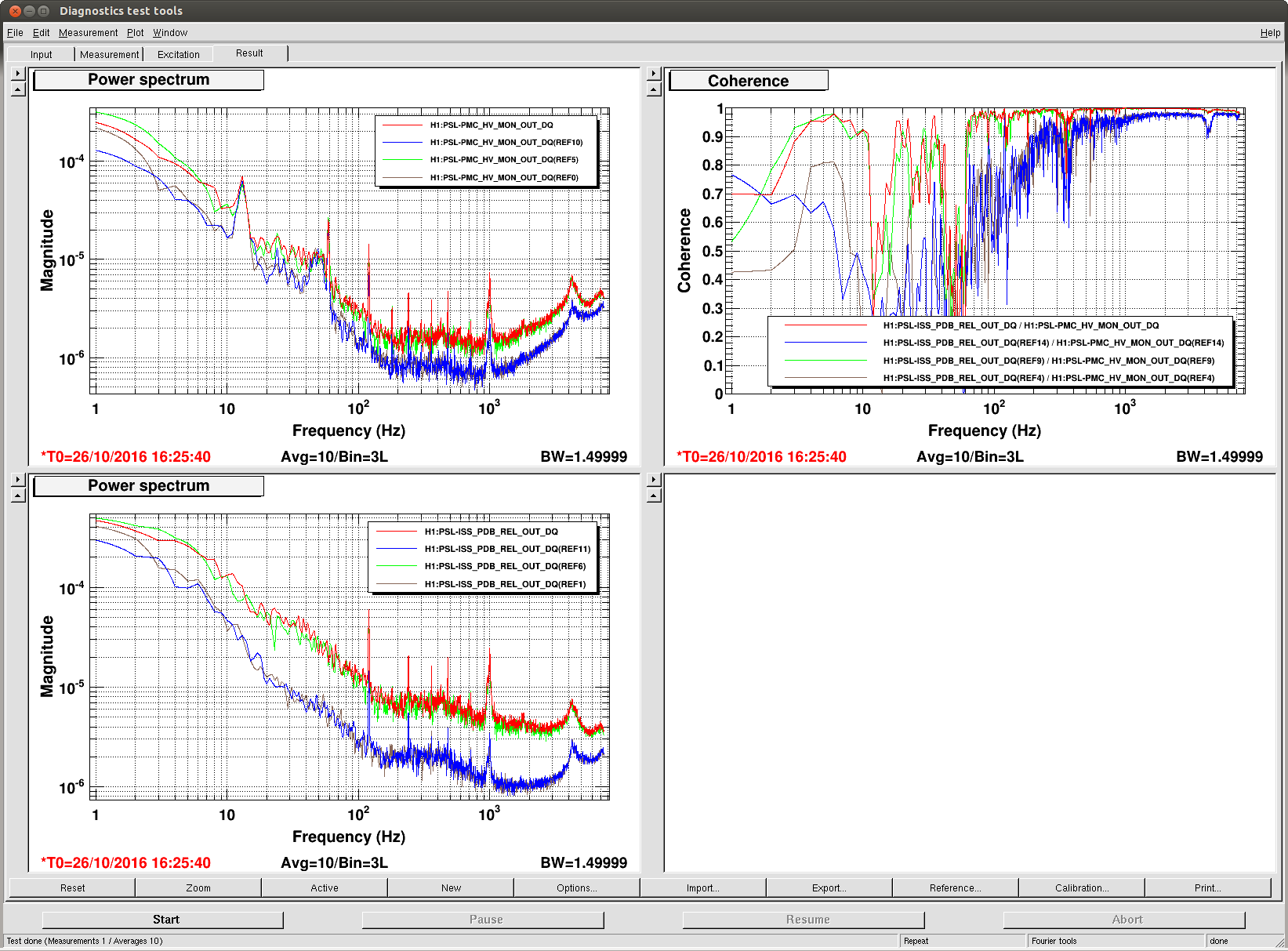
H1 HAM ISI CPS Noise Review--All look fine

Similar to the BSC look here.  Just looking at the higher frequency noise level indicating a problem.  All the HAMs look fine in this regard.  See the attached from diaggui template:

/ligo/svncommon/SeiSVN/seismic/HAM-ISI/H1/Common/CPS_Sensor_Spectra_HAM_ISI.xml

Images attached to this report
H1 SEI
hugh.radkins@LIGO.ORG - posted 08:50, Wednesday 22 June 2016 (27908)
Update of BSC CPS Noise

See logs 27648 27622 27549 27479 & 27475 for various looks & reports of the noise seen on BSC CPS channels.

In 27622, it is seen that ITMX Stage 1 has a very noisy V1 channel.  This morning's view has no such issue for any of the stage1 CPSs (this was also reported in 27648.)  The stage2 H3 channel however does now show a slight increase of noise relative to the others.   All other BSC CPSs look good.

Images attached to this report
LHO FMCS
bubba.gateley@LIGO.ORG - posted 08:47, Wednesday 22 June 2016 (27907)
3rd IFO Dewpoints
Dewpoints for the past 7 days for LTS containers in the LVEA.
Images attached to this report
LHO General
thomas.shaffer@LIGO.ORG - posted 08:35, Wednesday 22 June 2016 (27906)
Morning Meeting Minutes

SEI - More config testing

SUS - Tracking down noise in OSEMs from after power outage. Continues till 9am.

Fac - Wind fence is up at EXe.

PEM - Many L4Cs in bier garten, be careful. I

    lluminator on ITMX that was turned OFF

Commissioning - made 50+W last night!

Next Tuesday afternoon tour

H1 ISC
terra.hardwick@LIGO.ORG - posted 05:59, Wednesday 22 June 2016 - last comment - 10:07, Wednesday 22 June 2016(27904)
Damping new and old PI, 15521 Hz & 15541 Hz

We had three PI modes - 15522 of ITMX and 15541 of ETMX and 15542 or ETMY- ring up tonight and were only able to damp successfully ~40 W for a few hours; around 4am local time ITMX and ETMY began ringing up (despite fully driving both ESDs) and broke the lock. 

At 4:42 UTC we originally lost lock from ITMX and ETMX modes ringing up, shown below:. 

 In low power, I drove and damped each test mass to match it with it's peak. Here is a spectrum in low power with peaks labeled for this 15540 Hz mode group.

Tonight, 15521 Hz on ITMX was first damped easily but 15541 on ETMX is tricky since we don't have LV ESD on ETMX until further in the locking process. As Sheila mentioned, we tried switching to LV ESD ETMY so I could turn the LV ESD on for ETMX, but had some troubles and ultimately opted to not damp ETMX tonight but rather try remaining < 50 W. By 2 am we were successfully damping ITMX and (preventatively) ETMY ~40 W. A bit before 4am local, 15521 (ITMX), 15542 (ETMY) began ringing up. I'm having trouble grabbing data during these stretches to track the line amplitudes, so here's a spectrum showing the peak amplitude progression (in UTC times). It looks like ITMX led the ring up. Its not clear to me if ETMX went unstable.

We'll need to play with phases and iWave today to see if that helps strengthen damping.

Damping directions (for now) for 15522 of ITMX, 15541 of ETMX, 15542 of ETMY: 

1. From orange PI button on sitemap, choose ITMX / ETMX / ETMY --> OMC OVERVIEW --> MODE2 / MODE 1 / MODE 4

2. BP and DAMP filters are populated correctly. DAMP filter gain around saturation with sign - / ? / +

Images attached to this report
Comments related to this report
rich.abbott@LIGO.ORG - 10:07, Wednesday 22 June 2016 (27913)ISC, SUS
Terra, it is at least theoretically possible to change the ETM LV Driver such that the HV path be active AND an AC coupled LV path (PI) active simultaneously.  It would require some hacking and head scratching, but I don't see that it's impossible at this time.

A high voltage relay selects between the LV mode and the HV mode for each quadrant.  As you know, the HV mode doesn't have much PI drive capability, whereas the LV drive does.  The trick would be to bypass the relay contacts between the LV and HV sides with a high voltage capacitor of 1 to 2nF.  There is a 10k resistor in series with the HV side, so we would tie in on the optic side of the 10k with the bypass capacitor.  Using 1.6nF would put the RC highpass corner at 10kHz, which would slightly reduce the drive amplitude at 10k, so a compromise of corner frequency and PI drive amplitude can be struck.

Let me know, after exhausting other possibilities, whether or not this is worth pursuing.
H1 ISC (GRD)
sheila.dwyer@LIGO.ORG - posted 00:01, Wednesday 22 June 2016 - last comment - 12:02, Wednesday 22 June 2016(27901)
50+ Watts, stable for 10 minutes

Corey, Nergis, Stefan, Sheila, Terra

We were locked above 50 Watts for ~10 minutes.  Our high bandwidth HARD loops along and the ISS 3rd loop are keeping us stable enough to power up, but we still have some things to work out. 

Our first high power lock broke as we continued to increase the power beyond 50 W and a PI rang up. 

Durring our second attempt Terra damped one PI, (separate alog coming) but we lost lock by increasing the power, ringing up a different PI, and ringing up the bounce modes.

We attempted to switch to ETMY at 20W so Terra could try damping a PI on ETMY, but found that we saturated the low noise driver with the high ASC noise we have right now.  We engaged the Jenne Low passes in CHARD, which stopped the saturations at 20W, but we started to saturate again and lost lock as we tried to increase the power on ETMY.   We will probably need to figure out how to power up on the low noise driver so that we have the option of damping PI on all test masses.

In our last attempt we let the guardian power up to 40 Watts, the power up took about 10 minutes, the only steps we did manually were engaging the ISS 3rd loop and turning off the bounce mode damping.  We lost lock at 40 Watts around 9:18 UTC because of a problem with the ISS 3rd loop.

Images attached to this report
Non-image files attached to this report
Comments related to this report
keita.kawabe@LIGO.ORG - 12:02, Wednesday 22 June 2016 (27914)

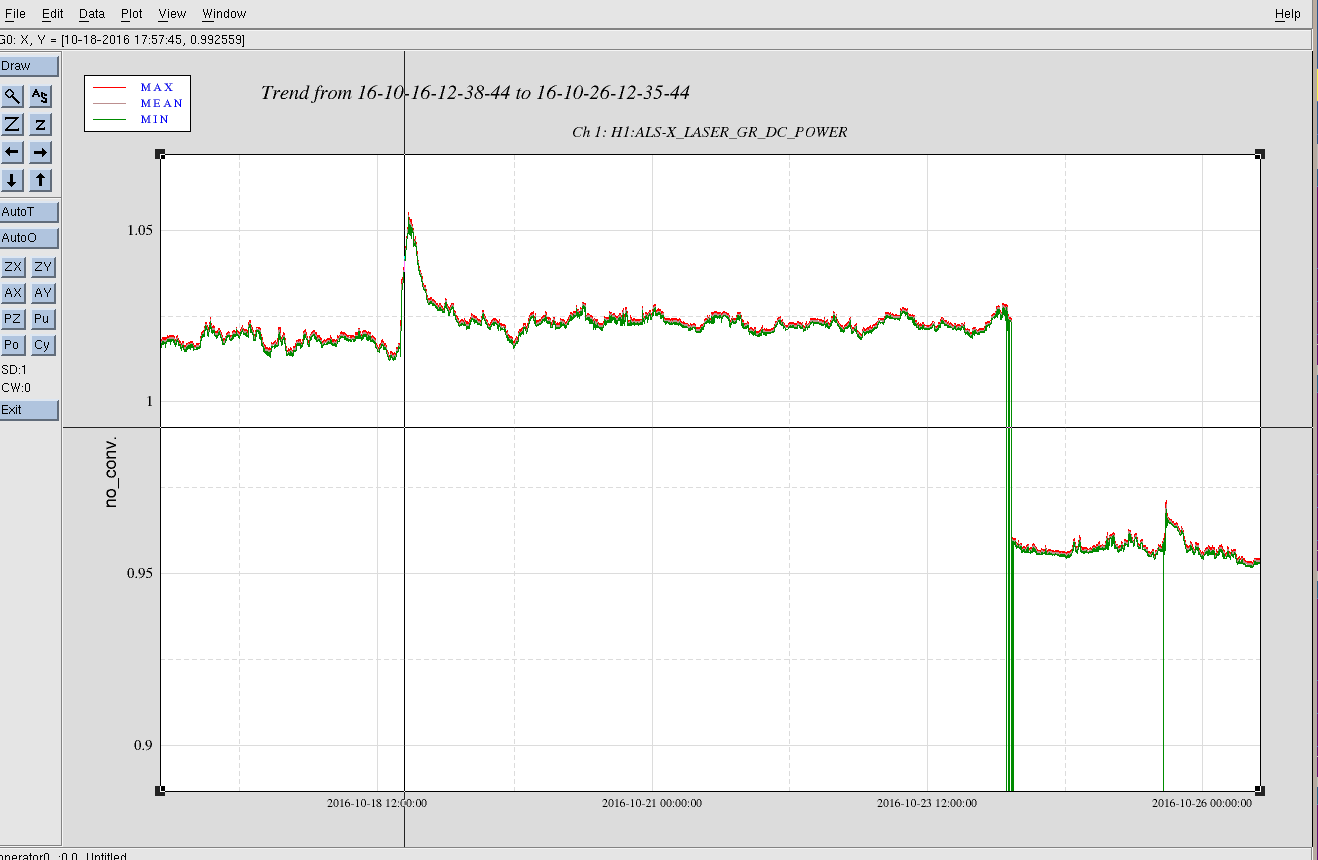
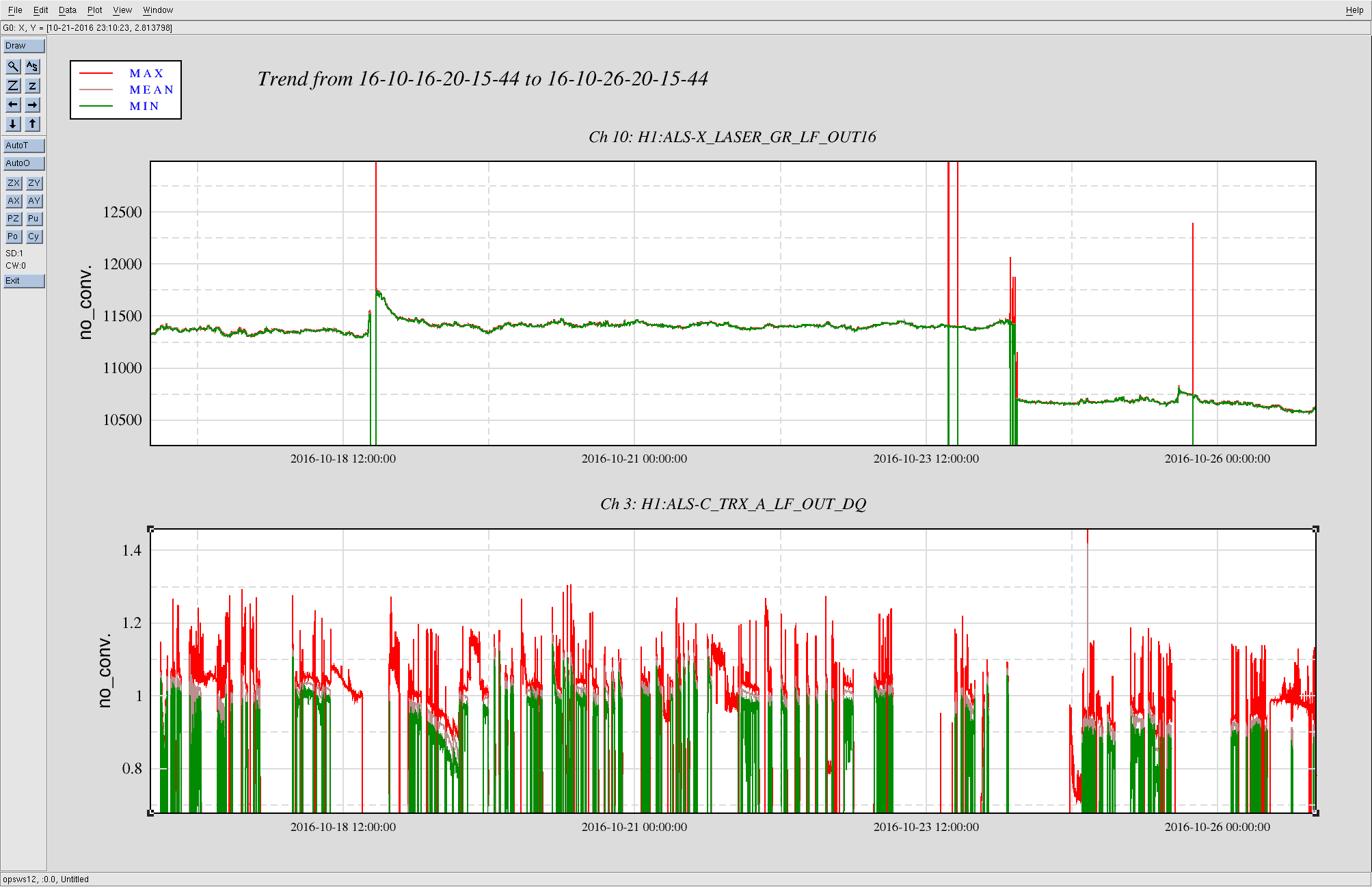
1. During power up from 2W to 50W, power-normalized arm transmission decreases by about a factor of 0.7 (attached).

That's a factor of 0.7 decrease of the optical gain of the 3rd loop. That's probably not enough to make something funny to the 3rd loop but it's something you need to know about.

And anyway, where's the power gone? MC transmission looks good, it should be IFO.

2. It might be possible to engage the 2nd and the 3rd loop at the same time before powering up, and changing the 2nd loop offset slider while powering up.

The reason why we need to adjust the offset is because the 2nd loop is DC coupled. Before engaging the 2nd loop (or 3rd loop) we run the offset adjustment servo, which is very slow due to double 0.1Hz pole in the offset path plus one 0.1Hz pole in the 2nd loop servo path itself. It's somewhat accelerated by digitally undoing a part of the delay, but it's impossible to undo three 0.1Hz poles without saturating the board badly.

However, once the 2nd loop is engaged, we only have to fight against two 0.1Hz poles to change the offset, so the task is somewhat easier (and quicker).

3. For engaging 2nd loop and 3rd loop at the same time, we need to change 3rd loop filter.

In principle all we need to do is to disable FM9 (boardComp) and set the gain correctly.

Images attached to this comment
LHO General
corey.gray@LIGO.ORG - posted 22:24, Tuesday 21 June 2016 (27902)
Eve Ops Summary

This evening has been focused on high power work (Nergis, Sheila, Stefan).  This evening's claim to fame has been having H1 get to ~56W (Guardian request was higher).  Somewhere above 50W, we were observing various instabilities---Nergis was watching PI modes ring up just before we lost lock.  

Terra is now here and will most likely log in some PI investigation time along with more high power work.

I saved some ASC & LSC inmon templates, at Stefan's request for high power; they are saved in the ops folder:    

/ligo/home/ops/Templates/Dataviewer/ [ ASC_inmons & LSC_inmons]

H1 PSL
keita.kawabe@LIGO.ORG - posted 16:15, Tuesday 21 June 2016 - last comment - 18:56, Tuesday 21 June 2016(27895)
ISS board transfer function

I injected into the 2nd loop board via PSL-ISS_TR (3rd looop filter) and SR560, and measured the transfer function from the readback of the analog input (H1:PSL-ISS_SECONDLOOP_PD_58_SUM_OUT, which is 32k channel) to the readback of the analog output ( H1:PSL-ISS_SECONDLOOP_SIGNAL_OUTPUT, which I think is in the 1st loop board) when the gain is set to 0, BOOST off, integrator off.

I was confused because of an additional 500Hz pole, but it seems like this was a questionable 500Hz digital pole in H1:PSL-ISS_SECONDLOOP_SIGNAL FM1. Anyway, in the attached, dots are as measured but after counter-compensating for the questionable 500Hz digital pole, and the lines are what is expected from D1300439 and S1400214.

The analog TF of the board itself should be something like zpk([1, 100, 8.46k, 10k], [0.1, 0.5, 500, 33.9k], 350). Yes there's 500Hz pole in analog. This is like one 0.1Hz pole up to 100Hz with some funny additional things (but don't forget SR560 with AC coupling and 10Hz pole, SR560 is used as a poor man's dewhitening to cut the DAC noise).

To make the 3rd loop design without 2nd loop somewhat easier, I made a simple zpk([0.1;0.5], [1;10; 50], 1) in FM9 of H1:PSL-ISS_TR called boardComp to get rid of p=[0.1, 0.5] and z=1. The potential problem of this is that the SR560 might rail. If this happens, we need something better.

Anyway, the starting point is to turn this filter on, then set the gain to whatever it was originally and divide it by 350, and measure the OLTF of the third loop without the second loop while the loop is open.

Images attached to this report
Comments related to this report
keita.kawabe@LIGO.ORG - 18:27, Tuesday 21 June 2016 (27898)

And it worked (Sheila, Kiwamu, Stefan, me).

No 2nd loop, boost off, integrator off, 20dB gain off.

Attached MEDM screen shows the filters used, and the dtt session shows the open loop transfer function when the loop gain was -1. At 2W, we were able to go as high as -3.

However, at 11W, when we turned the loop on with the gain of -3, something started oscillating with about 30 seconds period and we couldn't save the lock.

Images attached to this comment
keita.kawabe@LIGO.ORG - 18:56, Tuesday 21 June 2016 (27900)

Questionable 500Hz pole in H1:PSL-ISS_SECONDLOOP_SIGNAL FM1 was removed.

LHO General
thomas.shaffer@LIGO.ORG - posted 15:58, Tuesday 21 June 2016 (27877)
Ops Day Shift Summary

Maintenance Day Log:

Locking is now in progress, Bounce/roll modes are high and are being damping at the moment.

H1 SUS (DetChar)
betsy.weaver@LIGO.ORG - posted 15:15, Tuesday 21 June 2016 - last comment - 23:54, Saturday 02 July 2016(27893)
TUESDAY Maintenance SUS OSEM noise hunt - SAT AMP Power Cycles

Richard, Filiberto, Ed, Betsy

Following on from Andy's probing alog 27841 regarding funny looking OSEM spectra, today we looked into a few fishy signals.  Based on spectra he took from before and after the early June power outage which show signal changes, he and Jenne identified the following set of problematic OSEM signals.  I've annotated the list with status as to what we found or fixed today:


ITMY L2 LR - Fixed after power cycling the Satallite Amp box (see alog below)

ITMY R0 RT - Signal looks funny before power outage, old problem, TBC...

MC1 M3 UL - Signal looks funny before power outage, old problem, TBC...

PRM M2 UR - Fixed after power cycling the Satallite Amp box (see alog below)

PR2 M1 T2 - TBC...

PR2 M3 UL - Giant nominal YAW Bias which has been on this SUS for over a year - very little signal on OSEM - mechanical fix when vent

PR2 M3 LL - Giant nominal YAW Bias which has been on this SUS for over a year - very little signal on OSEM - mechanical fix when vent

SR2 M1 LF - Funny comb feature, TBC...

SR2 M1 T1 - Funny comb feature, TBC...

SR2 M1 T3 - Funny comb feature, TBC... 

ETMX L2 LL - 50Hz turn up noise, TBC... Turn up is due to LOCK ACQ PUSHING, turn up not present during nominal SUS damping, no LOCK ACQ, see below plot

ETMX L2 LR - 50Hz turn up noise, TBC... Turn up is due to LOCK ACQ PUSHING, turn up not present during nominal SUS damping, no LOCK ACQ, see below plot

ETMX L2 UR - 50Hz turn up noise, TBC... Turn up is due to LOCK ACQ PUSHING, turn up not present during nominal SUS damping, no LOCK ACQ, see below plot


ETMY L2 UR - 50Hz turn up noise, TBC... Turn up is due to LOCK ACQ PUSHING, turn up not present during nominal SUS damping, no LOCK ACQ, see below plot

IM3 M1 LL - TBC...


We plan to pursue ITMy R0 and SR2 this week at next opportunity.

Comments related to this report
betsy.weaver@LIGO.ORG - 15:43, Tuesday 21 June 2016 (27894)

Before doing the sat amp power cycle, we first tried a coil driver power cycle on a few of our funny OSEM sets.  This did not appear to clear the errant noise in any of the 4 cases.  We then embarked on the sat amp power cycle which cured the 2 shown in the above list.  Tomorrow we hope to revisit ITMY R0 RT and SR2 M1 which we have left off troubleshooting today with only coil driver OFF spectra.  (Betsy, tomorrow you should use the attached spectra as a jump off point.) 

TBC...  Note the wildly different looking symptoms both of which were seen by Lundgren in 20675 AUG 2015.

Images attached to this comment
betsy.weaver@LIGO.ORG - 15:45, Tuesday 21 June 2016 (27896)

Attached is the ITMY L2 OSEM signal spectra shown from before and after today's fix.  The PRM M2 OSEM before and after-fix spectra are very similar to this.

Images attached to this comment
betsy.weaver@LIGO.ORG - 09:58, Wednesday 22 June 2016 (27911)

ETMX High freq turn up during LOCK ACQ, not a stand alone OSEM signal feature.

Images attached to this comment
betsy.weaver@LIGO.ORG - 10:03, Wednesday 22 June 2016 (27912)

ITMy R0 RT investigation - this morning Richard and Fil performed another round of tests on the ITMy R0 RT (shared cable and electronics with R0 LF, M0 RT, M0 LF).  After power cycling the SAT box, other SAT box cable reseating, and reseating of the main cable to the chamber, the noise on this channel still exists.

SR2 M1 bouncy noise on 3 of 4 TOP investigation - Richard and Fil powert cycled the Sat AMp box for this set of 4 OSEMs, but the noise is still there.

TBC...

andrew.lundgren@LIGO.ORG - 23:54, Saturday 02 July 2016 (28136)DetChar, ISC, SUS
As requested by Betsy, I've made another set of spectra of the OSEMs. The green line is July 1 10:18 UTC. The reference time (black) is a time near the Boxing Day event (Dec 26 2015 4:30 UTC). This is because the OSEMINF channels are only stored in the commissioning frames, and those aren't stored for very long. But we did store them around events in O1.

If we need to do these checks often, then we will need to 1) Store the OSEMINF channels in raw frames. 2) Occasionally save commissioning frames for some time in known-good states 3) Write some code to dump spectra to a file occasionally.
Non-image files attached to this comment
H1 CAL (ISC, SUS)
jeffrey.kissel@LIGO.ORG - posted 14:27, Tuesday 21 June 2016 - last comment - 09:46, Wednesday 22 June 2016(27890)
ETM ESD Bias Signs Flipped; Beginning Regime of Regular Flipping
J. Kissel

After measuring charge today, I've flipped the BIAS sign on both ETMX and ETMY. 

In addition, I've changed the compensation scheme downstream of the BIAS flip such that signs are flipped in each quadrant's ESDOUTF bank GAIN instead of being convoluted in the the DRIVEALIGN matrix elements. This separates the functionality, compensates any angular control as well as longitudinal (though we don't send any angular control to the test mass stage at the moment), and minimizes the possibility for losing the fine-tuned DRIVEALIGN gains. 

Finally, I've modified the ISC guardian in such a way that it monitors the BIAS, and takes care of flipping all of the additional settings necessary to compensate for the bias change in the DOWN state. It had formerly had the DRIVEALIGN gain values hard coded, which was already bad news. Now the ESDOUTF gains (which have not been tuned / balanced as of yet) are flipped between -1 and +1; much easier to maintain. Also, I've added changing the CAL-CS settings to match as well, so the change in calibration will be taken care of as well.

I would post the latest results from today's change measurements, but I've been stuck trying to get 1 second of EPICS data from NDS2 for about 4 hours now.

Details
------------------
Before Flipping (to preserve my sanity, and minimize minus signs):
- Moved DRIVEALIGN negative signs into the ESDOUTF bank:
          ETMX              ETMY
      OLD       NEW       OLD     NEW
L2L   -1          +1       -30     30
L2P   -0.021  +0.021         0      0
L2Y   -0.007  +0.007         0      0
and the ESDOUTF GAINs had all been positive unity, were flipped to negative unity so as to not yet actually flip the compensating sign.

Then, I changed the ETMX bias sign:
- Changed H1:SUS-ETMX_L3_LOCK_INBIAS from +9.5 to -9.5 [V_DAC]
- (unlike before) The ISC_LOCK guardian (now) takes care of checking the sign of H1:SUS-ETMX_L3_LOCK_INBIAS, and adjusting the sign of 
   - H1:SUS-ETMX_L3_ESDOUTF_[UL,LL,UR,LR]_GAIN from -1.000 to +1.000  (fixes the ESD stage longitudinal loop gain to match the bias sign change)
   - H1:SUS-ETMX_L3_ESDOUTF_LIN_FORCE_COEFF from +124518.4 to -124518.4 (fixes the linearization force coefficient to match the new bias sign)
   accordingly.
- (like before) Accepted the new values in *all* SDF snap files, 
   /opt/rtcds/userapps/release/sus/h1/burtfiles/
   - h1susetmx_down.snap
   - h1susetmx_observe.snap
   - h1susetmx_safe.snap
  by loading in each table and accepting the values I've changed, followed by a commit to the userapps repo. 
- (like before) There's no need to make any further changes in the CAL-CS epics settings, because ETMX is not used in any capacity for calibration.

Followed by the ETMY bias sign:
- Changed H1:SUS-ETMY_L3_LOCK_INBIAS from -9.5 to +9.5 [V_DAC] 
- (unlike before) The ISC_LOCK guardian (now) takes care of checking the sign of H1:SUS-ETMX_L3_LOCK_INBIAS, and adjusting the sign of 
   - H1:SUS-ETMY_L3_ESDOUTF_[UL,LL,UR,LR]_GAIN from -1.000 to +1.000  (fixes the ESD stage longitudinal loop gain to match the bias sign change)
   - H1:SUS-ETMY_L3_ESDOUTF_LIN_FORCE_COEFF from -124518.4 to +124518.4 (fixes the linearization force coefficient to match the new bias sign)
   accordingly.
- (like before) Accepted the new values in *all* SDF snap files, 
   /opt/rtcds/userapps/release/sus/h1/burtfiles/
   - h1susetmy_down.snap
   - h1susetmy_observe.snap
   - h1susetmy_safe.snap
  by loading in each table and accepting the values I've changed, followed by a commit to the userapps repo. 
 (This also involved *creating* a copy of the down.snap in the userapps repo, and changing the file in the 
  target/h1susetmy/h1susetmyepics/burt/ directory to a soft link, as was already the case for the OBSERVE.snap and safe.snap) 

[Making sure Calibration is unaffected]
- (like before) We must make sure that the CAL-CS replica of the ETMY actuation matches the SUS ETMY digital signal chain. However, because the CAL-CS model had not been restarted, and its SDF system had been kept up-to-date it did not lose the appropriate settings, so the settings for
   - H1:CAL-CS_DARM_FE_ETMY_L3_DRIVEALIGN_L2L_GAIN to +30.0
   - H1:CAL-CS_DARM_FE_ETMY_L3_ESDOUTF_UL_GAIN to +1
   - H1:CAL-CS_DARM_ANALOG_ETMY_L3_GAIN stays +1.0
- (unlike before) Again, to be consistent, I've changed the sign of the linearization force coefficient,
   - H1:CAL-CS_DARM_FE_ETMY_L3_ESDOUTF_LIN_FORCE_COEFF from +124518.4 to -124518.4
- (unlike before) Accepted the new values in *all* SDF snap files, 
   /opt/rtcds/userapps/release/sus/h1/burtfiles/
   - h1susetmx_observe.snap
   - h1susetmx_safe.snap
  by loading in each table and accepting the values I've changed, followed by a commit to the userapps repo. 
 (Since there is no change between the "down" and "observation" state, a "down" .snap doesn't and need not exist.)  
Images attached to this report
Comments related to this report
sheila.dwyer@LIGO.ORG - 01:52, Wednesday 22 June 2016 (27903)

Something is wrong with ALS DIFF, is seems to saturate constantly.  Is something wrong after the bias flip?

jeffrey.kissel@LIGO.ORG - 09:46, Wednesday 22 June 2016 (27910)
Looks like the Linearization Force Coefficient some how got flipped back to +124518.4. We fixed the sign there, and made sure it was coded correctly in the ISC_LOCK guardian and moved on. To 50+ W no less!
H1 AOS
haocun.yu@LIGO.ORG - posted 11:50, Tuesday 21 June 2016 - last comment - 17:25, Tuesday 21 June 2016(27885)
HARD Loops after OL servos on for ETM's

Jenne, Nergis, Rana, Haocun


After all the PIT optical lever servos were on for both the ITMs and ETMs (27863), we measured the HARD Loops Gains again yesterday evening.

In the pictures attached, the red dots are mesurements when the PIT OLDAMPs are on for all the TMs, and also we have boosts on for those measurements (which explains the magnitude changes in low frequency and phase changes even for Yaw). The black curves are the measurements taken before the OL servos were on for the ETMs, and without boosts. The blue curves are the modeling results, which assume only OL on for ITMs.

Images attached to this report
Comments related to this report
haocun.yu@LIGO.ORG - 17:25, Tuesday 21 June 2016 (27897)

.fig files attached.

Non-image files attached to this comment
Displaying reports 58981-59000 of 86130.Go to page Start 2946 2947 2948 2949 2950 2951 2952 2953 2954 End