Displaying reports 59981-60000 of 86144.Go to page Start 2996 2997 2998 2999 3000 3001 3002 3003 3004 End
Reports until 14:30, Friday 29 April 2016
H1 PSL
keita.kawabe@LIGO.ORG - posted 14:30, Friday 29 April 2016 - last comment - 12:52, Thursday 01 September 2016(26879)
Which PSL monitor PDs correspond to which signal, and which DCC document.

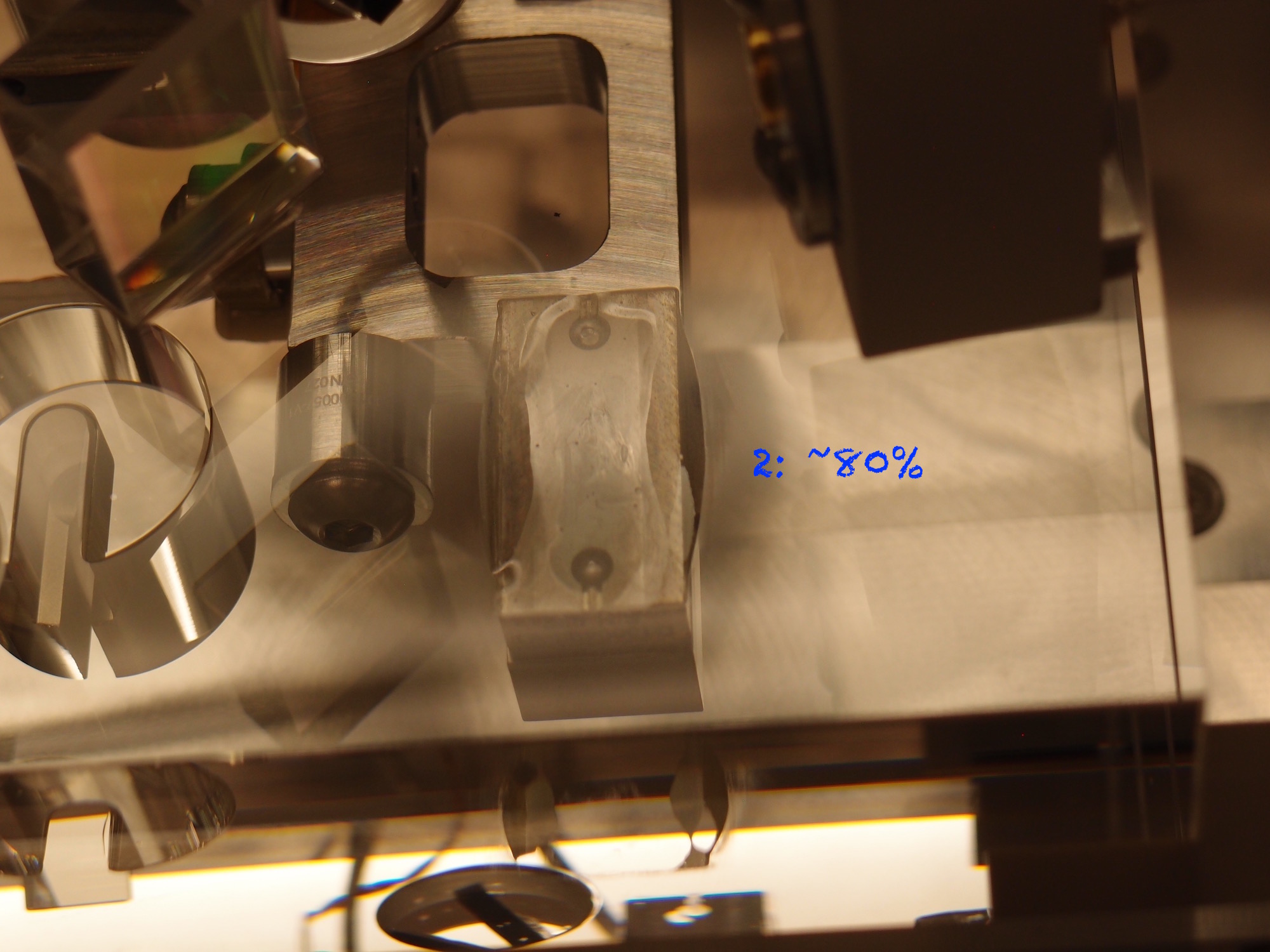
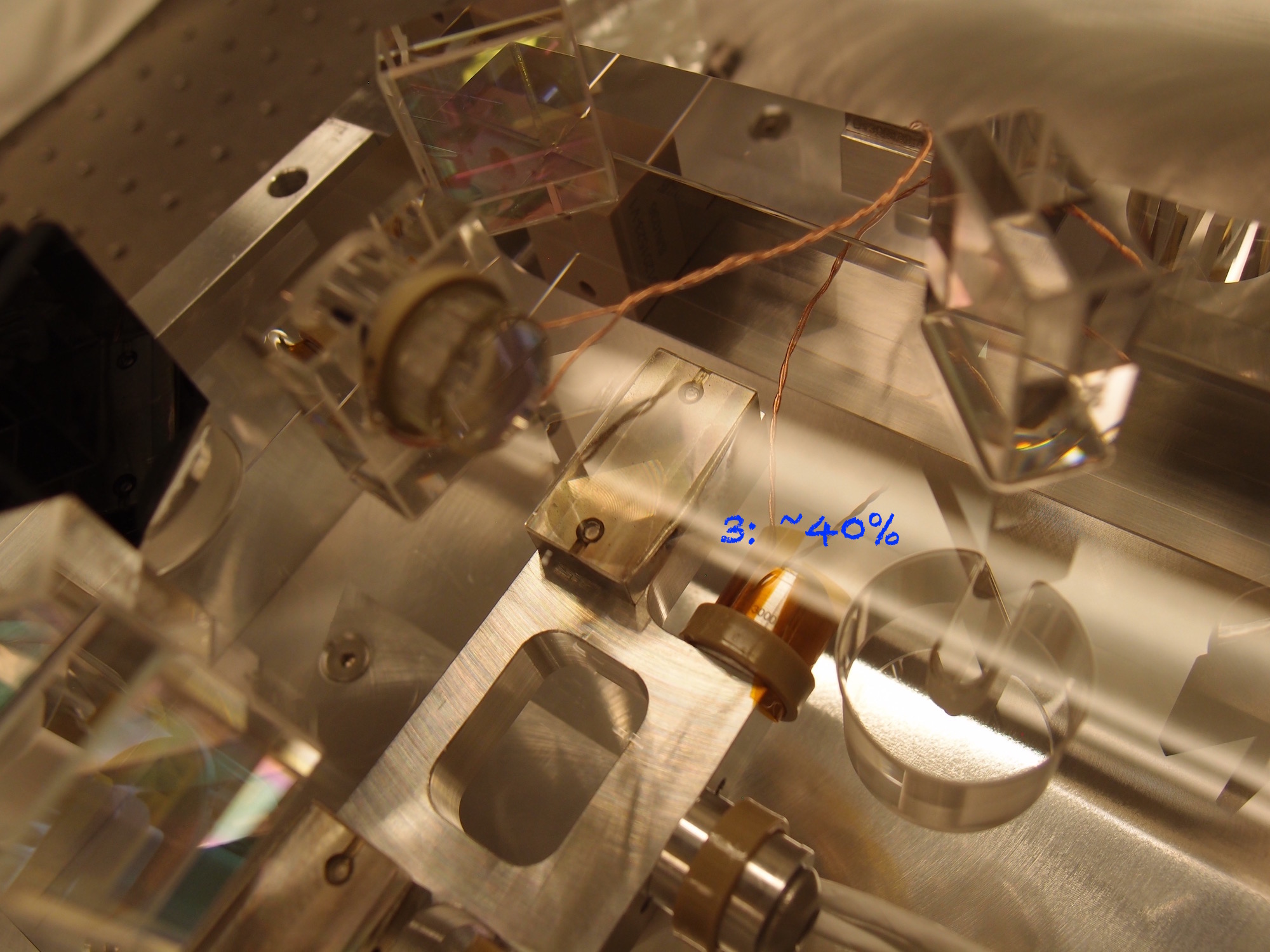
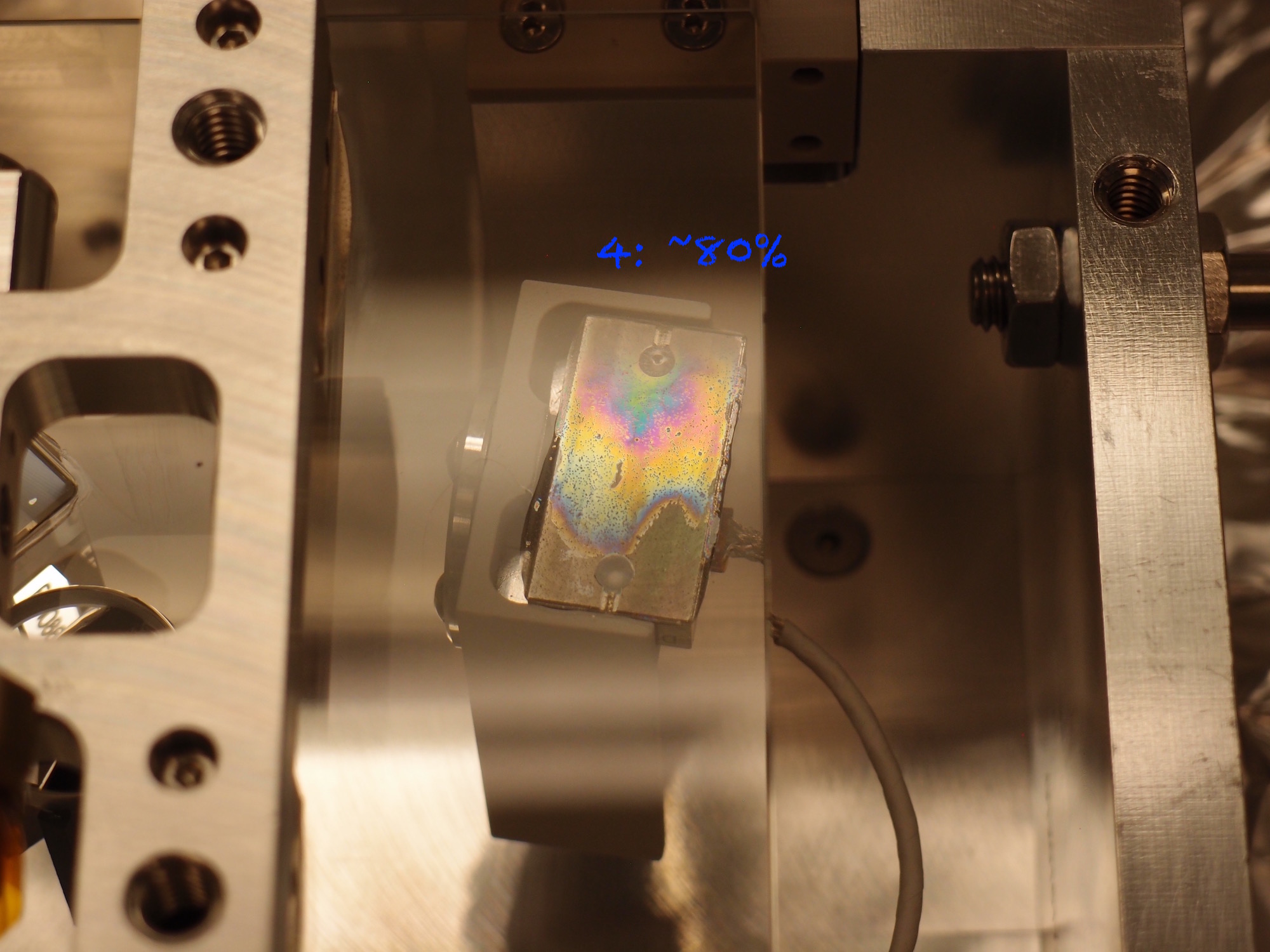
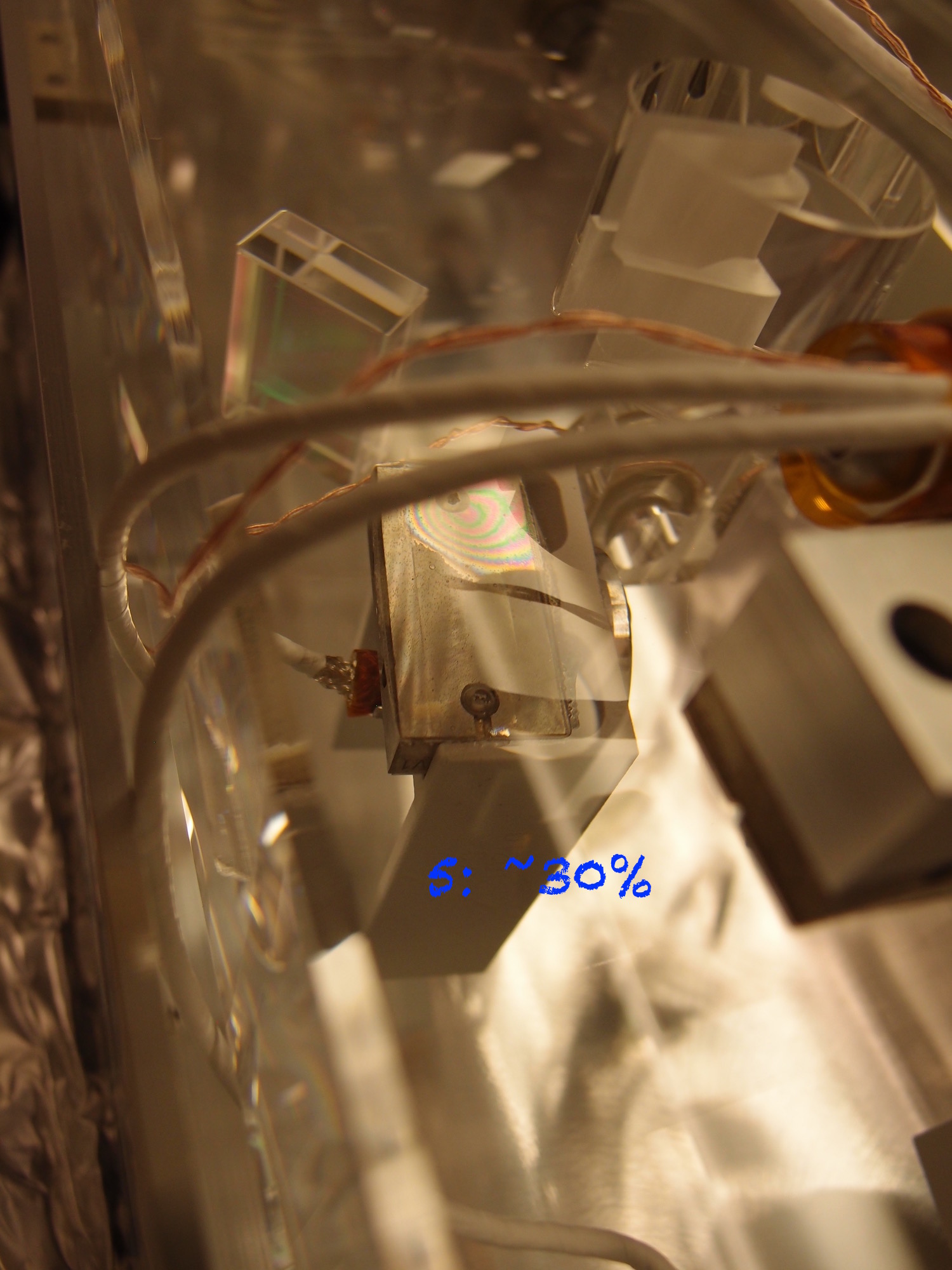
Since there seem to be some confusions about which PD has what kind of analog filtering and sent to which channel, here it is.

I'm quite certain about HPO output before AOM (which is "Power monitor PD" in D1002929) and ISS 1st loop monitors, but not that sure about "monitor PD"s in D1002164. E-travellers are incomplete (they don't say which one is installed where), so I'm just listing the nominal values for these "monitor PD"s.
What PD name on D0902114 Circuit type Analog out Transimpedance (Ohm) Analog filter Channel Note Can you find Filter MEDM from sitemap as of this writing?
HPO output before AOM PD1

Power monitor PD, D1002929

DC 3.3k DC  

H1:PSL-PWR_HPL_DC, DC_LF

DC_LF is digital downstream of DC, EPICS output is visible as "Power Monitor PD" on PSL_LASER MEDM.

No
AC 16.5k AC 5k HPF nominal H1:PSL-PWR_HPL_AC   No
ISS 1st loop diodes after PMC ISS_PDA, ISS_PDB

Inner loop diodes, D1001998

"Filt" on the board, "AC" on the box 660 DC

z=[0.0723;2700;0.0707] Hz,

p=[3.3607;130;3.12;2300]

H1:PSL-ISS_PDA and PDB

No dewhite, output is calibrated in volts.

No

H1:PSL-ISS_PDA_DC and PDB_DC

Digitally low-passed version of PDA and PDB, but has a DC gain of 5 so the DC agrees with the analog of "DC" output on the PD box. Yes, from ISS
H1:PSL-ISS_PDA_AC and PDB_AC Dewhitened and AC-coupled version of PDA and PDB, has a gain to match PDA_DC and PDB_DC Yes, from ISS
H1:PSL-ISS_PDA_REL AC-coupled RIN made by PDA_AC/PDA_DC. Yes, from ISS
DC on the box 3.3k DC   N/A   N/A
Frontend output before HPO but after FI PD_AMP

PSL monitor PD, D1002164, T100047

DC on the box 20k DC nominal   H1:PSL-OSC_PD_AMP_DC EPICS output visible as "FRONTEND POWER" on PSL_LASER MEDM. No
AC on the box 100k AC nominal 5k HPF nominal AMP_AC   No
Back-propagation rejected by FI between frontend and HPO PD_ISO PSL monitor PD, D1002164, T100047 DC 750 DC nominal   H1:PSL-OSC_PD_ISO_DC EPICS output visible as "PDISO" on PSL_LASER MEDM. No
AC 3.75k nominal 5k HPF nominal ISO_AC   No
Back-propagating HPO mode leaking from HPO cavity? PD_INT PSL monitor PD,  D1002164, T100047 DC 1k?   H1:PSL-OSC_PD_INT_DC EPICS output visible as "PDINT" on PSL_LASER MEDM. No
AC 5k? 5k HPF nominal INT_AC   No
HPO Brewster plate rejection PD_BP PSL monitor PD, D1002164, T100047 DC 1.5k nominal   H1:PSL-OSC_PD_BP_DC EPICS output visible as "PDBP" on PSL_LASER MEDM. No
AC 7.5k nominal 5k HPF nominal BP_AC   No
Comments related to this report
keita.kawabe@LIGO.ORG - 10:07, Wednesday 11 May 2016 (27113)

I cannot edit the above entry any more, so here is an additional table showing digital filters.

what analog channel model digital
HPO output before AOM DC H1:PSL-PWR_HPL_DC h1pslpmc None
  H1:PSL-PWR_HPL_DC_LP p=0.05
AC H1:PSL-PWR_HPL_AC None
ISS 1st loop diodes after PMC "filt" or AC
(DC-coupled)
H1:PSL-ISS_PDA (and PDB) h1psliss cts/volt conversion factor
  H1:PSL-ISS_PDA_CALI_AC

z= [0.0707, 0.0723], p= [0.3, 0.3] and 2nd order 0.3Hz Butterworth HP in addition to dewhite, DC gain of 5.

  H1:PSL-ISS_PDA_CALI_DC Some random LPF (p=[0.034141, 0.037449, 10430]), DC gain of 5.
    H1:PSL-ISS_PDA_REL None
Frontend output before HPO but after FI DC H1:PSL-OSC_PD_AMP_DC h1pslpmc Gain of 0.00349223
AC H1:PSL-OSC_PD_AMP_AC Gain of 0.000613
Back-propagation rejected by FI between frontend and HPO DC H1:PSL-OSC_PD_ISO_DC Gain set to 1 on May 11 2016 (alog 27112)
AC H1:PSL-OSC_PD_ISO_AC Gain of 1
Back-propagating HPO mode leaking from HPO cavity? DC H1:PSL-OSC_PD_INT_DC Gain set to 1 on May 11 2016 (alog 27112)
AC H1:PSL-OSC_PD_INT_AC Gain of 1
HPO Brewster plate rejection DC H1:PSL-OSC_PD_BP_DC Gain set to 1 on May 11 2016 (alog 27112)
AC H1:PSL-OSC_PD_BP_AC Gain of 1
PMC TRANS ? H1:PSL-PWR_PMC_TRANS Gain of 0.0103, p=0.15
PMC REFL DC ? H1:PSL-PWR_PMC_REFL Gain of -0.0248015, p=0.15
keita.kawabe@LIGO.ORG - 15:44, Tuesday 30 August 2016 (29392)

ISS inner loop (or 1st loop) diode has different filter than written above, it turns out. But 130Hz was a zero, not pole. 2.7k was a pole, not zero.

effective trans impedance = 660 Ohm (that's 0.2*3.3k).

z=[0.0707; 0.0723; 130]

p=[3.12; 3.36; 2.34k; 2.70k]

jeffrey.kissel@LIGO.ORG - 08:45, Wednesday 31 August 2016 (29409)DetChar, IOO, ISC
Tagging DetChar, IOO, and ISC for future reference.
keita.kawabe@LIGO.ORG - 12:52, Thursday 01 September 2016 (29441)

Seems like I was really, really tired, here's a correction of correction. Really sorry for the confusion.

My original table was correct.

Inner loop PD is equivalen of 660Ohm, zp=([0.0707;0.0723;2.7k],[3.12;3.36;130;2.34k]).

LHO VE
chandra.romel@LIGO.ORG - posted 14:29, Friday 29 April 2016 (26885)
CP3 LLCV increase
Increased LLCV of CP3 from 18% to 20% because it took almost 9 min. to overfill today. 
LHO VE
chandra.romel@LIGO.ORG - posted 14:15, Friday 29 April 2016 (26884)
CP3 overfill
MidY @ 1:40pm local

Opened CP3 bypass LLCV 1/2 turn with bypass exhaust valve open. Took 8:49 min. until vapor/liquid started to flow out the exhaust pipes. I waited several minutes before closing the bypass exhaust valve. Closed it a few times, pressure sounded high, so I opened it back up and then several seconds later liquid started to pour out. I did this three times, and then waited many minutes before finally leaving bypass exhaust valve closed.
H1 PSL
evan.hall@LIGO.ORG - posted 13:37, Friday 29 April 2016 (26882)
ISS inner-loop dark noise

Stefan, Evan

The attached plot shows the dark noise of the inner-loop ISS. It is "dark" in the sense that the NPRO is off, although there are still room lights on in the PSL.

PDA seems to have worse noise than PDB — a factor of 3 at 10 Hz. When the PDA/PDB inputs at the PSL rack are terminated, the noise performance is similar. So this excess seems to be somewhere between PDA and the PSL rack.

The traces are calibrated into equivalent RIN for the nominal ISS operating power.

Comparing with 26773 (for example), we see we are battling a noise that is more than a factor of 1000 worse than these dark noises.

Non-image files attached to this report
H1 TCS
nutsinee.kijbunchoo@LIGO.ORG - posted 11:38, Friday 29 April 2016 - last comment - 13:14, Friday 29 April 2016(26880)
Restarted HWSX code @ ~18:35 UTC

HWSX peak counts bad, I stopped the code, powercycled the frame grabber and the camera, then restarted the code. Peak counts are back to normal (~940).

Images attached to this report
Comments related to this report
nutsinee.kijbunchoo@LIGO.ORG - 13:14, Friday 29 April 2016 (26883)

20:14 Noticed HWSX has bad peak counts again. Restarted HWSX code.

H1 TCS (TCS)
aidan.brooks@LIGO.ORG - posted 10:33, Friday 29 April 2016 (26877)
Restarted HWS code on H1HWSMSR

I restarted the HWS code on H1HWSMSR this morning. It had stopped following the Beckhoff failure last night.

H1 General
travis.sadecki@LIGO.ORG - posted 10:07, Friday 29 April 2016 (26875)
Morning meeting notes
H1 SEI
hugh.radkins@LIGO.ORG - posted 09:55, Friday 29 April 2016 - last comment - 10:20, Friday 29 April 2016(26874)
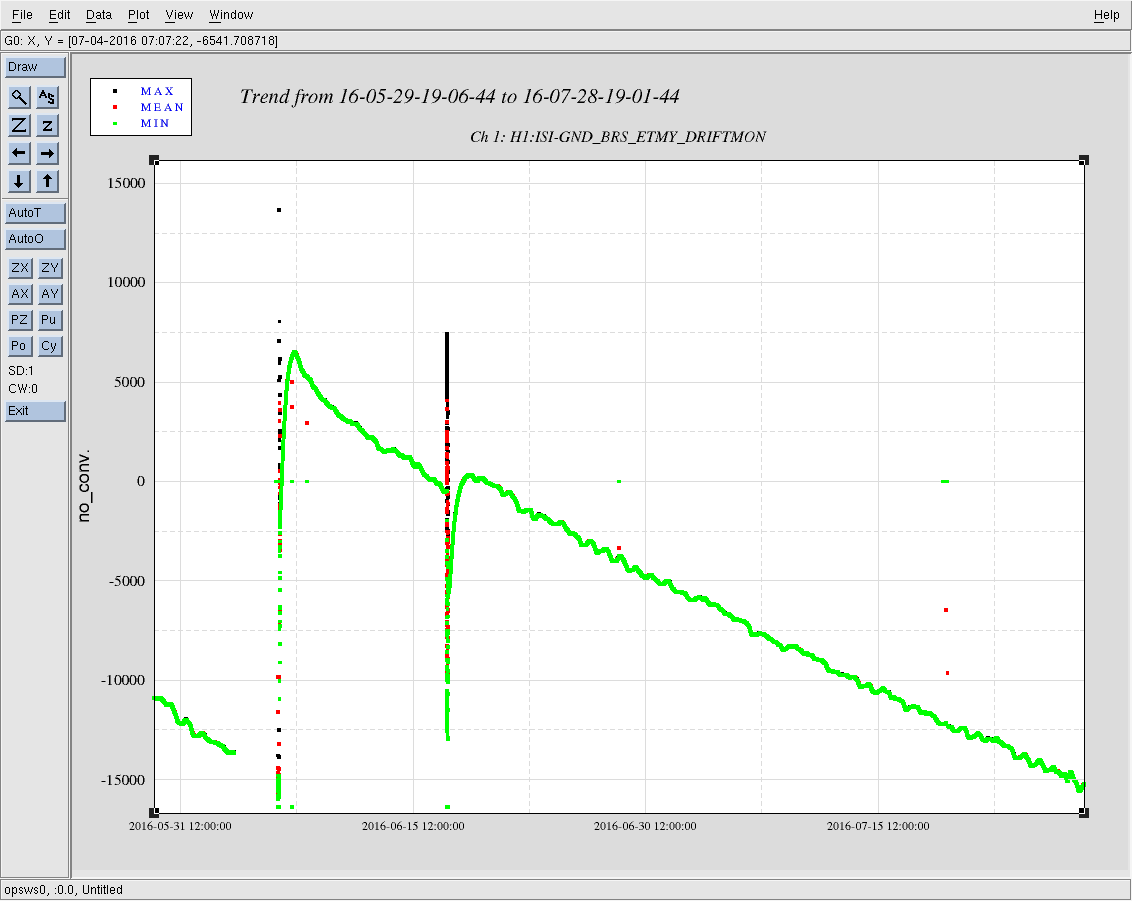
BRSY Trends--Not clearly related to wind speed

The attached 1 day trend plot shows the BRSY RX (tilt), wind speed, BRS Beam velocity, and the Y STS Seismometer motion.  Yesterday at the 1800 hours mark, the tilt and velocity rapid decrease is from when we forced the damping on.  Otherwise for the remainder of the plots, the BRS is running on its own.  The shape of the trends don't scale with the wind velocity as one might expect...

Images attached to this report
Comments related to this report
krishna.venkateswara@LIGO.ORG - 10:20, Friday 29 April 2016 (26876)

Remember that BRS_IN is the raw angle of the beam-balance, which is an undamped ~7.6 mHz oscillator with Q of ~2700. The real-time signal will be completely dominated by the resonance - it is like looking at the raw DARM channel and seeing only the violin mode and trying to see if there is a GW signal based on the unfiltered amplitude. To see the real-time ground tilt, you have to looks at (10-100 mHz) BLRMS of BRS_OUT or some such filtered signal.

LHO General
thomas.shaffer@LIGO.ORG - posted 23:16, Thursday 28 April 2016 (26829)
Ops Eve Shift Summary

TITLE: 04/29 Eve Shift: 23:00-07:00 UTC (16:00-00:00 PST), all times posted in UTC
STATE of H1: Planned Engineering
INCOMING OPERATOR: None
SHIFT SUMMARY: Plagued by earthquakes, a bit of wind, and then laser trouble. Wasn't a great night tonight.

SEI note: I struggled to get ISI ITMX to stay in fully_isolated, even after the 0.03-0.1Hz seemed to be back to normal. I'm leaving it fully_isolated with the T240s in Low gain now, but it has fooled me before. Also is there a way for us to tell if one of the sensors is already in low gain? Should it be added to the DIAG to make sure all are in high gain?
LOG:

H1 PSL (PSL)
richard.savage@LIGO.ORG - posted 23:11, Thursday 28 April 2016 (26871)
PSL down

Keita, PeterK, Rick

Keita and I went out to the laser room to make some RIN measurements.

Short summary:

     Front end RIN seems normal both with the high power oscillator (HPO) running and with it off

     High Power Oscillator RIN much higher (>factor of 10).  Glitches (few cycles of 500 kHz) at abouyt 37 kHz on the hight power oscillator light, but not the front end light

     More tomorrow regarding this.

After shutting the laser (front end and HPO) down to reset the Long Range Actuator (via the reset button on the back of the control box), the HPO only came back up with about 1/4 of the expected power.  Troubleshooting and brainstorming on the phone with Peter, we tried increasing the diode currents by 1 A (left the laser in this condition).  This due to the low power and because the head 4 output dropoed from about 96% to about 91%, i.e. it came back about 5% lower after switching the laser off to reset the LRA and turning it back on.

HPO power (with internal shutter open, front end off) still only came up to about 50 W (expecting close to 200).

Peter suspects that some internal optic has been damaged.  We decided to shut the system completely down - lasers and chillers - and try a cold start in the morning.

I plan to talk with MattH and Olli Puncken at LLO first thing in the morning to see if they have any ideas or suggestions.

It's looking pretty likely at this point that we aren't going to have a high-power laser until we can go into the HPO to inspect the optics and assess the state of the HPO.  This would start next week on Tuesday at the earliest, when PeterK returns from vacation.

Assuming that the cold start in the morning is not successful, we will have to decide is we want to try to get a the 15 watts reflected from the HPO aligned and modematched to the PMC so we will at least have a low power beam to work with until next week.

H1 AOS
richard.mittleman@LIGO.ORG - posted 18:31, Thursday 28 April 2016 (26867)
ETMY-ISI rX Sensor Correction

I'm leaving the rX-BRS sensor correction at ETMY on over night, as far as I can tell at the moment it is doing very little, but if someone gets suspicious about ETMY motion feel free to turn it off in ISI-ETMY_ST1_SENSCOR_GND_RX_Match

H1 CDS
patrick.thomas@LIGO.ORG - posted 18:30, Thursday 28 April 2016 - last comment - 10:35, Friday 29 April 2016(26866)
Corner Station Beckhoff down
Patrick, Matt, Kiwamu, Vern

We tried testing some code changes for the rotation stage. They didn't seem to work, so I reverted the change to the Laser Power library and went through the GUI to start afresh (copy new code from target directory, compile, run, etc.). Now everytime I do this I get a divide by zero error. (see attached).

Did someone change the code in PLC1 that introduced a divide by zero error, and not run it until we tried to now? Or did I somehow do this?
Images attached to this report
Comments related to this report
patrick.thomas@LIGO.ORG - 19:10, Thursday 28 April 2016 (26869)
Seem to be fixed by recompiling PLC1. I've burtrestored PLC1, PLC2 and PLC3 to 6:10 this morning (local time).
sheila.dwyer@LIGO.ORG - 19:37, Thursday 28 April 2016 (26870)

Here are two examples of locklosses when powering up from the last 24 hours.  The first one shows the rotation stage moving in a jerky way, this was an example of a time when the velocity was changed before the request was made, but is worse than the normal "moving in the wrong direction" problem.  You can see that the accelerometers on the PSL all have glitches when the rotation stage angle encoder records a change in angle. 

In the second example the rotation stage velocity moves smoothly, and the power changes smoothly, but we have a lockloss which could be ASC related.  

Images attached to this comment
daniel.sigg@LIGO.ORG - 08:01, Friday 29 April 2016 (26873)

One thing to remember is that TwinCAT will try to reuse its previously stored values of variables, when you log in with a slightly modified code. Generally, this is a good thing, but it can fail with an internal variable restored to a value which leads to a divide by zero error. You need to login and use the Reset (clear all variables except the persistant ones), or Reset All  (clear all variables). In the later case, you definitely need a SDF/burt restore.

patrick.thomas@LIGO.ORG - 10:35, Friday 29 April 2016 (26878)
I had tried logging in with the PLC and resetting the variables.
H1 CDS (DAQ)
david.barker@LIGO.ORG - posted 17:51, Thursday 28 April 2016 - last comment - 18:33, Thursday 28 April 2016(26862)
Chris Wipf's MEDM time machine installed

Chris, Carlos, Jonathan, Jim, Dave:

today we installed Chris' medm_time_machine software on the CDS workstations. This permits the user to ask how an MEDM screen looked like in the past, provided the channel data is available from the selected NDS server.

To open the feature, right-mouse inside an MEDM and select Execute (last item) and TimeMachine (last item on pull-out window). See figure 1.

As an example, H1 was locked at noon today and is currently unlocked due to an earthquake. Figure 2 is requesting the OMC DC-PDA filter module screen at noon (5 hours and 30 minutes ago at the time of asking). Figure 3 shows the current running MEDM on top, and the timewarped screen from 12:02 PDT today below it. The time strings in the upper right corner show the times. Channels which are not in the DAQ show up as white rectangles (for example strings, momentary buttons, redundent outputs). When the IFO was locked, the input was many thousands of counts.

One feature we added to the launcher today was to allow the user to set the precision of the playback data. In some screens a precision of 3 is good, for others lower precision makes the screen more readable.

Jonathan showed that by changing the NDSSERVER enviromnent setting and opening a kerberos ticket, this system is able to get data from the LDAS NDS2 server.

Things to note:

Images attached to this report
Comments related to this report
david.barker@LIGO.ORG - 18:08, Thursday 28 April 2016 (26864)

For this to run on the control room workstations, we installed pcaspy (easy-install pcaspy) locally at:

/usr/local/lib/python2.7/dist-packages/pcaspy-0.5.1-py2.7-linux-x86_64.egg/pcaspy

keith.thorne@LIGO.ORG - 18:33, Thursday 28 April 2016 (26868)
pcaspy should already be installed for LLO CDS, if we wish to install the patch
H1 PSL (PSL)
peter.king@LIGO.ORG - posted 17:25, Wednesday 27 April 2016 - last comment - 18:07, Friday 29 April 2016(26832)
Laser power noise
Made measurements of the oscillator power noise with a few photodiodes.

PowerNoise.png shows the free-running oscillator relative power noise
measured before the acousto-optic modulator.  This is more than 10 times
noisier than when the laser was installed in the H1 enclosure.  The
other trace in the plot is the out of loop of the relative power noise.
It is also about a factor of 10 higher than it should be.

    Whilst the power stabilisation was locked, I looked at the AC coupled
output of the photodiode and did not observe any oscillations.  The maximum
peak-to-peak variations were ~40 mVpp.
Images attached to this report
Comments related to this report
matthew.evans@LIGO.ORG - 09:06, Thursday 28 April 2016 (26850)

If I am reading this plot correctly, the ~37kHz rep-rate seen in last week is probably represented in this spectrum by the peak which the ISS is adding at that frequency.  (The 500kHz oscillation is too high to see here.)  It might be very informative to see what is going on above 100kHz since the ISS seems to be adding a lot of noise at 100kHz (about a factor of 10 above its input).

evan.hall@LIGO.ORG - 12:34, Friday 29 April 2016 (26881)

Is this plot really calibrated into RIN?

The digital RIN readback for the OOL inner-loop sensor appears to be 20 dB lower than the trace shown here (26773). Same for the digital readback for the HPO transmission.

keita.kawabe@LIGO.ORG - 18:07, Friday 29 April 2016 (26894)

Look at alog 26893.

Peter's "relative power noise" agrees well with the raw voltage spectrum of Rick and mine. In other words, Peter's plot seems to overestimate RIN by 15 dB or so for the HPL monitor (DC level is about -6V), and about 20dB for 1st loop sensor (DC level -9 to -10 Volt).

Displaying reports 59981-60000 of 86144.Go to page Start 2996 2997 2998 2999 3000 3001 3002 3003 3004 End