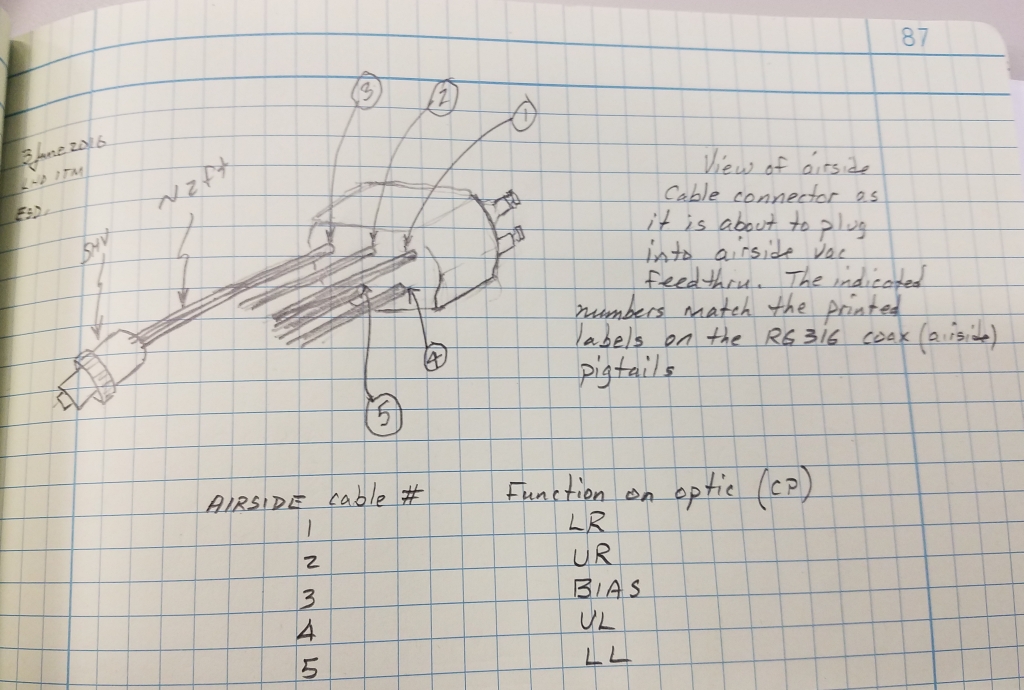
I took charge measurements at both ends today, they finished around 12:50 local. I'll post plots soon.
Following up on this earlier study, Weigang Liu has tried folding some of the corner-station magnetometer data in 8-second intervals, day-by-day, month-by-month and over nearly the full O1 run (excluding January because of commissioning work and October 20 for some channels because of anomalous data). Attached are the summary plots, while links to the daily & monthly plots are here: H1:PEM-CS_MAG_LVEA_VERTEX_X_DQ H1:PEM-CS_MAG_LVEA_VERTEX_Y_DQ H1:PEM-CS_MAG_LVEA_VERTEX_Z_DQ H1:PEM-CS_MAG_EBAY_SUSRACK_X_DQ H1:PEM-CS_MAG_EBAY_SUSRACK_Y_DQ H1:PEM-CS_MAG_EBAY_SUSRACK_Z_DQ As before, each figure has a top graph with the raw folded (averaged) data, a middle graph with the spectrum of the folded data, and a bottom graph which is the inverse FFT of the lowest 40 Hz. Remarks:
Laser Status:
SysStat is good
Front End power is 30.88W (should be around 30 W)
Frontend Watch is GREEN
HPO Watch is RED
PMC:
It has been locked 6.0 days, 0.0 hr 15.0 minutes (should be days/weeks)
Reflected power is 2.987Watts and PowerSum = 24.26Watts.
FSS:
It has been locked for 0.0 days 2.0 h and 26.0 min (should be days/weeks)
TPD[V] = 1.407V (min 0.9V)
ISS:
The diffracted power is around 9.374% (should be 5-9%)
Last saturation event was 0.0 days 2.0 hours and 26.0 minutes ago (should be days/weeks)
Tues. maintenance planned tasks:
TITLE: 03/28 Day Shift: 16:00-00:00 UTC (08:00-16:00 PST), all times posted in UTC
STATE of H1: Planned Engineering
OUTGOING OPERATOR: None
CURRENT ENVIRONMENT:
Wind: 12mph Gusts, 8mph 5min avg
Primary useism: 0.14 μm/s
Secondary useism: 0.19 μm/s
QUICK SUMMARY: Arrived this morning to find the IFO unlocked with many things tripped (TMSX, TMSY, ETMY, EY ISI, EX ISI, IY ISI, IX ISI WDs tripped). It appears this was due to a pair of EQs in Mexico during the night. Reset all WDs and began initial alignment.
During Maintenance March 15th, IM1, IM2, IM3 and IM4 all shifted alignment for the same given alignment drive. The first shift was identified and restored, but the next two shifts were not, and IM2 pitch, H1's biggest shifter, jumped about 40urad in the same direction, so a total of about 80urad alignment shift in pitch.
I restored the alignments (including IM4) to the values before the alignment shifts March 15th. I did so by moving each optic and leaving some time between each, so I could get a reading of how much each optic (IM1-3) changed IM4 Trans QPD.
The results are that IM4 Trans QPD is:
This suggests that the tolerance for alignment shifts on IM1 need to be smaller than the tolerances we use for IM3.
Currently we're using a tolerance of 5urad on all IMs, and I would suggest tightening that up for IM1 to 1urad tolerance for both pitch and yaw.
This week:
Week 4/4:
J. Kissel Joe Betzwieser has created some new bit of "user" c-code in order to facilitate getting the ISI's GS13s, projected into SUSPOINT longitudinal, to the corner station to be further projected into the IFO's cavity length basis. The code serves to mux multiple low-sampling rate channels (in this case, SEI channels) into one high-sampling rate channel for shipping over the RFM IPC with less overhead. See T1600083 for details. To absorb this new code for incorporation into the PEM model (as per the plan, see LHO aLOG 26249 and ECR E1600028), I've updated the ${userapps}/cds/common/src/ directory of the local copy of the cds_user_apps repository. -------------------------- Exactly what has been received: jeffrey.kissel@opsws2:/opt/rtcds/userapps/release/cds/common/src$ svn up A LOW_FREQ_MUX.c A ccodeio.h A MAX_MIN_CALC.c A LOW_FREQ_DEMUX.c Updated to revision 12938. jeffrey.kissel@opsws2:/opt/rtcds/userapps/release/cds/common/src$
Pressures still falling: HAM 7/8: 5.6e-6 Torr (Friday=8e-6 Torr) HAM 9: 3.8e-6 Torr (Friday=6e-6 Torr) HAM 11/12: 3.5e-6 Torr (Friday=5e-6 Torr) Then turned available annulus IPs ON: HAM 8: 7 mA (pressure at cart jumped to 9.6e-6 Torr) HAM 9: full scale with red light (pressure at cart jumped to 5.5e-6 Torr) HAM 11: full scale with red light (pressure at cart jumped to 4.2e-6 Torr) Need power and signal cables for IPs on HAM 7 & 12. Power cord on HAM 8 is sketchy with tears in outer insulation. I've asked Phil to replace it. Continue to monitor pressures to detect any potential outer o-ring leaks.
Signal cables are flipped in HAM 7&8 and HAM 11&12
Michael, Krishna
Yesterday, we tested some soft rubber-like pad under the turn-table to reduce the impact of the vibrations in the BRS-1 damper (as discussed here). This was unsuccessful and today we went back to the previous configuration with some thin sheets of closed-cell foam. The arrangement works for now but will likely not be permanent.
BRS-2's vacuum can was completely closed yesterday and we hooked up the portable pumping station to it but couldn't figure out how to enable the safety interlock to start pumping. We will start pumping on Monday after talking to the vacuum experts. We also connected the Satellite box to the Beckhoff computer and the 24V DC power supply. No issues there.
The high freqency calibration lines injected at the end of O1 (alog 24843) were analyzed to estimate the sensing function at those frequencies and compare it to the matlab DARM model. The calibration at frequencies above few kHz shows deviation from the model. The upward trend in the residual, as shown in the plot below, looks like the effect of the bulk elastic deformation of the testmass due to the misalignment of the pcal beams. However, this is not a definitive conclusion because the phase doesnot seems to suffer so much and also the error bars are too large to make a definitive statement. A set of measurement might be necessary to see if this effect is in fact reproducible.
The SLM tool was used to estimate the line amplitude with FFT duration listed below for each individual lines. The mean of the several data points was taken as the central value and the coherence of the measurement was estimated using magnitude squared coherence:
Coh = (A.B*)2 / A2 * B2
where A and B are amplitude of DARM_ERR and PCAL_PD channels readout.
Freq Amplitude Start Time Stop Time Duration FFT Data points Optical Gain (Hz) (ct) (mm-dd UTC) (mm-dd UTC) (hh:mm) (mins) (#'s) (kappa_C) ------------------------------------------------------------------------------------------------------------------------------------------ 1001.3 35k 01-09 22:45 01-10 00:05 01:20 10 8 0.995 1501.3 35k 01-09 21:12 01-09 22:42 01:30 10 9 0.995 2001.3 35k 01-09 18:38 01-09 21:03 02:25 10 13 1.00 2501.3 40k 01-09 12:13 01-09 18:31 06:18 30 12 0.995 3001.3 35k 01-10 00:09 01-10 04:38 04:29 30 8 0.99-0.96 (Fluctuating) 3501.3 35k 01-10 04:41 01-10 12:07 05:26 30 10 0.99 4001.3 40k 01-09 04:11 01-09 12:04 07:55 60 5 1.00 4501.3 40k 01-10 17:38 01-11 06:02 12:24 60 11 0.99 5001.3 40k 01-11 06:18 01-11 15:00 ~9:00 60 9 -----
These additional data points were added to one of the Pcal sweep done earlier during the run. In this case I picked the data from 2015-10-28. The optical gain during this sweep measurement was around 0.985 compared to 0.99-1.00 (from table above) during the high frequency injections. These optical gains were eye-balled from the detchar summary pages so I considered them within the margin of error and thus didnot do any correction. A new parameter file is created to run this as a new set of measurement. The parameter file is stored at the following location:
ligo/svncommon/CalSVN/aligocalibration/trunk/Runs/O1/H1/Scripts/DARMOLGTFs/H1DARMparams_20151028E.m
A script used make the plot attached above and save the output as a mat file is located here:
ligo/svncommon/CalSVN/aligocalibration/trunk/Runs/O1/H1/Scripts/DARMOLGTFs/make_sensing_HF.m
The result of the the above script is saved at the following location and is also attached to this alog.
ligo/svncommon/CalSVN/aligocalibration/trunk/Runs/O1/H1/Resulta/DARMOLGTFs/2015-10-28E_H1DARM_HF_sensing.mat
Hi Sudarshan,
Does your model include the FSR peaks ? In other words, it the DARM sensing a single pole model ? See, for example, G1501316.
In the attached figure we show the effect of the test mass deformations due to PCal beams on the calibration using COMSOL simulations. For the simulation we used the locations of the PCal's beams from T1600372 and main beam from G1501362 . The two curves in the plot corresponds to maximum and minimum offsets of the beams that we get from these documents. Explicitlly for the main beam we used (5,-5) mm and for PCal beams we usedd the values reported in the table below.
| MAX OFFSET [mm] | MIN OFFSET [mm] | |||
| X | Y | X | Y | |
| Upper beam | 1.8 | 6.1 | -0.2 | 4.1 |
|
Lower Beam |
1.77 | 6.6 | -0.23 | 4.6 |
We normalized the data points so that it will be 1 at low frequencies (the normailzation was 0.983).
1500 - 1510 hrs. local -> To and from Y-mid Exhaust check valve bypass opened, LN2 at exhaust after 2:47 mins with LLCV bypass open 1/2 turn Next CP3 over-fill to be Tues. before 4:00 pm hrs. local
Daniel, Ed D., Ross, Dave B., Terra
In anticipation of more parametric instabilities as we go to higher power, we've set up the ESD PI damping scheme here (which has been successfully used at LLO so far).
Brief context: Figure below shows example relationship between blue mechanical modes of test masses and red optical TEM00 and TEM03 beat note peak (seen at LLO during O1; figure courtesy of Carl Blair). As red optical beat note peak moves left or right, it overlaps with the mechanical mode groups on either side, which can lead to PI. Each mode group has 4 peaks, one for each test mass. Simulations of surface deformations for each mode are shown near their respective peaks. Previously at LHO, PI was observed near 15540Hz and the ETMX ring heater was turned on, effectively moving the red peak leftward away from the 15540 mode group and towards the stable region as shown below. However, as we increase power, high mechanical mode density will mean smaller stable regions to tune towards; hence the need for an active damping scheme.

Work this past week: ESD damping scheme is set up and ready for testing.
We've updated end station pi models (h1susetmxpi, h1susetmypi) and added a corner station pi model (h1susitmpi) to allow for ESD driving; these now match LLO's PI models, with some extra downconversion options added. Note that LHO currently doesn't have ITM ESD drivers, so corner station model is just in anticipation.
I've overhauled the X and Y-arm PI medm screens (screenshot attached), located in userapps under /sus/common/medm/pi. For now, only X and Y arm PI screens exist - orange PI buttons on main sitemap. Screens shown in screenshot unfold clockwise from top left for ETMX. Main screen holds list of modes that will be identified over time. Each mode then has its own screen for it's damping parameters.
The basic damping scheme for the ETMs is as follows: Arm transmission QPD signal carries test mass resonant mode information. QPD signal is passed through an analog 10K - 80K filter (see D1400419 for a rather enlightening PI hardware diagram). The 4-segment QPD vector is multiplied by INMTRX which selects for vertical or horizontal mode orientation. Band pass filter bank to pick out mode frequency; usually 2 x tight bandpass of <10Hz. Control filter bank to damp; gain of 100+, gain of -1 to damp, double zero1, pole 1000. All are shown in attached medm screenshot. Finally, PI has actuation control on two LNLV ESD drive segments: UR & LL.
We're also temporarily recording the OMC DP PDs at 64K at H1:OMC-PI_DCPD_64KHZ_A and _B as these have the best SNR for PI modes (via the new h1omcpi model). After the ring heater test (discussed below), we'll change these to record at a slower rate.
To do: There wasn't an available long lock > 10W while I was here so there's some testing of the system still to do.
1. Test ESD damping on known mode: As mentioned above, PI was previously seen at LHO at 15540Hz in ETMX at 15W. It was successfully avoided by turning the ETMX ring heater on; it has remained on since then at 0.5W requested power upper and lower. In an upcoming longer lock at ~15 W, the ring heater should be turned off to allow the 15540 mode to ring up and attempt to be damped with the new ESD scheme.
2. Ring heater test: To match mode to test mass, we can step up the ring heater on each respective test mass and watch which PI mode shifts in response. We need to step up one ring heater at a time by 0.1 W (both top and bottom simultateously) for 10-15 minutes each.
3. Implement line tracker before damping filter: Ed and Ross have been working on a line tracker that will lock onto each somewhat-well-identified PI mode. It's in the last stages of testing and will be added to the model and sitemap (in between the BP filter and damping filter) asap. Ed & Ross have a more detailed alog about this in the works.
The response of the TM ROC is given in the TCS SIMULATION. (For ETMX, for examplel, H1:TCS-SIM_ETMX_SURF_DEFOCUS_RH_OUTPUT and the full ROC is in H1:TCS-SIM_ETMX_SURF_ROC_FULL_OUTPUT).
We measured the response of the ROC to the RH back in the One Arm Test. See page 9 of T1200465.

The frame writers became unstable after the PI model changes Thursday 24th March. Attached is a plot of their restarts since that time. Initially fw0 was unstable, it then became stable and fw1 went unstable for periods of time. Note the regularity of h1fw1 restarts, roughly every hour around the 30 minute mark, with occassional restarts around the 45 minute mark.
The hourly restarts around the 30 minute mark have been correlated to the hourly running of the wiper script (crontab starts this at 23 minutes in the hour, it finished around the 30 minute mark). I was able to correlate this by changing the crontab time from 23 minutes to 03 minutes at 10:40 today. From that time onwards the restarts happened around the 10 minute mark. h1fw1 restart times for today are:
27_Sunday_March_2016_14:06:49_PDT
27_Sunday_March_2016_13:08:09_PDT
27_Sunday_March_2016_12:11:29_PDT
27_Sunday_March_2016_11:08:50_PDT
27_Sunday_March_2016_10:45:11_PDT
--------------------------------- cronjob changed 23 to 03 minutes
27_Sunday_March_2016_10:29:01_PDT
27_Sunday_March_2016_09:30:52_PDT
27_Sunday_March_2016_08:28:12_PDT
27_Sunday_March_2016_07:44:03_PDT
27_Sunday_March_2016_07:30:23_PDT
27_Sunday_March_2016_06:27:18_PDT
27_Sunday_March_2016_05:42:08_PDT
27_Sunday_March_2016_05:27:59_PDT
27_Sunday_March_2016_02:28:18_PDT
27_Sunday_March_2016_01:28:08_PDT
27_Sunday_March_2016_00:26:28_PDT
This suggests SAMFS disk access or NFS file sharing as a possible cause of the problem. I'll work with Greg and Dan tomorrow to see what diagnostics we can run on these file systems.
opened an FRS ticket, #5221 https://services.ligo-la.caltech.edu/FRS/show_bug.cgi?id=5221
Ed, Ross, Terra, Jim, Dave
we have added code to the x1fe3tim16 model to test Ed's line isolation C-code. When this testing is complete, we will run the code on other test models running at different rates.
Preliminary conclusion: the DARM cavity pole seems to be a strong function of the differential lensing. I was able to change it from 357 Hz to 220 Hz (!!!)
I will post more details tomorrow.
The cavity pole measurement is not valid until t=80 min. and also in the time band approximately between 230 and 250 min. The interferometer was locked on the DC readout with ASC fully engaged, The PSL power stayed at 2 W throughout the measurement.
Learning this behavior, I would like to do the followings in the next test:
By the way the second attachment is trend of various channels during the test.
Actually, Hang pointed out that SRM and SR2 showed much more visible reactions in their alignment. See the attached.
In particular, SR2 pitch seems to trace the lensing curve.
Also, looking at PRM and PR2, we did not see drift or anything interesting.
A simulation with substrate lensings as reported in the elog did not show a large variation of the cavity pole: about 1% or so. My suspect is that the change in differential lensing is causing the IFO working point to change: alignment or longitudinal offsets? In my simulation the longitudinal working point is obtained from simulated error signals, so I don't see any offset in the locking error signals.
The differential lens change is about 18 microdiopters. For what it's worth, there is ~2.3% of power scattered from the TEM00 mode on a double-pass through such a lens. Whether such a purely differential lens in the SRC would manifest solely as a 2.3% round-trip loss in the differential TEM00 mode of the arms is questionable. I still need to run the numbers for the effect on the DARM cavity pole if we simply added this loss to the SRM mirror.
Here are some more small points to note.
[Two cavity pole measurements]
At the beginning of the run before I started changing the CO2 power, I ran a Pcal swept sine measurement in order to get the cavity pole frequency. The DARM open loop was also measured within 10 minutes or so in order for us to be able to take out the loop suppression. In addition, I ran another pair of Pcal and DARM open loop measurements to double check the measurement. The attached below shows the transfer functions with fitting. The fitting was done with some weighted least square algorithm using LISO.
As shown in the plot, the shift in cavity pole is obvious. Also the optical gain is different between the two measurements.
[Evolution of the sensing function throughout the test]
The optical gain and cavity pole are negatively-correlated. The trend of the optical gain looks very similar to the one for the power recycling gain, but the variation in the optical is much larger-- the optical gain increased by 20 % at most relative to the beginning. As pointed out by Valera in the ISC call today, a fraction of the variation in the optical gain could be due to the OMC mode matching.
[Alignment drift]
As Gabriele pointed out in the comment, it may be possible that the CO2 lasers affected the alignment of the interferometer and changed the amount of losses in some parts of the interferometer or introduced some other impact on the cavity pole. Hang and I have looked at trend of optical levers during the time.
There are two optics that seemingly reacted to the differential lensing, that are BS yaw and ETMX PIT. The showed a kink point at the time when the CO2 power changed. In addition, ETMY pit slowly drifted by 2 urad and ETMY yaw moved by 1-ish urad. Other large optics also moved but were within 1 urad. From a naive point of view, the alignment does seem to explain the behavior of the cavity pole going down and up during the measurement because none of them clearly showed a going-up-and-down type behavior. However, it is possible that the true misalignment was covered by drift of the oplev itself.
[Online cavity pole measurement]
The cavity pole was measured by injecting a line at 331.9 Hz at the DARM output. The DARM loop is notched out at the same frequency. The measurement method is described in 18436.
Some simulations I did months ago for the MIT commissioning meeting (https://dcc.ligo.org/LIGO-G1500593) showed that the cavity pole is very sensitive to SRC matching. I therefore expect the cavity pole to be also very sensitive to SRC alignment, as seems to be sugegsted by the SR* mirror drifts.
The four plots are here
There were a few weeks that were not placed into the long trend, but a large majority of the data seems to be bad. I took out what I saw was obviously bad but the error bars are still huge on many of the points. Plots are attached but it definitely needs a second look hopefully tomorrow.
Note, I think it is time to change the sign on both of these ETM ESDs. The ETMx has now migrated ~20-30 volts away from 0, albiet at a slow rate. The ETMY sign flip from last month needs to be investigated since it seems that charge is still growing (slowly) there. More to follow.