Displaying reports 60881-60900 of 86427.Go to page Start 3041 3042 3043 3044 3045 3046 3047 3048 3049 End
Reports until 11:40, Friday 25 March 2016
H1 ISC (ISC)
jenne.driggers@LIGO.ORG - posted 11:40, Friday 25 March 2016 (26250)
Current DHARD loop shape

In preparation for designing ASC filters for increasing the laser power, I've looked at what we're actually using right now.  The filters that we are turning on during the "noise tunings" state is giving us 15dB of gain peaking in the pitch loop around 10 Hz.  Since the DHARD Yaw loop isn't so carefully tuned, it has much more phase margin, and so doesn't have egregious gain peaking.

I just noticed the noise tunings filter and its effect for the DHARD loops today. I didn't measure high enough frequencies to see the problem when I was measuring loops back in alog 25368.

Right now, I'm working on designing filters for DHARD Pit for power-up (almost done), designing filters for DHARD Yaw so that we have only a single UGF even at current powers (just starting), and doing similar work for the CHARD loops (not started).

Non-image files attached to this report
H1 SEI (CDS, ISC, SUS)
brian.lantz@LIGO.ORG - posted 10:04, Friday 25 March 2016 - last comment - 13:08, Friday 25 March 2016(26249)
suggested flow for the SUSpoint signals
We're working to get the calculations for the SUSpoint motion in the IFO basis installed
see ECR E1600028 ,
FRS issue 4694 : https://services.ligo-la.caltech.edu/FRS/show_bug.cgi?id=4694
and totally-out-of-date Tech doc T1500610 

here is an updated white-board drawing showing what we want to do.
It is weird because:
1) ISI models are not attached to the RFM network, so we need to pipe the data to another model first and PEM has lots of extra time
2) We really want 2 channels, but both are pretty slow, so Joe B made us a multiplexer to save RFM data.


-- email chain here so I don't lose it --


From: Jeff Kissel 
Subject: Re: SEI RFM channels from end to corner.
Date: March 24, 2016 at 4:34:30 PM PDT
To: David Barker 
Cc: Joseph Betzwieser , jim warner , Dave Barker , "Vern Sandberg" , Keith Thorne , Hugh Radkins , Joe Betzweiser , Rolf Bork , Brian Lantz 

Hey Dave,
	Yup, next Tuesday for removal.

Cheers,
Jeff Kissel


On Mar 24, 2016, at 3:42 PM, David Barker  wrote:

Hi Jeff,

yep, I’ll confirm with Daniel if we can get rid of the sender-with-no-receiver RFM channels.

Are we planning on giving this a try next Tuesday, and if so on one or both arms?

cheers,

Dave


On Mar 24, 2016, at 15:34, Jeff Kissel  wrote:

Hey Joe,
	Thanks for putting this together. 

Hey Brian,
 	Are we definitely going this MUX route to save on transmission channels?

Hey Dave,
	Side statement: we should also clean up all of the RFM channels you’ve identified as unused here

in the end station ALS, ISC, and corner station OAF models too.

Cheers,
Jeff Kissel
Controls Engineer


On Mar 24, 2016, at 2:06 PM, Joseph Betzwieser  wrote:

Hi,

Just want to provide an update on the MUX code.  In the prior e-mail I had indicated I had not done full testing of all functions.  I have now done so on the LLO test stand, and after some minor copy/paste bug fixes in the 4 and 8 channel versions, all currently coded functions are working as expected.

This includes functions for combing 2, 4, and 8 channels together and then demuxing them at the end, assuming the same data rate throughout.  In addition, there is a demux function for a 2 channel input which can handle a 4x data rate change from slower to faster (i.e. 4 kHz to 16 kHz).

If/When needs change, its fairly simple to copy the current functions and change them to different data rates or number of channels.
Again, links to code are at:

https://redoubt.ligo-wa.caltech.edu/websvn/filedetails.php?repname=cds_user_apps&path=%2Ftrunk%2Fcds%2Fcommon%2Fsrc%2FLOW_FREQ_MUX.c

https://redoubt.ligo-wa.caltech.edu/websvn/filedetails.php?repname=cds_user_apps&path=%2Ftrunk%2Fcds%2Fcommon%2Fsrc%2FLOW_FREQ_DEMUX.c

I am to use these in the code we are planning to push next Tuesday for the ISI RFM communication to the corner.

Cheers,
Joe


On Wed, Mar 23, 2016 at 1:03 PM, Joseph Betzwieser  wrote:
I forgot to attach the pdf.

Here it is.

Joe

On Wed, Mar 23, 2016 at 12:22 PM, Joseph Betzwieser  wrote:
Hi,

Based on the discussions I had with Brian Lantz, I've put together a very simple diagram this morning describing what I think is what we should do for the RFM communication.  I don't remember the exact channel names (and there may have only been 1 channel going from the corner to the end), but I think the attached pdf is generally correct.  At the vary least its a discussion starting point.

I'm working under the assumption that the IPC problems are on the reading end (i.e. each RFM read takes 1-2 microseconds), so that sending is not an issue.  Given Brian Lantz wants to read out channels into OAF, that read in can't be avoided, although we can condense it down to 1 channel per end via Muxing.

I've written a number of user C functions in /opt/rtcds/userapps/release/cds/common/src/LOW_FREQ_MUX.c and LOW_FREQ_DEMUX.c

Links to code are:

https://redoubt.ligo-wa.caltech.edu/websvn/filedetails.php?repname=cds_user_apps&path=%2Ftrunk%2Fcds%2Fcommon%2Fsrc%2FLOW_FREQ_MUX.c

https://redoubt.ligo-wa.caltech.edu/websvn/filedetails.php?repname=cds_user_apps&path=%2Ftrunk%2Fcds%2Fcommon%2Fsrc%2FLOW_FREQ_DEMUX.c

The idea is you take data from 2 different channels, one on an even cycle, then one on the odd cycle.  In this way you can transmit two 8 kHz channels over one 16 kHz channel, for example.  

I've tested some but not all of these functions, so the principle seems to work fine.  You will need to add low pass filters before and after to clean up the data transmitted.

Joe

On Mar 22, 2016 6:49 PM, "David Barker"  wrote:
Hi Brian,

sounds good, let’s plan on trying this on H1 next Tuesday and discuss the details tomorrow.

Dave


> On Mar 22, 2016, at 16:41, Brian Thomas Lantz  wrote:
>
> Dave,
> I’d like to install that RFM sender into Hanford next Tuesday so we can get the suspension point motion from each end to the corner at LHO.
> Can we discuss briefly at the CDS call on Wed?
> Joe B has a suggestion for plumbing, since the SEI models are not attached to the RFM network.
>
> Thanks
> -Brian
>
Images attached to this report
Comments related to this report
joseph.betzwieser@LIGO.ORG - 13:08, Friday 25 March 2016 (26254)SEI
I've created a technical document on how to utilize the C code blocks I've written to combine multiple low frequency channels together into a single higher frequency channel.  It is T1600083.

To use them on Tuesday, you'll need to have done an svn up in /opt/rtcds/userapps/release/cds/common/src to get the LOW_FREQ_MUX.c and LOW_FREQ_DEMUX.c files.

You can then use the normal CDS_PARTS.mdl user C code blocks.

The idea is to take the 2 channels sent from the h1isietmx/y to the h1pemex/y model (already low passed filtered in the ISI model) and pass them to the h1pemex/y model.  There they probably should be low passed again after upsampling, and then combine those two input channels into one with the low_freq_mux2 function (so 2 inputs, 1 output), and sent the output over the RFM to the h1oaf model, where it will then go into a low_freq_demux2 function, with the first input being a -1, indicating the data was sent from a cycle ago, and the second input being the combined channel sent over RFM.  This will then come out as two channels which can be used in the h1oaf model or sent further on as needed.  As both the sender and receiver will be in 16 kHz models, further filtering should not be necessary in the h1oaf model.
LHO General
patrick.thomas@LIGO.ORG - posted 08:47, Friday 25 March 2016 (26246)
Morning meeting notes
BRS installation continues at end Y
Possible TCS and ASC work over the weekend
Landscapers will be spraying for weeds over the weekend
There will be a preliminary planning meeting at 10 am for the upcoming vent
H1 AOS
kiwamu.izumi@LIGO.ORG - posted 02:11, Friday 25 March 2016 - last comment - 08:49, Monday 28 March 2016(26245)
Cavity pole strongly depends on the differential lensing

Preliminary conclusion: the DARM cavity pole seems to be a strong function of the differential lensing. I was able to change it from 357 Hz to 220 Hz (!!!)

I will post more details tomorrow.

The cavity pole measurement is not valid until t=80 min. and also in the time band approximately between 230 and 250 min. The interferometer was locked on the DC readout with ASC fully engaged, The PSL power stayed at 2 W throughout the measurement.

Learning this behavior, I would like to do the followings in the next test:

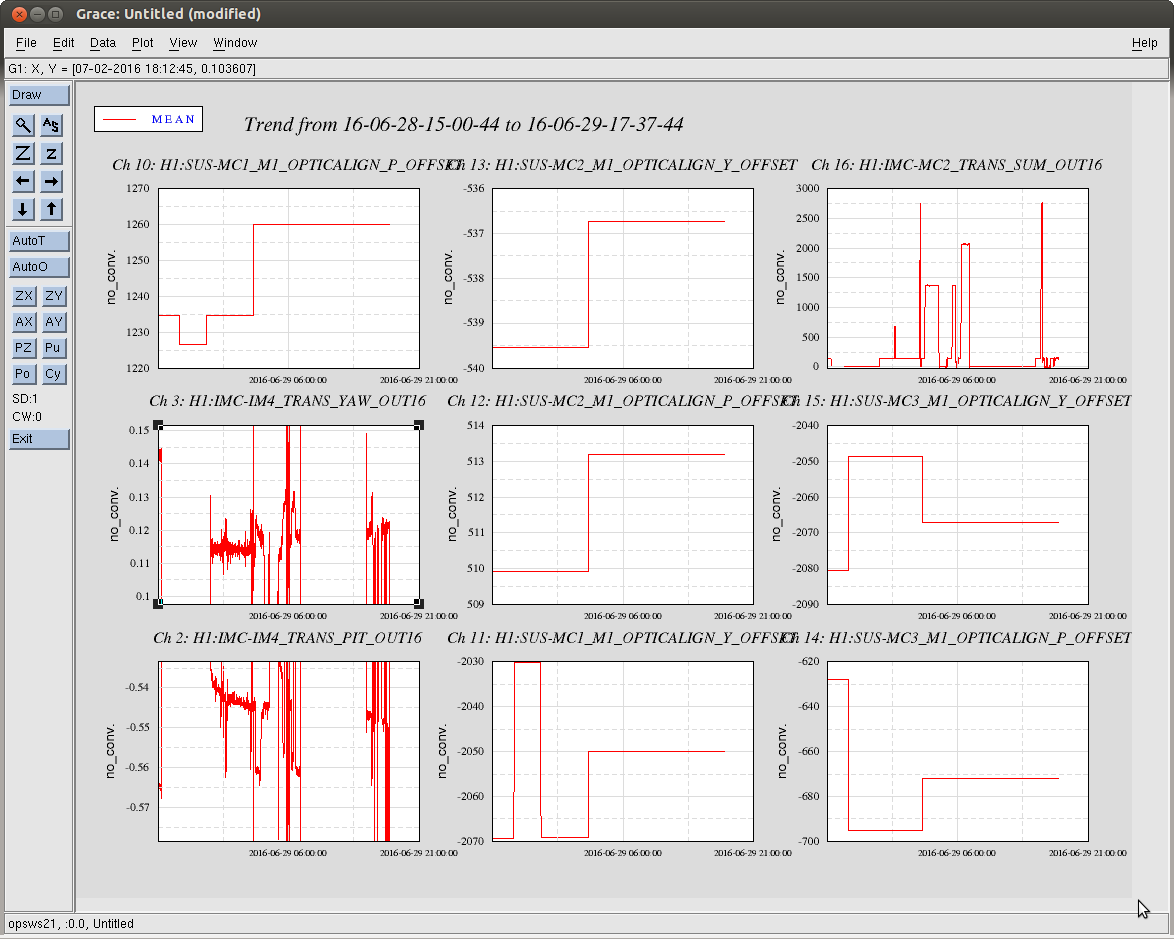
By the way the second attachment is trend of various channels during the test.

Images attached to this report
Comments related to this report
kiwamu.izumi@LIGO.ORG - 16:48, Friday 25 March 2016 (26261)

Actually, Hang pointed out that SRM and SR2 showed much more visible reactions in their alignment. See the attached.

In particular, SR2 pitch seems to trace the lensing curve.

Also, looking at PRM and PR2, we did not see drift or anything interesting.

Images attached to this comment
gabriele.vajente@LIGO.ORG - 09:13, Friday 25 March 2016 (26248)

A simulation  with substrate lensings as reported in the elog did not show a large variation of the cavity pole: about 1% or so. My suspect is that the change in differential lensing is causing the IFO working point to change: alignment or longitudinal offsets? In my simulation the longitudinal working point is obtained from simulated error signals, so I don't see any offset in the locking error signals.

aidan.brooks@LIGO.ORG - 11:43, Friday 25 March 2016 (26251)

The differential lens change is about 18 microdiopters. For what it's worth, there is ~2.3% of power scattered from the TEM00 mode on a double-pass through such a lens. Whether such a purely differential lens in the SRC would manifest solely as a 2.3% round-trip loss in the differential TEM00 mode of the arms is questionable. I still need to run the numbers for the effect on the DARM cavity pole if we simply added this loss to the SRM mirror.

kiwamu.izumi@LIGO.ORG - 16:15, Friday 25 March 2016 (26255)

Here are some more small points to note.

[Two cavity pole measurements]

At the beginning of the run before I started changing the CO2 power, I ran a Pcal swept sine measurement in order to get the cavity pole frequency. The DARM open loop was also measured within 10 minutes or so in order for us to be able to take out the loop suppression. In addition, I ran another pair of Pcal and DARM open loop measurements to double check the measurement. The attached below shows the transfer functions with fitting. The fitting was done with some weighted least square algorithm using LISO.

As shown in the plot, the shift in cavity pole is obvious. Also the optical gain is different between the two measurements.

[Evolution of the sensing function throughout the test]

The optical gain and cavity pole are negatively-correlated. The trend of the optical gain looks very similar to the one for the power recycling gain, but the variation in the optical is much larger-- the optical gain increased by 20 % at most relative to the beginning. As pointed out by Valera in the ISC call today, a fraction of the variation in the optical gain could be due to the OMC mode matching.

[Alignment drift]

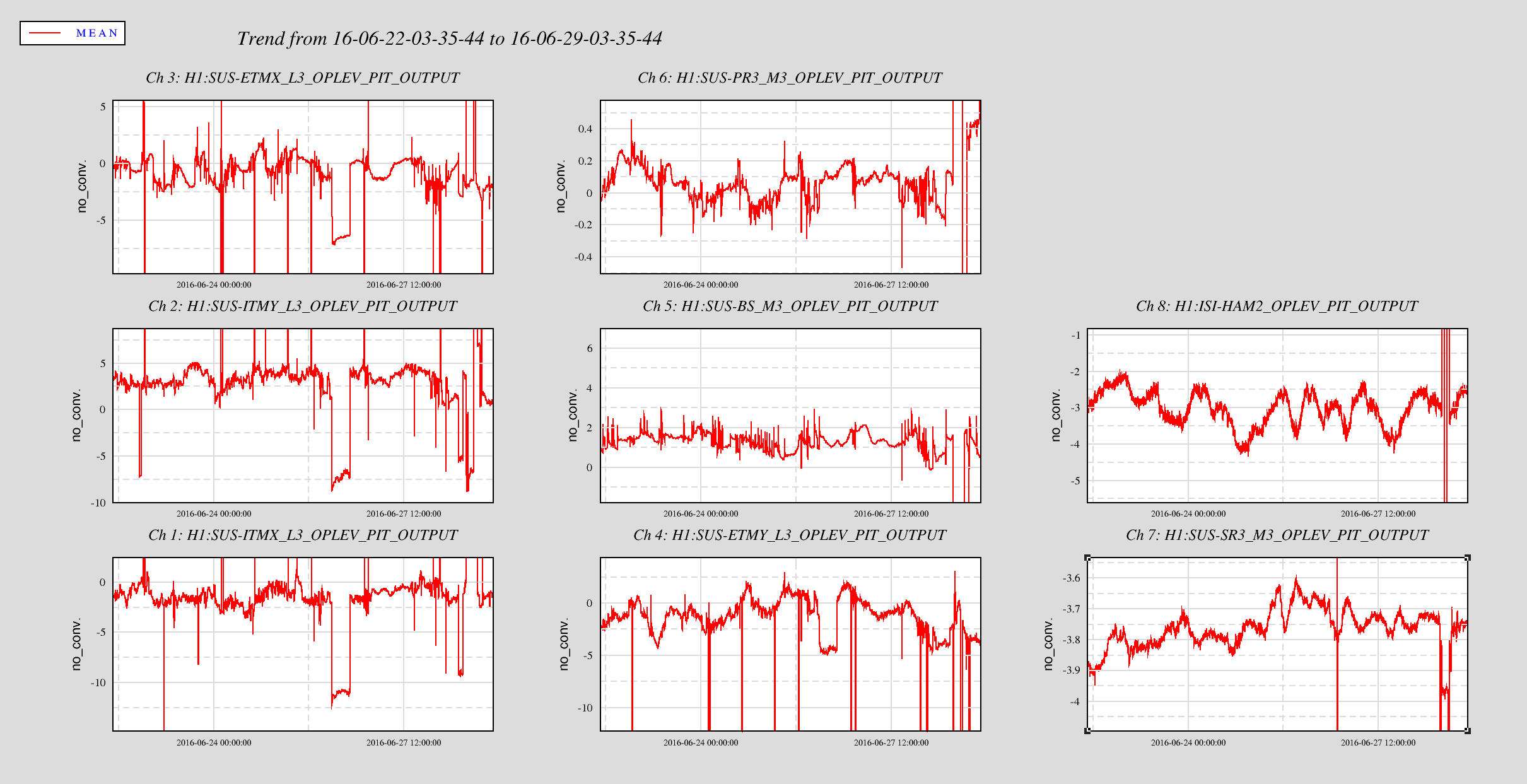
As Gabriele pointed out in the comment, it may be possible that the CO2 lasers affected the alignment of the interferometer and changed the amount of losses in some parts of the interferometer or introduced some other impact on the cavity pole. Hang and I have looked at trend of optical levers during the time.

There are two optics that seemingly reacted to the differential lensing, that are BS yaw and ETMX PIT. The showed a kink point at the time when the CO2 power changed. In addition, ETMY pit slowly drifted by 2 urad and ETMY yaw moved by 1-ish urad. Other large optics also moved but were within 1 urad. From a naive point of view, the alignment does seem to explain the behavior of the cavity pole going down and up during the measurement because none of them clearly showed a going-up-and-down type behavior. However, it is possible that the true misalignment was covered by drift of the oplev itself.


[Online cavity pole measurement]

The cavity pole was measured by injecting a line at 331.9 Hz at the DARM output. The DARM loop is notched out at the same frequency. The measurement method is described in 18436.

Images attached to this comment
gabriele.vajente@LIGO.ORG - 08:49, Monday 28 March 2016 (26279)

Some simulations I did months ago for the MIT commissioning meeting (https://dcc.ligo.org/LIGO-G1500593) showed that the cavity pole is very sensitive to SRC matching. I therefore expect the cavity pole to be also very sensitive to SRC alignment, as seems to be sugegsted by the SR* mirror drifts.

H1 General
edmond.merilh@LIGO.ORG - posted 19:21, Thursday 24 March 2016 (26244)
Shift Summary - Evening
TITLE: 03/25 Eve Shift: 00:00-08:00 UTC (16:00-00:00 PST), all times posted in UTC
STATE of H1: Planned Engineering
INCOMING OPERATOR: None
SHIFT SUMMARY:'No locking. Edited the Operator Wiki page to reflect the latest instructions for damping roll modes and added the appropriate Troubleshooting Links to the Locking page.
LOG:
Kiwamu has the IFO from the tme I got here and for the rest of the evening. Everyone except Nutsinee has left. I've been given the option which I will also exercise.
H1 TCS (GRD)
nutsinee.kijbunchoo@LIGO.ORG - posted 19:16, Thursday 24 March 2016 (26243)
Added HWS test items to DIAG_MAIN

Kiwamu, Nutsinee

------------------------------------------------------------------------------------------------------------------------------

Code added to line 115 - line 136

First test checks if the number of "peaks" measured by the HWS code makes sense. If below 800 -- not enough return SLED beam. If above 4096 (12 bit), something's wrong.

Second test checks if HWS code time stamp is correct compared to the actual GPS time. If |dt| > 15 seconds then the code must have stopped running.

------------------------------------------------------------------------------------------------------------------------------

@SYSDIAG.register_test
def TCS_HWS():
    #Make sure # of pixels are good
    pkcnts_X = ezca['TCS-ITMX_HWS_TOP100_PV']
    pkcnts_Y = ezca['TCS-ITMY_HWS_TOP100_PV']
    #If below 800 -- not enough return SLED light
    #If above 4096 -- above theoretical number (12 bit) -- something's wrong
    if not (pkcnts_X > 800) and (pkcnts_X < 4096):
       yield "HWSX Peak Counts BAD!!"
    if not (pkcnts_Y > 800) and (pkcnts_Y < 4096):
       yield "HWSY Peak Counts BAD!!"
    #Check if HWS GPS time agrees with current GPS time
    a = subprocess.Popen(['tconvert','now'], stdout = subprocess.PIPE)
    gpstime, err = a.communicate()
    gpsfloat = float(gpstime.strip(' '))
    #Fetch HWS GPS time
    liveGPS_X = ezca['TCS-ITMX_HWS_LIVE_ACQUISITION_GPSTIME']
    liveGPS_Y = ezca['TCS-ITMY_HWS_LIVE_ACQUISITION_GPSTIME']
    if np.abs(gpsfloat - liveGPS_X) > 15 :
    yield "HWSX Code Stopped Running"
    if np.abs(gpsfloat - liveGPS_Y) > 15:
    yield "HWSY Code Stopped Running"
 

H1 AOS (CDS, SEI)
krishna.venkateswara@LIGO.ORG - posted 18:18, Thursday 24 March 2016 - last comment - 14:43, Wednesday 27 April 2016(26242)
BRS-2 Installation DAY 1: Beam-balance suspended

Michael, Hugh, Krishna

A lot of progress was made with the installation of BRS-2 today. In the morning, we cleared out a space on the VEA floor. We had to slightly reposition the SEI ground seismometer (STS2) and the PEM Guralp seismometer. We then cleaned the BRS-2 vacuum can, foam box and other parts and moved them in. Upon opening the vacuum can, we noticed that the epoxy (TorrSeal) on one of the capacitor plates had come off, likely during the drive. We found a suitable alternative (Loctite 1c) and reattached the capacitor plate.

We the proceeded with the assembly. The beam-balance was pulled out, the flexures were carefully attached and the beam-balance was then reinserted into the can and suspended from the flexures. We did a crude adjustment of the horizontal center of mass. The vacuum can was then partially closed up and the autocollimator attached to it. We then had to realign the optics to get the reflections from the reference mirror and the main mirror algined well. Tomorrow we will continue with autocollimator adjustments to get good reflection patterns on the CCD.

In the meantime, Jim B and Carlos installed the BRS-2 Beckhoff computer at End Y. Also, Filiberto and Peter laid out the GiGE, Ethercat and Fiber-Optic (For the autocollimator light source) cables going from the VEA to the computer room.

Plan for tomorrow:

1. Get the C# code to read the CCD data and start measuring the tilt signal. At this point, the instrument is still in air, so will have excess noise and drifts.

2. Hook up the electronics for the capacitive control and the DACs for writing out the signals. Once the cables to go from these to the SEI Frontends is complete, the tilt data will be accessible to SEI.

3. Close up the rest of the vacuum can.

Comments related to this report
jeffrey.kissel@LIGO.ORG - 14:43, Wednesday 27 April 2016 (26825)INS
I attach a collection of pictures I took during this day's installation. I was primarily focused on pictures of the electronics readout system that's new for BRS 2.0, but there are also some pictures of the balance and vacuum can.

Let me know if you like and need any of the originals. 
For my record, the originals live on my laptop, in the folder 
/Users/kissel/Desktop/scratch/2016-03-24/
Non-image files attached to this comment
H1 CDS
patrick.thomas@LIGO.ORG - posted 17:00, Thursday 24 March 2016 (26241)
Updated Conlog channel list
Added 686 channels. Removed 526 channels. See attached.
All channels are now connected.
Non-image files attached to this report
LHO General
patrick.thomas@LIGO.ORG - posted 16:54, Thursday 24 March 2016 (26240)
Ops Day Shift Summary
14:59 UTC Karen and Christina to end Y
15:07 UTC Jeff B. to LVEA to check on dust monitors and cleanrooms
15:13 UTC Corey checking chillers
15:17 UTC Corey done
15:18 UTC Filiberto installing electronics outside of ISCT1
15:33 UTC Not making it past CHECK_IR. Starting initial alignment.
15:38 UTC Y arm intermittently losing lock on green. Going to 45 Mhz blends on both DOFs at end X and end Y per high microseisem.
15:42 UTC John and Chandra to LVEA to work on vacuum
15:42 UTC Filiberto done
15:48 UTC Hugh, Krishna and Michael starting BRS install at end Y, opening rollup doors (WP 5789)
15:53 UTC Adjusting PR3 to improve COMM beatnote. Y arm still intermittently losing lock on green.
15:55 UTC Jeff B. done
15:59 UTC Can't seem to improve COMM beatnote above 3.8 with PR3. Moving on.
16:24 UTC Done initial alignment.
16:31 UTC Y arm VCO is hitting low limit?
16:40 UTC Jeff B. to HAM6 and beer garden
16:42 UTC Setting end Y ISI blends back to 90 mHz per people walking around in VEA
16:49 UTC Jeff B. done
17:03 UTC Jeff B. to end X and end Y, briefly in VEA at each
17:09 UTC John and Chandra done
17:16 UTC Truck to pickup item from Christina at gate, directed to LSB
17:16 UTC Jason to optics lab to look for part
17:36 UTC Jason back
17:48 UTC Jeff B. back
17:55 UTC Betsy to cleaning area
17:56 UTC Nutsinee to LVEA to look in cabinets
18:11 UTC Nutsinee done
18:13 UTC Terra and Nutsinee to end Y
18:24 UTC Filiberto to end Y to check on cabling requirements
18:41 UTC Filiberto, Hugh, Krishna and Michael back
18:43 UTC Putting IFO_LOCK to down
18:53 UTC Terra and Nutsinee back, did nothing
19:07 UTC Dave, Jim and Carlos to end Y to install BRS computer
19:38 UTC DAQ restart
19:39 UTC Filiberto to end Y to pull cables for BRS
20:14 UTC Filiberto and Peter to end Y
21:58 UTC Kiwamu attempting to lock
21:59 UTC Brynley to electronics bay to look at LEDs
22:05 UTC Brynley back
22:40 UTC Carlos changing vlan for DMT switch in MSR
22:49 UTC Dave shutting down fw0
22:55 UTC Kiwamu giving up on locking. Will lock simple Michelson to measure contrast defect.

Jim B., Carlos, Dave:
Installation of BRS computer at end Y
New PI model on LSC frontend, h1omcpi
Updates to susitmpi, susetmxpi, susetmypi
DAQ restart to add h1omcpi model
H1 General
edmond.merilh@LIGO.ORG - posted 16:11, Thursday 24 March 2016 (26238)
Shift Summary - Evening Transition
TITLE: 03/24 Eve Shift: 00:00-08:00 UTC (16:00-00:00 PST), all times posted in UTC
STATE of H1: Planned Engineering
OUTGOING OPERATOR: Patrick
CURRENT ENVIRONMENT:
    Wind: 31mph Gusts, 19mph 5min avg
    Primary useism: 0.25 μm/s
    Secondary useism: 0.75 μm/s 
QUICK SUMMARY:
H1 TCS (TCS)
aidan.brooks@LIGO.ORG - posted 14:51, Thursday 24 March 2016 (26237)
HWSX glitch investigation

I investigated the HWS glitching issue in more detail. I ran the following tests to try to reproduce the glitching seen previously:

  1. Run each camera individually with the take command (number of ring buffers = 4): no glitching
  2. Run each camera individually with the take command (number of ring buffers = 1): no glitching
  3. Run both cameras at the same time with the take command (number of ring buffers = 1): no glitching
  4. Run both cameras at the same time with the take command (number of ring buffers = 4): no glitching
  5. Run both Run_HWS_ITMX and Run_HWS_ITMY at the same time: no glitching

Since we couldn't reproduce the glitching after everything restarted, Kiwamu and I decided that we create some Guardian diagnostics to run continuously on the HWS data. The following channels will be monitored and will issue warning in the case of aberrant behaviour:

H1 AOS
david.barker@LIGO.ORG - posted 14:02, Thursday 24 March 2016 - last comment - 16:16, Thursday 24 March 2016(26236)
new h1omcpi model installed, new code for sus pi, daq restart and h1fw0 instability

Daniel, Terra, Jim, Dave WP5790

A new model was installed on the final core of the h1lsc0 front end machine. Its name is h1omcpi, dcuid=9, rate = 64kHz.

A PI_MASTER.mdl file change was also made.

The new h1omcpi model was installed and started. The h1susitmpi, h1susetmxpi and h1susetmypi models were rebuild and restarted. The DAQ was restarted.

Unfortunately this precipitated an instability in h1fw0 which we are investigating.

Comments related to this report
david.barker@LIGO.ORG - 16:16, Thursday 24 March 2016 (26239)

h1fw0 continued to be unstable. First I power cycled h1fw0 but this did not help. Then I powered down h1fw0 and h1ldasgw0 (in that sequence). When I powered up h1ldasgw0 it went through an extensive set of startup diagnostics. I then had to manually mount the QFS file system and NFS export it. Finally I powered up h1fw0. Its been running for 5 minutes, so too early to tell if we have fixed this.

H1 CAL
kiwamu.izumi@LIGO.ORG - posted 11:19, Thursday 24 March 2016 - last comment - 18:36, Friday 01 April 2016(26229)
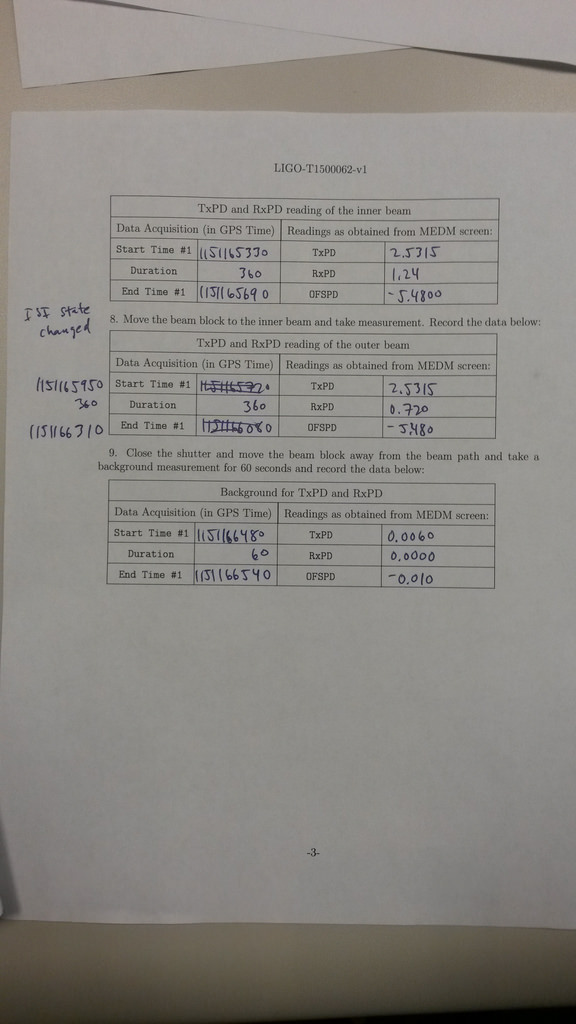
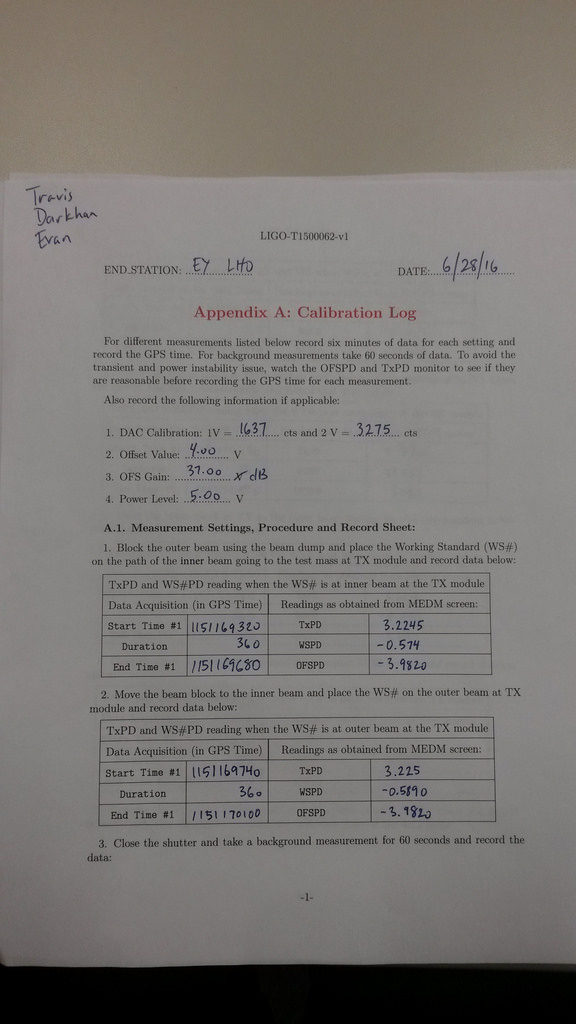
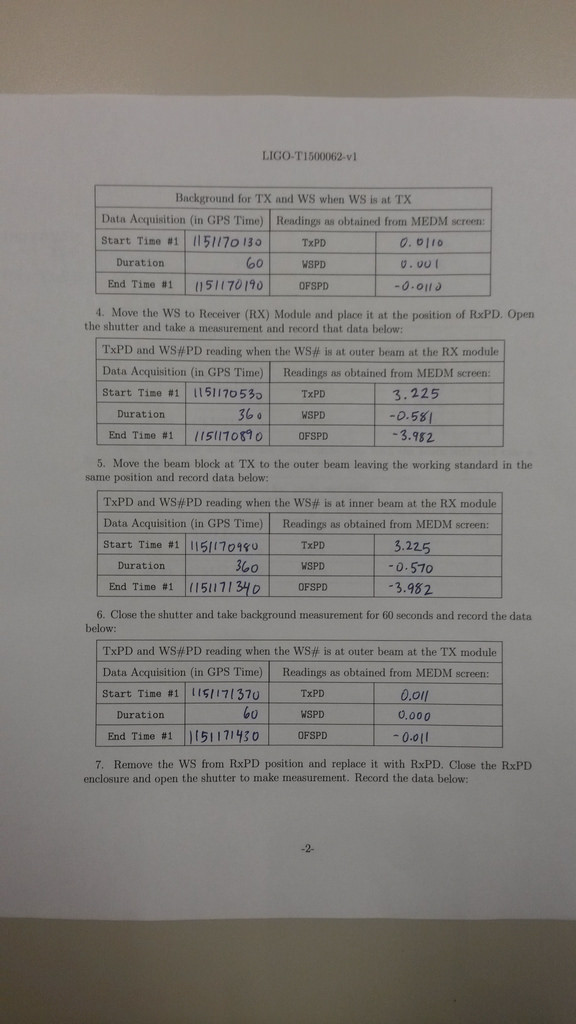
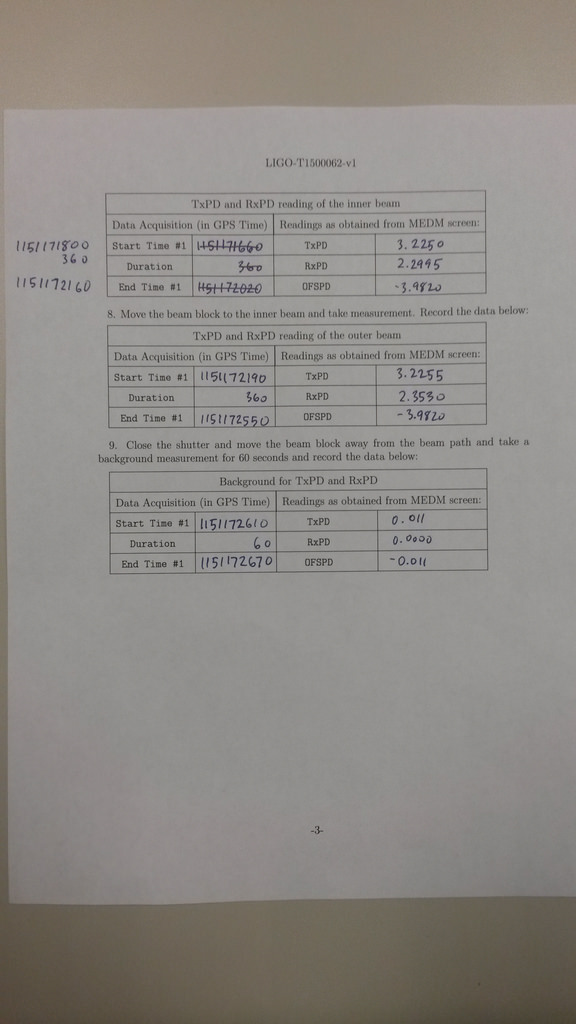
Pcal Y optical follower servo not functioning

Darkhan, Kiwamu,

We found that the optical follower servo (aka OFS) for the Pcal Y had stopped running. Pressing around some buttons on the medm screen, we could not make it back up running. We are suspecting some kind of hardware issue at the moment. According to trend data, it seems that it stopped running at around 18:30 UTC on Mar 18th for some reason. We will take a look at the hardware in the next Tuesday during the maintenance period.

Comments related to this report
jeffrey.kissel@LIGO.ORG - 18:36, Friday 01 April 2016 (26406)AOS
J. Kissel, E. Hall, [R. Savage via remote communication at LLO]

This was re-discovered again tonight. 
Opened FRS ticket #5241 so we don't forget. 
Email sent to E. Goetz and T. Sadecki suggesting they address on Monday 4/4.

Further information from our re-discovery:
Looks like Kiwamu had left the calibration line amplitude in a low / off state. We restored the line amplitudes to nominal, and it caused excess noise in the DARM spectrum (lots of lines, a little bit of elevated noise floor).
We don't see any sine-wave-like excitation in the OFS, TX, or RX PDs with a single calibration line on at reasonable amplitude (which is contradictory to elevated noise in DARM).
Rick suggests:
- Check the AOM.
- Check the shutter.
- Check that the laser hasn't tripped.


H1 TCS
kiwamu.izumi@LIGO.ORG - posted 11:09, Thursday 24 March 2016 (26228)
CO2 preloading test, cavity pole decreased to 300 Hz

Related alogs: 25932 and its comment

Yesterday, we started the preloading test. The CO2 lasers now have an additional common power of about 250 mW, corresponding to an additional common substrate lensing of roughly 31 uD.

Two major conclusions so far:

We need to decide what optimization we need to for this common lensiong. For testing purpose, we will keep running with this pre-loaded configuration for lock acquisition and for full lock with 2 W PSL.

Images attached to this report
LHO VE
chandra.romel@LIGO.ORG - posted 10:32, Thursday 24 March 2016 (26233)
Diagonal annuli pressures
After vent test, current pressures at aux carts:

HAM 7/8:    2e-5 Torr
HAM 9:      3e-5 Torr
HAM 11/12:  4e-5 Torr

Continue to monitor pressures to detect any potential outer oring leaks.
H1 PSL (PSL)
corey.gray@LIGO.ORG - posted 08:23, Thursday 24 March 2016 - last comment - 12:10, Thursday 24 March 2016(26227)
Weekly PSL Chiller Reservoir Top-Off

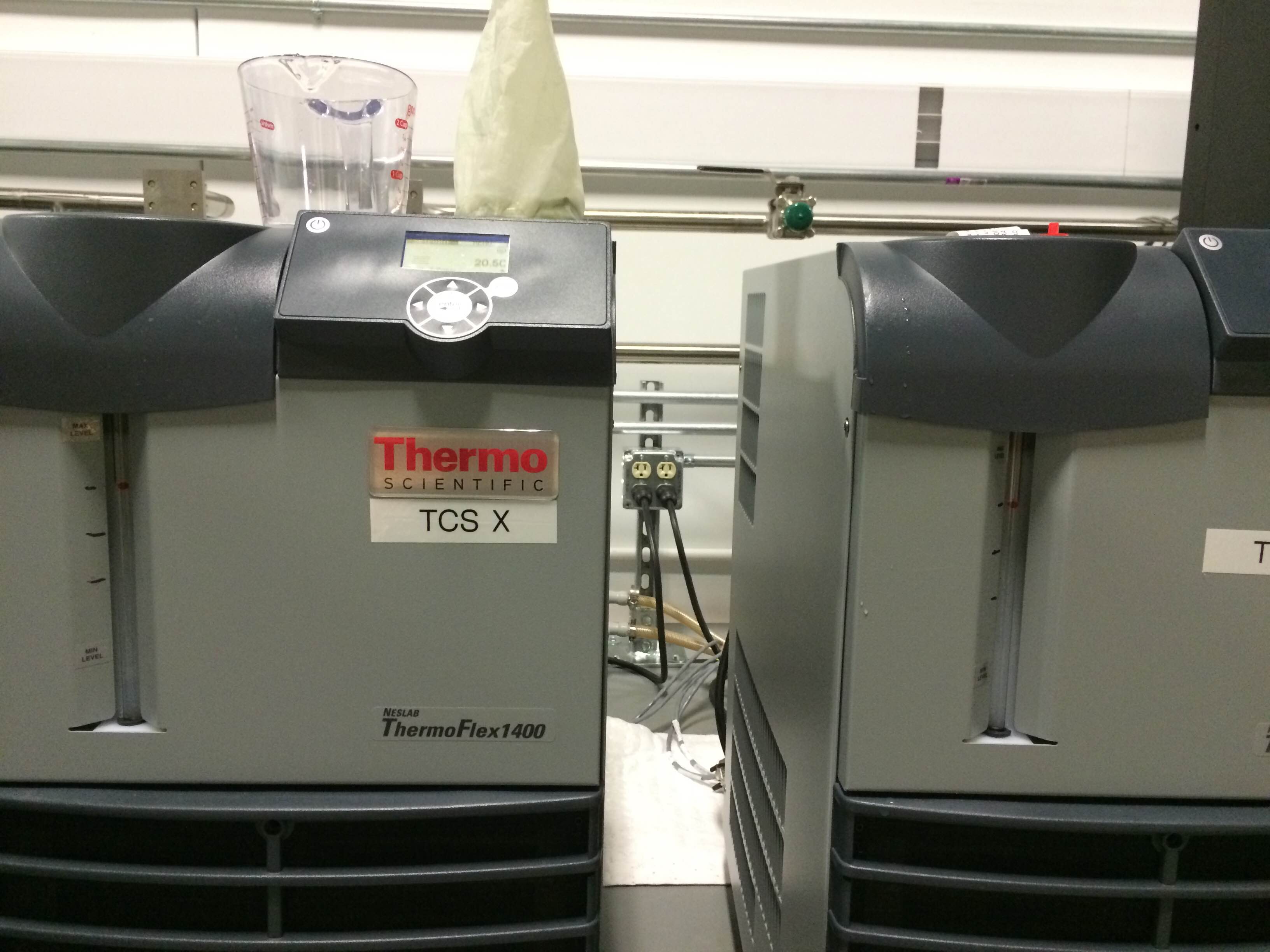
Checked the PSL Chillers per FAMIS#4143.  

Comments related to this report
edmond.merilh@LIGO.ORG - 10:15, Thursday 24 March 2016 (26230)

Aoplogies; I went in to do my weekly reset of the FE Watchdog last night and on my way out i noticed that the Xtal chiller level was at minimum so I added 250ml to bring it upo to the max line. I neglected to aLog this.

jason.oberling@LIGO.ORG - 12:10, Thursday 24 March 2016 (26235)

120mL seems like a good bit of water for only an ~12 hour period.  It's conceivable that Ed would have had to add 250mL Wednesday night since we did fix a water leak on Tuesday and had to drain the laser head circuit in order to do so.  We had to add more water to the chiller to get it operational, but only added enough to do this (was not topped off).  Corey having to add 120mL the next morning is somewhat concerning.

I have attached 3 and 7 day trends of the relative humidity of the HPO box and the PSL enclosure laser room.  Our activity on Tuesday is obvious, and once we put the lid back on the HPO box the RH slowly increased (over the course of ~17 hours) in the box until it reached its previous level.  I see nothing that to me obviously indicates that we have a bad water leak, although the slow RH increase in the HPO box could indicate we still have a slow water leak.  Will continue to monitor.

Images attached to this comment
H1 SEI
jim.warner@LIGO.ORG - posted 16:00, Wednesday 23 March 2016 - last comment - 09:00, Friday 25 March 2016(26221)
HAM 4&5 ISI feedforward revisited

Following the grouting of the HAM5&6 HEPI piers, and in light of JeffK's work untangling my designs (in LHO alog 26002), I wanted to review the design of the HAM 4/5 S0-1 feedforward. To do this I took a new set of measurements for HAM's 4 and 5 so I could see how similar the different transfer functions were. The measurements I took were: the transmissibility from the FF L4Cs on St0 to the St1 GS13s with the ISI in both damped and isolated states, and the actuator to GS13 tfs in both the isolated and damped states. I got all 24 measurments for HAM4, but I only got the all of the Z measurements for HAM5, so I looked at that dof filter design.

Jumping straight to the punchline (first plot, calibrated ground and GS13 spectra for HAM4) I have a new Z FF filter that does a lot better and makes more sense, installed on HAMs 4&5, and I'm working on similar redesigns for the remaining dofs. The two traces to really look at are brown and light blue, the GS13 measured displacement with the old and new FF filters. Compared to dark blue (FF off), the old FF filter mostly improved motion between 20 and 30 hz and only worked well with a gain of .5, something I couldn't explain when I installed it. The new filter works better from a few hz to almost 60 hz.

The second plot is the transmissibilties for HAM 4 (blue) and 5 (green) in both damped (solid) and isolated(dashed) states. The damped states are very similar, though I'm not sure why there is a gain difference. The Isolated tf's are more different, but probably it's probably due to some differences in the feedback loops, I should probably take a look at that.

The third plot is the stiffness tf, color key is the same, HAM 4 (blue) and 5 (green) in both damped (solid) and isolated(dashed) states. Again the damped states are similar, the isolated measurments are a little more different. Importantly, the differences are consistent with the transmissibility measurements, which means the filter design ends up looking the same between the chambers, as shown in my next plot.

The fourth plot is the ideal filter design for HAMs 4&5. This is done following the process outlined in JeffK's 26002 alog, where the ideal filter is roughly speaking the transmissibility over the stiffness. One of the other things I wanted to look at was  what state the ISI needed to be in when designing the filter, as I thought that I had found in the past that the ISI needed to be isolated for both the transmissibility measurment and the stiffness measurement. It looks like it doesn't much matter as far as the final filter design is concerned. The isolated design is a little different at a few hz, though it's hard to see because the data is crappy. The data is much cleaner with the damped transfer functions. UGF's for this loop are on the order of 35hz, so feedback is not doing a lot at 10 hz, that probably explains why the isolated and damped filters end up looking the same, and why they differ more at lower frequency. Also nice to see that the filters for HAM 4 & 5 should be the same, regardless of the either ISI's state. The cleaner data for the damped configuration is a strong argument for using that configuration for my future redesigns.

The fifth plot is a comparison of the HAM4 ideal filters(blue and green), the old filter (red), and the new filter (black). You can see that the black line matches green and blue very well between 10 and ~40 hz, but red only matches well in phase right at about 25 hz. This explains why the old filter only did well at 20-30hz. The gain mismatch at 25hz also explains why the old filter needed a gain of .5 to work. The new filter works well from a few hz up to almost 60 hz, with a gain of 1.

I still have my data and the script that I used for the orginal design, Jeff rehashes it in his log. I still don't understand the differences, what I screwed up originally. I think the approach used both times was the same, but I clearly did something wrong the first time around. I'm in the process of repeating this for the other dofs.


The last plot is HAM5, comparing the old FF filter to the new. Red, blue green are with the new filter, brown, pink and light blue are with the old filter.

Images attached to this report
Comments related to this report
jim.warner@LIGO.ORG - 09:00, Friday 25 March 2016 (26247)

I've look at all dofs now, X&Y needed to be redone as well, but the filter ended up just looking like the Z filter with a different gain. Attached are gnd STS, FF L4C and ST1 GS13 spectra show the performance before and after for both HAMs in X&Y. Solid lines are after, dashed are before. Similar to Z, these dofs show marked improvement. I've started this process with HAM2, which will likely apply to 3&6 as well, but those chambers use the HEPI L4Cs and the coherence isn't as good.

Images attached to this comment
H1 TCS
kiwamu.izumi@LIGO.ORG - posted 02:23, Tuesday 22 March 2016 - last comment - 11:24, Thursday 24 March 2016(26185)
An overnight measurement with ITMY ring heater

ITMY ring heater was left on for an overnight measurement. The upper and lower segments of the ring heater were set to 1 W (i.e. 2W in total). The interferometer is aligned but in the down state. I started the HWS codes on h1hwsmsr because they were not running. I have not updated the reference images for the HWS codes this time. Therefore they use whatever the reference images that are in ~/temp/. The ring heater will be automatically switched off at around 6 am in local time by a script running on opsws4.

Comments related to this report
aidan.brooks@LIGO.ORG - 10:40, Tuesday 22 March 2016 (26190)

The HWS code should have been running in a single tmux session containing two windows. Clearly this is too easy to circumvent. I'll talk to Jamie about seeing if we can get this set up as a daemon process instead with the new version of the code.

kiwamu.izumi@LIGO.ORG - 11:24, Thursday 24 March 2016 (26234)

JimB and I are working on this issue at the moment. We are trying to get rid of tmux sessions by implenting monit. As of yesterday, we succeeded in running the hartman codes under the managmenet of monit. The implementation is still underway and about 80% done at the moment.

Displaying reports 60881-60900 of 86427.Go to page Start 3041 3042 3043 3044 3045 3046 3047 3048 3049 End