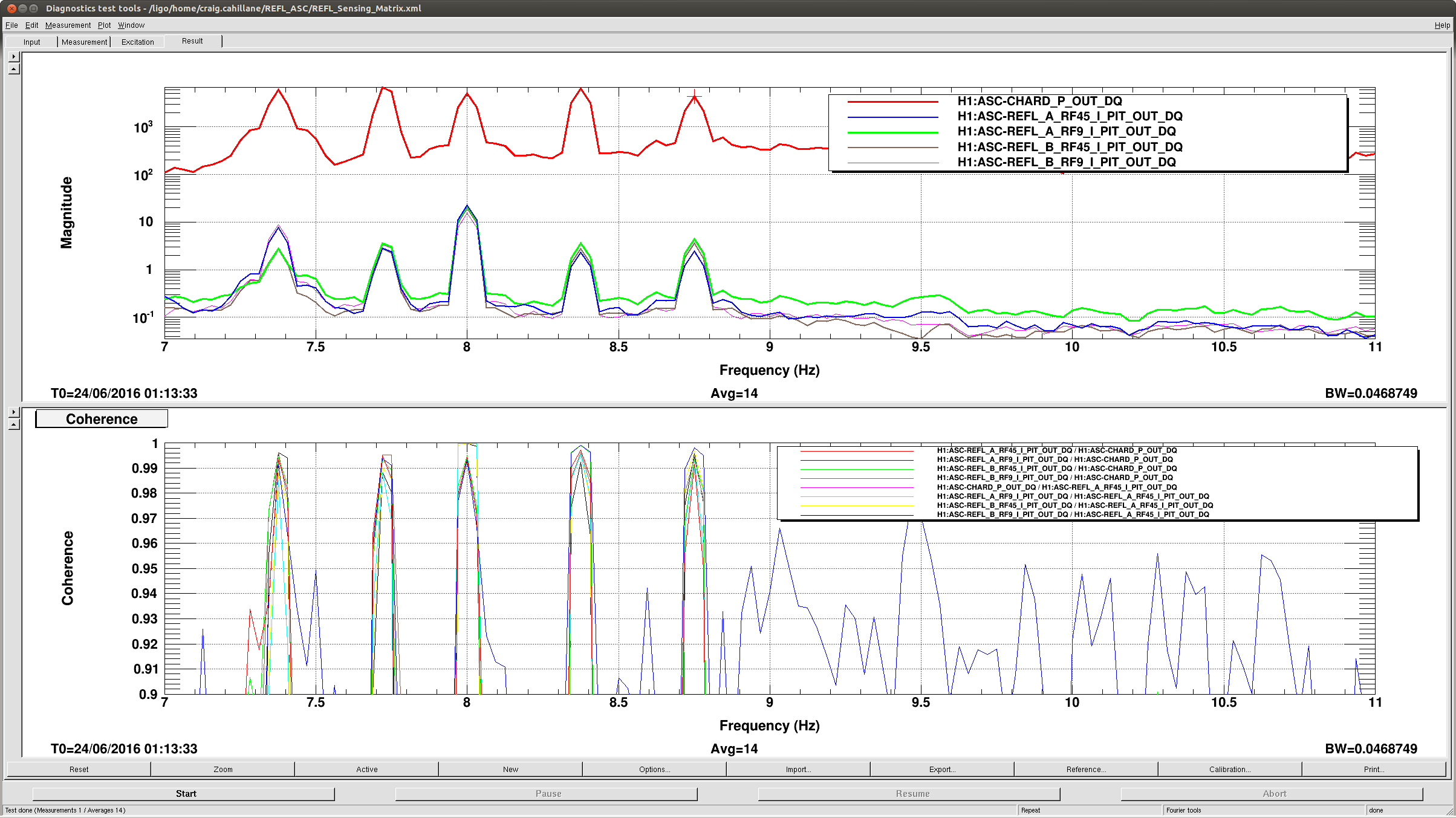
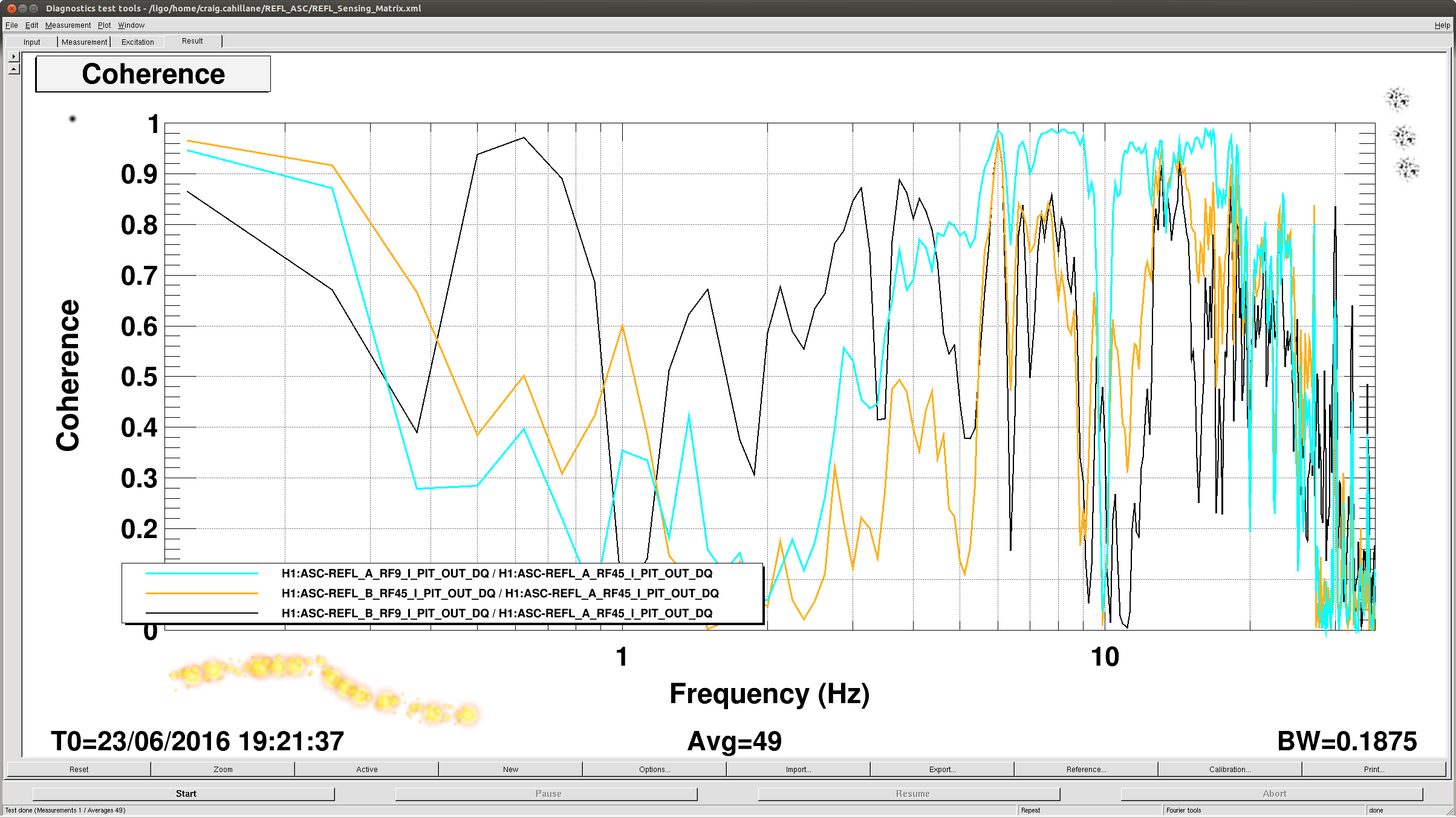
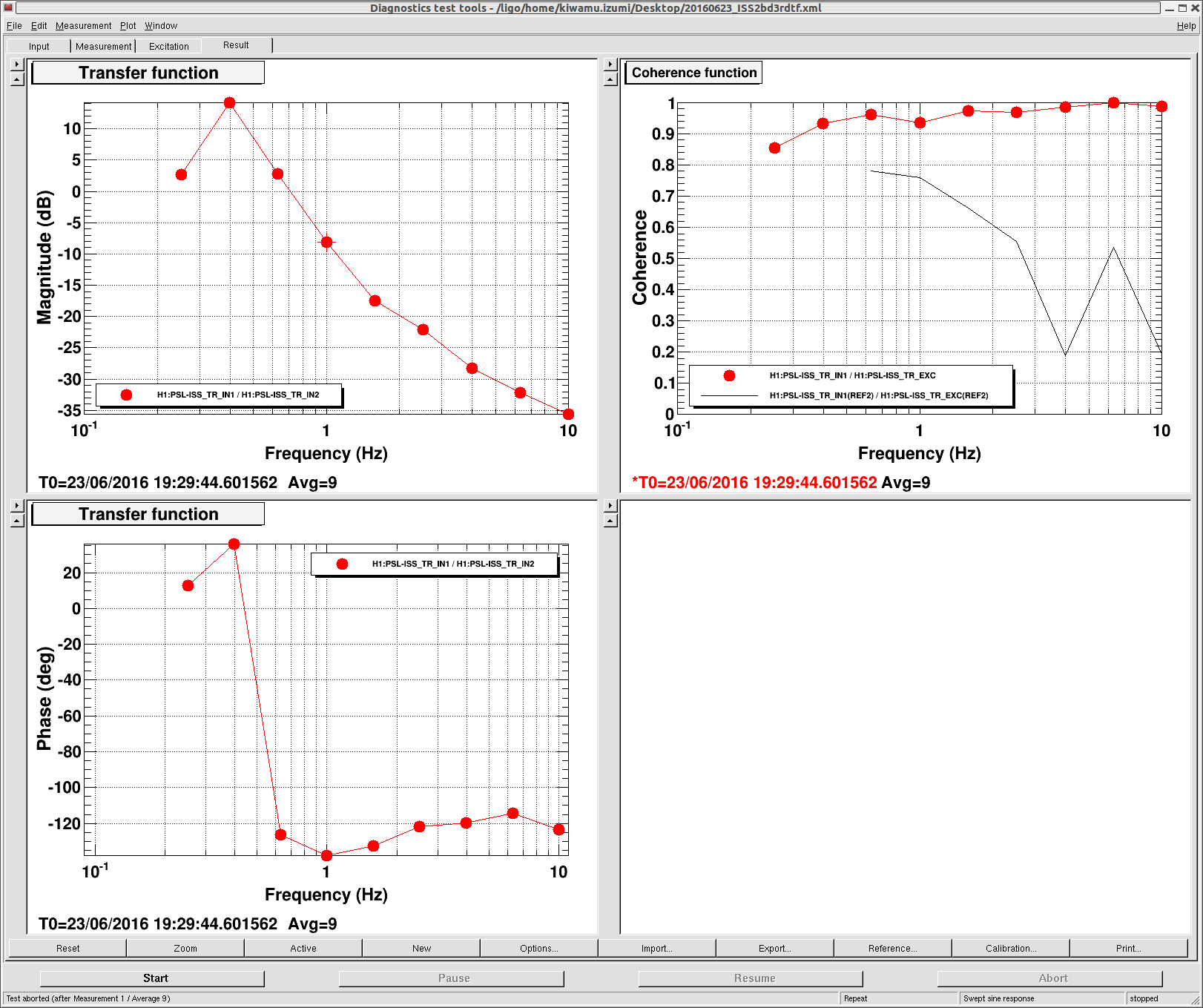
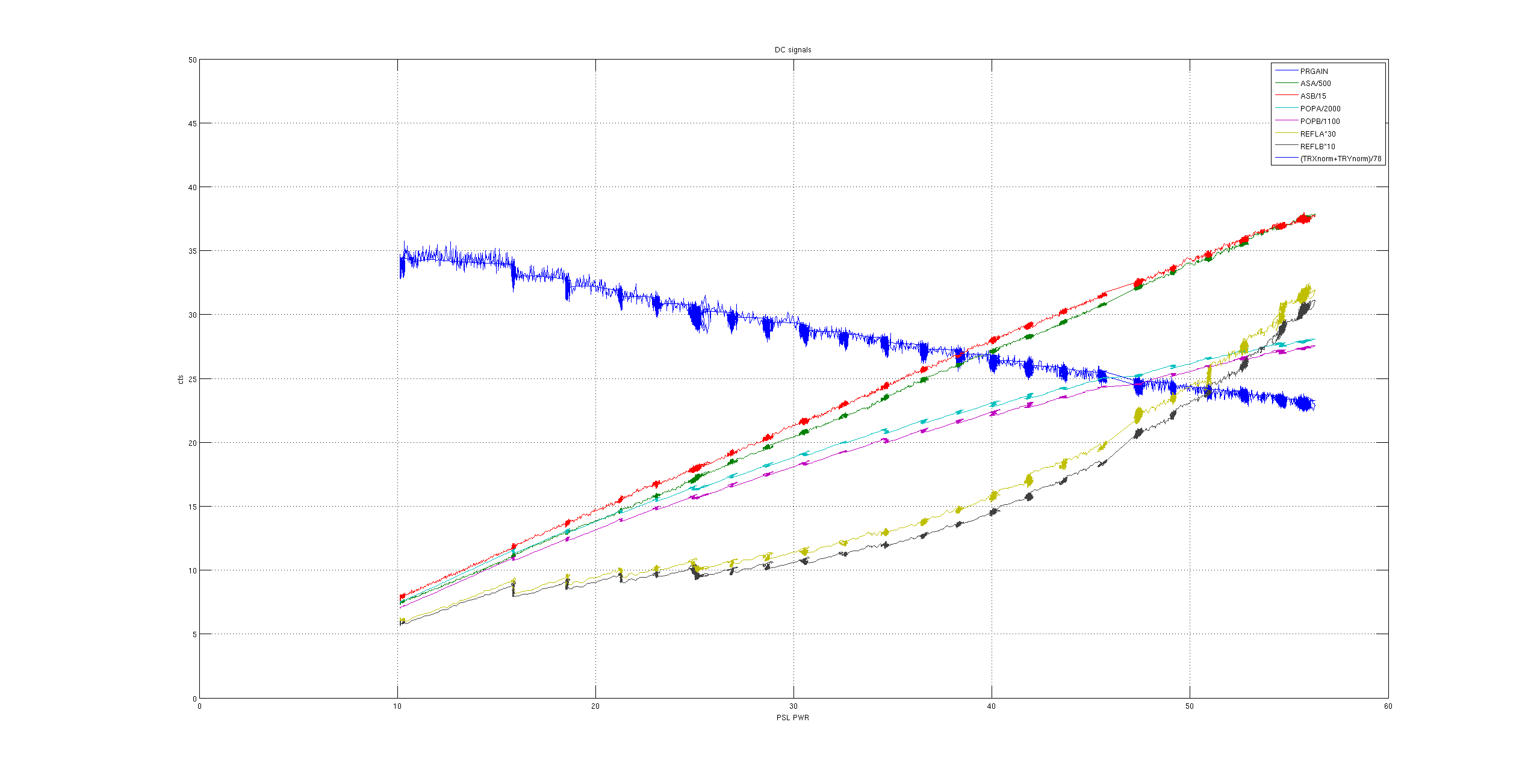
Krishna, Michael This morning we stopped pumping on the BRS-2 to add a ~0.57 g washer to the top of the balance which shifted the COM up by ~10 microns. We then resumed pumping and remeasured the transfer function using the piezo stacks we installed yesterday. The attached plot shows the results of the measurements along with the model assuming d=0 microns and d=+/-1 microns. Plan for tomorrow: 1. Stop pumping with cart and switch to ion pump 2. Remove piezo stacks 3. Install thermal insulation
Changing the Section to SEI and tagging SEI in this. Let us take a second to appreciate this entry (and its companion, LHO aLOG 26298) -- The new-and-improved measurement technique is precise enough to measure the "d," (the separation between suspension point and center of mass) to better than a 1 [um] (recall that with BRS1 we were only able to get -35 +/- 5 microns; see e.g. LHO aLOG 13563)! That means we'll get excellent translation rejection from this rotation sensor. Nice work gents!
Vern, Fil, Nutsinee
From the rotation stage random walk study we found that CO2Y rotation stage is off by ~30 deg when it's not behaving properly. Today we did some more test to narrow down the source of the problem and attempted to fix the problem. Turns out swapping out the rotation stage isn't as straight forward as I first thought so we went for less complicated approaches.
First we went out to the Ethercat chassis and look at the CO2Y rotation stage signal with an oscillascope while running the random walk script. The signal looked fine (Vern has the data saved in a floppy disk).
Then we swapped the sensing and motor cables such that CO2X software controls CO2Y rotation stage and CO2Y software controls CO2X rotation stage. This time CO2Y rotation stage behaved nicely and CO2X jumped. Attachment 1 shows CO2Y requested angle vs. measured angle and the differences. The data took after cable swap is plotted in cyan. Attachment 2 shows the same thing for CO2X. The jumpy red plot is the CO2X rotation stage data took after the cable swap (controlled by CO2Y software). Attachment 3 is CO2 power plotted against the requested angles. We concluded that the problem must be related to the software.
We planned to replace two things in the chassis: the CO2Y interface card (D1300131) and the dual motor controller (EL7342). After swapping the cables back in place, we replaced the CO2Y interface card (only). We also found lose connections in many places inside the chassis while doing the work so next Tuesday that chassis gonna have to come down so Fil can take a closer look. Anyway, swapping the interface card seems to have made the problem worse. Both rotation stages are now very jumpy, they have trouble going to negative requsted angles, and the measured angle goes beyond +-90 degrees. We were able to put the both CO2 power back to where they were before we started our work this morning but I wouldn't commission them at this point. The work is to be continued.
Note, for the record (and for the future), this ethercat chassis controls the PSL/IO rotation stage as well, so this work mucked with it as well which was surprising to the control room at the time. Now we know.
Today, I was planning to introduce the LASER_PWR Guardian node and the management changes in ISC_LOCK and ALIGN_IFO that would go along with it, but maintenance day got in the way. The LASER_PWR node seemed to work well and I thought I ironed out the small issues I had with the management, but I had not made it all the way through initial alignment before front ends started crashing and the PSL went down. I reverted to the copies in the svn just before I began my work (I committed before I started in case something like this happened), and it seems to all be back to mornal.
I'm leaving the LASER_PWR node alive, but stopped.
WP 5799 FR 4694 (PKA II 1193)
Continuing the offload of SUS calculating the SUSPOINT motion from ISI GS13 cartesian motion, this has ISI doing the calculating. We'll stop the SUS doing the calcs as soon as we confirm that DetChar is happy with the ISI numbers.
All the HAM models were rebuilt & installed and FrontEnds restarted. safe and OBSERVE.snaps were checked and updated (lots of new channels.)
No issues with HAM ISIs reisolating.
Medm editing is ongoing for the SUSPOINT. Each medm is custom for the number of suspensions. HAM6 and HAM2 still need to be built.
Along these lines, the BSC Models were adjusted to put the SUSPOINT on IPC and at ENDY, the BRS was added as at ETMX.
SVN COMMITS:
hugh.radkins@opsws1:models 0$ svn commit -m "HAM SUSPOINT calcs moved to ISI and BSC SUSPOINT calcs added to IPC and BRS at ETMY"
Sending models/h1isibs.mdl
Sending models/h1isietmx.mdl
Sending models/h1isietmy.mdl
Sending models/h1isiham2.mdl
Sending models/h1isiham3.mdl
Sending models/h1isiham4.mdl
Sending models/h1isiham5.mdl
Sending models/h1isiham6.mdl
Sending models/h1isiitmx.mdl
Sending models/h1isiitmy.mdl
Transmitting file data ..........
Committed revision 12961.
hugh.radkins@opsws1:models 0$ pwd
/opt/rtcds/userapps/release/isi/h1/models
hugh.radkins@opsws1:hamisi 0$ svn commit -m "Added suspension OPTICs for medm generation"
Sending hamisi/H1_isiham2_overview_macro.txt
Sending hamisi/H1_isiham3_overview_macro.txt
Sending hamisi/H1_isiham4_overview_macro.txt
Sending hamisi/H1_isiham5_overview_macro.txt
Sending hamisi/H1_isiham6_overview_macro.txt
Transmitting file data .....
Committed revision 12962.
hugh.radkins@opsws1:hamisi 0$ pwd
/opt/rtcds/userapps/release/isi/h1/medm/hamisi
hugh.radkins@opsws1:burtfiles 0$ svn commit -m "Update snaps for SUSPOINT & commissioning"
Sending burtfiles/h1isibs_down.snap
Sending burtfiles/h1isibs_safe.snap
Sending burtfiles/h1isietmx_safe.snap
Sending burtfiles/h1isietmy_OBSERVE.snap
Sending burtfiles/h1isietmy_safe.snap
Sending burtfiles/h1isiham2_safe.snap
Sending burtfiles/h1isiham3_safe.snap
Sending burtfiles/h1isiham4_OBSERVE.snap
Sending burtfiles/h1isiham4_safe.snap
Sending burtfiles/h1isiham5_OBSERVE.snap
Sending burtfiles/h1isiham5_safe.snap
Sending burtfiles/h1isiham6_safe.snap
Sending burtfiles/h1isiitmx_safe.snap
Sending burtfiles/h1isiitmy_OBSERVE.snap
Sending burtfiles/h1isiitmy_safe.snap
Transmitting file data ...............
Committed revision 12963.
hugh.radkins@opsws1:burtfiles 0$ pwd
/opt/rtcds/userapps/release/isi/h1/burtfiles
I'll commit the medm adls once I'm finished with them.
A full description of the changes committed about can be found in G1600795.
J. Kissel, B. Weaver, H. Radkins, D. Barker, J. Batch Here's a list of all of the upgrades we were involved in today. There will be more details of the upgrade, more debugging, associated MEDM screen changes, svn commits, and other clean up tomorrow as we continue to explore what we've installed and debug. Bear with us, and thanks for your patience. 1) Fixed UIM coil driver path's automatic compensation bug by updating CD_STATE_MACHINE.c. See Int. Issue 1178. 2) Installed ISI GS13's projection to SUSPOINT Euler basis projection into the SEI models. See ECR E1600028. 3) Sent the Euler Basis Longitudinal DOF for each SUS involved in a cavity over various IPC (PCIE and RFM) and models (ISI, End-station PEM, H1OAF) to be collected in OAF. See ECR E1600028. 8) Removed the excess RFM channels from End-Station ALS models (noteably *not* the excess channels in the ISC models). This made room for 3). See LHO aLOG 25216 4) Added various rotational sensor correction paths to the BSC ISIs (GND BRS to ST1, and ST1 to ST2). (Prototyping, this stuff, no ECRs just yet) 5) Removed the L4C sensor correction path. See SEI aLOG 666 6) Added new infrastructure for the EY BRS. (Most Copied from EX, covered by ECR E1500246) 7) Reverted the BSC SUS's coil driver monitors to store the NOISEMON in the frames (and pushed the FASTIMON to the commissioning frames). Also, we put filter modules in front of the NOISEMONs (like was done for the FASTIMONs the last time we touched this) in case we ever wish to calibrate them. See ECR E1600033 and LHO aLOG 26313 Because we haven't built MEDM screens and actually *used* any of these paths yet, there's still potential for bugs and we haven't explored and/or fixed all of the collateral damage. Stay tuned as we continue to work on all of these updates tomorrow.
J. Kissel I've documented all of the front-end model changes that were necessary for items 2, 3, 5, 6, and 7 (i.e. all of the SEI model changes). Check out G1600795. As indicated in LHO aLOG 26321, all of the simulink model changes have been committed to the repository.
J. Kissel, H. Radkins Here're the updated MEDM screens that correspond to the above SEI model updates. I'll work on the Cavity Basis OAF MEDM screen tomorrow. The following screens where changed and/or added: /opt/rtcds/userapps/release/isi/common/medm/bscisi A ISI_CUST_CHAMBER_ST1_ROT_SENSCOR_FIR_ALL.adl A ISI_CUST_CHAMBER_ST1_ROT_SENSCOR_IIRHP_ALL.adl A ISI_CUST_CHAMBER_ST1_ROT_SENSCOR_MATCH_ALL.adl A ISI_CUST_CHAMBER_ST2_ROT_SENSCOR_FIR_ALL.adl A ISI_CUST_CHAMBER_ST2_ROT_SENSCOR_IIRHP_ALL.adl A ISI_CUST_CHAMBER_ST2_ROT_SENSCOR_MATCH_ALL.adl Sending ISI_CUST_CHAMBER_ST1_SENSCOR_OVERVIEW.adl Sending ISI_CUST_CHAMBER_ST2_SENSCOR_OVERVIEW.adl Sending ISI_CUST_CHAMBER_OVERVIEW.adl=
TITLE: 03/29 Day Shift: 16:00-00:00 UTC (08:00-16:00 PST), all times posted in UTC
STATE of H1: Planned Engineering
INCOMING OPERATOR: Jim
SHIFT SUMMARY: Typical hectic maintenance day. Many models restarted. Front end computers becoming problematic (ALSX, PSL). Still in maintenance recovery.
LOG:
15:00 Hugh taking IMC ISIs down
15:05 FD on site
15:07 Karen and Chris to LVEA
15:17 Sprague on site
15:30 Fil and Ed to LVEA
15:35 Jason resetting PSL FE WD
15:39 TJ starting PSL Guardian work
15:42 Vern to TCS table wiggling cables
15:51 Mitch out
16:08 Krishna and Michael to EY BRS work
16:11 Richard transitioning to laser hazard
16:15 Jason and Cheryl to IOT2L for BS install
16:31 Jeff B out
16:56 Richard to EX vacuum Beckhoff work
16:56 Jeff B to EX and EY
16:57 John to EY wellhead
17:04 Chris and Karen to EY, then EX
17:30 Vern out
17:30 Jason out
17:35 Norco on site
17:35 Paradise water on site
17:37 Richard out
17:42 Nutsinee running rotation stage script
17:53 Keita to LVEA POPX whitening check
17:55 Ed out
18:02 Karen and Chris to EX
18:08 Jeff B back
18:20 Fil and Ed to LVEA
18:34 John to LVEA
18:35 Tour in CR
18:41 Karen and Chris done
18:50 Keita done
19:00 Patrick restarting vacuum IPC
19:10 DAQ restart
19:22 Hugh to ends to check HEPI fluid levels
19:41 Fil, Jeff B and Richard to EX
20:01 Ed to LVEA
20:17 Hugh back, going to LVEA HEPI pump station
20:45 Nicole to LVEA
20:54 Fil back, going to LVEA
22:00 DAQ restart
22:02 Fil and Vern swapping electronics in Ethercat chassis
22:07 John to CP03 manual fill
22:25 Ed out
22:31 Nicole out
Reset a few times, but won't turn on.
This gauge was cycled as the result of a CDS reboot.
Tested RGA on vertex. Pumped volume to ~7e-7 Torr, measured at aux turbo. RGA needs to be baked before valve to beam pipe can be opened.
The connections on the CER and the Vertex microphones were soldered.
18VDC power cables are in pplace and terminated in the corner station. The BS oplev power cable is not yet installed.
Fil and I ran and terminated the BS OpLev pwr cable today.
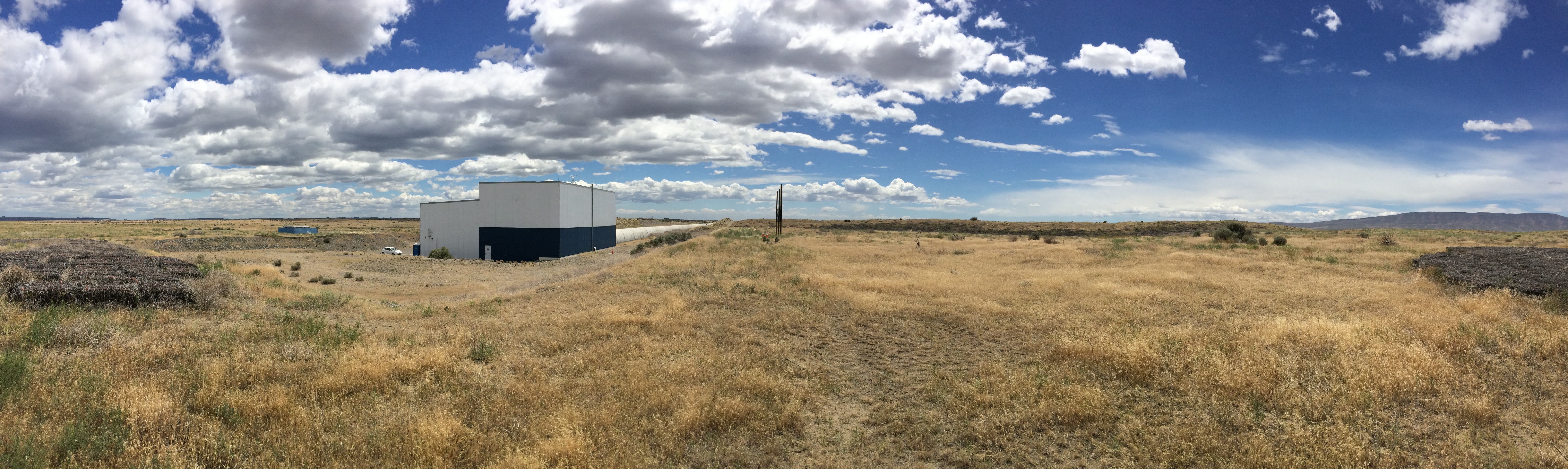
I completed install of the beam splitter and extra beam dump in the MC REFL path on IOT2L this morning (see attached pictures. Cheryl's alog also has a good one). This is for ECR E1500210. It should be noted that with this setup we cannot put more than 100W into the IMC. When we turn on the PSL HPO (starting next week, April 4th) we have to be sure to limit the amount of power going into the IFO to <100W; we have discussed a 60W limit for the duration of O2. Since we can't alter the laser power to this low level in the laser itself, we will use the HWP IO_MB_HWP1 located directly after the PMC to limit the maximum available power to the IFO. Once we begin using operating powers in excess of 100W we will have to come up with another solution for this.
This closes LHO WP 5783.
CP3 was filled at ~15:00 local time. Liquid was observed 1min 10 sec after opening the valve 1/2 turn. Next fill Thursday.
Flip flopping between the need to use FASTIMONs OR NOISEMONS for a variety of commissioning or DETCHAR reasons (but not being able to support both sets of channels) today we reverted a small portion of the work towards integrating the FASTIMONs into QUAD-land from alog 25329. Today we put the NOISEMONs back into the BS and QUAD models, keeping their original data rates and made the FASTIMONS commissioning frames only. This required restarts of the h1susauxb123, h1susauxex, and h1susauxey computers.
The SUS AUX Channel Monitor medms then had broken links which I partially fixed. I fixed the readback channel, but the long colored bit thing associated with every one of these channels (holds the same info as the read back) is a pain in the whooo to change so will have to wait until I can regrow some patience.
I've committed these SUSAUX model changes and medm edits to SVN.
To help avoid problems caused by out of date safe.snaps, I went through and changed the symbolic links for safe.snaps for some models to point to down.snaps Since most of these down.snaps were not in the userapps repository I copied them to userapps, and commited all the burt files to the svn in the relevant directories. The I removed the down.snaps from the target area and made symolic links called down.snap to the down in the userapps repository that will be loaded when the guardian runs down.
I did this for:
omc, lsc, lscaux, asc, ascimc, alsex, alsey, iscex, iscey
This means that from now on at least for these models there is one fewer sdf file to worry about. It would still be good for anyone restarting models to be aware that the down may not be up to date, and either update down before restarting or do a burt to make sure that you are leaving things the way you found them.
John, Chandra IP3 Varian power supply failed. We replaced it with a Gamma PS. It still needs a signal cable (a couple PSs do). PS is currently set to 7kV. Tomorrow we will step down to 5kV.
Richard, Patrick Last week I found what turned out to be the cause of the issue I had with reading the pressure from the BPG402 gauges at end X when we tried to move them from h1ecatx1 to h0veex (alog 26198). It turned out that there was a type mismatch between the IO variable for the gauge pressure and the PLC variable I linked it to. The IO variable is defined as a REAL and the PLC variable I had defined as a LREAL. Last week I updated the script that generates the code to change the PLC variable to a REAL and committed it into svn. Today Richard moved the gauges back to the h0veex vacuum chassis. I did an svn update on h0veex, recreated the target code and ran it. The reading of the pressure still remained flat 0 in the system manager, but reported valid values in the IOC. I am calling this success. I did a scan for devices, and the solar powered gauge and second fiber to ethercat converter is not seen. I disabled them in the system manager. Richard says that the fiber cable may be damaged. The channels for these gauges still exist on h1ecatx1. The next task will be to remove these. I also installed the necessary software to run medm on h0veex. I installed Xming-6-9-0-31 and EPICS Win32 Extensions 1.40. I also installed python-2.7.11 to generate the medm screens from a template substitution script I wrote. I had to add the following system environment variable to get medm to run: DISPLAY localhost:0 When medm started it gave messages for finding each process variable on both the CDS NIC and Beckhoff EtherCAT NIC. I tried adding the EPICS_CAS_INTF_ADDR_LIST system environment variable, setting it to 10.1.0.60 and restarting medm, but the same messages appeared, so I removed it. I then set the following system environment variables and restarted medm again: EPICS_CAS_AUTO_BEACON_ADDR_LIST NO EPICS_CAS_BEACON_ADDR_LIST 10.1.255.255 The messages changed to finding each channel on both 10.1.0.60 and h0veex (10.1.0.60 is the IP address for h0veex). I'm not sure why this is, but it seems to be working, so I am leaving it with this configuration for now. To access the medm screens after a reboot it is currently necessary to start Xming, then start medm, then open H0_VAC_MENU_CUSTOM.adl in C:/SlowControls/TwinCAT3/Vacuum/MEDM/LHO/Target.
We first found that one bit in POPX demod whitening readback that corresponds to the least significant bit of the whitening gain for the third quadrant is stuck on (attached). Corresponding BIO cable was CAB-H1:ISC_88 (i.e. the second board in the chassis).
I got suspicious about the cable but it turns out that this was the BIO itself. We removed the field cables for POPX from the BIO chassis in the CER and used an I/O tester to see the output, and the offending bit was always stuck ON (=low). Short circuit at the connector?
This is not tragic as we can still use odd dB gains (3, 9, 15, 21, 27, 33, 39 and 45dB), but it's a good idea to check these during laser upgrade.
Filter BIO seems to be OK.
Cleared HEPI Accumulated WD counters for HAM2, HAM3, HAM4, ITMY, and ETMX. See attached screenshot for values before reset.
I took charge measurements at both ends today, they finished around 12:50 local. I'll post plots soon.
The four plots are here
There were a few weeks that were not placed into the long trend, but a large majority of the data seems to be bad. I took out what I saw was obviously bad but the error bars are still huge on many of the points. Plots are attached but it definitely needs a second look hopefully tomorrow.
Note, I think it is time to change the sign on both of these ETM ESDs. The ETMx has now migrated ~20-30 volts away from 0, albiet at a slow rate. The ETMY sign flip from last month needs to be investigated since it seems that charge is still growing (slowly) there. More to follow.
Kiwamu, Stefan
Looking at the cross-power plot in alog 25768, we see a coherent noise floor following the shot noise a factor 3.3 below.
Looking at alog 21167, this seems cosistent with our old firend the excess 45.5 MHz noise in DARM.
Shot noise of 20mA: 8e-8mA/rtHz: a factor of 3.3 below that: 2.4e-8mA/rtHz. This is roughly consistent with the residual coherence seen in alog 21167.
Kiwamu will make an all-O1 plot to nicely resolve that noise. We need to add this noise to the mystery noise projection in alog 25106 (this plot).
Here is a cross-spectrum with more number of averaging (over 867 hours using the data between Oct-21-2015 to Jan-17-2016 with some glitchy durations excluded).
I looked at some few-hour stretches of O1 data and took the coherence between the DCPDs.
Above 1 kHz (where the DARM OLTF is −55 dB or less), the coherence goes as low as 1×10⁻⁴. See attachment for an example; FFT BW is 2 Hz and number of averages is >50,000. That would imply a correlated DCPD sum noise that is a factor of 7 below the shot noise [since the correlated noise ASD in each PD should be (1×10⁻⁴)1/4 = 0.1 relative to the uncorrelated (shot) noise ASD].
I suppose it is possible that the secular fluctuations in the nonlinear 45 MHz noise are enough to push the overall O1 coherence up to 2×10⁻³, which is what is required to achieve a correlated noise that is a factor of 3.3 below the shot noise in the DCPD sum.
To test this, I propose we look at the variation over O1 of some kind of BLRMS of the 45 MHz EOM driver control signal (or perhaps just the dc level of the control signal), similar to what Kiwamu has already done for some of the suspension channels.
During this same time period, the excess of sum over null above 1 kHz is about 0.1×10⁻⁸ mA/Hz1/2. Assuming 8×10⁻⁸ mA/Hz1/2 of null current therefore implies the correlated excess is a factor of 6 to 7 below shot noise.
(The slope in the data is probably from the uncompensated AA filtering).
The second attachment shows the conversion of the sum and null into equivalent freerunning DARM. From the residual alone, the limit on the coating Brownian noise seems to be a factor of 1.6 above nominal. (I quickly threw in a 5 kHz zero when undoing the loop in order to compensate for the AA filtering).
Finally, I add some mystery noise traces to this residual, where the slopes and amplitudes have been arrived at by careful numerology. The addition of a 1/f2 noise and a mystery white sensing noise (similar to 26004, but tuned to the residual during this time period) reduces the possible coating Brownian excess factor to 1.45 or so.
Here is an updated version of the cross spectrum using the O1 data. I have fixed a bug which previously overestimated the cross specctrum and have extended the analysis to high frequencies above 1 kHz.
As pointed out by Evan, my previous analysis overestimated the correlated noise. This turned out to be due to a bug in my code where I summed the absolute value of the segmented cross spcetra when averaging them. This is apparently wrong because the cross spectra by nature can have negative value (and imaginary number). I fixed the analysis code and reran the analysis again. The result looks consistent with Evan's targeted cross spectrum -- the kink point of the cross correlation happenes at around 1 kHz with the noise floor touching 1e-20 m/sqrtHz.