Displaying reports 6841-6860 of 86302.Go to page Start 339 340 341 342 343 344 345 346 347 End
Reports until 22:08, Saturday 14 December 2024
LHO General
ibrahim.abouelfettouh@LIGO.ORG - posted 22:08, Saturday 14 December 2024 (81830)
OPS Eve Shift Summary

TITLE: 12/15 Eve Shift: 0030-0600 UTC (1630-2200 PST), all times posted in UTC
STATE of H1: Observing at 156Mpc
INCOMING OPERATOR: Oli
SHIFT SUMMARY:

IFO is in NLN and OBSERVING as of 01:20 UTC (4 hr 45 min lock)

Beginning of shift was rough with winds over 40 mph and microseism over the 0.9 line (very high). However, after achieving NLN and going into OBSERVING, the wind has steadily gone down to below 10 mph and the microseism has gone down below the 0.9 line (first time in 2 days). Conditions are good!

LOG:


H1 General
corey.gray@LIGO.ORG - posted 16:32, Saturday 14 December 2024 (81825)
Sat DAY Ops Summary

TITLE: 12/14 Day Shift: 1530-0030 UTC (0730-1630 PST), all times posted in UTC
STATE of H1: Microseism
INCOMING OPERATOR: Ibrahim
SHIFT SUMMARY:

Microseism took a slight drop from its peak last night, but it still clearly above the 95th percentile (and just under 1µm/s) which continues to cause locking grief for H1 (but H1 managed surprisingly well with relocking earlier in the shift.  Once themalized (and after a Saturday tour left the Control Room, performed the Saturday Calibration).

Also of note is our winds have been picking up for the first time in days; winds picked up around 1800utc (around when H1 relocked!), and then we had lockloss which was tied to our biggest gusts (over 40mph) + our above-95th-percentile
LOG:

LHO General
ibrahim.abouelfettouh@LIGO.ORG - posted 16:28, Saturday 14 December 2024 (81829)
OPS Eve Shift Start

TITLE: 12/15 Eve Shift: 0030-0600 UTC (1630-2200 PST), all times posted in UTC
STATE of H1: Wind
OUTGOING OPERATOR: Corey
CURRENT ENVIRONMENT:
    SEI_ENV state: USEISM
    Wind: 32mph Gusts, 26mph 3min avg
    Primary useism: 0.05 μm/s
    Secondary useism: 0.62 μm/s
QUICK SUMMARY:

IFO is in ENVIRONMENT and LOCKING.

Getting hit by high microseism mixed with 40 mph gusts of wind is making locking difficult. We just ran initial alignment and are having some issues locking DRMI but wind seems to be coming down as does microseism.


H1 CAL (CAL)
corey.gray@LIGO.ORG - posted 14:47, Saturday 14 December 2024 (81828)
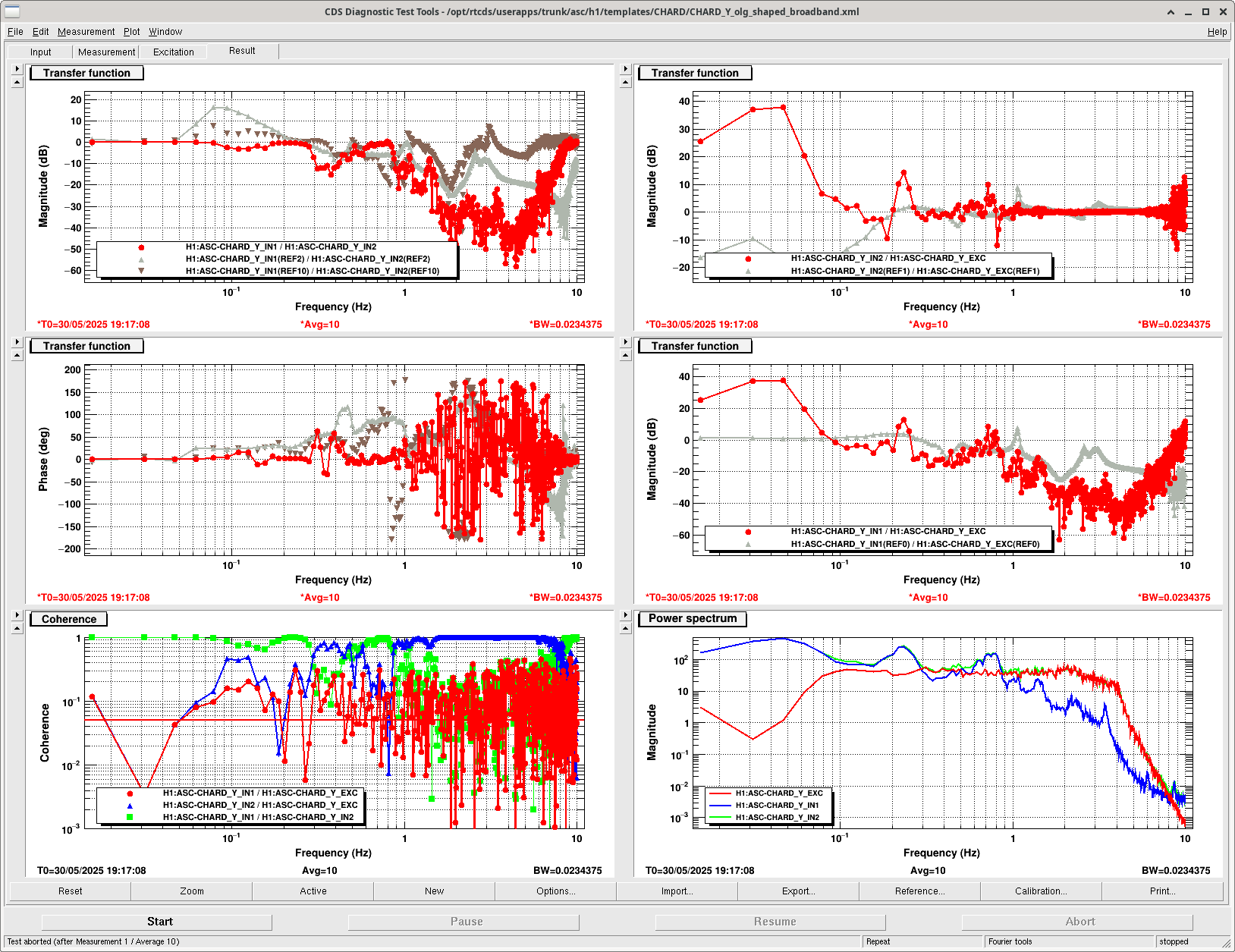
Saturday H1 Calibration Measurement (broadband headless + simulines)

H1 will be thermalized right around the Sat Calibration time of 2120utc (120pm PDT).

Measurement NOTES:

Images attached to this report
LHO VE
david.barker@LIGO.ORG - posted 10:56, Saturday 14 December 2024 (81827)
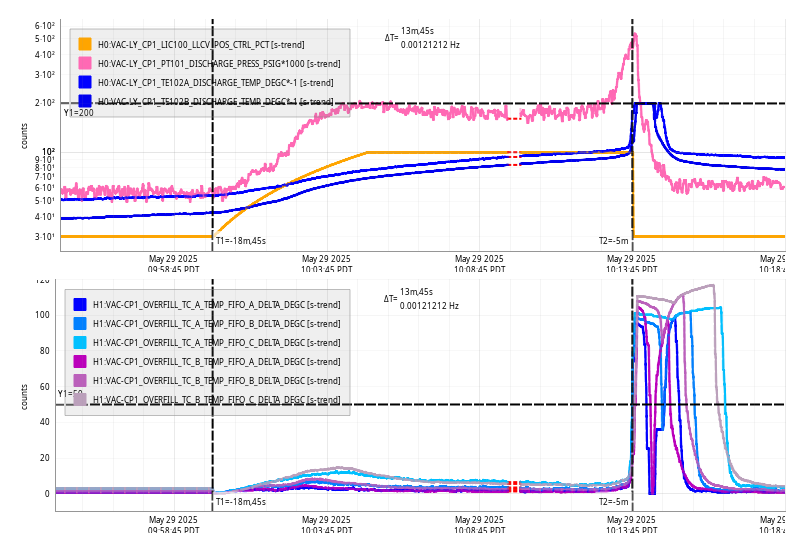
Sat CP1 Fill

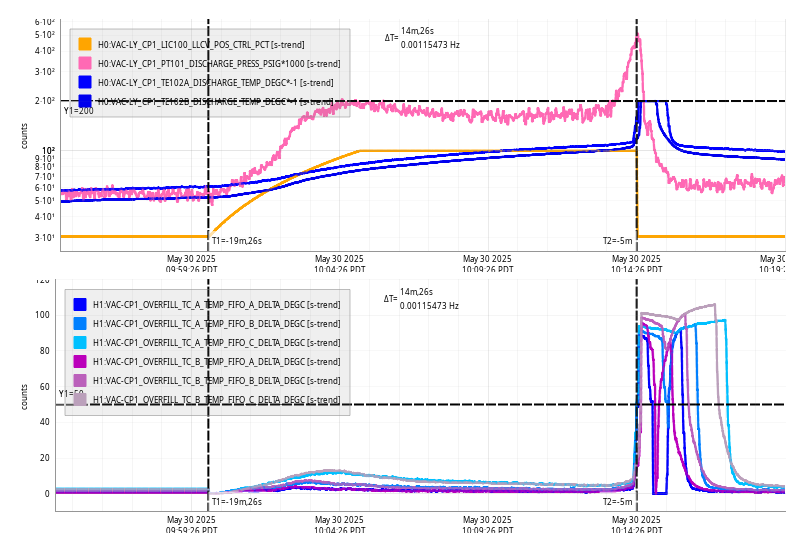
Sat Dec 14 10:13:35 2024 INFO: Fill completed in 13min 32secs


Images attached to this report
H1 General
corey.gray@LIGO.ORG - posted 08:39, Saturday 14 December 2024 - last comment - 10:49, Saturday 14 December 2024(81824)
H1 Lockloss At 1603utc (Marking Observatory Mode As MICROSEISM)

After the Calibration Observing drop, H1 had a lockloss about 15min later (with ETMy ring up a second before the lockloss). 

Taking Observatory Mode to MICROSEISM since it is still close to 1µm/s.

DRMI looked misaligned, so have went to CHECK MICH FRINGES (but then had another lockloss....but DOWN did NOT ramp PSL Power down from 10W....I'm only noting because this also happened yesterday afternoon). 

Comments related to this report
corey.gray@LIGO.ORG - 10:49, Saturday 14 December 2024 (81826)

1821utc  Back To Observing

This is post-Initial Alignment (with some ALSx minor grief), several DRMI locklosses, and continued high microseism).

H1 CAL (CAL)
corey.gray@LIGO.ORG - posted 08:07, Saturday 14 December 2024 (81823)
H1 Taken Out of OBSERVING due CW Calibration Gain Change at 1542utc

At 1542utc (742am local), H1 was dropped out of OBSERVING due to the gain for H1:CAL-INJ_CW_GAIN going to 0.  I reverted to 1 and returned H1 to OBSERVING within 2min.  (and then we had a lockloss 15min later) :(

Images attached to this report
LHO General
corey.gray@LIGO.ORG - posted 07:53, Saturday 14 December 2024 (81822)
Sat DAY Ops Transition

TITLE: 12/14 Day Shift: 1530-0030 UTC (0730-1630 PST), all times posted in UTC
STATE of H1: Observing at 157Mpc
OUTGOING OPERATOR: Oli
CURRENT ENVIRONMENT:
    SEI_ENV state: USEISM
    Wind: 10mph Gusts, 8mph 3min avg
    Primary useism: 0.04 μm/s
    Secondary useism: 0.93 μm/s
QUICK SUMMARY:

Looks like H1 relocked itself overnight, even with the gargantuan microseism of late! (H1's been locked 8.25hrs and also see that L1 has been up for the last 6+hrs). 

If I look at the microseism, it does indeed looks like it has dropped down a little bit from its peak state 12hrs ago to inch down below 1µm/s.

Saturday Docket: 

Local weather note:  light snows were up the Yakima Vallley last night, but nothing down here last night, but on the drive in there was definitely ice on the roads (eventually took the old Jeep to 4H and drove slower; parking lot was also slippery).

AND as I was typing there was an OBSERVATION drop due to the Calibration Injection CW GAIN being taken to 0.0.  I reverted back to 1.0 to return to observing.

LHO General
ibrahim.abouelfettouh@LIGO.ORG - posted 22:15, Friday 13 December 2024 (81821)
OPS Eve Shift Summary

TITLE: 12/14 Eve Shift: 0030-0600 UTC (1630-2200 PST), all times posted in UTC
STATE of H1: Lock Acquisition
INCOMING OPERATOR: Oli
SHIFT SUMMARY:

IFO is LOCKING at CARM_OFFSET_REDUCTION

Shift was dominated by microseism (hovering at 1 um/s) with a 6.4 magnitude EQ sprinkled in. H1 couldn't lock for the majority of the shift, managed to get there for 1hr and 9 mins before a lockloss.

Lockloss assumed to be due to the environment - lockloss alog 81820

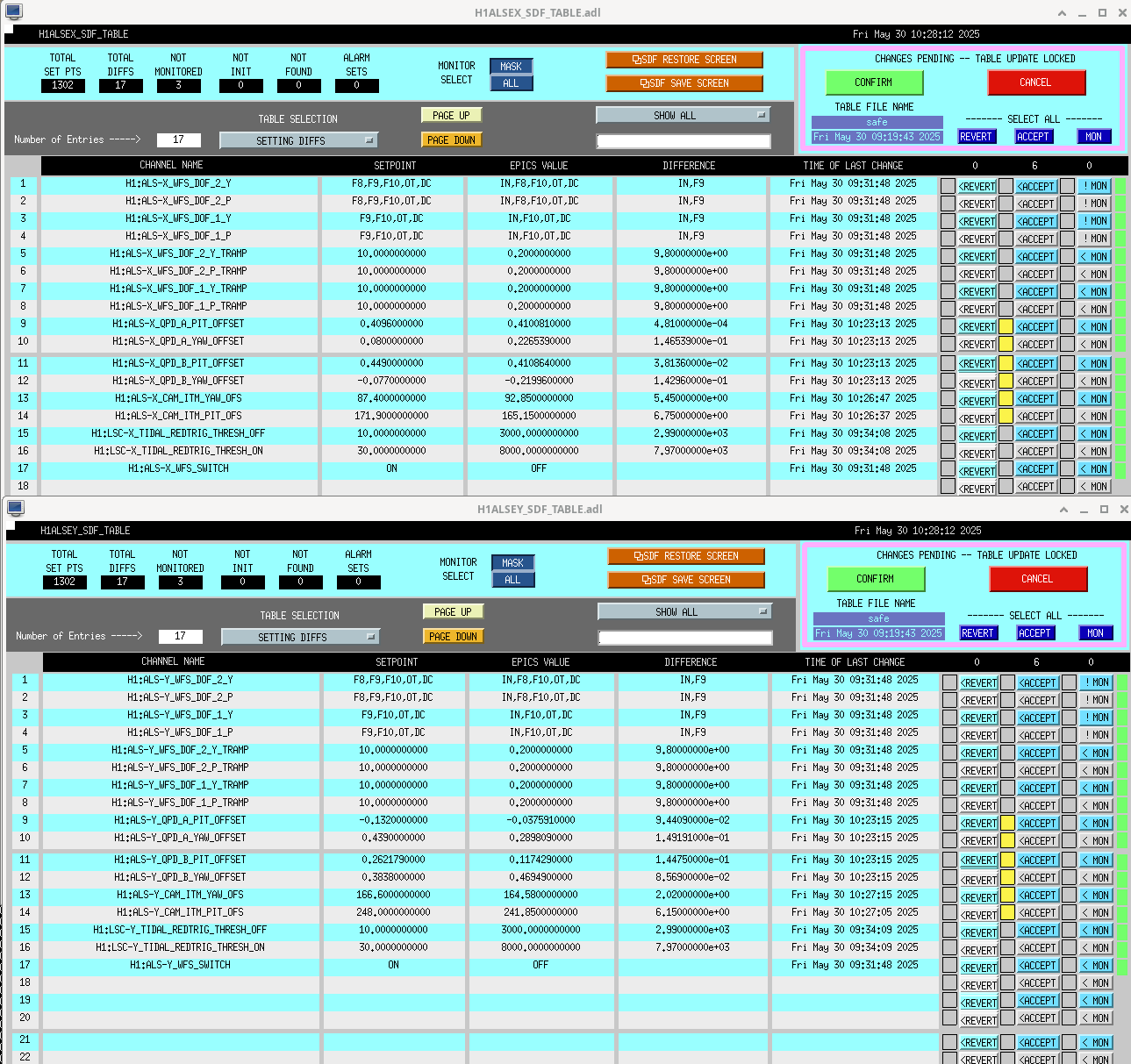
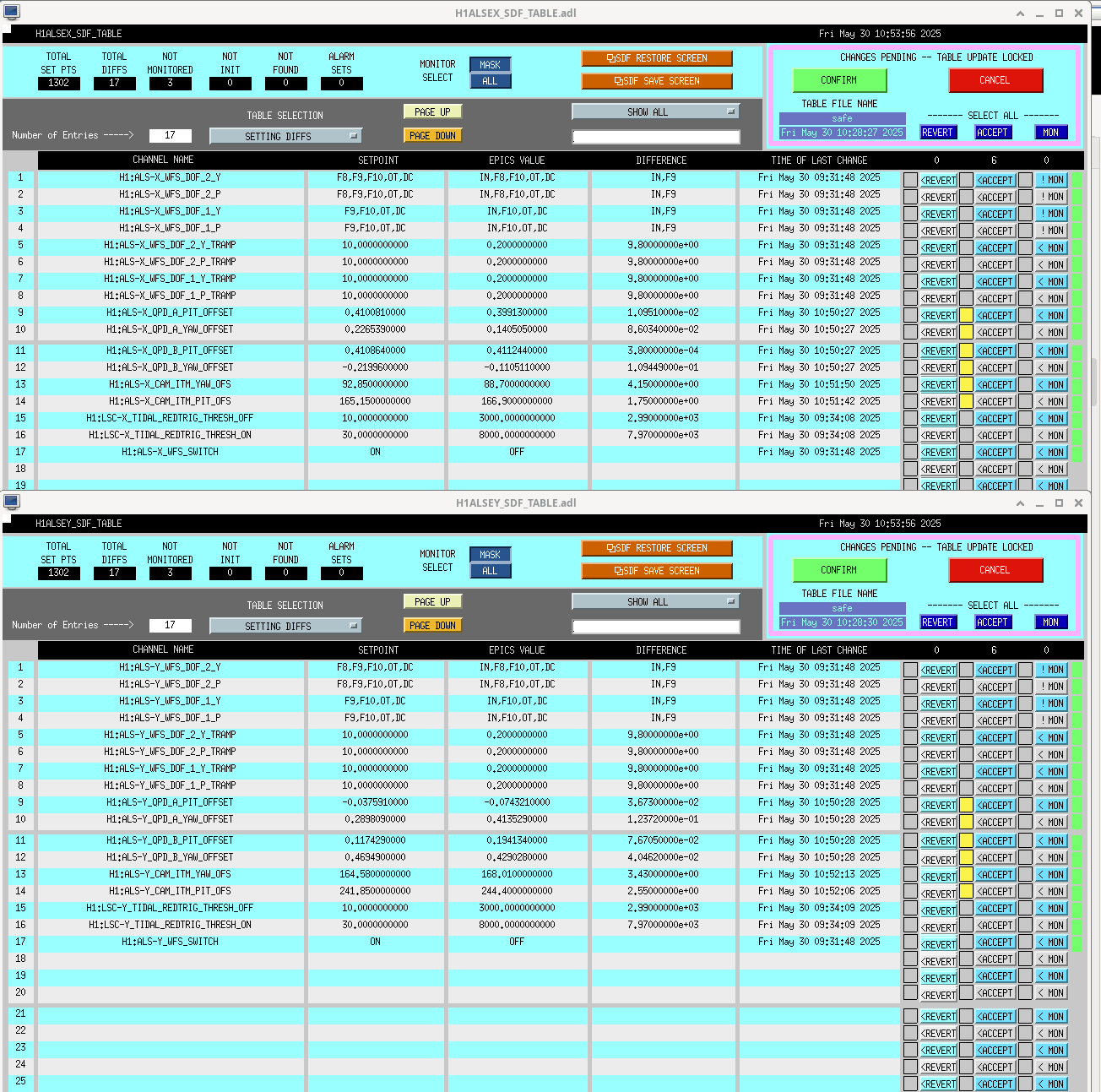
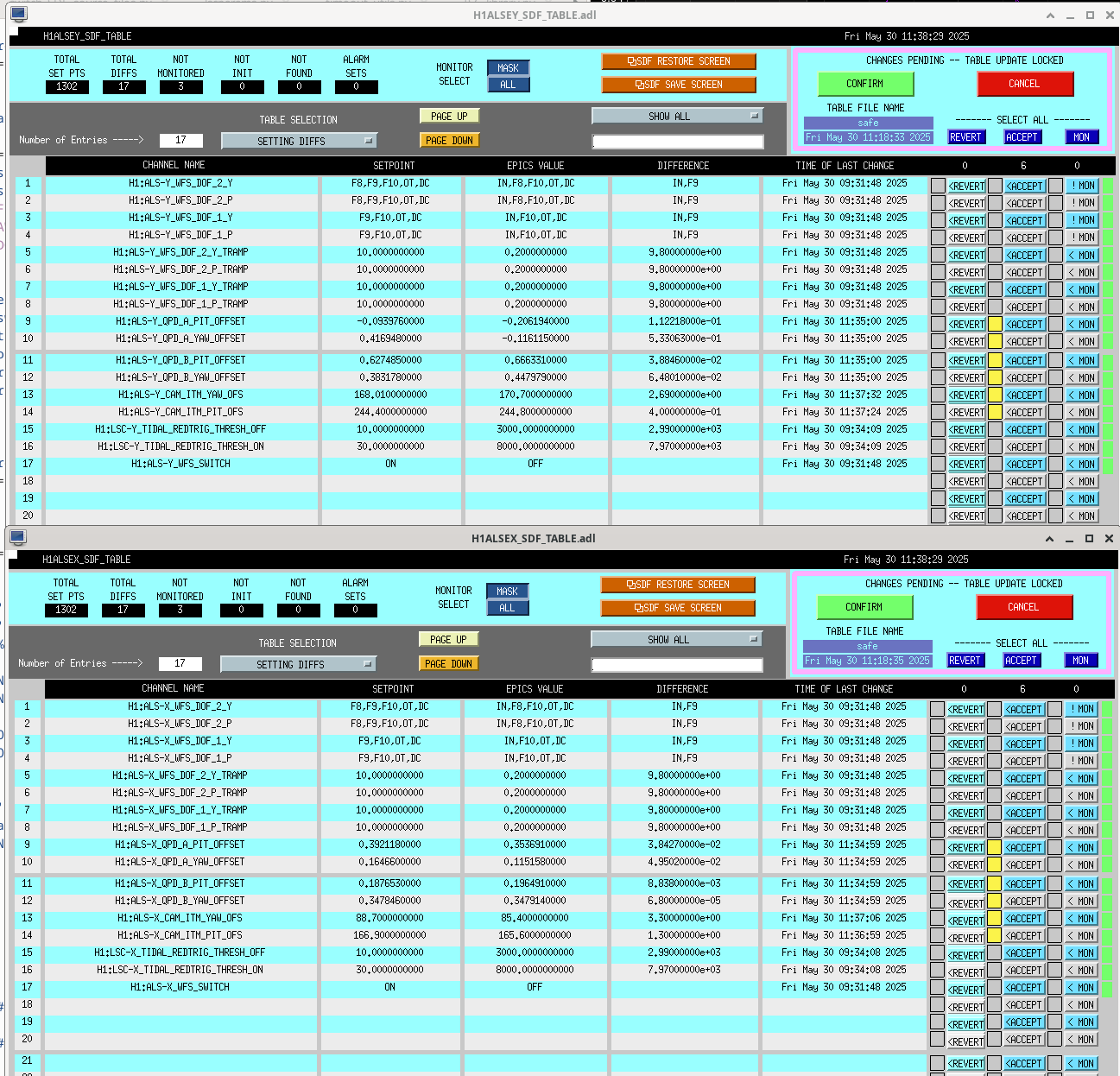
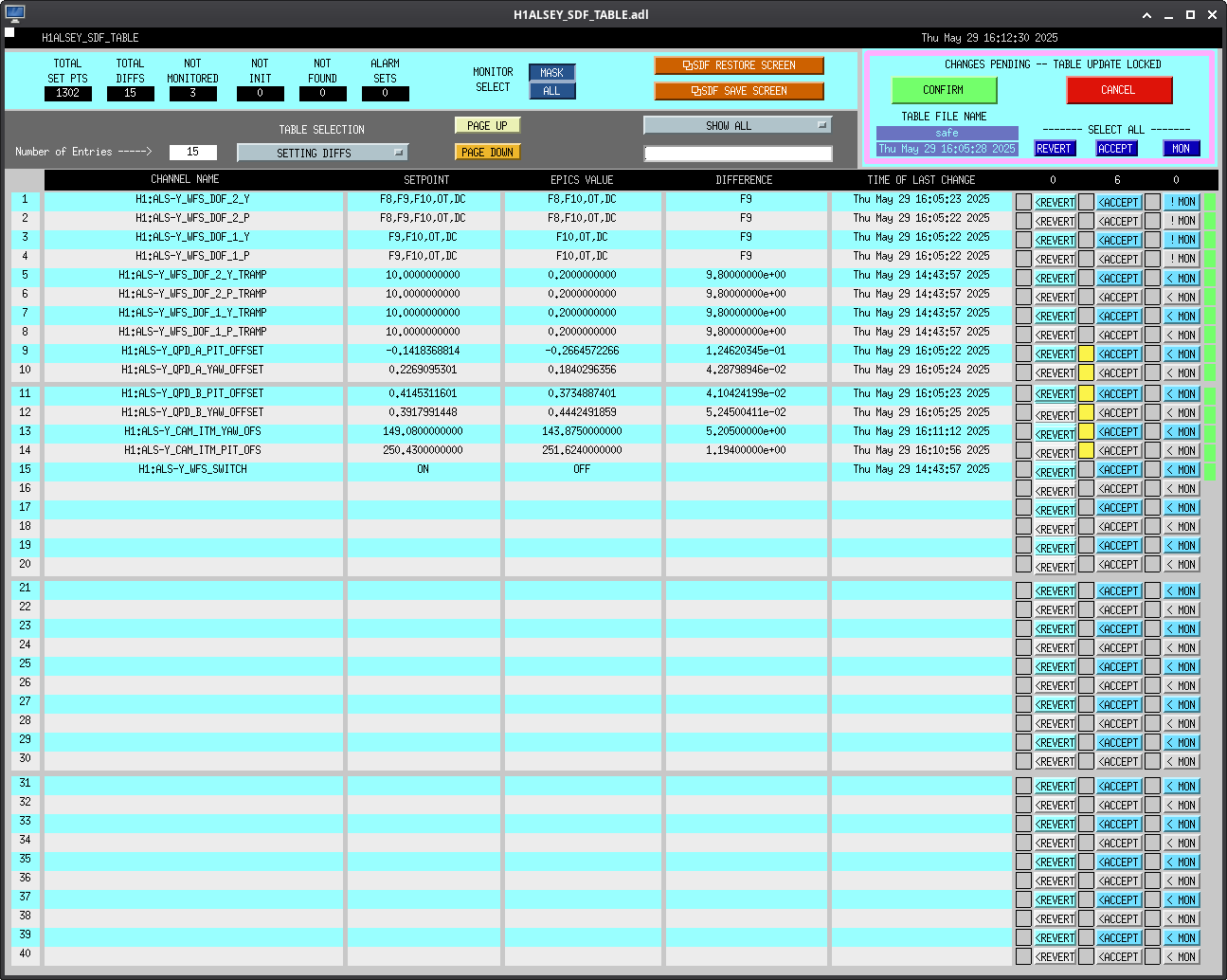
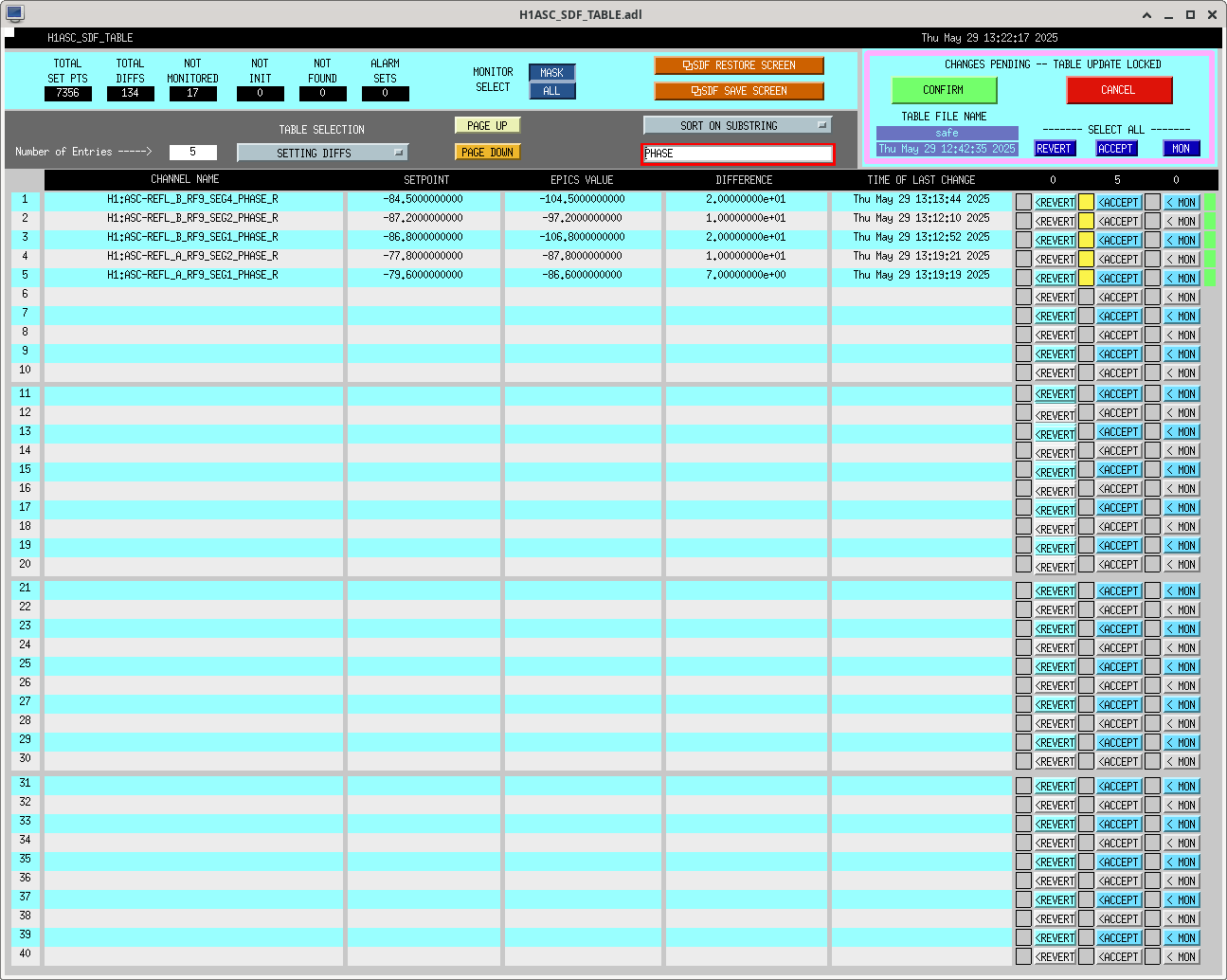
Other than that, there were 2 SDF diffs that were erroneously accepted, then manually reverted by Sheila and I. We then accepted those. SDF screenshot included. The relevant SDFs are the two top ones (dated 21:18)

LOG:

Start Time System Name Location Lazer_Haz Task Time End
16:53 OPS LVEA LVEA YES LVEA IS LASER HAZARD 21:13
03:49 PCAL Francisco PCAL Lab Local Turning off equipment 03:58
Images attached to this report
H1 PEM (Lockloss)
ibrahim.abouelfettouh@LIGO.ORG - posted 21:46, Friday 13 December 2024 (81820)
Lockloss 05:16 UTC

Lockloss likely due to ground motion. Microseism is high and in the two minutes pre-lockloss, ASC channels were noisy.

No tags on LL Tool.


LHO FMCS (PEM)
ibrahim.abouelfettouh@LIGO.ORG - posted 17:05, Friday 13 December 2024 (81819)
Checking HVAC Fans - Weekly FAMIS 26347

Closes FAMIS 26347. Last checked in alog 81655.

All trends look well. No fans above or near the (general) 0.7 ct threshold. Screenshots attached.

Images attached to this report
H1 ISC
elenna.capote@LIGO.ORG - posted 16:54, Friday 13 December 2024 - last comment - 16:40, Friday 30 May 2025(81816)
Sideband PRG Calibration

Anamaria took some time with me today to help me calibrate the sideband PRGs the same way she calculated them here for Livingston (LLO:69872). This is mostly with the intention of providing calibrated data for the finesse modeling effort that can help us better understand IFO behavior during TCS changes/powering up.

Reminder: I ran a check of the carrier PRG calibration this week (81752), which is based on the IM4 trans and end transmission values, which confirms that at 2W, our PRG is about 55.

Method:

Measure the power in the PRC at DRMI lock and compare it to the power in the PRC at 2W lock. Knowing the gamma of the 9 and 45 MHz sideband, estimate how much of the input power is sideband power. Use the predicted sideband PRG from an IFO model with perfect mode matching, and scale the expected sideband power in the PRC by those PRGs. Compare this expected value to the actual PRC power, and then scale the sideband PRGs accordingly.

Data:

DRMI lock values (measured after DRMI ASC converges):

Channel Value
POP A LF INMON 12.5 ct
POPAIR RF18 151 ct
POPAIR RF90 27.25 ct
IM4 TRANS NSUM 1.98 W

2W full lock values (measured after full IFO ASC converges, including ADS):

Channel Value
POP A LF INMON 283.8 ct
POPAIR RF18 154.5 ct
POPAIR RF90 28.5 ct
IM4 TRANS NSUM 1.98 W

Other useful numbers:

Parameter Value Notes
Gamma 9 0.213 22.7 mW 9 MHz per W of input power, 62883
Gamma 45 0.275 37.8 mW 45 MHz per W of input power, 62883
PRM Transmission 0.031 https://galaxy.ligo.caltech.edu/optics/
PR2 Transmission 229 ppm https://galaxy.ligo.caltech.edu/optics/
M12 Transmission 0.054 Splitter on POP path, 63625
2W lock carrier PRG 55 Original measurement, checked again recently
PRG9 from model 119 Anamaria's Optickle model
PRG45 from model 13 Anamaria's Optickle model

The work:

At 2 W lock, POP LF INMON measures 283.8 counts (this accounts for the dark offset). With an input power of 1.98 W and a PRG of 55, this should be 109 W. So we set a scale that 283.8 ct POP diode == 109 W PRC power.

At DRMI lock, we measure 12.5 counts in the POP diode (this accounts for the dark offset), so this gives us 4.8 W PRC power in DRMI lock.

At 1.98 W input power, 44.9 mW is 9 MHz power and 74.84 mW is 45 MHz power. We multiply by the perfect mode matching sideband PRGs and get that 5.3 W should be 9 MHz and 0.972 W should be 45 MHz in DRMI lock, so a total of 6.3 W expected PRC power in DRMI.

4.8 W / 6.3 W = 0.76, so 0.76 * 119 = 90.6 and 0.76 * 13 = 9.9, so we can say that our 2W PRG9 = 91 and PRG45 = 10.

Notice that this method ties the sideband PRGs to the measured carrier PRG. The method is perhaps not so good for the 45 MHz sideband, since we know there is so much less 45 MHz power than 9 MHz power. But these values are sensible.

Why did we do it this way?

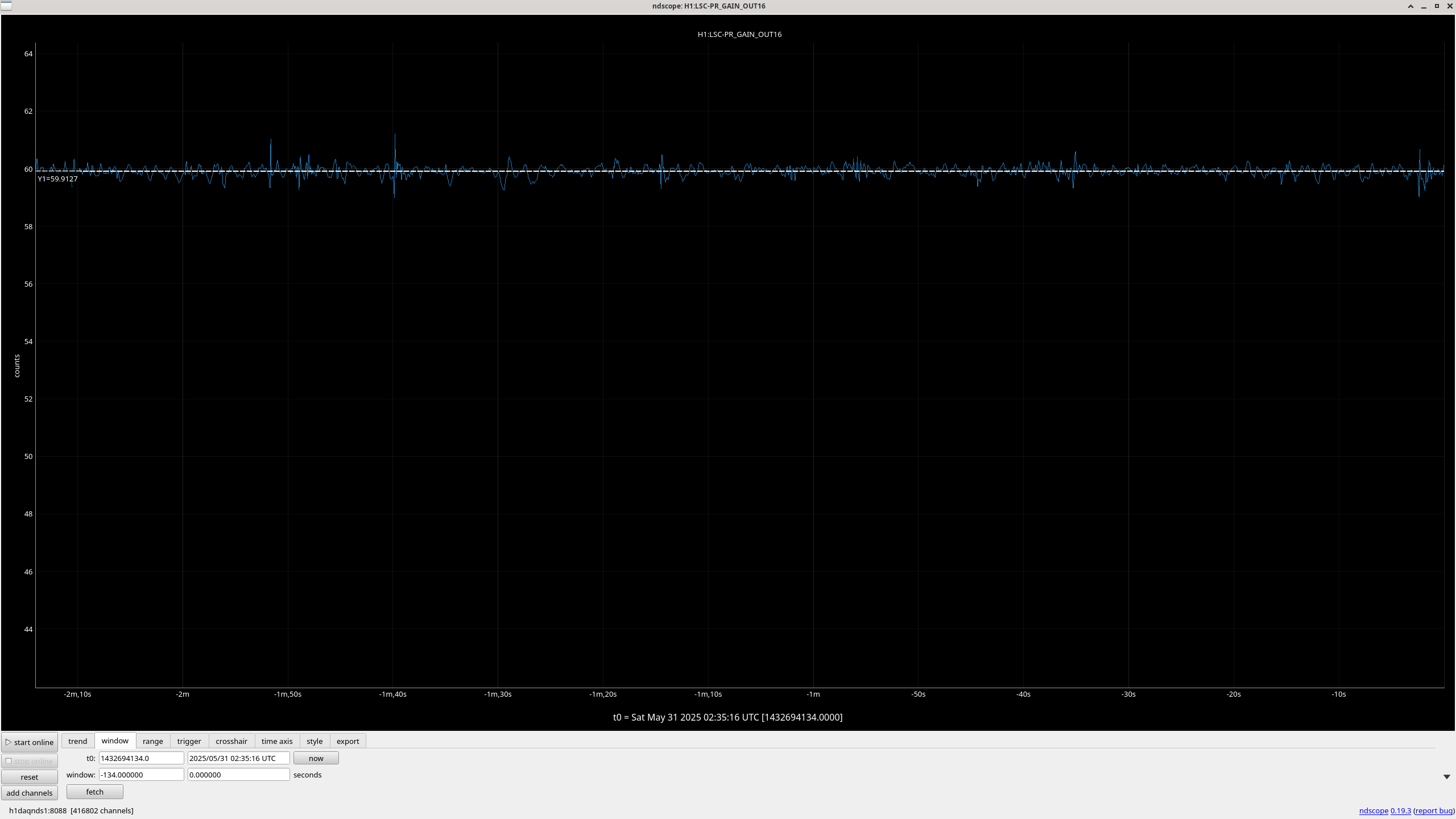
You might notice we used the POP LF inmon value instead of the POP LF out value. There is a calibration in the POP A LF filter bank labeled "to_uW", which I assume means "microwatts of power on the POP diode". We started by using this calibrated value, and putting it into Watts of PRC power using the known transmission of the M12 splitter and PR2 (LLO calibrates POP A LF into Watts in the PRC). This resulted in a lower sideband PRG, (76.7 and 8.4 respectively). However, it also predicted that the carrier PRG should be 46. The carrier PRG calibration Craig and I performed does not rely on the POP diode at all, which is good because there is enough sideband power in the PRC to confuse the measurement. So, Anamaria and I decided to trust the independent carrier PRG measurement based on the arm transmission. Furthermore, we looked at how the H1:LSC-PR_GAIN_OUT16 channel is calibrated, and noticed that it ratios the H1:LSC-POP_A_LF_INMON value with IM4 trans. This motivated us to ignore the uW calibration filter (which then motivated us to correct for the dark offset of 3.8 ct).

Comparisons to mod depth method

If you have a good enough alog memory you might know that Craig and Jennie W have done a sideband PRG calibration in the past, using the modulation depth step test such as here: 70865 and 76358. Upon further inspection of the results, I am not sure they are so good. Mainly, the 45 MHz sideband PRG that results from this test is around 27-30, which is huge. I looked at these measurements again to try to understand why the values are so different. I noticed that when Craig steps down the 45 MHz sideband, the POP A LF value actually increases. Anamaria and I think this is because with lower 45 MHz modulation, the carrier input power increases, and the high carrier PRG (compared to the 45 MHz PRG) amplifies this excess power further. I can't find anywhere in Craig's code that accounts for this. For now, I am going to trust the method described in this alog over the mod depth step method.

Channel calibration factor

These values will calibrate the POPAIR B RF18 I ERR and RF90 I ERR channels into sideband PRGs accordingly.

calibration factor = (2W sideband PRG value) / ( 2W POPAIR count value / IM4 trans)

POPAIR18 > PRG9 calibration factor = 91 / ( 154.5 / 1.98) = 1.17, and normalize by input power

POPAIR45 > PRG45 calibration factor = 10 / (28.5 / 1.98) = 0.7, and normalize by input power

Note that if you use the POPAIR B RF18/90 I NORM MON channels instead of the ERR channels, these are already normalized by input power.

Comments related to this report
craig.cahillane@LIGO.ORG - 16:40, Friday 30 May 2025 (84677)
You are right that when the 45 MHz goes down, the carrier goes up.  
That's why POP LF and the arm transmissions all rise when we lower our mod depths.
The mod depth code does account for this, otherwise it would not work at all, see Daniel's original work.
It gives an estimate that the arm powers are 100% carrier, for instance, which comes from the fact the arm transmissions rise.
LHO General
corey.gray@LIGO.ORG - posted 16:19, Friday 13 December 2024 (81807)
Fri Ops DAY Shift Summary

TITLE: 12/13 Day Shift: 1530-0030 UTC (0730-1630 PST), all times posted in UTC
STATE of H1: Observing at 153Mpc
INCOMING OPERATOR: Ibrahim
SHIFT SUMMARY:

Locked for most of the shift, but throughout the day, microseism continued climbing and is clearly above the 95th percentile now.  Eventually H1 lost lock (after a 10.5+ hr lock), but have struggled with very high microseism (+ we also had a 6.3 Chilean EQ).  In this downtime, did some To Do items:  (1) LOADed ISC_LOCK  and SQZ_MANAGER nodes, and (2) Ran an Initial Alignment.  Have taken OBSERVATORY MODE to MICROSEISM.  For locking, H1's green arms were fine, but even after the alignment, DRMI struggled (but its flashes looked good); this is what I handed off to Ibrahim.

When H1 does get back to Observing this weekend, if there are periods of the low-range glitching we've had in the last week, Sheila has a request for tests she would like operators to run (see alog81817).

LOG:

LHO General
ibrahim.abouelfettouh@LIGO.ORG - posted 16:07, Friday 13 December 2024 (81818)
OPS Eve Shift Start

TITLE: 12/14 Eve Shift: 0030-0600 UTC (1630-2200 PST), all times posted in UTC
STATE of H1: Microseism
OUTGOING OPERATOR: Corey
CURRENT ENVIRONMENT:
    SEI_ENV state: USEISM_EARTHQUAKE
    Wind: 11mph Gusts, 7mph 3min avg
    Primary useism: 0.34 μm/s
    Secondary useism: 1.16 μm/s
QUICK SUMMARY:

IFO is DOWN in Earthquake Mode.

Microseism is very high and we just got hit by a 6.4 EQ. Will resume locking when possible.

H1 SQZ (GRD, ISC, OpsInfo)
sheila.dwyer@LIGO.ORG - posted 16:00, Friday 13 December 2024 (81817)
operator requests, temporary change to SQZ MANAGER guardian

Today I made some temporary changes to the SQZ MANGER guardian, to turn off all the servos when the request is down. (Edited to add, now I've undone these changes but added a if False statement on line 270 in SQZ Manager's down state that can be toggled to put this back in).  This isn't usually what we want because we can leave the FSS and PMC locked. 

Derek pointed out in 81811 that some filter cavity length control channels are well correlated with the large glitches.  We know that blocking the squeezer doesn't stop the glitches, and without the squeezer locked to the IFO the filter cavity is locked on green and the noise of these channels seems too high to show the issue.

Request for operators:  If you see the glitches and low range happening again, please go out of observing.  First do a test of turning off and on the HAM1 feedforward (81775) it would be go to do 5 minutes off, 5 minutes on, 5 minutes off, then on again. Then open SQZ_MANager, and edit line 270 so that it says if True: , load sqz manager and request down, wait 5 minutes, request FREQUENCY DEPENDENT SQUEEZING for 5 minutes, DOWN for another 5, and back to Frequency dependent squeezing.  These things can be done at the same time that Robert walks around looking for noise if he's available when the glitches come back.


H1 CDS
david.barker@LIGO.ORG - posted 11:04, Friday 13 December 2024 (81813)
EX timing checks are no longer needed, Daniel updated Beckhoff to new Timing Card version numbers

Follow up from Tuesday maintenance: Daniel upgraded the Beckhoff slow controls software to no longer error on a version mismatch for the new timing cards installed in h1susex and h1omc0 (for new LIGO DAC and variable Duo-Tone frequency respectively).

I have changed the CDS HW stat code to no longer check that the EX timing error was solely due to the version mismatch. I also reverted the SYS_TC3_TIMING.adl file, removing the temporary blurb I had put in there explaining the expected EX error.

I took the opportunity to upgrade the timing entry on the CDS Overview to a system block. This will turn RED if there are any timing errors, or MAGENTA is the timing system freezes. Clicking on it opens the timing overview, please see attached.

Images attached to this report
LHO VE
david.barker@LIGO.ORG - posted 10:13, Friday 13 December 2024 (81812)
Fri CP1 Fill

Fri Dec 13 10:10:07 2024 INFO: Fill completed in 10min 3secs

Jordan confirmed a good fill curbside.

Images attached to this report
H1 DetChar (DetChar, SQZ)
derek.davis@LIGO.ORG - posted 10:08, Friday 13 December 2024 (81811)
Mystery glitching is present again Dec 13

The mystery glitching this team has been thoroughly investigating was present again for ~30 minutes starting at approximately 6 UTC on Dec 13, as seen in this range time series.  HVeto runs over this time period highlight H1:SQZ-FC_LSC_DOF2_OUT_DQ as the most correlated channel (same as in 81587), this time with a significance of 200 (a significance of > 10 is of interest). After checking omega scans of example glitching in the strain data, there is clear glitching present again in this squeezer channel. Similar to previous occurrences of this noise, it promptly appeared and then disappeared. 

Images attached to this report
H1 TCS (ISC)
camilla.compton@LIGO.ORG - posted 16:55, Wednesday 11 December 2024 - last comment - 12:57, Friday 13 December 2024(81777)
H1:TCS-ITMX_CO2_ISS_CTRL2_OUT_DQ step up unexplained but now not good witness of DARM noise

Sheila found that H1:TCS-ITMX_CO2_ISS_CTRL2_OUT_DQ stepped up from -0.2 to 0 on 2024/12/05 21:40:07 UTC (13:40 PST) Plot attached. This is of interest as this channel has ben a witness to our noisy/low range periods in DARM but is not connected to anything. I see no reason for this step up, the only person in the LVEA at the time was Robert setting up VP measurements (near HAM3 not CO2X) 81628, the CO2 laser remained l locked and we were not touching the CO2 chiller around the time 81634.

Since this step up, this channel has not been a good witness of our DARM noise, maybe the cable wasn't grounded and something changed to ground it on 12/05. Plot of it being a witness to the noise on 12/02 and not on 12/11.

Before and after the step up, this CO2 channel is still a witness to the CO2 rotation stage moving, attached. Both CO2X and CO2Y ISS CRTL2 channels see the rotation stages move, some crosstalk in chassis? CO2Y signal is orders of magnitude larger.  Jason was looking into these channels and the chassis

Images attached to this report
Comments related to this report
thomas.shaffer@LIGO.ORG - 08:33, Thursday 12 December 2024 (81787)DetChar, ISC

I don't see any change in the H1:TCS-ITMX_CO2_RIN_INLOOP_OUTMON channel at that time, but the reason for the step in the CRTL2 output is from a turned off digital offset in the H1:TCS-ITMX_CO2_AOM_SET_POINT bank. I turned this off when we were looking at it and I forgot to alog it, apologies.

Curious that we lost sensitivity to whatever this is when an offset was removed, but I think this is a good clue.

Images attached to this comment
thomas.shaffer@LIGO.ORG - 09:18, Thursday 12 December 2024 (81790)

I've just put the offset back in just to see if we get our "monitor" back. Accepted in safe and observe snaps, but only one screenshot.

Images attached to this comment
sheila.dwyer@LIGO.ORG - 12:57, Friday 13 December 2024 (81815)

It seems that with the offset on again, this channel is again a witness of the noisy times. 

Images attached to this comment
Displaying reports 6841-6860 of 86302.Go to page Start 339 340 341 342 343 344 345 346 347 End