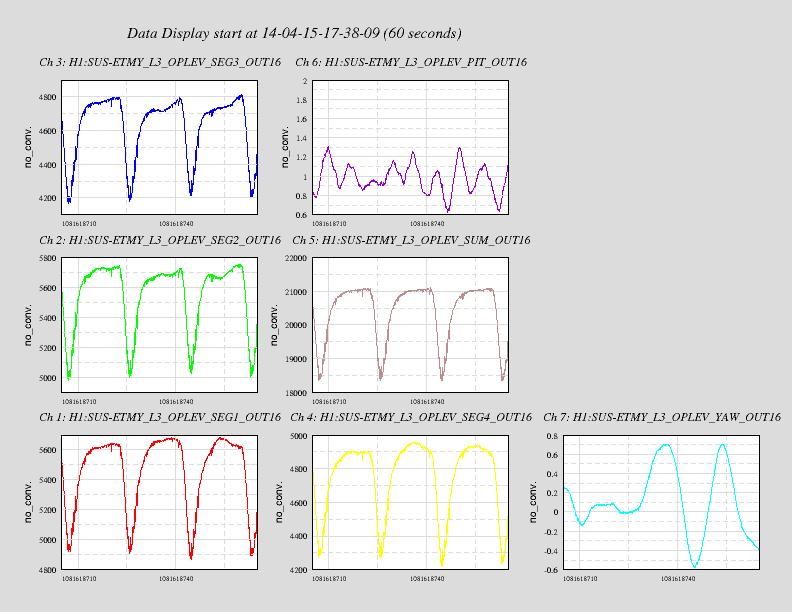
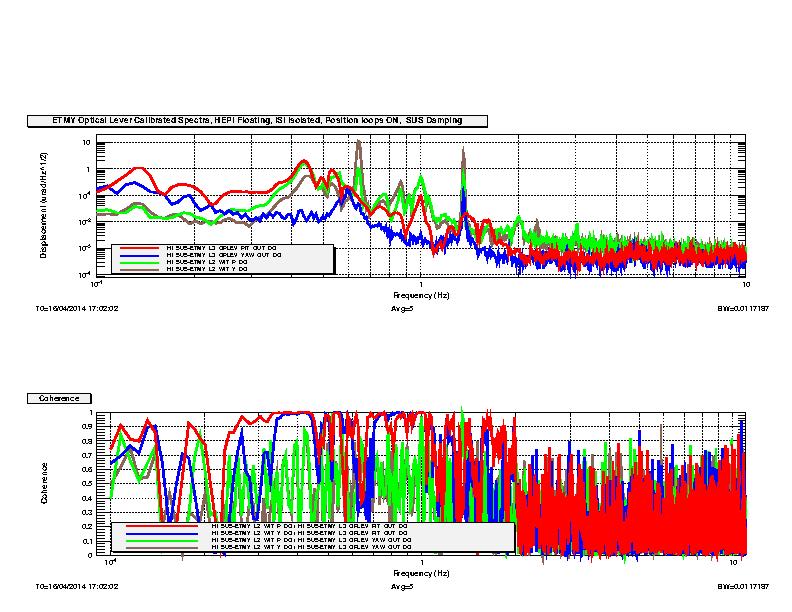
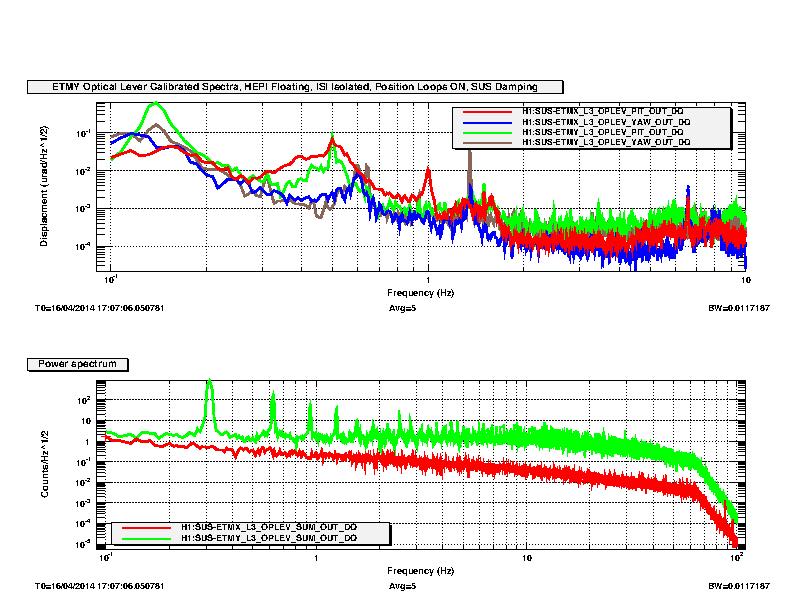
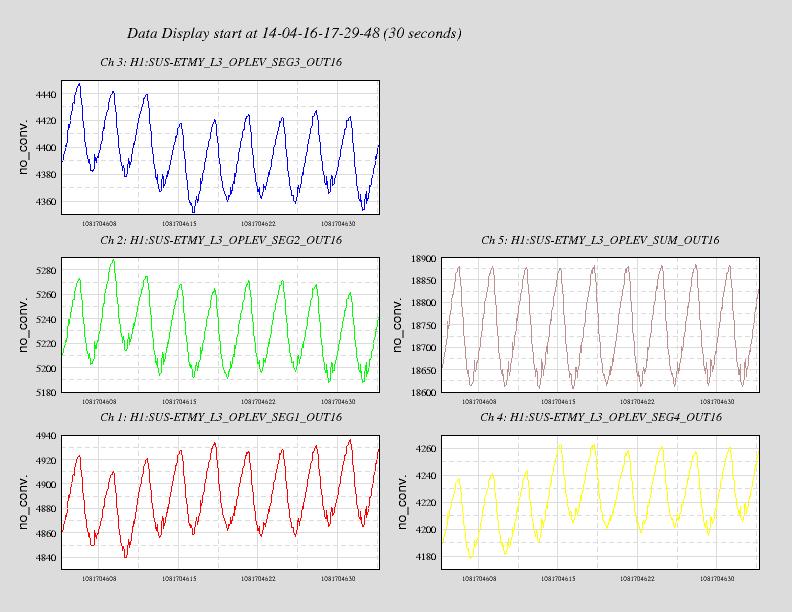
Wrote and installed the code for running the ring heaters. Added the rough calibration values that Aidan B had recommended for running the ring heaters. Some data below: Upper: Requested Power = 1.00 Watts Requested Current = .17 Amps Measured Voltage = 6.85 Volts Measured Current = 0.16 Amps Calculated Power = 1.13 Watts Calculated Resistance = 42.81 Ohms Lower: Requested Power = 1.00 Watts Requested Current = 0.17 Amps Measured Voltage = 6.71 Volts Measured Current = 0.17 Amps Calculated Power = 1.11 Watts Calculated Resistance = 39.47 Ohms A quick, back-of-the-envelope calculation shows that the ring heaters are working properly. Although their values are a bit different than ITMY shown in ALOG 8816, this is mostly due to only being roughly calibrated. The next step is to do a long term 4+ hour test to show curvature change and robustness.
10:51 I restarted the h1slow-cds epics gateway due to Beckhoff IOC work.
Done
Done
Breaking for lunch
Koji and I will be in the PSL today for replacing IO_MB_M2 as a preparation of the high power laser.
The attached was the current best alignment.
All models have stopped on h1seih45 at 1073754093, having suffered an ADC timeout. It's possible that the timing fiber was disconnected for work, not sure of the cause. I am going to reboot the computer after removing it from the dolphin network.
Computer rebooted, all models are running.
This was necessary because the model stopped running when I swapped ADC 1 and 2 ribbon cables in the IO chassis.
I started working on the arm cavity alingment this morning, we have flashes of 400 counts on the transmitted PD (ALS COMM), the refl PD drops from 19500 to 19000, and a spot is clearly visible on the ETM camera (scren shots attached). This can sort of lock for a few seconds. I'm heading to the X end to look at the locking.
Also. MC1 misalinged so we can see green on the ITM without confusion from the IR.
[Stefan, Kiwamu]
We are now in the process of checking/adjusting the suspensions as our length actuators.
One thing I am confused at this moment is the length transfer function of PRM and PR2. I did the same TF measurement as for the BS length drive for comparison, and found that the TF were 1/f above 10 Hz rather than 1/f^2 (see the attached). There must be some stupid reason because otherwise we wouldn't be able to lock PRX or PRY. I will revisit this issue tomorrow.
(Alexa, Daniel, Sheila)
PLL Beatnote:
PLL Open Loop Transfer Function:
PLL Noise Spectrum -- via IMON of PFD (S1000758)
PLL Servo Board Transfer Function:
Shot Noise of PLL BBPD:
The missing SR785 measurement:
PLL Open Loop Transfer Function:
Input 1 pol: NEG, Common Compensation: ON, Generic Filter: ON, Fast Option: ON, Fast Gain: -8dB, Input 1 Gain: 0db, Boost 1:ON rest OFF
I noticed that LLO was running their main ion pump at 7kv in the end station. Ours was set to 5kv.
Today at 22:30 UTC I set the voltage to 7kv. The immediate response has been a small increase in pressure at PT510. We'll watch for a few days and see where it goes.
Here is the last 11 hours of pressure. Looks like the 7kv is doing its thing.
[Dick, Daniel, Koji]
The POP 2f demodulator unit previously installed on row 28 of the ISC R2 rack (c.f. this entry ) was replaced with the 2f demod unit.
This unit has a 24MHz LPF and a 80MHz HPF on CH1 and CH2, respectively, forming a diplexer configulation for 18MHz (2xf1) and 90MHz (2xf2) signals.
Therefore, the temporary power splitter for the POP 2f path was removed.
Because of this action, we expect that the demod phase for the POPAIR18 and POPAIR90 were changed.
The 3f demods (CH3/4) still have the power splitter. This will be removed when the 3f diplexer unit is installed on row 27.
We also cleaned up some of the RF cables:
- The REFLAIR9 cable plugged on row 34 is now routed through the patch panel on row 27.
This means that the demod phase of the REFLAIR_A_RF9 was changed.
- The cable for REFL9 was made and connected to the demodulator on row 34.
- Unnecessary connectors/cables were removed from the patch panel on row 29.
We also added the cables between the greeen PFDs and the PLL error signals, as well as 2-pin LEMOs between the PLL servo outputs and the VCO tune inputs.
Then I adjusted the demod phase of REFLAIR_A_RF9 by toggling the swtiches of the phase shifter. This was adjusted for PRX. I haven't done it for REFL_A.
Last set of TFs on H1-SR2 showed a longitudinal to yaw cross coupling at 1.51 and 2.77Hz. I adjusted the Coil Holder and recentered the BOSEMs. There were only two of the four Coil Holder Mounting Brackets installed, (which may be a source of the noise in this suspension and a contributor to the cross coupling) when the earlier TFs were taken. The missing two Mounting Brackets required modification due to misaligned mounting slots. These modifications were not completed in time to be installed on the suspension before it was moved to the LVEA. One of the Mounting Brackets was modified correctly; and has been installed on the suspension. The second Mounting Bracket was not modified correctly and will need to be reworked before it can be installed. Three of the four Mounting Brackets are now clamping the Coil Holder to the Weldment. I have started a new set of TFs on H1-SR2, to see if the BOSEM adjustment and the addition of the third Mounting Bracket will improve the performance of the suspension over that revealed in the earlier TFs.
For my own apparent nomenclature, the "coil mount brackets" that Jeff is referring to is actually the tablecloth mounting brackets which attach it to the structure.