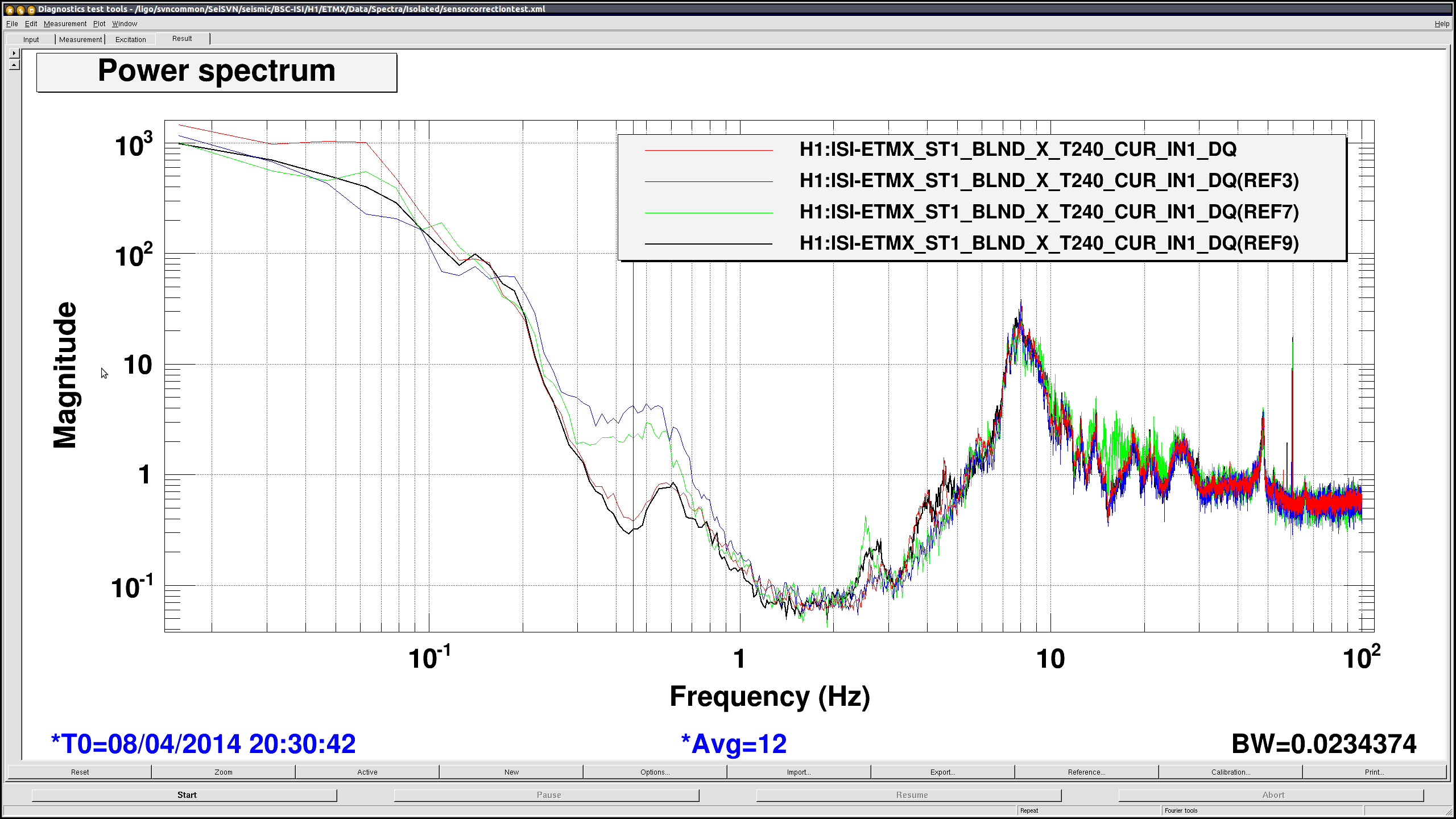
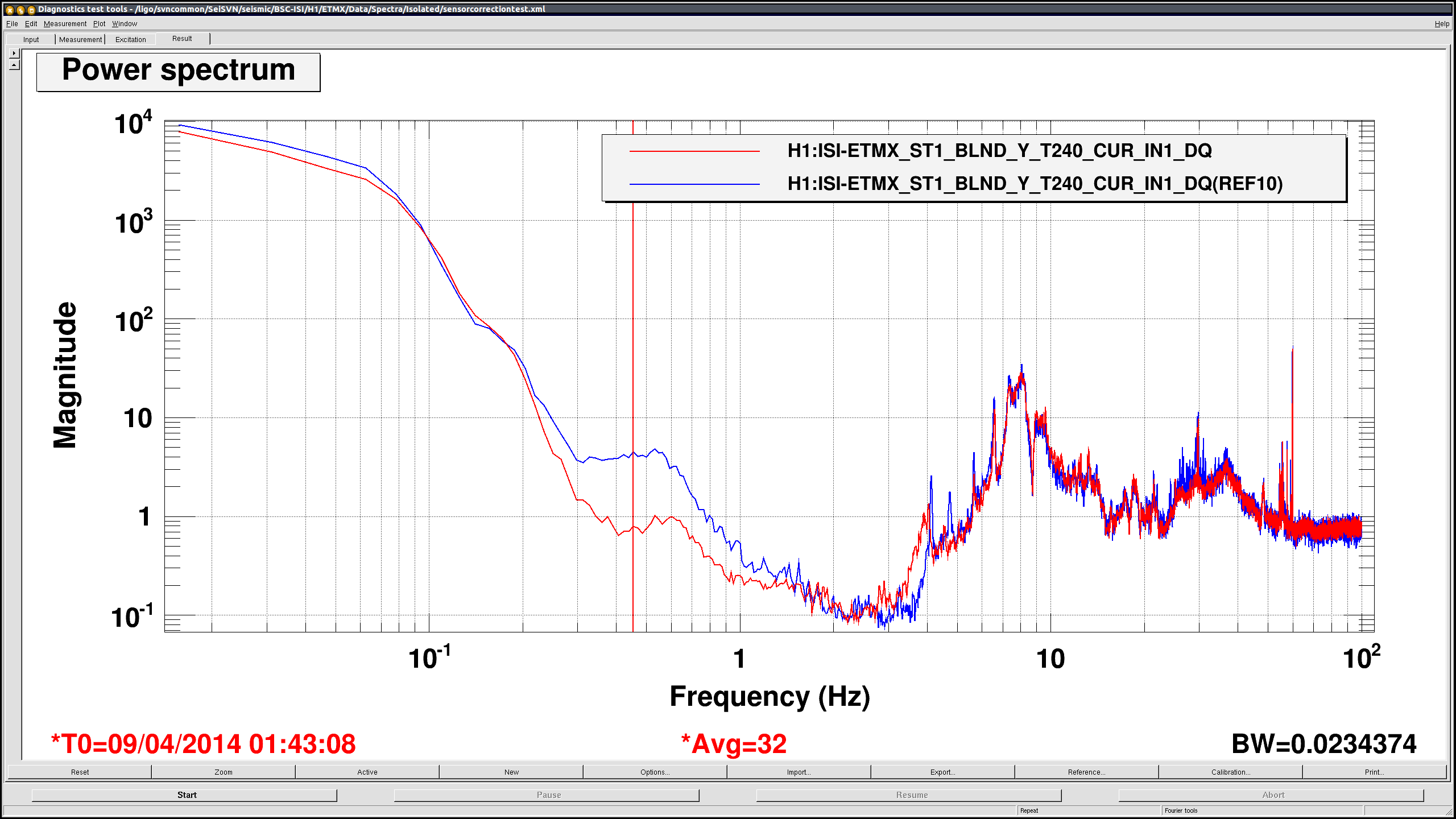
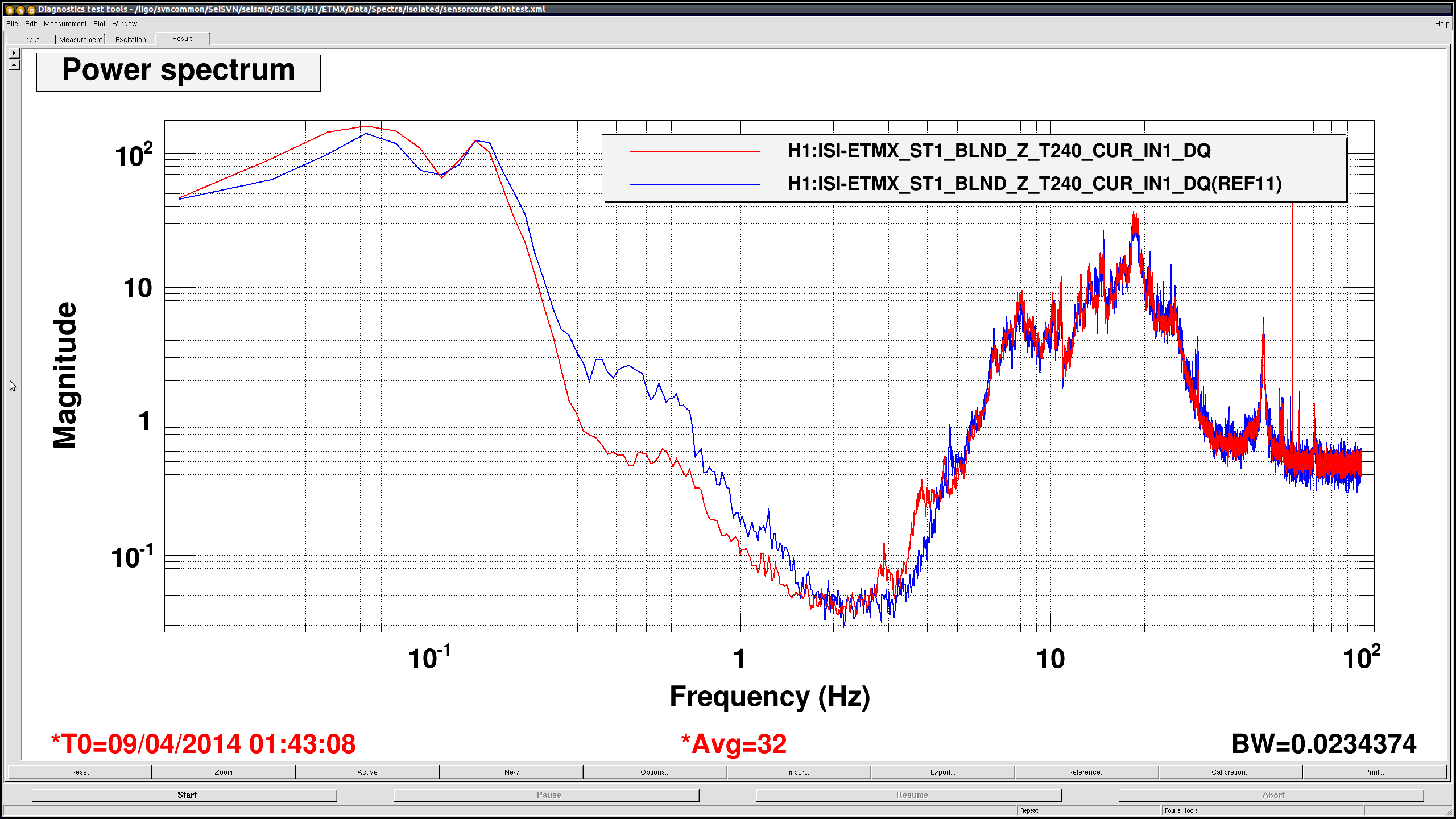
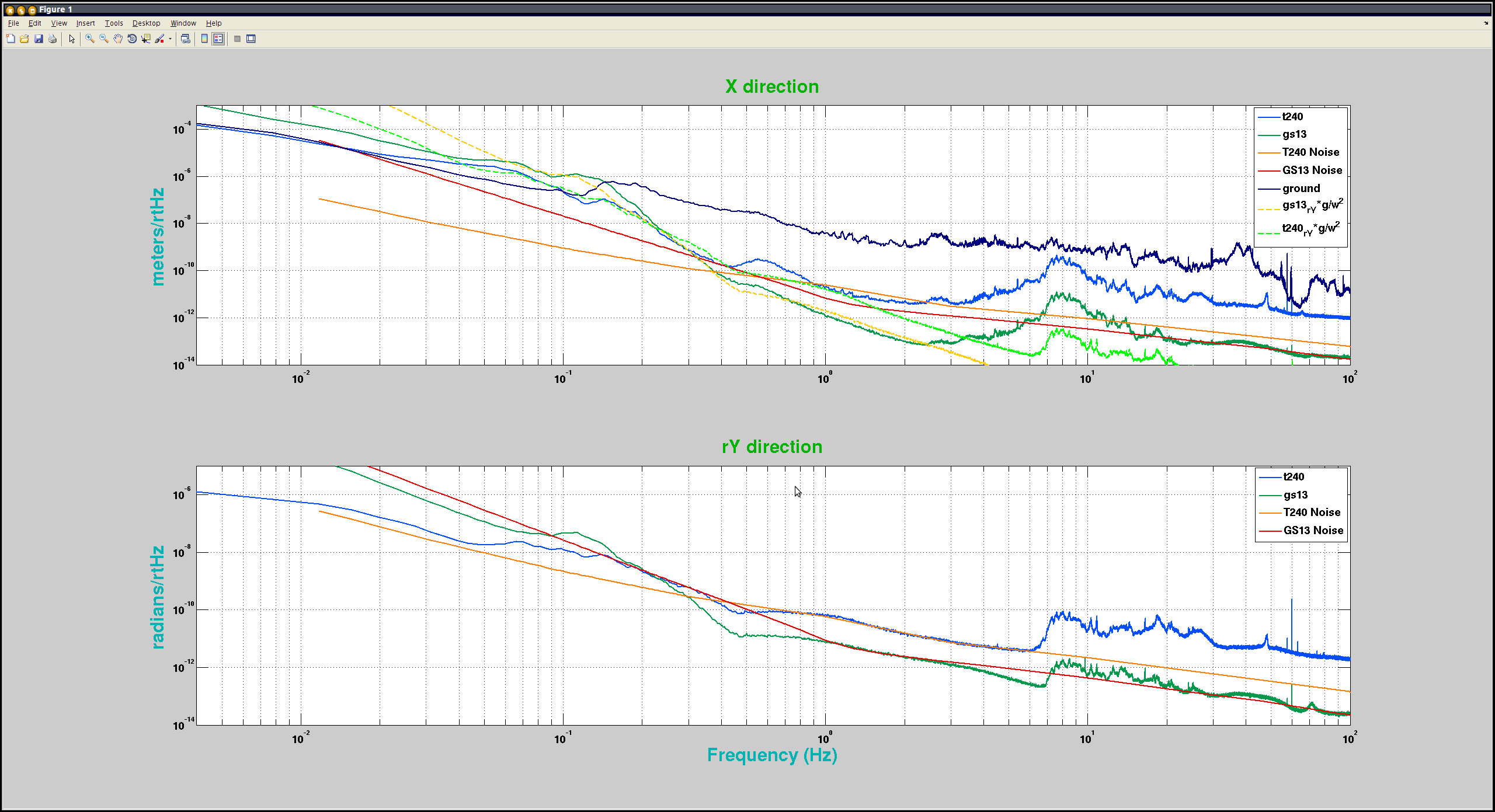
J. Kissel, R. Bork, B. Abbott, D. Barker, F. Clara, A. Sevigny Satisfied with a few days of debugging and testing a single chassis of the new Hardware Watchdog System on the H1 DAQ Test Stand, we have installed a similar chassis in the SUS BSC123 rack, and hooked it up to the H1 SUS ITMY M0 sensors. We have deliberately *not* connected any of the trip signals (either to the SEI or SUS actuators) while we characterize the RMS trigger system. In addition to the hardware, we've installed temporary configurations of the h1iopsusb123 and h1susitmy models, in which - h1iopsusb123: Unfortunately, neither analog or digital readbacks of the RMS calculated by the board are exposed in any way. Instead, we've installed a mock RMS system to replicate the RMS logic that is performed inside the hardware watchdog itself, using the raw ADC values as inputs. Though the changes have been made to the model, it has not yet been compiled, installed or restarted, since the green team were still actively searching for beams and needed ITMX up all afternoon. Hopefully we can install tomorrow morning. - h1susitmy: the status bits of the hardware watchdog *are* digitized via a binary input chassis, and fed into spare channels of the already present Contec BIO card. Similarly, the remote control reset bit are spit out of the same card, through a binary output chassis, to the SUS hardware watchdog. As such, for the status bits, we needed to add a few new connections inside the BIO_DECODE block, which are turned into a bitword and fed into a new EPICs readback channel, H1:SUS-ITMY_HWWD_STATUS. Once we get the readback installed, we'll run the ITMY chamber in various configurations of isolation and excitation, to determine a good value for the RMS threshold. The test cases we plan to use are: - Ambient (no actuation from any layer) - SUS Undamped, ISI Damped, HEPI Position Loops - SUS Undamped, ISI Damped, HEPI Position Loops (With large alignment offset) - SUS Damped, ISI Damped, HEPI Floating - SUS Damped, ISI Damped, HEPI Driven (Normal level TFs) - SUS Driven (LOUD White Noise TF), ISI Damped, HEPI Floating - SUS Damped (With large alignment offset), ISI Damped, HEPI Floating - SUS Undamped, ISI Driven (LOUD White Noise TF), HEPI Floating - SUS Undamped, ISI Floating, HEPI Driven (LOUD White Noist TF) These should give us a good feel for the most quiet and most loud situations for the M0 OSEMs. Based on these results, we'll make an assessment of where we want to set the threshold.
Alexa, Sheila, Daniel, Keita, Kiwamu, Stefan
We tried to lock the x-arm today, but we stumbled over a couple of mysteries.
- For the initial alignment we first pointed TMS onto ITM baffle PD1, and found TMS PIT=107, YAW=-207. This was -2urad, -4urad less in PIT, YAW than the previous alignment measurements (alog 9126), so we subtracted these values from the subsequent ones. We repeated this for the ITM using the ETM baffle PD. The ITM was PIT=57, YAW=-78.
- With both optics aligned we get about 18000 counts on REFL_B_LF. Surprisingly though, misalignment of ITMX (yes ITM) dropped this to 12000 counts
- We do get a PDH signal of about 5V out of the Imon demod. However, with the cavity just slightly misaligned, we still get a sinusoidal PDH signal of about 2V. We are not sure why, but are afraid it could be some scattered light.
- The PDH loop does lock temporarily, but the arm motion was slightly too large -- the sus pro-team is working on this.
- Next we misaligned PR3 in yaw by -150urad (from -272urad to -422urad). This put the straight through beam nicely on the Swiss cheese baffle.
- We also noticed a ghost beam to the right of the straight shot. It moves with ITMX and CPX, which pretty much nails down what it is.
- There is also a 2nd copy of the straight though and ghost beam visible to the left of the POP hole in the Swiss cheese baffle.
The fiber pulling machine upper clamp was binding up when we advance the trolly to the end of its stroke after the fiber is pulled. This advanced travel gives you the clearance to allow you to get the fiber assembly out after the fiber is pulled. This issue has been happening more and more recently and causes damage and gross mis-alignments of the translation stages and goniometer mounts. The mounting hardware fit to the fiber clamps was tightly constrained adding to the problem. There is a bit too much wiggle to the mounting stages that were allowing further issues. Bottom line, I loosened up some of the fit tolerances and coaligned the top and bottom mounts followed up by a beam realignment. I will revisit this in the AM and pull a test fiber. Hopefully we will not have any further issues. I hope to install more robust stages in the near future.
Attached is a picture of the top bracket of what would be a fiber holder stuck in the top stage of the fiber puller, when in fact it should have released (hence Doug's hand prepared to catch it during the photo shoot!). This sticky mating is what Doug fixed. Currently Travis and Giles are pulling fibers.
Now that the alignment of the cavities is roughly good, I aligned the ITMX, PR3, HAM2, HAM3, and ETMX optical levers to their respective optics/HAMs. It's relevant to note that the connector of the controller for the translation stages broke, we were able to re-solder the wires but the connection is very fragile. I'll just have to be careful when moving it around but it'd be best to have a system where we're not constantly unplugging and plugging in delicate wires every time we want to re-align the pointing.
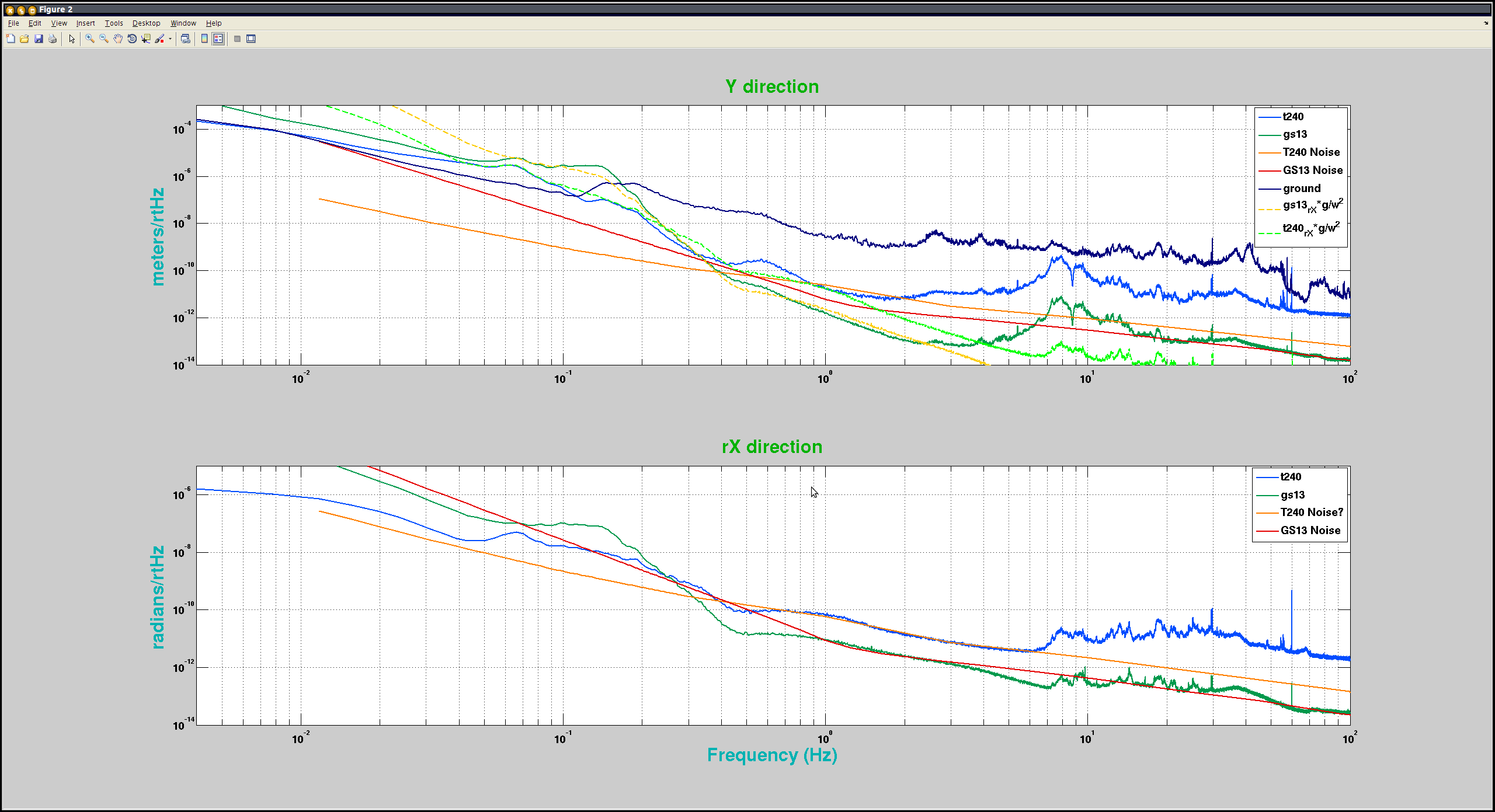
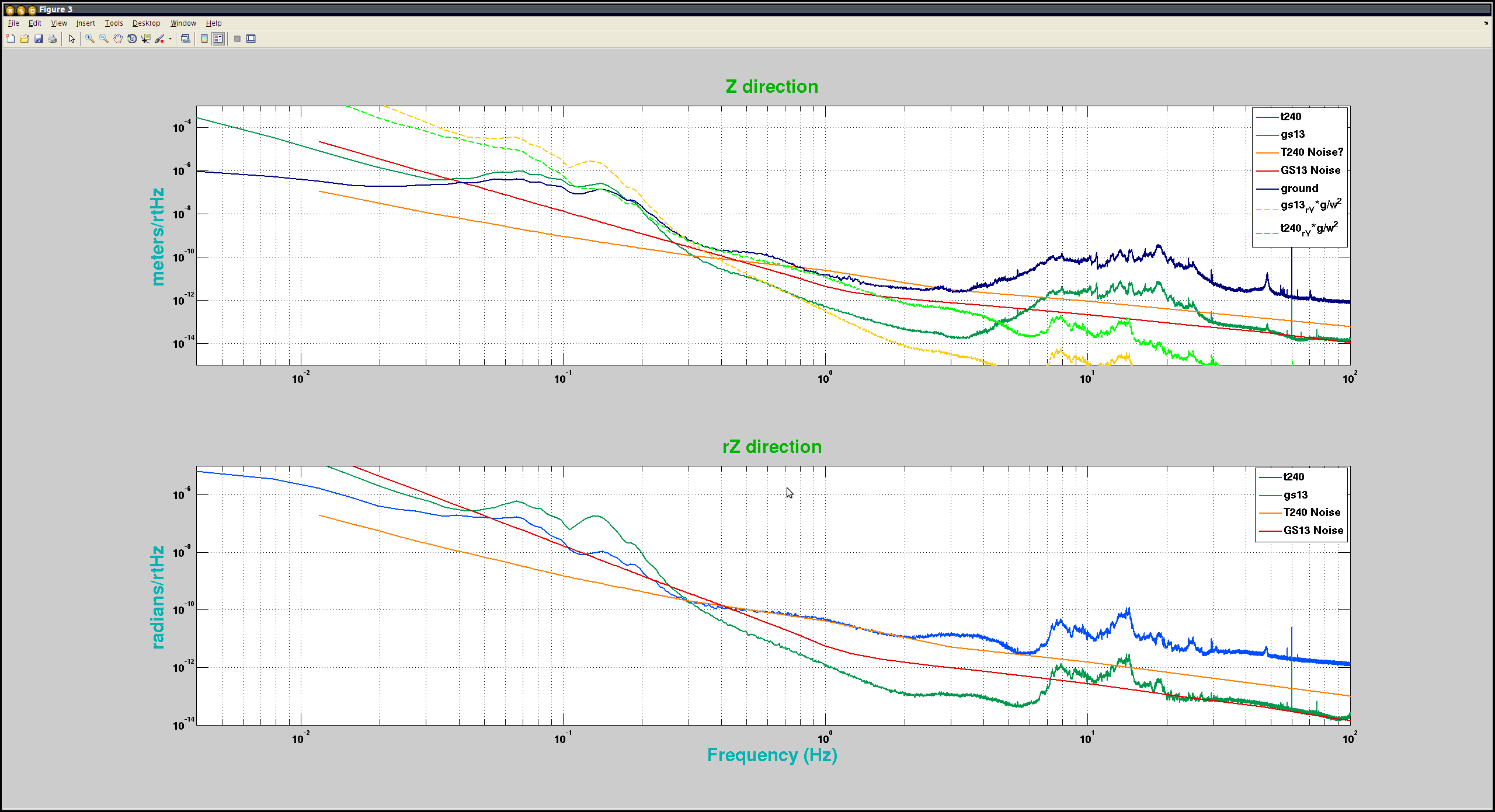
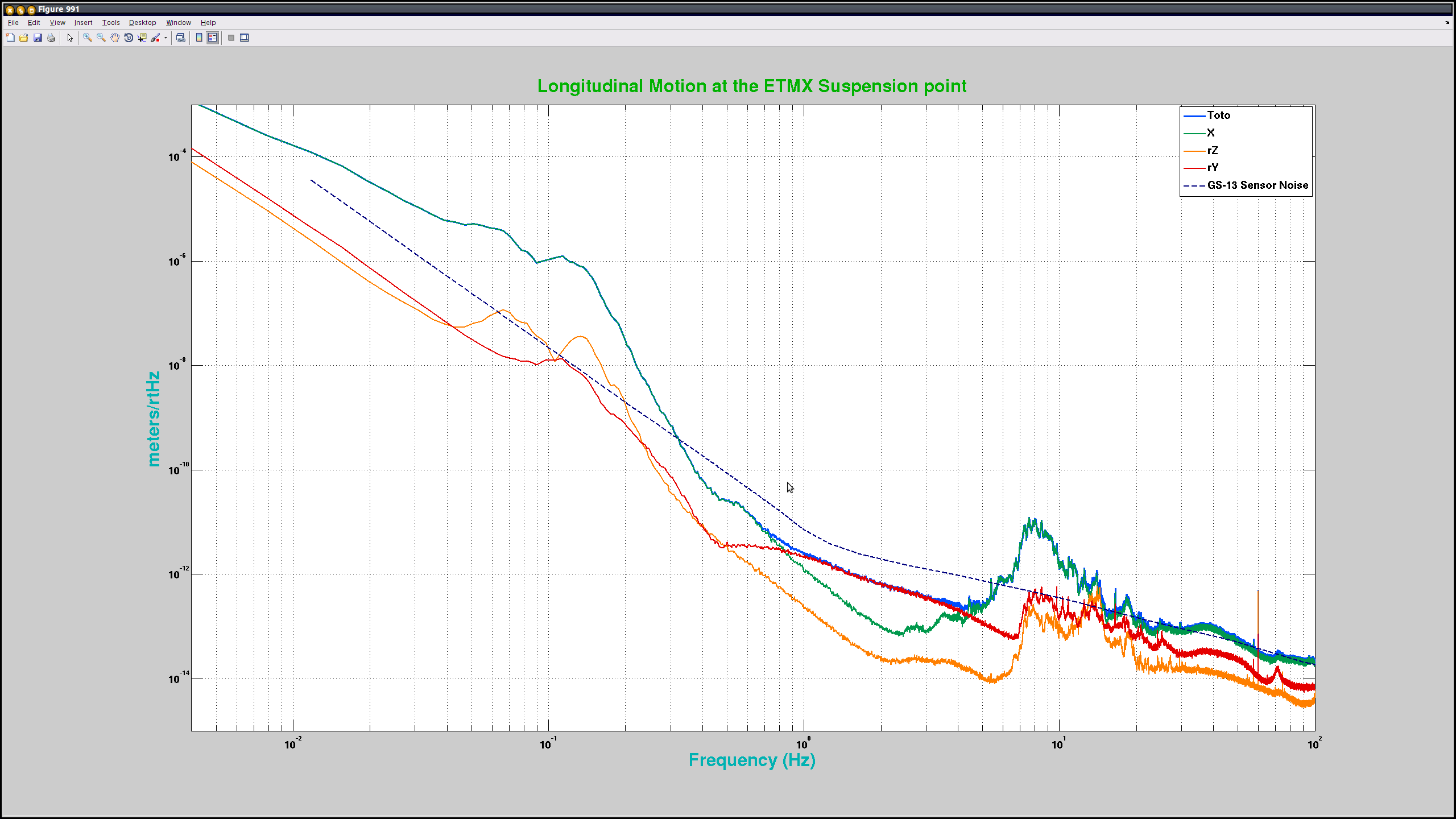
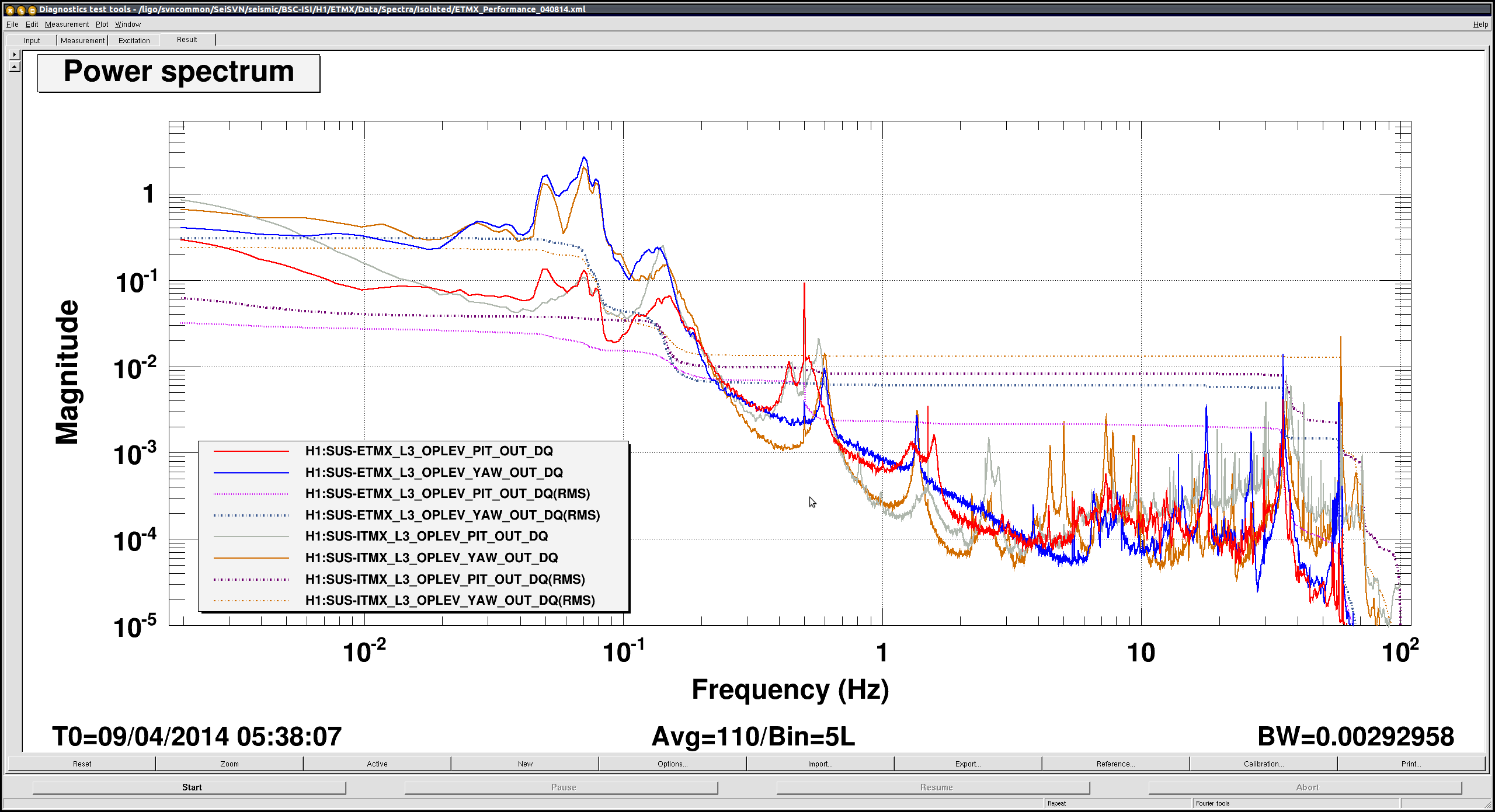
Related to the continuing study of the subject problem, I repeated the measurement at ETMx. When compared to a similar tilt applied to ITMY (see 9139), the HEPI Tilt increases the noise level on the T240 significantly more at ETMX. See the first 4 hour plot below. The upper right plot is the HEPI tilt first off then on and then off again. The vertical axes of the T240 are pretty much unaffected. And depending on the orientation of the pod, some axes are more affected than others.
I had a thought, if we were running the HEPI Actuators into their stops, we could be shorting HEPI to ground and affecting the T240. So, I did the -12000 offset, back to zero and then went to -13000. See the second 30 minute plot with the offset 'ramps' in the upper right. Notice the other graphs with the 8 HEPI position sensors showing an increase in position at the -13000 offset relative to the -12000. So I think this says the Actuators are not running into anything at the -12000 count level...
- Justin to LVEA, laser safe transition.
- John to LVEA, soft close GV6 and GV8, per WP4380.
- Bubba and crew to LVEA, remove HAM01 door, per WP4379.
- Mitchell and Andres to LVEA, AOS/ACB assembly work.
- Corey to MX, store items.
- Filiberto and Aaron to Y-End, inspection of installation.
- Justin to LVEA, supervise locksmith.
- Luis and Frank to X-End, PEM cable work.
- Justin to LVEA, laser hazard transition.
- Thomas to LVEA, alignment of OLs.
- Mitchell to LVEA, AOS/ACB assembly work.
- Dave from CR, lots of reboots per WP 4382.
- Karen and Chris to LVEA, HAM4 cleanroom, clean area per WP4384.
- Filiberto and Aaron to X-End, Install GigE camera on A1-C, port VP5, per WP4386.
Mark B. and Kiwamu.
Yesteday afternoon, Kiwamu reported that the MC2 guardian was giving an error in line 104 the SUS.py script. This was a call to a method from sustools.py in the definition of the ALIGNED state:
self.optic.lockGainWrite(1.0,[],[], [P,Y])
This could never have worked - all arguments to lockGainWrite other than the first are keyword arguments, and the non-empty list should be of strings. I changed it and a similar instance (line 120) to
self.optic.lockGainWrite(1.0,chans=['P','Y'])
That solved the initial problem and exposed a second: there was no file ^/sus/h1/burtfiles/h1susmc2_misaligned_offsets.snap .
I created one by copying h1susmc2_aligned_offsets.snap and manally putting in new offsets suggested by Kiwamu.
I committed the fixed SUS.py and added and committed everything else in the ^/sus/h1/burtfiles and ^/sus/common/guardian directories.
References: aLOG 6683, https://dcc.ligo.org/L1200282, https://dcc.ligo.org/T1200470, https://dcc.ligo.org/D1000313-V9
Attached shows the relative position of ALSX, ALSY and POP (from L1200282) together with two top periscope mirror profiles (equidistant from three beams and centered on ALSY, the latter is supposed to be the current configuration). Green and red circles show the beam diameter obtained from T1200470 and D1000313-V9 (V10 doesn't have the beam profile information).
With the "centered on ALSY" configuration POP is close to the edge of the mirror. Today HAM1 incursion team will move everything such that periscope and downstream will be equidistant from three beams though we have only the ALSX for the moment,. They'll also try to find POP in HAM1 again with the new alignment.
I installed the following IPC links: ASC to ISCEX: PZT1X_PIT PZT2X_PIT, PZT1X_YAW PZT2X_YAW (all four are being received) ASC to ISCEY: PZT1Y_PIT PZT2Y_PIT, PZT1Y_YAW PZT2Y_YAW (all four are being received) ASC to SUSTMSX: TMSX_PIT, TMSX_YAW (not being received yet) ASC to SUSTMSY: TMSY_PIT, TMSY_YAW (not being received yet) (links for ASC to ETMs and ITMs were already installed.) checked in h1asc.mdl: SVN revision 6769 h1iscex.mdl: SVN revision 6770 h1iscey.mdl: SVN revision 6770 We are still getting some IPC errors.
J. Kissel, S. Ballmer, D. Barker I've completed the install of the new IPC communication between the ASC front-end model and the TMS and HTTS models for green / REFL alignment control. This required - (as Stefan mentions above) Adding RFM IPC parts to the ASC model to send to the end-station SUS computers, H1:ASC_TMSX_PIT_SUSTMSX H1:ASC_TMSX_YAW_SUSTMSX H1:ASC_TMSY_PIT_SUSTMSY H1:ASC_TMSY_YAW_SUSTMSY - (as Stefan *didn't* mention above) Adding SHMEM IPC parts to the ASC model to send to the HTTS core on the same front-end H1:ASC_RM1_PIT_SUSHTTS H1:ASC_RM1_YAW_SUSHTTS H1:ASC_RM2_PIT_SUSHTTS H1:ASC_RM2_YAW_SUSHTTS - Modifying the ASC and OAF IOP model parameters to turn on the RFM capability (Set "rfm_dma=1") - Installing all of the above mentioned channel into the respective receiver models, and hooking them up to the already-present place holders in the ISC input bus creator, h1sustmsx --> H1:ASC_TMSX_PIT_SUSTMSX, H1:ASC_TMSX_YAW_SUSTMSX h1sustmsy --> H1:ASC_TMSY_PIT_SUSTMSY, H1:ASC_TMSY_YAW_SUSTMSY h1sushtts --> H1:ASC_RM1_PIT_SUSHTTS, H1:ASC_RM1_YAW_SUSHTTS, H1:ASC_RM2_PIT_SUSHTTS, H1:ASC_RM2_YAW_SUSHTTS - Re-compiling, Re-installing, Re-starting, and Re-storing all of the following models: h1iopasc0 h1iopoaf0 h1asc h1sustmsx h1sustmsy h1sushtts All of the modified models mentioned above have been committed to the userapps repository. Taking down H1 SUS TMSX naturally trips the watchdog on HPI and ISI ETMX, so Hugh and I made sure to ramp down all offsets before getting started. After restoring, Hugh has brought up HPI ETMX and ISI ETMX, and I've restored the alignment of both SUS ETMX and SUS TMSX. No one is using the RMs just yet, so they have not been restored -- and indeed, they do not yet have a good safe.snap, so they will need a complete restore from scratch. Bummer.
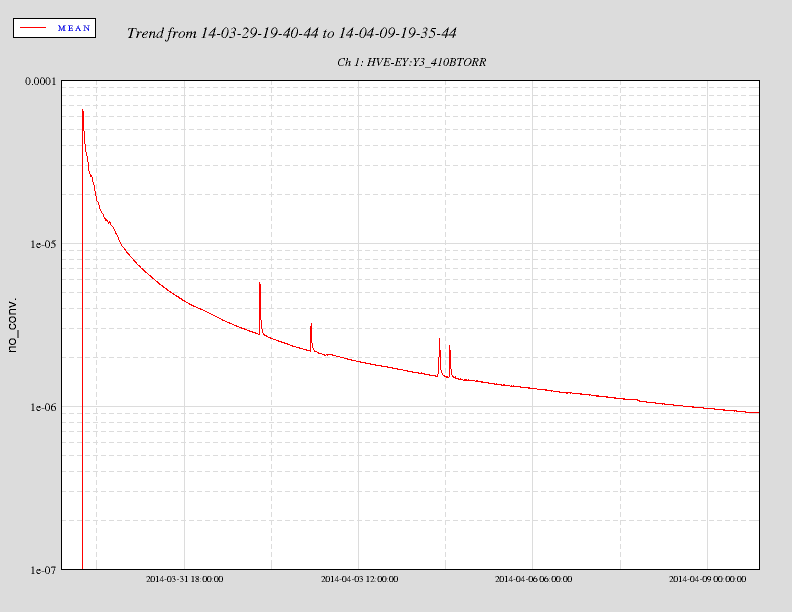
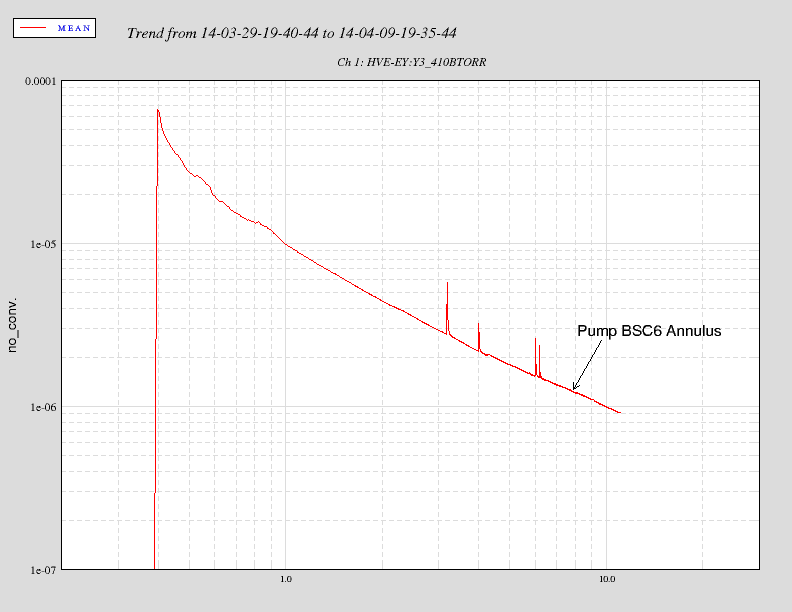
The attached plot shows the XEND pump down and transition to BT operation. 30 days are shown.
Over the Christmas break we operated on the main turbo only. On Jan 6 the transition to the main ion pump and 80K pumps was made.
After isolating the main turbo the beam tube valve was opened for HIFO X work.
You can see that the the pressure has come to ~4e-8 torr in the BSC chamber (pt510). The two gauges on the 80K pump and the beam tube are both below 2e-8 torr.
In summary the transition from turbo only to final configuration has bought us slightly more than a factor of 10 improvement in pressure.
The LVEA transition is shown in this alog https://alog.ligo-wa.caltech.edu/aLOG/index.php?callRep=9119
For reference, guidance related to opening to the beam tube is here: https://dcc.ligo.org/LIGO-T1300802
After the alignment of PR3 (see alog 9146), I aligned PR2 and PRM to get PRX flashing with the infrared light. The resultant alignment sliders are shown in the attached.
I could lock PRX quite smoothly, but it seems that some optics are oscillating in pitch by a non-negligible amount. Due to this, the intracavity field spatially wobbles by almost its beam size in pitch according to the CCD camera attached on BS's chamber. In this condition, the intracavity power observed by the POP_A QPD fluctuates more than 10%. We need to identify which optic is the culprit by using the oplevs and witness sensors. It seems to me that it is hopeless to try locking PRMI without improving this wobbliness.
An additional note:
The spatial beam motion was observed by introducing an intentional misalignment in ITMY and BS to let the ITMY reflection beam hit the BS baffle which is monitored by the BS CCD camera.
Greg G, Thomas V I tricked Greg into helping me and we successfully installed and aligned the ETMX optical lever; it will need to be calibrated it next but that will not require the closure of a gate valve. At the first shot of alignment, there was some clipping on the edge of the viewport so we had to modify the transmitter mount which took a bit more time than I expected. Note: We adjusted the height of the receiver pylon to line up the viewport to the optical lever enclosure, but this did not take into account what will be needed for the photon calibrator receiver so we might have to revisit this in the future.
Green arm transmission was first found on the Swiss cheese baffle while scanning PR3.
After centering the beam on the POP hole in the baffle (PIT was already good, YAW was off by 86urad), we looked inside HAM1 and found that the beam was already coming in that chamber. The beam was hitting somewhere on the green/IR separator M10, and some scattering or maybe specular reflection was hitting the beam duct of IR POP path, but nothing seemed to be hitting the green steering mirror M11.
Turning PR3 by +10urad in YAW and the beam was already blocked on the mirror holder of M11.
Turning PR3 by -10urad in YAW and the beam was nowhere to be found in HAM1, and we couldn't identify where the beam is blocked in HAM2, but it kind of seems from one of the GigE cameras that the beam might be blocked by one of the MC towers.
See attached if this helps.
Right now PR3 is set to the "neutral" position where the beam is centered in the baffle hole, but probably that's not the right thing to do (because the space between MC1 and MC3 tower gives us a tight aperture in YAW). We'll go in HAM1 tomorrow to find a right solution.
One positive thing is that it seemed as if we're locked to 00 mode.
However, refl power is supposed to drop to 45%-ish in an ideal case, we're only getting 90% or so, and our mode matching cannot be that bad (see earlier alog), so the alignment is far from ideal (Kiwamu and Sheila confirmed that no dither was used for aligning it).
In anticipation of some new changes to the ASC_MASTER library part, I updated it to the latest version from LLO. This includes pitch and yaw outputs for RM1,RM2,OM1,OM2. I updated our h1asc.mdl accordingly, recompiled and restarted it. SVN version number 6759.
I modified ASC_MASTER library part to route initial green arm alignment signals in and out. This added six new inputs (green arm signals) and twelve new output signals (controls for TMS, PZT1, PZT2, both pitch and yaw). ASC_MASTER.mdl was checked in to SVN: revision 6761 I also updated h1asc.mdl to deal with the additional in and outputs. For now I connected the twelve RFM IPCs to ISCEX/Y and SUSTMSX/Y. The inputs are still grounded, because the sending models have to be updated first. h1asc.mdl was checked into SVN: revision 6762 The model was compiled, installed and restarted.
I am in the process of updating the ISCEX and ISCEY models to receive the newly sent alignment dither signals for the PZTs. ALS_END.mdl was updated, and checked into SVN: revision 6763 I am in the process of editing h1iscex.mdl and h1iscey.mdl More tomorrow.
For the record, the following are the nominal values used for the large ion pump controllers (listed in the order queried by the MultiVac firmware Flow 7): Torr Spare 7000V 200mA 200watt Protect 10mA STEP 5000V 1.0 x 10⁻³amps 3000V 4.0 x 10⁻⁵amps (StPt 1) 1.0 x 10⁻⁵torr (not used?) (StPt 2) 1.0 x 10⁻⁶torr (not used?) 1.0 x 10⁻¹⁰ 1.7 x 10⁻⁹ 8.0 x 10⁻⁷ 2.0 x 10⁻⁴
Correction: 1 x 10⁻³ amps (should be) 3 x 10⁻³ amps