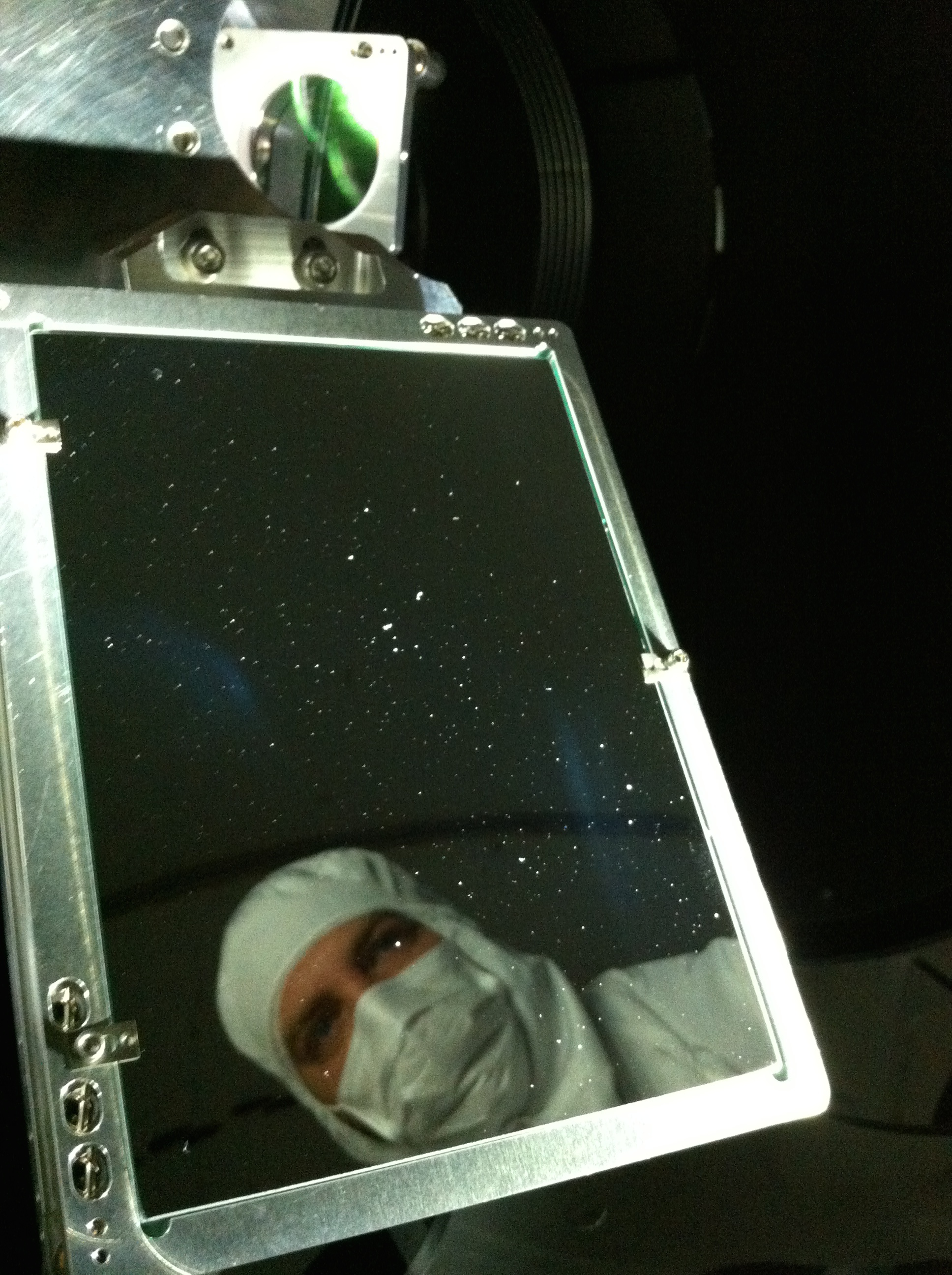
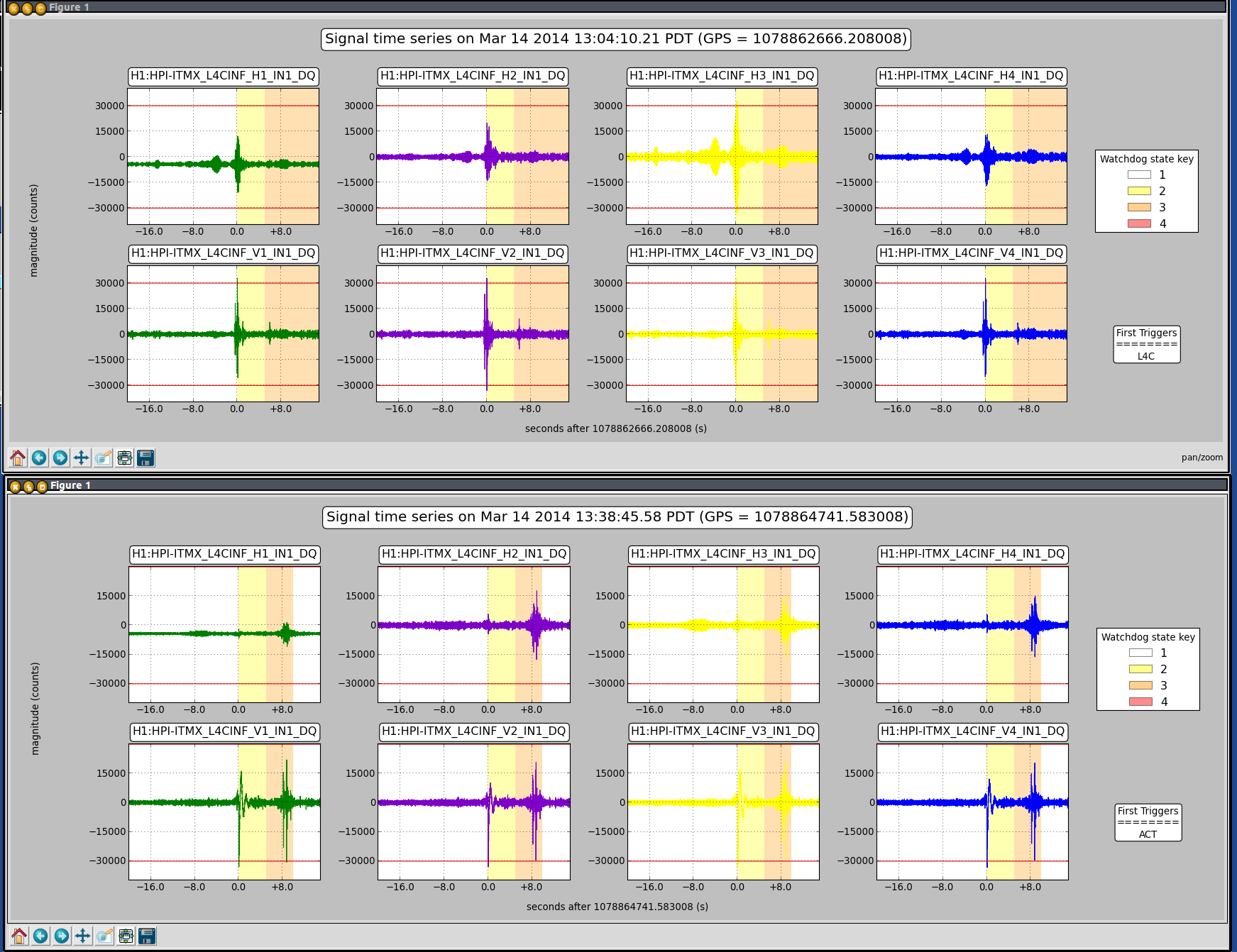
Greg G, Thomas V I tricked Greg into helping me and we successfully installed and aligned the ETMX optical lever; it will need to be calibrated it next but that will not require the closure of a gate valve. At the first shot of alignment, there was some clipping on the edge of the viewport so we had to modify the transmitter mount which took a bit more time than I expected. Note: We adjusted the height of the receiver pylon to line up the viewport to the optical lever enclosure, but this did not take into account what will be needed for the photon calibrator receiver so we might have to revisit this in the future.
Green arm transmission was first found on the Swiss cheese baffle while scanning PR3.
After centering the beam on the POP hole in the baffle (PIT was already good, YAW was off by 86urad), we looked inside HAM1 and found that the beam was already coming in that chamber. The beam was hitting somewhere on the green/IR separator M10, and some scattering or maybe specular reflection was hitting the beam duct of IR POP path, but nothing seemed to be hitting the green steering mirror M11.
Turning PR3 by +10urad in YAW and the beam was already blocked on the mirror holder of M11.
Turning PR3 by -10urad in YAW and the beam was nowhere to be found in HAM1, and we couldn't identify where the beam is blocked in HAM2, but it kind of seems from one of the GigE cameras that the beam might be blocked by one of the MC towers.
See attached if this helps.
Right now PR3 is set to the "neutral" position where the beam is centered in the baffle hole, but probably that's not the right thing to do (because the space between MC1 and MC3 tower gives us a tight aperture in YAW). We'll go in HAM1 tomorrow to find a right solution.
One positive thing is that it seemed as if we're locked to 00 mode.
However, refl power is supposed to drop to 45%-ish in an ideal case, we're only getting 90% or so, and our mode matching cannot be that bad (see earlier alog), so the alignment is far from ideal (Kiwamu and Sheila confirmed that no dither was used for aligning it).
I went back to the end station to look into why the frequency comparator readback has not been reliable. There was 1MHz oscillation on the readout of the PD that is similar in size to our beatnote, which was confusing the frequency comparator. The oscillation goes away when the noise eater is on, and the frequency readback works well. For now I have left it on, although this isn't a long term solution.
In alog 6669 I came to the opposite conclusion, that the nosie eater had to be off to avoid oscillations at 1 MHz that confuse the frequency comparator. A high pass in the path to the frequency comparator might take care of the problem.
Cyrus created a new EPICS gateway between the H1-AUX and H1-FE VLANS to permit the DAQ EDCU to acquire the new PSL Centroid EPICS channels created by Chris W. The new gateway is called h1aux-h1fe (client on h1aux, server on h1fe). The DAQ EDCU quickly connected to the new channels and became GREEN.
Today we were frought with more fiber pulling issues. After sorting user errors with the profile math yesterday, today the fiber puller was cranky. The latest problem this afternoon was that a piece of the mechanics on the bottom stage of the puller pulled out of place (a problem that has been seen before). It will (again) take a few hours of their time to fix tomorrow.
Meanwhile at EY, Jason and I repositioned the UIM and PUM in prep for the rewelding scheduled for later this week. When we went to position the test mass, Jason discovered that the HR return beam was very faint and the autocollimator could not get a reading off of it. LLO reported this finding when they did their ETM. We will pull the First Contact thin alignment sheet down a bit and try see if that improves the visability. Otherwise, we may entertain the idea of sighting off of the AR surface for pointing which has a much better return for the 670nm autocol beam.
Oh, and the cookie cutter for repositioning the ETMy QUAD upper structure on the ISI appears to have been machined incorrectly. I have time to fix it.
Fire Department on site doing maintenance Installation and alignment of the GigE cameras at the HAM2 and HAM3 spools – Kiwamu Centering SR2 BOSEMs at LVEA – Jeff B. Baffle work at LVEA West bay – Mitchell Electrician working at H1 electronics room Work at End X – Sheila/Koji/Alexas Turning Off aLOG, SVN, and awiki services due to hardware problems – Jonathan Work on H1 PSL diode room – R. Savage Cable pulling from Electronics room to HAM2 – Luis aLOG, SVN, and awiki services have been turned ON – Jonathan Remove the HAM1 viewport covers and/or camera cans – Keita/Kiwamu/Sheila/Koji/Alexa Soft-close GV20 at End X- Kyle Removing yellow cover from viewports on HAM1, HAM2 and HAM3 – Stefan Fix to the ETMX, ETMXY, TMSX and TMSY models – Jeff K. Hardware cabling at End X - Richard
In anticipation of some new changes to the ASC_MASTER library part, I updated it to the latest version from LLO. This includes pitch and yaw outputs for RM1,RM2,OM1,OM2. I updated our h1asc.mdl accordingly, recompiled and restarted it. SVN version number 6759.
I modified ASC_MASTER library part to route initial green arm alignment signals in and out. This added six new inputs (green arm signals) and twelve new output signals (controls for TMS, PZT1, PZT2, both pitch and yaw). ASC_MASTER.mdl was checked in to SVN: revision 6761 I also updated h1asc.mdl to deal with the additional in and outputs. For now I connected the twelve RFM IPCs to ISCEX/Y and SUSTMSX/Y. The inputs are still grounded, because the sending models have to be updated first. h1asc.mdl was checked into SVN: revision 6762 The model was compiled, installed and restarted.
I am in the process of updating the ISCEX and ISCEY models to receive the newly sent alignment dither signals for the PZTs. ALS_END.mdl was updated, and checked into SVN: revision 6763 I am in the process of editing h1iscex.mdl and h1iscey.mdl More tomorrow.
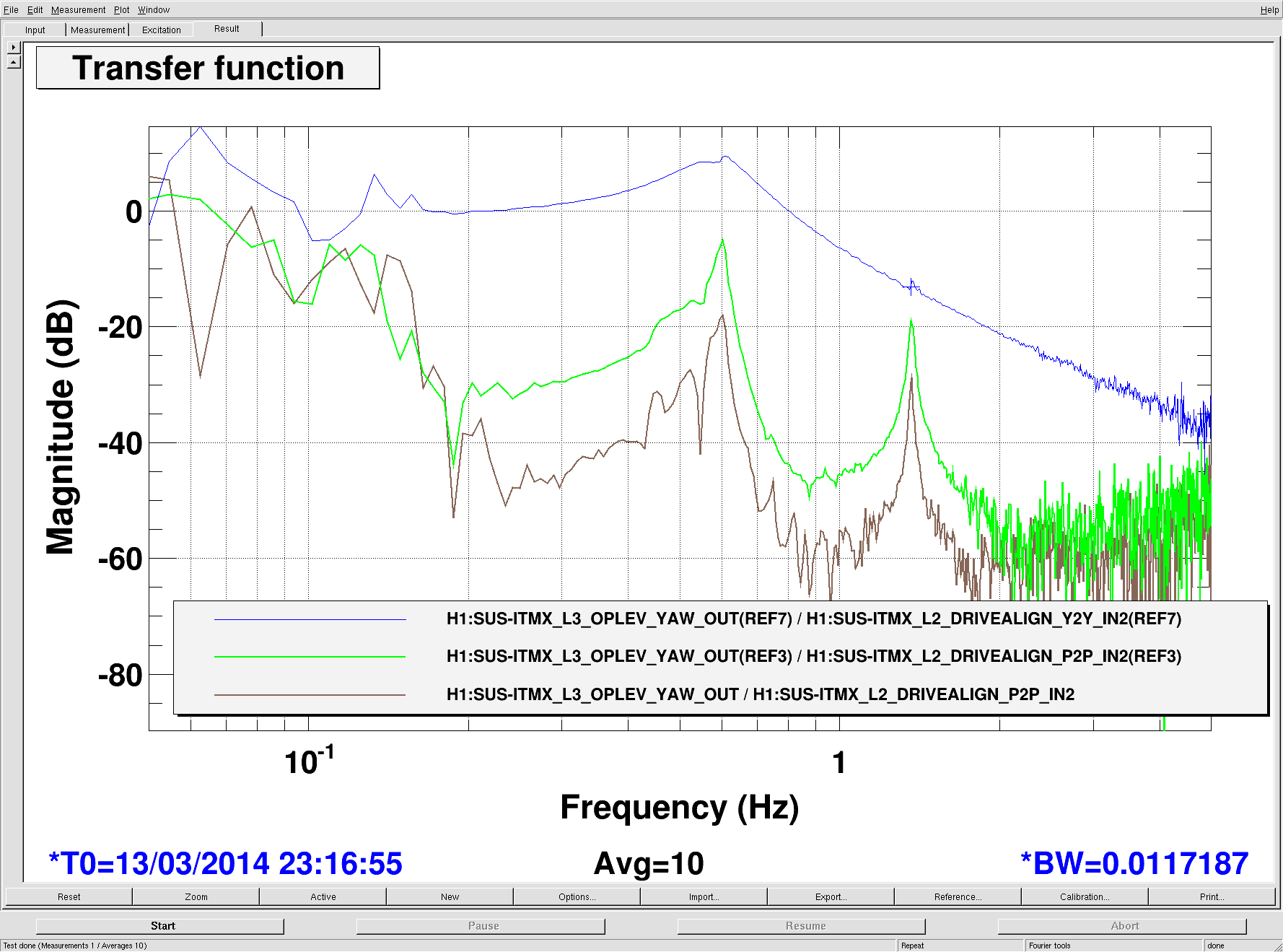
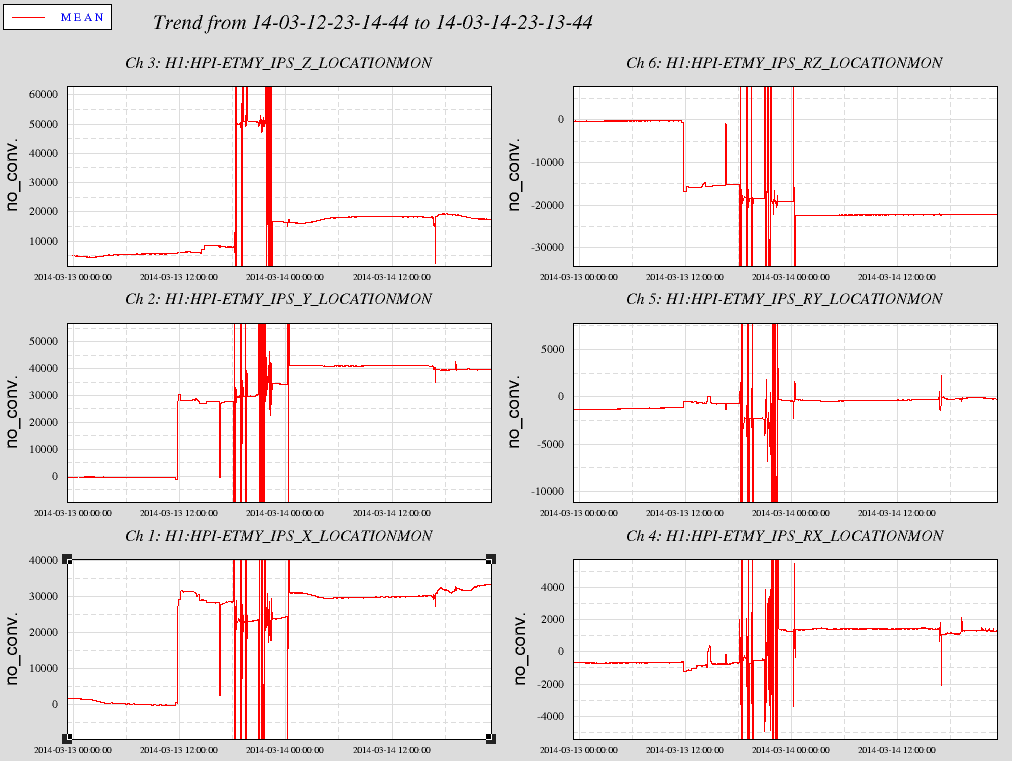
Back on 23 December, Keita found the need to tilt the HEPI to pitch the TMS. Attached is a plot showing the T240 signal going back 30 days from now. The time keita tilted the HEPI is pretty obvious in the middle of the trends when tilted axes of the T240s are affected. Much of the period since 23 Dec has the ISI off (tripped from T240 saturations) and so not the source of the increase in these T240 signals.
As I've logged before, the ETMX ISI has not managed to stay engaged for more than a few hours since this time. Notice too on these trends, the signals with the largest amplification has a regular hit of the rail. The second plot I've attached is a single channel of 15 days. Notice the rail hit every 24 hours; this is to the minute as best I can tell from a 15 day dv trend. I am suspicious that this is real given the periodicity.
Finally, the last plot zooms in to 8 days of this channel and I've added a channel indicating the HEPI tilt. Notice in the middle of the plot where on 2 & 3 Jan I'm mucking about with tilts and ISI. The noise of the T240 is reduced when there is no tilt applied.
Duplicated this situation at ITMY. We removed the HEPI position loops and took the ISI to damping only and then tilted the HEPI -12000 counts in the same method as the ETMX. Attached is the nominally affected channels. Upper right trace is the offset. There is no large difference between the periods of offset and no offset; certainly not to the extent it is seen on the ETM. Fabrice is currently repeating this measurement at ETMX while ISC has relenquished control.
J. Kissel, T. Vo, R. McCarthy Both sites have simultaneously discovered that the optical lever signal wiring has changed between version 5 and version 6 of the ETM System Wiring Diagram, D1002741, specifically page 4. However, since we're just now turning on the EM optical levers (whose signal installation required the change), we discovered that the front-end Simulink model is still wired according version 5 as cables were plugged in according to version 6. Note that the drawing changes were made back in July of 2013, as a part of resolving Integration Issue 78, but this week is the first time the changes have been exposed to installation reality at either site. As such, I have re-wired the following models: ${userapps}/sus/h1/models/ h1susetmx.mdl h1susetmy.mdl h1sustmsx.mdl h1sustmsy.mdl such that, in the ETM models: (1) Remove ADC1 from the top-level, since it no longer used in the ETM control models. (2) Change the From tag for the optical lever signals from "ADC1_2_QUAD" to "ADC0_2_QUAD," such that it receives signals from ADC0. (3) Re-selected ADC0 channels 0_24, 0_25, 0_26, 0_27, which are Quadrants A, B, C, D on D1002741, and Segments 1, 2, 3, and 4 in the QUAD simulink Library part, respectively. and in the TMS models: (1) From the ADC0_2_TMTS From tag, re-selected ADC0 channels 0_28 and 0_29 for M1 RT and M1 SD, respectively. Richard has now swapped the analog cabling accordingly, such that now both analog and digital match version 6. Note, the naively annoying signal shuffling that affects and separates the TMTS OSEM signals was done to preserve the last two channels on the ADC0 as open/spare required for the standard DAC and ADC duotone signals of every IO chassis. All top-level models (which is all that was affected by these changes) have been committed to the userapps repo as of this entry. H1 SUS ETMX AND H1 SUS TMSX have had their damping restored, and their alignment offsets restored to what they were just before the reboot. As the SEI/SUS watchdog system still stands, taking down the suspension models trips the HEPI and ISI, so I've restored the ISI to damping, and left HEPI untripped but requesting no actuation, since I don't know the state of these chamber's commissioning. I have not restored the 12000 nrad offset that Keita has installed to fix the differential alignment between ETMX and TMSX (see LHO aLOG 9064) that's need to lock the arm cavity on green (see LHO aLOG 9127) because he's put it in the hidden offset of the RY IPS blend filter bank, and I'm not sure whether position loops are functional. This should be moved to the DC BIAS location, and position loops should be run. I'll speak with Keita and the SEI team.
The aLOG is being turned off to examine possible hardware issues.
Our testing is done. We were unable to reproduce the problems seen yesterday during the power cycle of the MSR UPS. The hardware appropriately handled having UPS power removed and having facility power removed.
When aligning the X arm I thought that the green beam is too small on ITMX and ETMX, but when I actually looked at the data, the beam size on ITMX is not bad.
| Beam radius at ITMX [mm] | |
| Theoretical (using nominal ROC of ETM and ITM) | 37.8 |
| Measured (using straight shot beam on baffle PD) | 33 |
I adjusted the TMSX sliders to maximize one of the baffle PDs, moved TMSX in yaw such that the power on the PD drops, and assessed the beam size assuming that the beam is sufficiently smaller than the beam radius.
Attached plot shows that 4.4urad TMSX slider change in YAW makes one of the baffle PDs to drop from the peak by about half (.125/.240 = 0.521 to be more precise). From alog 9126 we know that the slider calibration for YAW is 1.07 [urad/urad], so the beam displacement is x=1.07E-6*4.4urad*4E3m=18.8mm.
exp(-2x^2/w^2) = 0.125/0.240= 0.521, x=18.8mm, therefore:
w=sqrt(-2/ln(0.521))*x=32.9mm.
I don't claim that the measurement has a mm accuracy, though, because I don't know the baffle PD size.
Sheila and Alexa reported issues seeing Beckhoff channels from the control room workstations, so I restarted the h1slow-cds EPICS gateway process. This appears to have corrected the problem.
Alexa and I restarted h1ecatx1 after we got a run time sytem not found error (from PLC2 or run time 2)
References: D1201036 (BSC9 ACB assy) and D1200314 (BSC3)
Gerardo read the distances between the baffle diodes off of CAD drawings for me (see the attached cartoon).
ITM baffle PD1-PD4 separation is 11.3" over 4km (72 urad) both horizontally and vertically. For ETM the number is 11.8", so it's 75 urad.
Don't know why the patterns are different for ETM and ITM, but using these we can calibrate TMSX, ITMX and ETMX bias sliders. Note the factor of 2 between TMS and mirrors, this is because TMS moves with the beam but mirrors don't.
| TMSX P | TMSX Y | ITMX P | ITMX Y | ETMX P | ETMX Y | |
| PD4-PD1 [urad in slider offset] |
187-118 = 69 |
-253+190 = -63 |
99-66.6 = 32.4 |
-38+72.9 = 34.9 |
355-310 = 45 |
-34-26.5 = -60.5 |
|
Slider Calibration [urad/urad] |
72/69 = 1.04 |
72/63 =1.07 |
75/32.4/2 = 1.2 |
75/34.9/2 = 1.1 |
72/45/2 =0.8 |
72/60.5/2 = 0.6 |
| Slider sign | positive=down | positive=out of L | positive=down | positive= inside of L | positive=down | positive=out of L |
Calibration of ETMX is somewhat suspect (at 10urad level) because of the fact that the position loop of EX ISI got accidentally off before I did ETMX adjustment.
There's an update on this. Nothing changed significantly, but anyway see the alog below:
https://alog.ligo-wa.caltech.edu/aLOG/index.php?callRep=9126
One error in the table, TMSX Y calibration = 1.14 urad/urad instead of 1.07.
Summary: Green injection hits the center of ITMX, comes back to the center of ETMX, and then back again to the center of ITMX. The alignment is good, with one caveat that HEPI should be tilted significantly in PIT to help TMS. Since EX PIT is unaffected by the HEPI, we're using EX sus bias to point it down by 330 urad.
1. Green beam from TMSX to ITMY
After Kyle opened the GVs we started scanning TMS to find the green beam on ITMX baffle diodes. Somehow PD4 amplifier was busted so we reconnected PD4 to PD3 amplifier.
At first TMSX was pointing up too much, and I had to give HEPI a PIT (RY) offset of -12000 counts to H1:HPI-ETMX_BLND_IPS_RY_OFFSET with a gain of 1. HEPI loops were all open, so that just gave a DC offset to the HEPI angle. After that treatment, we were able to maximize the output of three baffle diodes using the following offsets for TMS bias:
| Center =(PD1+PD4)/2 | PD1 | PD2 | PD4 | |
| H1:SUS-TMSX_M1_OPTICALIGN_P_OFFSET | 152.5 | 118 | 53 | 187 |
| H1:SUS-TMSX_M1_OPTICALIGN_Y_OFFSET | -221.5 | -190 | -256 | -253 |
See E1300634, figures 12 and 13, for the diode layout. PD1 and PD4 are two diagonal ones around the baffle hole, PD2 and PD3 are far from the mirror. "Center" is the mean of PD1 and PD4 and should be close to the real center of the optic.
Baffle diode channel names are H1:AOS-ITMX_BAFFLEPD_1_POWER etc., but they are not trended as of now. Also note that H1:AOS-ITMX_BAFFLEPD_3_POWER is actually reading PD4.
Transimpedance for the PDs were set to 20 kOhm, and when maximized the outputs were about 2.5V for PD2 and PD3, and about 2.3V for PD1.
2: ITMX reflection on ETMX
Got the beam reflected off of ITMX on ETMX baffle diodes. We used a factor of 10 larger trans impedance (200kOhm). All diodes worked and the channel numbering made sense. H1:AOS-ETMX_BAFFLEPD_1_POWER= ETMX baffle PD1 etc.
| Center | PD1 | PD2 | PD3 | PD4 | |
| H1:SUS-ITMX_M0_OPTICALIGN_P_OFFSET | 82.8 | 66.6 | 36 | 65.6 | 99 |
| H1:SUS-ITMX_M0_OPTICALIGN_Y_OFFSET | -55.5 | -72.9 | -41 | -8.9 | -38 |
Despite 10x higher trans impedance the maximum we got was something like 6V (VS 2.5V), so it's like a factor of 4 reduction. Probably the mode matching into the arm is not good.
3: ETMX reflection back to ITMX
I had to tilt the ETMX significantly in PIT, but anyway.
| Center | PD1 | PD2 | PD4 | |
| H1:SUS-ETMX_M0_OPTICALIGN_P_OFFSET | 332.5 |
310 |
290 | 355 |
| H1:SUS-ETMX_M0_OPTICALIGN_Y_OFFSET |
-3.75 |
26.5 | -10 | -34 |
Transimpedance is again 20kOhm and the maximum was about 0.3V, so it's a factor of 2 reduction in power (VS 6V 200kOhm ETM diodes).
At this point I had a power back in REFL B diode, and saw a fringing, but after 5 minutes the fringing was gone. Either the alignment is drifting (turns out that the ISI was undamped), or the frequency noise is too large (couldn't lock PLL).
During this operation I tripped ETMX watchdog, HEPI was restored after that but I forgot about ISI. That is OK, it's just that ISI was undamped.
4. ETMX initial alignment implication
The above shows clearly that, without any suspension slider bias, ETMX is pointing up 330 urad.
This should be either the initial alignment (we dead reckoned 300 urad caused by the weight of first contact) or the optic drifted after pumping down, but the former is more likely.
There's an update entry:
https://alog.ligo-wa.caltech.edu/aLOG/index.php?callRep=9126