We've installed a minimum set of optics that are absolutely necessary for HIFO in HAM1. The list of installed optics will be alog-ed by Lisa.
We haven't payed any attention whatsoever to align them, as we don't have any beam for now. Things are just put in place, and we'll need to go back when the beam will be available.
Nothing could have been as smooth and as quick as this. One professor did all in-vac placement and bolt tightening. Don't know if these two things are correlated.
If we have time, we might install other stuff that are not necessary for HIFO in HAM1.
We finally got those Actuators attached. A primary problem was the greater than expected compression of the Viton Cork Spring. This required an unusual lift of the HEPIs to bring the Optical Table to elevation. This ran the Horizontal Angle Mount to the limit of its slots and made attachment painful. In two cases we had to remove some material to allow bolt up. After the Actuators we had the Cleaning Crew give things a good wipe down--thanks Cris & Karen! Jason was at the ready then and measured position as reported below. We followed that with an level/elevation check: -200.4mm Gz(0.4mm low) and level +-0.1mm Keita Lisa & Matt then went in to add ISC things. After they are done, before we do anything else, we'll need to check the level/elevation and adjust the payload accordingly.
JimW, HugoP,
We started adjusting lockers on HAM3-ISI today. The iterative process starts with unlocking the ISI and adjusting the balancing. When we did so, Jim and I noticed the optics of MC2 and PR2 were swinging. We stopped while still having two of the four lockers (C and D) locked.
JeffB went in with AndresR and locked M2 and PR2.
Jim and I went back in the afternoon. We adjusted the vertical position of the lockers. We ended up swapping the shims of locker D: initially 122, now 129.
We adjusted the zero of the vertical CPSs on the new locked position.
We plan on adjusting the lockers horizontally, and the horizontal CPSs tomorrow.
MC3 - Filiberto checked the system cables from the BOSEMs back through the chassis, etc. and found no problems. I have swapped in a new D1000234-96 connected to T3 - SD and re-centered the BOSEMs. MC3 should be ready to test. MC1 - I swapped the M2 and M3 cables at the mock feed through and M3 UL still shows -4000 plus counts with no OSEM is connected, (should show 100 counts or less). Filiberto is going to look at his end of the cabling, amps, etc tomorrow.
Observed that the dew point of the X-end purge air has risen to -15C (should be <-25C) -> Found that the left drying tower isn't depressurizing completely during its regeneration cycle -> suspect components not in stock -> will repair when replacement parts arrive
After lunch, the forklift was craned across the beam tube in preparation for the doors going back on.
Early this week, the work platform was moved from BSC8 to BSC1 and a regular BSC cleanroom was moved into place over the work platform. Today, the cleanroom was modified to better accommodate the existing equipment. The E-module and spiral staircase were craned into the "beer garden". (NOTE: The E-module covers the lower portion of the regular stairway: please be careful of your head. The area of concern has been covered in foam and caution tape.) The bridge from the E-module to the work platform was installed (no modification needed). An aLIGO garbing/staging cleanroom was moved from BSC8 to the top of the E-module. The green iLIGO cleanroom was disassembled so that it can be used along the in-put arm for HAM2 work since we are stealing an aLIGO garbing/staging cleanroom for the floor level at BSC1.
We will unstop both suspensions when the Seismic team has completed their work.
Andres and I put MC2 and PR2 Intermediate and Bottom Masses on light stops so the seismic team can continue to unlock the HAM3 ISI. The stops are just touching so the masses cannot move. Before stopping, some of the Bottom Mass magnets were in contact with the side of the OSEMs. We positioned the bottom masses so no magnets were touching the OSEMs. We did not have good visibility of the OSEM/magnets on the Intermediate Masses, so stopped these as best we could.
Attached are plots of dust counts > .3 microns and > .5 microns in particles per cubic foot. The data was taken from approximately 6 AM to 7 PM.
I ran two tests, on 9/5/12 and 9/27/12, while keeping as much similar between the two tests as possible. The RGA was kept at it's default settings, for the head 70eV electron energy and 90V focus . The CEM was operating at a gain of ~30,000. This test should probably be re-ran with a lower ionizing voltage of 50eV where Rai worked out a good range for Ne sensitivity but lower Ar++ rates. The GS-13 being tested was repaired and loaded with trace Ne here at LHO and loaded into a modified VBO-A (represented by the block diagram). The same GS-13 pod was tested in VBO-A without having removed it from the chamber. The first set of graphs show two 10 minute accumulations, the first peak being a 4.88x10⁻⁹ torr-L/s calibrated leak + a GS-13 pod, the second peak being a 10 minute only pod accumulation. The second set of graphs show the overlay of the two relevant peaks from both the tests and their corresponding fits. Unfortunately, for the fit I've used some normalization on the data to get the fitting algorithm to work (if anyone has some good suggestions for getting matlab to fit this without that I am all ears). The two tests calculate out to 1.22x10⁻⁹ torr-L/s 1.54x10⁻⁹ torr-L/s pod leak rates respectively. The air leak into the chamber can be sort of fickle as my skill with sealing the copper wire is not the greatest and some fluctuation can be expected in between tests. Since these two tests were run without the chamber being opened a greater variation could be expected in between tests than this shows. Hopefully we can have some confidence in the podded seismometers going into H1 using VBO-A without having to continuously ship to and fro LLO.
We have all the vertical Actuators attached and have staged the horizontals to knock them out in the morning. We should be ready for IAS check late morning.
Attached are plots of dust counts > .3 microns and > .5 microns in particles per cubic foot. The data was taken from approximately 6 AM to 6 PM.
Last week the Support Tubes were put in nominal position in readiness for Cartridge Installation. The iLIGO SEI CAS elements were removed and replaced with HEPI Housings. This required much craning, wrenching, drilling & tapping, etc. Monday & Tuesday, the HEPI Actuators were installed, not possible once cleanroom is in place, and final securing of the housings were completed. The SEI external structure is now ready for the Cartridge.
Before the SUS move of the Quad on the ISI yesterday, on Monday the SEI Crew removed the remaining Trim Mass Assemblies. Yesterday, the Assemblies have been relocated along with many more on this ISI. This installation work continues.
- Rodica, Cheryl Testing of the FI started last Thursday, with increasing power to the IO optics on the PSL, and then increasing power through the FI. Currently, we are running high-power tests, to measure thermal lensing with and without the DKDP ( thermal lens compensator). In this process, we increased the power in steps, and located ghost beams in the IO path and through the FI path. With these dumped, we proceeded to high power tests putting 140W through the IO path and FI. Some clipping was found and corrected, however we see evidence of clipping in the beam downstream of the EOM, as measured with the beam scan. Thermal lens measurements without the DKDP look as expected.
We resumed analysis of MC3 Phase 2a data taken Sept 27 and found that now the sus ails from pretty severe yaw to vertical and transverse coupling. Travis eye-balled the suspesnion and sees that it is not well aligned in Yaw. Note, the alignment procedure during the build phase of HXTSes is all done "by eye". I think we possibly have been aligning suspensions to the crocked side flag mount (a recent discovery).
Note to self, our recent issues with processing the plothsts_dtttfs.m script was due to file naming convention. Watch for dash and underscore locations in the name!
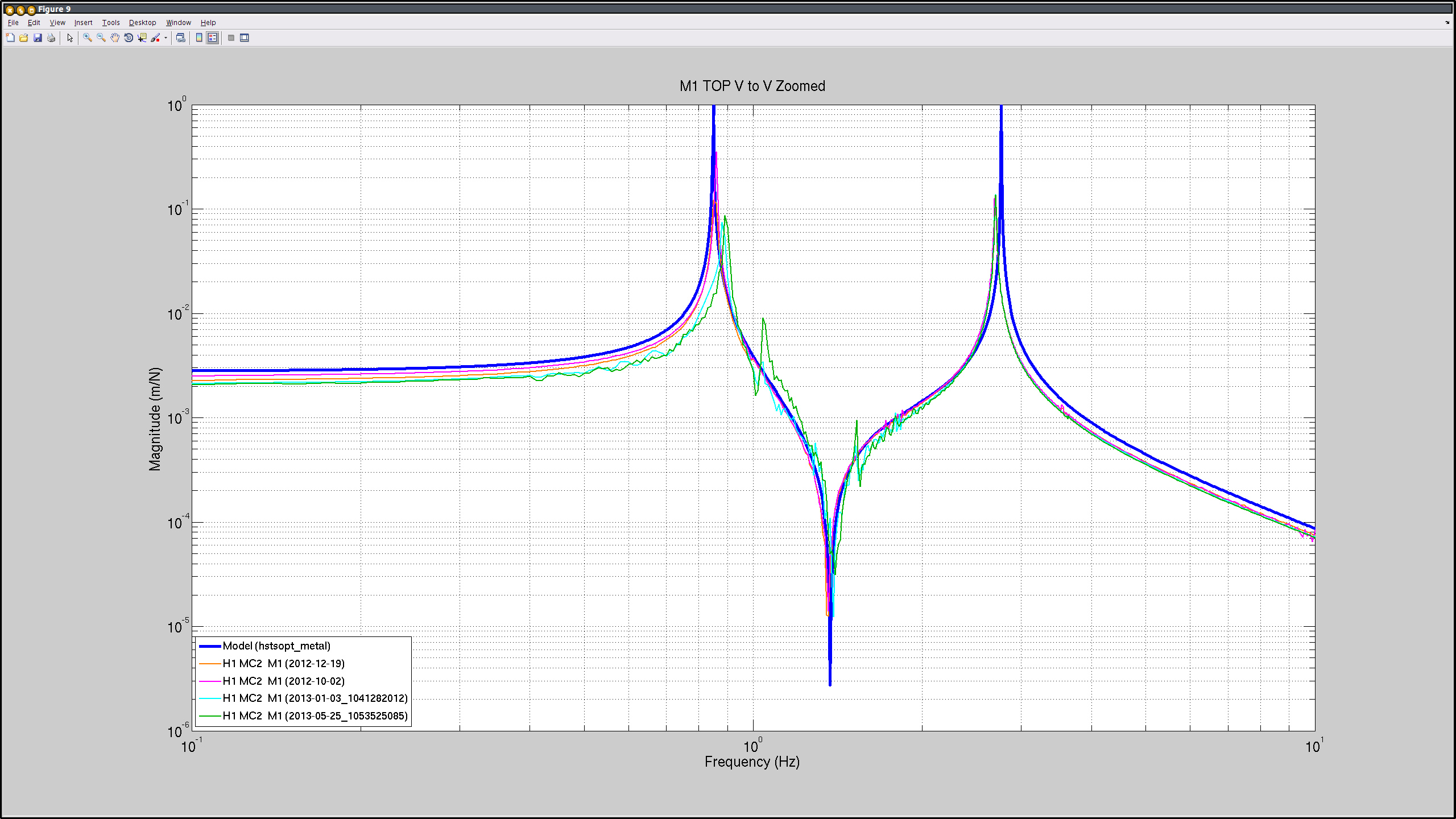
Attached are the most recent M1-M1 TFs for MC3 (see 2012-09-27_0400_H1SUSMC3_M1_ALL_TFs.pdf). These Phase 2a measurements can be compared to the equivalent Phase 1b measurements obtained for MC3 (see allhstss_2012_10_02_Phase2a_MC3_ALL_ZOOMED_TFs.pdf)
The most recent MC3 TFs taken at the end of last week (2012−10−05). Following some re-aliment and tweaking of the tablecloth, the cross-couplings visible in the TFs are identical to how they appeared the week before (2012−09−27).
Broken black glass story
Before moving periscope assembly to HAM1, we've noticed that the black glass behind the top periscope mirror was getting loose. On a closer inspection, it turned out that actually the glass was completely broken and the larger piece was held in place just by a friction. The first picture shows the J-clamp with the broken shards of black glasses in the slot. We also observed a LOT of glass powder on the mirror, but fortunately this was all in the back (second picture). Lisa recleaned the mirror, we put another black glass, and everything was fine.
There could be more than one cause for this. Matt and Lisa noticed yesterday that the metal screw to hold the black glass was grinding and making some glass powder, so maybe we need to use PEEK.
Another thing is that, when tightening the J-clamp setscrew for attaching the J-clamp to the mirror holder (as opposed to tightening the screws for the glass), J-clamp moves in such a way that the black glass moves laterally towards or away from the mirror. If the tip of the black glass is already touching the mirror mount, which is hard to avoid unless you pay some attention, the J-clamp motion puts some torque to the black glass. So we need to make sure that the black glass doesn't touch the mirror mount.
And the slot in J-clamp for the black glass is too narrow anyway, sometimes you need to press it in really hard, sometimes it doesn't fit at all, and that doesn't help things. We need to make these grooves wider.