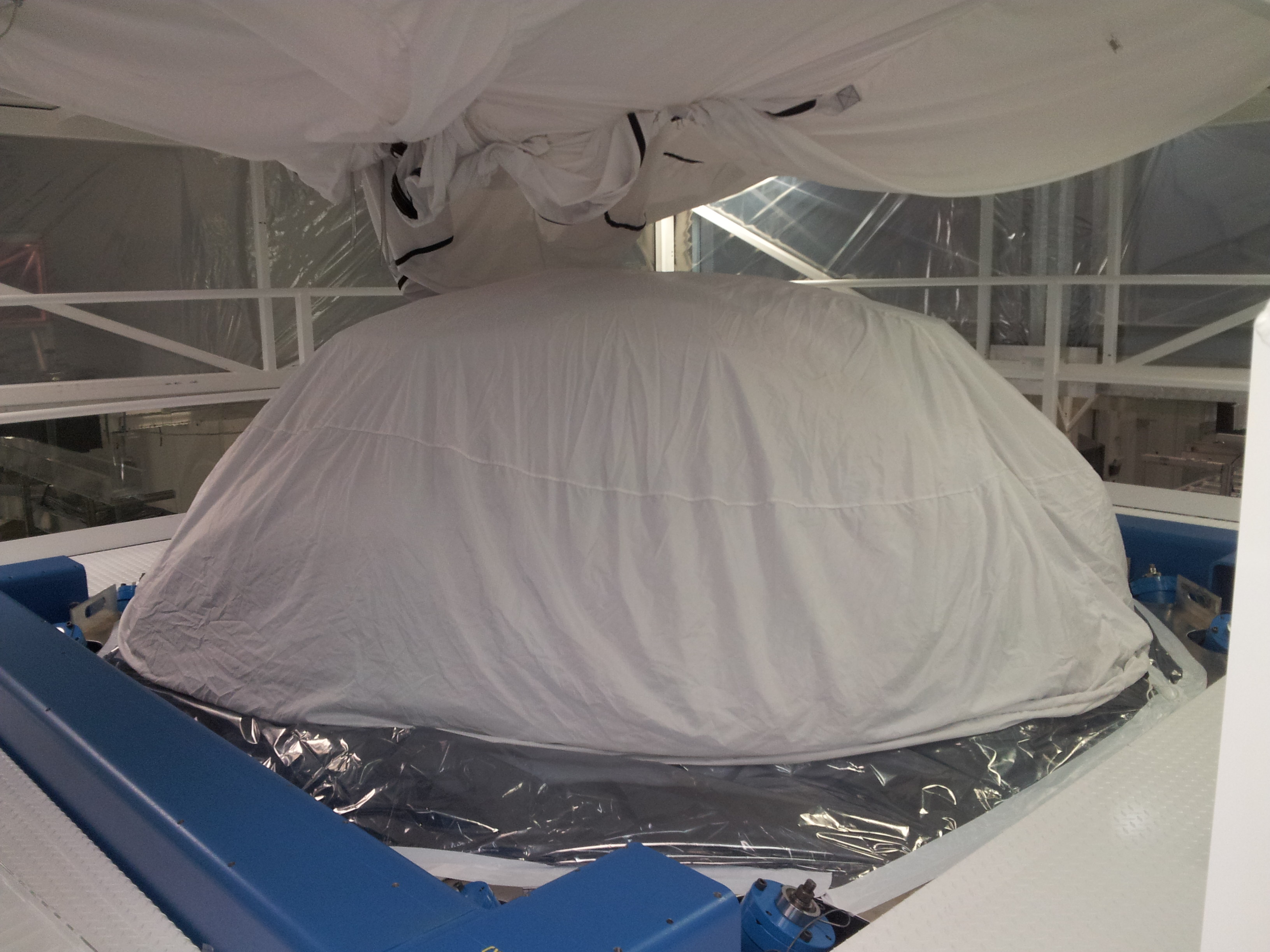
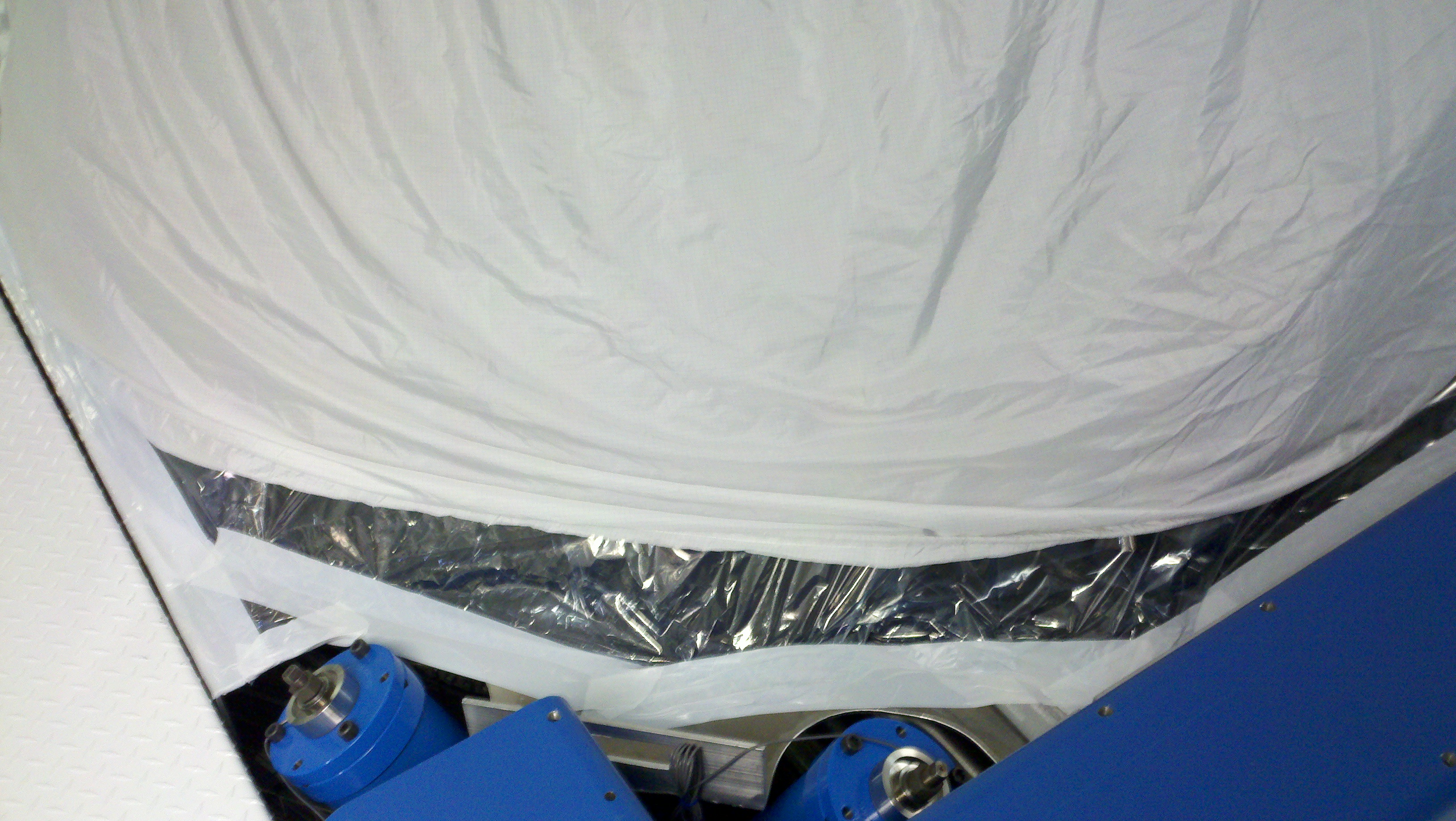
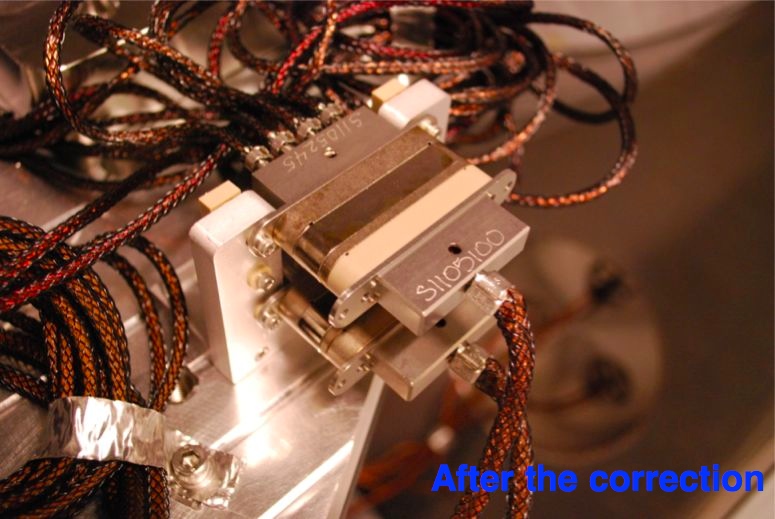
This morning we noticed that the magnetic rotator is not in full contact with its mount. Cheryl identified the problem as due to the fact that the thru-holes drilled in the restraining Omega-shaped rings are not well matched to the corresponding screw-holes in the mount. I gave her the restraining rings for adjustment.
This means that the magnetic rotator is not secured in its mount at the moment. I will not be placing any optics (TGGs and Quartz) inside the magnet until it is secured (required for steps 20-on of the procedure in E0900301).
I have gone through steps 1 thru 19 of E0900301 (at low powers only).
Steps 16-17, s-pol extinction by the 1st Calcite Wedge Polarizor:
| incident | trans s-pol | extinction |
| 1 W | 0.59 µW | 62.2 dB |
| 5 W | 0.13 mW | 45.8 dB |
| 10 W | 0.26 mW | 45.8 dB |
Step 19, s-pol extinction by both CWPs:
| incident | trans s-pol | extinction |
| 9.85 W | 0.313 mW | 45.0 dB |
Some more adjustment is needed to get to the required extinction of 50 dB.
Electronics were troubleshooted.
SEI and SUS models were arranged to allow un-tripping HAM2-ISI Payload Watchdogs.
HAM2 model was re-compiled, installed and re-started after that. It is now running.
Matrices were filled
Input and output filters are loaded
The latest version (Version_2) of the unit-specific control scripts were copied from LASTI. They were made ready for use on HAM2.
Spectra were taken on the ISI tilted. It is the worse configuration for GS13s and they all appear to be working fine (see attached plot).
Transfer function measurements are running overnight.
The transfer functions measured last night had features that are typical to mis-connected sensors/actuators. Deeper analysis allowed narrowing it down the the GS13s.
We made a program to check for "cross-coupling transfer functions" (e.g. drive on H1, response on H2). It revealed that:
H1-GS13 was read on the channel of H3-GS13
H2-GS13 was read on the channel of H1-GS13
H3-GS13 was read on the channel of H2-GS13
V1-GS13 was read on the channel of V3-GS13
V2-GS13 was read on the channel of V1-GS13
V3-GS13 was read on the channel of V2-GS13
We checked our model and did not find a cause for such behaviour there. We moved on the the electronics rack and spotted the issue: GS13 In-field cables were connected to the wrong inputs on HAM2 sensor interfaces.
We ran a quick TF measurement between 500mHz and 5Hz. It confirmed that the sensors were now all correctly connected. This quick measurement is also in good accordance with what we measured on HAM-ISIs in the past which is encourraging.
TF measurement are running overnight on HAM2. They will be over by 7am.
Note: A blinking notification was recently added to HAM-ISI overview MEDM screens (see attachement). It turns the green "measurement" button to blinking yellow when a TF is running. HAM2 overview screen can be seen on the Video6 monitor of the Control Room.
Hugh and I added screwdriver tips under the top payload mass of HAM2-ISI last week, before the chamber was closed. They helped prevent this big mass of ~600lbs from causing unwanted resonances. Befoire/After comparison plots are attached.
We compared the latest transfer functions with the ones taken on LLO HAM2-ISI during the same phase of testing (Intitial In-Chamber Testing). Plots are attached. Accordance is good. We are confident that the unwanted resonance seen at 96Hz comes from the top mass. We plan on ajusting its boundary conditions with the optical table once the doors of HAM2 chamber are open again.
I have implemented the sensor correction at HEPI-BSC6. Sensor correction improves the isolation performances of the HEPI in the X, Y and Z directions. In attachment, spectra of the L4C installed in the HEPI boots are presented in different configurations:
JimW CoreyG HughR With IAS signing off on position yesterday, we did a final check on elevation/leveling and did need to make some vertical adjustments. We ended up with the Optical Table 0.1mm high at -240.3mm and level to 100urad (+-0.1mm) These vertical adjustments barely moved the system horizontally--based on Dial Indicators the sw & se corners moved 1 & 2 mils (<0.05mm). So we have locked up the HEPI and are now doing ISI measurements. We will continue with ISI testing, then attached HEPI Actuators, followed by a post install (actuators) IAS check if dial indicator readings suggest it is warranted. Attached is the surveying and dial indicator readings logbook page.
[Jeff G., Bram]
Made new safe.snap files for ISCEY, ETMY, TMSY and ITMY.
The H1 suspensions on HAM2 are currently broadcasting a constant "0" as the watchdog state to other FrontEnds on the Dolphin network via an IPC library part. This value satisfies the HAM-ISI Simulink model condition for a "0" input in order to prevent the triggering of the "DACKILL" functionality. To further complicate the issue, the error signal from the receiving IPC part on the HAM-ISI model is currently reading out a non-zero error, meaning their is a communication issue on the Dolphin network. A bypass on the receiving model ("h1isiham2") in the form of a constant "0" for the communication error will enable the functionality of actuation from the HAM-ISI user model.
The true watchdog signal from the SUS models will be broadcast as soon as the Dolphin network communication issue is resolved.
h1isiham2.mdl was modified to apply a constant at the error input of the HAM2_PAYLOAD block (see attached picture). The constant value is 0. It corresponds to the Dolphin communication error value for the state of SUS model running
Modifications were commited to the SVN. The model was re-compiled, installed, and re-started.
It allowed untripping the ISI. Actuation is now possible. Actuators respond on all corners, and they appear to be correctly wired.
This modification of h1isiham2.mdl will have to be reversed when rcg is updated on site (planned for 08/28/2012).
The modifications applied to SUS's models will need to be reversed when suspensions are installed on the ISI.
Ability to log out a user out and not have the previous users info saved, so I can log him out and log myself in without clearing cookies. This is not Jeff Garcia. Also, I'd like to be able to add captions to attached files.
The logout issue is a known limitation with the LIGO.ORG authentication on shared workstations. You need to completely close/kill the browser, or open a different browser (not just a different browser window). The authentication is not handled by the application, it is handled by the LSC auth project login server (login.ligo.org). Clicking aLOG log-out button does in fact clear all state in the application associated with your session. The issue is that the aLOG does not have a way to affect the state of login.ligo.org. So this is a known issue, it will be fixed at some point. The benefit in account and password management of using the LIGO.ORG credentials appears (by far) to outweigh the inconvenience of having to kill the browser when you work at a shared workstation.
The first of your requests has been a request since last summer, see LHO aLOG 1000. I know Jonathan Hanks is working on this.
We had a timing glitch at EY which required a restart of all EY front ends. I took the opportunity to install the new h2tcsetmy model for the ring heater.
I did a manual burt restore of the safe.snap files and found problems with
I'll fix the ones marked *
I restored ISCEY, ETMY and TMSY to 3am, 22 August 2012.
I have attached 2 plots:
LHO_ISI_ITMY_Calibration_Check_Stage_1_Sensors_201208022.fig shows the calibrated transfer function from the Y drive to CPS, L4C and T240 on ITMY. Calibration is OK. LHO_ISI_ITMY_Calibration_Check_Super_Sensor_201208022.fig shows the contribution of each sensor in the stage 1 250mHz blend in the Y direction. The calibrated TFs are slightly different in the 2 figures due to the introduction of the calibration correction gain to improve the blend (amplitude - phase).
After Robert's presentation on magnetic coupling today at the Systems meeting, I wanted to double check that the calibration in place were the final numbers that Thomas and I had calculated, having remembered that the incorrect numbers were stored in the safe.snap, and were restored incorrectly a few weeks ago. When there is down time in the cavity commissioning: please turn off the suspension and grab a new safe.snap. ETMY's numbers are confirmed to be correct.
HAM 3 ISI
Ok, I could not help myself. It all looked fine, so I engaged the Trilliums on the ISI's. Attached are the blend screens, showing what trillium blends are engaged (due to the great work by Vincent on organising the scripting behind the buttons!).
The RefCav still drops and relocks (as for the arm), but I am sure we can make a spectrum in between the drop spikes. It is runnig as of the time of this entry.
Advised not to enter the LVEA otherwise the Trillium will trip, and not sure if the ISI will trip as a whole or drops to damping only.
Earlier this evening I kept the arm locked, but we unsuccess full in generating a proper spectrum. This was because the RefCav kept dropping lock every ~10 min or so, see the first attachement of the StripTool.
I did manage to get a spectrum (only 8 ave in a <10 min stretch), and it is nice to see the noise above 1 Hz dropping due to the work on the RefCav. In the other hand we have not made anyhead way at the lower frequencies.
To that end I tried to engage the Trilliums on the ISI's, which I did but then got trumped by the 10 min lock treches. I was worried to keep the ISI running with the Trilliums overnight, so I reverted back to running with the L4C's overnight.
When writing this entry, the cavity is still locked, but has the ~10 min lock loss after which itself brings into lock. This is sort of an hiddious autolocker:)
Oeps, just noticed the units in the spectrum are missing. They are [nm/rtHz].
Filiberto, Richard, Michael R
The PSL was moved off of the temporary power supplies for 24, 18 and 12V and is now running on the DC power supplies in the H1 electronics room. For the moment, we are still running on the temporary power supplies for high voltage (400V for PMC/ILS, and 180V for FSS), however they were moved into the PSL rack to free up room. The purple cables in the electronics room were redressed as well.
The PSL servos and laser were shutdown for this work, and the key from the control box was removed to make the laser and ante room laser safe (to make David Feldbaums work easier). I plan on turning the laser on tomorrow morning, so it will be off for the night. If all goes well with David's work we may go to high power tomorrow as well.
Laser was restarted yesteday, with the FSS and PMC servos running. The ISS is off because it keeps glitching with work on the table. Watchdogs are on.