- Lots of visitors, for SUS, fiber pulling, TMS assembly, and HR program
- Reiboldt working on roof of H2 PSL
- Mount's Lock and Key, Stoneway Electric on site
- Patrick working on dust monitors in the LVEA
- H1 was running (stays locked through Detect) today during Laser Safe operation. Squeezers transitioned to Laser Hazard at ~18:15 to access beam enclosures.
- H1 TCSY flipper M2 alarmed but that's OK, as no laser power is being transmitted
- EY: HEPI pumping ongoing
Taken picture of the TMS ISC table to survey the components already mounted on the table What it is clearly missing are the two periscopes, the glass baffle, the glass beam dump, and some connectors. Picture of the underside of the table should show that all the ballast masses are there The total current weight of the table is 52.5 kg (Keita)
What were missing from the table when the weight of the table was measured 52.5kg, as far as I can tell: 2xHAM connector brackets (in the picture, but they were not there when measured). Beam diverter cable, cable clamps, and a 25pin connector (not yet installed). Total of 9 posts with black glass mount and total of 10 glass plates to be mounted on the posts (total of 10, not 9, because one of the posts will have two plates) (not yet installed). Tiny black glasses behind high reflectors and tiny aluminum holders for them (not installed yet).
And neither of two periscope assemblies (including mirrors) are not included in the weight, as they are not yet installed.
And most importantly, this is H2! H2!!!!!!
(Craig, Virginio) Mount wires from upper blades to suspended mass without any particular issues Tablecloth earthquakes stop screws were at the end of their travel to be able to secure the clamps. We will need to lower the upper blade's tips by about 2 mm to secure completely the clamps to the mass
(Andreas, Jeff B., Craig & Virginio) Modified the jig to string the wire, see pictures Nominal load 146lbs = 66.36kg => used 66 kg (nominal values read on the weights) Wire music steel wire diam 1.1 mm Distance between the aluminum parts the hold the clamps (425 +- 0.3) mm ( see picture) Used two 10 mm spacers to get to 425 mm. This should bring the clamps' distance to 455 mm as shown in drawing https://dcc.ligo.org/cgi-bin/private/DocDB/ShowDocument?docid=63179. We need to design a couple of parts to have a better way string the wires.
The "quadrapuss" cable type (D1000234 - 125") coming from M1 SD and RT was changed from S/N 901 to S/N 903. There was an issue with the readout of the OSEM. The new cable was routed through the same path on the FMY structure, and the readout was confirmed in the medm.
In the interest of time, using good 'ol foton, I've installed the basic electronics compensation and damping filters that we've been using thus far to commission the BSFM/QUAD in the assembly area, since it's basically the same electronics. These include (notation is [zeros:poles], every filter has a gain of 1). - In the M1 OSEMINF banks, compensation for the analog whitening in the Satellite Amplifiers, a [10:0.4] dewhitening filter. - In the M1 COILOUTF banks, compensation for the analog dewhitening of the "acquire" state of the TOP coil driver. a [1:31] anti-dewhitening filter (note, as with the QUAD, there is an additional state [1,1:10,31], but I have not yet installed that filter) - In the M1 DAMP banks, the same simple damping loops that have been inherited from the LASTI QUAD; a differentiator with a cutoff ([0:20,20]), and the 50Hz elliptical filter. Now that these filters are installed, as soon as the M1 BOSEMs are restored to the middle of the range, and properly diagonalized, we *should* be able to close damping loops (though it should be done cautiously at first!!).
Betsy & Co had left H2SUSFMY with it's OSEMs entire backed off from their flags, such that they read "open light" currents. At her request, I've installed the "proper" offsets and gains to compensate for these open light current values (on both M1 and M2), such that the OSEMINF_*OUT channels are nominally 0 when the flags are in the middle of the OSEM's range. Tomorrow, the OSEMs will be physically set to there nominal range using these newly conditioned signals. I don't think all of the M2 BOSEMs are truely open light, as they should register in the (62+/-20)e-6 [A] * 240e3 [V/A] * 2 [V/V] * 2^16 / 40 [ct/V] = (24e3+/-7e3) cts and for example, UL is showing 7e3 counts. When we're confident that the M2 BOSEMs are open, then we should repeat the process detailed below. "How To" Details I measured the open light current using the inputs of the OSEMINF filter banks (i.e. the raw signal just as it comes off the ADC) using tdsavg -- a quick command line tool that takes the average of a channel for a specified duration. The command and results are: controls@cdsws2:~ 0$ tdsavg 30 H2:SUS-FMY_M1_OSEMINF_F1_IN1_DQ H2:SUS-FMY_M1_OSEMINF_F2_IN1_DQ H2:SUS-FMY_M1_OSEMINF_F3_IN1_DQ H2:SUS-FMY_M1_OSEMINF_LF_IN1_DQ H2:SUS-FMY_M1_OSEMINF_RT_IN1_DQ H2:SUS-FMY_M1_OSEMINF_SD_IN1_DQ 28331.1 27269.3 30542 27143.1 28230.5 21085 controls@cdsws2:~ 0$ tdsavg 30 H2:SUS-FMY_M2_OSEMINF_UL_IN1_DQ H2:SUS-FMY_M2_OSEMINF_LL_IN1_DQ H2:SUS-FMY_M2_OSEMINF_UR_IN1_DQ H2:SUS-FMY_M2_OSEMINF_LR_IN1_DQ 7395.21 25831.7 17090.4 22564.3 controls@cdsws2:~ 0$ To calculate the offest for each channel, one divides the above result by 2 and flips the sign. To calculate the gain for each channel, one normalizes the above result to 30000 cts, i.e. (30000 / result) = gain. I installed them by hand. Hence the offsets are controls@cdsws2:~ 134$ tdsread H2:SUS-FMY_M1_OSEMINF_F1_OFFSET H2:SUS-FMY_M1_OSEMINF_F2_OFFSET H2:SUS-FMY_M1_OSEMINF_F3_OFFSET H2:SUS-FMY_M1_OSEMINF_LF_OFFSET H2:SUS-FMY_M1_OSEMINF_RT_OFFSET H2:SUS-FMY_M1_OSEMINF_SD_OFFSET -14165 -13634 -15271 -13571 -14115 -10542 controls@cdsws2:~ 134$ tdsread H2:SUS-FMY_M2_OSEMINF_UL_OFFSET H2:SUS-FMY_M2_OSEMINF_LL_OFFSET H2:SUS-FMY_M2_OSEMINF_UR_OFFSET H2:SUS-FMY_M2_OSEMINF_LR_OFFSET -3697 -12915 -8545 -11282 and the gains are controls@cdsws2:~ 134$ tdsread H2:SUS-FMY_M1_OSEMINF_F1_GAIN H2:SUS-FMY_M1_OSEMINF_F2_GAIN H2:SUS-FMY_M1_OSEMINF_F3_GAIN H2:SUS-FMY_M1_OSEMINF_LF_GAIN H2:SUS-FMY_M1_OSEMINF_RT_GAIN H2:SUS-FMY_M1_OSEMINF_SD_GAIN 1.059 1.1 0.982 1.105 1.063 1.422 controls@cdsws2:~ 134$ tdsread H2:SUS-FMY_M2_OSEMINF_UL_GAIN H2:SUS-FMY_M2_OSEMINF_LL_GAIN H2:SUS-FMY_M2_OSEMINF_UR_GAIN H2:SUS-FMY_M2_OSEMINF_LR_GAIN 4.056 1.161 1.755 1.329
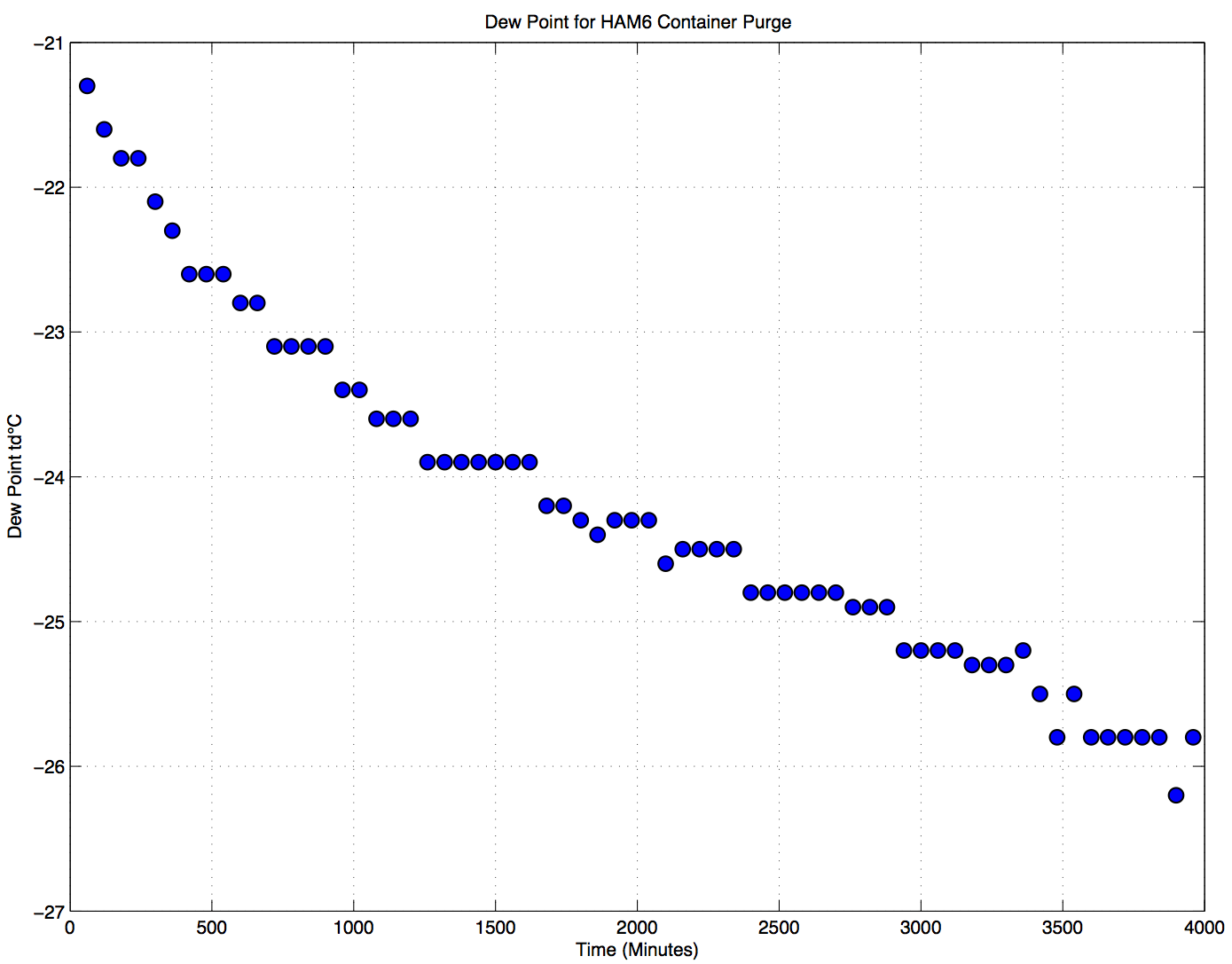
Gas bottle delivery HR workshops Activities listed on the white board: LVEA: PSL diode / chiller room SUS / SEI test squeezer / H1 restore triage clean storage welding setup ICC @ HAM 7,8 HEPI Welding HAM 9 EX: BSC 5 set, pier set MY: oplev test EY: ICC @ BSC 6 RGA @ BSC 10 Transmon assy HEPI Station Run Plots of > .5 micron dust counts attached. I still need to investigate the dust monitor at location 1 in the LVEA (ISCT 4). The dust monitor at location 7 in the LVEA (near the previous location of the H2 PSL racks) dropped out for a while for an unknown reason. Michael R. replaced the fuse, but this did not appear to fix the problem.
Today the ETMY Quad-3 was moved to Y End Station. No problems were encountered during the move.
This afternoon the TMS upper suspension was transported to the Y End Station. It has been mated to the Bosch tubing test stand for final assembly and alignment.
We needed to use full size dog clamps for attaching the suspension frame to the Bosch frame as the top plate was too thick for the low profile ones. Some Wire clamps are in the clean/bake, they'll come out tomorrow. Clean transport box for the suspension structure is still in the EY lab. It will be transported back to the staging building tomorrow.
Today, we suspended the ITMy glass PUM from it's loop - the pitch error was better than the metal hang (!) at ~400 uRad (note, better than ~1 mRad is the spec). Prior to the pitch look, we spent a fair amount of time setting roll correctly. The tolerance for getting the clocking of the mass correct is ~0.25mm which proved a bit difficult to set manually with the mass sitting on TFE caps. We overshot a few times before settling in at having the prism-to-prism height diff off by 0.2mm. We determined that the ergo arm would not have helped us since we had to push the TFE lower stops up for a little loop slack, roll the mass a fraction of a mm, and then release it to hanging for a reading of the pitch with the theodolite, a very iterative process. This would have taken hours with multiple pump-downs of the ergo arm, likely not yielding better results than us doing it "by hand". Since the loop looked good, we proceeded with installing the ITMy test mass into the sus structure. We stole the base from the split rotation tooling and mounted the ITMy LS/LSAT/Weld Trolley on top of it such that the ergo arm legs would fit underneath while installing the optic. The install went well, right through the open ring heater from the back of the LS structure - the ears only have a few mm of clearance with the structure, but it went well with 3 spotters. Pictures to be posted on ReSource Space shortly.
Cyrus working on paging system Filiberto extended the dust monitor power and RS485 lines near the new H2 PSL enclosure. Fire department well testing Electrical inspector on site Ski working on air handler system Activities listed on the white board: LVEA: PSL diode / chiller room SUS / SEI test squeezer / H1 restore triage clean storage welding setup ICC @ HAM 7,8 HEPI Welding HAM 9 EX: BSC 5 set, pier set MY: oplev test EY: ICC @ BSC 6 RGA @ BSC 10 Transmon assy HEPI Station Run Plots of > .5 micron dust counts attached. Note relatively high levels at location 7 (near previous location of H2 electronic racks). The dust monitor at location 1 in the LVEA (ISCT 4) has dropped out. There are also some drop outs in the data for the counts in the LVEA from when Filiberto was working on the system.
Summary: we are close to reaching our goal of at least a factor of 10 attenuation down to 10 Hz. Further improvements could be made with acoustic damping tuned to the room modes, a new acoustic door, and reduction in make-up air flow. I studied the acoustic isolation of the H2 PSL enclosure even though it is not quite complete because it will become more difficult when the laser arrives and it becomes a clean room. In addition to its current performance, I also studied what might improve the isolation should we be limited by acoustic coupling at the PSL in aLIGO. Low frequency attenuation is about 20dB I injected 5 Hz combs using a large speaker at distant locations in the LVEA and compared the signal on a microphone inside the enclosure to the signals from a microphone at 5 locations around and above the enclosure. The microphones were calibrated in situ and huddle tested. Figure 1 shows the resulting amplitude attenuation plot. Currently, sound pressure levels are attenuated by a factor of about 10 at 100 Hz, nearly as good as the smaller (and thus more rigid) acoustic enclosures for iLIGO that had a factor of about 20 attenuation. Although low frequency attenuation is difficult, we hoped to have a factor of 10 down to 10 Hz for aLIGO. Figure 1 shows that we mostly reached this, though there are a few high points that are likely associated with chamber modes and scatter associated with the difficulty of generating high signal to noise around 5-30 Hz. Damping would improve low frequency performance Figure 2 shows that I got a slight reduction in amplitude at low frequencies when a single tuned damper and two bales of fiberglass were in the room (I moved them in, blue, and out, red, several times). If we placed tuned corner dampers (as in the iLIGO acoustic enclosures) to fill all vertical corners we would have about 5 times as much damping material as in this test. A better door should improve high frequency performance The acoustic door was of inferior quality and will be replaced. Figure 3 shows that I reduced high frequency noise by stuffing the poorly sealed edges of the door with foam. Make-up air at 100% flow increases sound by at least 1.5 at low and high frequencies Figure 4 shows that the make-up air increases the sound level by 1.5 at high frequencies, and also down at the putative room resonances below 100 Hz. The increase over background (no make-up air) is expected to be even larger when the LVEA does not have a lot of noisy clean rooms running. Running at a lower speed may help. Room modes Figure 4 also shows room resonances at about 11, 14, 22, 41 and 64 Hz. The 3 highest of these are consistent with the calculated lowest room modes: axial – 23 Hz, tangential – 42 Hz, oblique – 63 Hz. The microphone was hung above the table for Figure 4. When the mic was hung near the wall, there was also a strong 31 Hz peak, possibly the second lowest axial mode calculated at 35 Hz. The 11 and 14 Hz peaks may be due to structural resonances of the enclosure or the clean room structure within. Penetrations I tested the stuffing of the penetrations by adding additional stuffing. Extra stuffing didn’t help on the feed-throughs without cables, but did on those with cables. It takes careful packing around the cables to maximize performance. I corked the output duct and saw no reduction in sound, suggesting that our acoustic labyrinth is working well. Robert, Rick
I have been looking for environmental coupling to the aLIGO electronics located by the SUS and SEI test stands in the Y arm of the LVEA. To test for vibrational coupling, I used speakers and shakers (photograph below shows accelerometer and shaker on one of the cabinets). I shook each rack using a 5 Hz ramped sawtooth, and looked for evidence of the 5 Hz comb in many of the working channels by looking for coherence between the channel and the accelerometer channel. Even though I shook the racks with more than 100 times the amplitude of the ambient background at most frequencies (see plot) I found no evidence of coupling - good job CDS.
B. Bland (and G. Moreno, T. Sadecki) On Friday, the first piece of glass was installed into a suspension at LHO. The ITMy Penultimate Mass (PUM) was loaded into its QUAD lower structure in the LVEA fiber welding cleanroom. We utilized the ergo arm, and the Genie lift, as we encountered some leg interference between the ergo arm and the weld trolley which holds the lower suspension structure. We will look into a different weld trolley base mount to alleviate this interference for the future installs. Pictures of the maneuver are on ReSource Space (note the software uploads the library backwards, so start clicking pictures at the end for appropriate install sequence): https://ligoimages.mit.edu/?c=736 Collection entitled "LHO ITMy Glass PUM Install" if the link above doesn't work. After we do a test hang of this mass with it's new wire loop, we anticipate loading the ITMy Test Mass this week in preparation for fiber welding later in the week.
These clean rooms were not in use so I shut them down to prevent interference with interferometer locking.
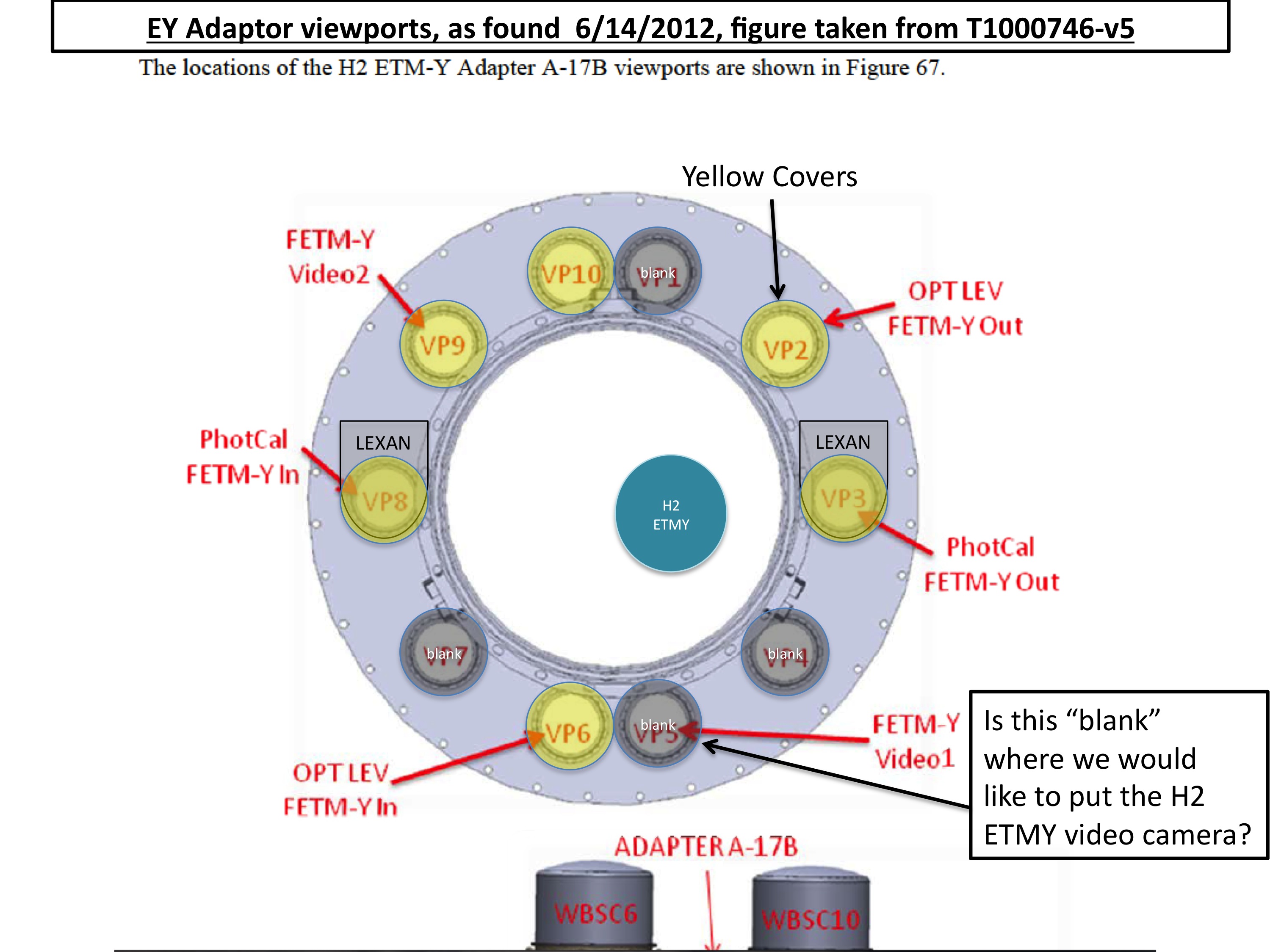
Yesterday we mounted and routed the various cables from the QPDs and picomotors on the H2 ETMY Transmon ISC breadboard.
Using ISC breadboard layout D1101585 for the picomotor locations and D1000238 for the actual picomotor cable assembly, the connectors are conected as follow:
J1 (25-pin connector) = mounted in the connector bracket in the lowest location on the ETM side of the breadboard ( photo of the bracket)
J2 (4-pin mighty mouse connector) = M3 (green beam)
J3 (4-pin mighty mouse connector) = M6 (green + IR beam)
J4 (4-pin mighty mouse connector) = M4 (IR beam)
J5 (4-pin mighty mouse connector) = M14 (IR beam)
During assembly of the picomotor mounts, we are not sure if the 'verticl' and 'horizontal' axis of the picomotors are maintained (e.g. we did not know which of the picomotor was horizontal or vertical).
Also, the two QPD sleds are aligned, with each a single 25-pin connector (D1000231), are mounted in the connector brackets. There are two QPDs per 25-pin connector, one for the green sled adnd one for the IR sled. The QPDs are ordered such that QPD1 is the first QPD the beam will be director to (by a beam splitter), while QPD2 is the last QPD on the sled.
The connectors are mounted with pin-1 on the top right corner, with the connector mounting bracket on the primary mirror side of the breadboard. (photo of the bracket)
25-pin IR QPD connector mounted on the lowest position
25-pin GRN QPD connector mounted on the middle position.
Here is a photo of the top view of the breadboard with the cables routed and clamped on the breadboard. The 'ETM Side' is on the right.
The only cable missing on the breadboard is for the bam diverter (the larger structure on the bottom right on the breadboard).
Matt and Bram
I inherited this shift from MichaelR at noon.
- DaveB and JonathanH at EY installing WiFi
- HEPI actuators being craned in LVEA
- Bob Hamilton of Bob Rhodes HVAC arrives for H2 PSL work
- Work continues by SUS stand in LVEA
- L1 OMC shipped this morning from LLO
- Laser hazard restored in LVEA by ~15:30 for squeezer work
The structure of the sections/tasks will be changing to better reflect the system. Currently most entries reside under the 'IFO and SubSystems' section with sub-system specific tasks. These will be rearranged to separate out the H1 & H2 IFOs, test stands, and general site issues. As such the new structure will be added today (Friday the 16th). The actual migration will take place early Monday (I will aim for 8:15-8:30am Pacific). The old section and task names will be removed as part of the migration. You may continue to use the old section and task names today if you wish. Please begin using the new ones before Monday morning. No existing entries will be lost, they will simply be migrated to their new locations. No chronology will be lost. No downtime will be involved. This will be done in the near future at LLO as well. This email will be posted in the aLOG. New structure: Section: Logbook_Admin Tasks: Bug Feature Requests General Section: LHO Tasks: General FMCS VE Section: H1 Tasks: AOS CDS COC DAQ DCS FMP IOO INS ISC PEM PSL SEI SUS SYS TCS Section: H2 Tasks: same as H1 Section: X1 Tasks: SEI SUS -- Jonathan Hanks General Computing Sys Admin LIGO Hanford Observatory
The sections and tasks have been added. Please begin filing new entries under the new sections/tasks before Monday. The old secions/tasks (IFO and SubSystems and all its tasks) will be removed as part of the migration process. All entries posted (or saved as a draft) will be migrated to the corresponding new section/task. No entry id will be changed, but IFO and SubSystems is going away. The migration will happen on Monday. Thank you.
The sections and tasks have been updated at LHO.