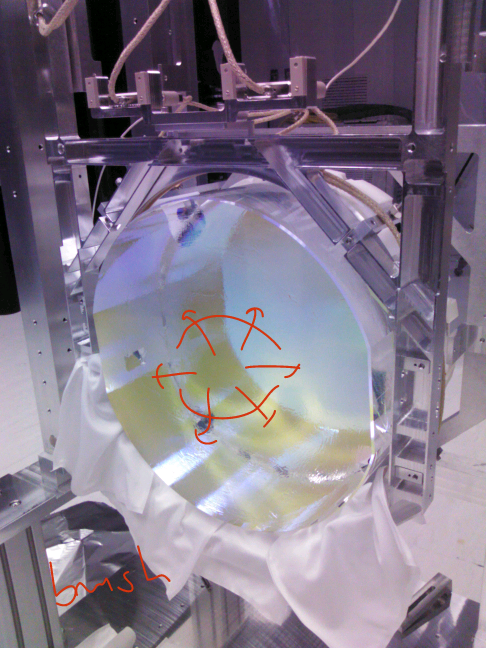
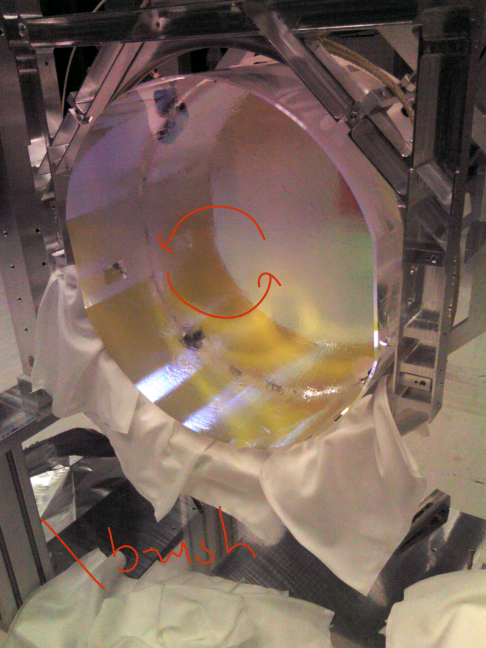
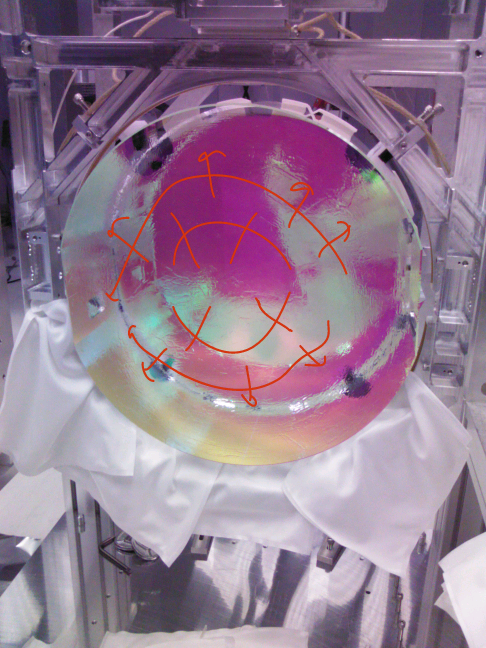
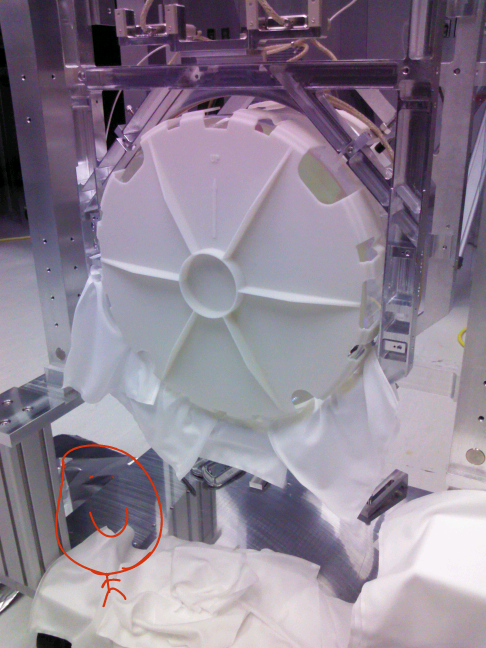
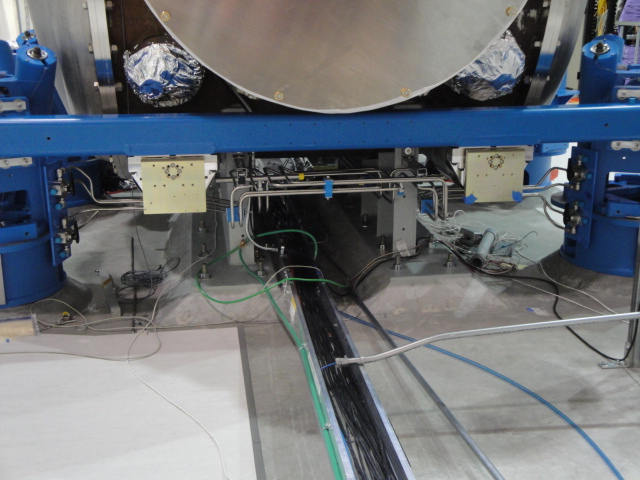
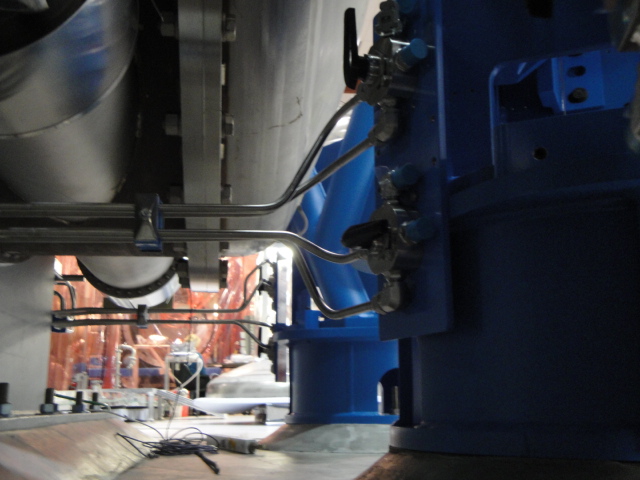
Last week, we performed cleanup of the debris from the fiber breakage on the ITMy main chain. This was the order of the cleaning steps over a course of a few days: Optics caps we on both HR and AR during steps unless stated otherwise. 1) Vacuumed the structure. 2) Blew the glass PUM and more of the structure top down with N2 deionizing (DI) gun. This only removed roughly half of the particulate from the glass PUM. 3) Blew the ITMy barrel with DI gun in direction of AR to HR (cap and FC still on HR). 4) Blew the ITMy AR with DI gun. Again, this only removed roughly half of the particulate on the surface, and was almost ineffective on the heavier EQ stop debris rings at the noon, 3, 6, and 9 o'clock positions. 5) Applied First Contact "bandaids" on these ring spots. 6) After letting them dry for an hour, we peeled them and found that most of the ring debris was removed. There were some small (1mm) scratch-like features remaining at these locations. 7) Calum and I pains-takingly removed ~100 particles using ~25 dry Alpha q-tips which were still located within diameter-1" on the surface. Blowing with DI during this seemed to help. The q-tip technique we used was "dabbing" as advised by COC. 8) Applied FC starting in center of optic AR surface and moving outward (pix attached - thanks Calum and the new Lenova).
As Kyle reports there are some high pressures at the corner station (~1-2 e-7torr). The Mid Station pressures will slowly rise as the gas load travels down the tube. Pressures there should NOT go as high as 1e-7 torr. There is one gauge at MIDY which has been disconnected since the BSC chamber was moved to the End Station. This is PT 210 (may be ignored).
Please call if you see anything unusual.
Note: PT114, PT124, PT134 and PT144 will show "RED" as long as their pressures remain above 1 x 10⁻⁷ torr (probably most of the weekend).
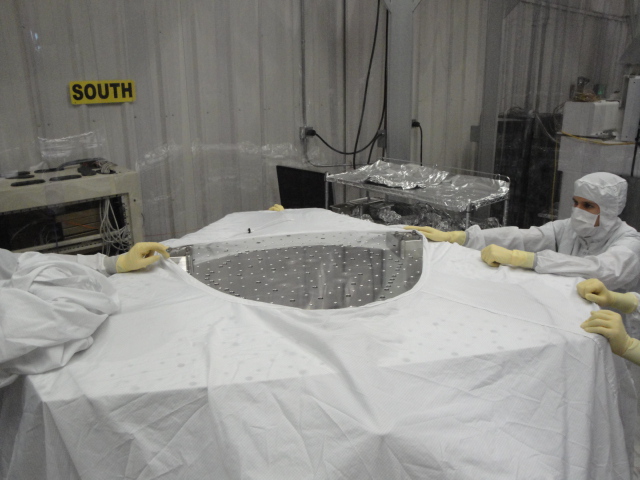
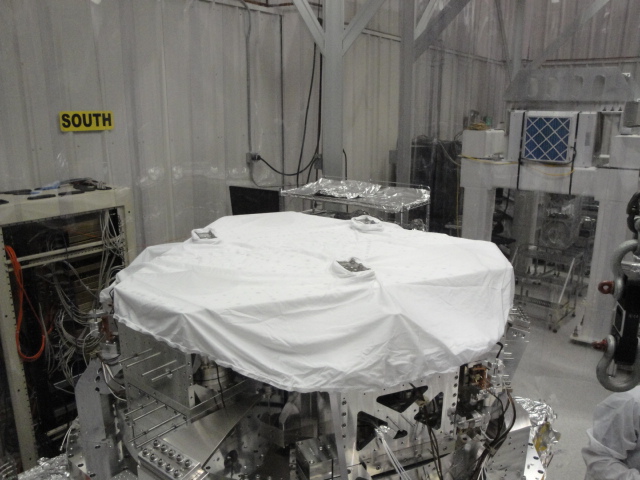
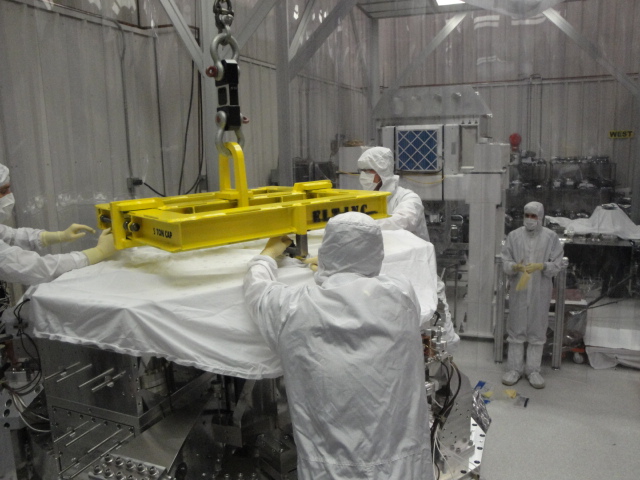
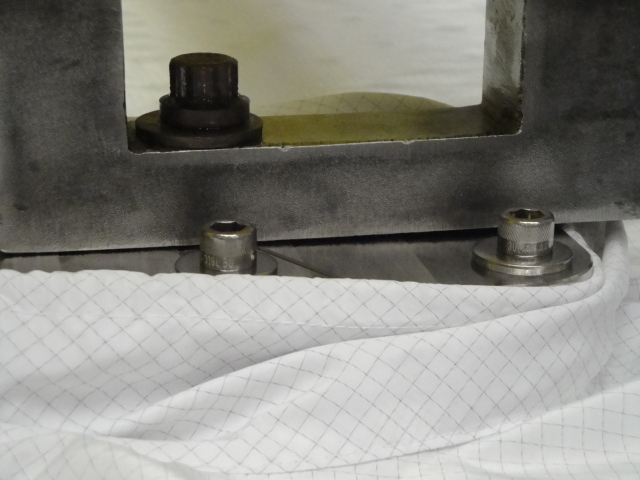
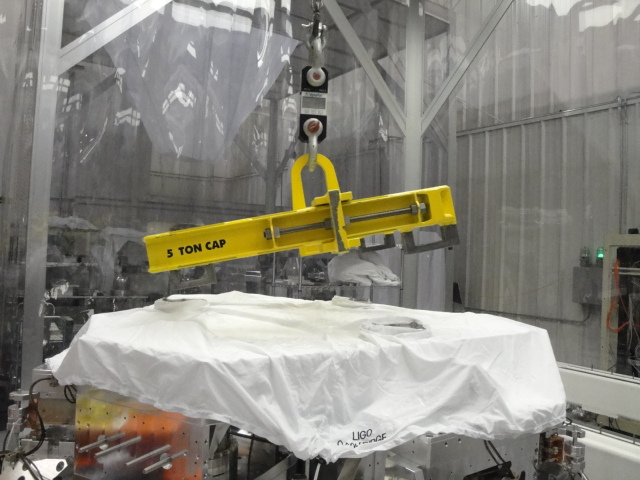
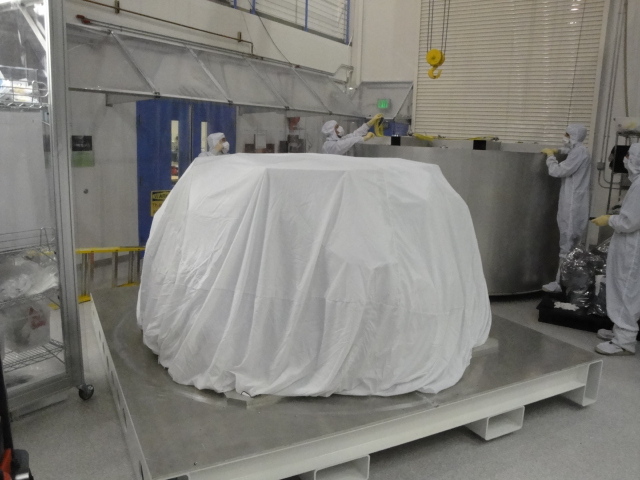
Great effort from Jim, Mitchell, Greg & Eric. We put BSC6 ISI in the storage container to transport to EndY. First Lesson--The ISI Cover with the hole in the top, well that hole doesn't open quite enough to get around the mounting pads that attach the lift fixture to the ISI--see first image. So we elected to take this cover off and just use the Crane debris catch cover--see second image. This works pretty well but the holes are just a little small to open up enough to go around the pad--I wanted to make sure we were not pinching any cloth under the lifter. So we'll just move the ISI with the Crane Catch in place and when the lifter comes off, we'll put the full ISI cover back on. So next image is the 3Pt Lifter being bolted into place. Next we see where the fabrication/QC was poor. See Image 4, where the weldment of the lifter is not flat relative to each other. The three very flat pads on top of our very flat keel top don't mate up very well to the lifter pads. This really needs to be addressed as the pad was no where near metal to metal. We'll take this to a shop and have all the pads surfaced to the same plane. Using the 12.5ton load cell, the tri-lifter weighed 400lbs; it weighed 440 on the 1.25ton load cell. This may suggest the load cells need calibrating. When we picked the ISI we read 7630lbs. Less the 400 of the lifter we have 7230. I believe this is about 770lbs less than we expected. So the discrepancies scale, ~10% low on the big load cell. A poor reality of the 3pt lifter design, it doesn't hang lever for a level pick of a balanced load. The fifth image shows how the lifter hung after we adjusted it to hoist the ISI level. With the current weight distribution, this ISI should be very well balanced. And this out of level hang of the lifter actually puts its lift point in the center--it all hangs together, so to speak. OK, so the ISI is on the BSC Storage Base and we remove the lifter. Lots of debris on the debris catch from adjusting the lifter etc, we pulled the Debris Catch Cover off and reinstalled the ISI cover. We then added a BSC Dome Tall cover (no hole in top). So now we have two C3 layers--this is all done in the clean room and now we roll it out--See sixth image. Finally we pick the lid up and onto the Base. A little N2 for good measure and we are ready to go outside. When we get in the garage, we'll add a tarp and shes ready for the road trip. Again, thanks to the crew for working through lunch to get this completed.
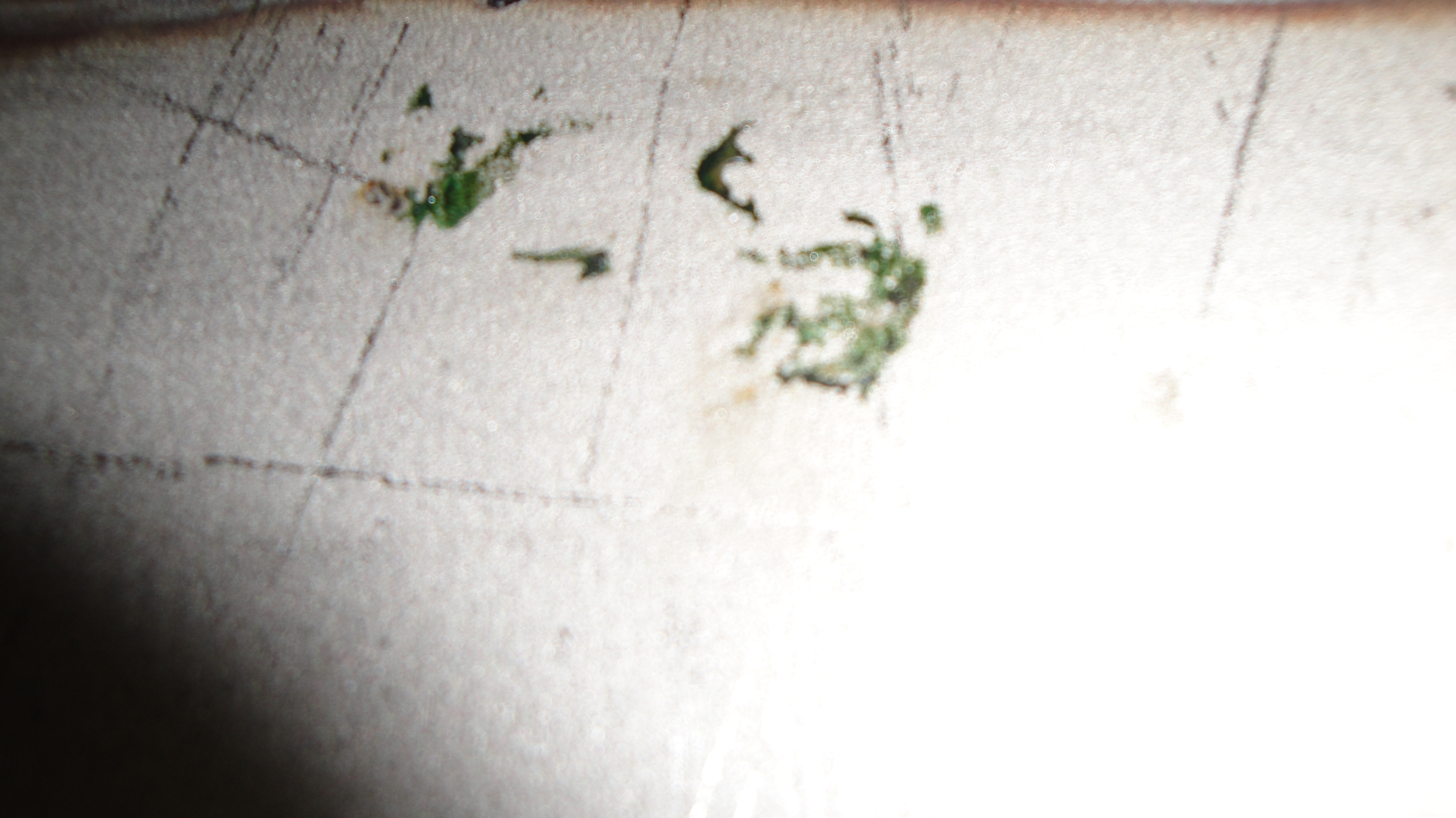
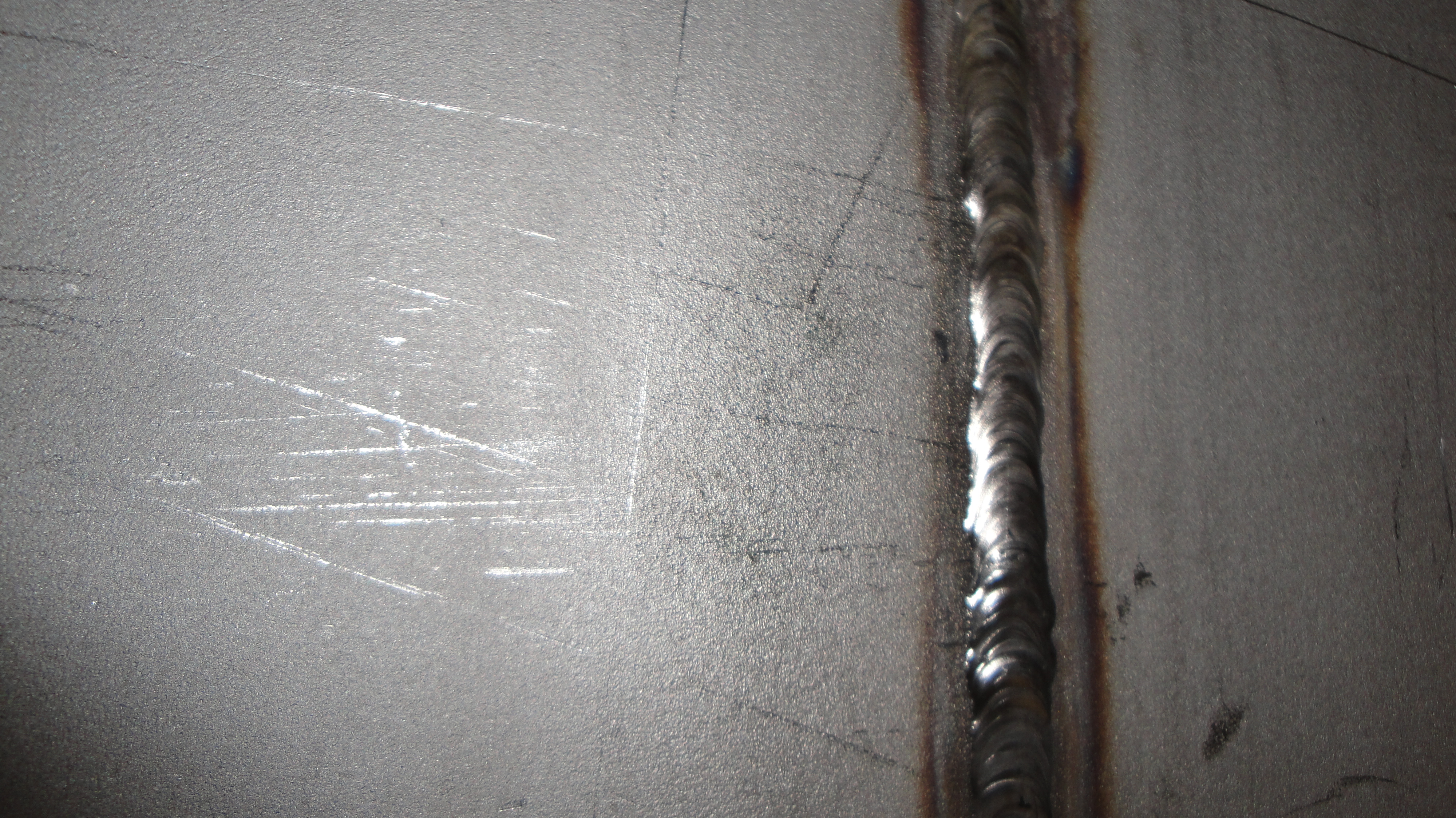
We worked on the BSC-4 dome today. Removal of the conflat, assessment, wipe down of welds, a light vacuum and restoration of the conflat all took place before lunch. There was one troublesome spot: please see picture below and note the beautiful grass-green color. The spot did not come of with an isopropanol wipe so John advised using a stainless steel brush on the spot and then some acetone. This seems to have worked well: please see second picture below. We took an FTIR of the spot and will post results when they arrive.
All OPERATORS please note:
Since there are no longer interferometer components in the two Mid stations we will typically be able to tolerate much larger temperature deviations. Therefore, we have disabled the chillers and the chilled water pumps for these two buildings. The alarm handler will need some attention as a result.
thanks
After optimizing the injection locked laser system on Monday, we operated it also over night. We will keep the external shutter closed at the times nobody is inside the LAE, so that the light is dumped on a power meter inside the oscillator box, until the flow watchdog for the external power heads is installed. The power and flow watchdogs for the laser are already working. The path towards the high power PMC is aligned and we are currently working on the alignment of the ISS AOM. When this is finished we can increase the power in this path as well (at the moment the light is dumped on at a variable attenuation unit that is placed directly outside the high power oscillator box). During calibration of the Diagnostic Breadboard (DBB) we figured out that one PZT used for the autoalignment to the modecleaner is broken. So we had to replace that with a spare one and starting the calibration all over. Currently we are still in that process so that the DBB is not operational at this time.
The crew did not get into BSC-4 until after lunch due to a couple of factors. However, first vacuum, bellows clean-up, and support tube fiber removal were completed today. Since tomorrow is a short day (due to aLIGO 1st anniversary lunch), we'll work on the dome and should be able to finish it. We'll start wipe down next week.
Attached are plots of dust counts > .5 microns. The dust monitor in the H1 diode room (LVEA location 6) needs to be reset.
The main turbo pumping the vertex volume tripped at ~8:15 this morning. I currently do not know why and the turbo restarted with no issues.
Below is a duplicate of my SEI ELOG. Talking with Calum this morning, seems we should have replacement for these in about a month. Is it likely we'd be doing low noise experiments where this ground loop problem might appear? SEI ELOG id 1970: The BSC Trillium Cable D1100152 is unique in the BSC ISI In-vacuum cables in that it is one piece. All other cables, GS-13s L4-Cs and Actuators, are two piece and one of these two has one end where the peek connector has been metalized. Since the metal backshell has been shorted to the shield & pin1, the metalized connector is too now tied back into the rack ground. This is just fine for the two part cables as the metalized peek connector (with ears) are mounted to the Cable Bracket D1001347 isolating the ground connection. The problem with the Trillium Cable is the cabling company got sloppy and put the metalized connector with ears on when it should not have. Now the metalized connector mates up to the Trillium and shorts the grounded shield & Pin1 to the Trillium pod, Stage1 etc etc. I understand this is not desirable. Corey and I looked closely at one of these Trilliums to confirm and yes the backshell is shorted to pin1 and therefore likely to ground back at the rack. That connection continues to the metalized connector and to the front of the connector where it would contact the Trillium pod. We took the backshell back as far as comfortable and could not see where the Pin1/Shield/backshell connection was made so I'm not sure we can address it there. Solution? Could we not just get another connector that wasn't metalized and exchange it? Needs to be classA'd, probably need a fancy gizmo to install it, and have to test the cable again. [BenA has proposed cutting a groove around the metalized connector through the metalization to break the contact to the front of the connector--seems dirty, ugly, non-LIGO] Maybe we'll actually get some cables that were made correctly soon and we can exchange it?
In-chamber cleaning recommenced in BSC-4 after lunch. First vacuum on the collar, upper, and mid-sections were completed as were the nozzles. Support tubes were unwrapped, vacuumed, and remaining fibers were removed.
Kyle
Couple photos here showing the completed local welding at HAM8. The welders finished Tuesday and have moved onto HAM10. They are not quite 1/2 done on the West end of HAM10. The East end is in the Cleanroom over BSC4. The first image shows the busy South side of HAM8 looking North. The second photo is closeup to the NW pier plumbing looking South with the SW pier in the back ground.
It was discovered last night that an actuator link block had been left on one actuator. This part was likely responsible for the reduced twist on unit 3 after the last round of tinkering. We now have a rather large twist(not sure of the size just yet), but it is in the opposite direction from what we had previously. It appears that this rotation is very sensitive to Stage 0-1 flexure position. For the moment, we plan on readjusting the flexure position in one corner only, maybe we can tune the rotation one corner at a time.
Kyle Removed leaking 4.5" CF ESC feedthrough -> Replaced with CF blank -> Pumping YBM
- LVEA Laser Hazard - Sprague Pest Inspection - Squeezers at HAM6 - Shipment from Peninsula Truck Line - Leak Checks at BSC8
Yesterday, we managed to fix the model. Renamed the DAC_x names so the first DAC name starts at '0' (DAC_0 and DAC_1), and also renamed the OSEM_OUT to COIL_OUT to be consistent with the quad models.
I am not sure if I fixed it the 'proper' way, but I changed coil output names in the TMTS_MASTER.mdl. I also used all capitals for the _IN and _OUT names. Then in the H2SUSTMSY.mdl I changed the names of the DAC_x blocks (as mentionedin the T080135-v4 (page 42), but left the card_num to 2 and 3 respectivily. I copied the models by changing the name to 'name'_24oct2011, but don't know if or how to upload them to svn or not.
We recompiled and installed the front-end, and all seemed to work. We check the output by setting an offset on one of the output filters (F3 in our case). There is a nice feature, that on the EPICS screen (SUS_CUST_TMTS_OVERVIEW.adl) the last value (just before the grey button to H2SUSTMSY_DAC_MONITOR_0.adl) is 100. But when looking on the H2SUSTMSY_DAC_MONITOR_0.adl (which is the output of the TMS model) the DAC0 OUT value is 99, and further looking on H2IOPSUSB6_DAC_MONITOR_0.adl (which is the IOP model which actually talks to the DAC) DAC2 OUT value is 101!? Go figure.
The original entry seemed to be quit cryptic, so here is some more info.
In h2sustmsy.mdl there is a TMSY block with all the standard top level components in it (ADC, DAC etc). The TMSY block has a little arrow in the bottom right corner.
I modified the DAC_x/y to DAC_0/1 in the top level of the model. After recompiling all seemed to work fine.
In addition I changed the names of the outports.
Follow this link gives me: TMTS_MASTER.
-> open (double click) TMTS, and I renamed the outports from _OSEM_F3_Out to _COIL_F3_OUT etc. It turns out I didn't change the _In to _IN.
I didn't break the link, I modified the TMST_MASTER library part (didn't know how to break the link).
--> checking the block properties of the M1 gives a description of 'SIXOSEMSTAGE_FACE_MASTER' which I presume is the name of the library part. When I open it (via the open link), I get 'SIXOSEM_F_STAGE_MASTER with a description of 'SIXOSEMSTAGE_FACE_MASTER'. I don't think this is crucial but very confusing.
I presume it is still here on the compile server at LHO only. Will see to get it uploaded to svn.