Displaying reports 10401-10420 of 86476.Go to page Start 517 518 519 520 521 522 523 524 525 End
Reports until 00:53, Tuesday 11 June 2024
LHO FMCS (PEM)
anthony.sanchez@LIGO.ORG - posted 00:53, Tuesday 11 June 2024 (78362)
FAMIS Virbometer HVAC fans

FAMIS 26308 HVAC Vibrometer fans

The H0:VAC-MY_FAN1_270_1_ACC_INCHSEC saw a decrease in signal 3.5 days ago that also looks like it have more noise on the signal.

Images attached to this report
H1 General
anthony.sanchez@LIGO.ORG - posted 16:33, Monday 10 June 2024 (78358)
Monday Ops Eve Shift Start

TITLE: 06/10 Eve Shift: 2300-0800 UTC (1600-0100 PST), all times posted in UTC
STATE of H1: Observing at 148Mpc
OUTGOING OPERATOR: Corey
CURRENT ENVIRONMENT:
    SEI_ENV state: SEISMON_ALERT
    Wind: 13mph Gusts, 10mph 5min avg
    Primary useism: 0.04 μm/s
    Secondary useism: 0.13 μm/s
QUICK SUMMARY:

H1 Has been locked  for 14 hours and 20 minutes and is currently OBSERVING.
All systems seem to be functioning well.


LHO General
corey.gray@LIGO.ORG - posted 16:20, Monday 10 June 2024 (78340)
Mon DAY Ops Summary

TITLE: 06/10 Day Shift: 1430-2330 UTC (0730-1630 PST), all times posted in UTC
STATE of H1: Observing at 127Mpc
INCOMING OPERATOR: Tony
SHIFT SUMMARY:

For the morning H1 was in Observe (from Tony at 2am!) and shortly later we transitioned to Commissioning.  (much of this occurring under a glow of blue light from the visiting film crew!)  

The film crew completed multiple shots of Nergis, and filmed interviews with Sheila, Ibrahim, and Corey.  And we had lots of extras in the Control Room as well.  This work was mostly done after 1pm (they then moved to the Staging Building, LExC (early eve), and other shots?).
LOG:

H1 SEI (CDS)
jeffrey.kissel@LIGO.ORG - posted 16:03, Monday 10 June 2024 (78356)
H1 SEI H23 ADC2 ADC Noise -- Low Frequency Noise Matches Standard Noise Model; 50 - 400 Hz Is More Feature Full than We Want
J. Kissel

Here're the first results of looking at the channel's whose differential inputs I'd shorted to ground the other day (LHO:78302); the inputs to the AA chassis that feed ADC2 on the SEI H23 computer (and ADC2 is used to readout all of the HAM3 ISI's sensors and monitor signals.)

I'm happy to report that it's not that interesting:
    (1) We model all of these 16-bit, General Standards (16AI64SSA) ADC channels used in differential mode to asymptote to 3.6e-6 [V/rtHz], or ~4 [uV/rtHz] above 100 Hz, and to start getting worse than that below 10 Hz, eventually rising in noise inversely proportional to frequency ("rising with a 1/f slope below 10 Hz").
    (2) First attachment shows these four channels agree with, for the most part, with the asymptotes at 3.53e-6, 4.14e-6, 3.17e-6, and 3.24e-6 [V/rtHz] at 1000 Hz, so a range of 3.66e-6 +/- 13%, and the slope of noise increase at the low-frequency end agrees the xpected rise.
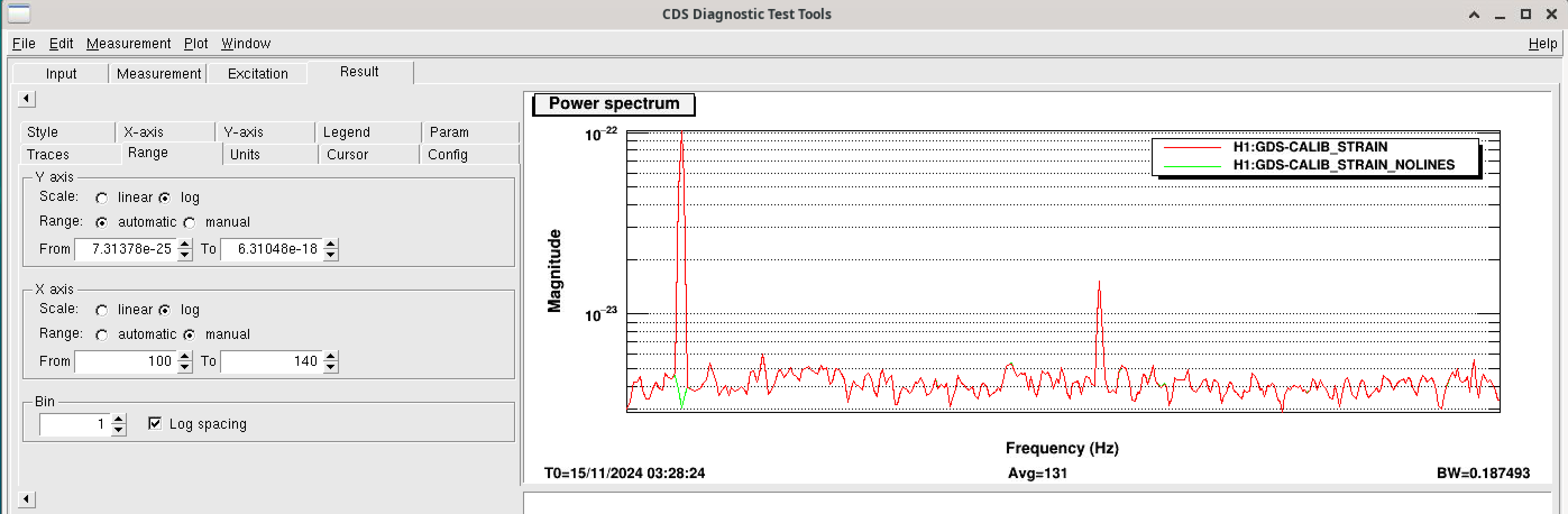
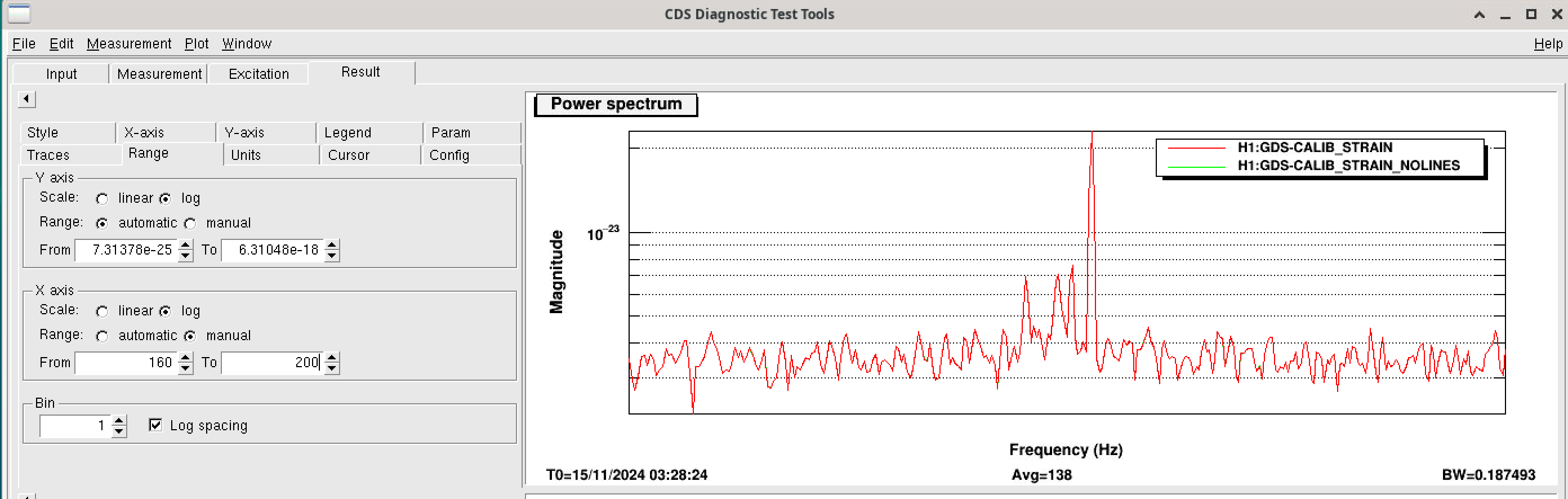
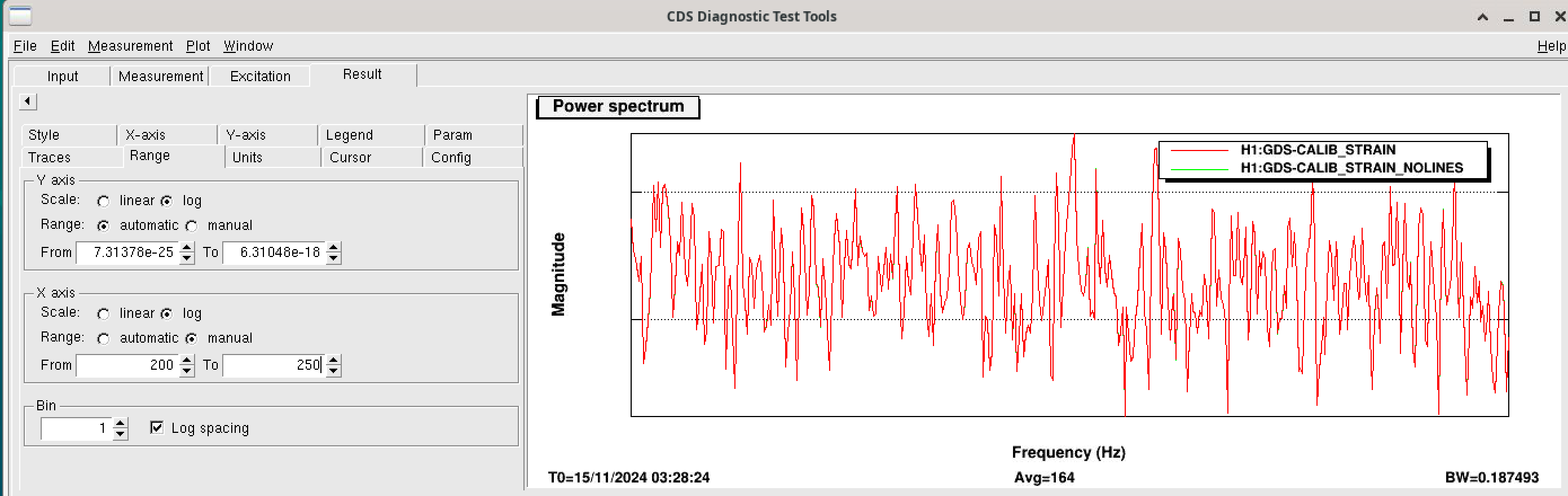
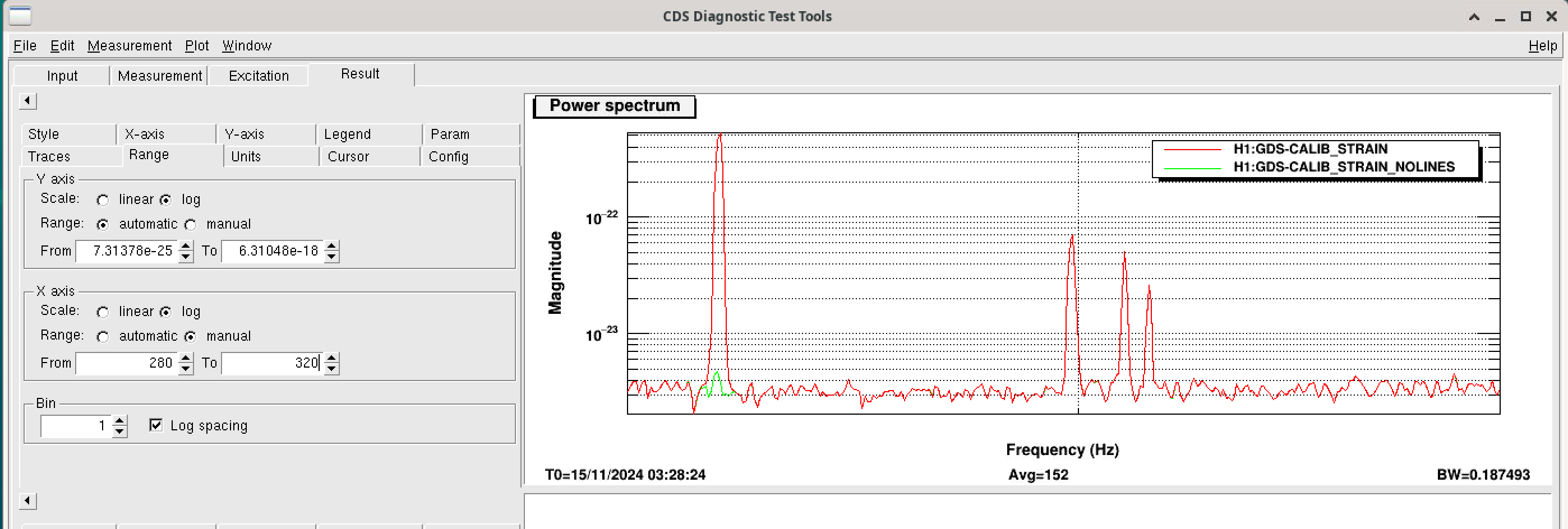
    (3) I'm a little bit sad that the 50-400 Hz region (see second attachment for zoom) which seems to have wide 5-20 Hz wide features that get as loud as 10 to 14 [uV/rtHz] at ~[55, 72, 95, 145, 165, 190, 220, 285, 370] Hz but I don't have time to investigate (e.g. the first thing I would do would be to check if these features have coherence with the other channels on this ADC that have real ISI sensor signals).

More to come on coupling to the DuoTone signals.
Images attached to this report
LHO VE (VE)
gerardo.moreno@LIGO.ORG - posted 15:24, Monday 10 June 2024 - last comment - 16:45, Thursday 13 June 2024(78346)
Report of the Observed Vacuum Pressure Anomalities (06/06/2024 local)

On Friday 06/07/2024 Dave Barker sent an email to the vacuum group noting 3 spikes on the pressure of the main vacuum envelope, I took a closer look at the 3 different events and noticed that the events correlated to the IFO losing lock.  I contacted Dave, and together we contacted the operator, Corey, who made others aware of our findings.

The pressure "spikes" were noted by different components integral to the vacuum envelope.  Gauges noted the sudden rise on pressure, and almost at the same time ion pumps reacted to the rise on pressure.  The outgassing was noted on all stations, very noticeable a the mid stations, and with less effect at both end stations, and for both with a delay.

The largest spike for all 3 events is noted at HAM6 gauge, we do not have a gauge at HAM5 or HAM4.  The one near HAM6 is the one on the relay tube that joins HAM5/7 (PT152), with the restriction of the relay tube, then the next gauge is at BSC2 (PT120), however the spike is not as "high" as the one noted on HAM6 gauge.

A list of aLOGs made by others related to the pressure anomalies and their findings:
https://alog.ligo-wa.caltech.edu/aLOG/index.php?callRep=78308
https://alog.ligo-wa.caltech.edu/aLOG/index.php?callRep=78320
https://alog.ligo-wa.caltech.edu/aLOG/index.php?callRep=78323
https://alog.ligo-wa.caltech.edu/aLOG/index.php?callRep=78343

Note: the oscillation visible on the plot of the outer stations (Mids and Ends) is the diurnal cycle, nominal behavior.

Images attached to this report
Comments related to this report
michael.zucker@LIGO.ORG - 13:13, Tuesday 11 June 2024 (78371)

Of live working gauges, PT110 appears closest to the source based on time signature. This is on the HAM5-7 relay tube and only indirectly samples HAM6*.  It registered a peak of 2e-6 8e-6 Torr with decay time of order 30 17s. Taking a HAM as sample volume (optimistic) this indicates at least 0.02 0.08 torr-liters of "something" must have been released at once.  The strong visible signal at mid- and end-stations suggests it was not entirely water vapor, as this should have been trapped in CP's. 

For reference, a mirror in a 2e-6 Torr environment intercepts about 1 molecular monolayer per second. Depending on sticking fraction, each of these gas pulses could deposit of order 100 monolayers of contaminant on everything. 

The observation that the IFO still works is comforting; maybe we should feel lucky. However it seems critical to understand how (for example) the lock loss energy transient could possibly hit something thermally unstable, and to at least guess what material that might be.  Recall we have previously noted evidence of melted glass on an OMC shroud.

Based on the above order-of-magnitude limits, similar gas pulses far too small to see on pressure gauges could be damaging the optics. 

It would be instructive to compare before/after measures of arm, MC, OMC, etc. losses, to at least bound any acquired absorption


*corrected, thanks Gerardo

jordan.vanosky@LIGO.ORG - 14:03, Tuesday 11 June 2024 (78374)

Corner RGA scans were collected today during maintenance, using RGA on Output tube. RGA volume has been open to main volume since last pumpdown ~March 2024, but electronics head/filament was turned off due to the small fan on the electronics head not spinning during observing. Unable to connect to HAM6 RGA, through either RGA computer in control room, or locally at unit with laptop. Only Output tube RGA available at this time.

Small aux cart and turbo was connected to RGA volume on output tube, then RGA Volume isolated from main volume and the filament turned on. The filament had warmed for ~2 hours prior to RGA scans being collected.

RGA Model: Pfeiffer PrismaPlus

AMU Range: 0-100

Chamber Pressure: 1.24E-8 torr on PT131(BSC 3), and 9.54E-8 torr on PT110 (HAM6), NOTE: Cold Cathode gauge interlocks tripped during filming activings in LVEA today, BSC2 pressure not recorded

Pumping Conditions: 4x 2500 l/s Ion Pumps and 2x 10^5 l/s cryopumps, HAM6 IP and HAM7/Relay tube

SEM voltage: 1200V

Dwell time: 500ms

Pts/AMU: 10

RGAVolume scans collected with main volume valve closed, only pumping with 80 l/s turbo aux cart

Corner scans collected with main volume valve open, and aux cart valve closed

Comparison to March 2024 scan provided as well.

RGA is still powered on and connected to main volume with a continuous 0-100AMU scan sweep at 5ms dwell time

Images attached to this comment
richard.mccarthy@LIGO.ORG - 07:34, Wednesday 12 June 2024 (78385)

Richard posting from Robert S.

I had a work permit to remove viewports so I opened the two viewports on the -Y side of HAM6. I used one of the bright LED arrays at one viewport and looked through the other viewport  so everything was well lit.  I looked for any evidence of  burned spots, most specifically on the fast shutter or in the area where the fast shutter directs the beam to the cylindrical dump.  I did not see a damaged spot but there are a lot of blocking components, so not surprising. I also looked at OM1 which is right in front of the viewports. I looked for burned spots on the cables etc but didnt see any. I tried to see if there were any spots on the OMC shroud, or around OM2 and OM3, the portions that I could see. I didnt see anything, but I think its pretty unlikely that I could have seen something.

jordan.vanosky@LIGO.ORG - 11:48, Wednesday 12 June 2024 (78390)

Repeated 0-100AMU scans of the corner today, after filament had full 24 hours to warm up. Same scan parameters as above June 11th scans. Corner pressure 9.36e-9 Torr, PT 120.

Dwell time 500 ms

Attached is comparison to yesterday's scan, and compared to the March 4th 2024 scan after corner pumpdown.

There is a significant decrease in AMU 41, 43 and 64 compared to yesterday's scan.

Images attached to this comment
jordan.vanosky@LIGO.ORG - 16:45, Thursday 13 June 2024 (78424)

Raw RGA text files stored on DCC at T2400198

H1 SQZ (SQZ)
andrei.danilin@LIGO.ORG - posted 15:18, Monday 10 June 2024 (78344)
Finding the cause of whistles in VCO's

Andrei, Sheila, Naoki

We've tried to link the observable whistles with working VCOs. We've manually checked the correlation between channel H1:SQZ-FC_LSC_DOF2_OUT_DQ and channels that record the frequency of squeezer related VCOs: H1:SQZ-CLF_VCXO_FREQUENCY, H1:SQZ-FC_VCO_FREQUENCY, and H1:SQZ-LASER_VCO_FREQUENCY.

Upon quick inspection Figure 1, we observed visible dependance of H1:SQZ-FC_LSC_DOF2_OUT_DQ channel excess noise with frequency noise of H1:SQZ-FC_VCO_FREQUENCY. However, the H1:SQZ-FC_VCO_FREQUENCY frequency deviates on far less scale than whistles of the channel H1:SQZ-FC_LSC_DOF2_OUT_DQ, therefore we believe it is safe to conclude that this frequency noise is the consequence of these whistels rather its cause.

Figure_2 shows the step-like frequency drift of the whistle-signal.


UPD: We've also disabled this VCO and checked whether its noise is the cause of our problems. However, since in the observation was only for a few hours, it was hard to say whether that solved the problem (see Figure 3). We will continue to make observation with turned off VCO.

UPD2: We've added channel H1:TCS-ITMX_CO2_ISS_CTRL2_OUT_DQ for analysis (Figure 1 and  Figure 3). It didn't show any dependance on whistles. 

Images attached to this report
H1 OpsInfo (ISC, OpsInfo)
jennifer.wright@LIGO.ORG - posted 14:54, Monday 10 June 2024 (78355)
Cleared SDF diffs associated with A2L tuning to go into OBSERVING

Jennie W, TJ


See attached images for the SDFs I reverted which were just used for our A2L measurements (mostly TRAMPS or filter settings in ADS YAW7 and PIT7 banks which were used for injecting our A2L tuning lines but are not used normally).

The only ones I accepted were the updated DRIVEALIGN gains used to minimise the A2L coupling.

Images attached to this report
H1 ISC (ISC, SQZ)
jennifer.wright@LIGO.ORG - posted 14:12, Monday 10 June 2024 (78354)
DARM changes after SQZ, A2L, MICH FF tuning this morning

After the commissioning period this morning where I tuned A2L gains, Naoki tuned the squeezer, and Sheila updated the MICH FF we gained noticeably at frequencies above 60 Hz and between 18 Hz to 23 Hz.

We are noticeably worse below 12 Hz.

See attached plot.

The template is stored in /jennifer.wright/Documents/ASC/20240610_DARM_pre_post_A2L_tuning.xml

Images attached to this report
H1 SEI
ryan.crouch@LIGO.ORG - posted 13:49, Monday 10 June 2024 (78352)
H1 ISI CPS Sensor Noise Spectra Check - Weekly

Closes FAMIS 25995, everything looks good at high frequency.

ITMY_ST2_CPSINF_H1 looks elevated below 10 Hz

ETMY_{ST1,ST2}s overall noise looks reduced below 10 Hz

Non-image files attached to this report
H1 ISC
jennifer.wright@LIGO.ORG - posted 11:52, Monday 10 June 2024 - last comment - 16:19, Thursday 13 June 2024(78074)
Optical Gain Changes before and during O4b

Jennie W, Sheila


Sheila wanted me to look at how good our optical gain is doing since the burn on the OFI that roughly happened (we think) on the 22nd April.

Before this happened we made a measurement of the OMC alignment using dithers on the OMC ASC degrees of freedom. We got a set of new alignment offsets for the OMC QPDs that would have increased our optical gain but did not implement these at the time.

After the OFI burn we remeasured these alignment dithers and found a similar set of offsets that would imrpove our optical gain. Thus I have assumed that we would have achieved this optical gain increase before the OFI burn if we had implemented the offset changes then.

Below is the sequence of events then a table stating our actual or inferred optical gain and the date on which it was measured.


Optical gain before vent as tracked by kappa C: 2024/01/10 22:36:26 UTC is 1.0117 +/- 0.0039

Optical gain after vent: 2024/04/14 03:54:38 UTC is 1.0158 +/- 0.0028, optical gain if we had improved OMC alignment = 1.0158 + 0.0189 = 1.0347

SR3 yaw position and SR2 yaw and pitch positions were changed on the 24th April ( starting 17:18:15 UTC time) to gain some of our throughput back.

The OMC QPD offsets were changed on 1st May (18:26:26 UTC time) to improve our optical gain - this improved kappa c by 0.0189.

Optical gain after spot on OFI moved due to OFI damage: 2024-05-23 06:35:25 UTC 1.0051 +/- 0.0035

SR3 pitch and yaw positions and the SR2 pitch and yaw positions were changed on 28th May (starting at 19:14:34 UTC time).

SR3 and SR2 positions moved back to pre-28th values on 30th May (20:51:03 UTC time).

So we still should be able to gain around 0.0296 ~ 3% optical gain increase, provided we stay at the spot on the OFI we had post 24th April:

SR2 Yaw slider = 2068 uradians
SR2 Pitch slider = -3 uradians

SR3 Yaw slider = 120 uradians

SR3 Pitch slider = 438 uradians
 

Date kappa_C Optical Gain [mA/pm] Comments
10th January 1.0117 8.46 O4a
14th April 1.0347 8.66 Post vent
23rd May 1.0051 8.41 Post OFI 'burn'


Images attached to this report
Comments related to this report
jenne.driggers@LIGO.ORG - 12:05, Monday 10 June 2024 (78350)

I'm not really sure why, but our optical gain is particularly good right now.  And, it's still increasing even though we've been locked for 12+ hours. 

The other times in this plot where the optical gain is this high is about April 5th (well before the OFI incident), and May 30th.

Images attached to this comment
jenne.driggers@LIGO.ORG - 12:23, Monday 10 June 2024 (78353)

Actually, this *might* be related to the AS72 offsets we've got in the guardian now.  Next time we're commissioning, we should re-measure the SR2 and SRM spot positions.

Images attached to this comment
jennifer.wright@LIGO.ORG - 16:19, Thursday 13 June 2024 (78376)

Jennie W, Sheila, Louis


I recalculated the optical gain for pre-vent as I had mixed up the time in PDT with the UTC time for this measurement, it was actually from on the 11th January 2024.

Also the value I was using for OMC-DCPD_SUM_OUT/LSC-DARM_IN1 in mA/counts changes over time, and the optical gain reference value in counts/m also changes between before the vent, April, and now.

Louis wrote a script that grabs the correct front-end calibration (when this is updated the kappa C reference is updated) and the measured OMC-DCPD_SUM_OUTPUT to the DARM loop error point.

Instructions for running the code can be found here.

The code calculates current optical gain = kappa C  * reference optical gain * 1e-12 / (DARM_IN1 divided by OMC-DCPD_SUM)

                                                       [mA/pm] = [counts/m] * [m/pm]  / [counts/mA]

All the kappa Cs in the table below and all the optical gains were calculated by Louis's script except for the 14th April.

I calculated the optical gain on the 14th April assuming as in the entry above that we would have got a (~0.0189) increase in kappa C if we had previously (before the 14th April) implemented the OMC alignment offsets we in fact implemented post OFI burn, on 1st May.

I went to these reference times and measured coupled cavity pole, f_cc and P_circ the arm cavity power.

I also checked the OMC Offset and OMC-DCPD_SUM for these times (which shouldn't change).

Date kappa_C f_c Optical Gain [mA/pm] P_Circ X/Y OMC Offset OMC-DCPD_SUM Comments

11th January

06:36:26 UTC

1.0122 441 +/- 7 8.33 368 kW +/- 0.6kW 10.9405 +/- 0.0002 40mA -/+ 0.005 O4a, time actually 11/01/2024 06:36:26 UTC

14th April

03:54:54 UTC

1.0257 391 +/- 7 8.70 375 +/- 0.8 kW 10.9402 +/ - 0.0002 40mA -/+ 0.003mA Post vent

23rd May

06:35:41 UTC

1.0044 440 +/- 6 8.52 382 kW +/-0.4 kW/ 384 kW +/- 0.4 kW 10.9378 +/- 0.00002 40mA +/- 0.006 mA Post OFI 'burn'

12th June

09:43:04 UTC

1.0171 436 +/- 7 kW 8.62 379 kW +/- 0.6 kW/ 380 kW +/- 0.5 kW 10.9378 +/- 0.00002 40mA +/- 0.004 mA Post HAM6 pressure spike


In summary we have (8.62/8.70) *100 = 99.1% of the optical gain that we could have achieved before the OFI burn, and our current optical gain  is (8.62/8.33)*100 = 103.5 % of that before the vent.

We do not appear to be doing worse in optical gain since the vacuum spikes last week.


Images attached to this comment
LHO VE
david.barker@LIGO.ORG - posted 10:34, Monday 10 June 2024 (78348)
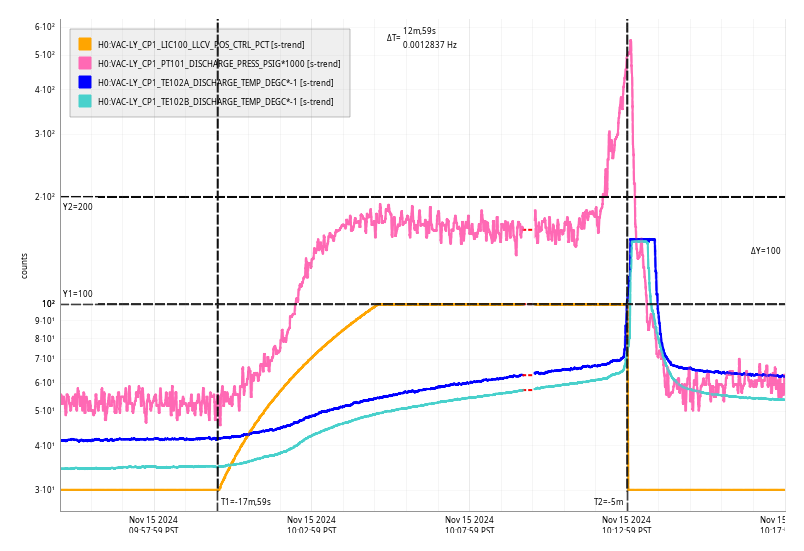
Mon CP1 Fill

Mon Jun 10 10:11:12 2024 INFO: Fill completed in 11min 7secs

Travis confirmed a good fill curbside

Images attached to this report
H1 SQZ
naoki.aritomi@LIGO.ORG - posted 10:34, Monday 10 June 2024 - last comment - 11:02, Wednesday 12 June 2024(78345)
Turn off FC green VCO lock after FC IR transition

Naoki, Sheila

To investigate the origin of whistles and rms increase in FC IR signal as reported in 78263 and 78344, we turned off the FC green VCO lock after FC IR transition.

In TRANSITION_IR_LOCKING state of SQZ_FC guardian, the FC CMB servo is disabled after FC IR transition. Since we use the green QPD at FC trans for beam spot control, we also turned off the beam spot control. The SDF is accepted as shown in the attachment.

Images attached to this report
Comments related to this report
naoki.aritomi@LIGO.ORG - 11:02, Wednesday 12 June 2024 (78389)

After this guardian change, FC lost lock after IR transition. I reverted the guardian change and FC lock is fine. The FC CMB input is ON now and it was OFF from 2024/06/10 16:44:06 UTC to 2024/06/11 15:07:58 UTC. The beam spot control is still OFF.

LHO VE (ISC, VE)
corey.gray@LIGO.ORG - posted 10:00, Monday 10 June 2024 (78343)
A Look At 60W Locklosses & Pressure Since Yesterday

After getting the OK for operations ABOVE 10W for H1 yesterday, I forgot to post anything looking at pressure sensors during higher power locklosses/operations yesterday/today.  So here is a look from the last 24hrs.

Images attached to this report
H1 ISC
jennifer.wright@LIGO.ORG - posted 09:41, Monday 10 June 2024 - last comment - 16:41, Wednesday 12 June 2024(78342)
Ran A2L scripts to reduce A2L coupling

Jennie W, Sheila, TJ


This is done to reduce the coupling we get to length from having off-centre spot positions on the mirrors.

The script can be found in userapps/isc/common/scripts/decoup/a2l_min_generic_LHO.py .

See the steps the script runs in the bottom two plots and the reponse of the ADS demodulated signals in the top plots.

I ran ETMX P and Y first by calling the script with

python a2l_min_generic_LHO ETMX BOTH

changed P and Y

H1:SUS-ETMX_L2_DRIVEALIGN_P2L_SPOT_GAIN => 3.22

H1:SUS-ETMX_L2_DRIVEALIGN_Y2L_SPOT_GAIN => 4.99


ETMY

both P and Y changed

H1:SUS-ETMY_L2_DRIVEALIGN_P2L_SPOT_GAIN => 4.3

H1:SUS-ETMY_L2_DRIVEALIGN_Y2L_SPOT_GAIN => 0.92


ITMX

both P and Y changed

H1:SUS-ITMX_L2_DRIVEALIGN_P2L_SPOT_GAIN => -0.99

H1:SUS-ITMX_L2_DRIVEALIGN_Y2L_SPOT_GAIN => 2.88


ITMY

H1:SUS-ITMY_L2_DRIVEALIGN_P2L_SPOT_GAIN => -0.36

H1:SUS-ITMY_L2_DRIVEALIGN_Y2L_SPOT_GAIN => -2.5
 

16:35:52 UTC all A2L gains set and script finished.


Images attached to this report
Comments related to this report
jennifer.wright@LIGO.ORG - 10:38, Monday 10 June 2024 (78347)

CHARD_Y coupling was still bad so we reran Y degree of freedom for all test masses.

ETMX

Want to change gain from 4.99 to 4.98, rounded to 2 decimal places. St.Div is 0.925. Change of 0.01
H1:SUS-ETMX_L2_DRIVEALIGN_Y2L_SPOT_GAIN => 4.98


ETMY

Want to change gain from 0.92 to 0.93, rounded to 2 decimal places. St.Div is 0.145. Change of -0.007
H1:SUS-ETMY_L2_DRIVEALIGN_Y2L_SPOT_GAIN => 0.93


ITMY

Want to change gain from -2.5 to -2.5, rounded to 2 decimal places. St.Div is 1.0. Change of -0.001
Gain did not change.

3 A2Ls changed by 17:33:32 UTC.

ITMX

Want to change gain from 2.88 to 2.87, rounded to 2 decimal places. St.Div is 0.496. Change of 0.01
H1:SUS-ITMX_L2_DRIVEALIGN_Y2L_SPOT_GAIN => 2.87


3 A2Ls changed by 17:33:32 UTC.


jenne.driggers@LIGO.ORG - 16:41, Wednesday 12 June 2024 (78402)

I don't think these values made it into lscparams' dictionary a2l_gains['FINAL'] (starting around line 451 in lscparams.py), so they were reverted for the next lock, and they were accepted as the previous values in alog 78383.

H1 PSL
ryan.short@LIGO.ORG - posted 08:59, Monday 10 June 2024 (78341)
PSL 10-Day Trends

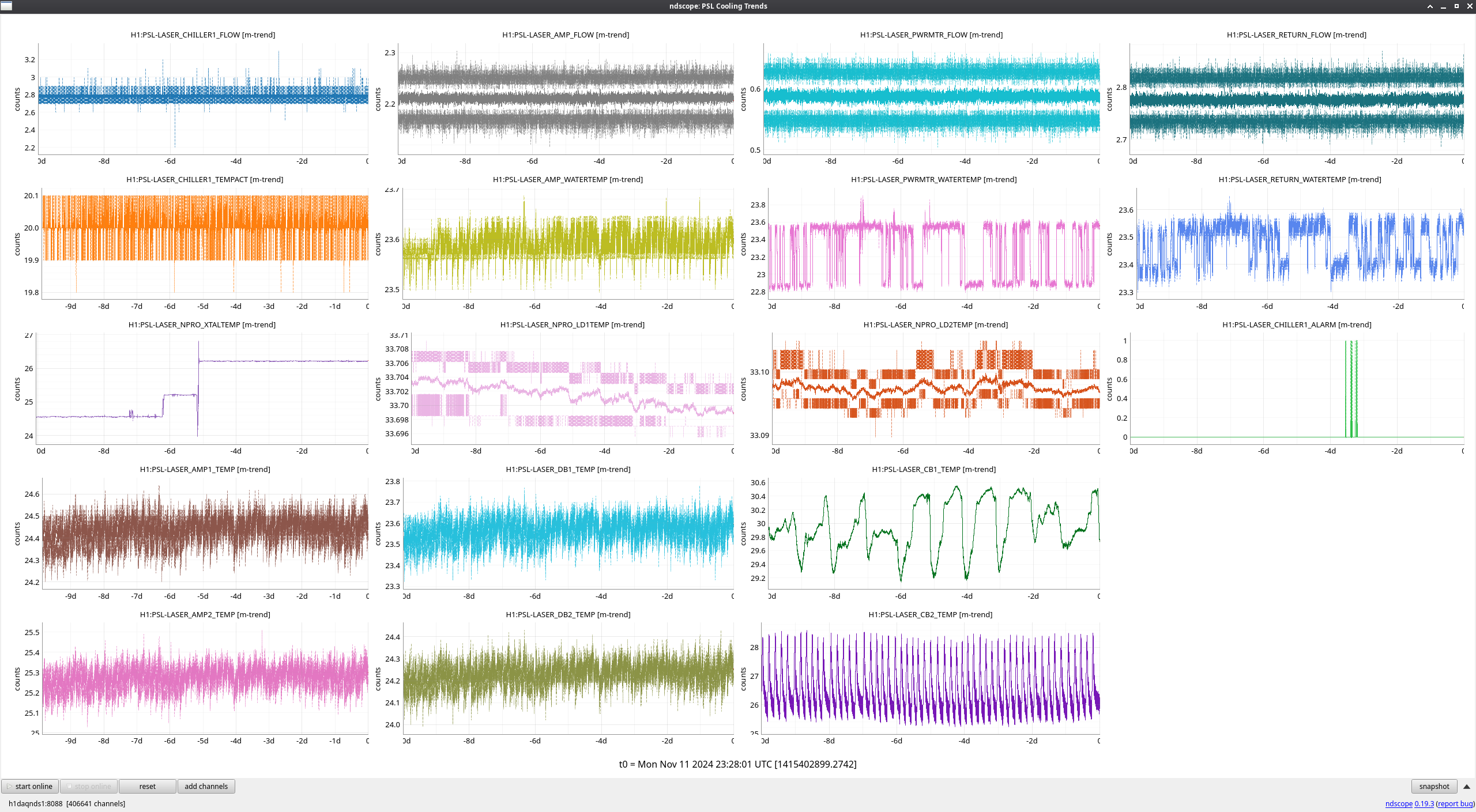
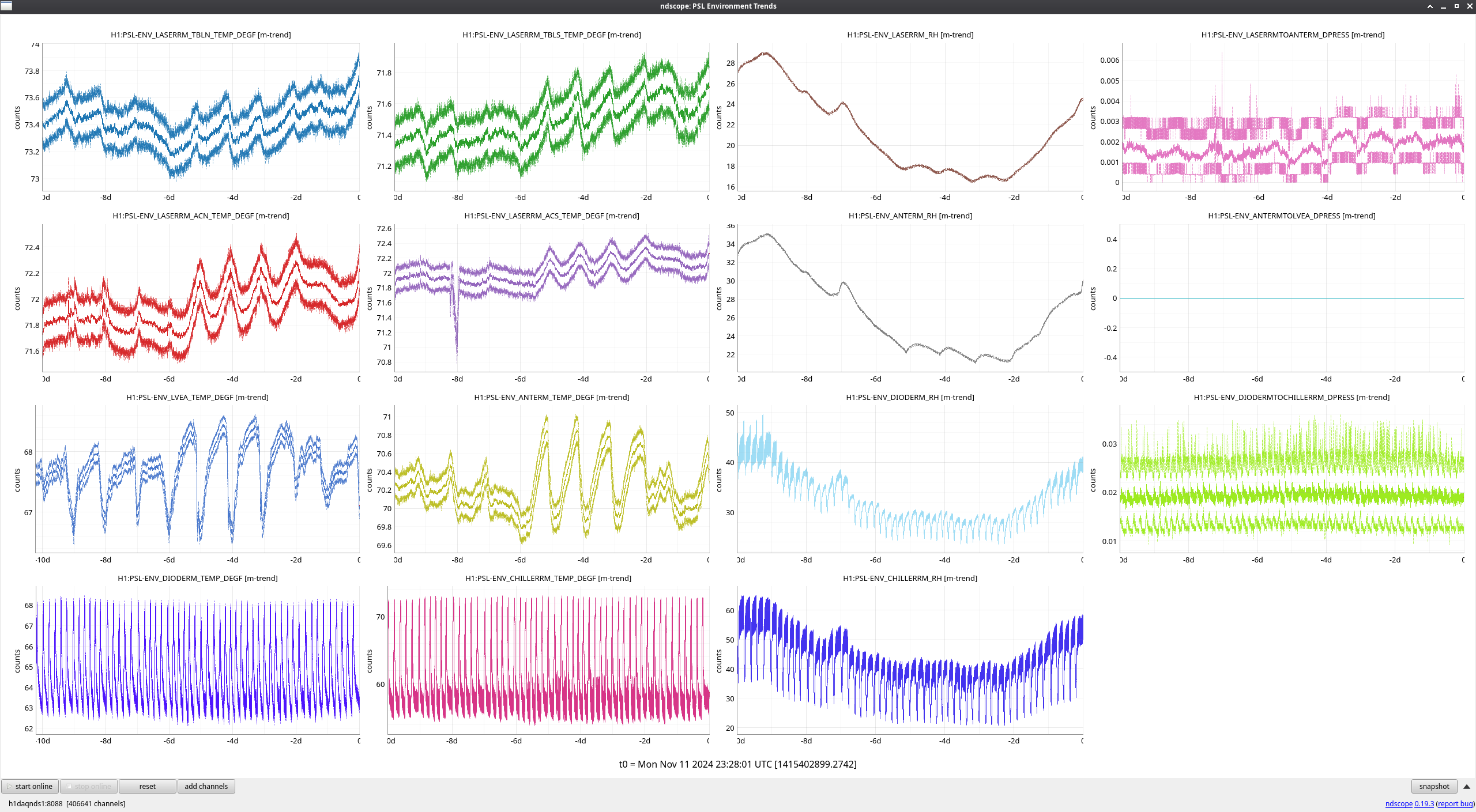
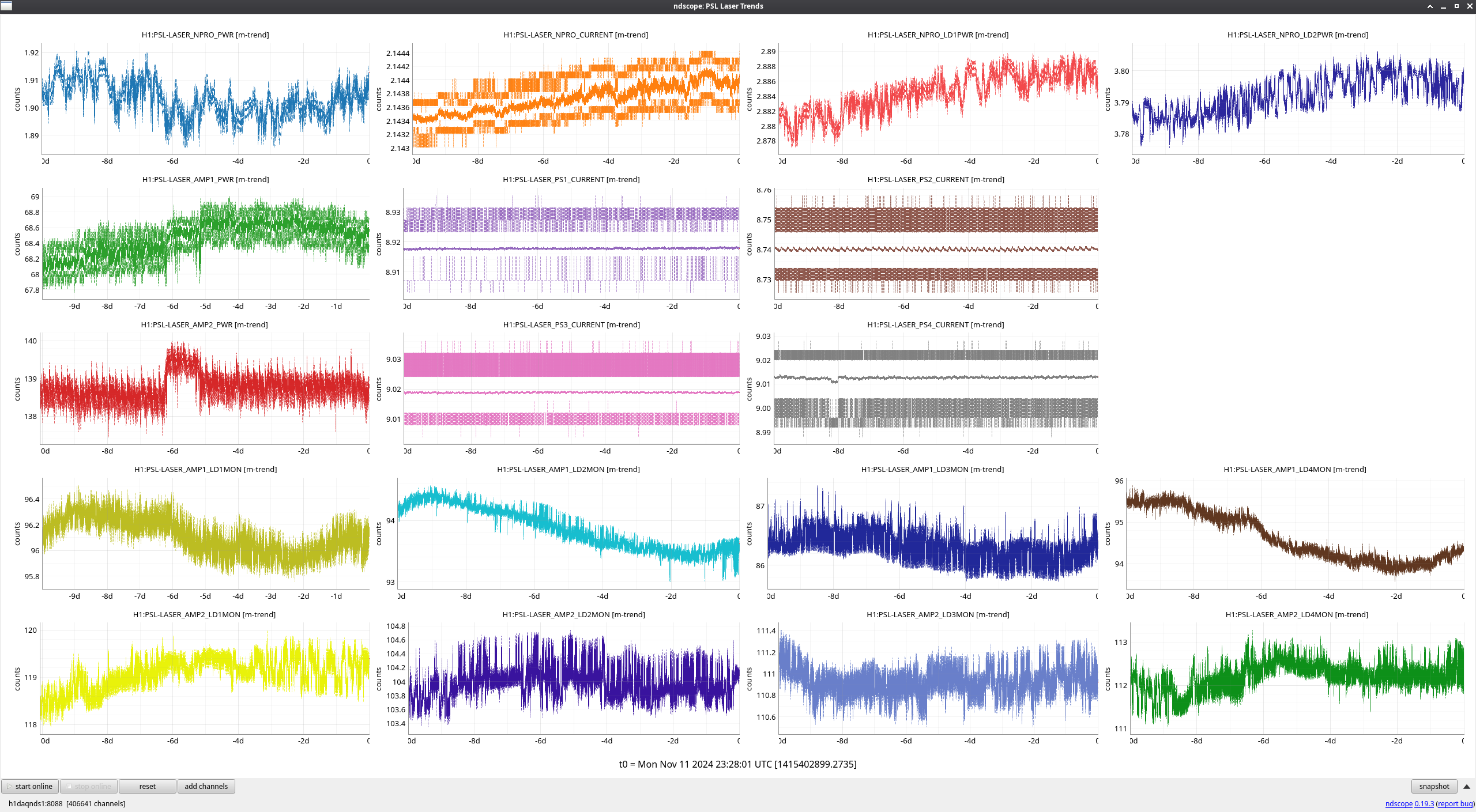
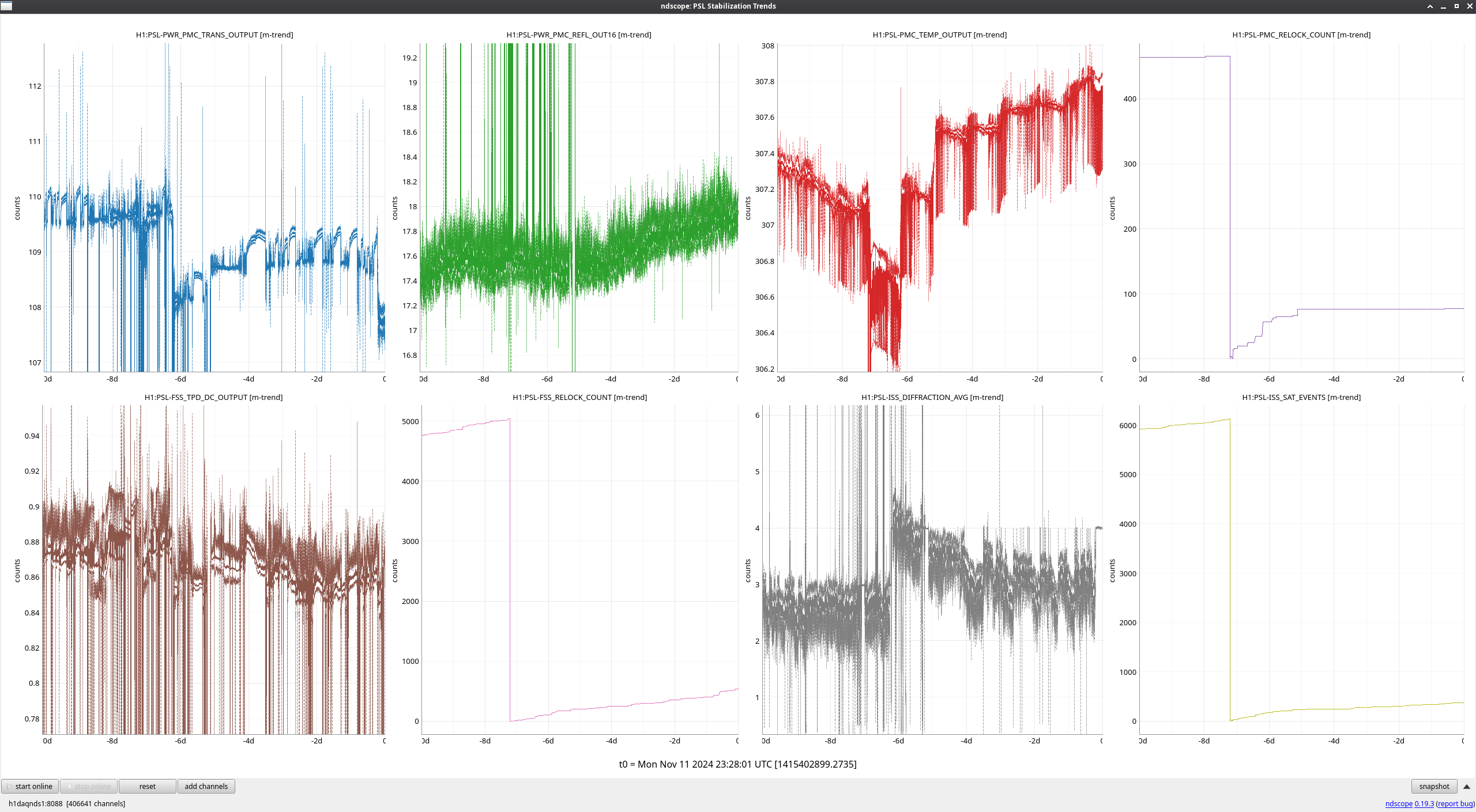
FAMIS 20701

No major events for this week, but I am noticing that the PMC TRANS/REFL drifting we've been seeing for a couple months now has somewhat settled down. Thinking this might relate to how we've had an unlocked IFO for longer periods of time in recent days, I trended this against IFO range, but I don't notice a strong correlation.

Images attached to this report
LHO VE (VE)
gerardo.moreno@LIGO.ORG - posted 08:01, Monday 10 June 2024 (78339)
GV20 Annulus Ion Pump Failure

GV20 AIP went red yesterday, about 22:43 utc time.  We will take a look at the controller for this unit as soon as posible, failure is unusual, as of right now it appears as if the controller failed, per trend of adjecent gauges the internal pressure does not appear to be affected.  No further action is required at this moment.

Images attached to this report
H1 PEM (CDS, DetChar, ISC, SYS)
richard.mccarthy@LIGO.ORG - posted 10:09, Tuesday 28 May 2024 - last comment - 10:16, Tuesday 11 June 2024(78079)
Unplugged IRIG-B channel from PEM chassis and EX & EY

LLO noted a 10 Hz comb that was attributed to the IRIG B monitor channel at the end station connected to the PEM chassis. (https://alog.ligo-la.caltech.edu/aLOG/index.php?callRep=71217)

LHO has agreed to remove this signal for a week to see how it impacts our DARM signal.

EX and EY cables have been disconnected.

Images attached to this report
Comments related to this report
david.barker@LIGO.ORG - 15:17, Tuesday 28 May 2024 (78099)

Disconnection times

EX GPS 1400946722 15:51:44 Tue 28 May 2024 UTC
EY GPS 1400947702 16:08:04 Tue 28 May 2024 UTC


keita.kawabe@LIGO.ORG - 18:02, Wednesday 05 June 2024 (78266)

I checked  H1:CAL-PCALX_IRIGB_DQ at gps=1400946722 and H1:CAL-PCALY_IRIGB_DQ at gps=1400947702. From 10 seconds prior to the cable disconnection to 1 sec before the cable disconnection, IRIG-B code in these channels agreed with the time stamp after taking into account the leap second offset (18 sec currently).

Note that the offset is there because the IRIG-B output from the CNS-II witness GPS clock ignores leap seconds.

I fixed things in https://svn.ligo.caltech.edu/svn/aligocalibration/trunk/Common/Scripts/Timing/ so that they run in the control room with modern gpstime package and also the offset is not hard coded.  I committed the changes.

Please reconnect the cable soon so we have independent witness signals of the time stamp. There could be a better implementation but we need the current ones until a proper fix is proposed, approved and implemented.

evan.goetz@LIGO.ORG - 17:08, Monday 10 June 2024 (78359)CDS, DetChar
I have checked the weekly Fscans to look for similar 1 Hz and 10 Hz combs in the H1 data (which we haven't see in the H1 O4 data thus far), or any obvious changes in the H1 spectral artifacts occurring due to the configuration change May 28. I do not see any changes due to this configuration change. This may be because the coupling from the timing IRIG-B signal may be lower at LHO than it is at LLO.

I do notice that there is some change around the beginning of May 2024 that the number of line artifacts seems to increase; this should be investigated further.

Attached are two figures showing the trend of 1 Hz and 10 Hz comb, where the black points are the average comb power and colored points are the individual comb frequency power values; color of the individual points indicates the frequency. Note that there is no change in the last black data point (the only full-1-week Fscan so far).
Images attached to this comment
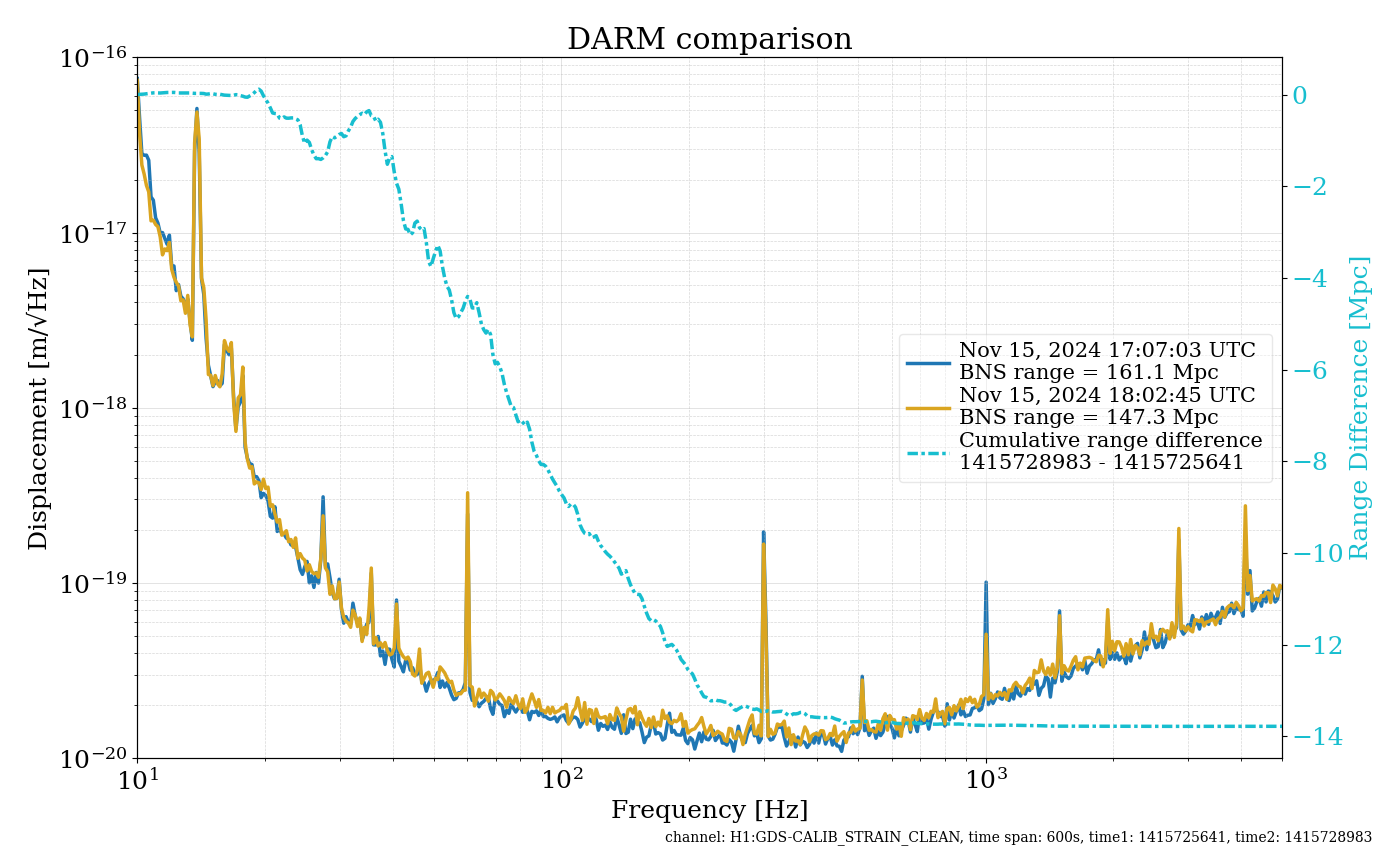
filiberto.clara@LIGO.ORG - 10:16, Tuesday 11 June 2024 (78366)

The IRIGB cables at EX and EY have been reconnected (PEM AA Chassis CH31).
Displaying reports 10401-10420 of 86476.Go to page Start 517 518 519 520 521 522 523 524 525 End