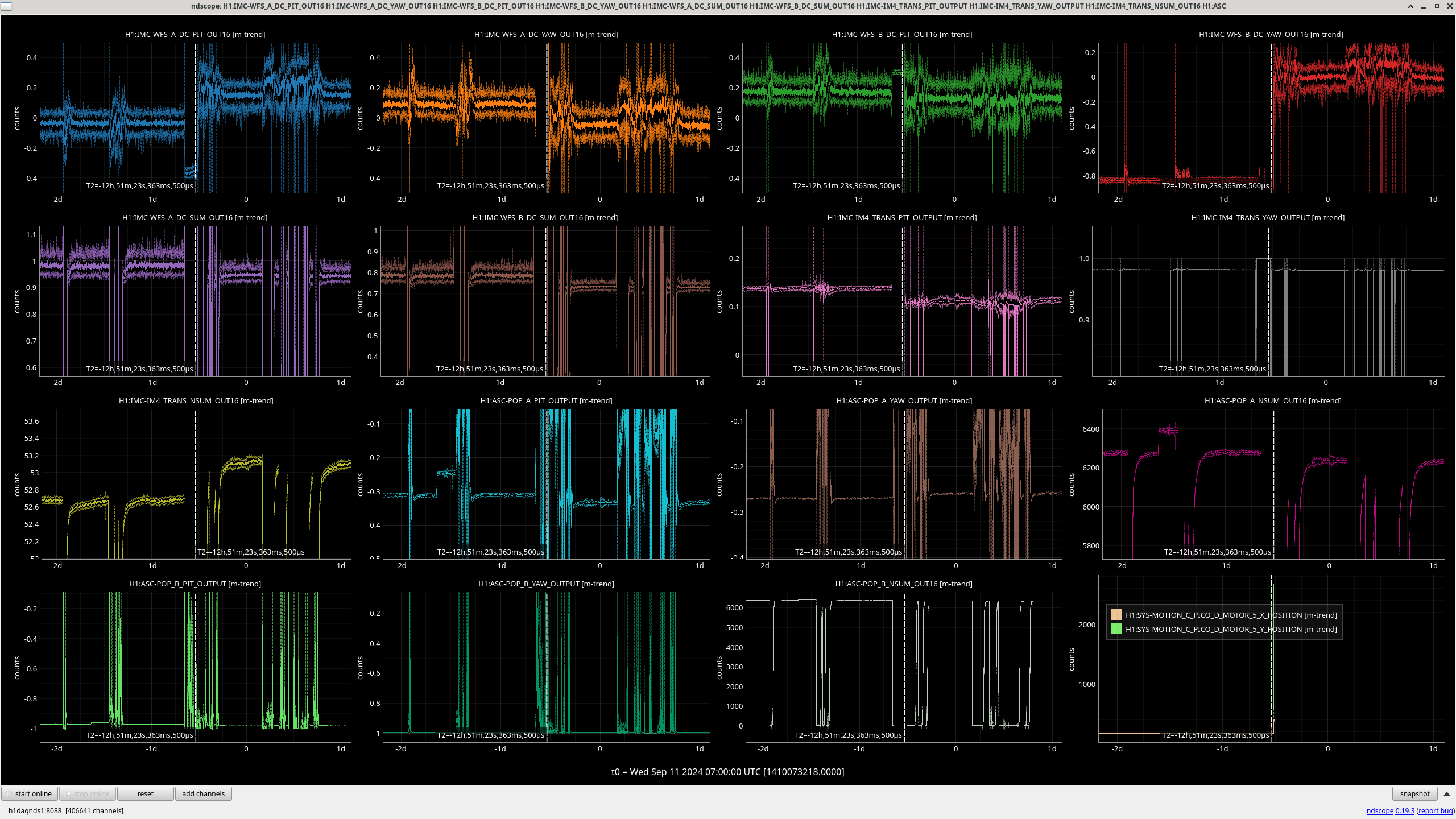
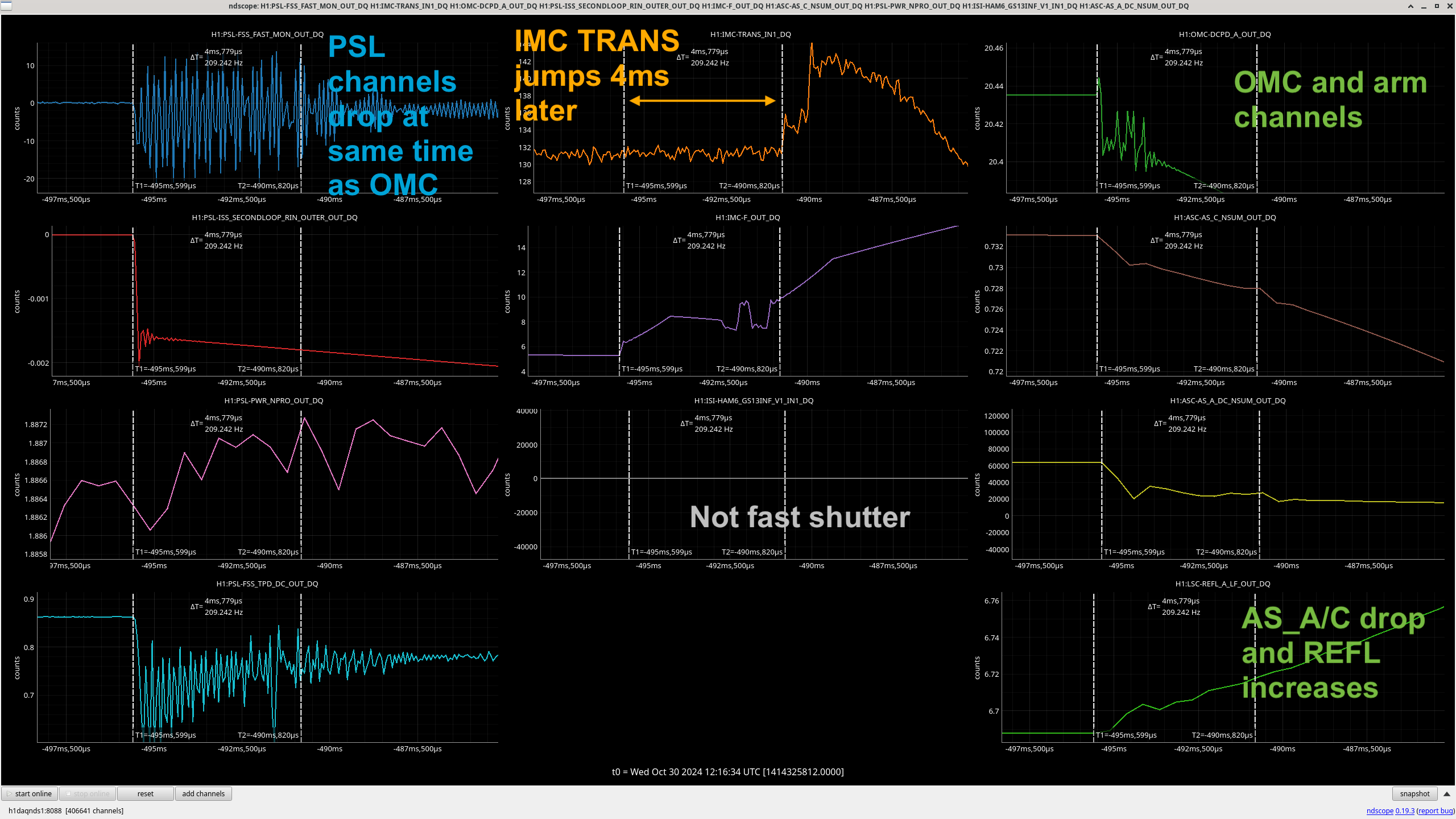
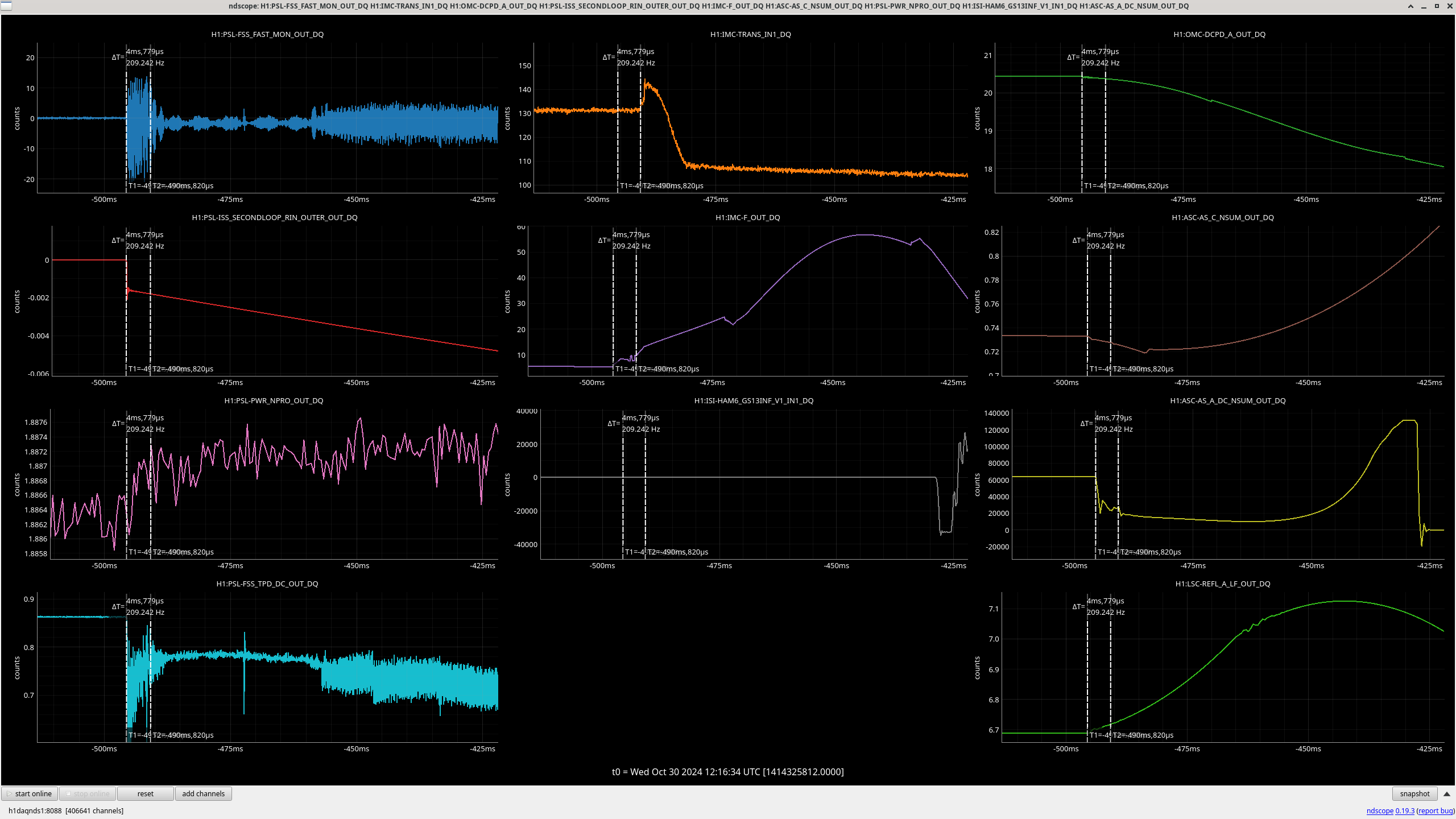
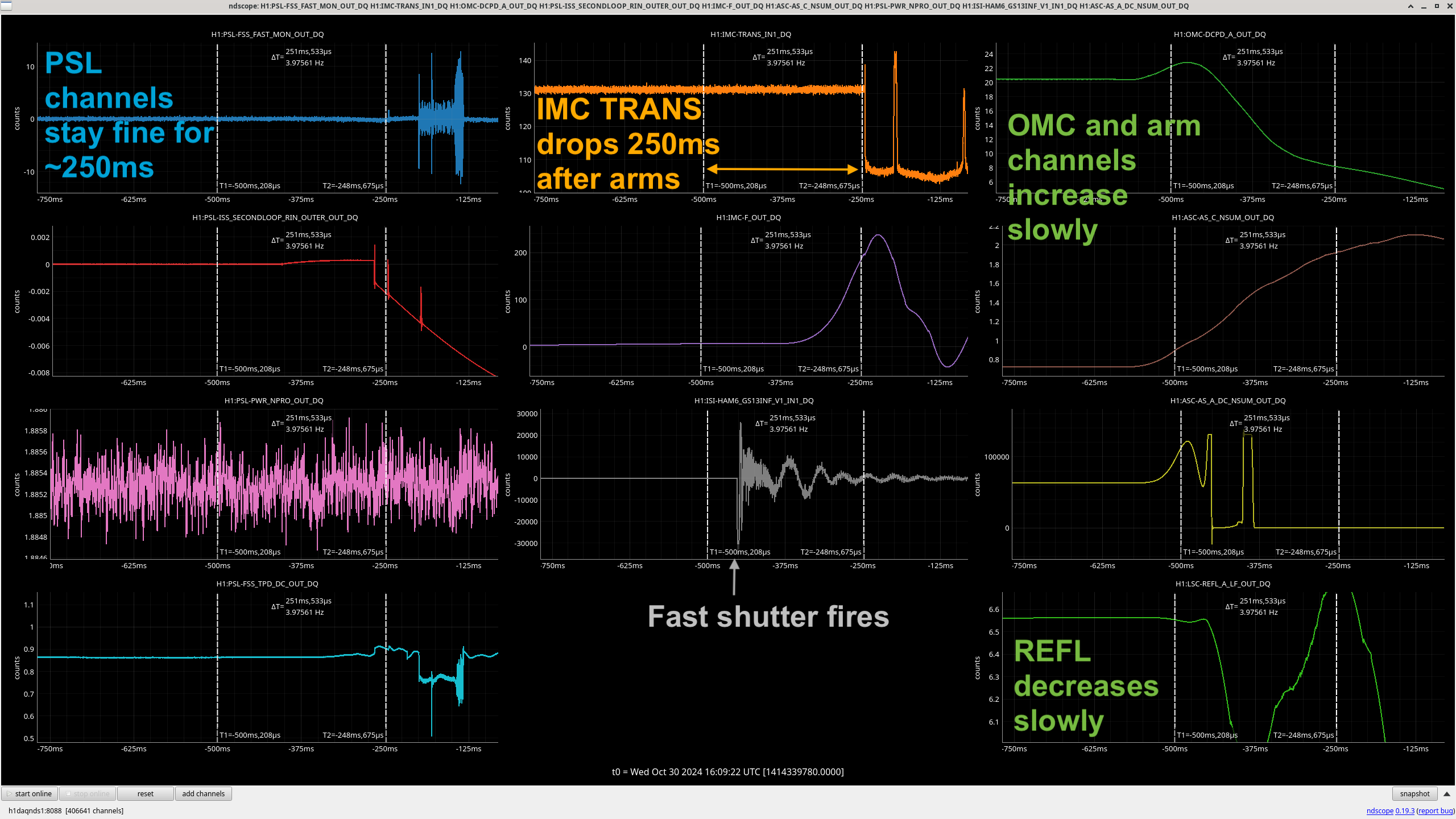
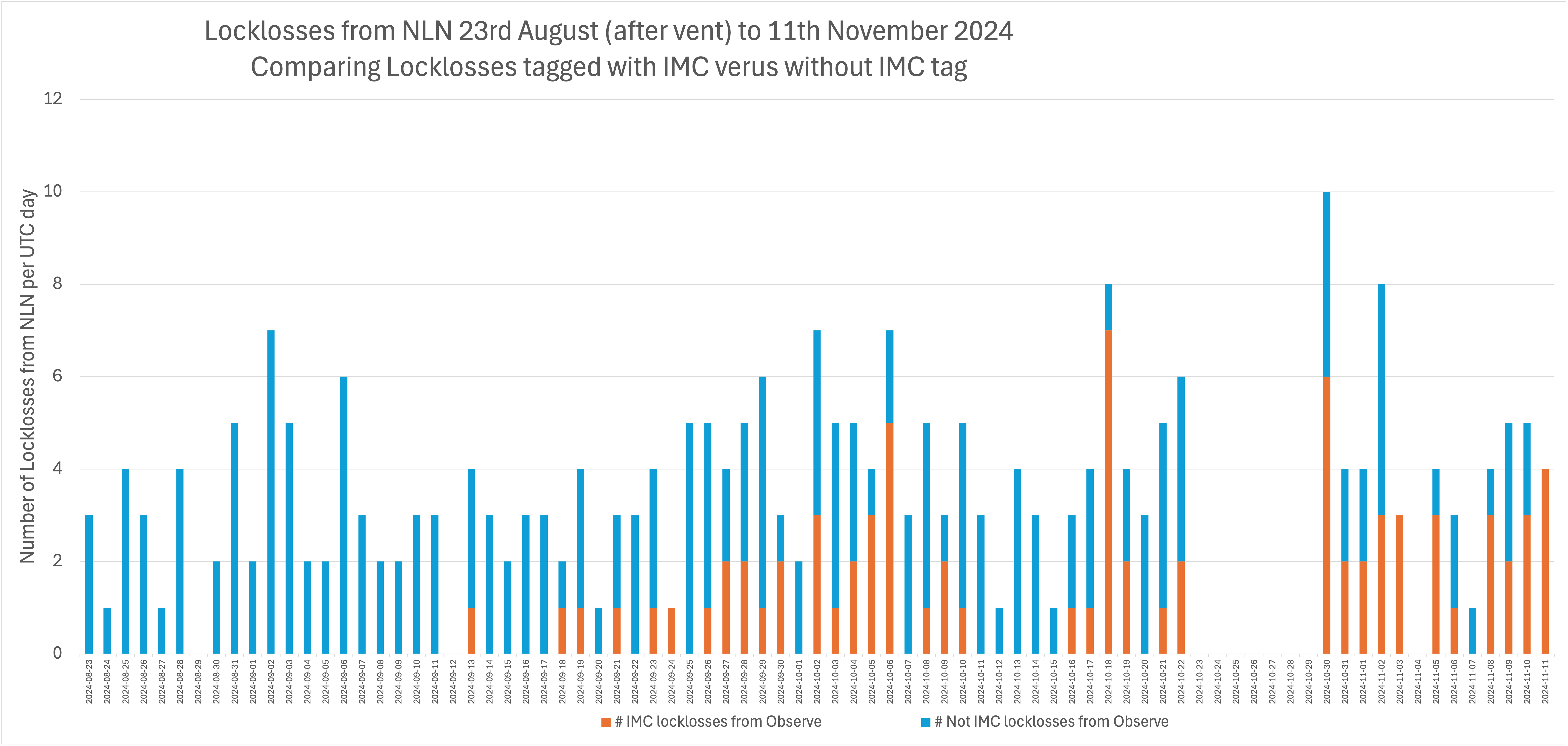
Sheila, Jenne, TJ, Ryan, Keita, Jennie W
Today we had trouble locking from the start of the commissioning period. This seems to have been a problem with OMC locking - see Ryan's log for further details.
We scanned the OMC in single bounce anmd everything seemed to look ok.
We managed to power up but then eventually lost lock after Sheila measured LSC FF and Robert took some photos at viewports.
Alena had suggested a better spot we could be aligned to on the OFI (second column on second last page), so since we have been having locking problems since maintenance on Tuesday we decided to unlock and try this move.
The best spot suggested is so far off that we know we will have to use the HAM6 picomotors to recentre the beam on the AS_A, AS_B and AS_C QPDs.
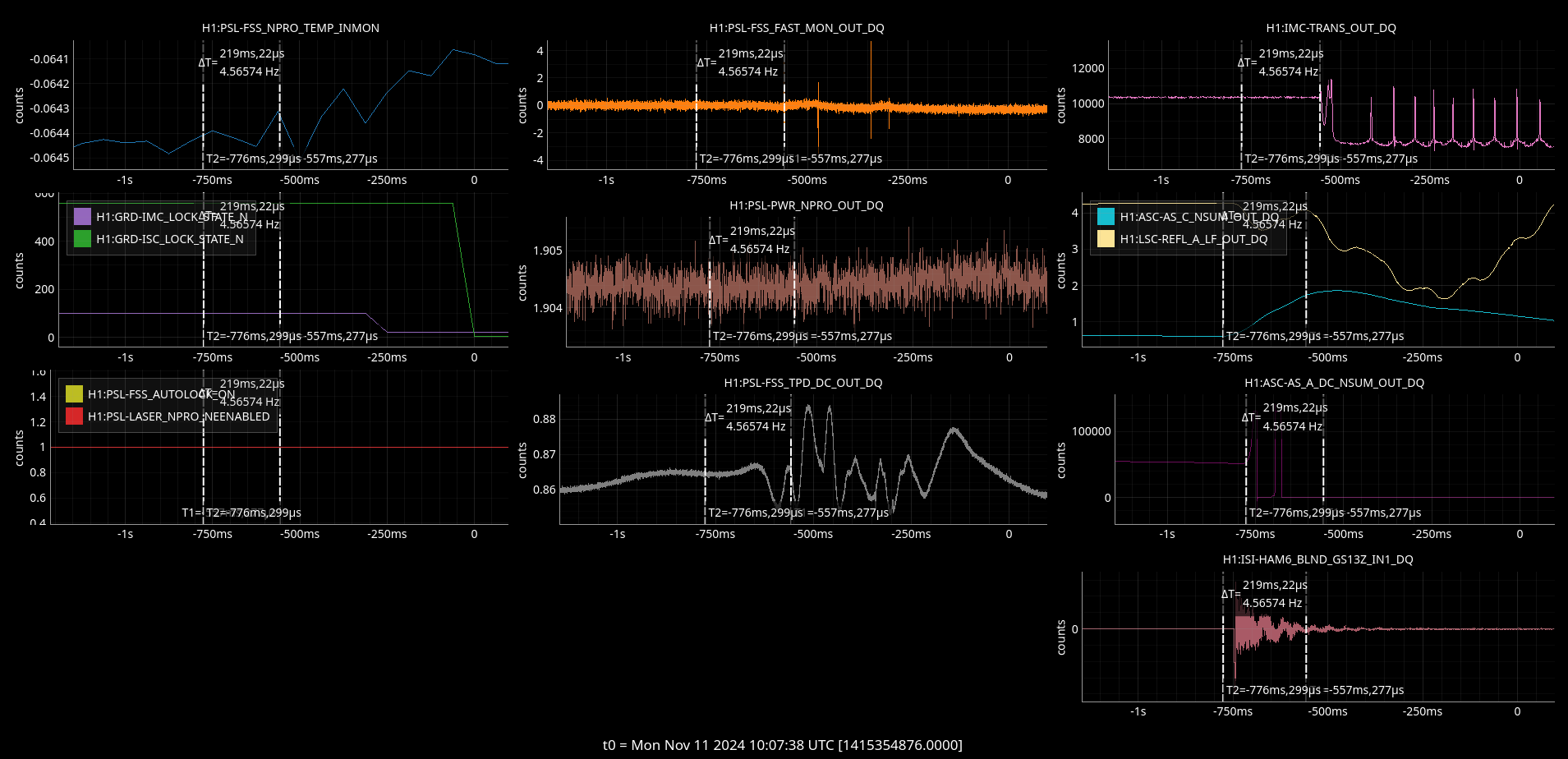
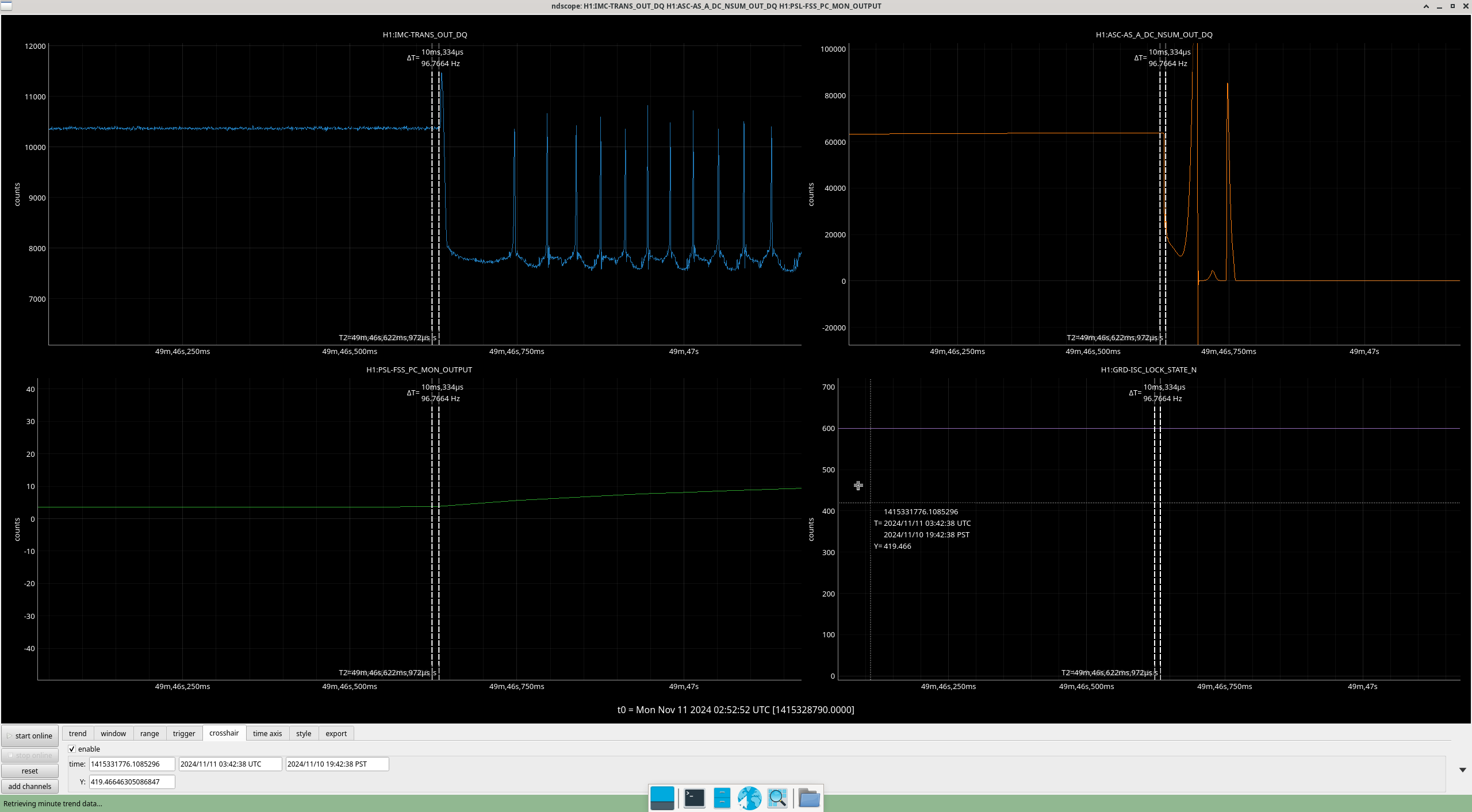
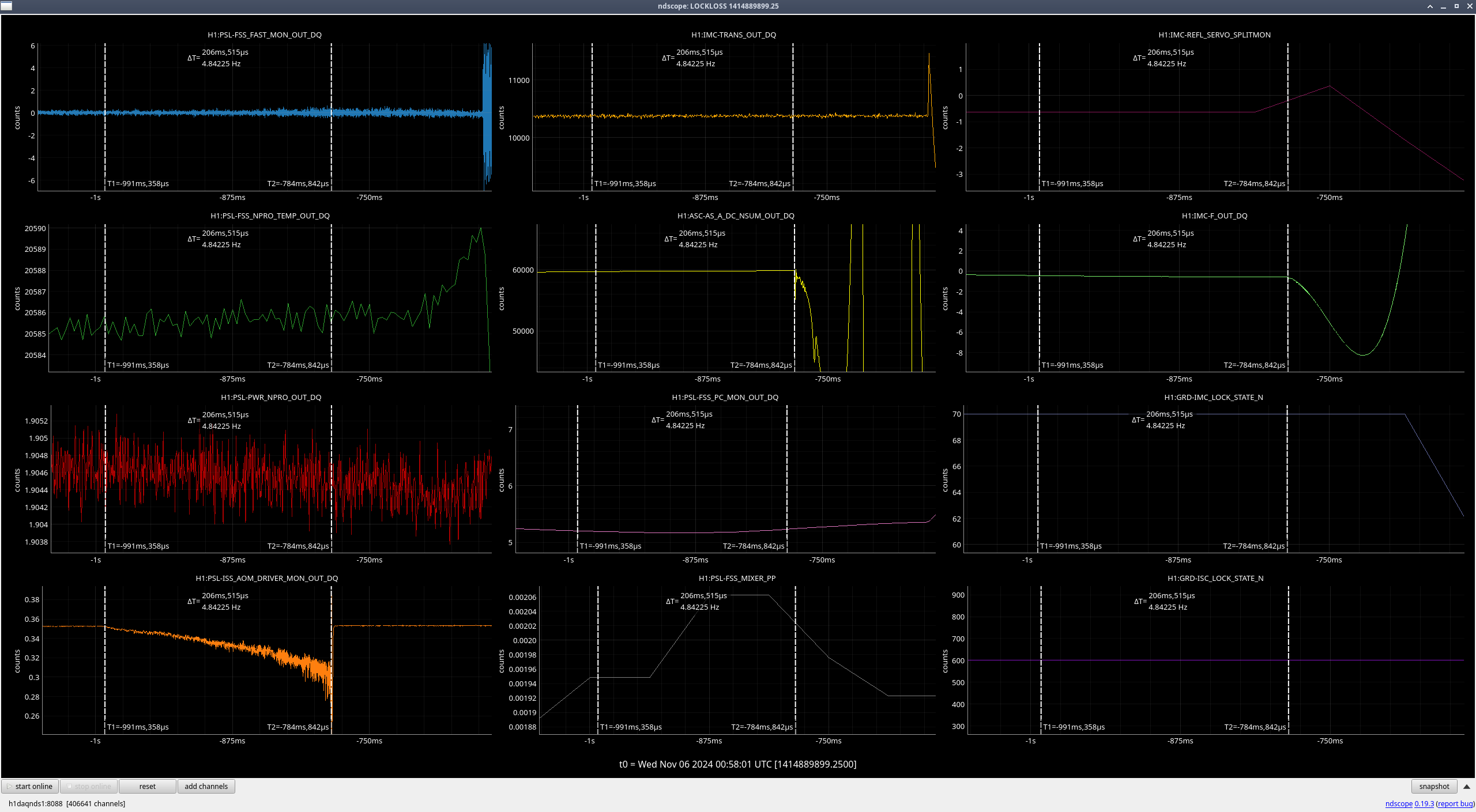
TJ and Jenne slowly brought us to this new spot (between two t cursors in this image) while also using picomotors 2X, 3X, 3Y, 1X to keep us centred on AS_A, AS_B and AS_C. During this time we were also trying to run the DC centering loops on OM1 and 2 to keep us centred on AS_A and AS_B, unfortunately we then ended up in a situation where we were saturating OM1, 2 and 3 and OMC suspensions at different points. Turning off the DC centering loops relieved OM1 and 2.
We couldn't get past PREP_DC_READOUT_TRANSITION.
Before doing this, at 22:50 UTC Sheila and I measured the spot positions on the SRM and SR2 mirrors using the A2L gains.
Sheila tried to releive the OMC and OM3 suspensions using their sliders but eventually we realised that we might have to do a combo of this with more pico-motoring to lock the OMC and power up.
This is shown in this image, however, these efforts eventually unlocked us.
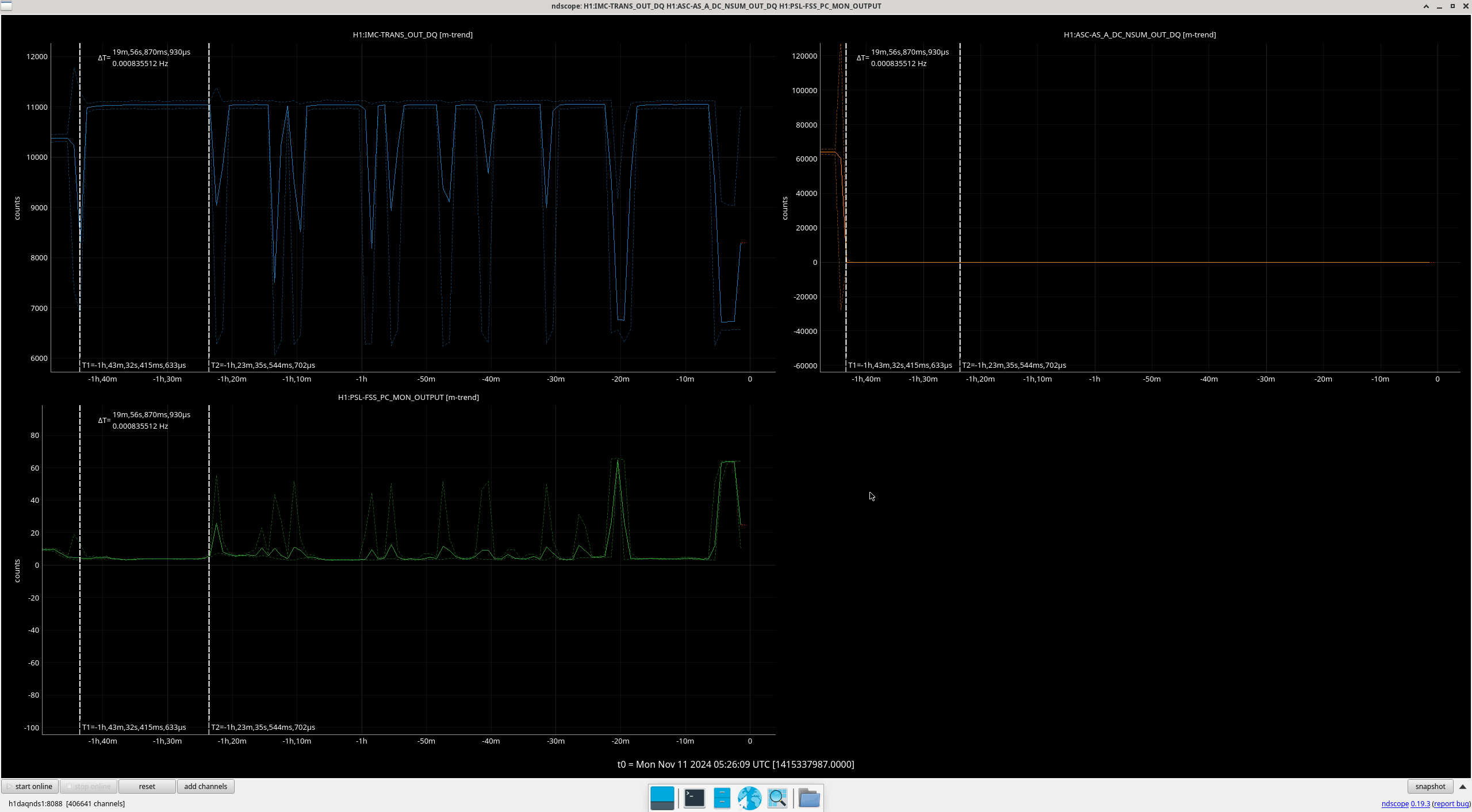
Here is another ndscope showing the full days efforts with the ISC_LOCK guardian state also.
If we decide to stick with this new alignment, we'll need to update the thresholds in SRC align when acquiring SRY so that H1:LSC-SRCL_TRIG_THRESH_ON is something like 0.003 (so, half of its current value of 0.006), and the _OFF is similarly lowered. Maybe not a full half, but some lowering.
Also, we are somewhat concerned about the throughput in this position. AS_C yesterday when centered had an NSUM of about 0.0225, but today when centered is about 0.18. However, when we were doing SR2 single-bounce alignment as part of initial alignment, AS_C was at 0.0218. So, some of the loss of NSUM on AS_C happens when we center on it. This is rather consistent with AS_A and AS_B sums thinking that we still have similar throughput through the OFI today as compared to yesterday.
Also, when we were at PREP_DC_READOUT_TRANSITION, I spent a while with Ibrahim offloading OM3 and OMC by changing the spot position (via picomotor) on the AS WFS. I think Jennie shows this in her second to last plot.
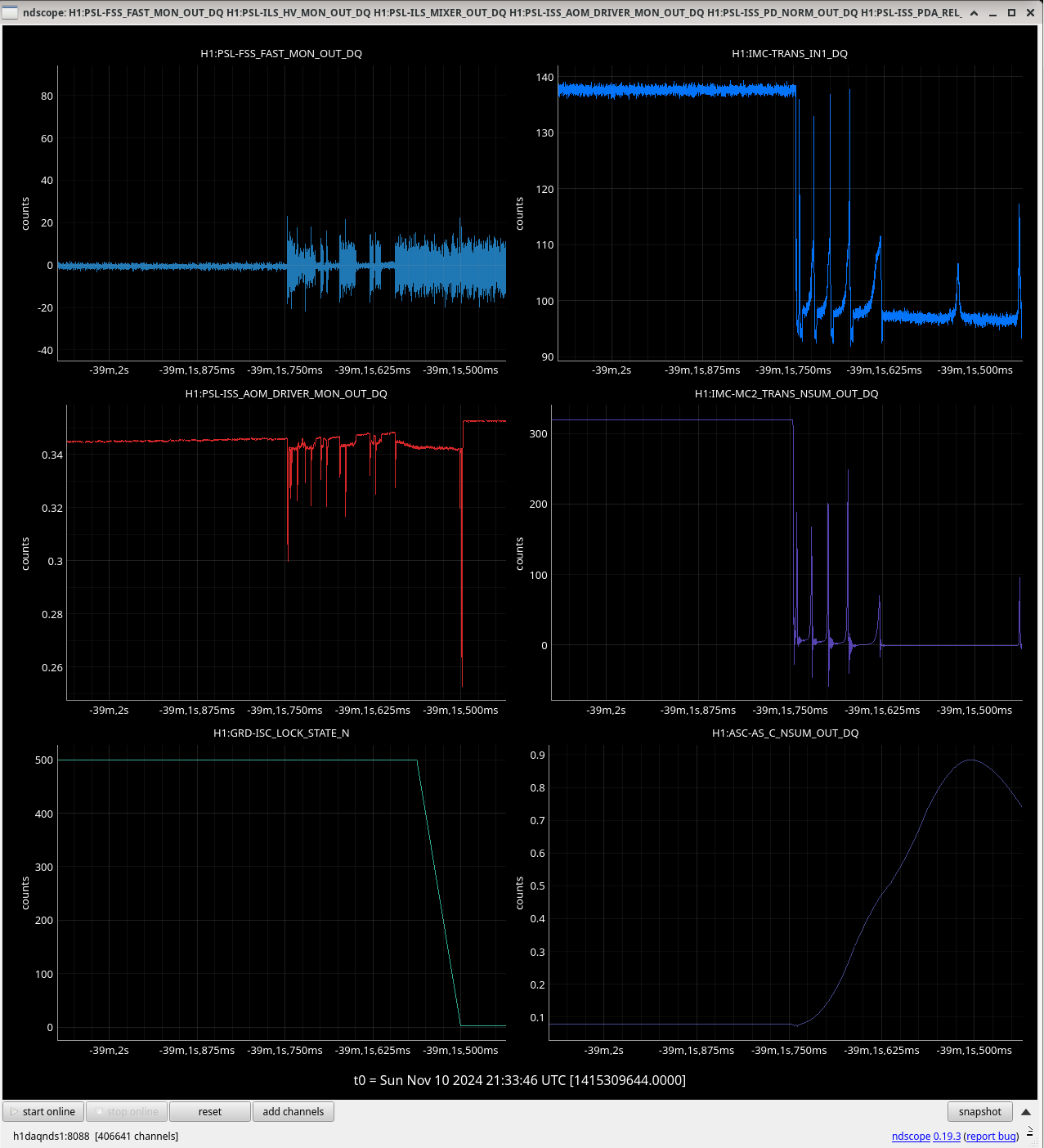
I spent a while moving things to get the OMC QPDs closer to their setpoints. Then, with the OMC ASC loops engaged (with OM3 and OMC not quite saturating), I moved the picomotors in front of AS_A and AS_B to get OM3 and OMC farther from saturation. This part (the offloading, after OMC ASC was on) is shown in the attached image. After I had offloaded OM3 and OMC, I requested OMC_LOCK to lock the OMC, and we were able to go to DC Readout. As Jennie notes, after we got to 10W I was worried that OM2 was going to saturate, so I made one more click on Motor 2 to change the pointing on AS_B, and that caused a lockloss (even though the same clicks at 2W on RF DARM were safe). The last little bumps in the most recent 5 mins of this xaxis are the power up to 10W.
When you make a big alignment change upstream of HAM6 and you find that WFS centering won't work without pico, the only cure is pico-ing, but confirm that the OMC QPDs are OK before locking IFO.
The right sequence is something like this:
Using single bounce beam, enable WFS centering. If nothing rails, turn on the OMC ASC, nothing should rail again, be happy.
If OM1 and/or OM2 rail by WFS centering, eventually you'll have to pico, but don't pico right away. Instead, do the following.
This is pretty much the same as what you do after changing AS path and/or OMC in HAM6. By working on AS path alignment before locking IFO, you don't have to worry about IFO lockloss by upsetting ASC-AS_A, kicking HAM6 electronics by HV pulses sent to picos and/or making huge vibration in HAM6.
When manually aligning the beam into OMC using OM1 and OM3 (or OM1 and OM2, or combination of OM1, 2 and 3), it's convenient to remember that ASC-OMC_A is far field and OMC_B is near. It seems that that's the case as of now.
You always want to use the mirror closer to the OMC (like OM3) to center the far QPD (OMC_A) and the far mirror (like OM1) to center the closer QPD. Iterate this and things converge.
Even when you only see the beam on one QPD, you can use the above rule. For example, if your beam is on OMC_B but not on OMC_A, you will scan OM3 by a large amplitude to find the bean on OMC_A. It doesn't matter if you lose the beam on OMC_B at this point, next thing to do is to scan OM1 to regain the beam on OMC_B. Iterate and you'll find the beam on both of the QPDs at some point.
Andrei, Naoki, Sheila
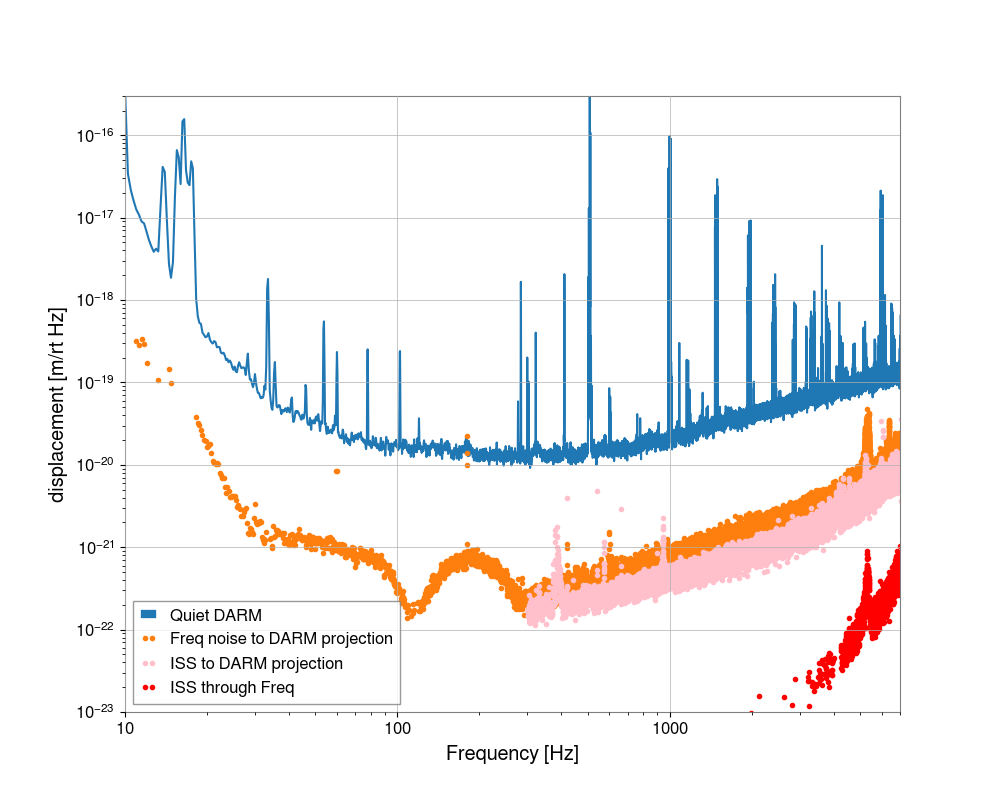
Following the research of aLOG 78125 and aLOG 78262, we aimed to quantify the value of backscattering from the ZM2 and ZM5. We performed backscattering measurements under the assumption that modulation of the optical path between scatterer and interferometer would introduce additional noise in the DCPD spectrum [1-4].
We used data from the H1:OMC-DCPD_SUM_OUT_DQ channel (calibrated to mA of photocurrent) for the times of aLOG 78125. We've then calculated RIN with correction for the DARM control loop. Using Eq. 25 from [1], we performed manual fit. Although we couldn’t perfectly fit within the range from 15 Hz to 21 Hz (probably because of the chosen Welch's transform parameters), we were still able to obtain meaningful results for the backscattering coefficients (see Fig. Backscattering_meas.png). The resulting coefficients are below:
rZM5 ≈ 4 x 10⁻⁴
rZM2 ≈ 0.1 x 10⁻⁴
Also note, that the amplitude of the excitation used for fit is several times larger than that we've measured from the H1:SUS-ZM#_M1_DAMP_L_INMON channel (1.2 μm unstead of 0.4 μm).
Code that was used for this calculation is attached to this report. OM1_fringewrapping_test.m (Sheila's code) was used to calculate RIN, main.nb was used for manual fit and plotting.
[1] Martynov, D. V., Hall, E. D., Abbott, B. P., Abbott, R., Abbott, T. D., Adams, C., ... & McIver, J. (2016). The sensitivity of the Advanced LIGO detectors at the beginning of gravitational wave astronomy. Physical Review D, 93(11), 112004.
[2] Ottaway, D. J., Fritschel, P., & Waldman, S. J. (2012). Impact of upconverted scattered light on advanced interferometric gravitational wave detectors. Optics express, 20(8), 8329-8336.
[3] Nguyen, P., Schofield, R. M. S., Effler, A., Austin, C., Adya, V., Ball, M., ... & Moreno, G. (2021). Environmental noise in advanced LIGO detectors. Classical and Quantum Gravity, 38(14), 145001.
[4] Fricke, T. T. (2011). Homodyne detection for laser-interferometric gravitational wave detectors. Louisiana State University and Agricultural & Mechanical College.
Camilla, Elenna, Sheila
We wanted to compare this to the design requirement for the filter cavity, table 1 on page 11 T1800447. We are operating with about 47mW of carrier going to the AS port, and the r's above should be amplitude reflectivities. So, this means that we should have 47mw *(1e-5)^2 = 5 pW. This is a factor of 10 less than the assumption in the document.
On Tuesday, I tried running the HAM7 high voltage CPS electronics again. This time I was able to get all 6 sensors to the noise floor I expected. I replace another ethernet cable and one of the in-air triax cables, and I had to use one of the test cards the RichM used at MIT to get there though. After that I was able to turn the isolation loops on let the ISI run for a while when we were trying to lock. My initial measurement looked like the low frequency isolation was pretty bad, so I reverted to the old electronics that afternoon.
Attached first 3 images compare the performance with the high voltage cps (refs) and the nominal cps (live traces). The high frequency performance is not really any better, and in RX and Y the below .3hz performance seems much worse. Z seems to be worse pretty much everywhere below 10hz. Maybe one of these sensors has a funny calibration or something? I will probably try again next week and see if I can measure that with some ISI tfs.
Fourth image is calibrated spectra for each individual hv cps. The H1 still had a high noise floor for this test. Another thing to try to fix next time.
Robert noticed that we have been set to the incorrect R0 offsets for ITMY for the last 36 days. I've saved what they should be in SDF so they will not be reverted.
TITLE: 06/06 Day Shift: 1430-2330 UTC (0730-1630 PST), all times posted in UTC
STATE of H1: Commissioning
INCOMING OPERATOR: Ibrahim
SHIFT SUMMARY: Since my midshift report (alog78281), efforts have been focused on trying to find optimal alignment into the OMC with this new spot position in the OFI. Work on this is ongoing, with the current plan being to use picomotors to adjust the pointing onto PDs in HAM6 to then give more range with OM mirrors to direct light into the OMC.
LOG:
| Start Time | System | Name | Location | Lazer_Haz | Task | Time End |
|---|---|---|---|---|---|---|
| 21:03 | SAF | HAZARD | LVEA | YES | LVEA is Laser HAZARD | Ongoing |
| 14:40 | FAC | Tyler, Eric | EY | N | Picking up cooler | 15:40 |
| 15:14 | FAC | Karen | Opt Lab | N | Technical cleaning | 15:37 |
| 15:42 | PEM | Robert | LVEA | - | Taking viewport pictures | 17:03 |
| 16:40 | FAC | Kim | H2 | N | Technical cleaning | 16:51 |
| 17:00 | SQZ | Terry | Opt Lab | Local | SHG work | 19:36 |
| 17:08 | ISC | Sheila, TJ, Jennie | CR | N | OFI spot move | 20:08 |
| 17:36 | PEM | Robert | LVEA | - | Turning on shaker amp | 18:26 |
| 20:49 | CAL | Jeff | CER | N | Checking electronics | 20:51 |
| 21:26 | SQZ | Terry, Kar Meng | Opt Lab | Local | SHG work | Ongoing |
| 23:12 | CAL | Francisco | PCal Lab | N | Measurements | Ongoing |
Jennie W, Sheila
After our picoing efforts, at 22:50 UTC today Sheila and I measured the A2L gains of the SRM and SR2.
Sheila notched 31 Hz out of the SRCL control loop and I injected a line at this frequency first at SUS-SRM_M3_LOCK_P_EXC, then SUS-SRM_M3_LOCK_Y_EXC.
Sheila changed the A2L gains for the corresponding degree of freedom so that the line height was minimised in SRCL_IN1 and in DARM using the channels H1:SUS-SRM_M3_DRIVEALIGN_P2L_GAIN and H1:SUS-SRM_M3_DRIVEALIGN_Y2L_GAIN.
SRM spot position:
P2L -1 with precision of 1
Y2L 6 with a precision of 0.5
(not too sure of the precisions as I lost my alog halfway through (d'oh).
We then did the same thing for SR2 by injecting in the M3_LOCK P and Y channels and changing the DRIVE ALIGN gains for SR2.
SR2 spot position was
Y2L 1.5 with precisioon of 0.25
P2L is 8 with precision of 1
The templates for these measurements are in: /ligo/home/jennifer.wright/Templates/Measure_spot_size_SR2.xml and Measure_spot_size_SRM.xml
Sheila and Keita have recently found and fixed sign convention errors. Please see alog 78393 for the corrected interpretation of A2L gains to inferred spot positions.
At the request of Alena, here's a table of M1 OSEM P and Y INMON for the output optics right after A2L measurements (starting ~2024/Jun/06 23:10:00 UTC):
| XXX=PIT | XXX=YAW | |
| H1:SUS-SR3_M1_DAMP_XXX_INMON | -171 | -600 |
| H1:SUS-SR2_M1_DAMP_XXX_INMON | -25.9 | +55.3 |
| H1:SUS-SRM_M1_DAMP_XXX_INMON | -280 | -474 |
TITLE: 06/06 Eve Shift: 2300-0800 UTC (1600-0100 PST), all times posted in UTC
STATE of H1: Commissioning
OUTGOING OPERATOR: Ryan S
CURRENT ENVIRONMENT:
SEI_ENV state: CALM
Wind: 13mph Gusts, 10mph 5min avg
Primary useism: 0.03 μm/s
Secondary useism: 0.22 μm/s
QUICK SUMMARY:
IFO is at PREP_DC_READOUT_TRANSITION and is staying there for comissioning.
Comissioners are testing out alignment configurations with respect to the OFI spot trials
At the start of commissioning today, before we got to NLN and were having trouble locking the OMC, I took an OMC mode scan when we were locked at 10W.
We manually move the OMC_PZT2_OFFSET to its lowest slider value then run the template which does two 100s ramps of this PZT.
Posting for posterity.
Time of Scan = 15:23:43 UTC
200s length. See template in /ligo/home/jennifer.wright/Documents/OMC_scan/2024_06_06_OMC_Scan_15-23UTC.xml
Analysed mode scan and C02 mode for this full-lock scan but since we have mainly been doing single bounce to look at losses and all the sidebands were on, just posting it here for posterity. The mode-matching calculation has to take into account all the sidebands I think.
Analysis code is In OMCscan_nosidebands13.py and fit_two_peaks_no_sidebands13.py in /gitcommon/labutils/omc_scan/figures/2024-06-06 on the /dev branch (ie. it will not be on the workstation branch as this is the master branch).
Today has so far been busy with commissioning time, mostly in the effort of moving to a new spot on the OFI. We were able to get locked to NLN this morning after diagnosing the OMC locking issue (see alog78275), then after some commissioning tests, we purposefully unlocked the IFO to start the process of moving the OFI spot in single-bounce configuration.
As of about 20 minutes ago, we've successfully completed an initial alignment after finding the new spot (where SRM needed to move a LOT) and are locking, no issues so far up to ENGAGE_ASC.
FAMIS25994
I didn't notice any higher frequency noise that was appreciably elevated.
Jenne D, Jennie W
Jenne noticed that our AS_A_YAW offset was on in the current state (PREP_FOR_LOCKING). We don't want this offset on currently as we are moving to a different spot on the OFI for which we need the picomotors, therefore we my need to rethink AS_A and B alignment offsets.
We turned this offset and the other AS_A and AS_B oiffsets off.
This is the only one I could find set in the ISC_LOCK guardian so I commented this line out.
elif self.counter==9 and self.timer['LoopShapeRamp']:
#ezca['ASC-AS_A_DC_YAW_OFFSET'] = -0.15 J Wright commented this out on 6th June 2024.
ezca.switch('ASC-AS_A_DC_YAW', 'OFFSET', 'ON')
I reloaded the ISC_LOCK guardian.
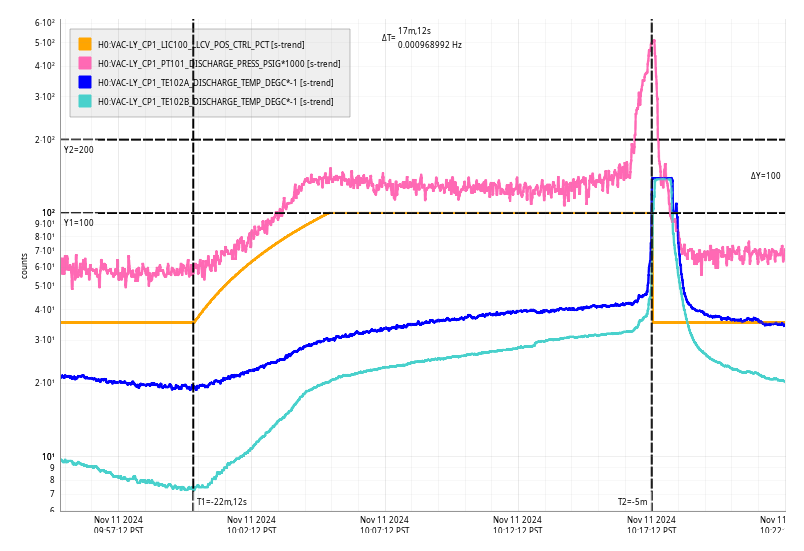
Thu Jun 06 10:09:03 2024 INFO: Fill completed in 9min 0secs
Gerardo confirmed a good fill curbside.
P. Baxi , J. Kissel
Finished characterizing (Channels 1 to 4) of the new 524KHz Analog OMC Anti-Alias Chassis - S2300162
BodePlot_Channel_1_4_freq_start_102.4KHz_Freq_stop_1KHz_Steps_100.pdf (raw data - available in DCC S2300162)
- We see the frequency response has minimal phase impact in the gravitational wave band, with deg of phase loss at 1000 Hz.
ASD_SR785_Channel_1_4_Freq_span_4to32K_32to256K_128to1024K.pdf (raw data - available in DCC S2300162)
- We see the noise of each of these 4 representative ADC channels is around ~20 nV/rtHz
Bode plot and ASD plots) Bode plot and ASD plots)
For the bode: We see the frequency response has minimal phase impact in the gravitational wave band, with 1.5 deg of phase loss at 1000 Hz.
TITLE: 06/06 Day Shift: 1430-2330 UTC (0730-1630 PST), all times posted in UTC
STATE of H1: Lock Acquisition
OUTGOING OPERATOR: TJ
CURRENT ENVIRONMENT:
SEI_ENV state: CALM
Wind: 5mph Gusts, 4mph 5min avg
Primary useism: 0.02 μm/s
Secondary useism: 0.26 μm/s
QUICK SUMMARY: H1 has been unlocked since 10:21 UTC this morning. It's been able to relock up to PREP_DC_READOUT_TRANSITION, but the OMC is not locked; OMC_LOCK is stuck in the SET_WHITENING state with a notification reading "DCPD gains not equal after whitening switch -- yikes!" (I've not seen this before; will start troubleshooting)
Looking into why the OMC couldn't lock this morning, it seems to me like the sequence of events went as follows (all times in UTC):
H1 sat in this position for several hours (owl operator wasn't notified, separate issue) until Sheila manually set the DCPD gains to what they should be (1), then the OMC was able to lock without issue and the IFO followed suit.
I believe this interaction happened because now that the DARM_OFFSET state has been moved to after all the ASC states, the OMC doesn't have as long to lock before we reach PREP_DC_READOUT_TRANSITION, and the OMC_LOCK DOWN state request happened in a bad spot. If we want to keep DARM_OFFSET where it is, we might want to change ISC_LOCK to give OMC_LOCK more time to lock the OMC before having it try again.
Ibrahim, Ryan S, Jenne, Sheila, TJ
TITLE: 06/06 Eve Shift: 2300-0800 UTC (1600-0100 PST), all times posted in UTC
STATE of H1: Observing at 146Mpc
INCOMING OPERATOR: TJ
SHIFT SUMMARY:
IFO is in NLN and OBSERVING (after a 24 hour outage) as of 07:59 UTC (cutting it real close H1...)
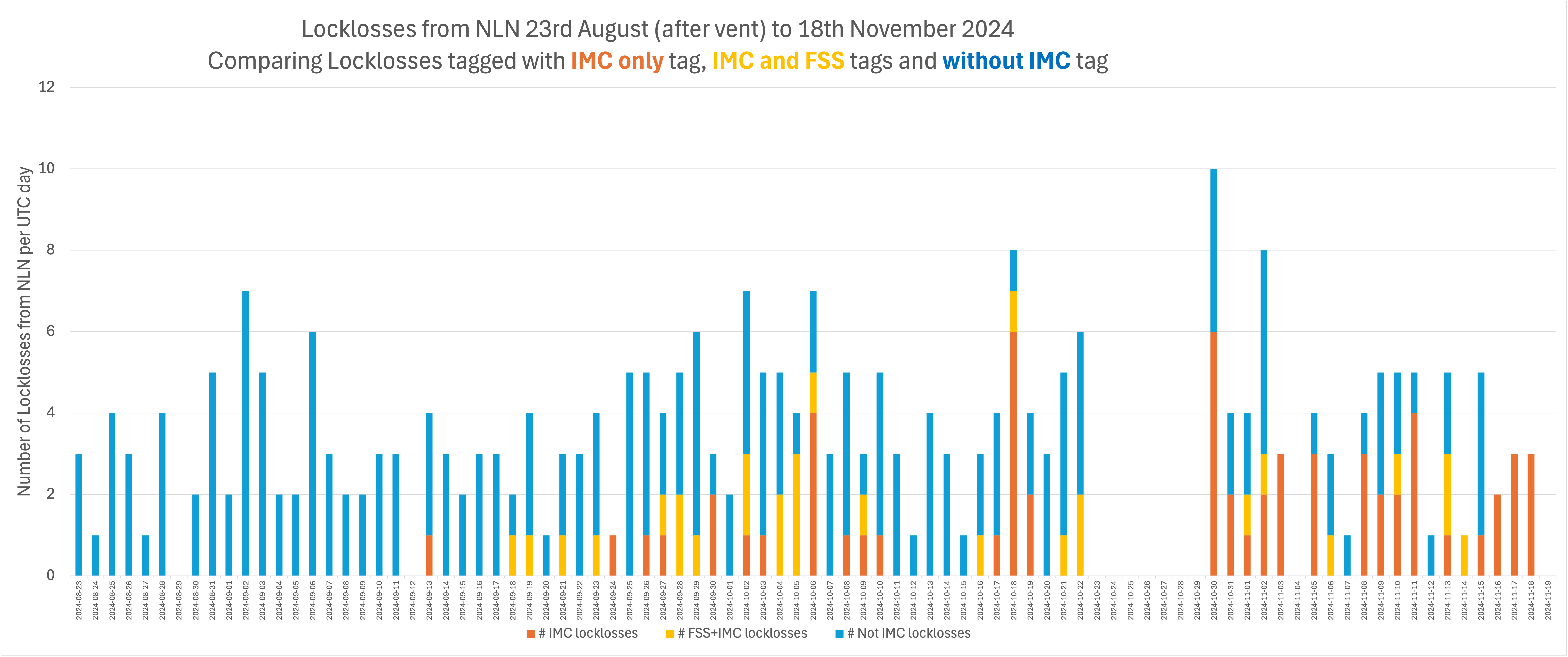
For the majority of the shift, I was unable to lock - here’s why:
On top of these, we have also had a few totally spontaneous lock losses which do not have tracks as egregious as the three above. Moreover, running INITIAL_ALIGNMENT seems to randomize what issue I face in that I either will be acquainted with a totally new problem or face no problems.
SDF Diffs Attached (All Seismic Related)
LOG:
None
IFO is still LOCKING (I know)
While violins were damping to turn on whitening (pretty steadily too), we lost lock unexpectedly. DRMI could not lock - PRMI could not lock and MICH Fringes could not lock PRMI. So now I'm doing an initial alignment.
Jennie W, Jenne D, Sheila
The other day I designed a new notch to get rid of a bump we had been seeing at 17.75Hz. We think this is the bounce mode of the BS coupling into the MICH loop. The notch for this in LSC-MICH has not been updated since the BRDs were installed I think, and there is no notch for this mode in the ASC-MICH_P and ASC_MICH_Y loops.
Changes made to ISC_DRMI.py
Added Bounce-roll notch (FM8) to MICH2 (line 457) in DRMI_LOCKED state and took out line turning on notch at 15Hz (line 456).
#ezca.get_LIGOFilter('LSC-MICH2').switch_on('FM10') # Turn on the BounceRoll FM10 in LSC FM
ezca.get_LIGOFilter('LSC-MICH2').switch_on('FM8') # Turn on the BounceRoll FM8 in LSC FM 05/06/2024 J Wright
Added bounce-roll notch to PREP_PRMI_ASC in FM MICH_P and MICH_Y in FM9. These were added to lines 690 and 692.
zca.get_LIGOFilter('ASC-MICH_P').only_on('INPUT','FM3','FM9','FM10','OUTPUT', 'DECIMATION') #SED increased gain by 20db (removing FM1) Oct 28 2019. added in BR for damped mode at 17Hz 05/06/2024 J Wrightezca.get_LIGOFilter('ASC-MICH_Y').only_on('INPUT','FM3','FM4','FM7','FM9','FM10','OUTPUT', 'DECIMATION')#change LP from LP6 to ELP15 SED DDB March 17 2019, added in BR for damped mode at 17Hz 05/06/2024 J WrightAdded these same filters in PREP_DRMI_ASC state in FM MICH_P and MICH_Y in FM9 in lines 920 and 922.
ezca.get_LIGOFilter('ASC-MICH_P').only_on('INPUT', 'FM1','FM3','FM9','FM10','OUTPUT', 'DECIMATION')# added in tuned BR for 17Hz mode J Wright 05/06/2024.ezca.get_LIGOFilter('ASC-MICH_Y').only_on('INPUT', 'FM1','FM3','FM4','FM7','FM9','FM10','OUTPUT', 'DECIMATION')#change LP from LP6 to ELP15 SED DDB March 17 2019, added in tuned BR for 17Hz mode J Wright 05/06/2024.Just undid these changes in case they prevent us locking DRMI as we keep falling put from ENGAGE DRMI ASC in ISC_LOCK guardian.
I turned these filters on when we got to NLN at the start of today's commissioning period. Since they didn't unlock us and seem to possibly make the noise at 17.7Hz better in DARM I have put them back in ISC_DRMI as detailed above and reloaded it. I will post a high resolution spectra next time we get a good lock stetch.
With the difficulties locking, I tried changing some of the CPS diff filters to get the end station ISI to follow the corner ISI. The CPS diff uses a band pass filter to reduce the differential motion between the ISI, but this filter can inject motion at the microseism. Microseism is low, I'm guessing the arms are struggling more with the below .1hz motion. In the attached image the filters we had been using, are the red trace, blue is what I switched to. It kind of seemed to help, but I think we lost lock after I left the room. I'll leave this running for now, going to try a couple other things.
These changes were reverted today, in case they were causing issues with locking. ASC was engaged at the time, I didn't see any effect reverting to the old configuration, so I think they were probably benign.