TITLE: 05/03 Eve Shift: 23:00-07:00 UTC (16:00-00:00 PST), all times posted in UTC
STATE of H1: Observing at 155Mpc
OUTGOING OPERATOR: Tony
CURRENT ENVIRONMENT:
SEI_ENV state: CALM
Wind: 14mph Gusts, 10mph 5min avg
Primary useism: 0.04 μm/s
Secondary useism: 0.08 μm/s
QUICK SUMMARY:
IFO is in NLN and OBSERVING (18hr 45 min lock)
Nothing else of note
[Anamaria, Tony, Jenne]
Anamaria has updated the L1 trace in our DARM FOM, so we can more easily see the difference between the sites. Tony made sure it's on the front wall TV via the launcher.
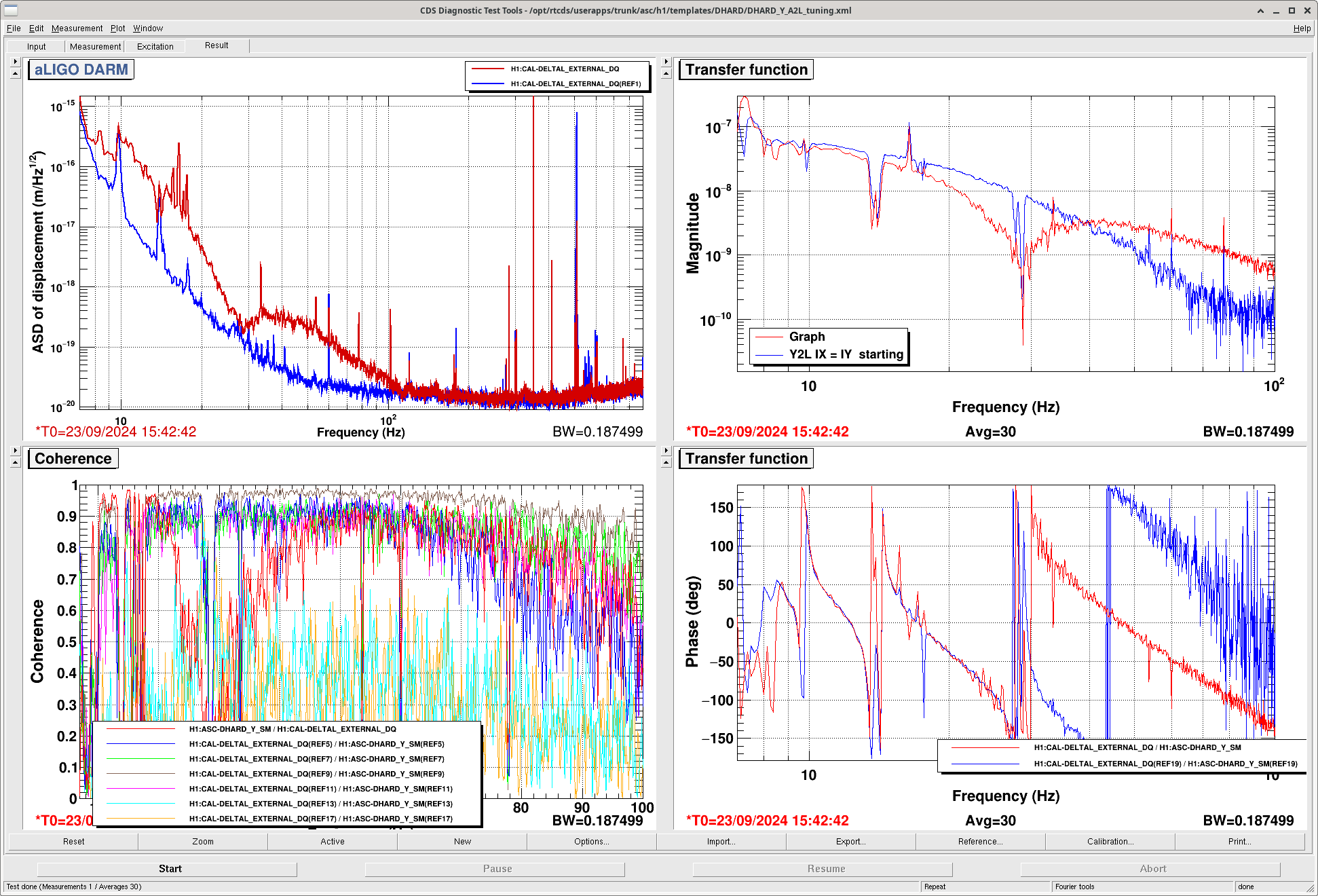
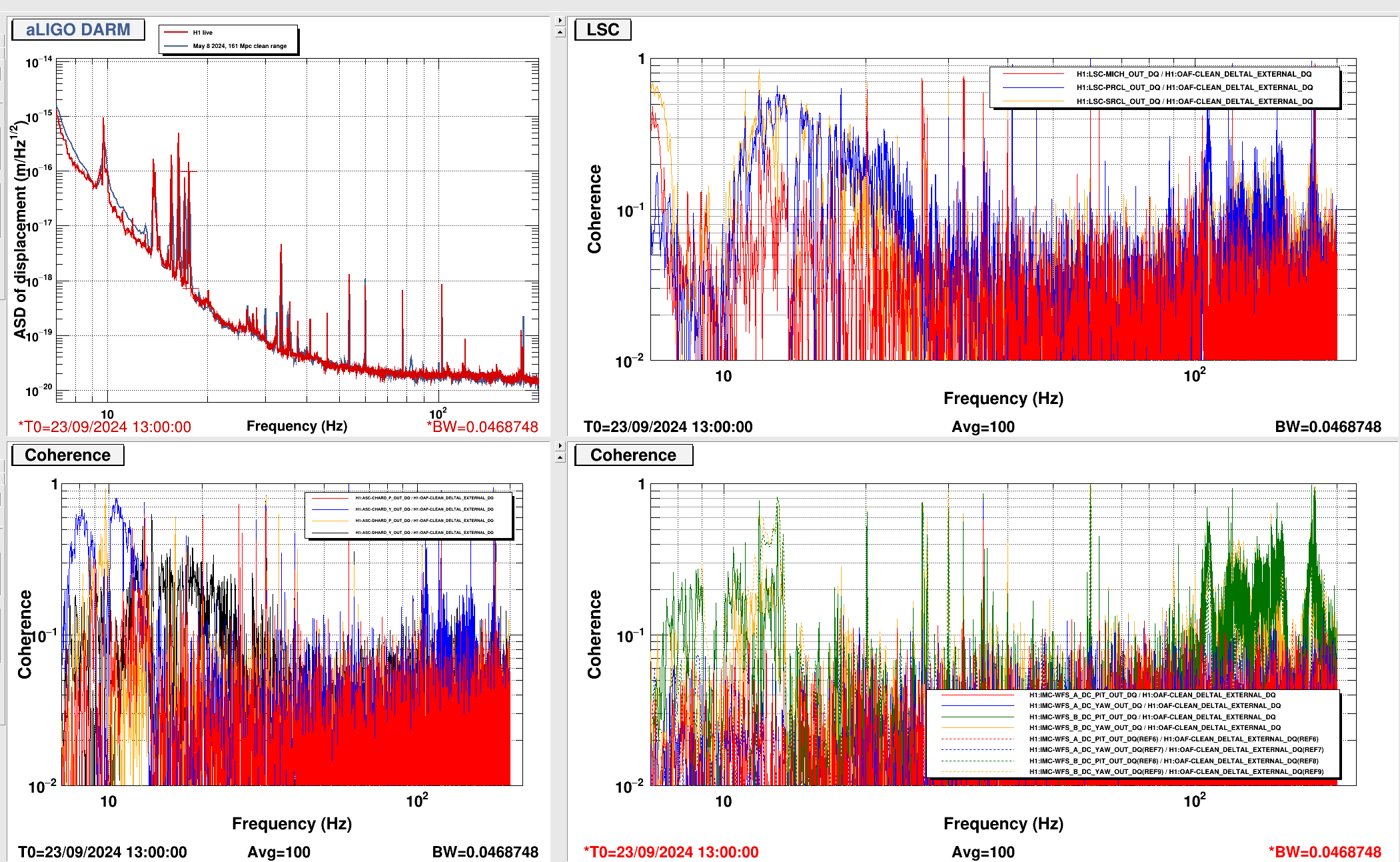
Attached is a comparison of the DARM spectrum of our good time April 11th (164 Mpc), compared to now that we have mostly recovered from our OFI incident (161Mpc). Our sensitivity below 25Hz is slightly better than before, and above 1kHz the squeezing is a bit worse.
There is a bruco running which will appear here soon: https://ldas-jobs.ligo.caltech.edu/~sheila.dwyer/brucos/CLEAN_1398770931/
TITLE: 05/03 Day Shift: 15:00-23:00 UTC (08:00-16:00 PST), all times posted in UTC
STATE of H1: Observing at 156Mpc
CURRENT ENVIRONMENT:
SEI_ENV state: CALM
Wind: 10mph Gusts, 7mph 5min avg
Primary useism: 0.04 μm/s
Secondary useism: 0.09 μm/s
QUICK SUMMARY:
H1's current lock has just hit 17 hours of Observing.
Wind speed is ramping up.
No plans to drop out of Observing.
Robert, Anamaria
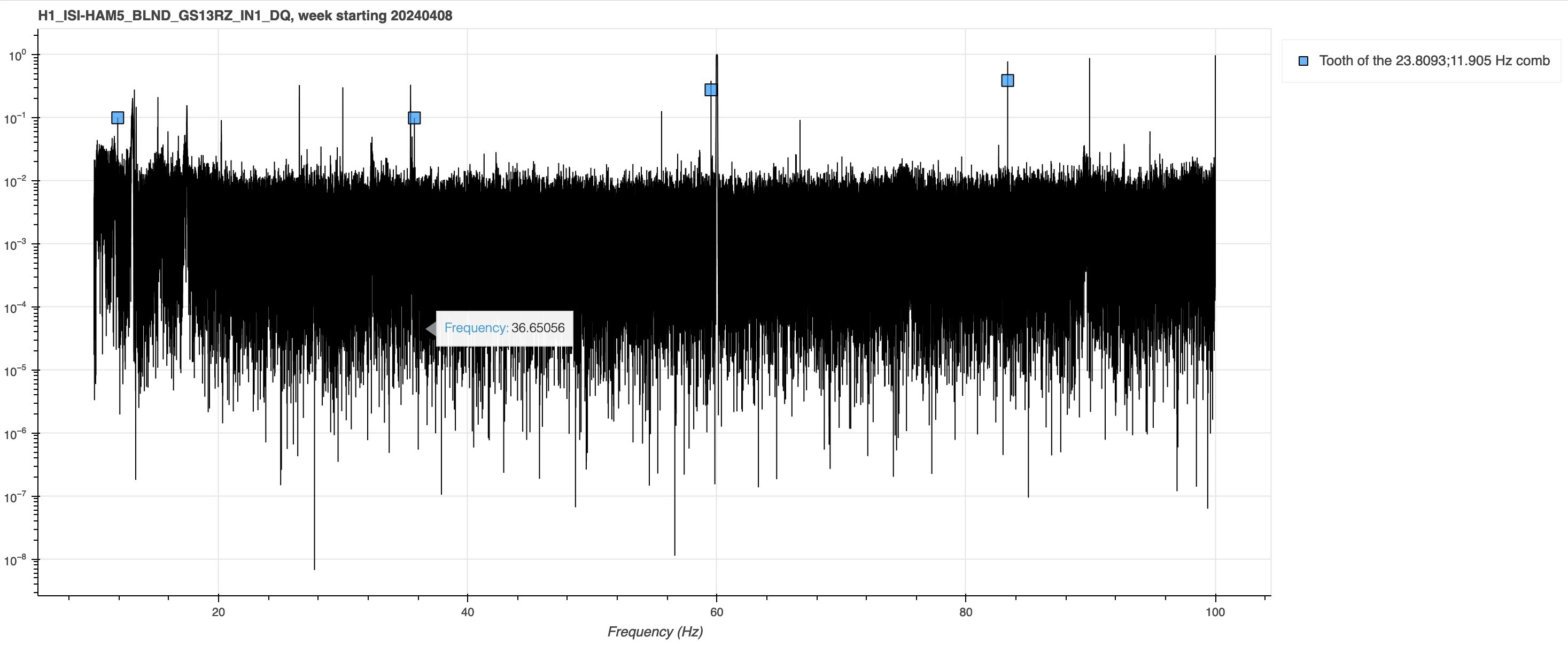
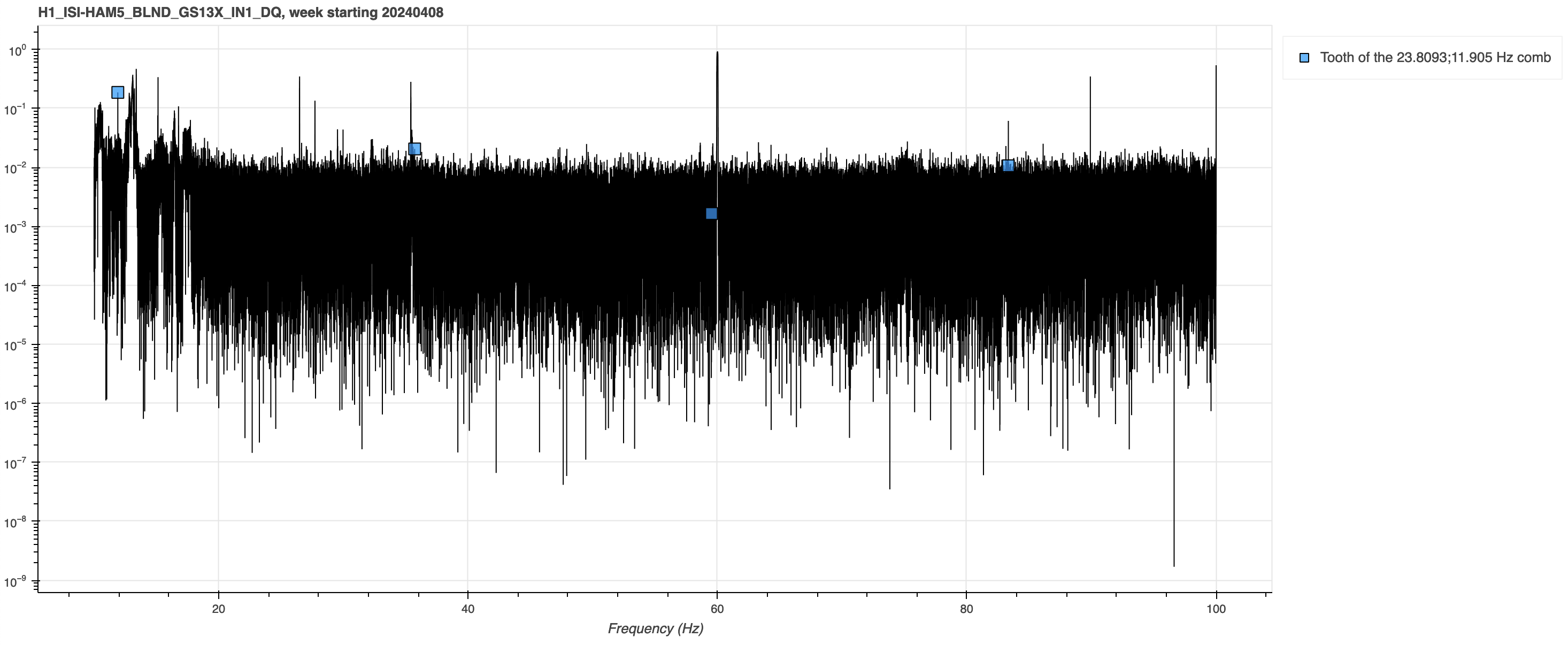
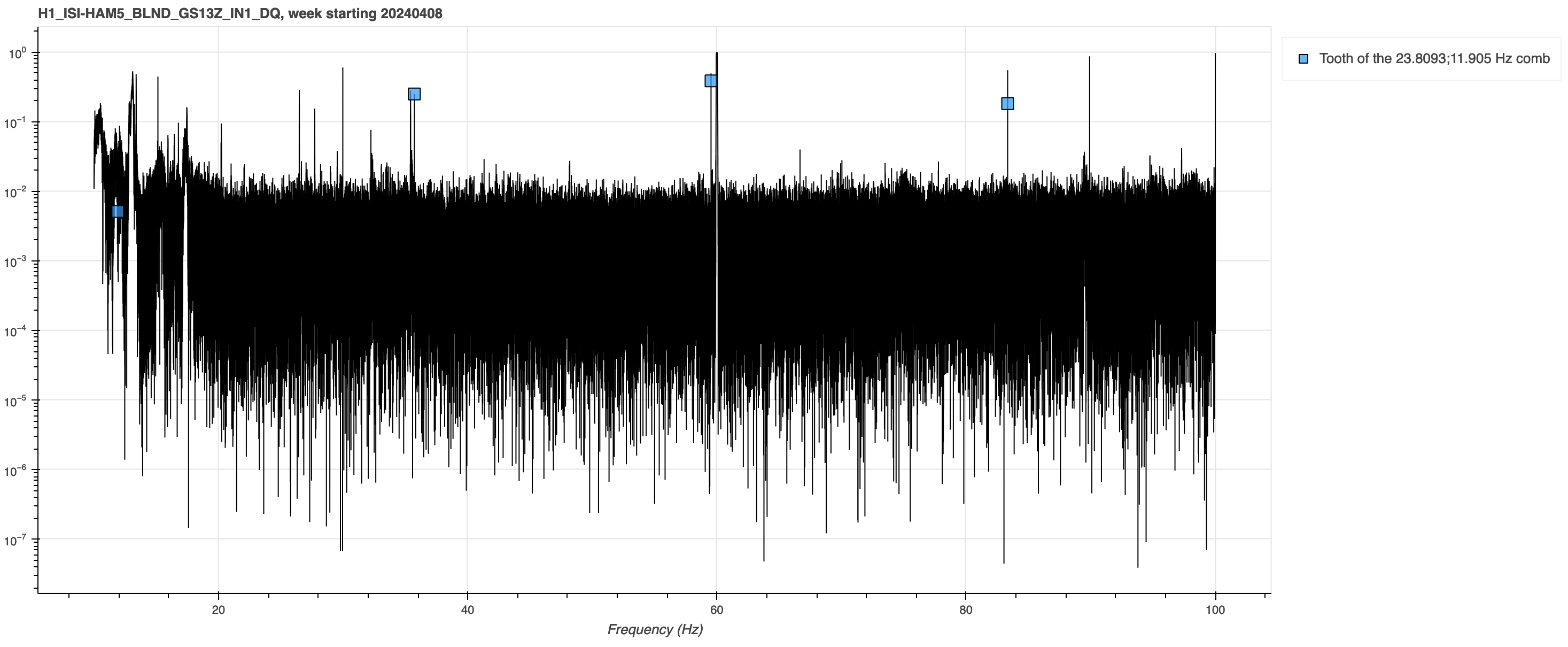
Yesterday during the commissioning period I was running some tests at low frequency from the control room and Robert went in to look into a HAM5 viewport (for OFI issues). During my tests I noticed several times that the 82ish peak in DARM went very high, possibly excited by viewport activites. I attach here a spectrogram that shows the 82Hz and the closest HAM5 accelerometer. We lost lock a minute or two after this time. Some of the ring-ups line up with some of the accelerometer disturbances, but not all. Perhaps if we go through several of the chamber accelerometers, we could find one that lines up with all of them and better triangulate where the 82 Hz is coming from.
Fri May 03 10:12:05 2024 INFO: Fill completed in 12min 1secs
Famis 26489
Output of Check_T240_Centering.py :
Averaging Mass Centering channels for 10 [sec] ...
2024-05-03 08:16:49.261630
There are 13 T240 proof masses out of range ( > 0.3 [V] )!
ETMX T240 2 DOF X/U = -0.343 [V]
ITMX T240 1 DOF X/U = -1.206 [V]
ITMX T240 1 DOF Y/V = 0.358 [V]
ITMX T240 1 DOF Z/W = 0.461 [V]
ITMX T240 3 DOF X/U = -1.244 [V]
ITMY T240 3 DOF X/U = -0.572 [V]
ITMY T240 3 DOF Z/W = -1.611 [V]
BS T240 1 DOF Y/V = -0.379 [V]
BS T240 3 DOF Y/V = -0.334 [V]
BS T240 3 DOF Z/W = -0.476 [V]
HAM8 1 DOF X/U = -0.35 [V]
HAM8 1 DOF Y/V = -0.396 [V]
HAM8 1 DOF Z/W = -0.671 [V]
All other proof masses are within range ( < 0.3 [V] ):
ETMX T240 1 DOF X/U = -0.077 [V]
ETMX T240 1 DOF Y/V = -0.04 [V]
ETMX T240 1 DOF Z/W = -0.073 [V]
ETMX T240 2 DOF Y/V = -0.269 [V]
ETMX T240 2 DOF Z/W = -0.275 [V]
ETMX T240 3 DOF X/U = -0.023 [V]
ETMX T240 3 DOF Y/V = -0.155 [V]
ETMX T240 3 DOF Z/W = -0.024 [V]
ETMY T240 1 DOF X/U = 0.09 [V]
ETMY T240 1 DOF Y/V = 0.12 [V]
ETMY T240 1 DOF Z/W = 0.18 [V]
ETMY T240 2 DOF X/U = -0.071 [V]
ETMY T240 2 DOF Y/V = 0.172 [V]
ETMY T240 2 DOF Z/W = 0.094 [V]
ETMY T240 3 DOF X/U = 0.193 [V]
ETMY T240 3 DOF Y/V = 0.115 [V]
ETMY T240 3 DOF Z/W = 0.125 [V]
ITMX T240 2 DOF X/U = 0.164 [V]
ITMX T240 2 DOF Y/V = 0.264 [V]
ITMX T240 2 DOF Z/W = 0.259 [V]
ITMX T240 3 DOF Y/V = 0.157 [V]
ITMX T240 3 DOF Z/W = 0.146 [V]
ITMY T240 1 DOF X/U = 0.099 [V]
ITMY T240 1 DOF Y/V = 0.088 [V]
ITMY T240 1 DOF Z/W = 0.002 [V]
ITMY T240 2 DOF X/U = 0.061 [V]
ITMY T240 2 DOF Y/V = 0.233 [V]
ITMY T240 2 DOF Z/W = 0.103 [V]
ITMY T240 3 DOF Y/V = 0.076 [V]
BS T240 1 DOF X/U = -0.193 [V]
BS T240 1 DOF Z/W = 0.104 [V]
BS T240 2 DOF X/U = -0.087 [V]
BS T240 2 DOF Y/V = 0.025 [V]
BS T240 2 DOF Z/W = -0.149 [V]
BS T240 3 DOF X/U = -0.184 [V]
Assessment complete.
-------------------------------------------------
Output of check_sts_centering.py
Averaging Mass Centering channels for 10 [sec] ...
2024-05-03 08:22:21.261255
There are 2 STS proof masses out of range ( > 2.0 [V] )!
STS EY DOF X/U = -4.063 [V]
STS EY DOF Z/W = 2.831 [V]
All other proof masses are within range ( < 2.0 [V] ):
STS A DOF X/U = -0.495 [V]
STS A DOF Y/V = -0.773 [V]
STS A DOF Z/W = -0.624 [V]
STS B DOF X/U = 0.396 [V]
STS B DOF Y/V = 0.958 [V]
STS B DOF Z/W = -0.457 [V]
STS C DOF X/U = -0.711 [V]
STS C DOF Y/V = 0.876 [V]
STS C DOF Z/W = 0.425 [V]
STS EX DOF X/U = -0.04 [V]
STS EX DOF Y/V = 0.053 [V]
STS EX DOF Z/W = 0.085 [V]
STS EY DOF Y/V = 0.04 [V]
STS FC DOF X/U = 0.245 [V]
STS FC DOF Y/V = -1.019 [V]
STS FC DOF Z/W = 0.679 [V]
Assessment complete.
TITLE: 05/03 Day Shift: 15:00-23:00 UTC (08:00-16:00 PST), all times posted in UTC
STATE of H1: Observing at 160Mpc
OUTGOING OPERATOR: Ryan S
CURRENT ENVIRONMENT:
SEI_ENV state: CALM
Wind: 3mph Gusts, 1mph 5min avg
Primary useism: 0.01 μm/s
Secondary useism: 0.09 μm/s
QUICK SUMMARY:
H1 has been locked for 10 hours and surviveded a 5.7 earthquake out of the Philippines.
Everything looks great!
TITLE: 05/03 Eve Shift: 23:00-07:00 UTC (16:00-00:00 PST), all times posted in UTC
STATE of H1: Observing at 153Mpc
INCOMING OPERATOR: Ryan S
SHIFT SUMMARY: We've now been Locked for 2:40 and are Observing. Two locklosses(1, 2) during my shift, but relocking was easy and we didn't have any locklosses during PRMI/DRMI like we have been having lately.
LOG:
23:00 Relocking, at MOVE_SPOTS
23:19 NOMINAL_LOW_NOISE
23:24 Observing
00:54 Lockloss
02:00 NOMINAL_LOW_NOISE
02:03 Observing
03:05 Earthquake mode activated due to local earthquake just off the coast of Washington&Canada
03:09 Lockloss from earthquake
03:15 Started an Initial Alignment
03:25 Back to CALM
03:39 Initial Alignment complete, relocking
04:20 NOMINAL_LOW_NOISE
04:23 Observing
| Start Time | System | Name | Location | Lazer_Haz | Task | Time End |
|---|---|---|---|---|---|---|
| 20:23 | SQZ | Terry | Optics lab | LOCAL | SQZ work | 23:55 |
| 20:47 | SQZ | Kar Meng | Optics lab | LOCAL | SQZ work | 23:21 |
| 21:15 | SQZ | Camilla | Optics lab | LOCAL | Join SQZ crew | 23:05 |
| 22:02 | CAL | Tony, Francisco, Rick | PCAL lab | LOCAL | PCAL work | 01:45 |
| 22:43 | VAC | Gerardo | MidY | N | CP check | 23:27 |
Closes FAMIS#28351, last checked 76900
Attached are the results for the In-Lock SUS Charge Measurements from this past Tuesday + last six months. Similar to last time it was posted in the alog (77059), the excitations still have not automatically run for the ITMs since March 13th, something which we are still troubleshooting. So I have only attached the plots for ETMX and ETMY since any of the previous runs with ITM excitations have been previously alogged.
Lockloss 05/03 03:09UTC due to sudden local earthquake
Multiple SRM saturations in the minute leading up to LL, which I thought was interesting
04:20 NOMINAL_LOW_NOISE
04:23 Observing
02:03 Observing
PCAL Main optics Table was disconnected & rotated 90 degrees, leveled to match the hieght of the other optics table in the lab.
PCAL Rack was shut down and moved and reconnected.
PCAL Pneumatics were unplugged moved and reconnected.
Aloging so we have a record of exactly when this change happened.
Today I repeated a few damping loop injections that we had done at LLO. I did all 6 BOSEMs on the BS and 3 on ITMX. I injected circa 100 above ambient. I did not see anything for the BS injections, and saw a small coupling on the ITMX. It remains to be seen if the other suspensions slowly add up to a significant contribution to DARM. Sheila recommended that Josh, the new fellow, take this on in consultation with Jeff so we sat down and I passed on the methods.
The dtt's are to be found in: /ligo/home/anamaria.effler/dtt/damping/ and each test is saved separately. The first attachment shows an example injection on the BS, with the references being the background. The second attachment shows the injection awggui. I did a uniform noise with an 8th order butterworth bandpass 10 to 100 Hz. The gain was 600 for all BOSEMs tested, BS and ITMX. For DARM projection it's best to inject directly at the OSEM basis such that the noises are easy to add up incoherently.
I copied over a coupling calculation code to be found in: /ligo/home/anamaria.effler/scripts/
The three python files there, as well as the darmcalGDS_meters.txt should be copied to be used. The coupling_utils.py is kinda all that's needed, but an example usage is in test_coupling_utils.py. In this script, at the bottom, one can choose the channel injected, add the times for the background and injection, duration and the frequency range to be used, filename to save the data, etc. It will show and save a plot of the derived estimated ambient contribution to DARM from that injection. See example plot for ITMX F2 in the third attachment. It also saves a text file of the coupling function to be used for noise budgets, but only of the measured blue points (which are determined by the darm threshold chosen - for this data I chose 2). I set the default DARM to be GDS CLEAN but it can be changed in the call of the coupling function or in the base code.
TITLE: 05/02 Eve Shift: 23:00-07:00 UTC (16:00-00:00 PST), all times posted in UTC
STATE of H1: Lock Acquisition
OUTGOING OPERATOR: Ryan C
CURRENT ENVIRONMENT:
SEI_ENV state: CALM
Wind: 13mph Gusts, 8mph 5min avg
Primary useism: 0.02 μm/s
Secondary useism: 0.09 μm/s
QUICK SUMMARY:
Currently at ADS_TO_CAMERAS. wind low, around 15mph
TITLE: 05/02 Day Shift: 15:00-23:00 UTC (08:00-16:00 PST), all times posted in UTC
STATE of H1: Observing at 159Mpc
INCOMING OPERATOR: Oli
SHIFT SUMMARY: Robert replaced all the view-ports, so the LVEA is ready to be transitioned back to SAFE whenever. We broke back into the 160s today, we briefly hit 161.8 Mpcs. Johnson Controls finished and headed out around 21:10UTC.
Lock#1
17:52UTC Lost lock right before 11.5 hours, possibly from a jack being used in the optics/pcal lab
Lock#2
No good flashes, went through CHECK_MICH. PRMI then locked pretty low but ASC was able to fix it
18:18 UTC VPW major dust alarm, 0 to 80k in a few seconds. It came down after 10-15 minutes
18:21UTC Lost lock after turning on BS_STAGE2 too early, from the alignment not being that great? The next attempt I held us in engage_drmi_asc for a few minutes before continuing.
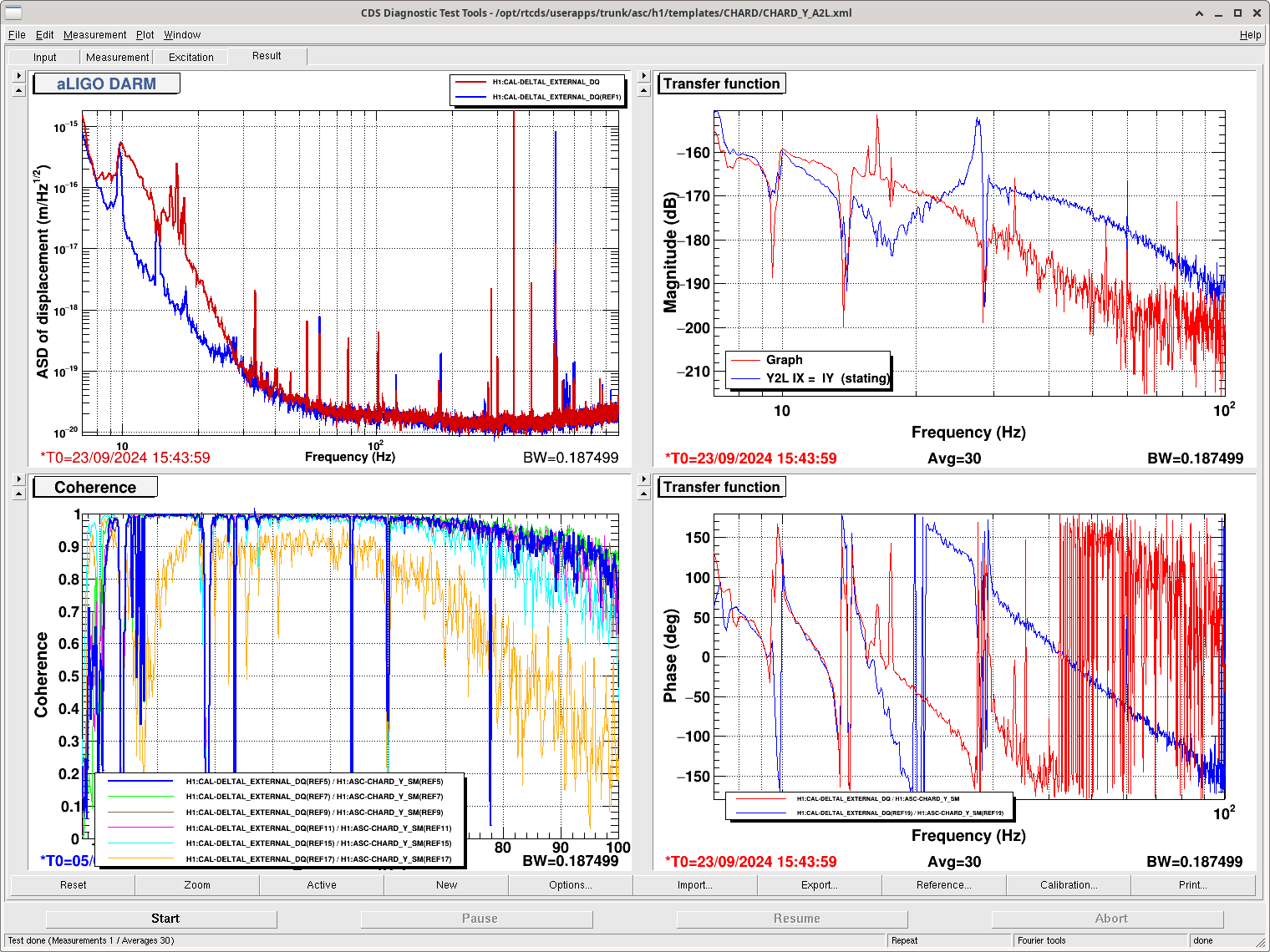
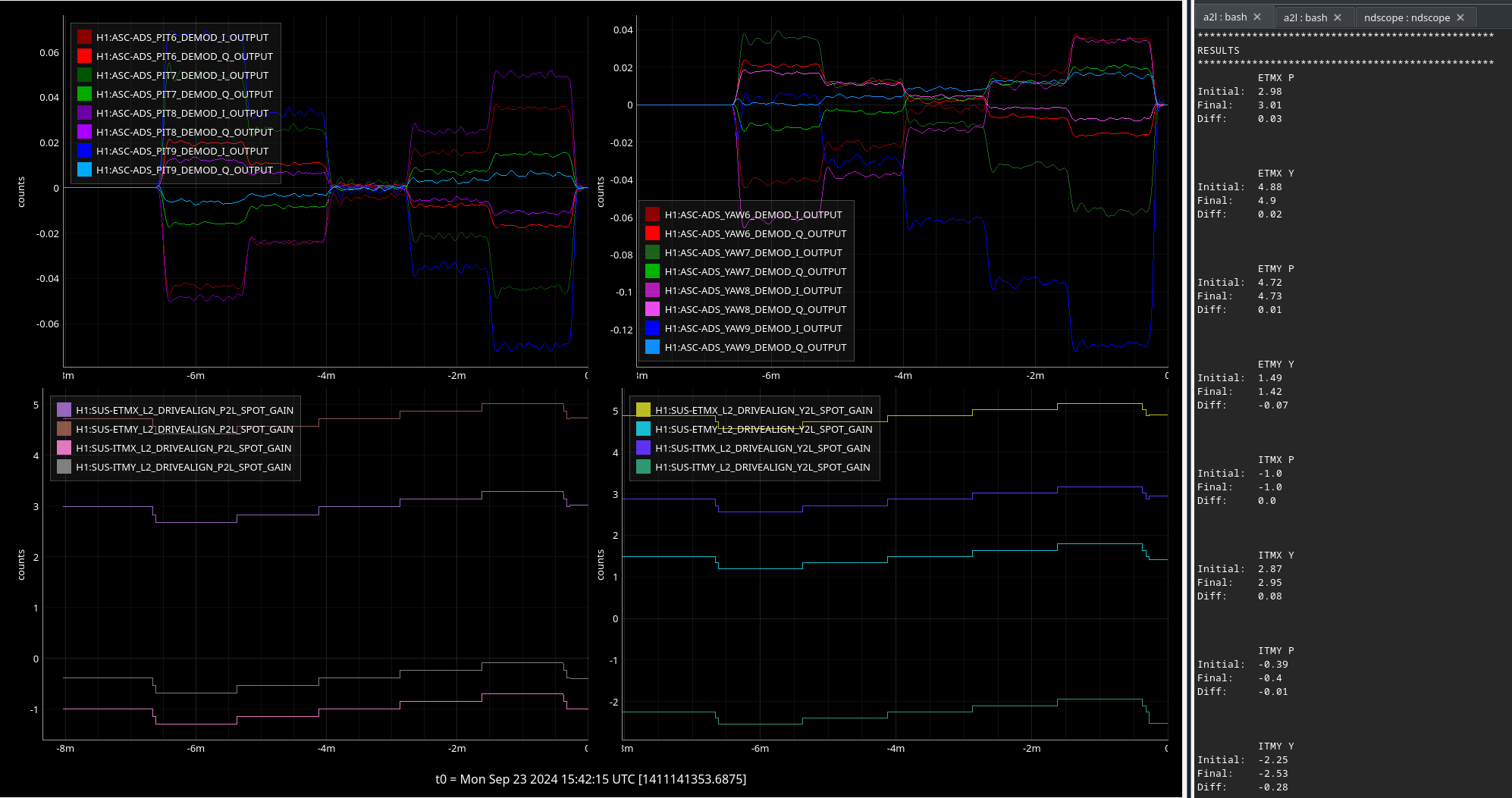
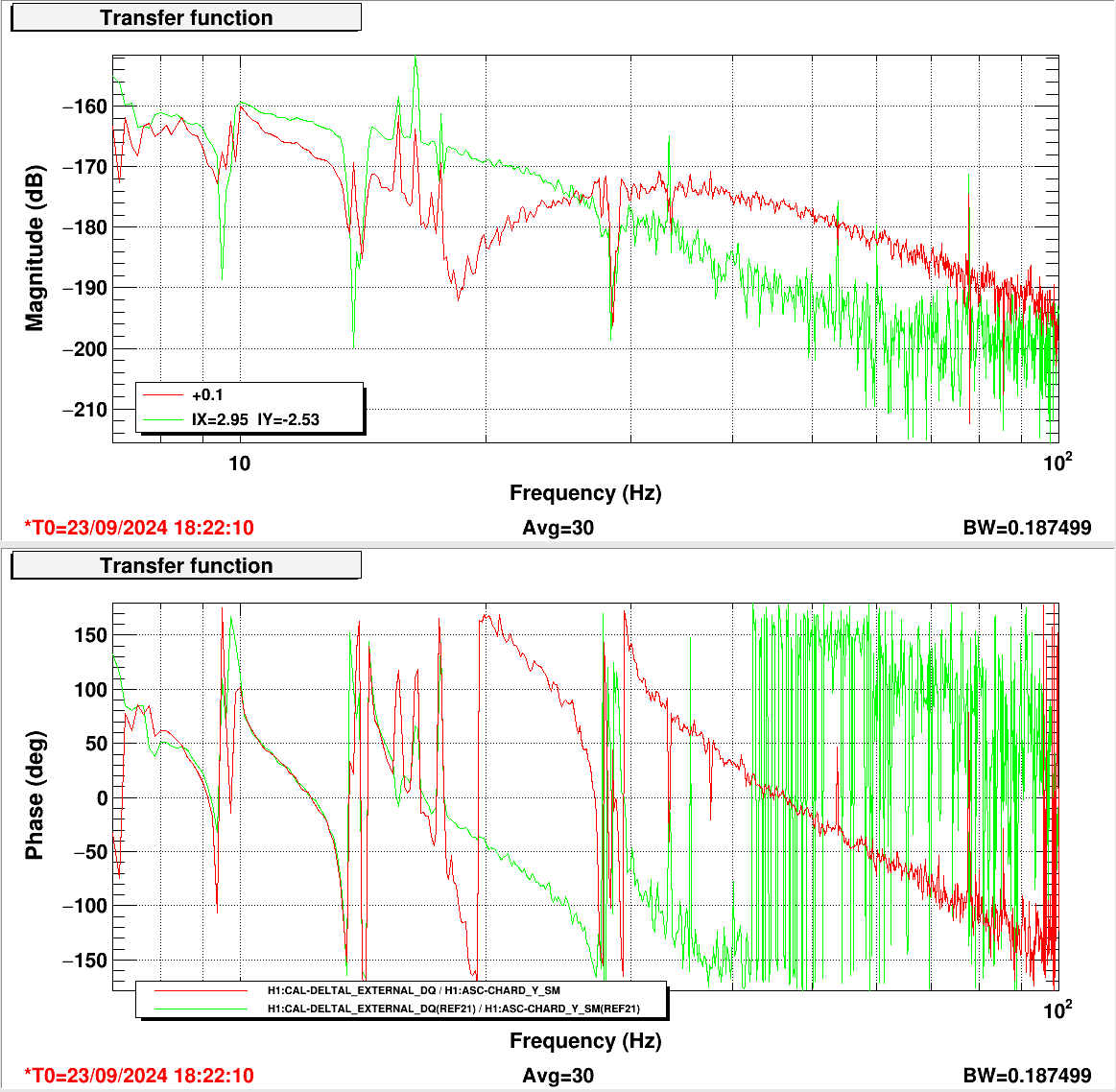
4 SDF diffs I accepted, relating to SCRL FF and Y2LI accepted SDF diffs for Sheilas SCRL FF gain and Y2L measurements
Lock#3
We struggled to get past ENGAGE_DRMI_ASC, the BS was getting kicked (glitches?) mostly seen by the ST1 L4Cs and T240s
Relocking at MAX_POWER right now
LOG:
| Start Time | System | Name | Location | Lazer_Haz | Task | Time End |
|---|---|---|---|---|---|---|
| 15:11 | SAF | LASER HAZARD | LVEA | YES | LVEA is LASER HAZARD | 19:03 |
| 16:00 | pem | Robert | EndY | N | Turn on an amplifier | 16:13 |
| 16:01 | LSC | Sheila | CR | N | SRCL FF, Y2L | 17:21 |
| 16:22 | VAC | Jordan | MidY | N | CP3 pump | 16:56 |
| 16:23 | FAC | Kim | H2 | N | Tech clean | 16:33 |
| 17:00 | CAL | Rick, Francisco | PCAL lab | LOCAL | PCAL work | 21:07 |
| 16:39 | SQZ | Terry | Optics lab | Local | SQZ work | 18:14 |
| 16:40 | PEM | Robert | EndY then X | N | Move amplifier | 17:29 |
| 16:43 | CAL | Rick | LVEA | Y | Parts search | 16:59 |
| 17:03 | SQZ | Kar Meng | Optics lab | N | SQZ work | 18:14 |
| 17:20 | CAL | Tony | CER, PCAL lab | N/local | Grab a laptop then PCAL work | 21:07 |
| 17:48 | Betsy | LVEA | Y | Checks | 18:03 | |
| 18:05 | PEM | Robert | LVEA | Y | Put viewports back on | 18:25 |
| 20:23 | SQZ | Terry | Optics lab | LOCAL | SQZ work | 22:51 |
| 20:47 | SQZ | Kar Meng | Optics lab | LOCAL | SQZ work | 23:21 |
| 21:15 | SQZ | Camilla | Optics lab | LOCAL | Join SQZ crew | 23:05 |
| 22:02 | CAL | Tony, Francisco | PCAL lab | LOCAL | PCAL work | 23:02 |
| 22:06 | CAL | Rick | PCAL lab | LOCAL | PCAL work | 23:06 |
DCPD sat then LL
23:24 Observing
Had to accept sdf for SUS-ETMY_L3_LOCK_BIAS_OFFSET to get into Observing
Robert, Anamaria
Yesterday we opened the viewports of the oplevs for both ITMX and ITMY to find the alignment of the CP's.
The procedure relies on the fact that the optics are not coated for red so we can see all four surfaces. The separation between the beams at this distance (~34m) is about 10cm due to the wedges (in the table below from the galaxy page). The test mass has a vertical wedge, thick down, so the AR beam will show up directly below. The CP is supposed to be perfectly parallel to the back surface so the closest surface of the CP (CP1) would land essentially right on top of the ITM AR beam. Then the CP has a similar size wedge, but horizontal, so the second CP surface would hit at the same level as CP1 and ITM AR but to the left or right, depending which ITM.
The first plot attached shows the nominal view of these beams as seen at the oplev viewport on the white page. The yellow pages were attached to the lexand covering the viewport and the beams were marked. The full view of all the beams no longer fits through the viewport due to the addition of nozzle baffles so we had to walk the oplev sender to find all the beams. For the ITMX we lucked out and the ITM AR beam was visible at the top gap of the baffle at the same time as the second AR reflection and the CP beam were visible in the aperture. As such we are able to scale the misalignments to the wedge value. We verified the CP beams by moving the CPs, and we scanned to find the second CP surface (CP2) horizontally at about the right distance from CP1.
| wedge ITM/CP | misalignment | |
| CP-X | 0.07/0.07 deg | 1.7 mrad down |
| CP-Y | 0.08/0.07 deg | 0.55 mrad down |
By down I mean they are further pitched down towards the arm.
One would think that we have +/- 440 urad range in pitch on the R0, but it seems its range is much less than advertised. Even stranger, this was also found to be the case at L1, on both ITM R0. When we moved CPY, with respect to this calibration it only moves ~230 urad. So we cannot make it back to the nominal position of overlapping the ITM AR beam. For yaw we did a smaller step so more error on it, but it's about 60% of slider value. More on this later.
(CPY is the one that Robert found to modulate the noise from the MC tube baffle.) Speaking of the L1 experience, we even had to vent back in 2016 to fix one of these CP misalignments, which was too close to HR actually. The interesting thing to me, looking back, is that L1 still has a similar misalignment for CPX to the H1 CPY and we don't see as high noise coupling at the IMC tube.
CPX is very misaligned by comparison, but not linked to the MC tube scatter. Alena has agreed to help us track where these ghost beams land at P/SR3 and the scraper baffles, now that we know their exact orientation.
+Peter, Jeff
Regarding the reduced range of CPY R0, we checked what the BOSEMs and the coil current monitors had to say about the range during our optical measurement. Jeff kindly calibrated the RMSMONs so we could see what the current really is. The data is in the attached screenshot. We did not check the CPX but, as I mention above, we found this to be the case at LLO as well. For pitch I show F1, which gets the largest drive, for yaw I show one of F2/F3 which get identical drives. In terms of range, I define it as how far from 0 we can go, so half range technically, but it's max DAC output and current. If we want more range we have to decide if we can afford more than ~45mA on the BOSEMs.
| CPY | Slider [urad] | range [%] | OSEM readback [urad] | Oplev meas [urad] | Coil current [mA] |
| PIT | 440 | 100 | 1130 | 230 | 45 |
| YAW | 200 | 33 | 160 | 120 | 16 |