TITLE: 03/19 Day Shift: 15:00-23:00 UTC (08:00-16:00 PST), all times posted in UTC
STATE of H1: Commissioning
OUTGOING OPERATOR: None
CURRENT ENVIRONMENT:
SEI_ENV state: CALM
Wind: 4mph Gusts, 2mph 5min avg
Primary useism: 0.02 μm/s
Secondary useism: 0.19 μm/s
QUICK SUMMARY:
Maintenance today! Looks like we were up for a good number of hours overnight.
Workstations were updated and rebooted. Os packages were updated. Conda package 'gwinc' was updated to 0.6.0.
TITLE: 03/18 Eve Shift: 23:00-07:00 UTC (16:00-00:00 PST), all times posted in UTC
STATE of H1: Commissioning
INCOMING OPERATOR: None
SHIFT SUMMARY:
Shift started with Squeezer work with H1 in NLN.
Then there was work on PSAMs differential adjustments. Then there was work on PR3 alignment
For locking, we definitely appear to need to run Initial Alignment after locklosses.
And LOWNOISE ASC was stuck in a loop for about 20-30min before I noticed it. (see below)
LOG:
Naoki, Camilla, Evan, Sheila, Julian, Nutsinee
Many things happened with the squeezer this afternoon. A quick summary is we are back to 5 dB at kHz and we should be able to do this repeatedly. No PSAMs adjustment required at this time.
- When the IFO relocked this afternoon we adjusted ZM5 alignment to optimize ADF trans signal. By doing so we improved both the RF3 and the 42. However this made squeezing worse.
- We adjusted the SQZ angle. We couldn't make it better so we went the other way. This made squeezing worse and ADS TRANS went up with it. Note that this is the IQSUM channel. We didn't think that was a sensible behavior but we've seen it before.
- Sheila and Julian then optimized the crystal tempeature. The NLG for today was 17.3.
- Naoki measured the SQZ IFO sensing matrix. We found a big cross coupling between ZM5 P to AS42 B Y. Other than then everything else was sensible. A new improved sensing matrix has been implemented.
- We lost hours tracking down why the filter cavity failed to lock on green. A reminder to check SDF next time we run into mysterious problems.
- After everything went back to normal we recovered 5 dB of squeezing. DARM plot said so. BLRMS seemed slightly off. We tried turning the ASC loop off and optimizing the ZM alignment by hand to see if we could do any better than the loop. We couldn't. SQZ IFO ASC loop now works as it should.
- We also optimized the filter cavity offset. Mostly to double checked that we were sitting at a good place. An offset of -28 (where we started) gave the best squeezing at low frequency.
We haven't got to increase CLF power today.
After a new CLF VCO installed we should revert the CLF sign to make sure everything was the same as before. In theory this shouldn't do anything.
Naoki Nutsinee
We changed "fcgs_trans_lock_threshold" to 120 today so FC wouldn't lock on higher order mode. The filter cavity was having trouble getting pass GR VCO lock so we have now reduced this power back to 80.
Accepted the new ASC_INMATRIX settings in sdf, see attached. Aslo accepted ASC_POS_Y's new minus sign and AS_A_RF42_YAW_OFFSET.
Accpeted the SQZ_ASC WFS as OFF. As decided, we will start the ER with SQZ ASC IFO off.
Jennie, Naoki, Evan, Gabriele
WE stepped the two PSAMS differentially, to find a better position. There is some evidence that a value of 150 / 90 is better than the original 120 / 120. Noise i a 200-250 Hz region is about 4% lower. More details will follow.
We tried a small common step after the differential tuning, but saw little effect
| ZM4 | ZM5 | θSQZ | BLRMS, 200–250 Hz (m) | BLRMS, 430–490 Hz (m) |
| 120 | 120 | 205.2° | 1.124×10⁻¹⁹ | 1.099×10⁻¹⁹ |
| 140 | 100 | 195.7° | 1.096×10⁻¹⁹ | 1.045×10⁻¹⁹ |
| 150 | 90 | 200.5° | 1.105×10⁻¹⁹ | 1.051×10⁻¹⁹ |
| 160 | 80 | 200.5° | 1.080×10⁻¹⁹ | 1.044×10⁻¹⁹ |
| 180 | 60 | 200.5° | 1.122×10⁻¹⁹ | 1.078×10⁻¹⁹ |
| 200 | 40 | 200.5° | 1.141×10⁻¹⁹ | 1.100×10⁻¹⁹ |
| 170 | 110 | 200.5° | 1.104×10⁻¹⁹ | 1.050×10⁻¹⁹ |
Naoki was optimizing the squeeze angle by hand. The BLRMS are possibly confounded by some 0.03–0.1 Hz motion from an earthquake, but in any case there doesn't seem to be a major win here.
Jennie, Naoki, Evan, Gabriele
We changed the SRCL offset between -250 and 0 counts, and optimizd the squeezing angle at each value. We see an effect at high frequency (worsening when the offset is different than the nominal -175) but not noticeable change in the bucket.
| SRCL offset (ct) | PCAL (m) | BLRMS, 430–490 Hz (m) | Ratio (m/m) |
| −250 | 1.182×10⁻¹⁸ | 1.114×10⁻¹⁹ | 10.61 |
| −175 | 1.185×10⁻¹⁸ | 1.101×10⁻¹⁹ | 10.76 |
| −100 | 1.180×10⁻¹⁸ | 1.107×10⁻¹⁹ | 10.66 |
| 0 | 1.177×10⁻¹⁸ | 1.101×10⁻¹⁹ | 10.69 |
No clear win here.
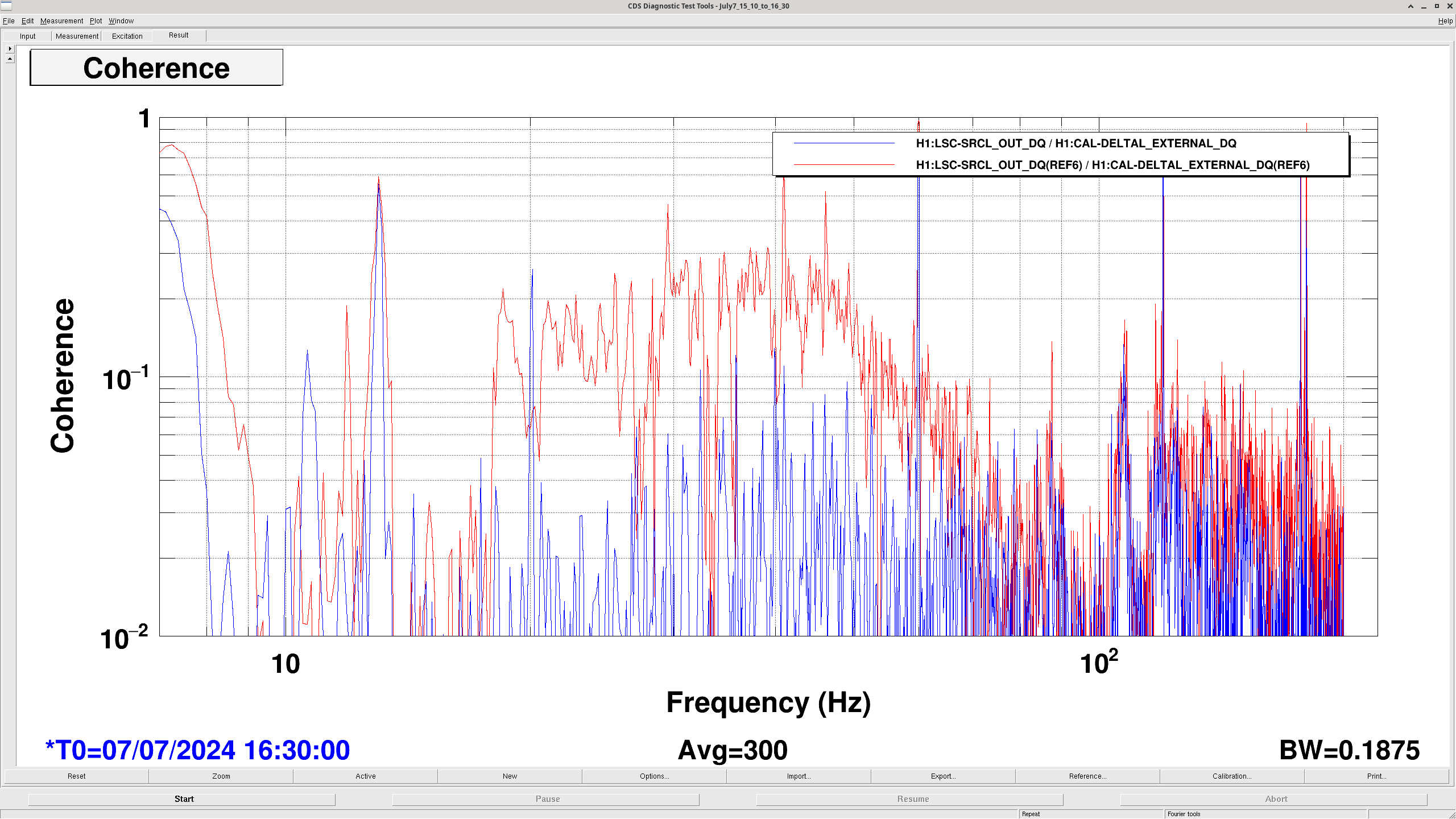
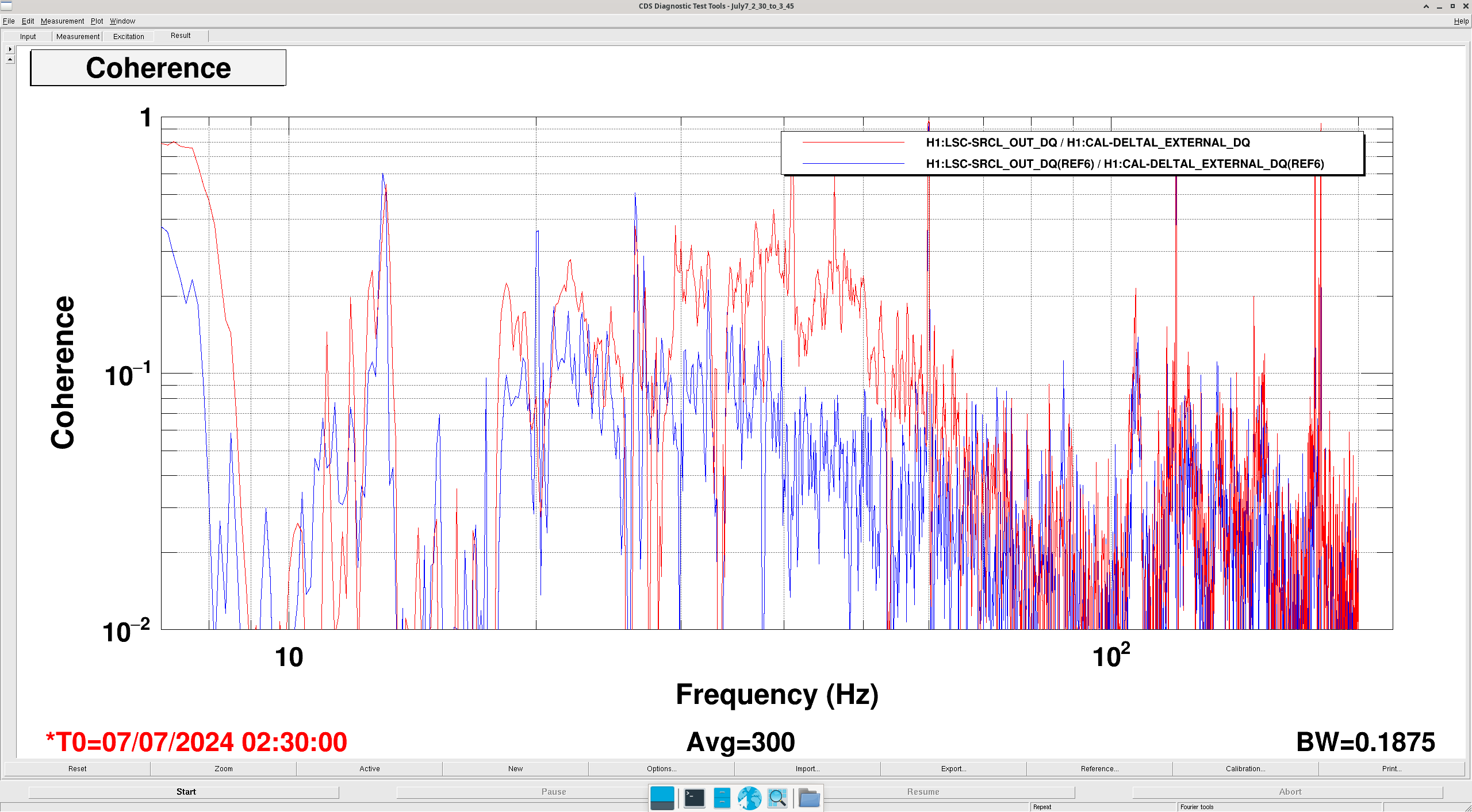
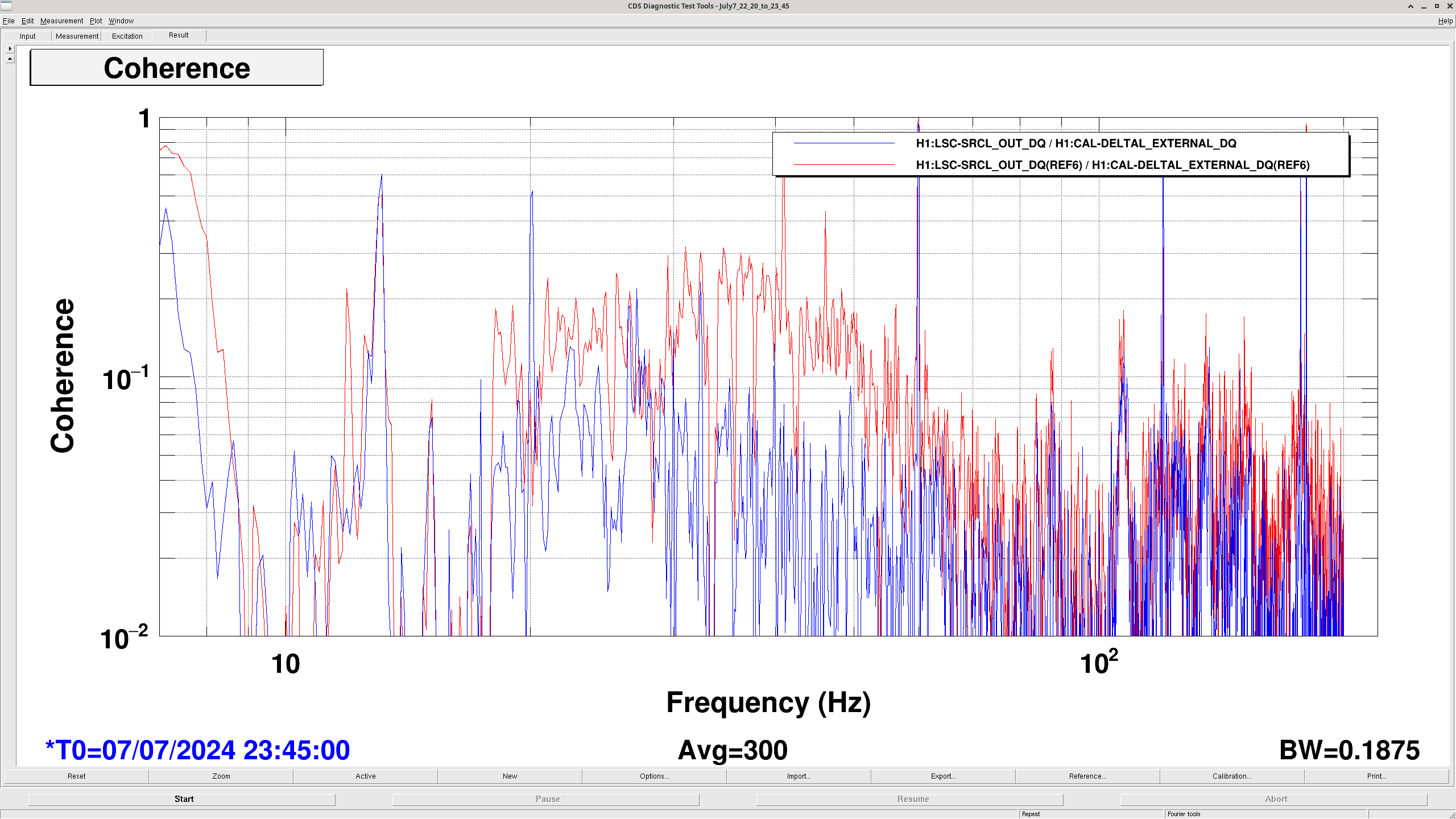
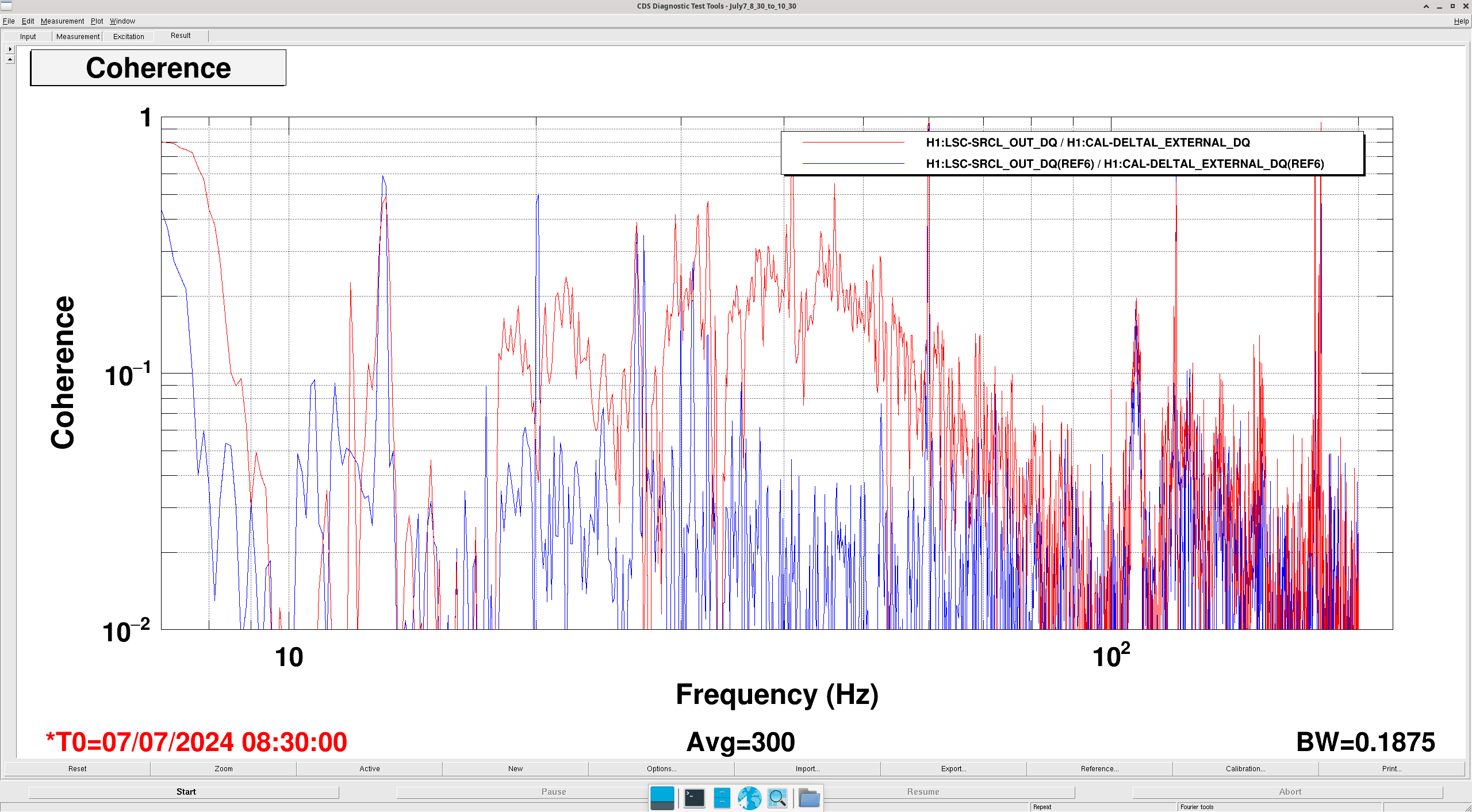
The bump of noise in DARM around 30 Hz is mostly a forest of peaks. One of them (33.43 Hz) is actually a calibration line. For the others, I looked at coherence with corner suspension optical levers and witness sensors. Some of the peaks shos enough coherence to indicate that maybe the peak is due to motion of that suspension
Frequency Suspension 25.19 26.53 BS / PR3 27.04 BS / PR3 / SR3 27.42 27.50 27.72 28.22 29.50 PR3 / SR3 29.97 PR3 32.31 33.33 33.43 35.22 PR2 35.71 39.80 PR3 SR3
Here's a full table of coherence
| 25.19 | 26.53 | 27.04 | 27.42 | 27.50 | 27.72 | 28.22 | 29.50 | 29.97 | 32.31 | 33.33 | 33.43 | 35.22 | 35.71 | 39.80 | |
| H1:SUS-BS_M3_OPLEV_PIT_OUT_DQ | 0.019 | 0.231 | 0.290 | 0.008 | 0.009 | 0.001 | 0.003 | 0.164 | 0.003 | 0.028 | 0.008 | 0.039 | 0.123 | 0.020 | 0.024 |
| H1:SUS-BS_M3_OPLEV_YAW_OUT_DQ | 0.004 | 0.201 | 0.304 | 0.007 | 0.003 | 0.003 | 0.040 | 0.138 | 0.022 | 0.018 | 0.008 | 0.012 | 0.182 | 0.047 | 0.118 |
| H1:SUS-PRM_M3_WIT_P_DQ | 0.003 | 0.013 | 0.020 | 0.003 | 0.024 | 0.001 | 0.013 | 0.121 | 0.042 | 0.005 | 0.001 | 0.001 | 0.040 | 0.107 | 0.001 |
| H1:SUS-PRM_M3_WIT_Y_DQ | 0.003 | 0.017 | 0.002 | 0.008 | 0.014 | 0.021 | 0.049 | 0.001 | 0.008 | 0.016 | 0.033 | 0.021 | 0.009 | 0.007 | 0.006 |
| H1:SUS-PR2_M3_WIT_P_DQ | 0.001 | 0.002 | 0.032 | 0.002 | 0.021 | 0.031 | 0.023 | 0.013 | 0.041 | 0.023 | 0.013 | 0.011 | 0.010 | 0.013 | 0.043 |
| H1:SUS-PR2_M3_WIT_Y_DQ | 0.004 | 0.014 | 0.054 | 0.006 | 0.035 | 0.023 | 0.005 | 0.045 | 0.074 | 0.002 | 0.005 | 0.004 | 0.020 | 0.093 | 0.005 |
| H1:SUS-PR3_M3_OPLEV_PIT_OUT_DQ | 0.023 | 0.257 | 0.297 | 0.003 | 0.033 | 0.007 | 0.005 | 0.166 | 0.017 | 0.031 | 0.001 | 0.004 | 0.188 | 0.007 | 0.165 |
| H1:SUS-PR3_M3_OPLEV_YAW_OUT_DQ | 0.002 | 0.258 | 0.297 | 0.003 | 0.059 | 0.005 | 0.002 | 0.163 | 0.005 | 0.016 | 0.004 | 0.002 | 0.171 | 0.038 | 0.109 |
| H1:SUS-PR3_M3_WIT_P_DQ | 0.026 | 0.051 | 0.005 | 0.022 | 0.017 | 0.035 | 0.025 | 0.065 | 0.365 | 0.005 | 0.001 | 0.028 | 0.070 | 0.039 | 0.021 |
| H1:SUS-PR3_M3_WIT_Y_DQ | 0.064 | 0.072 | 0.030 | 0.000 | 0.020 | 0.001 | 0.000 | 0.052 | 0.772 | 0.036 | 0.079 | 0.042 | 0.001 | 0.353 | 0.005 |
| H1:SUS-SRM_M3_WIT_P_DQ | 0.028 | 0.049 | 0.034 | 0.002 | 0.001 | 0.008 | 0.024 | 0.049 | 0.006 | 0.009 | 0.011 | 0.028 | 0.016 | 0.001 | 0.034 |
| H1:SUS-SRM_M3_WIT_Y_DQ | 0.006 | 0.029 | 0.015 | 0.059 | 0.011 | 0.020 | 0.022 | 0.015 | 0.006 | 0.029 | 0.046 | 0.007 | 0.003 | 0.001 | 0.020 |
| H1:SUS-SR2_M3_WIT_P_DQ | 0.004 | 0.002 | 0.008 | 0.006 | 0.014 | 0.005 | 0.054 | 0.013 | 0.540 | 0.008 | 0.001 | 0.014 | 0.012 | 0.121 | 0.008 |
| H1:SUS-SR2_M3_WIT_Y_DQ | 0.013 | 0.008 | 0.039 | 0.029 | 0.028 | 0.010 | 0.010 | 0.003 | 0.521 | 0.004 | 0.008 | 0.003 | 0.068 | 0.153 | 0.008 |
| H1:SUS-SR3_M3_OPLEV_PIT_OUT_DQ | 0.014 | 0.165 | 0.287 | 0.006 | 0.030 | 0.001 | 0.001 | 0.169 | 0.012 | 0.009 | 0.012 | 0.012 | 0.145 | 0.008 | 0.079 |
| H1:SUS-SR3_M3_OPLEV_YAW_OUT_DQ | 0.029 | 0.133 | 0.290 | 0.007 | 0.040 | 0.003 | 0.001 | 0.173 | 0.013 | 0.010 | 0.008 | 0.005 | 0.020 | 0.006 | 0.175 |
| H1:SUS-SR3_M3_WIT_P_DQ | 0.007 | 0.002 | 0.002 | 0.013 | 0.011 | 0.017 | 0.015 | 0.046 | 0.005 | 0.026 | 0.007 | 0.028 | 0.008 | 0.068 | 0.011 |
| H1:SUS-SR3_M3_WIT_Y_DQ | 0.092 | 0.005 | 0.023 | 0.014 | 0.000 | 0.010 | 0.021 | 0.022 | 0.003 | 0.000 | 0.007 | 0.009 | 0.008 | 0.013 | 0.022 |
| H1:SUS-MC1_M3_WIT_P_DQ | 0.031 | 0.032 | 0.016 | 0.005 | 0.012 | 0.025 | 0.003 | 0.020 | 0.658 | 0.003 | 0.006 | 0.001 | 0.042 | 0.125 | 0.015 |
| H1:SUS-MC1_M3_WIT_Y_DQ | 0.004 | 0.000 | 0.009 | 0.013 | 0.014 | 0.004 | 0.057 | 0.111 | 0.124 | 0.017 | 0.020 | 0.012 | 0.047 | 0.034 | 0.041 |
| H1:SUS-MC2_M3_WIT_P_DQ | 0.012 | 0.044 | 0.016 | 0.005 | 0.004 | 0.016 | 0.011 | 0.008 | 0.061 | 0.002 | 0.015 | 0.028 | 0.039 | 0.005 | 0.036 |
| H1:SUS-MC2_M3_WIT_Y_DQ | 0.005 | 0.009 | 0.003 | 0.006 | 0.024 | 0.012 | 0.002 | 0.012 | 0.082 | 0.032 | 0.058 | 0.034 | 0.037 | 0.029 | 0.041 |
| H1:SUS-MC3_M3_WIT_P_DQ | 0.010 | 0.014 | 0.039 | 0.015 | 0.025 | 0.043 | 0.032 | 0.008 | 0.015 | 0.003 | 0.003 | 0.009 | 0.008 | 0.018 | 0.003 |
| H1:SUS-MC3_M3_WIT_Y_DQ | 0.003 | 0.047 | 0.044 | 0.009 | 0.043 | 0.024 | 0.004 | 0.095 | 0.006 | 0.049 | 0.004 | 0.027 | 0.015 | 0.008 | 0.001 |
Evan, Naoki, Nutsinee, Camilla
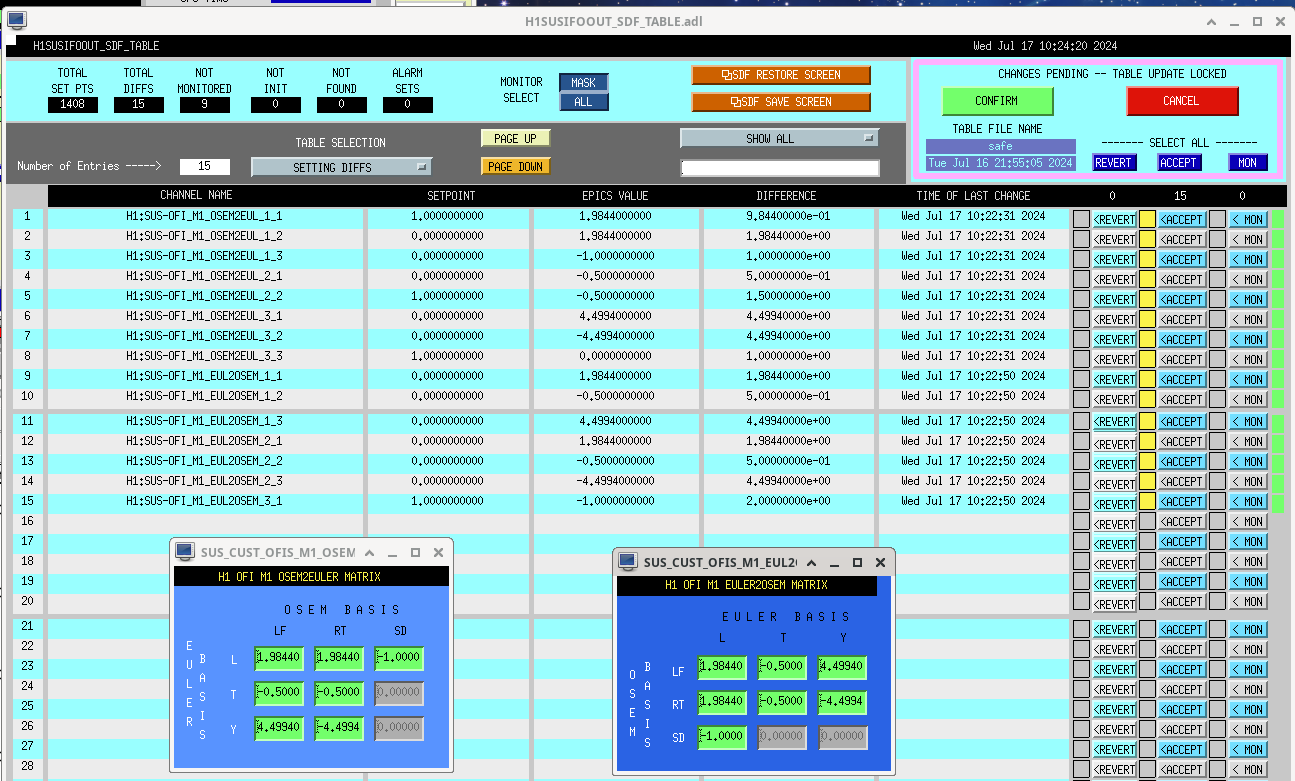
Today Sheila added nodes.set_managed() in INIT state of SQZ_FC guardian and let SQZ_FC guardian go through the INIT state. However, the FC2 M1 offload filter in the INIT state was old filter setting in 68914, which caused GR_SUS_LOCKING failure. We reverted it as shown in the attachment and updated the FC2 M1 offload filter in INIT state.
Attached a screen shot of the old (wrong) settings on top, correct one at the bottom.
In 76503, the limiter for FC2 M1 was not in INIT state of SQZ_FC guardian, but we added the limiter.
This is an update of the plot in 76372: the high frequency (above 2 kHz) now lines up with the O4a level, but the noise between 40 and 1000 Hz is still larger now than in O4a, although a bit better than a week ago.
The first plot is done with GDS-CALIB_CLEAN: the jitter subtraction is still doing a decent job, even though it was tuned for O4a.
The second plot is done with GDS-CALIB_NOLINES, and shows the jitter peaks in all cases. There is still the same difference between now and then. So jitter is not enough to explain the lowest range we have now.
Updated ASC-AS_A_DC_YAW_OFFSET to be -0.15 instead of OFF at 00:09:36 UTC as even though this change has now been put in the guardian we have not lost lock since this was done by Sheila and so the offset was still off. I checked with the squeezers first.
just noting for our future selves: Sheila updated the guardian in LHO:76488.
Ibrahim, Jennie W
I analysed the DARM offset step test that Ibrahim ran over the weekend. The contrast defect is now 1.149mW.
See the attached plot for DCPD sum level and circulating power level during the test. DCPD_SUM_OUT is nominally at 40mA before and after the test. The first attached plot uses the height of two calibration lines on the DCPD and in DARM to track how the DARM optical gain changes with differing power on DCPD sum. The second shows the scaling of DARM optical gain with DARM offset. From this we can see the DARM offset true zero is when the applied offset in OMC-READOUT_X0_OFFSET is 0.608 counts.
I trended the DARM offset (via checking the fringe offset OMC-READOUT_X0_OFFSET) and the circulating powers in 04 a on Jan 14th and on March 16th post-vent.
The offset and circulating powers have not changed appreciably. The first image is 04a and the second this past Saturday. In both cases the contrast defect was set to give 40mA on DCPD_SUM. The Y cirulating power went up by 2.5W and the X by 2W.
The fringe offset went up by 8.8e-4 counts in that time.
I edited ISC_LOCK LOWNOISE_ASC state to engage the -0.15 offset in AS_A_YAW_DC that was found 76407, I have just loaded it now so it should happen the next time we lock the IFO.
I added a missing counter increment. Corey found that we got stuck here for 20minutes Monday night. svn revision: 27257
[Louis, Gabriele]
The DHARD_Y to DARM coupling always showed two regimes: a steep coupling below 20-30 Hz, and a flatter coupling above 20-30 Hz. We've been able to change the flatter coupling above 20-30 Hz by changing the ITMT Y2L coefficient.
Today we confirmed a suspicion: the steep low frequency coupling is due to length to angle coupling at the AS WFS. We changed the beam position on the WFS by adding an offset to the WFS centering (H1:ASC-AS_A_DC_YAW_OFFSET) and saw a change in the DHARD_Y to DARM coupling.
A value close to -0.14 gives the minimum coupling below 20 Hz. we now have two independent knobs to minimize the DHARD_Y to DARM coupling at all frequencies.
Incidentally, the higher frequency couping is now lower than yesterday, with the same ITMY Y2L coefficient of -1.65
We did a scan of the AS_A_WFS Y centering from -0.2 to -0.1 in steps of 0.01, an analysis will follow tomorrow:
-0.200: 1394510627 - 1394510727
-0.190: 1394510777 - 1394510877
-0.180: 1394510927 - 1394511027
-0.170: 1394511077 - 1394511177
-0.160: 1394511227 - 1394511327
-0.150: 1394511377 - 1394511477
-0.140: 1394511527 - 1394511627
-0.130: 1394511677 - 1394511777
-0.120: 1394511827 - 1394511928
-0.110: 1394511978 - 1394512078
-0.100: 1394512128 - 1394512228
0.000: 1394512278 - 1394512378
We are leaving a value of -0.14 in the WFS offset
Attached is a comparison of the DARM sensing function with no AS A centering offset vs an offset of -0.14. With an AS A centering offset of -0.14, which we found to be the value that results in the minimum amount of coupling to DARM below 20Hz, the sensing function clearly shows optical spring-like characteristics. This brings to mind a few thoughts: 1. This supports the idea that coupling from the DHARD loop into DARM has a noticeable effect on the structure seen in the sensing function at low frequencies. We've been wondering about this for some time, so it's nice to finally have a direction to point in. 2. We tend to adjust the src detuning by constantly measuring the sensing function and trying to find an SRC offset that results in a flat sensing function at low frequencies. The fact that DHARD also couples with DARM in such a way that it can affect the shape of the sensing function at low frequencies begs the question: could we be in fact further detuning the src while intending to do the opposite due to confusion caused by the dhard coupling effects? 3. I recall being told that sometimes squeezing gets better with some level of detuning. If our only measure of SRC detuning is from measuring and inspecting the sensing function then this measurement hasn't been clean due to the DHARD coupling. lots to think about..
Here's a more detailed analysis of the AS WFC centering steps.
The first plot shows the steps in ASC-AS_A_DC_YAW_OFFSET compared with a DARM spectrogram, during a DHARD_Y injection. The spectrogram shows that there is minimum in the coupling of DHARD_Y to DARM around -0.15 / =0.16.
The second plot shows the transfer function from DHARD_Y to DARM for all values of the offset. A value of -0.15 gives the lowest coherence and the lowest coupling, so that seems to be the optimal value. One can notice how the transfer function phase flips sign as expected when one goes through the minimum coupling.
Changing the AS_A centering offset also moved SR2, SRM and BS.
I tried stepping the REFl WFS A and B DC offsets in yaw similarly to see if the CHARD Y coupling to DARM would change. In summary, I stepped between -0.2 and 0.2 for both WFS and saw no change.
Method: I set a 30 second ramp on the offsets because the DC centering loops are slow. I stepped first in steps of 0.01, and then 0.02. I injected a broadband CHARD Y injection and measured the transfer function to darm between 10-30 Hz. I saw no change in the coupling while I made these steps.
Before checking on the calibration change in DARM and DHARD, I check on the thermalisation effect with the coupling.
I chose long duration locking time (Mar. 16, 05:30:00 UTC ~ 15:30:00 UTC) without centering offset, and selected start, middle (10:30:00 UTC) and end time within the time window.
Three plots are; 1) DARM, 2) DHARD PIT, 3) DHARD YAW.
In addition, I included screenshot of ndscope to confirm the time window.
As the 'end' time data in all plots show different trend compare to the other times, it seems that the thermalisation affects DARM and DHARD.
Checked on the calibration lines in DARM and DHARD with centering offset on/off conditions.
To minimize the thermalisation effect, time for the comparison were chosen within short time window.
Figures are; 1) Comparison altogether, 2) DARM comparison, 3) DHARD PIT, 4) DHARD YAW, 5) Screenshot of the ndscope around comparison time.
It can be confirmed that the peaks of calibration lines were same in DARM with and without the centering offset. However, for DHARD, only YAW showed calibration lines, and with different peak magnitude (lower in without offset).
The previous timing master which was again running out of range on the voltage to the OCXO, see alogs 68000 and 61988, has been retuned using the mechanical adjustment of the OCXO.
Today's readback voltage is at +3.88V. We will keep it running over the next few months to see, if it eventually settles.
Today's readback voltage is at +3.55V.
Today's readback voltage is at +3.116V.
Today's readback voltage is at +1.857V.
Today's readback voltage is at +0.951V.
Today's readback voltage is at -2.511V