Displaying reports 12281-12300 of 86532.Go to page Start 611 612 613 614 615 616 617 618 619 End
Reports until 08:53, Monday 18 March 2024
H1 ISC (DetChar)
gabriele.vajente@LIGO.ORG - posted 08:53, Monday 18 March 2024 (76472)
New DARM: fewer glitches

The new DARM configuration drastically reduced the number of low frequency glitches.

See a comparison of omicorn glitches with old DARM and with new DARM, and glitch rates with old DARM and new DARM.

Images attached to this report
LHO General
ibrahim.abouelfettouh@LIGO.ORG - posted 08:05, Monday 18 March 2024 - last comment - 11:47, Monday 18 March 2024(76470)
OPS Day Shift Start

TITLE: 03/18 Day Shift: 15:00-23:00 UTC (08:00-16:00 PST), all times posted in UTC
STATE of H1: Commissioning
OUTGOING OPERATOR: None
CURRENT ENVIRONMENT:
    SEI_ENV state: CALM
    Wind: 3mph Gusts, 2mph 5min avg
    Primary useism: 0.02 μm/s
    Secondary useism: 0.18 μm/s
QUICK SUMMARY:

IFO is in DOWN

Louis put IFO in DOWN due to issues locking itself. Will begin locking now.

Other:

H1:PEM-CS_DUST_PSL101   dust counts did not change, please investigate.

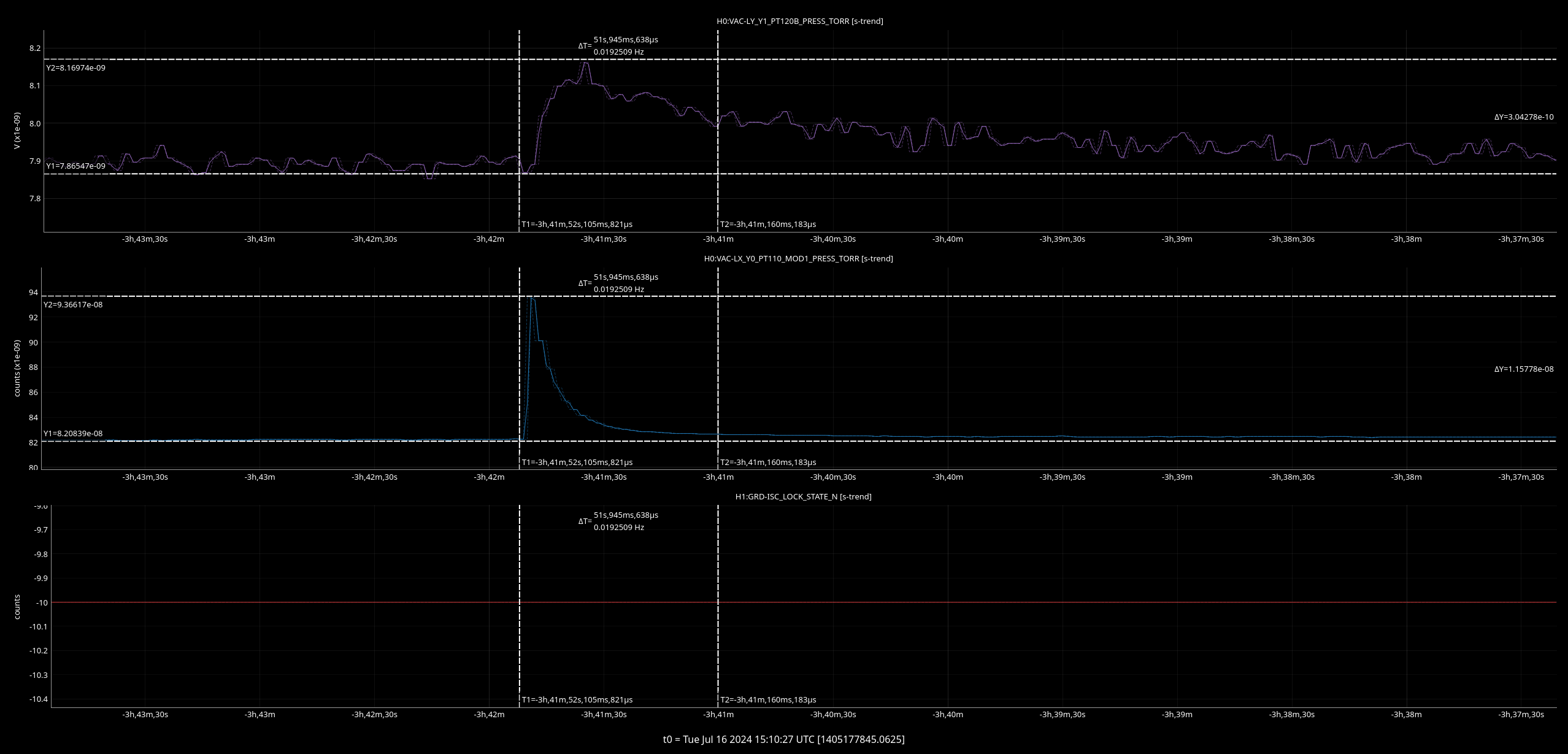
EX Pressure EX_X5_PT526 MOD1 PRESS TORR is showing a yellow alert on the vacuum alarm handler.

Comments related to this report
david.barker@LIGO.ORG - 08:53, Monday 18 March 2024 (76473)

PSL Dust monitor 101 went offline 10:15 Tue 27 Feb 2024, around the time Jason and Ryan S were doing some PSL table work. I restarted the LVEA/PSL Dust EPICS IOC this morning, and the PSL 101 system came back with a "NOT IN USE" status.

Images attached to this comment
jason.oberling@LIGO.ORG - 11:47, Monday 18 March 2024 (76479)

PSL 101 is the Laser Room dust monitor, we will take a look at this next time we go into the PSL enclosure.

H1 AOS
louis.dartez@LIGO.ORG - posted 20:13, Sunday 17 March 2024 (76469)
requesting down for the night
The IFO is having trouble locking itself this evening. Requesting down for the night.
Images attached to this report
LHO General
ibrahim.abouelfettouh@LIGO.ORG - posted 16:01, Sunday 17 March 2024 (76467)
OPS Day Shift Summary

TITLE: 03/17 Day Shift: 15:00-23:00 UTC (08:00-16:00 PST), all times posted in UTC
STATE of H1: Commissioning
INCOMING OPERATOR: None
SHIFT SUMMARY:

IFO is at LOCKING and at CARM_5_PICOMETERS (309)

(15:00 UTC 0- 21:45 UTC) ISI IY Interface Chassis is dead and requires replacement:

ISI IY WD tripped around 3AM - I go to untrip right now, it trips again, triggering our last lockloss.  (09:48 UTC)

Looking at the values, they are all below threshold so I untrip and then <1 minute later, it trips again. I try this one more time while trending the relevant channel, T240 ISI Stage 1and the counts climb uo irrattically until it trips again (<1 min later). After ensuring, Screenshots of this behavior below.

I get in contact with Jim, and he informs me that the corner 1 sensors are all dead, indicating an interface chassis issue. With instructions, I go to the CER to power cycle but it stays dead. Photos of the dead chassis below.

After getting a hold of Fernando, him and Richard were able to get a hold of Fil, who said he would come to site to do the replacement/fix (according to Richard).

Jim noticed that the Chassis came back at 10:53 but that we should stay down until Fil investigates.

At around 21:00 UTC, Fil arrived and we replaced the Chassis with a functional one. Fil stayed until ALSY locked, confirming that the issue was fixed.

21:25 UTC - Began Locking

22:23 UTC - Started Initial Alignment due to CHECK MICH FRINGES ran and failed for the 3rd time and manual touching of BS and PRM was going nowhere.

22:49 UTC - Initial Alignment Complete, locking now

22:56 UTC - DRMI Locked - requested NLN

Other:

EX Pressure EX_X5_PT526 MOD1 PRESS TORR is showing a yellow alert on the vacuum alarm handler.

LOG:

Start Time System Name Location Lazer_Haz Task Time End
21:00 OPS Ibrahim CER N Power cycling interface chassis 22:00
20:51 PCAL Rick Optics Lab N Grabbing something to ship to LLO 21:21
22:27 EE Fil, Ibrahim CER N Interface chassis replacement 22:27
Images attached to this report
LHO VE
david.barker@LIGO.ORG - posted 10:14, Sunday 17 March 2024 (76468)
Sun CP1 Fill

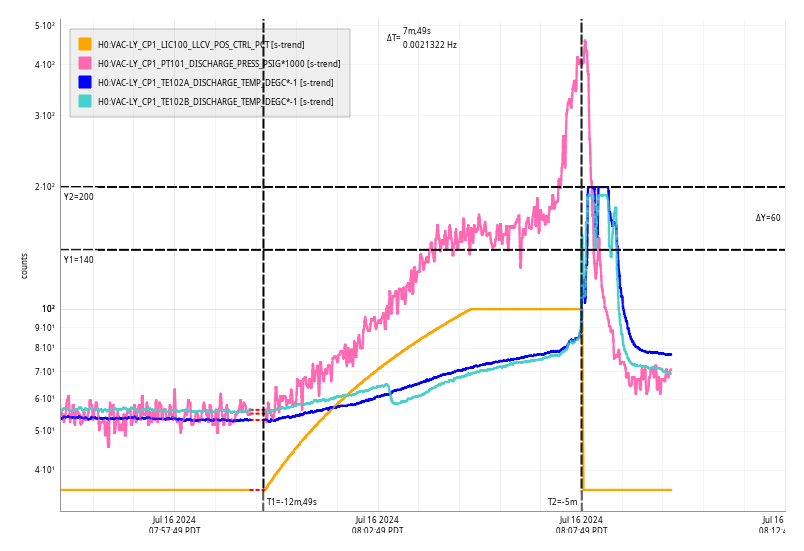
Sun Mar 17 10:09:59 2024 INFO: Fill completed in 9min 56secs


Images attached to this report
LHO General
ibrahim.abouelfettouh@LIGO.ORG - posted 08:12, Sunday 17 March 2024 - last comment - 09:42, Sunday 17 March 2024(76465)
OPS Day Shift Start

TITLE: 03/17 Day Shift: 15:00-23:00 UTC (08:00-16:00 PST), all times posted in UTC
STATE of H1: Commissioning
OUTGOING OPERATOR: None
CURRENT ENVIRONMENT:
    SEI_ENV state: CALM
    Wind: 3mph Gusts, 2mph 5min avg
    Primary useism: 0.02 μm/s
    Secondary useism: 0.18 μm/s
QUICK SUMMARY:

IFO is LOCKING (but seems to need help)

Other:

Seems hat the last lockloss happened ~4.5 hrs ago, triggered by an IY ISI Stage 1 and 2 WD Trip. No earthquakes occured during this time.

H1:PEM-CS_DUST_PSL101   dust counts did not change, please investigate.

EX Pressure EX_X5_PT526 MOD1 PRESS TORR is showing a yellow alert on the vacuum alarm handler.


Comments related to this report
jim.warner@LIGO.ORG - 09:42, Sunday 17 March 2024 (76466)

The ITMY trip seems to have been caused by the corner 1 interface chassis failing. All of the corner 1 CPS, L4C and GS13s are dead. Probably need to swap it out so Fil can take a look, but I think our only spare is installed in HAM8, at the moment.

H1 SQZ
camilla.compton@LIGO.ORG - posted 23:01, Saturday 16 March 2024 (76434)
ZM4/ZM5 PSAMs Adjust stepper script prepared and SQZ_ANG_ADJUST guardian commissioned

Summary: Took SQZ/ASQZ/NoSQZ data. Recommissioned SQZ_ANG_ADJUST guardian but leaving it off. Script prepared to change ZM4/ZM5 PSAMs while IFO is locked, this depends on SQZ IFO ASC and the SQZ_ANG_ADJUST working correctly. 
Nominal since yesterday is 205deg SQZ angle, PSAMS 120/120 76444.
I checked the SQZ BLRMs didn't have any unexpected peaks in and then scanned the ADF demod phase as we did in 74691.  From 108 to 150 in 2deg / 180second steps. See attached plot. SQZ_ANG_ADJUST servos the SQZ angle by keeping H1:SQZ-ADF_OMC_TRANS_SQZ_ANG at 0. Accepted new optimum H1:SQZ-ADF_OMC_TRANS_PHASE = 128 in sdf. Nominal in NLN for SQZ_ANG_ADJUST is still DOWN though it probably it now should be fine to keep on, we should change this next week. 

While trying to take ASQZ data, OPO unlocked. Took No SQZ time 4:45UTC to 4:55UTC, we are getting 4.8 dB of SQZ at 2kHz.No SQZ didn't look as good as 6/28/2023 ref. Relocked with different FC_WFS value, plot attached I needed to readjust sqz angle from 215 back to 205. After that we got better SQZ and ASQZ.. what changed? Different OPO temp or alignment or PZT at different range? I'm not sure. Think this means the SQZ_ANG_ADJUST setting is now wrong so adjusted to ADF_OMC_TRANS_PHASE = 140.

Have a script saved in userapps/../sqz/h1/scripts/PSAMs_double_raster.py that adjusts:

ZM4 PSAMs: 0, 50, 100, 150, 200V: (5 steps of 10 minutes each = 50 minutes), then step after the ZM5 step, step back down 200, 150, 100, 50, 0V.
ZM5 PSAMs: 0, 50, 100, 150, 200V for 5 steps of 50 minutes each = ~4 hours of data. 

The test will stop and go back to nominal phase and ZMs if the IFO looses lock. After the test the ZM PSAMs will slowly (5mins so ASC/ADF servos can keep up) be taken back to 120/120. 

Instructions for operator is there is time tomorrow:

Images attached to this report
H1 INS
gabriele.vajente@LIGO.ORG - posted 19:42, Saturday 16 March 2024 - last comment - 11:56, Tuesday 19 March 2024(76462)
OMC alignment

I tested again the OMC aligment with low frequency lines, as in 76335

It looks like there is still some modulation of the DARM line amplitude at 410.x Hz. There is also some effect on the pitch jitter line amplitude, but no effect on the yaw jitter line amplitude.

New offsets that simultaneously make the DARM calibration line maximum and the pitch jitter minimum:

  Old Diff New
A PIT -0.25 -0.07 -0.32
A YAW 0.1 0.1 0.2
B PIT -0.05 -0.05 -0.1
B YAW 0.07 -0.01 -0.03

I put those offsets in. The range dropped. So they are not good. I don't understand why. I reverted them. The range went back. A step in the other directions did not change the range much, but KAPPAC dropped.

Images attached to this report
Comments related to this report
gabriele.vajente@LIGO.ORG - 15:51, Monday 18 March 2024 (76494)

I checked that indeed GDS-CALIB_STRAIN was worse with the alignment offsets that made the range lower

Images attached to this comment
gabriele.vajente@LIGO.ORG - 11:56, Tuesday 19 March 2024 (76520)

Disregard the previous plot, there were two glitches in the data. DARM is slightly worse, but as significantly as thought.

Images attached to this comment
H1 ISC
gabriele.vajente@LIGO.ORG - posted 19:10, Saturday 16 March 2024 - last comment - 19:41, Saturday 16 March 2024(76461)
Alignment tests trying to reduce jitter noise

I started injecting jitter lines in the periscope PZT: pitch at 215 Hz, amplitude 20, yaw 135 amplitude 10, in H1:IMC-PZT_PIT and H1:IMC-PZT_YAW. The yaw line is very well visible in DARM, the pitch line is much smaller. This is as expected, since yaw is the main jitter that couples.

I tried to move the AS_C YAW offset to move the SRC, without any change in the jitter line amplitude, with offsets as large as 0.2.

I then tried to move the OMC alignment. It looks like there is little effect on yaw, but some effect on pitch. Bummer. More on a later alog with a full OMC alignment change.

Comments related to this report
gabriele.vajente@LIGO.ORG - 19:41, Saturday 16 March 2024 (76464)

Actually both PIT and YAW see coherence with DARM, so maybe this is worth some more thinking. The PZT injection is very visible in yaw, but not much in pitch

H1 ISC
gabriele.vajente@LIGO.ORG - posted 18:44, Saturday 16 March 2024 - last comment - 19:29, Saturday 16 March 2024(76460)
MICH FF retuned

I measured again MICH and SRCL FF. I could fit a MICH filter that improves the subtraction. SRCL is still work in progres.

The new MICH FF filter is loaded into FM1, it's better so I'll put in in guardian.

Images attached to this report
Comments related to this report
gabriele.vajente@LIGO.ORG - 19:29, Saturday 16 March 2024 (76463)

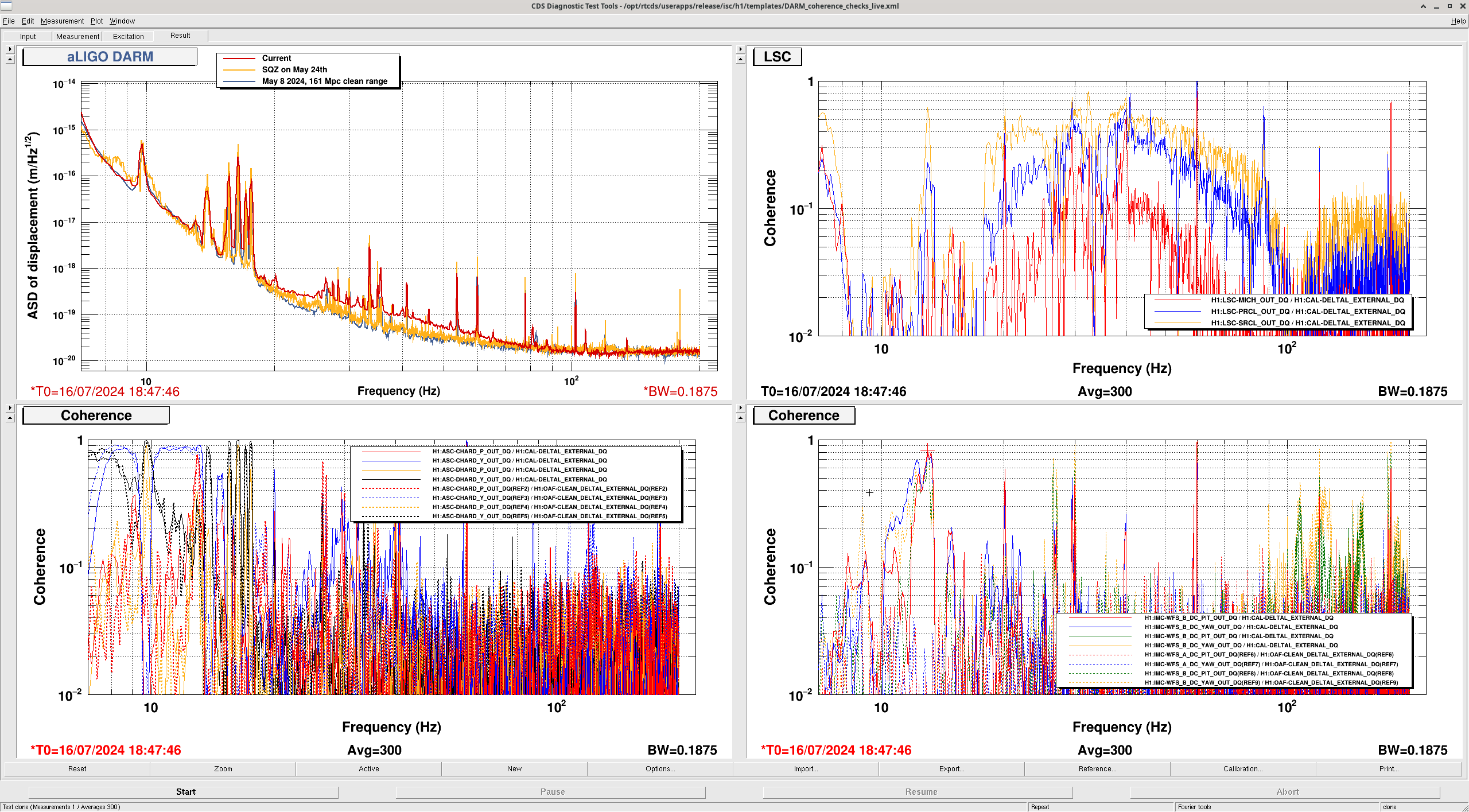
There is now almost no coherence with MICH, and with SRCL only at the ~100 Hz jitter peaks. So I think the current LSC FF are good.

Images attached to this comment
H1 ISC
gabriele.vajente@LIGO.ORG - posted 18:21, Saturday 16 March 2024 - last comment - 11:30, Monday 18 March 2024(76459)
New DARM offloading improves low frequency noise level and stationarity

We now have the new DARM offloading configuration up and running, and fully calibrated, so we can do a direct comparison of the old offloading (Old DARM) and new offloading (New DARM) using GDS-CALIB_STRAIN.

As pointed out by Elenna, the new DARM configuration improves the low frequency noise level. See first plot.

The old DARM configuration induced non-stationary noise at low frequency, as visible in the spectrogram in the second plot, and also in the whitened spectrogram in the third plot (where DARM is whitened with the median of the Old DARM configuration, to show at the same time the reduction in noise and the better stationarity).

Those same spectrograms also show that the new DARM configuration makes the low frequency noise more stationary.

Other comparison plots:

Finally, the last two plots show bicoherence of DARM with the ESD drive in old DARM and new DARM: nothing is visible in new DARM.

Images attached to this report
Comments related to this report
evan.hall@LIGO.ORG - 11:30, Monday 18 March 2024 (76476)

Great! This tripled the volumetric sensitivity to 500+500 M☀️ intermediate-mass black holes.

Non-image files attached to this comment
LHO General
ibrahim.abouelfettouh@LIGO.ORG - posted 16:12, Saturday 16 March 2024 (76458)
OPS Day Shift Summary

TITLE: 03/16 Day Shift: 15:00-23:00 UTC (08:00-16:00 PST), all times posted in UTC
STATE of H1: Commissioning
INCOMING OPERATOR: None
SHIFT SUMMARY:

IFO is in NLN and COMISSIONING - 17:56 Hour Lock!

Conducted the following measurements with instructions from comissioners;

1. SRC Detuning and Sensing - alog 76457

2. Calibration Suite and Broadband Measurements - H1_calibration_report_20240316T161823Z - alog 76455

3. DARM Offset Test - alog 76454

Other:

EX Pressure EX_X5_PT526 MOD1 PRESS TORR is showing a yellow alert on the vacuum alarm handler - this is still the case and the trend just shows that it has been zero forever (years). - don't know what's going on here, but do not think it's serious.
 

LOG:

22:05 (ish) UTC - Gabriele arrived on site


H1 ISC (ISC)
ibrahim.abouelfettouh@LIGO.ORG - posted 15:51, Saturday 16 March 2024 (76457)
SRC Detuning and Sensing

Louis, Ibrahim

The test was successful and results can be found in:

/ligo/gitcommon/noise_recorder/data/pcaly_noise/

/ligo/gitcommon/noise_recorder/data/pcaly_noise/

with some variant of today's date (03/16/24) and the title SRCLOFFSET

Screenshots show trends of both the SRC Offset and the SQZ Phase over the course of the test.

Images attached to this report
H1 ISC
trent.gayer@LIGO.ORG - posted 18:42, Friday 15 March 2024 - last comment - 08:41, Monday 18 March 2024(76386)
OMC finnese for different pzt voltages

Georgia, Trent

To get the finesse of the omc as a function of the pzt voltage (in order to double check the pzt voltage calibration). OMCscan.py has shortcoming in that it doesn't like when there are more than three carrier 00 peaks so to get three carrier 00 peaks that were included in my initial scan I had to seperate the data into two "bins". I had the GPS time 1393542033 with a duration of 80 to get the first two peaks and the GPS time 1393542063 with a duration of 60 to get the second and third peaks. The links of the GPS times are the corresponding pzt calibrations. The links in the finesse are the zoomed in plots for the corresponsing peaks. To get the plots we ran OMCscan.py and fit_peak_w_args.py

Field Mode q Finesse PZT Voltage [V]
Carrier 00 0 404 7.3
1 408 50.6
2 404 91.0
10 0 395 41.8
1 406 82.0
20 0 367 32.7
1 368 73.1
45 upper 00 -1 372 15.7
45 lower 00 0 356 43.7


Images attached to this report
Non-image files attached to this report
Comments related to this report
trent.gayer@LIGO.ORG - 08:41, Monday 18 March 2024 (76471)

Here is a plot of all the finesses versus the pzt voltages.

Images attached to this comment
H1 ISC (ISC)
craig.cahillane@LIGO.ORG - posted 17:12, Friday 15 March 2024 - last comment - 06:56, Monday 18 March 2024(76442)
CARM to DARM at 50-100 kHz
Graeme, Matt, Craig

Using our setup from yesterday (alog 76397), we injected into the common mode board and measured a CARM to DARM transfer function.
Matt will post plots, comparisons, and measurement times later.

I am posting the data now, it lives in /ligo/gitcommon/psl_measurements/data/carm_to_darm_tfs/.

Just to clarify what these measurements are, we injected a 600 mV broadband white noise injection from 51.2 kHz to 102.4 kHz frequency span into the common mode board excitation point.
We measured out at the REFL A 9 QMON at the PSL racks (which is actually REFL A 9 I used for frequency feedback) and out of the OMC DCPD whitening chassis A+ terminal, patched over to the PSL racks as described in alog 76397.

We saw a significant rise in the REFL A 9 QMON noise as we injected more (Matt's plots to come), but very little increase in the OMC DCPD noise.
We had around 5e-3 coherence between the two at best.
We took 10000 averages, so we believe that anything above 1e-4 is "well-resolved".

We did not have time to try injecting between 1 kHz and 51.2 kHz before we lost lock, or to try looking at OMC DCPD A / EXC
We were not injecting at the time of the lockloss.  
We left the SR785 out there but not plugged in to anything on the racks so we can relock peacefully.

EDIT:
We went back out, got some data betwen 1 kHz and 52 kHz, and then unplugged everything, including the SR785 and the HAM6 OMC DCPD A+ whitening chassis cable.  We didn't unplug the patch panel connection.
Non-image files attached to this report
Comments related to this report
matthewrichard.todd@LIGO.ORG - 06:56, Monday 18 March 2024 (76443)

I've also attached my notes of the measurement process, displaying port connections as well as injection times and so on.

Measurement Span Injection Times Excitation Amp Data / Plots
IMC OLG Transfer Function 10kHz-102kHz

2024/03/15 15:17 - 15:41 PST

(MC Common Mode Servo Common Path Exc A)

100mV  
CARM Measurement 10kHz-102kHz

2024/03/15 15:43 - 15:47 PST

(IFO Common Mode Servo Common Path Exc A)

100mV  
CARM to DARM Measurements 50kHz-100kHz

2024/03/15 16:17 - 16:36 PST

(IFO Common Mode Servo Common Path Exc A)

600mV Without_Exc_Vs_Exc_CARM_to_DARM
CARM to DARM Measurements 1kHz - 52kHz

2024/03/15 15:54 - 18:00 PST

(IFO Common Mode Servo Common Path Exc A)

300mV

OMC_DCPD/REFL9I Coherence

CARM to DARM transfer func.

OMC_DCPD & REFL9I PSDs

OMC_DCPD/REFL9I CSDs

OMC DCPD excitation 1kHz - 52kHz

2024/03/15 18:13 - 18:16 PST

(IFO Common Mode Servo Common Path Exc A)

300mV

OMC_DCPD vs. Excitation Coherence

OMC_DCPD vs Excitation Transfer Func.

OMC_DCPD, PSD with Excitation

Loop Suppression to CARM 1kHz - 52kHz

2024/03/15 18:24 - 18:32 PST

(IFO Common Mode Servo Common Path Exc A)

300mV  
Images attached to this comment
Non-image files attached to this comment
H1 SQZ
naoki.aritomi@LIGO.ORG - posted 20:39, Thursday 14 March 2024 - last comment - 15:56, Saturday 16 March 2024(76405)
Less CLF power gives better squeezing

Naoki, Dhruva, Nutsinee

Yesterday we had only 3dB squeezing at IFO so we checked squeezing at homodyne. Although the visibility is good (98.5%), the squeezing was only 4.5dB at homodyne with 6dBm CLF6. We reduced the CLF power and recovered 8dB squeezing as shown in the attached figure.

The CLF6 was reduced from 6dBm to -42dBm and the 8dB squeezing was obtained with -38dBm CLF6. The CLF6 between -38 and -20 dBm gave similar squeezing so we set it at -24dBm, which is similar to O4a value and corresponds to 8uW CLF_REFL_LF_OUTPUT. The squeezing at IFO is recovered to 4.5dB with -24dBm CLF6.

Note that the LLO also saw the better squeezing at IFO with less CLF power in LLO70072.

We had 6.5dB squeezing at homodyne in 76040 and 4.5dB squeezing at IFO in 76226 with 6dBm CLF6 before. The question is why we lost squeezing at homodyne and IFO this week with same CLF power? The commissioning list in 76369 might give us a clue.

Images attached to this report
Comments related to this report
daniel.sigg@LIGO.ORG - 12:49, Friday 15 March 2024 (76429)

At high CLF power we have about 12 uW of light for CLF and RLF after the OPO. Each homodyne PD has 0.5 mW of power, or 1 mW total. This yields a CLF/RLF to LO ratio of 0.012. Using the equation Gamma^2/2 to get the modulation index, we obtain an estimate of 150 mrad for the maximum phase modulation. In reality, it will be somewhat smaller since some of the power will be in amplitude modulation. This will limit the maximum amount of achievable squeezing on the homodyne. But, this has no bearing on the DCPDs, since the CLF/RLF to LO ratio there is approximetaly 5000 times smaller.

nutsinee.kijbunchoo@LIGO.ORG - 15:56, Saturday 16 March 2024 (76452)SQZ

A bit more details on this.

The power ratio between SB and CR of each sideband is approximated to be ~ (gamma/2)^2 where gamma is modulation depth in radian. Add the two sidebands together you get (gamma^2)/2.


A total power transmits through the OPO during high CLF case was 12uW. A total LO power hitting the HD was 1mW. So the phase noise contribution to HD sqz was

(gamma^2)/2 = 12uW/1mW 

High CLF phase noise (gamma) at the homodyne = 154mrad (max)


A total power transmits through the OPO during low CLF case was 0.6 uW. A total LO power hitting the HD was 1mW. So the phase noise contribution to HD sqz was

Low CLF phase noise (gamma) at the homodyne = sqrt(2*0.6uW/1mW) = 35mrad (max)


These number include amplitude modulation. It's the worse case that could possibly happen. Using 45 mrad of phase noise and *16dB of asqz fits the high CLF squeezing of 6.5 dB in the homodyne. 15 mrad and 16 dB of squeezing fits the low CLF squeezing of 8 dB in the HD.


For the IFO case we've only injected sqz using low CLF so far. All the sideband power gets attenuated by the OMC (a factor of 5000). The LO (IFO carrier) is ~40mW. Phase noise contribution from CLF/RLF sidebands is 0.08 mrad, which is negligible. Even for high CLF power (RF6 = 6 dBm) this phase noise would be 0.3 mrad. That number is still negligible so there's no reason why we shouldn't be able to see good squeezing with high CLF. Using **15dB of aSQZ and a loss of ***30% we have 5 dB of squeezing as observed on Friday. 


*ASQZ trace overlapped with 16 dB aSQZ reference in HD https://alog.ligo-wa.caltech.edu/aLOG/uploads/73562_20231018171710_8dB_hd_sqz_2023Oct18.png

**15 dB of aSQZ in DARM https://alog.ligo-wa.caltech.edu/aLOG/index.php?callRep=76426

*** If I'm reading this noise budget correctly the inferred loss in the IFO is 30%. 


Images attached to this comment
Displaying reports 12281-12300 of 86532.Go to page Start 611 612 613 614 615 616 617 618 619 End