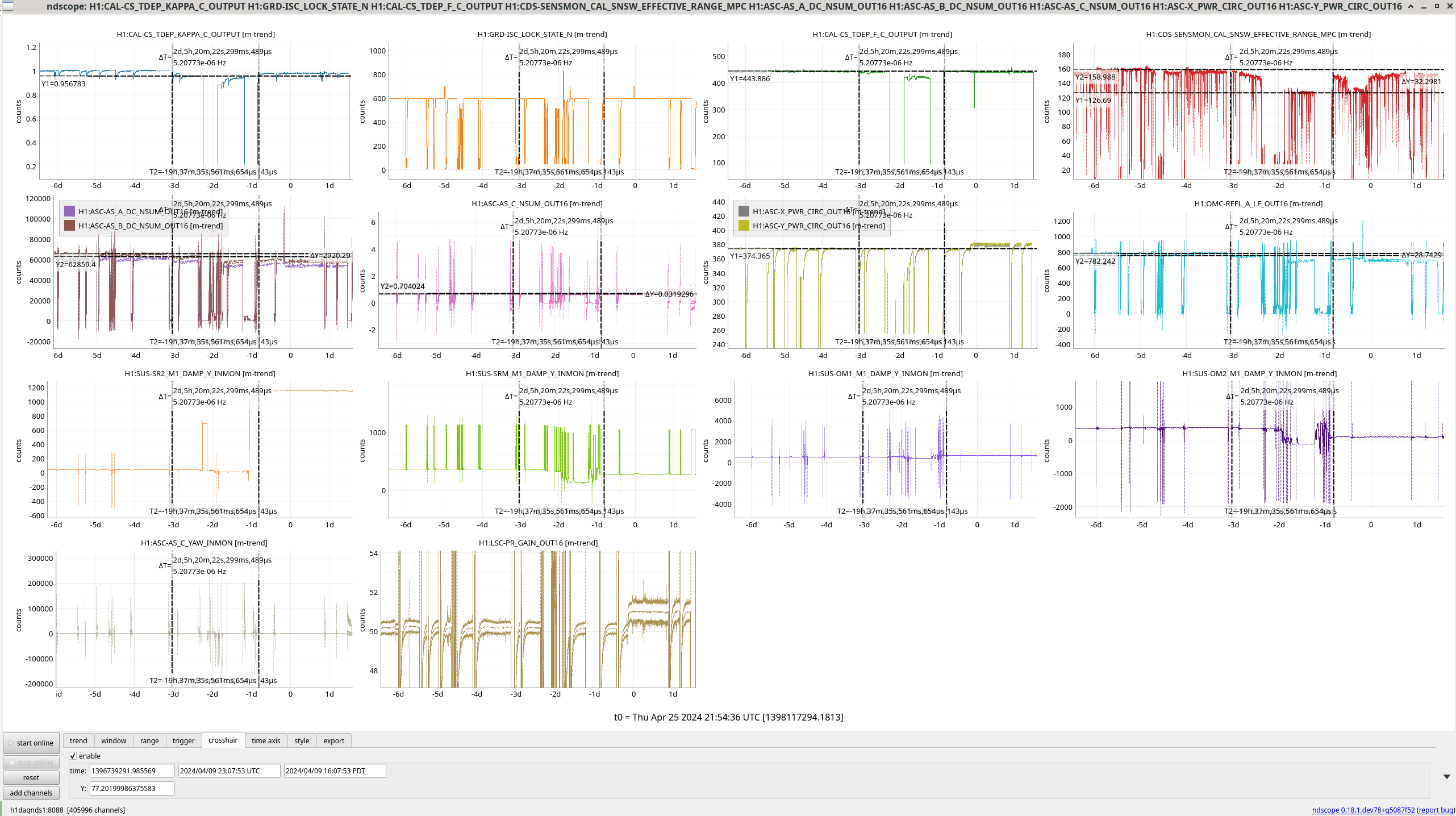
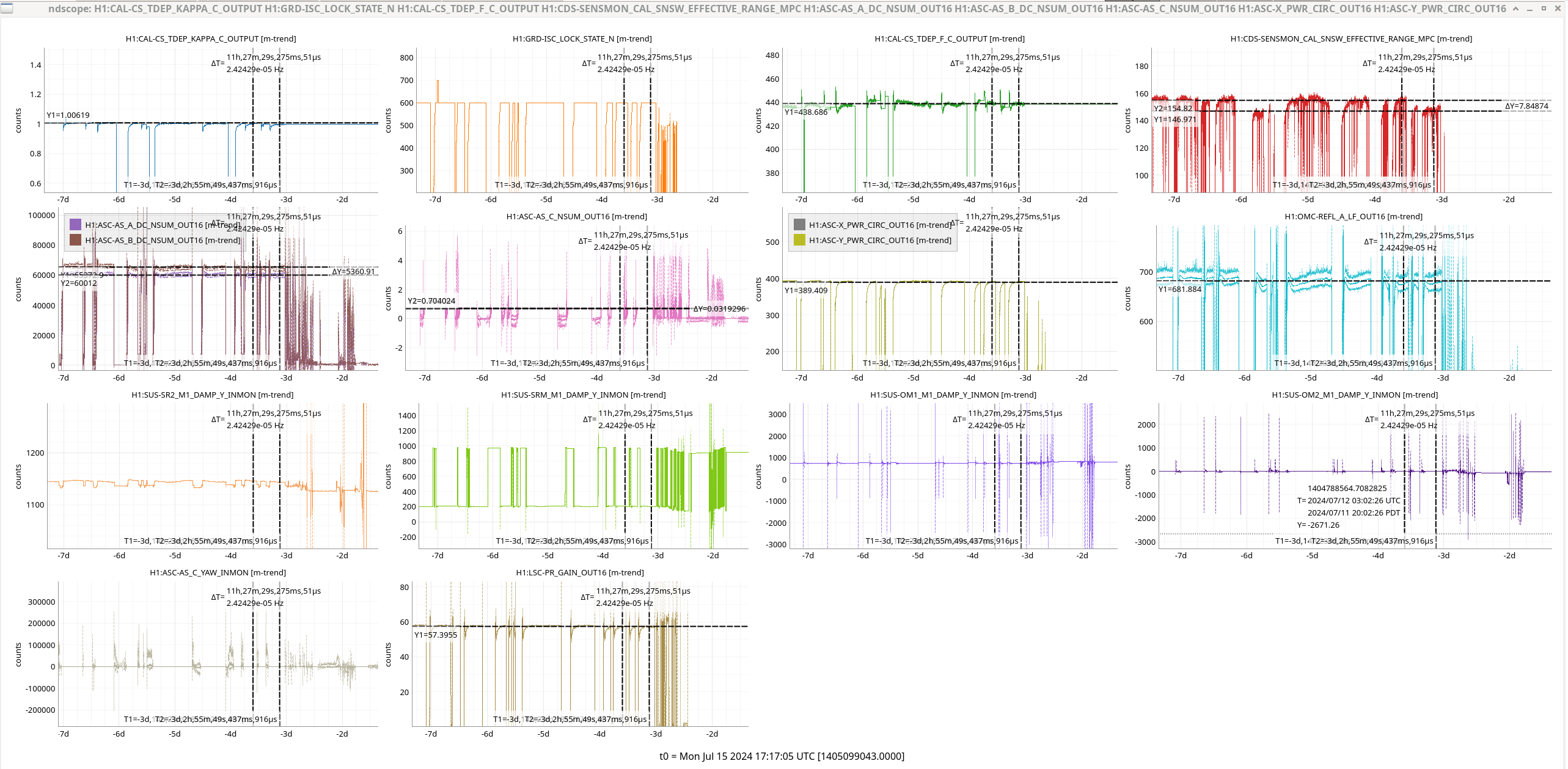
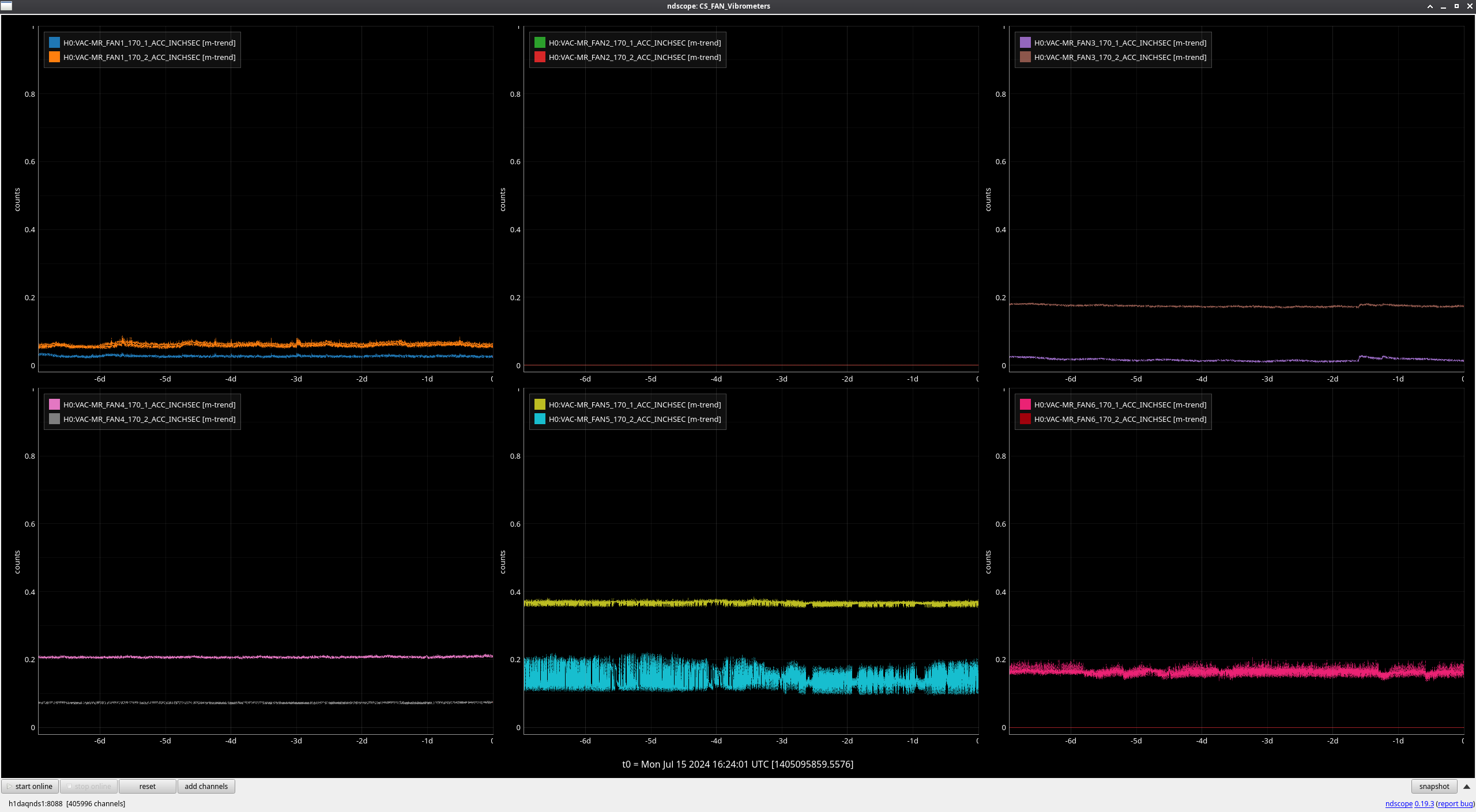
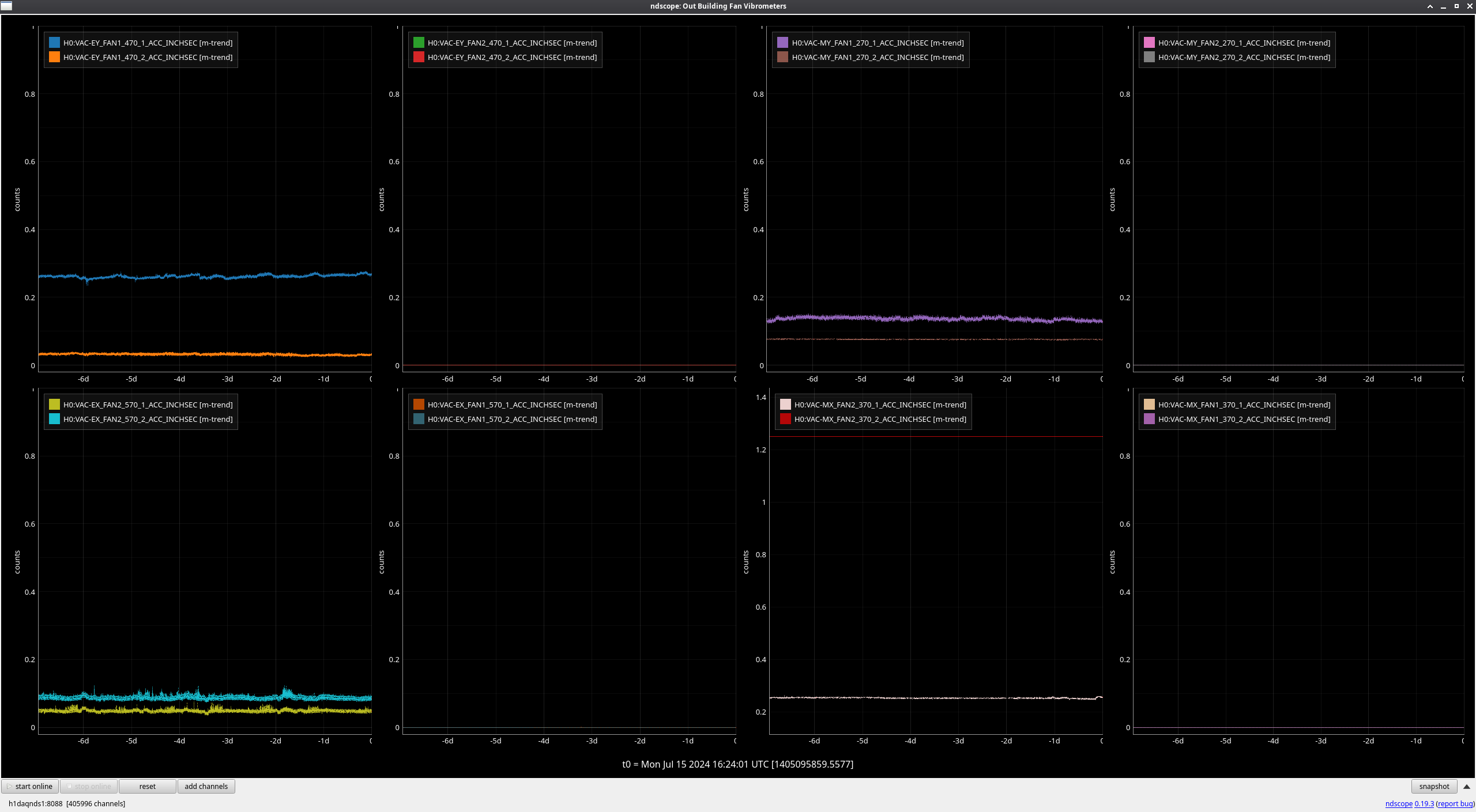
I've written a new check_model_changes program (used to be called check_model_daq_changes) to additionally check for any IPC addition or removal.
If an IPC sender has been removed, the code gives the list running models which currently have receivers as a reminder that they should also be changed.
The code is designed to be ran between running "rtcds build" and "rtcds install" to catch any issues before the production files are overwritten.
If the list of DAQ channels which have been added/removed is long, the code defaults to showing the first ten channels. The --all argument gives the full list.
For example, after building the h1susitmx and h1isiitmx models on h1build:
david.barker@opslogin0: check_model_changes h1susitmx
--------------------- file times ----------------------
Fri Mar 15 13:35:17 2024 = Model build time
Tue Mar 12 14:47:02 2024 = Current configuration load time
DAQ configuration is changed, processing...
++: slow channel H1:SUS-ITMX_R0_WD_OSEMAC_RMSLP_F1_OFFSET added to the DAQ
++: slow channel H1:SUS-ITMX_R0_WD_OSEMAC_RMSLP_F1_GAIN added to the DAQ
++: slow channel H1:SUS-ITMX_R0_WD_OSEMAC_RMSLP_F1_LIMIT added to the DAQ
++: slow channel H1:SUS-ITMX_R0_WD_OSEMAC_RMSLP_F1_TRAMP added to the DAQ
++: slow channel H1:SUS-ITMX_R0_WD_OSEMAC_RMSLP_F1_SWREQ added to the DAQ
++: slow channel H1:SUS-ITMX_R0_WD_OSEMAC_RMSLP_F1_SWMASK added to the DAQ
++: slow channel H1:SUS-ITMX_R0_WD_OSEMAC_RMSLP_F1_INMON added to the DAQ
++: slow channel H1:SUS-ITMX_R0_WD_OSEMAC_RMSLP_F1_EXCMON added to the DAQ
++: slow channel H1:SUS-ITMX_R0_WD_OSEMAC_RMSLP_F1_OUT16 added to the DAQ
++: slow channel H1:SUS-ITMX_R0_WD_OSEMAC_RMSLP_F1_OUTPUT added to the DAQ
++: ... plus 210 more slow channels ...
--: slow channel H1:SUS-ITMX_DACKILL_STATE removed from the DAQ
--: slow channel H1:SUS-ITMX_DACKILL_RESET removed from the DAQ
--: slow channel H1:SUS-ITMX_DACKILL_BPSET removed from the DAQ
--: slow channel H1:SUS-ITMX_DACKILL_BPTIME removed from the DAQ
--: slow channel H1:SUS-ITMX_DACKILL_PANIC removed from the DAQ
--: slow channel H1:FEC-29_IPC_SUS_ITMX_M0R0_WDMON_STATE_DOLPHIN_TX removed from the DAQ
--: slow channel H1:FEC-29_IPC_SUS_ITMX_M0R0_WDMON_STATE_SHMEM_TX removed from the DAQ
--: slow channel H1:SUS-ITMX_R0_WD_OSEMAC_SD_RMSMON removed from the DAQ
--: slow channel H1:SUS-ITMX_R0_WD_OSEMAC_RT_RMSMON removed from the DAQ
--: slow channel H1:SUS-ITMX_R0_WD_OSEMAC_LF_RMSMON removed from the DAQ
--: ... plus 19 more slow channels ...
Total number of DAQ changes = 249
(220 additions, 29 deletions)
IPC Senders have been removed
Please wait while ipc receiver database is generated...
----------------------------------------------------------------------------------------------------------------------------done
IPC: 2 Removed Senders
H1:FEC-29_IPC_SUS_ITMX_M0R0_WDMON_STATE_DOLPHIN NOTE: receiver in model(s) ['h1isiitmx']
H1:FEC-29_IPC_SUS_ITMX_M0R0_WDMON_STATE_SHMEM NOTE: receiver in model(s) ['h1susitmpi']
david.barker@opslogin0: check_model_changes h1isiitmx
--------------------- file times ----------------------
Fri Mar 15 13:20:55 2024 = Model build time
Tue Mar 12 14:47:01 2024 = Current configuration load time
DAQ configuration is changed, processing...
--: slow channel H1:FEC-70_IPC_SUS_ITMX_M0R0_WDMON_STATE_DOLPHIN_ER removed from the DAQ
--: slow channel H1:FEC-70_IPC_SUS_ITMX_M0R0_WDMON_STATE_DOLPHIN_ET removed from the DAQ
--: slow channel H1:FEC-70_IPC_SUS_ITMX_M0R0_WDMON_STATE_DOLPHIN_PS removed from the DAQ
--: slow channel H1:FEC-70_IPC_SUS_ITMX_M0R0_WDMON_STATE_DOLPHIN_RX removed from the DAQ
Total number of DAQ changes = 4
(0 additions, 4 deletions)
IPC: 1 Removed Receiver:
H1:FEC-70_IPC_SUS_ITMX_M0R0_WDMON_STATE_DOLPHIN
The readback of the broadband PD in transmission of the SHG (SQZ-SHG_TRANS_DC) was electronicslly saturating. We switched the gain from 10x to 1x on the generic PD interface box and adjusted the transimpedance gain accordingly. The readback now shows ~1.2V and 7.2mW.
Closes FAMIS 26235
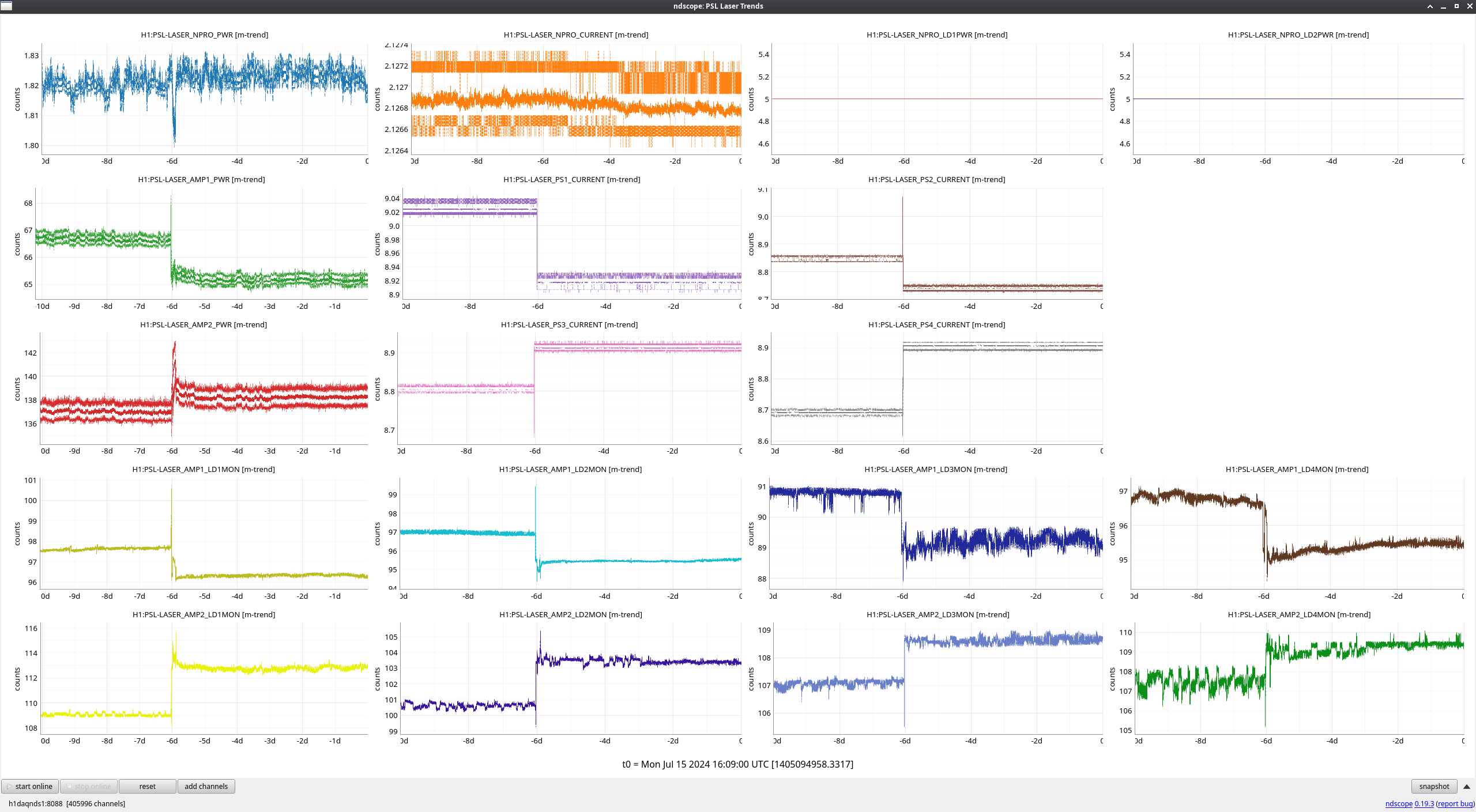
Laser Status:
NPRO output power is 1.819W (nominal ~2W)
AMP1 output power is 67.79W (nominal ~70W)
AMP2 output power is 138.9W (nominal 135-140W)
NPRO watchdog is GREEN
AMP1 watchdog is GREEN
AMP2 watchdog is GREEN
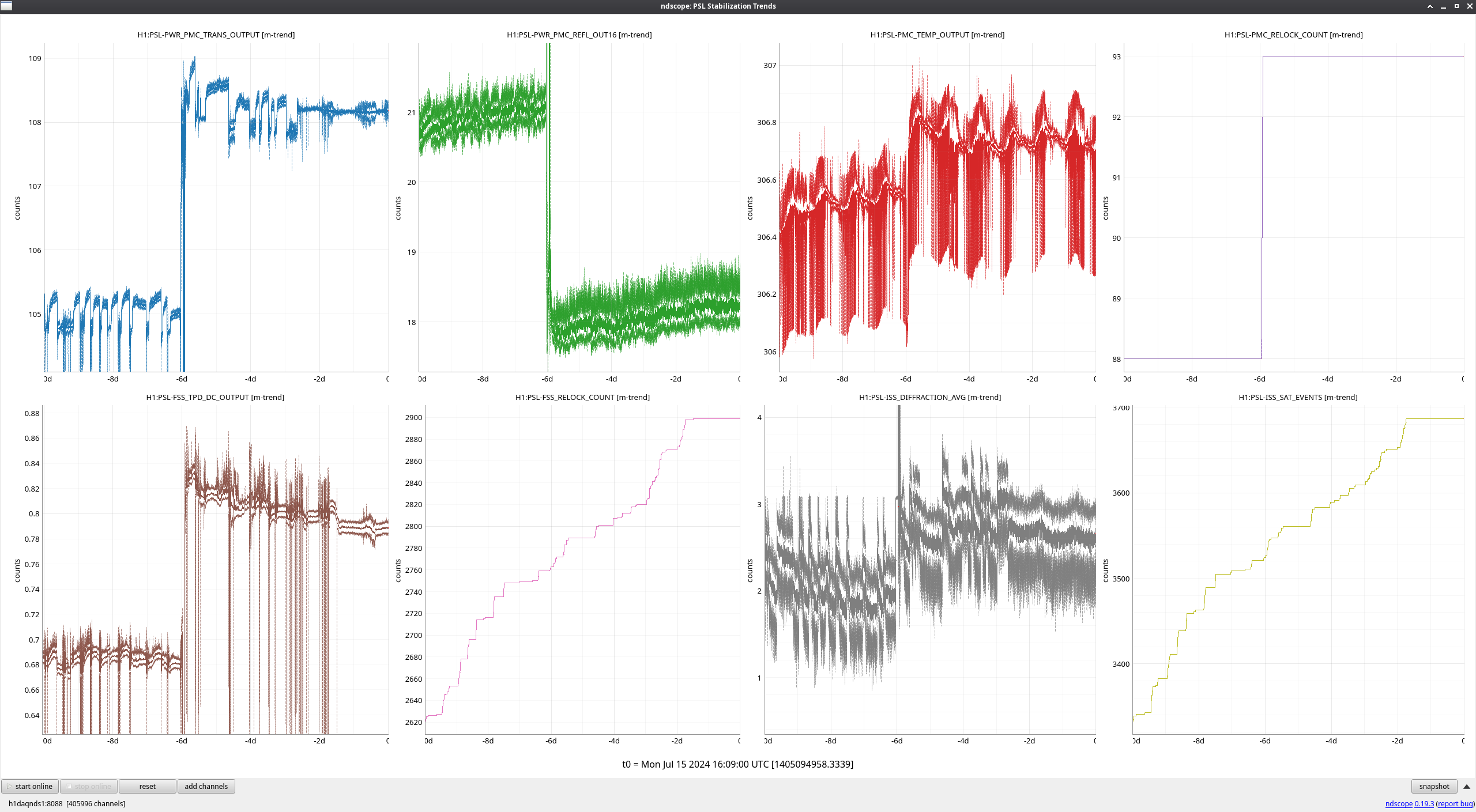
PMC:
It has been locked 14 days, 20 hr 29 minutes
Reflected power = 16.63W
Transmitted power = 109.4W
PowerSum = 126.1W
FSS:
It has been locked for 0 days 0 hr and 25 min
TPD[V] = 0.8046V
ISS:
The diffracted power is around 2.5%
Last saturation event was 0 days 0 hours and 25 minutes ago
Possible Issues: None
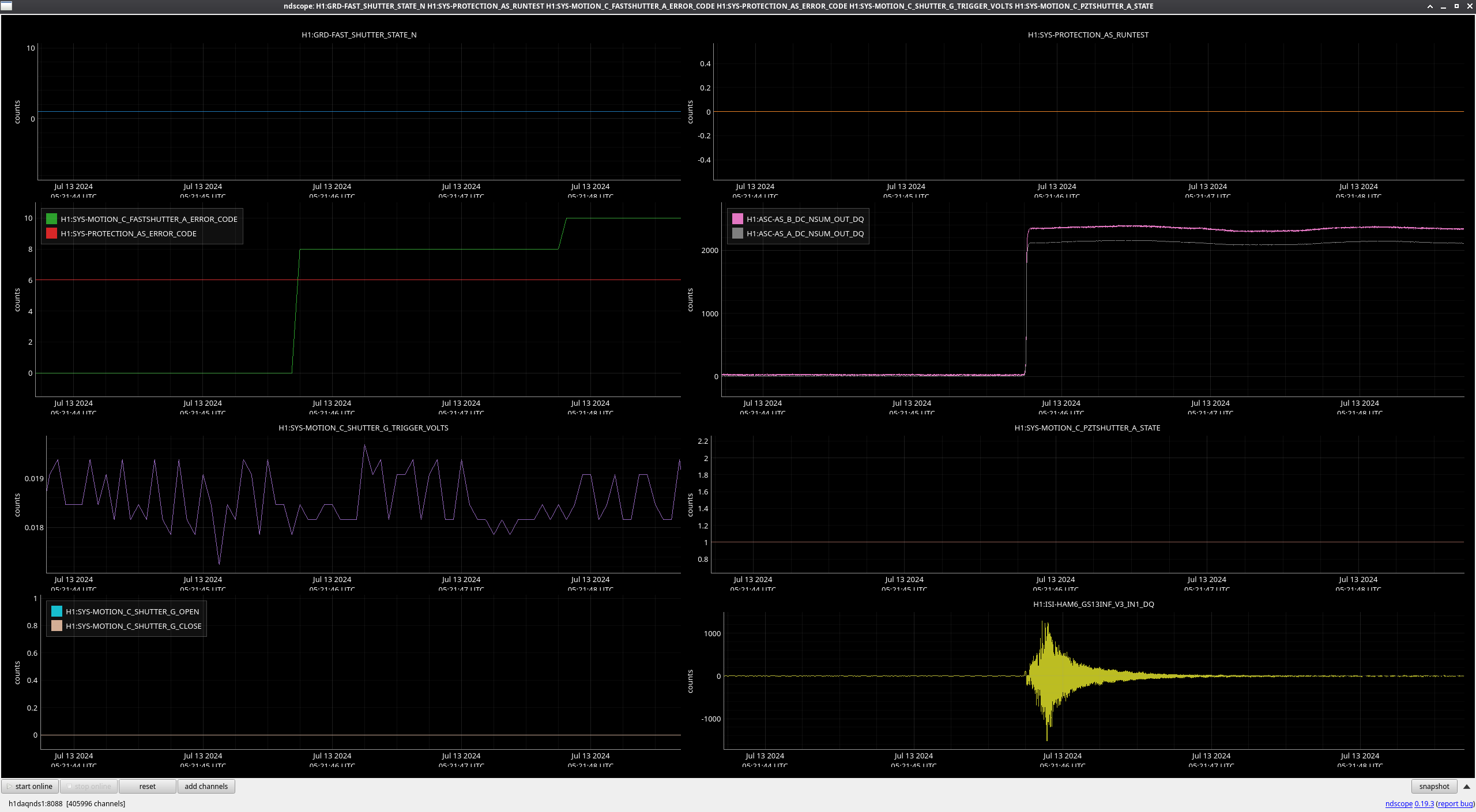
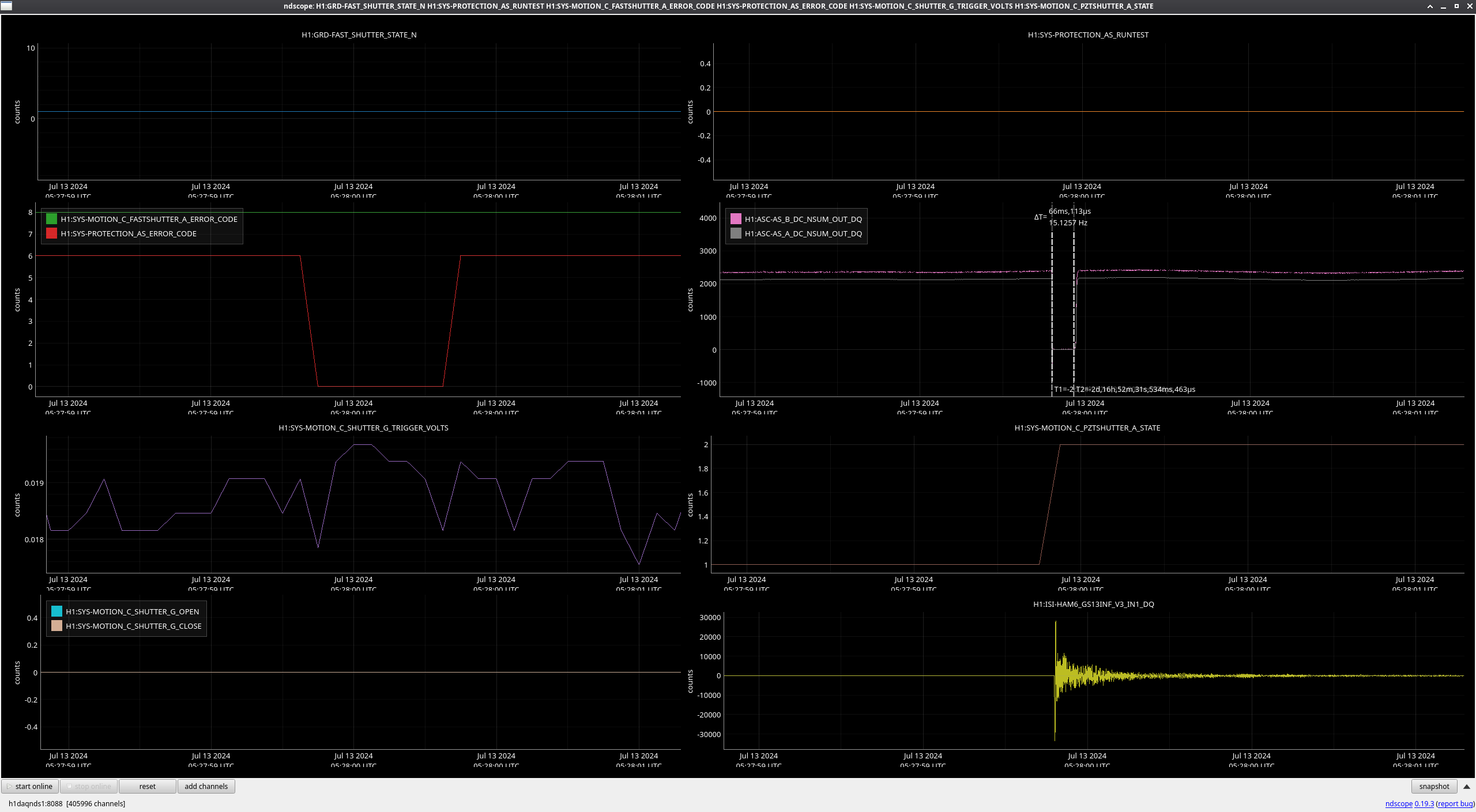
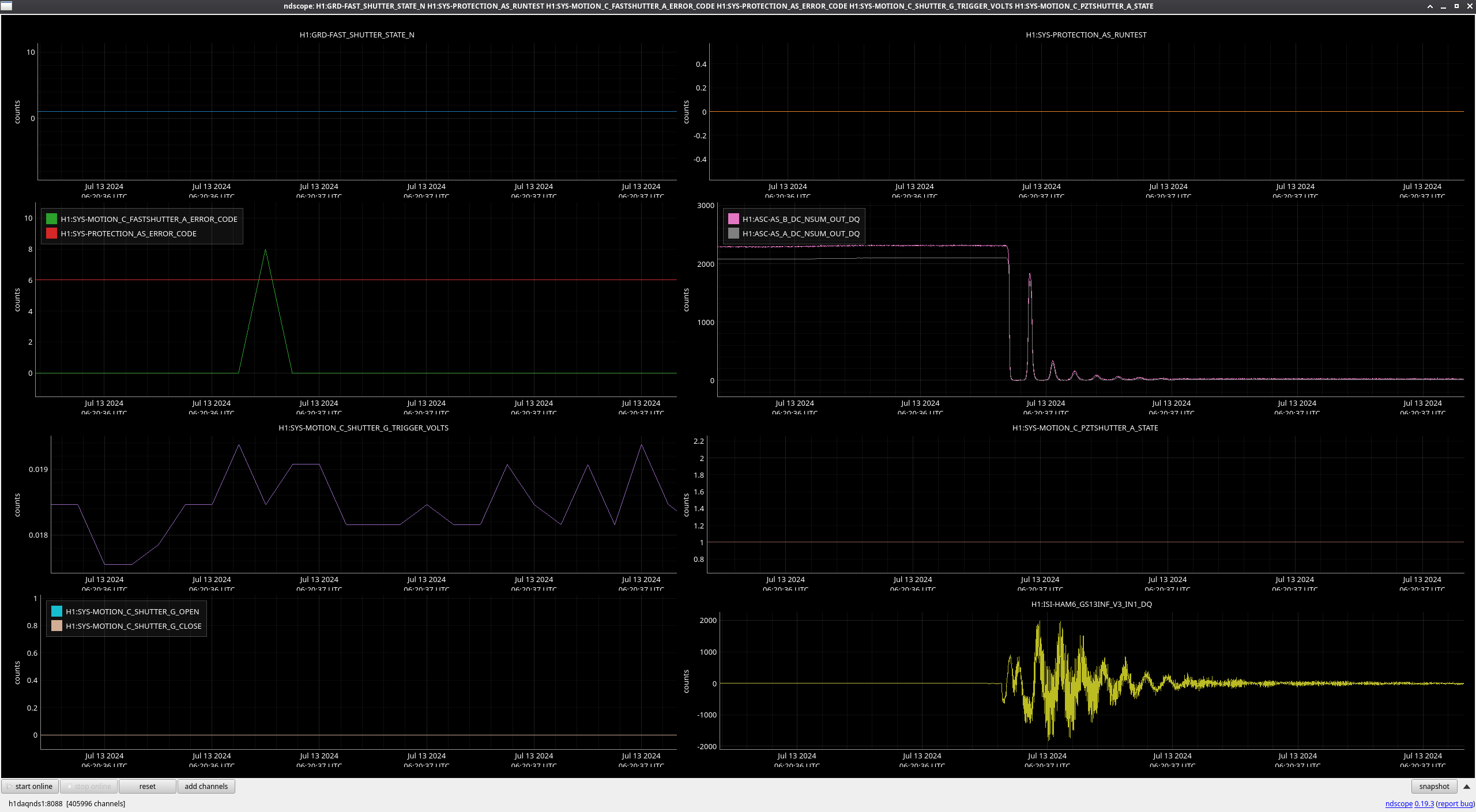
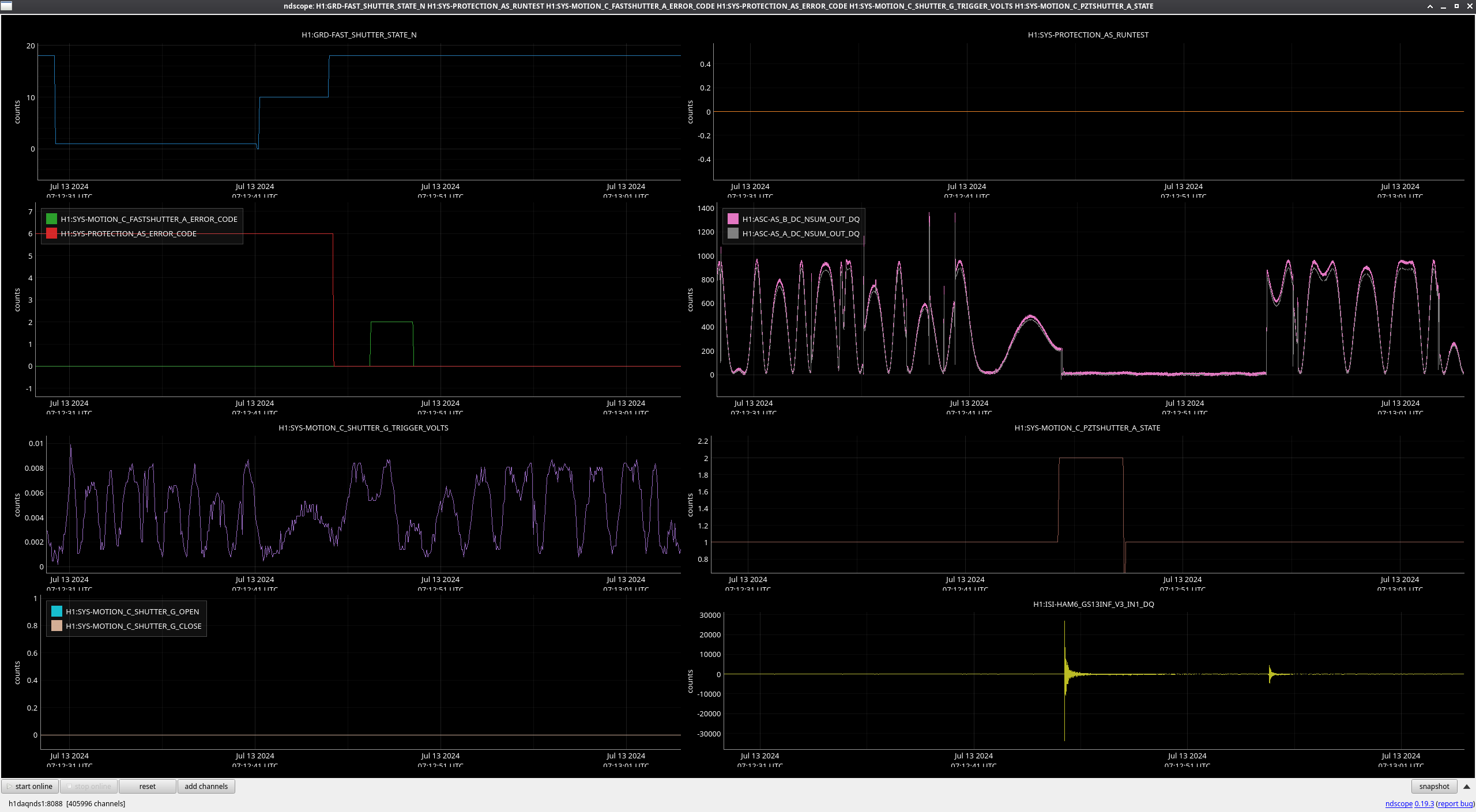
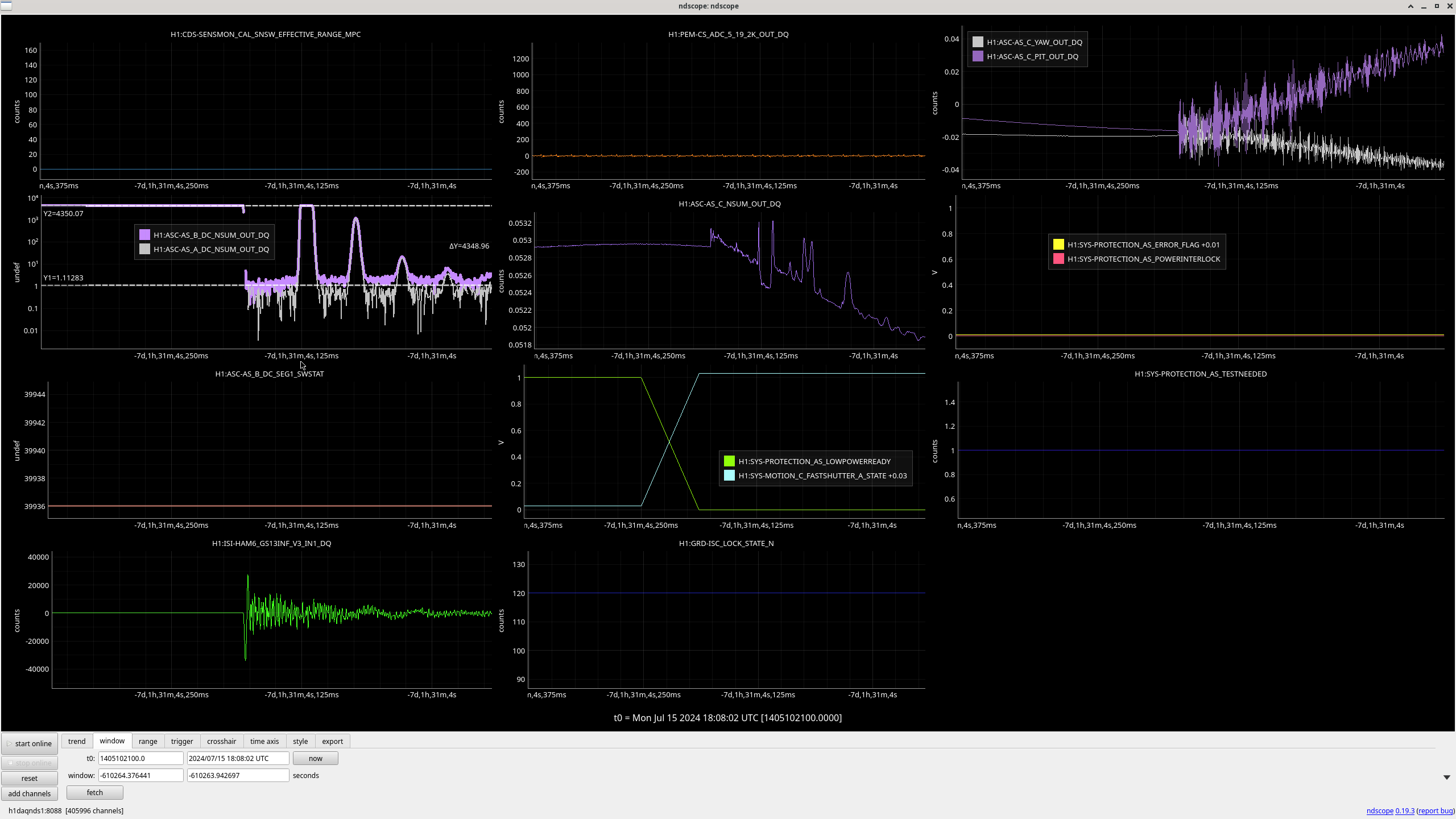
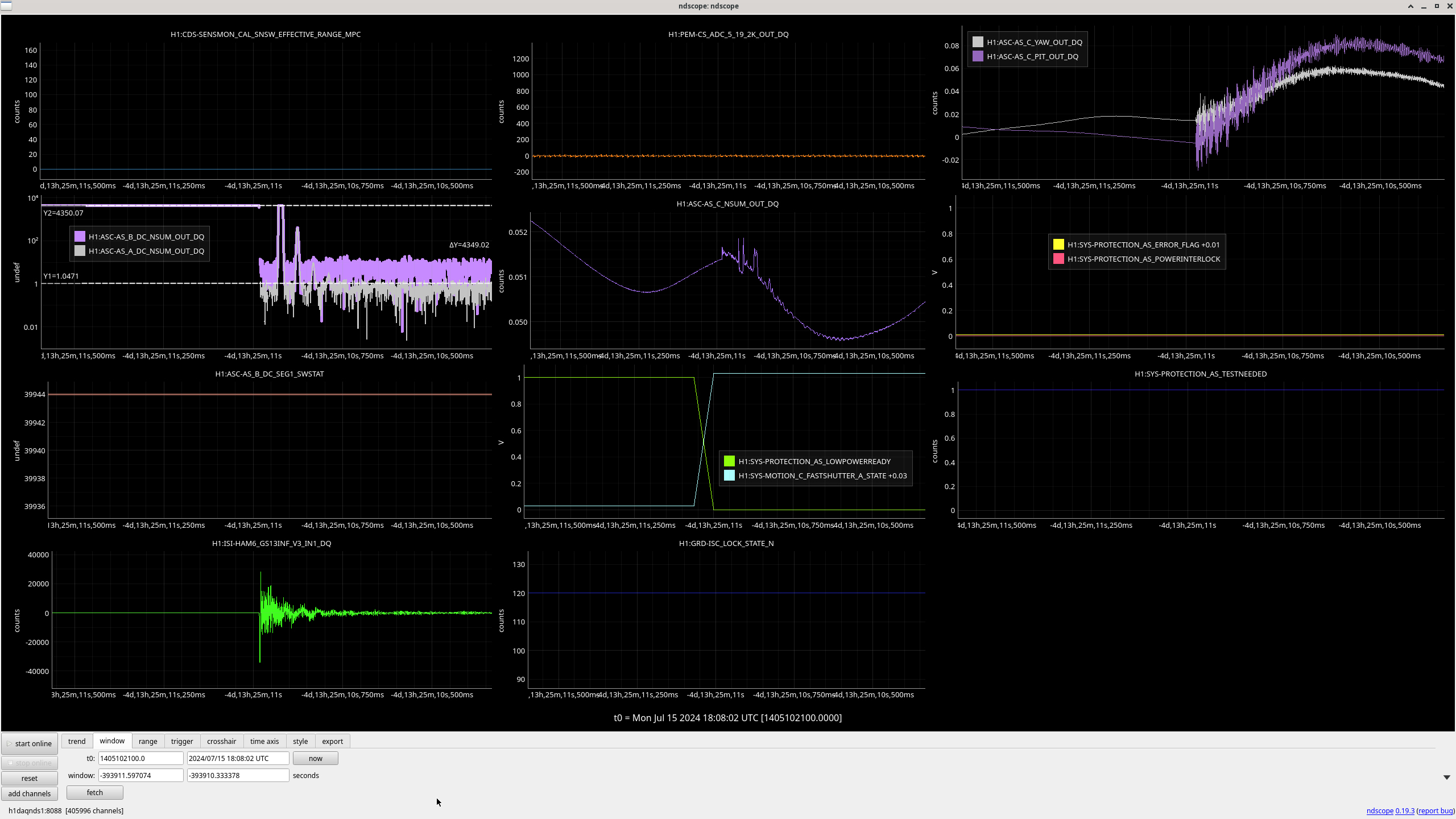
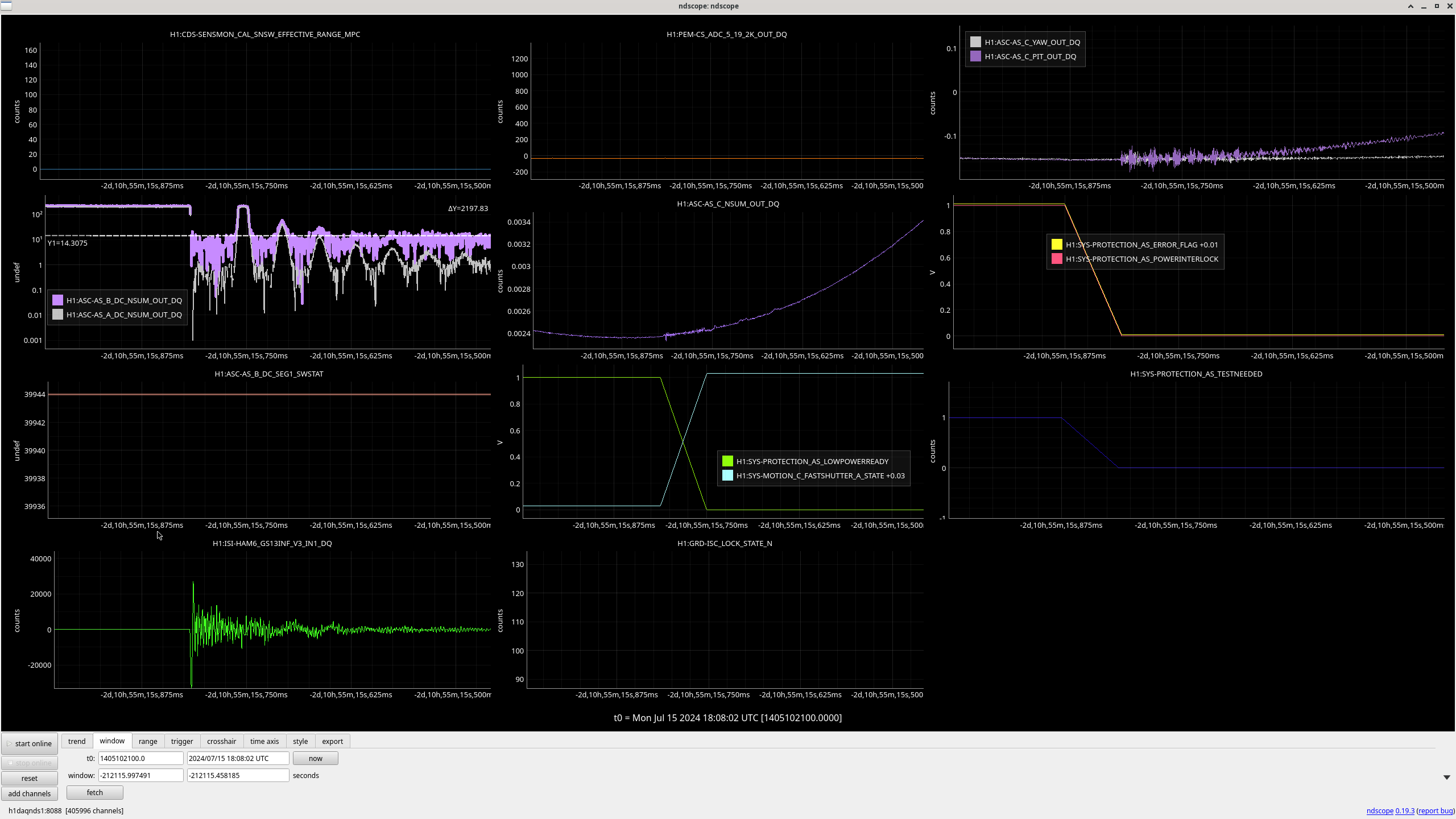
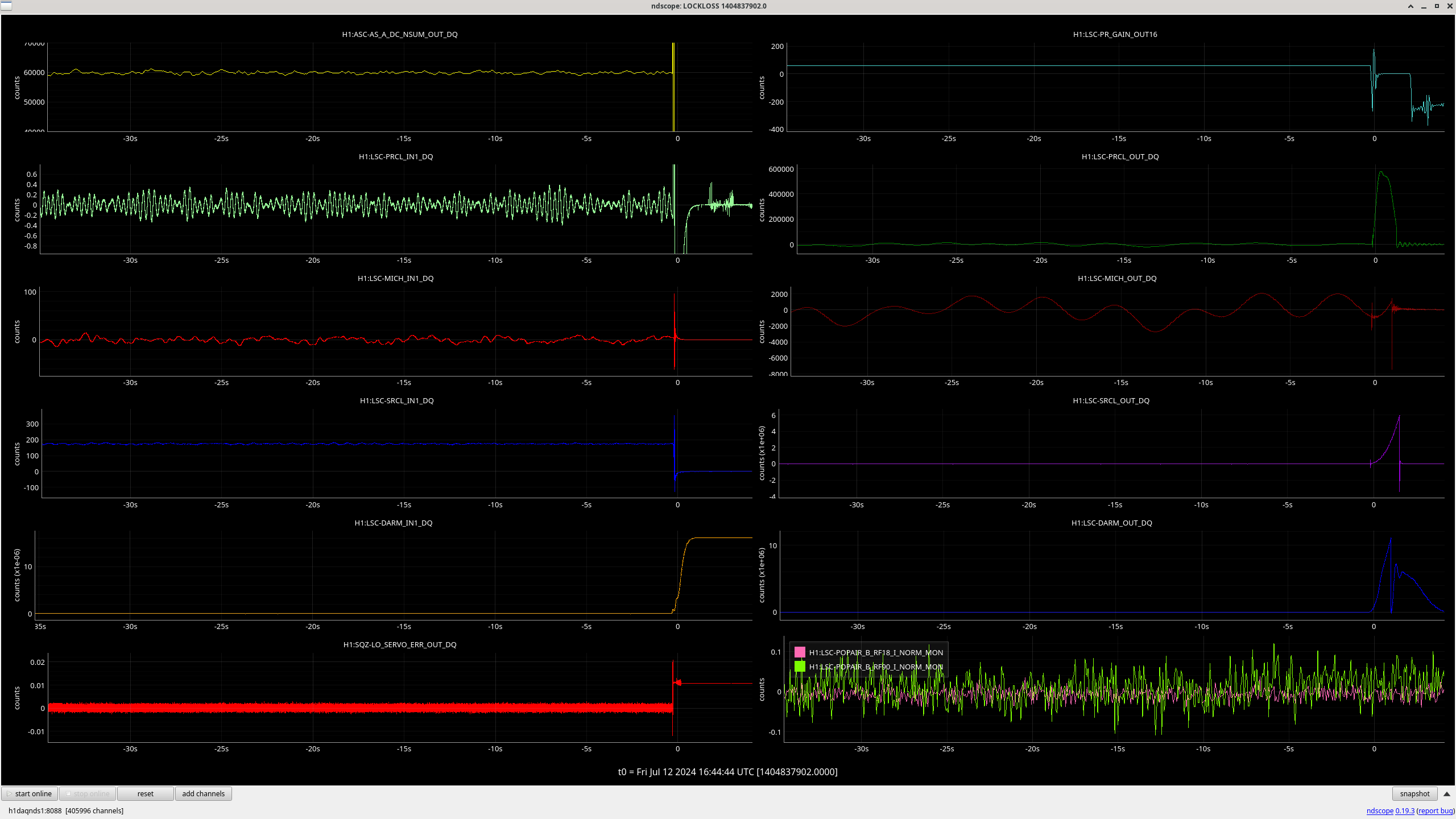
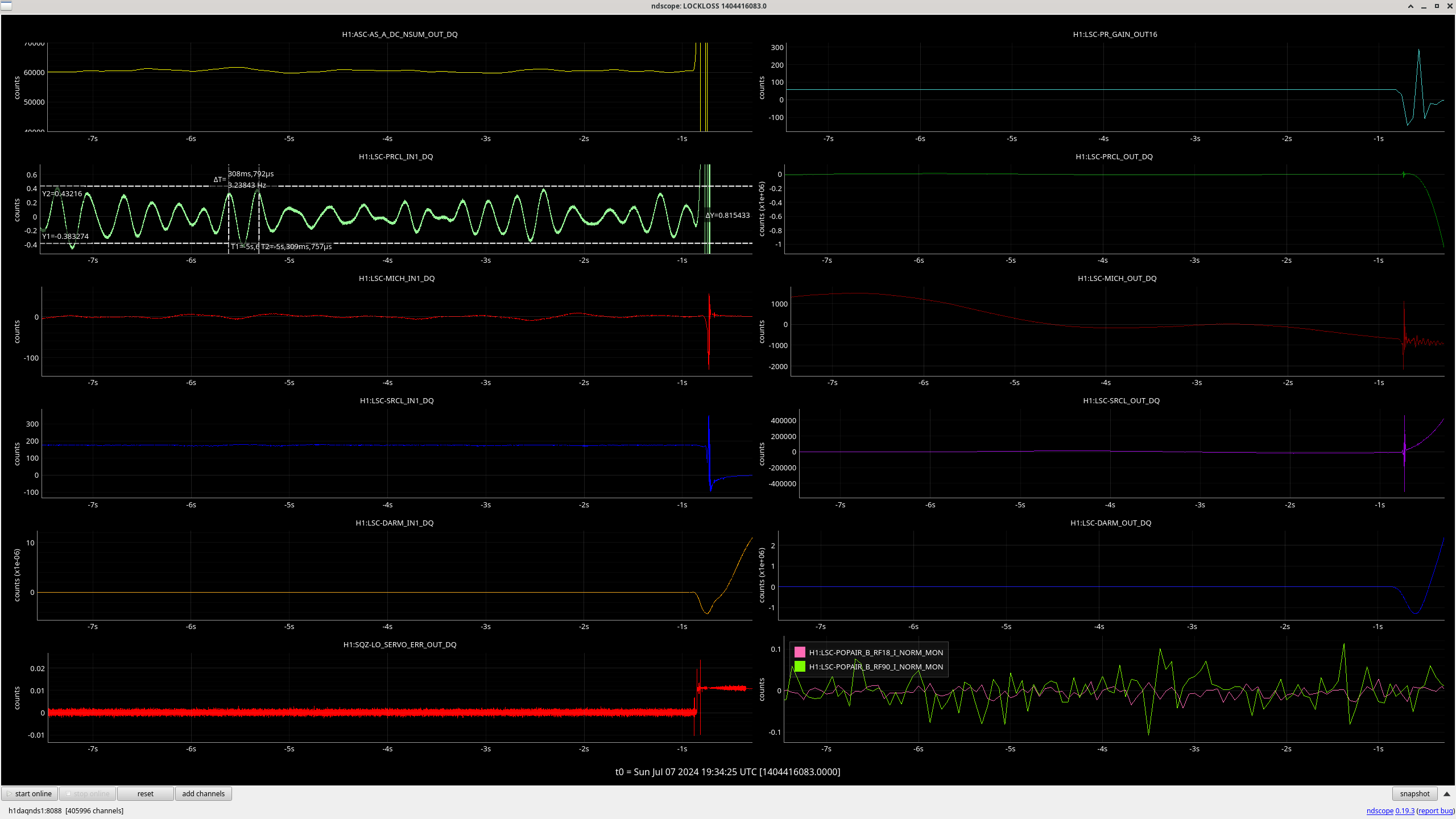
Around 2024/03/15 18:39 UTC Elenna noticed that H1:GRD-ALS_XARM was in INITIAL_ALIGNMENT waiting for the WFs to converge. But the WFS weren't on!
ENABLE_WFS state compleated at 18:34UTC. It stayed in INITIAL_ALIGNMENT (state -16) until unlocked at 18:39:51UTC. Plot attached showing WFS off.
I've updated TRANSITION_FROM_ETMX to activate the new DARM configuration directly. On the next lock we'll test whether we can transition directly into this configuration smoothly without having to move to ETMY before settling in.
svn commit version: r27235
On Wednesday, while testing filters in the "New DARM" state, the ETMX roll mode was inadvertently rung up (I assume it was ETMX because that was the suspension we were changing filters on). It dominated the DARM RMS long enough that I figured I could get a fit of the ringdown and measure the via the OMC DCPD sum.
I extracted the data during the ringdown time, after the filter that was driving the mode was turned off. I split the data up into smaller segments and estimated the height of the peak in the ASD and fit a decaying exponential. The estimated Q of this mode is about 6173 with an estimated frequency of 13.759 Hz. The resulting plot of the exponential fit is show in the third attachment. I performed the fit by taking the logarithm of the data and fitting a linear regression- the resulting r-squared value was 0.998, so I think this is a very good fit. However, I made no estimate of the background for this fit, so there may be some bias in the fit itself. I tried to perform a more precise fit of the damped sinusoid using a digital heterodyne, but I'm unhappy with my curve fitting algorithm. I think ultimately that may be a better way to get a more accurate Q (but if I'm being honest I am unlikely to follow through on that work unless someone really wants me to).
However, I think this is still a pretty good measurement, especially given that Jeff measured a Q of about 7000 for the ETMY roll mode. It is a bit high, given the goal of the BRD was "a Q between one and a few thousand" (quoting Norna's slides from https://dcc.ligo.org/LIGO-G1600371). From a practical point of view, within 10 minutes the roll mode was back to nominal anyway.
Fri Mar 15 10:12:31 2024 INFO: Fill completed in 12min 27secs
Gerardo confirmed a good fill curbside.
With the offset on the AS_A WFS centering, that should lower DHARD_Y coupling to DARM:
https://ldas-jobs.ligo-wa.caltech.edu/~gabriele.vajente/bruco_1394535464_DARM
Indeed, DHARD_Y coherence with DARM is much lower. Interestingly, now CHARD_Y coherence seems higher.
In other news, there is some coherence with MICH, but hopefully the retuned FF filter will help with that.
Coherence with input jitter witness is also large, see for example the PSL periscope
[Trent, Georgia]
We were curious if the coherence between DARM and the PSL periscope accelerometer was improved with Craig's Wednesday night input alignment. Though there wasn't much time without glitches or excitations during this lock, we got a 700 averages with 75% overlap bw 0.1Hz. In the attached plot, top is DARM ASD, bottom is coherence with the PSL periscope accelerometer (witness sensor for jitter), and right plot is zoomed in on some of the jitter peaks. It looks pretty convincing that for the resonances above 100Hz, the coherence was lower with the new input (and full IFO) alignment on Wendesday.
According to some of the sensors in HAM2 and HAM3, we might have walked the input pointing further in PIT than the O4A alignment, so maybe there is an IM1 and IM3 alignment somewhere in between the two times in the attached plot that has even lower input jitter coherence.
Attachment shows DARM × PSL acceleration coherence on 13 Dec (red), 11 Jan (turquoise), and 16 Mar (black). There is no significant difference between the latter two.
OM2 was hot on 13 Dec and cold on the latter two.
Picket Fence on nuc5 stopped updating 18:44 Thu 14mar2024 PDT. I killed the frozen window and started the code by hand on nuc5 via a vnc connection, it is updating again now.
[Louis, Gabriele]
We did again the noise injections for retuning the MICH FF, analysis and fit will follow tomorrow.
New fit done, loaded into FM2, not tested yet.
We tested the new FF, and it didn't perform as well as expected. However
We therefore used the measurement to fit another MICH FF, we'll test it soon
Gabriele created two new filters in FM1 and FM2 to try out in DARM. Currently, we are using FM3. I ran an injection using the current filter, and then for each of Gabriele's new filters. Overall, if we want the most suppression 10-20 Hz, we should go with the current, FM3. If we want to do better 20-40 Hz, we can choose one of the new filters. FM2 is worse from 40-70 Hz, but I'm not sure how much that matters. FM1 will inject a few dB more noise than the others from 7-10 Hz, again, not sure how much that matters. I am staying with FM3 pending some evaluation.
[Louis, Gabriele]
The DHARD_Y to DARM coupling always showed two regimes: a steep coupling below 20-30 Hz, and a flatter coupling above 20-30 Hz. We've been able to change the flatter coupling above 20-30 Hz by changing the ITMT Y2L coefficient.
Today we confirmed a suspicion: the steep low frequency coupling is due to length to angle coupling at the AS WFS. We changed the beam position on the WFS by adding an offset to the WFS centering (H1:ASC-AS_A_DC_YAW_OFFSET) and saw a change in the DHARD_Y to DARM coupling.
A value close to -0.14 gives the minimum coupling below 20 Hz. we now have two independent knobs to minimize the DHARD_Y to DARM coupling at all frequencies.
Incidentally, the higher frequency couping is now lower than yesterday, with the same ITMY Y2L coefficient of -1.65
We did a scan of the AS_A_WFS Y centering from -0.2 to -0.1 in steps of 0.01, an analysis will follow tomorrow:
-0.200: 1394510627 - 1394510727
-0.190: 1394510777 - 1394510877
-0.180: 1394510927 - 1394511027
-0.170: 1394511077 - 1394511177
-0.160: 1394511227 - 1394511327
-0.150: 1394511377 - 1394511477
-0.140: 1394511527 - 1394511627
-0.130: 1394511677 - 1394511777
-0.120: 1394511827 - 1394511928
-0.110: 1394511978 - 1394512078
-0.100: 1394512128 - 1394512228
0.000: 1394512278 - 1394512378
We are leaving a value of -0.14 in the WFS offset
Attached is a comparison of the DARM sensing function with no AS A centering offset vs an offset of -0.14. With an AS A centering offset of -0.14, which we found to be the value that results in the minimum amount of coupling to DARM below 20Hz, the sensing function clearly shows optical spring-like characteristics. This brings to mind a few thoughts: 1. This supports the idea that coupling from the DHARD loop into DARM has a noticeable effect on the structure seen in the sensing function at low frequencies. We've been wondering about this for some time, so it's nice to finally have a direction to point in. 2. We tend to adjust the src detuning by constantly measuring the sensing function and trying to find an SRC offset that results in a flat sensing function at low frequencies. The fact that DHARD also couples with DARM in such a way that it can affect the shape of the sensing function at low frequencies begs the question: could we be in fact further detuning the src while intending to do the opposite due to confusion caused by the dhard coupling effects? 3. I recall being told that sometimes squeezing gets better with some level of detuning. If our only measure of SRC detuning is from measuring and inspecting the sensing function then this measurement hasn't been clean due to the DHARD coupling. lots to think about..
Here's a more detailed analysis of the AS WFC centering steps.
The first plot shows the steps in ASC-AS_A_DC_YAW_OFFSET compared with a DARM spectrogram, during a DHARD_Y injection. The spectrogram shows that there is minimum in the coupling of DHARD_Y to DARM around -0.15 / =0.16.
The second plot shows the transfer function from DHARD_Y to DARM for all values of the offset. A value of -0.15 gives the lowest coherence and the lowest coupling, so that seems to be the optimal value. One can notice how the transfer function phase flips sign as expected when one goes through the minimum coupling.
Changing the AS_A centering offset also moved SR2, SRM and BS.
I tried stepping the REFl WFS A and B DC offsets in yaw similarly to see if the CHARD Y coupling to DARM would change. In summary, I stepped between -0.2 and 0.2 for both WFS and saw no change.
Method: I set a 30 second ramp on the offsets because the DC centering loops are slow. I stepped first in steps of 0.01, and then 0.02. I injected a broadband CHARD Y injection and measured the transfer function to darm between 10-30 Hz. I saw no change in the coupling while I made these steps.
Before checking on the calibration change in DARM and DHARD, I check on the thermalisation effect with the coupling.
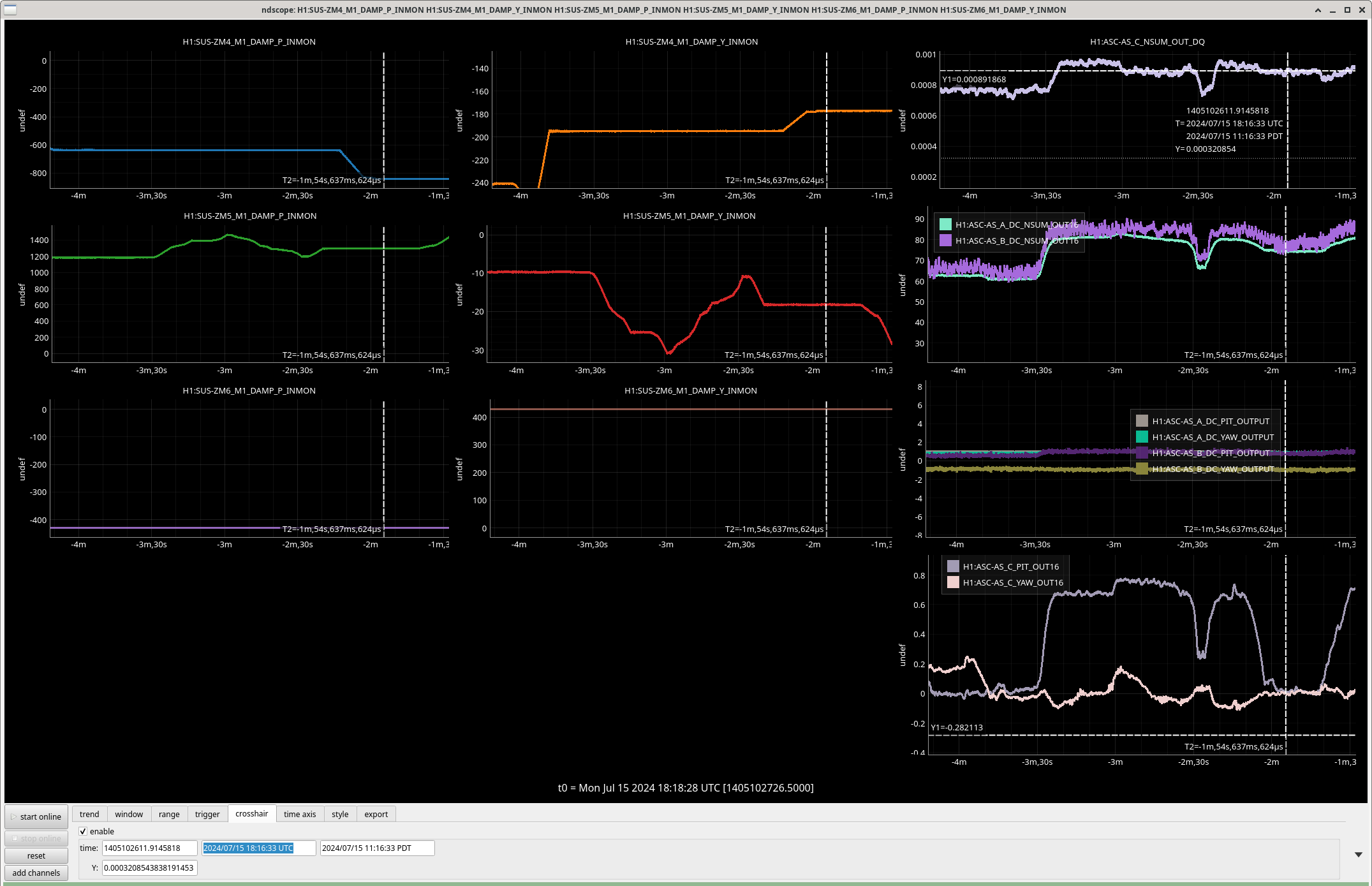
I chose long duration locking time (Mar. 16, 05:30:00 UTC ~ 15:30:00 UTC) without centering offset, and selected start, middle (10:30:00 UTC) and end time within the time window.
Three plots are; 1) DARM, 2) DHARD PIT, 3) DHARD YAW.
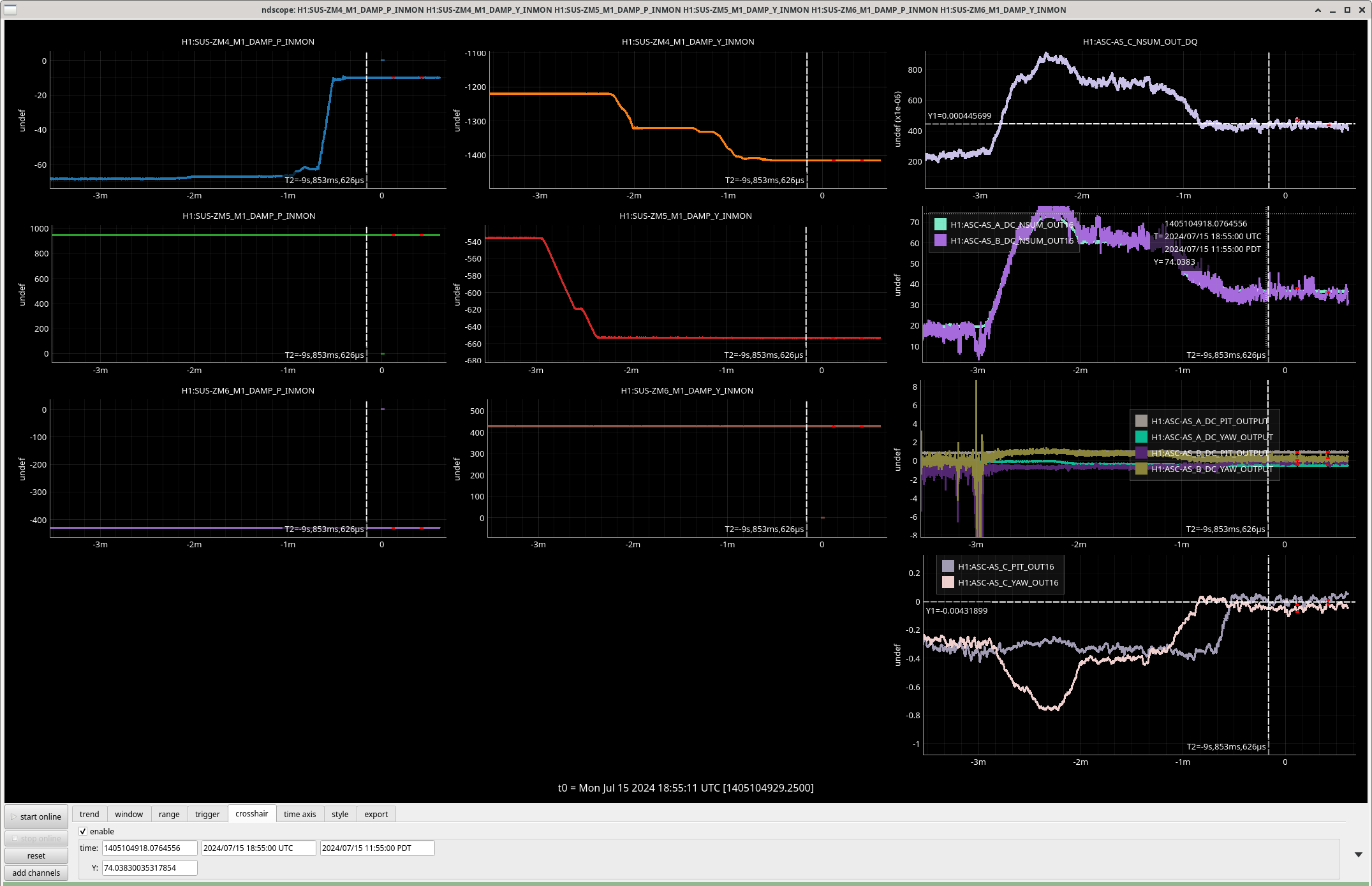
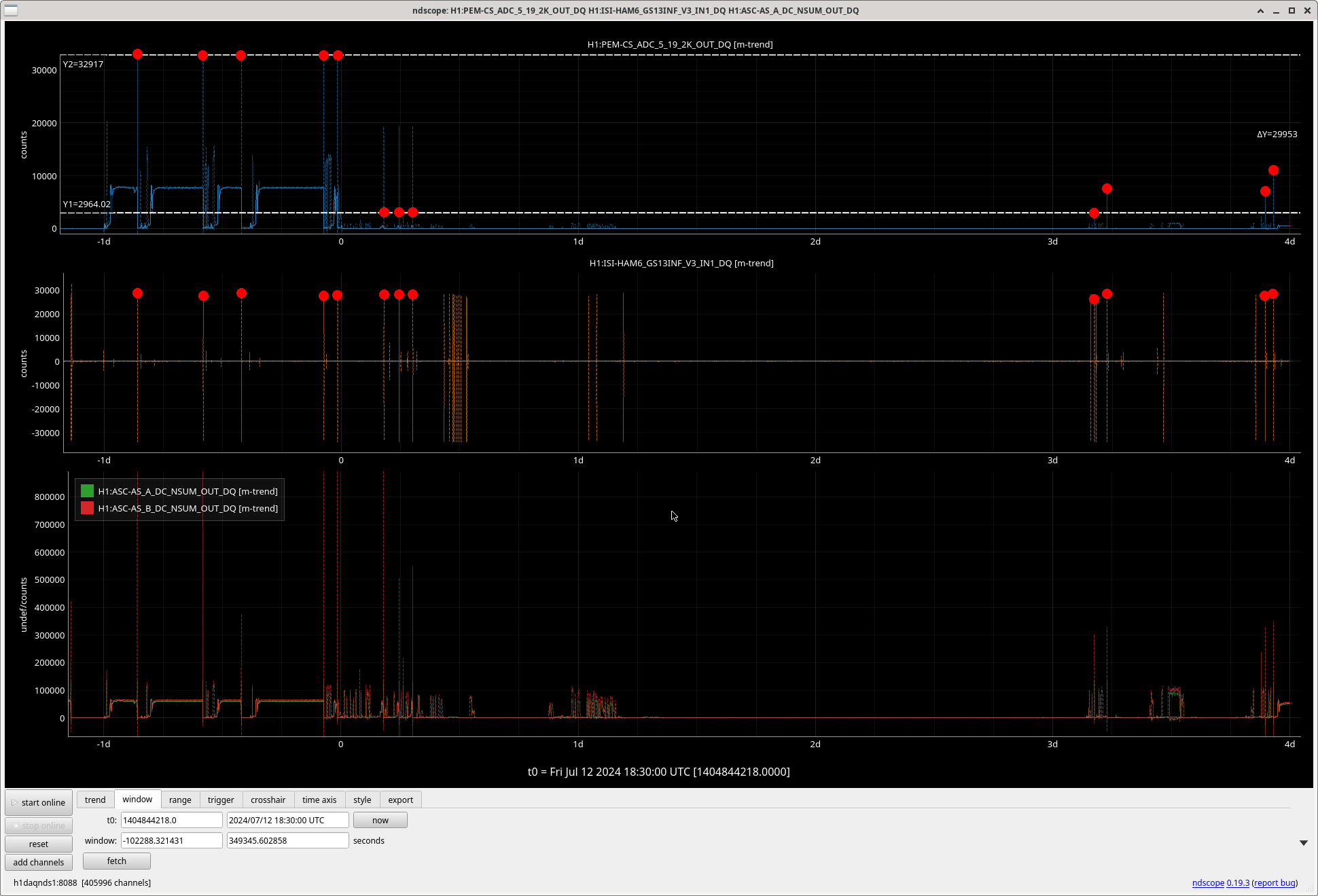
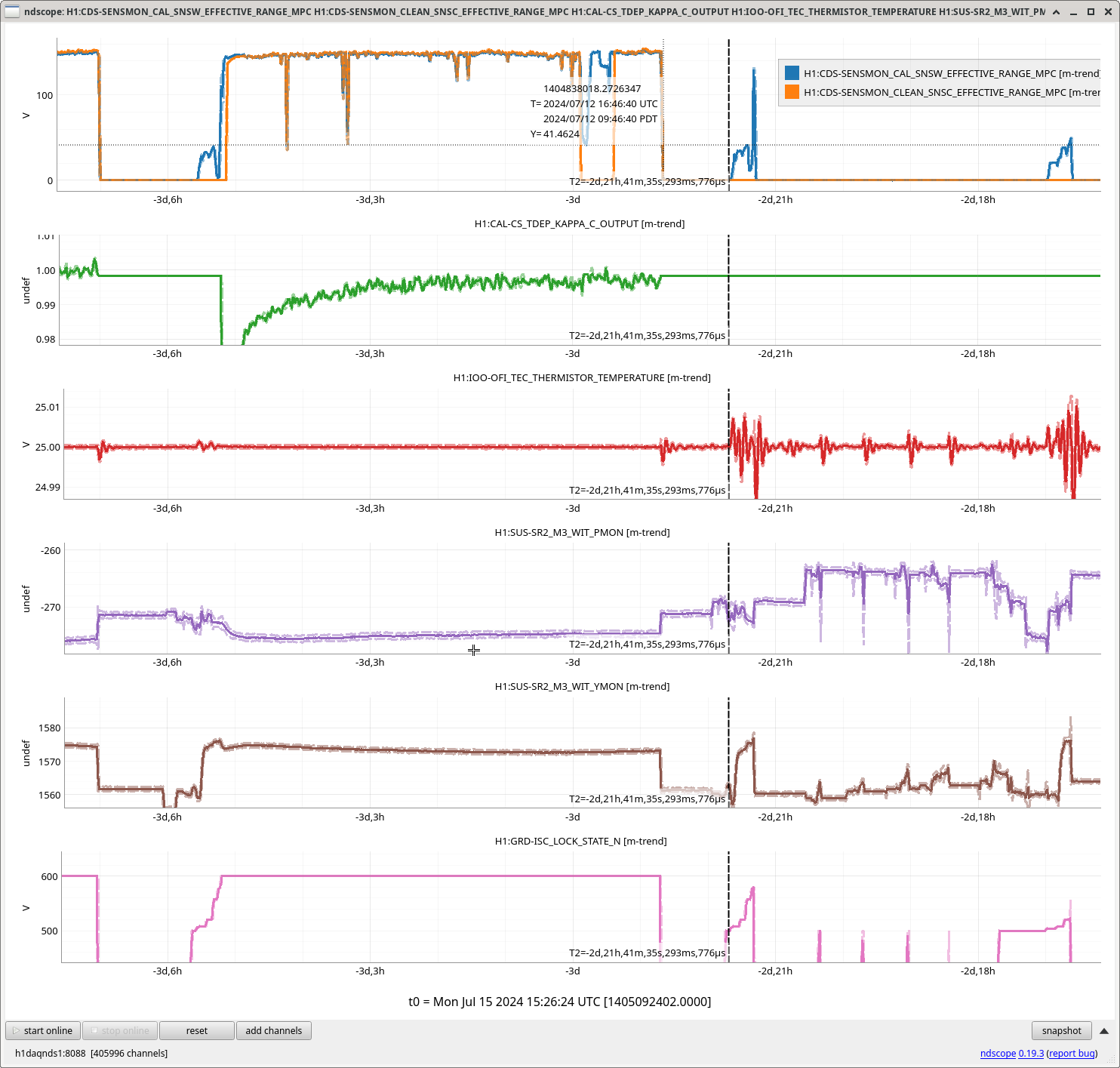
In addition, I included screenshot of ndscope to confirm the time window.
As the 'end' time data in all plots show different trend compare to the other times, it seems that the thermalisation affects DARM and DHARD.
Checked on the calibration lines in DARM and DHARD with centering offset on/off conditions.
To minimize the thermalisation effect, time for the comparison were chosen within short time window.
Figures are; 1) Comparison altogether, 2) DARM comparison, 3) DHARD PIT, 4) DHARD YAW, 5) Screenshot of the ndscope around comparison time.
It can be confirmed that the peaks of calibration lines were same in DARM with and without the centering offset. However, for DHARD, only YAW showed calibration lines, and with different peak magnitude (lower in without offset).
Naoki, Dhruva, Nutsinee
Yesterday we had only 3dB squeezing at IFO so we checked squeezing at homodyne. Although the visibility is good (98.5%), the squeezing was only 4.5dB at homodyne with 6dBm CLF6. We reduced the CLF power and recovered 8dB squeezing as shown in the attached figure.
The CLF6 was reduced from 6dBm to -42dBm and the 8dB squeezing was obtained with -38dBm CLF6. The CLF6 between -38 and -20 dBm gave similar squeezing so we set it at -24dBm, which is similar to O4a value and corresponds to 8uW CLF_REFL_LF_OUTPUT. The squeezing at IFO is recovered to 4.5dB with -24dBm CLF6.
Note that the LLO also saw the better squeezing at IFO with less CLF power in LLO70072.
We had 6.5dB squeezing at homodyne in 76040 and 4.5dB squeezing at IFO in 76226 with 6dBm CLF6 before. The question is why we lost squeezing at homodyne and IFO this week with same CLF power? The commissioning list in 76369 might give us a clue.
At high CLF power we have about 12 uW of light for CLF and RLF after the OPO. Each homodyne PD has 0.5 mW of power, or 1 mW total. This yields a CLF/RLF to LO ratio of 0.012. Using the equation Gamma^2/2 to get the modulation index, we obtain an estimate of 150 mrad for the maximum phase modulation. In reality, it will be somewhat smaller since some of the power will be in amplitude modulation. This will limit the maximum amount of achievable squeezing on the homodyne. But, this has no bearing on the DCPDs, since the CLF/RLF to LO ratio there is approximetaly 5000 times smaller.
A bit more details on this.
The power ratio between SB and CR of each sideband is approximated to be ~ (gamma/2)^2 where gamma is modulation depth in radian. Add the two sidebands together you get (gamma^2)/2.
A total power transmits through the OPO during high CLF case was 12uW. A total LO power hitting the HD was 1mW. So the phase noise contribution to HD sqz was
(gamma^2)/2 = 12uW/1mW
High CLF phase noise (gamma) at the homodyne = 154mrad (max)
A total power transmits through the OPO during low CLF case was 0.6 uW. A total LO power hitting the HD was 1mW. So the phase noise contribution to HD sqz was
Low CLF phase noise (gamma) at the homodyne = sqrt(2*0.6uW/1mW) = 35mrad (max)
These number include amplitude modulation. It's the worse case that could possibly happen. Using 45 mrad of phase noise and *16dB of asqz fits the high CLF squeezing of 6.5 dB in the homodyne. 15 mrad and 16 dB of squeezing fits the low CLF squeezing of 8 dB in the HD.
For the IFO case we've only injected sqz using low CLF so far. All the sideband power gets attenuated by the OMC (a factor of 5000). The LO (IFO carrier) is ~40mW. Phase noise contribution from CLF/RLF sidebands is 0.08 mrad, which is negligible. Even for high CLF power (RF6 = 6 dBm) this phase noise would be 0.3 mrad. That number is still negligible so there's no reason why we shouldn't be able to see good squeezing with high CLF. Using **15dB of aSQZ and a loss of ***30% we have 5 dB of squeezing as observed on Friday.
*ASQZ trace overlapped with 16 dB aSQZ reference in HD https://alog.ligo-wa.caltech.edu/aLOG/uploads/73562_20231018171710_8dB_hd_sqz_2023Oct18.png
**15 dB of aSQZ in DARM https://alog.ligo-wa.caltech.edu/aLOG/index.php?callRep=76426
*** If I'm reading this noise budget correctly the inferred loss in the IFO is 30%.
Last week when we locked the new OMC by hand I copy-pasted some guardian code into a shell, and found that there was a gain set and wait that were totally unnecessary. This inspired me to start reading through ISC_LOCK to look for other redundant waits. Here are my notes, I only got up to the start of LOWNOISE_ASC before I went totally cross-eyed.
Here are the notes I took, the ones in bold we can for sure remove.
Line 301-305 [ISC_LOCK, DOWN] Prcl UGF servo turn off (do we still do this?) no wait times but maybe unnecessary
Line 327 [PREP_FOR_LOCKING] Thermalization guardian (are we using this?)
Line 350-354 [PREP_FOR_LOCKING] Turn off CHARD blending, no wait times
Line 423 [PREP_FOR_LOCKING] turn off PR3 DRIVEALIGN P2P offset for PR3 wire heating
Line 719 [PREP_FOR_LOCKING] toggling ETM ESD HV if the output is low, seems redundant with line 445
INITIAL_ALIGNMENT for the green arms only offloads a minute or 2 after it's visually converged. Initially I thought the convergence checker thresholds should be raised, but it's a 30 second average. Might make sense to reduce the averaging time?
(2 screenshots attached for this one)
ALS_DIFF [LOCK] Ramps DARM gain to 40, waits 5 seconds, ramps DARM gain to 400, waits 10 seconds. Seems long.
ALS_DIFF Line 179, waits 2* the DARM ramp time, but why?
ALS_DIFF [LOCK] Enegages boosts with a 3 second wait, engages boosts with another 10 second wait
ALS DIFF Line 191 wait timer 10 seconds seems unnecessary.
ALS_COMM [PREP_FOR_HANDOFF] line 90 5 second wait - maybe we could shorten this?
ALS_COMM [HANDOFF_PART_3] lines 170 and 179 - 2 and 5 second timers but I'm not sure I get why they are there
ALS_COMM's Find IR takes 5 seconds of dark data, has two hard coded VCO offsets in FAST_SEARCH, if it sees a flash it waits 5 seconds to make sure it's real, and then moves to FINE_TUNE_IR, taking 50 count VCO steps until the transmitted power is >0.65
Suggest updating the hard coded offsets (ALS_DIFF line 247) from [78893614, 78931180] to [78893816, 78931184] (second spot seems good, first spot needs a few steps)
ALS_DIFF's find IR has 3 locations saved in alsDiffParams.dat which it searches around. This list gets updated each time it finds a new spot, HOWEVER the search starts 150 counts away from the startin location and steps in in increments of 30. Seems like it would be more efficient to start 30 below the saved offset?
ISC_LOCK [CHECK_IR] line 1206 has a 5 second wait after everything is done which could probably be reduced?
PRMI locking - a bunch of 1 second waits idk if they are needed?
ISC_DRMI line 627/640 [PRMI_LOCKED] self.timer['wait']=1 seems maybe unnecessary?
ISC_DRMI line 746, 748 [ENGAGE_PRMI_ASC] - MICH P and Y ASC ramps on with a 20 second timer, but wait = false, but this seems long anyway?
ISC_DRMI line 762/765/768 [ENGAGE_PRMI_ASC] self.timer['wait'] = 4... totally could remove this?
ISC_DRMI [PRMI_TO_DRMI] line 835 - wait timer of 4 seconds (but I don't think it actually waited 4 seconds, see third attached screenshot, so maybe I dont know what time['wait'] really means!!!
When doing the PRMI to DRMI transition it first offloads the PRMI ASC, does the PRMI_TO_DRMI_TRANSITION state, then runs through the whole DOWN state of ISC_DRMI which takes ~25 seconds? maybe there can be a quicker way to do this
In ISC_DRMI there's a self.caution flag which is set as True if AS_C is low, and has 10 second waits after ASC engagements and a *90 second* wait before tirning on the SRC ASC. Might be worthwhile to to replace this with a convergence checker since it might not be needed that we wait for a minute and a half if we are already well algined
Line 1845 ISC_LOCK [CHECK_AS_SHUTTERS] 10 second wait for...? This happens after the MICH RSET but before the FAST SHTTER is reqested to READY
Lines 1837/8 and 1865 redundant?
Line 1870 wait timer 2 seconds after AS centering + MICH turned back on but why
Line 1887 - straight up 10 second wait after increasing MICH gain by 20dB
Line 2119 [CARM_TO_TR] time.sleep(3) at the end of this state not clear what we're waiting for
Line 2222 [DARM_TO_RF] self.timer['wait'] = 2 that used to be 1
Line 2235 [DARM_TO_RF] another 2 second timer?
Line 2314 [DHARD_WFS] 20 second timer to turn DHARD on, but maybe we should just go straight to convergence checking once the gains are ramped on?
Line 2360 [PARK_ALS_VCO] 5 second wait after resetting the COMM and DIFF PLLs
Line 2406 [SHUTTER_ALS] 5 second wait followed by a 1 second sleep after the X arm, Y arm, and COMM are taken to shuttered
Line 2744 [CARM_TO_ANALOG] 2 second wait when REFLBIAS boost turned off but before summing node gain (A IN2) increased?
Line 2753 [CARM_TO_ANALOG] 5 second wait after summing node gain increased
Line 2760 [CARM_TO_ANALOG] 2 second wait after enabling digital CARM antiboost?
Line 2766 [CARM_TO_ANALOG] 2 second wait after turning on analog CARM boost
Line 2772 [CARM_TO_ANALOG] 2 second wait after raming the REFL_DC_BIAS gain to 0, actually maybe this one makes sense.
There are a ton of waits during the ASC engagement but I think usually the convergence checkers are the limit to time spent in the state.
Line 3706 [ENGAGE_SOFT_LOOPS] 5 second wait after everything has converged?
Line 3765 [PREP_DC_READOUT_TRANSITION] 3 second wait after turning on DARM boost but shouldn't it be 1 second?
Line 3816 [DARM_TO_DC_READOUT] 10 second wait after switching DARM intrix from AS45 to DC readout, might be excessive
Line 3826/7 [DARM_TO_DC_READOUT] - DARM gain is set to 400 (but it's already 400!) and then there is a 4 second wait, these two lines can for sure be removed!
Line 3834 [DARM_TO_DC_READOUT] - 5 second wait after turning ramping some offsets to 0 BUT the offsets ramp much more quickly than that!
line 4033 [POWER_10_W] 30 second wait after turning on some differential arm ASC filters but actually, never mind I don't think it actually does this wait
Line 4299 [REDUCE_RF45_MODULATION_DEPTH] we have a 30 second ramp time to ramp the modulation depths, maybe this could be shorter?
Line 4614 [MAX_POWER] 20 second thermal wait could be decreased?
Line 4641 [MAX_POWER] 30 second thermal wait could be decreased??
Line 4645 [MAX_POWER] 30 second thermal wait for the final small step could be devreased?
line 4463/4482 [LOWNOISE_ASC] 5 second wait after we turn off RPC gains that were already off
line 4490 [LOWNOISE_ASC] 10 second wait after CHARD_Y gain lowered, but it looks to have stabilized after 5 seconds so I think we can drop this to 5.
honestly a lot of waits in lownoise_asc so I ran out of time to check them all for necessity
More waits in the guardian:
line 4530 [LOWNOISE_ASC] 5 second wait after turning up (more negative) MICH gain, next steps are not MICH related so maybe we can shorten it?
line 4563 [LOWNOISE_ASC] 10 second ramp after changing top mass damping loop yaw gains, then another 10 second ramp after lowering SR2 and SR3 everything damping loop yaw gains? probably can lump these together and then also maybe reduce the wait?
too scared to think about the timers in transition_from_etmx, but the whole state takes about 3 minutes, which I guess makes sense since we ramp the ESDs down, and up again, also this has been newly edited today
line 5503 [LOWNOISE_LENGTH_CONTROL] 10 second wait after setting up filters for LSC feedforward, and some MICH modifications but not sure why?
line 5536 [LOWNOISE_LENGTH_CONTROL] 10 second wait after changing filters and gains in MICH1/PRCL1/SRCL1 but all their ramp times are 2 or 5 seconds
line 5549 [LOWNOISE_LENGTH_CONTROL] 1 second wait after turning on LSCFF, maybe not needed?
line 5773 [LASER_NOISE_SUPPRESSION] 1 second waits after each LSC_REFL_SERVO gain step - could this be quicker?
line 5632 [OMC_WHITENING] 5 second wait after confirming OMC is locked could probably be skipped?
I'm attaching ISC_LOCK as I was reading it since it's always in a state of flux!
Georgia and I looked through lownoise ASC together and tried to improve the steps of the state. Overall, it should be shorter except we now need to add the new AS_A DC offset change. I have it set for a 30 second ramp, and I want it to go independently of other changes in lownoise ASC since the DC centering loops are slow. However, Gabriele says he has successfully engaged this offset with 10 seconds, so maybe it can be shorter. I would like to try the state once like this, and if it's ok, go to a shorter ramp on the offset. This is line 4551 in my version, 'self.timer['LoopShapeRamp'] = 30'.
Generally, we combined various steps of the same ramp length that had previously been separate, such as ASC loop changes, MICH gain changes, smooth limiter changes, etc. I completely removed the RPC step because it does nothing now that we do not use RPC.
Ok, this was a bad change because we lost lock in this state. It was not during the WFS offset change, it was likely during some other filter change. We probably combined too many steps into each section. I reverted to the old version of the state, but I did take out the RPC gain ramp to zero since that is unnecessary.
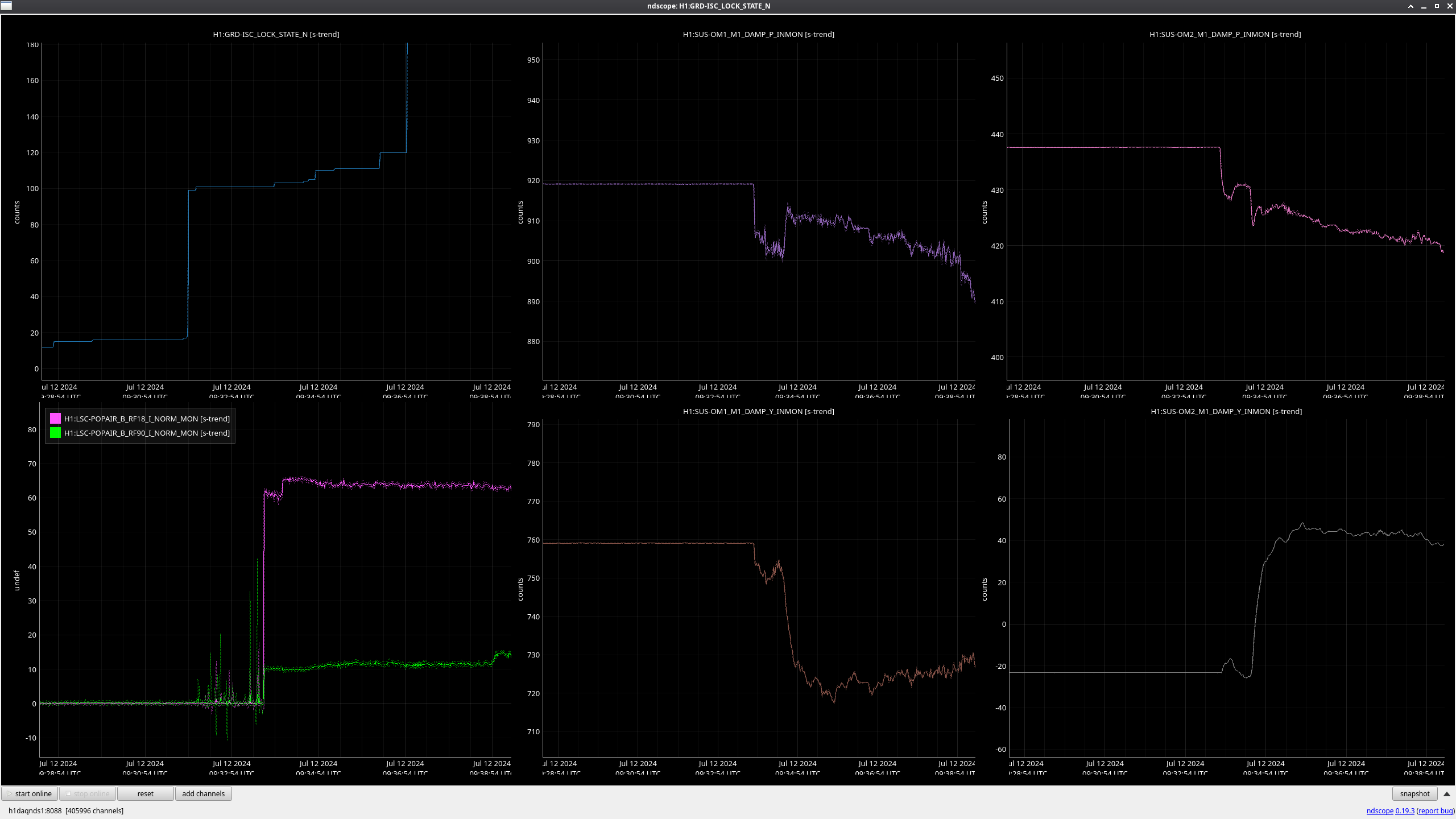
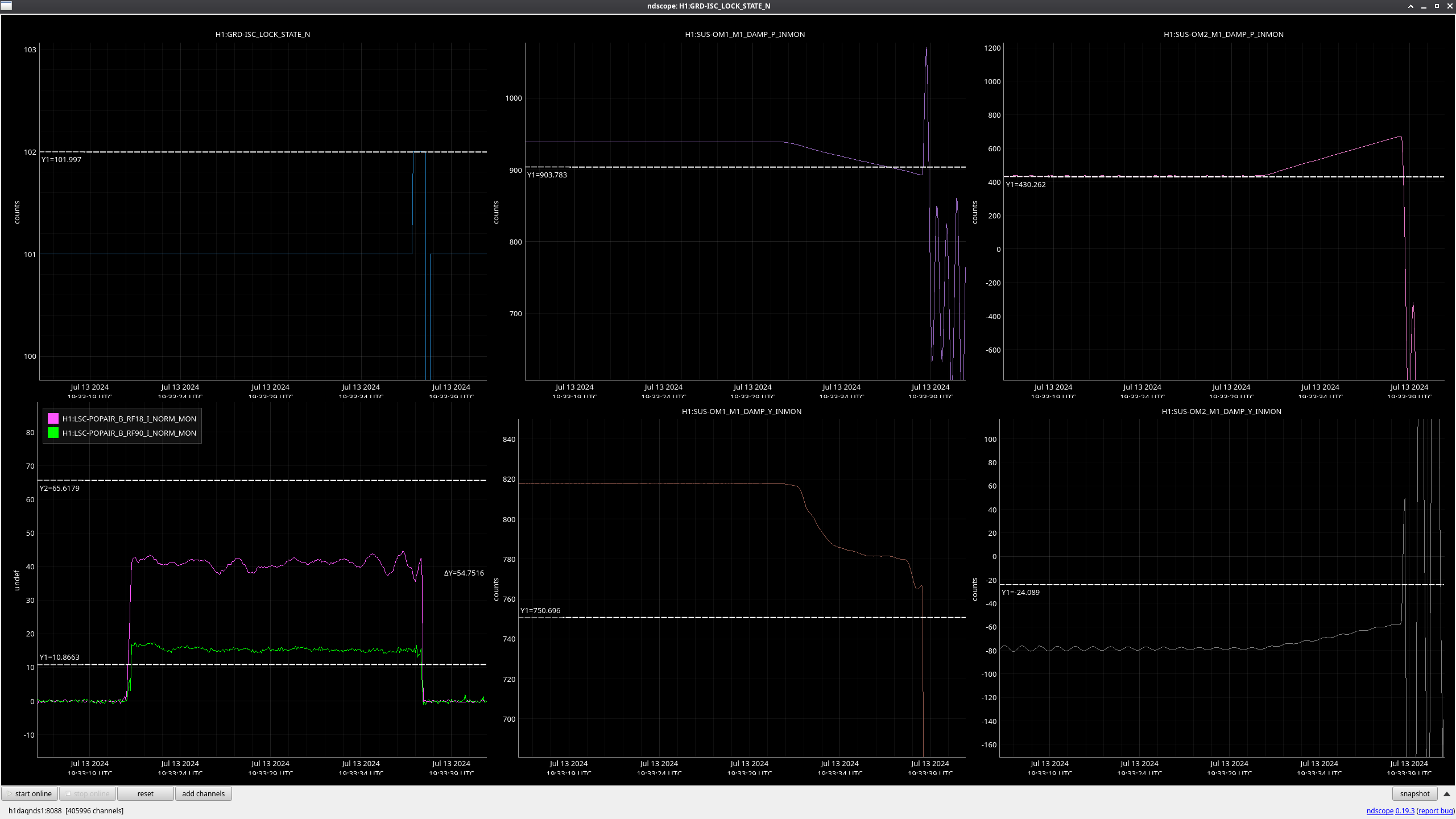
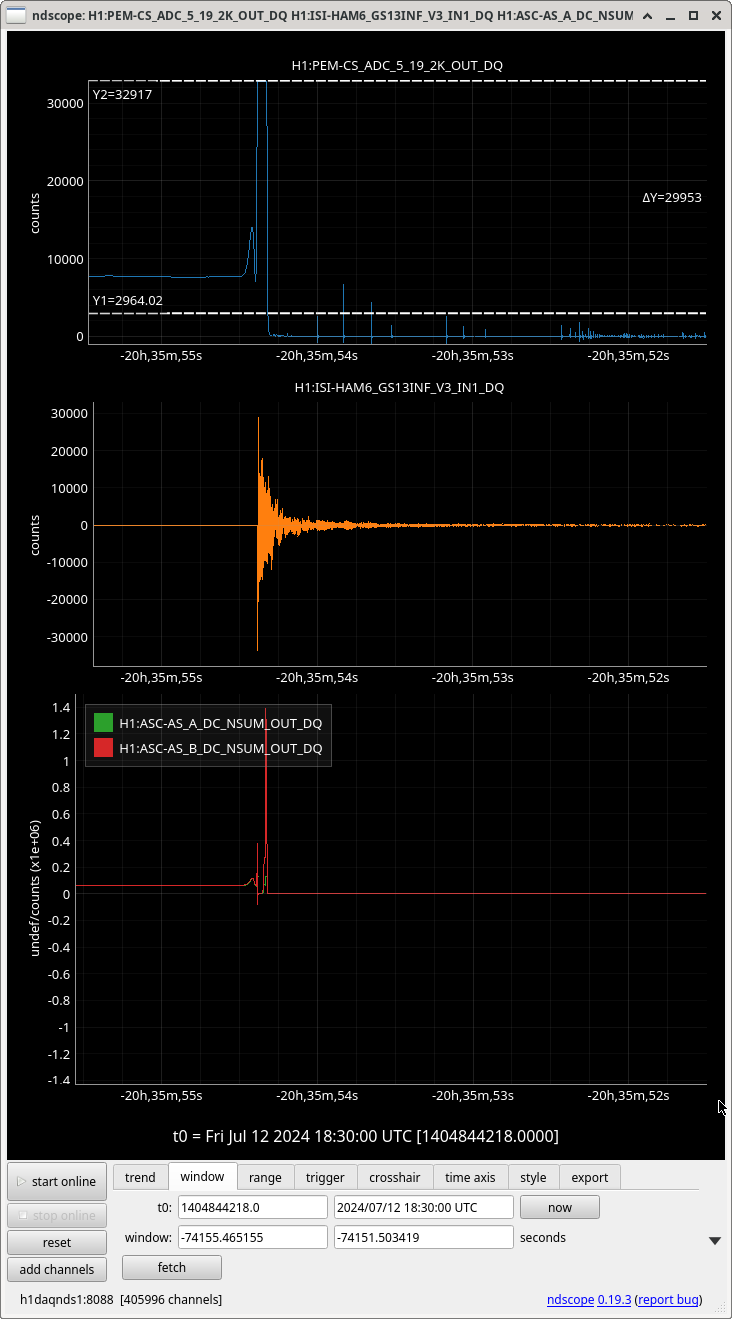
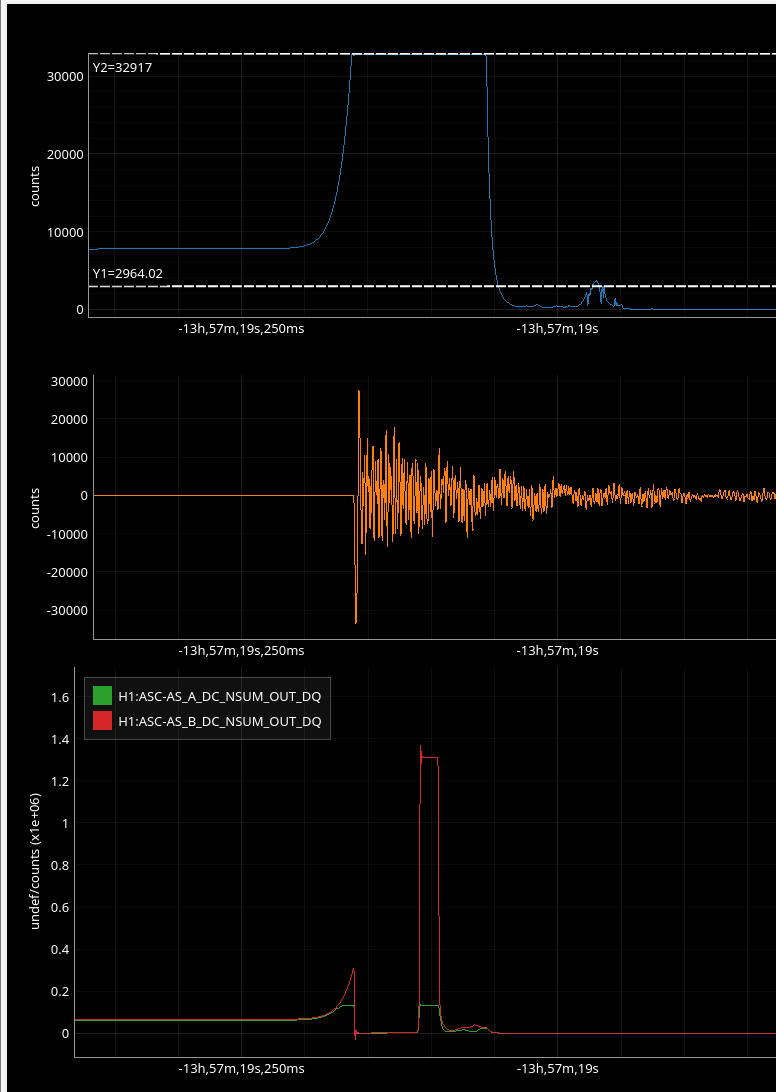
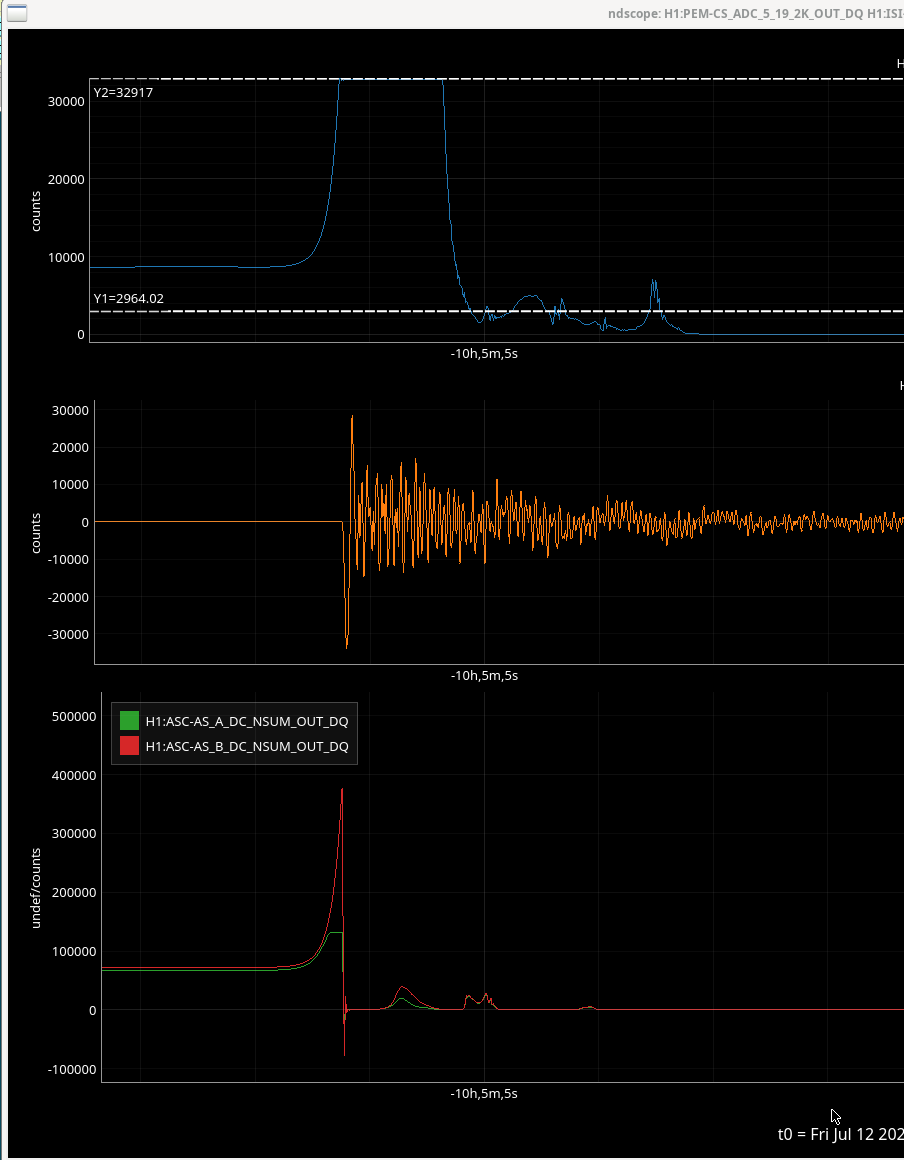
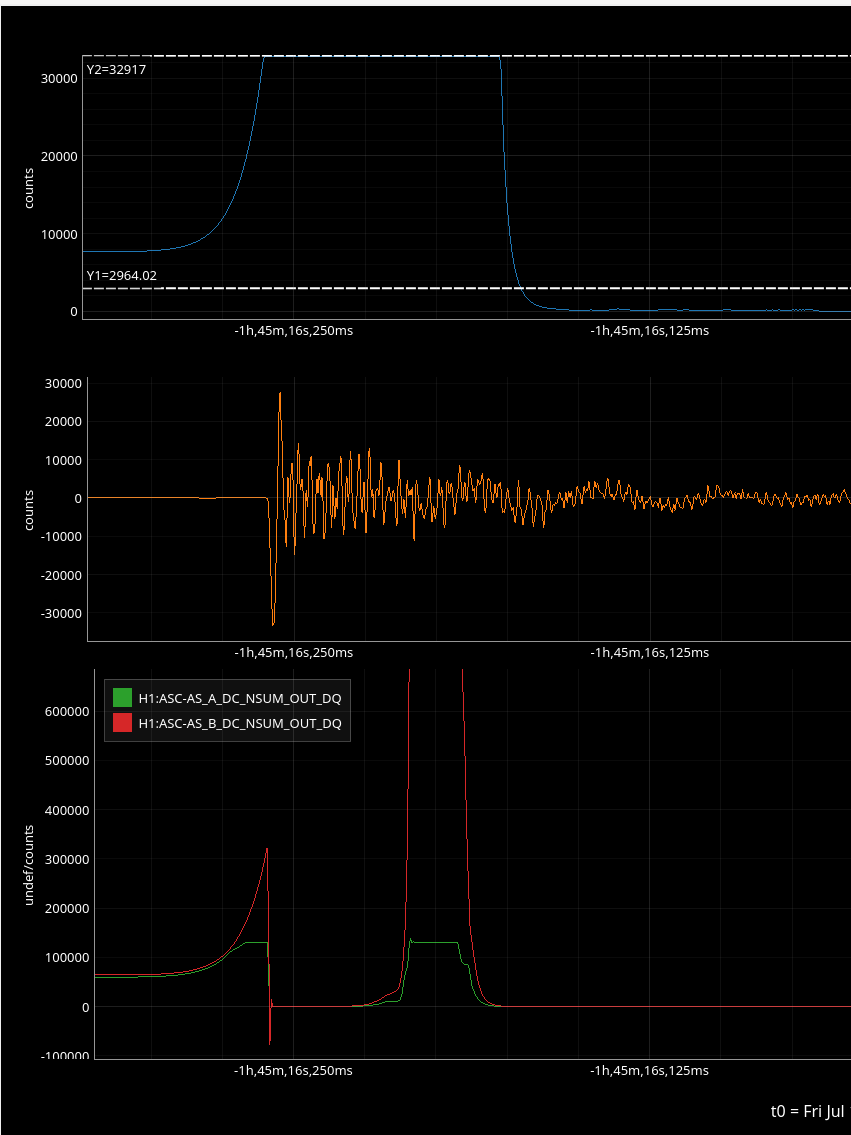
Quickly looking at the guardlog (first screenshot) and the buildups (second screenshot), and ASC error signals (third screenshot) during this LOWNOISE_ASC lockloss.
It seems like consolidating the test mass yaw damping loop gain change, and the SR2/SR3 damping loop gain change was not a good choice. It was a slow lockloss.
Probably the changes earlier in the state were safe though!
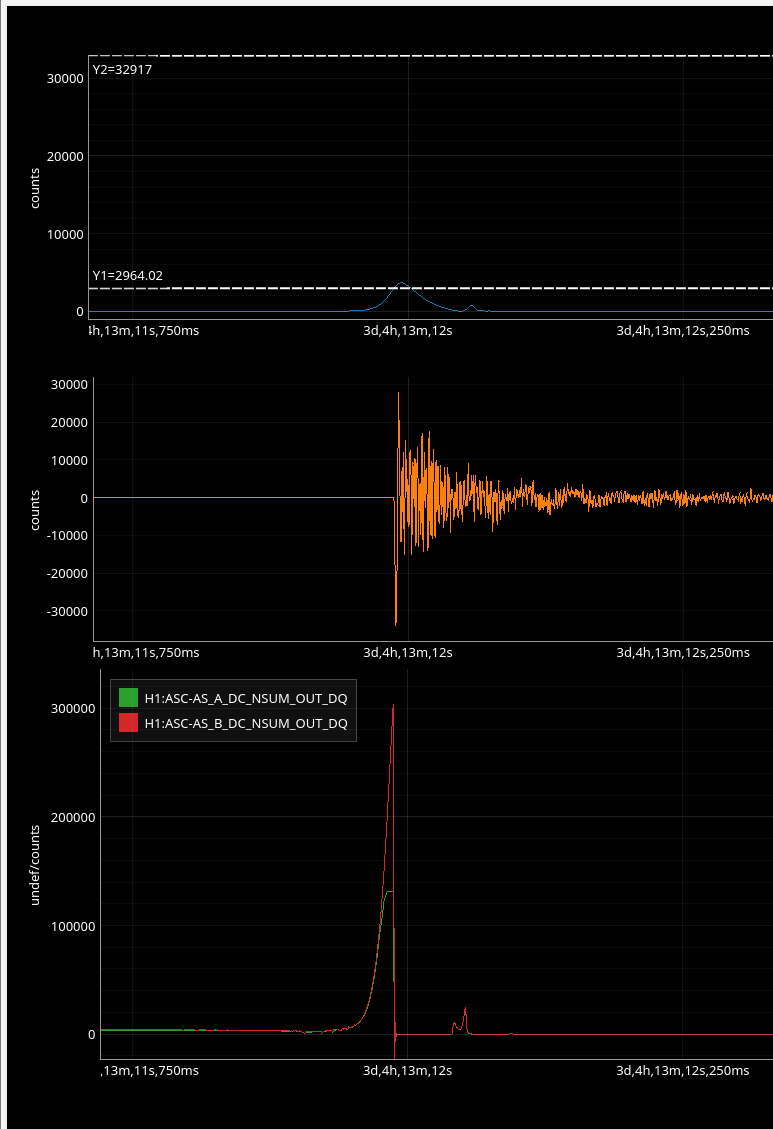
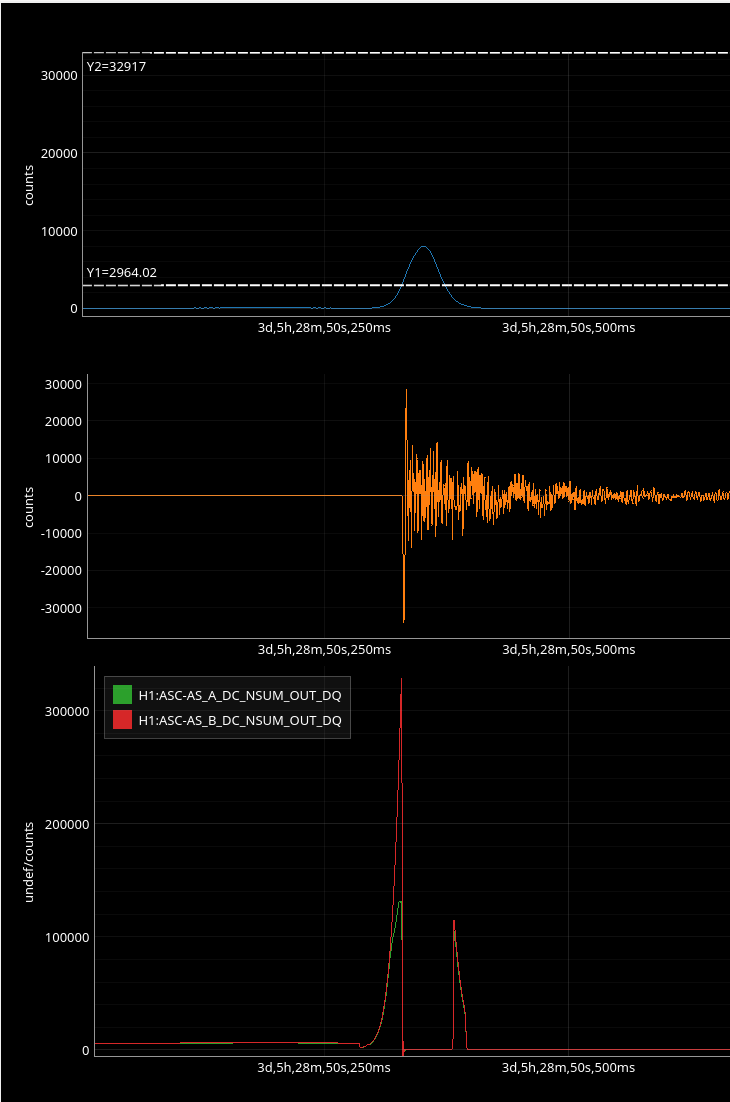
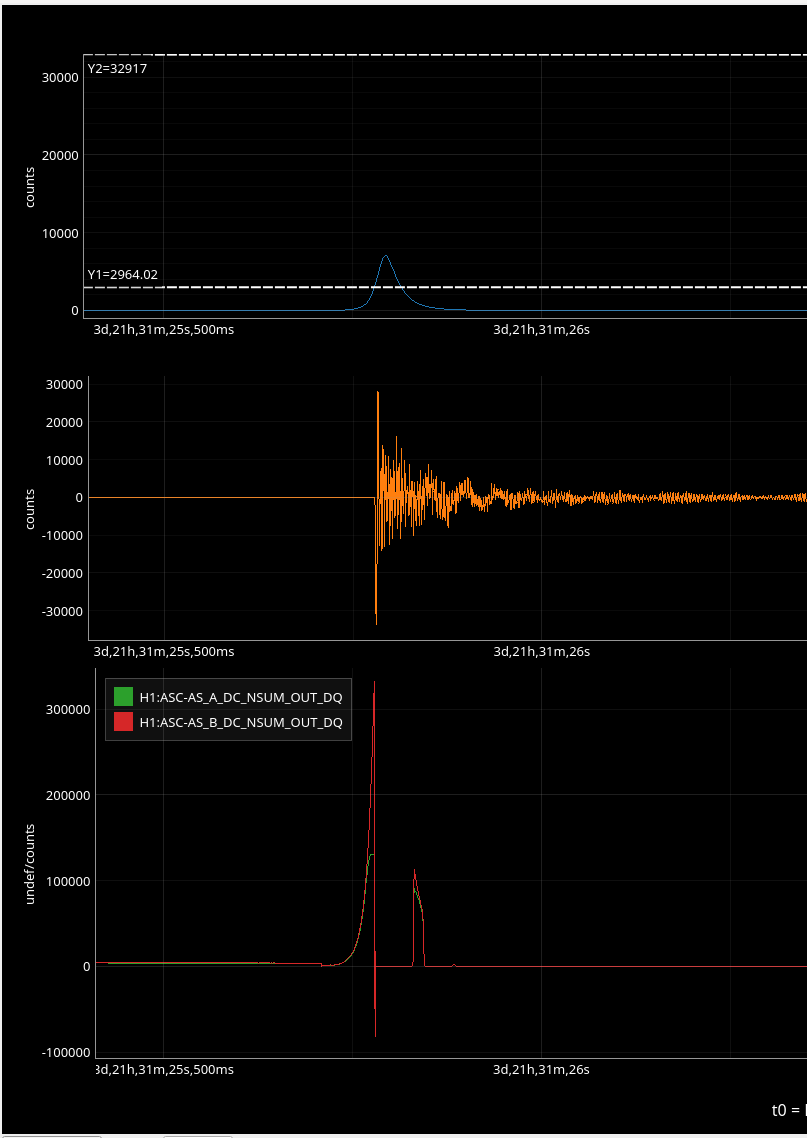
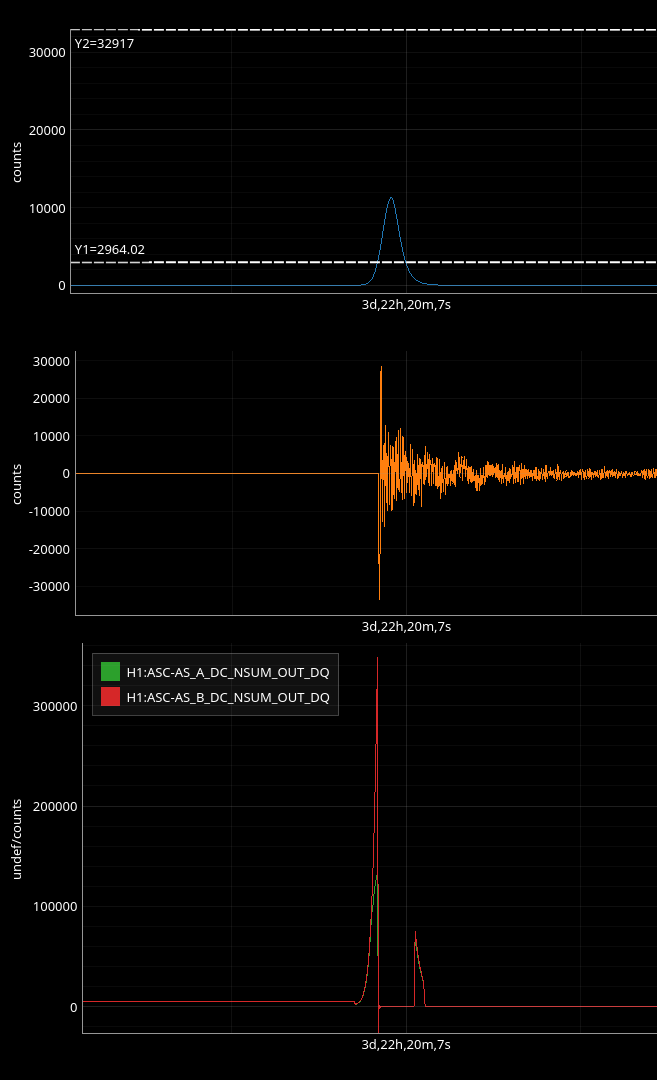
The CAL-CS filters installed by Jeff (LHO:76392) do a better job of correcting CAL-DELTAL_EXTERNAL. See darm_fom.png. Here's a screenshot of the filter banks: new_darm_calcs_filters.png. Also, Evan's 5Hz high pass filter (LHO:76365) pretty much killed the strong kick we've been seeing each time we switch into this new DARM state from ETMY.
The rms drive to the ESD is now about 5000 DAC counts on each quadrant, dominated by motion around 3 Hz.