Jeff K, Dave B, Oli P
All of the optics (except OFIS, OPOS, and HXDS) were originally built with a DACKILL that will only trip if all of that suspension's Watchdogs trip. This has resulted in some problems (74545, 74622). Because of this, there has been a push to update the logic for each suspension to have an OR instead of an AND, so that the IOP DACKILL trips as soon as any one of the stages trips.
The Watchdogs for these suspensions also rely on an outdated BLRMS to figure out if the stages are saturating, and people have been wanting this to be updated since 2017(FRS9392). This update to the watchdogs would remove the need for a USER DACKILL, so now is a perfect opportunity to do both at the same time! Suspension models created after 2019 (OFIS, OPOS, HXDS, and the new HXTS) were originally made with the updated watchdogs and without the USER DACKILL, and we haven't had any issues. The changes that we made line up with what was done for these previously changed models.
Today we updated the models for the ETMs and TMSs(76305), and we will gradually be updating all of the models.
Changes made:
QUAD MASTER and TMTS Master sus models (QUAD_MASTER.mdl, TMTS_MASTER.mdl):
- Top level: Removed USER DACKILL and WD block output flags(attachment1)
- Inside each block with watchdogs: removed the watchdog flags that connect the WD RMS to the DACKILL(attachment2)
- Inside each WD block within stage blocks: swapped the old WD BLRMS block with the better BLRMSLP block(attachment3)
Individal sus models (h1susetmx.mdl, h1susetmy.mdl, h1sustmsx.mdl, h1sustmsy.mdl):
- Removed top level WD_2_ISI output flags and connection of WD_2_ISI out to ISI model(attachment4)
Individual sus pi models(h1susetmxpi.mdl, h1susetmypi.mdl):
- Found out during installation of these updated models that a WD value that we had removed in the individual models went out to the pi models. The sus pi models were updated to include constants as inputs in lieu of the removed WD values(attachment5)
ISI QUAD models (h1isietmx.mdl, h1isietmy.mdl):
- Since the USER DACKILL connects to dolphin, we also changed the ISI QUAD inputs that feed into SUSWD_2_PAYLOAD from ground to both be 0 for WDMON_STATE_DOLPHIN and WDMON_STATE_DOLPHIN_ERR respectively(WDMON_STATE_DOLPHIN_ERR needs to be 1 because it later gets inverted)(attachment6)
Changes to medms (ETMs,TMSs adl files):
- Removed the IOP DACKILL button on suspension medm and TO ISI arrow(attachment7)
- Inside the watchdog subscreens: added in the filter banks for the low pass and removed the diagrams showing the USER DACKILL logic(attachment8).
All changes have been committed to svn.
Here's an updated version of Oli's 5th screenshot above, that shows the PI model changes to include a "before" screen shot which shows the SHMEM IPC that used to be there. Check the attachment in this aLOG. P.S. I've now committed Dave's work on pi models to the userapps SVN, /opt/rtcds/userapps/release/sus/h1/models/ h1susetmxpi.mdl h1susetmypi.mdl are both committed as of rev 27215.
Oli's 8th screenshot showing the WD overview screen before vs. after shows the upgraded screen before the new channels existed and the infrastructure was filled out.
Here, I offer an updated "before vs. after" screenshot that shows an "after" with the way things should like when working normally now.
I've also committed the screen to the userapps SVN,
/opt/rtcds/userapps/trunk/sus/common/medm/quad/
SUS_CUST_QUAD_WD.adl
committed as rev 27216.
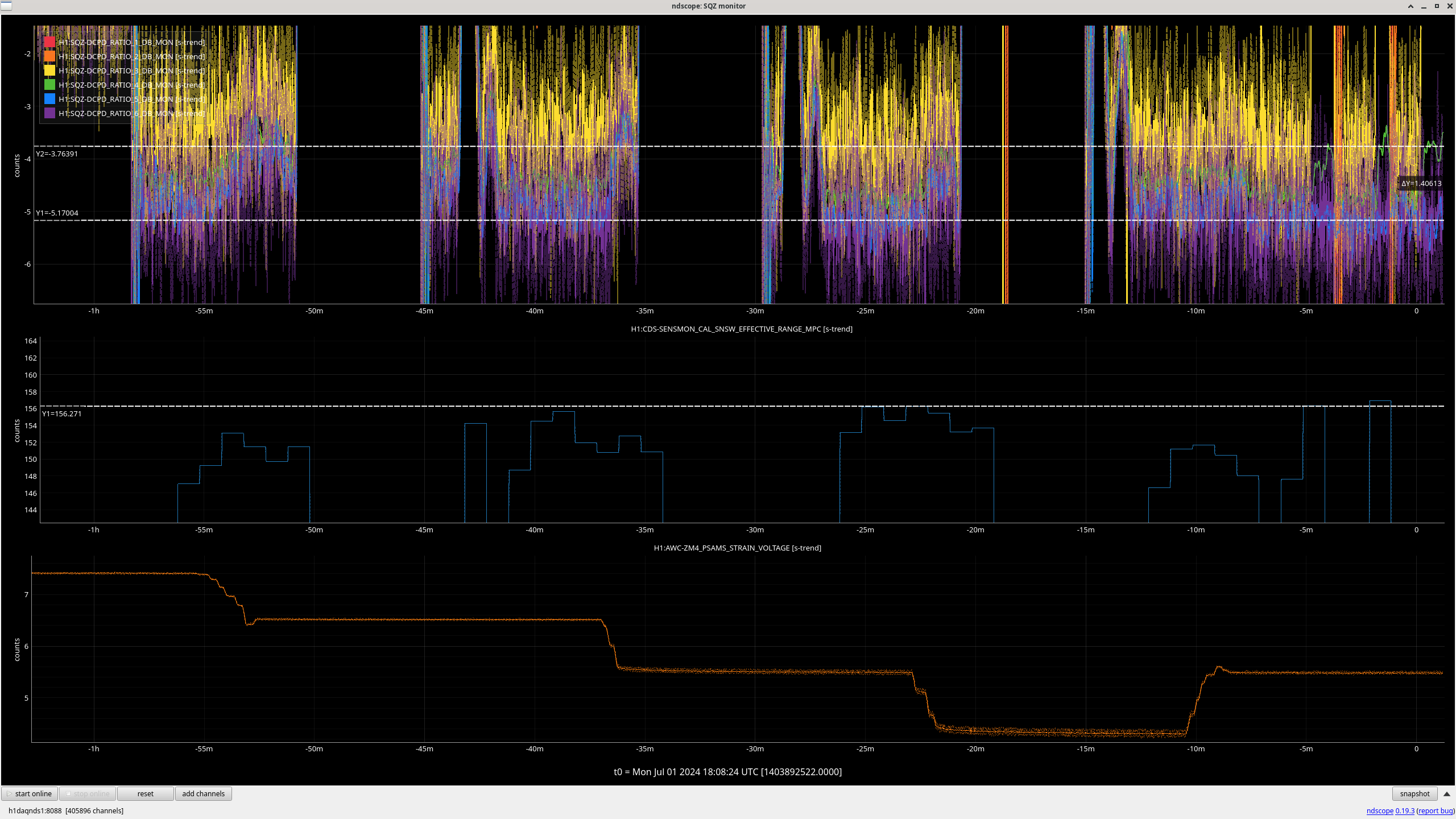
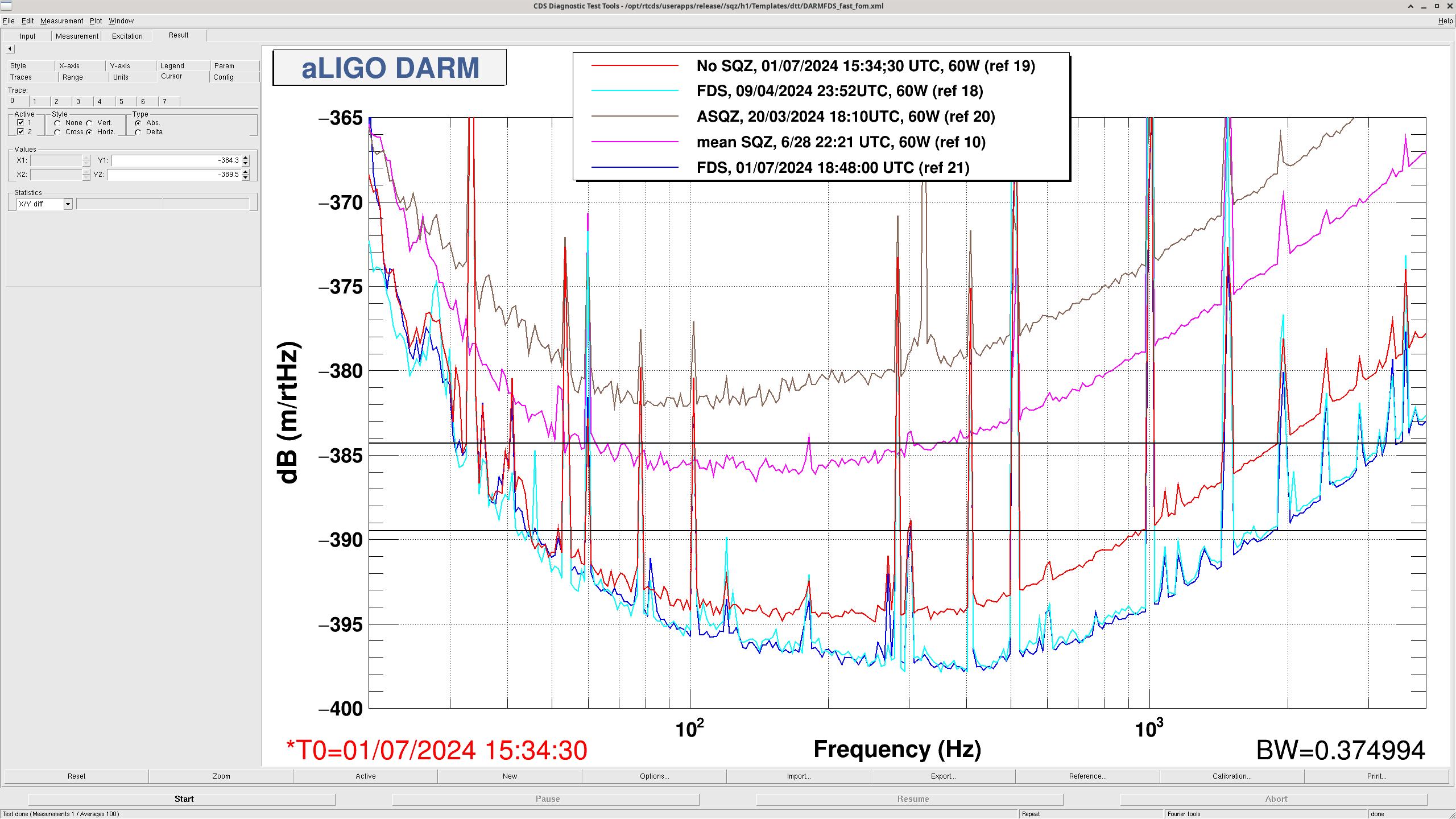
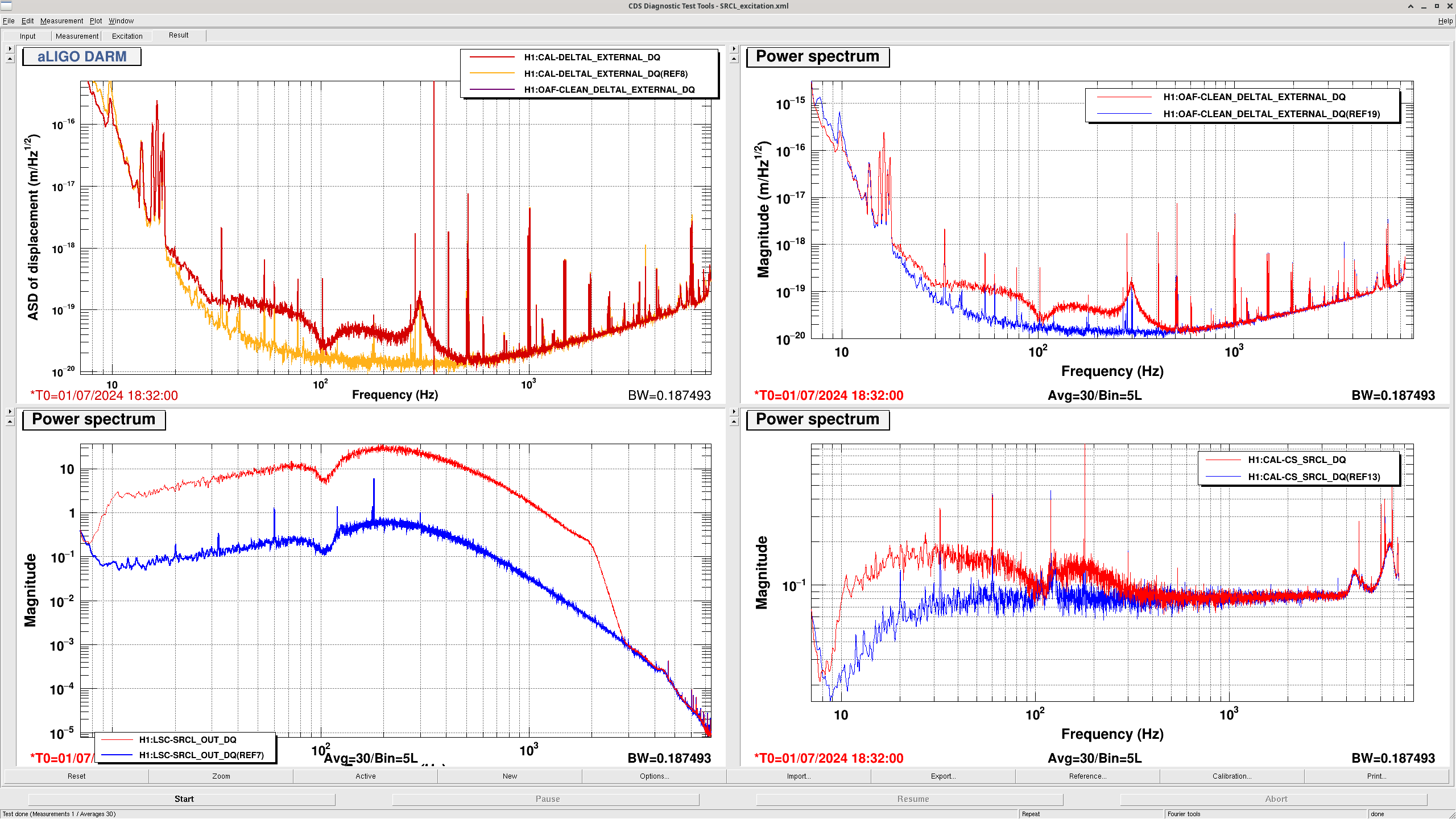
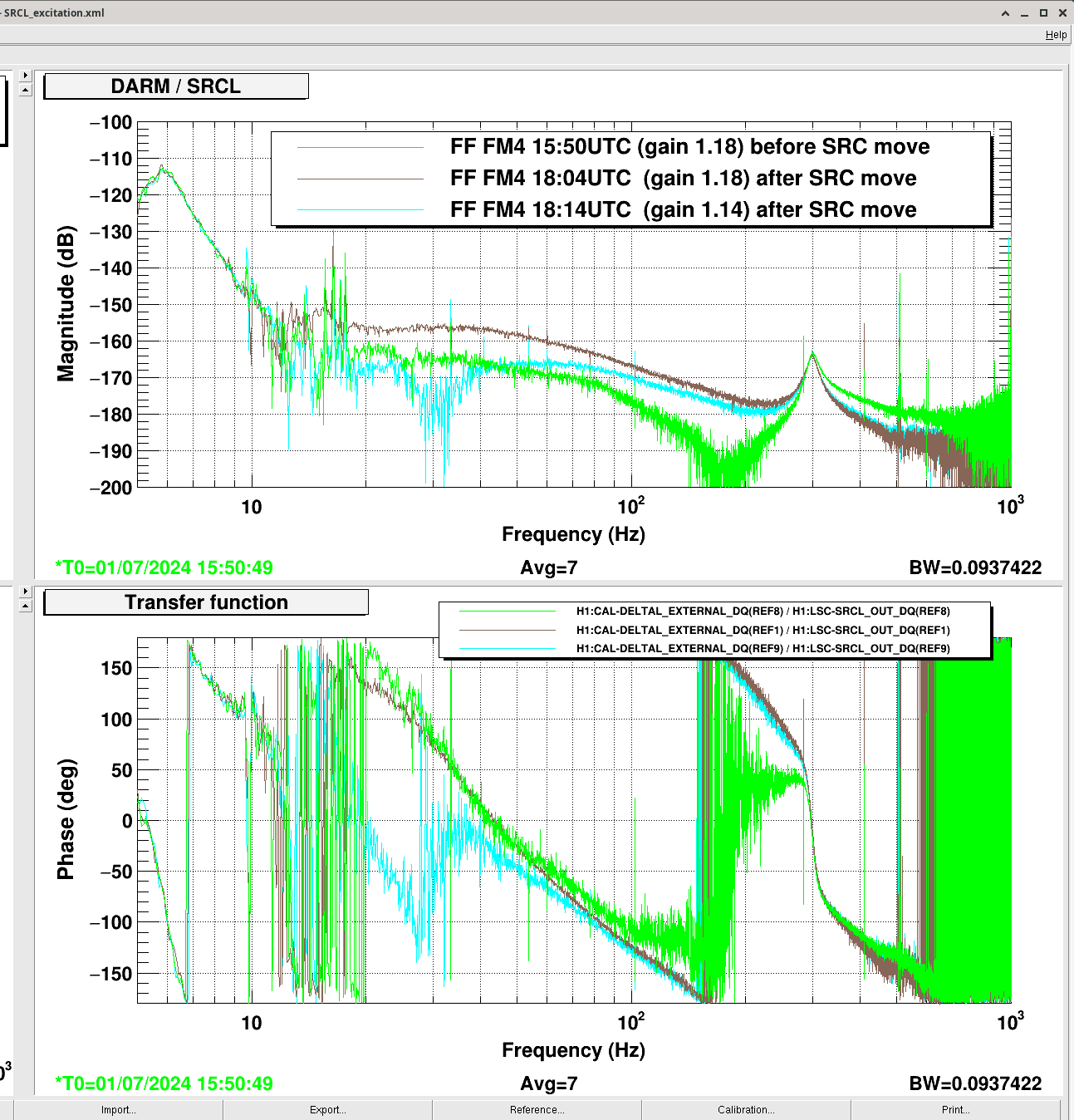
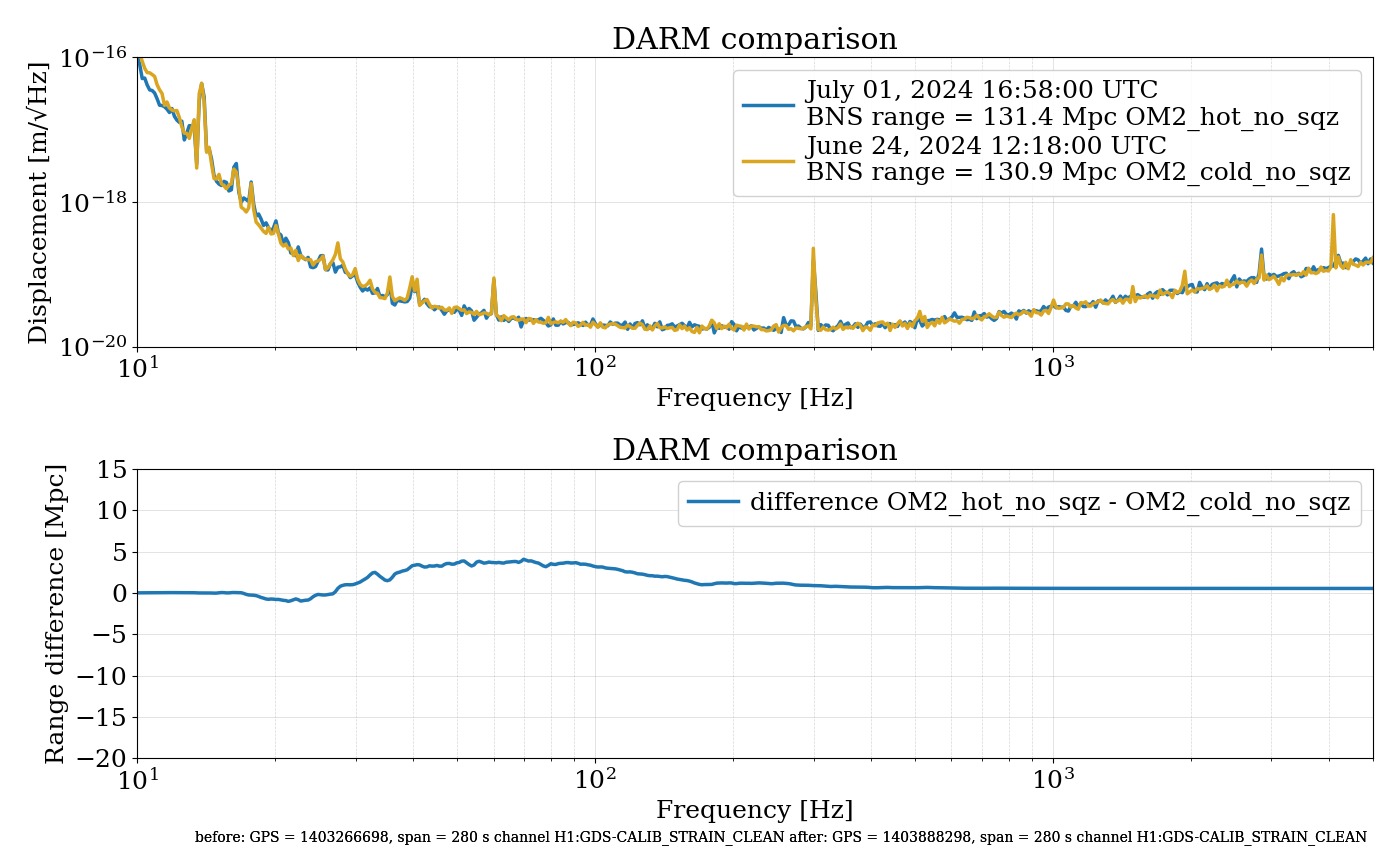
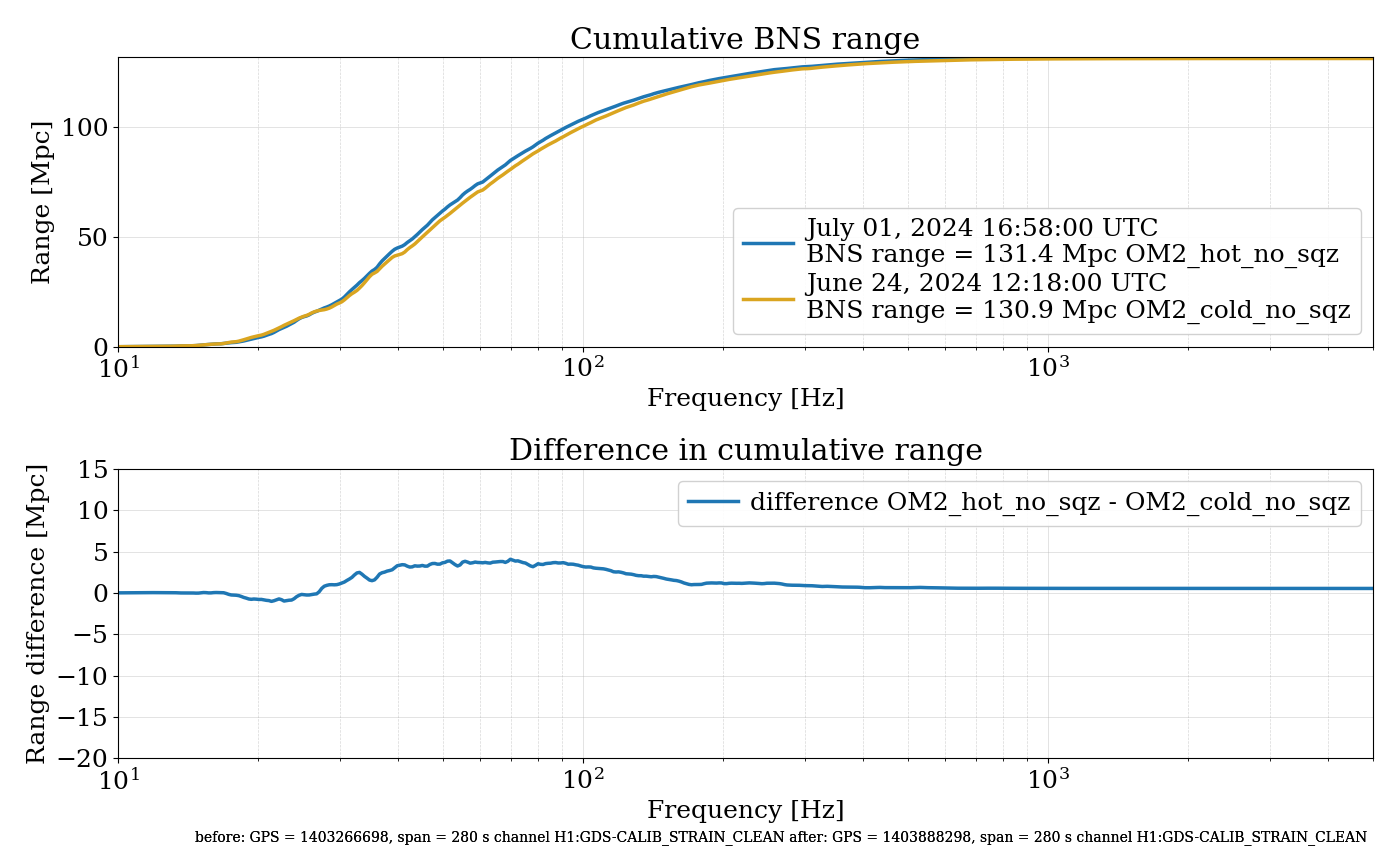
No SQZ time taken this morning 15:29UTC to 15:51UTC. There was small glitches at 15:35:37 and 15:41:53. Best stretch of time is 15:42:00 to 15:51:00. Took no sqz time with hot OM2 in 74834 / 74640, Cold OM2 Dec 20th 18:00- 18:18UTC 74935.
Minhyo
I compared the DARM sensitivity with NO SQZ and OM2 cold condition between today's morning and one in O4a (20/12/2023, 18:10 UTC)
(Also refer to Elenna's alog: 76277)
Seems that the sensitivity don't show much difference above 100 Hz, but noise went up in low frequency.
Other no SQZ times taken yesterday:
Followed Naoki's 70642 instructions. Pushed to aligoNB git. There was a small EQ passing through just before I started this. Had ~3dB of constant SQZ.
Last ran and analyzes aligoNB injections with hot and cold OM2 in December 74943 / 74788. We haven't measured coupling of frequency and intensity noise since August 2023: 72140.
Followed Naoki's instructions for running aligoNB 74788. Using data from 1387120622 2023-12-20 15:16 UTC (cold OM2, observing, IFO locked 11.5 hours, 160Mpc) with today's intensity noise injections.
See attached plot, above 300Hz laser intensity noise is a factor of 2 to 5 above August measurement (Laser NB plot from Aug 2023 -alog 72770) but still low. We don't see any contributions in 30-300Hz range.
Wow, not very coherent for a signal appearing that strongly in DARM.
Adding the coherence plots for LF and MF, low freq coherence is only 0.3, maybe th reason we see no intensity noise contrusion 30-300Hz.
We could think about repeating with higher gains, Craig also suggests doing the frequency noise injections (70642) as MF and HF noise can be seen in DARM but coherence is not 1, maybe the coupling mechanism is frequency noise.
Fil, Dave:
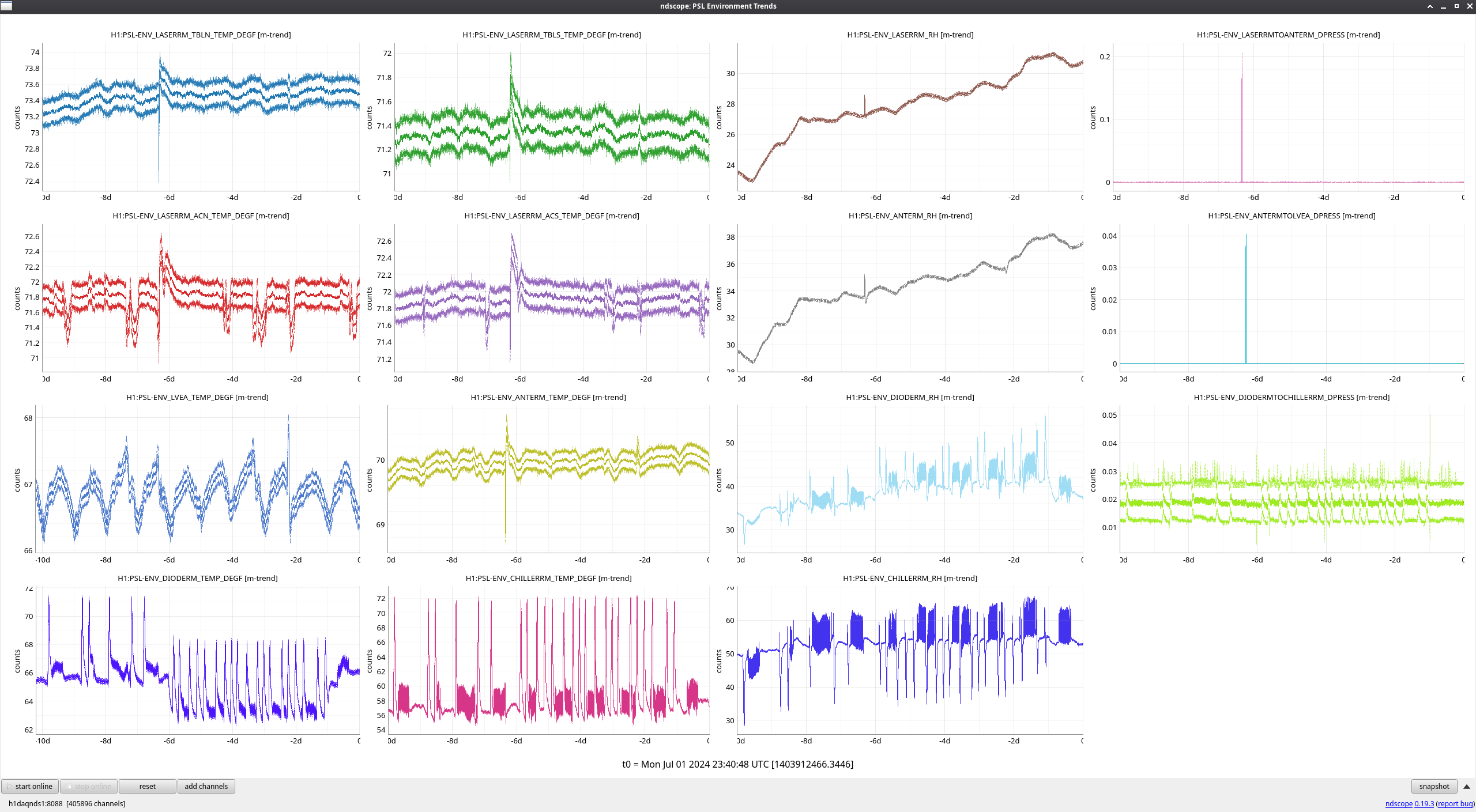
I've updated the dewpoint.adl MEDM to show the decommissioning of HAM 4. Fil found yesterday that the Modular Container #2 sensor is misreading and will be replaced.
TITLE: 03/13 Day Shift: 15:00-23:00 UTC (08:00-16:00 PST), all times posted in UTC
STATE of H1: Commissioning
OUTGOING OPERATOR: None
CURRENT ENVIRONMENT:
SEI_ENV state: USEISM
Wind: 4mph Gusts, 3mph 5min avg
Primary useism: 0.04 μm/s
Secondary useism: 0.64 μm/s
QUICK SUMMARY: H1 has been locked for the past 6 hours, BNS range currently at 135Mpc.
Very low frequency angular lines are being injected in the OMC ASC controls starting at 14:39 UTC. The longer they run the better, but please feel free to stop them if other tests are ongoing.
awggui's are running on cdsws26.
This is a test to see if we can find a better OMC alignment position, and if this has any effect on DARM noise.
We reduced the amplitude by half at around 15:12:50 UTC, because this was saturating the OMC.
We paused these at 15:28:00UTC.
I was able to request and transition to the new DARM state without issue. ETMX still saw a pretty large kick. I'll have to circle back re: how large compared to previous attempts. We will also want to take a look at any effects moving the integrator on L2 LOCK L had. Note: We do get a few SUS_PI warnings shortly after transitioning to this state. Quiet time to monitor for non-stationarity: Start GPS: 1394344327 Stop GPS: 1394346169 Turned off cal lines at GPS 1394346770.39 Elenna started a Bruco after the cal lines were turned off. here is a screenshot of DARM in the new configuration. 20-90Hz looks high and below 15Hz looks low. It's hard to tell how much of this is real until CAL-CS is calibrated & that calibration is propagated to the DTT template. I started an L2 LOCK IN1/IN2 injection using noise recorder at 1394347034.426. We used a tuned broadband measurement that Craig and I put together. Apparently it was too strong because we lost lock from this injection. It also tripped EX. I requested DOWN and the EX trip alarm reset.
Bruco is here: https://ldas-jobs.ligo-wa.caltech.edu/~elenna.capote/brucos/New_DARM/
Just from first glance looks like some residual LSC coherence, but not enough to explain the strange shape of New DARM.
Here are plots comparing the MASTER OUTS on ETMX during Louis's quiet time here with L3 offloaded, vs Gabriele's quiet time in alog 76278 during Nominal DARM. We are concerned only with the filter changes that Louis and Sheila made to offload more of L3's length actuation onto L2. Because L2 is used to control both length and angular degrees of freedom, it can be easy to ask too much of L2. This lock seems to indicate that this configuration is fairly stable. I looked at the UL MASTER OUTs for the L1, L2, L3 on ETMX. 1) RMS on L3 drives is halved. There is much less L3 drive from 1 to 6 Hz, which dominates the RMS. 2) L2 drives are largely unchanged. 3) L1 drives are changed, but the RMS remains similar. There is much less HF content in the L1 drive with L3 offloaded, and the shape of the resonances around 3 and 6 Hz is altered. Overall it's hard to tell which stage is picking up L3's slack from these PSDs. I believe the intention was to offload to L2, but we don't see any obvious change in what control signal is being sent to the L2 stage. This could simply mean that the angular controls are relatively stronger in the L2 controllers. We'll look at the DRIVEALIGN signals to try and figure that one out quantitatively.
The new DARM loop configuration reduces the DARM noise non-stationary at low frequency.
First plot compares the ESD drive with the Old DARM and the New DARM, confirming that the RMS is significantly reduced, especially at the relevant frequencies.
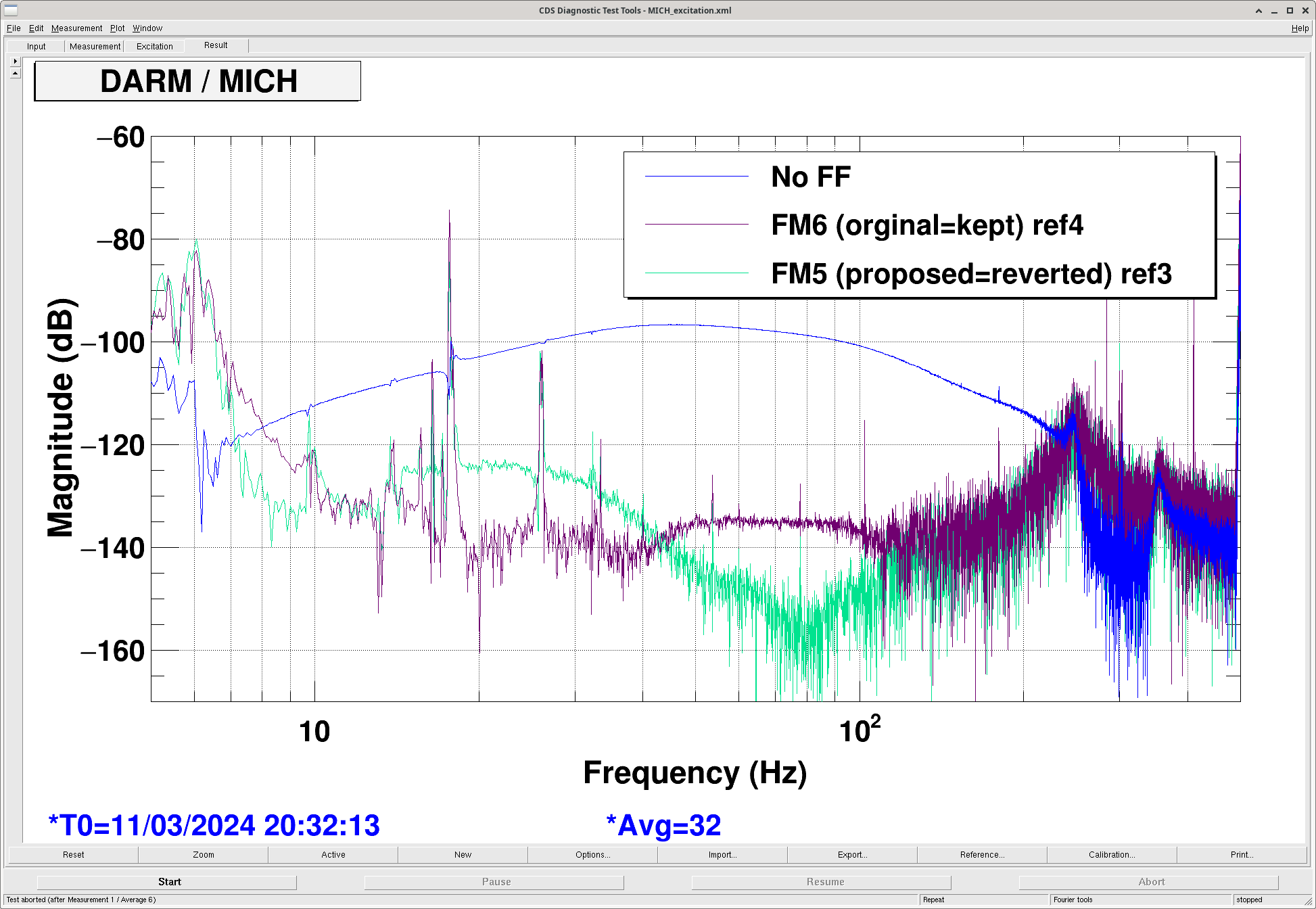
Second and third plots are spectrograms and whitened spectrograms of GDS-CALIB_STRAIN in the two configuration. Despire GDS-CALIB_STRAIN being wrongly calibrated with the New DARM, it is clear that the low frequency non stationarity is gone in New DARM.
Last two plots are the bicoherence of DARM with the ESD drives, showing that in the Old DARM there is still some bicoherence for noise in the 10-30 Hz region, while in the New DARM this is gone.
These transitions last night were made with a different L2 LOCK filter (which is in L2 LOCK L FM6, replacing the filter used in earlier new DARM configurations that was at FM2). The attached screenshot shows the filter change, I replaced the poles at zero with poles at 0.03 Hz to get rid of the integrator here without changing the phase at the crossover much. This was done with the guardian version 27211
Plots of the actuators during the transitions are attached, here and here, they can be compared to the one that Louis posted where we used L2 LOCK FM2. This suggests that the change to these poles didn't help to reduce the transient during the transition.
Today we tried another change to the transition, this time Evan and I moved the poles in L2 LOCK L from 0.03 Hz to 0.1 Hz, and changed the ramp time for the transition to 10 seconds (from 5). The model is shown in the attached PDF where the new filter is in place in the transition traces. This transition wasn't smoother than the others, see here.
The new UGF is 70 Hz with 20° of phase margin. The crossover between L2 and L3 is at 18 Hz with probably about 40° of phase margin (low coherence due to interference with calibration lines). We have not measured the L1 to L2 crossover yet.
S. Dwyer, E. Capote, E. Hall, S. Pandey, L. Dartez
Here are some notes from our efforts to measure IN1/IN2 at the L1 LOCK L input.
- Sheila adjusted UIM measurement template for new darm config. This template is at /opt/rtcds/userapps/release/lsc/h1/templates/DARM/UIM_crossover.xml.
- Evan ran the template initially and saw that the UGF is near 1Hz. He adjusted the excitation amplitude along the way to improve coherence for the next time we run this measurement.
- Evan added a high pass filter in the L3 DRIVEALIGN bank with a cutoff frequency at at 5Hz
- first filter attempt was at 8Hz; possibly caused a roll mode to excite near 13.75Hz
- second filter attempt was at 5Hz; this seemed to improve the roll mode excitation
We ended up losing lock a shortly after the injection finished due to PRC activity.
Comparison of DARM ESD drive from end of O4a versus a few days ago. The microseism was about 0.2 µm/s in both cases. The rms DAC drive from 0.1 Hz to 0.3 Hz is about 400 ct, so even in cases of exceptionally high microseism it will be subdominant to the 7000 ct rms that is accumulated above 1 Hz.
I tried a new DHARD Y filter that should reduce the noise injected from DHARD Y between 10-30 Hz. It's about 6 dB improvement. I ran 10 minutes quiet DARM after the test starting Mar 13 4:36 UTC (Mar12 21:36 local). No apparent change in the low frequency noise in DARM.
The filter engagement works, so I added it to the "LOWNOISE ASC" state of the guardian. It's in FM8 and engages with other DHARD Y boosts.
Gabriele ran a bruco for me, looks like this was an improvement-
[Gabriele, Elenna]
Since we saw high coherence betwen DHARD_Y and DARM, we tried to improve the A2L. In summary, the current value of 1.65 is the best for angular coupling at ~30 Hz, so we didn't change it.
To do the measurement, we injected two lines, one at 15.1 Hz and one at 30.3 Hz, and used a python script to demodulate the lines in DARM. The lowest coupling at 15.1 Hz is obtained for a larger value around -2.4, but this makes the coupling at 30.3 Hz larger. The initial value is the best for minmize the coupling at 30 Hz, where DHARD is limitign DARM.
As a part of several suggestions to address the clipping on IM4 trans and the ISS QPD, Keita suggested I check the POP QPDs to see if things have changed there since the vent. Here are two ndscopes comparing the PIT, YAW and NSUM channels of both POP A and POP B QPDs. The two screenshots show the last lock in January and the recent lock yesterday. It appears that the overall power on the QPDs is about the same, but the alignment on POP B in particular has changed significantly in pitch, close to -1 and probably to falling off.
We servo on POP A during DRMI lock, but do not use POP B for any control (to my knowledge).
[Evan, Gabriele, Louis, Georgia]
We struggled to properly align the IFO. We saw low flashes in the y arm during ALS locking and had to move the beamsplitter to increase the flashes. Then, after completion of initial alignment, the ALS Y arm alignment would be poor again. After some trial and error and fighting with the "increase flashes" guardian state, Evan saw that PR3 has drifted in yaw 0.4 microradians. When he moved PR3, it significantly improved the Y arm flashes and the input alignment. We don't know why PR3 drifted and it had so much effect on the Y arm but not necessarily the X arm. Our third initial alignment succeeded and locking is proceeding well.
Attached are some trends of PR3 witness sensors.
The hepi and ISI position sensors say that those are not drifting. The oplev yaw was restored by the move described above; the top mass osem doesn't see any drift except for the move of the slider to restore the optical lever.
General Compute work successful and complete. Split the fibre optic pair that was a single pair - 2 strand connection to ESNet and split the fiber to 2 single strand full duplex circuits to ESNet. We now have BGP Peer redundancy and Seattle route as preference. We are using BiDi connectors now over standard SFP+. One route to Boise and one route to Seattle. Seattle preferred due to latency, Boise is redundant. Duration of total outage was approximately 30 minutes, and duration to full restoration was about one hour. 1500: Work Started 15:15 Internet connection cut 15:45 Initial restoration achieved, but not the Seattle link. 16:15 Seattle link is restored when fiber patch found incorrectly connected. This was corrected and full circuit restoration was seen. 16:30 All secure from this evolution. Hands off all systems check shows complete operation, BGP peering to Seattle that is established, and IP Flows are in the Seattle route destinations.
TITLE: 03/12 Day Shift: 15:00-23:00 UTC (08:00-16:00 PST), all times posted in UTC
STATE of H1: Preventive Maintenance
INCOMING OPERATOR: None
SHIFT SUMMARY: Tuesday maintenance today, mostly a lot of VAC and CDS work. We has issues getting ETM and TMS model working(76305), but we were finally able to get them up and are currently working on locking green arms.
LOG:
15:00UTC Starting Tuesday maintenance
15:38 Turned sensor correction off
| Start Time | System | Name | Location | Lazer_Haz | Task | Time End |
|---|---|---|---|---|---|---|
| 15:15 | ISC | TJ, Georgia, Matt, Trent | LVEA - ISCT1 | yes(local) | Realigning green beatnote - TJ out 15:50 | 16:01 |
| 15:15 | FAC | Karen | EY | n | Tech clean | 15:53 |
| 15:16 | FAC | Kim | EX | n | Tech clean | 16:20 |
| 15:24 | HWS | Camilla, Graeme, TJ | EX | YES | HWS table work | 18:20 |
| 15:28 | FAC | Mitchell | LVEA - West bay | n | Labelling things | 17:47 |
| 15:30 | EE | Fil | H2 | n | Looking at humidity sensors | 16:23 |
| 15:38 | VAC | Gerardo, Jordan | Bier Garten | n | Purge air, Jordan out 17:07, Travis out 18:40, Janos out 18:49 | 19:00 |
| 16:01 | CDS | Dave | remote | n | WP11766 New h1iopsusey model | 20:23 |
| 16:02 | SUS/ISI | Oli, Jeff,Dave | CR | n | WP11743 New SUS & ISI models ETMX, ETMY | 20:23 |
| 16:03 | DMT | Dan | MSR | n | WP11765 Reboot DMT servers | 18:46 |
| 16:03 | DAQ | Dave | remote | n | Reboot DAQ for SUS/ISI model changes | 20:23 |
| 16:08 | FAC | Karen, Kim | HAM Shack | n | Tech clean | 16:35 |
| 16:09 | CDS | Jonathan | office | n | WP11761 Upgrade FCES network switch | 17:23 |
| 16:14 | CDS | Jonathan | remote | n | Upgrading FCES switch firmware | 16:55 |
| 16:34 | Richard | LVEA - GV2 | n | Meeting up with Fil | 16:55 | |
| 16:36 | IAS | Ryan C | LVEA - Beer garden | n | Measuring with FARO | 18:29 |
| 16:45 | SQZ | Daniel, Nutsinee | HAM7 | n | Measuring SQZ rack electronics | 18:19 |
| 17:02 | FAC | Kim | High Bay | n | Tech clean | 18:48 |
| 17:04 | FAC | Karen | OptLab, VacPrep, LVEA | n | Tech clean | 18:16 |
| 17:07 | VAC | Jordan, Eric | EX | YES | Hooking up RGA | 18:07 |
| 17:25 | EE | Marc, Fernando | LVEA | n | Helping Gerardo | 18:35 |
| 18:36 | TCS | Camilla, Fernando | LVEA | n | Looking at TCS controls | 19:01 |
| 20:00 | FAC | Bubba | EY | n | Checking water tank | 20:24 |
| 20:13 | - | Gabriele | EX,EY | n | Becoming healthier | 22:13 |
| 20:56 | - | Janos, Graeme, Craig | MX | n | tour | 21:56 |
| 21:01 | EE | Gerardo, Jordan | EY,ex | n | replacing batteries for solar panels | 22:01 |
| 22:21 | SQZ | Nutsinee | LVEA - SQZT0 | n | Taking measurements | 22:26 |
| 22:22 | VAC | Travis | MX | n | Turn off turbo pump | 22:52 |
| 22:35 | SQZ | Nutsinee | LVEA - SQZT0 | n | More measurements | 23:05 |
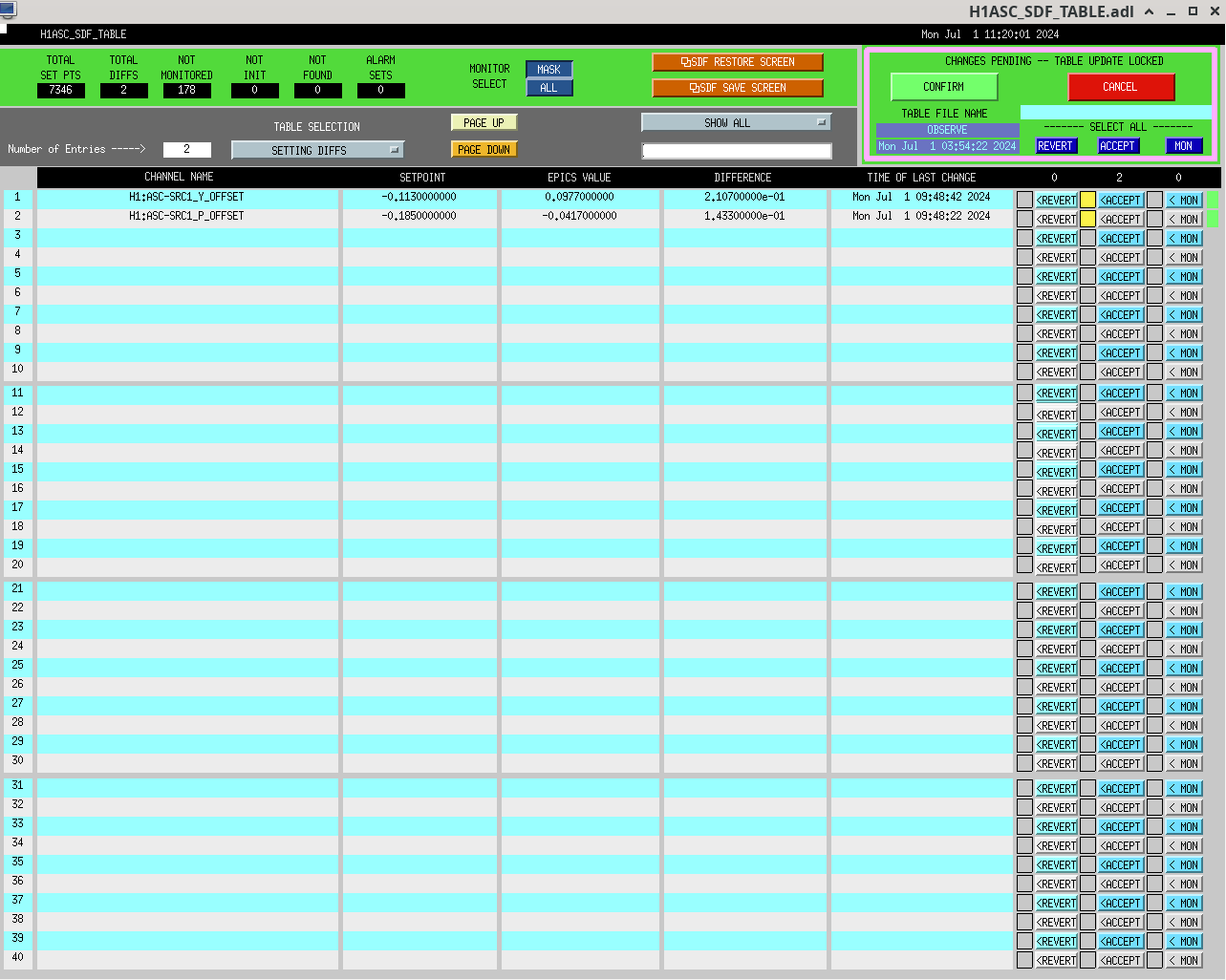
J. Kissel, O. Patane, D. Barker ECR E1700387 IIET Ticket 9392 WP 11743 More details to follow in the comments, but today started the campaign of SUS / SEI watchdog improvements. This required us to restart the h1susetmx h1susetmy h1sustmsx h1sustmsy h1susetmxpi h1susetmypi h1isietmx h1isietmy front-end models. The update makes the following changes: (1) Establish a sensible band-limited RMS user watchdog trigger (where it had been some old broken RMS code prior), where the OSEM trigger signals are now calibrated into microns (um_RMS), and the threshold has been adjusted to match it. (2) Entirely removed the USER DACKILLs from the SUS, so we no longer AND together the output triggers for any stages' user watchdog and shut down the output of DAC. In other words, we'll no longer kill damping and offsets if we drive the L2 stage too hard with ISC control. (3) Entirely removed the connection between the ETM and TMS DACKILLs to the ISI and PI models, and replaced the input to the ISI's PAYLOAD flag with "always good" constants. As originally promised in ECR and IIET ticket -- this drastically reduces the unnecessary complexity and redundancy of the watchdog system, it now behaves in a much less trigger-happy fashion, and delightfully, we now can answer the question "how much motion trips the watchdog?" I've accepted the threshold at 25 um_RMS over the 0.1 to 10 Hz band. We can and should adjust this threshold as we gather more experience. All changes to settings have been accepted in the corresponding SUS safe.snap such that the work in calibrating the OSEM trigger signal won't disappear with the ISC_LOCK guardian's SDF_REVERT state.
Sheila, Camilla, Jennie W, Keita remote
Stefan and Daniel suspect that our excess noise around 100 Hz might be due to intensity noise, and we did have a large shift in alignment of the beam transmitted through IM4 (76291) 76241. I moved pico 1, first to center the beam on the ISS QPD, which made the power on the ISS array PDs drop, and didn't improve the spectrum of the ISS Sum inner or outer channels (we did this with the loop open). We reverted this, then looked at the QPD position in O4a when we had 60W input power, went to 60W input power and pico'd to bring the beam to the same location as O4a. This also didn't improve the spectrum, so we brought the pico back to where we started.
Sheila asked me to compare the ISS second loop outputs with from our recent NLN lock last night to that during O4a. The spectra doesn't show much difference in the noise (top left plot shows Jan 14th lock in cyan and yellow, last night's one in pink and brown).
The other three plots shows the coherence of ISS output with all three GS13s on the HAM2 optical table. There only seems to be coherence at the power lines.
So maybe the ISS is not causing intensity noise to couple into DARM differently pre and post vent.
Images 2 and 3 attached shows the ndscope fro all channels I used around the two times I took spectra.
Time 1 = 2024-01-14 22:05:27 UTC
Time 2 = 2024-03-12 12:53:24 UTC
Channels for ISS:
H1:PSL-ISS_SECONDLOOP_PDSUMINNER_OUT_DQ
H1:PSL-ISS_SECONDLOOP_PDSUMOUTER_OUT_DQ
Channels for GS13s:
H1:ISI-HAM2_BLND_GS13X_IN1_DQ
H1:ISI-HAM2_BLND_GS13Y_IN1_DQ
H1:ISI-HAM2_BLND_GS13Z_IN1_DQ
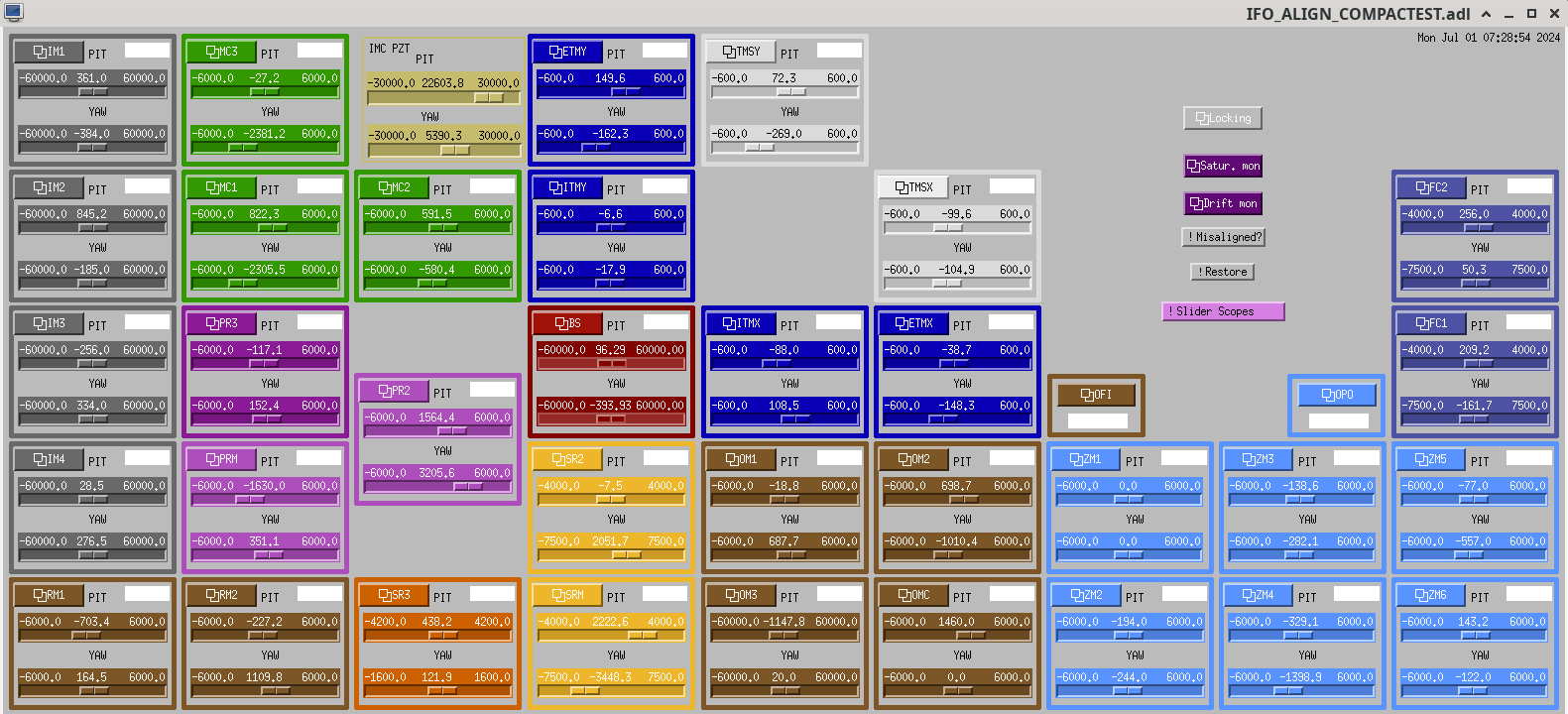
I looked at the pointing of the IMs and MCs from the start of a lock 16th Janary to now. As previously found, nothing seems to have changed much, IM1 P changed by ~100 counts, more than the other IMs, but it's unclear what these counts are calibrated to.