
ryan.crouch@LIGO.ORG - posted 23:40, Wednesday 19 June 2024 (78543)
Lockloss at 06:38 UTC
Lockloss at 06:38 UTC
Lockloss at 06:38 UTC
We've been locked for just over 10 hours, all is calm on site. High frequency squeezing isn't quite as good as it was earlier in the week.
TITLE: 06/19 Day Shift: 1430-2330 UTC (0730-1630 PST), all times posted in UTC
STATE of H1: Observing at 148Mpc
INCOMING OPERATOR: Ryan C
SHIFT SUMMARY: One lockloss with an automated relock. Our range was around 150, but has since increased a handful of Mpcs now. It looks like CHARDY and DHARD_Y are looking a bit better.
LOG:
TITLE: 06/19 Eve Shift: 2300-0800 UTC (1600-0100 PST), all times posted in UTC
STATE of H1: Observing at 148Mpc
OUTGOING OPERATOR: TJ
CURRENT ENVIRONMENT:
SEI_ENV state: CALM
Wind: 14mph Gusts, 10mph 5min avg
Primary useism: 0.04 μm/s
Secondary useism: 0.06 μm/s
QUICK SUMMARY:
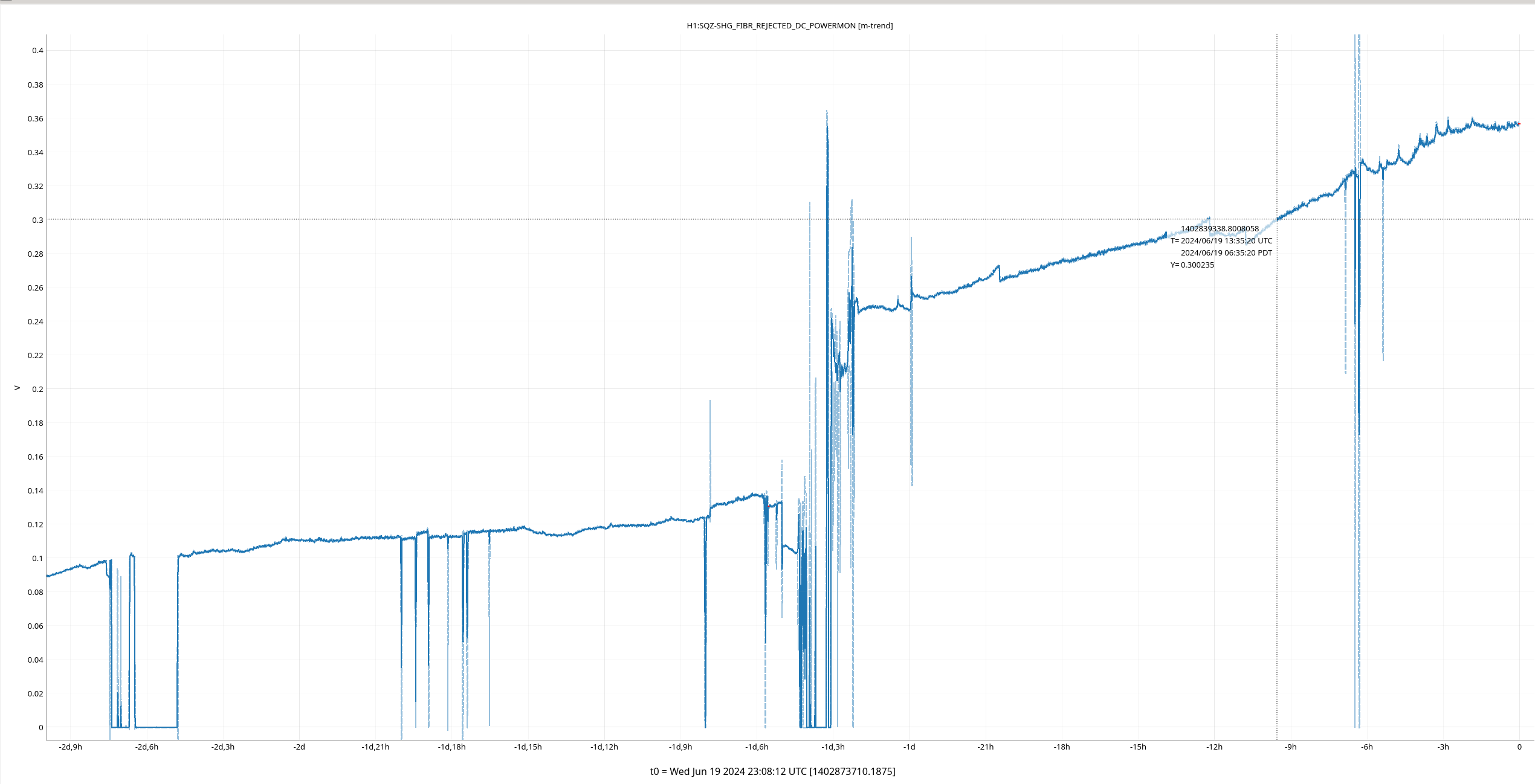
SQZ_OPO_LR GRD is notifying: 'pump fiber rej power in ham7 high, nominal 35e-3, align fiber pol on sqzt0.'
Its currently just under 0.36, (0.3 is considered high).
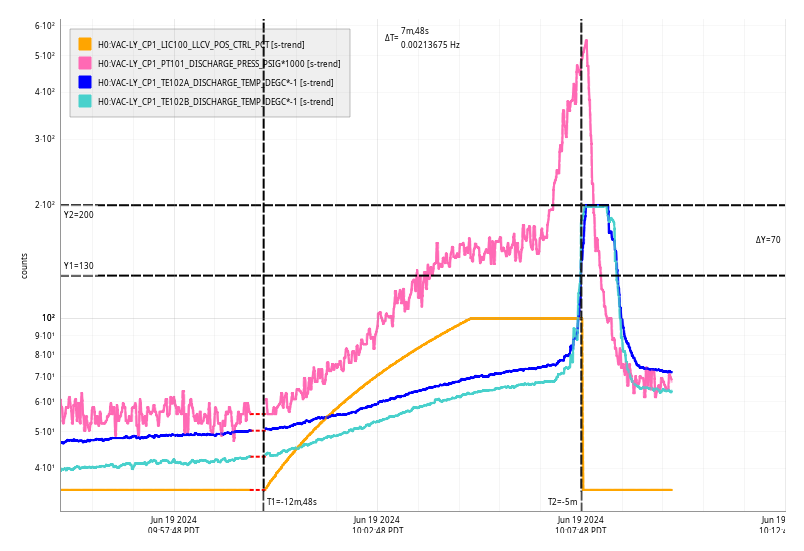
Wed Jun 19 10:07:48 2024 INFO: Fill completed in 7min 45secs
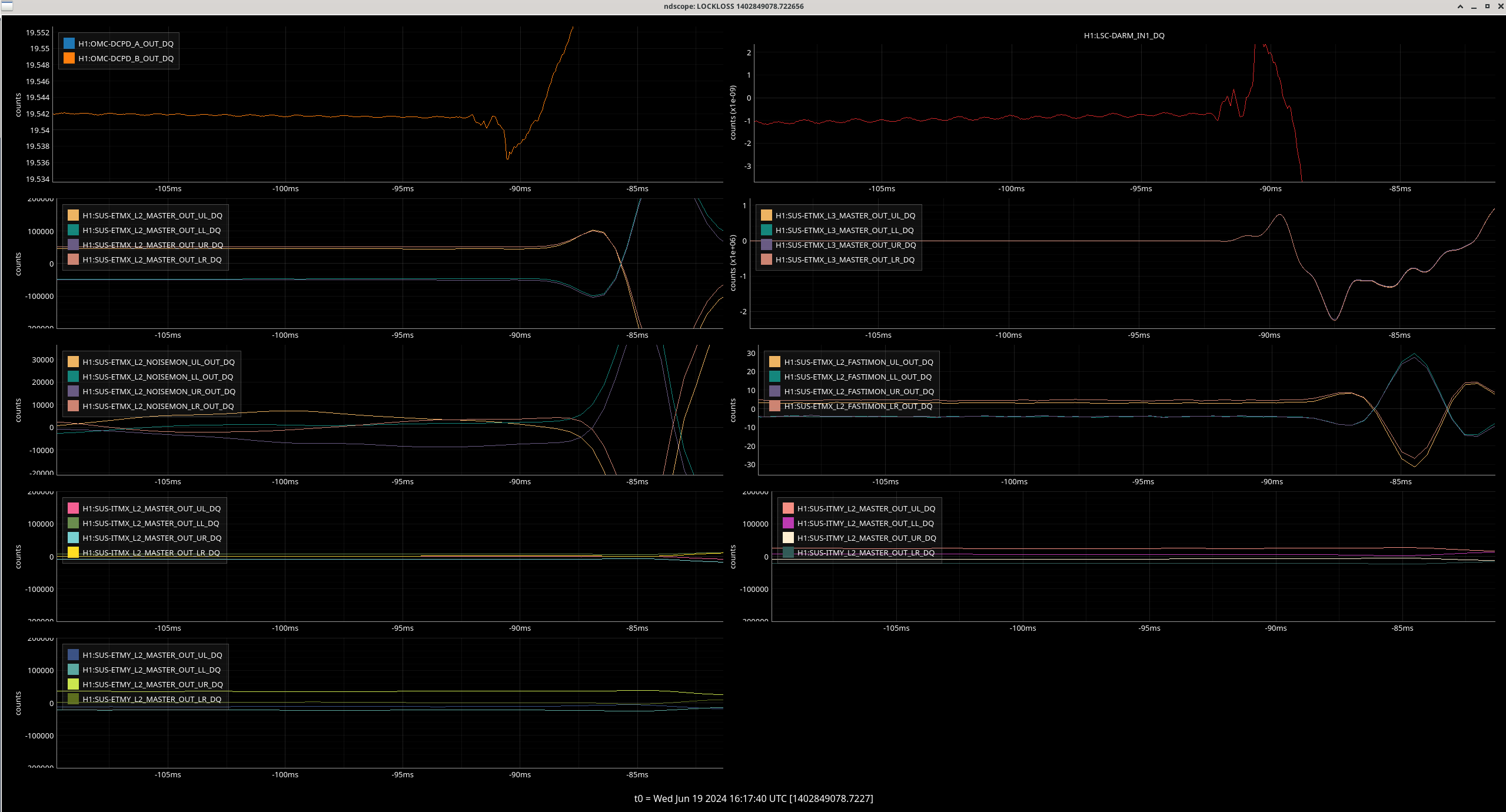
Ended a 20 hour lock. Looking at the plots it seemed to be a very fast lock loss. I see that LSC-DARM wiggle that we often see, but the magnitude of it is a bit smaller than what I have been looking at in the recent past.
Back to observing at 1748 UTC. Fully auto relock with an initial alignment.
TITLE: 06/19 Day Shift: 1430-2330 UTC (0730-1630 PST), all times posted in UTC
STATE of H1: Observing at 148Mpc
OUTGOING OPERATOR: Tony
CURRENT ENVIRONMENT:
SEI_ENV state: CALM
Wind: 14mph Gusts, 10mph 5min avg
Primary useism: 0.03 μm/s
Secondary useism: 0.07 μm/s
QUICK SUMMARY: Locked for 18.5 hours, the range has been decreasing a bit the last hour or two. I'll run some checks to see what's going on.
There is a loud whining in/on the OSB that can be heard from the parking lot and alos in the control room. I think it might be coming from the roof or somewhere in the ceiling. I'll see if I can localize it a bit before calling facilities.
Two updates:
The whining stopped around 740PT and hasn't returned. It went away before I was able to localize it any better than somewhere in the OSB.
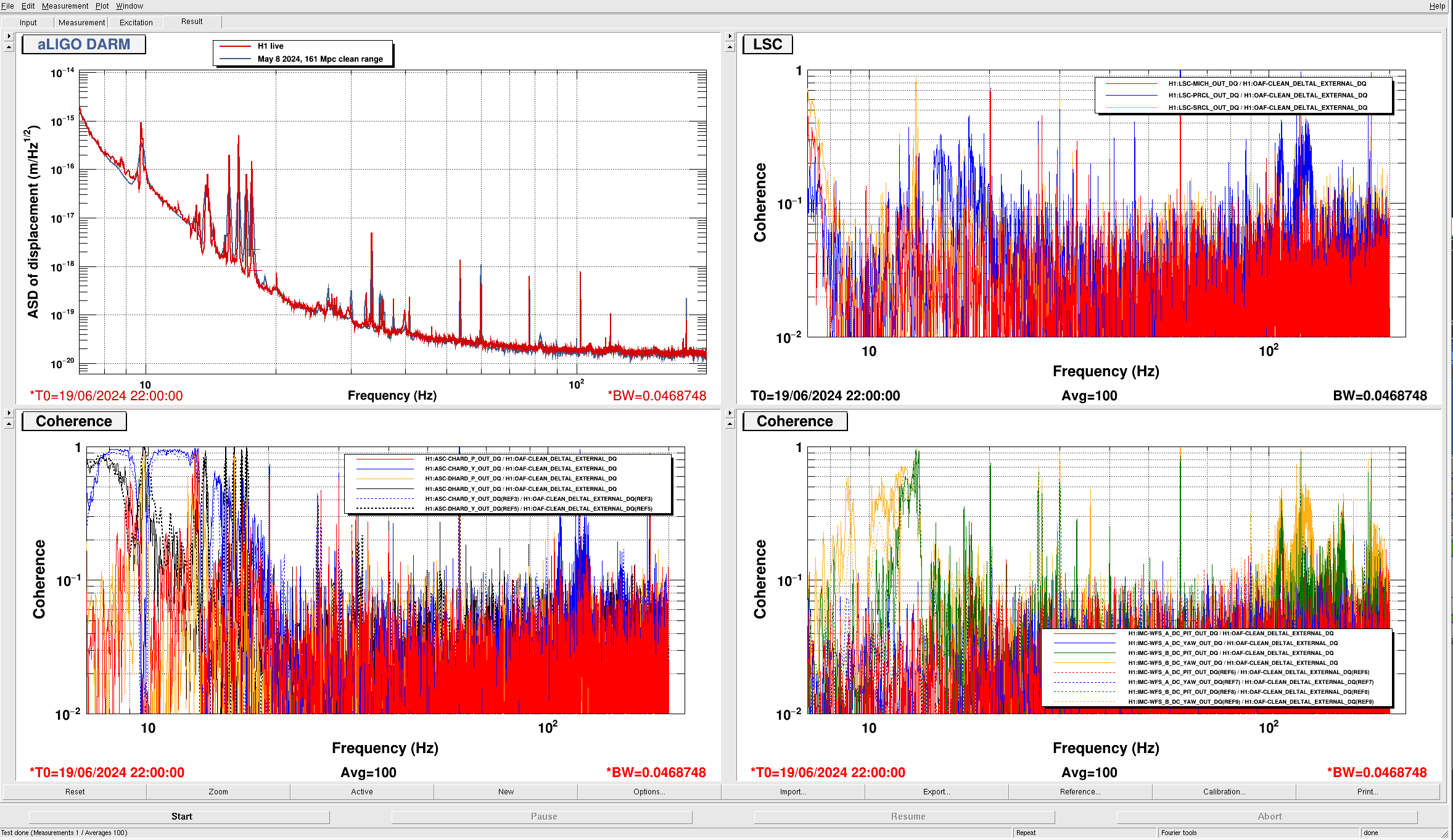
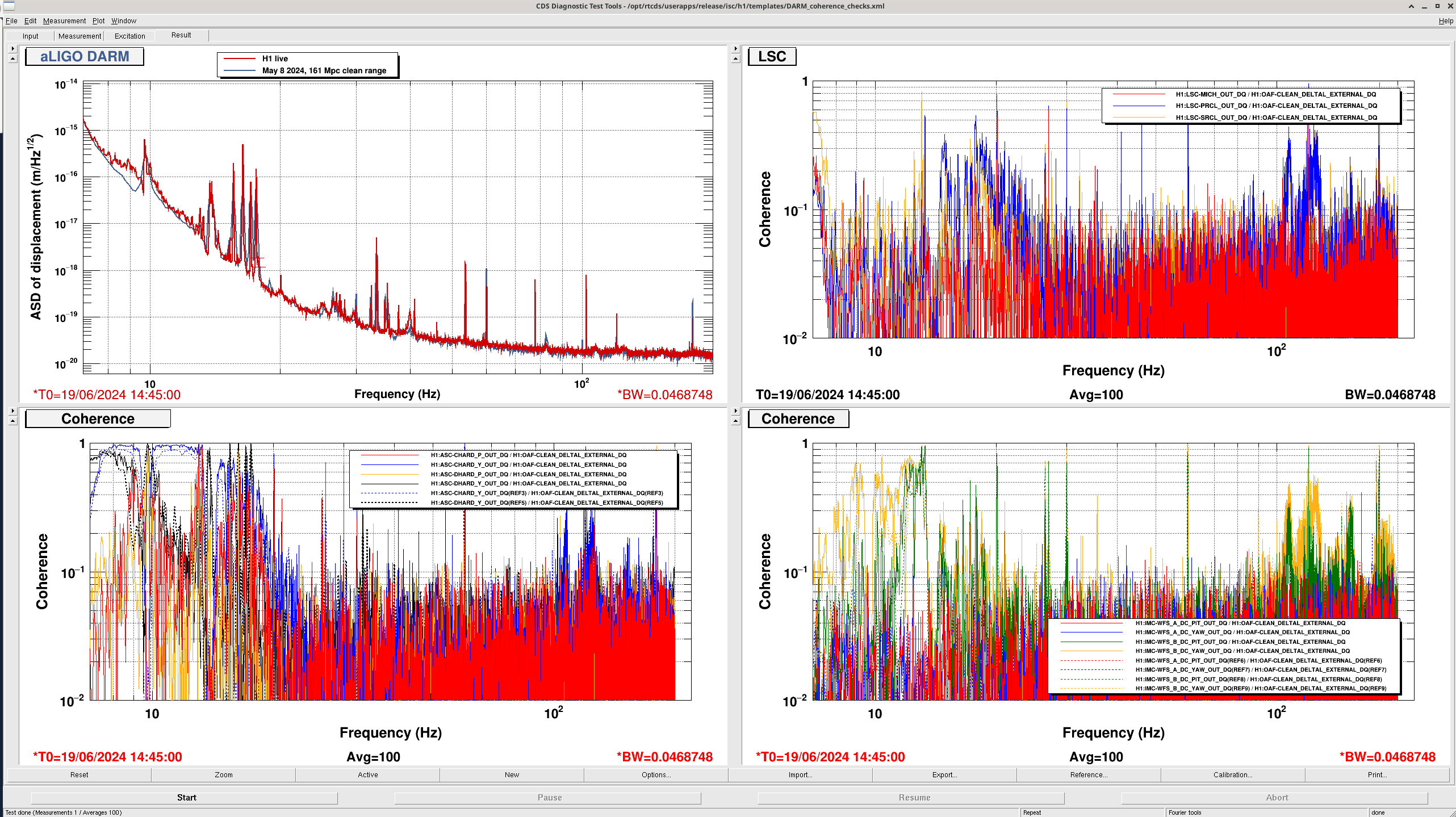
I ran Sheila's low range dtt and it looks like our <15Hz is what's hurting us the most at the moment. In particular CHARD Y, DHARD Y, and maybe IMC-WFS_B YAW but the last one is a bit tough to tell.
TITLE: 06/19 Eve Shift: 2300-0800 UTC (1600-0100 PST), all times posted in UTC
STATE of H1: Observing at 149Mpc
INCOMING OPERATOR: Tony
SHIFT SUMMARY: We've been locked for 11:50, calm night. The trace on the bottom of nuc5 isn't showing up.
23:25 -23:27 UTC We dropped out of observing to run SCAN_SQZ_ANG to improve SQZing which did not look good following its last relock.
If we lose lock and relock ISC_LOCK will need to be taken to INJECT_SQUEEZING then back to NLN to reset the ISC_LOCK notification about SQZ_MANAGER.
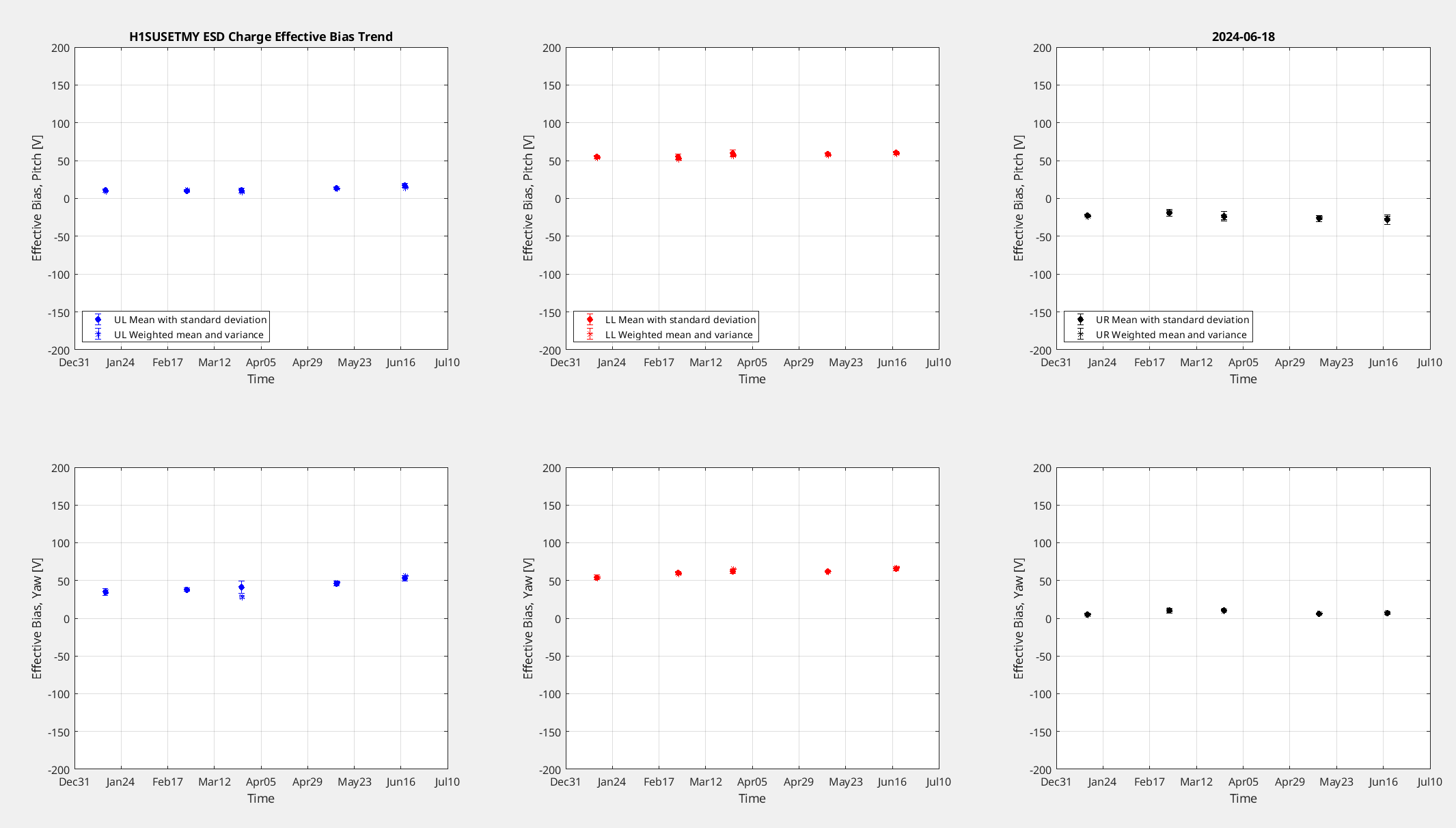
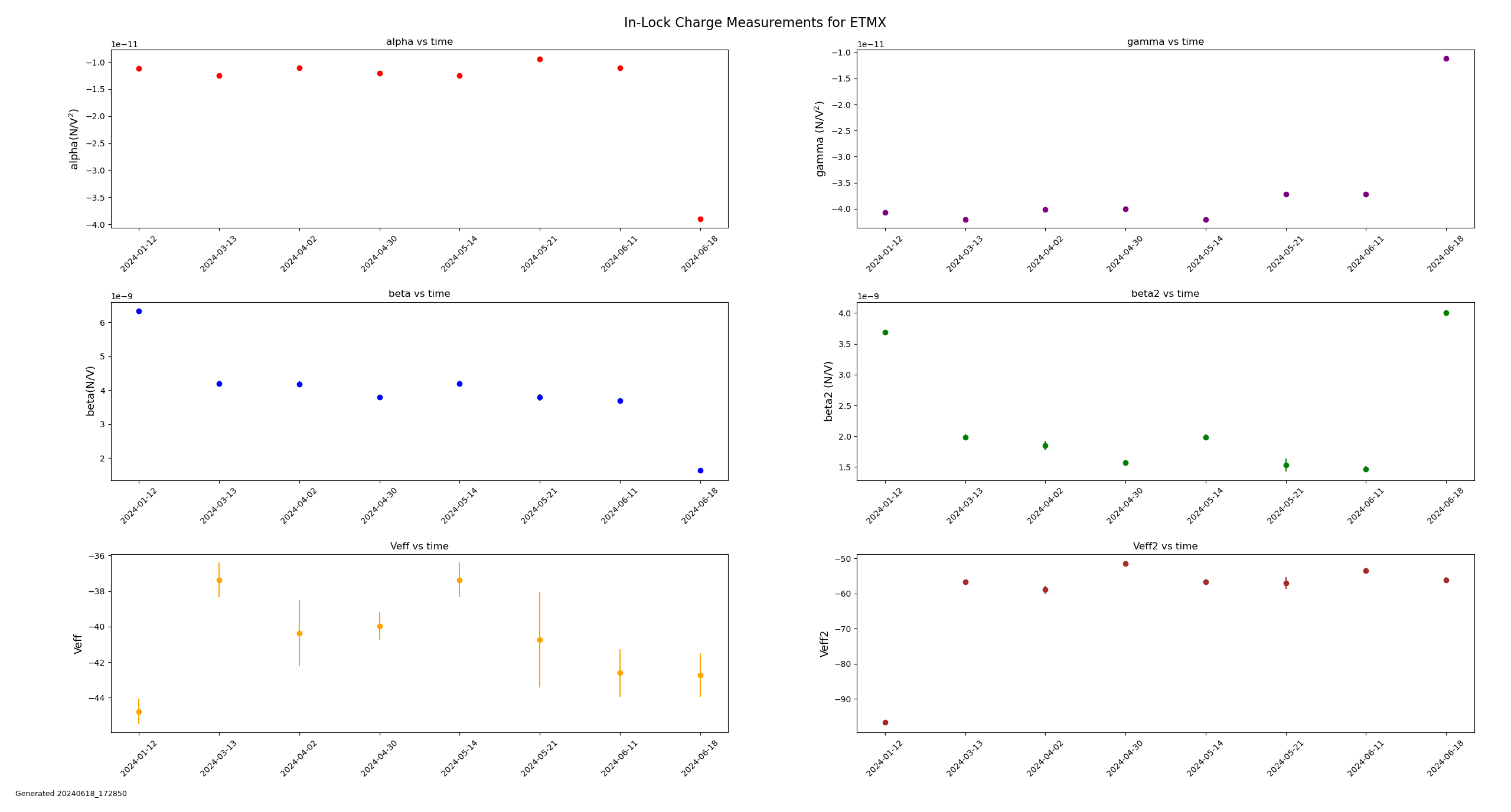
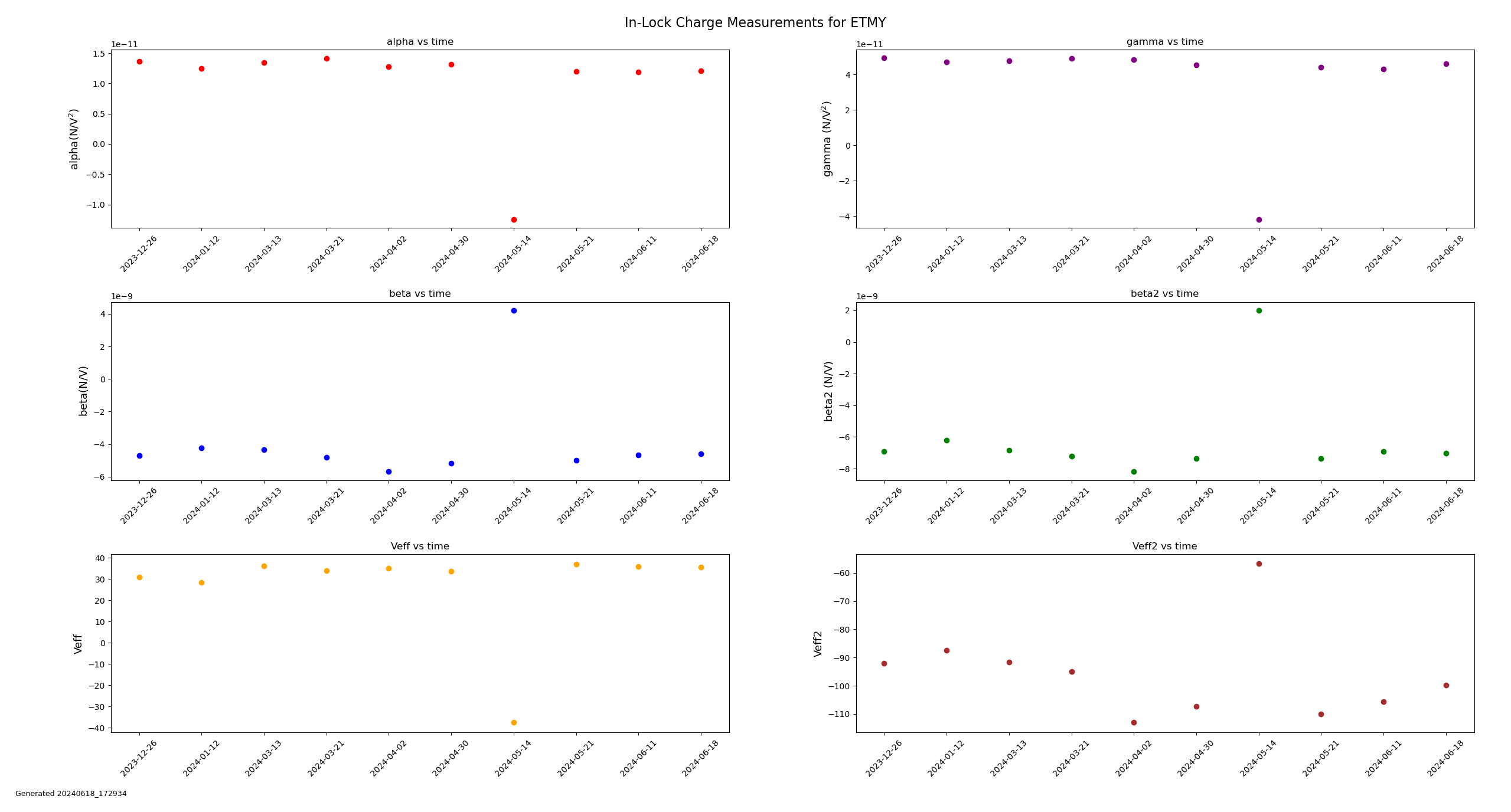
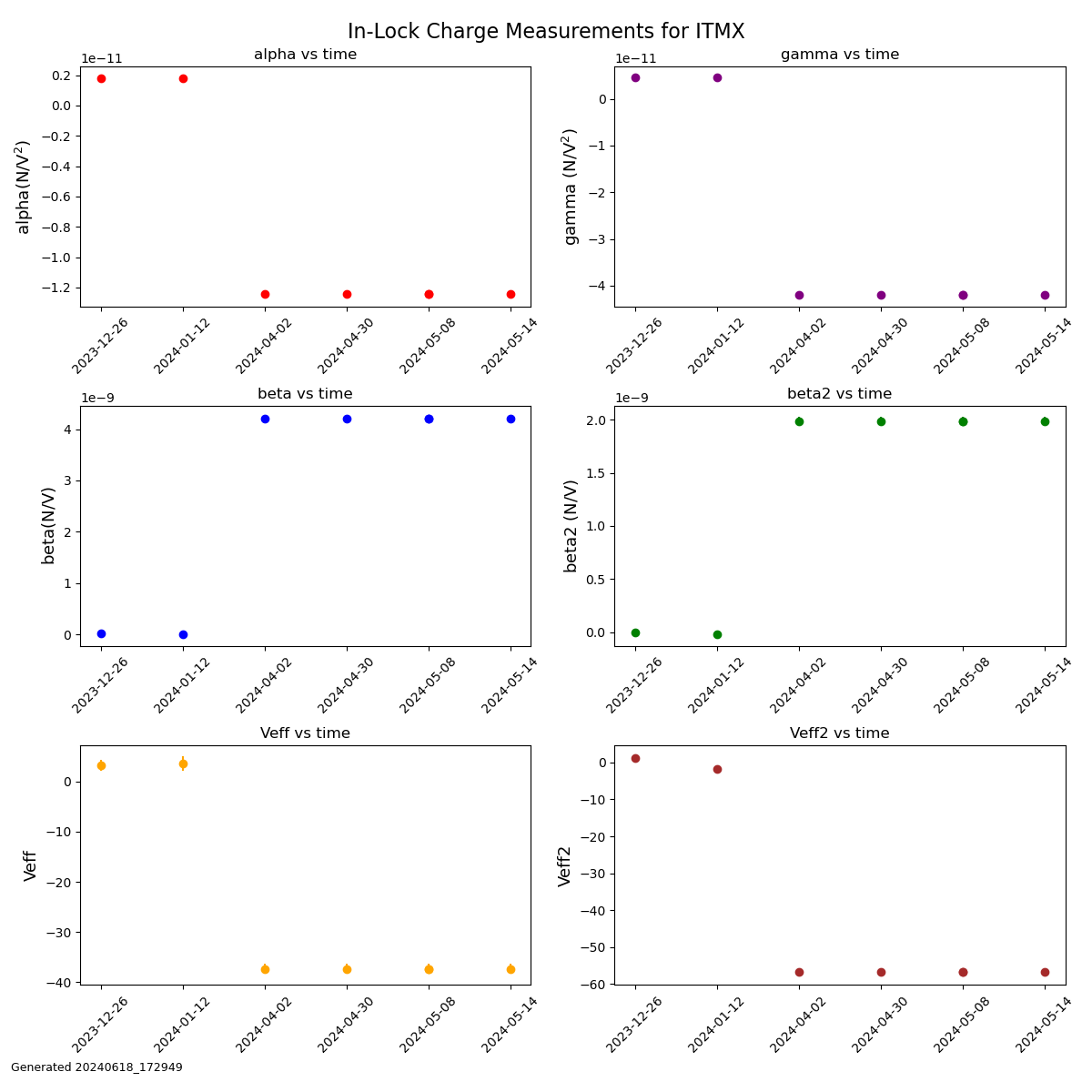
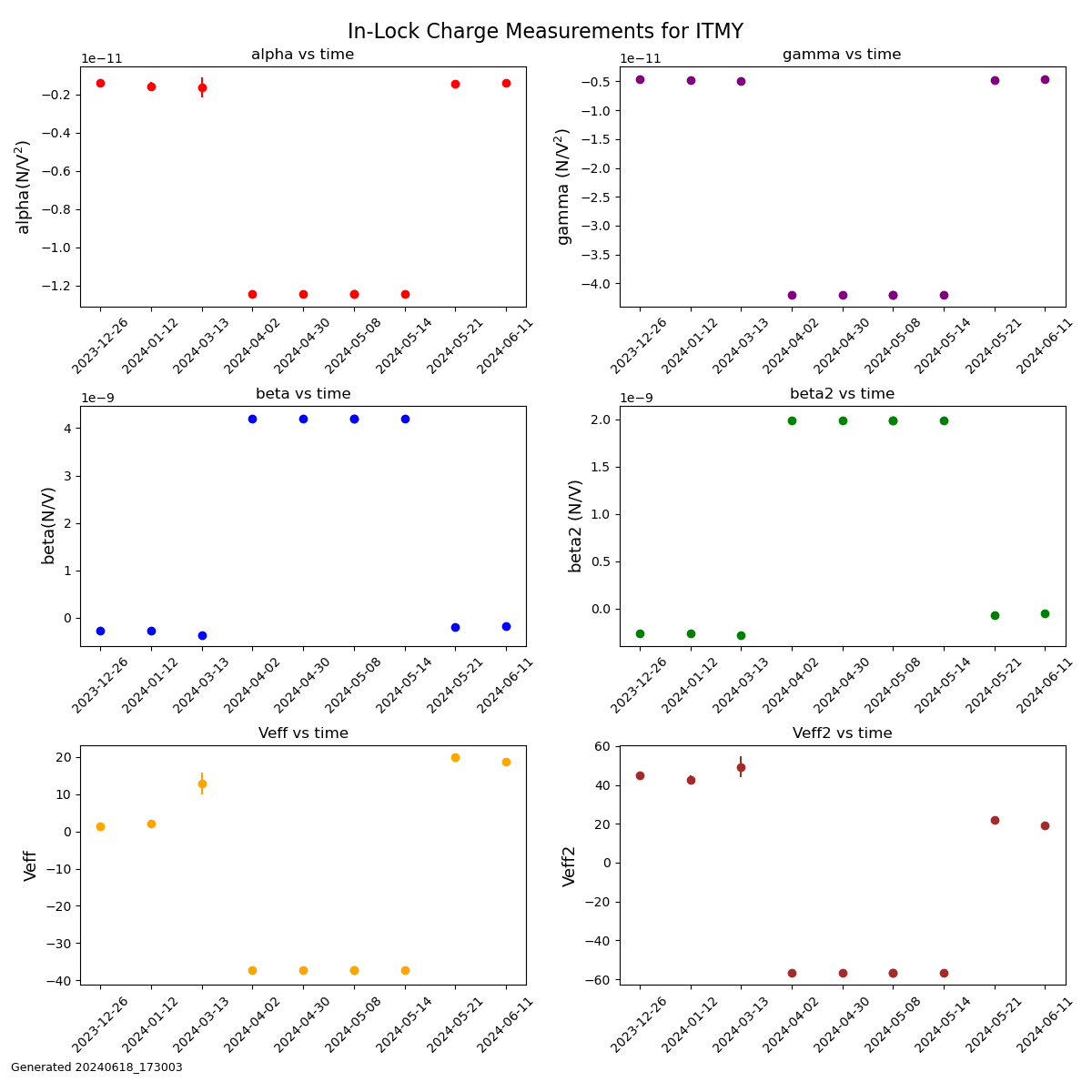
Rahul ran the OPLEV charge measurement this morning for ETMY so I processed the measurement.
TITLE: 06/19 Eve Shift: 2300-0800 UTC (1600-0100 PST), all times posted in UTC
STATE of H1: Observing at 150Mpc
We've been locked for almost 8 hours, the wind has died down a bit.
Last checked in alog78384
Closes FAMIS 28358
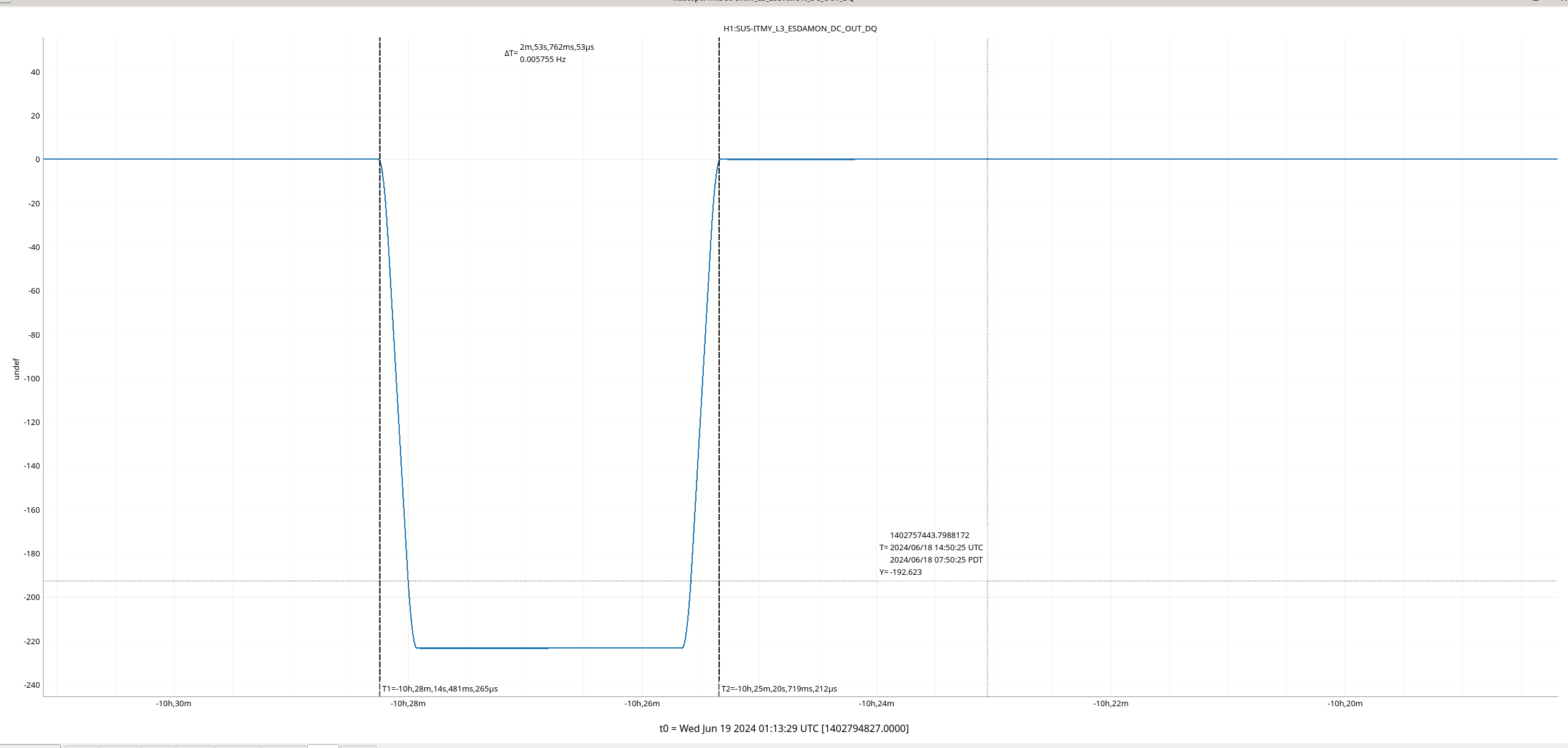
While the SUS_CHARGE guardian LOG shows no errors in the measurement, ITMX, and ITMY failed to be processed. ITMX complained of bad coherence and or failed measurements:
" UserWarning: Cannot calculate alpha/gamma because some measurements failed ' 'or have insufficient coherence!
warn("Cannot calculate alpha/gamma because some measurements failed ' \ "
ITMY had the following error when trying to load the data:
"ValueError: no Fr{Adc,Proc,Sim}Data structures with the name H1:SUS-ITMY_L3_ESDAMON_DC_OUT_DQ"
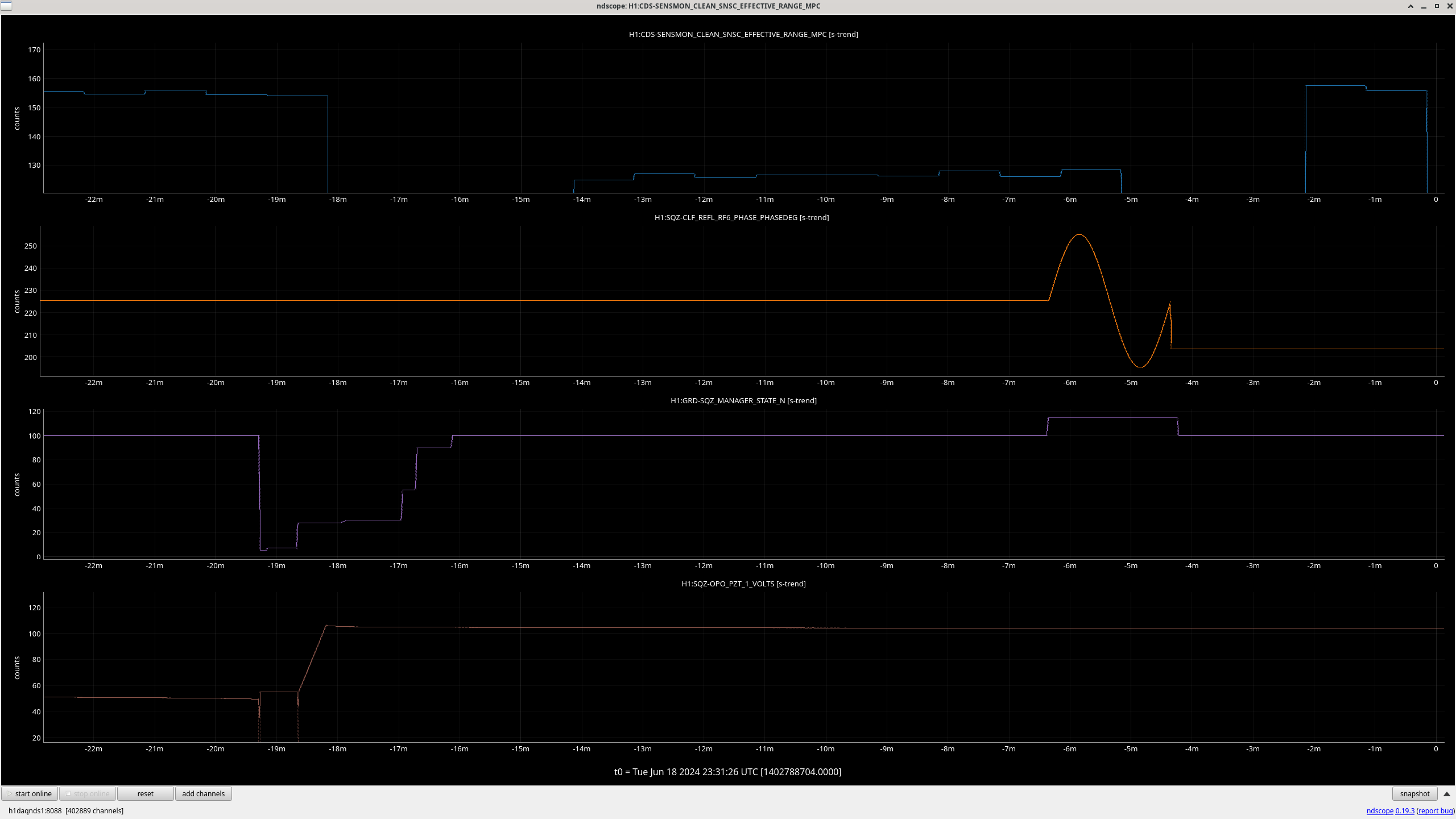
As shown in the attachment, SQZ unlocked for unknown reason at 2024/6/18 23:12:09 UTC and the range got much worse after it relocked. We ran the SCAN_SQZANG and the range was recovered. The optimal SQZ angle changed from 225 to 203 after relocking and it seems due to the different OPO PZT voltage.
TITLE: 06/18 Day Shift: 1430-2330 UTC (0730-1630 PST), all times posted in UTC
STATE of H1: Observing at 122Mpc
INCOMING OPERATOR: Ryan C
SHIFT SUMMARY: Quieter maintenance day. Relocking was fully automated after and initial alignment. We have been locked for 3.5 hours. The SQZer has unlocked a few times since the team finished their table work, and Naoki has been looking into this.
LOG:
| Start Time | System | Name | Location | Lazer_Haz | Task | Time End |
|---|---|---|---|---|---|---|
| 22:41 | SAF | LVEA | LVEA | YES | LVEA IS LASER HAZARD | 15:22 |
| 15:03 | Property | Christina | EY, EX, FCES, LVEA | n | Property search | 17:03 |
| 15:03 | SAF | Camilla | LVEA | - | Transition LVEA to laser safe | 15:18 |
| 15:09 | VAC | Gerardo, Jordan, Isaiah | LVEA | - | HAM4 ion pump troubleshooting | 15:26 |
| 15:16 | PCAL | Francisco, Tony, Miriam | EX | Yes | PCAL measurement | 16:37 |
| 15:17 | FAC | Chris, Eric, Tyler | LVEA | n | Put crane lights back in, move lift, other cleanup from film last week | 16:10 |
| 15:18 | - | Corey, Photographer | LVEA, FCTE | n | Taking pictures | 17:19 |
| 15:34 | SUS | Rahul | EY | n | Charge measurements | 17:09 |
| 15:40 | FAC | Karen, Kim | FCES | n | Tech clean | 16:02 |
| 15:43 | VAC | Travis | EX | yes | Check on vac equipment | 16:07 |
| 15:53 | CDS | Richard, Sheila | LVEA | n | Check on magnetometer | 15:57 |
| 15:55 | CDS | Fil | EY, EX | - | Looking for analyser | 18:06 |
| 15:57 | CDS | Ryan S | CER | n | Look at pulizzi | 15:58 |
| 16:03 | FAC | Kim | EX | - | Tech clean | 17:03 |
| 16:03 | FAC | Karen | EY | n | Tech clean | 16:49 |
| 16:05 | VAC | Gerardo, Janos, Jordan, Isaiah, Travis | LVEA | n | Pulling cables | 18:03 |
| 16:32 | PSL | Jason, Ryan S | LVEA | n | Grab laser and move chiller | 17:32 |
| 16:45 | FAC | Chris | EY | n | Replace fan filters | 19:04 |
| 16:58 | CDS | Erik | CER | n | Swap pulizzi power supply | 17:28 |
| 17:04 | SQZ | Kar Meng | Opt Lab | local | SHG work | 19:37 |
| 17:18 | FAC | Karen, Kim | LVEA | n | Tech clean | 18:35 |
| 17:29 | CDS | Dave, Jonathan | - | n | DAQ restart | 17:40 |
| 17:54 | FAC | Tyler | OSB, EX, EY | n | Roof inspection | 18:44 |
| 18:00 | CAL | Rick | PCal Lab | - | 19:13 | |
| 18:07 | - | Camilla, surfs | LVEA | n | Tour | 18:37 |
| 18:18 | VAC | Travis | EX | n | Unhook turbo from GV20 | 18:44 |
| 18:26 | SAF | Sheila | LVEA | YES | Transition LVEA to laser HAZARD | 18:35 |
| 18:32 | VAC | Janos, Isaiah | EX, MX, MY | n | Gas cyclinder hunt | 18:58 |
| 18:36 | SAF | - | LVEA | YES | LVEA is laser HAZARD | 05:15 |
| 18:36 | VAC | Gerardo, Jordan | LVEA | Yes | Take pictures in HAM6 from view ports | 19:33 |
| 18:57 | - | Ryan S | LVEA | - | LVEA sweep | 19:04 |
| 18:58 | SQZ | Sheila, Naoki, Andrei, Terry | LVEA | YES | SQZ table work | 20:25 |
| 20:17 | VAC | Janos, Travis | MX | n | Bringing gas | 20:33 |
| 21:43 | SQZ | Kar Meng, Terry | Opt Lab | local | SHG work | 22:58 |
| 22:08 | VAC | Gerardo | MY | n | Pickup cable chunks | 22:48 |
| 22:11 | - | Chris (photographer) | Xarm | n | Driving on arm and taking pictures | 00:11 |
TITLE: 06/18 Eve Shift: 2300-0800 UTC (1600-0100 PST), all times posted in UTC
STATE of H1: Observing at 151Mpc
OUTGOING OPERATOR: TJ
CURRENT ENVIRONMENT:
SEI_ENV state: CALM
Wind: 12mph Gusts, 9mph 5min avg
Primary useism: 0.02 μm/s
Secondary useism: 0.07 μm/s
QUICK SUMMARY:
23:12 - 23:16 dropped out of observing due to the SQZer loosing lock
Andrei, Terry, Naoki
We aligned pump AOM and fiber following 72081.
We set the ISS drivepoint at 0V and measured the AOM throughput. The throughput was 30 mW/60 mW = 50%. We aligned the AOM and got 57 mW/60 mW = 95% throughput.
Then we set the ISS drivepoint at 5V and aligned the AOM to maximize the 1st order beam. The 1st order beam improved from 3.5 mW to 11.5 mW. Then we set the ISS drivepoint at 0V and checked the AOM throughput again. The throughput was only 35mW/60 mW = 58%. We found that bottom screws of AOM for vertical alignment maximized the 1st order beam, but the 0th order beam significantly reduced, which means there is a clipping. This was the case in the last AOM alignment in 77508.
To avoid the clipping, everytime we aligned the AOM and improved the 1st order beam, we made sure that the 0th order beam is not clipped. We ended up with 10.5 mW of 1st order beam and 55 mW of 0th order beam.
After AOM alignment, we aligned the pump fiber, but the fiber alignment did not improve much.
We reverted the OPO trans setpoint from 70 to 80, which was done in 78467.
Camilla, Andrei, Naoki, Sheila
There have been many examples of times when the filter cavity length locking error signal peak to peak seems to be correlated with worse range over the last 3 months, I've attached some screenshots of examples. This was true before the May 16th change in the status of the CO2 ISS channel , 78217, and before the output arm damage that happened April 22nd.
Some of these times correspond to times when there is a whistle visible in the FC WFS signals 78263, others do not. These whistles in the FC WFS channel have been present throughout all of O4, but they do go away sometimes for several days, this last week they do not seem to have been present. Andrei has identified a candidate wandering line in the IOP channels for these WFS that was last week ~10 kHz away from the 105kHz RLF-CLF signal, today that line seems to be gone.
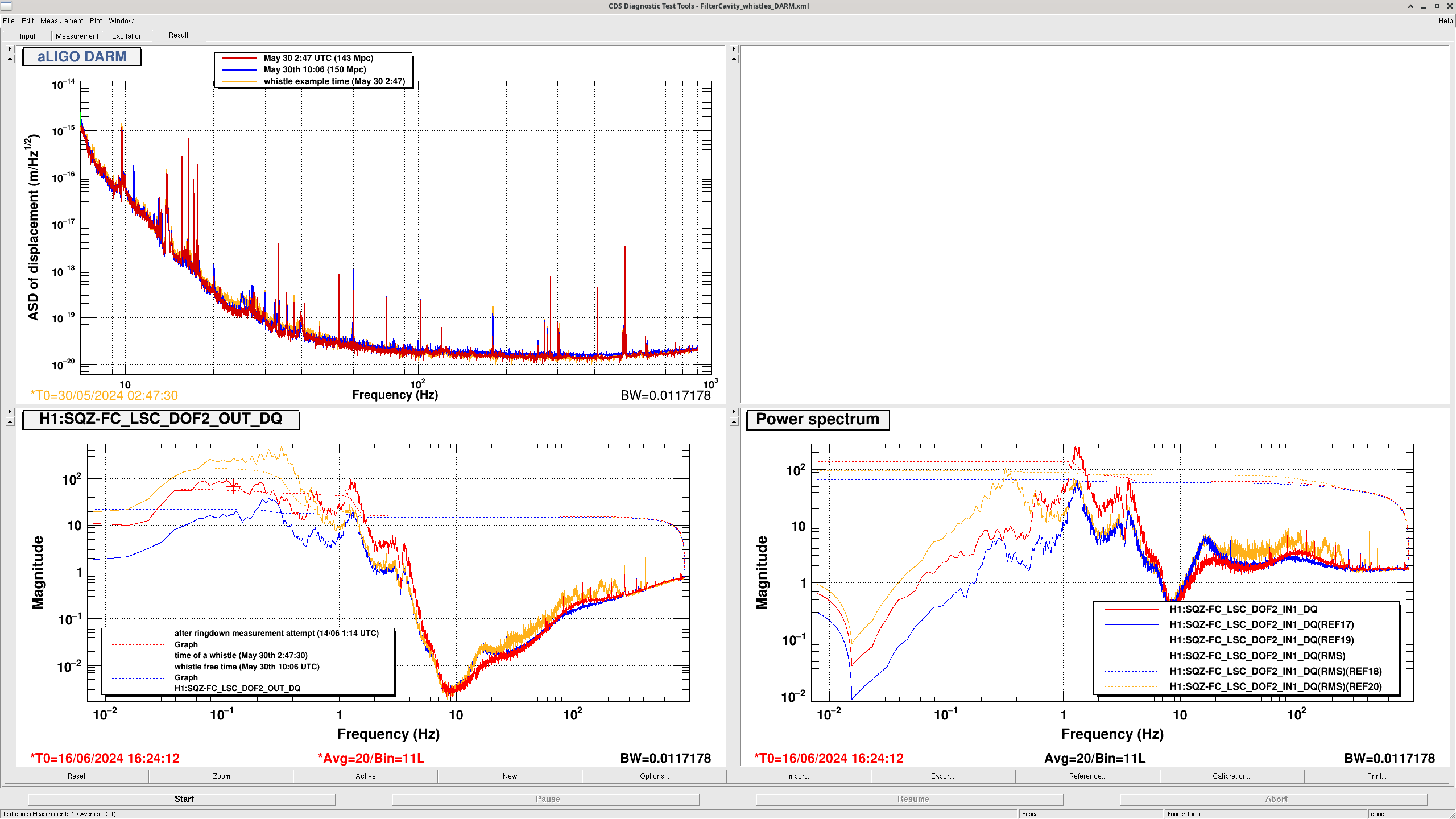
Last week, the filter cavity error signal peak to peak became much noisier than it was previously (screenshot), until June 15th at around 15 UTC when things returned to the previous state. Camilla identified that this started a few hours after the time of the ringdown measurement attempt, 78422, and that there haven't been any ZM1/2/3 alignment changes. During that time period, the FC error signal from around 0.7-9 Hz has higher and variable, in addition, the low frequency noise was changing and varriying the RMS as it has done before. The attached screenshot shows some of the typical low frequency variation (compare yellow to blue), a whistle in the yellow trace, and in red a time during last week's elevated noise when the low frequency was relatively quiet but there is elevated noise from 0.7-9Hz.
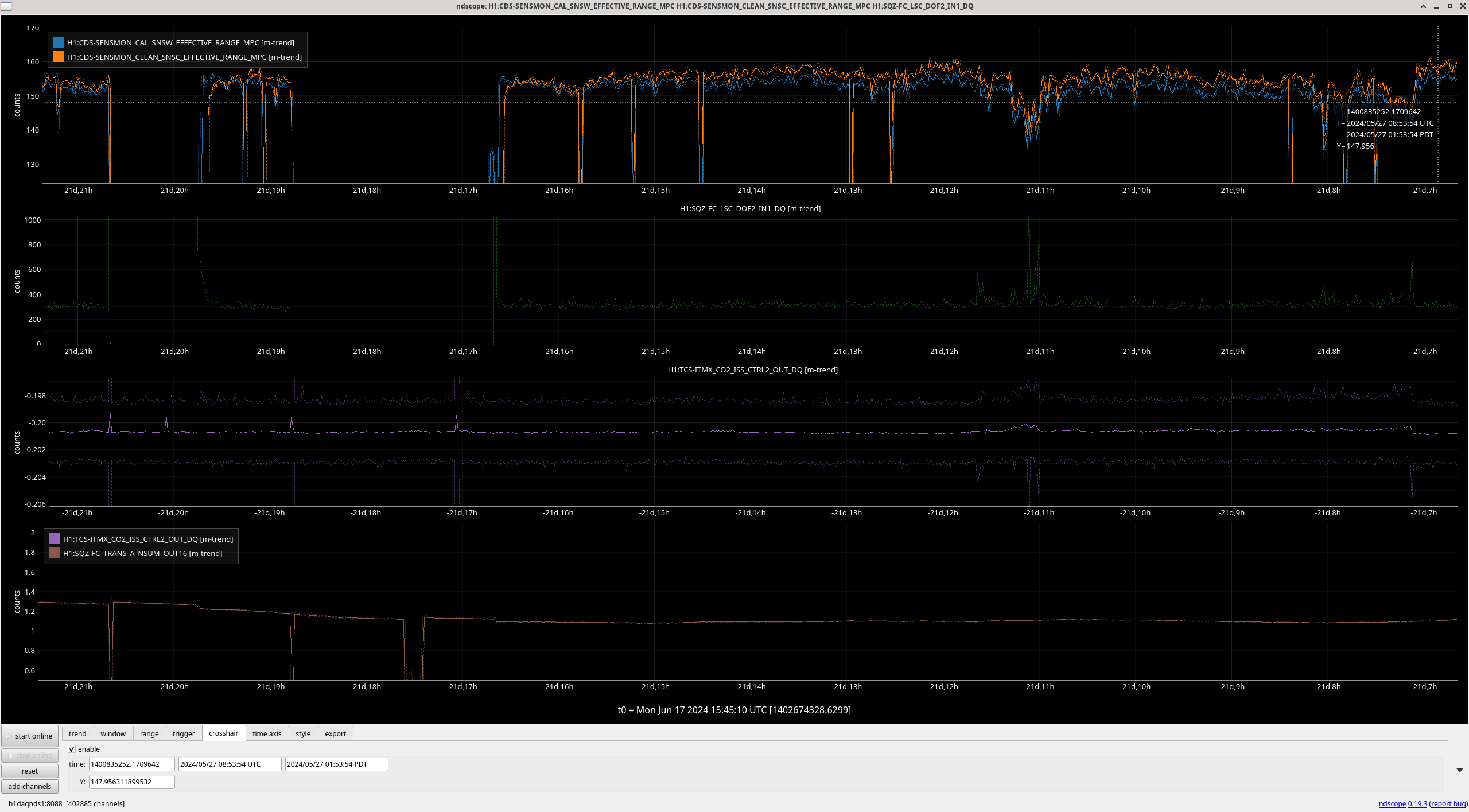
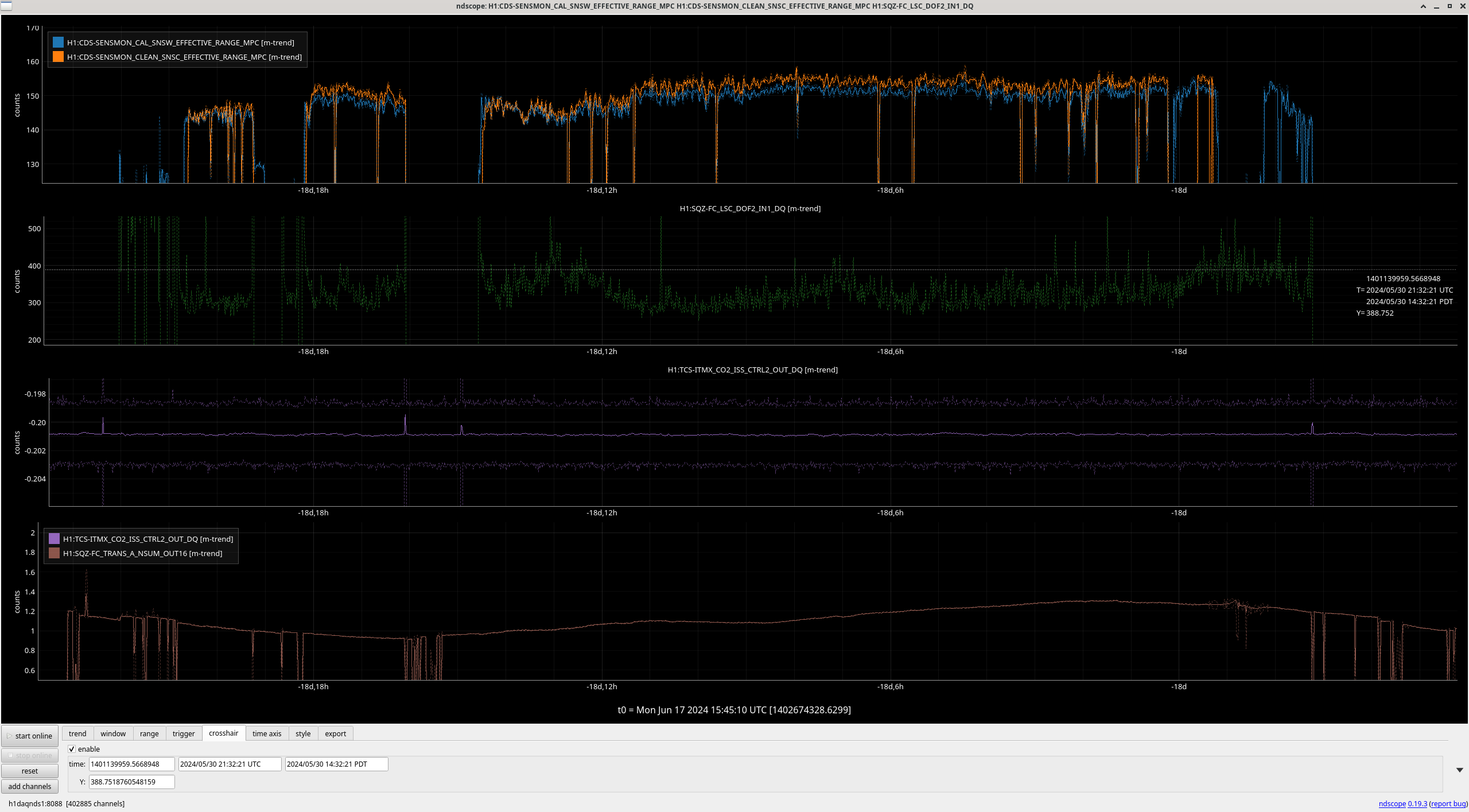
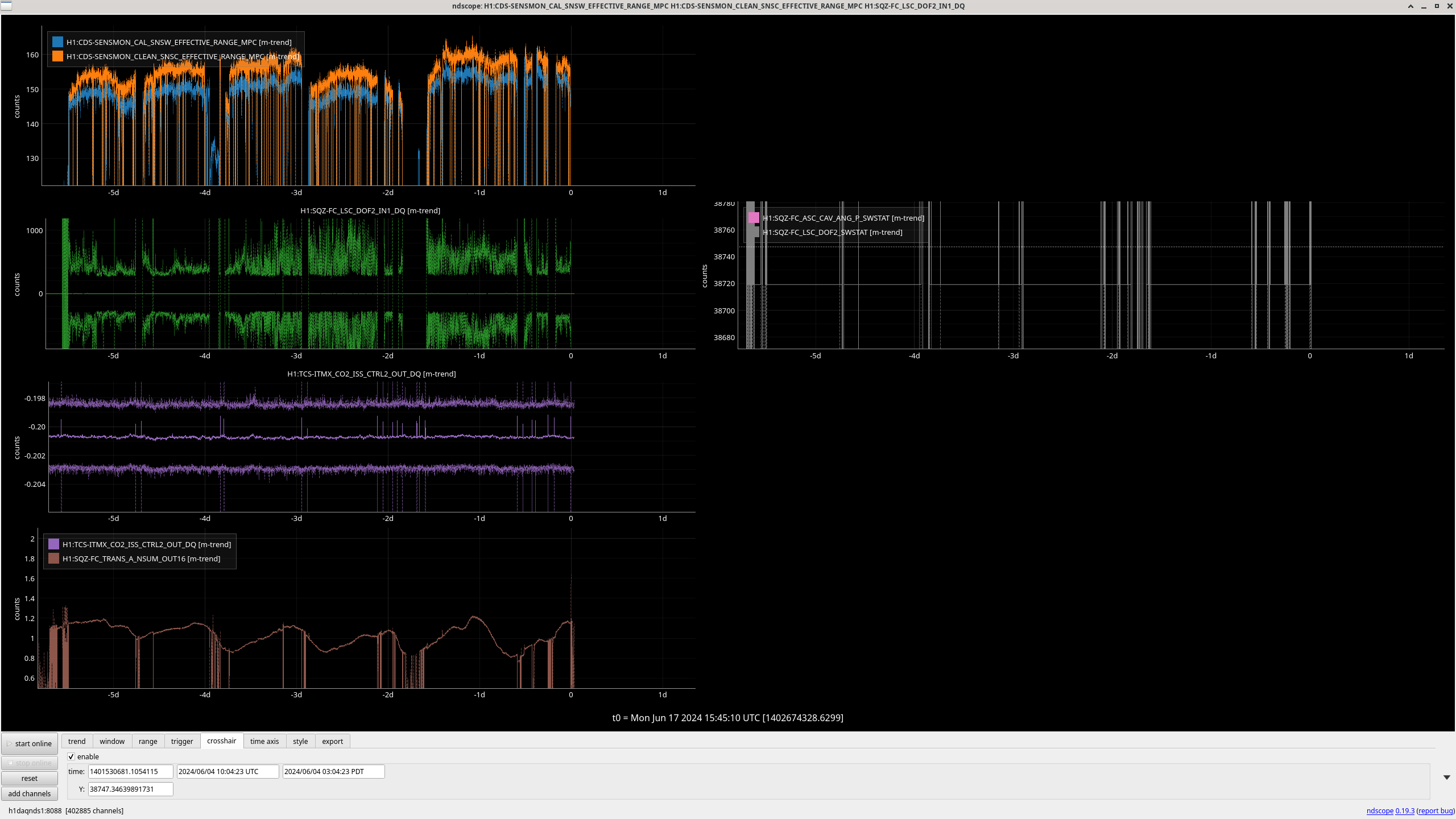
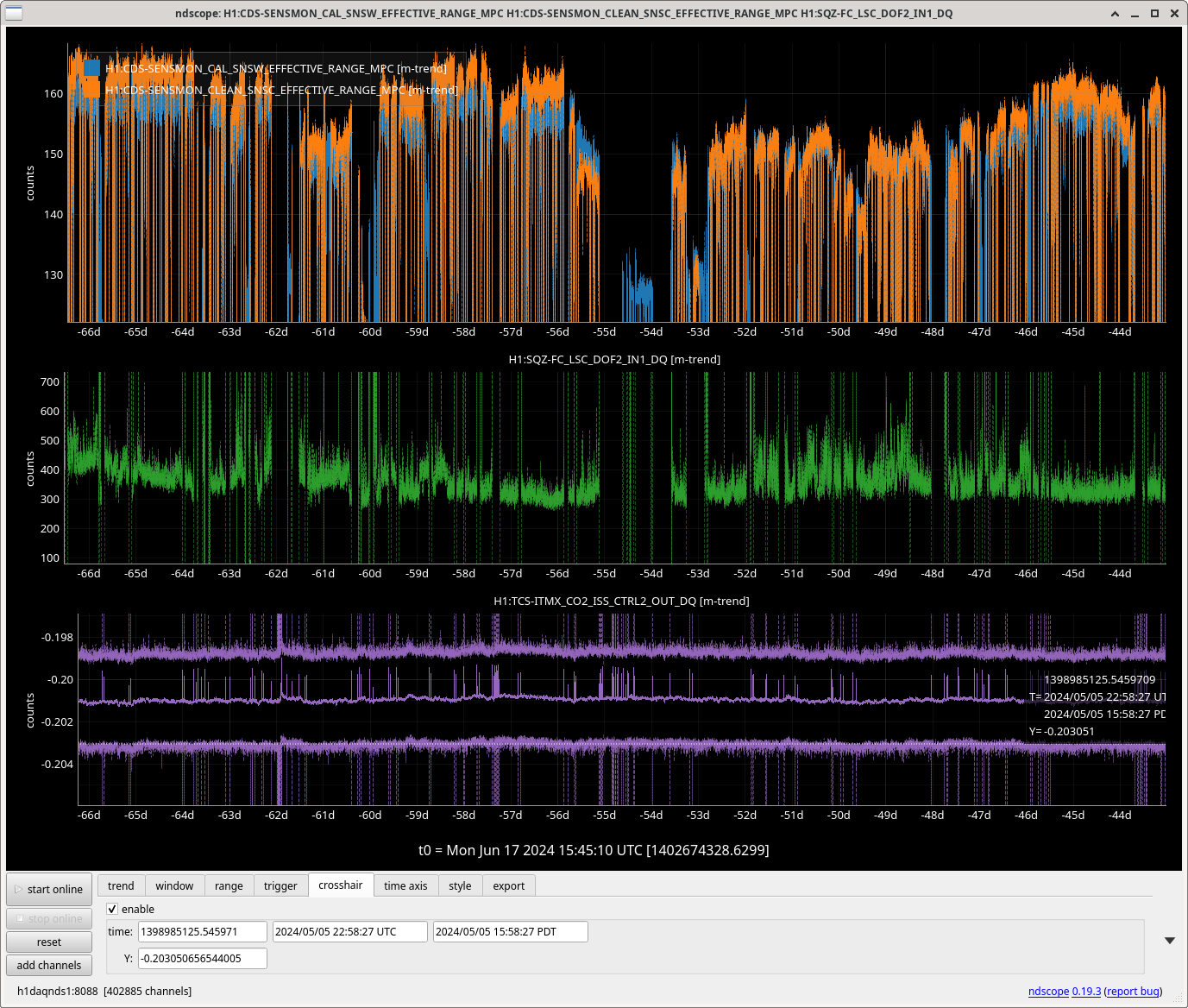
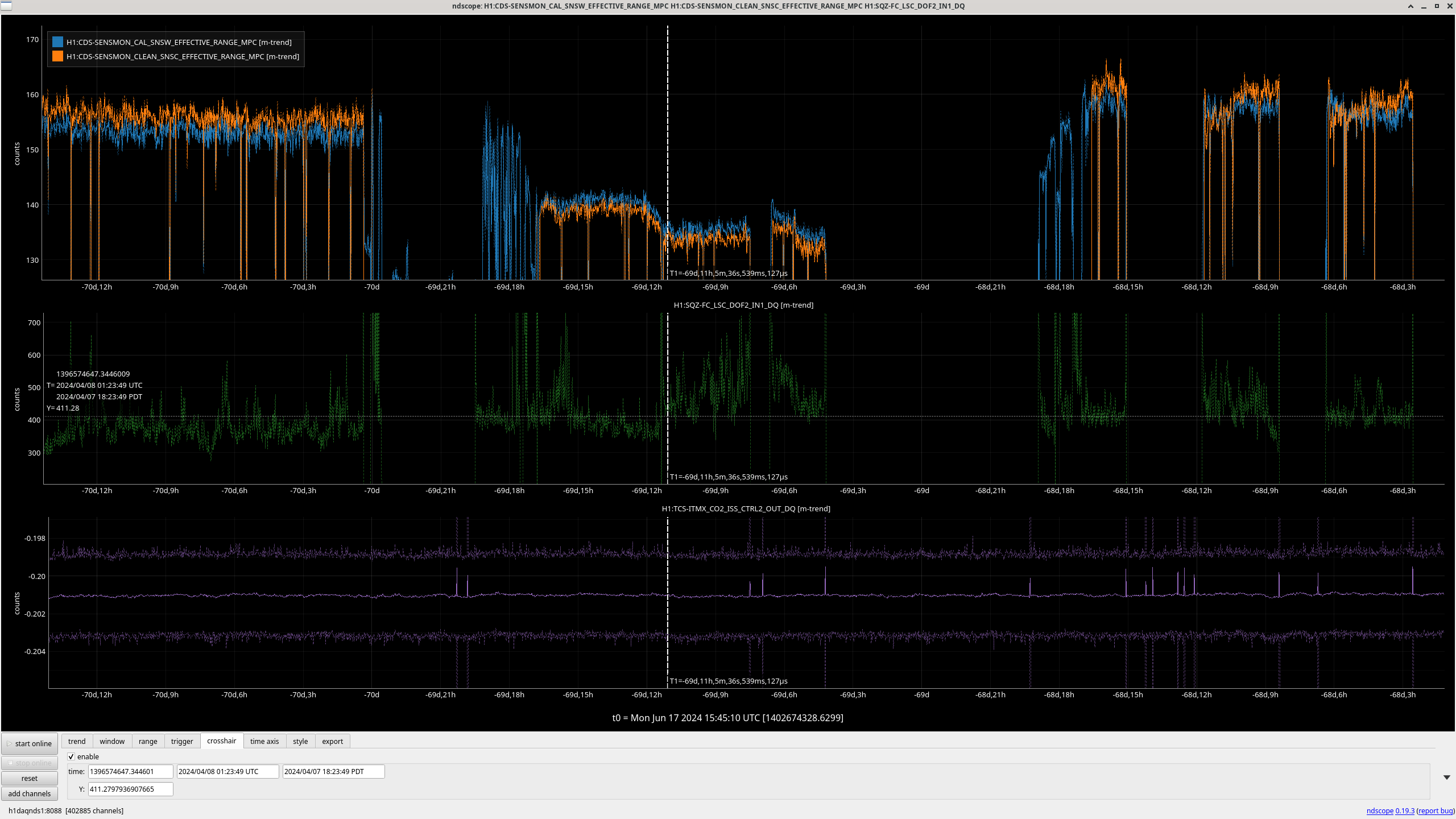
As part of a detchar request that is related to this, I ran the tool lasso on four different days in which their were some range drops. The days (and the linked results) are below:
Lasso normally uses the mean trends of the auxillary channels to try and correlate with the range, but I used the max trends instead as requested. The results from lasso are interesting. On the 17th, there is a correlation with H1:SUS-MC3_M3_OSEMINF_UR_OUTPUT.max and the CO2 channel H1:TCS-ITMX_CO2_ISS_CTRL2_OUT16.max. On the 21st, the range lines up pretty well with a filter cavity channel, H1:SUS-FC2_M3_NOISEMON_LR_OUT16.max. On the 27th, lasso still picks out the TCS ITMX C02 channel, but the second most correlated channel is another H1:SUS-FC2_M3_NOISEMON_LL_OUT16.max channel. There are two drops around ~4:30 and ~8:30 UTC and they seem to match up with this FC2 channel, which seems similar to what happened on the 21st. On the 30th, lasso seems to pick out a lot of ISI BLRMS channels, which is different that the other days. The top channel is H1:ISI-HAM7_BLRMS_LOG_RY_1_3.max. Overall there does seem to maybe be some relation between the CO2 channel and these filter cavity channels.
