R. Short, with guidance from K. Kawabe and J. Oberling
I've made some updates to the 'CLOSE_ISS' state in the IMC_LOCK Guardian, which handles the closing of the ISS second loop, that should make the closing of the second loop more consistent.
When the second loop is engaged, the DC working point of the ISS is determined by the output of the second loop's digital AC coupling (H1:PSL-ISS_SECONDLOOP_AC_COUPLING_DRIVE). This output is held when the second loop is closed, but it can occasionally be held far from the average of its oscillations before the second loop is engaged, which in the past has caused locklosses and was mitigated earlier this year (see alog 67347). While the second loop isn't causing locklosses anymore (that I can recall), we do still see the digital AC coupling output being held slightly off from the mean, causing the diffracted power to jump. I've expanded upon Georgia's logic by changing the way the output of the AC coupling drive is held to be more consistent. Instead of waiting to hold the output until it's near the mean over the past 10 seconds (a calculation that itself can take several seconds), the process is now as follows:
I was able to test this logic during the maintenance period today, both with the IMC locked at 2W and 60W, with great success. We'll run with this for a while to see if over several lock acquisitions the second loop is being engaged with a more consistent digital AC coupling drive. The updated IMC_LOCK Guardian code is loaded and committed to SVN.
I added roughly 5 meters of LMR 195 to the cable sending the 3MHz local oscillator to the demod for the OMC 3MHz signal. This should add roughly 21ns of delay, or roughly 23 degrees of phase for the 3MHz signal.
We are hoping that this will shift the turn around point of the ADF sqz angle readback so that our operating point is at a better place to use this readback to adjust the sqz angle. (for background see 74256
This means we will need to retune the SQZ angle before we to observing today.
The SQZ angle will have to be retuned when we relock today. To do this, from the sitemap choose SQZ > SQZ overview to pull up the scren shown in the screenshot. You can then adjust the slider circled in red (H1:SQZ-CLF_REFL_RF6_PHASE_PHASEDEG) looking at the FOMs on NUC33 to tune the squeezing. Try to minimize the black trace on the spectrum on the bottom of NUC33.
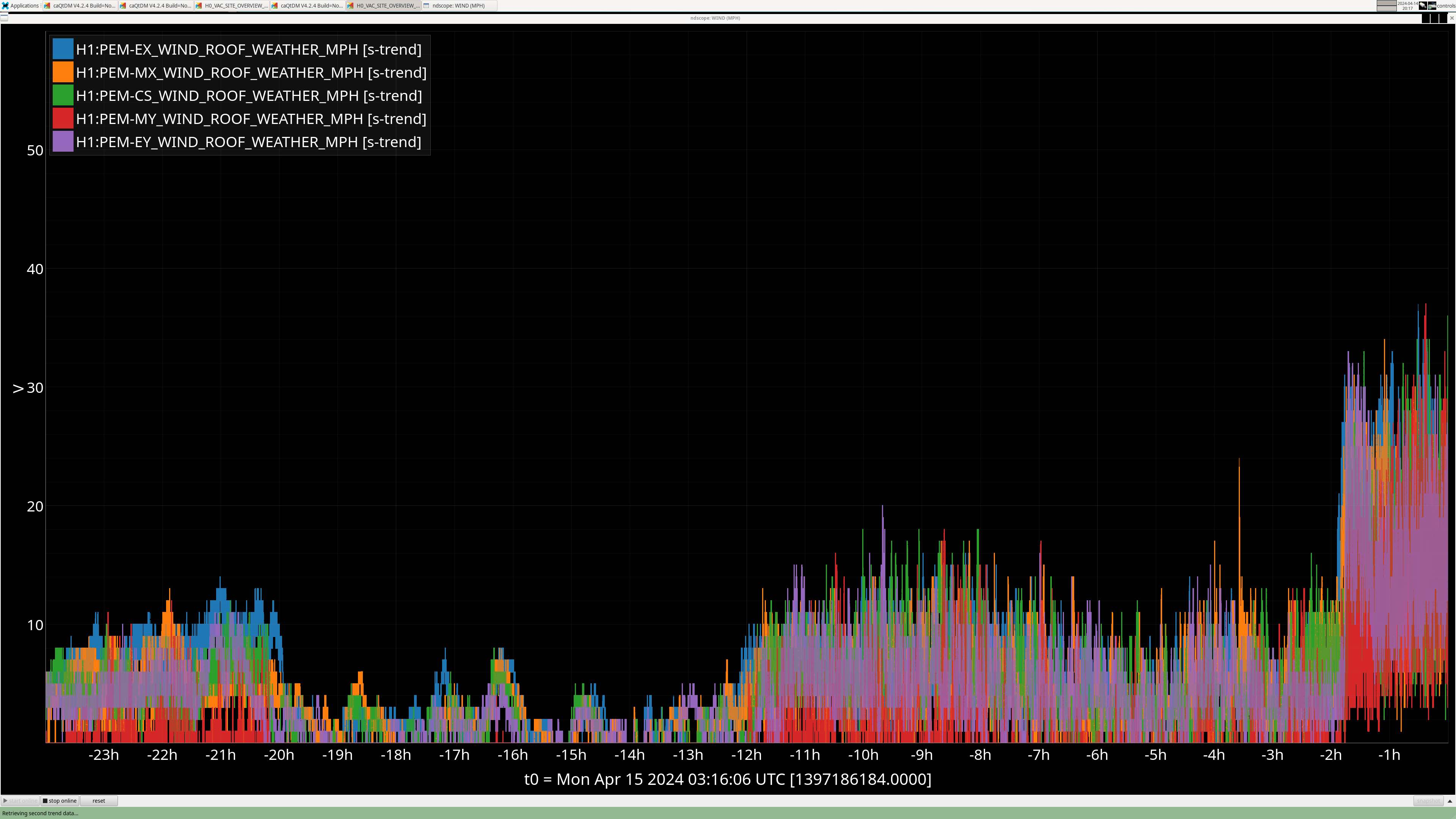
Maintenance tasks have wrapped up but team CDS and SEI are trying to solve a problem that showed up at 19:29UTC on EndX where we lost all SEI signals (went to exactly zero). Microseis remains elevated, above the 90th percentile for the past ~16 hours and based on its trend visually it will probably take another 6 hours to get fully below that mark.
Once this issue is resolved we will resume attempting to lock.
Fil Daniel
PMC install preparation:
Auxiliary Signals Concentrator 11 PD Monitors (D2300326) installed in SQZ-R2, slot U3.
Serial Number: S2300254
Tue Nov 21 10:14:21 2023 INFO: Fill completed in 14min 16secs
I grabbed an ETMY OPLEV charge measurement this morning before the cleanroom work started.
TITLE: 11/21 Day Shift: 16:00-00:00 UTC (08:00-16:00 PST), all times posted in UTC
STATE of H1: Lock Acquisition
OUTGOING OPERATOR: Ryan S
CURRENT ENVIRONMENT:
SEI_ENV state: CALM
Wind: 4mph Gusts, 3mph 5min avg
Primary useism: 0.05 μm/s
Secondary useism: 0.93 μm/s
QUICK SUMMARY:
Workstations were updated and rebooted. This was an OS package update. Conda packages were not affected.
H1 called for assistance this morning at 10:13 UTC when the 40 minute initial alignment timer expired; it looks like following the earlier lockloss, H1 was struggling to lock (I suspect due to the very elevated secondary microsiesm, plot attached) and started an initial alignment. It took a while to align the arms in green, which caused IA to take longer than usual. I responded to the call right as the SRC was finishing its alignment (IA finished on its own), but when I selected 'INIT' to clear the alert on H1_MANAGER, this caused H1_MANAGER to jump to the 'RELOCKING' state and requested ISC_LOCK to start initial alignment over again. I didn't realize this until IA was a good way through, so I decided to let it finish (meaning IA was run twice in a row). I imagine one could add a check into H1_MANAGER to not re-request an initial alignment if one is already underway to avoid restarting the alignment process when an alert is acknowledged.
Following the most recent IA, H1 has been relocking smoothly and is currently up to POWER_10W.
TITLE: 11/21 Eve Shift: 00:00-08:00 UTC (16:00-00:00 PST), all times posted in UTC
STATE of H1: Lock Acquisition
INCOMING OPERATOR: Ryan S
SHIFT SUMMARY:
The entire night was very quiet... until:
07:59:44 UTC LOCKLOSS.... yes it was 16 seconds before my shift ended. There was an earthquake passing through at the time but it was a very small earthquake.
Microseism is still elevated.
ALS-X and ASL-Y guardians were reloaded.
IFO Current Status: Increase Flashes.
LOG:
No log
TITLE: 11/21 Eve Shift: 00:00-08:00 UTC (16:00-00:00 PST), all times posted in UTC
STATE of H1: Observing at 159Mpc
CURRENT ENVIRONMENT:
SEI_ENV state: SEISMON_ALERT
Wind: 12mph Gusts, 9mph 5min avg
Primary useism: 0.04 μm/s
Secondary useism: 1.01 μm/s
QUICK SUMMARY:
Incoming 5.5M Earthquake in the central mid atlantic ridge.
Microseism had been climbing back up for the last few hours too.
PSL_FSS_TPD: RefCav transmission low, fix alignment message on DIAG_MAIN now.
Otherwise, Very Quiet night. Locked for 13 hour and 48 Min. OBSERVING.
Over the weekend we've been having some trouble with low ALSX beatnote and other ALS issues causing locking trouble (See 74310, 74289). There was also a XVEA temperature change that happened Friday evening (picture here). Looking back at past changed of the ALSX laser we have June 30th alog70976 which had similar symptoms and was maybe fixed with a laser current and temperature change. Before that in Aug 2022 Daniel (alog64752) did a similar fix.
Plots attached have a dozen ALSX channels trended over 3.5years, 2years, 21 months, 65 days. The only bit that stands out to me is that the green power has started to trend down ~20 days ago, but it's a small amount (0.83 -> 0.80mW).
Artem, Gabriele, Sheila, Louis Plots and Jupyter notebook with these results are also available here.ESD quadratic noise
This is a follow up on investigation of potential non-stationary noise at Handford introduced by the ESD drive, reported in 73913 and previous entries linked from there. The idea is that from the ESD signal, Vs, and bias, Vb, voltages we can reconstruct ESD force applied to the mirror, using equations in LIGO-T1700446. The force component linear in Vs gets subtracted by the control loop and therefore does not affect DARM. But the force component quadratic in Vb and both linear and quadratic in Vb can couple to DARM. Therefore in this report, we are calculating respective force components and projecting them to DARM. Then respective ASDs and spectrograms are compared.Selection of input channels
The ESD drive voltages are recorded by Monitors, H1:SUS-ETMX_L3_LVESDAMON_LL_OUT_DQ for Vs and H1:SUS-ETMX_L3_ESDAMON_DC_OUT_DQ for Vb. Important note here: we initially tried channel H1:SUS-ETMX_L3_ESDAMON_UL_OUT_DQ to get Vb, but it looks like it's not connected to anything and recording ASD noise... The H1:SUS-ETMX_L3_ESDAMON_DC_OUT_DQ seems to be fine. Also, LIGO-T1700446 specifies calibrations for voltage channels (equations 13 and 16), but currently the channels mentioned above are already calibrated to voltage.![]()
Calculating force terms
Calculation is based on equation 3 in LIGO-T1700446, but this equation is modified in the following way:
I did the same exercise but now for GPS time 1382909598 (and up to +22 mins from it), where bias voltage was set at 409V. Below you find plots where you can see that noise went up* (ASD) but apparent non-stationarity is reduced (spectrograms), which is consistent with Gabriele's findings in comment in 73935, specifically this and this plots.![]()
* Currently noise ASD is actually higher than DARM, this is not realistic but the modelling is not 100% precise. What is important here is relative changes with respect to results with "standard" level of bias voltage. Plots and Jupyter notebook with these results are also available here.
Another way to look at ESD quadratic noise. The DARM strain band-limited RMS (computed between 16 and 30 Hz and normalized to the median over time) is correlated to the total RMS of the ESD drive (dominated by the low frequency component, below 10 Hz)
TITLE: 11/21 Eve Shift: 00:00-08:00 UTC (16:00-00:00 PST), all times posted in UTC
STATE of H1: Observing at 158Mpc
OUTGOING OPERATOR: Oli
CURRENT ENVIRONMENT:
SEI_ENV state: CALM
Wind: 9mph Gusts, 6mph 5min avg
Primary useism: 0.03 μm/s
Secondary useism: 0.64 μm/s
QUICK SUMMARY:
Current Status of H1: Locked for 8 hours 29 minutes and OBSERVING.
I will reload ALS-X and Y if a lock loss happnens to load in Mr. Crouch's Changes.
TITLE: 11/21 Day Shift: 16:00-00:00 UTC (08:00-16:00 PST), all times posted in UTC
STATE of H1: Observing at 157Mpc
INCOMING OPERATOR: Tony
SHIFT SUMMARY: Observing and Locked for 8.5 hours. Been a quiet day.
LOG:
16:00UTC In NOMINAL_LOW_NOISE, I rejected the ASC-X_FIBR_LOCK_BEAT_RFMIN value change of -10 so it is still at -20dB, and put us into Observing.
| Start Time | System | Name | Location | Lazer_Haz | Task | Time End |
|---|---|---|---|---|---|---|
| 18:51 | FAC | Randy | EX | n | Delivery | 20:21 |
| 19:24 | FAC | Chris, locksmith | OSB, EY, EX | n | Changing external locks | 22:28 |
Building off of 74289, I checked to see how the ALS-X beatnote strength was doing, and then tried to confirm that the issues were actually a result of the EX VEA temperature changes.
Currently, the beatnote strength is still oscillating, and last night it was back to dipping below -10dB when at its minimum (attachment1).
Here is what I noticed when looking to confirm the beatnote-temperature correlations:
ALS-X_FIBR_DEMOD_RFMON is very sensitive to changes in EX VEA temperatures
- Already pretty obvious based on how the temp changes from Friday affected ALS-X_FIBR_DEMOD_RFMON, but even small changes/normal daily fluctuations in EX VEA temperatures can change the beatnote strength by almost 2dB.
- Here are two stretches of time comparing the EX VEA average temperatures and how it affects ALS-X_FIBR_DEMOD_RFMON (attachment2, attachment3).
- Sometimes the temperature affects the beatnote strength more than other times.
ALS-Y_FIBR_DEMOD_RFMON is NOT very sensitive to changes in EY VEA temperatures
- Comparing ALS-Y_FIBR_A_DEMOD_RFMON and FMC-EY_VEA_AVTEMP_DEGF(attachment4), although VEA temp changes are definitely affecting the beatnote strength (especially during large temperature excursions), the beatnote strength is able to stay very consistant.
It is especially interesting seeing the difference between the amount of variation in ALS-X_FIBR_DEMOD_RFMON as compared to ALS-Y_FIBR_DEMOD_RFMON as temperature changes (attachment5). To be fair, the temperatures at EX do seem to fluctuate more (higher highs and lower lows) than at EY, but the way that the ALS-X beatnote strength reacts still seems to me to be much more exaggerated than it should be (like if ALS-Y was going through the EX temperature changes).
The demod readback goes thru channel 1 of the demodulator concentrator D1100691 before reaching the EtherCAT end station chassis 2 at the L5 terminal. The RF monitor is read using this calibration dB = 16.67 * V - 72.
Naoki, Sheila
In the AS72 sensing matrix measurement in alog74106, Daniel suggested to increase the whitening gain of AS72 since it could be limited by ADC noise. We checked the whitening filter of AS72 A and B. Both of them have 12dB whitening gain, but one stage whitening is engaged for AS72 A, while two stage whitening is engaged for AS72 B. We decided to engage the 2 stage whitening for AS72 A, which is used in SRC1. The IFO locks without any problem with this additional whitening. We accepted some SDFs as shown in the attached figures. We will try to increase the whitening gain later.
I think the attached plot shows this was a good idea. I have some old data measuring whitening and no whitening on at RF72, but I never posted it because I couldn't figure out the correct RF72 transimpedance. The attached plot shows an estimation of the ADC noise level comparison with the noise spectrum in lock. Naoki and Daniel were kind enough to help me figure out the proper transimpedance for the RF72 (see 37065).
The measurement procedure and calculation procedure is detailed in alog 66734. At the time, RF72 was using 1 stage of whitening with 12 dB whitening gain.
I think it's likely my shot noise calculation here is incorrect. Correcting that calcuation is in progress...
During Tuesday maintenance and IMC_LOCK is OFFLINE, I measured the AS72 dark noise with different whitening setting. The attached figure shows the dark noise of AS72 A Q PIT/YAW, which are used in SRC1. The 2 stage whitening and 12 dB whitening gain are the current nominal setting. In the previous Elenna's measurement, there was a bump around 25 Hz, but there is no bump in today's measurement.
I went back and forth (~5 mins each) with the BS M2 coil drivers between their nominal low noise state, and their higher noise higher range state.
When in the higher noise state (state 2), there seems to be consistently higher noise between about 55 Hz up to 100 Hz. In the attached plot the blue / green is the nominal low noise state, while red / pink is the high noise state.
I'll work on making this an actual noise projection that we can include in the noise budget, using Craig's code for quad PUM noise as a guide.
We were in the high noise state 2 from 20:56:45 - 21:04:00. Then in low noise state from 21:06:10 - 21:11:15 (there's a glitch during this time). Back to high noise from 21:13:20 - 21:19:40 (there's a small glitch during this time). Back to low noise from 21:21:50 - 21:28:00. All times UTC on 8 Nov 2023. After this I handed back to Robert.
I've finally had a look at projecting this noise to what it looks like in our nominal state.
I'm 'following along' the philosophy of Craig's quad coil driver noise projections in https://git.ligo.org/aligo_commissioning/labutils/-/blob/master/coil_drivers_state_switch/plot_all_quad_pum_switch.py
I take an average of the ASDs of the noisy time (blue trace), and an average of the nominal quiet time (orange trace), then subtract them to get the excess power (green trace). I then take the residual excess power, and divide by the ratio of filters that are different between the two times, and that gives the projection of this excess power to our nominal state (red trace).
The attached plot shows that the projected noise (red) is more than a factor of 100x below our nominal sensitivity (orange), so BS M2 coil driver noise should not be an (immediate) issue for us.
The notebook is in /ligo/home/jenne.driggers/LHO_work/2023_11_21_BS_coil_driver_noise_budget/BS_coil_driver_noise_projection.ipynb
Naoki, Sheila, Camilla, Vicky
Summary: After yesterday's crystal move LHO:73535, we re-aligned SQZT7, and now see 8 dB SQZ on the homodyne, up to measured NLG=114 without a phase noise turnaround! This fully resolves the homodyne loss budget, there is 0 mystery loss remaining on the homodyne, from which we can infer 0 mystery losses in HAM7. Back to the IFO afterwards, after 1 day at this new crystal spot, squeezing in DARM is about 4.5dB - 4.8dB, reaching almost 5dB at the start of lock.
We first re-aligned the homodyne to the IFO SQZ alignment, which reached 4.8dB SQZ in DARM yesterday, so we are more confident the alignment back through the VOPO is not clipping. In yesterday's measurements, we had a sign error in the FC-ASC offloading script, which brought us to a bad alignment with limited homodyne squeezing, despite high 98% fringe visibilities. Attached is a screenshot of homodyne FC/ZM slider values with FC+SQZ ASC's fully offloaded (correctly), to which the on-table SQZT7 homodyne is now well-aligned. After Sheila re-aligned the homodyne to the screenshotted FC/ZM values, fringe visibilities are PD1 = 98.5% (loss 3.1%), PD2 = 97.8% (loss 4.2%).
We then did an NLG sweep on the homodyne, from NLG=2.4 (opo trans 20uW) to NLG=114 (opo trans 120uW). Measurements below and attached as .txt, DTT is attached, plots to follow.
-------------------------------------------------------------------------------------------------------------------------------------------------------------------------------------------
unamplified_ir = 0.0014 (H1:SQZ-OPO_IR_PD_LF_OUT_DQ with pump shuttered)
NLG = amplified / unamplified_ir (opo green pump un-shuttered)
@80uW pump trans, amplified = 0.0198 (at start, 0.0196 at end) --> NLG 0.0198/0.0014 ~ 14
@100uW pump trans, amplified = 0.0046 (at start, 0.0458 at end) --> NLG 0.046/0.0014 = 33
@120uW pump trans, amplified = 0.16 --> NLG 0.16/0.0014 = 114
@60uW pump trans, amplified = 0.011 (at start, 0.0107 at end) --> NLG = 7.86
@40uW pump trans, amplified = 0.0059 (at start, 0.0059 at end) --> NLG = 4.2
@20uW pump trans, amplified = 0.0034 (at start, --- at end) --> NLG = 2.4
| trace | reference | opo_green_trans (uW) |
NLG | SQZ dB | CLF RF6 demod angles (+) |
| LO shot noise @ 1.106 mA, -136.3 dB | 10 | 80 | 14 | ||
| Mean SQZ | 11 | +13 | |||
| SQZ | 12 | -8.0 | 162.0 | ||
| ASQZ | 13 | +16 | 245.44 | ||
| NLG=33 | 100 | 33 | |||
| Mean SQZ | 14 | +16.7 | |||
| SQZ | 15 | -8.0 | 170.5 | ||
| ASQZ | 16 | +19.9 | 237.85 | ||
| NLG = 114 | 120 | 114 | |||
| Mean SQZ | 17 | +22.5 | |||
| SQZ | 19 | -8.0 | 177.98 | ||
| ASQZ | 18 | +25.6 | 230.13 | ||
| NLG = 7.9 | 60 | 7.9 | |||
| Mean SQZ | 20 | +9.7 | |||
| SQZ | 21 | -7.7 | 154.28 | ||
| ASQZ | 22 | +12.4 | 253.83 | ||
| NLG = 4.2 | 40 | 4.2 | |||
| LO SN check | 4 | ~0.1dB lower? | |||
| Mean SQZ | 23 | +6.8 | |||
| SQZ | 24 | -6.3 | 140.6 | ||
| ASQZ | 25 | +9.6 | 262.64 | ||
| NLG = 2.4 | 20 | 2.4 | |||
| Mean SQZ | 26 | +3.8 | |||
| SQZ | 27 | -4.8 | 135.45 | ||
| ASQZ | 28 | +6.3 | -100.5 | ||
| LO shot noise @ 1.06 mA, | 29 |
All measurements had PUMP_ISS engaged throughout; we manually tuned the ISS setpoint for different NLGs. For low NLG (20uW trans) we manually engaged ISS. LO power (shot noise) drifted ~5% over the measurement, see trends.
NLG Sweep Procedure:
DTT saved in $(userapps)/sqz/h1/Templates/dtt/HD_SQZ/HD_SQZ_8dB_101823_NLGsweep.xml
Using Dhruva's nice plotting code for NLG sweeps from LHO:67242, here are some plots of squeezing vs. NLG, and calibrating the OPO lasing threshold and various green powers at this new crystal spot. Data & updated plotting code attached.
NLG sweep data summary here:
| SHG Launched (mW) | OPO Green Refl (mW) | OPO Green Trans (uW) | NLG |
Mean SQZ (dB) | SQZ (dB) | Anti-SQZ (dB) |
| 10.8 | 1 | 80 | 14 | 13 | -8.0 | 16 |
| 13.3 | 1.3 | 100 | 33 | 16.7 | -8.0 | 19.9 |
| 16 | 1.5 | 120 | 114 | 22.5 | -8.0 | 25.6 |
| 8.4 | 0.8 | 60 | 7.9 | 9.7 | -7.7 | 12.4 |
| 5.9 | 0.6 | 40 | 4.2 | 6.8 | -6.3 | 9.6 |
| 3.5 | 0.4 | 20 | 2.4 | 3.8 | -4.8 | 6.3 |
To-do: Look into the fits of loss & technical noise.
Outstanding work, well done!
Attached here is a re-fitting of this homodyne NLG sweep, which fits [loss, phase noise, technical noise] to measured SQZ+ASQZ, given measured NLG. It also shows the calculated loss from measured mean-sqz and NLG (which relies on accurate calibration of NLG --> generated SQZ dB). The same fitting was done for NLG sweeps on DARM the following week LHO:73747.
The previous anlaysis was fitting [phase noise, technical noise] using the loss calcuated from mean-squeezing. Compared to the earlier analysis, I think these fits here are closer.
We budgeted 13% HD loss for this homodyne measurement: 1 - [0.985(opo) * 0.96(ham7) * 0.98(sqzt7 optics) * 0.977(HD PD QE) * 0.96((visibility~98%)**2)] = 13%.
This fit to the NLG HD sweep suggests ~11% homodyne loss, 7 mrad rms phase noise, with technical noise about -10 dB below 1.1 mW LO shot noise. Note HD dark noise is -22 dB below shot noise, suggesting mystery technical noise on the homodyne.
This is infinitely better than the old, bandaid-on-bandaid logic. See how the diffraction number hardly changed after the 2nd loop was engaged.