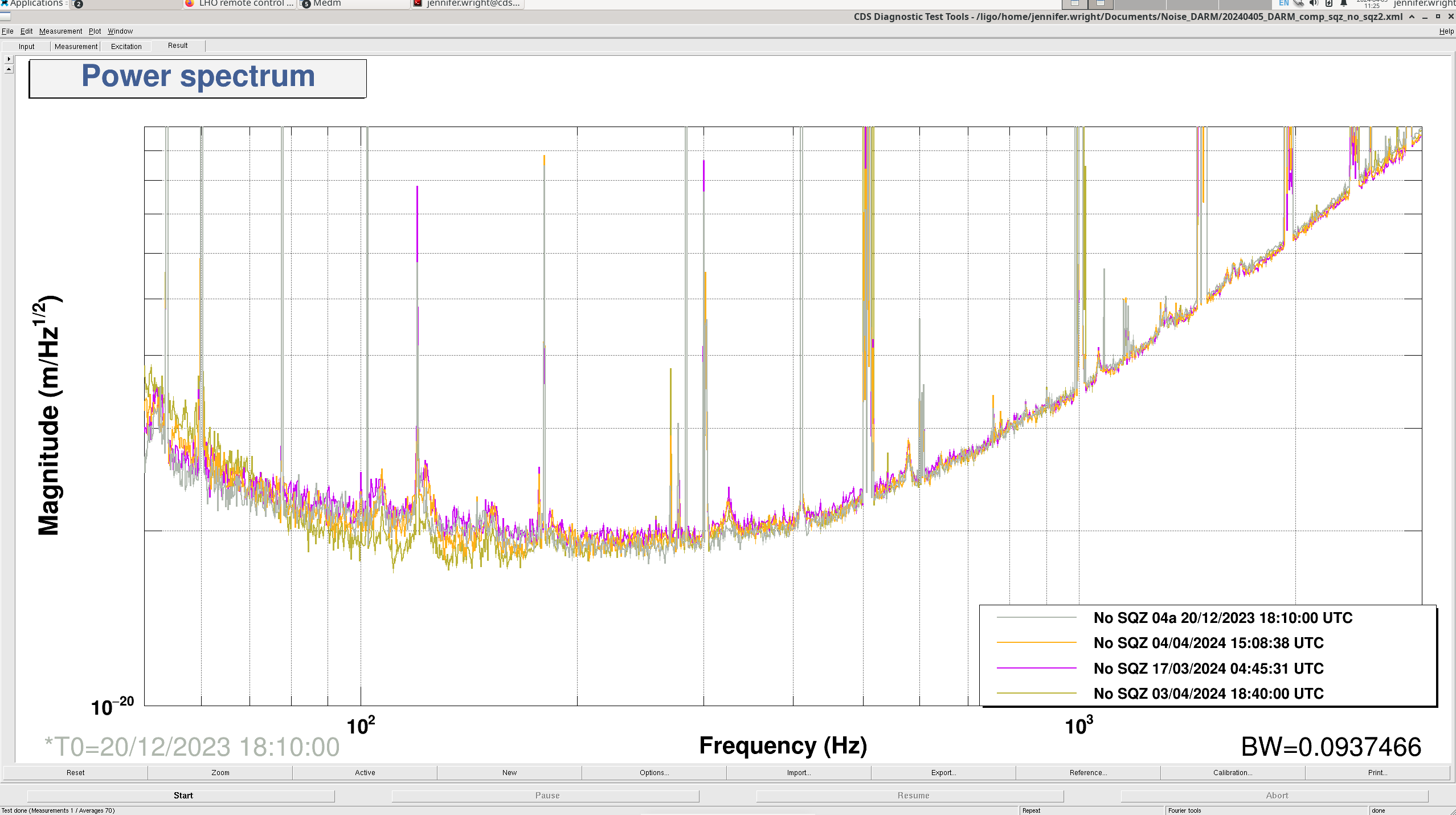
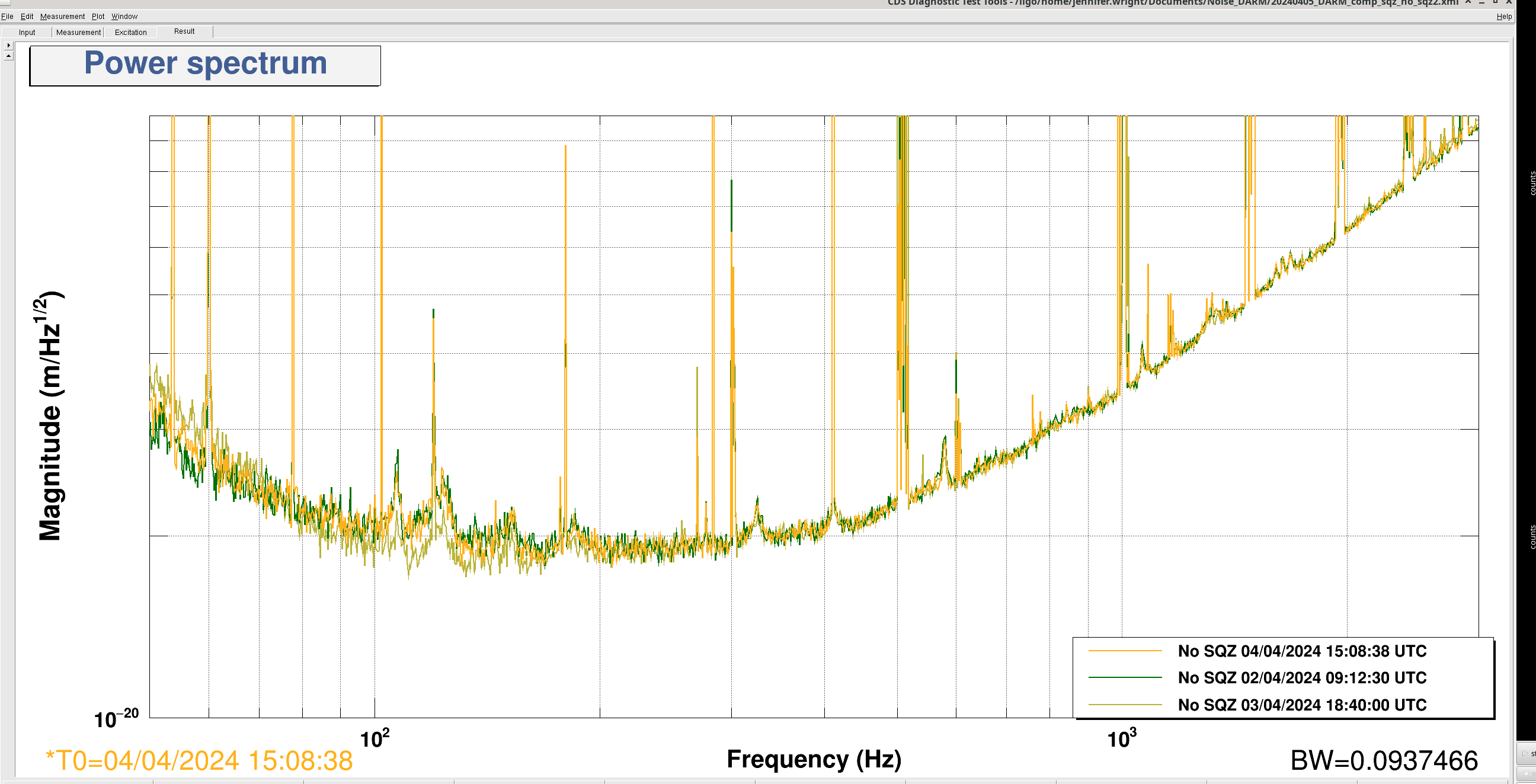
I took some sqz and no sqz quiet times from yesterday to try and make a plot of the excess noise agaion as in this entry. As Vicky thinks this correlated (non-quantum) noise is getting better.
For the first image I compared calibrated DARM from this week with the same measurement from March and from 04a.
Grey is from 04a, purple is from previous slide with March data, yellow and green are from this week.
What we can get from this plot is that this non-quantum noise is different from lock to lock and we are not sure why.
Between 80 and 190 Hz the excess noise seems to now be better relative to March and 04a.
But the fact the noise without squeezing changes so much in a week is confusing.
In the second plot I have just compared three no squeeze quiet times from this week and it easier to see that the noise is not consistent below 200Hz.
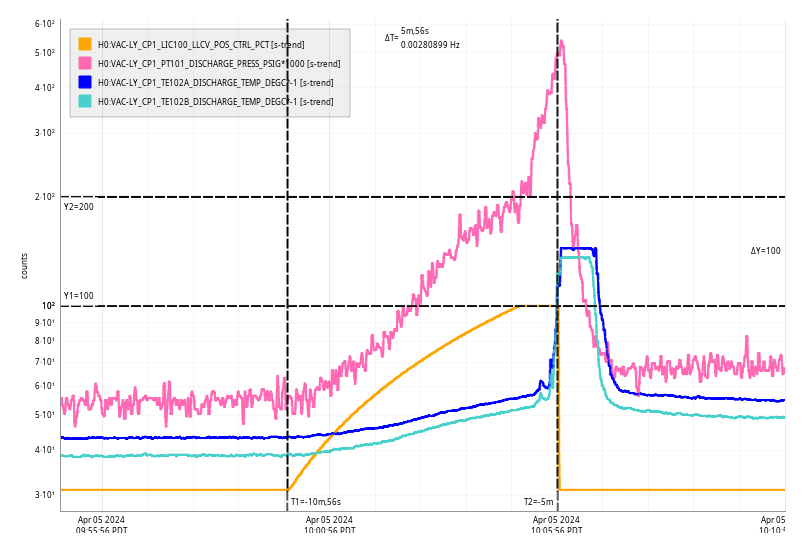
Fri Apr 05 10:05:56 2024 INFO: Fill completed in 5min 53secs
Gerardo confirmed a good fill curbside. TCtrip raised to -100C while this cold spell lasts.
FAMIS 19972
pH of PSL chiller water was measured to be just above 10.0 according to the color of the test strip.
S. Dwyer, R. Short
During H1's locking troubles this morning, we decided at one point to start an initial alignment from the start since DRMI was not locking. While the ACQUIRE_XARM_IR state was running during the input alignment steps, Sheila noticed the LSC-TR_X signal was far off from zero with no light, meaning there was a dark offset that needed to be fixed. I took the mode cleaner offline so we could observe the dark signal on the POP_A_RF45 photodiode and applied the negative value of that to the offset for both the I and Q segments. This allowed XARM IR to catch quickly, and input alignment completed without issue (contrary to its behavior in recent weeks). Sheila has updated the hard-coded offsets in ALIGN_IFO's PREP_ARM_IR state generator (lines 770-771) and included a note that these need to be updated periodically when input alignment has trouble.
This should fix the troubles we've been seeing with input alignment and serves as a reminder to check for any erroneous changes to dark offsets if we notice issues with alignment steps.
https://ldas-jobs.ligo.caltech.edu/~gabriele.vajente/bruco_1396341217_GDS_CALIB_CLEAN/
DHARD_Y is pretty bad, much worse than usual. Probably need a retuning of A2L
Jennie, Sheila, Camilla
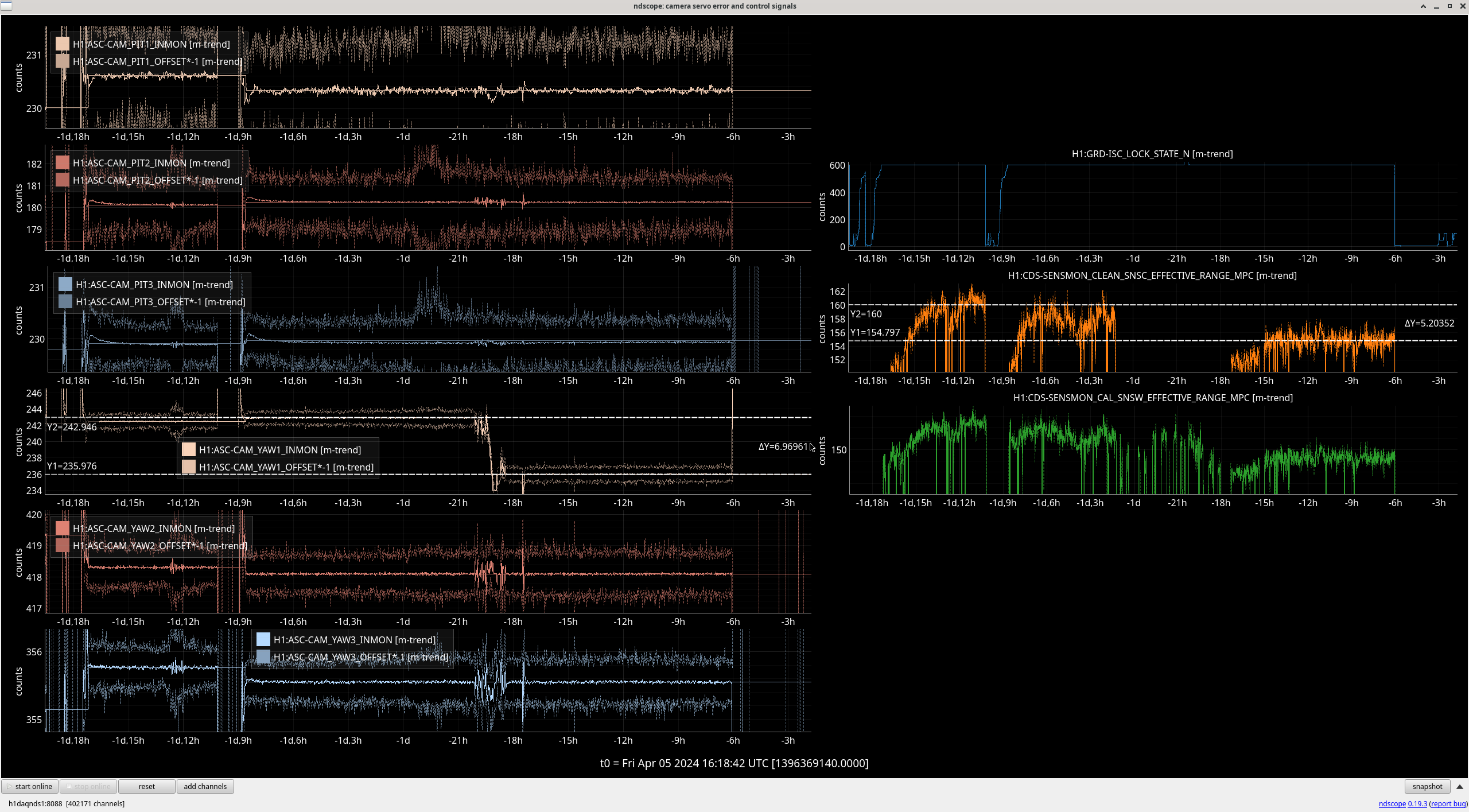
We expect DHARD yaw to be worse. In the seconds half of last night's lock the CAM_YAW1 offset was changed by ~7 counts, see 76961. It is expected that A2L would need to be retuned, we are still working on adding these 76961 changes to the guardian.
TITLE: 04/05 Day Shift: 15:00-23:00 UTC (08:00-16:00 PST), all times posted in UTC
STATE of H1: Earthquake
OUTGOING OPERATOR: TJ
CURRENT ENVIRONMENT:
SEI_ENV state: CALM
Wind: 4mph Gusts, 3mph 5min avg
Primary useism: 0.04 μm/s
Secondary useism: 0.32 μm/s
QUICK SUMMARY: H1 is currently running and initial alignment following downtime for about 5 hours from an earthquake (mentioned in the owl shift alog).
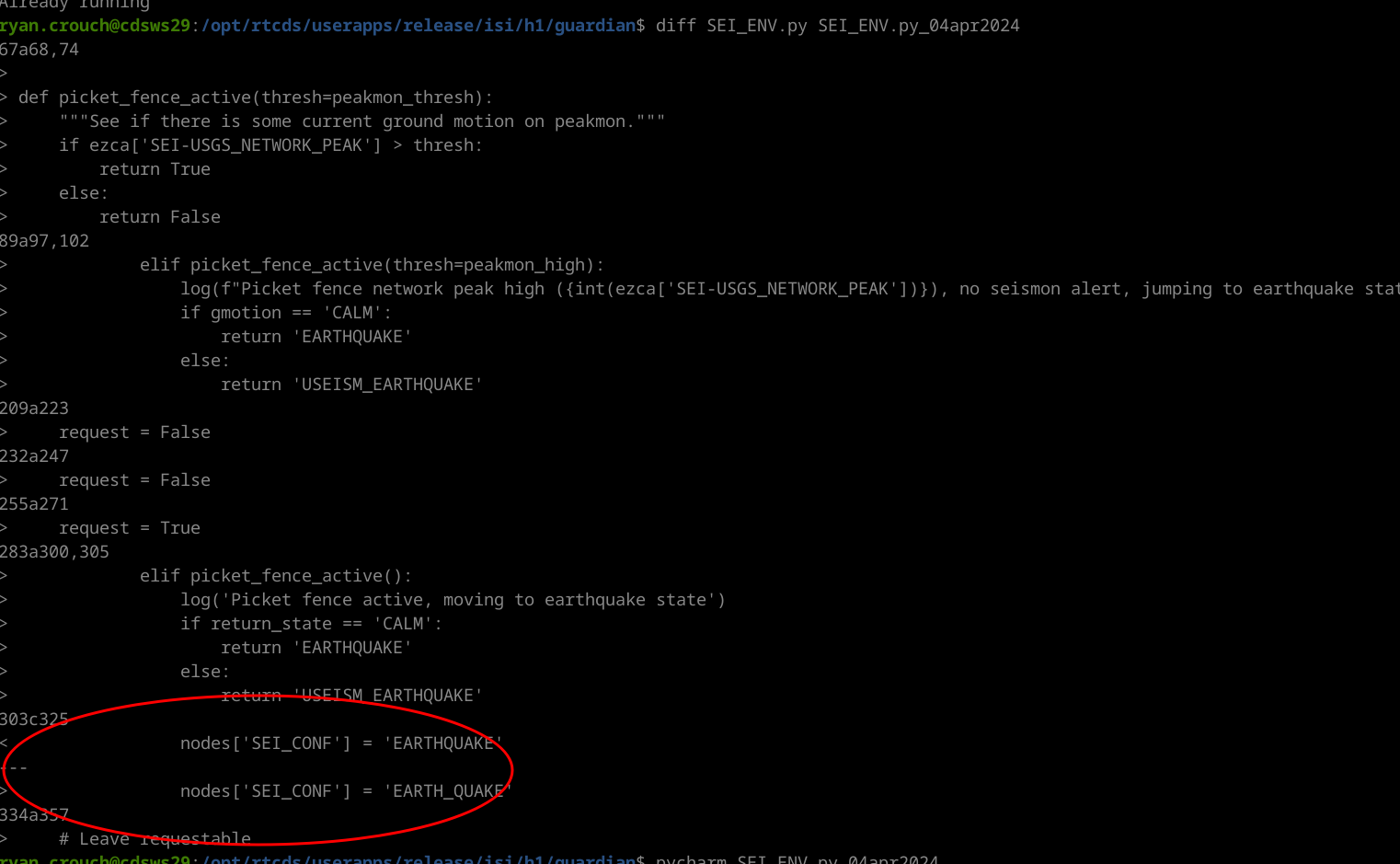
The IFO lost lock at around 1015UTC, then while running an alignment, a 6.8M earthquake from the pacific rolled through, tripping ST1&2 ITMY ISI. This also put SEI_ENV into error for requesting the EARTHQUAKE state from SEI_CONF, which for reasons is actually EARTH_QUAKE. I'm waiting for the ground motion to come down a bit before finishing the alignment and starting to relock.
After waiting a bit for the earth to calm down, I tried finishing up the alingment, which was a non-issue. When I tried locking, I was able to lock PRMI but not DRMI. The AS air camera spot looked off, but no matter how much I adjusted SRM, I couldn't get it to lock or get the spot to look much better, I ran another alignment, but skipped green and input align. At this point another earthquake rolled through and made SRC a bit tricky, but it eventually locked. Second time around and I was back in the same spot. PRMI would lock, though it perhaps looked shaky, but I couldn't get DRMI to lock. It would have many "baby" locks, but I couldn't seem to increase the POP flashes. I tried changing the trigger thresholds for SRCL and MICH, but this didn't seem to help either.
I ended up giving up and running a full alignment. It's currently finishing up SRC and I'm handing this off to Ryan.
TITLE: 04/05 Eve Shift: 23:00-07:00 UTC (16:00-00:00 PST), all times posted in UTC
STATE of H1: Observing at 150Mpc
INCOMING OPERATOR: TJ
SHIFT SUMMARY: We've been locked for 23:18 as of 07:00UTC
Lock#1
LOG:
| Start Time | System | Name | Location | Lazer_Haz | Task | Time End |
|---|---|---|---|---|---|---|
| 23:42 | CAL | Francisco | PCAL lab | LOCAL | PCAL work | 00:15 |
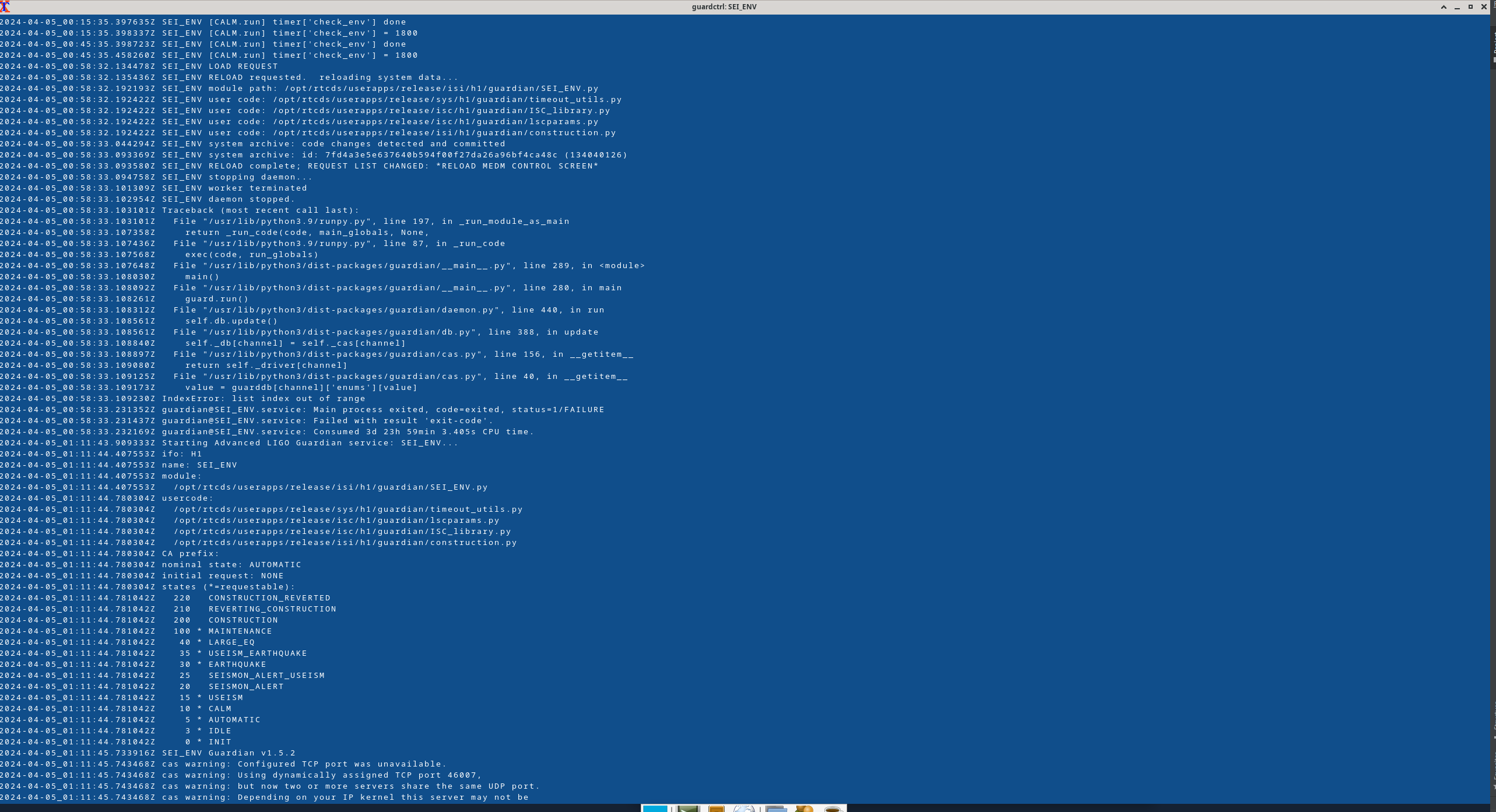
We briefly dropped from Observing due to the SQZer losing lock from 00:58 till 01:14 UTC. I reloaded SEI_ENV during this time which caused it to fail due to an index error, so Dave and I reverted the latest changes and restarted the node.
We've been locked and observing since, lock time of 19:20 as of 03:00UTC
EX Cryobaffle
In January we damped the EX cryobaffle through a viewport (75553) because it had not been available for damping during the O3-O4 break and because the scattering noise from it increased with beam power (70808). The baffle has a 4 Hz resonance that matched a 4 Hz mode of the isolation system of one of the HVAC fans, making it particularly noisy early in the run, until we switched fans. Figure 1 shows that, after damping, about five times more motion of the beam tube is required to produce about the same level of noise in DARM.
Input Arm
During the break, we doubled the angle of the MC baffles in the input arm, so that there would be no specular reflection paths between optics, we added more damping to the MC baffles, added nozzle baffles to each of the nozzles with blank-off flanges, and added an unplanned baffle for a glint (75726).
Figure 2 shows a frequency sweep, injected by a speaker, and the resulting noise in DARM before and immediately after the break. The noise produced by injections above 15 Hz, is greatly reduced immediately after the break. However, we had also hoped to better reduce the noise produced by injections below 15 Hz. I spent last week looking into glints that I could see in the chamber and other potential sources of the residual coupling below 15 Hz. I found that I could greatly reduce the residual coupling by changing the yaw of the ITMY compensation plate by 50 microradians. The last pair of spectrograms in Fig. 1 shows that this CP angling further reduced the coupling to levels that we had hoped to achieve.
Figure 3 shows the elimination of noise for a 13.1 Hz injection after angling the ITMY compensation plate in yaw. The second page shows that there is repeatable structure at about 20 microradians in the coupling, suggesting that there are multiple ghost beams or, more likely, multiple retroreflecting structures. The third page shows a bright light on the wall of a spool piece that bears further investigation.
TITLE: 04/04 Eve Shift: 23:00-07:00 UTC (16:00-00:00 PST), all times posted in UTC
STATE of H1: Commissioning
OUTGOING OPERATOR: Corey
CURRENT ENVIRONMENT:
SEI_ENV state: CALM
Wind: 11mph Gusts, 8mph 5min avg
Primary useism: 0.03 μm/s
Secondary useism: 0.28 μm/s
QUICK SUMMARY:
Back into Observing at 23:00 UTC
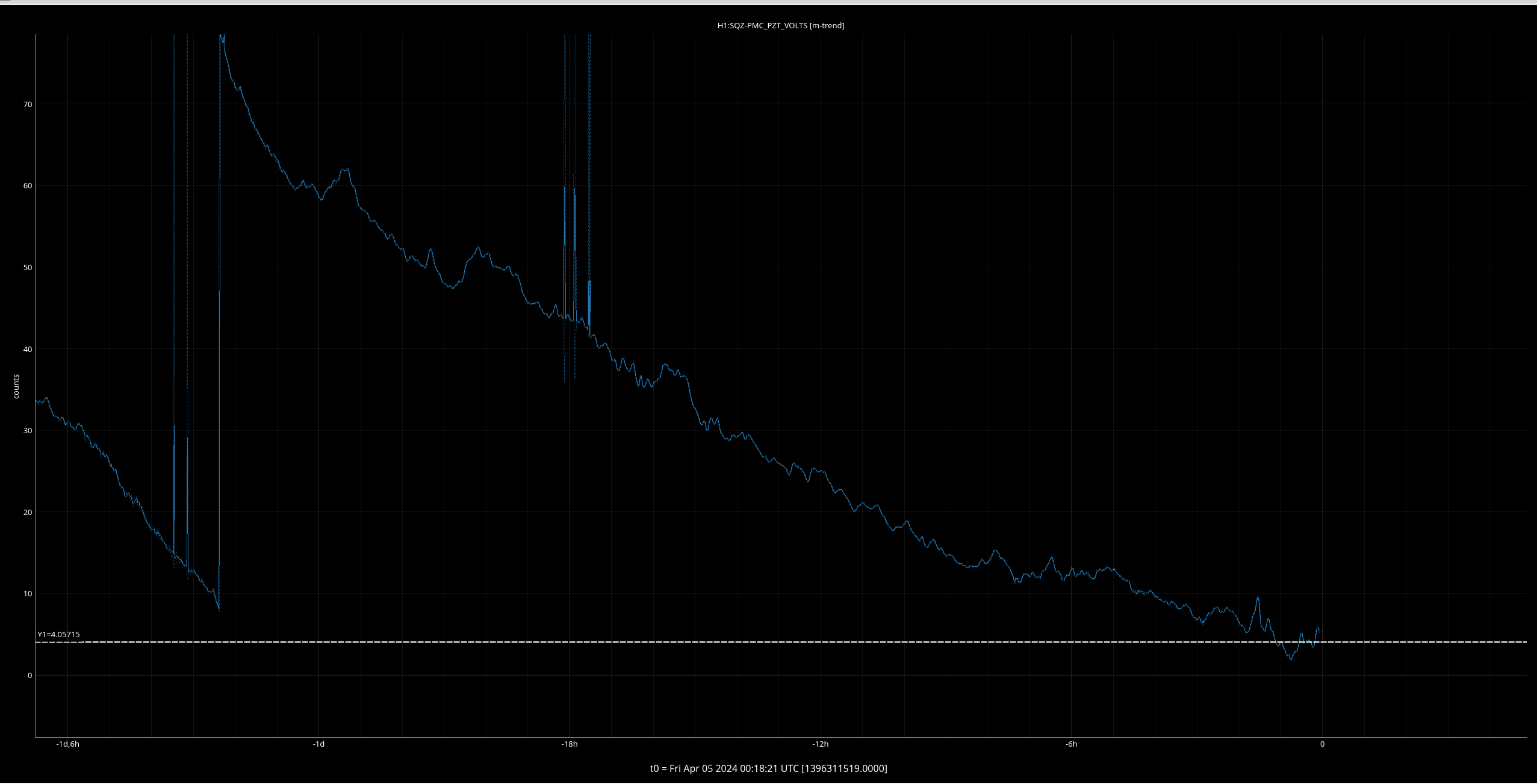
SQZ_PMC is giving notifications of "PMC PZT volts low", the node returns this notification if the SQZ-PMC_VOLTS channel is less than 5. Its decayed from 80 to where it is currently, hovering around 5 over the past day.
SQZ unlocked dropping us out of observing at 00:58UTC, I also took the moment to reload SEI_ENV which caused it to lose FAIL/lose connection? I'm going to call Dave
Dave and I reverted the most recent code changes from Jim and I restarted the node with "guardctrl restart SEI_ENV", the codes changes included some states becoming unrequestable and a few other small changes, none of which made any sense for the "Index error" that the LOG had. Verbal alarms is now constantly throwing a TypeError for SEI_ENV "NoneType is not iterable". I went back into Observing at 01:14 after the SQZer relocked itself and then the MANAGER prompted me to "Return to FDS" so I requested us back to FDS
Naoki, Eric, Camilla
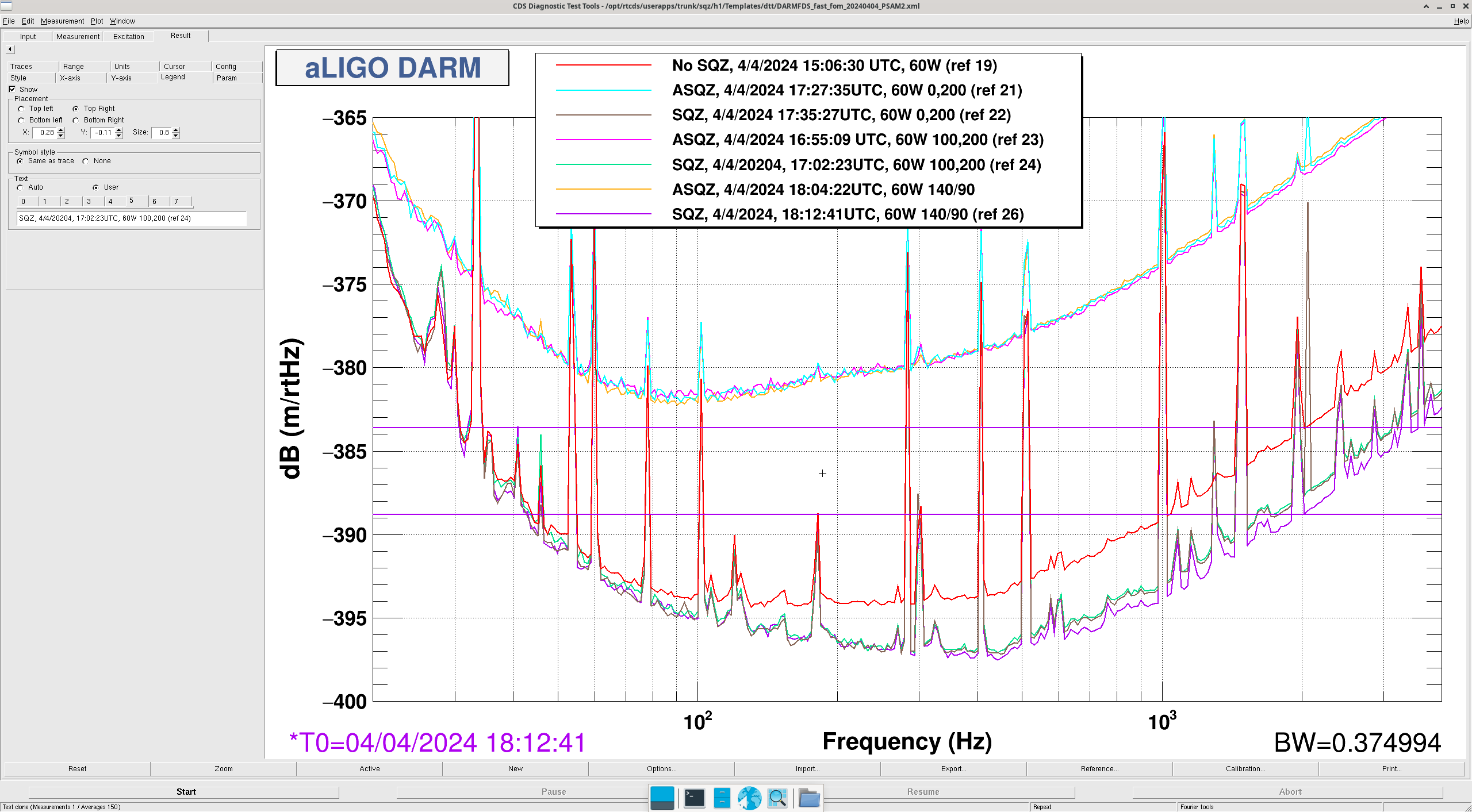
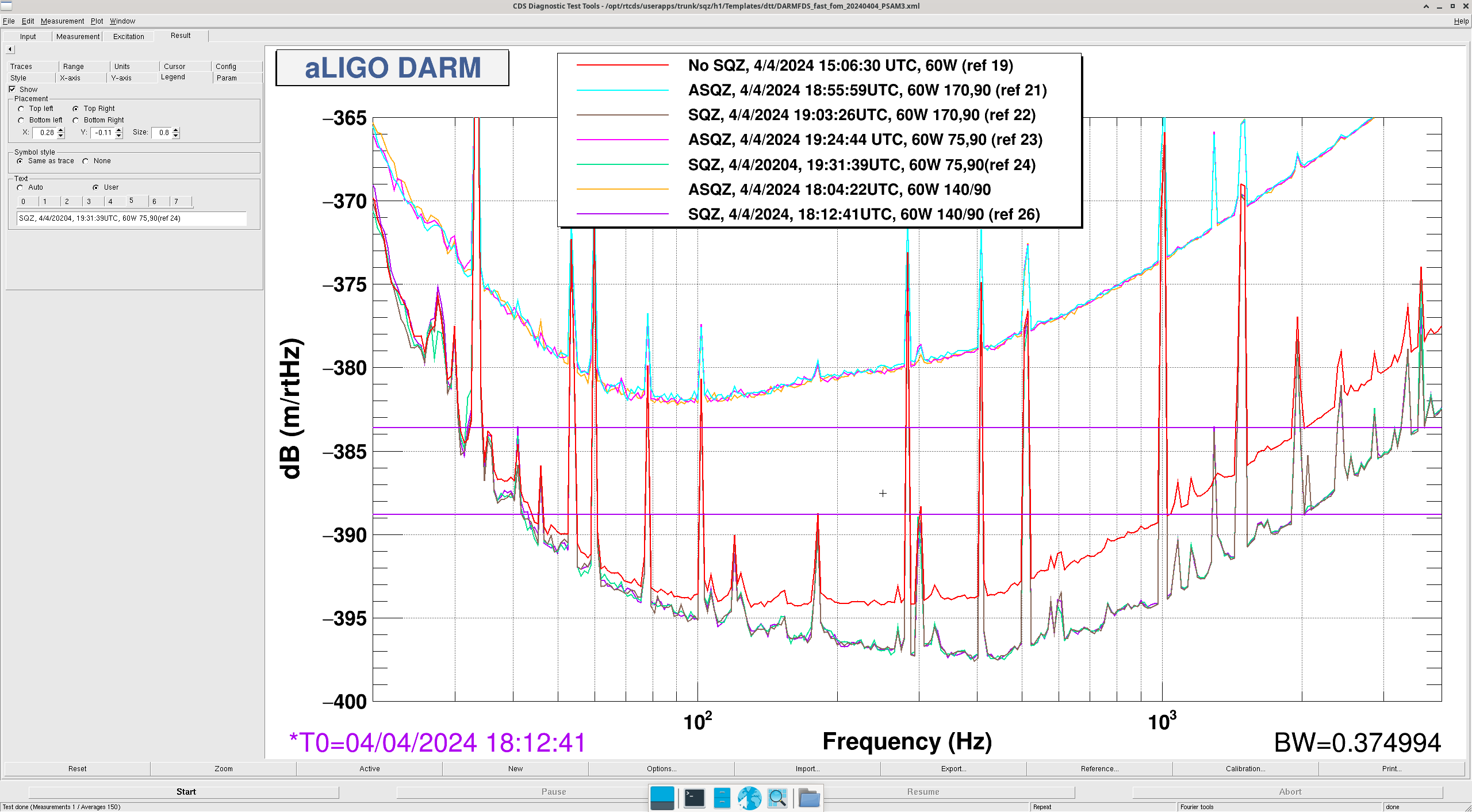
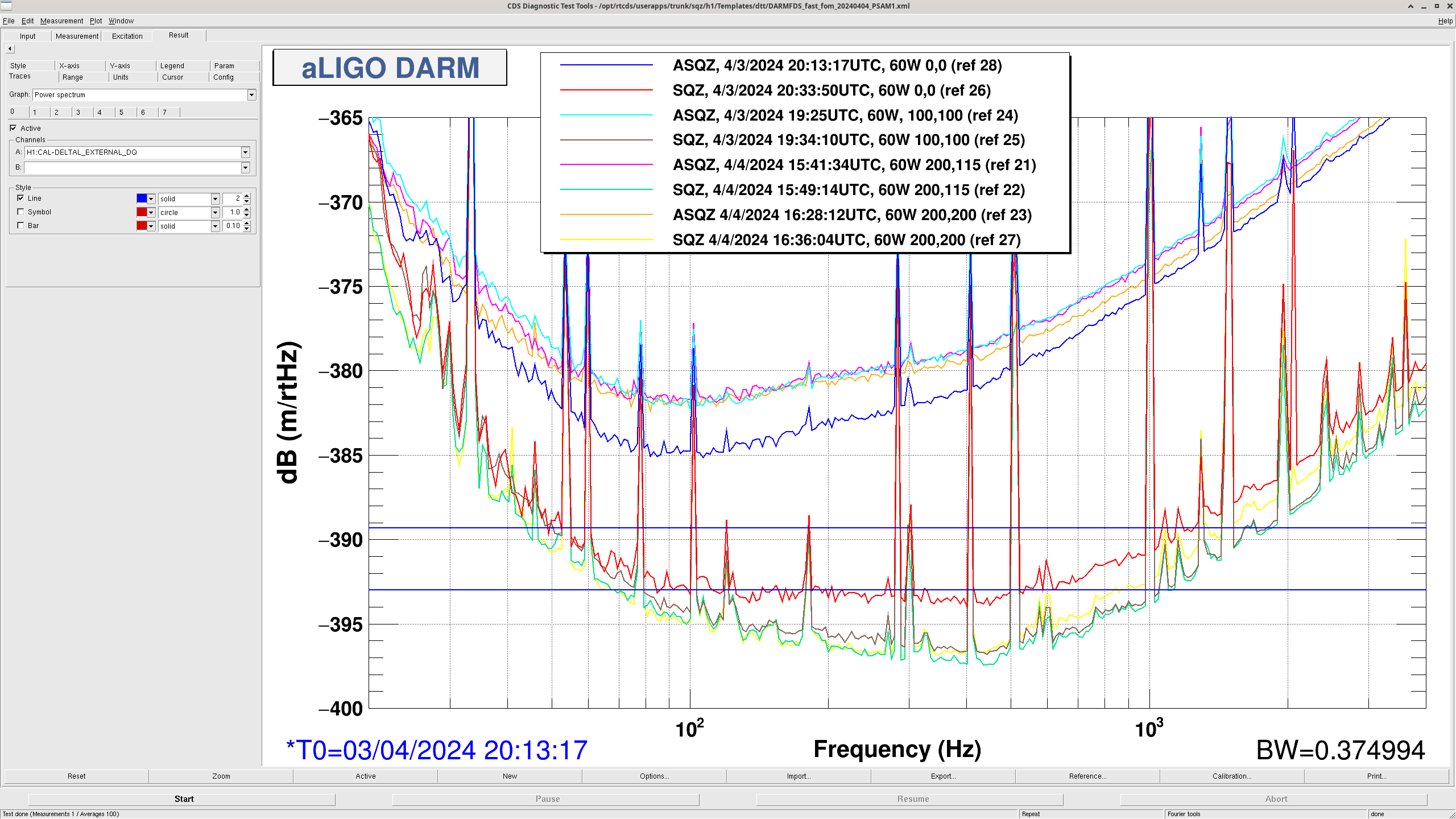
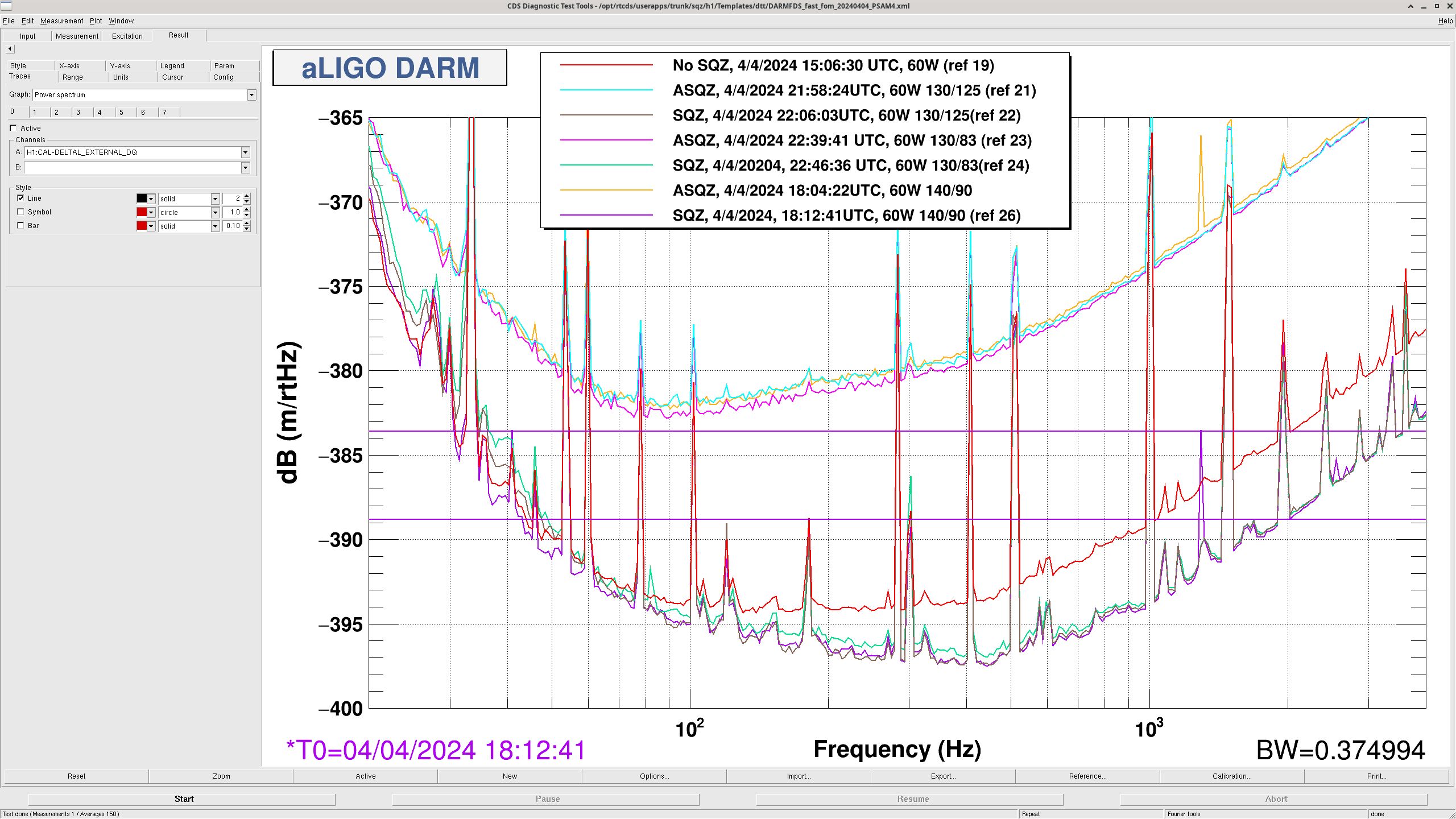
We continued the PSAMS coarse scan in 76925. Yesterday, IFO was not thermalized, but today IFO is thermalized at least for 7 hours. It seems our nominal 140/90 (strain voltage 7.22/-0.71) would be close to optimal. The detail analysis will follow.
This time, after we moved PSAMS, we compensated the alignment change caused by the PSAMS change by looking at OSEM. This works well for ZM4, but not for ZM5 and we need to touch ZM5 in addition to the compensation. This might be related to the beam miscentering in ZM5 as reported in 75770.
no sqz (10 min)
PDT: 2024-04-04 08:06:30 PDT
UTC: 2024-04-04 15:06:30 UTC
GPS: 1396278408
asqz 200/115 (strain voltage 9.59/-0.702) (5 min)
PDT: 2024-04-04 08:41:34 PDT
UTC: 2024-04-04 15:41:34 UTC
GPS: 1396280512
sqz 200/115 (5 min)
PDT: 2024-04-04 08:49:14 PDT
UTC: 2024-04-04 15:49:14 UTC
GPS: 1396280972
asqz 200/200 (strain voltage: 9.59/2.67) (5 min)
PDT: 2024-04-04 09:28:12 PDT
UTC: 2024-04-04 16:28:12 UTC
GPS: 1396283310
sqz 200/200 (5 min)
PDT: 2024-04-04 09:36:04 PDT
UTC: 2024-04-04 16:36:04 UTC
GPS: 1396283782
asqz 100/200 (strain voltage 6.83/2.72) (5 min)
PDT: 2024-04-04 09:55:09 PDT
UTC: 2024-04-04 16:55:09 UTC
GPS: 1396284927
sqz 100/200 (5 min)
PDT: 2024-04-04 10:02:23 PDT
UTC: 2024-04-04 17:02:23 UTC
GPS: 1396285361
asqz 0/200 (strain voltage 2.2/2.72) (5 min)
PDT: 2024-04-04 10:27:25 PDT
UTC: 2024-04-04 17:27:25 UTC
GPS: 1396286863
sqz 0/200 (5 min)
PDT: 2024-04-04 10:35:27 PDT
UTC: 2024-04-04 17:35:27 UTC
GPS: 1396287345
asqz 140/90 (strain voltage 7.22/-0.71) (5 min)
PDT: 2024-04-04 11:04:22 PDT
UTC: 2024-04-04 18:04:22 UTC
GPS: 1396289080
sqz 140/90 (5 min)
PDT: 2024-04-04 11:12:41 PDT
UTC: 2024-04-04 18:12:41 UTC
GPS: 1396289579
asqz 170/90 (strain voltage 8.80/-0.70) (5 min)
PDT: 2024-04-04 11:55:59 PDT
UTC: 2024-04-04 18:55:59 UTC
GPS: 1396292177
sqz 170/90 (5 min)
PDT: 2024-04-04 12:03:26 PDT
UTC: 2024-04-04 19:03:26 UTC
GPS: 1396292624
asqz 75/90 (strain voltage 5.77/-0.71) (5 min)
PDT: 2024-04-04 12:24:44 PDT
UTC: 2024-04-04 19:24:44 UTC
GPS: 1396293902
sqz 75/90 (5 min)
PDT: 2024-04-04 12:31:39 PDT
UTC: 2024-04-04 19:31:39 UTC
GPS: 1396294317
asqz 130/125 (strain voltage 7.21/0.26) (5 min)
PDT: 2024-04-04 14:58:24 PDT
UTC: 2024-04-04 21:58:24 UTC
GPS: 1396303122
sqz 130/125 (5 min)
PDT: 2024-04-04 15:06:03 PDT
UTC: 2024-04-04 22:06:03 UTC
GPS: 1396303581
asqz 130/83 (strain voltage 7.22/-1.2) (5 min)
PDT: 2024-04-04 15:39:41 PDT
UTC: 2024-04-04 22:39:41 UTC
GPS: 1396305599
sqz 130/83 (5 min)
PDT: 2024-04-04 15:46:36 PDT
UTC: 2024-04-04 22:46:36 UTC
GPS: 1396306014
Attached are the averaged squeezing and anti-squeezing DARM spectra for each PSAM value we've measured so far. Based on the course scan, we see that our initial PSAM values (strain voltages of 7.22/-0.71 for ZM4/ZM5) appear to be roughly optimal, giving roughly -5.2 dB of squeezing and 15.6 dB antisqueezing at 2 kHz. So far we've noticed that any significant movement of the PSAM setting for ZM5 seems to de-optimize things and we are relatively insensitive to changes in ZM4 when ZM5 is held fixed at its initial value. Values from yesterday afternoon are also included.
On April 9th, we took one more PSAMS data. This PSAMS setting might be better than the nominal 170/95 (strain voltage 8.8/-0.66) as reported in 77074. We may come back to this setting later.
asqz 125/136 (strain voltage 7.5/0.5) (5 min)
PDT: 2024-04-09 15:36:49 PDT
UTC: 2024-04-09 22:36:49 UTC
GPS: 1396737427
sqz 125/136 (5 min)
PDT: 2024-04-09 15:43:59 PDT
UTC: 2024-04-09 22:43:59 UTC
GPS: 1396737857
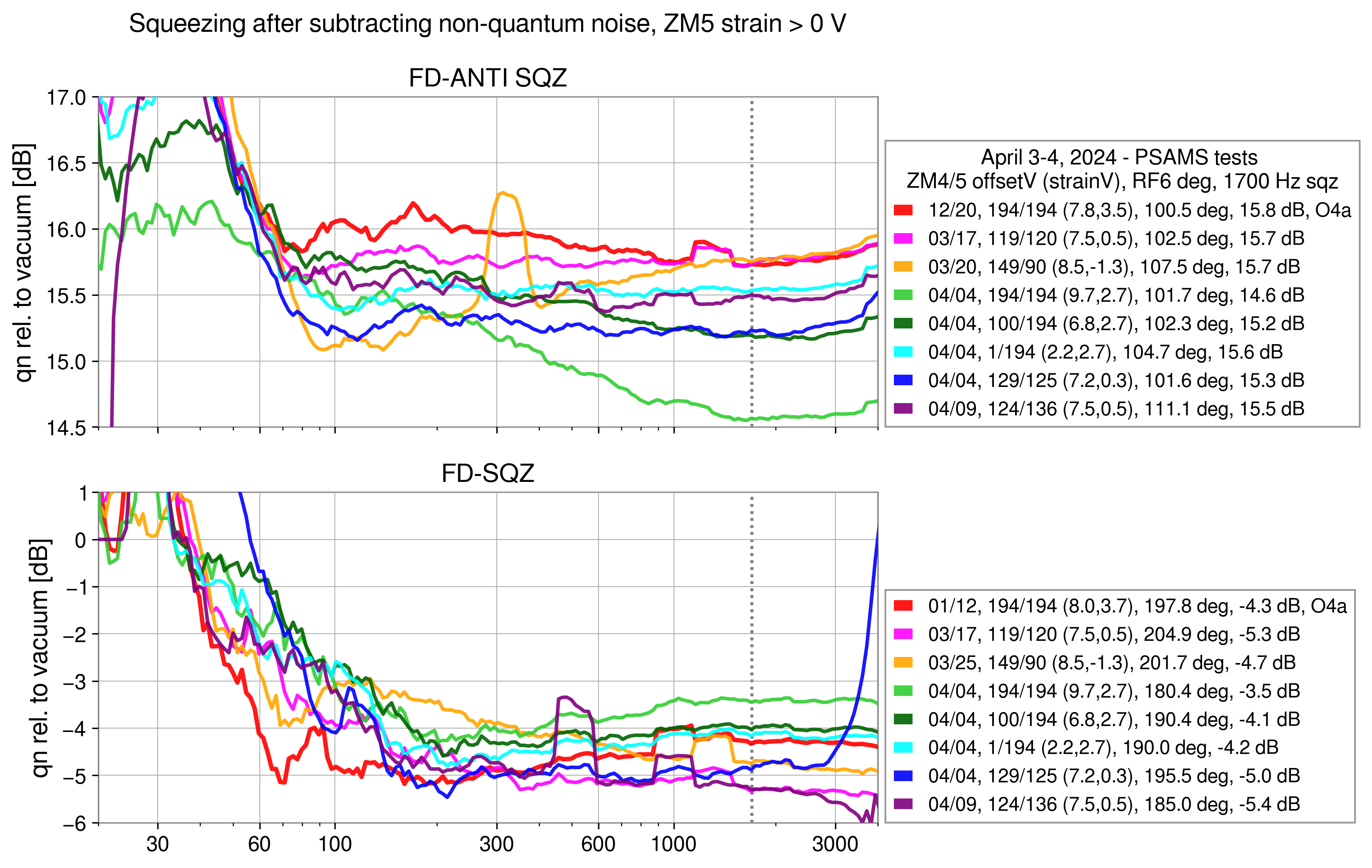
Subtracted SQZ dB's for the various PSAMS settings last week: course trial #1: 76925, and course trial #2: 76949, and the previous optimzations in LHO:76507, which used SQZ ASC to hold alignments when moving PSAMS before ZM alignment scripts 76757.
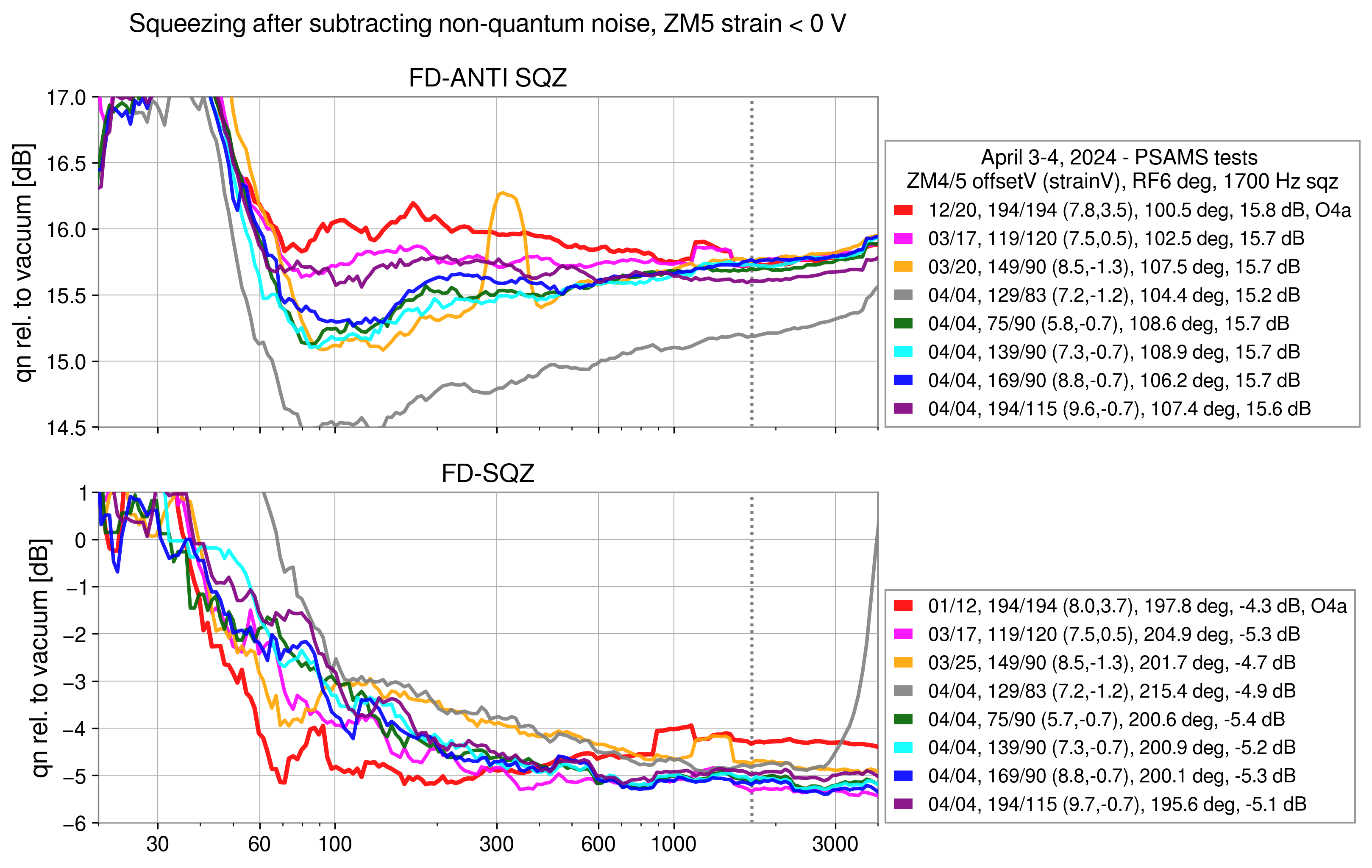
I sorted the PSAMS tests by positive and negative ZM5 strain gauge voltages.
Some takeaways: hard to interpret what's happening. Could be interesting to try ZM5 strains around 0 - 0.5 V, and scan with e.g. ~0.1 V steps. I wonder if reviving the psams scanning scripts, and doing fine optimizations, would be productive at this point. I'm not sure if there's a tension between good squeezing at 1 kHz vs. 100 Hz. But some settings that give the most kHz squeezing (negative ZM5 strain) don't necessarily show the best 100 Hz squeezing (positive ZM5 strain), and vice-versa. It may just be that the optimal point is narrow, and we're taking big steps?
Attachment 1 - positive ZM5 strain - potentially more SQZ at 100 Hz, and less sqz at 1 kHz?
Attachment 2 - negative ZM5 strain - more kHz SQZ, but kinda looks lossier below the DARM pole at e.g. 100 Hz.
Linking LHO:75749 with the in-chamber beam profiles at various PSAMS settings, as we continue working to reconcile the models and measurements.
Jennie W, Sheila, Gabriele remotely
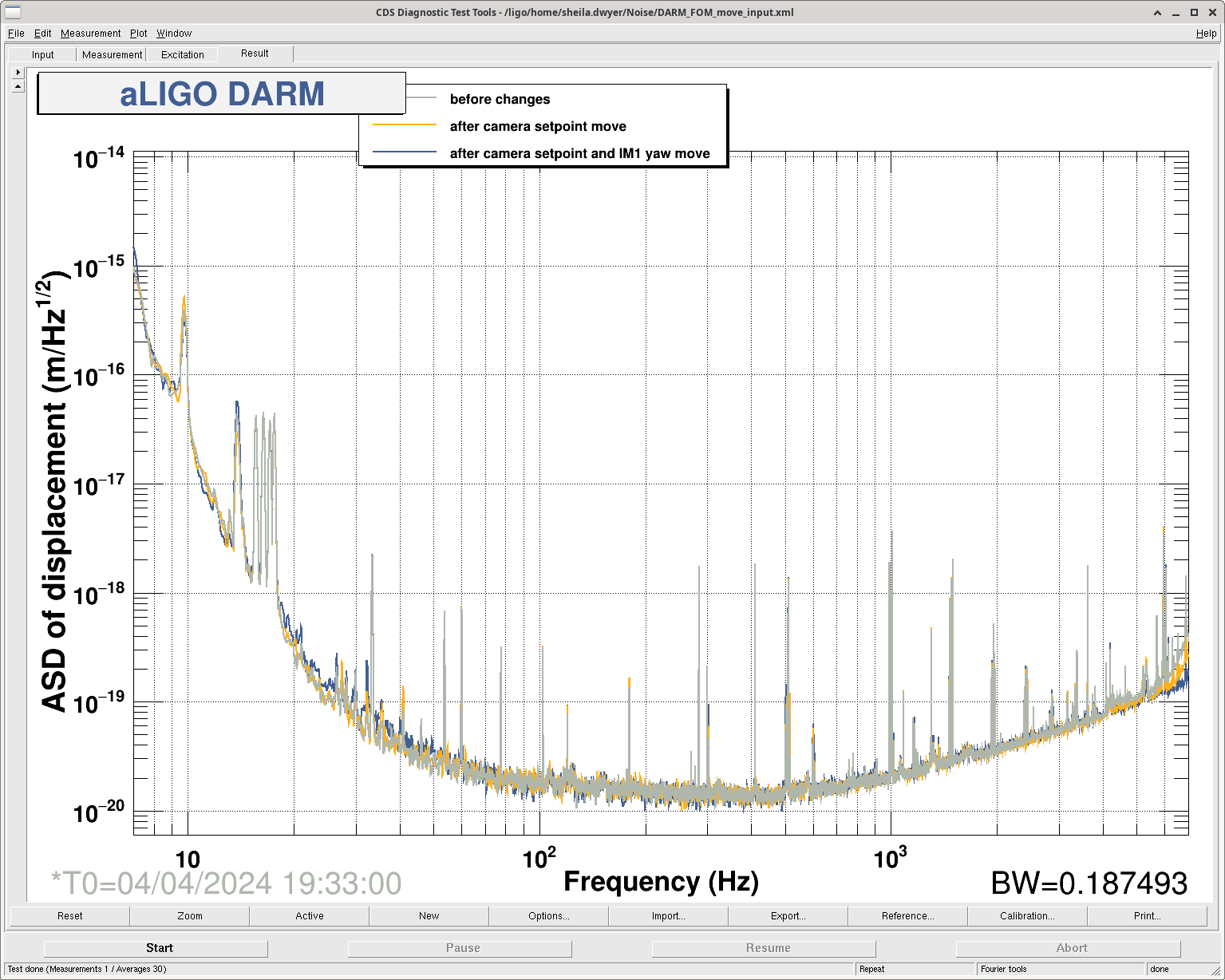
Summary: With the ISS second loop open, we were able to move the IMs without loosing lock. We realized that the BS camera set point is not ideal for power recycling gain, and that is the reason that the IM moves seemed to improve build ups. After reseting the camera servo set point, we were able to increase power on the ISS array and IM4 by moving IM1 yaw in the opposite direction from past moves ( 76534 and 76607 ).
Details:
We moved IM1 and 3 with the ISS second loop open (take IMC_LOCK to LOCKED), this allowed us to move the input pointing without loosing lock.
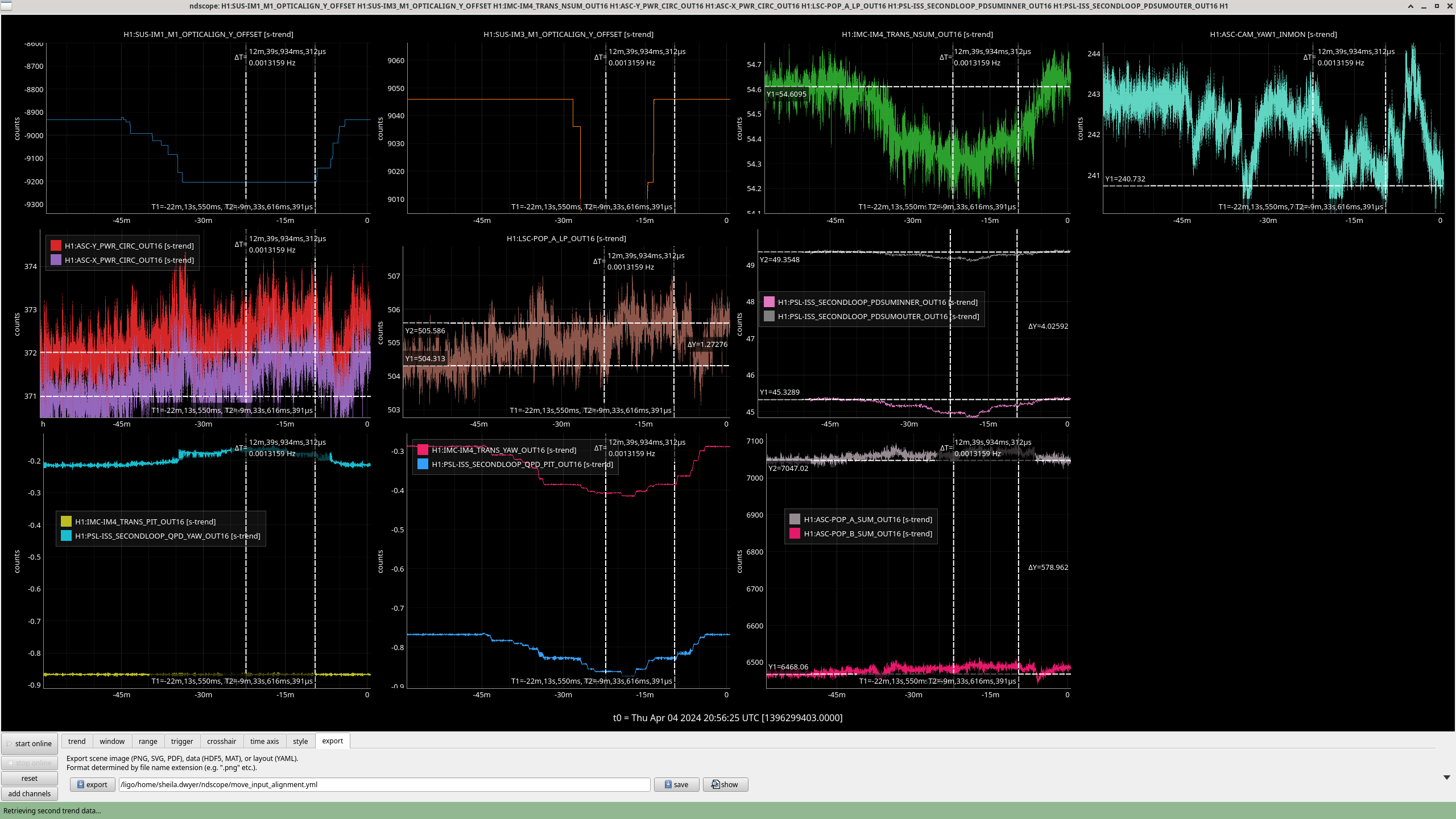
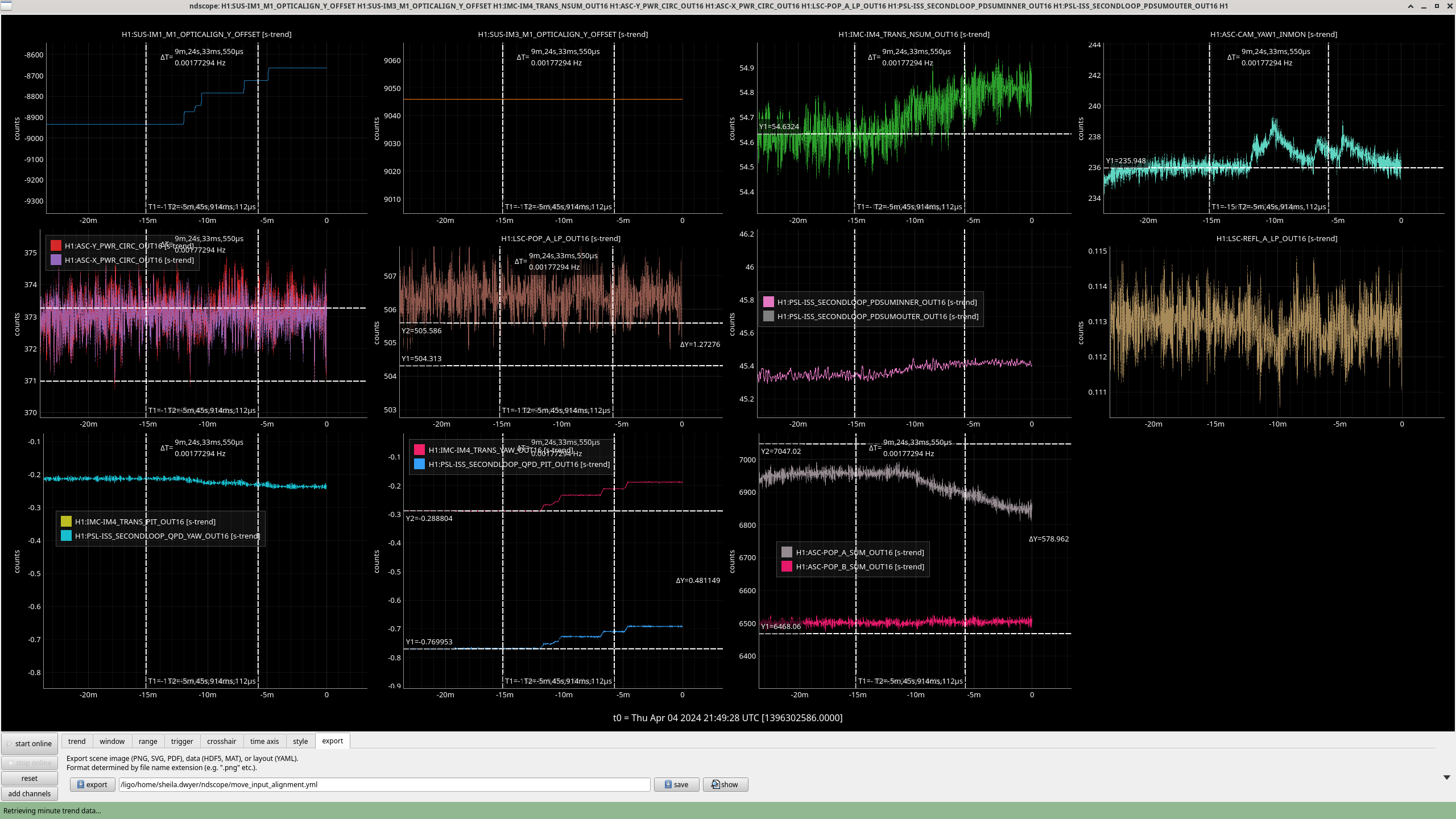
We believe that the improvements in build ups seen in 76534 and 76607 were due to the spot on the ITMs/BS moving. When Jennie moved the IMs in the same direction as these earlier attempts, the build ups increased in both arms and LSC POP, but once the CAM1 YAW servo converged the build ups where back to where they started (screenshot). The IM move also decreased the power on the ISS second loop array (in and out of loop sums) and IM4 trans QPD dropped, indicating that this move may have been the wrong direction to reduce any clipping in HAM2. We then moved the CAM1 YAW set point to where the error signal was at the maximum build up time, and this restored the build ups.
Jennie moved the IMs back to their starting place, which restored the power on IM4 trans and the ISS array, then we walked the CAM1 YAW offset (BS camera feeds back to PRM) to maximize the POP and arm powers, we found that an offset of -236 counts seemed best. This is consistent with what Jennie and Camilla found with the stepper scripts in 76770. In 76695, Camilla looked at how the camera offsets change from lock to lock, when they are set after ADS converges. This gave us a roughly 0.5% more power in the arms. We want to change the guardian to use this set point in every lock, and retune the ITMs A2L gain for this new set point, but we haven't done that today.
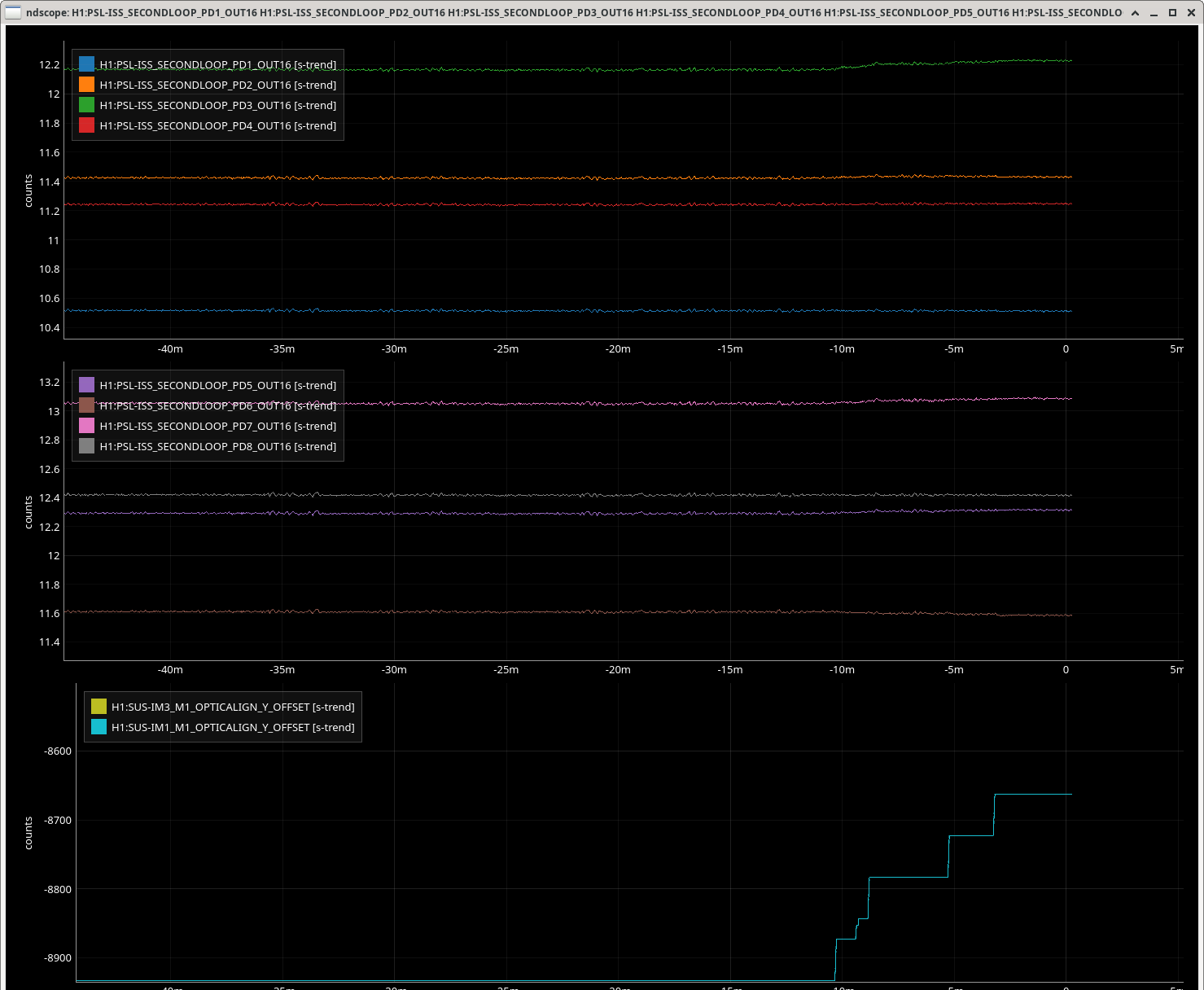
Next Jennie moved IM1 yaw in the positive direction, which increased the power on IM4 trans and ISS second loop array PDs screenshot and here. While she was doing this the sqz team was injecting anti-sqz, but when they were done we had a quick quite time for a DARM comparison, it appears that we might have made the noise worse. We wll double check as we revert this move after the squeezers are finished.
We relooked at CAL-DELTAL both with the IM1 move up in yaw still in and with the yaw reverted and the noise was still worse. We may have to optimise A2L gains for the ITMs to work with this camera offset change.
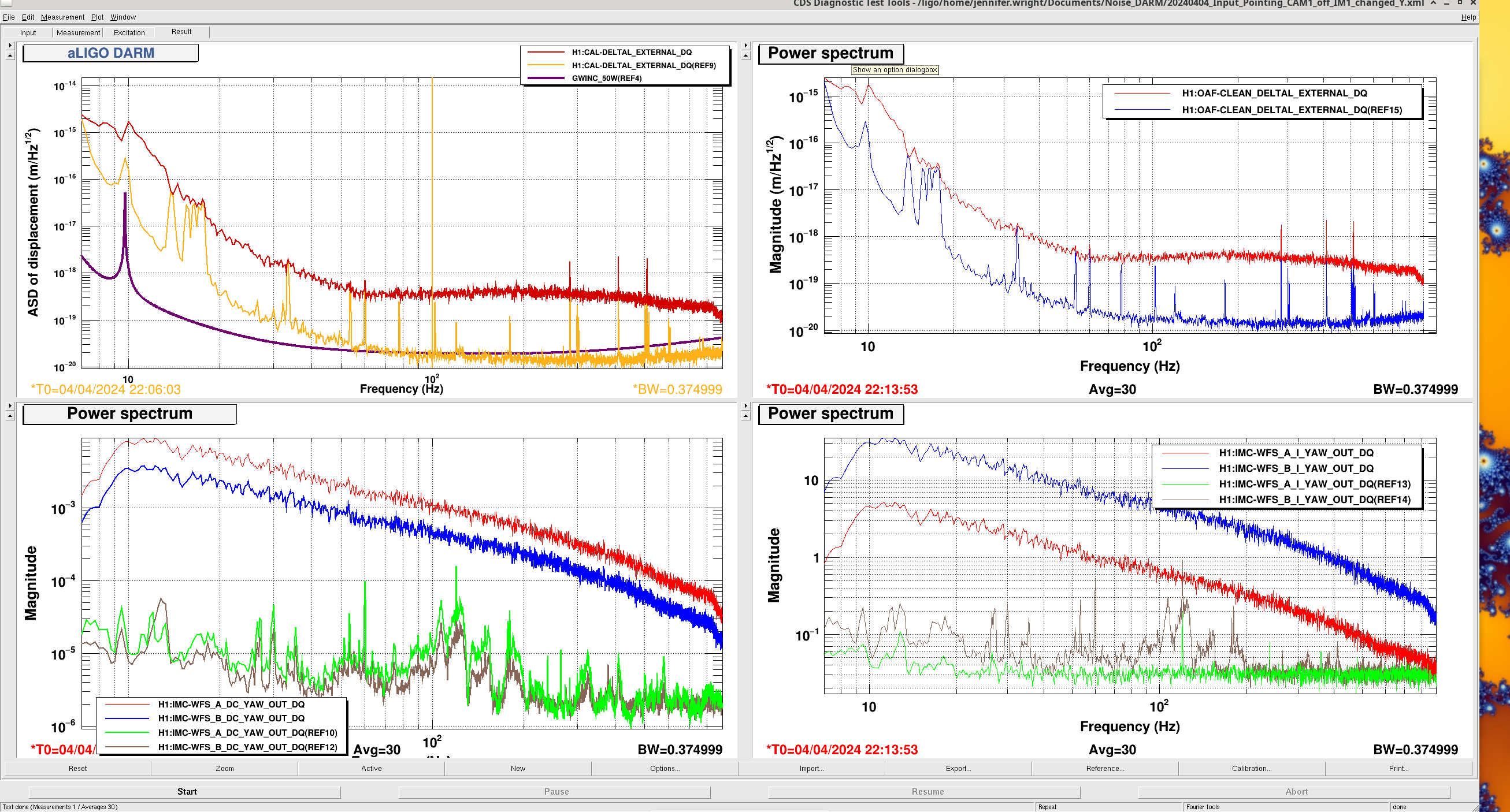
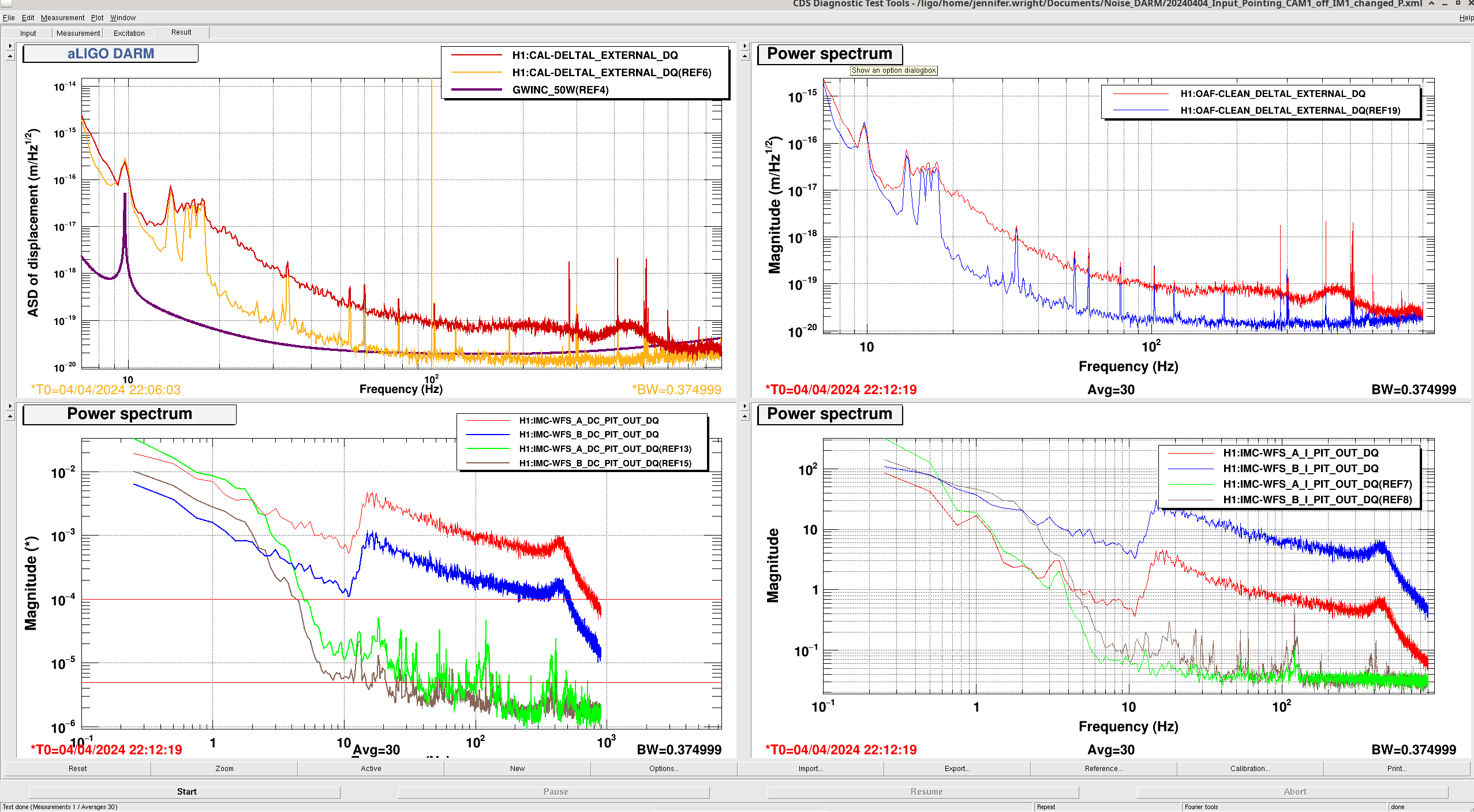
I also measured the jitter coupling with the camera setpoint changed - interleaved between squeezing measurements.
The templates are saved in /ligo/home/jennifer.wright/Documents/Noise_DARM for yaw and pitch.
I will compare these to our previous jitter couplings.
The reference changes are without injecting and the live traces are with an injection into the IMC_PZT pitch or yaw.
Turned on new MICH FF at 19:45UTC, details and plot in 76956. Updated safe and observe sdf's and ISC_LOCK.
Took SRCL measurements 19:50-20:05UTC.
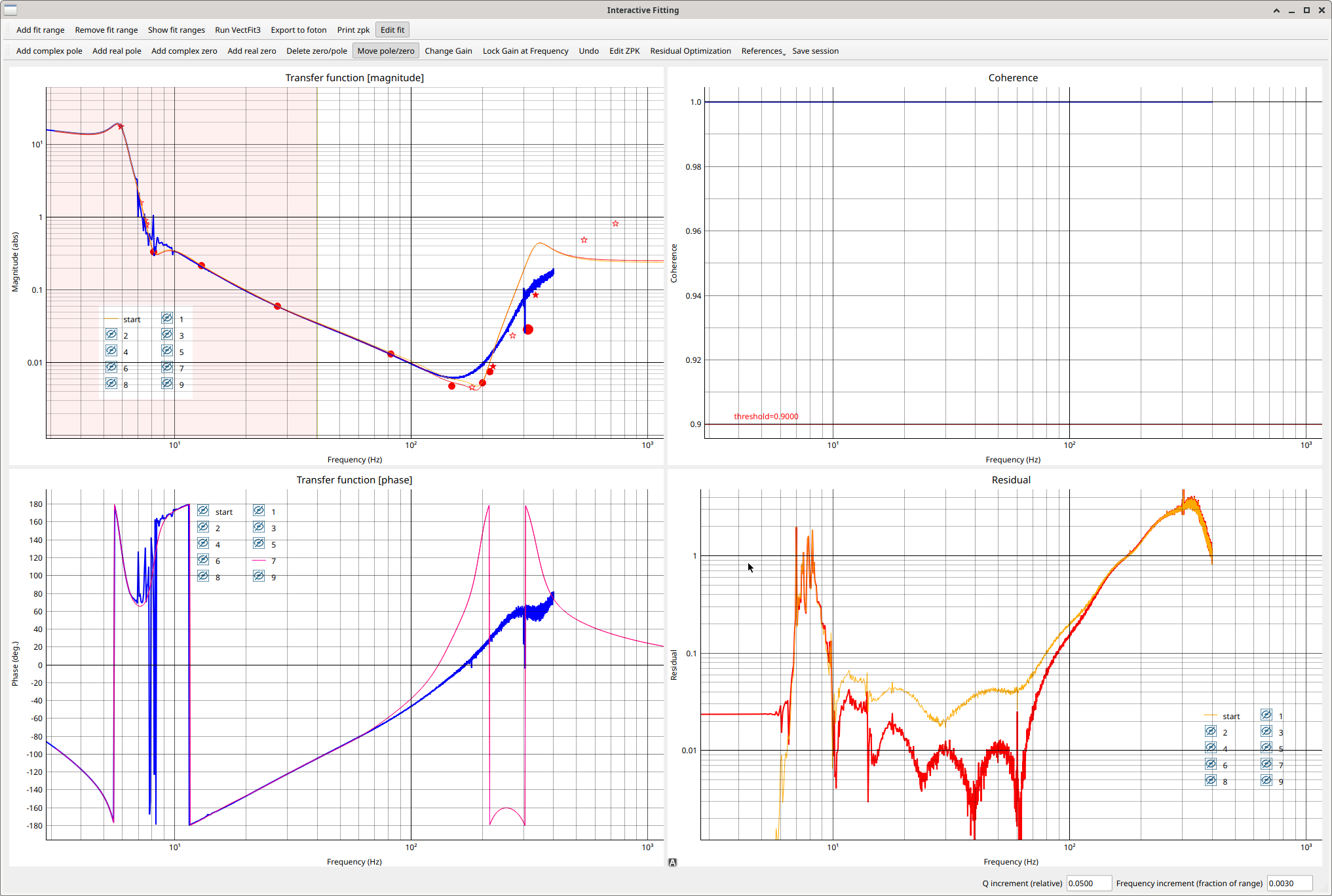
Gabriele's last bruco of SRCL from 76927 shows coherence in 15-60Hz range and some 100-200Hz. I'm struggling to fit a better SRCLFF in this 100-200Hz region but have a slightly different filter that's improved 15-60Hz, see attached. This is saved into FM1 (not loaded as in Observing).
Jennie, Jenne, Sheila
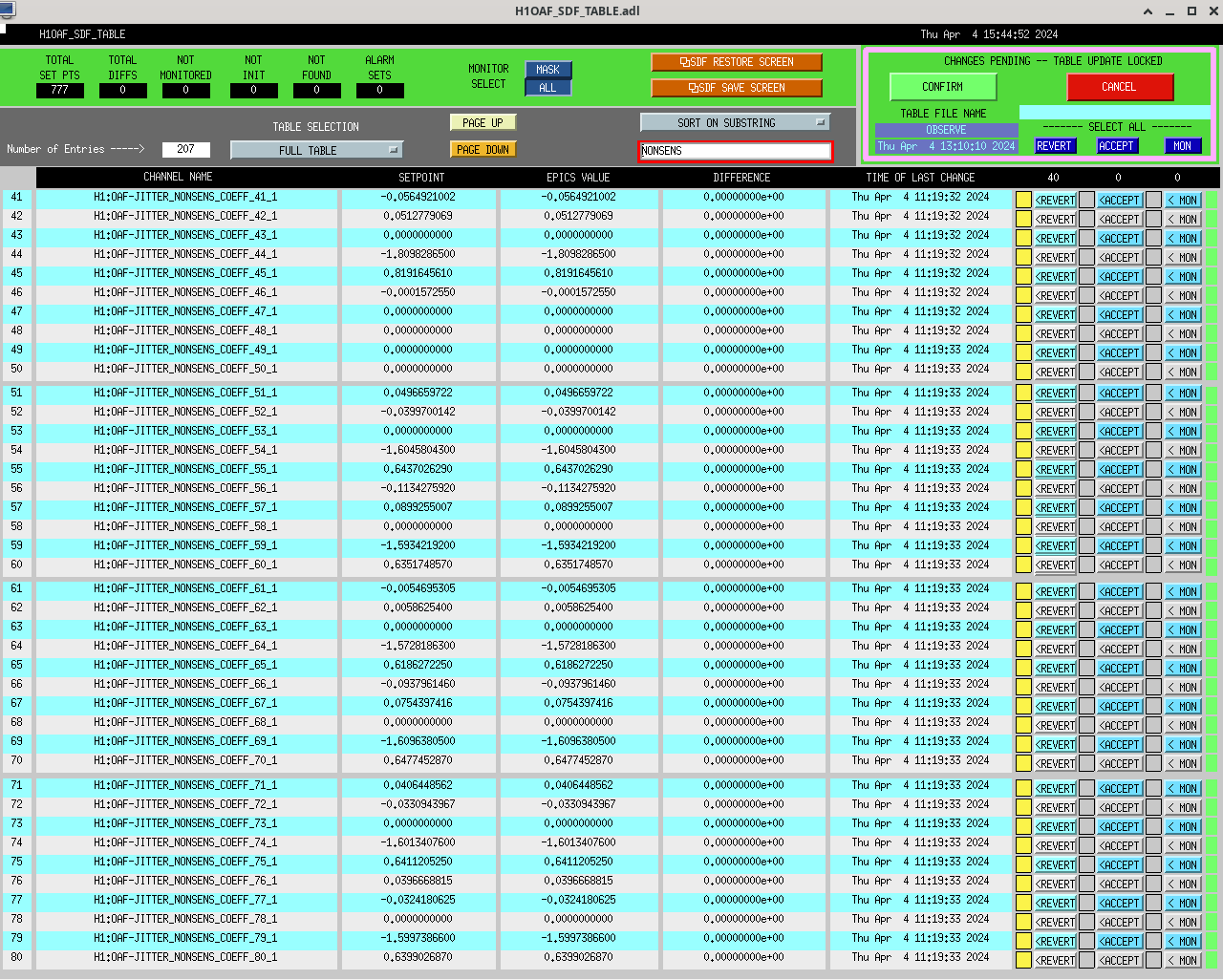
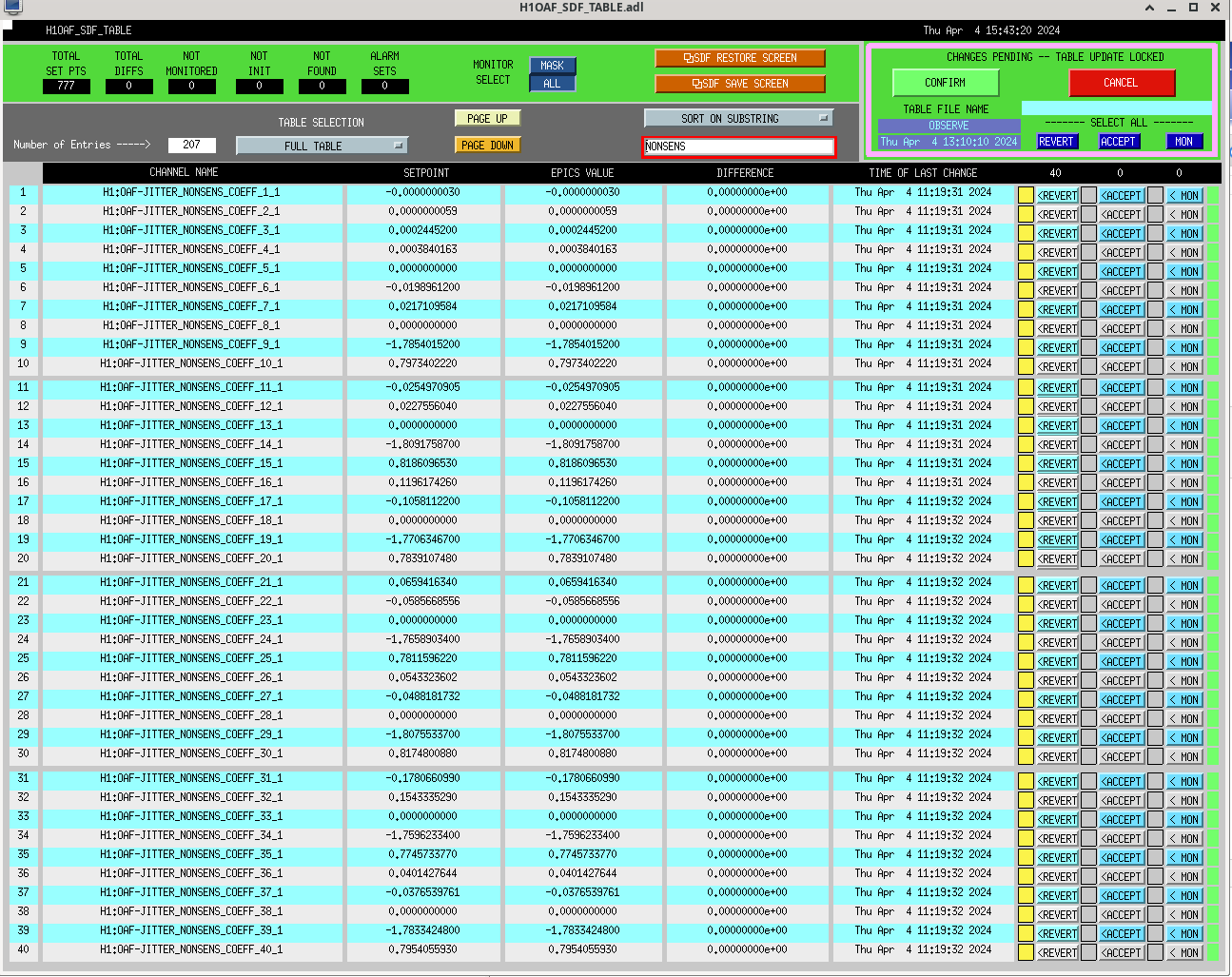
I pushed Jenne's updated cleaning but cannot check if this is better or worse until our problems getting data from nds2 are fixed.
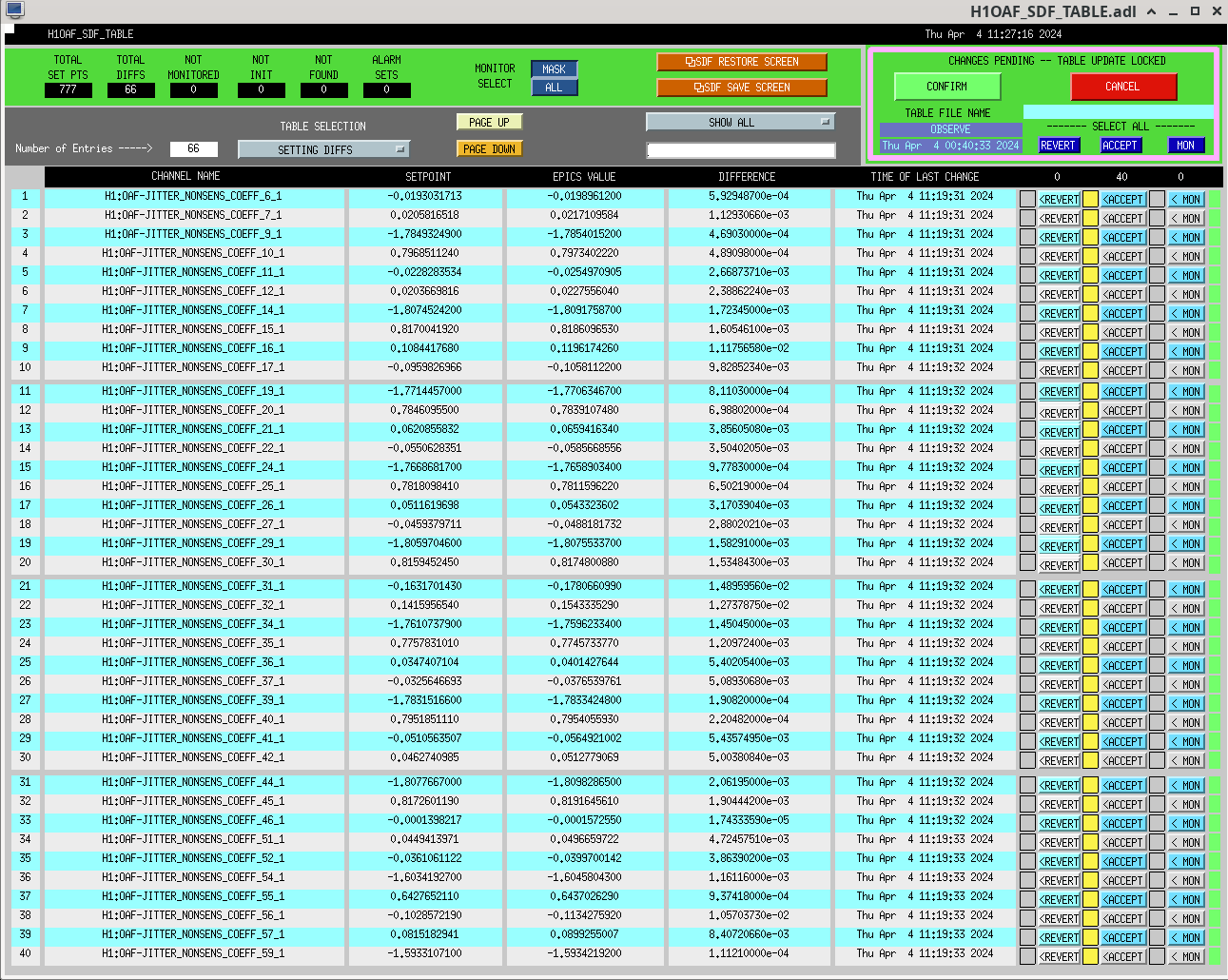
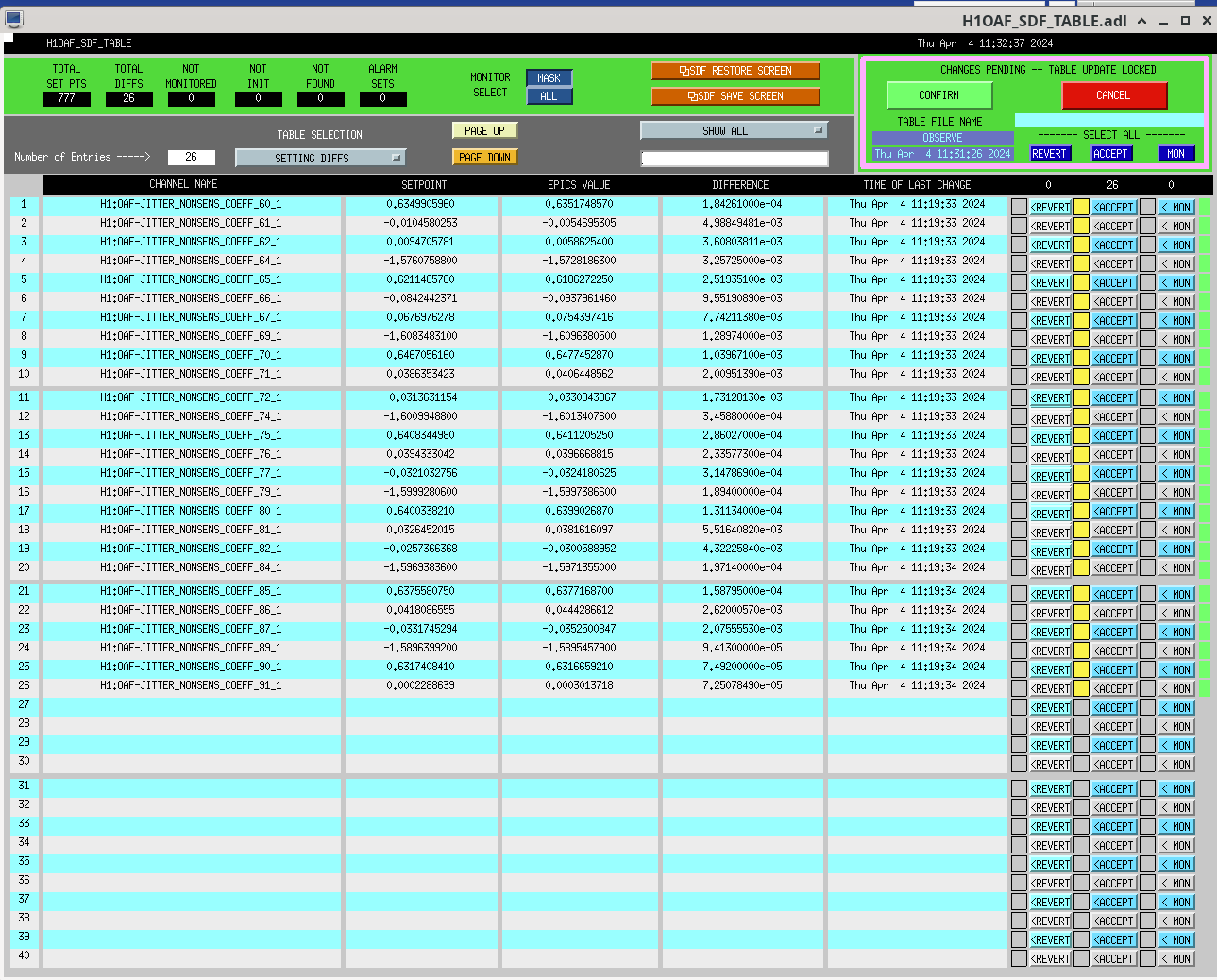
I ran the following:
cd /ligo/gitcommon/NoiseCleaning_O4/Frontend_NonSENS/lho-online-cleaning/Jitter/CoeffFilesToWriteToEPICS/ python3 Jitter_writeEPICS.py
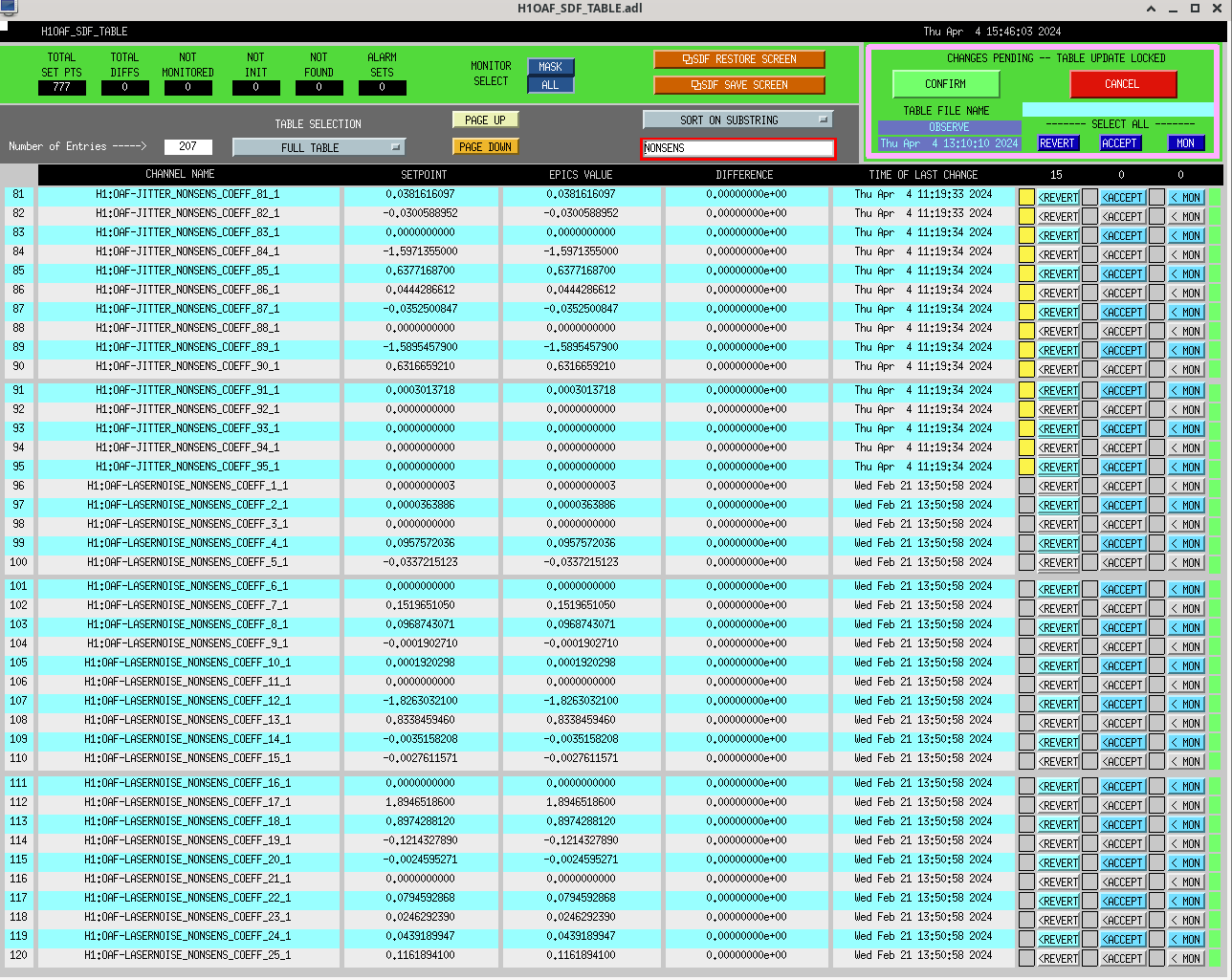
I accepted these DIFFS in OAF model in OBSERVE.snap but we might have to revert them before finish of the commissioning period today if we find out the cleaning is worse.
GPS 139627823 - 16 mins quiet time from last night.
11:12:41 UTC - 11:18:38 UTC quiet time just before cleaning implemented.
11:19:55 UTC new cleaning drops.
11:31:30 UTC end of quiet time.
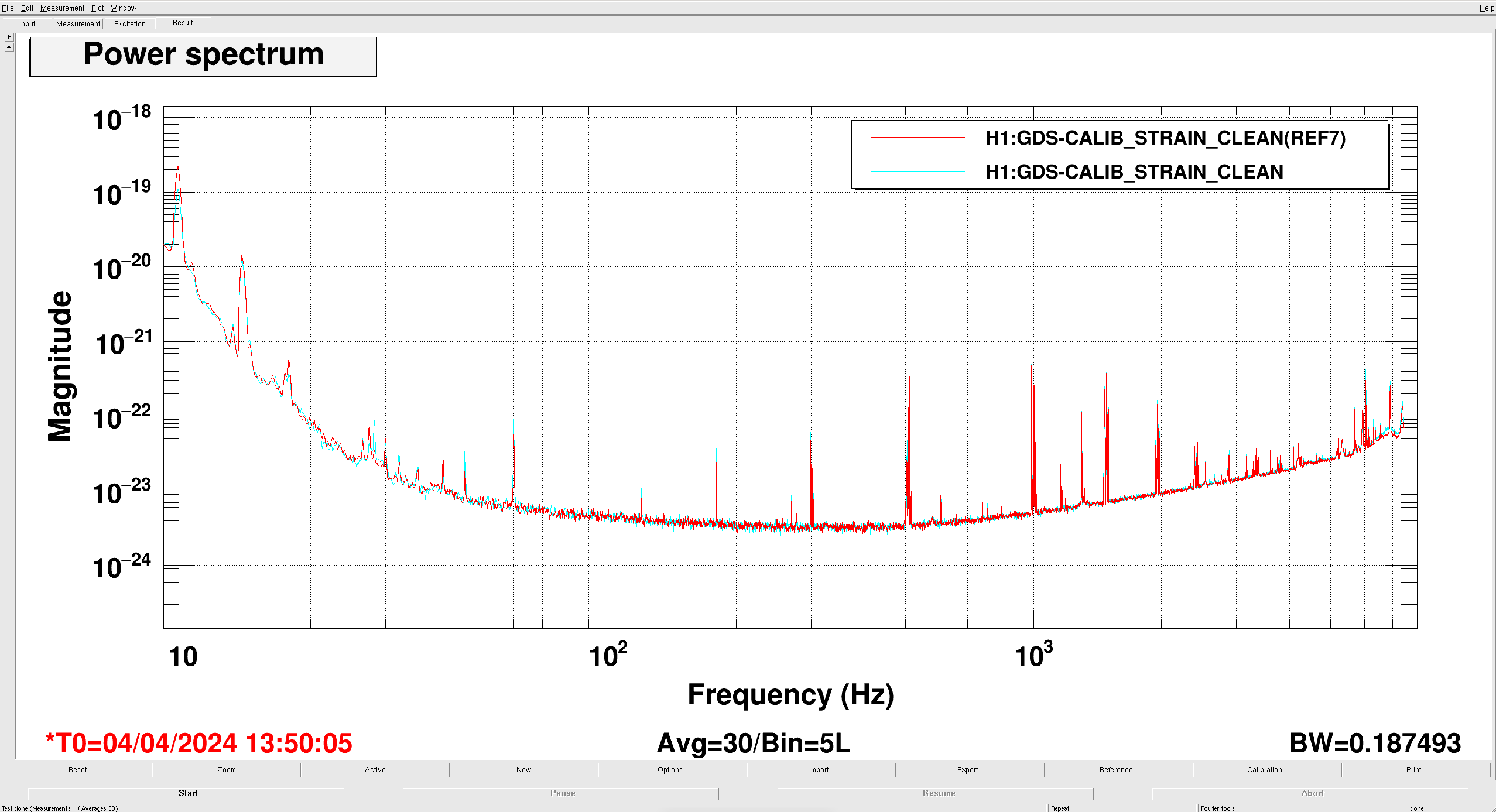
I took the following jitter comparison measurements
Old Cleaning quiet time: 11:19:55 UTC 0404/2024 light blue
New cleaning quiet time: 13:50:05 UTC 04/04/2024 red
Its hard to tell if new cleaning is better and I have reverted the coefficients in OBSERVE.snap to what they were this morning.
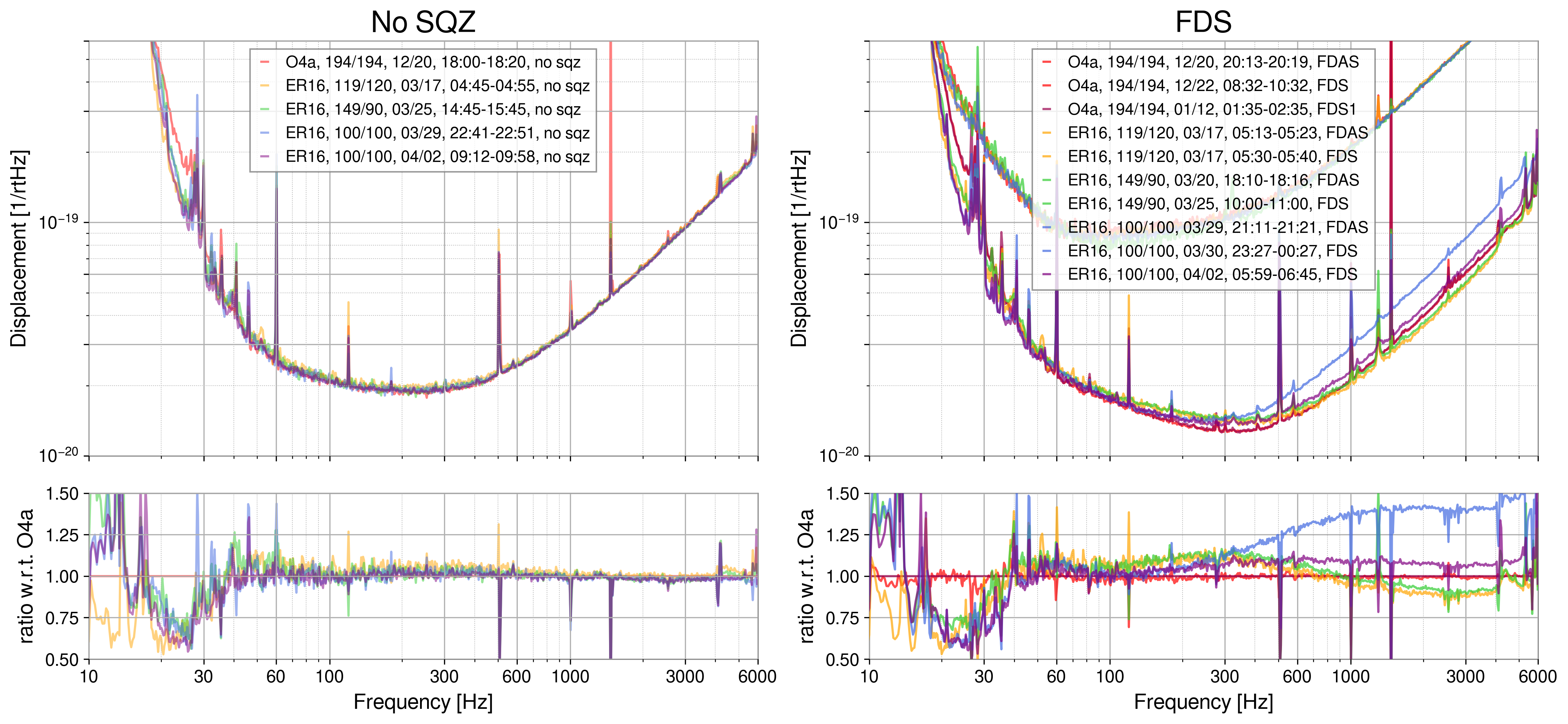
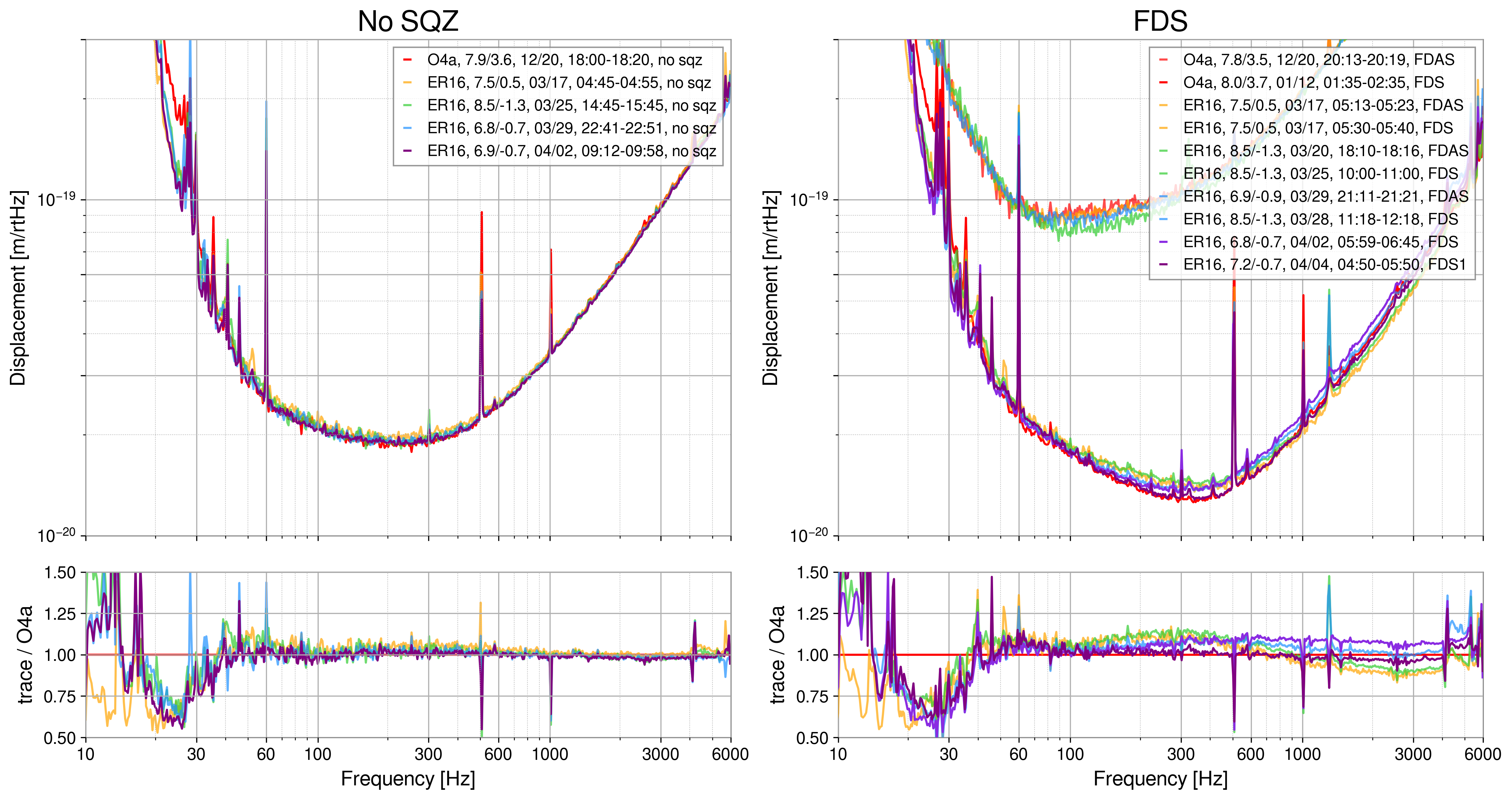
Attachment 1 - Unsqueezed (left) vs. squeezed (right) DARMs in ER16, with respect to O4a. Like Gabriele's plots, the ratios on the bottom show a given trace / O4a reference, so ratio > 1 means more noise now than O4a.
Colors: Rainbow colors are ordered past to present: e.g. Red = O4a, ... Purple = now.
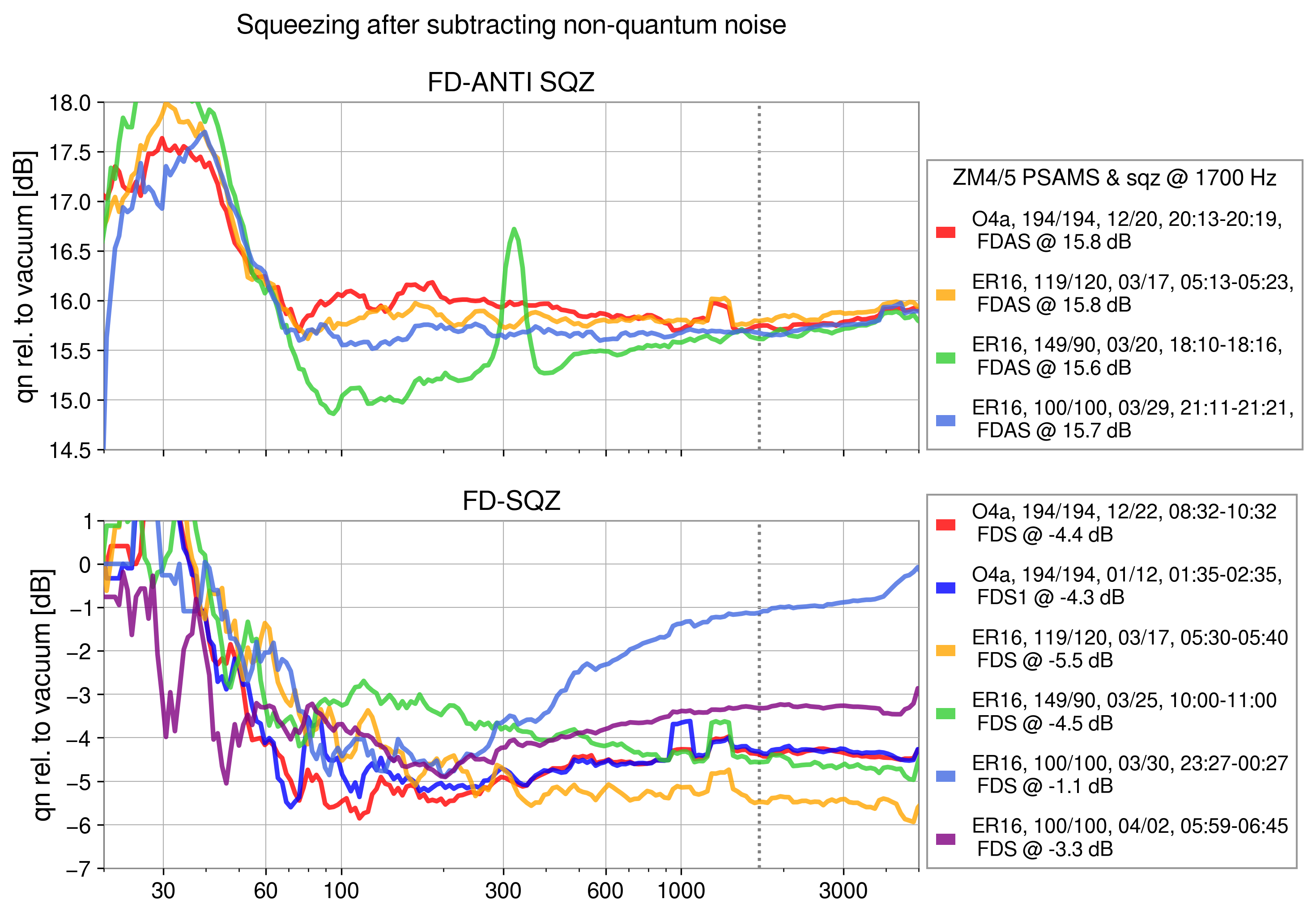
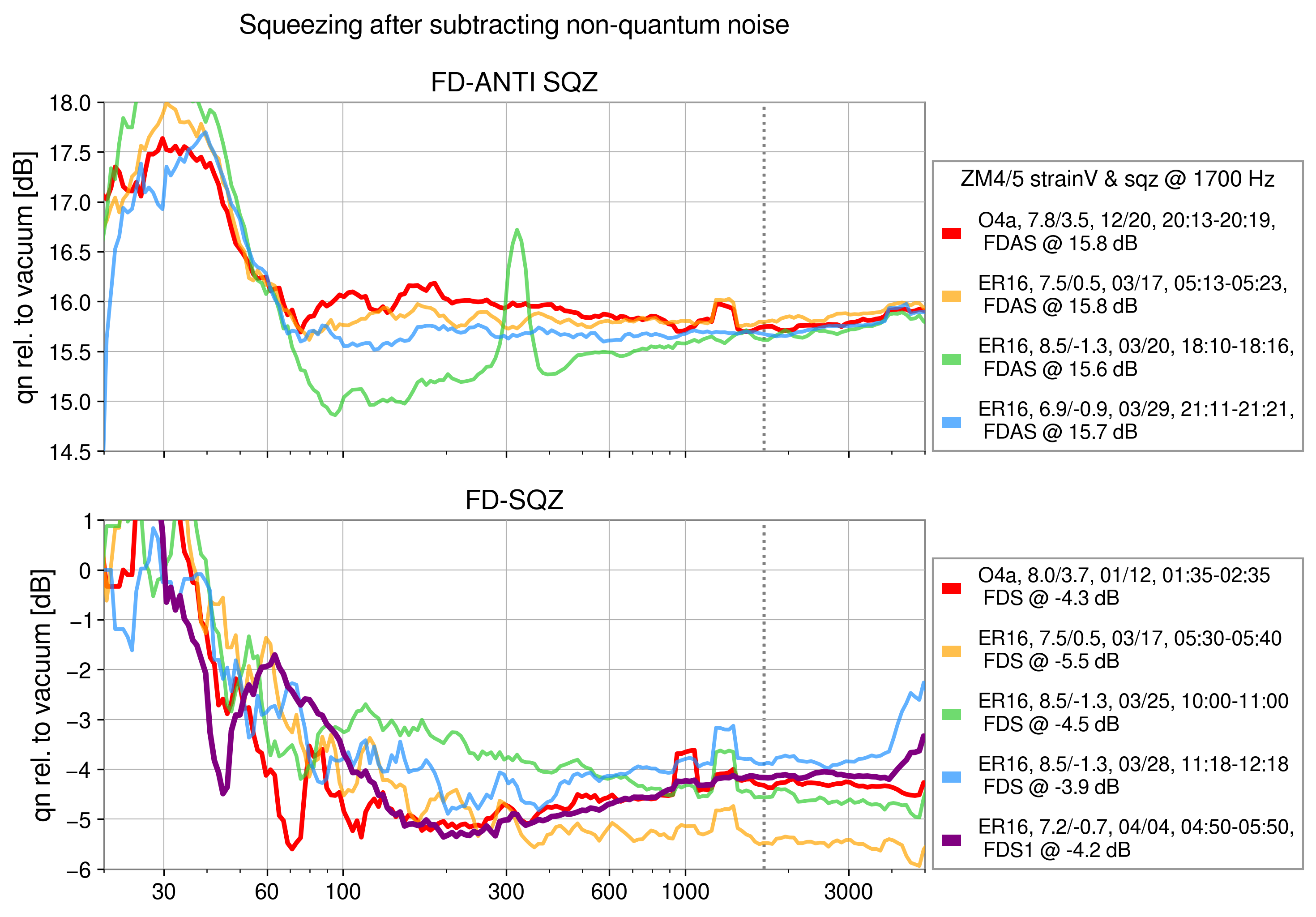
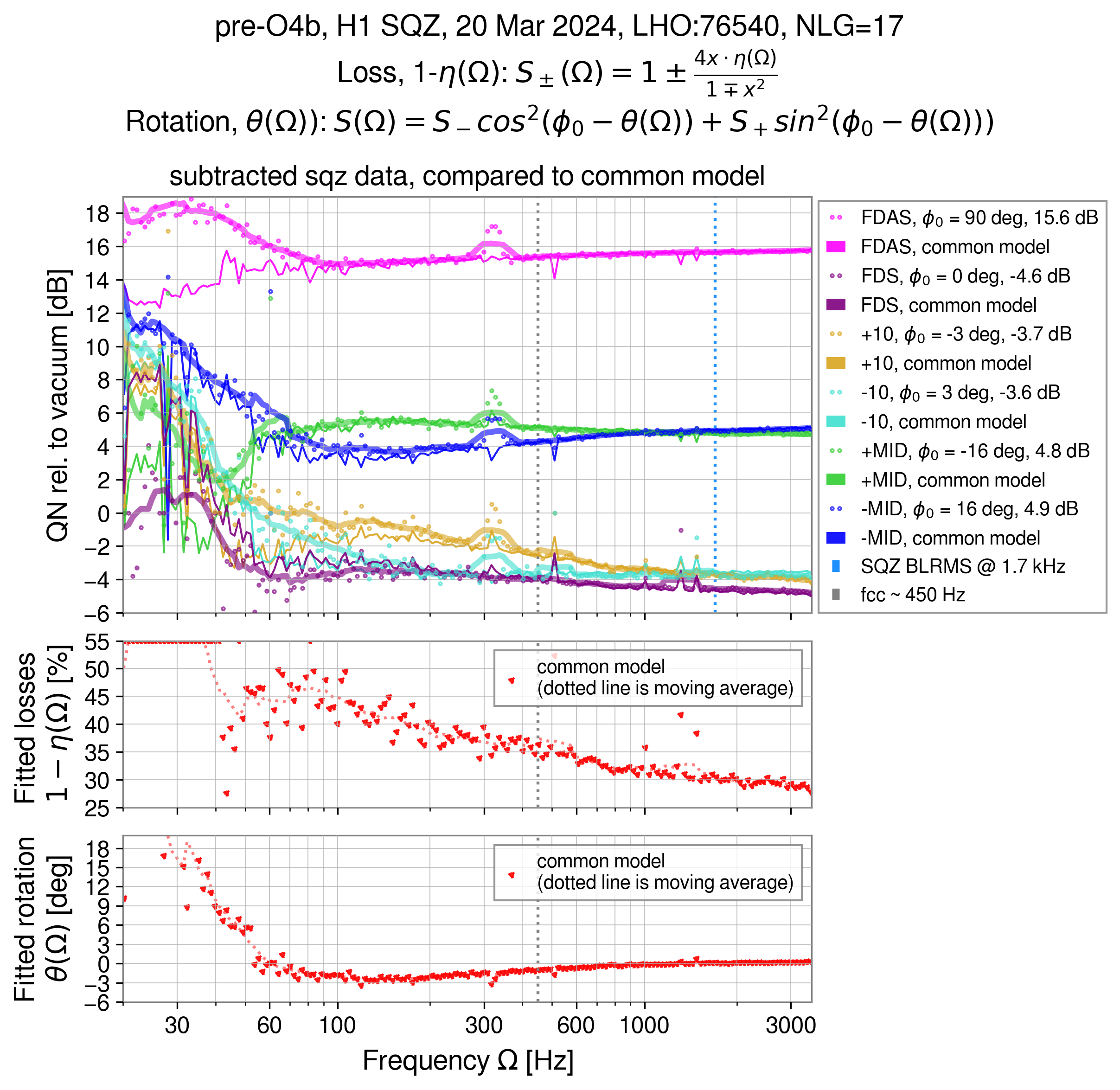
Attachment 2 - SQZ dBs after subtracting non-quantum noise, with various recent PSAMS settings. Upper subplot: Anti-SQZ, Lower subplot: SQZ. Lines are a moving average of the data. Some caveats for the subtraction: here I am using the same H1 unsqueezed quantum noise model for all subtractions; this may not be the most accurate, but I think it should be fairly close.
Reference alogs wth times that I used to grab GDS_STRAIN_CLEAN:
Adding FDS times from the DARM comparison in 76955, and only including times with sqz/no-sqz comparable to those recent darm comparisons.
Attachment 1 - Unsqueezed (left) vs. squeezed (right) DARMs in ER16, with respect to O4a. Like Gabriele's plots, the ratios are trace / O4a reference, so ratio > 1 means more noise now than O4a.
Attachment 2 - SQZ dBs after subtracting non-quantum noise. Analysis with non-quantum noise subtraction for this week's PSAMS data in 76925 and 76949 ongoing.
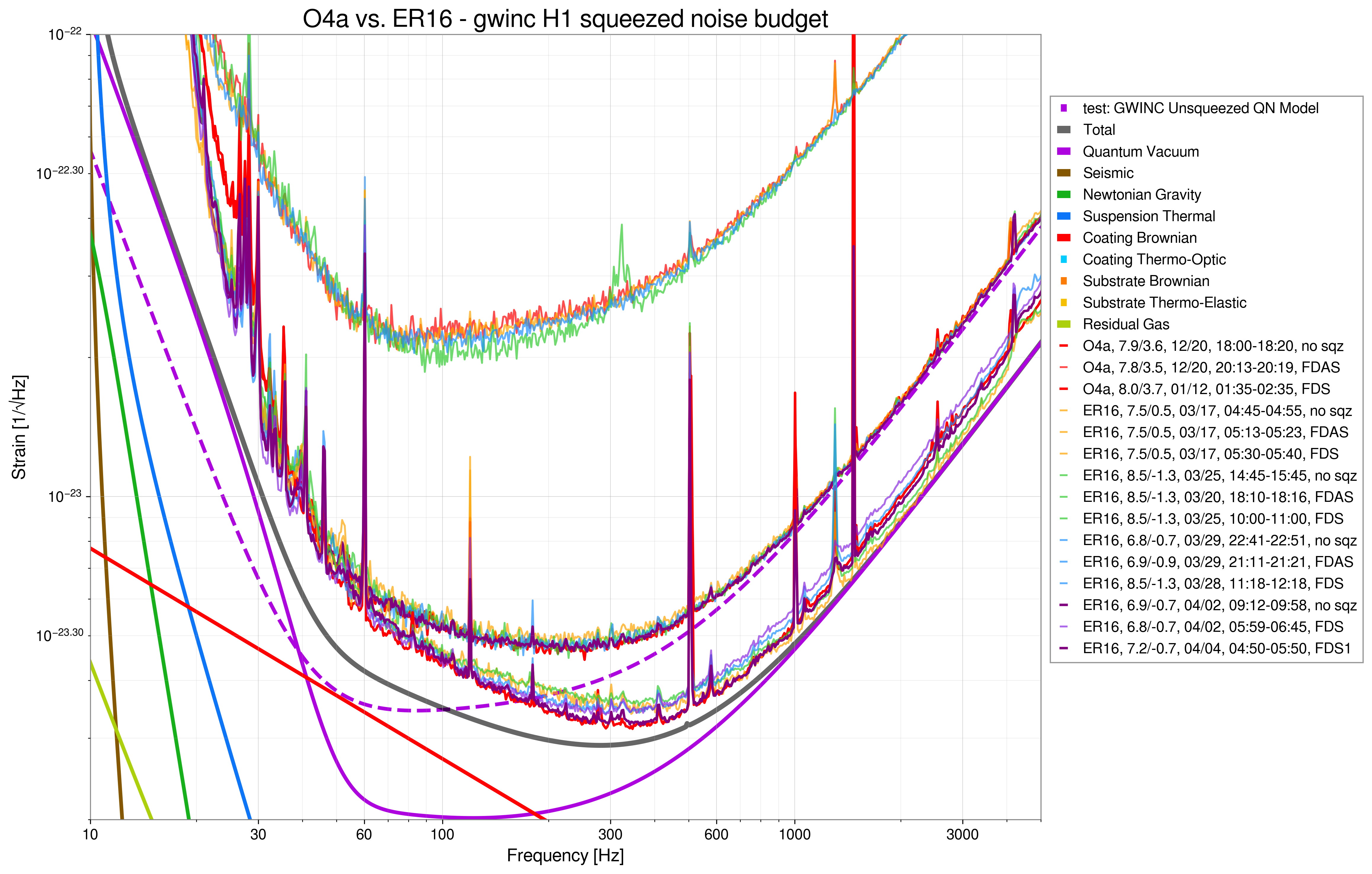
Attachment 3 - Comparison to a very basic gwinc noise model (pulled from H1 NB) for squeezed darm. For example the dashed purple "Unsqueezed QN model" is (almost) what I am using for subtracting non-quantum noises.
Colors are rainbow-ordered time-wise. Red = O4a reference. Purple = 4/4 times from 76955 for FDS DARM comparisons.
Note: here the PSAMS settings are referenced in terms of strain voltages. Just pointing out that LLO has a guardian to servo PSAMS voltage to meet the "_TARGET" strain gauge voltage LLO:63403.
Reference alogs wth times used to grab GDS_STRAIN_CLEAN: