Displaying reports 14581-14600 of 87917.Go to page Start 726 727 728 729 730 731 732 733 734 End
Reports until 10:34, Wednesday 24 January 2024
LHO VE
david.barker@LIGO.ORG - posted 10:34, Wednesday 24 January 2024 (75539)
Wed CP1 Fill

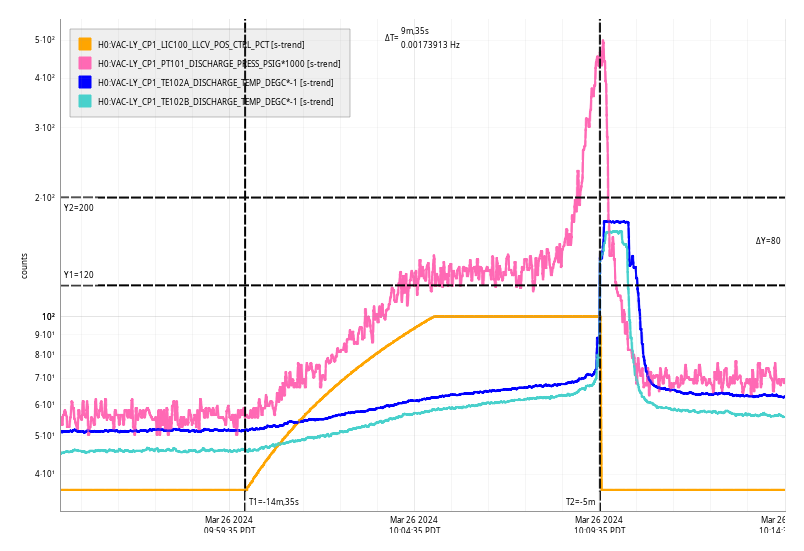
Wed Jan 24 10:05:46 2024 INFO: Fill completed in 5min 43secs

Images attached to this report
H1 SQZ
daniel.sigg@LIGO.ORG - posted 10:04, Wednesday 24 January 2024 - last comment - 11:34, Thursday 25 January 2024(75537)
SQZ PMC work

Naoki Vicky Daniel

We physically placed the PMC, the RF photodetector, and a bunch of steering mirrors into the empty space on SQZT0. Everything seems to fit as planned. No beams yet!

We also installed the Thorlabs PDA100A that serves as the PMC_TRANS monitor. It is installed along the seed path. There is a 50:50 splitter that reduces the seed power by 2. We installed a one-side AR coated wedge in the path of the beam dump to get about 19mW of light that we steered onto the PDA100A.

The slow controls system was upgraded to add new channels associated with the PMC and update some channels names. There is no longer a FIBR_REJECTED PD, instead we added a FIBR_INPUT PD that monitors the fiber power from squeezer laser in the beat note box.We no longer have a monitor for light in the wrong polarization at the laser locking beat note. Instead, we have to use the beat note strength to optmize the input polarization.

Comments related to this report
victoriaa.xu@LIGO.ORG - 13:38, Wednesday 24 January 2024 (75546)

Some photos here. Here is the PMC TRANS PD path and aligment, including the beam dumps. Here's a photo of PMC + RFPD fitting into the table, to-be aligned afterwards. The SHG beam path clears the back of the PMC, so that's good.
Images attached to this comment
victoriaa.xu@LIGO.ORG - 13:41, Wednesday 24 January 2024 (75547)

We also installed a longpass filter onto the SEED_LAUNCH_PD (FEL0850, cuts-on above 850nm), so we can now open the SQZT0 table lights without changing the measured seed launch power.

daniel.sigg@LIGO.ORG - 11:34, Thursday 25 January 2024 (75556)

Updated medm

Images attached to this comment
H1 ISC (ISC, SQZ)
marc.pirello@LIGO.ORG - posted 09:39, Wednesday 24 January 2024 (75536)
ISC-SQZ-SC Kepco Power Supply replaced

Per WP11624 replaced the squeezer slow controls Kepco power supply due to issues had with it in ALOG75331.

Old Kepco Serial Number = S1201988

New Kepco Serial Number = S1201903

Temperature and airflow measurements in new supply are similar to the old supply.  I suspect the thermal cutoff on the old supply is not functioning correctly.

H1 SEI (SEI)
corey.gray@LIGO.ORG - posted 08:55, Wednesday 24 January 2024 (75535)
H1 BSC/HAM ISI CPS Sensor Noise Spectra Check (FAMIS task, #25975)

[Measurements attached]

FAMIS LINK:  25975

BSC CPS:  Received following from CPS script terminal output:

NOTE:  If one was to follow the above channel as an example, it would seem several other BSCs had CPS' with spectra similarly high by eye:

HAM CPS:  Looks good.

Non-image files attached to this report
LHO General
corey.gray@LIGO.ORG - posted 08:14, Wednesday 24 January 2024 (75533)
Wed EVE Ops Transition

TITLE: 01/24 Day Shift: 16:00-00:00 UTC (08:00-16:00 PST), all times posted in UTC
STATE of H1: Planned Engineering
OUTGOING OPERATOR: None
CURRENT ENVIRONMENT:
    SEI_ENV state: CALM
    Wind: 4mph Gusts, 2mph 5min avg
    Primary useism: 0.02 μm/s
    Secondary useism: 0.27 μm/s
QUICK SUMMARY:

H1 CAL
anthony.sanchez@LIGO.ORG - posted 23:32, Tuesday 23 January 2024 - last comment - 23:35, Tuesday 23 January 2024(75528)
PCAL EY End Station Measurement & Lab Measurements

Rick and I went to EndY to do the PCAL Tx module maintanence today.
We followed Mostly followed the procedure outlined in DCC doc T1600436-v11 which was printed out and attached to the ALOG.
I have also updated the PCALTxMaintenanceLogBook spreadsheet with the latest information from today's activity. This is information is now in the DCC with an updated version number.
Attached a picture of the OLTF taken with the SR785 .
And a beam spot with both beams after we were finished cleaning and measuring.

Images attached to this report
Non-image files attached to this report
Comments related to this report
anthony.sanchez@LIGO.ORG - 23:35, Tuesday 23 January 2024 (75530)

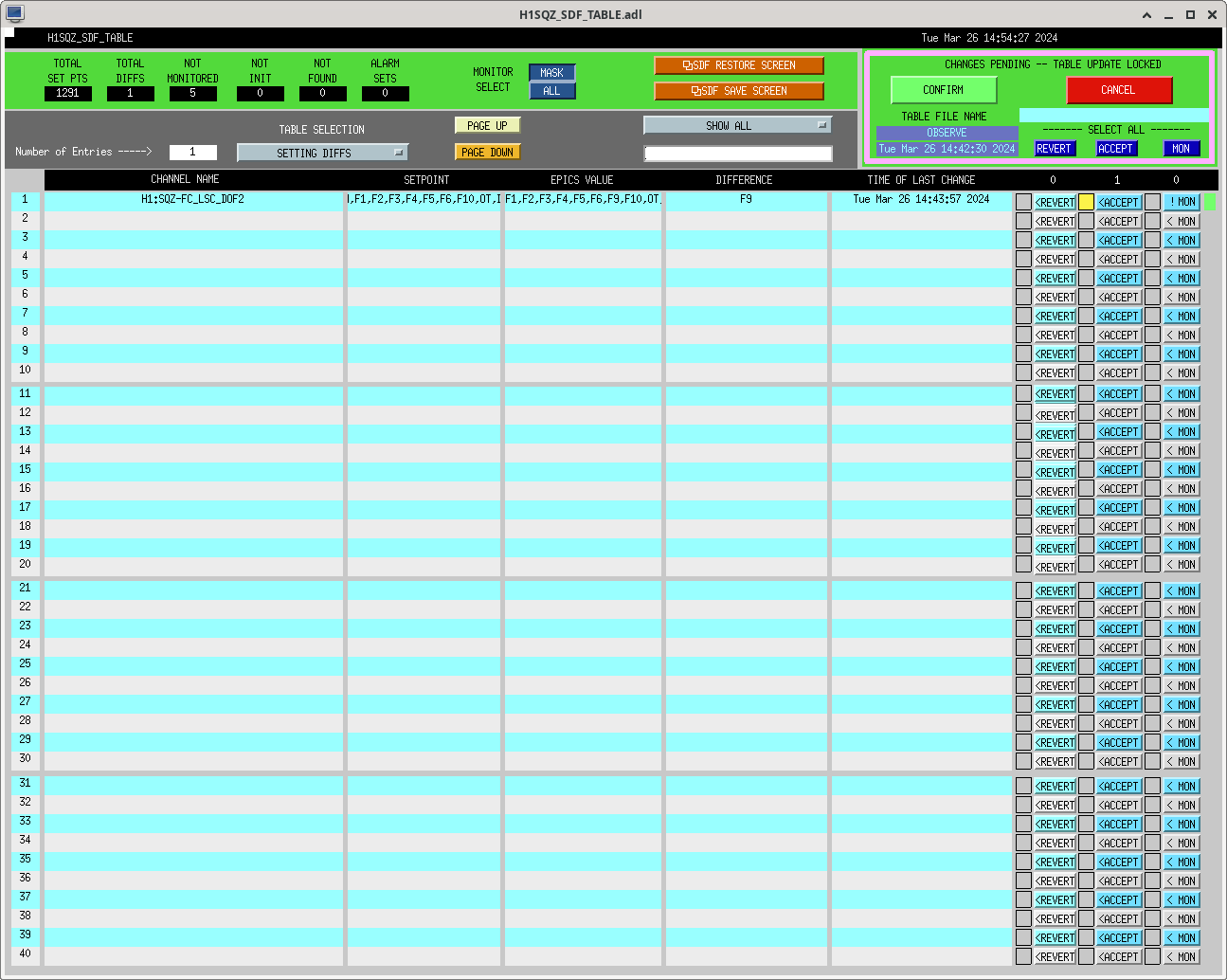
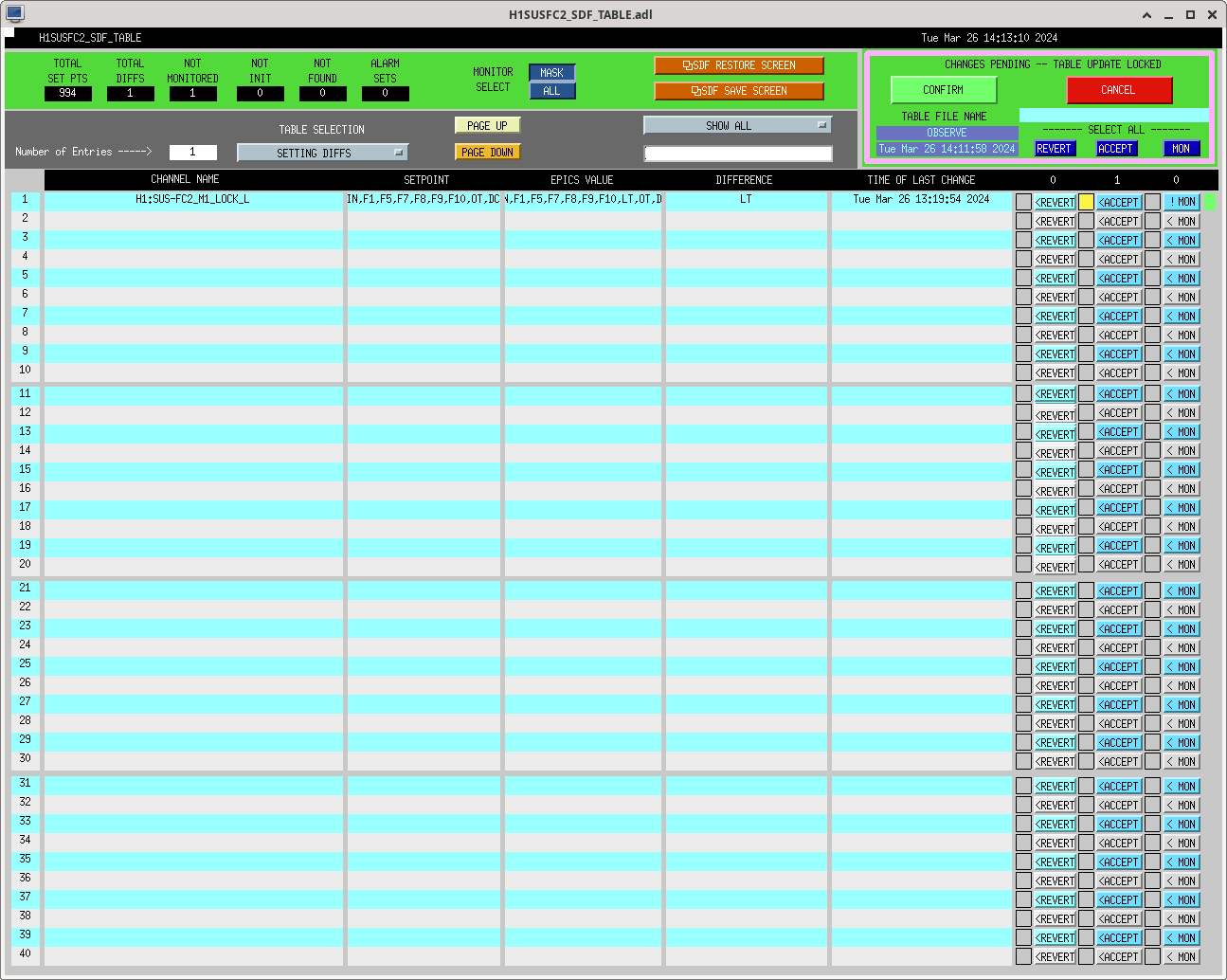
Accepted todays OFS PD offset and OFS Gain settings in the SDF Diffs as well.

Images attached to this comment
H1 ISC (SUS)
koji.arai@LIGO.ORG - posted 23:30, Tuesday 23 January 2024 - last comment - 13:18, Wednesday 24 January 2024(75529)
Old OMC extracted / New OMC suspended in OMCS

[Rahul Betsy Keita Ali Koji]

The extraction of the old OMC (Unit #3) and installation of the new OMC (Unit #1) went exceptionally well.


= OMC Extraction =

Tuesday morning, we resumed HAM6 work from the OMC extraction.
Rahul and Koji went into the chamber. Rahul positioned close to HAM5, and Koji was on the other side.
They followed the extraction procedure (E1600164) after some rehearsals.

During the OMC extraction, assistance from two others was very effective in supporting wires from both HAM6 openings, preventing the wires from touching the OMC. (The procedure to be updated)
The extracted OMC was placed in the fixture on the ISI and moved back to the work table for further action.

= Balance Mass Migration =

Balancing masses were transferred from the previous OMC to the new one (Attachment 1). At the same time, a Viton ring and a 10g mass were added to each corner for the body mode damping (See T1700471).
The mass distribution differed from what Koji had figured out from the past unclear photos. But the masses could be fixed to the OMC using various 1/4-20 screws that were prepared for this.
Only light torque was applied to the fixing screws to avoid delamination/fracture of the mounting brackets below the mass mount.

= Final OMC cleaning =

All the optical surfaces were cleaned by FirstContact except for a couple of surfaces where the access was quite limited. (Attachment 2)

We let the FC paint dry during lunch and then resumed peeling them off, combined with discharging with Top Gun.
The surfaces were checked with a flashlight to find any residual.
A FC residual was located not on the optical surface but on the corner of a tombstone prism. It was cleaned with additional FC paint.

In parallel with the cleaning work, Ali and Keita worked on the review of DCPD-related cable shielding in HAM6.

= OMC Installation =

The reverse process of the extraction has been performed.

When inserting the clamps into the clamp hooks, sometimes incomplete mating happens due to friction between the copper cone and the frosted glass cup.
This can be fixed by pushing the clamp into the slit by a small flat-head driver, while the tension on the wire was released by lifting that side of the OMC.

= EQ stop release =

Reverse process of the OMCS mass clamping.

This made the OMC free. Rahul quickly checked the transfer functions of the OMCS as well as the damping control.

We decided to stop here. (Attachment 3)

Next Steps:

Images attached to this report
Comments related to this report
koji.arai@LIGO.ORG - 00:40, Wednesday 24 January 2024 (75531)

The attached PDF shows the previous and current balance mass configurations.

The highest mass has the height of 2 7/8" from the mating plane of the fixture, while the fixture has 3" clearance,
So we still could close the lid with the gap of 1/8".

Images attached to this comment
Non-image files attached to this comment
lisa.barsotti@LIGO.ORG - 07:59, Wednesday 24 January 2024 (75532)

Wonderful, CONGRATS!!!

betsy.weaver@LIGO.ORG - 10:37, Wednesday 24 January 2024 (75540)

Koji, Keita, and Rahul in HAM6.

Images attached to this comment
corey.gray@LIGO.ORG - 13:18, Wednesday 24 January 2024 (75544)EPO

Tagging EPO for photos 

H1 SQZ (ISC, SQZ)
victoriaa.xu@LIGO.ORG - posted 18:34, Tuesday 23 January 2024 - last comment - 15:33, Tuesday 30 January 2024(75509)
1/22 HAM7 - Found SQZ beam to place irises in HAM6/7 post-vent

[Julian, Naoki, Camilla, Sheila, Vicky]

Summary to get SQZ alignment beam: Launched 76mW into seed fiber, ~25 mW incident on opo cavity, ~0.85 mW transmitted through opo cavity. Had to find opo transmission past the VIP, for this we used green SK path as a reference. This ~0.85 mW opo transmission was bright on an IR card at the HAM5 gate valve, and enough to iris the SQZ beam in HAM7 and HAM6 (for OMC work 75512). DC 3/4 centering loops engaged easily, then OMC A/B QPD's saw the sqz beam.

----------- Notes from today ------------------------------------------

Launched power into SEED fiber (SQZT0): 76 mW

OPO IR REFL (CLF_TRIG_REFL_DC_POWERMON @ SQZT7): 24.8mW   (when opo is dither-locked).

Fiber rejected power PD in HAM7 (CLF_REFL_REJ) is 5.3 mW.
  -->  Seed fiber coupling: ~34% of the seed fiber launched power was incident on the opo cavity. 
  -->  40% coupling through fiber, ~6% mispolarized and rejected after fiber. This is similar to recent fiber alignment 75344, even after more recent on-table work 75486.

We had to find the OPO IR transmitted beam after the VIP. Nothing at first despite restoring suspensions 75502. Notes to self on what worked to find the SQZ beam post-vent:

OPO IR TRANS (OPO_IR_PD_DC_POWERMON @ SQZT7): 0.85 mW  -- Just before opening the HAM7/5 gate valves. Opened the beam diverter, SQZ beam was bright on an IR card held at the HAM5 gate valve.

After opening gate valve, immediately saw the beam on AS A/B/C QPDs.

ASC-AS_A/B_DC_SUM_OUTPUT ~ 60.  ASC-AS_C_NSUM_OUT16 ~ 0.65-0.67.  

HAM6 crew irising SQZ beam, 75512.

HAM7 crew irising SQZ beam. Julian has some photos of HAM6 and HAM7 irses. Sheila -- looks like there is some clipping on the VIP (we have not totally optimized FC_REFL path slider alignments post-vent, just found the beam). Revisit this FC REFL alignment later.

Engaged DC 3/4 centering. It just worked. Control signals near 0. 

We see the beam on the OMC QPD's, power is consistent with ASC-AS_C power, around 300-400e-6 on each OMC QPD A/B. Power goes away when SQZ beam diverter is closed. See omc powers screenshot with as_wfs powers.

TO-DO SQZ work later:

Images attached to this report
Comments related to this report
corey.gray@LIGO.ORG - 08:09, Tuesday 23 January 2024 (75516)EPO

tagging for EPO

camilla.compton@LIGO.ORG - 09:30, Tuesday 23 January 2024 (75517)SUS

Accepted ZM1,2,3,4,5,6, FC1,2 OPTICALIGN sliders in sdf. Attached is the photo so we'll know where to bring them back to after pumpdown.

ZM4,5,6 are not monitored - should remember why that is....

Images attached to this comment
victoriaa.xu@LIGO.ORG - 18:48, Tuesday 23 January 2024 (75527)

Camilla, Naoki, Vicky

Next day 1/23, we tried to help check OMC alignment, but after turning the SQZ laser back on, we didn't find the beam past the VIP at first.

To re-find the sqz beam, we had to move FC1 quite a bit (pitch slider by 100 counts, yaw slider by 65 counts). See FC1 SDF's of today's move, compared to what Camilla just accepted in SDF after we first found the beam yesterday 75517.

Naoki checked FC1 and ZM1-2-3-4-5-6 SUS, and did not see any anomolous movements of the optics.

We left FC1 with an alignment that maximizes signal on both HAM7 FC WFS (RLF QPD's). Both QPD's are now saturated with 75mW into the fiber. With 5mW into the fiber to un-saturate, both QPD's are close-ish to centered.

Hopefully this is enough to use AS A/B WFS centering tomorrow. Today when we tried it, DC3 worked, but DC4 railed as the beam wasn't hitting AS_B well.

Images attached to this comment
victoriaa.xu@LIGO.ORG - 11:05, Wednesday 24 January 2024 (75542)

Sheila, Camilla, Vicky

We re-found the SQZ beam in HAM6 this morning after opening the ham5 gate valve. Steps taken this morning 1/24, after yesterday using FC1 to align onto the HAM7 FC WFS QPD's:

  • With TTFSS locked, 75mW launched into seed fiber, brought SQZ_MANAGER to LOCKED_SEED_DITHER
  • Watch using opo-ir-dither-locking scope to make sure OPO dither locked properly on red. Can check OPO IR REFL locks at its aminimum (see H1:SQZ-CLF_TRIG_DC_POWERMON, or SHUTTER_I_TRIGGER on the opo-ir-dither scope, successful dither lock example here).
  • Check there is power on the HAM7 FC WFS QPD's. When aligned to OMC, we've been saturating RLF_QPD_A, and ~40-70 on RLF_QPD_B.
  • Open HAM7 SQZ beam diverter
  • Open HAM6 Fast shutter
  • (check AS WFS DC centering is off, check that suspension histories on OM1,2 are clear)
  • Use ZM5 P/Y to align onto AS_C, AS_A, AS_B
  • If beam is hitting AS_A/B, the AS_WFS_P/Y_INMON input signals should all be < 1.  When the beam was missing AS_A/B, their WFS_P/Y_INMON signals were ~1e6. Once the beam start to hit QPD's, INMONs were < 1.
  • With the beam hitting AS_WFS, turn on inputs for DC3/4 WFS centering, control signals ~ 0.
Images attached to this comment
victoriaa.xu@LIGO.ORG - 13:52, Wednesday 24 January 2024 (75545)

For convenience while vented, I made the following guardian changes so far:

  • SQZ_MANAGER -- these changes can be reverted post-break
    • "LOCKED_SEED_DITHER" is now requestable from drop-down menu -- Line 597 -- change back later
    • "DOWN" no longer closes squeezer beam diverter -- commented out Line 213 -- change back / re-evaluate later
  • SQZ_OPO_LR: trying to improve dither lock's lockless detection -- keep these changes

All guardian edits (+sqz angle servo flag in sqzparams.py) commited to svn revision 27088.

camilla.compton@LIGO.ORG - 15:33, Tuesday 30 January 2024 (75635)

Attached Julian's photos of the iris locations on HAM6 and HAM7. 

Images attached to this comment
LHO VE
janos.csizmazia@LIGO.ORG - posted 17:29, Tuesday 23 January 2024 - last comment - 16:10, Friday 26 January 2024(75526)
1-23 vent vacuum diary
Today's activities:
- The RGA tree at EX was leak-checked, and multiple flanges were leaky, possibly because of some overheating during a bakeout in the past. The gaskets will be redone, and the all-metal angle valve will be also replaced
- EX was vented
- The VPW vacuum chamber was opened, after the 2 stuck screw was removed
- Both 2 spare roughing stations are entirely finished
- All the Hepta header filter works were finished in the LVEA
Comments related to this report
gerardo.moreno@LIGO.ORG - 16:10, Friday 26 January 2024 (75591)VE

Measured the purge air dew point at the corner station with no usage from other groups, no people in chamber, measured -41.3 degrees C.

Measured the purge air dew point at EX, no open ports, before vent, measurement was done at the purge valve area, measured -45.4 degrees C.

Images attached to this comment
LHO General
corey.gray@LIGO.ORG - posted 16:04, Tuesday 23 January 2024 (75515)
Tues DAY Ops Summary 17:01UTC Keita into LVEA - HAM6 OMC swap

TITLE: 01/23 Day Shift: 16:00-00:00 UTC (08:00-16:00 PST), all times posted in UTC
STATE of H1: Planned Engineering
INCOMING OPERATOR: None
SHIFT SUMMARY:

LOG:

H1 CDS
filiberto.clara@LIGO.ORG - posted 14:02, Tuesday 23 January 2024 (75524)
EX High Voltage Powered Off

WP 11645
Procedure M1300464

The following high voltage power supplies/electronics were powered off in preparation for the EX vent.

1. EX ESD HV and Low Voltage Chassis
2. EX Ring Heater

F. Clara, G. Moreno

LHO VE
janos.csizmazia@LIGO.ORG - posted 11:29, Tuesday 23 January 2024 (75523)
1-22 vent vacuum diary
Late entry. Activities on Jan 22nd:
- The HAM7 X+ and X- doors have been removed
- The purge air was switched on at EX
- GV20 (at EX) was closed - the GV struggled with closing, but in the end it seems to be OK
- Electrically 1, mechanically both 2 spare roughing stations are finished
- VPW C+B door issue - 2 screws stuck, tomorrow will open it: this load has some blanks and new Hepta headers, which will be also needed
H1 CDS
david.barker@LIGO.ORG - posted 10:56, Tuesday 23 January 2024 (75522)
DAQ restart

At 10:33 the DAQ 0-leg was restarted, followed at 10:38 by the 1-leg. The DAQ restart was for two EDC changes: Daniel's new slow controls CS_SQZ channels and Patrick's additional FMCS channels.

The EDC was restarted at 10:33.

A new SQZ SDF monitor.req file was installed the and h1syscssqzsdf service was restarted.

H1 SQZ
daniel.sigg@LIGO.ORG - posted 20:40, Saturday 20 January 2024 - last comment - 17:01, Tuesday 23 January 2024(75486)
New Beat Note Path for Laser Locking Installed

Vicky Daniel

Today we swapped the beamsplitter in the squeezer laser path that transmits a sample beam to the IR PD (which monitors the laser power). The old splitter was 98:2 for p-polarization and transmitted about 0.1% in s-polarization. We replaced it with a 98:2 meant for s-polarization that transmitted just shy of 1%. After a turning mirror, another 50:50 splitter was installed. The transmitted beam is used for the IR PD, whereas the reflected beam passes through a half wave plate, a polarizing beam splitter, a quarter and a half waveplate, and two additional turning mirrors into a fiber coupler. The other end of the fiber was connected to the squeezer laser input of the fiber beat note box. We also moved the fiber PSL sample beam from the table feedthrough to the PSL input of the fiber beat note box. This allowed us to lock the TTFSS with the new setup.

A slight realignment was required for the CLF, seed and SHG paths. The power coupled into these fibers came back to near the values where they were.

The channels H1:SQZ-FIBR_TRANS_DC and H1:SQZ_FIBR_REJECTED_DC are now monitoring the power in the fibers of the PSL and squeezer lasers, respectively.

The squeezer laser has been turned off and locked out again after the work was finished.

Comments related to this report
daniel.sigg@LIGO.ORG - 20:44, Saturday 20 January 2024 (75487)

The power out of the PSL fiber was measured to be 0.925mW. The DC readback of the 1611 then read 785mV. The DC readback is not recorded at the moment. This requires a slow controls software update.
daniel.sigg@LIGO.ORG - 20:47, Saturday 20 January 2024 (75488)

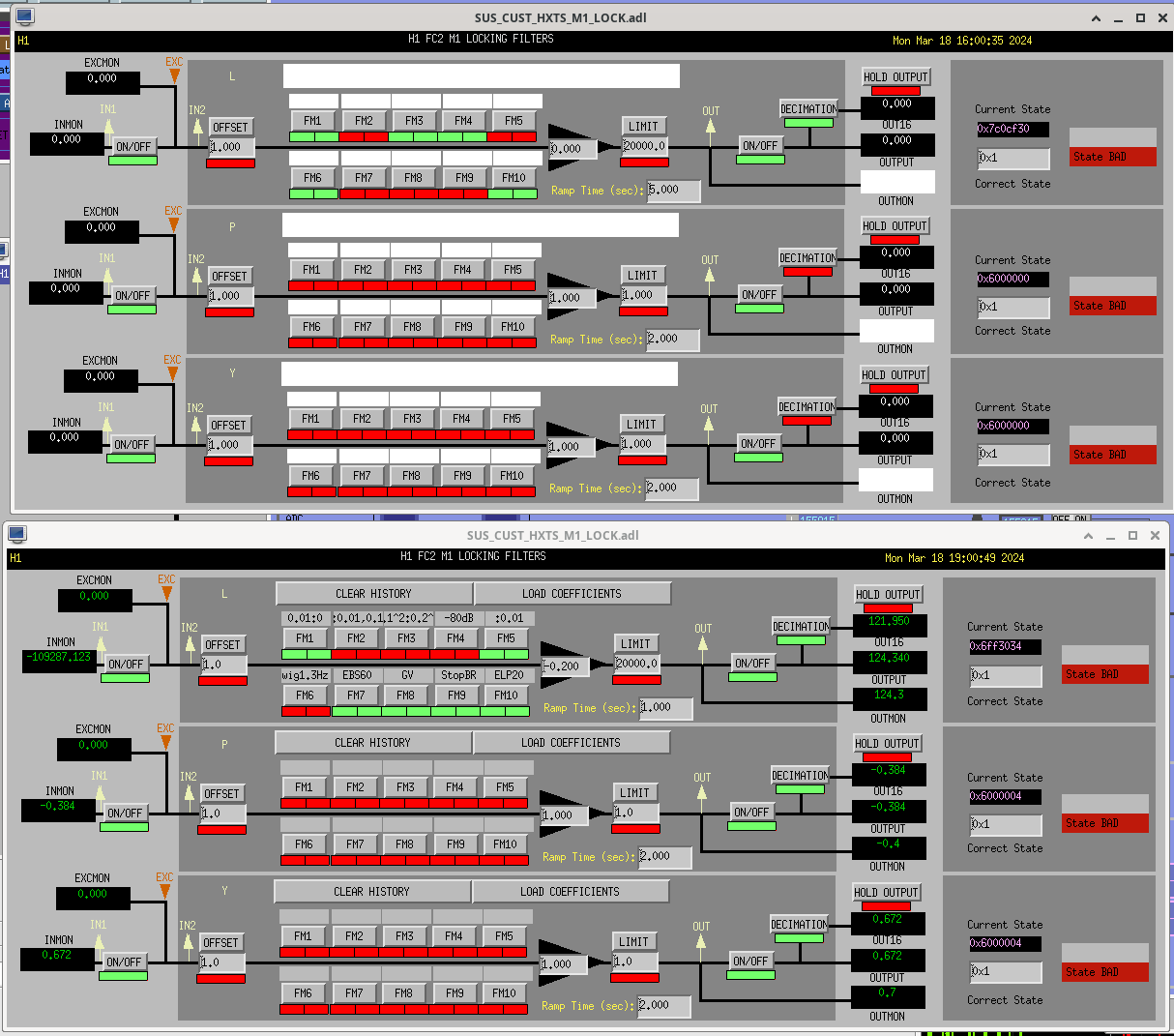
The IR PD had to be recalibrated:

  • We removed a gain of 10 from the generic PD interface box.
  • We reduced the gain setting on the PDA100A from 20dB to 10dB.
  • This required a change of the transimpedance gain from 15000 to 4750 Ohms.
  • The splitting ratio was adjusted from 0.09 to 0.42.
  • And the DC offset was set to 0.0065.
victoriaa.xu@LIGO.ORG - 22:31, Saturday 20 January 2024 (75490)

Following the plan in T2300300, here are some photos of the fiber TTFSS path we installed today, with the path and powers labelled and with the path lengths marked, to update H1's SQZT0 optical layout D1201210.

We took the pico waveplates from free-space TTFSS for this fiber TTFSS path, and got the 160 MHz SQZ-PSL beatnote power up to 3.6. In observe, it was ~2, so this beatnote is usable for locking.

To-do later - improve this fiber coupling, currently it is only ~30-40% with some variation between fibers. Moving the lens and collimator +/- 1 inch from design only changed the fiber coupling by a few %, so different lenses might be needed. Can revisit this fiber coupling later.

Images attached to this comment
daniel.sigg@LIGO.ORG - 17:01, Tuesday 23 January 2024 (75525)

Currently we have

  • PSL fiber input (SQZ-FIBR_TRANS_DC): 0.81mW which results in ~0.12mW on the 1611.
  • Squeezer laser fiber input (SQZ_FIBR_INPUT_DC): 0.97mW which results in ~0.10mW on the 1611.
  • The RF beat note then becomes 4.9dBm.
H1 SQZ
sheila.dwyer@LIGO.ORG - posted 15:40, Wednesday 20 December 2023 - last comment - 12:12, Tuesday 23 January 2024(74935)
SQZ data taking with OM2 cold

Camilla, Naoki, Sheila, Nutsinee

We did a repeat of the measurement set from 73621 with OM2 cold.  For a summary, Camilla's plot shows 200V/200V PSAMs setting with solid lines and 120V/120V as dashed lines. There is a stronger frequency dependence for the 120V/120V settings, which confirms what we saw with OM2 hot, that 200V/200V has better mode matching and less frequency dependent SQZ rotation. (This plot is a direct comparison to October's data. )

The third attachment is a plot that shows that the squeezing angle that maximizes the squeezing at 2kHz is not the same as the one that maximizes the squeezing at 200Hz, (green traces are optimized for 2kHz, blue traces are optimized for 200Hz, solid is 200V/200V and dashed is 120V/120V), you can see that the frequency dependence is larger for 120V/120V.

The fith attachment compares OM2 hot vs OM2 cold for antisqueeze and squeezing, with PSAMS at 200V/200V.  There is less anti-squeezing with OM2 hot, which could be due to a difference in nonlinear gain or reduced readout losses.  The green traces show that the squeezing level is similar, although the no sqz spectra is also different between the two times. 

times:

Since our ASQZ with PSAMS 200/200 was a little lower than with 120/120, and that seemed inconsistent with our sqz data and our previous measurement with OM2 hot, we went back to SQZ with PSAMS 200/200, ran ASC then turned it off, and checked the sqz angle carefully. This did give a little more anti-sqz to replace the reference 20 above:

Camilla saved these references in userapps/sqz/Templates/dtt/DARM/PSAMS_tests_Dec2023.xml


Images attached to this report
Comments related to this report
victoriaa.xu@LIGO.ORG - 12:12, Tuesday 23 January 2024 (75521)AWC, ISC, SQZ

[Vicky, Sheila, Kevin]

Summary: In O4a at LHO, maxing out the ZM4/5 PSAMS to 200/200V corresponded to the best squeezer mode-matching, as judged from the flatter frequency-dependence of the squeezing angle. We didn't see a clear signature of freq-dep squeezing losses. It's possible the squeezer was better mode-matched with hot OM2, while the IFO was better mode-matched with cold OM2. So, both situations ended up comparable, and neither was fully optimal (LHO:74916, these plots). Hopefully we can repeat these PSAMS tests and reach even flatter sqz / better mode-matching in O4b, after offloading psams during the break.

To evaluate the different SQZ-IFO-OMC mode-matching configurations, Sheila suggested we can try comparing the frequency-dependence of squeezing losses and sqeezing angle across different active optics settings. This is comparing some of the SQZ metrics from Lee's paper, for various mode-matching situations (see bottom panels of Figure 3 from P2100050). If flat squeezing across all frequencies is a good figure of merit for good matching, in O4a, railing PSAMS 200/200 consistently produced the flattest squeezing (small dots) regardless of OM2.

We compared these two PSAMS datasets as a function of OM2 temp: 74935 - Dec 2023 - cold OM2, and 73621 - Oct 2023 - hot OM2. Changing OM2 temp varies the IFO-OMC mode-matching, while changing the PSAMS voltage varies the SQZ - IFO/OMC mode-matchings.

This the main takeaway plot - it shows the squeezing angle's frequency dependence as we varied PSAMS settings (ie, squeezer beam shape), at two different OM2 temps (ie, different IFO-OMC path mode matchings). Smaller dots == PSAMS 200/200, bigger dots == PSAMS 120/120. Dots = data, lines = moving average of data (not a fit) to guide the eye. 
 --->  Traces with 200/200 (smaller dots) have less degrees of sqz angle rotation across the band, i.e. they are flatter. We could interpret this flatter sqz as better squeezer mode matching.

For the process: this screenshot shows all the DARM PSAMS data we started with, and the squeeze dBs from all the configurations after subtracting classical noise. From this squeeze dB data, at each frequency we ues standard sqz equations: for anti-sqz we fit losses, for +/- mid-sqz and sqz data we fit the squeeze angle. Altogether, we get the above main plot of freq-dep losses and angle variations.

To add to this analysis -

  • Use sqz+asqz data to solve for the nonlinear gain (ie, generated sqz level) and loss at each frequency. Maybe even include the angle variations. In principle we have 2 equations, 2 measurements, 2 unknowns, so this is do-able. See if one configuraiton has higher losses than the other. Until we do this, I think the absolute loss levels (the y-axis of top row in main plot) are somewhat untrustworthy. Even for the freq-dependence of the anti-sqz losses, that is believably be due to sqz angle variations and not due to frequency-dependent losses (which I don't see strong evidence for).
  • Fit these squeeze angle variations to quantum noise mode-matching models. Ideally we could estimate how much mode-mismatch is where from these squeeze metrics.
  • Reconcile the squeezer mode-matching situation with the as-built beam paths and PSAMS settings, which Kevin is working on. Hopefully while in-chamber, we can get more photos of optic locations and beam profiles, to do this analysis after the break.
Images attached to this comment
Displaying reports 14581-14600 of 87917.Go to page Start 726 727 728 729 730 731 732 733 734 End