TITLE: 10/27 Day Shift: 15:00-23:00 UTC (08:00-16:00 PST), all times posted in UTC
STATE of H1: Observing at 159Mpc
OUTGOING OPERATOR: Camilla
CURRENT ENVIRONMENT:
SEI_ENV state: CALM
Wind: 20mph Gusts, 15mph 5min avg
Primary useism: 0.04 μm/s
Secondary useism: 0.09 μm/s
QUICK SUMMARY:
Took MICH FF measurements following instructions in lsc/h1/scripts/feedforward/README.md but running MICHFF_excitation_ETMYpum.xml. Data saved in lsc/h1/scripts/feedforward/ as .txt files. Last tuned MICH in 73420.
I saved a new filter in FM6 as 27-10-23-b (red trace) but it made the MICH coupling worse between 20 and 80Hz so we left the original (pink trace). We could try to re-fit the data to load in Wednesday's commissioning period.
I re-fit this data and think i have a better filter saved (not loaded) in FM3 as "27-10-23-a". We could try this during a commissioning period this week if we wanted to try to further improve MICH.
Tried this FM3 FF 2023/11/14 16:04:30UTC to 16:06:30UTC. It did not cause a lockloss. I did not run the MICH comparism plot but DARM looked slightly worse. Plot attached.
From 16:07:05, I tried FM6 which is the currently installed MICH FF (FM5) without the 17.7Hz feature 74139.
I tried to test a new MICH FF FM3 Camilla made. First I measured the current MICH FF FM5 as shown in the attached figure. The pink and black curves are the current MICH FF FM5 on 20231027 and 20231103, respectively. The current MICH FF gets worse between 30-80 Hz in a week. The MICH FF on 20231103 was measured after 6.5 hours into lock. Then I ramped the MICH FF gain to 0 and turned off FM5 and turned on FM3. After I ramped the MICH FF gain to 1, a lockloss happened immediately.
Sorry that this caused the 1383077917 lockloss.
Unsure why this FM3 would be unstable. Lockloss occurred 10 seconds after MICHFF had finished ramping on (13s - 3sec ramp time). FM3 MICH_FF looks to be outputting ~ factor of 2 higher than the current FM5 filter. Don't see any obvious instabilities in the 10seconds before the lockloss.
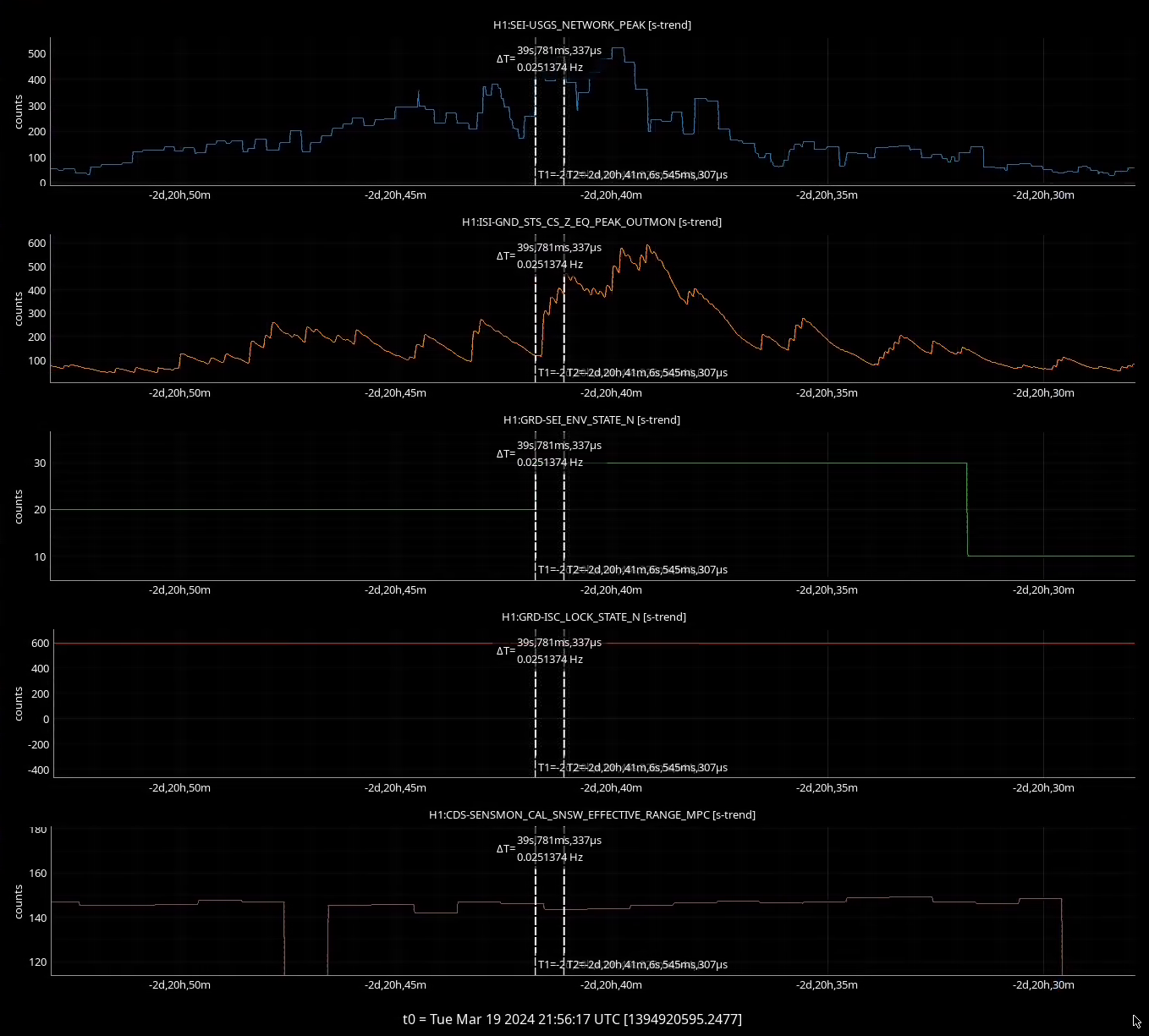
LSC and ASC plots attached. I wonder if the lockloss was just badly timed. We could attempt to repeat this before our Tuesday Maintenance period.
A recent suggestion is that we see if the BS coil drivers are a limit to our sensitivity now. The way we'd check is to put the BS back to it's acquisition state, and see if we see noise in DARM. Any excess noise can then be projected down with the ratio of the coil driver filters.
I took an old version of a coil state switching script (from userapps/isc/guardian/bs_m2_switch_fast.py), and added to it turning off the output gain (upon recommendation of LLO who suspects that as contributing to their lockloss). We don't have time to try it out today, but the script (attached here, as well as checked in to userapps) should be ready to try next week. We can consider running it on Tuesday morning just to check that there are no issues with it, but then actually try it Wednesday afternoon.
To turn the BS to it's actuation state, line 12 setting the 'actuatorState' variable should be set to 2, then run the script. Then, to go back to the lownoise setting, change that variable back to 3 and re-run the script.
Note that the BS suspension guardian can take us from the acquisition state to the low noise state gracefully, but it doesn't look like it's got built-in a graceful way to go back to the high noise state.
We were not locked (due to an earthquake) at the beginning of maintenance, so we have not yet tried this with the IFO locked.
However, I ran it a few times during maintenance and it seems to work. I did need to update the script to convince it to work with python3 (the version I started with was quite old). I attach the updated script here, but it's also still in userapps/isc/h1/guardian/bs_m2_switch_fast.py
I see some small motion in the BS optical lever siganls when I do the switching, particularly from the low noise state to the high range state (3->1->2), but I'm still working on convincing ndscope to lookback at data from the last time we went through ISC_LOCK state 552 (lownoise_coil_drivers) to see what scale of oplev motion we normally survive in that state.
I might try running this once or twice as we acquire lock after maintenance today, but otherwise this is probably as ready to go as possible in preparation for trying it during a commissioning time.
Since the FC2 centering is not good now and it could cause the FC2 L2A coupling issue in alog73770, I centered FC2 using IR dither. The first attached figure shows the FC IR error signal with FC1/2 dithered. FC2 is dithered at 7.1Hz in pitch and 16.1Hz in yaw. You can see the FC2 dither peak at 7.1Hz, which indicates that FC2 centering is not good in pitch. I changed the green QPD offset at FC transmission while running FC ASC to minimize the peak at 7.1Hz. I changed the offset of INJ ANG P from 0.08 to 0.18 as shown in the second and third attached figures. After the centering, the dither peak at 7.1Hz is removed and the FC2 centering is as good as one in May.
I activated Jenne's DARM2 boost from LHO:73745 (in FM2) at 10/27/2023 13:25:54. The FM2 change has been saved in SDF. The file that includes this new DARM2 boost filter is at/opt/rtcds/lho/h1/chans/filter_archive/h1omc/H1OMC_1382307261.txt. I've copied it to/ligo/svncommon/CalSVN/aligocalibration/trunk/Common/H1CalFilterArchive/h1omcfor the Cal group. The file has been committed to the SVN. The corresponding repo has been updated on the LHO cluster under the cal account too.
Added this FM2 boost to ISC_LOCK state LOWNOISE_LENGTH_CONTROL, FM2 is now turned on at the same time as DARM2 FM8 is.
This Calibration-affecting change has been recorded in the H1 Record of Real-Time Calibration Pipeline Parameter Changes (DCC T2300297).
Jenne, Vlad, Louis Vlad noticed that the injection on H1:CAL-INJ_CW_EXC stays on during NLN CAL MEAS. This is a note to say that we should have ISC_LOCK turn it off/on when moving into/out of NLN_CAL_MEAS.
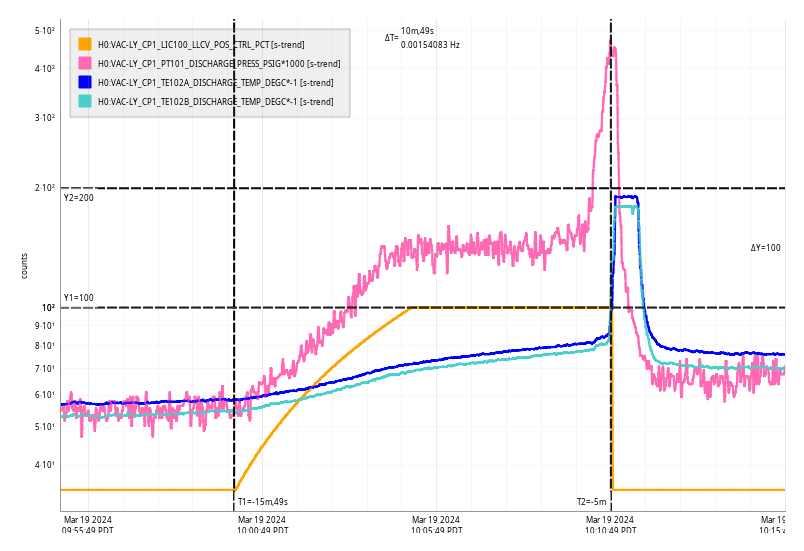
Fri Oct 27 10:14:19 2023 INFO: Fill completed in 14min 14secs
Jordan confirmed a good fill curbside. Outside air +6C, TC mins -138C, -129C.
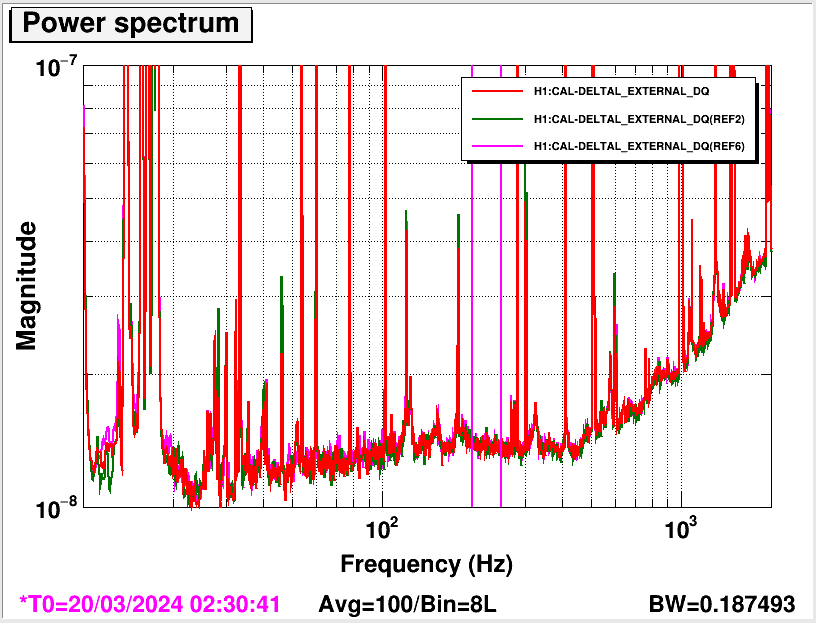
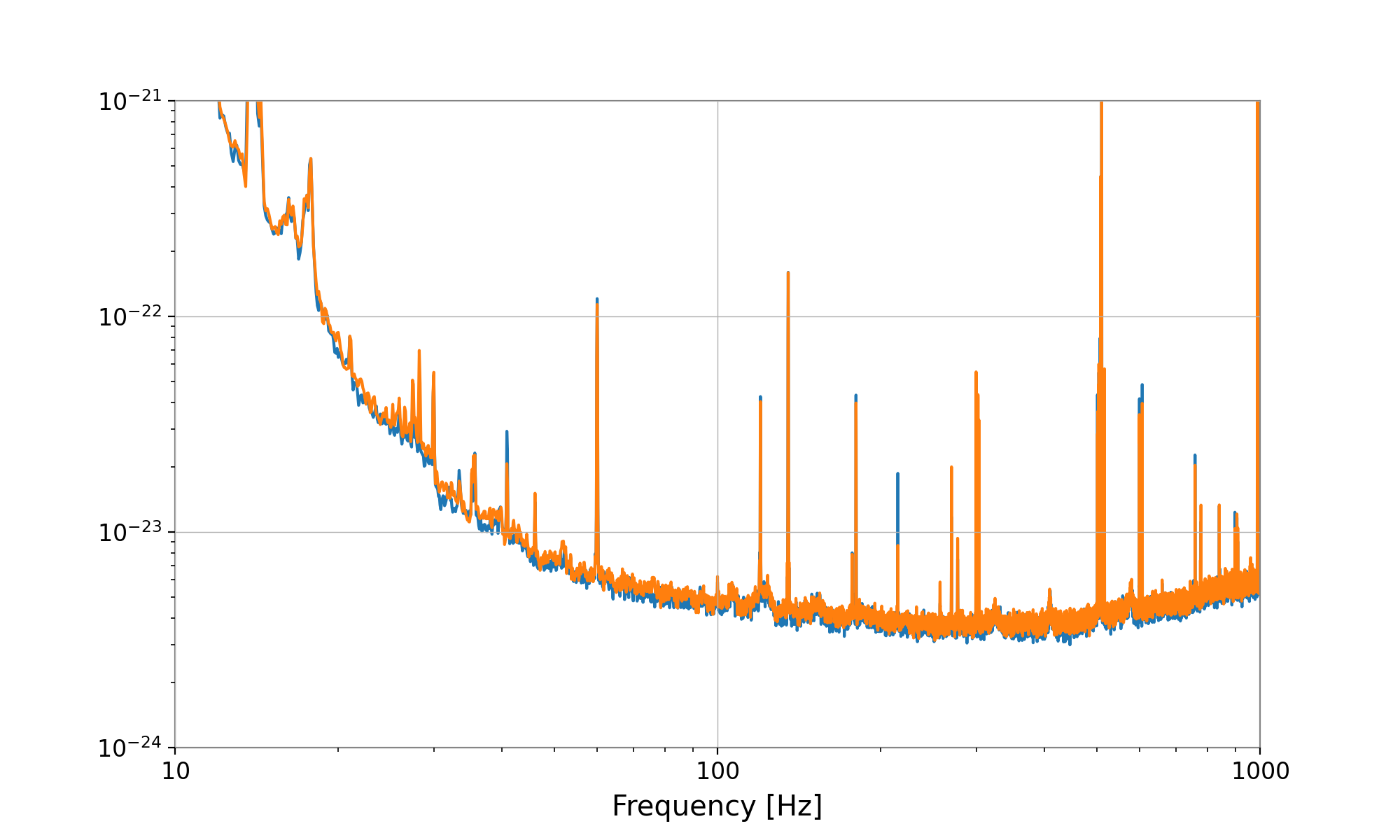
Vlad and I noticed a set of 20Hz peaks in DARM at 16:50UTC, see attached. Maybe similar to the peaks Robert and Tyler mitigated by changing AC settings in 73430
Vicky, Camilla
IFO was Out of Observing 15:40 to 15:56UTC as SQZ FC Unlocked. After 5 failed automatic SQZ_FC TRANSION_IR_LOCKING attempts, Vicky and I kept the FC GRD in DOWN, closed the Input 1 loop (SQZ Overview > FC Servo > H1:SQZ-FC_SERVO_IN1EN) to manually lock FC on green and aligned FC2 using the GR camera and maximizing H1:SQZ-FC_TRANS_C_LF_OUTPUT. Accepted FC2 alignment sdfs and went back to observing. Updated "Issues with SQZ FC Guardian" wiki
Think the issue could have been due to alignment drifts over the long 21 hour lock and as the M3 length was cleared, this couples in with pitch and yaw alignments, plot attached. Enough that the FC2 alignment needed to be slightly tweaked to relock. From plot, can see that M2 Pit (grey trace, bottom left) changed ~40urad on FC unlock?! This is a lot of drift over 20 hours, zoomed out plot here.
We have previously decoupled L2A for FC2's M1 stage, see LHO:67957, March 2023, most L2A decoupling was needed in pitch. But we have not decoupled L2A for FC2's lower M3 stage (in principle we should not have to do this as most DC gain is on M1). More relevant is probably that since March 2023, the beam spots on FC1/2 mirrors have since drifted away from center so the previous L2A decoupling may be less valid now. May be worth checking and re-centering FC cavity axis on the optic centers now, where our previous L2A decoupling should work better, and may overall be more stable.
I think that if L2A decoupling coefficients are very different now, that could impact FC alignment and relocking after long lock stretches. That's basically what happened before, which led us to do the decoupling FC2 M1 L2A in the first place (i.e., after long locks, the FC alignment drifts a lot due to the length-to-pitch coupling, such that when FC unlocks and we stop pushing on FC2 in length, then FC2 pitch changes suddenly and we lose FC alignment). Something to keep an eye on as Camilla's fixing of FC2 pitch alignment seemed to recover the filter cavity lock transition from green to red, which feels similar to before.
TITLE: 10/27 Day Shift: 15:00-23:00 UTC (08:00-16:00 PST), all times posted in UTC
STATE of H1: Observing at 162Mpc
OUTGOING OPERATOR: Austin
CURRENT ENVIRONMENT:
SEI_ENV state: CALM
Wind: 13mph Gusts, 10mph 5min avg
Primary useism: 0.02 μm/s
Secondary useism: 0.09 μm/s
QUICK SUMMARY:
IFO has been locked 20h30. There is plans for commissioning time 1-3pm this afternoon.
TITLE: 10/27 Eve Shift: 23:00-07:00 UTC (16:00-00:00 PST), all times posted in UTC
STATE of H1: Observing at 163Mpc
INCOMING OPERATOR: Austin
SHIFT SUMMARY:
Very Quiet night. Violins look great! Everything running smoothly.
H1 Current Status: Locked in NOMINAL_LOW _NOISE & OBSERVING for 12.5 hours.
LOG:
No Log
TITLE: 10/26 Day Shift: 15:00-23:00 UTC (08:00-16:00 PST), all times posted in UTC
STATE of H1: Observing at 163Mpc
INCOMING OPERATOR: Tony
SHIFT SUMMARY: Earlier lockloss due to earthquake, then we needed to do an Initial Alignment before being able to lock agian. Currently inn Observing and have been Locked for 4.5hours.
LOG:
15:00UTC Detector Locked for 2.5hours
16:20 Earthquake mode activated due to local earthquake
16:25 Earthquake incoming from Japan
16:38 Lockloss due to earthquake
- Holding in DOWN for ~10mins
16:53 Started relocking
17:21 Took us to DOWN to start an initial alignment
- While I was waiting for PREP_FOR_LOCKING to complete, IMC kept going between OFFLINE and FAULT
17:23 Started Initial Alignment
17:43 INITIAL_ALIGNMENT complete, started relocking
-At PREP_ASC_FOR_FULL_IFO got lots of IFO_OUT call-outs, similar to what Tony had noticed (73753)
18:29 Reached NOMINAL_LOW_NOISE
18:49 Observing
| Start Time | System | Name | Location | Lazer_Haz | Task | Time End |
|---|---|---|---|---|---|---|
| 15:28 | FAC | Tyler, Randy, Eric | EX/EY | n | Chillers | 16:44 |
| 15:36 | FAC | Karen | OptLab,VacPrep | n | Tech clean | 16:00 |
| 16:13 | FAC | Karen | WS | n | Tech clean | 16:38 |
| 16:39 | VAC | Travis | LVEA | n | Checking ion pump | 16:47 |
| 18:21 | FAC | Cindi | MechRoom | n | Tech clean | 19:51 |
| 20:09 | VAC | Travis | MY | n | Looking for tools | 20:51 |
| 20:36 | EE | Fil | MY | n | Moving things to/from | 21:01 |
TITLE: 10/26 Eve Shift: 23:00-07:00 UTC (16:00-00:00 PST), all times posted in UTC
STATE of H1: Observing at 163Mpc
OUTGOING OPERATOR: Oli
CURRENT ENVIRONMENT:
SEI_ENV state: CALM
Wind: 5mph Gusts, 4mph 5min avg
Primary useism: 0.01 μm/s
Secondary useism: 0.11 μm/s
QUICK SUMMARY:
IFO is currently Locked for 4 .5 hours and is no longer in earthquake mode.
Based on the unexpectedly high gain of this PI (~260), if LHO is in a position where they wish to avoid inducing this PI at any cost, without requiring to have active actuation runnning to damp it, they have some breathing room in the settings of the X-arm ring heaters (RHs) before the mode-spacing crosses the threshold of parametric gain, R > 1. Here I give a rough estimate on the magnitude these RH settings can be, whilst remaining in this "safe space", based on Diopter per Watt estimates here.
Presently modespacing for the relevant interacting mode in a well thermalised state sits at (see black curves in figures of this aLog): 5240 Hz in the 0'th FSR, and 80287 Hz in the 2'nd FSR.
To reach the condition for R > 1, modespacing can go up as high as 5244.5 Hz in the 0'th FSR, giving us 4.5 Hz of breathing room right now.
3 basic scenarios to reach that threshold:
Effective PI damping actuation would relax this further.
The last time LHO lost lock to this PI was 22nd May 2023. I fetched tape data to derive the observed paramertic gain (R_obs) for that event, and fit exponentials to periods of exponential growth, to get the time constants:
I will take the conservative estimate and take R_obs = 16.
Given an estimate of the mechanical Q factor of 1.7 million, all I need to know is what was the difference between the optical mode frequency and the mechanical mode itself, in order to deduce the underlying Parametric Gain (R0), which would occur at an exact frequency match of these parameters.
To fetch these paramters, I fetched spectra of the OMC_DCPD_SUM (to see optical mode spacing) and MODE28_BP_IN1 (to see exact PI frequency which is demodulated at 80000 Hz). I use the frequency mapping I established earlier for the optical mode to project what the frequency is 2 FRSs away:
Now I take these juicy details and I crank the algebraic handle with this simple script.
R0 = 260
Highlights:
All in all, a pretty quiet week, data qualiity wise. Full shift report here: https://wiki.ligo.org/DetChar/DataQuality/DQShiftLHO20231016
Thu Oct 26 10:14:54 2023 INFO: Fill completed in 14min 49secs
Travis confirmed a good fill curbside.
Note that now the outside temperatures have dropped (and therefore also the thermocouple reference junctions) the TCs no longer drop down to -200C.
I increased the trip temperature from their summer setting of -130C to their winter setting of -100C this morning. The TCs min temps for today's fill were TCA=-125C, TCB=-119C.
The plot y-axis marker has been set to the new trip temp.
Lockloss @ 16:38 UTC due to earthquake
Holding in DOWN for a bit while the ground motion settles.
16:53 Started relocking
18:49UTC Observing