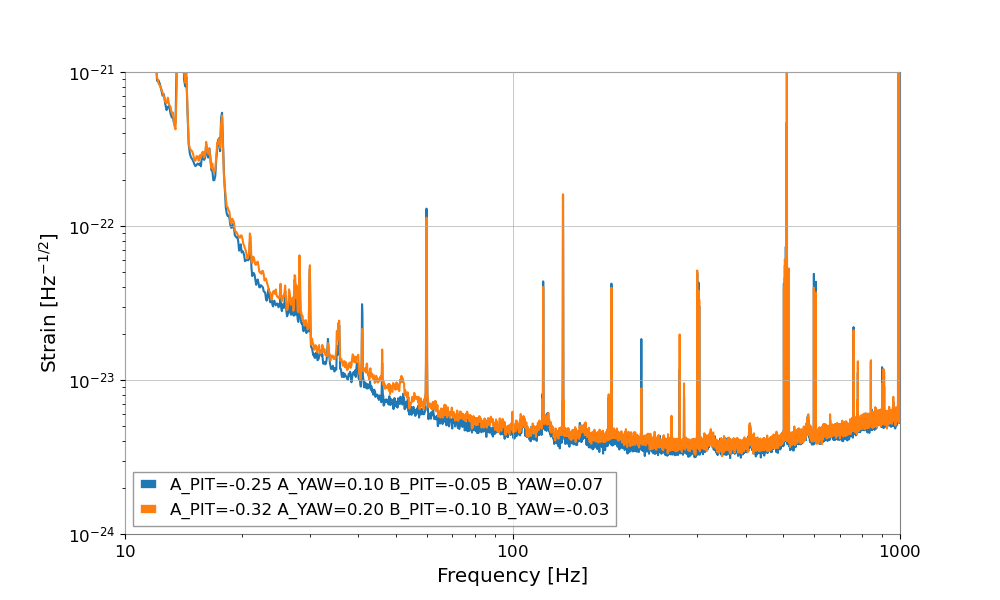
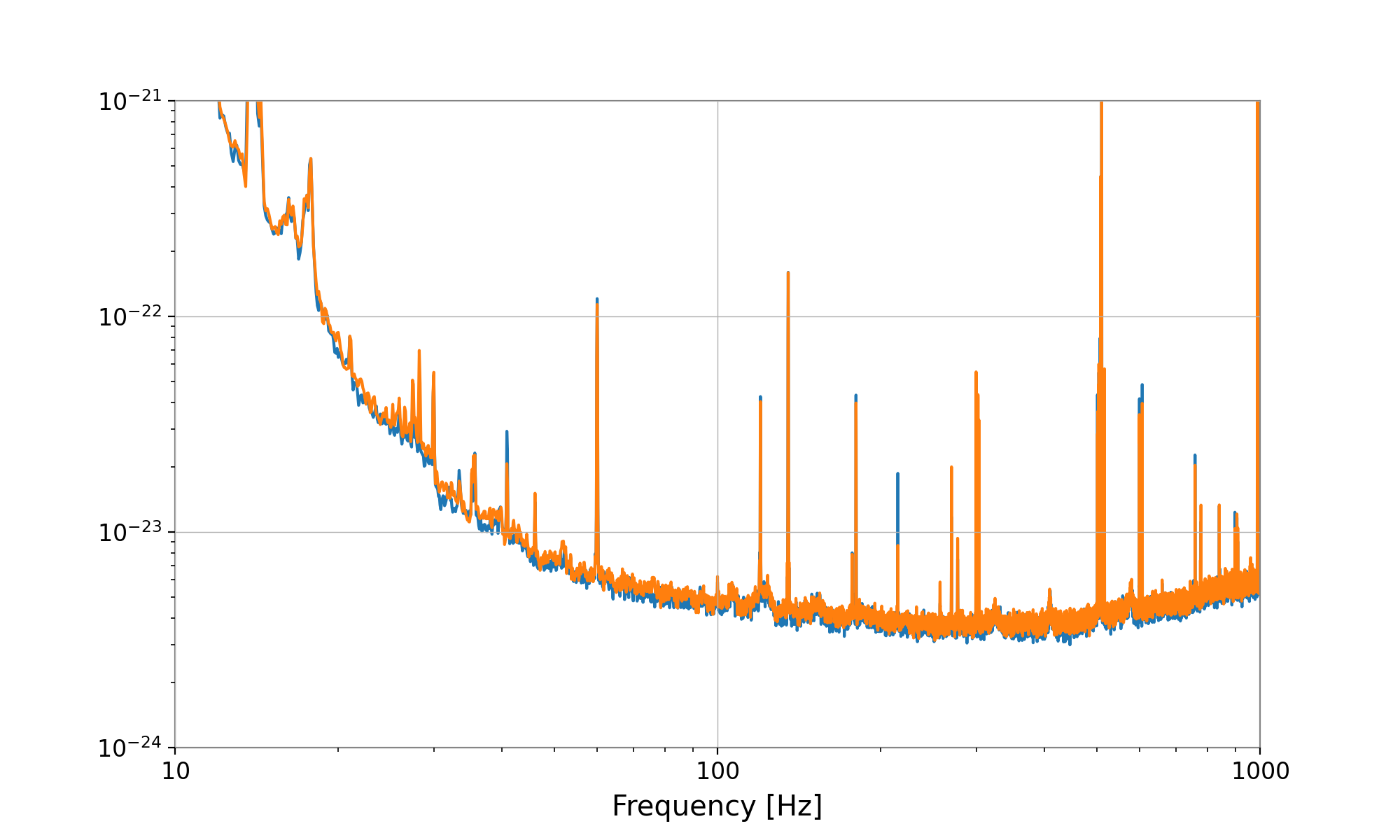
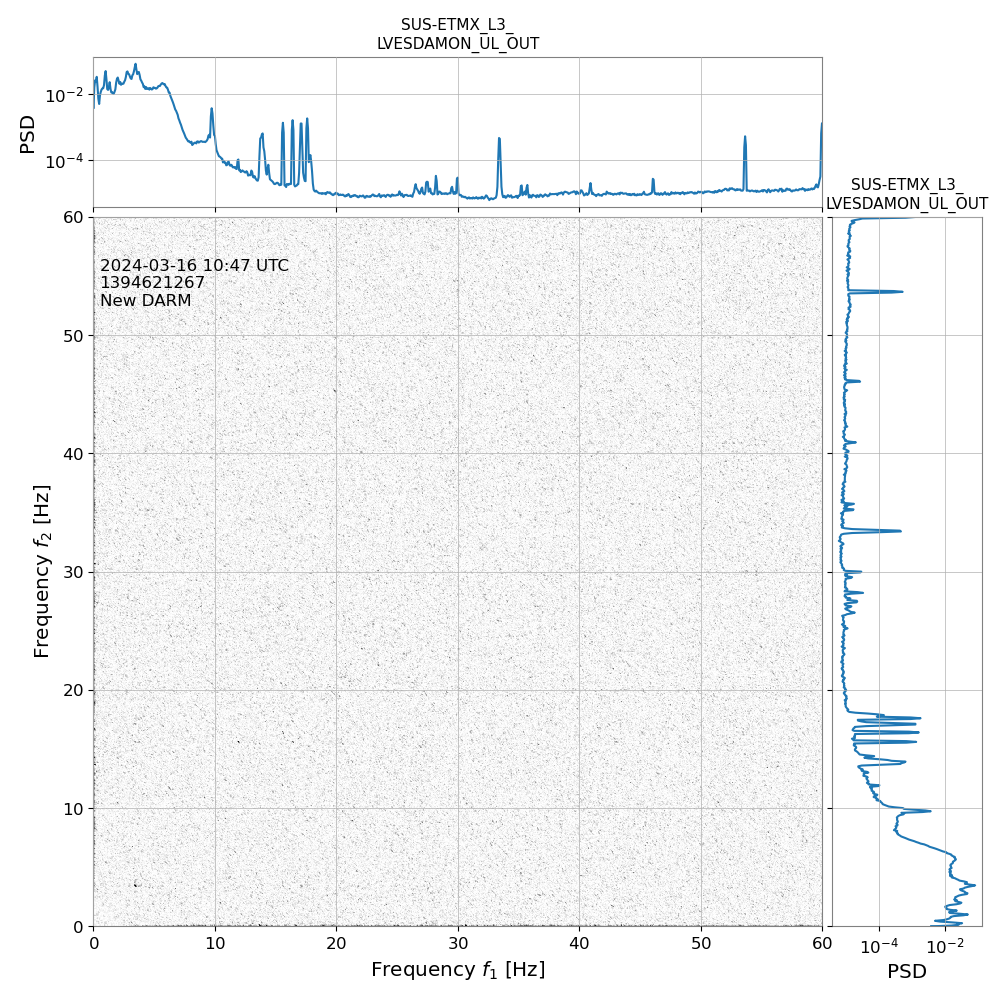
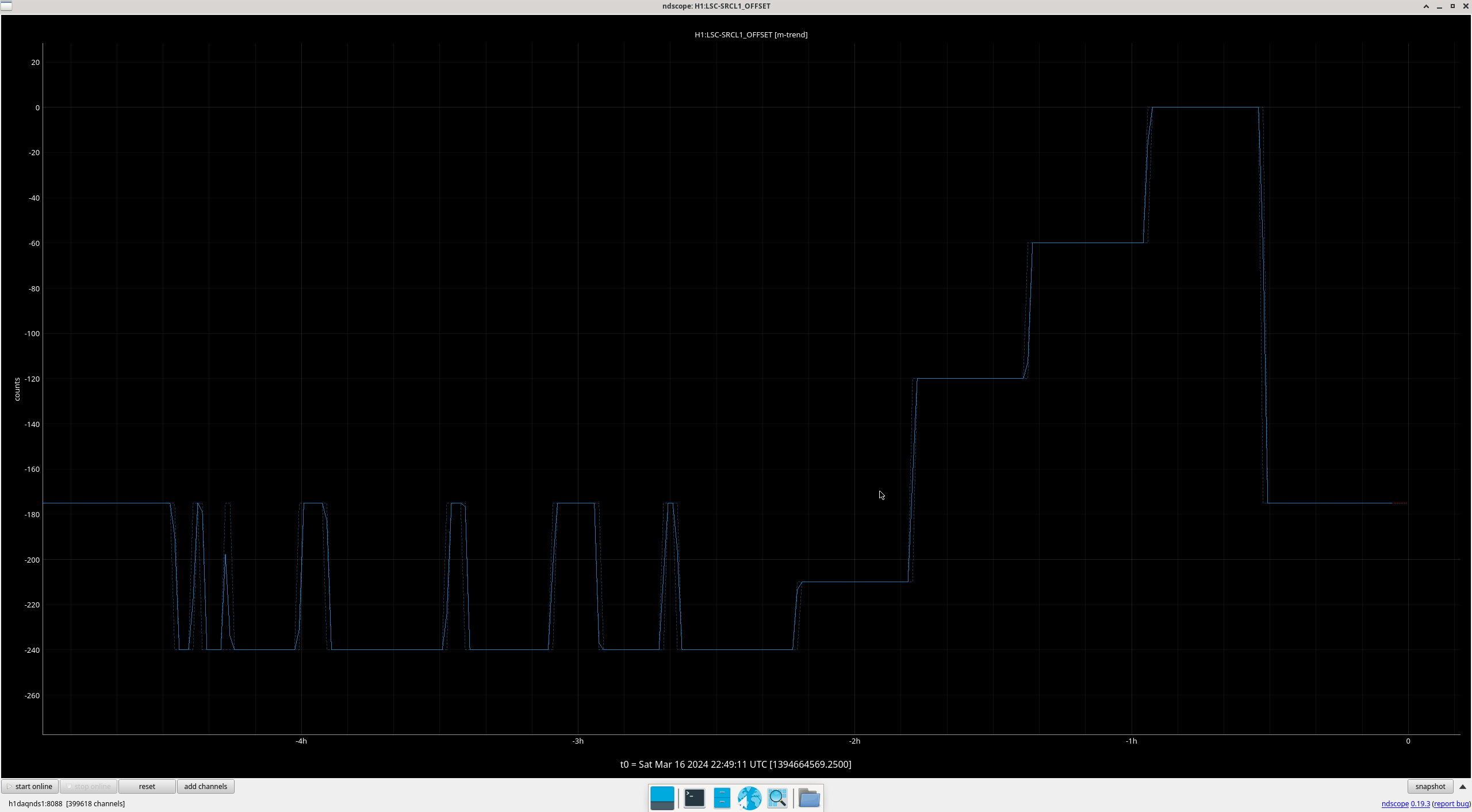
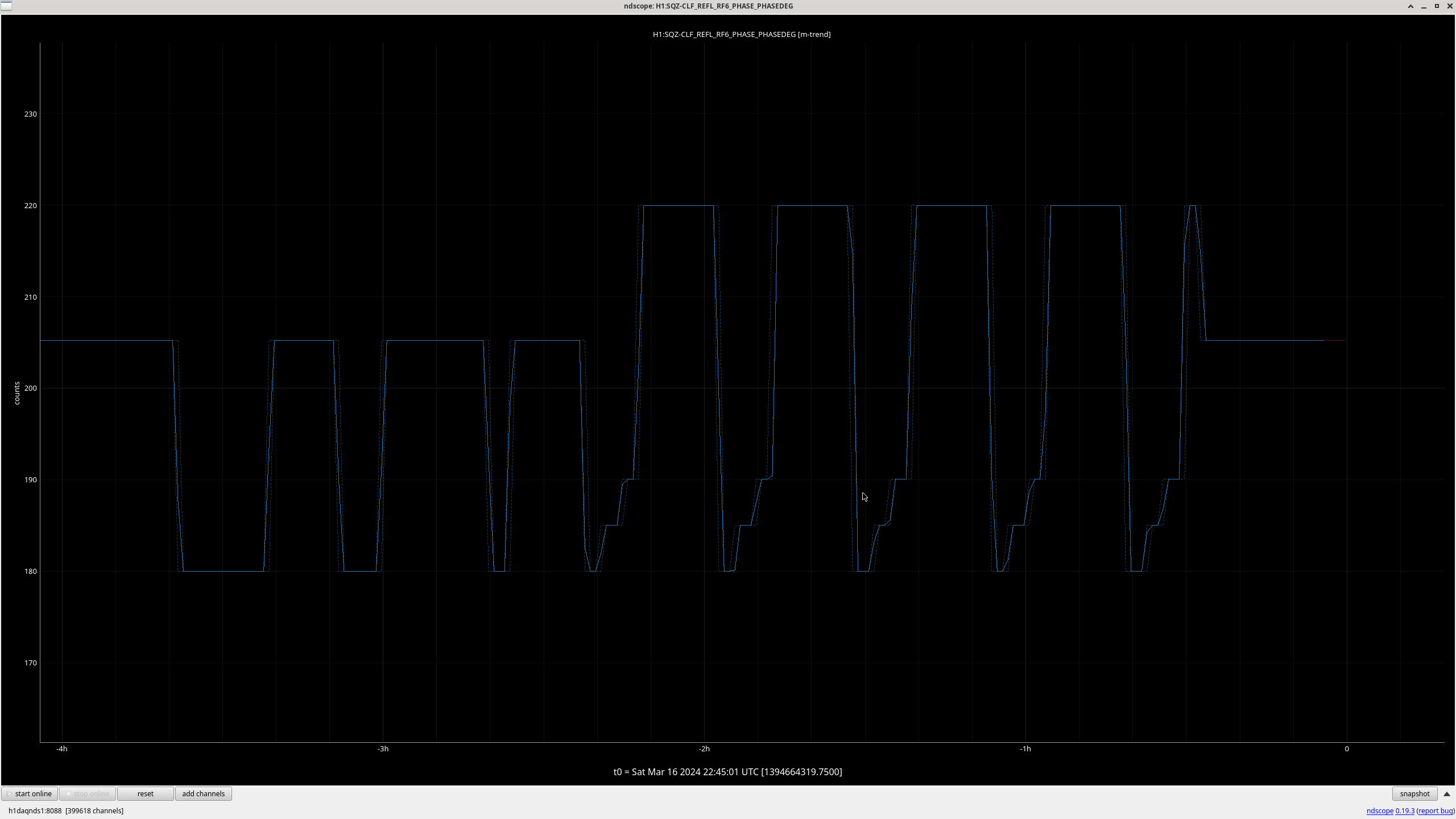
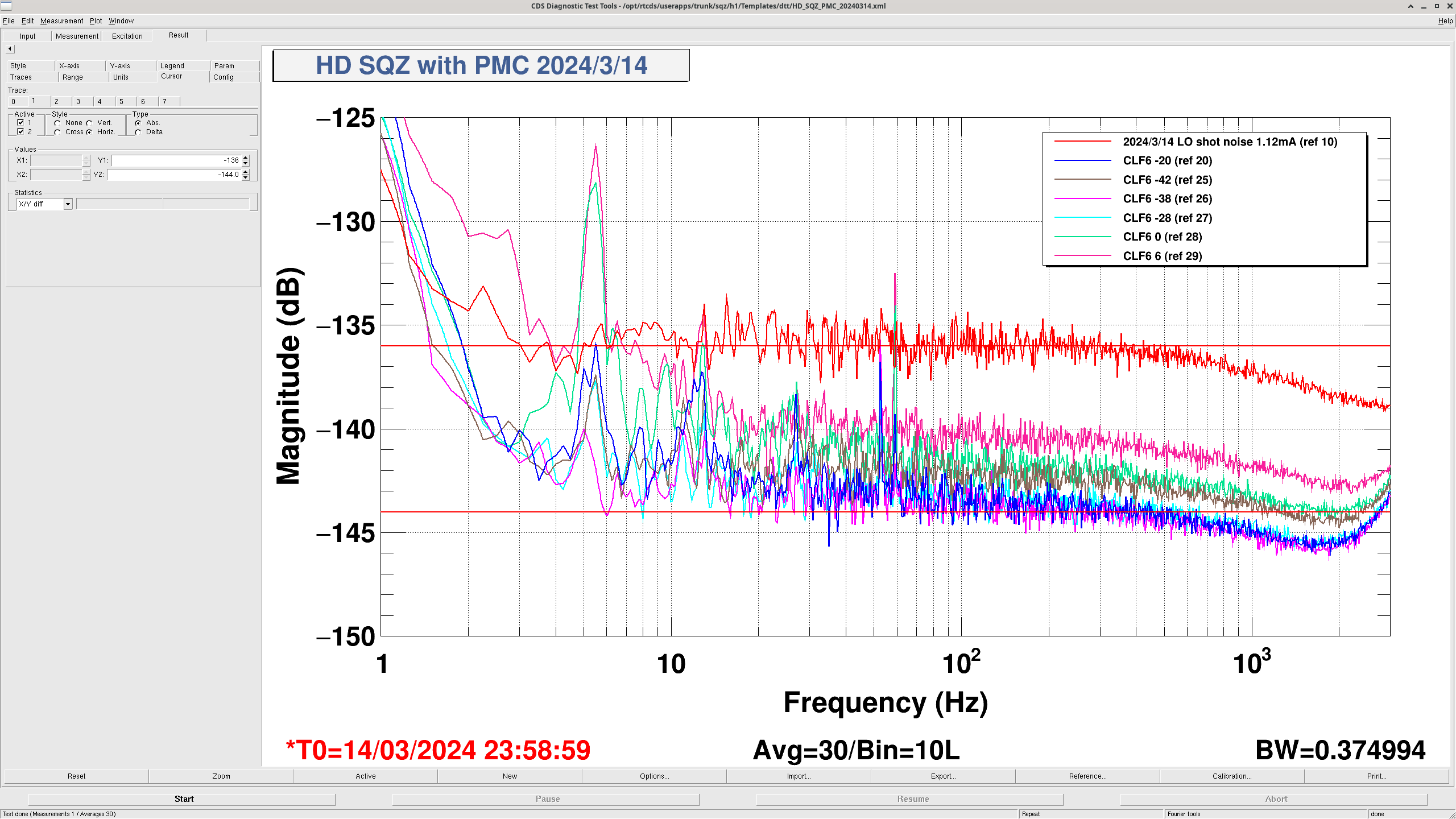
Ran a BB measurement followed by Simulines:
- bb measurements: 1382296233 - 1382296559 (2023-10-25 19:10:15 - 19:15:41)
- simulines measurements: 1382296585 - 1382297917 (2023-10-25 19:16:09 - 19:38:19)
Output files:
BB:
/ligo/groups/cal/H1/measurements/PCALY2DARM_BB/PCALY2DARM_BB_20231025T191015Z.xml
Simulines:
/ligo/groups/cal/H1/measurements/DARMOLG_SS/DARMOLG_SS_20231025T191609Z.hdf5
/ligo/groups/cal/H1/measurements/PCALY2DARM_SS/PCALY2DARM_SS_20231025T191609Z.hdf5
/ligo/groups/cal/H1/measurements/SUSETMX_L1_SS/SUSETMX_L1_SS_20231025T191609Z.hdf5
/ligo/groups/cal/H1/measurements/SUSETMX_L2_SS/SUSETMX_L2_SS_20231025T191609Z.hdf5
/ligo/groups/cal/H1/measurements/SUSETMX_L3_SS/SUSETMX_L3_SS_20231025T191609Z.hdf5
Today we tested the effect on DARM of additional resonant gains at 2.8 and 3.4 Hz, as described in 73698.
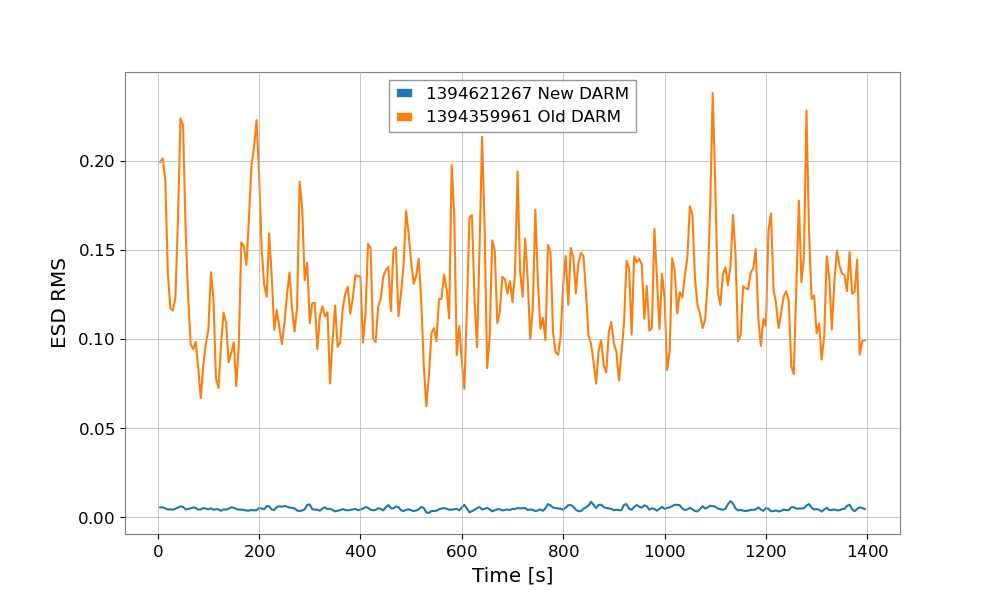
DARM RMS was reduced as expected from 1.6e-9 to 1.2e-9.
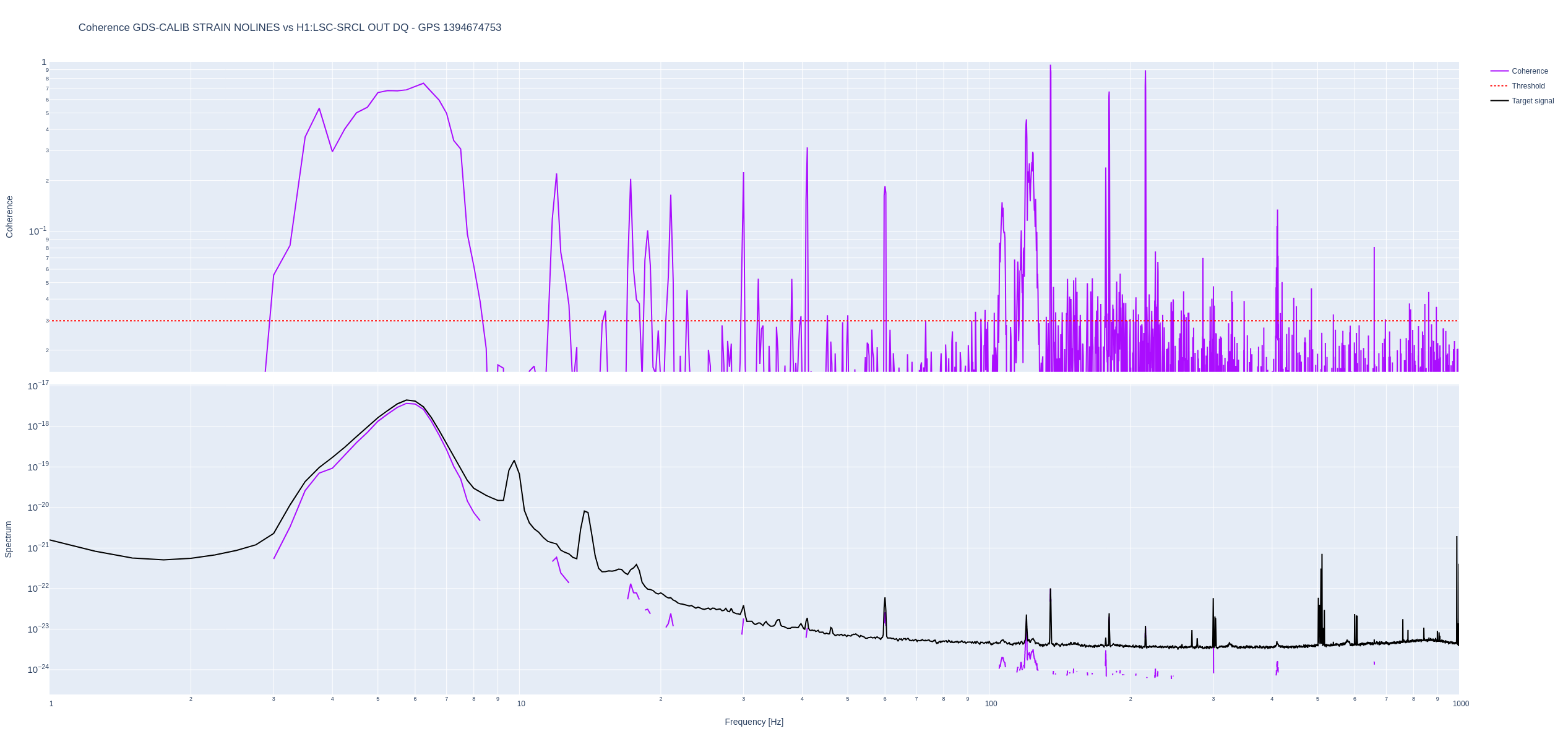
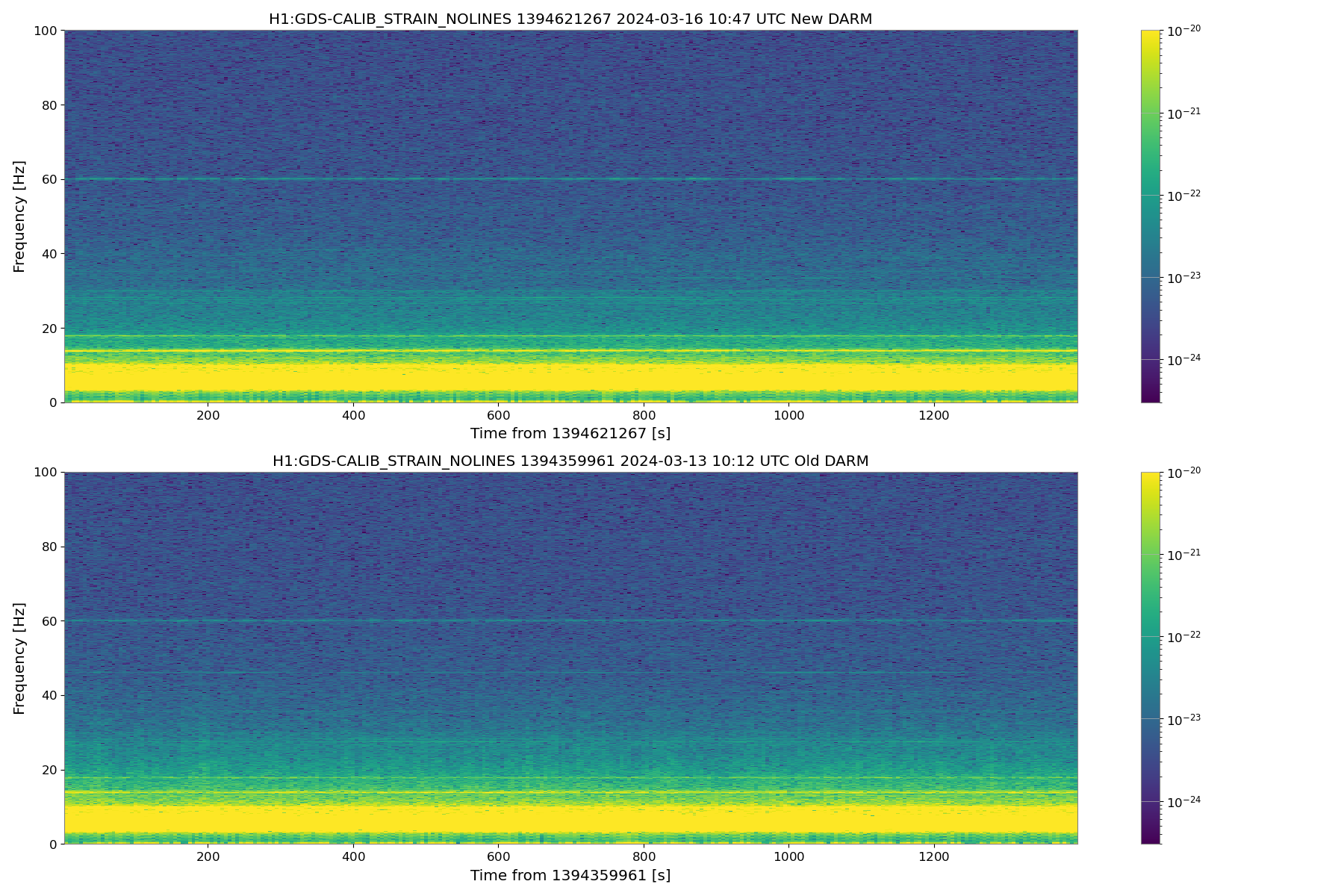
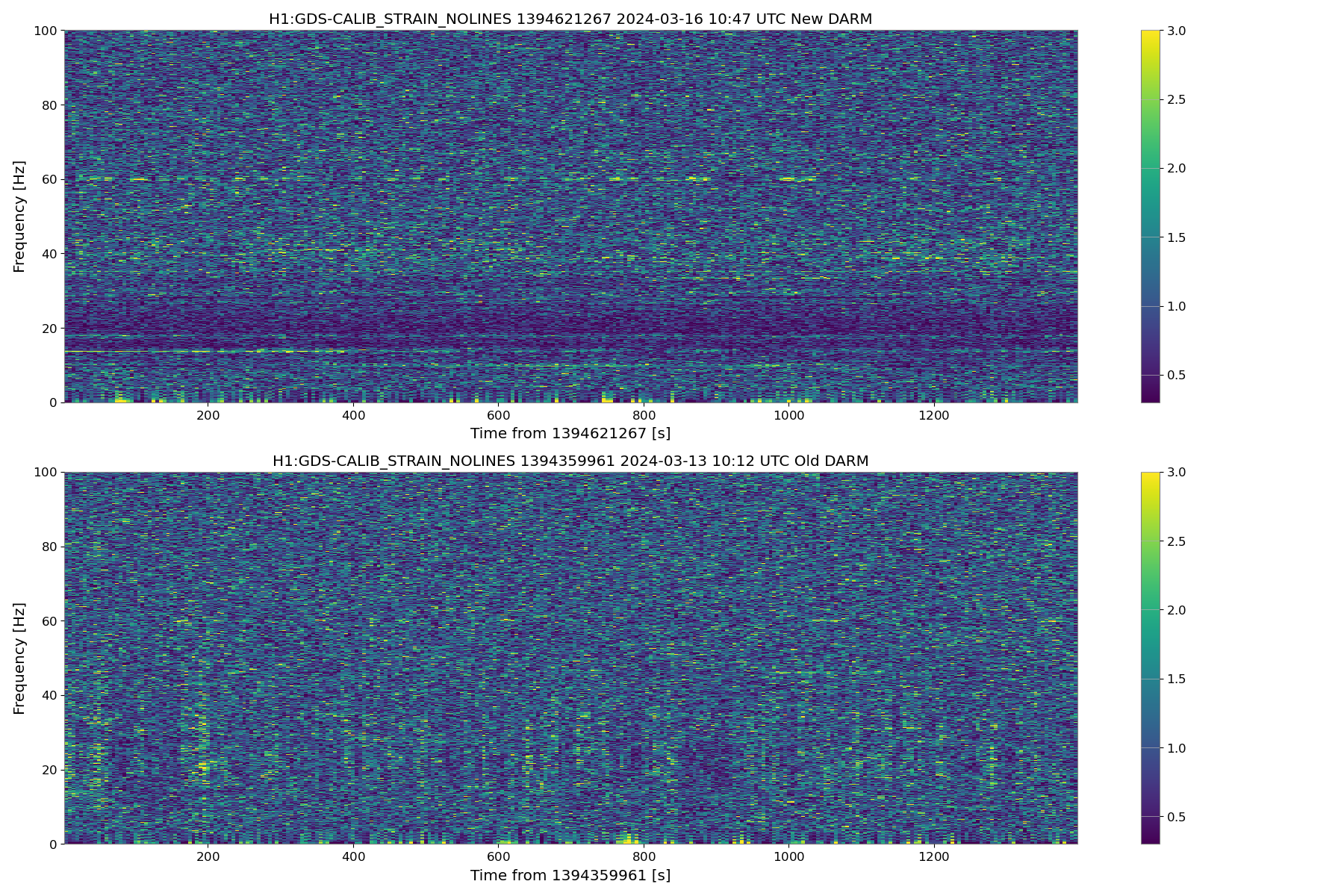
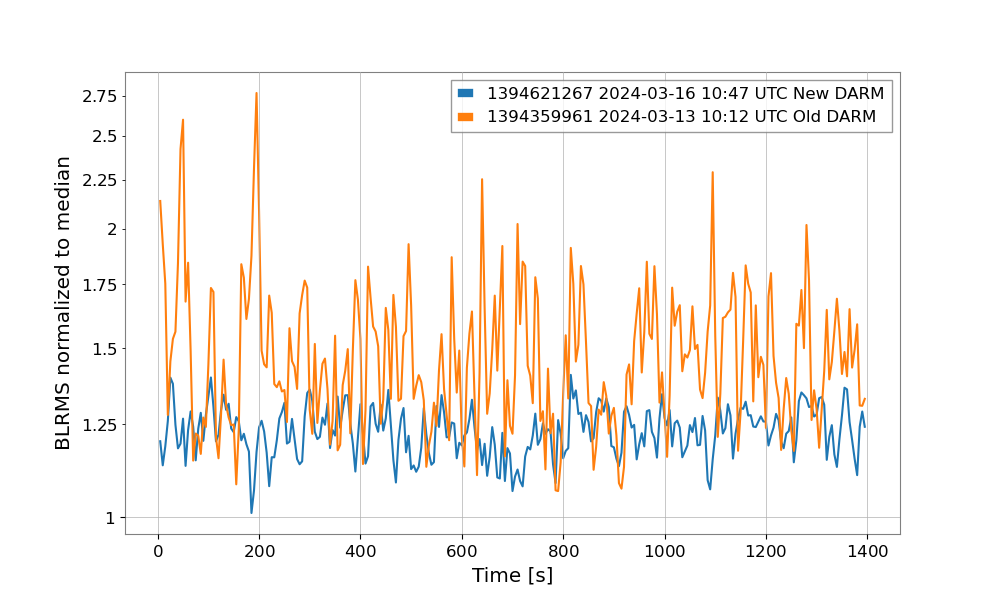
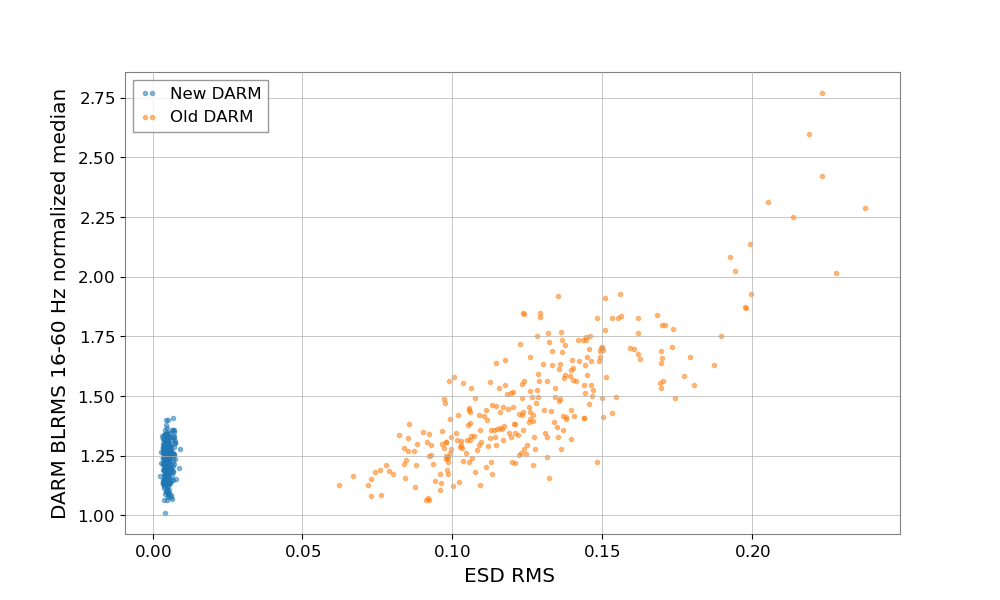
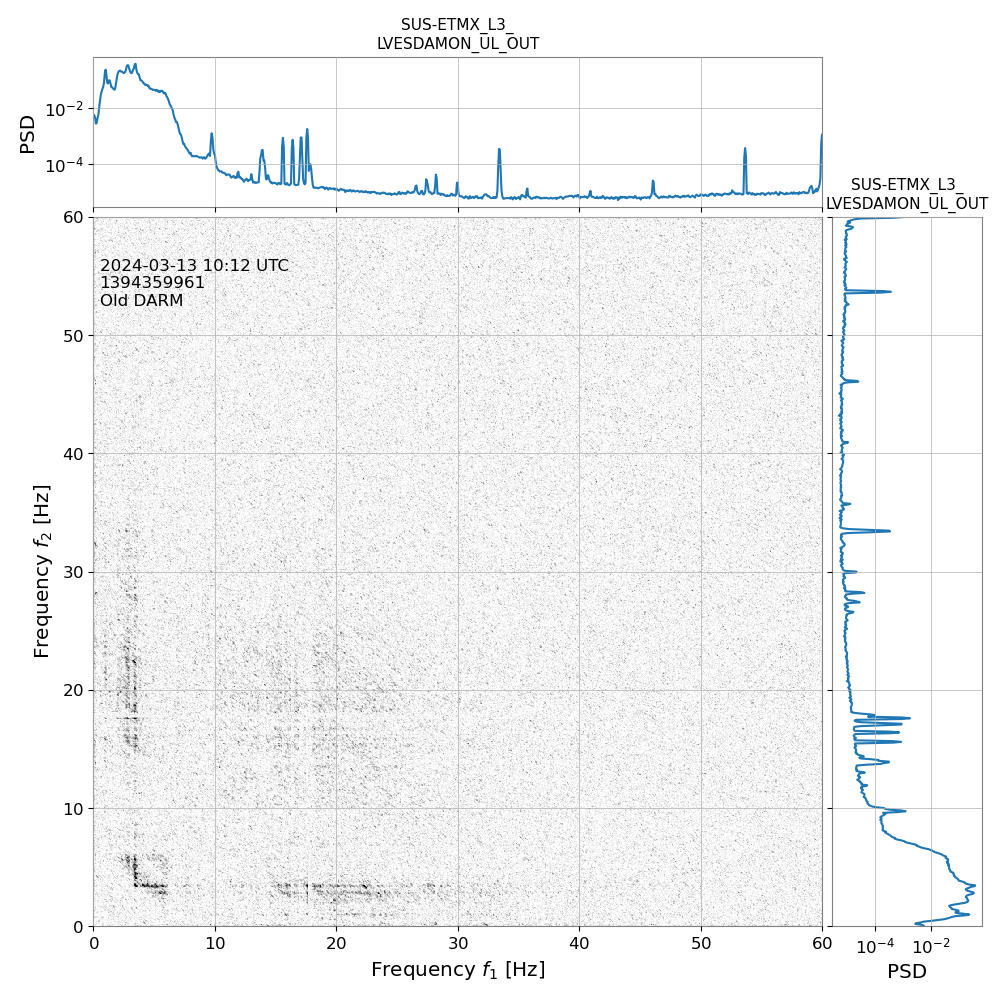
Looking at DARM spectrograms, there is no evident difference in the level of non-stationary noise.
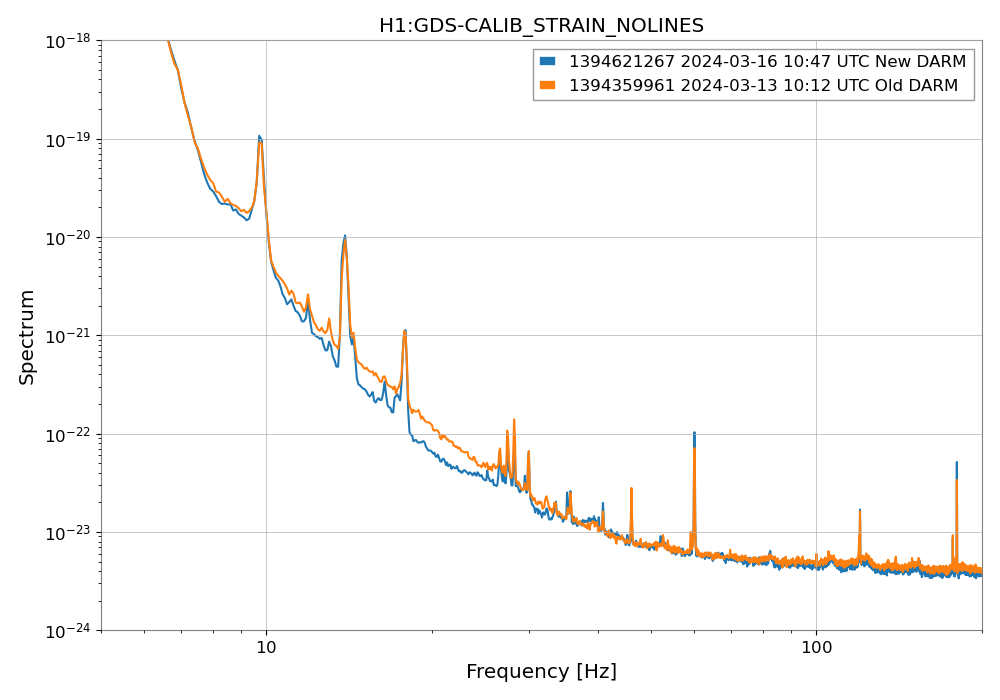
Comapring the DARM PSD during two times, there seems to be a small improvement, but that might be a fluctuation.
In summary: the resonant gains improve the DARM RMS, but we don't see a clear improvement in noise; they don't hurt though
I've created a low frequency boost that generally gives more gain at low freq, rather than just having the resGs. I turned it on starting at 23:11:00 UTC. Until 23:19:38, the squeezers were working. Then around 23:26:00 I changed the CARM gain. So, maybe this isn't such great 'quiet time' to evaluate whether we've improved our nonstationarity, but it certainly does seem fine, and it also does nicely reduce the low frequency DARM_IN1 and its RMS. The filter was back off around 23:31:00 UTC so we could go back to Obsering.
In the first plot, the blue filter is the one that Gabriele had created, and we tried early in the commissioning period today. Red is my new proposed filter.
In the second plot, the blue is DARM_IN1 under nominal circumstances (so, no resG or boost), and red is with my version of the boost filter. As noted in my 'timeline' above, there isn't really a lot of good quiet time to evaluate its effect on the nonstationarity, but the significant reduction in RMS seems like a good thing. If we want to leave this filter on, Louis will need to do some work to prepare the calibration pipeline, and we'll need to restart the GDS pipeline during the same commissioning window that we turn on the new boost.
EDIT: please disregard the y-axis label on the DARM_IN1 specra plot. I don't think that should be there.
In a follow-up to what TJ did yesterday(73685), I alternated the CARM gains (H1:LSC-REFL_SERVO_IN{1, 2}GAIN) between 6 (what it was nominally at) and 12 every two minutes.
Times when we were at each gain setting (in UTC):
12: 20:08:17 - 20:10:17
6: 20:10:29 - 20:12:29
12: 20:12:44 - 20:14:44
6: 20:14:58 - 20:16:58
Attached is an ndscope over this timeframe looking at the CARM gain and SQZ BLRMS channels (same as the channels that TJ and Camilla had been looking at yesterday(73682)).
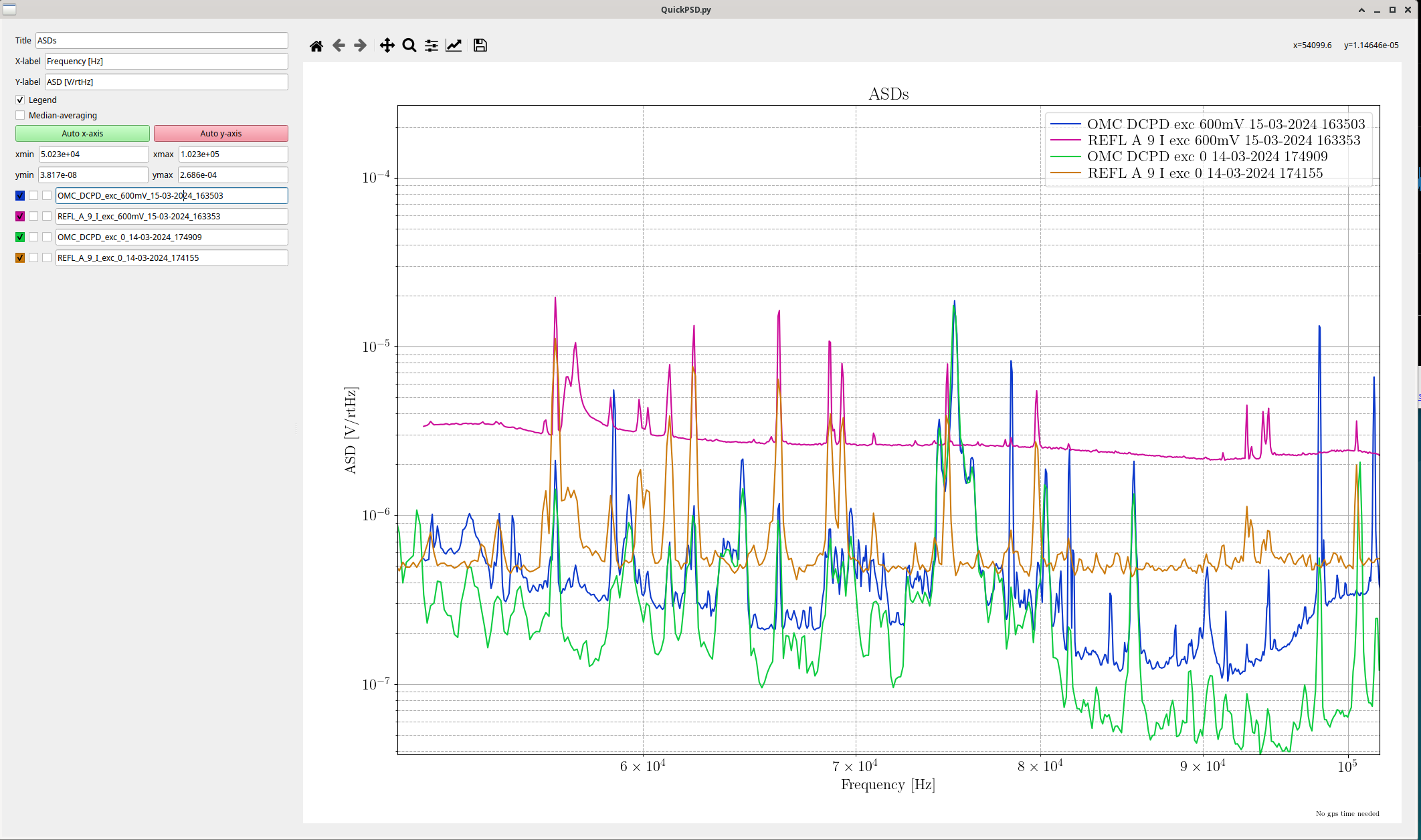
Attached is our very high frequency monitor of the DCPDs. (Since this channel is not saved, I also upload the DTT file).
The red / pink traces are at our nominal CARM gains of 6dB on each slider (H1:LSC-REFL_SERVO_IN1GAIN and IN2GAIN), and the blue / teal traces are the higher values of 12dB on each slider. All data is 10 avgs at 1 Hz BW, 25th Oct 2023. Times of the data are in the legend for each trace.
It seems that increasing the CARM gain is beneficial to our noise between 6 kHz to about 25 kHz. From about 25 kHz to a little above 100 kHz it increase our noise a bit. Above 100 kHz we're limited by some other noise, and so not seeing the effect of frequency noise.
I think it seems fine to leave CARM with the higher gain.
I've just modified LASER_NOISE_SUPRESSION to increase the sliders to 12dB (it used to increase them up to the previous nominal of 6dB at the end of the state). I've just increased the sliders before we go back to Observe, so we'll have lower frequency noise for all our upcoming locks.
Here is a list of the _known_ corrections to the systematic error that need to be accounted for when regenerating the O4a uncertainty budgets.
| Issue | Start | End | Status |
|---|---|---|---|
| 3.2 kHz ESD Driver Pole in CAL-CS Model (LHO:72043) | 2023/04/26 (ER15) | 2023/08/08 00:15 UTC | Rough fit exists. LHO:71787 |
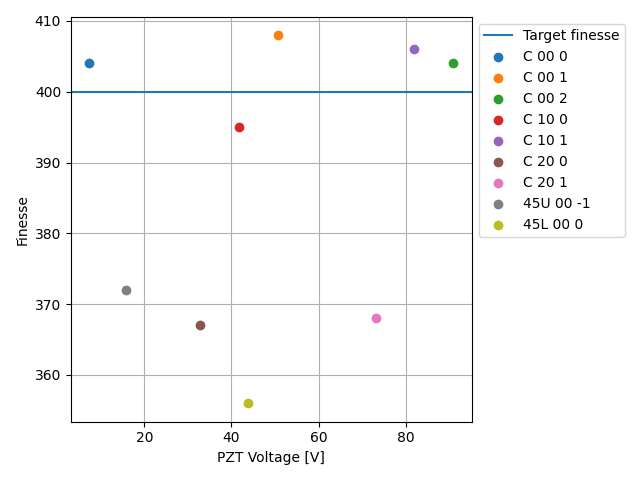
| Spoiled TDCFs due to noise in Kappa_UIM (LHO:71790, LHO:71846) | 2023/07/20 | 2023/08/03 | In progress. Pending correction file. |
| Thermalization effects seen in sensing function at 75W | ER15 | 2023/06/21 | In progress by Cal group. |
| Thermalization effects seen in sensing function at 60W | 2023/06/21 | Now | In progress by Cal group. |
Observing at 157Mpc and Locked for 16.5hours.
We're right about to start some Commissioning for the next four hours.
I measured the optical modes moving in the OMC-DCPD-SUM signal where, with A LOT of averaging (when the optical modes are pseudo stable), the optical high order mode (HOM) spacing can be observed as its changing through a lock stretch.
I look at the spectrum visible in the 5.2kHz range; and the spectrum visible in the 80.3 kHz range.
There are 2 sets of optical modes easily visible. Currently I assume the one I need to worry about is the higher one that is substantially closer to 80297 kHz of the PI.
The 2 two times plotted correspond to:
This should, in principle, correspond to 2*FSRx + HOM_spacing, but there is a slight discrepancy at both LLO and LHO (roughly 4 Hz by my estimates), which may be related to the small Gouy phase impact of the PRC, but I'm not sure exactly how.
For these measurements, the difference in frequency is 75047.61 Hz
For completeness, 2*FSRx = 75051.87 Hz (X-arm length is 3994.4704 m)
This is relevant to being able to track how far away we are in terms of optical mode spacing, from the mechanical mode Frequency in a DQ channel for post processing.
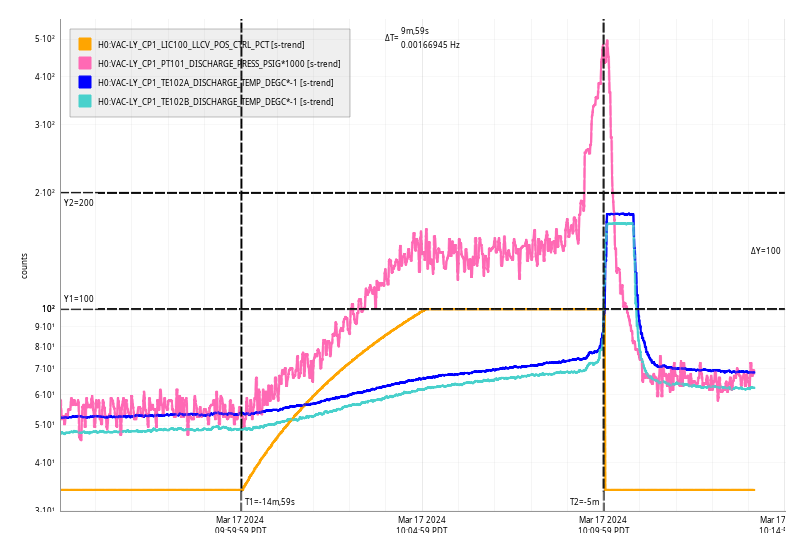
Wed Oct 25 10:17:16 2023 INFO: Fill completed in 17min 11secs
Jordan confirmed a good fill curbside. Note TCs only just cleared the trip level, outside temp was 45F at time of fill.
A follow up on the two new IFO range channels which were added to the DMT2EPICS_IOC and the DAQ yesterday.
Attachment shows a new MEDM I created which shows all four range channels, along with their GPS. This MEDM can be opened from SITEMAP -> OPS -> H1 IFO RANGES.
The ndscope second-trend plot shows that CAL has the largest range, HOFT the lowest, CLEAN and NOLINES are inbetween and are phase shifted versions of the same channel.
TITLE: 10/25 Day Shift: 15:00-23:00 UTC (08:00-16:00 PST), all times posted in UTC
STATE of H1: Observing at 159Mpc
OUTGOING OPERATOR: TJ
CURRENT ENVIRONMENT:
SEI_ENV state: CALM
Wind: 10mph Gusts, 7mph 5min avg
Primary useism: 0.02 μm/s
Secondary useism: 0.20 μm/s
QUICK SUMMARY:
In Observing and Locked for 12.5 hours.
TITLE: 10/25 Eve Shift: 23:00-07:00 UTC (16:00-00:00 PST), all times posted in UTC
STATE of H1: Observing at 163Mpc
INCOMING OPERATOR: TJ
SHIFT SUMMARY:
Since the mid shift report not much happened, pretty quiet night.
The Violins are heading in the right direction and have come down a lot, since the legend spire spike at ~500hz turned up at the begining of the lock.
Ey and EX temps have settled back down to a reasonable and stable temp.
H0:FMC-EY_VEA_AVTEMP_DEGF = 64.47 currently.
LOG:
| Start Time | System | Name | Location | Lazer_Haz | Task | Time End |
|---|
|
23:19 |
PSL | Jason | Optic lab | N | Looking for parts | 23:23 |
Took ISC_LOCK to INITIAL_ALINMENT and found almost no light on both arms.
I then Exited INITIAL_ALIGNMENT, and went to Manual Green Arms.
Set Increase flashes on Y and Manualed X all the way up to 80%
Increase flashes couldn't get above 55ish% on Yarm so I then touched up Y arm and got it to 1.
Sent ISC_LOCK back to I.A.
Once Initial Alignment completed the lock went well up until ISC_LOCK got to
PREP_DC_READOUT_TRANSITION where we got stuck due to a change in the OMC settings which were resolved by Vlad and Jenne. See comment 73720 https://alog.ligo-wa.caltech.edu/aLOG/index.php?callRep=73718
We continued up to POWER_10W and caught a lockloss.
https://ldas-jobs.ligo-wa.caltech.edu/~lockloss/index.cgi?event=1382229688
picture taken before 17:45
Relocking had another lockloss at Find IR.
01:10 UTC EY temp is still high but the slope of the temp trend seems to be trying to turn around.
H0:FMC-EY_VEA_AVTEMP_DEGF = 65.50
2:26 UTc Vicky Gets back to us and says that the SQZr Looks good.
Used the following command to mananged the blends under SEI_CONF
cdsutils write H1:GRD-ISI_ITMY_ST1_BLND_MANAGER SEI_CONF
cdsutils write H1:GRD-ISI_ETMX_ST1_BLND_MANAGER SEI_CONF
Finally got into NOMINAL_LOW_NOISE at 2:34 UTC and started sorting through SDF Diffs, then went to NLN_CAL_MEAS to run the following command at 2:42 UTC :
hwinj detchar safety --run
and back to NOMINAL_LOW_NOISE And OBSERVING at 2:51 UTC
Followed the instruction found here:
https://docs.google.com/document/d/1AXIOEC6XkT9Mp47Ny4aEZu0ucMTprHV0lA-Bu1KJnvk/edit
and ran the following command @ 2:42 UTC and got the following output:
anthony.sanchez@cdsws13: hwinj detchar safety --run
ifo: H1
waveform root: /ligo/groups/cal/H1/hwinj
config file: /ligo/groups/cal/H1/hwinj/hwinj.yaml
GraceDB url: https://gracedb-playground.ligo.org/api/
GraceDB group: Test
GraceDB pipeline: HardwareInjection
excitation channel: H1:CAL-INJ_TRANSIENT_EXC
injection group: detchar
injection name: safety
reading waveform file...
injection waveform file: /ligo/groups/cal/H1/hwinj/detchar/detchar-hwinj-schedule_LIGO-T1900555-PROPOSED_H1_INJECTIONS.txt
injection waveform sample rate: 16384
injection waveform length: 390.0 seconds
reading log file...
injection log file: /ligo/groups/cal/H1/hwinj/detchar/detchar-hwinj-schedule_LIGO-T1900555-PROPOSED_H1_INJECTIONS_log.csv
injection log entries: 75
initiating ligo_proxy_init for GraceDB access...
injection start GPS: 1382236977.6
H1:CAL-INJ_TINJ_TYPE => 3
H1:CAL-INJ_TRANSIENT_SW2 => 1024
H1::CAL-INJ_TRANSIENT => ON: OUTPUT
=== EXECUTING AWG INJECTION ===
this will wait until the injection is nearly complete...
ndshosts: h1daqnds1 and h1daqnds0
getting host by name: h1daqnds1
found host
testpoint_client 1.0.0
found version 4 or newer test point interface
H1:CAL-INJ_TRANSIENT_SW2 => 1024
H1::CAL-INJ_TRANSIENT => OFF: OUTPUT
H1:CAL-INJ_TINJ_TYPE => 0
=== INJECTION COMPLETE ===
creating injection events in GraceDB...
creating event: Detchar_HW_INJ_H1_1382236987.6.json
creating event: Detchar_HW_INJ_H1_1382236992.6.json
creating event: Detchar_HW_INJ_H1_1382236997.6.json
creating event: Detchar_HW_INJ_H1_1382237002.6.json
creating event: Detchar_HW_INJ_H1_1382237007.6.json
creating event: Detchar_HW_INJ_H1_1382237012.6.json
creating event: Detchar_HW_INJ_H1_1382237017.6.json
creating event: Detchar_HW_INJ_H1_1382237022.6.json
creating event: Detchar_HW_INJ_H1_1382237027.6.json
creating event: Detchar_HW_INJ_H1_1382237032.6.json
creating event: Detchar_HW_INJ_H1_1382237037.6.json
creating event: Detchar_HW_INJ_H1_1382237042.6.json
creating event: Detchar_HW_INJ_H1_1382237047.6.json
creating event: Detchar_HW_INJ_H1_1382237052.6.json
creating event: Detchar_HW_INJ_H1_1382237057.6.json
creating event: Detchar_HW_INJ_H1_1382237062.6.json
creating event: Detchar_HW_INJ_H1_1382237067.6.json
creating event: Detchar_HW_INJ_H1_1382237072.6.json
creating event: Detchar_HW_INJ_H1_1382237077.6.json
creating event: Detchar_HW_INJ_H1_1382237082.6.json
creating event: Detchar_HW_INJ_H1_1382237087.6.json
creating event: Detchar_HW_INJ_H1_1382237092.6.json
creating event: Detchar_HW_INJ_H1_1382237097.6.json
creating event: Detchar_HW_INJ_H1_1382237102.6.json
creating event: Detchar_HW_INJ_H1_1382237107.6.json
creating event: Detchar_HW_INJ_H1_1382237112.6.json
creating event: Detchar_HW_INJ_H1_1382237117.6.json
creating event: Detchar_HW_INJ_H1_1382237122.6.json
creating event: Detchar_HW_INJ_H1_1382237127.6.json
creating event: Detchar_HW_INJ_H1_1382237132.6.json
creating event: Detchar_HW_INJ_H1_1382237137.6.json
creating event: Detchar_HW_INJ_H1_1382237142.6.json
creating event: Detchar_HW_INJ_H1_1382237147.6.json
creating event: Detchar_HW_INJ_H1_1382237152.6.json
creating event: Detchar_HW_INJ_H1_1382237157.6.json
creating event: Detchar_HW_INJ_H1_1382237162.6.json
creating event: Detchar_HW_INJ_H1_1382237167.6.json
creating event: Detchar_HW_INJ_H1_1382237172.6.json
creating event: Detchar_HW_INJ_H1_1382237177.6.json
creating event: Detchar_HW_INJ_H1_1382237182.6.json
creating event: Detchar_HW_INJ_H1_1382237187.6.json
creating event: Detchar_HW_INJ_H1_1382237192.6.json
creating event: Detchar_HW_INJ_H1_1382237197.6.json
creating event: Detchar_HW_INJ_H1_1382237202.6.json
creating event: Detchar_HW_INJ_H1_1382237207.6.json
creating event: Detchar_HW_INJ_H1_1382237212.6.json
creating event: Detchar_HW_INJ_H1_1382237217.6.json
creating event: Detchar_HW_INJ_H1_1382237222.6.json
creating event: Detchar_HW_INJ_H1_1382237227.6.json
creating event: Detchar_HW_INJ_H1_1382237232.6.json
creating event: Detchar_HW_INJ_H1_1382237237.6.json
creating event: Detchar_HW_INJ_H1_1382237242.6.json
creating event: Detchar_HW_INJ_H1_1382237247.6.json
creating event: Detchar_HW_INJ_H1_1382237252.6.json
creating event: Detchar_HW_INJ_H1_1382237257.6.json
creating event: Detchar_HW_INJ_H1_1382237262.6.json
creating event: Detchar_HW_INJ_H1_1382237267.6.json
creating event: Detchar_HW_INJ_H1_1382237272.6.json
creating event: Detchar_HW_INJ_H1_1382237277.6.json
creating event: Detchar_HW_INJ_H1_1382237282.6.json
creating event: Detchar_HW_INJ_H1_1382237287.6.json
creating event: Detchar_HW_INJ_H1_1382237292.6.json
creating event: Detchar_HW_INJ_H1_1382237297.6.json
creating event: Detchar_HW_INJ_H1_1382237302.6.json
creating event: Detchar_HW_INJ_H1_1382237307.6.json
creating event: Detchar_HW_INJ_H1_1382237312.6.json
creating event: Detchar_HW_INJ_H1_1382237317.6.json
creating event: Detchar_HW_INJ_H1_1382237322.6.json
creating event: Detchar_HW_INJ_H1_1382237327.6.json
creating event: Detchar_HW_INJ_H1_1382237332.6.json
creating event: Detchar_HW_INJ_H1_1382237337.6.json
creating event: Detchar_HW_INJ_H1_1382237342.6.json
creating event: Detchar_HW_INJ_H1_1382237347.6.json
creating event: Detchar_HW_INJ_H1_1382237352.6.json
creating event: Detchar_HW_INJ_H1_1382237357.6.json
uploads complete.
anthony.sanchez@cdsws13:
TJ, Camilla. WP #11483.
Uninstalled the "new" S&K HWS laser (TSOP M1900163) from the ALS table, stored it in it's case in the LVEA TCS cabinets. Removed fiber and fiber launcher. This was installed in 62089.
Reinstalled the "old" diode source M530F2 (eye safe). Using M92L02 20um multi-mode fiber and original D1800125 fiber launcher. Reduced length of the tube of D1800125 fiber launcher as we thought we need to bring the F=125mm lens closer to the launcher.
Realigned the path to get a retro-reflected beam off ETMX and checked this by mis-aligning ETMX. Took new references on EX, and ITMs at 00:08UTC.
Photos before and after attached. Decision made to swap back to original source in T2300336. Will update FRS 14310 with Aidan.
We are getting data, see attached, but the TOTAL_PIXEL_VALUE is changing as we thermalize, which we don't want. There is some clipping happening which we can work to minimize on table.
TJ and I repeated the laser swap EY 73878 but struggled to get an unclipped beam. We went back to EX ~3pm Oct 31st to understand if the EX beam was clipping somewhere to get the bad HWS data above. We saw the beam was clipping on the edges of BS2 and M2 and then after clipping L1 (1" optic), the beam appears round again. Layout D1800270.
In 42171 and T1000717 there is mode matching solutions of this path showing the beam should remain under 10mm diameter until the Transmon telescope. We don't remember this ever being the case. The beam starts around 10mm and then diverges to >1" after L3, rather than converging.
We think we should revisit this mode matching to understand what our input optics should be and check all the lenses are correct (they are labeled as in D1800270).
Summary - Camilla and I removed the running TCSX chiller and replaced it with a new ThermoFlex 1400 SN#1153600201231003.
We've been having some issues with the TCSX laser relocking itself during Observing (ex: alog73331). This seems to be due to inconsistent water temperature from two of our three chilers, causing the temperature of the laser to shift slightly. We've swapped out SN#0110193301120813 for the new chiller and sent off the spare chiller for service. We input the settings from the CO2Y chiller and it the new chiller fired right up and seems to be outputing correct flow and pressure. We'll keep an eye on it the next few days.
Flow with the new chiller seems much more stable and the laser is operating at a slightly lower temperature (23.4C vs 24.5C) and a slightly higher output power (41.9W vs 40.9W). In the attached shot I'm unsure why the flow rate, as seen by the flow meter under the BSC, starts a bit higher and then over the course of ~4hours settles back to where it is now. I'd expect the system to settle much faster than that. For reference alog72267 is the last time we swapped the chillers and SN813 didn't show this.
When packing up our old spare chiller (SN#822) to be sent in for service, we found a small piece of metal, about the size of a bb in the outlet quick disconnect. This clearly wasn't helping the flow, but this chiller also had a refrigerant leak. Definitely time to be sent in.
Summary - Jim fixed it with a little shake.
We cycled through the various ISI state controls. The 1Hz line would start appearing when stage 1 is isolated. In any states below this point, we can clearly see the difference in the 'sensor response' of the local H1 L4C wrt T240 or CPS. While Jim was taking an olg measurement, the ISI tripped, which seem to have changed the response of the H1 L4C back to the nominal response, see the first pdf attached, showing the L4C/T240 local TF, before (p1) vs after (p2) the ISI trip. The 2nd pdf attached shows the ISI spectra in the isolated state before (p1) vs after (p2) the shake, no other changes.
We've had sticky L4Cs in the past and solved it in a similar way (see alog 38939), but the symptoms were much more obvious than a slight change in resonant frequency as we are seeing here.
Timeline of tests :
16:04 - 16:12 UTC ETMX ISI/HEPI OFFLINE
16:15 - 16:30 UTC HEPI ON / ETMX ISI OFFLINE
16:31 - 16:37 UTC HEPI ON /ETMX DAMPED
16:38 - 16:44 UTC HEPI ON / ETMX ST1 ISO - We can see the giant ~1Hz line
16:45 - 16:48 UTC HEPI ON/ ETMX ST1 ISO - H1 L4C gain 0.5 - sym filter off - ~1Hz line goes down
16:50 - 16:52 UTC HEPION/ETMX ST1/ST2 ISO - H1 L4C gain 0.5 - sym filter off
16:55 - 17:07 UTC Back to nominal
17:25 - Jim changing stage 1 Rz blend to noL4C
17:38 - Jim changing stage 1 Y blend to noL4C
18:00 - Jim measuring Rz olgf
Ref alog 73625
The ITMY peak is also coming the a "stuck" H1 L4C. This problem is kind of subtle, the L4C only seems to misbehave when the isolation loops are on and the accelerations on the L4C are low. Because tripping ETMX seemed to fix that L4C, I tried it on ITMY. To do this, I put the ISI in damped, ramped on an offset on the ST1H1 actuator, then turned it off with a zero ramp time. I did this for 2k, 3k and 4k counts of drive. All of these caused a bigger signal than the ETMX trip earlier, but the ITMY H1 L4C is still "stuck". Attached asds compare the corner 1 and corner 2 l4c-to-t240 local tfs before and after the whacks. No difference before vs after, but brown and pink are before, red and blue are after.
But, changing ITMY Y and RZ St1 blends to 250mhz blends that don't use the H1L4C makes the 1.something hz peak on ITMY go away. This also worked on ETMX. I've set both ISIs to not use their H1 L4Cs, we'll watch for a while and re-evaluate next week. At this point, only ITMX is still using it's H1 L4C.
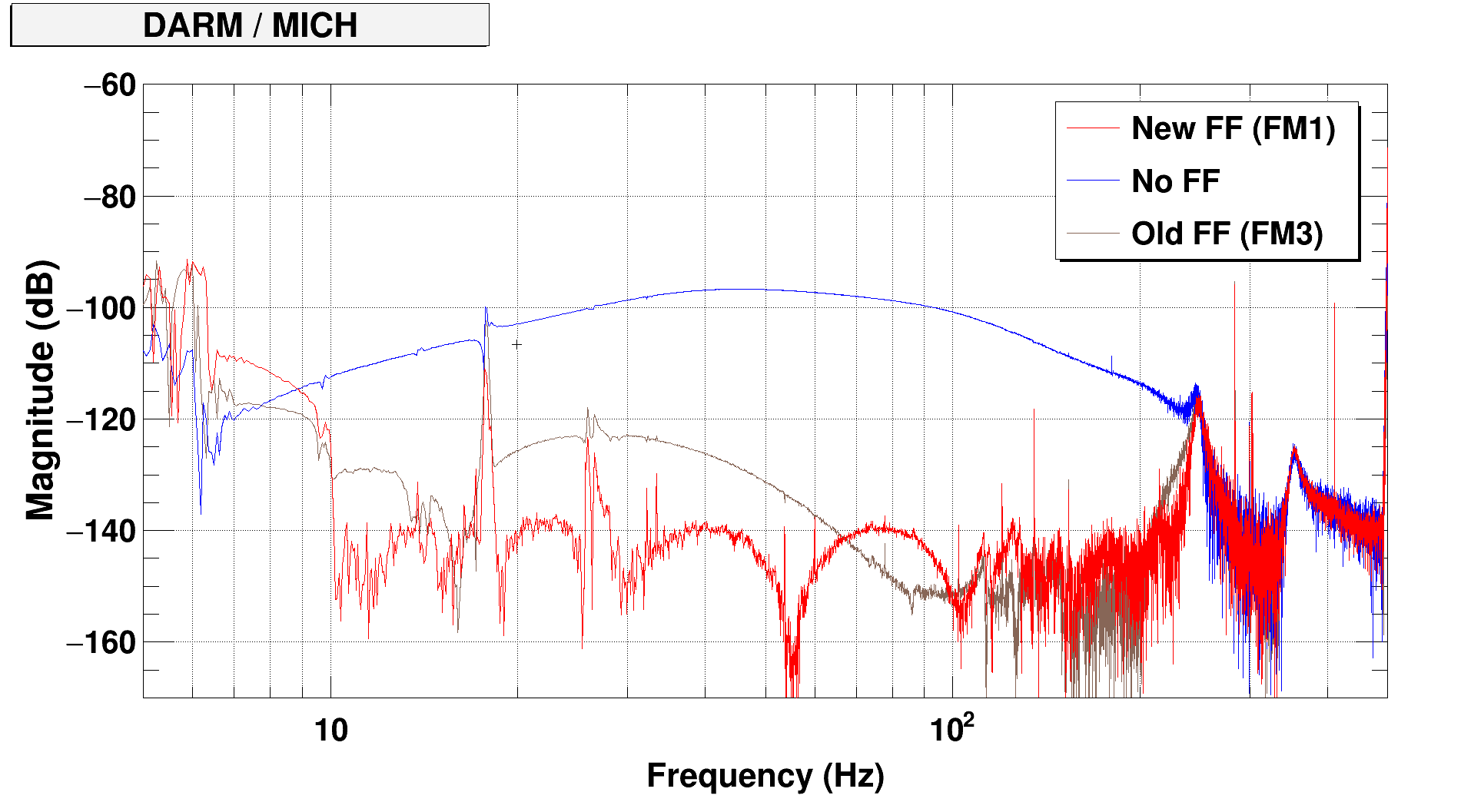
The two lines around 1.3 Hz are gone from DARM.
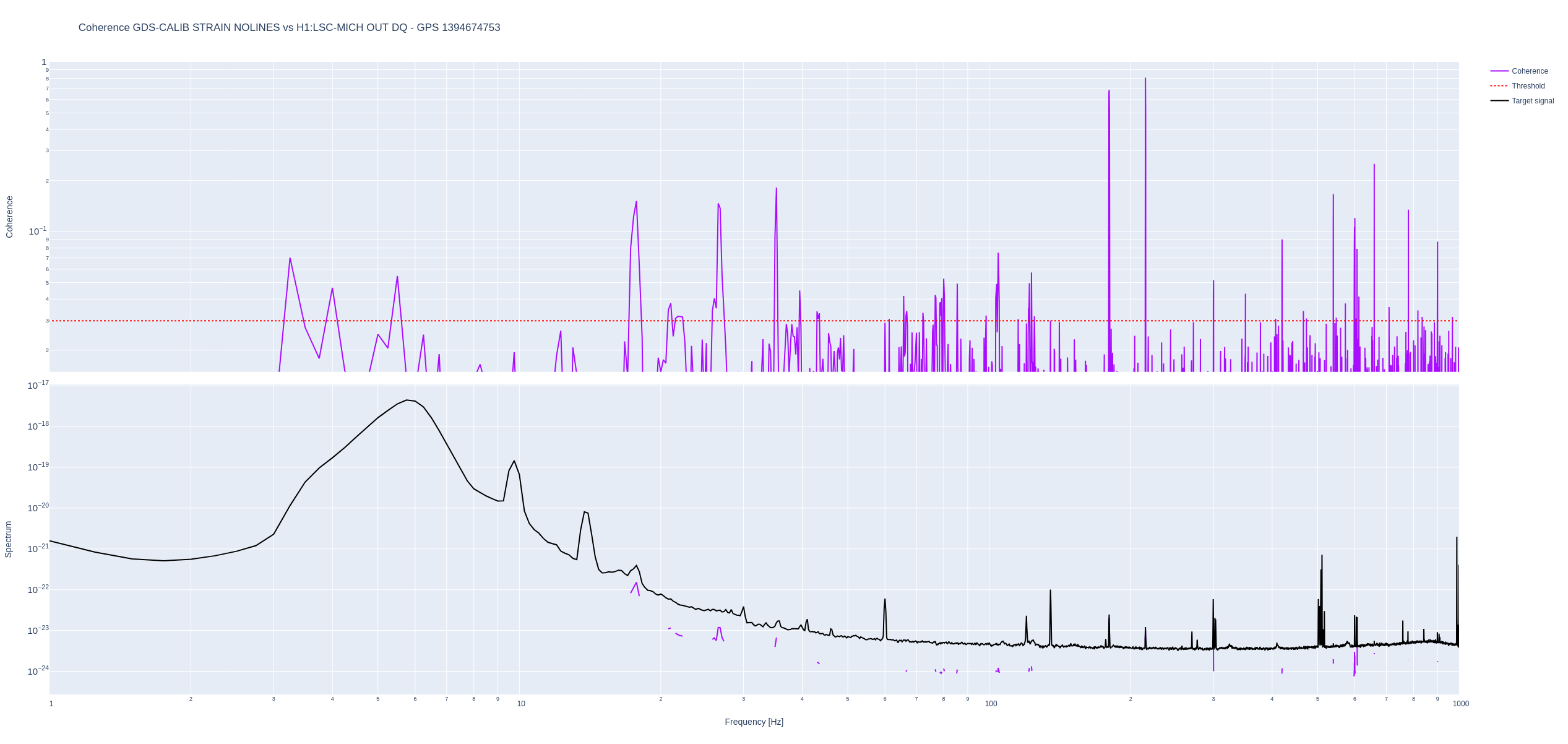
Unfortunateely it's hard to tell if this improved the nosie above 10 Hz, because there are a lof of scattered light events (4 Hz cryobaffle?)
I prepared a new filter module with resonant gains at 2.8 Hz and 3.4 Hz. This can be tried tomorrow (on during some commissioning time) to reduce the DARM RMS and see if it helps the non-stationary noise.
The new FM is loaded into DARM2 FM1 "RG2.8-3.4". It is not engaged now.
For future reference, here are the FMs that are used during lock acquisition:
DARM1: FM1 FM2 FM3 FM4 FM7 FM9 FM10
DARM2: FM3 FM4 FM5 FM6 FM7 FM8 FM9 FM10
leaving DARM1 FM5,6,8 and DARM2 FM1,2 unused
Camilla and I turned on DAM2 FM1 from 19:43:37 to 20:05:50 UTC October 25
Naoki, Sheila
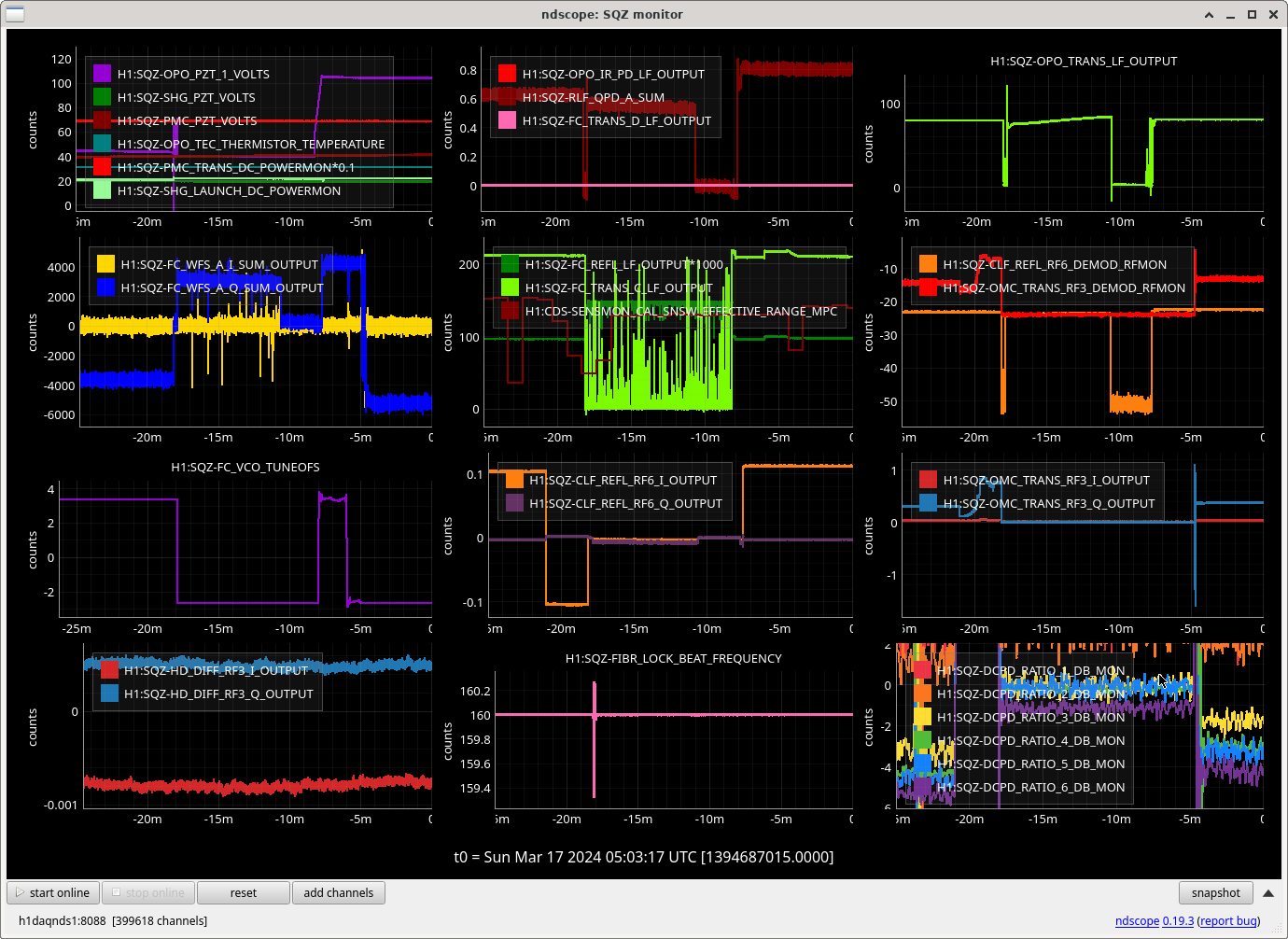
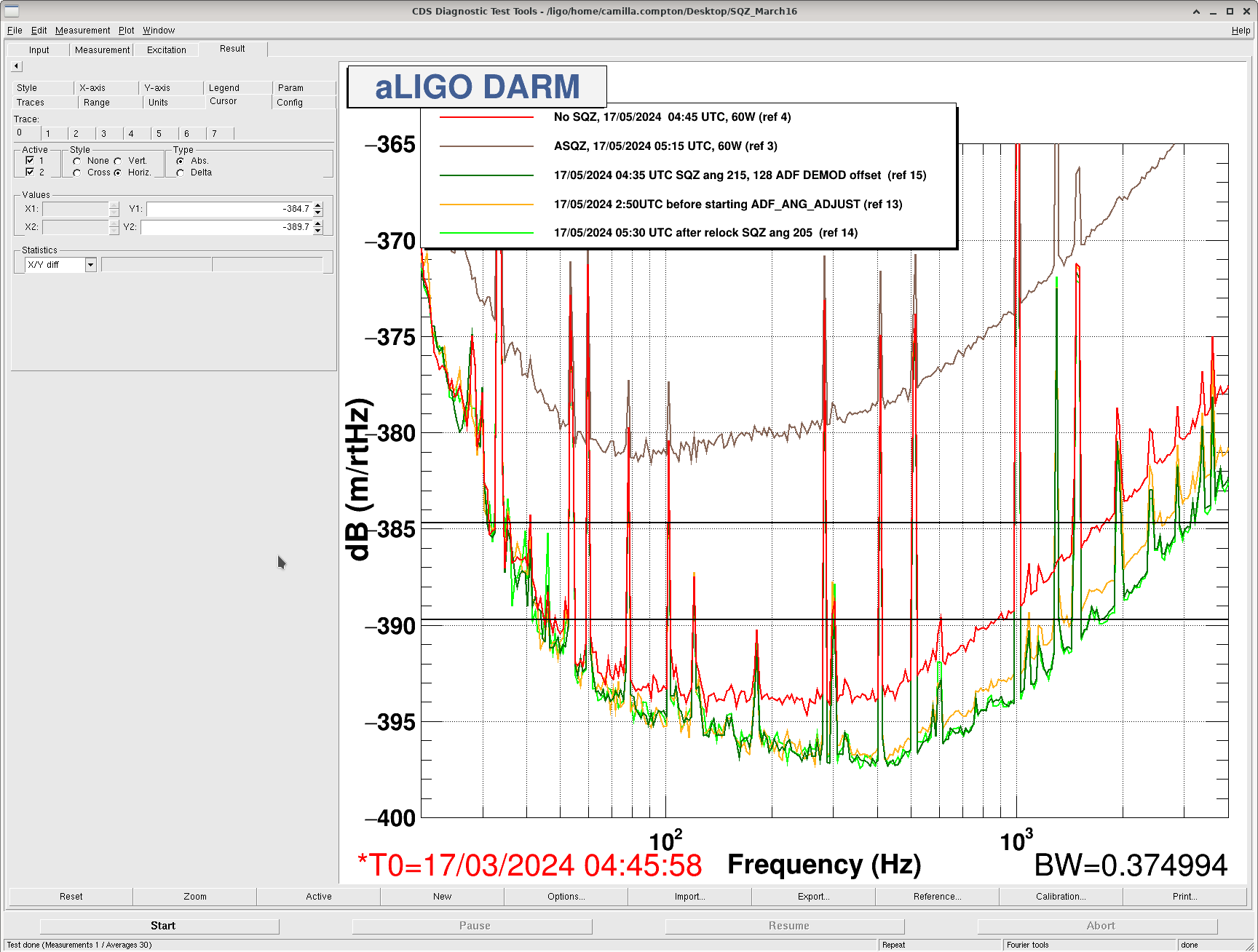
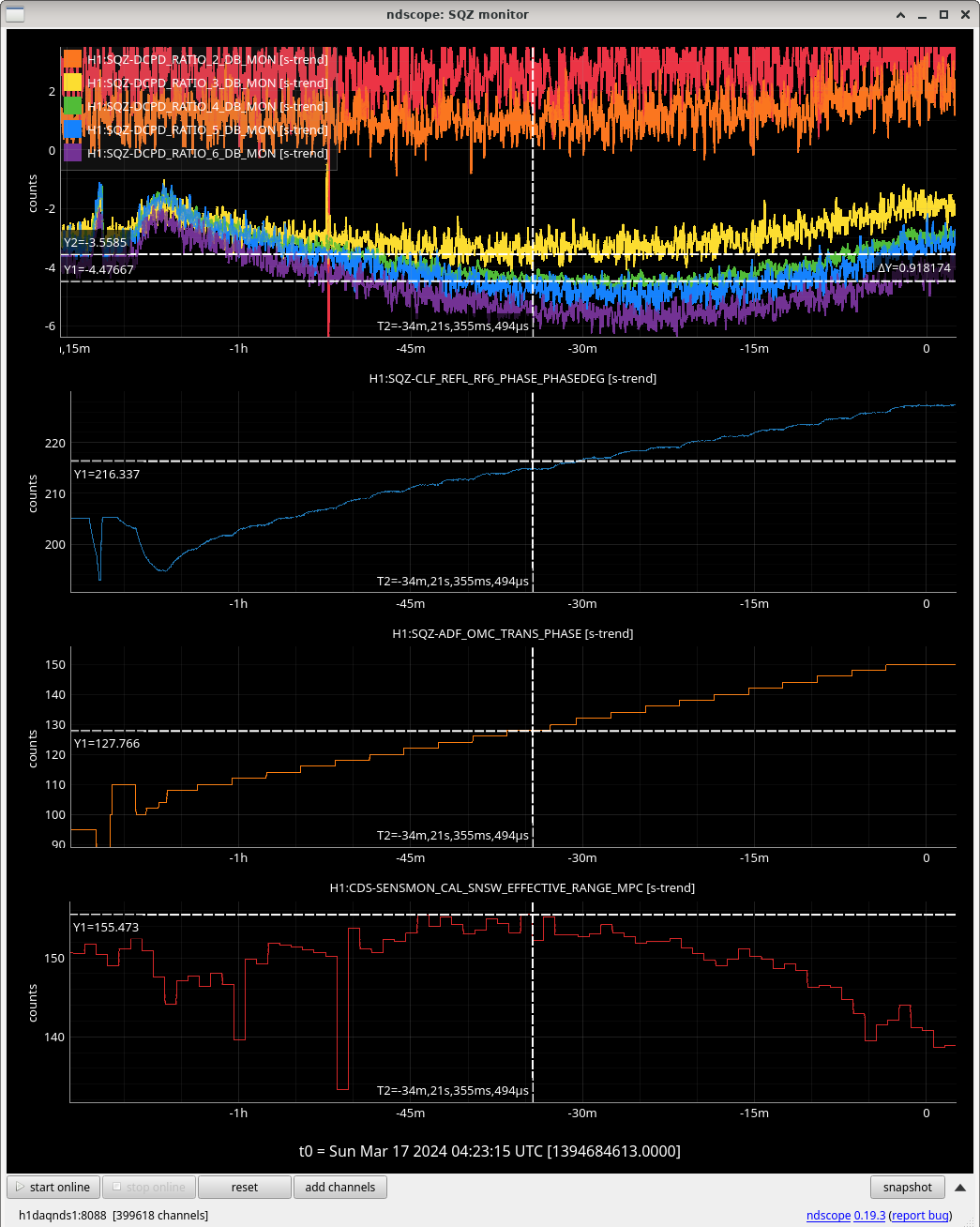
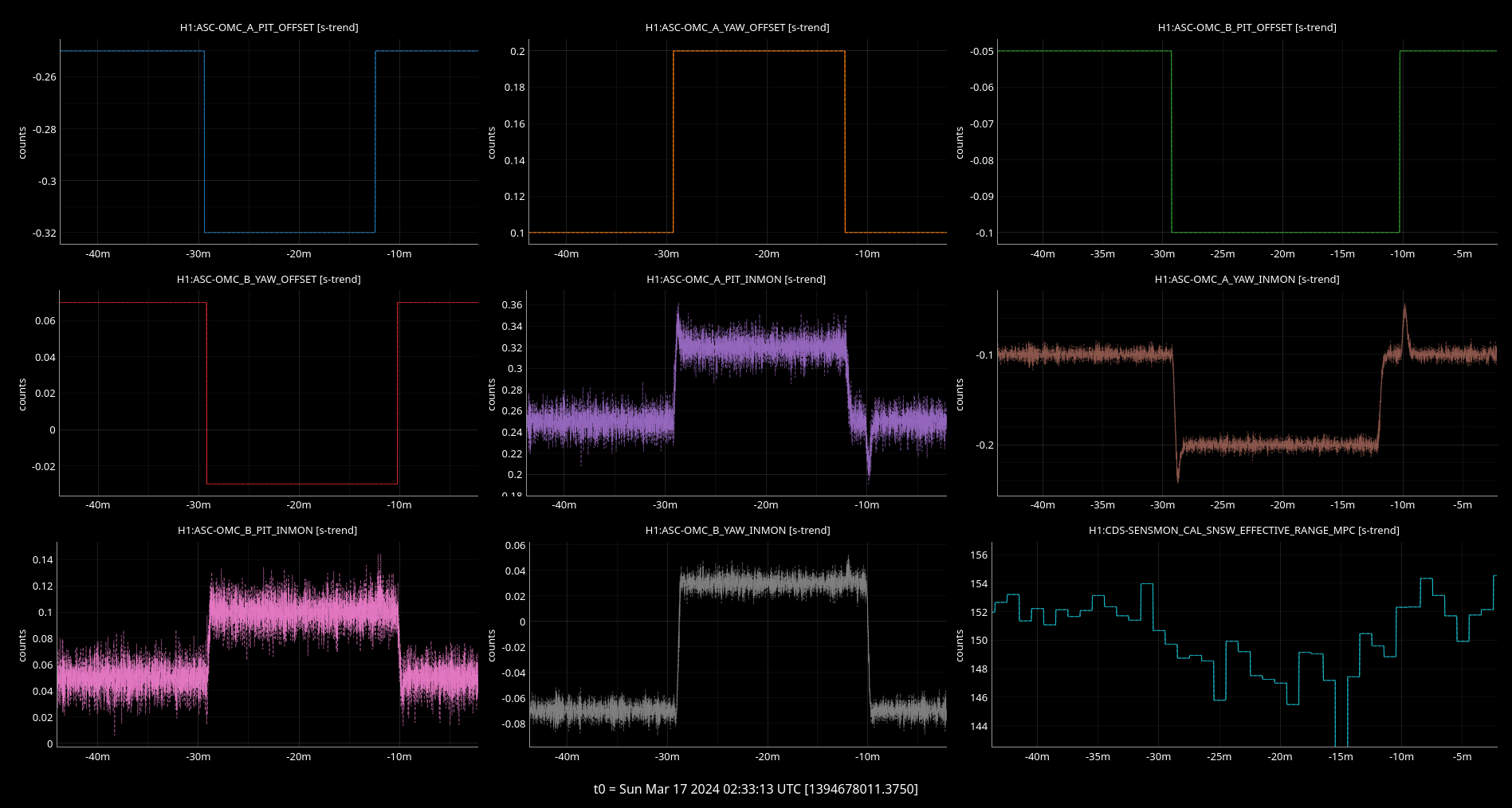
Summary: We have repeated the test from 73400, with our higher level of squeezing after the crystal move, and with the ASC off for squeezing angles other than squeezing. This seems to generally reproduce the results in that alog, convincing us that most of the rotation we are seeing is from the mode matching change not an alignment shift.
We have saved references in userapps/sqz/h1/Templates/dtt/DARM/PSAMS_tests_Oct202023.xml. This is a copy of PSAMS_tests_Oct112023.xml, with the references saved there and shown in alog 73400 The times written below are minimum times, for many of these references there is actually more time.
times (PSAMs 200/200):
set sqz angle back to sqz, turned AS42 and FC ASC, set PSAMs to 120/120 with 30 second ramp
times (PSAMS 120/120):
For PSAMS 120 vs. 200, adding in subtracted squeezing dBs data for this 20 Oct 2023 dataset (new crystal spot with more sqz, better controlled alignment), and from our initial dataset LHO:73400 12 Oct 2023 (before the crystal move so less sqz, ASC running the whole time). A model of unsqueezed quantum noise is used as the reference for the subtraction; relevant GWINC IFO parameters are in the plot title.
Now working on fitting the mode-mismatch amplitudes + phases to a GWINC quantum noise model.
Naoki, Vicky, Sheila, Camilla. WP 11470.
OPO Crystal Move
Following last time we moved the OPO crystal 65684, we used the wincam dell laptop and gray E-870 PI shift driver box (stored in LVEA SQZ cabinet) and the OPO crystal cable Daniel attached the the +X HAM7 flange. Adjusted OPO temperature from 31.684 degC to 31.804 degC for co-resonance while scanning rather than stationary.
To scan the OPO PZT fast enough, we used external function generator and Thorlabs driver at the racks for the OPO PZT to scan over more than 1 FSR (around 1-9V scan).
We were able to move the OPO crytal over its full range and found 6 spots with red/green co-resonance, attached pdf shows the places we moved. LLO found 10-13 potions which is surprisingly more than us, 73502.
Through O4 we've been using the 2nd posltion from the right, but left the crystal on the 2nd spot from the Left.
Photos attached of the PZT scan (yellow trace), OPO IR trans light measured on HD PDA (pink trace), Green trans from CLF path (green trace). The green alignment looked bad at all spots. This could be from misalignment of OPO path or HOMs present in fiber. When we next go into HAM7 we can look at this.
NLG Measurement
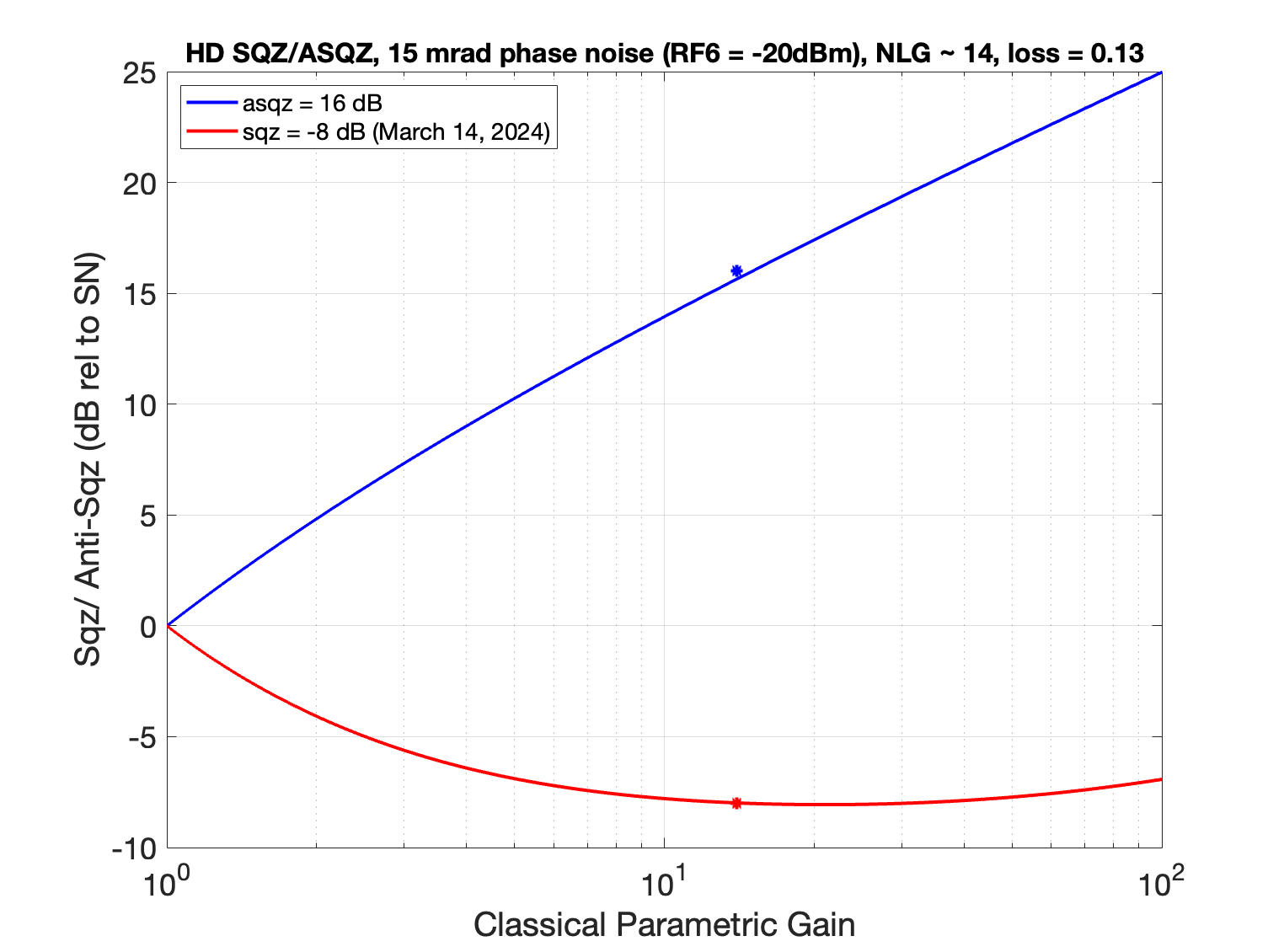
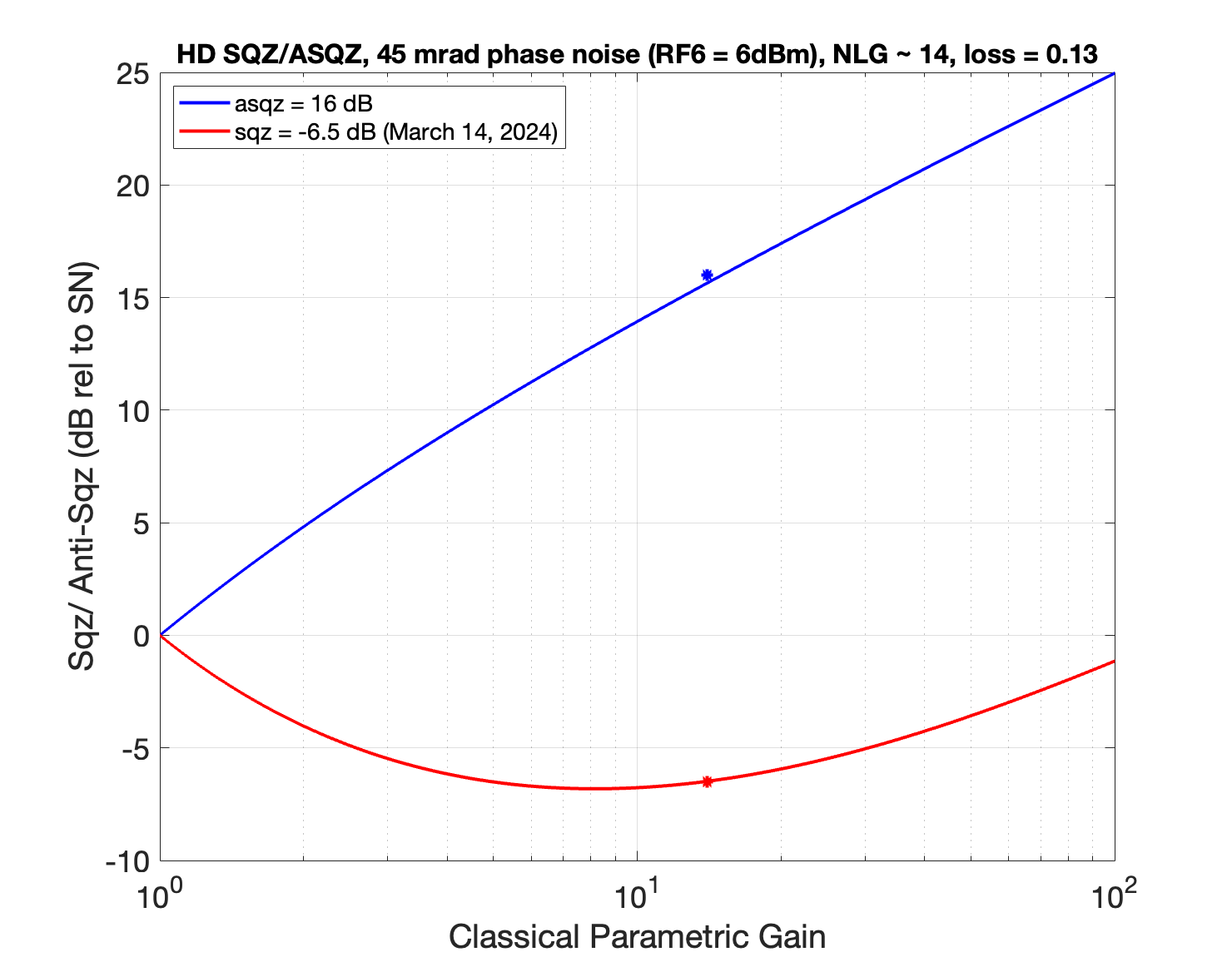
Turn down green pump power with SQZT0 wave plate to 4mW in to stop the OPO lazing. We measured NLG of 14 (OPO_IR_PD_LF_OUTPUT amplified / unamplifed = 0.0136/0.00092). This reduced to NLG of 12 over a few minutes.
Homodyne Measurement
We balanced the HD by reducing the seed power and realigned to maximize visibility. At start of measurement visibly was 14 and at the end it NLG was 12. Vicky, Sheila Naoki took Homodyne measurements which were hard with NLG drifting. Measured 4.5dB whihc is less than the 6dB measured last week 73376. But we think we could have offloaded the ASC alignments incorrectly to not see good SQZ on the HD.
SQZ in IFO
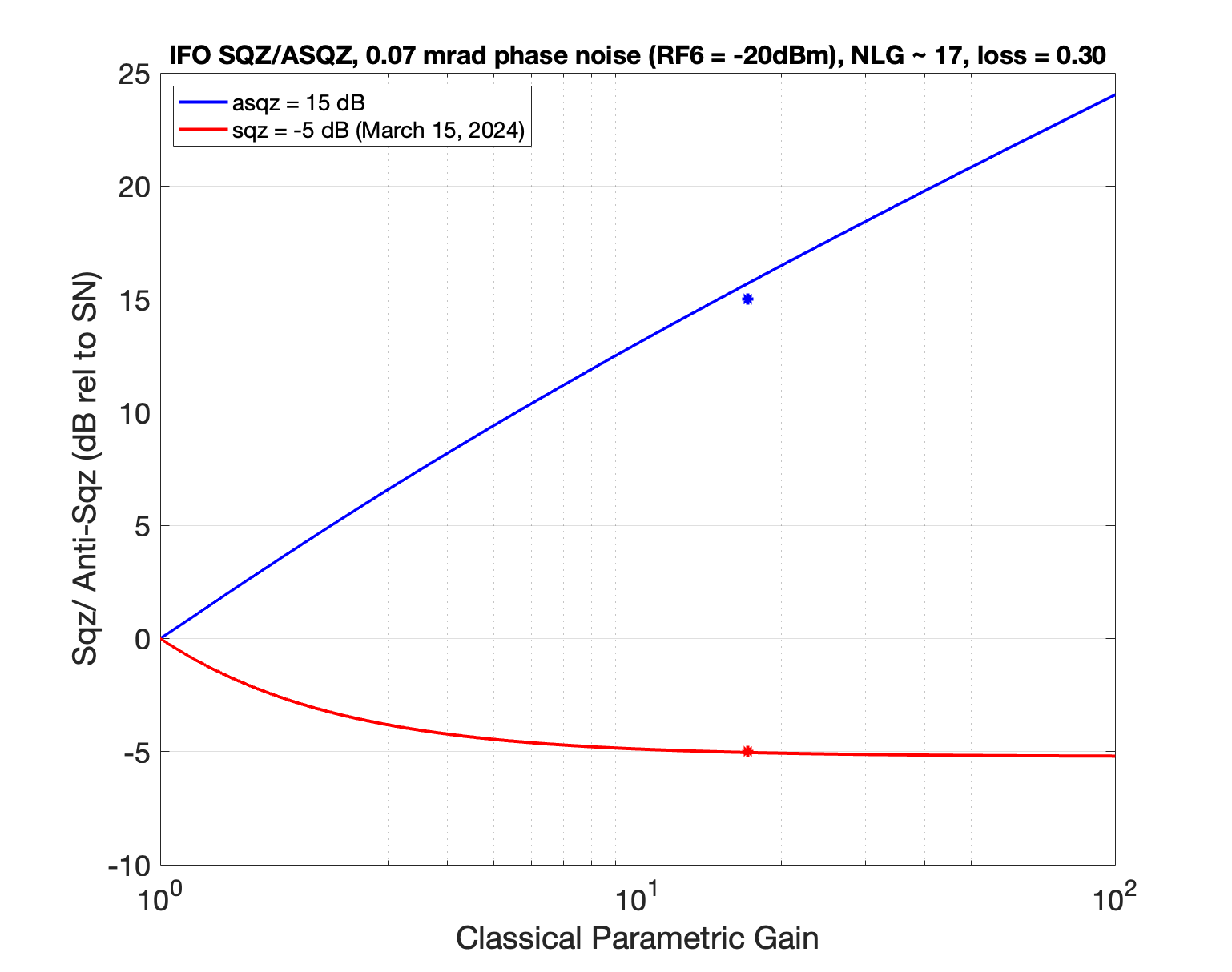
Ended with NLG of 13.5 into IFO. Amplified power of 0.0196, unamplified seed of 0.00149. Though this may be changing quickly.
Took some no sqz data while TJ tested updates to the Observing with No SQZ wiki. Accepted sdfs to go back into observing. Vicky adjusted OPO tempurature and had to adjust the SQZ angle from 142 to 163, squeezing looks better 4dB+ but we expect the angle and OPO tempurature may need to be adjusted over the next hours...
On the bad alignment of the green to the OPO shown in Camilla's photos of the scope:
We normally apply an offset to PZT1, which we were not doing this morning. This offset impacts the cavity alignment, as you can see in Vicky's screenshots from April 2022. 62856
Here are some past alogs showing an OPO cavity scan with the green transmission.
Dec 2022: 66527 (we should do a repeat of a scan like this now, with lowered green power and a slow scan, to see if things have really degraded).
April 2022: 62691
Sept 22 we swapped the CLF collimator.
With this new crystal position, we have more squeezing in DARM, at first briefly measuring ~4.8 dB SQZ at 2kHz! It has since settled to ~4.2dB in Observe. As Camilla said, this is with the 2nd spot from the left edge (5th from the right). The optimal OPO temperature will be changing as it settles into this new spot, so there we may need to tune co-resonance temperature over the next few days to re-optimize.
Just before injecting SQZ to the interferometer, with OPO trans = 80uW, NLG was measured as 13.15. We took some sqz/asqz/meansqz loss measurements, and will do subtraction using the following times. Measurements using dtt cursors:
Loss analysis and subtraction to follow.
NLG variation over an early ~6min of operating at this new spot is interesting. I think we see the crystal's green losses increasing rapidly. In the screenshot, the OPO was locked in green (~80uW green transmitted power, but no intensity stabilization so green power varied).
edited to include: NLG measured ~7 hours later in the lockloss. After ~4 hours with stabilized green trans = 80uW, the opo co-resonance changed from 31.638 degC to 31.617 degC, and we recovered the same NLG after tuning the temperature, so the interaction strength (probably also the red losses) did not degrade much in this time.
edited to include darm sqz 15 min after relocking: SQZ reached 4.8dB again after relocking; the darker bottom SQZ trace is taken ~15 minutes into this next lock. This is operating at the new spot for ~8 hours.
For these squeezed darms at the new crystal spot, here's adding in subtracted sqz data for these times of anti-squeezing, squeezing, and mean-squeezing (i.e. LO loop unlocked, sqz phase is unlocked from the IFO beam and spinning through all sqz angles).