Displaying reports 14981-15000 of 86441.Go to page Start 746 747 748 749 750 751 752 753 754 End
Reports until 11:00, Friday 20 October 2023
LHO VE
david.barker@LIGO.ORG - posted 11:00, Friday 20 October 2023 (73618)
Fri CP1 Fill

Fri Oct 20 10:11:27 2023 INFO: Fill completed in 11min 23secs

Gerardo confirmed a good fill curbside.

Images attached to this report
H1 PSL
ryan.crouch@LIGO.ORG - posted 08:50, Friday 20 October 2023 (73612)
PSL 10-day Trends

FAMIS 19998

The PMC_TRANS_OUTPUT looks like it may be slowly trending downwords, the PMC_TEMP_OUTPUT stepped up by about .4 on the 12th. Theres a spike in a lot of channels 3 days ago which was tuesday maintenance when Jason went in to realign the RefCav alog73513.

Images attached to this report
LHO VE
ryan.crouch@LIGO.ORG - posted 08:01, Friday 20 October 2023 - last comment - 09:16, Friday 20 October 2023(73611)
OPS Friday day shift start

TITLE: 10/20 Day Shift: 15:00-23:00 UTC (08:00-16:00 PST), all times posted in UTC
STATE of H1: Observing at 156Mpc
OUTGOING OPERATOR: Tony
CURRENT ENVIRONMENT:
    SEI_ENV state: CALM
    Wind: 3mph Gusts, 1mph 5min avg
    Primary useism: 0.03 μm/s
    Secondary useism: 0.36 μm/s
QUICK SUMMARY:

Comments related to this report
ryan.crouch@LIGO.ORG - 09:16, Friday 20 October 2023 (73614)

The VAC team will take care of the EX_BT_Manifold annulus ion pump issue this coming tuesday as it's not a pressing issue.

H1 General
oli.patane@LIGO.ORG - posted 00:00, Friday 20 October 2023 (73608)
Ops EVE Shift End

TITLE: 10/20 Eve Shift: 23:00-07:00 UTC (16:00-00:00 PST), all times posted in UTC
STATE of H1: Observing at 159Mpc
INCOMING OPERATOR: Tony
SHIFT SUMMARY: Quiet night overall. We're Observing and have now been Locked for 11hours 45mins.
LOG:

23:00UTC Detector in Commissioning and has been Locked for 4hrs

23:14 Trash truck put down trash bin loudly
23:16 Trash truck leaving site

00:44 Earthquake mode activated
00:54 Back to CALM

H1 PEM (DetChar)
oli.patane@LIGO.ORG - posted 21:39, Thursday 19 October 2023 (73607)
Noise pattern in OAF-RANGE_RLP_1

Tony and I noticed a strange pattern of noise that happened twice in close succession in the OAF-RANGE_RLP_1_OUTPUT BLRMs channel(bandpassed between 10-20Hz)(attachment1-red trace). It starts around 10/19 22:58UTC and ends at 23:08 before then repeating between 23:08 and 23:20.

We know that the garbage truck was onsite today and slammed a dumpster down at ~23:14 before leaving the site at 23:16, so we think this could be caused by the truck's movement onsite. The OAF-RANGE_RLP_{2,3,4}_OUTPUT BLRMs channels (20-34, 38-60, and 60-100Hz, respectively) all saw a spike at 23:14:41(attachment2-orange,yellow,green traces), and Lance's previous alog(72404) shows clear noise in GDS-CALIB_STRAIN up to ~50/60Hz.

However, this noise being caused by the truck would mean that the truck was onsite for 20 minutes, which seems way too long. Additionally, I did a quick look back at when the garbage truck was onsite from Lance's alog (08/24 and left at 23:05UTC), and although I did not see anything that looked similar during when the truck was onsite, I did find a similar-ish pattern that happened between 08/24 23:11 and 23:36UTC(attachment3-red trace), ten minutes after the truck would have left, meaning that the noise could not have been caused by the truck. But this could also be my brain trying to fit this random noise into a pattern that resembles the noise from today, so please take with a grain of salt.

Images attached to this report
H1 General
oli.patane@LIGO.ORG - posted 20:15, Thursday 19 October 2023 (73606)
Ops EVE Midshift Update

Observing at 160Mpc and have been Locked for 8 hours.

Everything is looking good and nothing to report.

H1 SEI
anthony.sanchez@LIGO.ORG - posted 16:39, Thursday 19 October 2023 (73604)
H1 ISI CPS Sensor Noise Spectra Check - Weekly FAMIS 25961

FAMIS 25961

Generating BSC pngs...

    
BSC high freq noise is elevated for these sensor(s)!!!
    
ITMX_ST2_CPSINF_H3    
ITMX_ST2_CPSINF_V1    
ITMX_ST2_CPSINF_V3    


Generating HAM pngs...
Merging pngs to final PDF

final PDF is attached

It looks like HAM7_CPSINF_V3 is elevated compared to the rest of the HAM spectras, but looking back to https://alog.ligo-wa.caltech.edu/aLOG/index.php?callRep=73295 HAM 7 seems to generally have more noise than the rest of the HAMs on that channel.

Non-image files attached to this report
LHO General
thomas.shaffer@LIGO.ORG - posted 16:07, Thursday 19 October 2023 (73589)
Ops Day Shift Summary

TITLE: 10/19 Day Shift: 15:00-23:00 UTC (08:00-16:00 PST), all times posted in UTC
STATE of H1: Observing at 161Mpc
INCOMING OPERATOR: Oli
SHIFT SUMMARY: Locked for 3.3 hours after losing lock with the same odd LSC-DARM wiggle (alog73592). On relock, the squeezer had an issue locking and Vicky needed to step in. All is well now.
LOG:

Start Time System Name Location Lazer_Haz Task Time End
15:38 FAC Karen Opt Lab n Tech clean 16:40
17:19 FAC Karen WoodShop N Technical cleaning in the Woodshop& Firepump rm 17:57
19:56 FAC Fil, Tyler EY n Chiller work 21:56
H1 General
oli.patane@LIGO.ORG - posted 16:05, Thursday 19 October 2023 (73603)
Ops EVE Shift Start

TITLE: 10/19 Eve Shift: 23:00-07:00 UTC (16:00-00:00 PST), all times posted in UTC
STATE of H1: Observing at 163Mpc
OUTGOING OPERATOR: TJ
CURRENT ENVIRONMENT:
    SEI_ENV state: CALM
    Wind: 10mph Gusts, 8mph 5min avg
    Primary useism: 0.06 μm/s
    Secondary useism: 0.43 μm/s
QUICK SUMMARY:

Locked for 4hours and Observing. Everything sounds normal but I'll keep an eye on the squeezer.

H1 DetChar (DetChar, PEM, SEI)
beverly.berger@LIGO.ORG - posted 15:47, Thursday 19 October 2023 (73601)
CS ground-motion noise bursts at 32 Hz visible in DARM

On 16 Oct, I noticed bursts of noise at about 32 Hz in the h(t) spectrogram on the LHO main Summary page. These noise bursts are circled in Fig. 1. They have appeared every day since then and appear to be growing more prominent. A specific burst at 15:30 will be used as an example and is shown in Fig. 2.

Fig. 3 shows the spectrum for 15 minutes around the noise burst (blue) of Fig. 2 compared to the previous 15 minutes with no noise burst (orange). The spectral feature is clearly associated with the noise burst.

Previous Summary Pages show these noise bursts from time to time. Previous significant aLog mentions just prior to ER15 of 32 Hz noise are here [LSC feedback-related peaks have been visible in DARM at 32Hz and 40Hz. it was demonstrated that they could be removed by notch filters in MICH servo] with a follow up here [Identifying the moment when the 32Hz peak couples to MICH (POP45)]. These aLogs contained spectra which matched those in Fig. 3  and also pointed to ASC MITCH CONTROL. Fig. 4 shows that the noise bursts in ASC MITCH Pitch control appear at the same times and at the same frequency as in h(t). While Fig. 4 shows the pitch component, the yaw component looks the same.

Several of the CS ACC channels visible on the Summary Pages had noise bursts at the same times and frequency as DARM. They are (using the Summary Page designation): LVEA floor motion [HAM1, Y], HAM2 Z, HAM3 Y, HAM4 X, HAM6 Z , BS X FLOOR, BS Y FLOOR, BS Z FLOOR, HAM1 Y FLOOR, HAM6 Z FLOOR, PSL TABLE X,Y, and Z, PSL  Periscope.

Spectrograms comparing the noise burst of Fig. 2 in h(t)  to spectrograms of the HAM1 floor accelerometers were made using the same color range for the ACC channels. The comparison using the Y component is shown in Fig. 5. The turquoise lines point to the ends of the burst in both spectrograms. The noise burst is not visible for the X component while, though strong, there is less contrast for the Z component because the ambient noise level is much higher. There is no evidence that the noise burst is stronger in the HAM1 ACCs than in the other ACCs. It has just been used as an example.

This aLog has used several normalized spectrograms. This means that an apparently stronger noise burst from day to day might just indicate lower ambient noise. This is demonstrated in Fig. 6 comparing the spectrum including a noise burst on 2023-10-16 15:25:00 (orange) to one at 2023-10-19 11:05:00 (blue). The later time shows a very comparable peak amplitude at 32.25 Hz but lower ambient noise.

Images attached to this report
H1 CDS
david.barker@LIGO.ORG - posted 14:08, Thursday 19 October 2023 - last comment - 15:35, Thursday 19 October 2023(73596)
Picket Fence restarted, added back in PNSNDATA stations in WA and OR

The problem was due a remote server restart, which has now been resolved. I have added the two pnsndata stations (OTR and LAIR) back into the code and restarted Picket Fence at 14:00. Note that the map is now back to full scale.

Images attached to this report
Comments related to this report
edgard.bonilla@LIGO.ORG - 15:35, Thursday 19 October 2023 (73602)SEI

Good to know, thanks for the update Dave.

H1 SQZ
victoriaa.xu@LIGO.ORG - posted 19:03, Wednesday 18 October 2023 - last comment - 15:29, Monday 20 November 2023(73562)
NLG HD sweep, HD mystery losses fully resolved, ~8dB HD SQZ with new crystal spot

Naoki, Sheila, Camilla, Vicky

Summary: After yesterday's crystal move LHO:73535, we re-aligned SQZT7, and now see 8 dB SQZ on the homodyne, up to measured NLG=114 without a phase noise turnaround! This fully resolves the homodyne loss budget, there is 0 mystery loss remaining on the homodyne, from which we can infer 0 mystery losses in HAM7. Back to the IFO afterwards, after 1 day at this new crystal spot, squeezing in DARM is about 4.5dB - 4.8dB, reaching almost 5dB at the start of lock.

We first re-aligned the homodyne to the IFO SQZ alignment, which reached 4.8dB SQZ in DARM yesterday, so we are more confident the alignment back through the VOPO is not clipping. In yesterday's measurements, we had a sign error in the FC-ASC offloading script, which brought us to a bad alignment with limited homodyne squeezing, despite high 98% fringe visibilities. Attached is a screenshot of homodyne FC/ZM slider values with FC+SQZ ASC's fully offloaded (correctly), to which the on-table SQZT7 homodyne is now well-aligned. After Sheila re-aligned the homodyne to the screenshotted FC/ZM values, fringe visibilities are PD1 = 98.5% (loss 3.1%), PD2 = 97.8% (loss 4.2%).

We then did an NLG sweep on the homodyne, from NLG=2.4 (opo trans 20uW) to NLG=114 (opo trans 120uW). Measurements below and attached as .txt, DTT is attached, plots to follow.

-------------------------------------------------------------------------------------------------------------------------------------------------------------------------------------------

unamplified_ir = 0.0014 (H1:SQZ-OPO_IR_PD_LF_OUT_DQ with pump shuttered)

NLG = amplified / unamplified_ir (opo green pump un-shuttered)

@80uW pump trans, amplified = 0.0198 (at start, 0.0196 at end) --> NLG 0.0198/0.0014 ~ 14

@100uW pump trans, amplified = 0.0046 (at start, 0.0458 at end) --> NLG 0.046/0.0014 = 33

@120uW pump trans, amplified = 0.16 --> NLG 0.16/0.0014 = 114

@60uW pump trans, amplified = 0.011 (at start, 0.0107 at end) --> NLG = 7.86

@40uW pump trans, amplified = 0.0059 (at start, 0.0059 at end) --> NLG = 4.2

@20uW pump trans, amplified = 0.0034 (at start, --- at end) --> NLG = 2.4

trace reference opo_green_trans
(uW)
NLG SQZ dB CLF RF6 demod angles (+)
LO shot noise @ 1.106 mA, -136.3 dB 10 80 14    
Mean SQZ 11     +13  
SQZ 12     -8.0 162.0
ASQZ 13     +16 245.44
NLG=33   100 33    
Mean SQZ 14     +16.7  
SQZ 15     -8.0 170.5
ASQZ 16     +19.9 237.85
NLG = 114   120 114    
Mean SQZ 17     +22.5  
SQZ 19     -8.0 177.98
ASQZ 18     +25.6 230.13
NLG = 7.9   60 7.9    
Mean SQZ 20     +9.7  
SQZ 21     -7.7 154.28
ASQZ 22     +12.4 253.83
NLG = 4.2   40 4.2    
LO SN check 4       ~0.1dB lower?
Mean SQZ 23     +6.8  
SQZ 24     -6.3 140.6
ASQZ 25     +9.6 262.64
NLG = 2.4   20 2.4    
Mean SQZ 26     +3.8  
SQZ 27     -4.8 135.45
ASQZ 28     +6.3 -100.5
LO shot noise @ 1.06 mA, 29        

All measurements had PUMP_ISS engaged throughout; we manually tuned the ISS setpoint for different NLGs. For low NLG (20uW trans) we manually engaged ISS. LO power (shot noise) drifted ~5% over the measurement, see trends.

NLG Sweep Procedure:

DTT saved in $(userapps)/sqz/h1/Templates/dtt/HD_SQZ/HD_SQZ_8dB_101823_NLGsweep.xml

Images attached to this report
Non-image files attached to this report
Comments related to this report
victoriaa.xu@LIGO.ORG - 11:06, Thursday 19 October 2023 (73581)

Using Dhruva's nice plotting code for NLG sweeps from LHO:67242, here are some plots of squeezing vs. NLG, and calibrating the OPO lasing threshold and various green powers at this new crystal spot. Data & updated plotting code attached.

NLG sweep data summary here:

SHG Launched (mW) OPO Green Refl (mW) OPO Green Trans (uW)  NLG 
 
Mean SQZ (dB) SQZ (dB) Anti-SQZ (dB)
10.8 1 80 14 13 -8.0 16
13.3 1.3 100 33 16.7 -8.0 19.9
16 1.5 120 114 22.5 -8.0 25.6
8.4 0.8 60 7.9 9.7 -7.7 12.4
5.9 0.6 40 4.2 6.8 -6.3 9.6
3.5 0.4 20 2.4 3.8 -4.8 6.3

To-do: Look into the fits of loss & technical noise.

  • Technical noise here fits to -8.8dB below LO shot noise @ 1.1mA (-136dB, dark noise @ -159dB) -- check this is correct/real. For reference with the old homodyne PD in Feb 2023, LHO:67223 with 5.5dB sqz, technical noise fit to -9.6dB below LO shot noise @ 1.08mA (calibration suspect, HD_DIFF_DC_OUT was around -134-135dB, dark noise @ - 157dB). Would be interesting if this about -10dB technical noise below shot noise on the homodyne is real technical noise injection from the squeezer, and/or if it can be improved with upcoming squeezer laser PMC installation.
  • Loss estimate from NLG sweep - our homodyne loss budget accounts for 13% losses (after scaling back all over-estimations of losses), but this sweep fits to 7% losses, so we should resolve this over-estimated loss discrepancy.
Non-image files attached to this comment
michael.zucker@LIGO.ORG - 14:58, Thursday 19 October 2023 (73599)

Outstanding work, well done!

victoriaa.xu@LIGO.ORG - 15:29, Monday 20 November 2023 (74319)

Attached here is a re-fitting of this homodyne NLG sweep, which fits [loss, phase noise, technical noise] to measured SQZ+ASQZ, given measured NLG. It also shows the calculated loss from measured mean-sqz and NLG (which relies on accurate calibration of NLG --> generated SQZ dB). The same fitting was done for NLG sweeps on DARM the following week LHO:73747.

The previous anlaysis was fitting [phase noise, technical noise] using the loss calcuated from mean-squeezing. Compared to the earlier analysis, I think these fits here are closer. 

We budgeted 13% HD loss for this homodyne measurement:  1 - [0.985(opo) * 0.96(ham7) * 0.98(sqzt7 optics) * 0.977(HD PD QE) * 0.96((visibility~98%)**2)] = 13%.

This fit to the NLG HD sweep suggests ~11% homodyne loss, 7 mrad rms phase noise, with technical noise about -10 dB below 1.1 mW LO shot noise. Note HD dark noise is -22 dB below shot noise, suggesting mystery technical noise on the homodyne.

Images attached to this comment
H1 OpsInfo (SEI)
thomas.shaffer@LIGO.ORG - posted 15:43, Wednesday 18 October 2023 - last comment - 14:55, Thursday 19 October 2023(73569)
Temporarily increased the SEI_ENV transition to earthquake threshold

With high primary and secondary useism the SEI_ENV node has been transitioning to earthquake mode based on higher peakmon (H1:ISI-GND_STS_CS_Z_EQ_PEAK_OUTMON) signals, but not due to an actual earthquake. I've raised this threshold from 600 to 850 for now. It looks like the waves should calm down in about a day so I'll plan to revert this tomorrow.

Comments related to this report
jim.warner@LIGO.ORG - 14:55, Thursday 19 October 2023 (73597)

TJ reverted this threshold earlier today. Around the same time (11:22pst) I made a change to the filter used for the peakmon calibration, that should reduce the confusion between microseism and earthquakes.

First picture show 3 ground spectra, red is a more normal frequency higher microseism time on the 16th, blue is a spectra take when both the primary and secondary microseism were elevated from a large mass of wave activity right off the coast and pink is a largish eq from a couple days ago. On the blue spectra  the .1-.3hz peak has spread down to 80 or 90mhz, and was bleeding into the band peakmon uses.

Second image compares the bandpass peakmon was using to the one I installed today. Blue is the new filter, a cheby1 lowpass with a zpk([0],[.015],1) high pass, green is the old total filter. The problem this week with the old filter was the higher primary microseism peak at 50-60 mhz and the broader peak around .1-.3hz extending down to  80mhz. The blue filter should greatly reduce the chance of that secondary peak confusing the SEI guardians.Rise time for this filter is important, and the blue filter has some lower frequency poles than the green, but the foton step response for the filters isn't dramatically different. The new filter takes a couple seconds longer to respond, but that should be easy to tweak.

 We've already had one successful earthquake transition about an hour after I changed the filter. Wave forecasts for next week suggest more high microseism starting this next Tues-Wed.

Images attached to this comment
H1 ISC (DetChar)
siddharth.soni@LIGO.ORG - posted 13:47, Wednesday 18 October 2023 - last comment - 05:58, Friday 20 October 2023(73564)
ETMX Oplev BRDF comparison between 75 W and 60 W power

Peter, Sidd

Counts_to_volts = 40/2^16

Transimpedance = 20,000

Responsivity = 0.35

Oplev_from_ETMX = 5.6 m

Diode_area = 10x10 mm^2

Angle_from_test_mass = 7.6 degrees

Power_scatter = Counts x Counts_to_volts x (1/Responsivity) x (1/Transimpedance)

Solid_angle = diode_area/(Oplev_from_ETMX)^2

BRDF = Power_scatter/(Arms_Power x solid_angle x cos(angle_from_test_mass) )

I compared the ETMX Oplev BRDF between the 75 W and 60 W configuration. The details are below, the first three days are when LHO operated with 75 W and the last three days are with 60 W input power. I do not find any significant change in the ETMX Oplev BRDF. 

Date

Power (KW)

Counts

Power_Scatter (µW)

BRDF

2023-06-05

430.7 

4960

432.4 

3.18e-4

2023-06-07

439.2 

4964

432.8

3.12e-4

2023-06-14

434.24

5016

437.3

3.19e-4

2023-07-28

370.1

4243

370

3.16e-4

2023-08-10

364

4177

364.2

3.17e-4

2023-08-13

368.4

4206

366

3.14e-4


The calculation is in the notebook

Comments related to this report
siddharth.soni@LIGO.ORG - 05:58, Friday 20 October 2023 (73610)

Just to clarify, the Counts term in the Power_scatter is the difference in the Oplev counts between locked and unlocked ifo.

LHO VE (VE)
gerardo.moreno@LIGO.ORG - posted 01:29, Wednesday 18 October 2023 - last comment - 10:26, Friday 20 October 2023(73545)
GV8 Annulus Ion Pump Failure

Today at 4:45 UTC the annulus ion pump for GV8 went down to zero-ish, not a common failure, perhaps the ion pump controller failed, we (vacuum group) will take a look at the system as soon as permissible.

Images attached to this report
Comments related to this report
gerardo.moreno@LIGO.ORG - 09:50, Friday 20 October 2023 (73615)VE

Late entry.

On Wednesday I had the opportunity to investigate the failure of the annulus ion pump, IFO was out of lock.  The controller for the annulus ion pump did not show signs of power, the front display lights were off, see photo.  Replaced the controller, and the system started working again.  However, the signal for the current was a bit unusual, on a plot of the past 10 years the signal never reached such a low level, see attached plots.

Images attached to this comment
gerardo.moreno@LIGO.ORG - 10:26, Friday 20 October 2023 (73616)VE

And today the AIP railed high.  Pump to be changed next Tuesday.

Images attached to this comment
H1 ISC (AWC, DetChar-Request, ISC)
keita.kawabe@LIGO.ORG - posted 15:09, Tuesday 10 October 2023 - last comment - 15:27, Thursday 19 October 2023(73367)
OM2/beckhoff coupling no light test (Daniel, Keita)

To see if the OM2/beckhoff coupling is a direct electronics coupling or not, we've done A-B-A test while the fast shutter was closed (no meaningful light on the DCPD).

State A (should be quiet): 2023 Oct/10 15:18:30 UTC - 16:48:00 UTC. The same as the last observing mode. No electrical connection from any pin of the Beckhoff cable to the OM2 heater driver chassis. Heater drive voltage is supplied by the portable voltage reference.

State B (might be noisy): 16:50:00 UTC - 18:21:00 UTC. The cable is directly connected to the OM2 heater driver chassis.

State A (should be quiet): 18:23:00- 19:19:30 UTC or so.

DetChar, please directly look at H1:OMC-DCPD_SUM_OUT_DQ to find combs.

It seems that even if the shutter is closed, once in a while very small amount of light reaches DCPDs (green and red arrows in the first attachment). One of them (red arrow) lasted long and we don't know what was going on there. One of the short glitches was caused by BS momentarilly kicked (cyan arrow) and scattered light in HAM6 somehow reached DCPDs, but I couldn't find other glitches that exactly coincided with optics motion or IMC locked/unlocked.

To give you a sense of how bad (or not) these glitches are, 2nd attachment shows the DCPD spectrum of a quiet time in the first State A period (green), strange glitchy period indicated by the red arrow in the first attachment (blue), a quiet time in State B (red) and during the observing time (black, not corrected for the loop).

FYI, right now we're back to State A (should be quiet). Next Tuesday I'll inject something to thermistors in chamber. BTW 785 was moved in front of the HAM6 rack though it's powered off and not connected to anything.

Images attached to this report
Comments related to this report
ansel.neunzert@LIGO.ORG - 10:25, Monday 16 October 2023 (73498)

I checked H1:OMC-DCPD_SUM_OUT_DQ and don't see the comb in any of the three listed intervals (neither state A nor B). Tested with a couple of SFT lengths (900s and 1800s) in each case.

keita.kawabe@LIGO.ORG - 17:19, Tuesday 17 October 2023 (73527)DetChar-Request

Since it seems that the coupling is NOT a direct electronics coupling from Beckhoff -> OM2 -> DCPD, we fully connected the Beckhoff cable to the OM2 heater driver chassis and locked the OMC to the shoulder with an X single bounce beam (~20mA DCPD_SUM, not 40mA like in the usual nominal low noise state). That way, if the Beckhoff is somehow coupling to OMC PZT that might cause visible combs in the DCPD.

We didn't see the comb in this configuration. See the 1st attachment, red is the shoulder lock and green is when 1.66Hz comb was visible with the full IFO (the same time reported by Ansel in alog 73000), showing just two largest peaks of 1.66Hz harmonics visible in the green trace. (It seems that the 277.41Hz and 279.07 Hz peak are 167th and 168th harmonics of 1.66Hz.) Anyway, because of the higher noise floor, even if the combs are there we couldn't have seen these peaks. We've had a different comb spacing since then (alog 73028) but anyway I don't see anything at around 280Hz. FYI I used 2048 FFTs for both, red is a single FFT and the green is an average of 6. This is w/o any normalization (like RIN).

In the top panel of 2nd attachment, red is the RIN of OMC-DCPD_SUM_OUT_DQ of the shoulder lock, blue and dark green are RIN of 2nd loop in- and out-of-loop sensor array. Magenta, cyan and blue green are the same set of signals when H1 was in observing last night. Bottom panel shows coherence between DCPD_SUM during the shoulder lock and ISS sensors as well as IMC_F, which just means that there's no coherence except for high kHz.

If you look at Georgia's length noise spectrum from 2019 (alog 47286), you'll see that it's not totally dissimilar to our 2nd plot top panel even though Georgia's measurement used dither lock data. Daniel points out that a low-Q peak at around 1000Hz is a mechanical resonance of OMC structure causing the real length noise.

Configurations: H1:IMC-PWR_IN~25.2W. ISS 2nd loop is on. Single bounce X beam. DCPD_SUM peaked at about 38mW when the length offset was scanned, and the lock point was set to the middle (i.e. 19mA). DC pointing loops using AS WFS DC (DC3 and DC4) were on. OMC QPD loops were not ON (it was enabled at first but was disabled by the guardian at some point before we started the measurement). We were in this state from Oct/17/2023 18:12:00 - 19:17:20 UTC.

Images attached to this comment
Non-image files attached to this comment
keita.kawabe@LIGO.ORG - 17:25, Tuesday 17 October 2023 (73536)DetChar-Request

BTW Beckhoff cable is still fully connected to the OM2 heater driver chassis. This is the first observation data with such configuration after Fil worked on the grounding of Beckhoff chassis (alog 73233).

Detchar, please find the comb in the obs mode data starting Oct/17/2023 22:33:40 UTC.

ansel.neunzert@LIGO.ORG - 11:31, Wednesday 18 October 2023 (73555)

The comb indeed re-appeared after 22:33 UTC on 10/17. I've attached one of the Fscan daily spectrograms (1st figure); you can see it appear in the upper right corner, around 280 Hz as usual at the start of the lock stretch.

Two other notes:

  • The comb is now back to its original spacing of 1.6611 Hz.
  • There are new strong lines visible at +/- 1.235 Hz from the comb teeth. If this structure has appeared before, I'm not aware of it. I've attached an image showing the lines (2nd figure, average of DMT-ANALYSIS_READY data between 22:00 10/17 and 02:00 10/18) and a comparison with older data from Sept 20th (3rd figure).
Images attached to this comment
keita.kawabe@LIGO.ORG - 13:29, Wednesday 18 October 2023 (73563)DetChar-Request

Just to see if anything changes, I used the switchable breakout board at the back of the OM2 heater driver chassis to break the thermistor connections but kept the heater driver input coming from the Beckhoff. The only two pins that are conducting are pins 6 and 19.

That happened at around Oct/18/2023 20:18:00 to 20:19-something UTC when others were doing the commissioning measurements.

Detchar, please look at the data once the commissioning activities are over for today.

ansel.neunzert@LIGO.ORG - 14:04, Thursday 19 October 2023 (73595)

Because there was an elevated noise floor in the data from Oct/17/2023 18:12:00 mentioned in Keita's previous comment, there was some doubt as to whether the comb would have been visible even if it were present. To check this, we did a direct comparison with a slightly later time when the comb was definitely present & visible. The first figure shows an hour of OMC-DCPD_SUM_OUT_DQ data starting at UTC 00:00 on 10/18 (comparison time with visible comb). Blue and yellow points indicate the comb and its +/-1.235 Hz sidebands. The second figure shows the time period of interest starting 18:12 on 10/17, with identical averaging/plotting parameters (1800s SFTs with 50% overlap, no normalization applied so that amplitudes can be compared) and identical frequencies marked. If it were present with equivalent strength, it looks like the comb ought to have been visible in the time period of interest despite the elevated noise floor. So this supports the conclusion that the comb *not* present in the 10/17 18:12 data.

Images attached to this comment
ansel.neunzert@LIGO.ORG - 15:27, Thursday 19 October 2023 (73600)

Following up, here's about 4 hours of DELTAL_EXTERNAL after Oct 18 22:00. So this is after Keita left only the heater driver input connected to the Beckhoff on Oct/18/2023 20:18:00. The comb is gone in this configuration.

Images attached to this comment
H1 SQZ
sheila.dwyer@LIGO.ORG - posted 17:08, Thursday 31 August 2023 - last comment - 17:55, Thursday 19 October 2023(72604)
SQZ loss measurements on SQZT7

Vicky and I went to SQZT7 while calibration work was happening, to follow up on some of our observations from 72525 (and Vicky's comment). 

Polarization issue:

​​​​​​​With the seed dither locked, we placed a PBS before the half wave plate in the homodyne sqz path and measured 67.2uW transmitted (vertical pol) and 750uW reflected (horizontal) (817uW total, 8% in the wrong polarization, 16.5 degrees polarization rotation).  After the half wave plate we measured 5.48uW transmission through the PBS (vertical) and 802uW reflected (horizontal) ( 807uW total, 0.7% in the wrong polarization, polarization less than 5 degrees away from horizontal).  We also placed the PBS right at the bottom of the periscope, and there measured 70uW transmitted and 820uW before the PBS was inserted (8.5% in the wrong polarization, 17 degrees polarization rotation away from horizontal).  This would not limit the squeezing measured on the homodyne since we are able to correct it with the HWP, but measuring the same polarization rotation at the bottom of the periscope suggests that the beam could be coming out of HAM7 with this polarization error, which would look like an 8% loss to the squeezing level in the IFO. 

In Sept 2022, during the vent for the OM2 swap, we measured the throughput of the seed beam from HAM7 to HAM6 65110, which agreed well with the only loss between HAM7 and HAM6 being the 65.6% reflectivity of SRM, and suggests that there was not an 8% loss in the OFI at that time. 

Loss on SQZT7 (not bad):

Comparing the total power measurements here, we have 820uW at the bottom of the periscope, and 807uW measured right before the homodyne, so we have something like 1.6% loss on SQZT7 optics (small compared to the type of loss we need to explain our squeezing level).  

Seed transmitted power over reflected power ratio has dropped:

We also measured the seed power reflected from the OPO, so that we could compare the ratio of transmitted to reflected seed measured at the time of the squeezer installation in HAM7 in Feb 2022: 61904 (3.9% trans/refl). Today we saw 0.82mW seed transmitted, and 27mW of reflected seed at the bottom of the periscopes (3.03% trans/refl).  This is 78% of the ratio measured at installation.  Because this seems like a large drop, we repeated the measurement twice more, and got 3% each time.  We also checked that the dither lock is locking at the maximum seed transmission.  

Homodyne PD QE check (QE of PDB might be low):

We used an Ophir which was calibrated in 2018 to measure the LO power onto the homodyne PDs, the filter and head are SN 889882 and the controller is SN 889428.  For PDA we saw 0.6mW, for PDB we saw 0.63mW.

Both the PDs are calibrated into mA in the front end, which includes anti-gain of gain(0.25)gain(0.22027), transimpedance of 0.001 (1kOhm), two anti-whitening filters (and cnts2V and mA factors).  For PDA there is a fudge factor in the filter gain, if we divide this out, the readback is that the PDA photocurrent was 0.512mA, and 0.5126mA for PDB (with a drift of 0.5% over the measurement time).  This gives a responsivity of 0.855A/W for PDA and 0.813A/W for PDB.  For QE of 1, the responsivity would be e lambda/(h c) = 0.8582 A/W, so our measurement is 99.6% QE of PDA, and 95% QE for PDB.  (See Vicky measured higher reflection off PDB than PDA in 63893 and Haocuns' measurement in 43452).  

Comments related to this report
sheila.dwyer@LIGO.ORG - 11:03, Tuesday 05 September 2023 (72678)

Above I mixed up vertical and horizontal polarization.  The LO beam arriving at the homodyne is vertically polarized, as well as the seed beam coming out of the chamber. 

Revisiting old alogs about the seed refl/trans (throughput) measurement:

In the first installation Feb 2022, The refl/trans ratio was measured as 4% Feb 24th 61904, and the ratio of IR trans arriving on SQZT7 to right after the OPO was 95% measured Feb 10th 61698

When the CLF fiber was swapped this measurement was redone: 64272  There we didn't measure CLF refl, but combining the measurements of 37mW out of fiber and 8mW rejected we can expect 29mW CLF refl.  With 0.81mW reaching HAM7 this was a 2.8% ratio of refl/trans.  This is worse than at the inital installation but similar to what Vicky and I measured last week.  But, this alog also indicated 95% transmission from right out of the OPO to SQZT7.  So this second measurement is consistent with the one we made last week, and would indicate no excess losses in HAM7 compared to that time. 

victoriaa.xu@LIGO.ORG - 17:55, Thursday 19 October 2023 (73605)

Polarization rotation is only an on-table problem for SQZT7, not an issue for IFO. It can be attributed to the SQZT7 persicope. To close the loop, see LHO:73537 for Don's latest CAD layout with the squeezer beam going to SQZT7 at a 14.4 degree angle (90-75.58) from +Y. SQZT7 periscope re-directs the beam to travel basically along +Y.

H1 SQZ (SQZ)
victoriaa.xu@LIGO.ORG - posted 10:11, Tuesday 24 January 2023 - last comment - 16:00, Thursday 19 October 2023(66946)
Omc mode scans of sqz beam to explore sqz-omc mode-matching

Dhruva, Jenne, Craig, Naoki, Vicky

Summary: ZM4/5 PSAMS at 200V seems to continue improving SQZ-OMC mode-matching, when OMC is held at a spot near the "hot" IFO state. Some fuzziness in results as we saturated the OMC suspension when aligning high ZM4/5 PSAMS. Tentatively, the mode-matching (TEM20) peak seems to improve as we increase PSAMS, but the alignment was not perfect in these tests.

WIth PSAMS at 0V/0V, the beam out of ham7 is bigger; on AS AIR camera, the beam is dimmer and it looks clippy (same exposure), and the power levels on AS QPD's are all very sensitive to clipping (even with DC centering engaged). Maybe at 0/0 we are clipping on the OFI or something en route to the ham6? The 0/0V test is somewhat inconclusive. Also, at higher PSAMS voltages, we started saturating the OMC suspension, so we weren't able to resolve misalignment peaks-- but, the mode-misalignment 20 peak does seem to reduce at higher PSAMS.

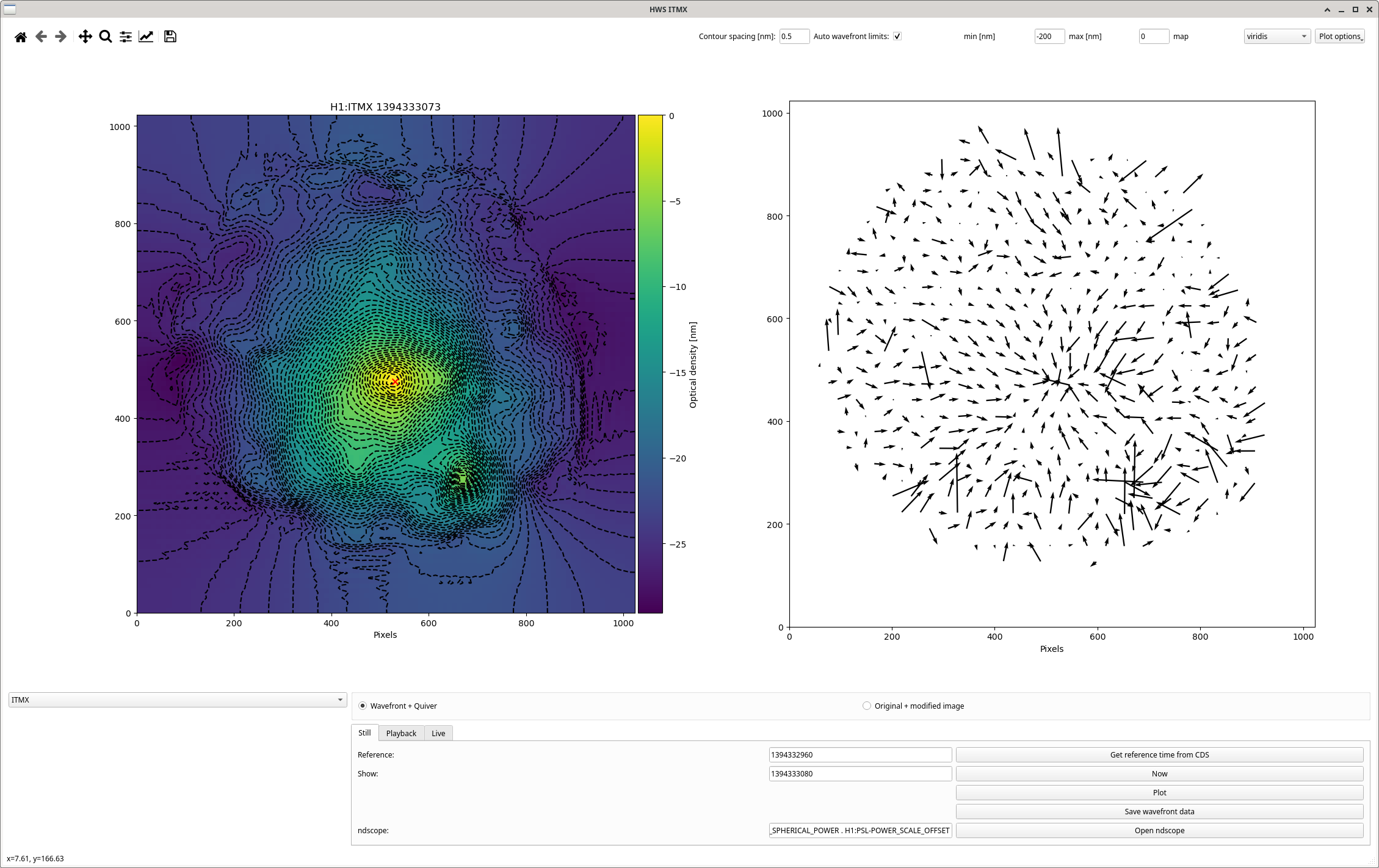
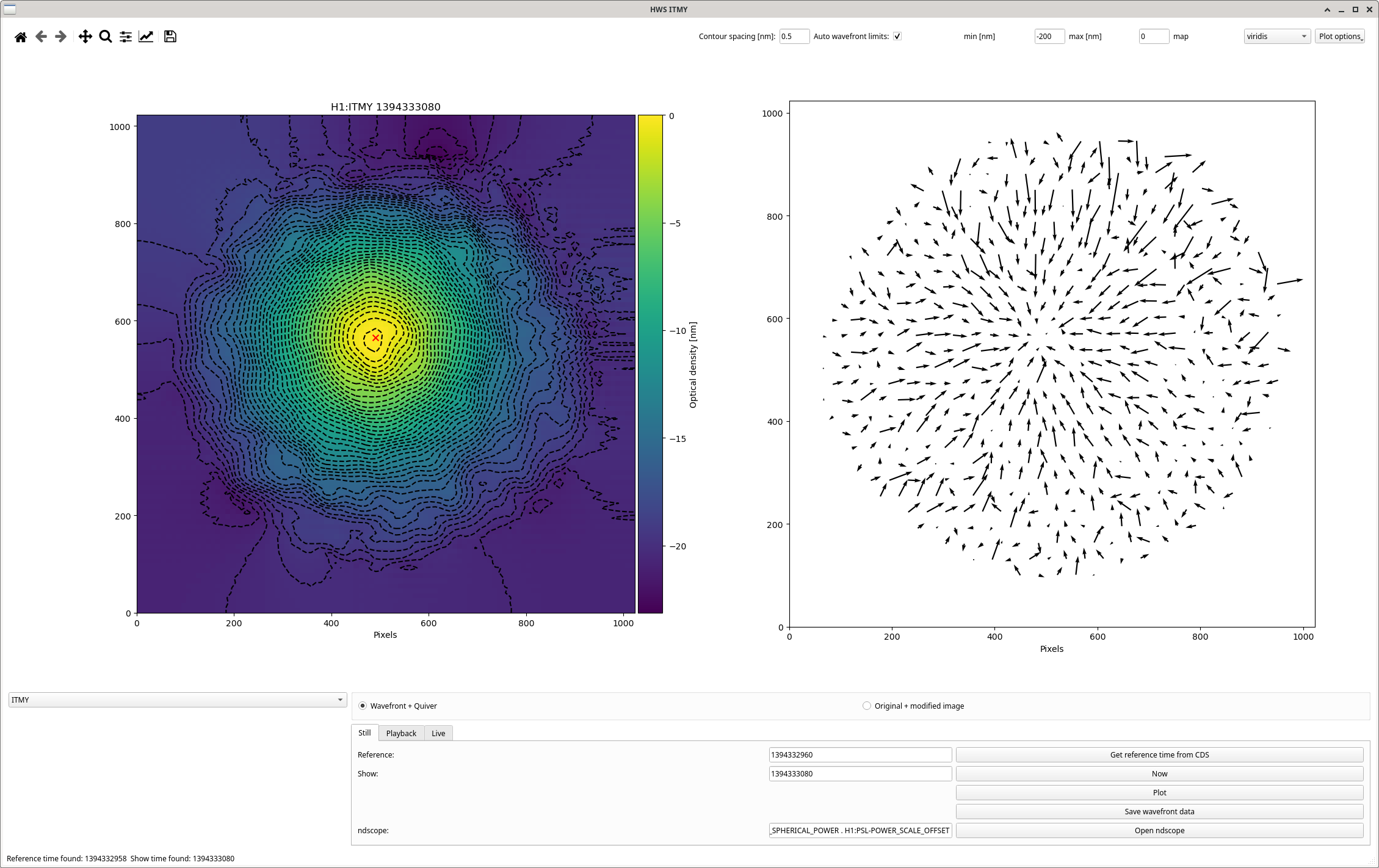
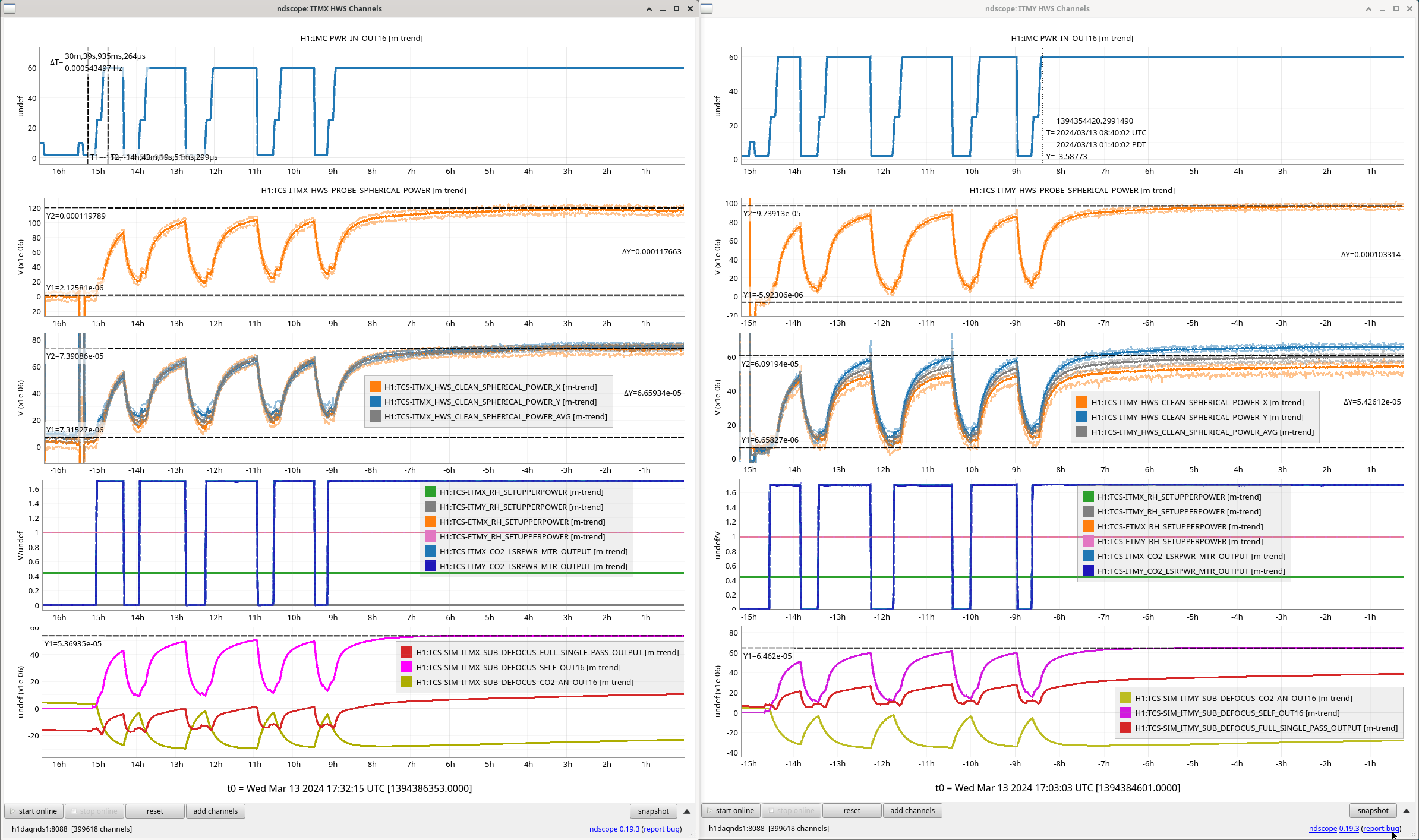
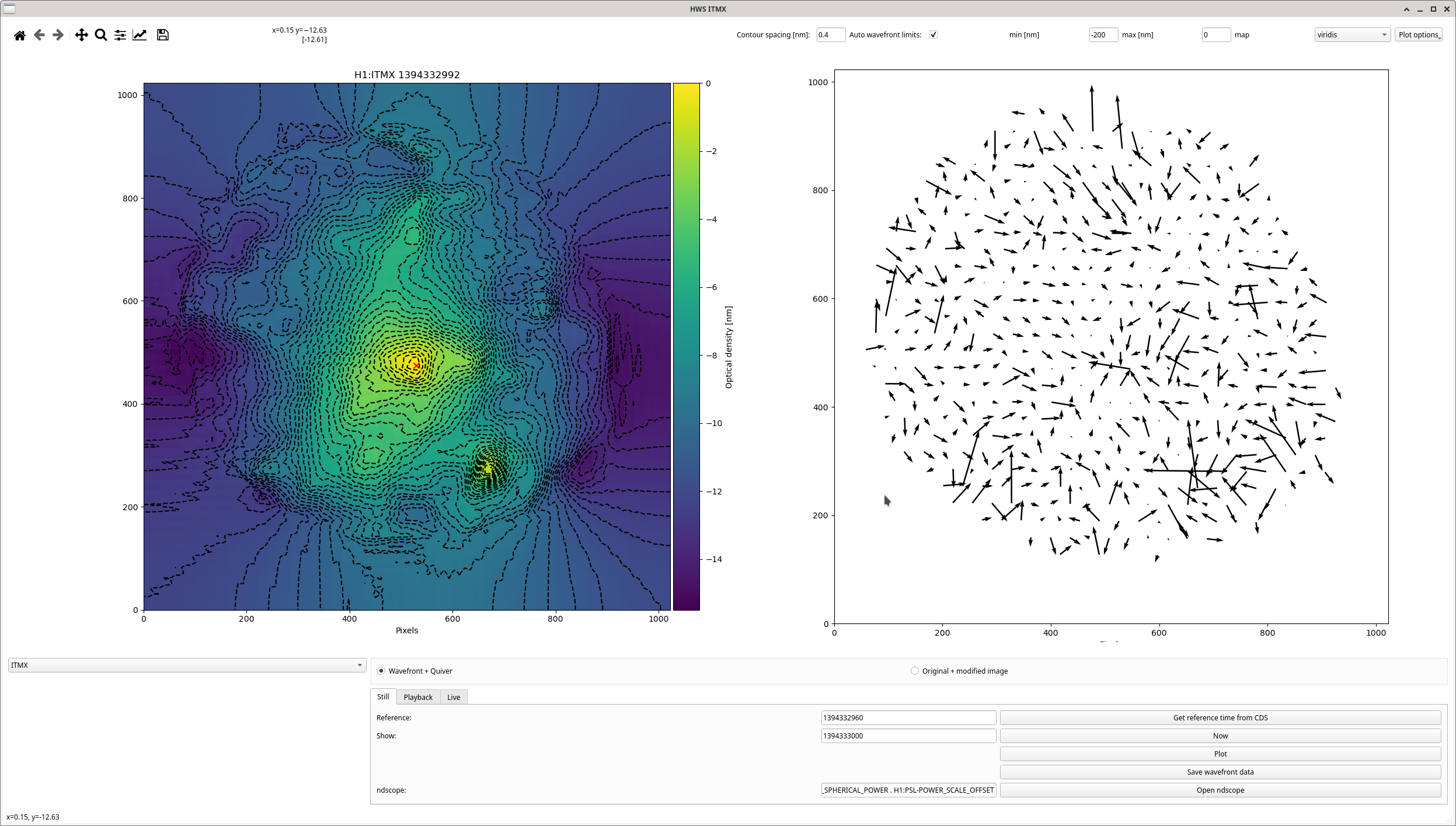
Here are our mode-matchings, measured using cursors on ndscope:

------ Notes from the process of getting the omc mode scan:

To try and understand the SQZ-OMC matching, yesterday we took OMC mode scans today of the sqz/seed beam, with the OPO dither-locked on sqz laser carrier light. Jenne and Craig set us up for taking OMC mode scans.

Images attached to this report
Comments related to this report
victoriaa.xu@LIGO.ORG - 16:00, Thursday 19 October 2023 (73598)

Note: OM2 was cold during these Jan. 2023 SQZ-OMC mode scans, which suggest when OM2 is cold, SQZ-OMC mode-matching improves with ZM4/5 PSAMS at 200/200V.

Images attached to this comment
Displaying reports 14981-15000 of 86441.Go to page Start 746 747 748 749 750 751 752 753 754 End