
ryan.crouch@LIGO.ORG - posted 08:27, Tuesday 09 January 2024 (75267)
Lockloss at 08:35UTC
Lockloss at 08:35UTC from an earthquake, high winds as well at the time.
Lockloss at 08:35UTC from an earthquake, high winds as well at the time.
TITLE: 01/09 Day Shift: 16:00-00:00 UTC (08:00-16:00 PST), all times posted in UTC
STATE of H1: Wind
OUTGOING OPERATOR: Ryan C
CURRENT ENVIRONMENT:
SEI_ENV state: MAINTENANCE
Wind: 33mph Gusts, 21mph 5min avg
Primary useism: 0.14 μm/s
Secondary useism: 0.83 μm/s
QUICK SUMMARY: Lost lock 7.5 hours ago and Ryan was unable to relock with the high wind and high useism. Maintenance activities have started.
Workstations were updated and rebooted. This was an OS package update only. Conda packages were not updated.
H1 called for assistance at 10:15UTC, it seems to be stuck in IA as we're still ringing down from an earthquake and winds have picked up which is making locking Yarm a struggle.
TITLE: 01/09 Eve Shift: 00:00-08:00 UTC (16:00-00:00 PST), all times posted in UTC
STATE of H1: Observing at 156Mpc
INCOMING OPERATOR: Ryan C
SHIFT SUMMARY: Quiet shift with one superevent. H1 has now been locked for almost 8 hours.
State of H1: Observing at 160Mpc
H1 has been locked for almost 4 hours. Quiet night so far with just one minor earthquake passing through.
Full DQ shift report is here.
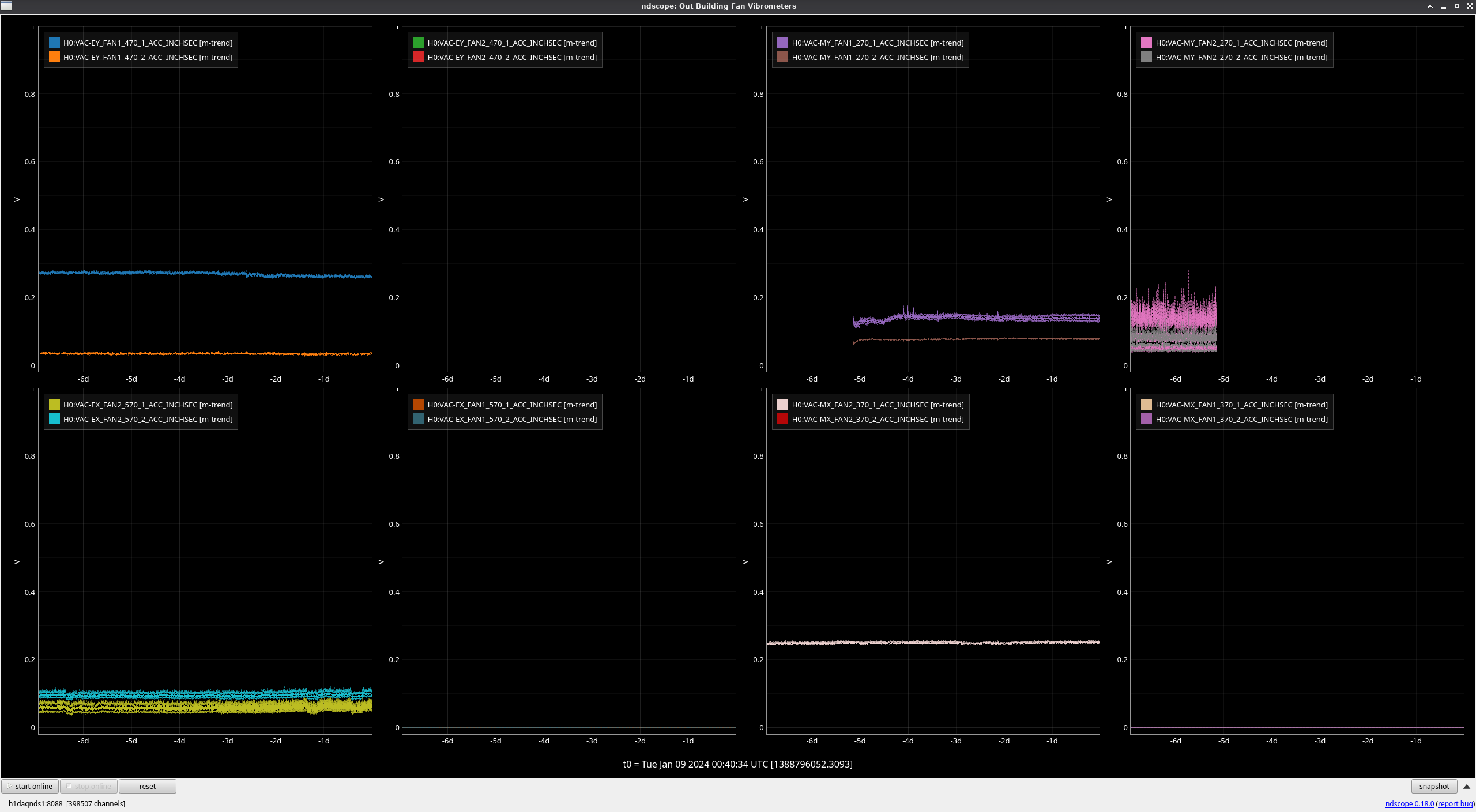
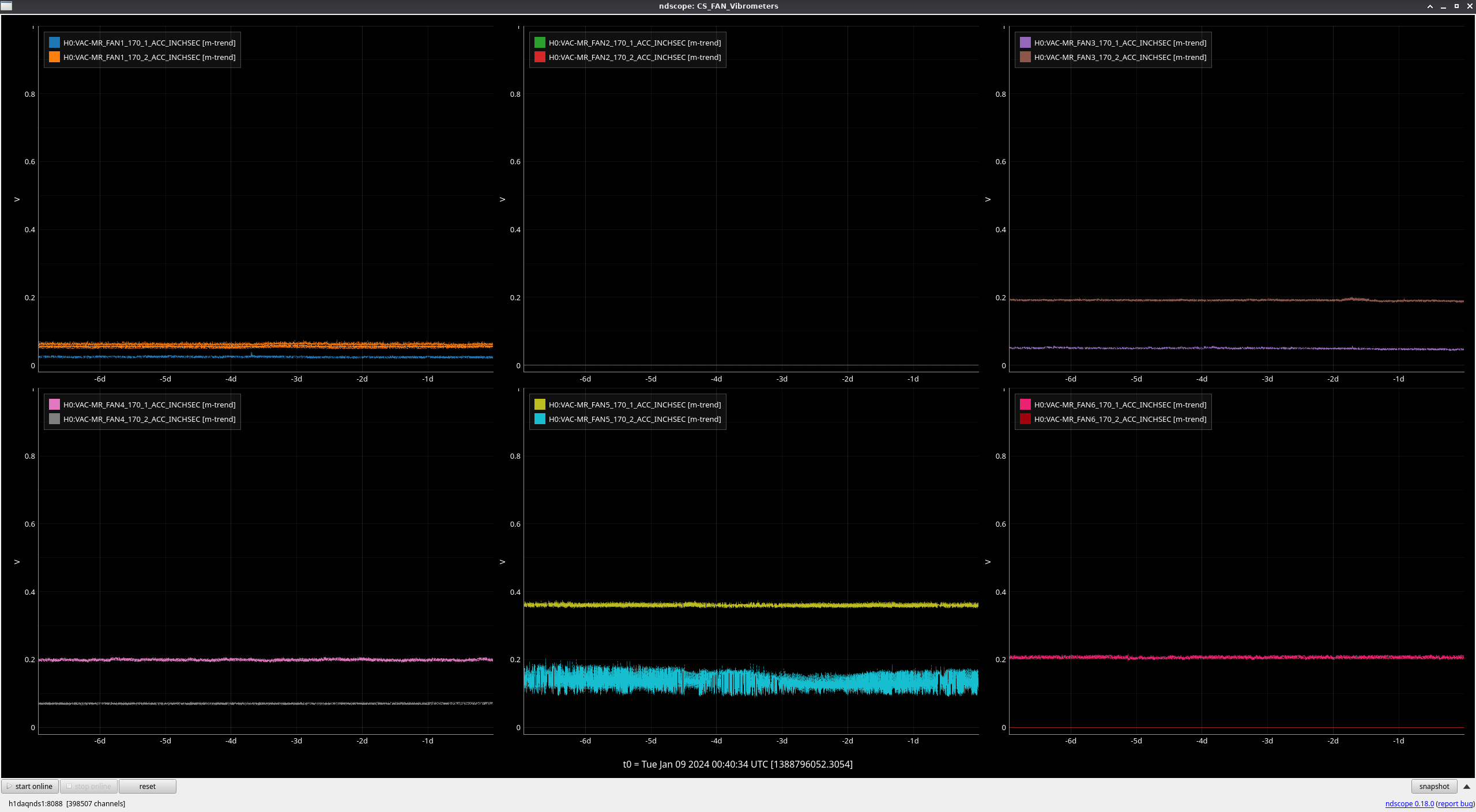
FAMIS 26273, last checked in alog75087
Looks like MY fans were switched 5 days ago, but otherwise all fans look okay.
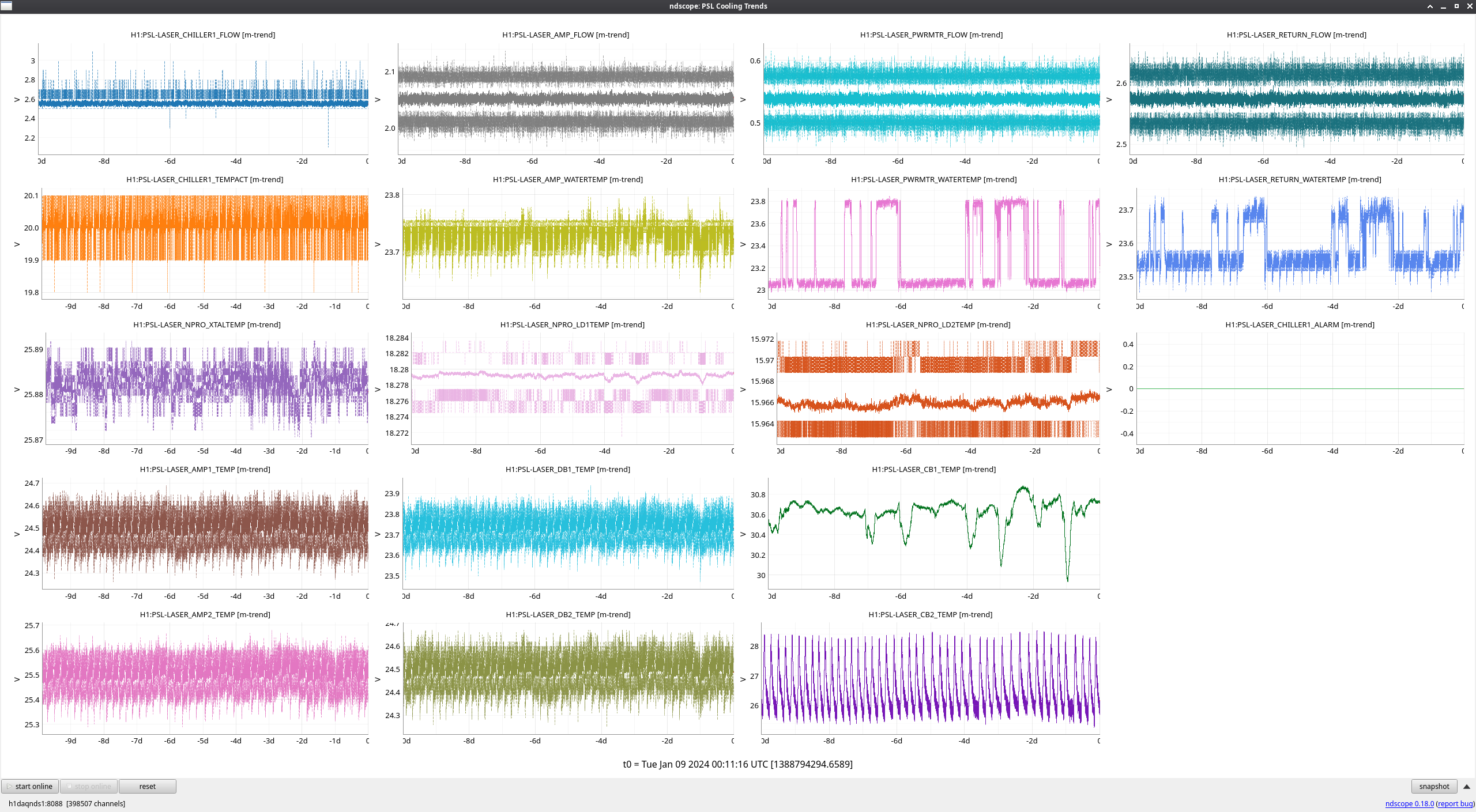
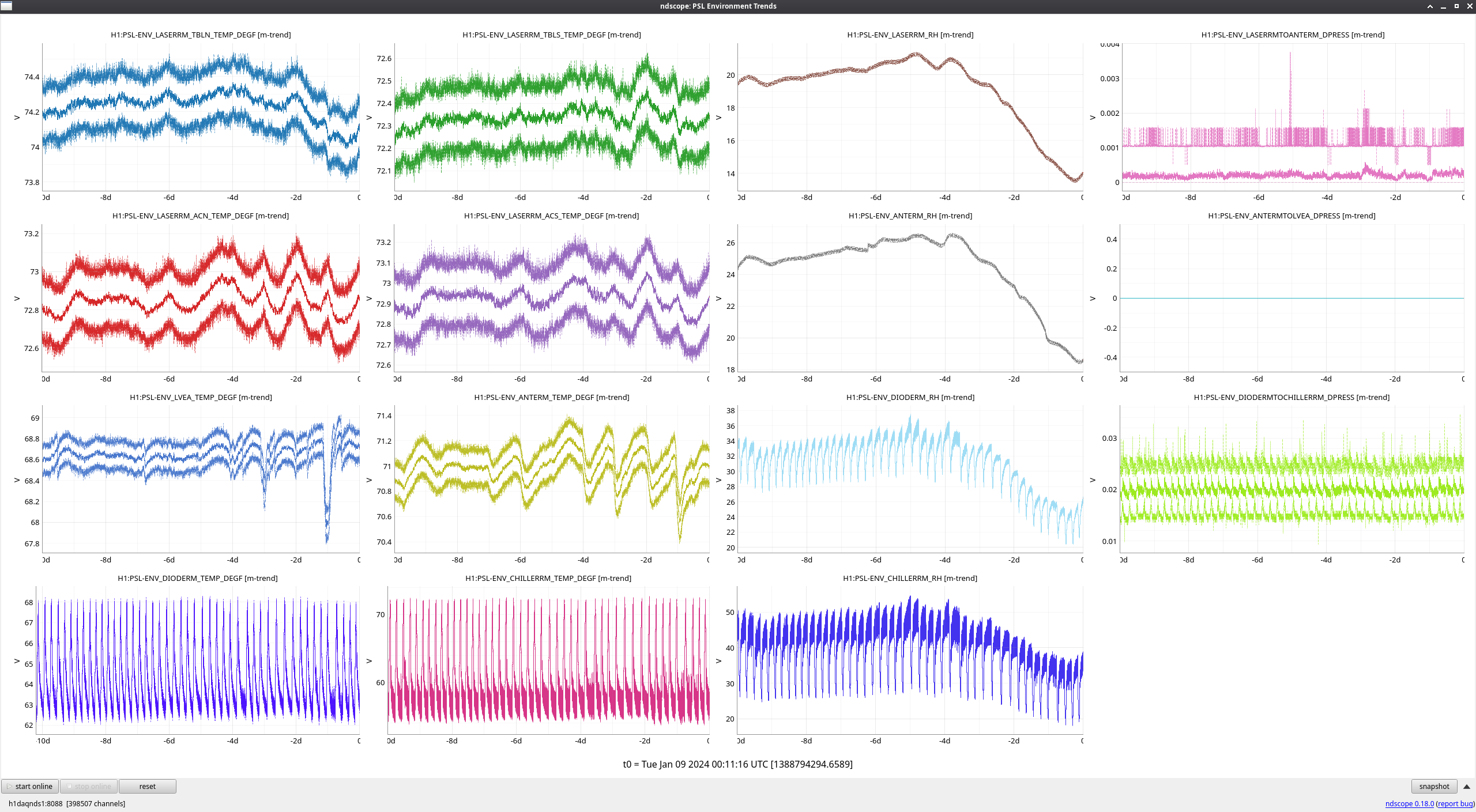
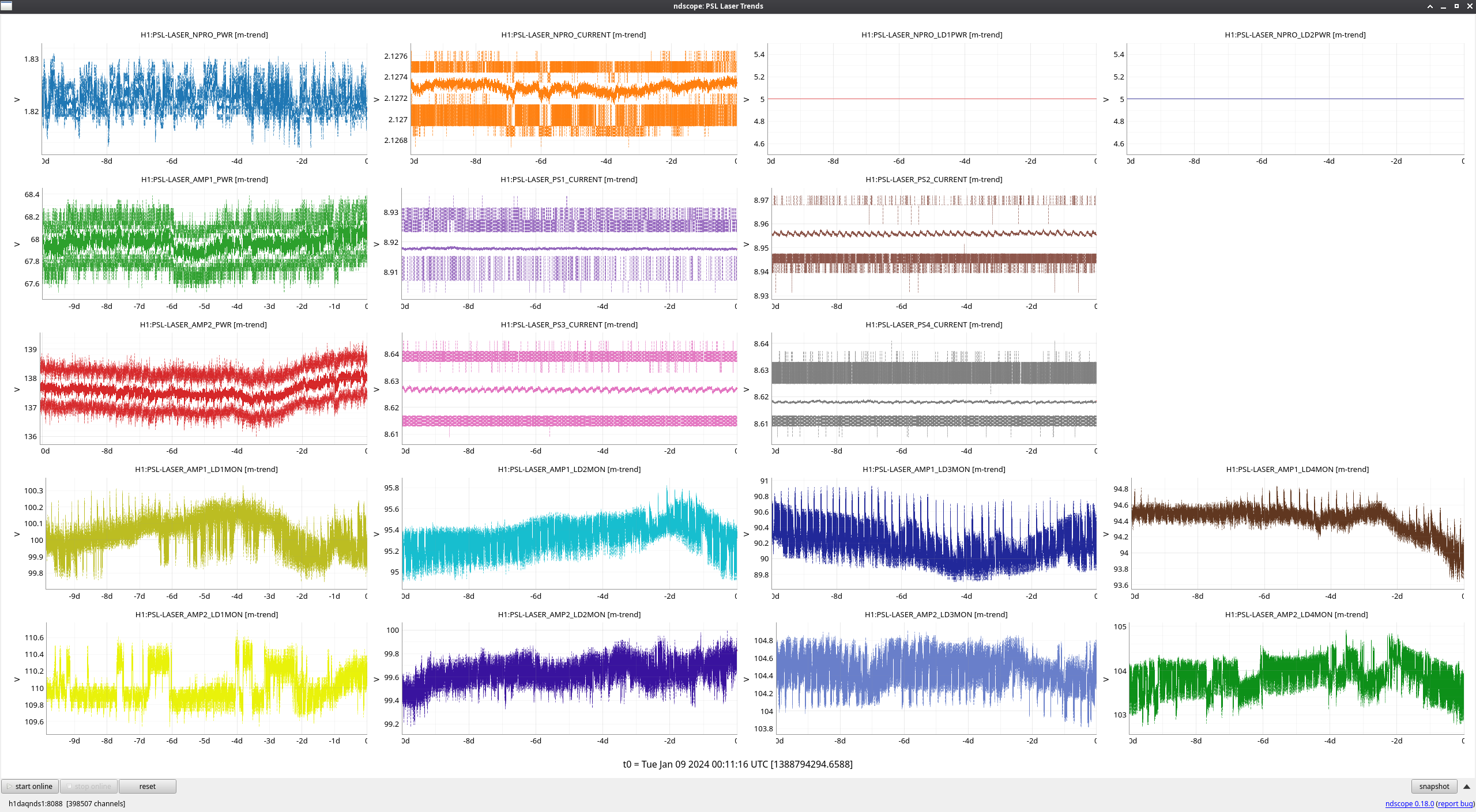
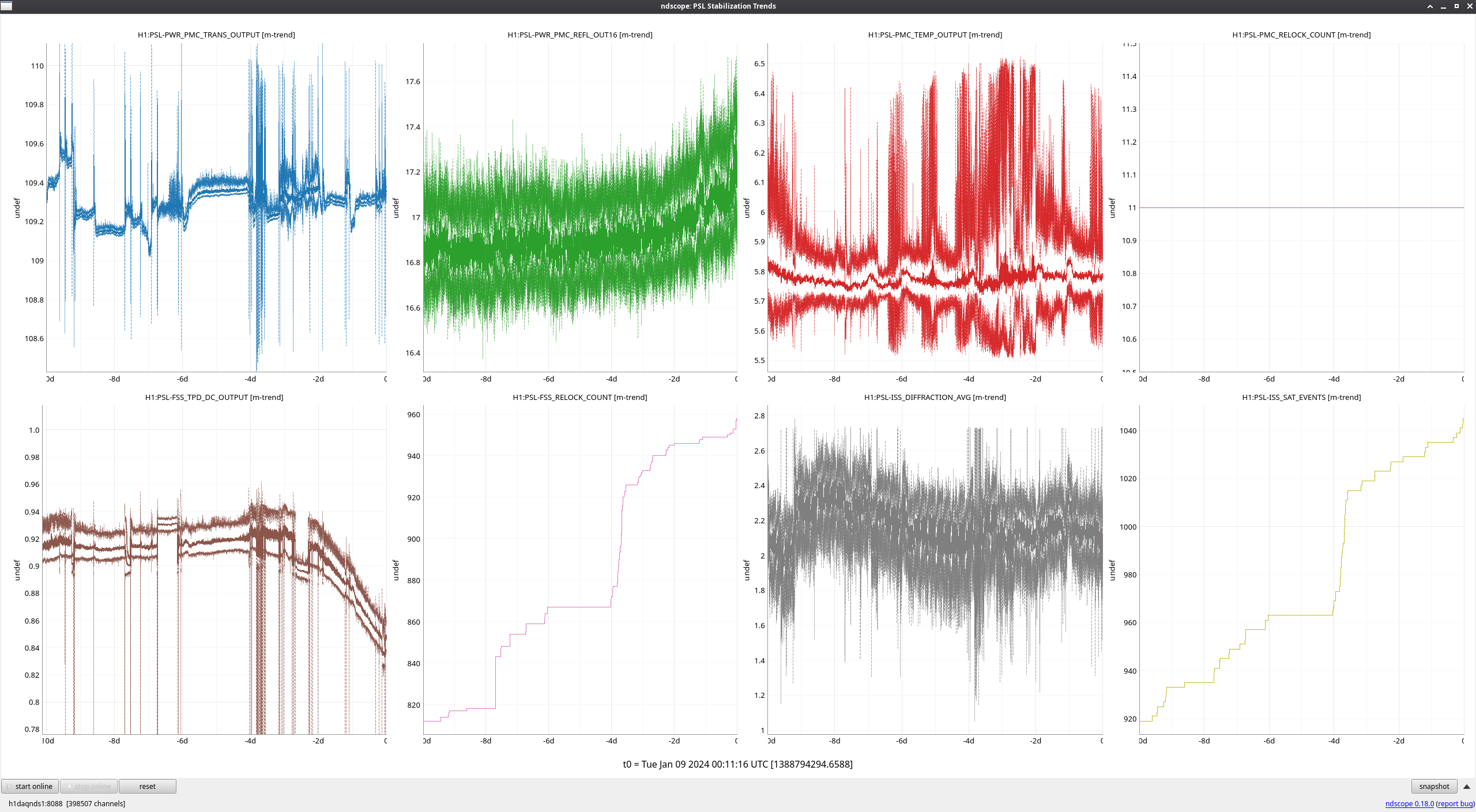
FAMIS 20010
PMC reflected power has been slightly increasing over the past ~3 days, and FSS transmitted power has been decreasing over the same period, but I don't see that PMC transmitted power has changed much at all.
TITLE: 01/09 Day Shift: 16:00-00:00 UTC (08:00-16:00 PST), all times posted in UTC
STATE of H1: Lock Acquisition
INCOMING OPERATOR: Ryan S
SHIFT SUMMARY:
IFO is LOCKING and at TRANSITION_FROM_ETMX
EQ recovery is going smoothly
Lockloss alogs:
Lockloss 21:13 UTC (EQ)
Other:
LOG:
| Start Time | System | Name | Location | Lazer_Haz | Task | Time End |
|---|---|---|---|---|---|---|
| 16:24 | FAC | Tyler | EX, EY | N | Tumbleweed check | 17:24 |
| 17:17 | SUS | Randy | MX | N | Inventory | 18:03 |
| 18:03 | FAC | Karen | Optics/Vac Prep | N | Technical Cleaning | 18:03 |
| 18:29 | VAC | Travis | MX | N | Pfeiffer Box Check | 19:29 |
| 21:46 | SUS | Randy | LVEA | N | Tue Maint prep | 22:01 |
| 21:57 | PEM | Ryan C | CER | N | Looking at dust monitors | 22:15 |
| 22:45 | VAC | Gerardo | LVEA | N | Vacuum prep for Tue | 23:05 |
TITLE: 01/08 Eve Shift: 00:00-08:00 UTC (16:00-00:00 PST), all times posted in UTC
STATE of H1: Lock Acquisition
OUTGOING OPERATOR: Ibrahim
CURRENT ENVIRONMENT:
SEI_ENV state: CALM
Wind: 3mph Gusts, 2mph 5min avg
Primary useism: 0.04 μm/s
Secondary useism: 0.51 μm/s
QUICK SUMMARY:
H1 is relocking following a M7.0 earthquake; currently up to MOVE_SPOTS. All systems look good; wind is low and microseism is sitting just below the 90th percentile.
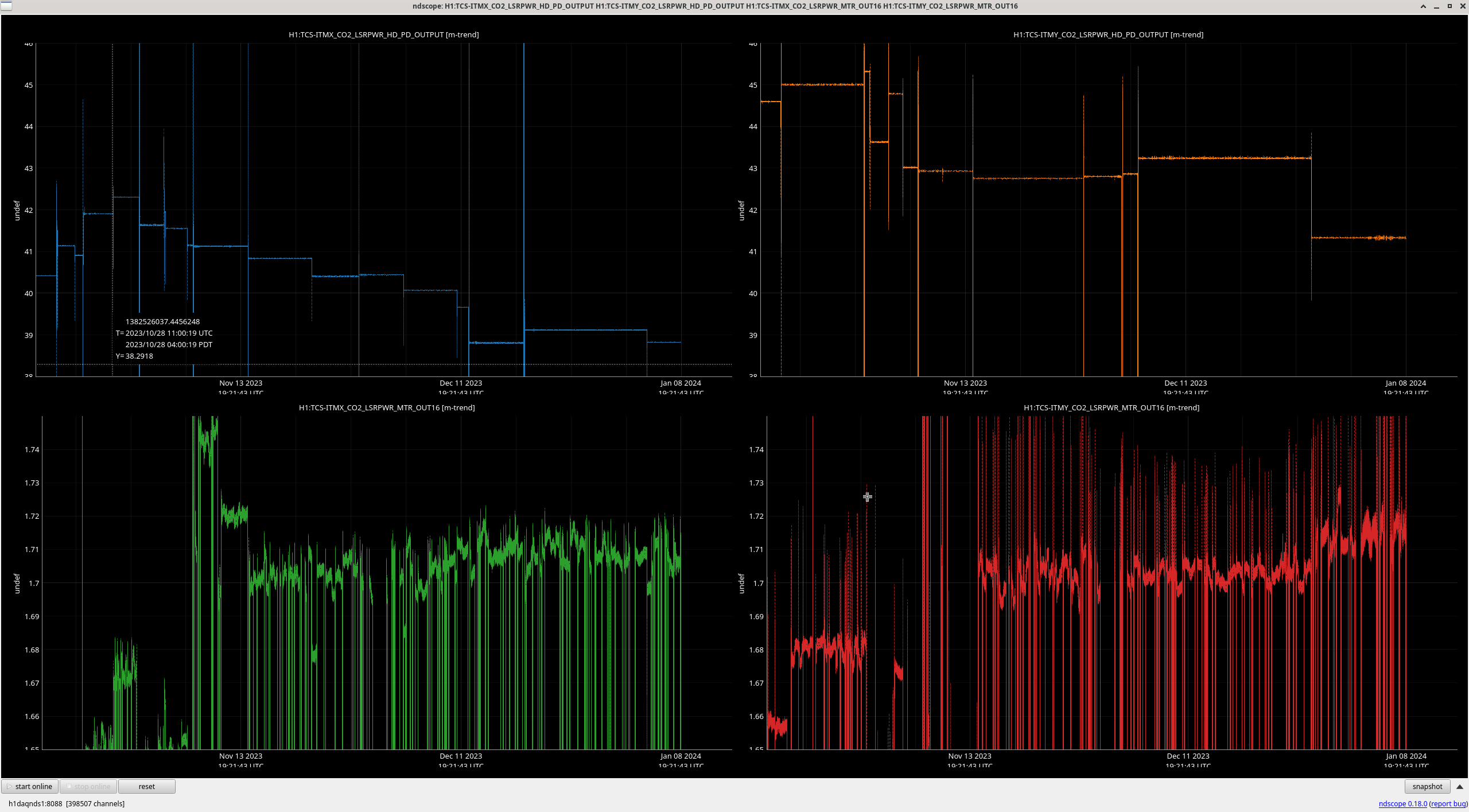
Since TJ implemented bootstrapping on the CO2_PWR guardians, 74075 the power sent into vacuum has been much more stable.
We installed a new chiller in CO2X 73704 October 27th. It's been more stable and decaying less quickly since then but has still been relocking around once a week. Plot attached
As in 74872 and 74741, I have taken PEM_MAG_INJ and SUS_CHARGE from WAITING to DOWN so that they do not run tomorrow. Instead, tomorrow Louis and Sheila will try the risky DARM loop swaps and calibration from 7amPT. To re-enable the automated measurements, the nodes should be requested to INJECTIONS_COMPLETE before next Tuesday.
IFO was unlocked from wind this morning. Re-requested both guardians to INJECTIONS_COMPLETE.
Lockloss due to 7.0 EQ from Philippines
Staying in DOWN until it passes.
We've been seeing SQZ angle not optimizing correctly (75245, 75151). At 20:05 Ibrahim took us into commissioning and I tried to change ADF frequency H1:SQZ-ADF_VCXO_FREQ_SET from 1300Hz to 200Hz. The ADF line didn't move from the 1300Hz region, just became noisy when I changed it. PLL didn't lock. Unsure why the ADF wouldn't move, I also tried 800Hz to no avail. ADF frequency hasn't successfully been changed since Daniel adjusted the model in May 69453.
At ~16:15UTC when we got to NLN, I tried and failed at this again.
Vicky showed (image) that H1:SQZ-ADF_VCXO_CONTROLS_SETFREQUENCYOFFSET and H1:SQZ-ADF_VCXO_FREQ_SET need to be changed then the ADF successfully moved. I also turned the size of the line down by turning up H1:SQZ-RLF_INTEGRATION_ADFATTENUATE, but it was still big and probably reduced our range a few MPc. Attached settings changed and then reverted.
It didn't seem to be able to converge on zero, plot attached. After trying twice I reverted the changes.
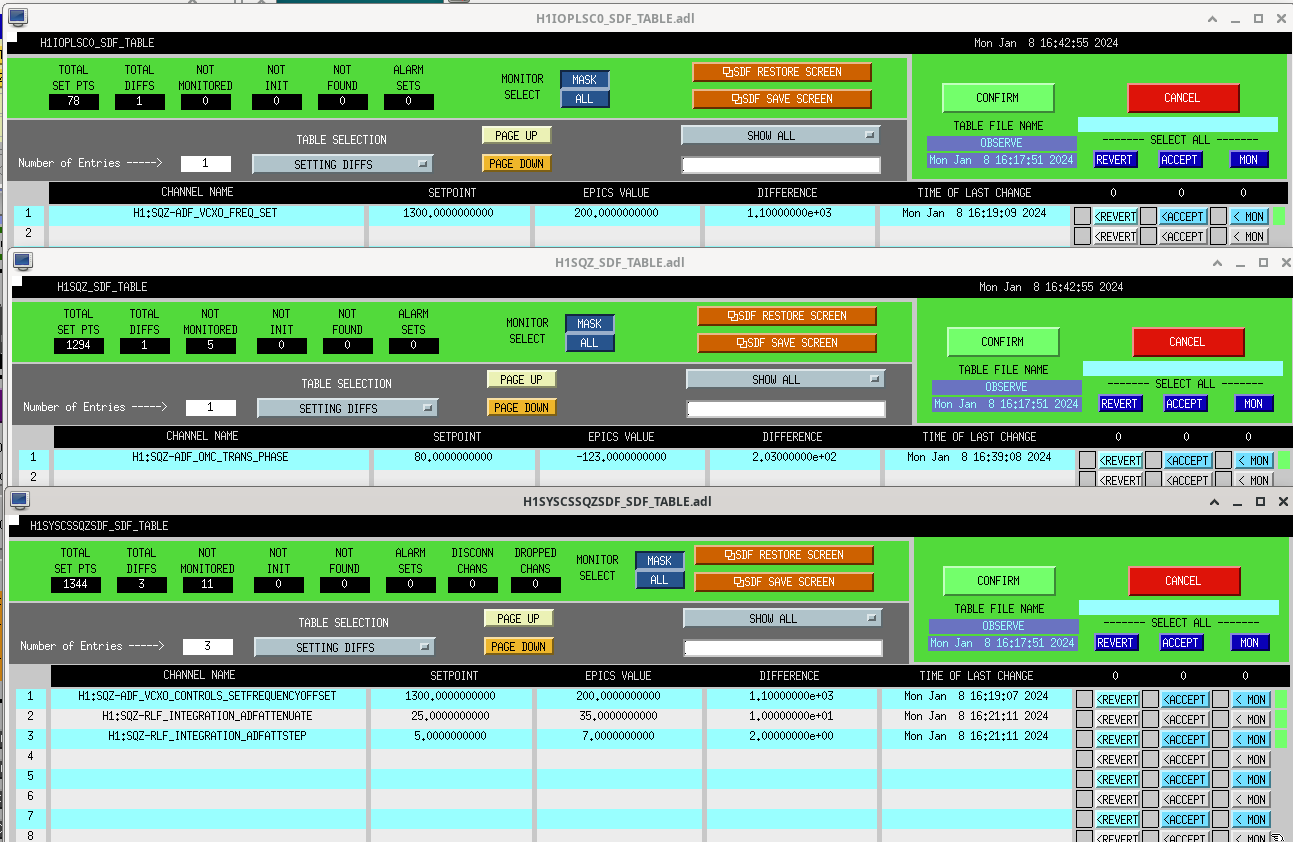
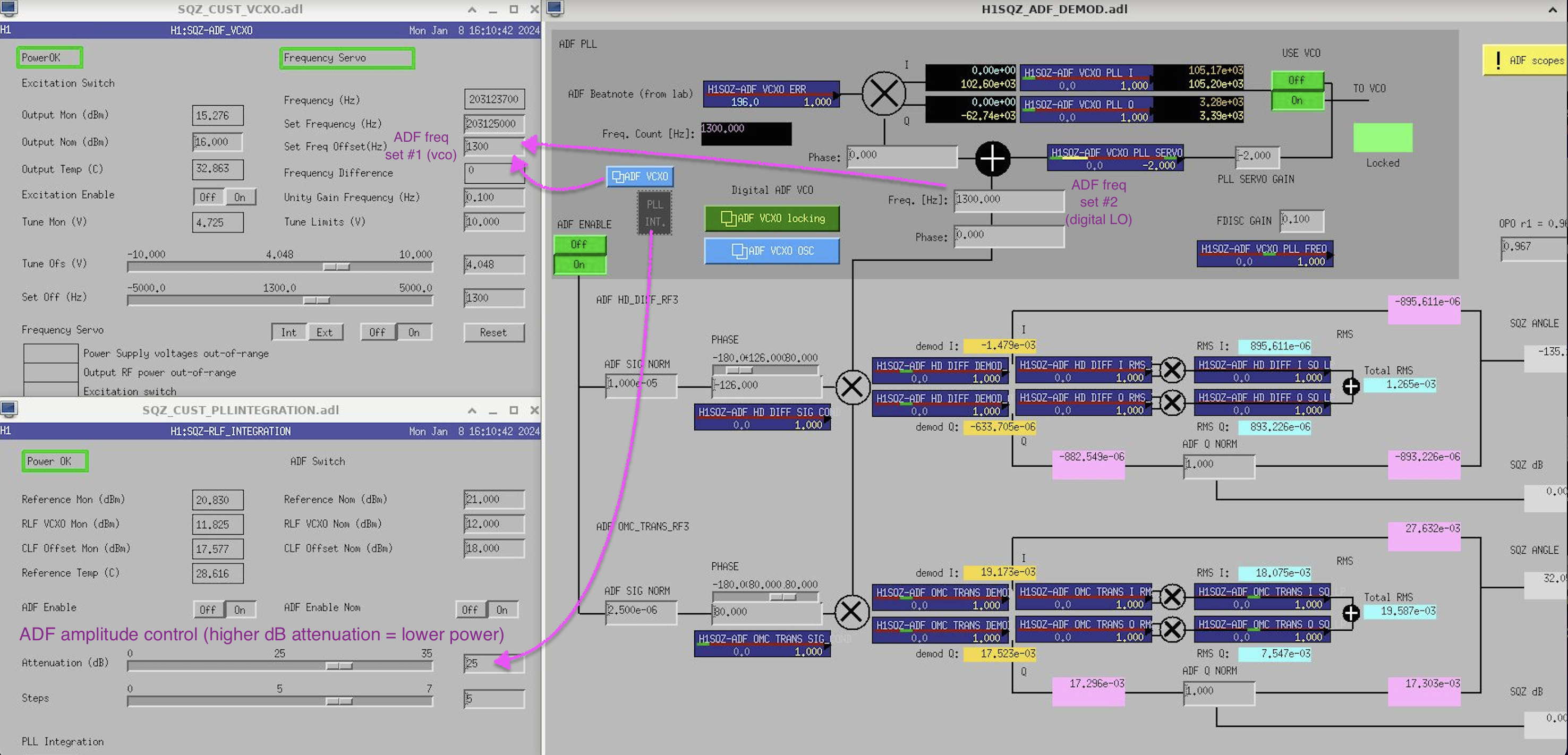
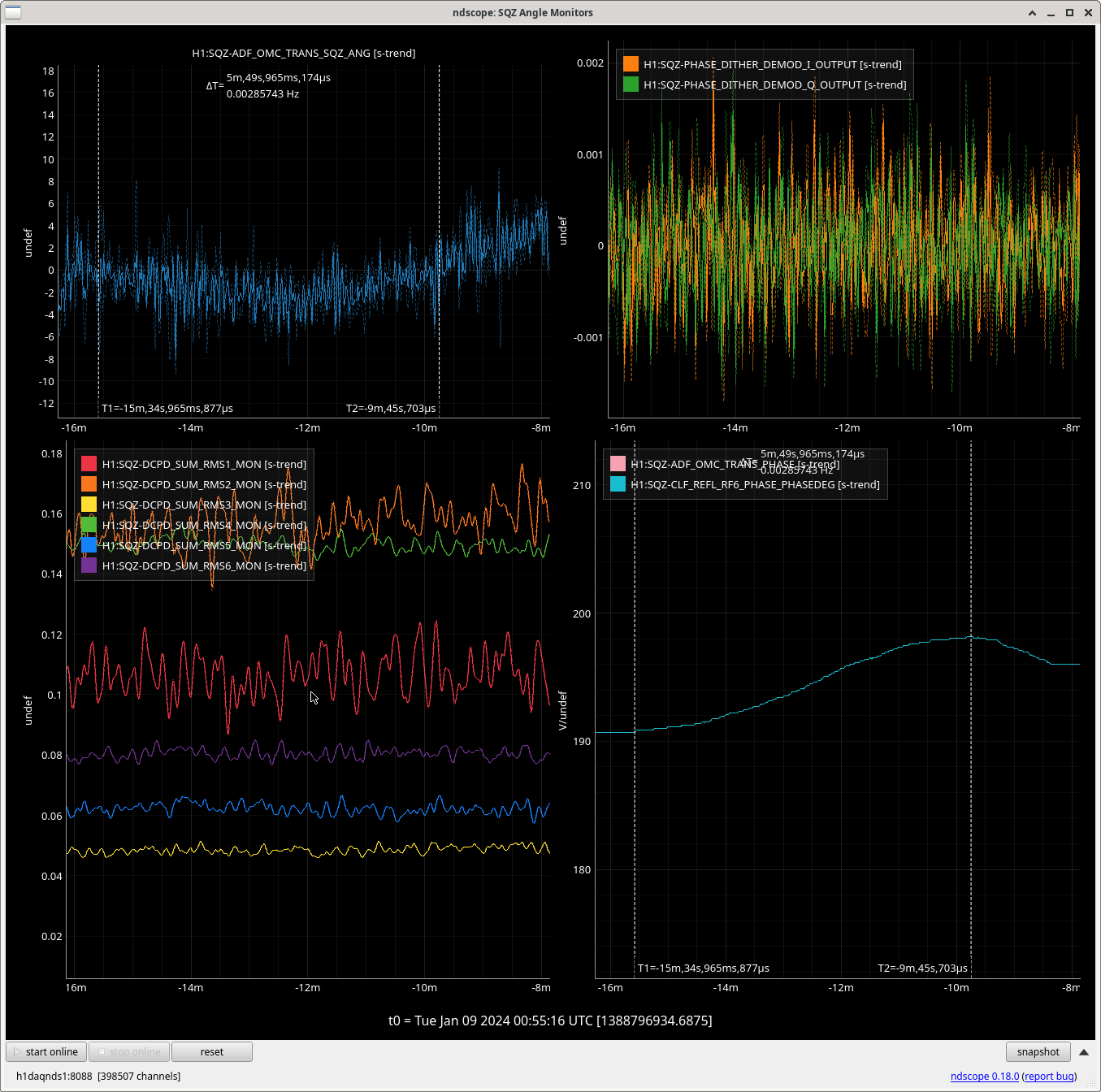
Dhruva points out to correctly change both of these settings we can use the script in /sqz/h1/scripts/ADF/ 'python setADF.py -f newfrequency'
Jenne, Naoki, Louis, Camilla, Sheila
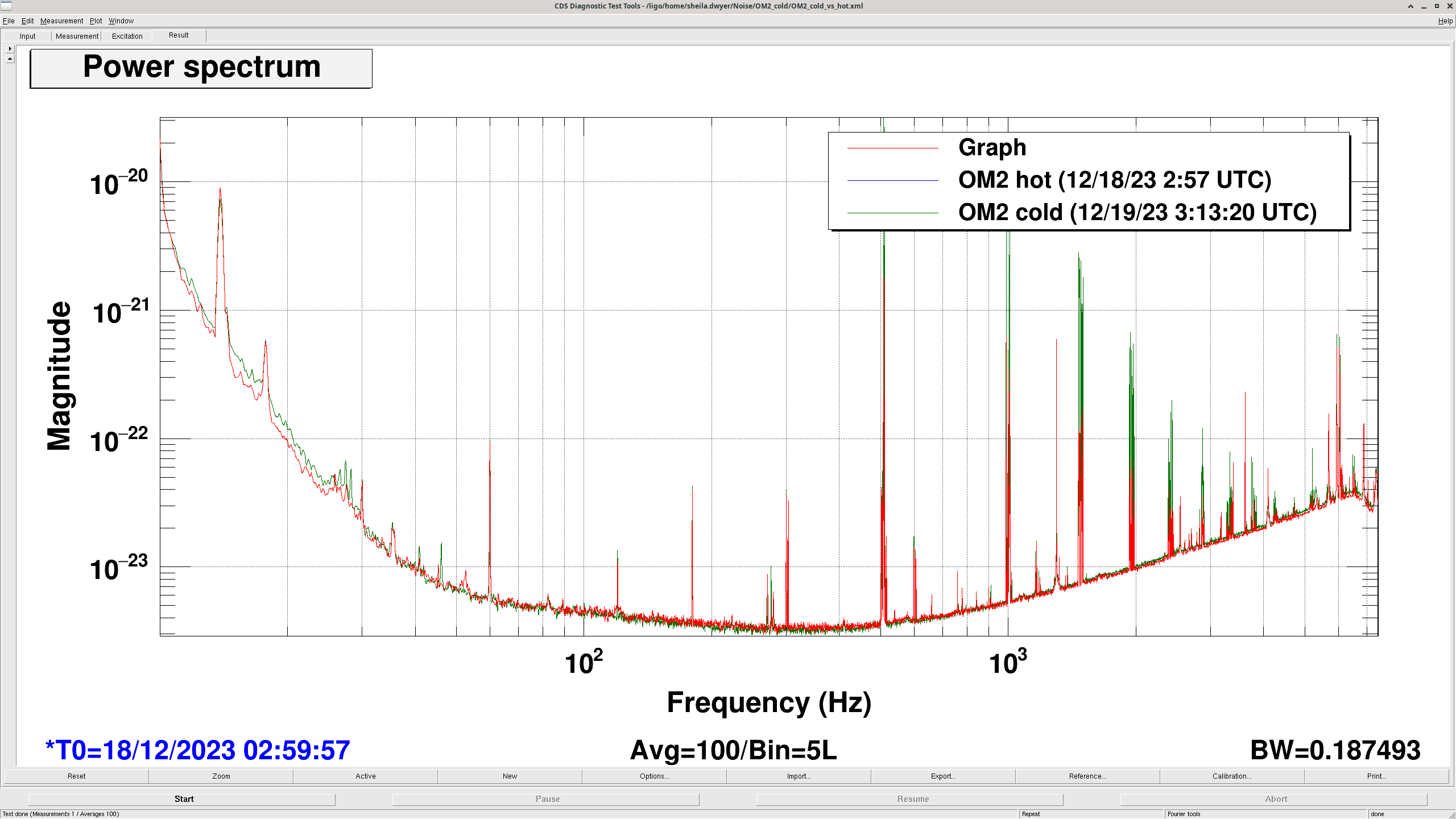
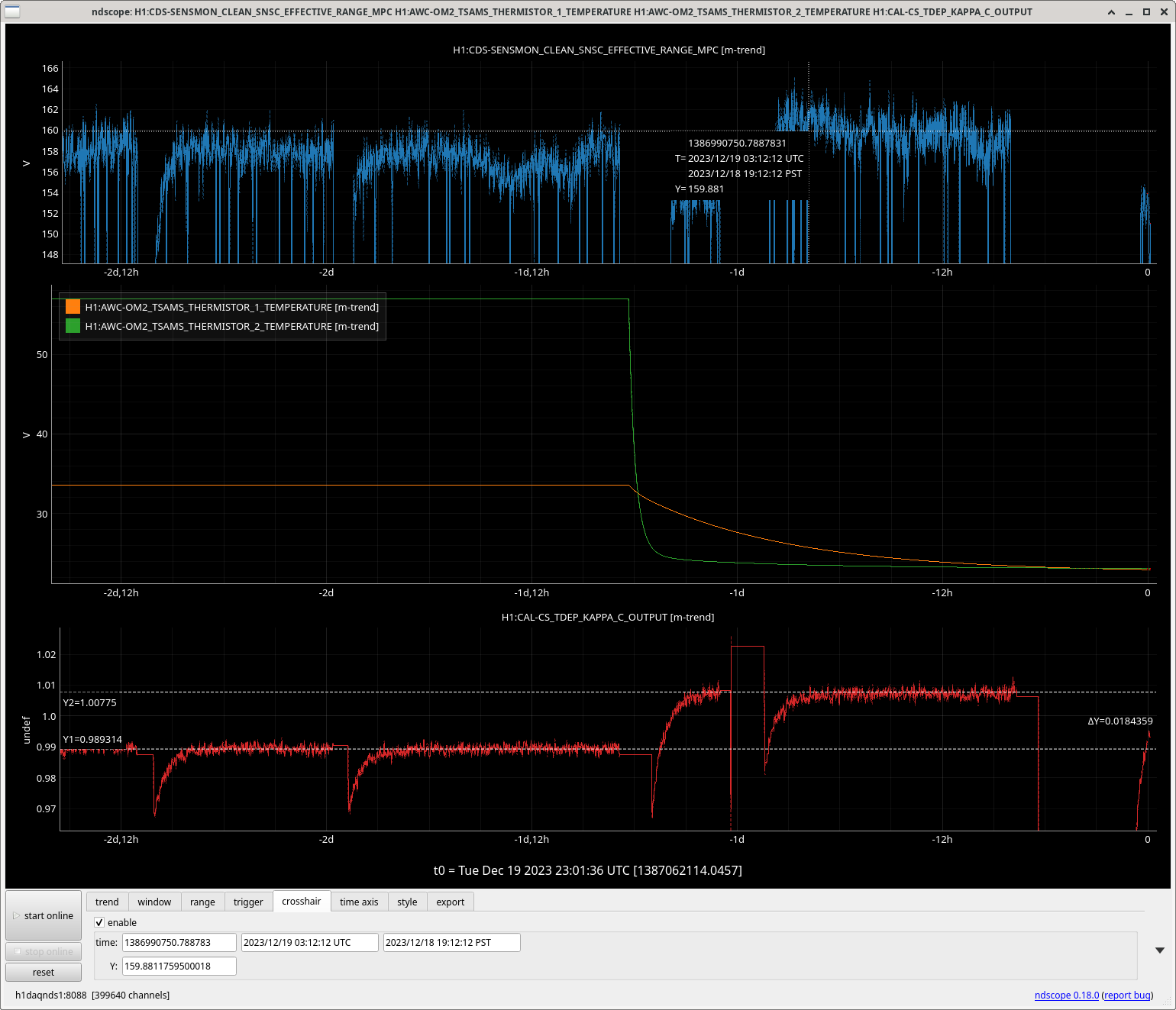
Here is comparison of the DARM CLEAN spectrum with OM2 hot vs cold. The second screenshot shows a time series of OM2 cooling off. The optical gain increased by 2%, as was seen in the past (for example 71087). Thermistor 1 shows that the thermal transient takes much longer (12 + hours) than what thermistor 2 says (2 hours).
Louis posted a comparison of the calibration between the two states, there are small differences in calibration ~1% (74913). While the DARM spectrum is worse below 25Hz, it is similar at 70 Hz where we in the past thought that the sensitivity was worse with OM2 cold. From 100-200 Hz the sensitivity seems slightly better with OM2 cold, some of the peaks are removed by Jenne's jitter subtraction (74879) but there also seems to be a lower level of noise between the peaks (which could be small enough to be a calibration issue). At high frequency the cold OM2 noise seems worse, this could be because of the squeezing. We plan to take data with some different squeezing angles tomorow and will check the squeezing angle as part of that.
So, it seems that this test gives us a different conculsion than the one we did in the spring/summer, and that now it seems that we should be able to run with OM2 cold to have better mode matching from the interferometer to the OMC. We may have not had our feedforwards well tuned in the previous test, or perhaps some other changes in the noise mean that the result is different now.
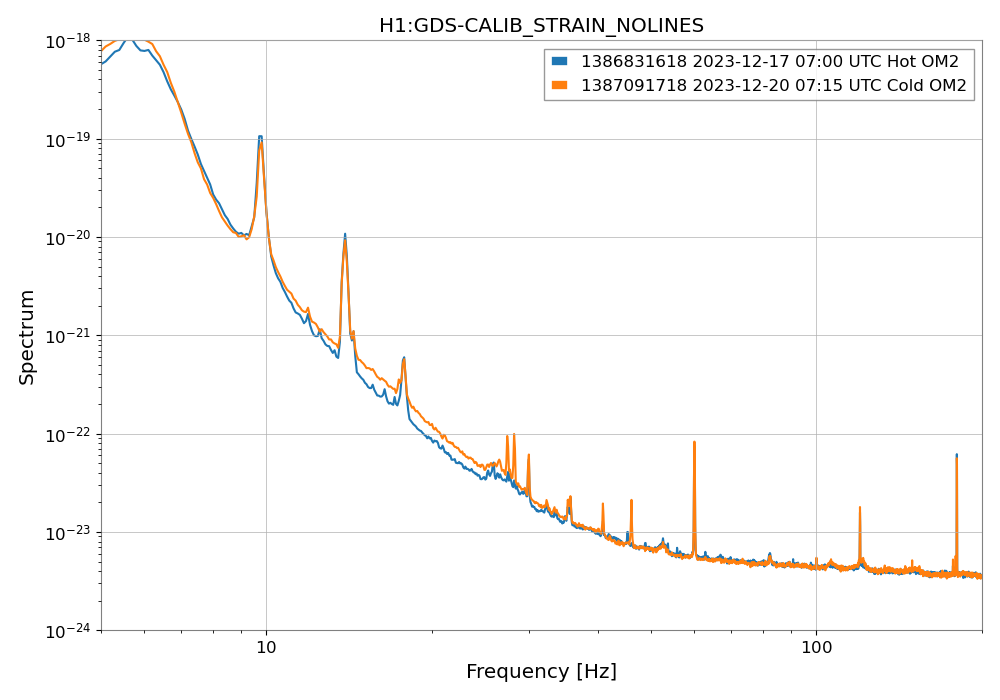
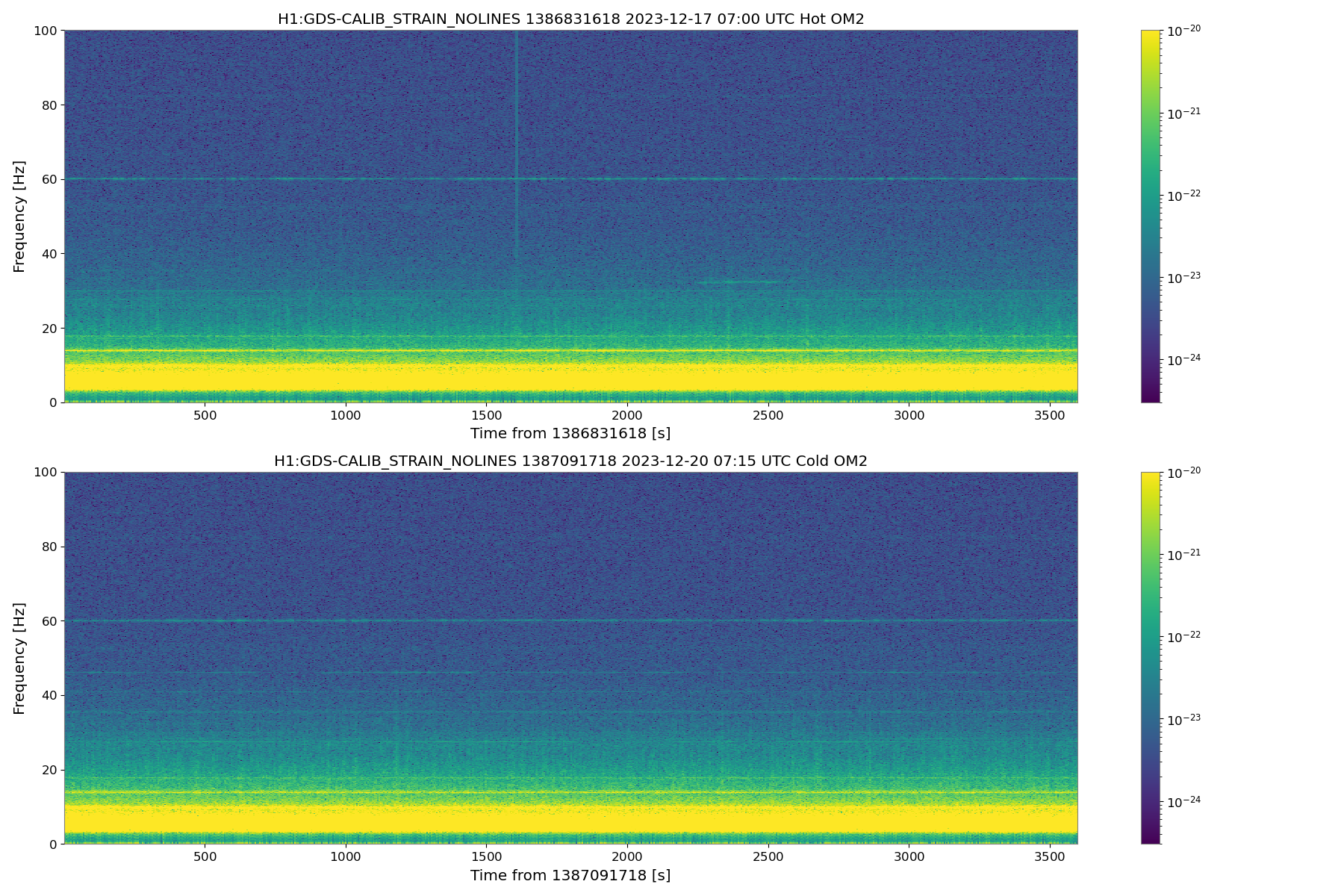
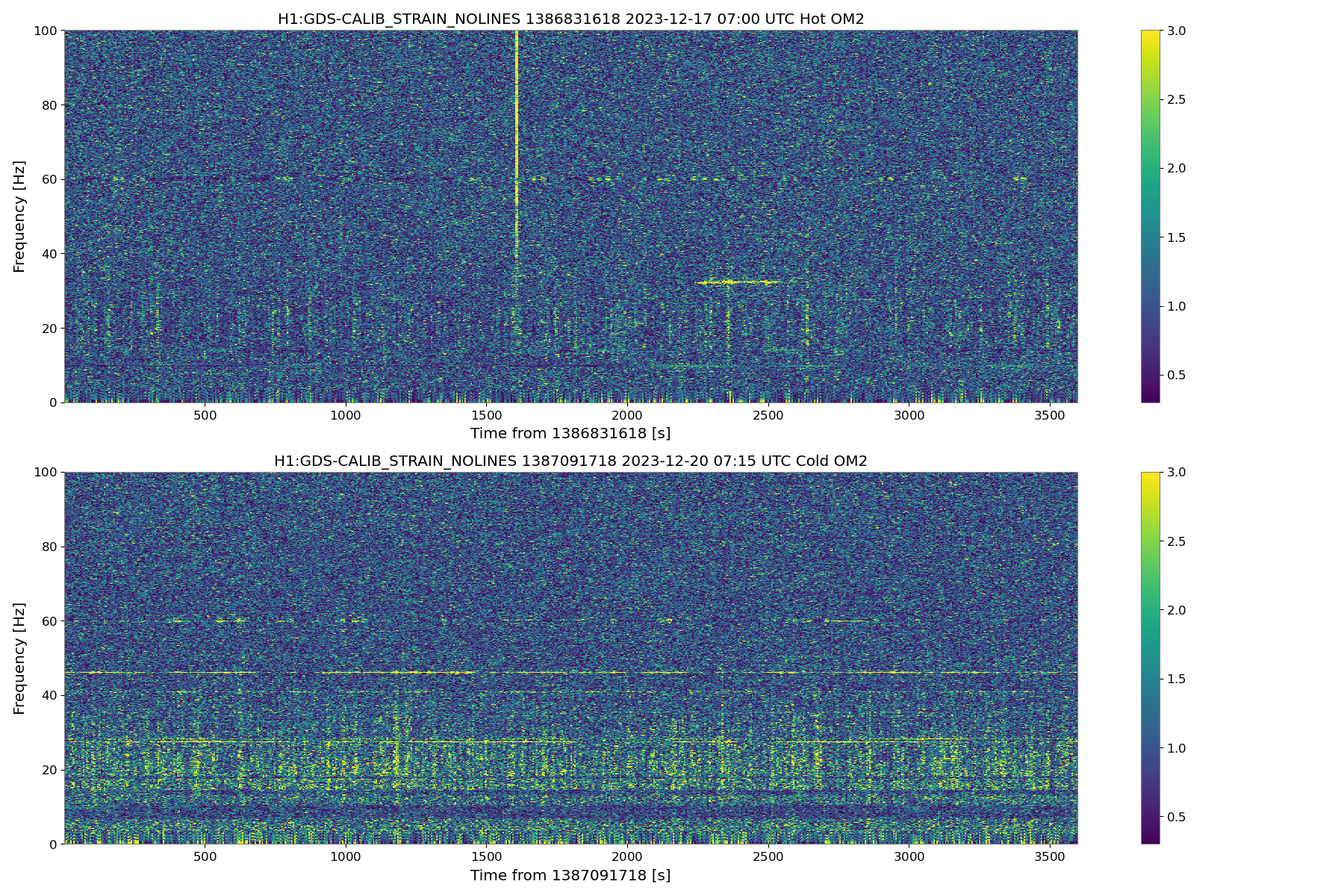
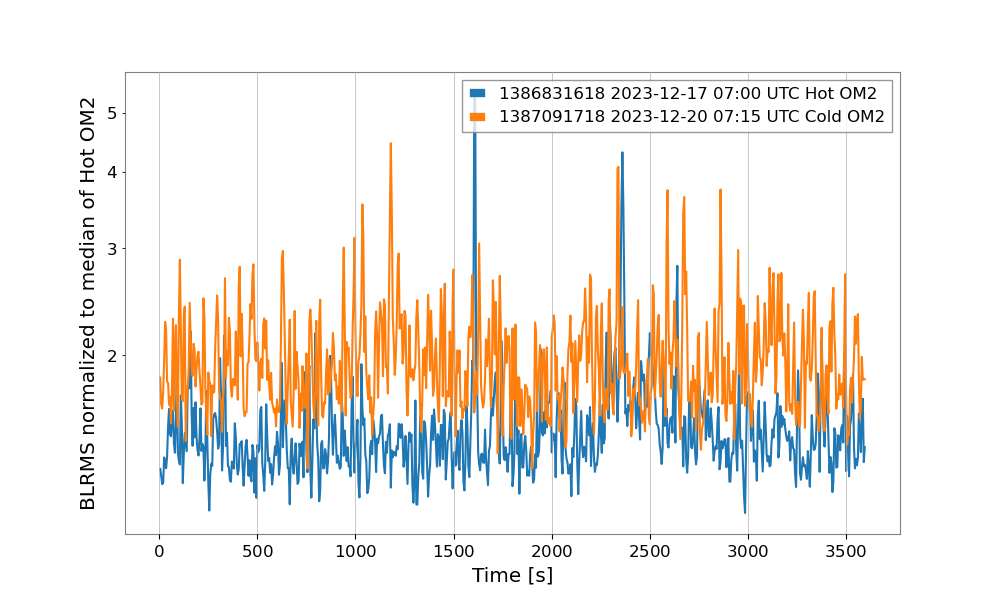
Is this additonal nosie at low frequency due to the same non-stationarity we oberved before and we believe is related to the ESD upconversion? Probably not, here's why.
First plot compares the strain spectrum from two times with cold and hot OM2. This confirms Sheila's observation.
The second and third plots are spectrograms of GDS-CALIB_STRAIN during the two periods. Both show non-stationry noise at low frequency. The third plot shows the strain spectrogram normalized to the median of the hot OM2 data: beside the non-stationariity, it looks like the background noise is higher below 30 Hz.
This is confirmed by looking at the BLRMS in the 16-60 Hz region for the two times, as shown in the fourth plot: its higher with cold OM2
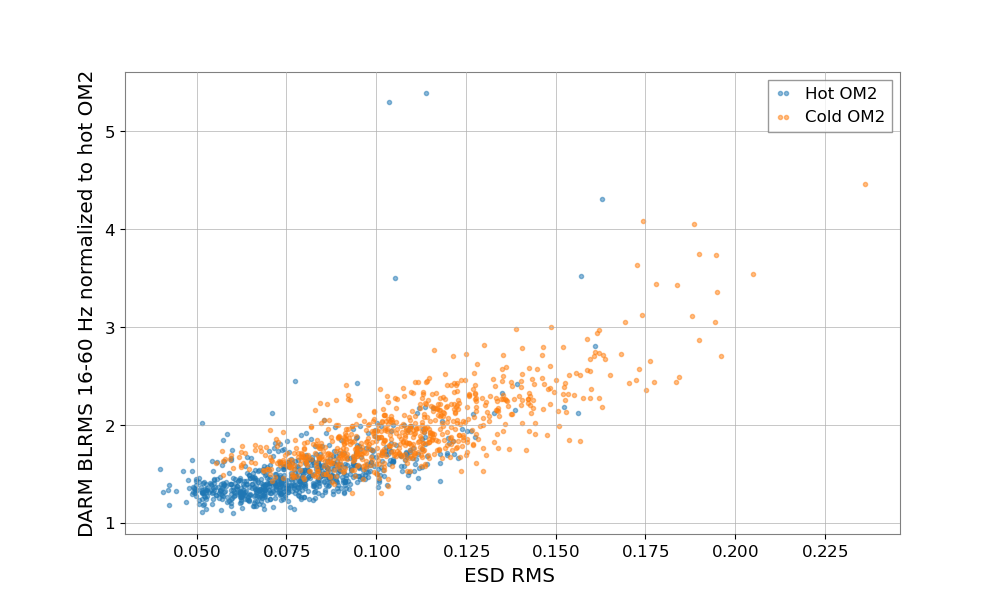
Finally, the last plot shows the correlation between the ESD RMS and the strain BLRMS, normalized to the hot OM2 state. There is still a correlation, but it appear again that the cold OM2 state has an additional background noise: when the ESD RMS is att the lower end, the strain BLRMS setlles to higher values
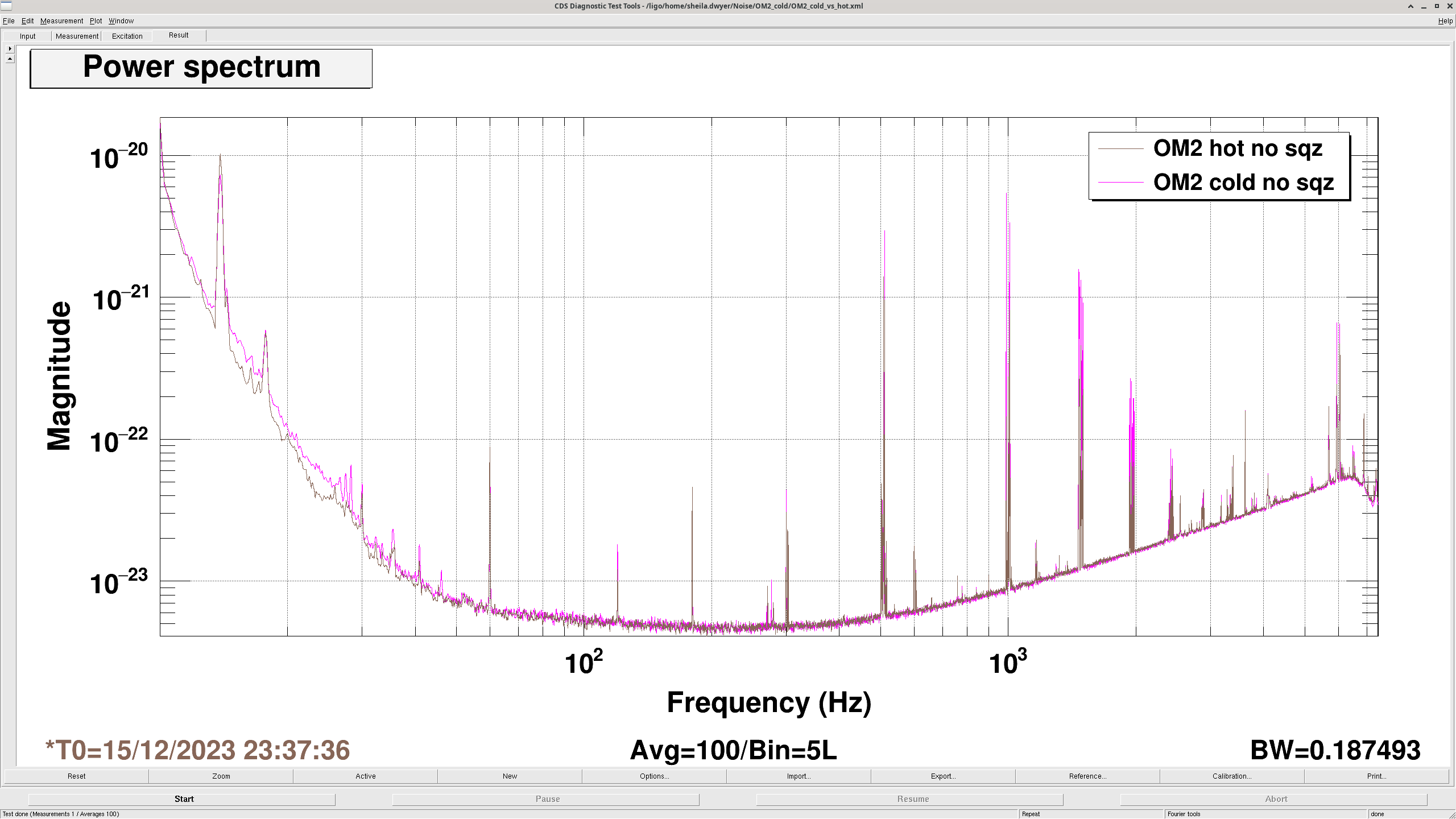
Here is the same comparison, without squeezing. Using times from 74935 and 74834
This suggests that where cold OM2 seems better than hot OM2 above that is due to the squeezing (and the jitter subtraction Jenne added, which is also on in this plot for cold OM2 but not for hot OM2). And the additional noise with cold OM2 reaches up to about 45Hz.
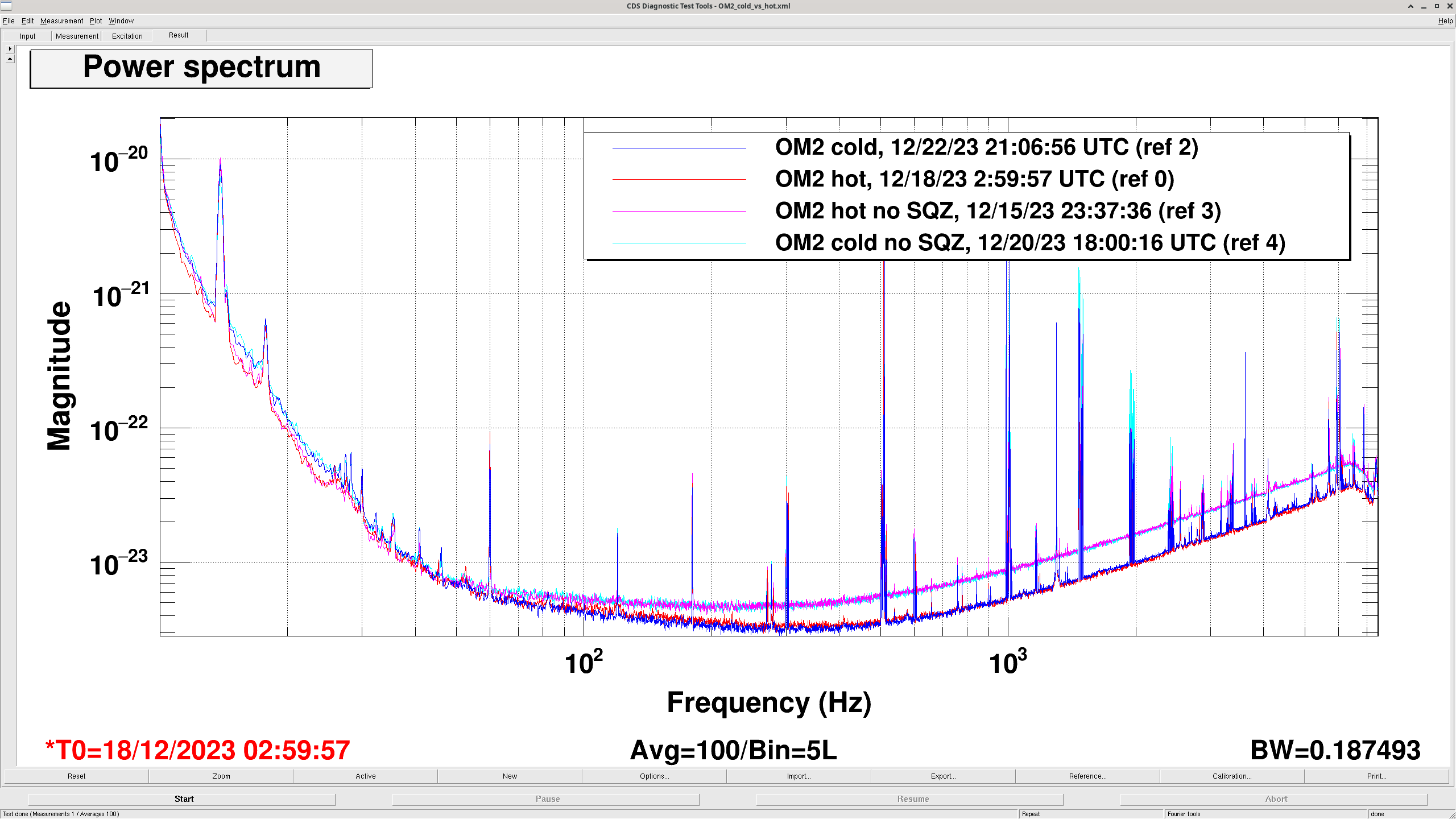
After we optimized ADF demod phase in 74972, the BNS range seems better and consistently 160-165Mpc. The attached plot shows the comparison of OM2 cold/hot with/without SQZ. The OM2 cold with SQZ is measured after optimization of ADF demod phase and other measurements are same as Sheila's previous plots.
This plot supports what Sheila says in the previous alogs.
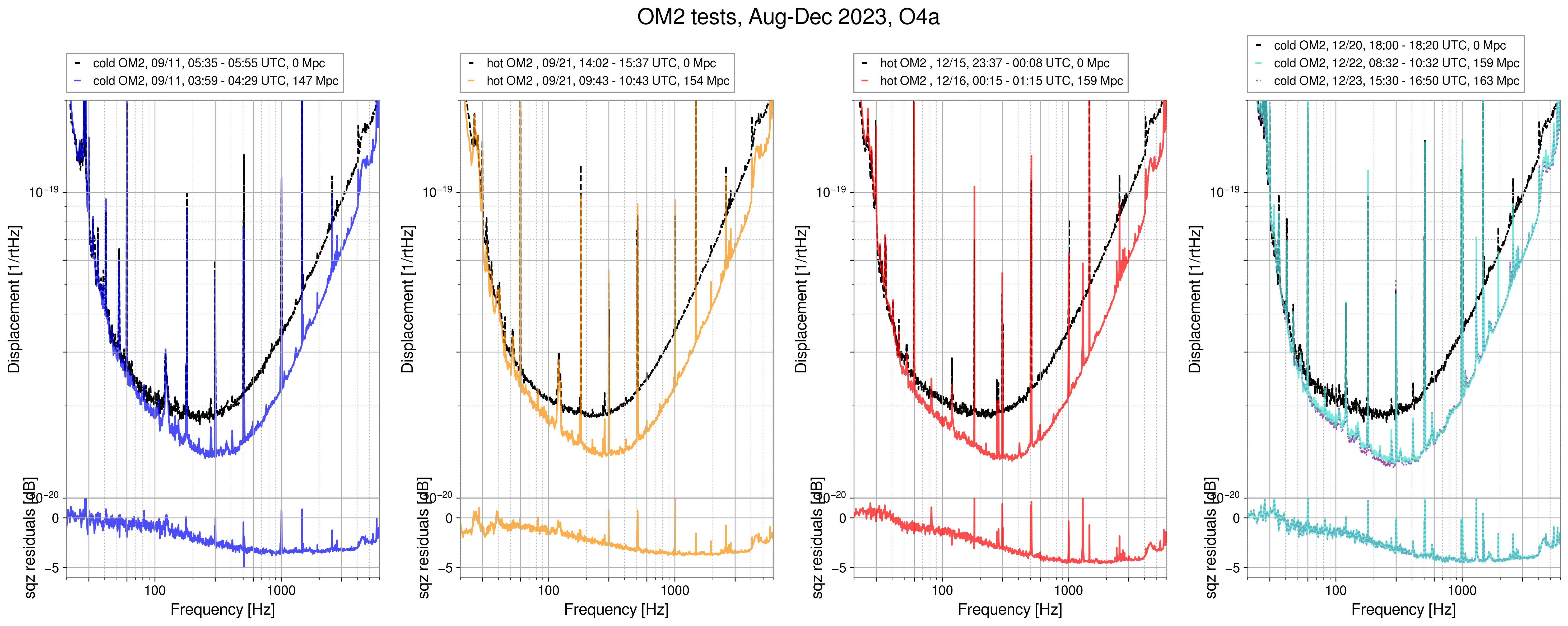
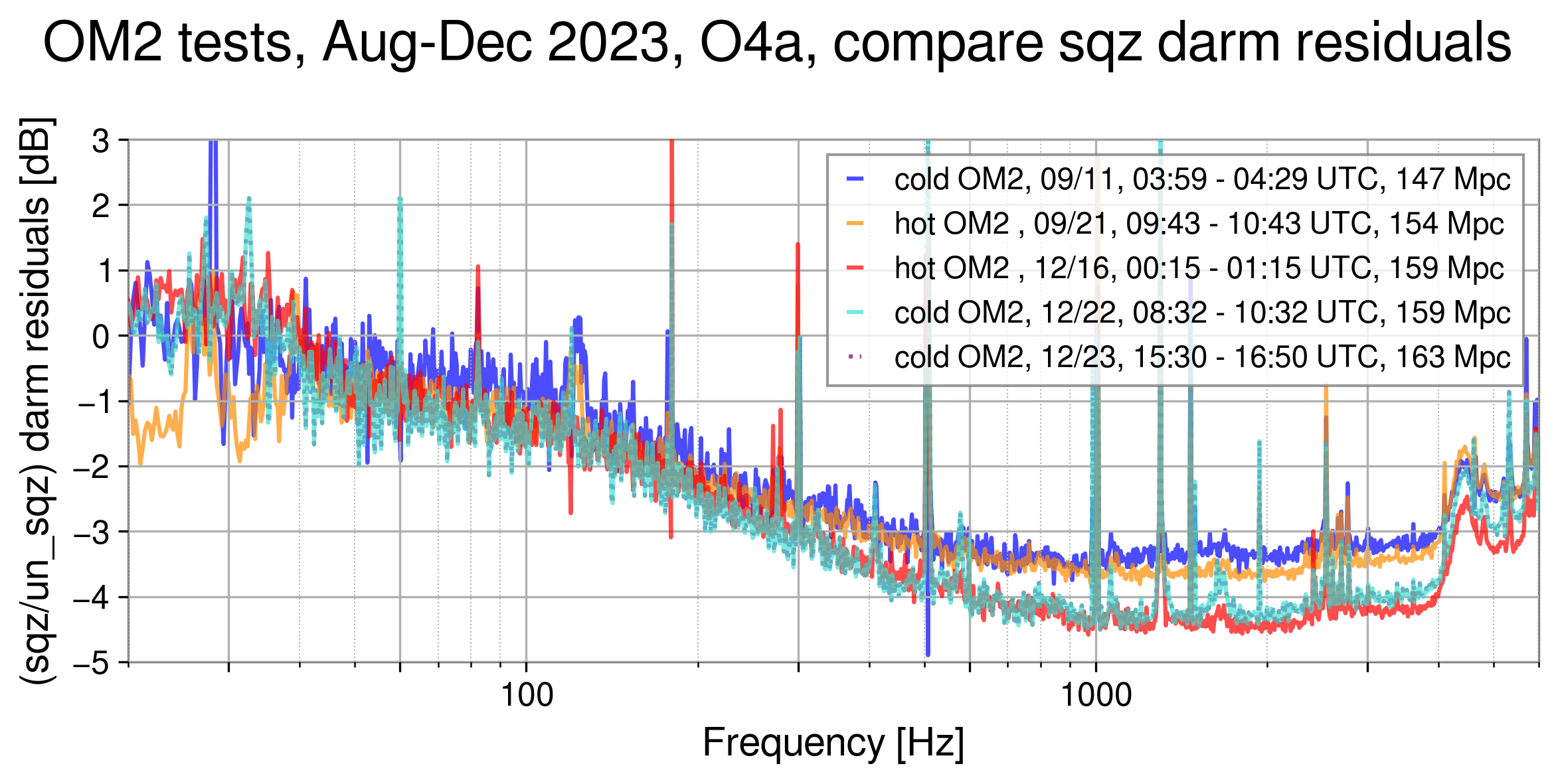
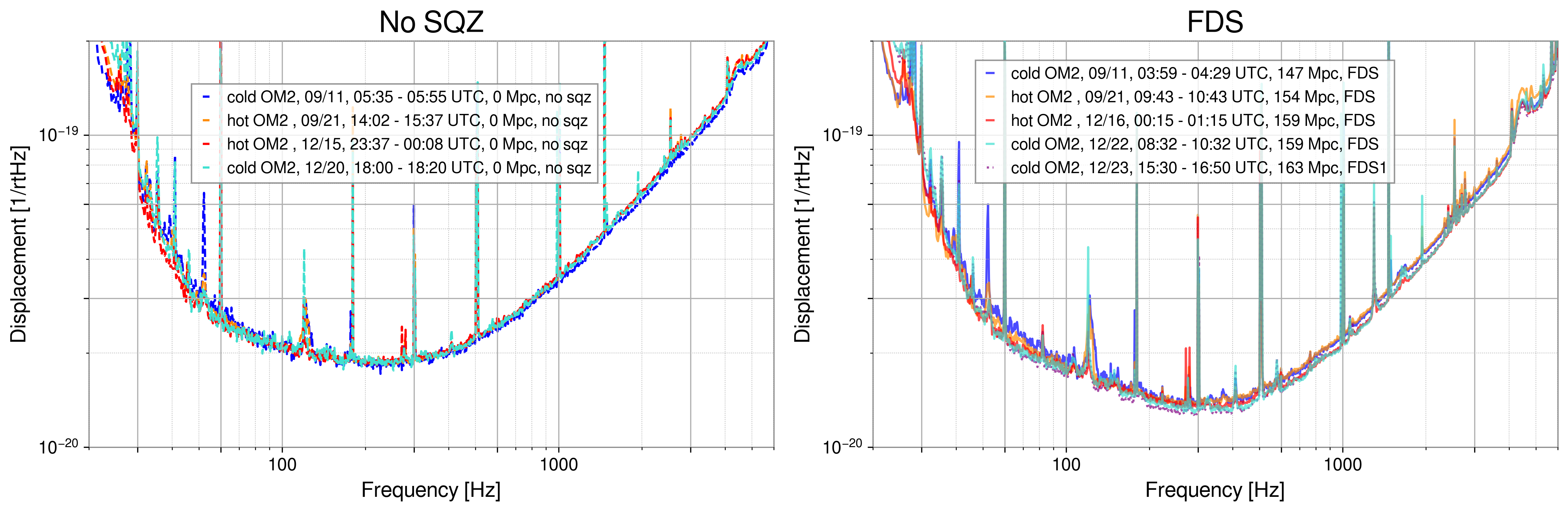
Echo-ing the above, and summarizing a look at OM2 with sqz in both Sept 2023 and Dec 2023 (running gps times dictionary is attached here).
If we compare the effect of squeezing -- there is higher kHz squeezing efficiency with hot OM2. We can look at either just the darm residuals dB[sqz/unsqz] (top), or do subtraction of non-quantum noise (bottom) which shows that hot OM2 improved the kHz squeezing level by ~0.5 dB at 1.7 kHz (the blue sqz blrms 5). This is consistent with summary pages: SQZ has not reached 4.5 dB since cooling OM2 74861. Possibly suggests better SQZ-OMC mode-matching with hot OM2.
Without squeezing, cold om2 has more optical gain and more low-freq non-quantum noise. Better IFO-OMC mode-matching with cold OM2.
In total, it's almost a wash for kHz sensitivity: heating OM2 loses a few % optical gain, but recovers 0.2-0.5 dB of shot noise squeezing.
It's worth noting the consistent range increases with SQZ tuning + improvements: even in FDS, there is a non-zero contribution of quantum noise down to almost 50 Hz. For example Naoki's adjustment of sqz angle setpoint on 12/21 74972 improved range, same for Camilla's Jan sqz tuning 75151. Looking at DARM (bottom green/purple traces), these sqz angle tunings reproducibly improved quantum noise between about 60-450 Hz.


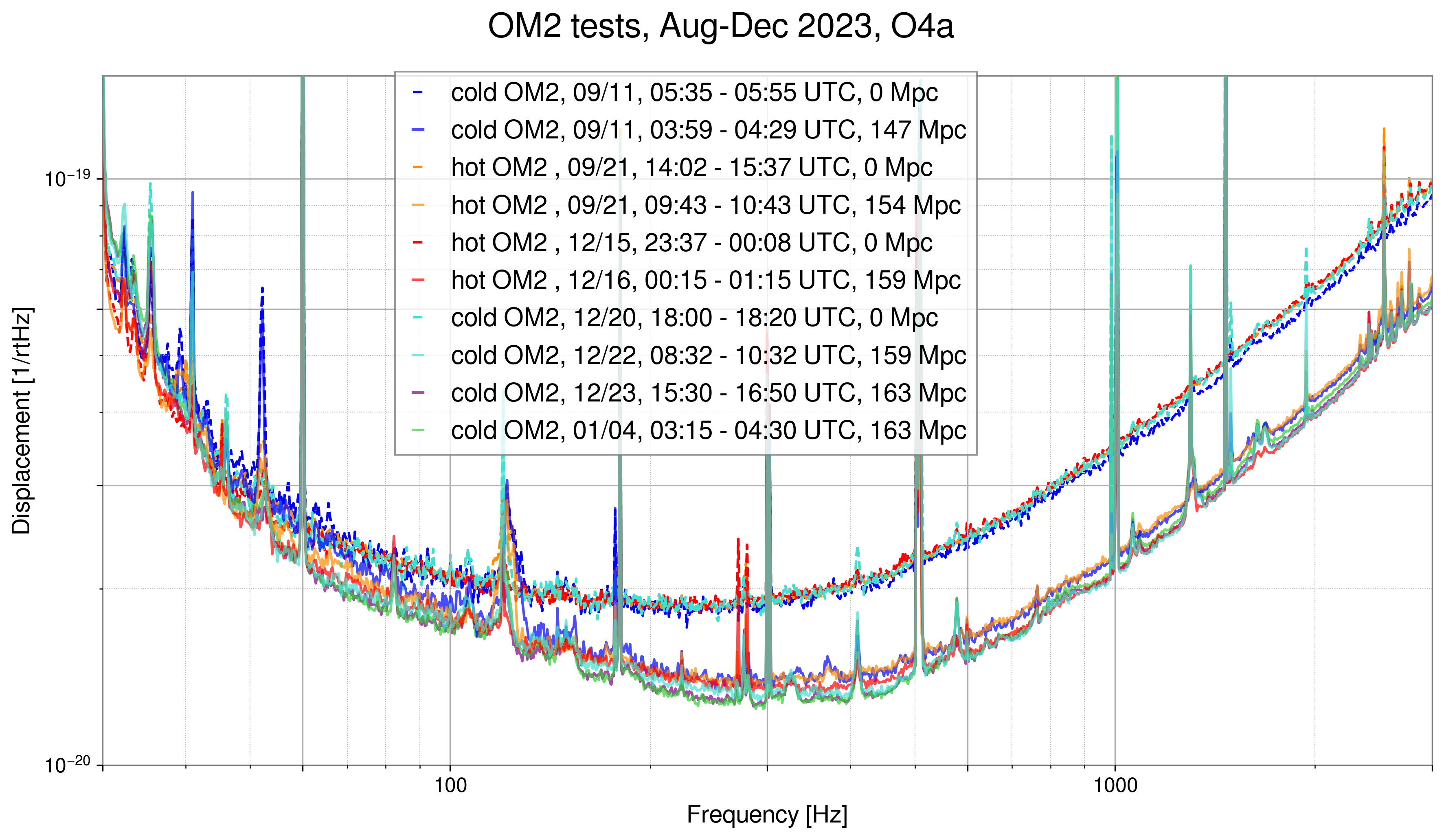
Here are some more plots of the times that Vicky plotted above.
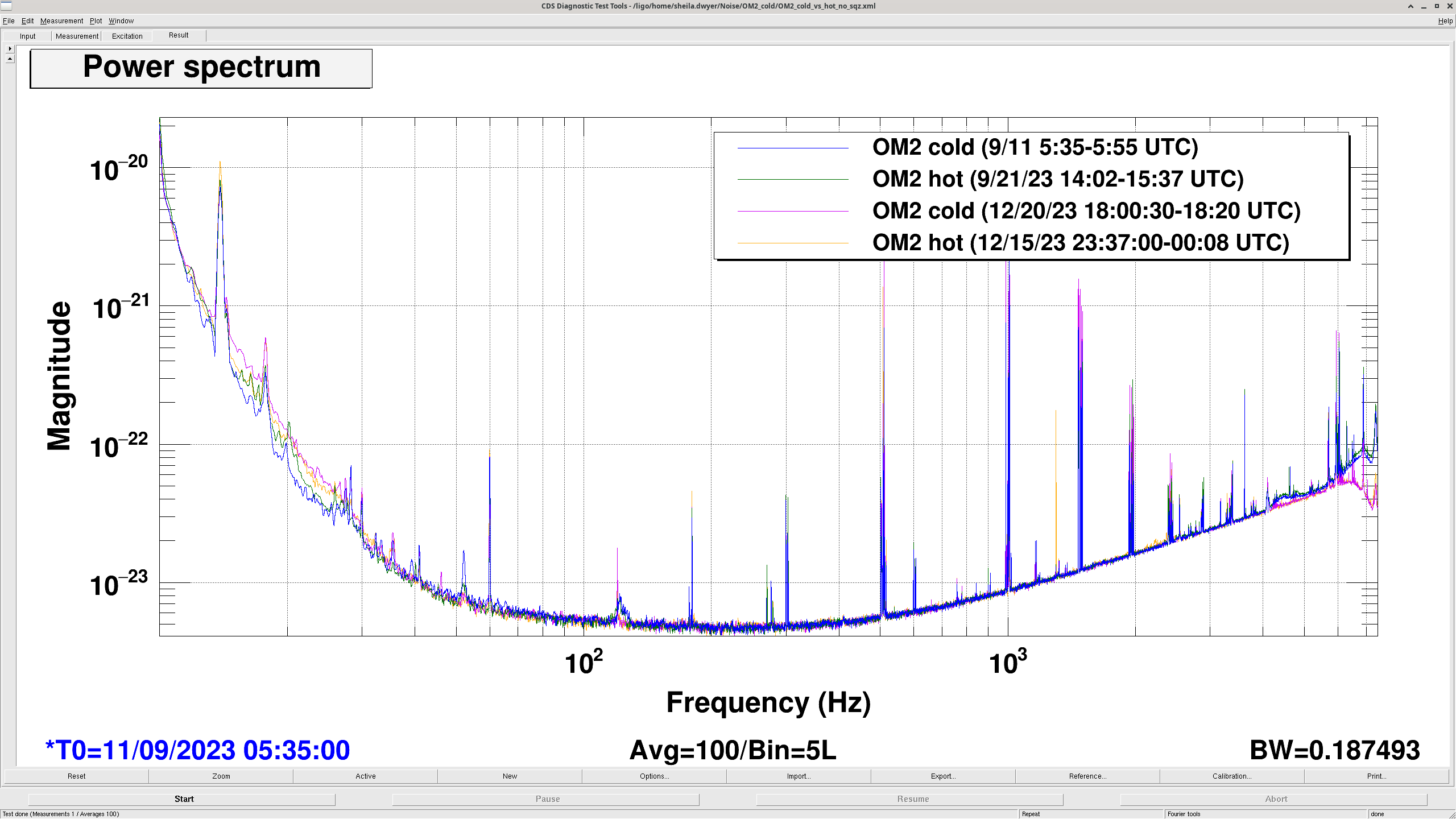
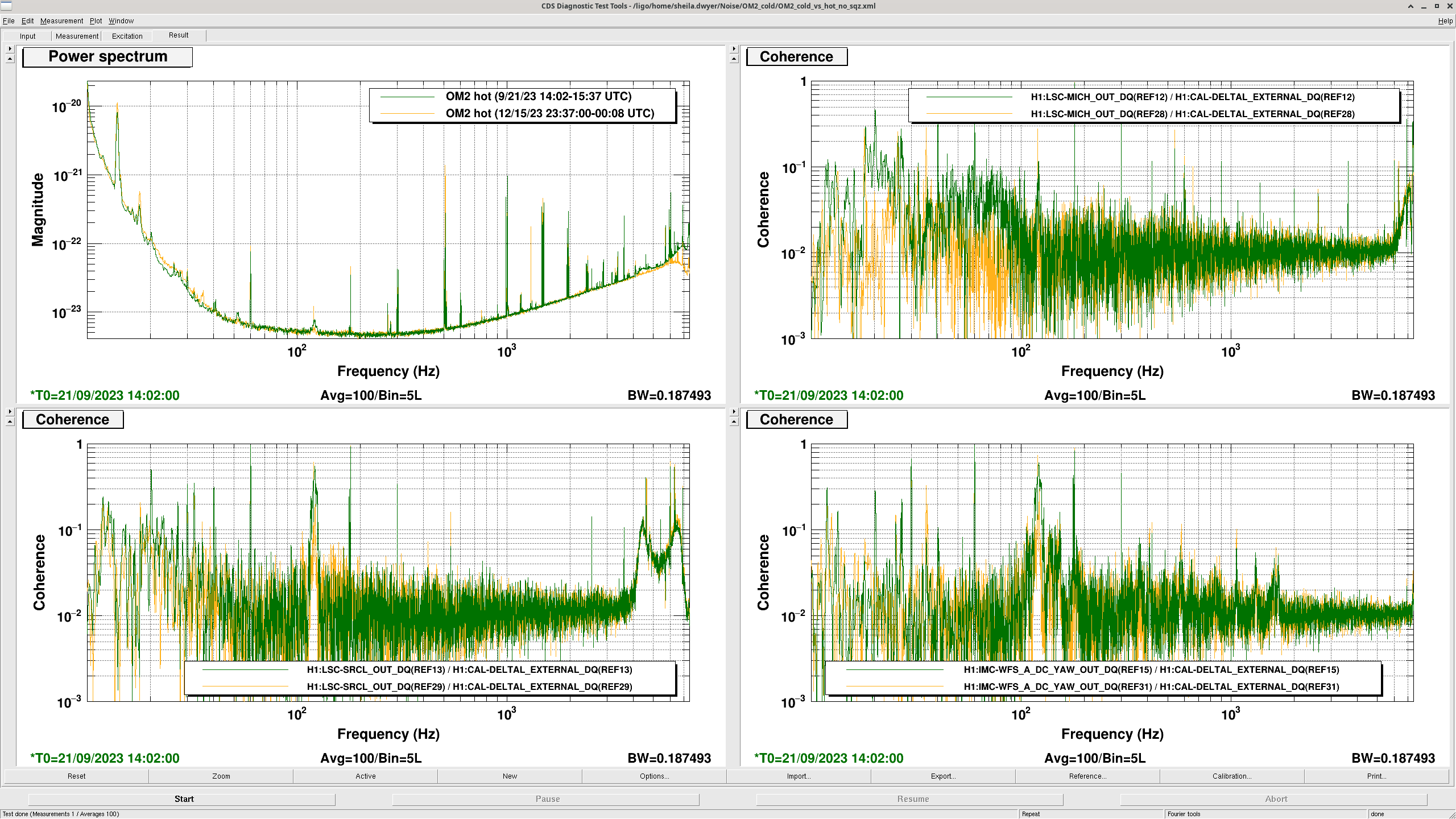
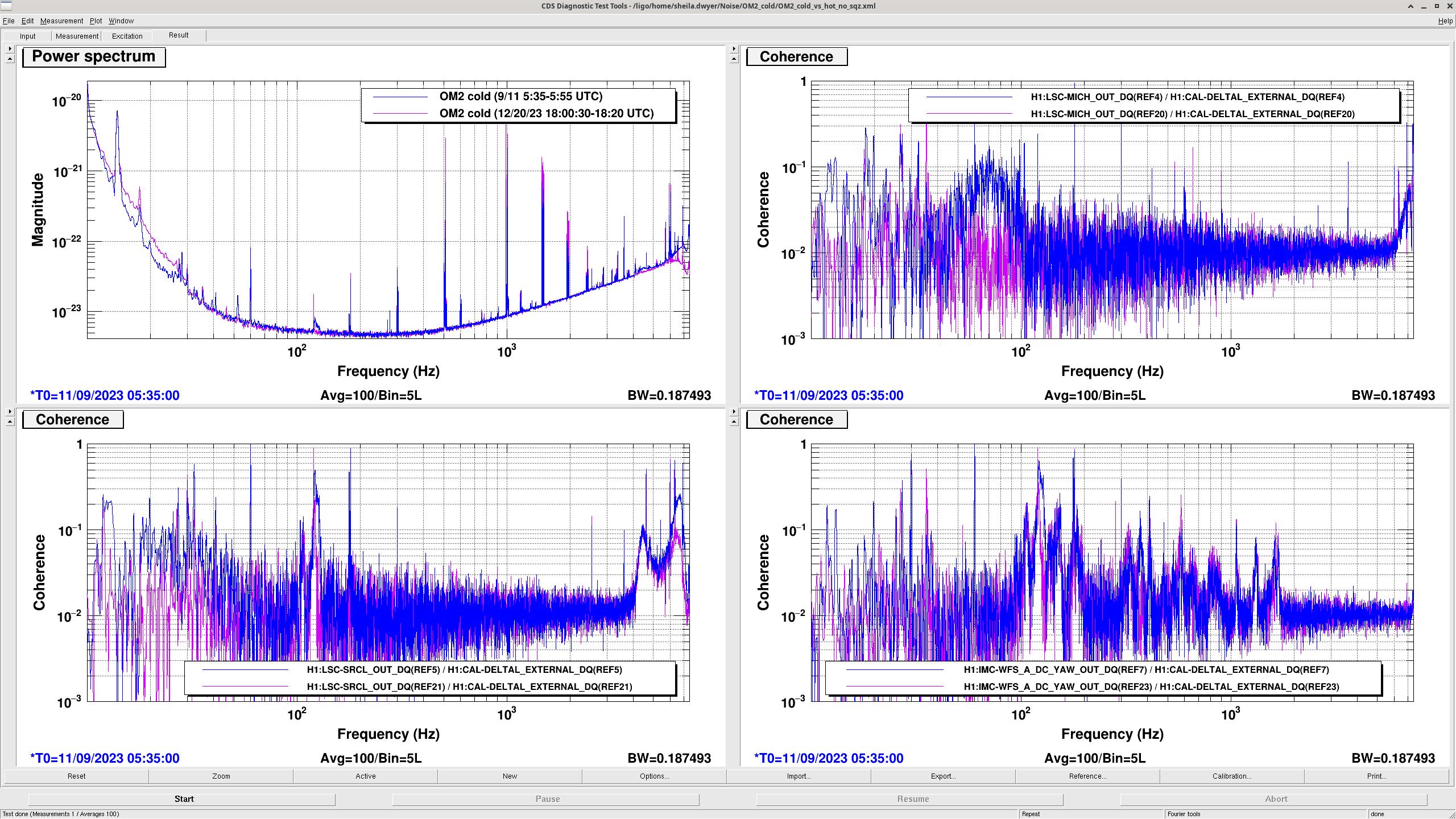
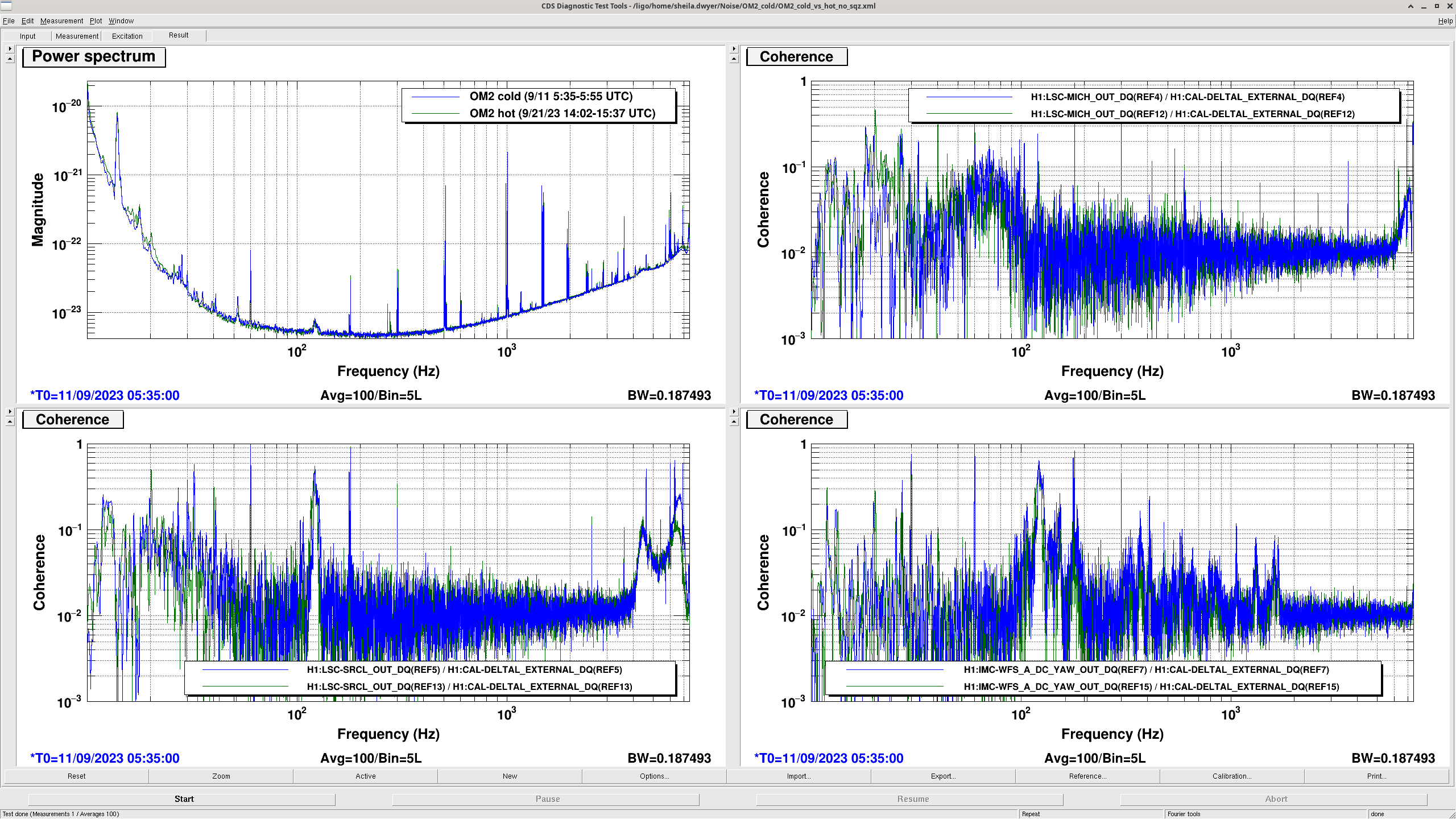
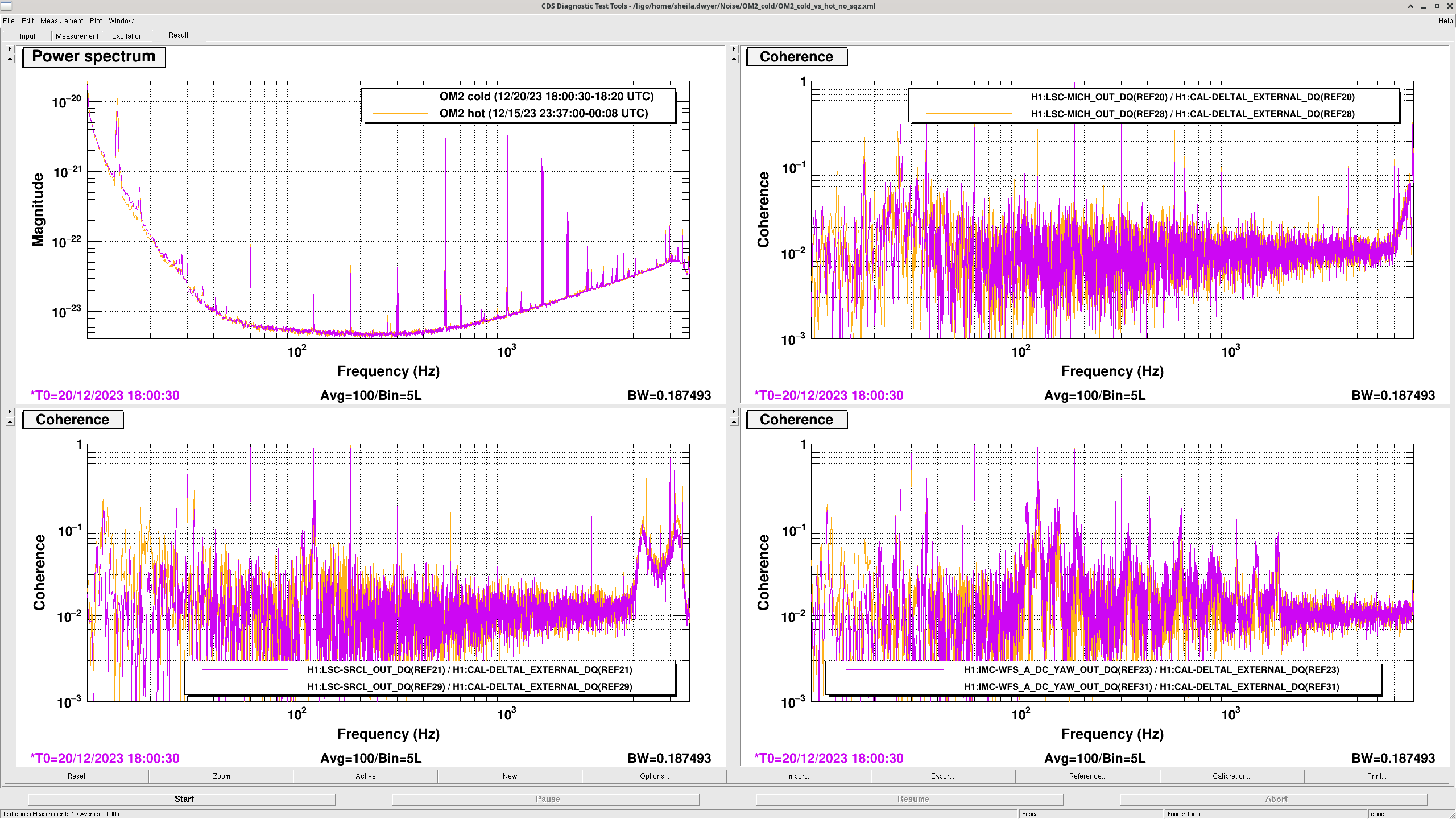
The first attachment is just a DARM comparison with all 4 no sqz times, OM2 cold vs hot in December vs September.
Comparing OM2 hot September vs December shows that our sensitivity at from 20-40 Hz has gotten worse since September, the MICH coherence seems lower while the jitter and SRCL coherence seem similar. The same comparison for OM2 cold shows that with OM2 cold our sensitivity has also gotten worse from 15-30 Hz.
Comparing cold vs hot, in September the MICH coherence did get worse from 60-80 Hz for cold OM2, which might explain the worse sensitivity in that region. The MICH coherence got better from 20-30 Hz where the sensitivty was better for cold OM2. The December test had better tuned MICH FF for both hot and cold OM2, so this is the better test of the impact of the curvature change.
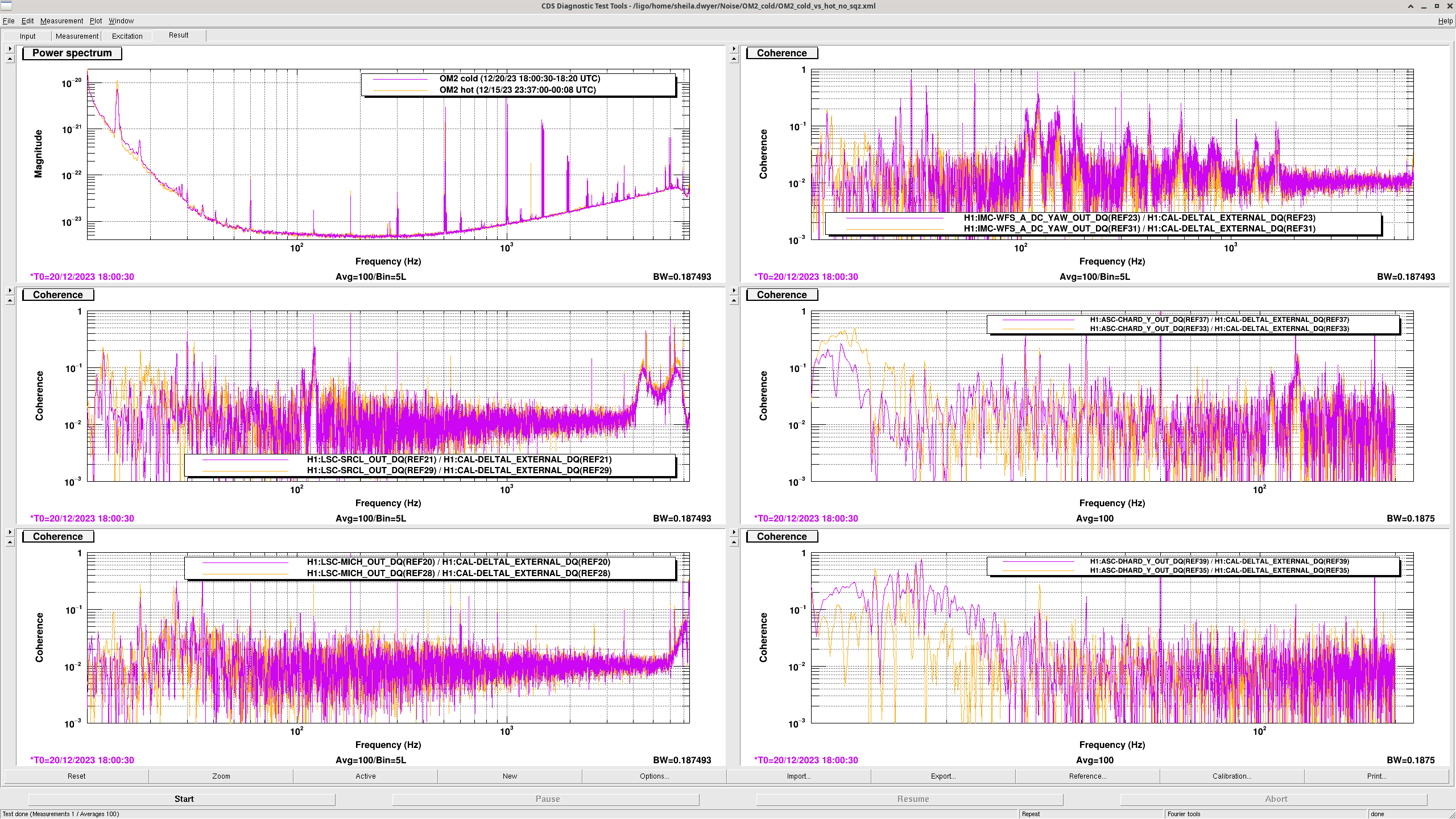
As Gabriele pointed out with his BRUCO, 74886 there is extra coherence with DHARD Y for cold OM2 at the right frequencies to help explain the extra noise. There isn't much change in the HARD pitch coherence between these December times, but the last attachment here shows a comparison of the HARD Y coherences for hot and cold OM2 in December.
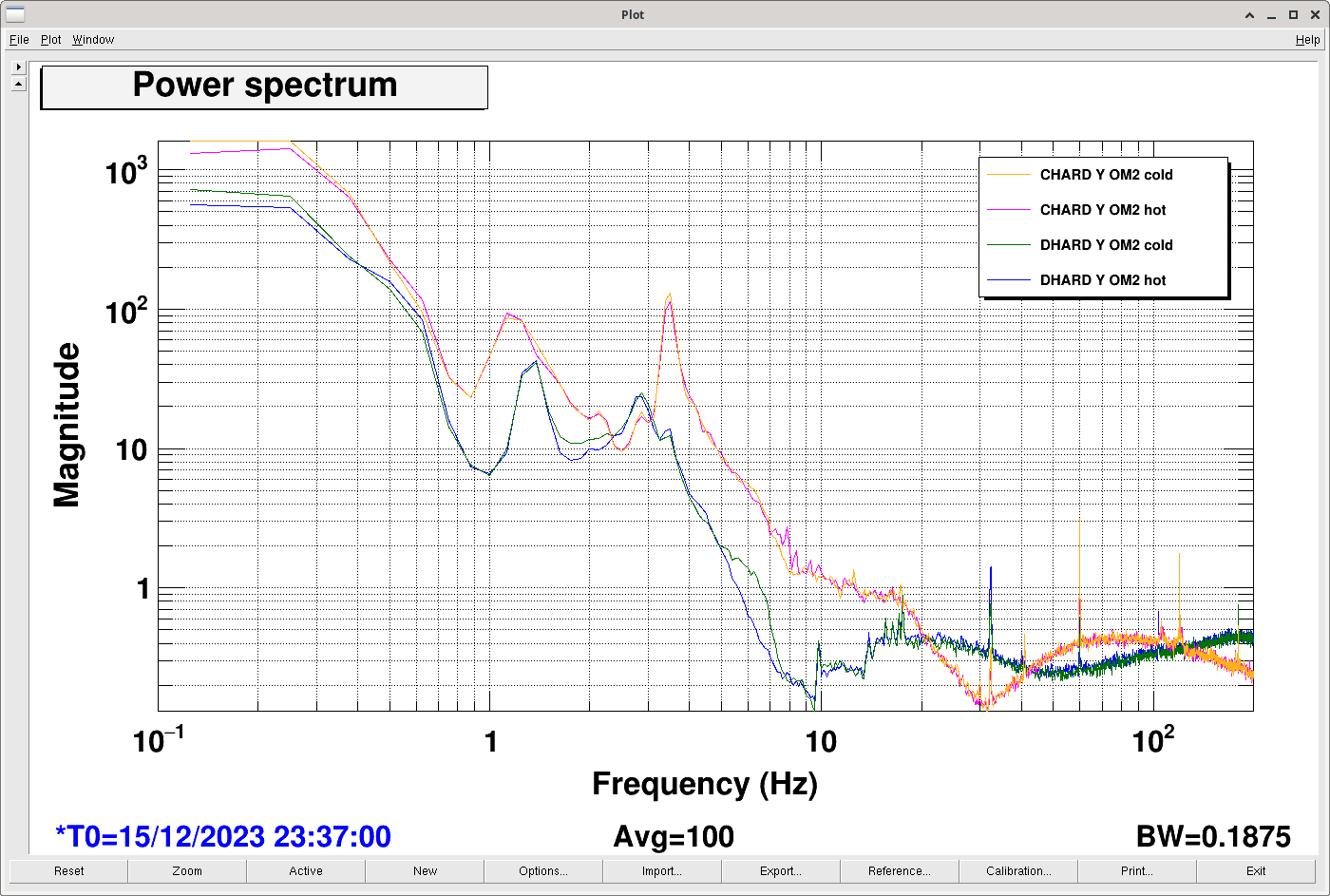
Peter asked if the difference in coherence with the HARD Yaw ASC was due to a change in the coupling or the control signal.
Here is a comparison of the control signals with OM2 hot and cold, they look very similar at the frequencies of the coherence.

IA finished at 11:12UTC, back to locking. I had to help yarm lock during IA.
With wind increasing with gusts up to 40mph I've taken SEI back to WINDY from MICROSEISM
Wind gusts up to 60mph! ALS is having lots of difficulty locking due to the wind and high microseism. The forecast on windy.com says the wind is likely stay at the same level for the rest of the morning and increase further, peaking around 11am today. So I'm not super hopeful of the IFO getting relocked, unless the wind dies down for a short period.