Camilla, Erik, Dave:
h1hwsmsr (HWS ITMX and /data RAID) computer froze at 22:14 Thu 04 Jan 2024 PST. The EDC disconnect count went to 88 at this time.
Erik and Camilla have just viewed h1hwsmsr's console, which indicated a HWS driver issue at the time. They rebooted the computer to get the /data RAID NFS shared to h1hwsex and h1hwsmsr1. Currently the ITMX HWS code is not running, we will start it during this afternoon's commissioning break.
One theory of the recent instabilities is the camera_control code I started just before the break to ensure the HWS cameras are inactive (in extenal trigger mode) when H1 is locked. Every minute the camera_control code gets the status of the camera, which along with the status of H1 lets it decide if the camera needs to be turned ON or OFF. Perhaps with the main HWS code getting frames from the camera, and the control code getting the camera status, there is a possible collision risk.
To test, we turn the camera_control code off at noon. I will rework the code to minimize the number of camera operations to the bare minimum.
Ibrahim, Dave, Jonathan:
The CDS-GC NAT router (rtr-msr-cds) stopped running at 06:20 PST this morning. Symptoms are that all compuer networking between CDS and GC is down, but the control room VOIP phones still work.
Jonathan and Ibrahim power cycled rtr-msr-cds and all is working again now.
Opened FRS30104 to cover this issue
To get the DTS EPICS channels working again (and fix EDC disconnection to these) I restarted the DTS services on cdsioc0 (dts_tunnel, dts_env). The EDC has reconnected to these channels.
TITLE: 12/18 Day Shift: 16:00-00:00 UTC (08:00-16:00 PST), all times posted in UTC
STATE of H1: Observing at ??Mpc
OUTGOING OPERATOR:
CURRENT ENVIRONMENT:
SEI_ENV state: CALM
Wind: ??
Primary useism: ??
Secondary useism: ??
QUICK SUMMARY:
IFO is in NLN and OBSERVING as of 13:04UTC
Computers in Control Room are NOT working - here is a summary:
- I cannot sign into any of the computers - getting a "password incorrect" despite being able to sign in immediately on my laptop (to write ths).
- DARM FOM is frozen
- Picket fence is frozen
- Teamspeak is frozen
- Cameras are frozen
- No Range is being shown
This seems to be some CDS issue so will call the relevant people to notify and rectify
Other than this, it seems that microseism is on the rise.
TITLE: 01/05 Day Shift: 16:00-00:00 UTC (08:00-16:00 PST), all times posted in UTC
STATE of H1: Observing at 149Mpc
OUTGOING OPERATOR: Ryan C
CURRENT ENVIRONMENT:
SEI_ENV state: CALM
Wind: 6mph Gusts, 4mph 5min avg
Primary useism: 0.13 μm/s
Secondary useism: 0.76 μm/s
QUICK SUMMARY:
CDS Network is back after restarting router in MSR.
- Problem has been fixed (for now), though we don't know the root cause.
- After calling Dave, Jonathan called and walked me through which MSR power to cycle - after doing this:
- Restarting all NUCs now
Other:
- Potential computer slowdowns
My initial sessions on cdslogin were for some reason slow, but it is now working normally.
Statues of H1: Relocking at CHECK_VIOLINS
11:04UTC H1 called for assistance as the NLN timer had expired with IA already been run. We were at PREP_ASC_FOR_FULL__IFO and I can see that the Violins look huge on DARM, H1 lost lock at MAX_POWER twice this morning/night so that's probably why (tagging SUS), most of the other LLs have been at ALS, presumably these ALS difficulties are from the increased ground motion. I'm going to have to spend some time damping violins it seems.
After spending about an hour in OMC_WHITENING damping violins and increasing gains we've reaquired NLN at 13:04UTC, back into Observing at 13:04UTC
TITLE: 01/05 Eve Shift: 00:00-08:00 UTC (16:00-00:00 PST), all times posted in UTC
STATE of H1: Lock Acquisition
INCOMING OPERATOR: Ryan C
SHIFT SUMMARY:
High Microseism (over the 95th percentile) is making acquisition tough.
Seems like best chances for locking is right after an alignment.
Have had mixed luck transitioning states for SEI_CONF (between USEISM & WINDY) for most of the shift. Overall, I had more luck in WINDY, but still only made it to NLN once--sole lock of the evening of 2.5hrs.
Ran an alignment with non-trivial results in that some states would not complete. Ended up spending about an hour on alignment.
Picket Fences have been flashing yellow quite a bit (don't recall this yesterday, although I wasn't looking at them as much).
End of shift consisted of frantically trying to get H1 to NLN (lots of quick/early locklosses only around LOCKING ALS) before the end of the shift to no avail.
LOG:
H1 has been locked for 2hrs with a range just under 165Mpc. This is with microseism above the 95th percentile just under 1um/s.
After Austin started an Initial Alignment, locking looked optimistic, but then several consecutive locklosses later, I ended up transitioning SEI_CONF node from USEISM --back to--> WINDY. This required:
The picket fence has been pretty noisy and flashes yellow for various channels (don't recall seeing this earlier this week).
Violins are just under an order of magnitude higher than they were last night at 3e10^-17.
TITLE: 01/05 Eve Shift: 00:00-08:00 UTC (16:00-00:00 PST), all times posted in UTC
STATE of H1: Aligning
OUTGOING OPERATOR: Austin
CURRENT ENVIRONMENT:
SEI_ENV state: CALM
Wind: 5mph Gusts, 3mph 5min avg
Primary useism: 0.15 μm/s
Secondary useism: 0.55 μm/s
QUICK SUMMARY:
Arrived to my shift Mid-Initial Alignment for H1 per Austin's recovery from commissioning lockloss (and due to minor hardship for getting through early steps of ISC-LOCKing). Status: Alignment complete and H1 has just passed the DRMI locking steps. NOTE: Lockloss at LOW NOISE COIL DRIVERS, & then CHECK AS SHUTTERS.
Austin also mentioned the unique low-freq seismic activity--Microseism was starting a slow decrease 24hrs ago, but in the last 12hrs it started to turn around and is currently back up to where it was 24hrs ago (which is at/above the 95th percentile). BUT--a unique observation is that the "secondary" microseism band has also increased around the 12hr turnaround. So because of the odd microseism and rough locking in early states, SEI_CONF is at the USEISM state. If we want to return SEI_CONF to WINDY, It's not a simple transition to WINDY. TJ shared how we make this transition:
For much of the above---it most likely not be done tonight, unless the Earth becomes much more quieter seismically for us.
Dave, Erik, Camilla, Jonathan, During a lock loss Jonathan went to EY and got the network interface configured. This was enough to get the machine back on the network. When the machine was replaced yesterday the camera was plugged into the wrong slot on the pci board, this was fixed as well. Dave, Erik, and Camilla remotely activated and tested the camera. Some notes: * During an iteration of work inside, go outside for cell phone reception something in the door mechanism to EY got stuck and it would not open despite being set to unlocked by the operator and by a key fob. After many tries it eventually opened. * Since the re-keying there is no key in the lock box.
Before the HWS ETMY IOC was started on h1hwsey, I stopped the simulation IOC which had been running on cdsioc0.
This was running under systemd control as h1hwsetmy_dummy_ioc.service. I have stopped and disabled this service.
h1tcshwssdf was restarted a few times this afternoon as ETMX and ETMY HWS IOCs came and went.
Camilla started the camera control code for ETMY.
At 15:30:48 PST this afternoon h1hwsex crashed again. It had crashed Sat 23 Dec 2023 and was rebooted this Tue 02 Jan 2024. It ran for just about 2 days before crashing again.
Camilla says it is OK to leave the computer off overnight, Erik will replace this computer with a V1 during tomorrow's commissioning break (Fri 05 Jan 2024).
H1 was unlocked at the time of the crash, which means the HWS camera is acquiring images. Camilla confirmed it is OK to leave the camera in this state, it is the ITM cameras which have been causing noise issues.
To green up EDC and SDF, I started the HWS EX dummy IOC on cdsioc0. This is running as user 'ioc' in a tmux session.
TITLE: 01/04 Day Shift: 16:00-00:00 UTC (08:00-16:00 PST), all times posted in UTC
STATE of H1: Lock Aquisition
INCOMING OPERATOR: Corey
SHIFT SUMMARY:
- 16:17 - GRB short E463149
- 16:51 - Superevent S240104b
- 17:11 - 18:10 - Fire pump testing began - Tagging DetChar in case this shows up as noise on their end
- EX saturation @ 22:02
- 22:35 - went into COMMISSIONING for opportunistic DARM measurements while LLO is down due to microseism
- ISC went through MICH FRINGES a few times without being able to move up, which is my cue to begin running an IA, which is currrently ongoing
- Mystery rise and steady hold of primary microseism is still apparent, coupled with a now rising secondary microseism, I have moved the SEI CONF guardian to USEISM to help make locking less cumbersome
LOG:
| Start Time | System | Name | Location | Lazer_Haz | Task | Time End |
|---|---|---|---|---|---|---|
| 16:50 | FAC | Johnson Controls | Site | N | Fire panel work | ?? |
| 17:03 | FAC | Karen | Wood shop | N | Tech clean | 17:20 |
| 18:26 | FAC | Kim | H2 | N | Tech clean | 18:30 |
| 19:33 | VAC | Janos | MX | N | Vac checks | 19:45 |
| 21:26 | FAC | Randy | EX Mech | N | Inventory | 21:56 |
| 22:34 | VAC | Gerardo | MX | N | Check purge air | ?? |
| 23:09 | CDS | Jonathan | EY | N | Finish set up of HWS computer | 23:59 |
Sheila, Louis
We tried transitioning to the new DARM configuration today slowly to debug the transition from NEW_DARM -> [nominal] DARM. We've had plenty of success transitioning into the new DARM state recently using the ETMY_NLN and NEW_DARM ISC_LOCK guardian states. However, today we encountered several errors when doing so. Some syntax errors cropped up from a few lines in ETMY_NLN (that neither of us recognized) that kept us from moving beyond the main() method. We ran the run() instructions by hand (with the GRD state back in NLN) and fixed the syntax errors in ETMY_NLN and then continued by hand to the NEW_DARM configuration (while the guardian state stayed in NLN) but lost lock when swapping the gains on SUS-ETM{Y,X}_L3_LOCK_L. We confirmed that all the expected DARM loop filters were installed and engaged as expected before moving to ETMX (NEW_DARM) from ETMY. It's not clear to us yet why we lost lock this time around after having virtually no issues switching to the new DARM state recently.
Lockloss @ 22:57 - caused by commissioner measurement.
Jenne, Naoki, Louis, Camilla, Sheila
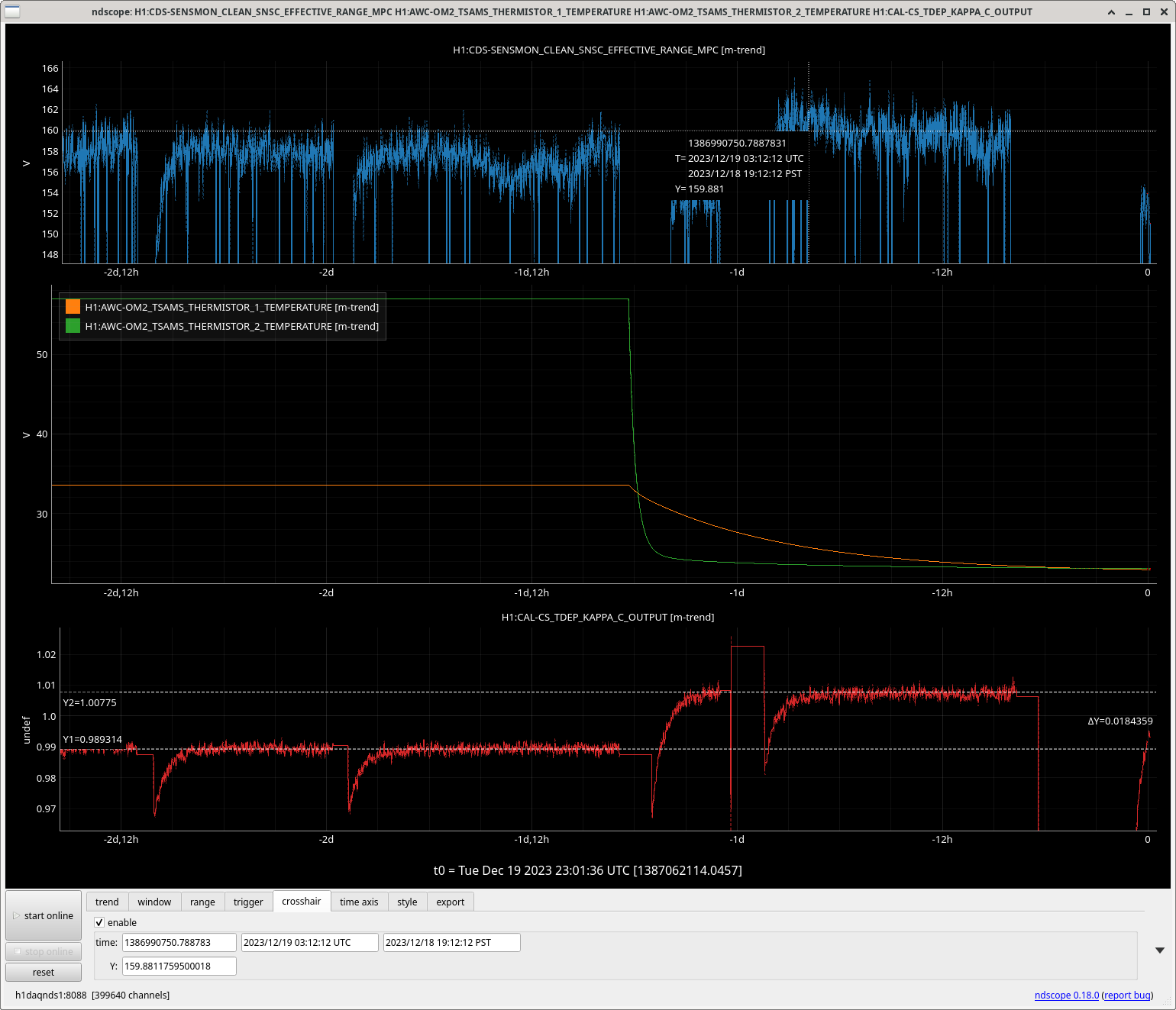
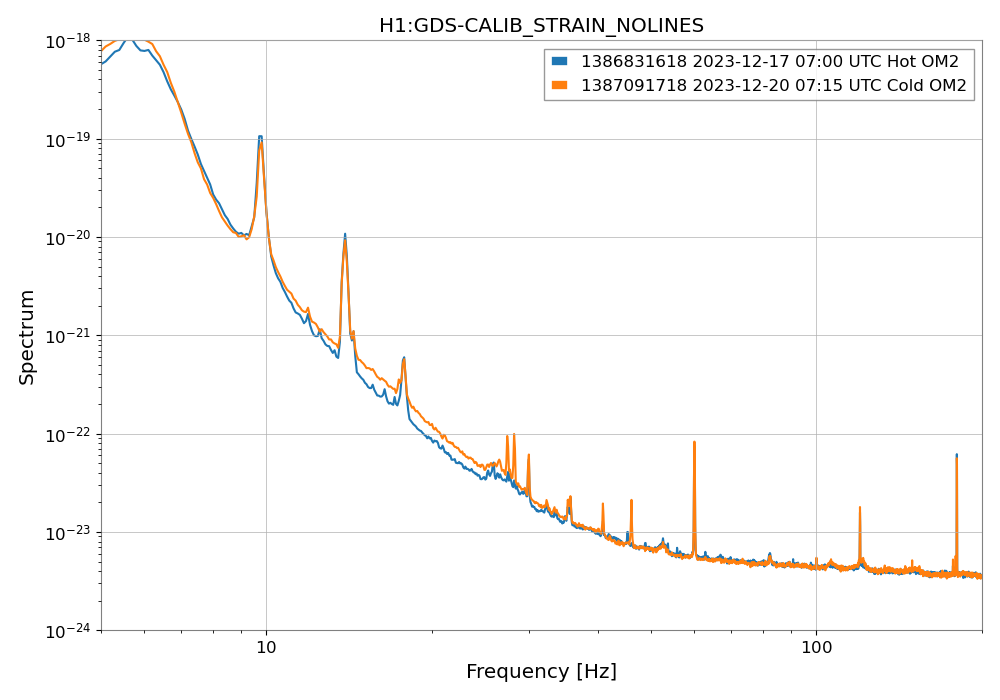
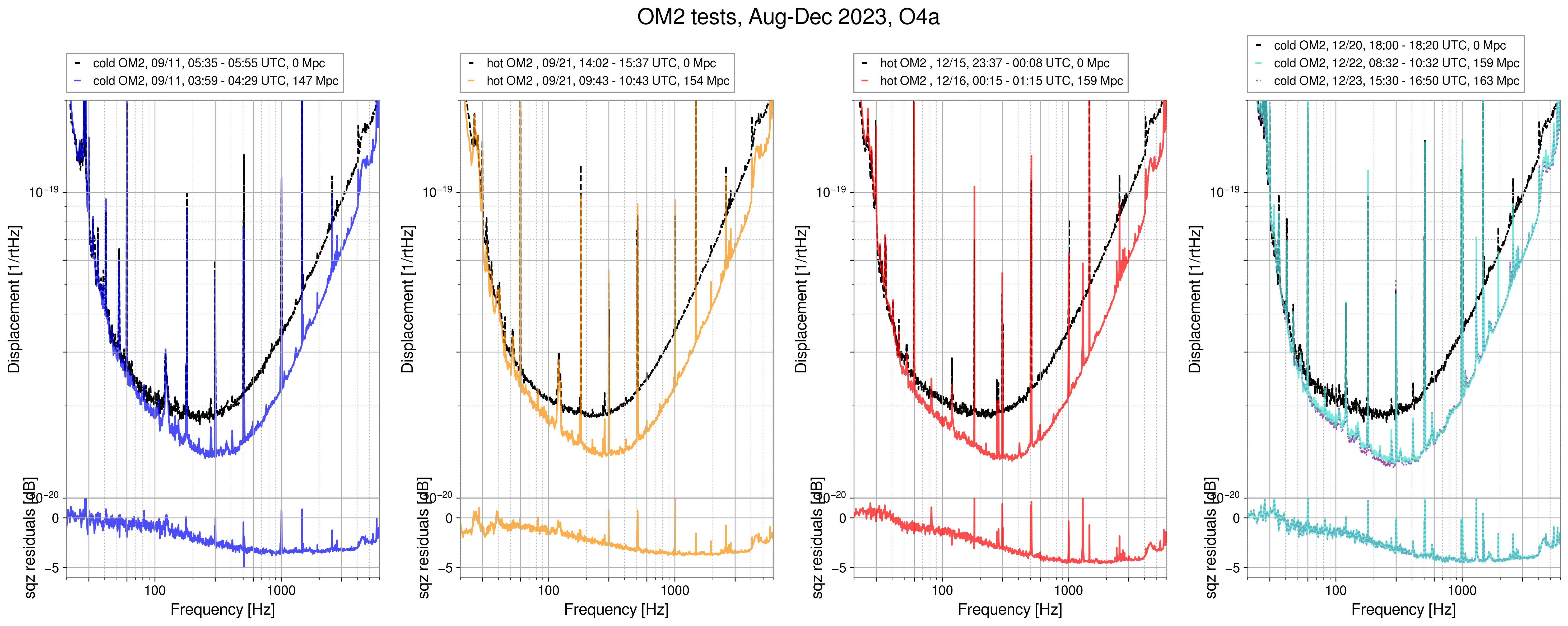
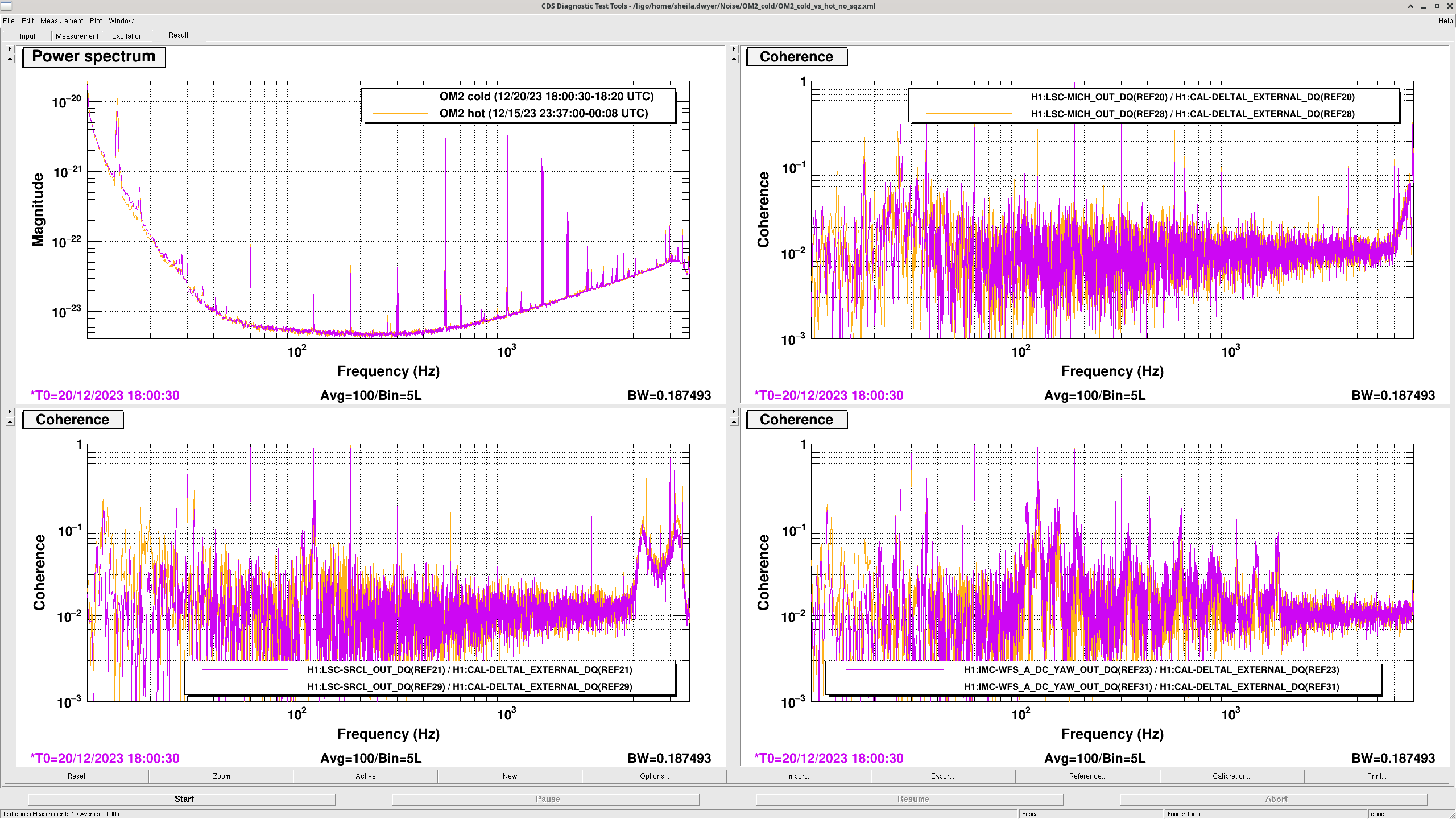
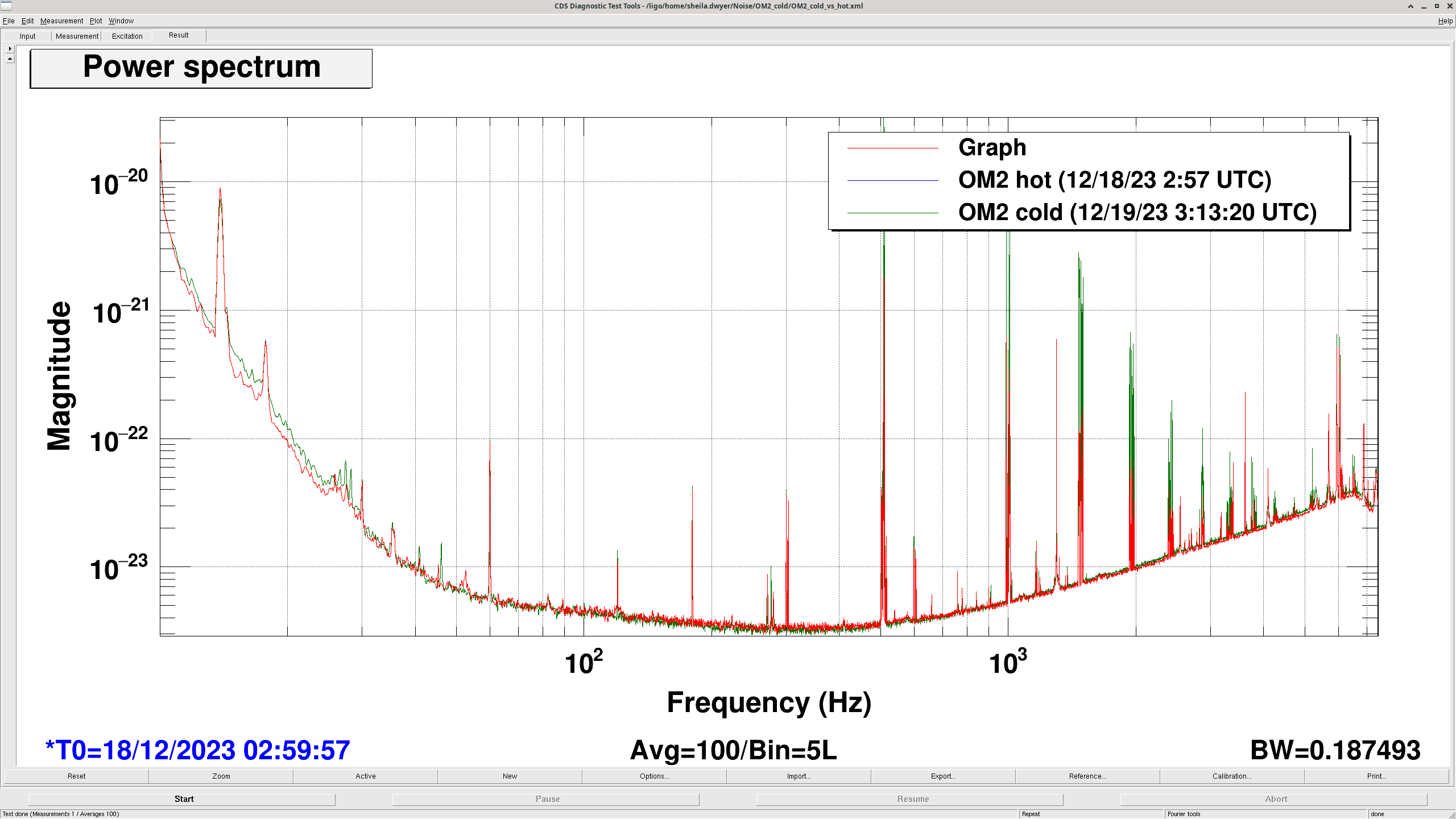
Here is comparison of the DARM CLEAN spectrum with OM2 hot vs cold. The second screenshot shows a time series of OM2 cooling off. The optical gain increased by 2%, as was seen in the past (for example 71087). Thermistor 1 shows that the thermal transient takes much longer (12 + hours) than what thermistor 2 says (2 hours).
Louis posted a comparison of the calibration between the two states, there are small differences in calibration ~1% (74913). While the DARM spectrum is worse below 25Hz, it is similar at 70 Hz where we in the past thought that the sensitivity was worse with OM2 cold. From 100-200 Hz the sensitivity seems slightly better with OM2 cold, some of the peaks are removed by Jenne's jitter subtraction (74879) but there also seems to be a lower level of noise between the peaks (which could be small enough to be a calibration issue). At high frequency the cold OM2 noise seems worse, this could be because of the squeezing. We plan to take data with some different squeezing angles tomorow and will check the squeezing angle as part of that.
So, it seems that this test gives us a different conculsion than the one we did in the spring/summer, and that now it seems that we should be able to run with OM2 cold to have better mode matching from the interferometer to the OMC. We may have not had our feedforwards well tuned in the previous test, or perhaps some other changes in the noise mean that the result is different now.
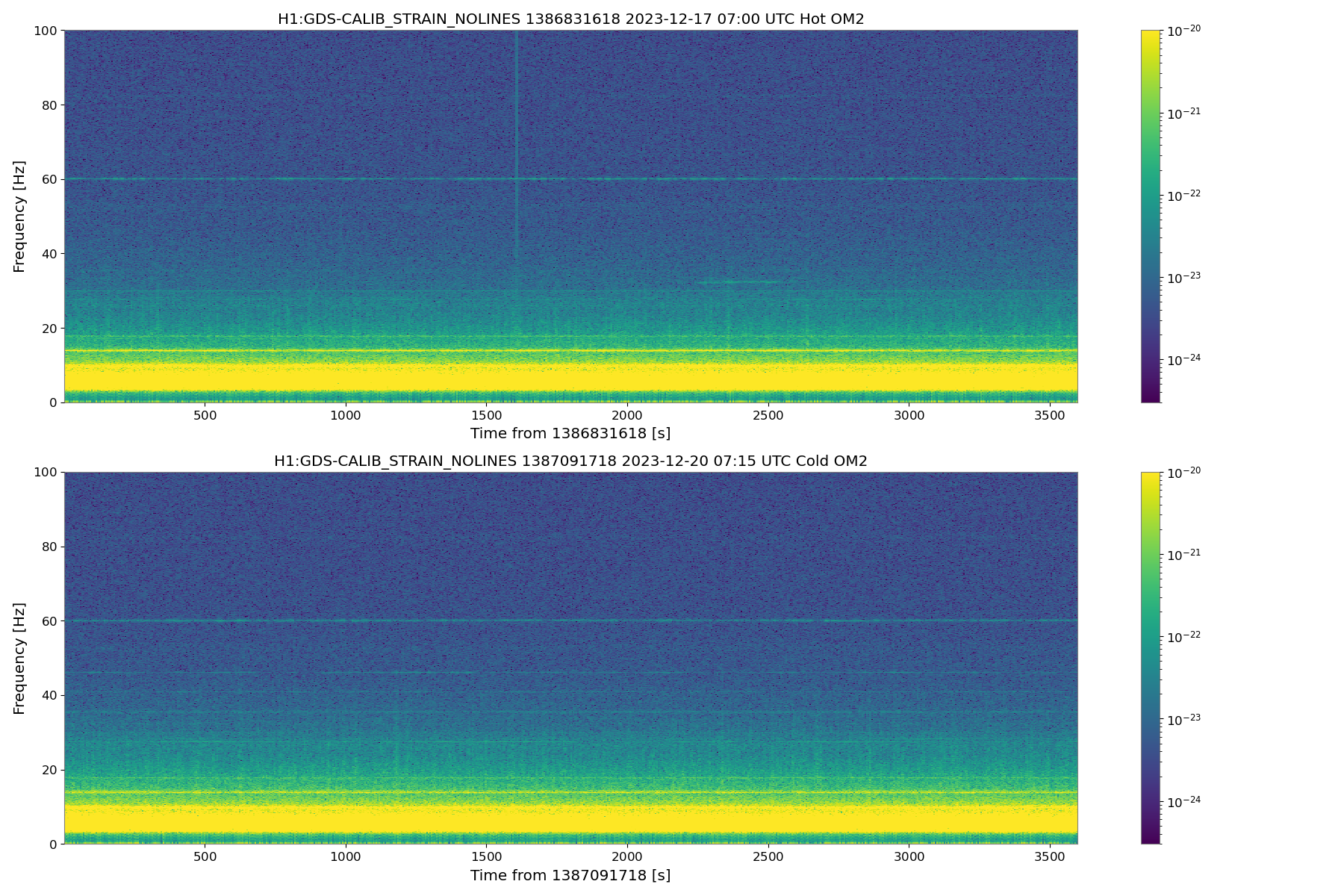
Is this additonal nosie at low frequency due to the same non-stationarity we oberved before and we believe is related to the ESD upconversion? Probably not, here's why.
First plot compares the strain spectrum from two times with cold and hot OM2. This confirms Sheila's observation.
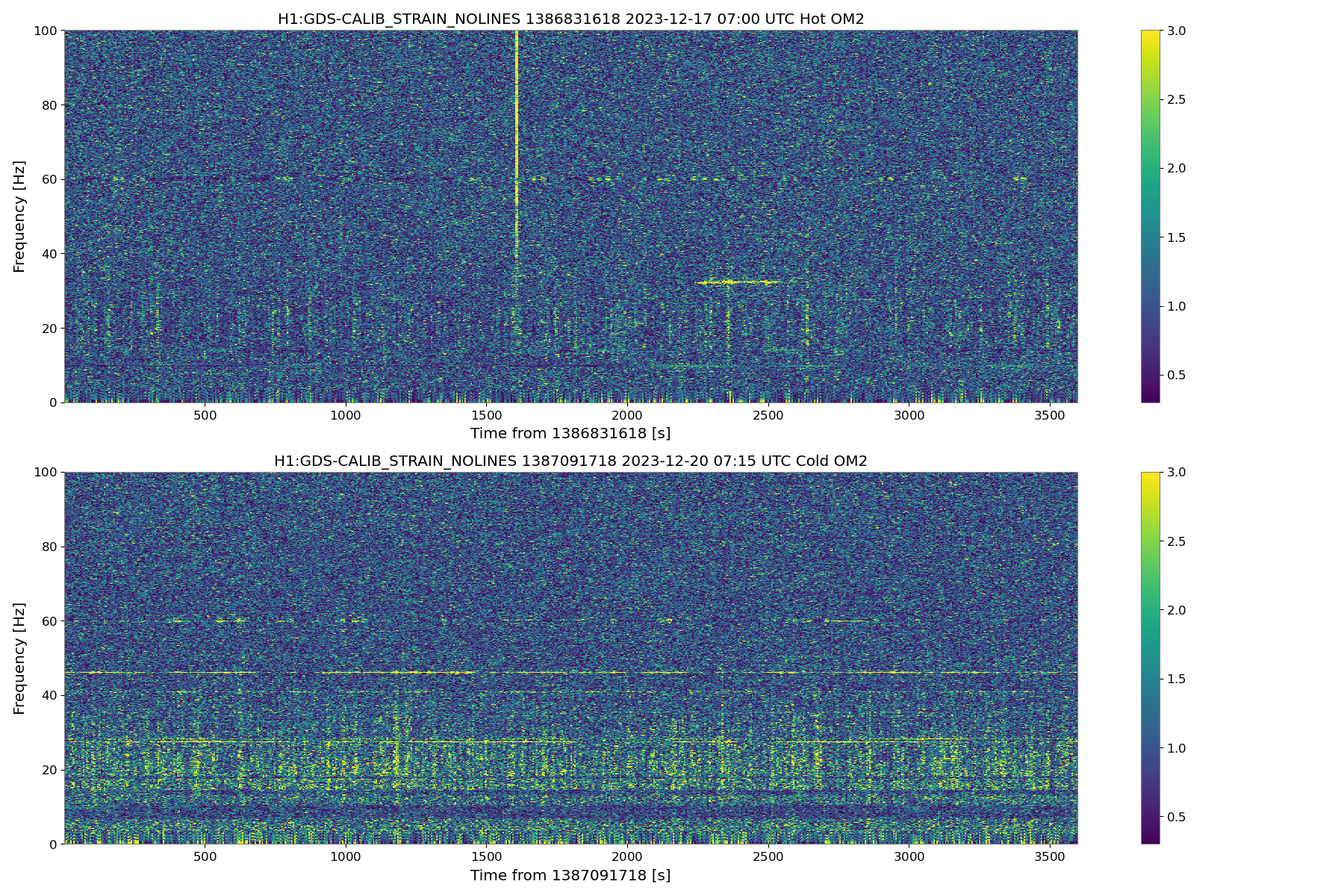
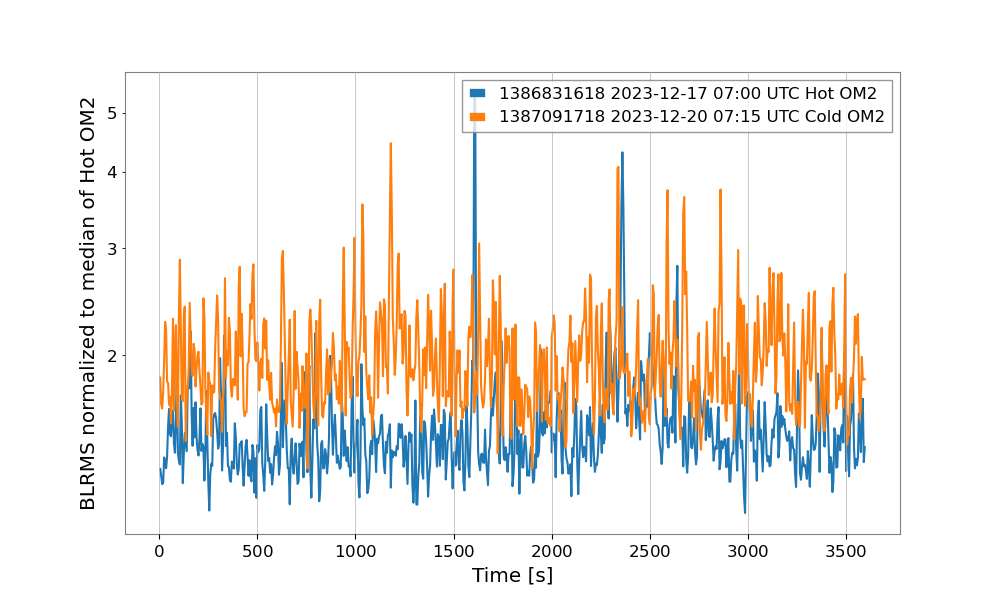
The second and third plots are spectrograms of GDS-CALIB_STRAIN during the two periods. Both show non-stationry noise at low frequency. The third plot shows the strain spectrogram normalized to the median of the hot OM2 data: beside the non-stationariity, it looks like the background noise is higher below 30 Hz.
This is confirmed by looking at the BLRMS in the 16-60 Hz region for the two times, as shown in the fourth plot: its higher with cold OM2
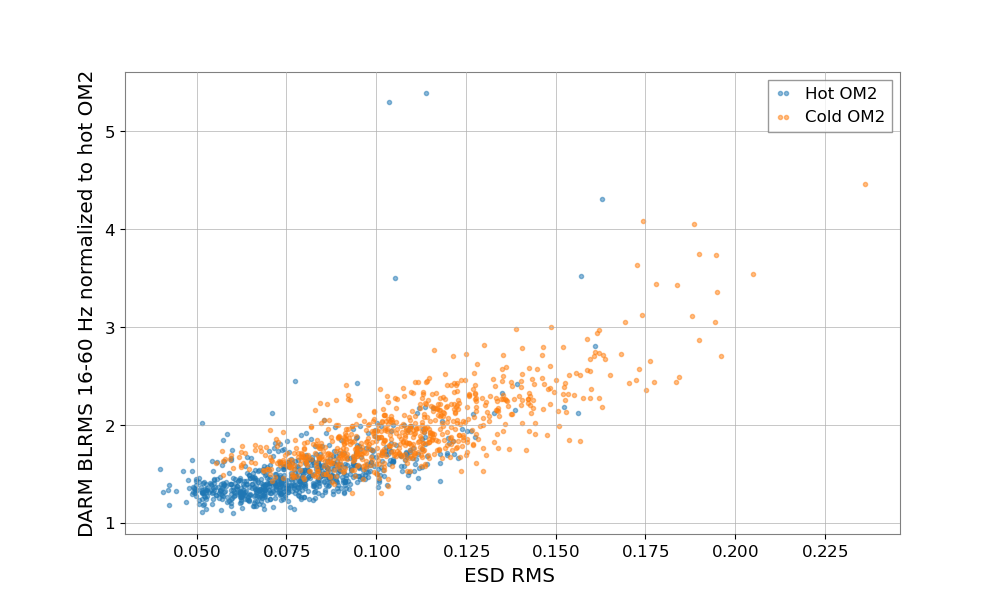
Finally, the last plot shows the correlation between the ESD RMS and the strain BLRMS, normalized to the hot OM2 state. There is still a correlation, but it appear again that the cold OM2 state has an additional background noise: when the ESD RMS is att the lower end, the strain BLRMS setlles to higher values
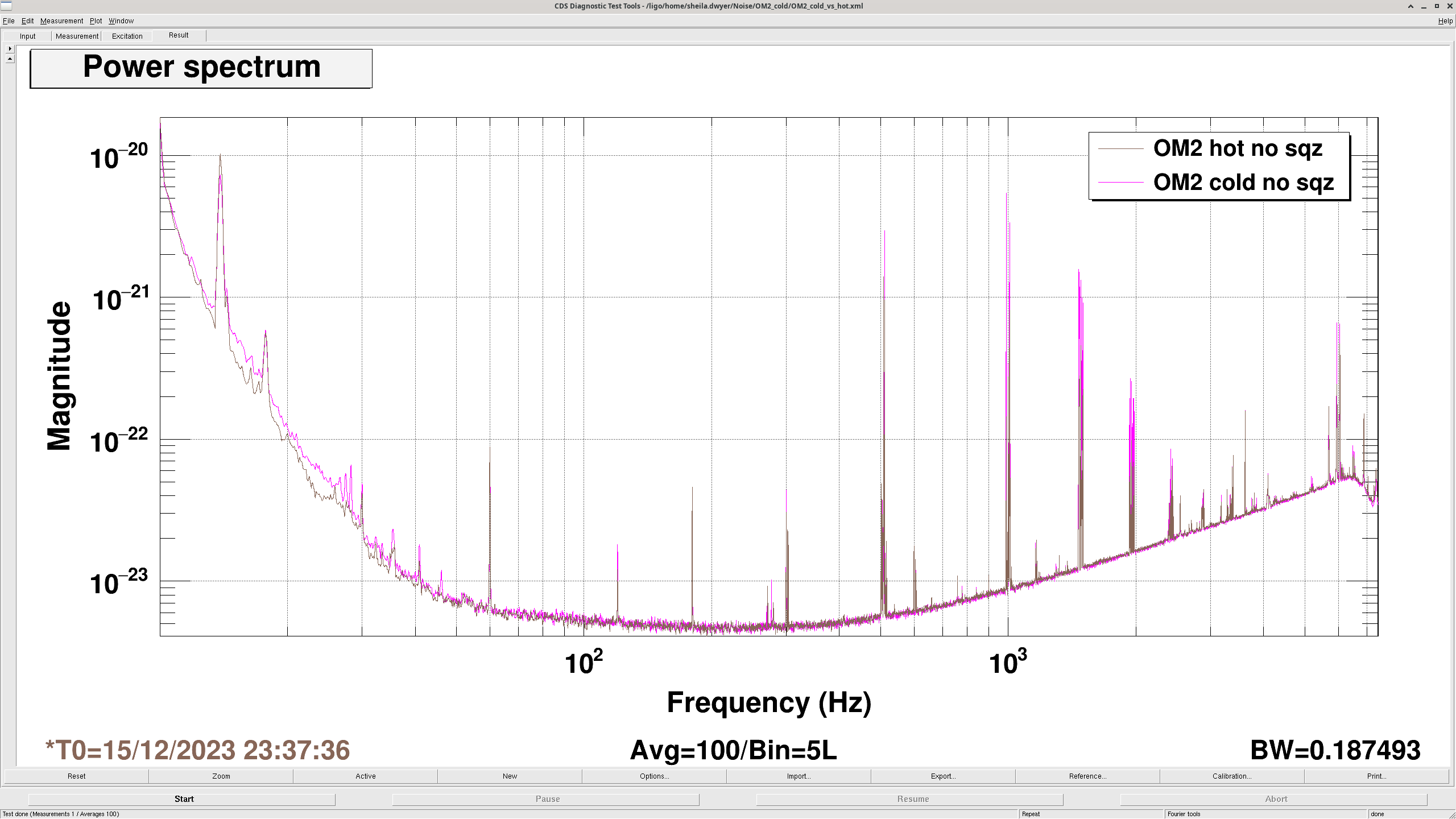
Here is the same comparison, without squeezing. Using times from 74935 and 74834
This suggests that where cold OM2 seems better than hot OM2 above that is due to the squeezing (and the jitter subtraction Jenne added, which is also on in this plot for cold OM2 but not for hot OM2). And the additional noise with cold OM2 reaches up to about 45Hz.
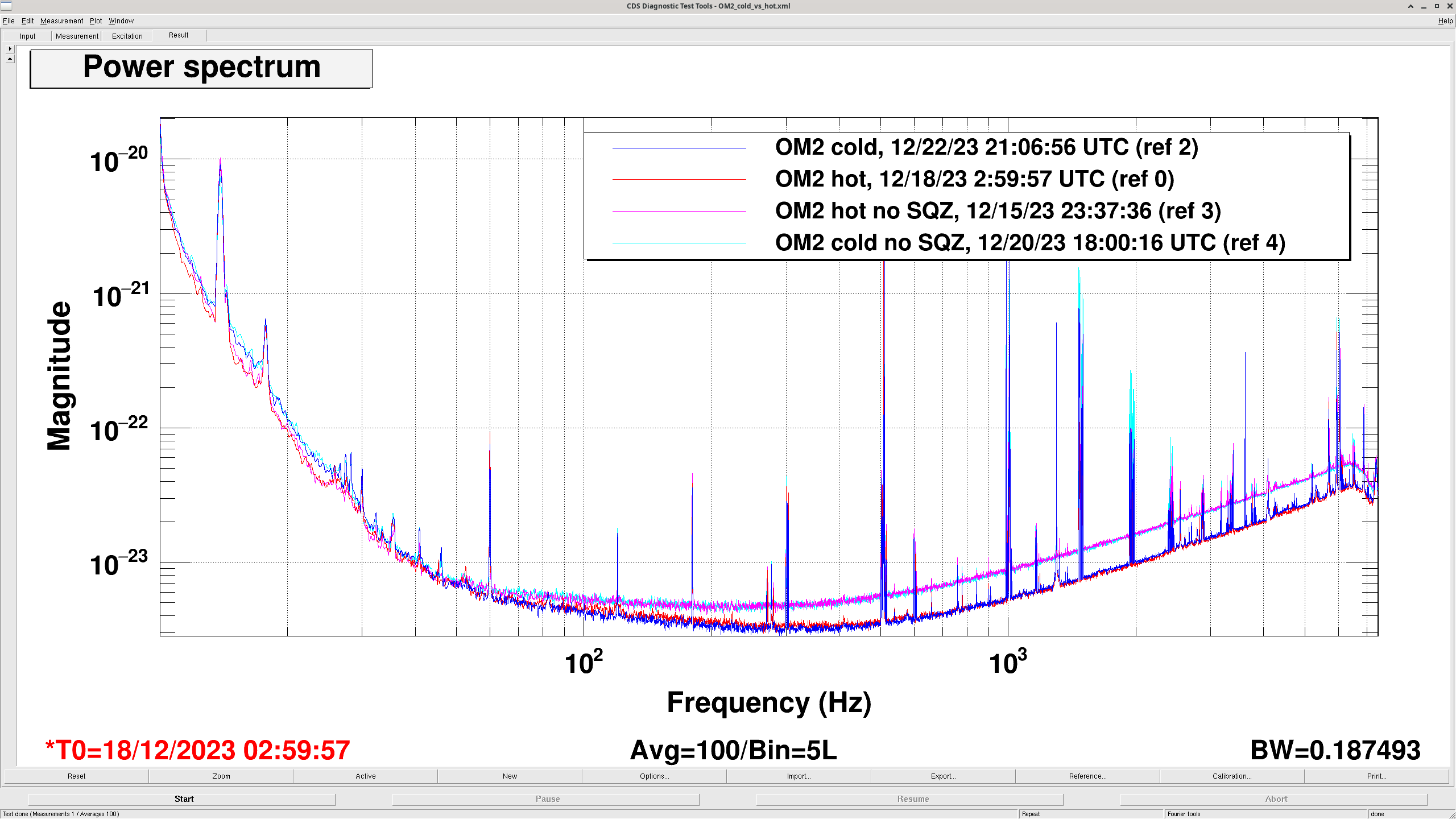
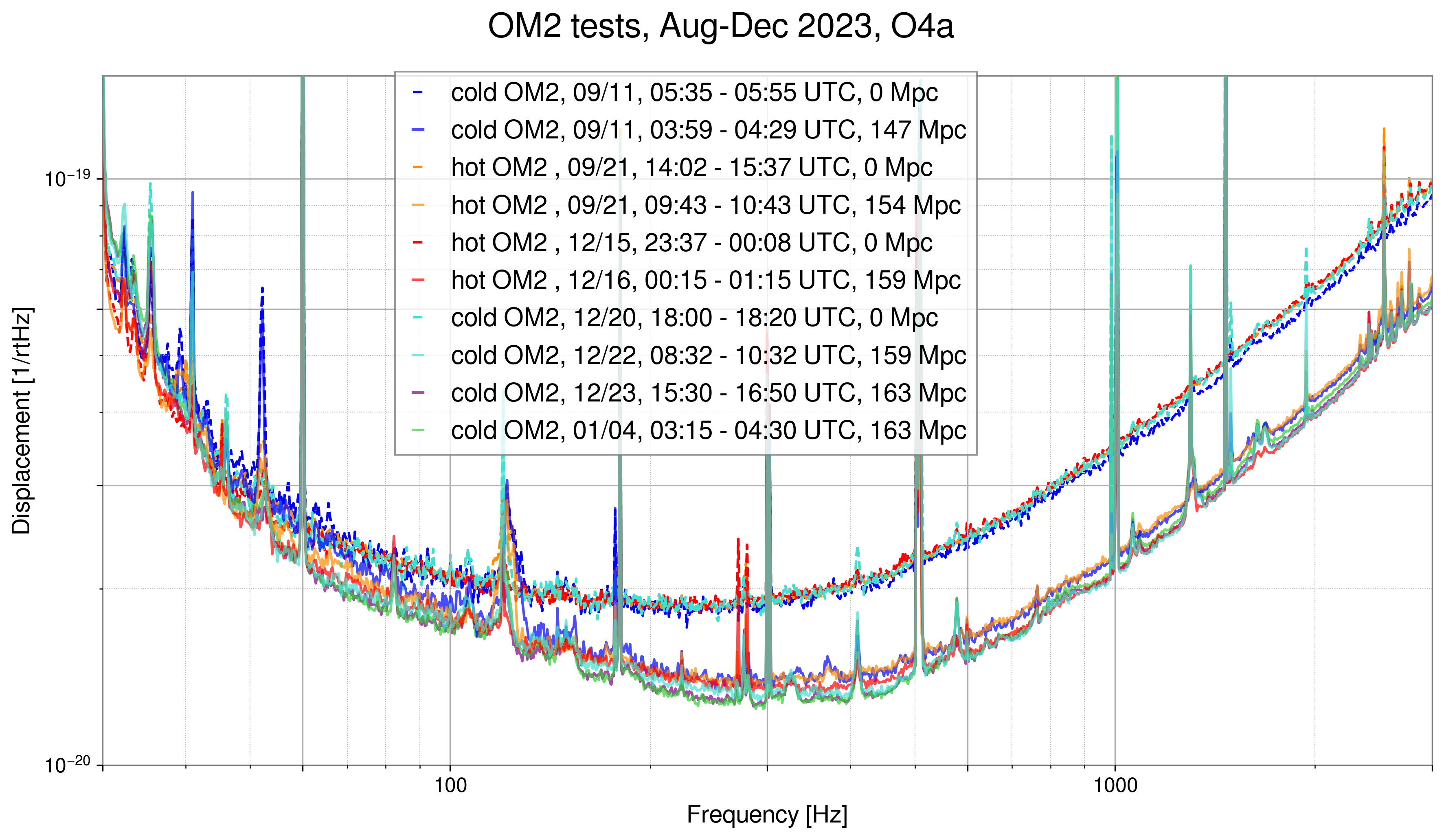
After we optimized ADF demod phase in 74972, the BNS range seems better and consistently 160-165Mpc. The attached plot shows the comparison of OM2 cold/hot with/without SQZ. The OM2 cold with SQZ is measured after optimization of ADF demod phase and other measurements are same as Sheila's previous plots.
This plot supports what Sheila says in the previous alogs.
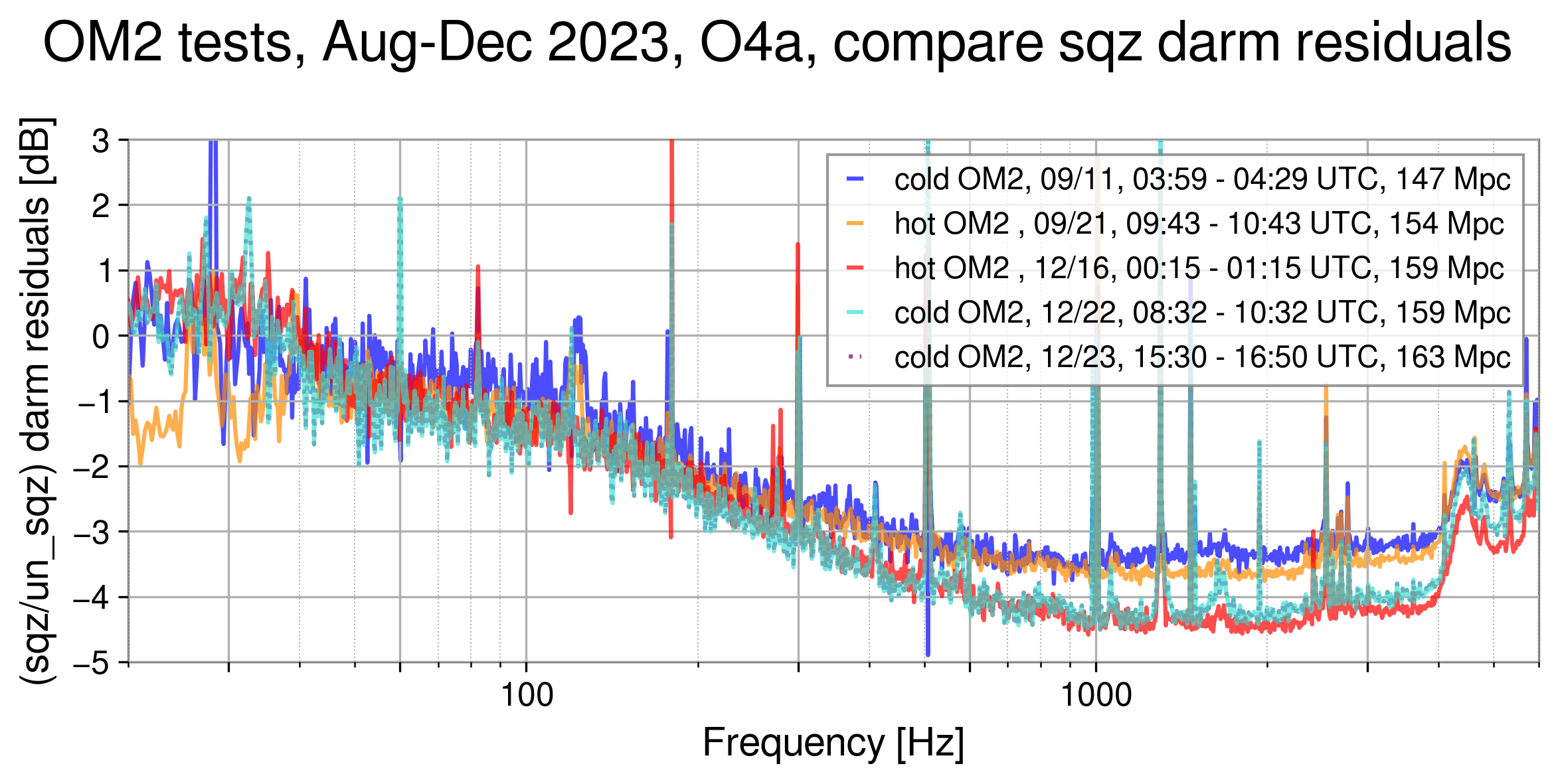
Echo-ing the above, and summarizing a look at OM2 with sqz in both Sept 2023 and Dec 2023 (running gps times dictionary is attached here).
If we compare the effect of squeezing -- there is higher kHz squeezing efficiency with hot OM2. We can look at either just the darm residuals dB[sqz/unsqz] (top), or do subtraction of non-quantum noise (bottom) which shows that hot OM2 improved the kHz squeezing level by ~0.5 dB at 1.7 kHz (the blue sqz blrms 5). This is consistent with summary pages: SQZ has not reached 4.5 dB since cooling OM2 74861. Possibly suggests better SQZ-OMC mode-matching with hot OM2.
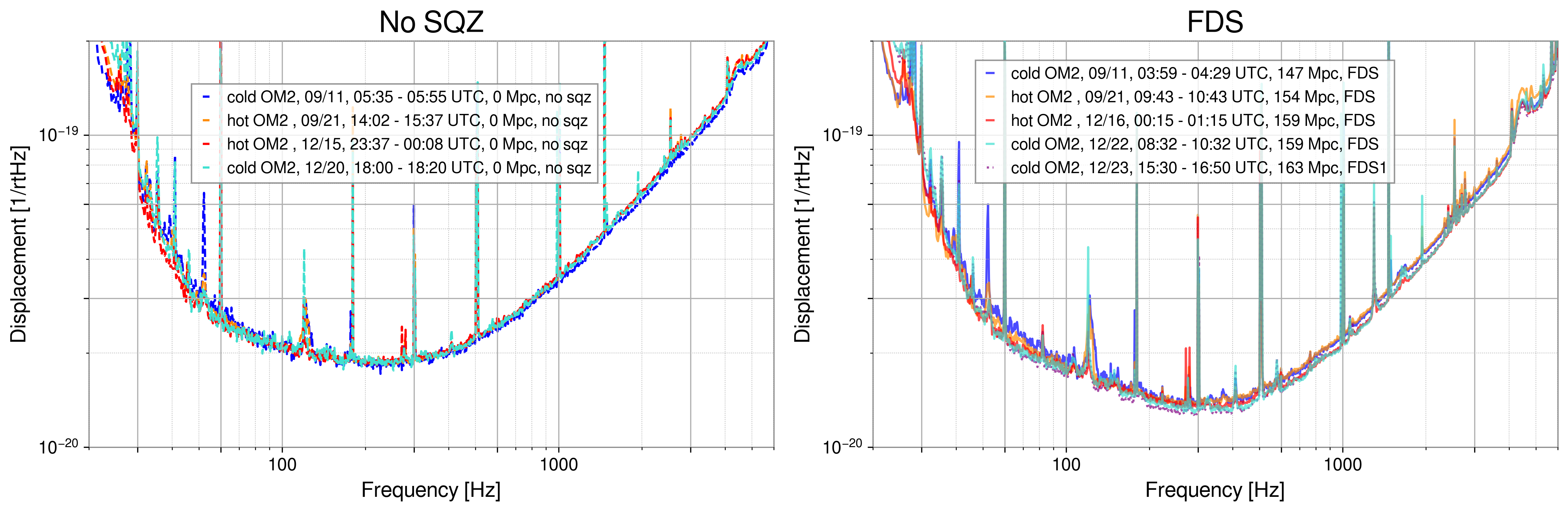
Without squeezing, cold om2 has more optical gain and more low-freq non-quantum noise. Better IFO-OMC mode-matching with cold OM2.
In total, it's almost a wash for kHz sensitivity: heating OM2 loses a few % optical gain, but recovers 0.2-0.5 dB of shot noise squeezing.
It's worth noting the consistent range increases with SQZ tuning + improvements: even in FDS, there is a non-zero contribution of quantum noise down to almost 50 Hz. For example Naoki's adjustment of sqz angle setpoint on 12/21 74972 improved range, same for Camilla's Jan sqz tuning 75151. Looking at DARM (bottom green/purple traces), these sqz angle tunings reproducibly improved quantum noise between about 60-450 Hz.
Here are some more plots of the times that Vicky plotted above.
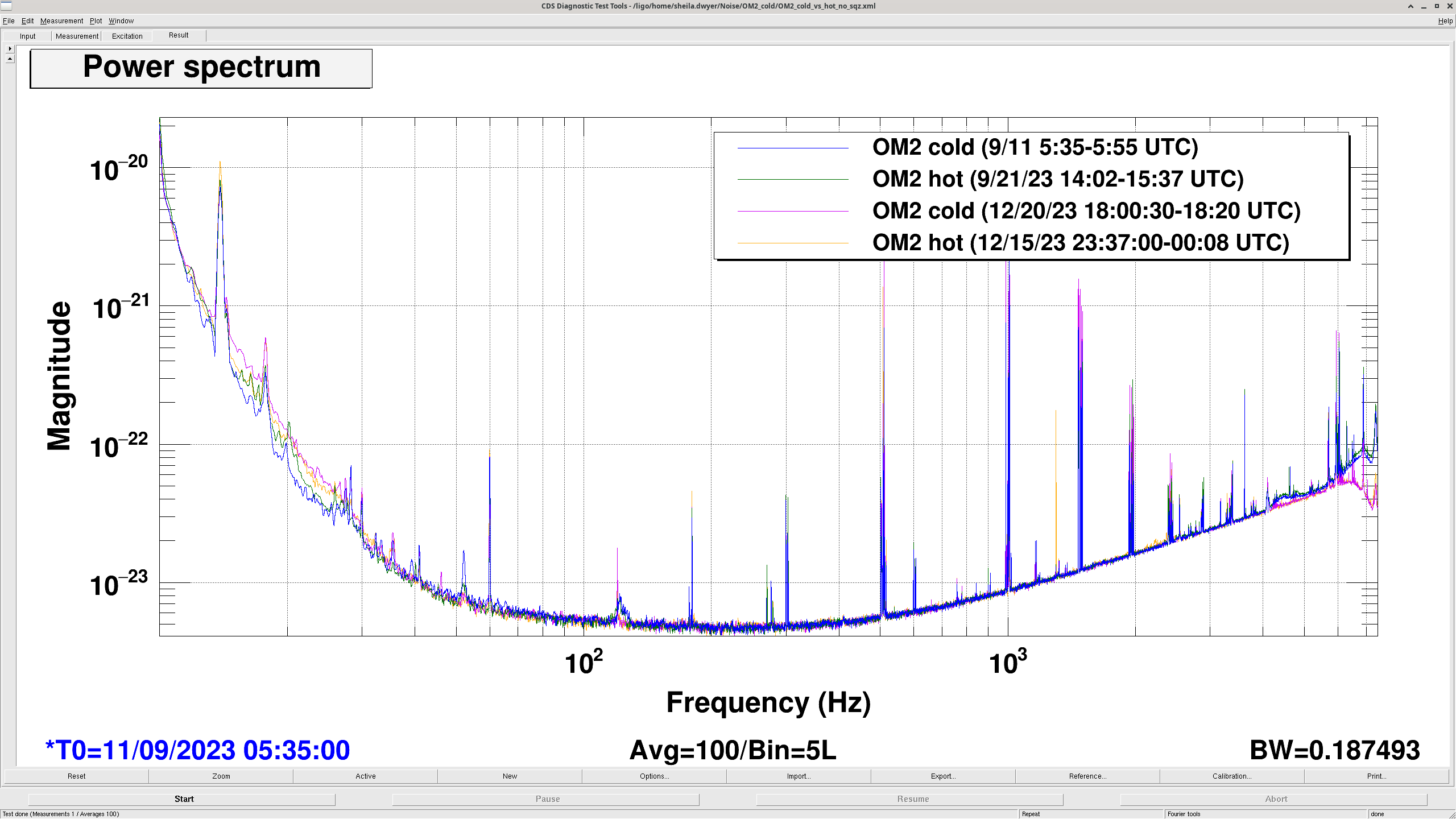
The first attachment is just a DARM comparison with all 4 no sqz times, OM2 cold vs hot in December vs September.
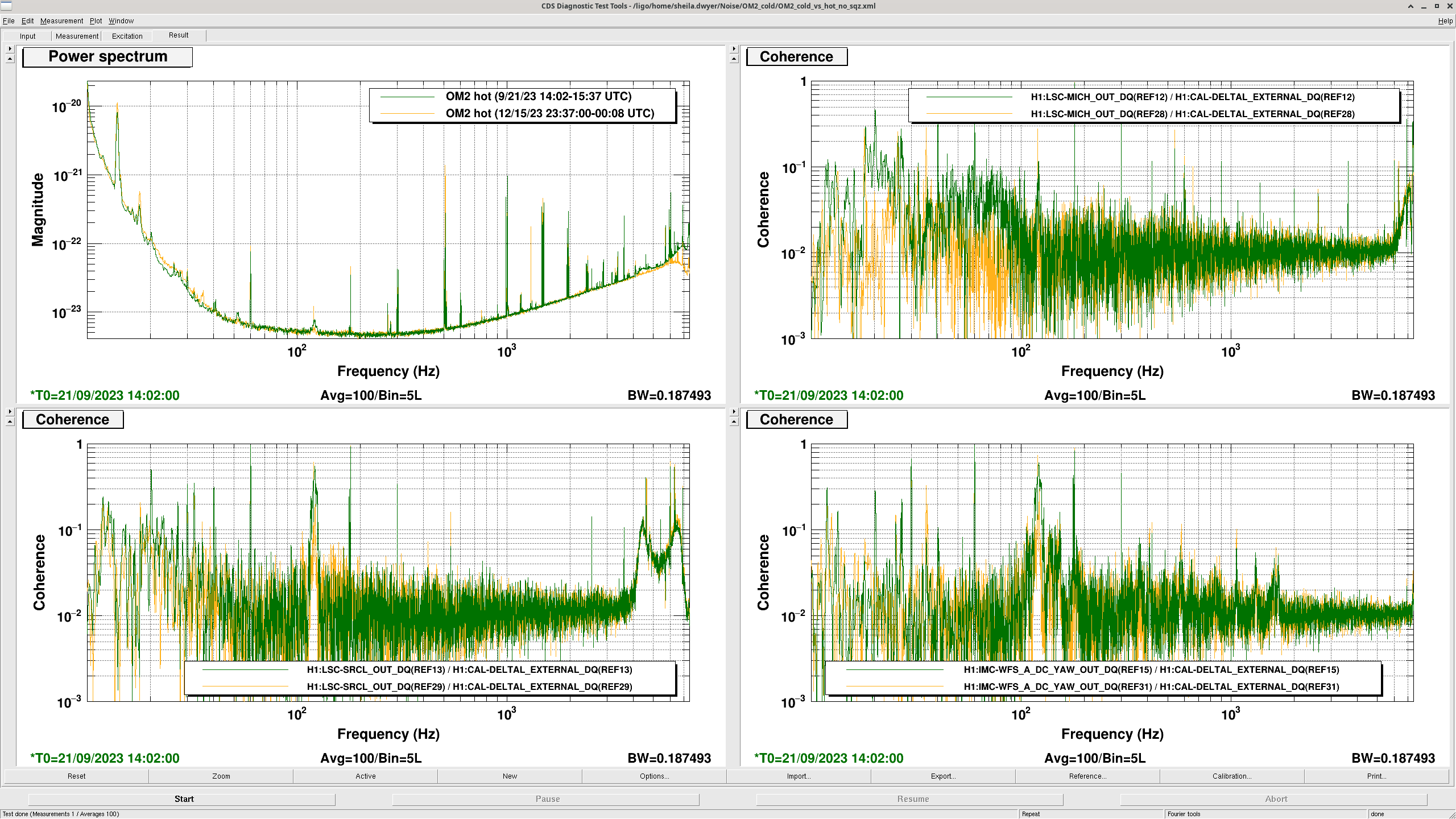
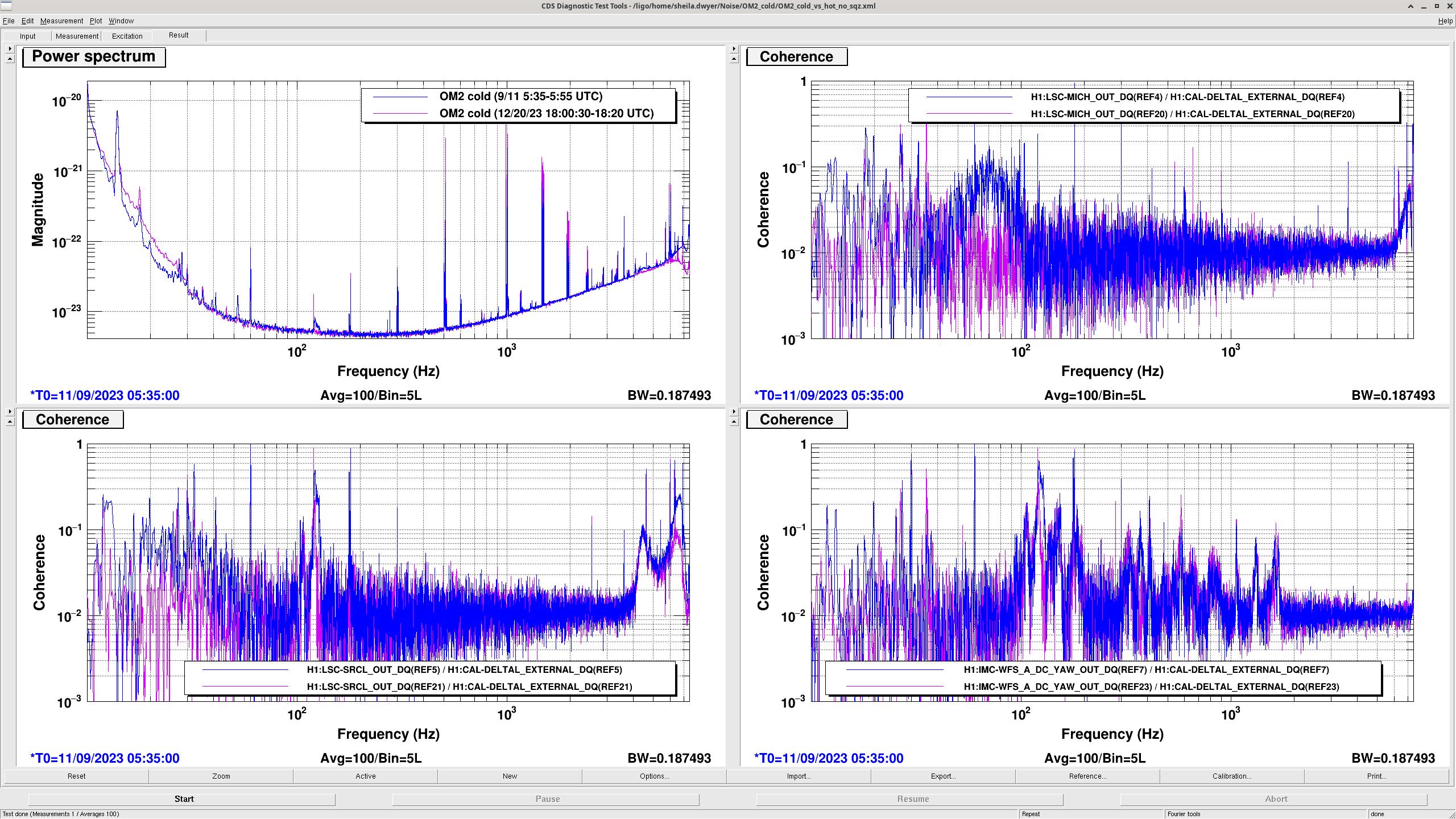
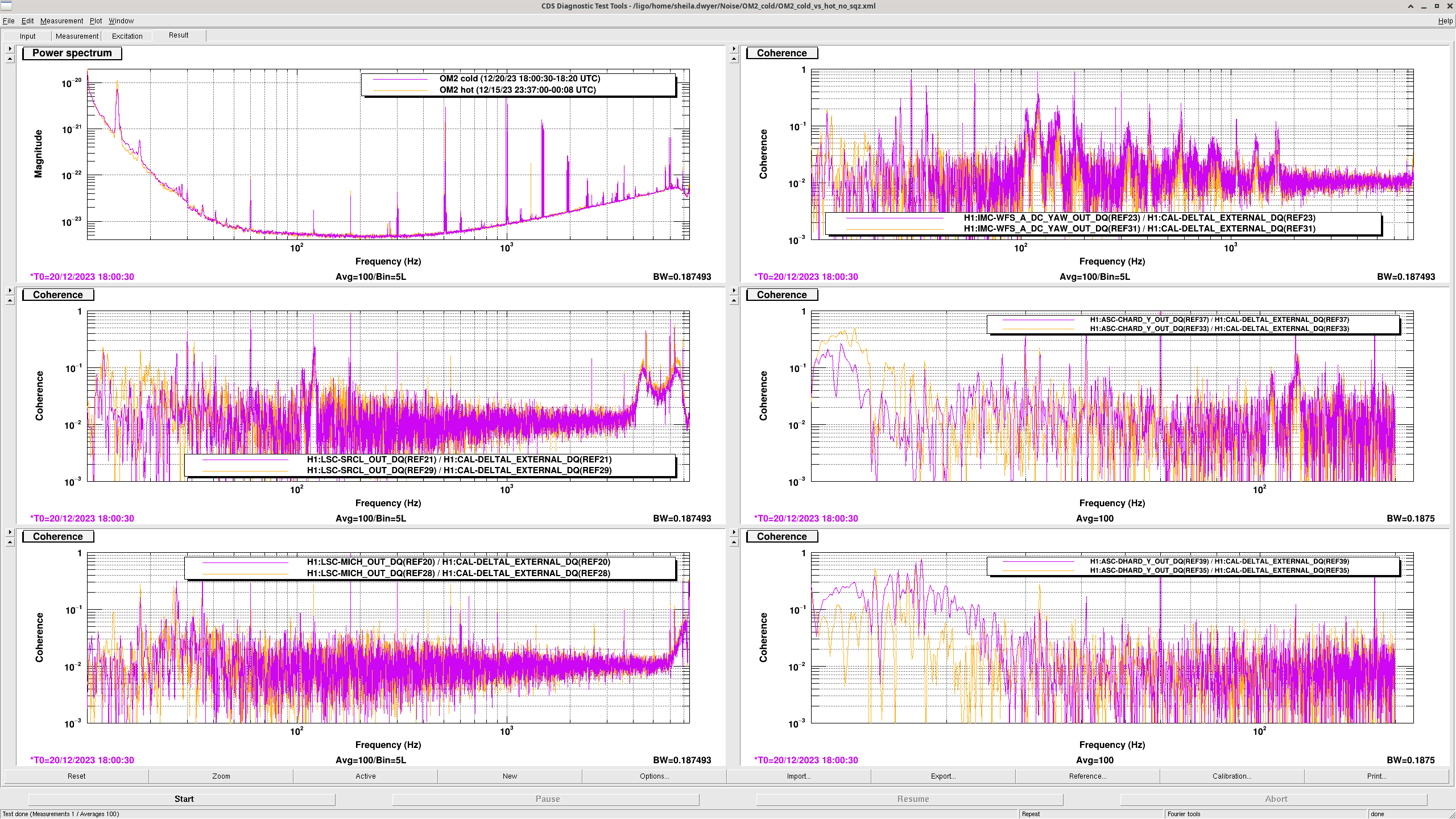
Comparing OM2 hot September vs December shows that our sensitivity at from 20-40 Hz has gotten worse since September, the MICH coherence seems lower while the jitter and SRCL coherence seem similar. The same comparison for OM2 cold shows that with OM2 cold our sensitivity has also gotten worse from 15-30 Hz.
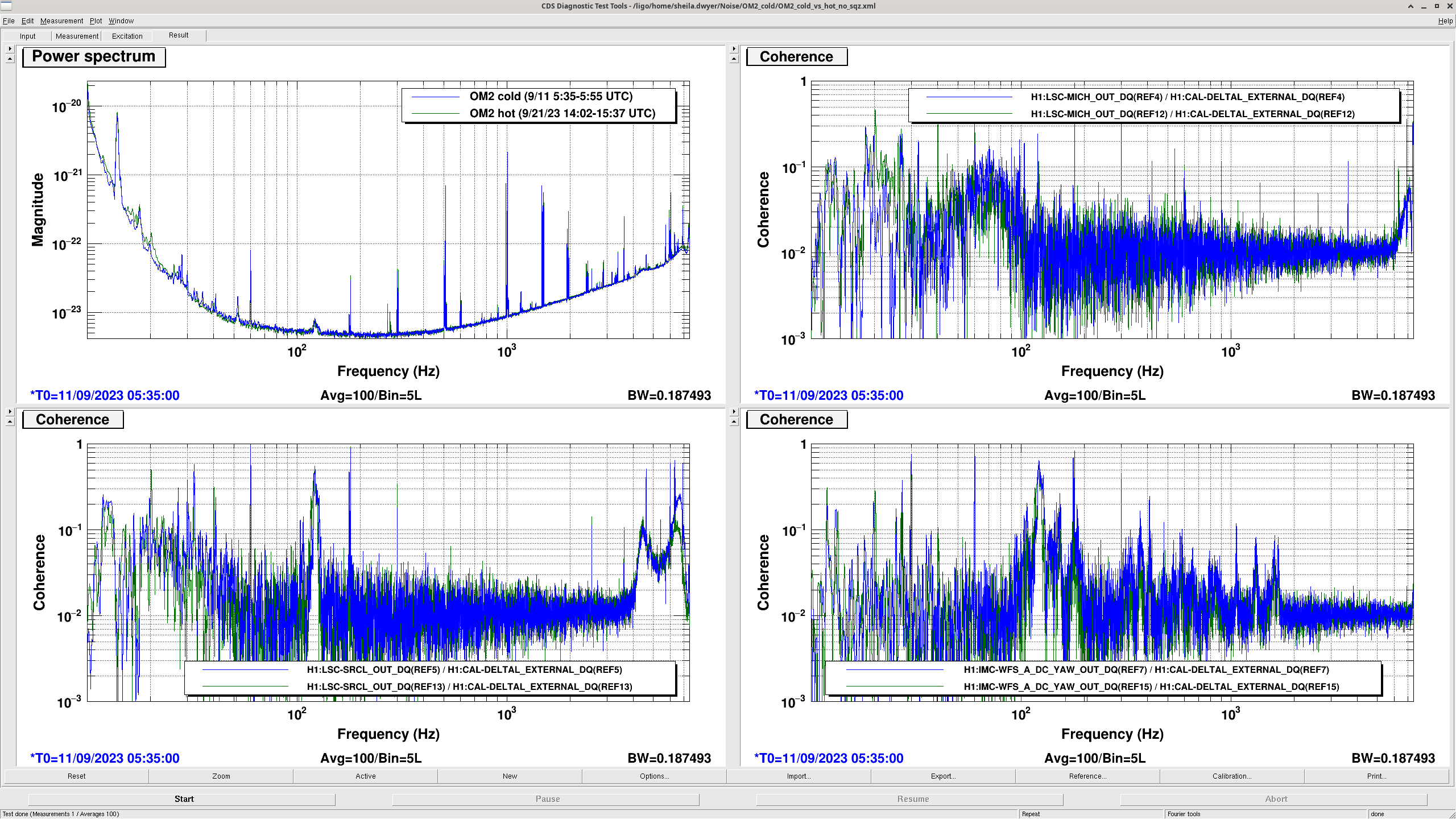
Comparing cold vs hot, in September the MICH coherence did get worse from 60-80 Hz for cold OM2, which might explain the worse sensitivity in that region. The MICH coherence got better from 20-30 Hz where the sensitivty was better for cold OM2. The December test had better tuned MICH FF for both hot and cold OM2, so this is the better test of the impact of the curvature change.
As Gabriele pointed out with his BRUCO, 74886 there is extra coherence with DHARD Y for cold OM2 at the right frequencies to help explain the extra noise. There isn't much change in the HARD pitch coherence between these December times, but the last attachment here shows a comparison of the HARD Y coherences for hot and cold OM2 in December.
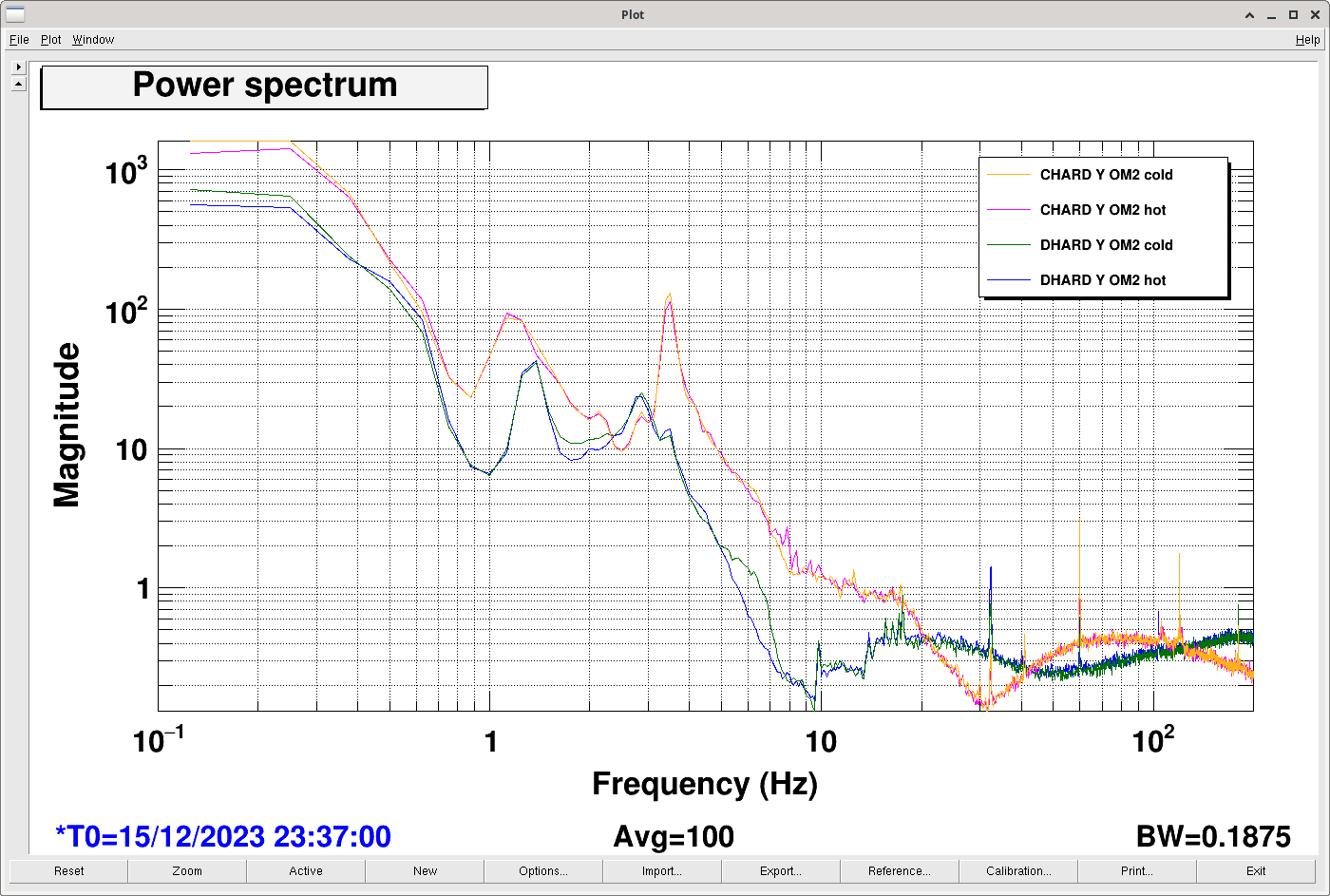
Peter asked if the difference in coherence with the HARD Yaw ASC was due to a change in the coupling or the control signal.
Here is a comparison of the control signals with OM2 hot and cold, they look very similar at the frequencies of the coherence.
At ~ 20:00UTC we left the HWS code running (restarted ITMX) but stopped Dave's carema control code 74951 on ITMX, ITMY, ETMY, leaving the camera's off. They'll be left off over the weekend until Tuesday. ETMX is still down from yesterday 75176.
If the computers remain up over the weekend we'll look at incorporating the camera control into the hws code to avoid crashes.
Erik swapped h1hwsex to a new v1 machine. We restarted the HWS code and turned the camera to external trigger mode so it too should remain off over the weekend.
I've commented out the HWS test entirely (only ITMY was being checked) from DIAG_MAIN since no HWS cameras are capturing data. Tagging OpsInfo.
Trace from h1hwsmsr crash attached.
All 4 computers remained up and running over the weekend, with the camera on/off code paused. We'll look into either making Dave's code smarter or incorporating the cameras turning on/off into the hws-server code so that we don't send multiple calls to the camera at the same time, our leading theory as to why these hws computers have been crashing.