[Jenne, RyanS, JoeB remote at LLO]
We've started the 45 min stochastic magnetic injection set after having recently reacquired lock.
We turned on the amplifier in the LVEA by clicking the ON button on H1:CDS-PULIZZI_ACPWRCTRL_VERTEX0_OUTLET_1 (sitemap -> CDS -> CDS AC Power Control), then put in the same gps time (1387146396) as LLO into the script from userapps/pem/h1/scripts/inject_mag_10to40.py, which is using waveform = 'CorrMagInj_timestream_2700sec.dat'.
The attached screenshot shows the vertex magnetometers and a (not necessarily well calibrated) version of DARM with the references before the injections, and the 'live' traces during a time of the injection.
This will run for about 45 mins, then we'll turn off the amplifier and go to Observing for the night.
This is finished. I turned off the amplifier, and reset the gain H1:PEM-CS_GDS_0_GAIN back to its nominal value of 1.0, then RyanS took us to Observing.
Injection was succesfull and is coherently recovered in magnetometers as well as h(t).
Fig1 &2: Hx magnetometer - Lx magnetometer: Coherence/CSD, before, during and after injection
Fig3 &4: H strain - Lstrain: Coherence/CSD, before, during and after injection
Channels used:
Hx mag = H1:PEM-CS_MAG_LVEA_VERTEX_X_DQ
Lx mag = L1:PEM-CS_MAG_LVEA_VERTEX_X_DQ
H strain =H1:GDS-CALIB_STRAIN
L strain = L1:GDS-CALIB_STRAIN
Times used:
Before: start: 1387126878 (Dec 20 - 17:01:00 UTC) - duration: 43min, 10 sec fft, 50% overlap (since no good period of coincident lock just before injection, I took the last part of previous lock)
Injection: start gps = 1387146456 (Dec 20 - 22:27:18 UTC) - duration: 43min, 10 sec fft, 50% overlap
After: start: (Dec 21 - 02:01:00 UTC) - duration: 43 min, 10 sec fft, 50% overlap (since no good period of coincident lock just after injection, I took the first part of next lock)
[Louis, Sheila, Gabriele]
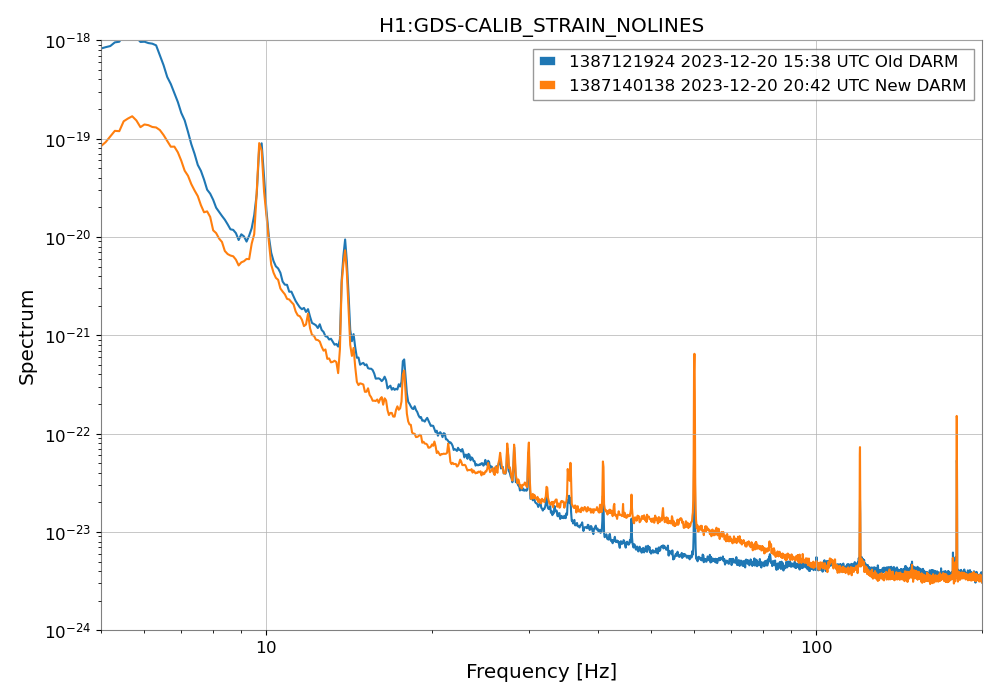
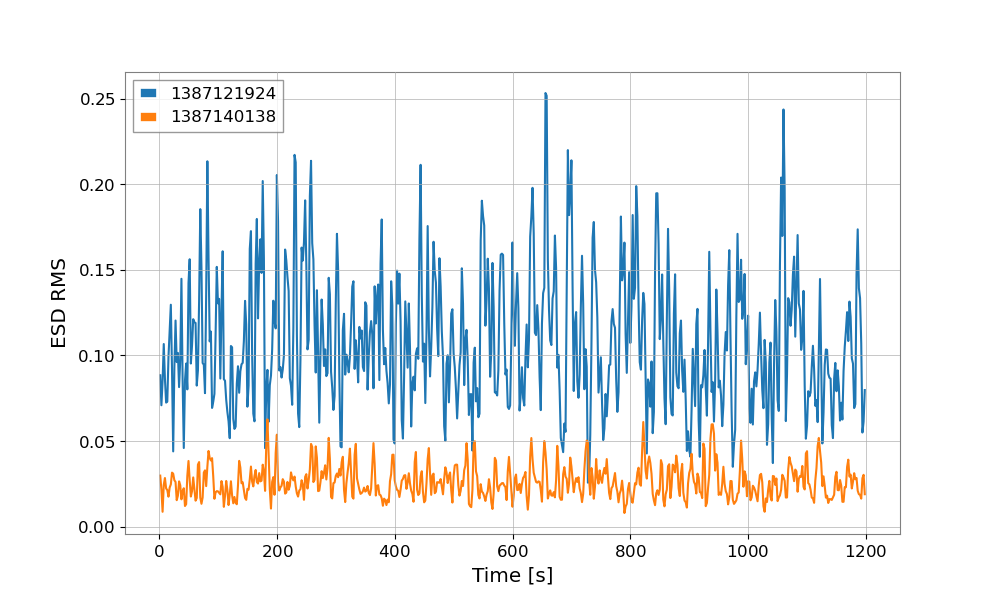
Today Sheila and Louis transitioned again to the new DARM offloading to check if the low-frequency non-stationarity in the strain was due to the ESD drive non-linearity. In summary: it works
First of all, GDS-CALIB_STRAIN was not yet calibrated for the new configuration, so in the "New DARM" offloading the absolute values of strain spectrum are wrong. Nevertheless we can study the non-stationarity.
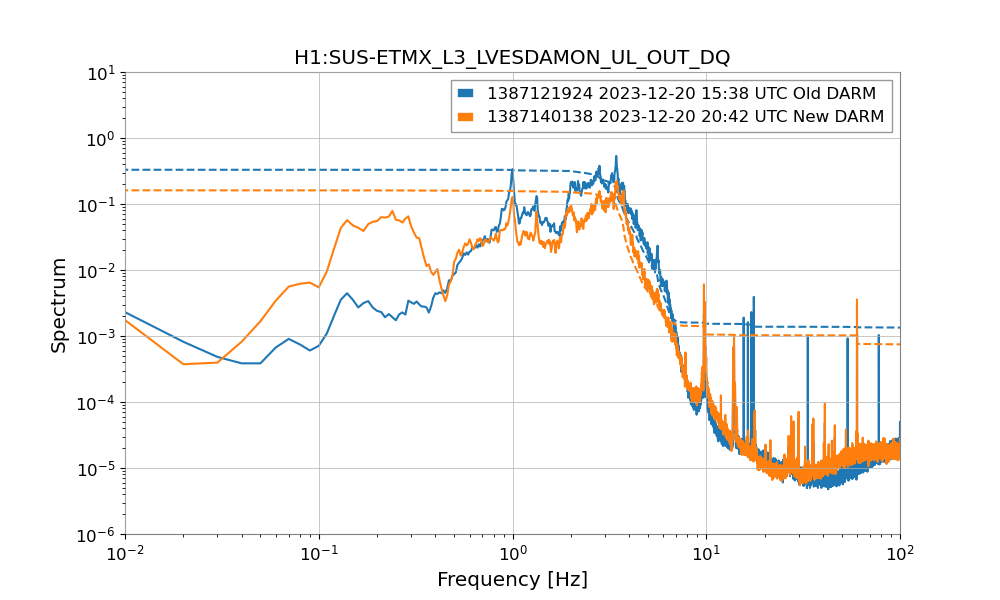
The new DARM offloading scheme reduces the ESD drive and its RMS as expected in the few Hz region. There is an increase of ESD drive below 0.5 Hz, to be understood. But that increase doesn't seem to be a problem for now.
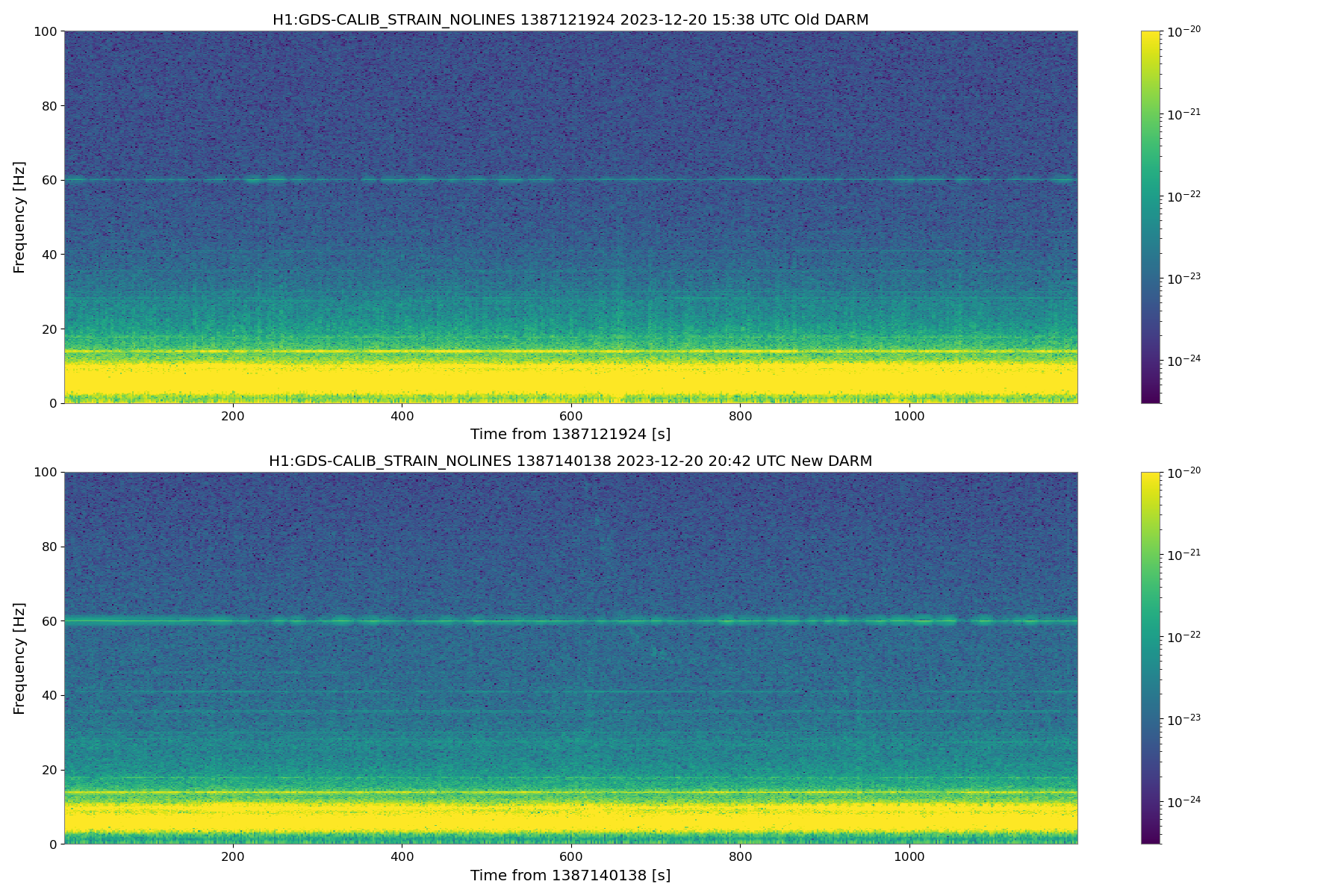
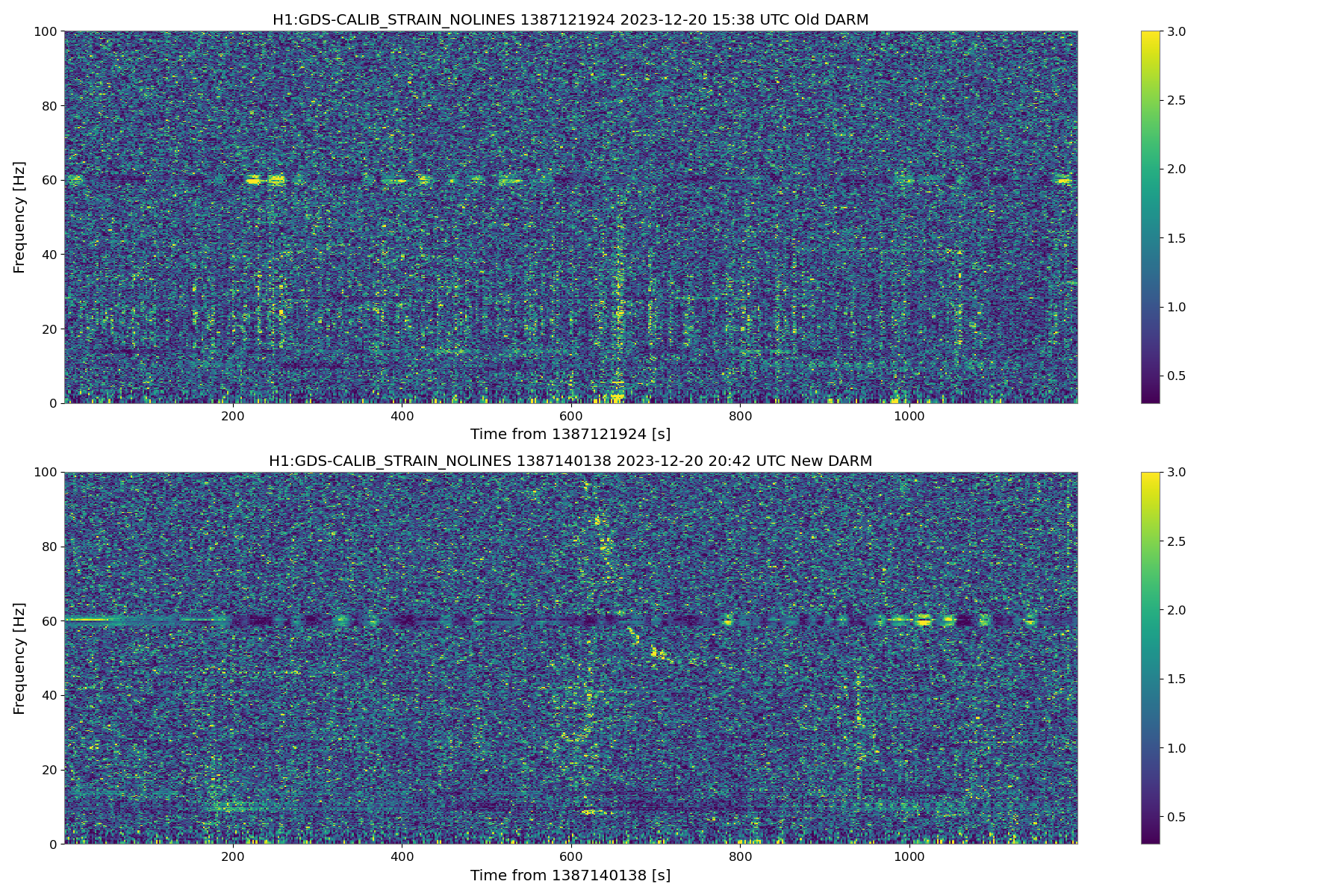
We can compare a period with the "Old DARM" scheme with a period with the 'New DARM" scheme by looking at a spectrogram and at a whitened spectrogram. The difference is evident: the fast non-stationarity evident with the old scheme is not visible in the new scheme.
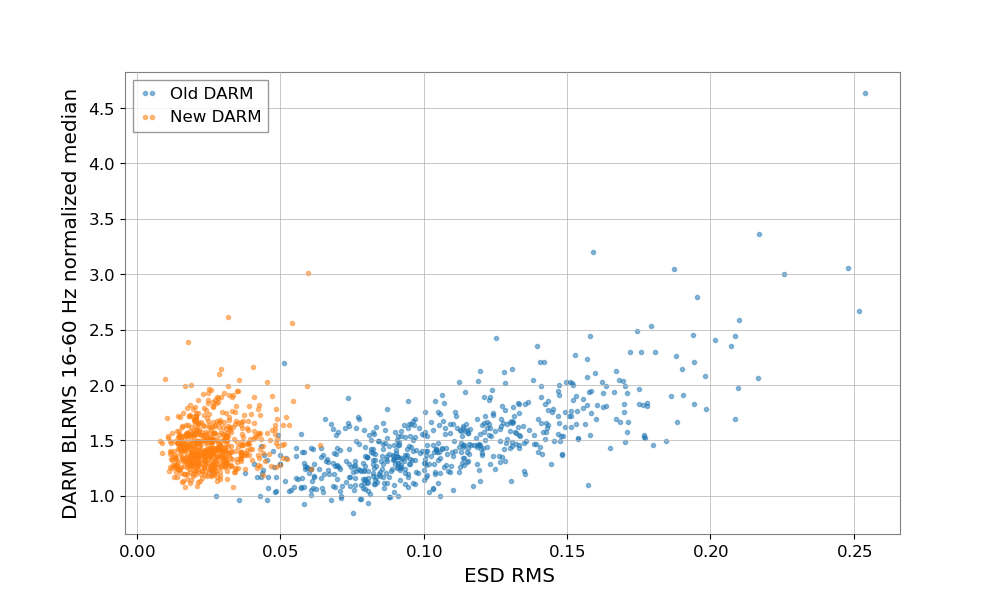
We can also make a scatter plot of strain noise BLRMS between 16 and 60 Hz and the ESD RMS. Since the strain channel is not calibrate yet, absolute values of the strain BLRMS are not informative. Nevertheless, the correlation between ESD RMS and strain noise is gone.
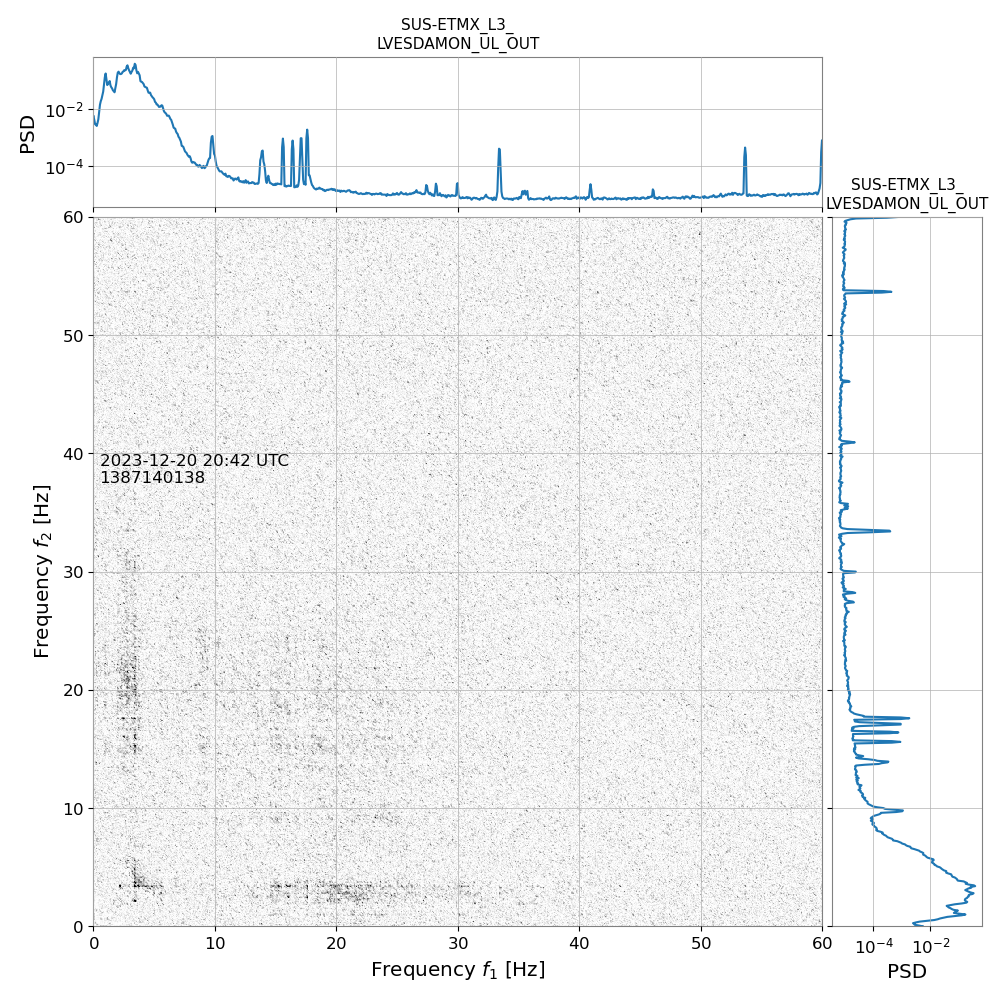
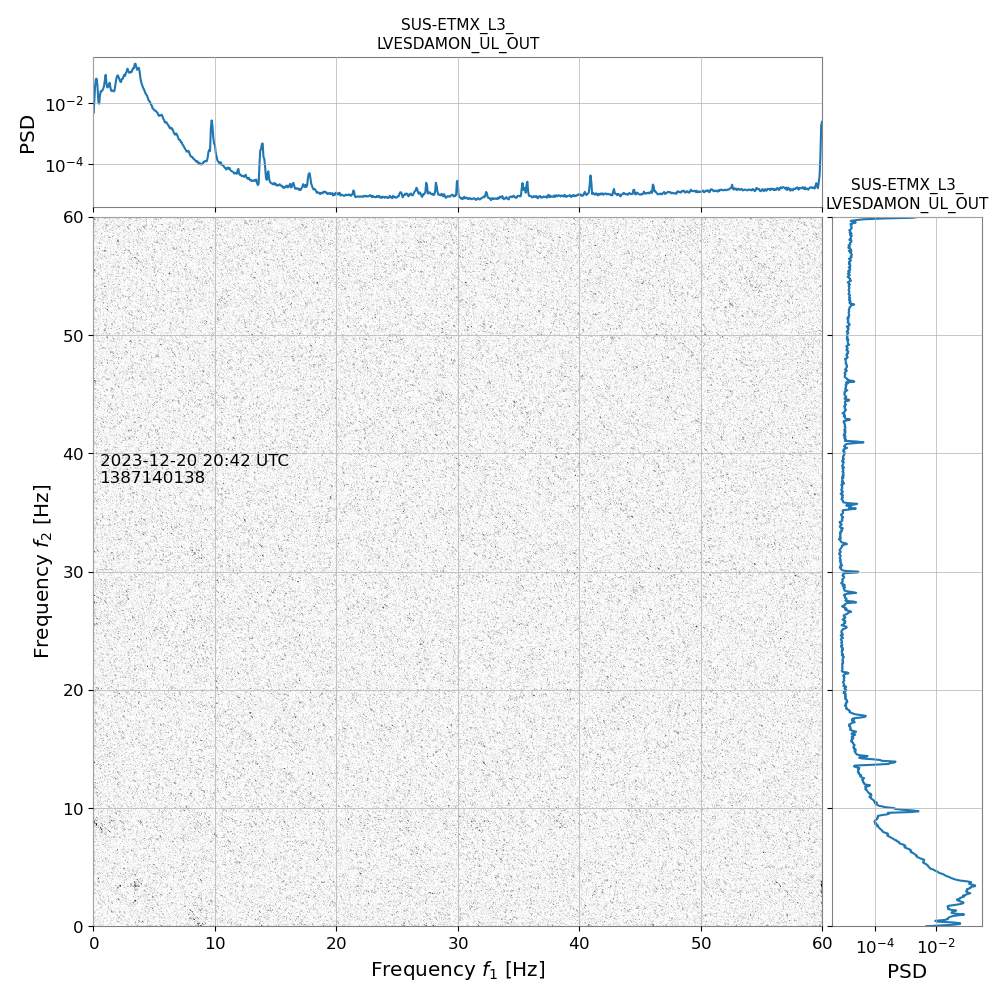
As a final point, we can compare the bicoherence of ESD times ESD to DARM with the old scheme and the new scheme. All bicoherence is gone in the new configuration
All changes are reverted for now.
Lockloss @ 21:03 UTC from commissioning activities (switching DARM control between ETMX and ETMY). This was the last test performed at the end of commissioning time.
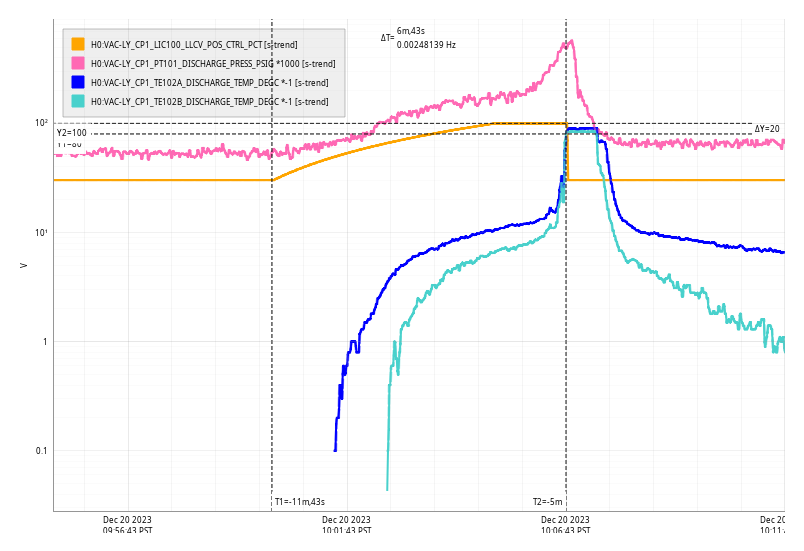
Wed Dec 20 10:06:43 2023 INFO: Fill completed in 6min 39secs
Gerardo confirmed a good fill curbside.
H1 is now out of observing in coordination with L1 for a planned ~3 hours of commissioning. Starting with no-SQZ time.
Back to observing at 23:12 UTC
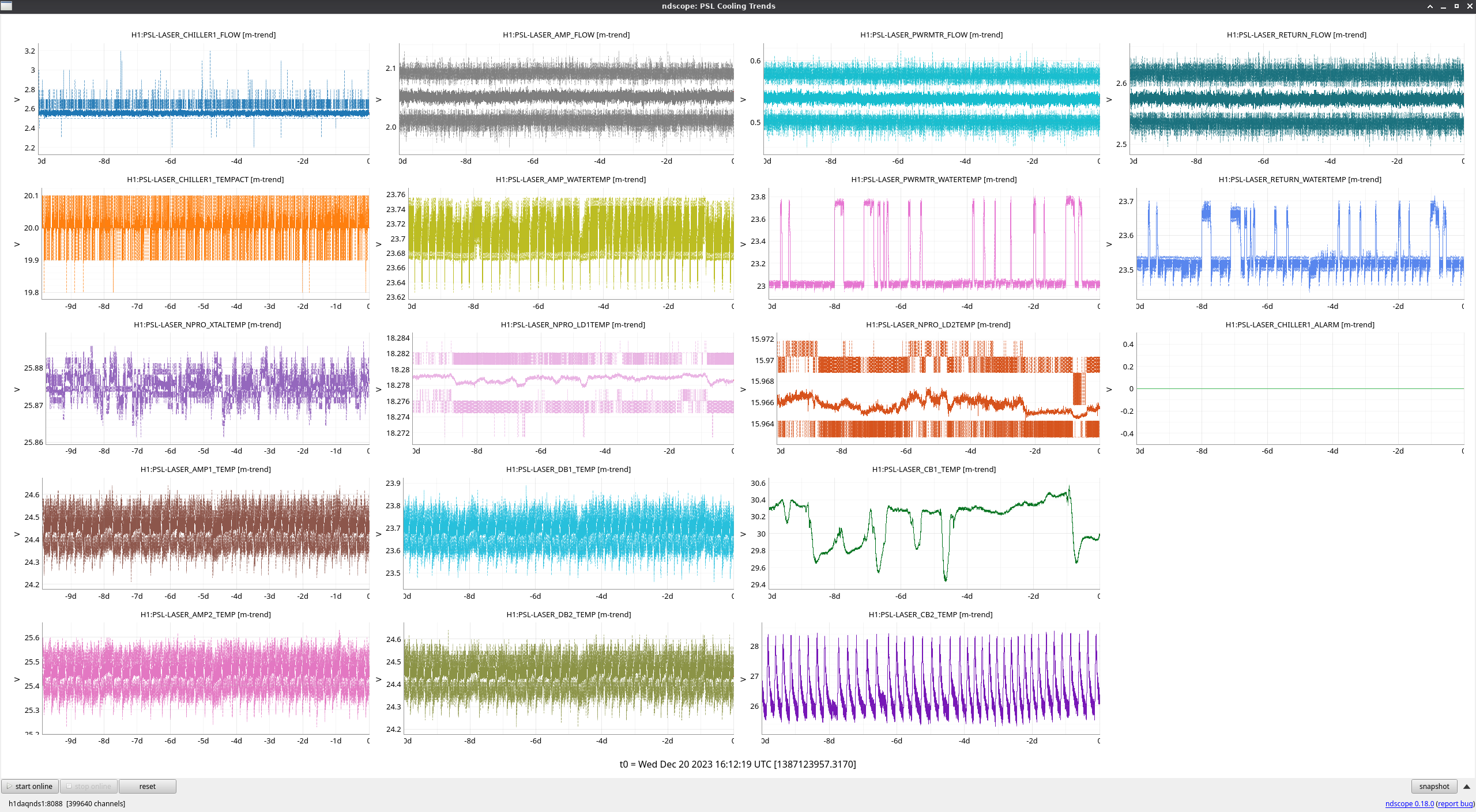
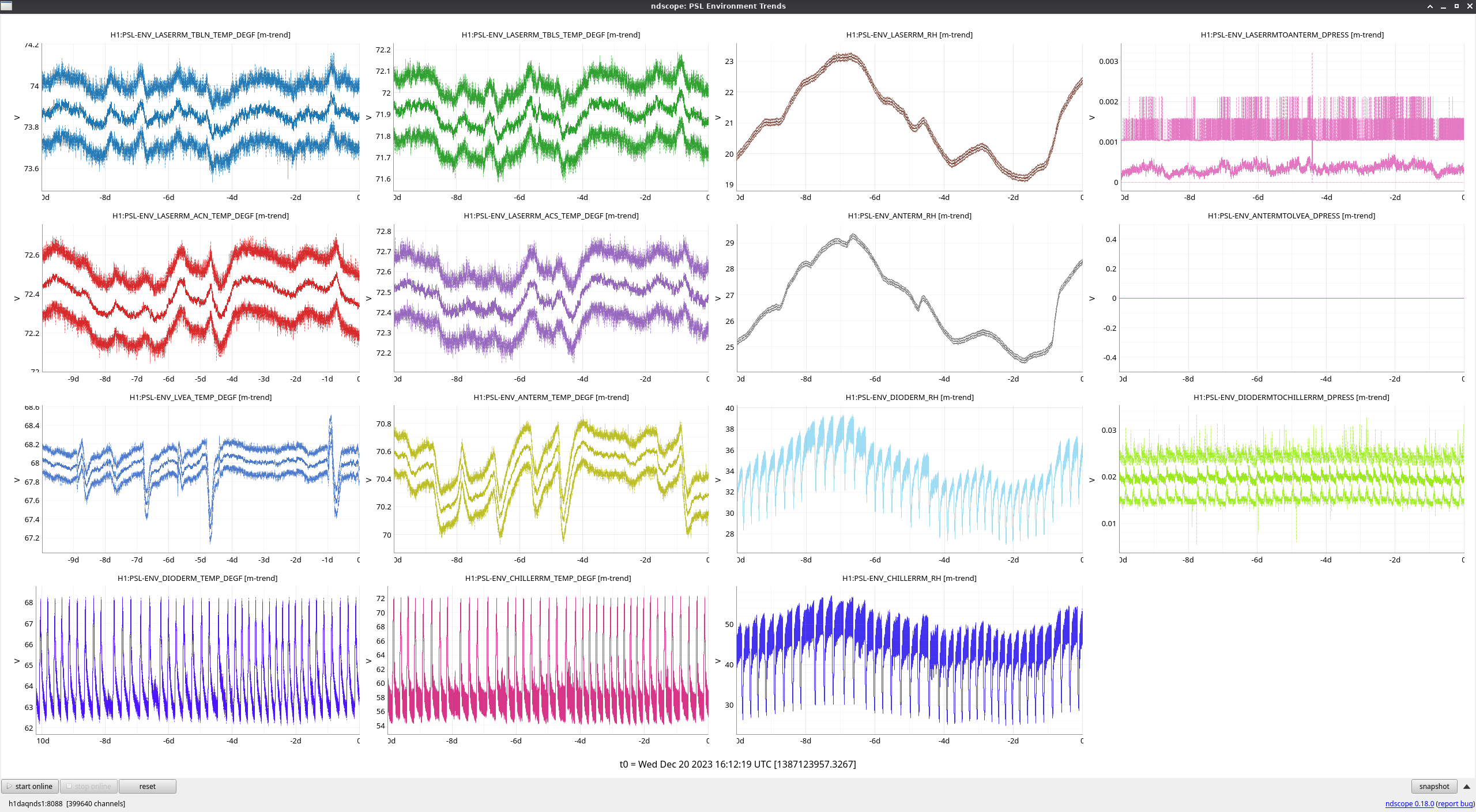
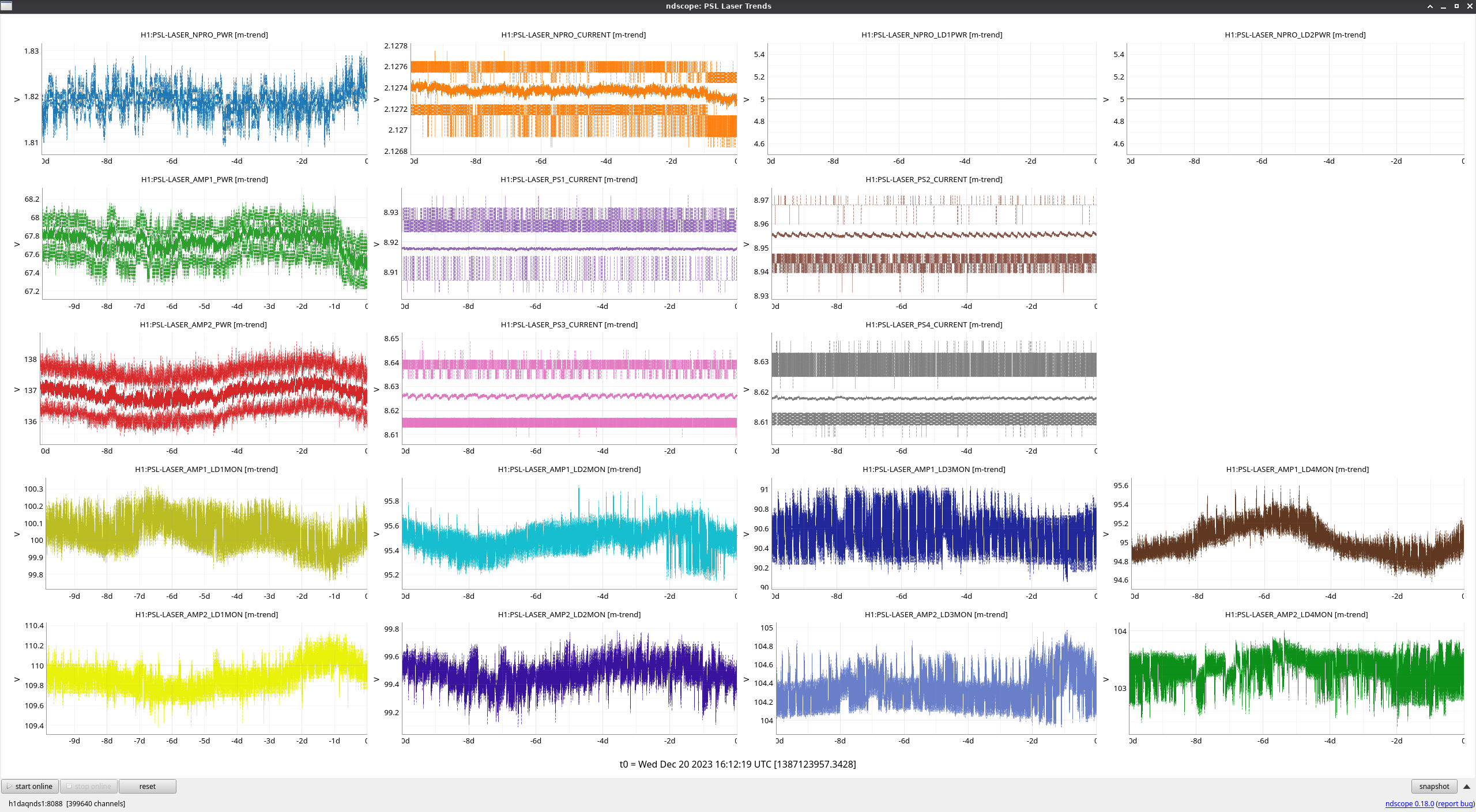
FAMIS 20007
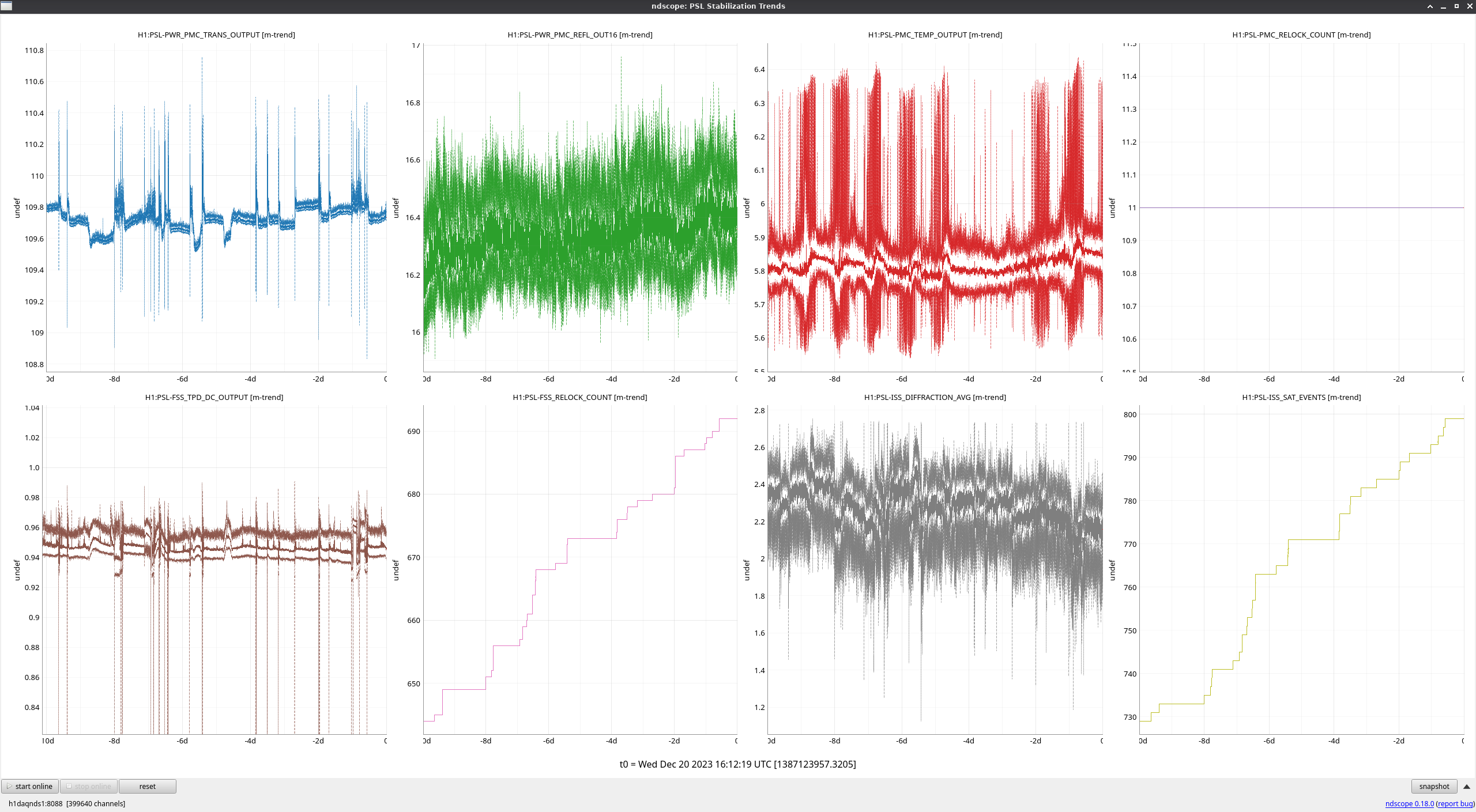
No major events of note in the past 10 days; everything looks fairly stable.
TITLE: 12/20 Day Shift: 16:00-00:00 UTC (08:00-16:00 PST), all times posted in UTC
STATE of H1: Observing at 158Mpc
OUTGOING OPERATOR: Tony
CURRENT ENVIRONMENT:
SEI_ENV state: CALM
Wind: 2mph Gusts, 0mph 5min avg
Primary useism: 0.03 μm/s
Secondary useism: 0.29 μm/s
QUICK SUMMARY:
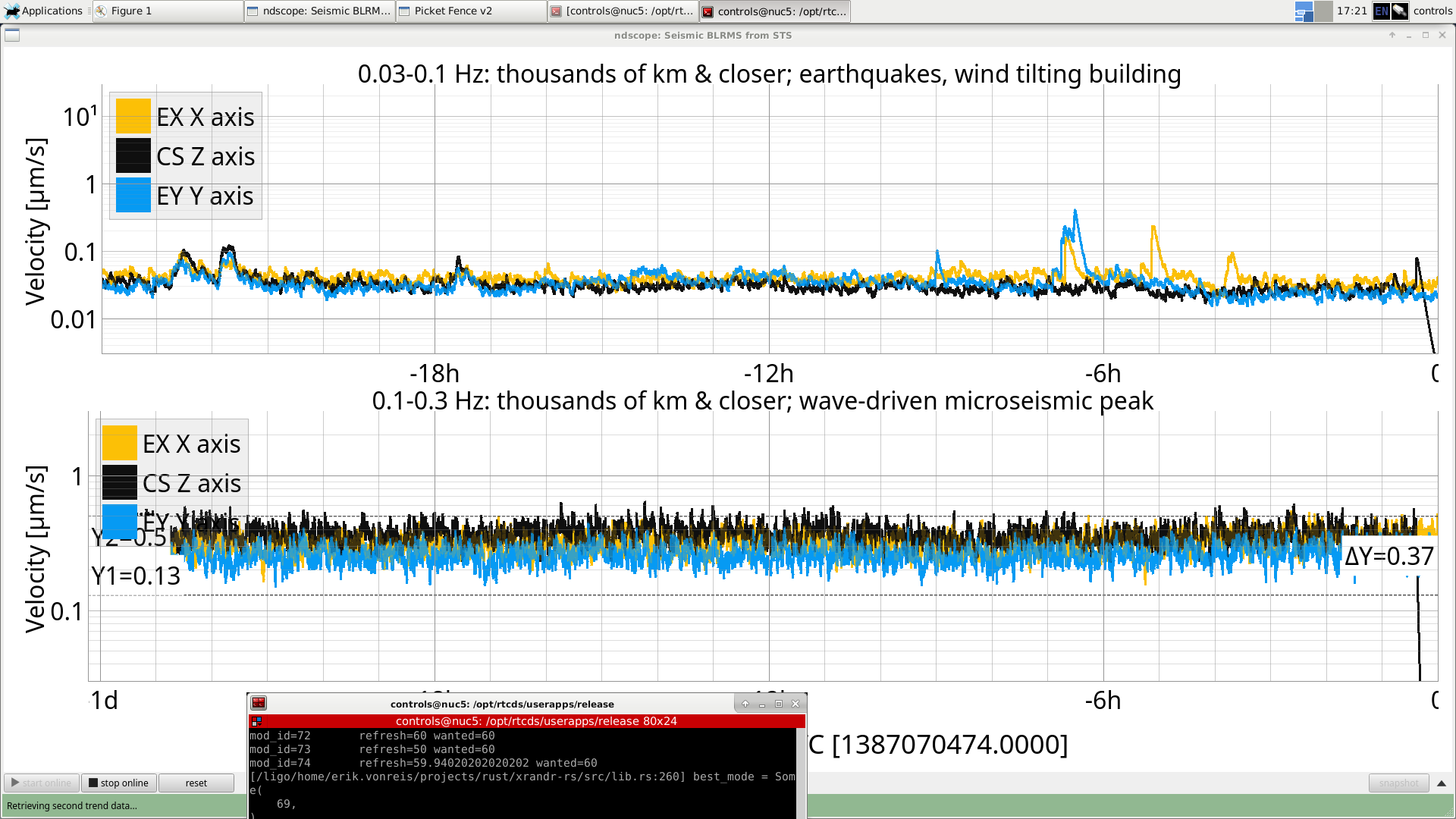
H1 has been locked and observing for 12.5 hours. EQ mode turned on for two large quakes overnight at 12:33 and 12:51 UTC. All other systems look good.
TITLE: 12/20 Eve Shift: 00:00-08:00 UTC (16:00-00:00 PST), all times posted in UTC
STATE of H1: Observing at 154Mpc
INCOMING OPERATOR: Tony
SHIFT SUMMARY: Currently Observing and have been Locked for 4.5 hours. Had one lockloss during my shift due to ADC card timeout (74923, 74925), but otherwise a smooth relock and quiet rest of the evening.
LOG:
00:00 Detector Observing and Locked for 1.5hours
00:57 Lockloss due to CS SEI ADC timeout https://alog.ligo-wa.caltech.edu/aLOG/index.php?callRep=74923, https://alog.ligo-wa.caltech.edu/aLOG/index.php?callRep=74925
-- Relocking --
02:07 Relocking
- ALSX gets up to 1.2
03:23 NOMINAL_LOW_NOISE
-- Relocking End --
03:35 Observing
| Start Time | System | Name | Location | Lazer_Haz | Task | Time End |
|---|---|---|---|---|---|---|
| 22:41 | SQZ | Nutsinee | Optics Lab | Local | 00:41 | |
| 01:39 | CDS | Erik, Jonathan | CER | n | Fix CS SEI computer crash | 02:04 |
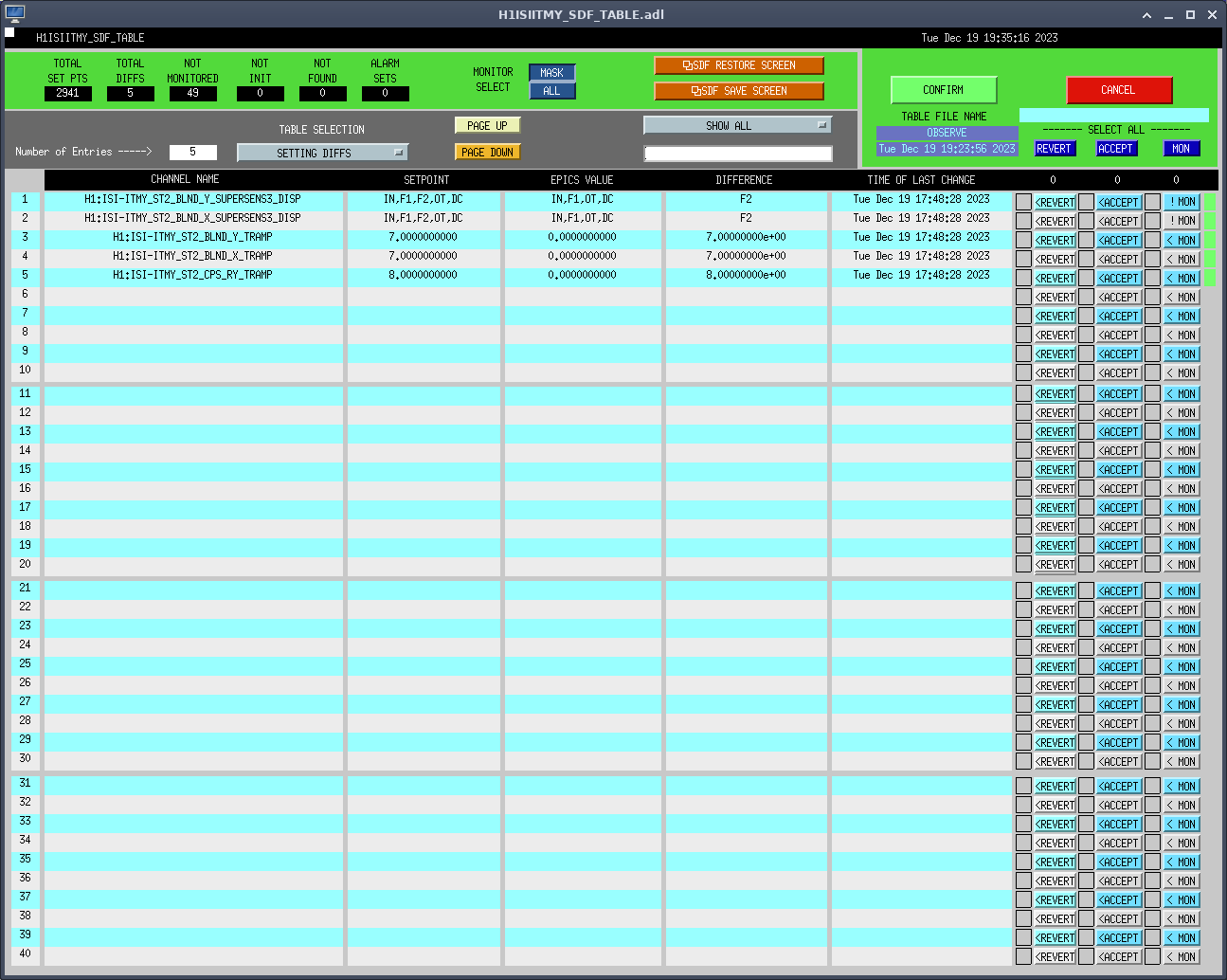
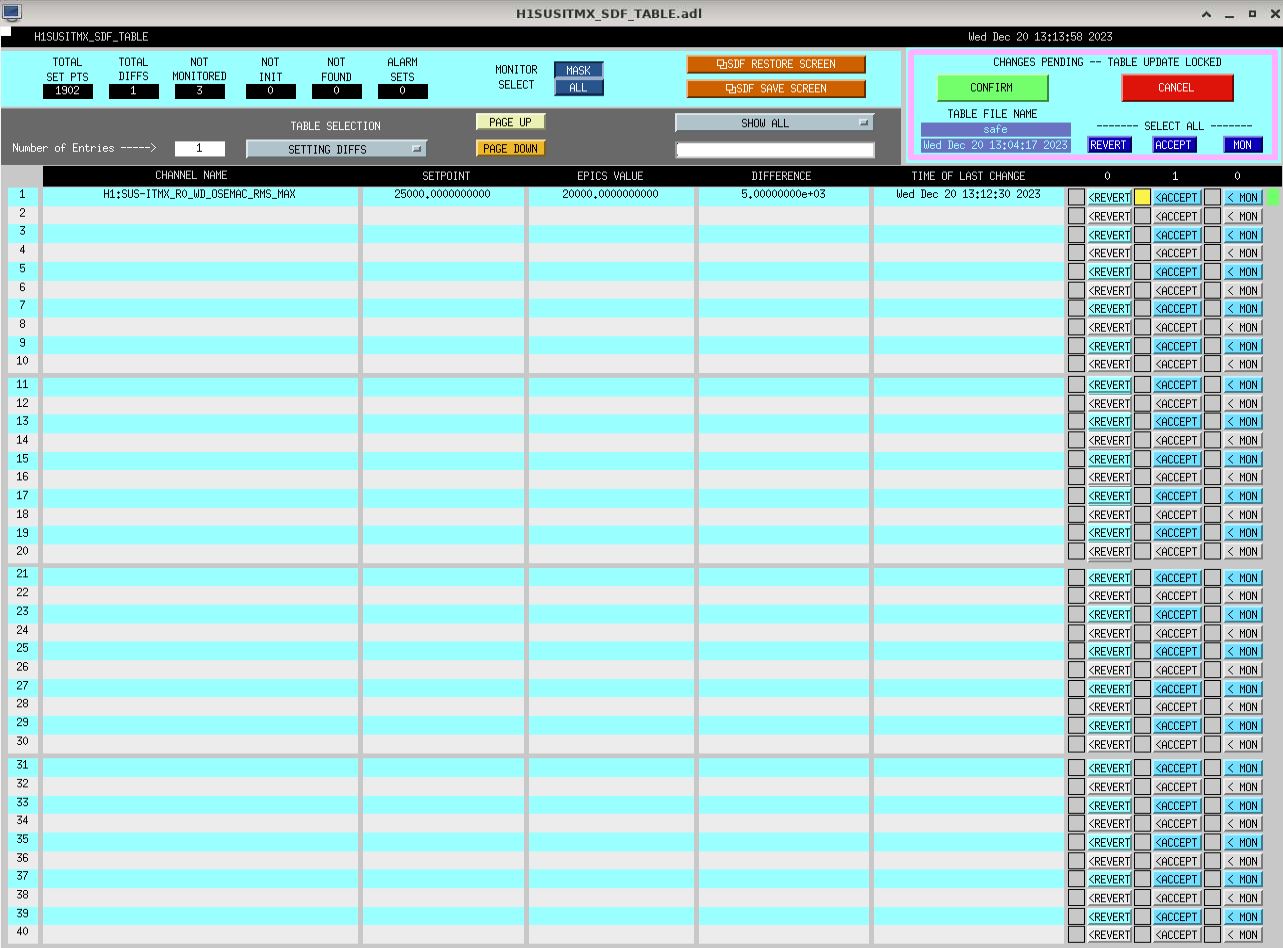
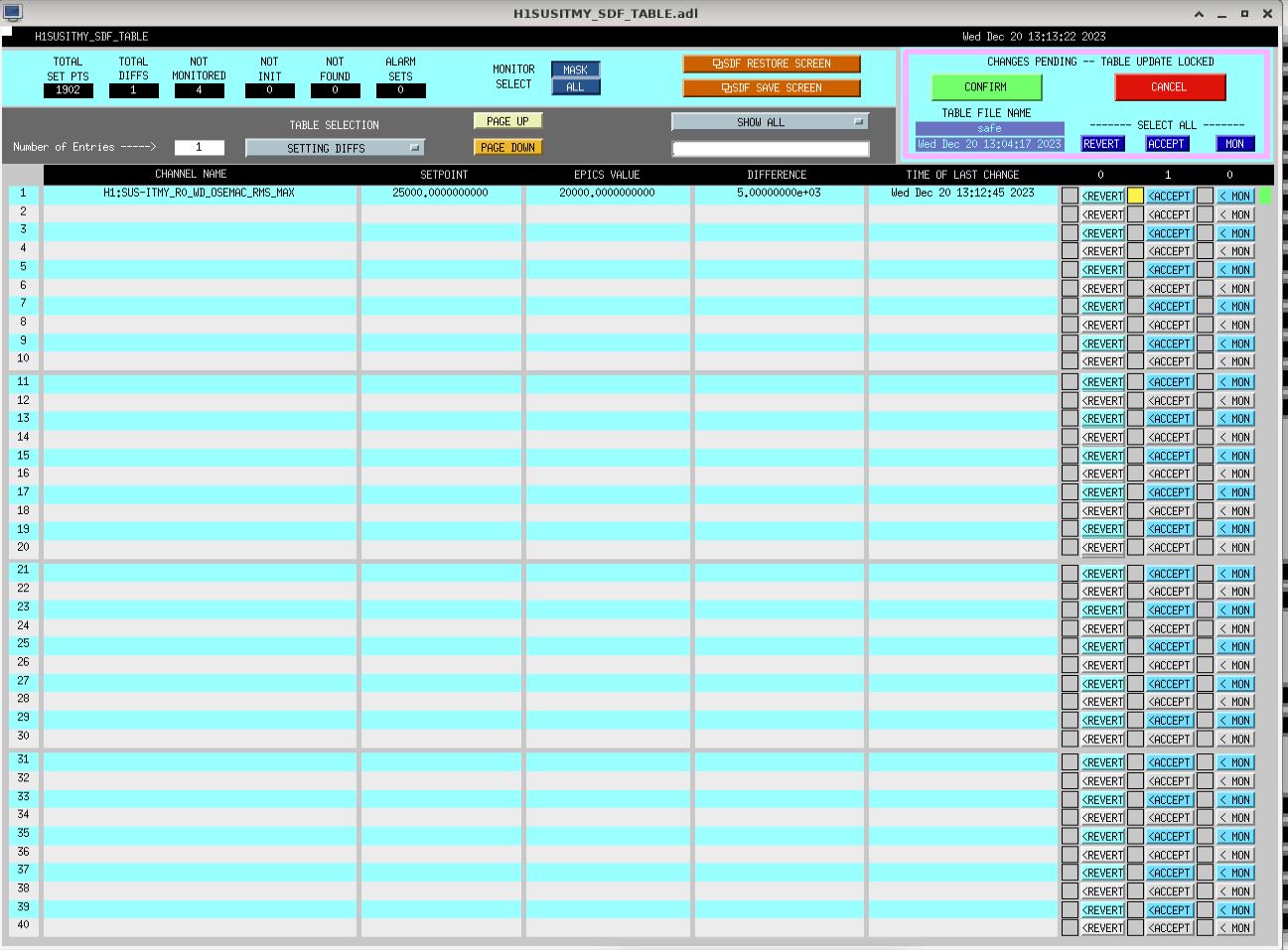
We're back to Observing and have been Locked for 39 minutes after the lockloss earlier (74923). Attached are the SDF diffs for h1isiitmy that I accepted.
Currently DOWN and in Corrective Maintanence due to an ADC crash on h1seib1 that caused our last lockloss(74924).
[Dave, Jonathan, Erik, Oli]
GDS TP screen showed ADC 4 with the timeout.
Some cards were missing from lspci, We shut the front end off powered off the AI chasses and cycled power on the IO chassis. After bringing the front end back, all cards appeared normal, so we turned the AI chasses back on and resumed operation.
I will prep a spare ADC in case ADC 4 permenantly fails, but ADC timeouts have signaled DAC or Adnaco failure as well.
I opened (and then marked as Resolved) an FRS ticket: FRS#29998
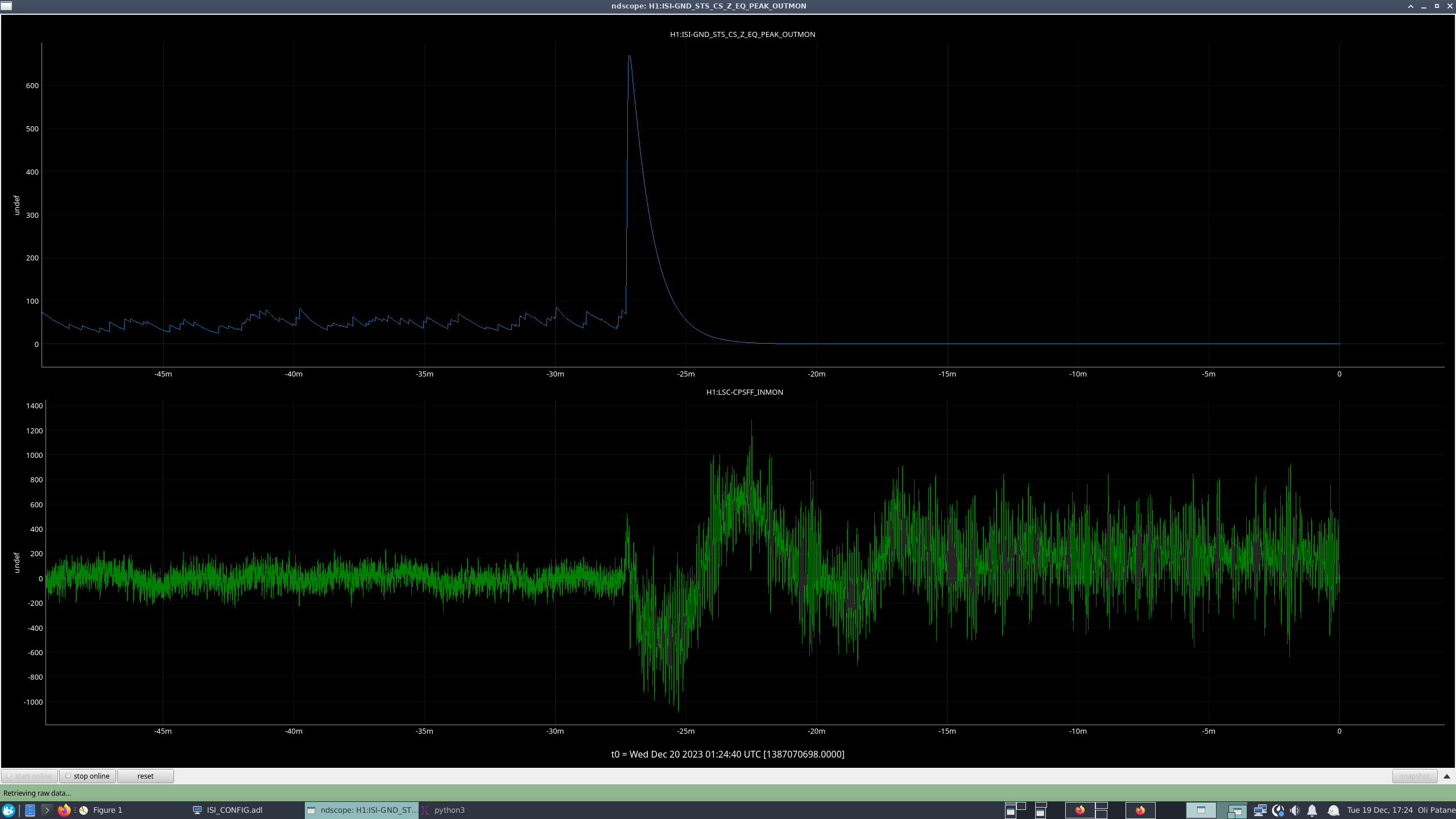
Looks like we have an issue with the corner station seismometer having given out and caused the 'local earthquake' and lockloss(ndscope, seismon FOM, peakmon/CPSFF).
03:35UTC Back Observing
Jenne, Naoki, Louis, Camilla, Sheila
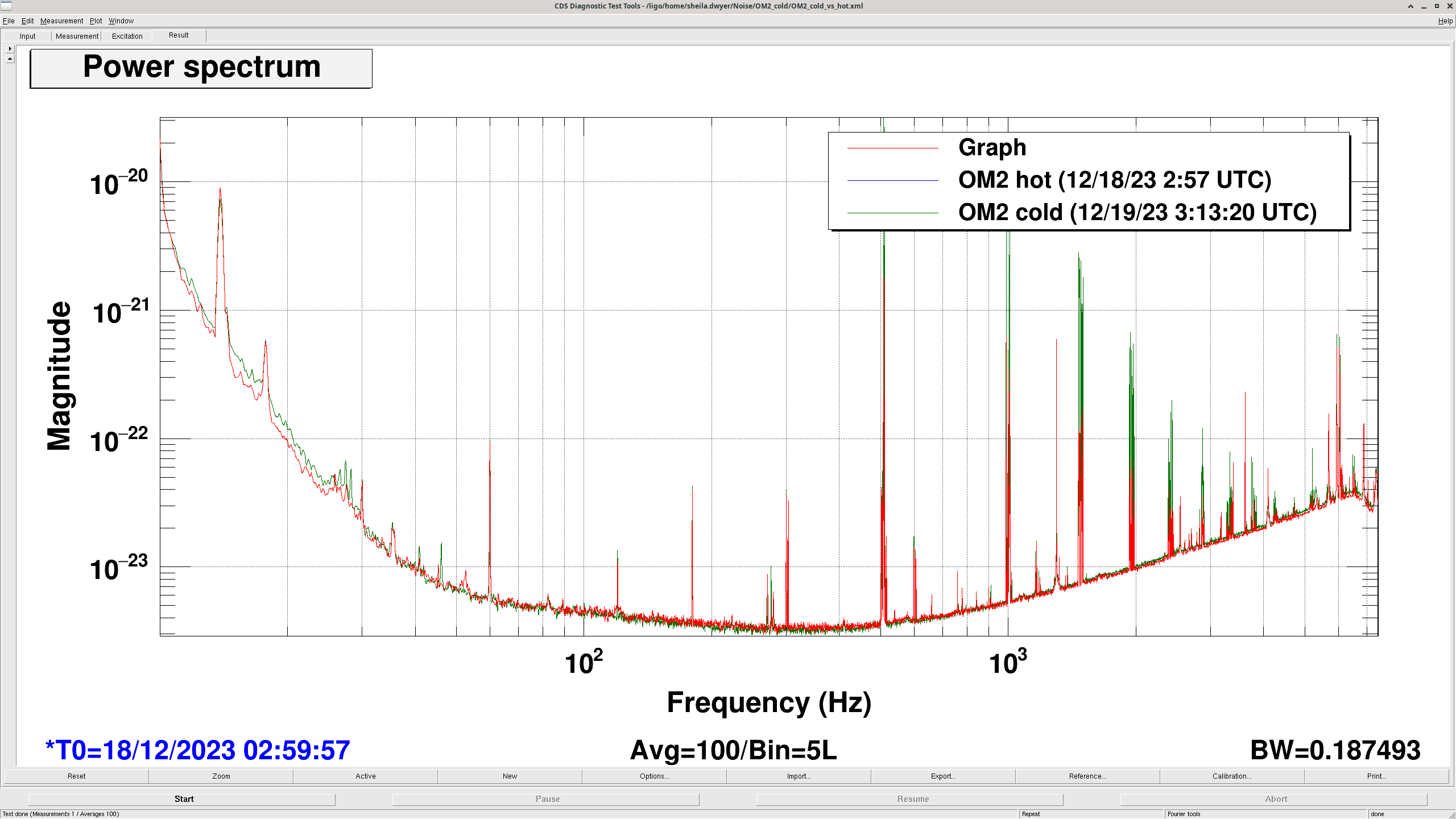
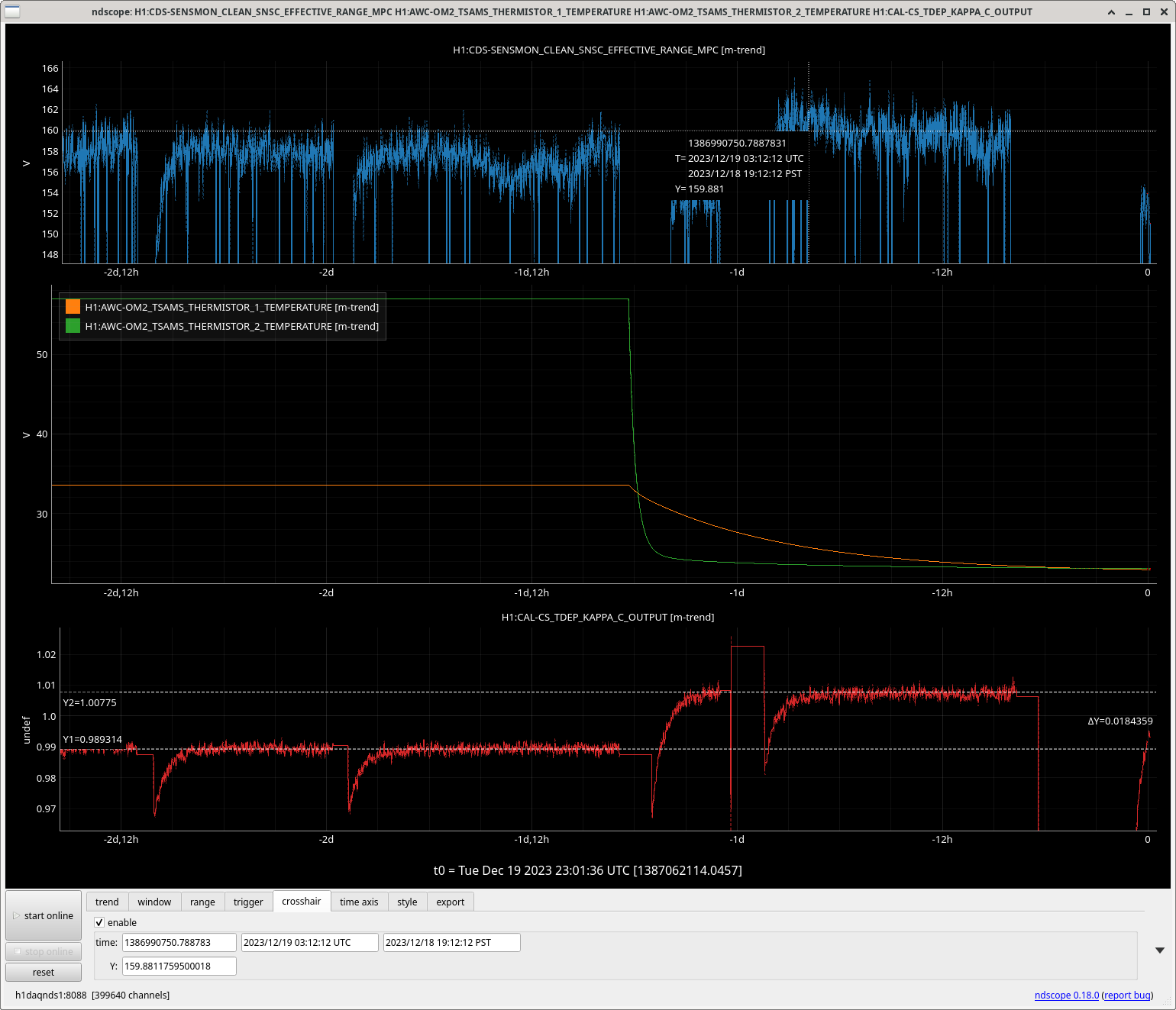
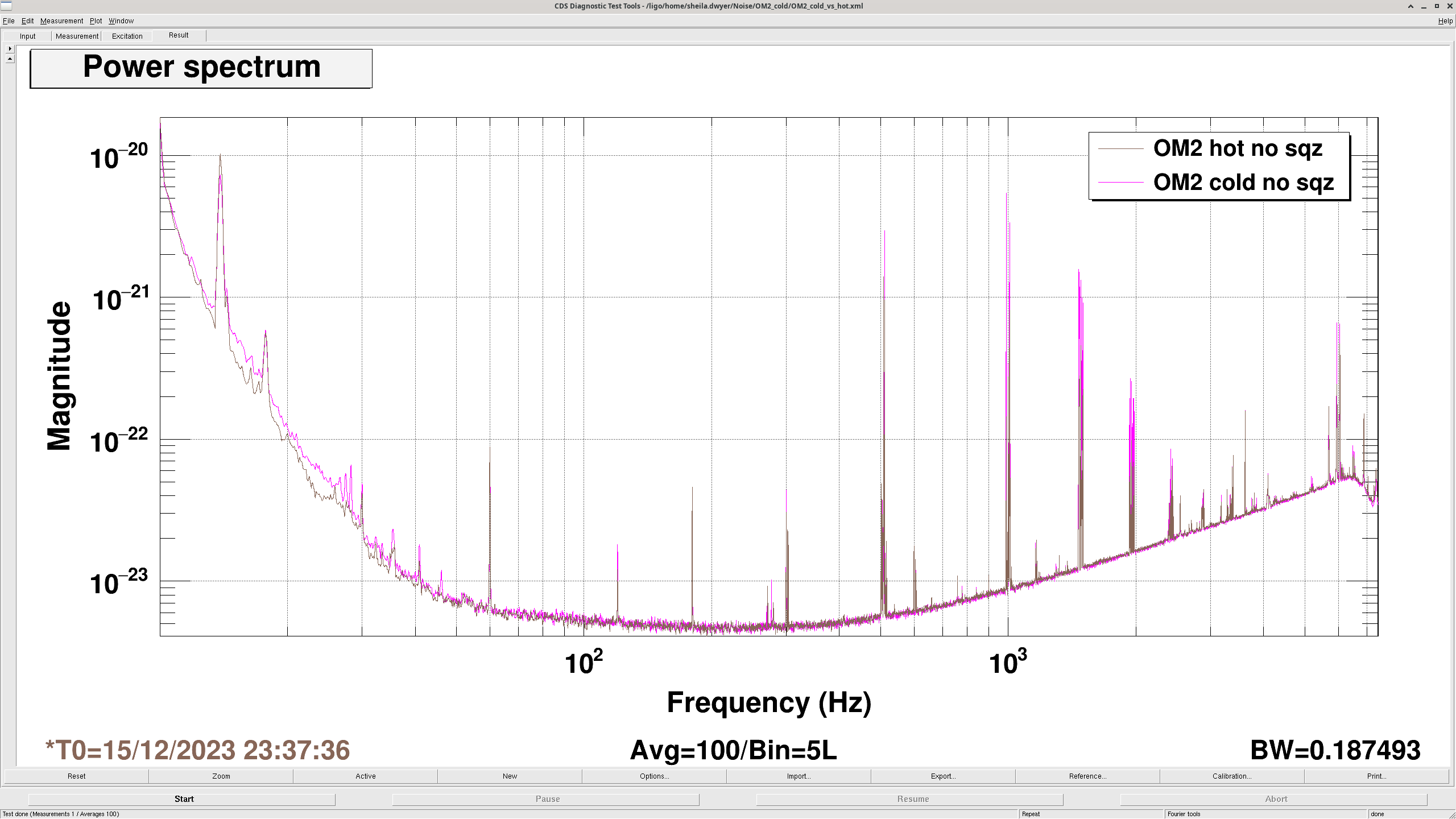
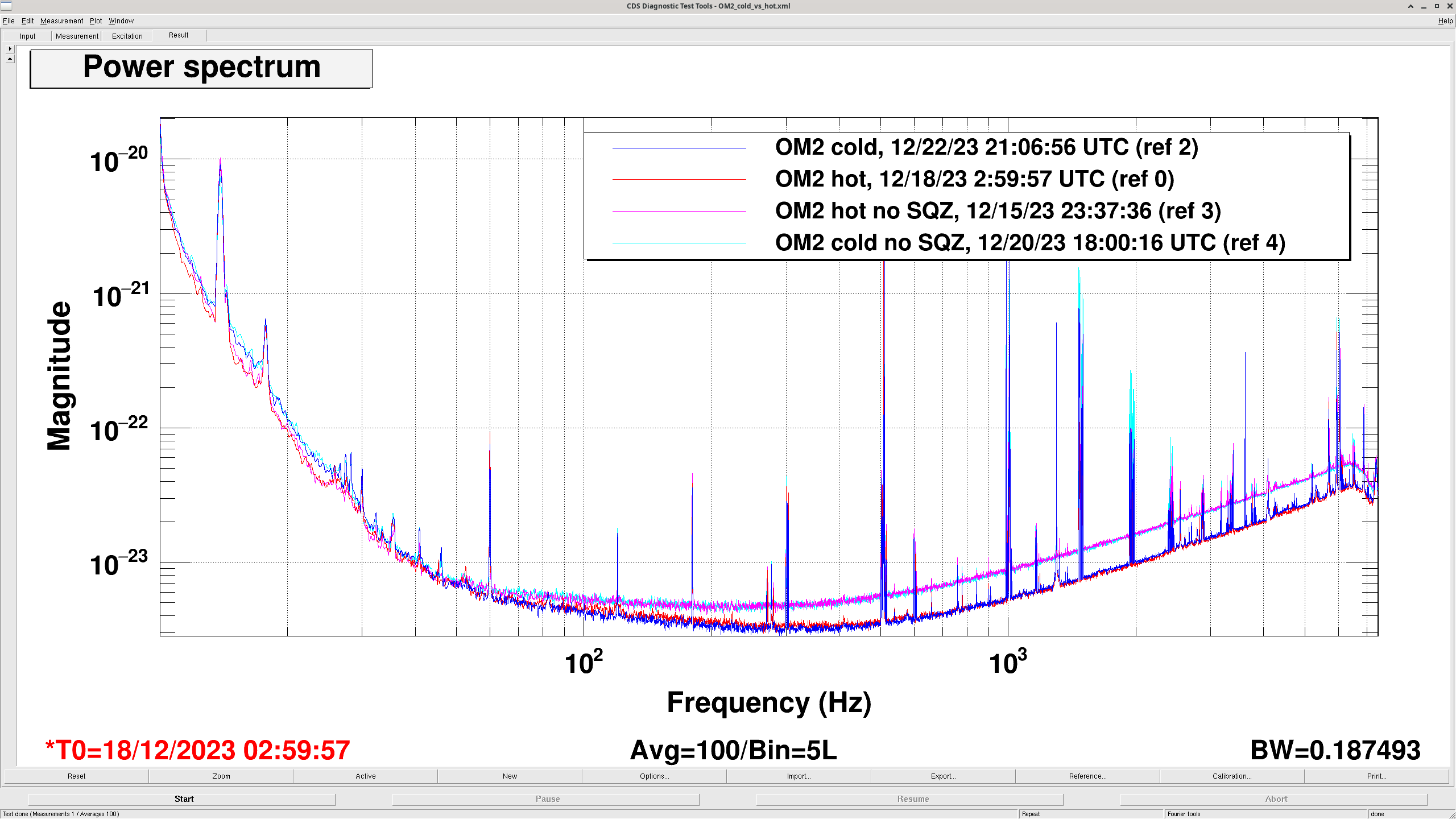
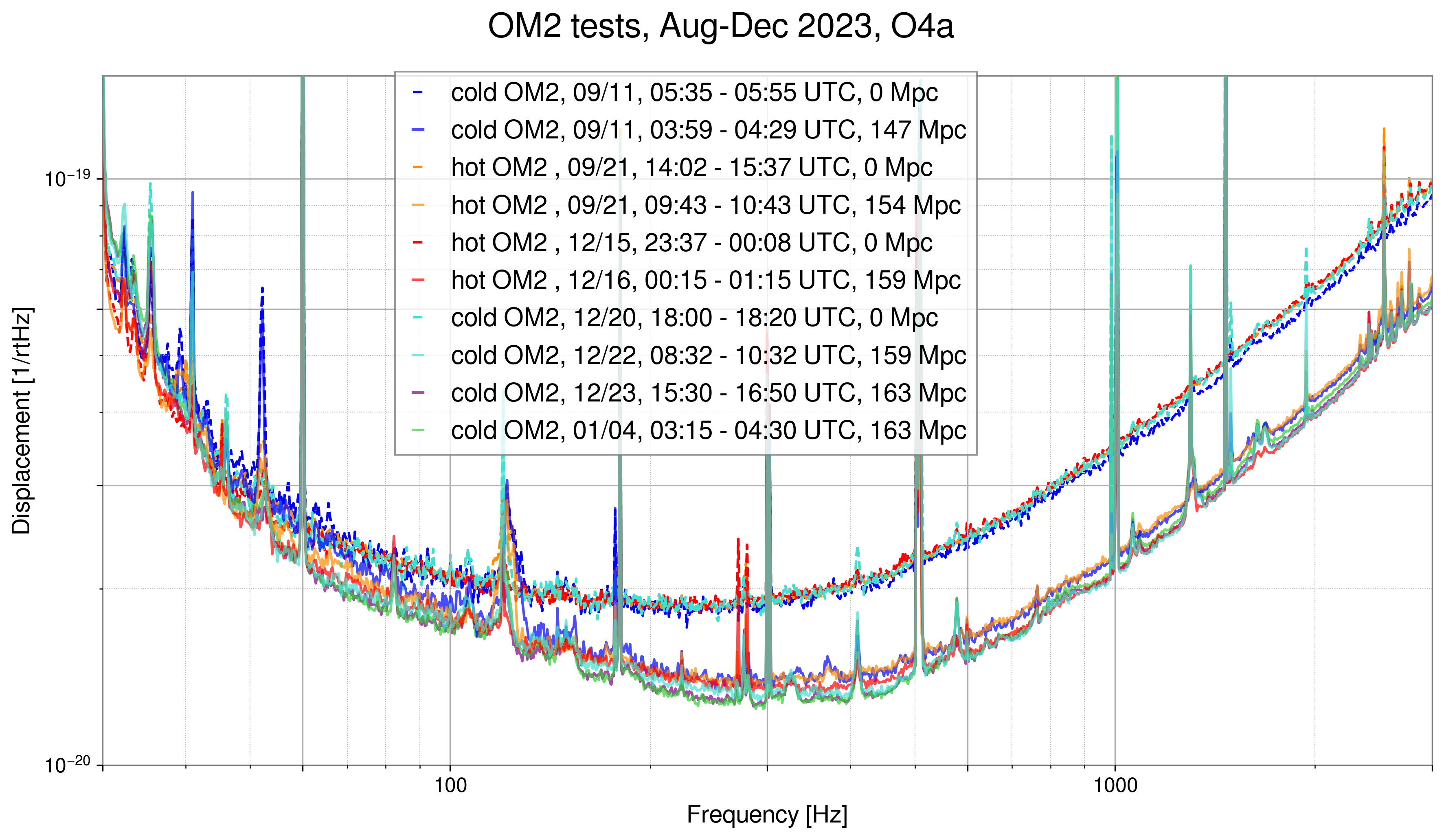
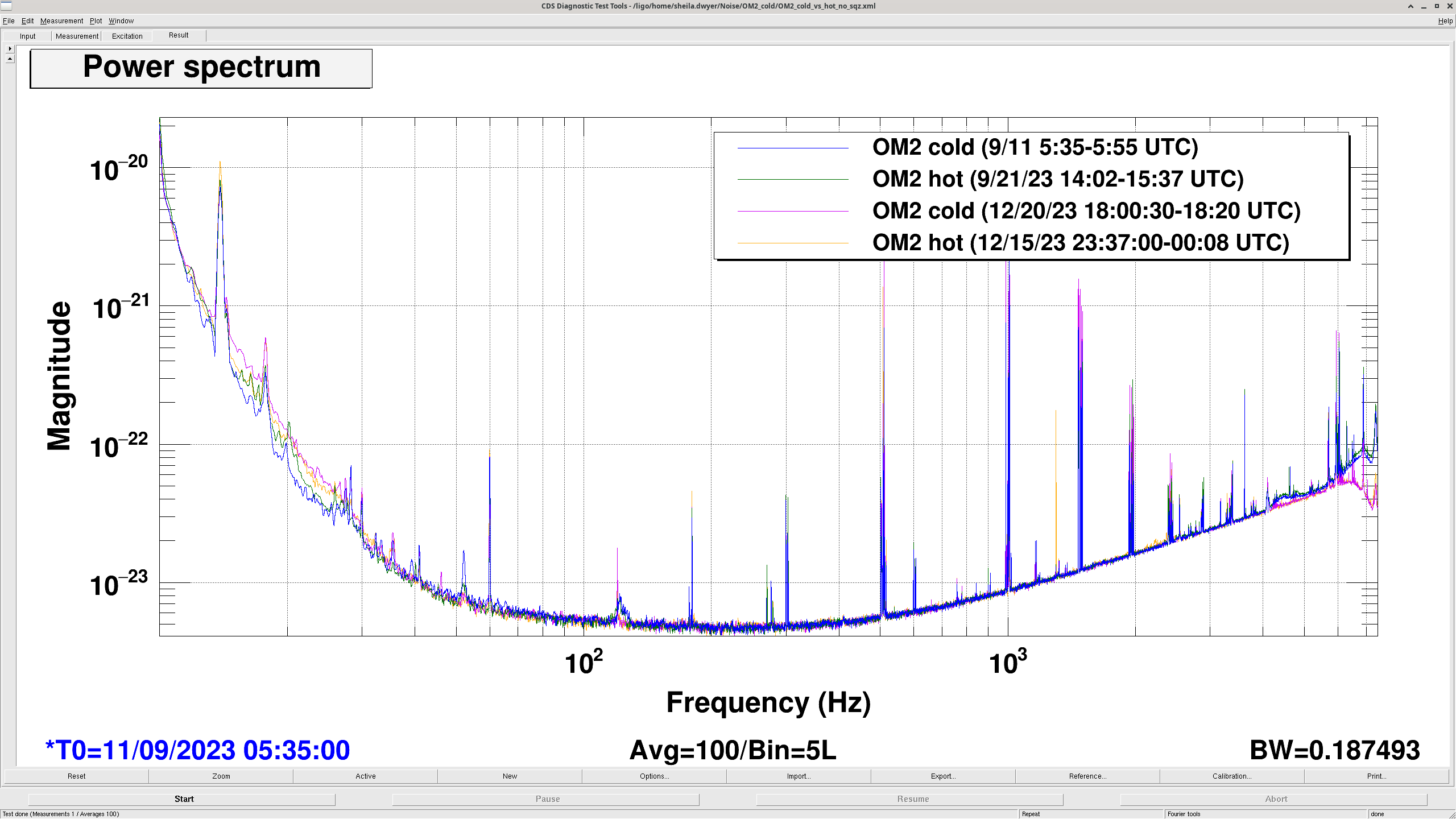
Here is comparison of the DARM CLEAN spectrum with OM2 hot vs cold. The second screenshot shows a time series of OM2 cooling off. The optical gain increased by 2%, as was seen in the past (for example 71087). Thermistor 1 shows that the thermal transient takes much longer (12 + hours) than what thermistor 2 says (2 hours).
Louis posted a comparison of the calibration between the two states, there are small differences in calibration ~1% (74913). While the DARM spectrum is worse below 25Hz, it is similar at 70 Hz where we in the past thought that the sensitivity was worse with OM2 cold. From 100-200 Hz the sensitivity seems slightly better with OM2 cold, some of the peaks are removed by Jenne's jitter subtraction (74879) but there also seems to be a lower level of noise between the peaks (which could be small enough to be a calibration issue). At high frequency the cold OM2 noise seems worse, this could be because of the squeezing. We plan to take data with some different squeezing angles tomorow and will check the squeezing angle as part of that.
So, it seems that this test gives us a different conculsion than the one we did in the spring/summer, and that now it seems that we should be able to run with OM2 cold to have better mode matching from the interferometer to the OMC. We may have not had our feedforwards well tuned in the previous test, or perhaps some other changes in the noise mean that the result is different now.
Is this additonal nosie at low frequency due to the same non-stationarity we oberved before and we believe is related to the ESD upconversion? Probably not, here's why.
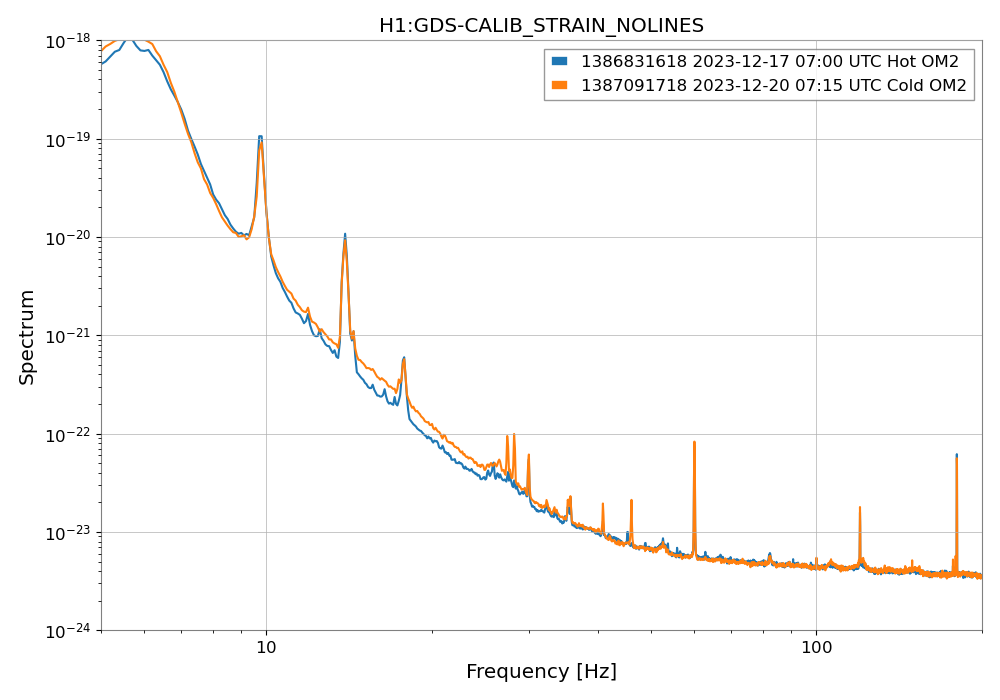
First plot compares the strain spectrum from two times with cold and hot OM2. This confirms Sheila's observation.
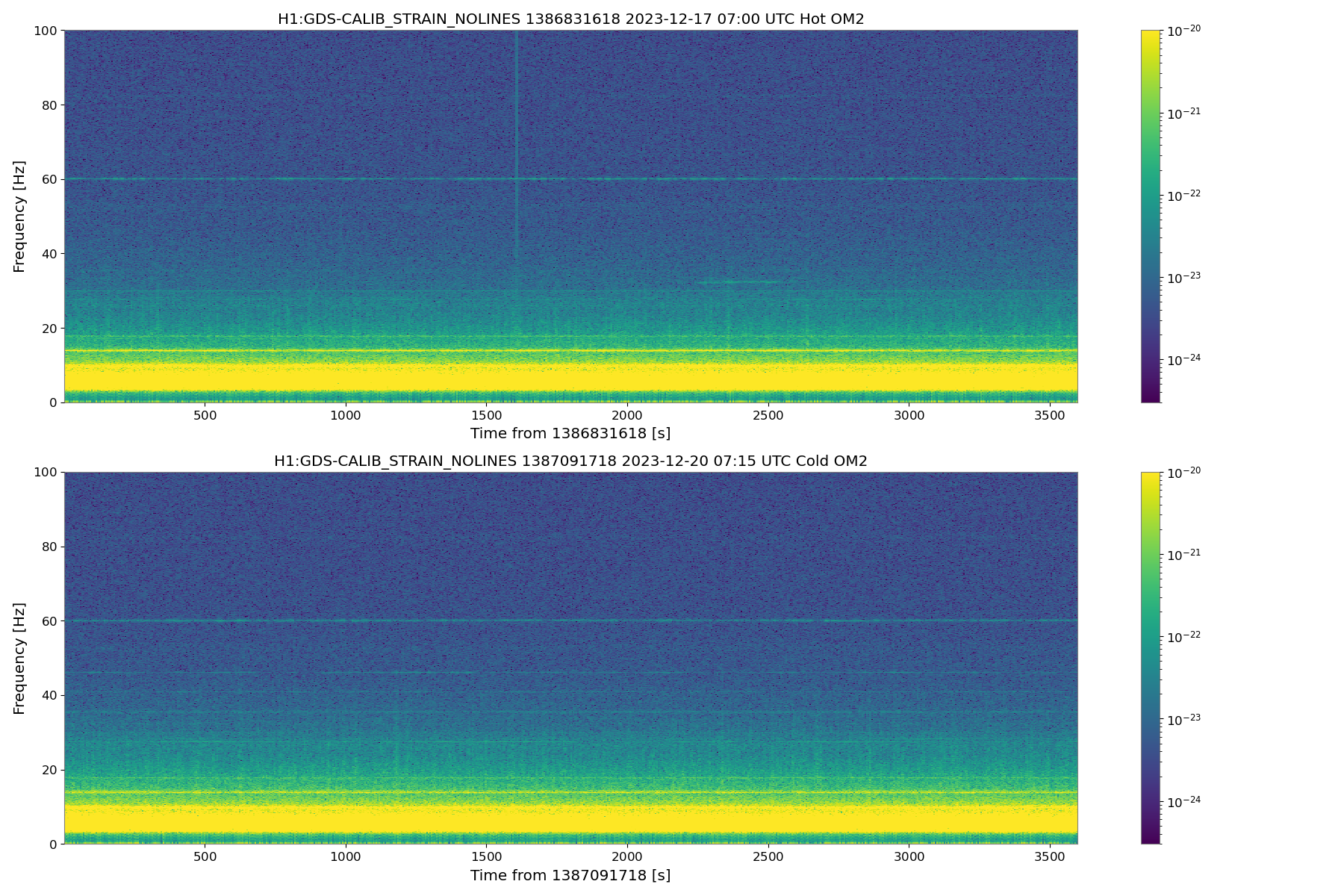
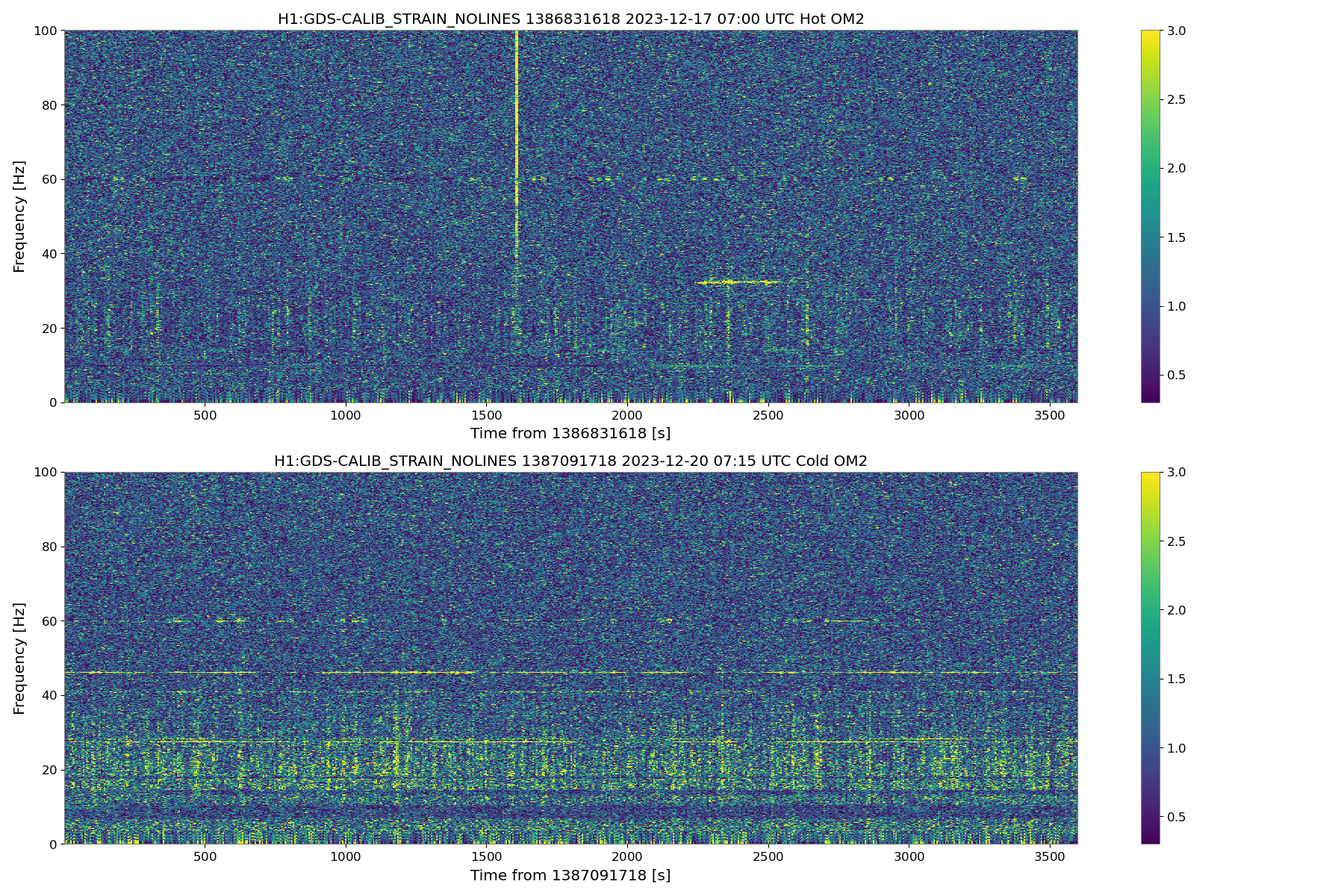
The second and third plots are spectrograms of GDS-CALIB_STRAIN during the two periods. Both show non-stationry noise at low frequency. The third plot shows the strain spectrogram normalized to the median of the hot OM2 data: beside the non-stationariity, it looks like the background noise is higher below 30 Hz.
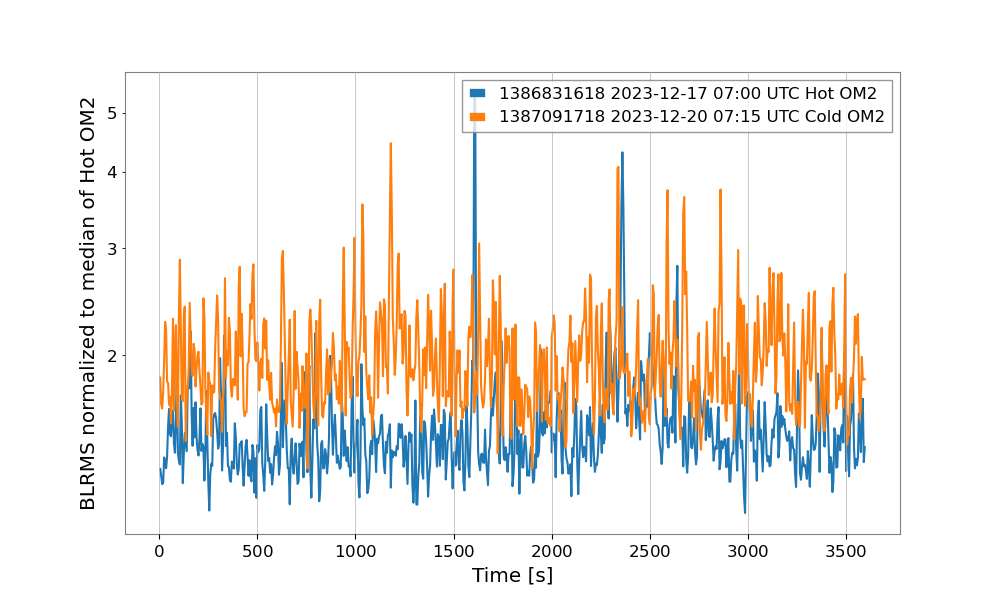
This is confirmed by looking at the BLRMS in the 16-60 Hz region for the two times, as shown in the fourth plot: its higher with cold OM2
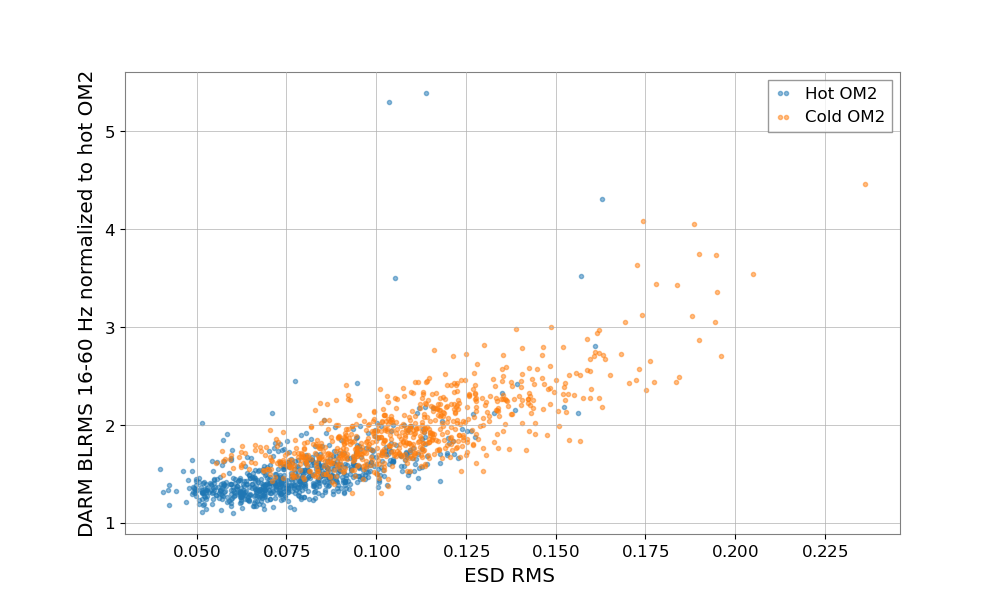
Finally, the last plot shows the correlation between the ESD RMS and the strain BLRMS, normalized to the hot OM2 state. There is still a correlation, but it appear again that the cold OM2 state has an additional background noise: when the ESD RMS is att the lower end, the strain BLRMS setlles to higher values
Here is the same comparison, without squeezing. Using times from 74935 and 74834
This suggests that where cold OM2 seems better than hot OM2 above that is due to the squeezing (and the jitter subtraction Jenne added, which is also on in this plot for cold OM2 but not for hot OM2). And the additional noise with cold OM2 reaches up to about 45Hz.
After we optimized ADF demod phase in 74972, the BNS range seems better and consistently 160-165Mpc. The attached plot shows the comparison of OM2 cold/hot with/without SQZ. The OM2 cold with SQZ is measured after optimization of ADF demod phase and other measurements are same as Sheila's previous plots.
This plot supports what Sheila says in the previous alogs.
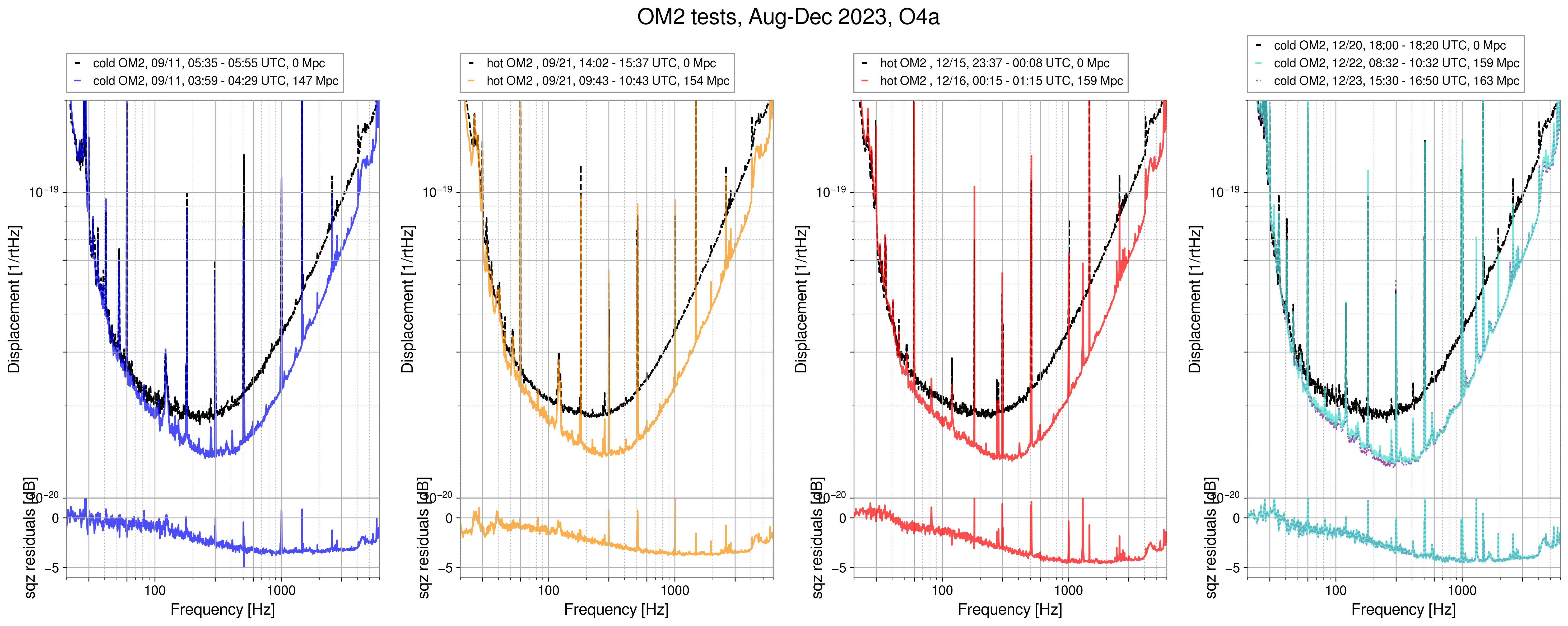
Echo-ing the above, and summarizing a look at OM2 with sqz in both Sept 2023 and Dec 2023 (running gps times dictionary is attached here).
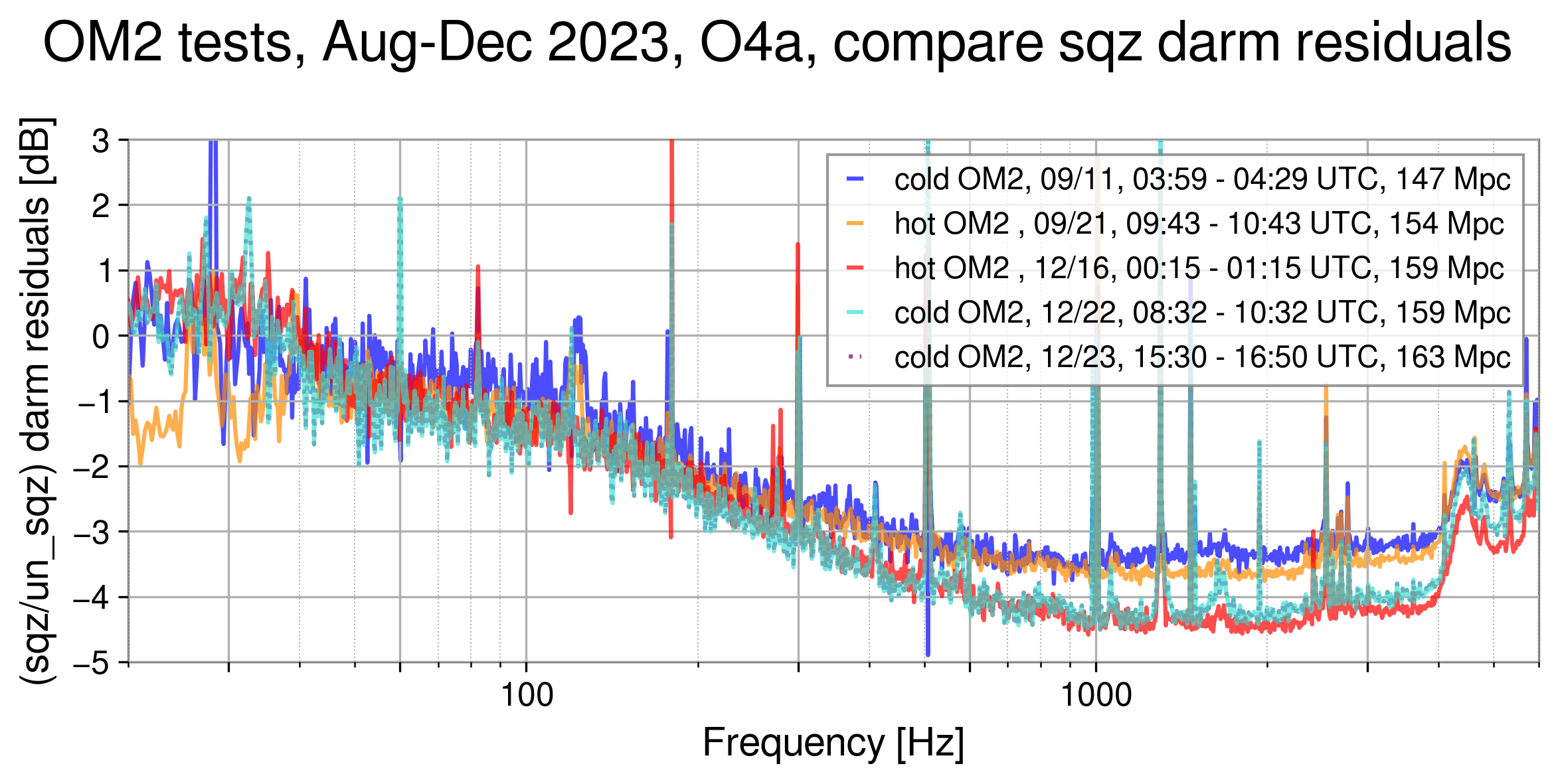
If we compare the effect of squeezing -- there is higher kHz squeezing efficiency with hot OM2. We can look at either just the darm residuals dB[sqz/unsqz] (top), or do subtraction of non-quantum noise (bottom) which shows that hot OM2 improved the kHz squeezing level by ~0.5 dB at 1.7 kHz (the blue sqz blrms 5). This is consistent with summary pages: SQZ has not reached 4.5 dB since cooling OM2 74861. Possibly suggests better SQZ-OMC mode-matching with hot OM2.
Without squeezing, cold om2 has more optical gain and more low-freq non-quantum noise. Better IFO-OMC mode-matching with cold OM2.
In total, it's almost a wash for kHz sensitivity: heating OM2 loses a few % optical gain, but recovers 0.2-0.5 dB of shot noise squeezing.
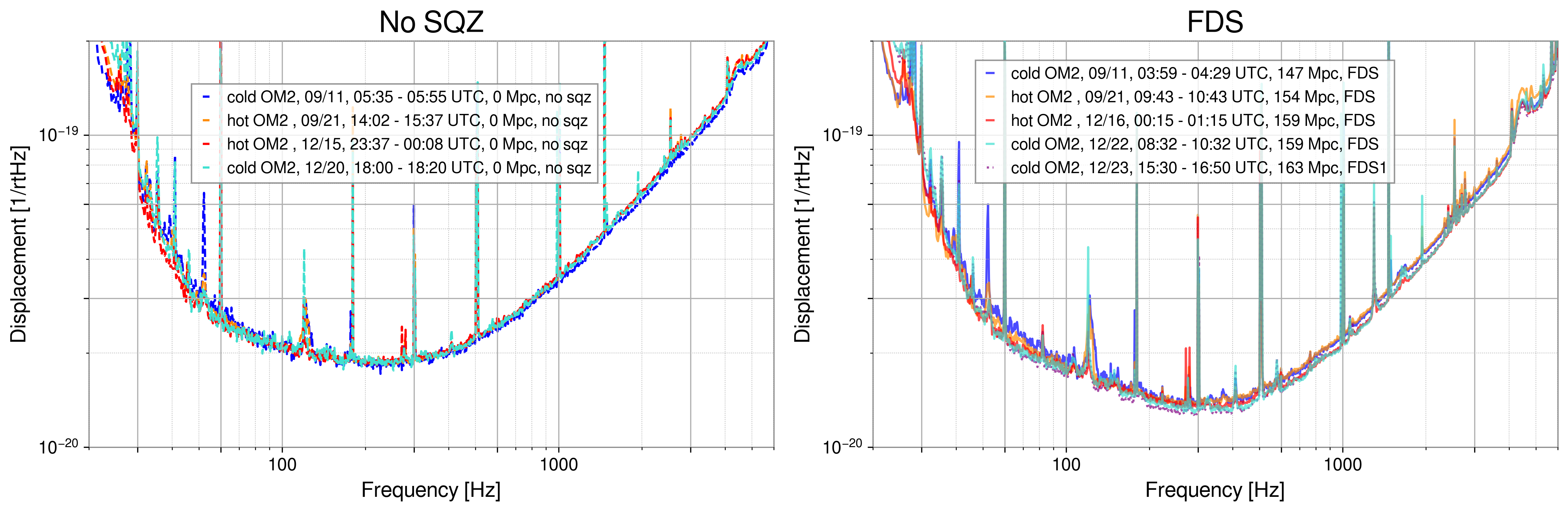
It's worth noting the consistent range increases with SQZ tuning + improvements: even in FDS, there is a non-zero contribution of quantum noise down to almost 50 Hz. For example Naoki's adjustment of sqz angle setpoint on 12/21 74972 improved range, same for Camilla's Jan sqz tuning 75151. Looking at DARM (bottom green/purple traces), these sqz angle tunings reproducibly improved quantum noise between about 60-450 Hz.
Here are some more plots of the times that Vicky plotted above.
The first attachment is just a DARM comparison with all 4 no sqz times, OM2 cold vs hot in December vs September.
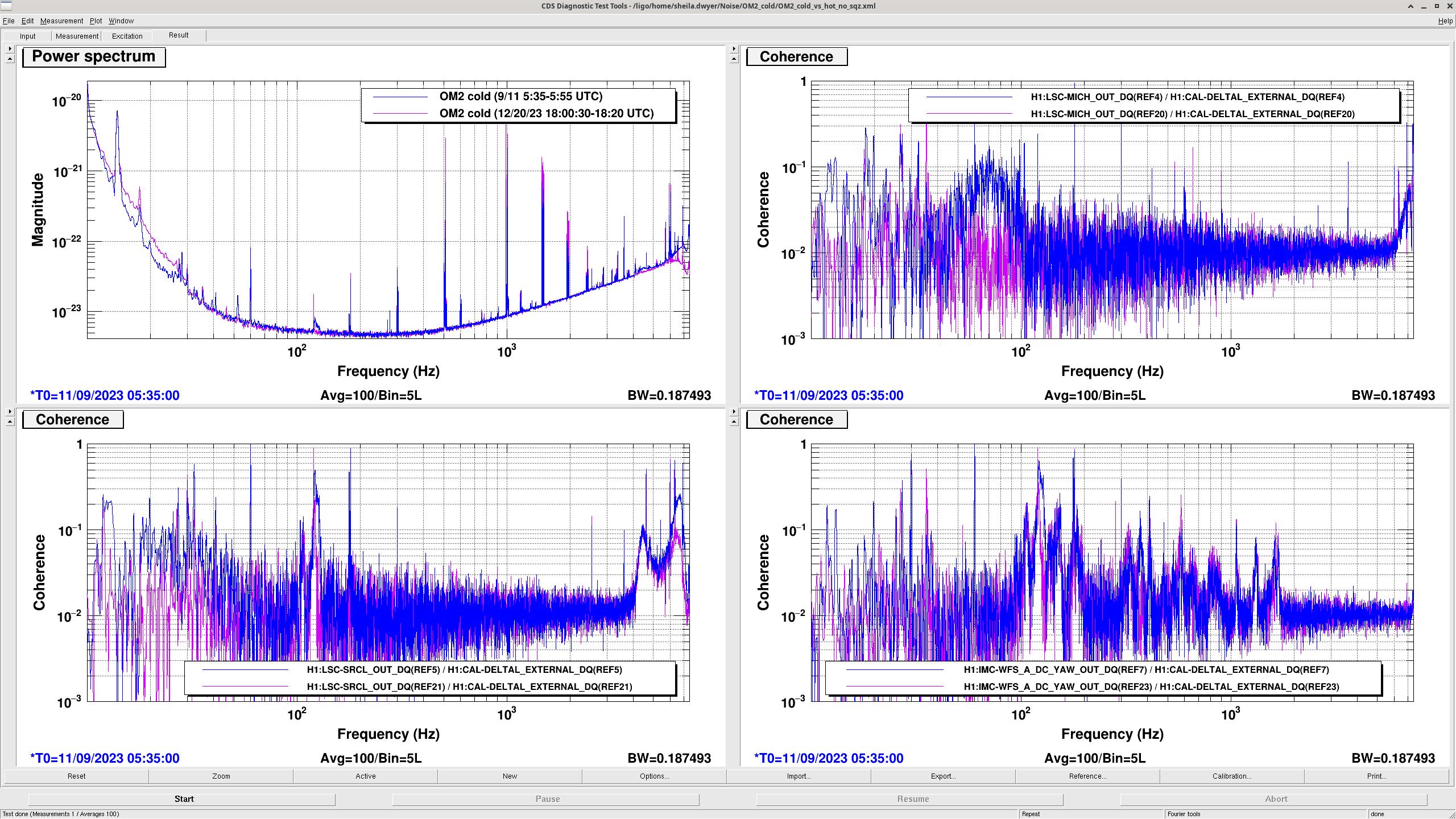
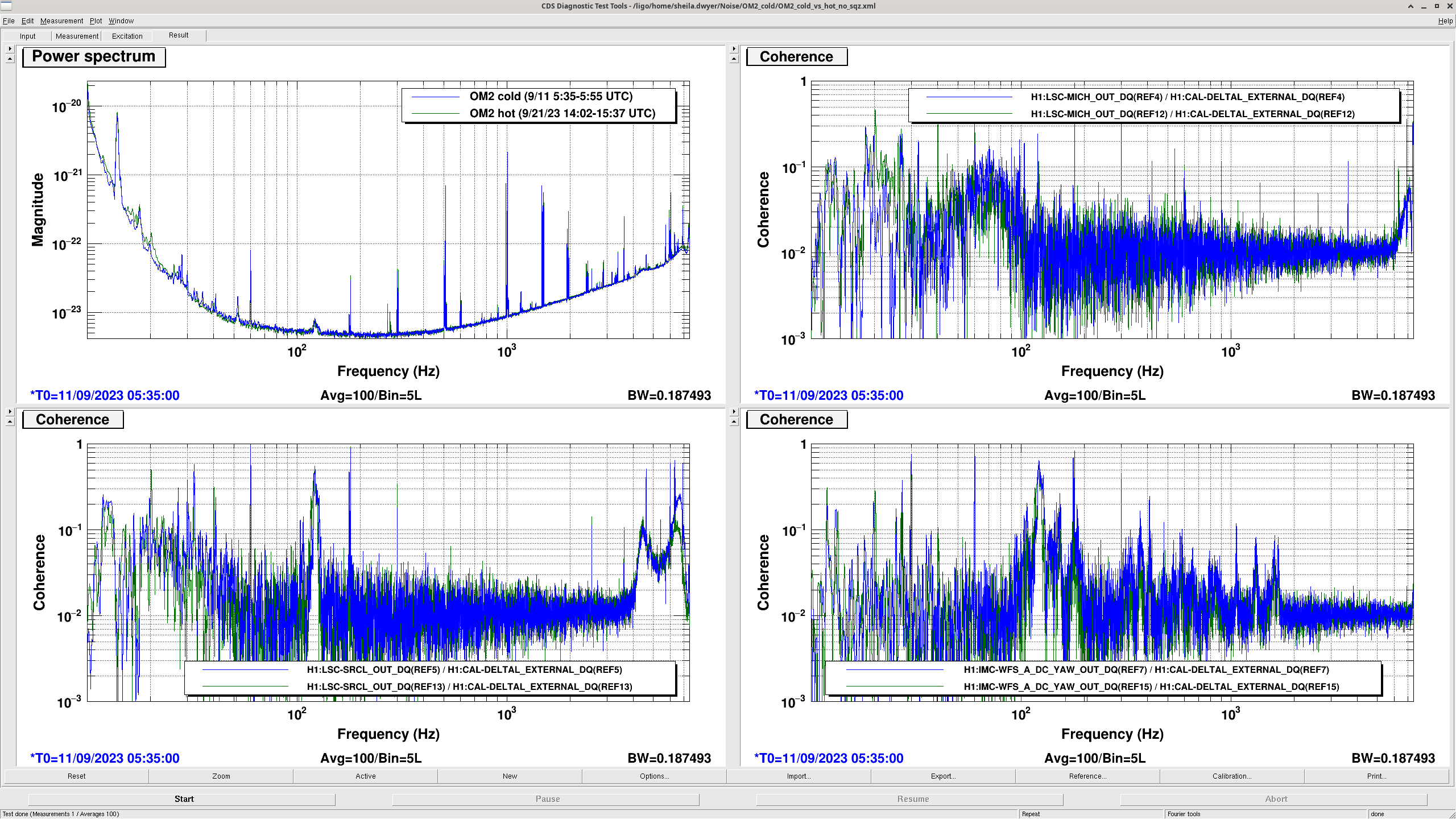
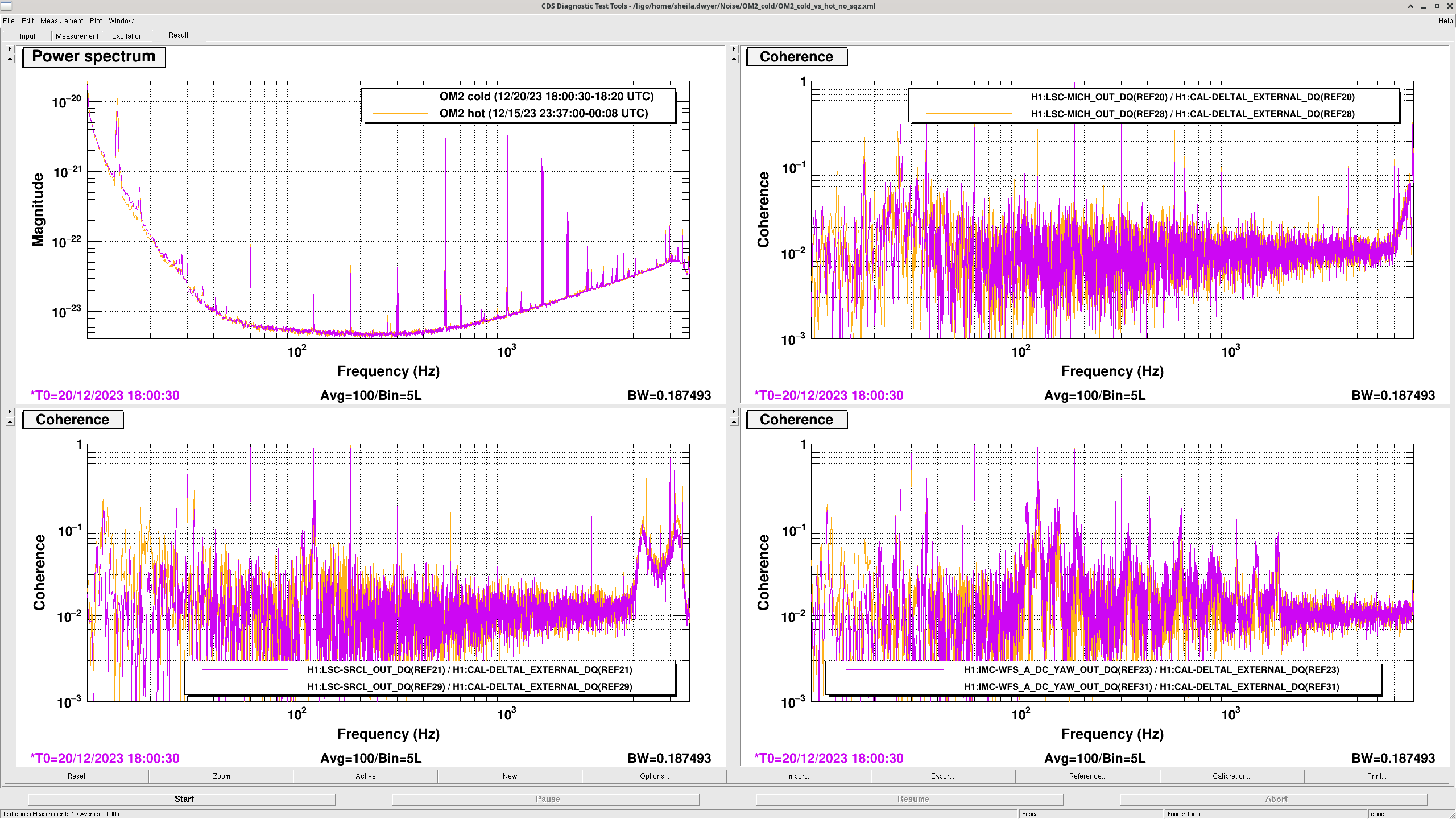
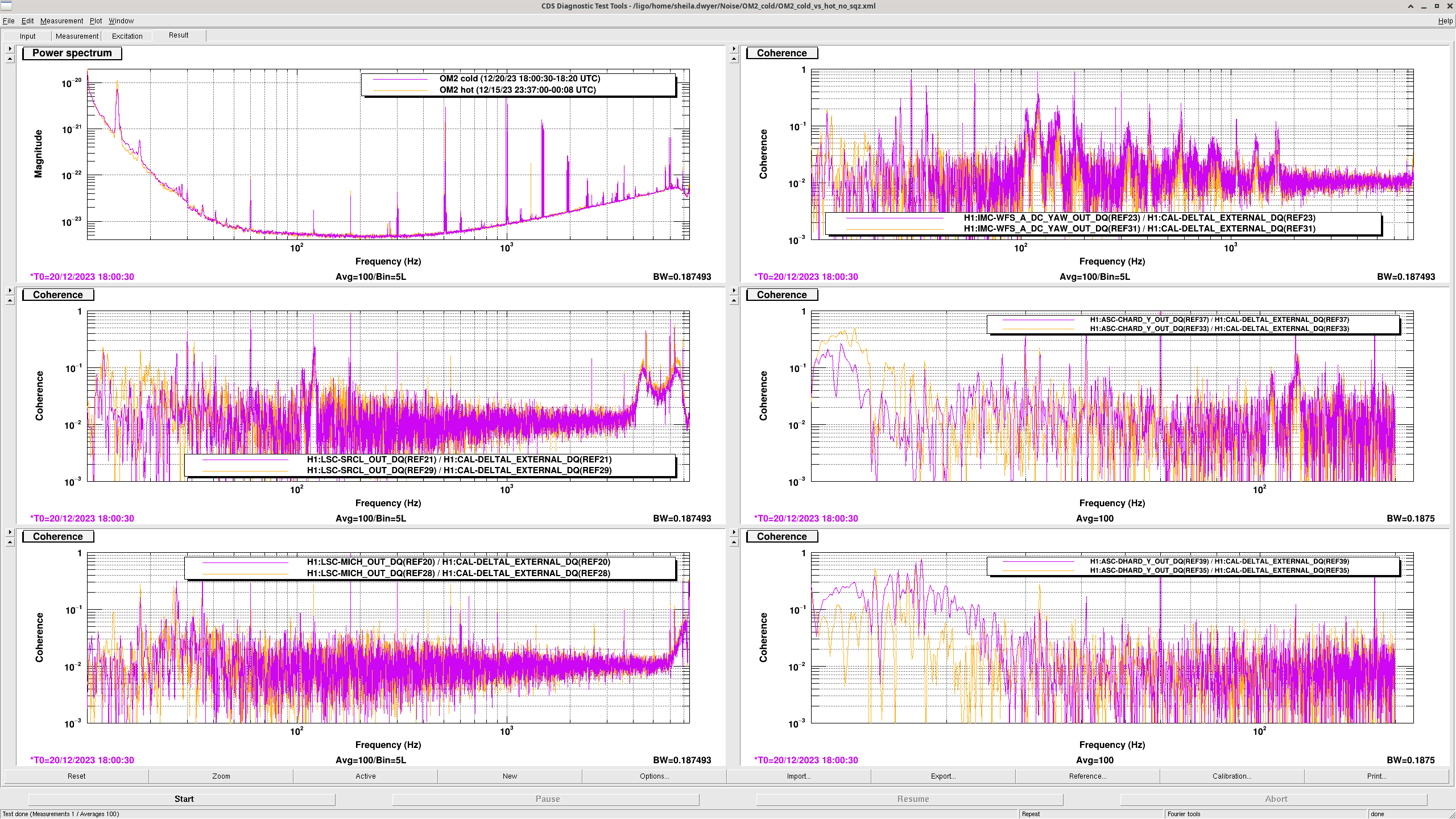
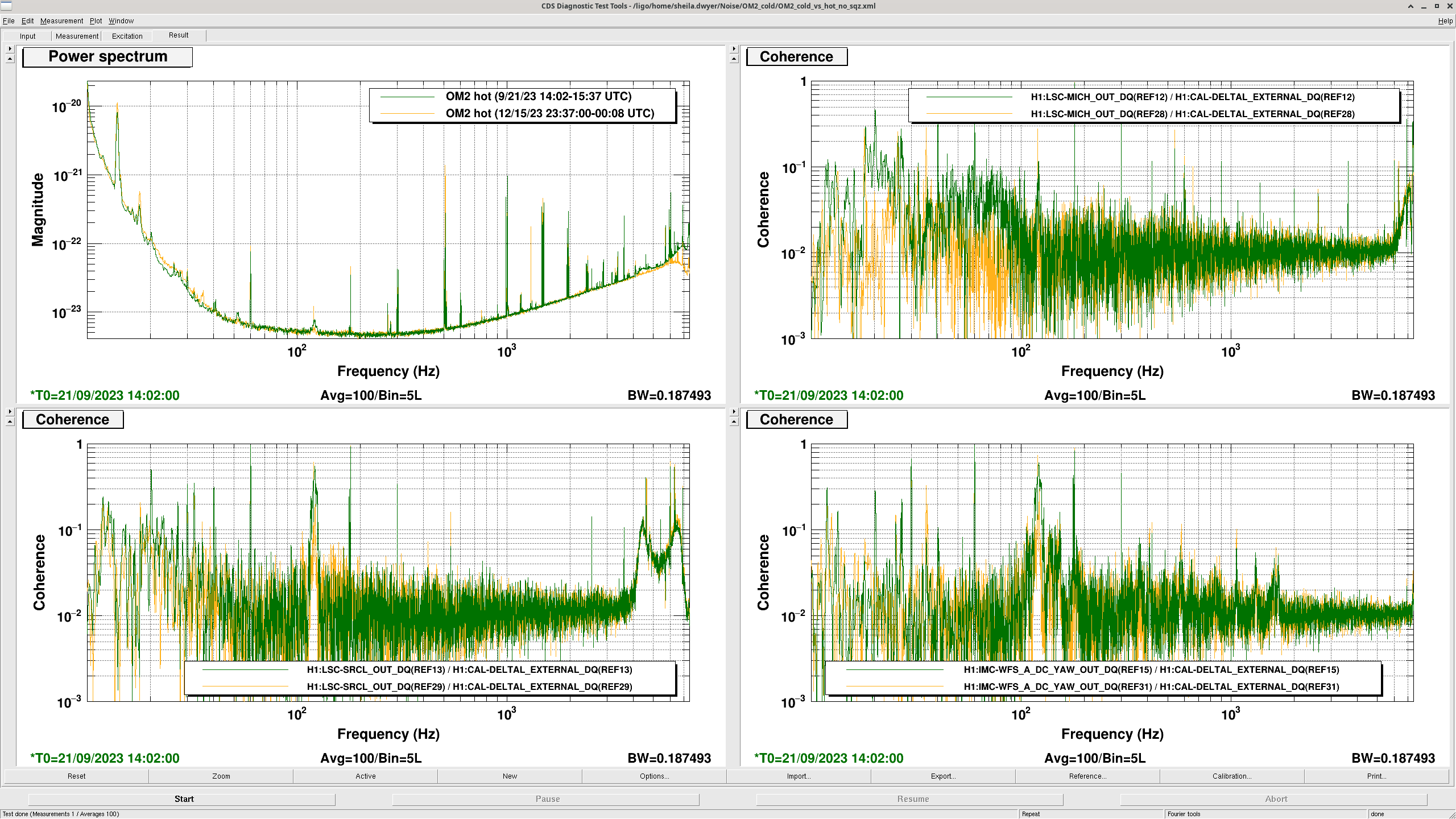
Comparing OM2 hot September vs December shows that our sensitivity at from 20-40 Hz has gotten worse since September, the MICH coherence seems lower while the jitter and SRCL coherence seem similar. The same comparison for OM2 cold shows that with OM2 cold our sensitivity has also gotten worse from 15-30 Hz.
Comparing cold vs hot, in September the MICH coherence did get worse from 60-80 Hz for cold OM2, which might explain the worse sensitivity in that region. The MICH coherence got better from 20-30 Hz where the sensitivty was better for cold OM2. The December test had better tuned MICH FF for both hot and cold OM2, so this is the better test of the impact of the curvature change.
As Gabriele pointed out with his BRUCO, 74886 there is extra coherence with DHARD Y for cold OM2 at the right frequencies to help explain the extra noise. There isn't much change in the HARD pitch coherence between these December times, but the last attachment here shows a comparison of the HARD Y coherences for hot and cold OM2 in December.
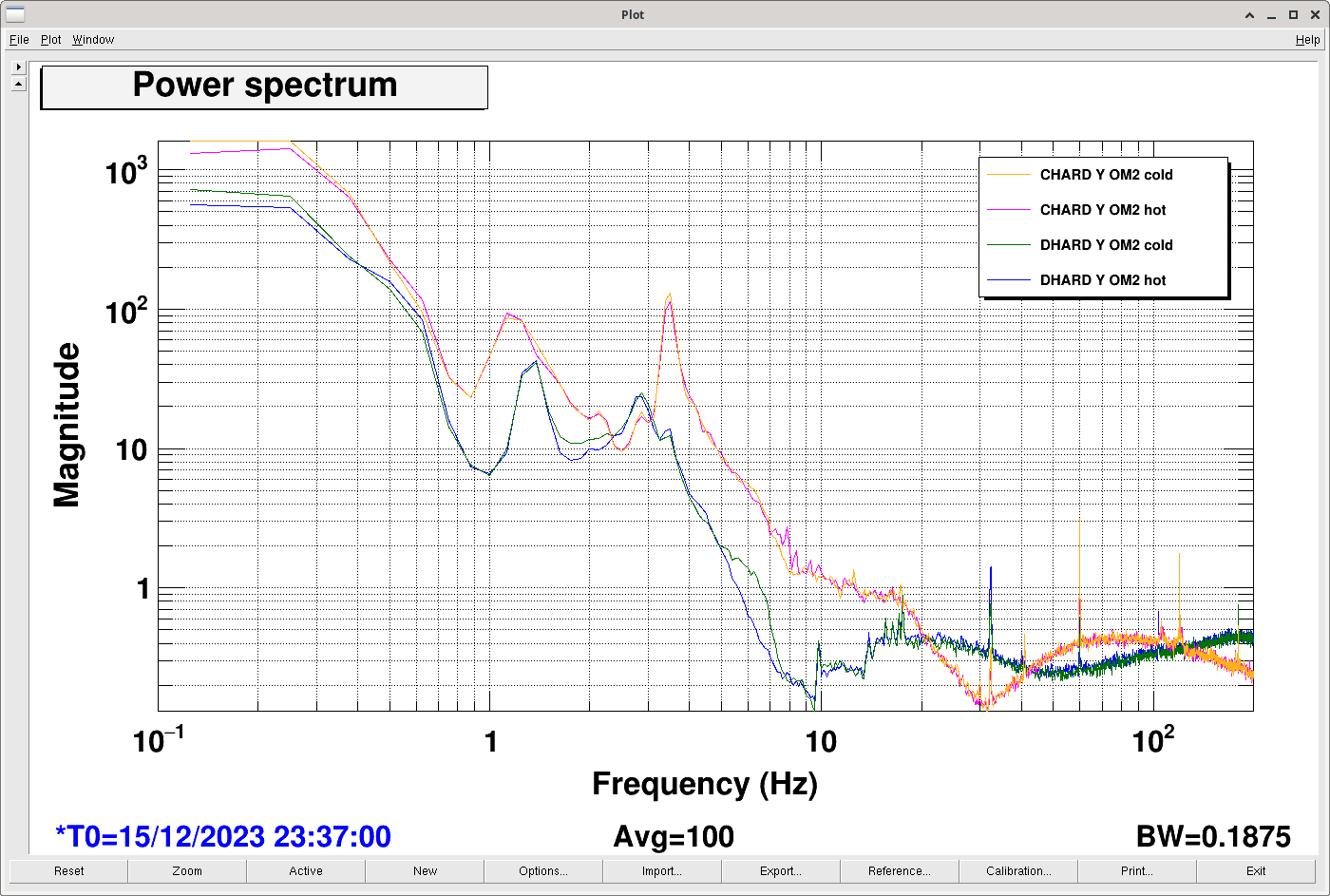
Peter asked if the difference in coherence with the HARD Yaw ASC was due to a change in the coupling or the control signal.
Here is a comparison of the control signals with OM2 hot and cold, they look very similar at the frequencies of the coherence.
Rahul, Camilla, Jonathan, Erik, Dave:
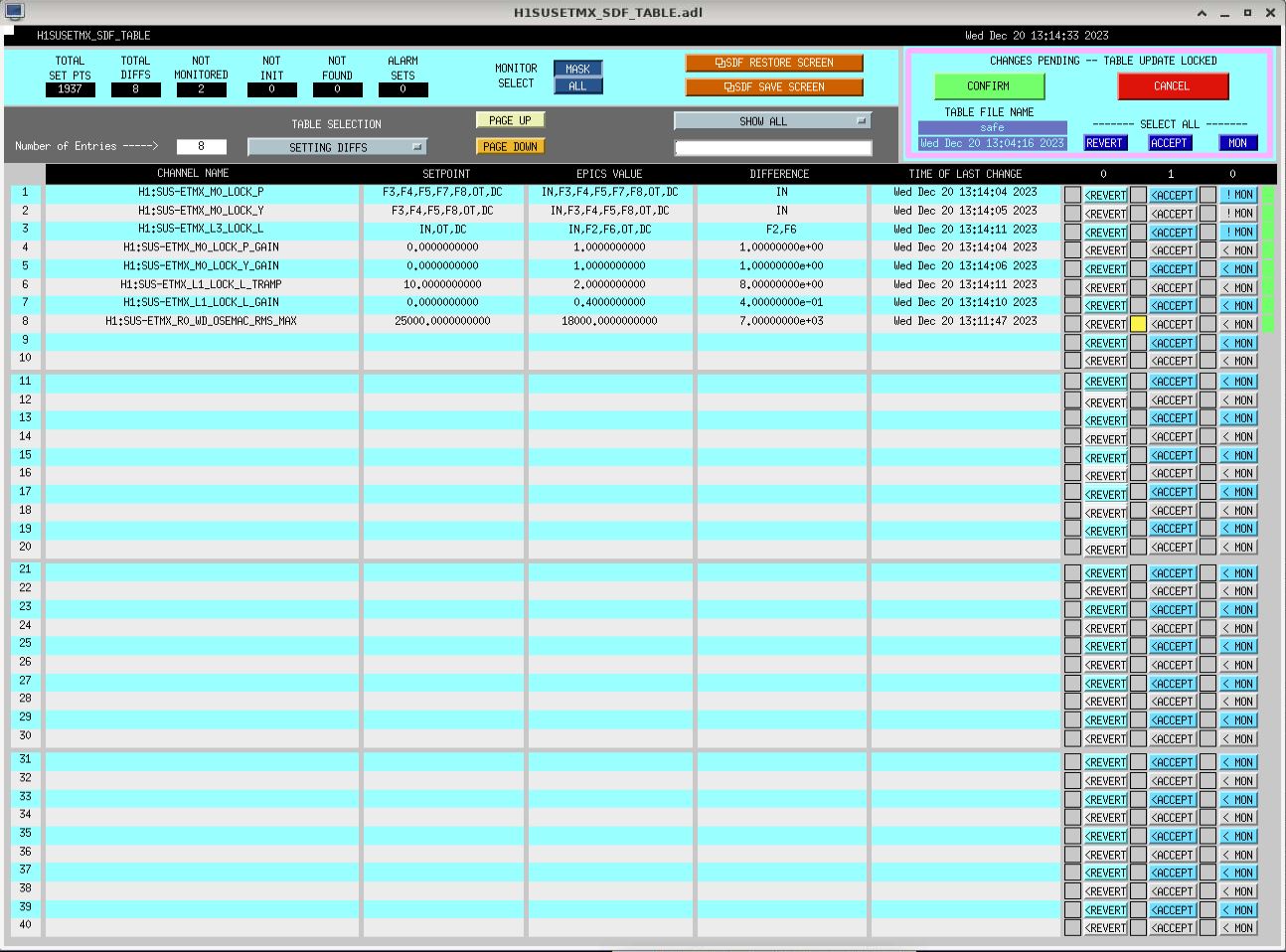
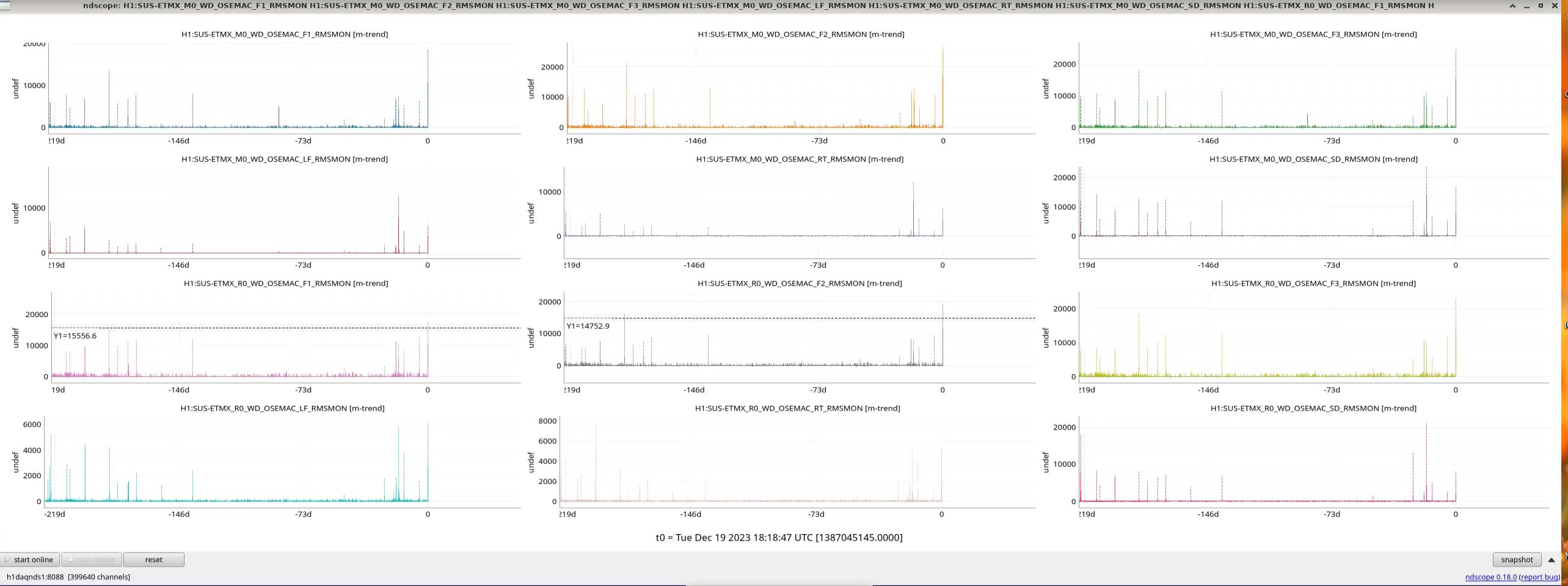
At 07:33 PST during a measurement this morning the ETMX test mass was set into motion which exceeded the user-model, SWWD and HWWD RMS trigger levels. This was very similar to the 02 Dec 2023 event which eventually led to the tripping of the ETMX HWWD.
The 02 Dec event details can be found in T2300428
Following that event, it was decided to reduce the time the SUS SWWD takes to issue a local SUS DACKILL from 20 minutes to 15 minutes. It was this change which prevented the ETMX HWWD from tripping today.
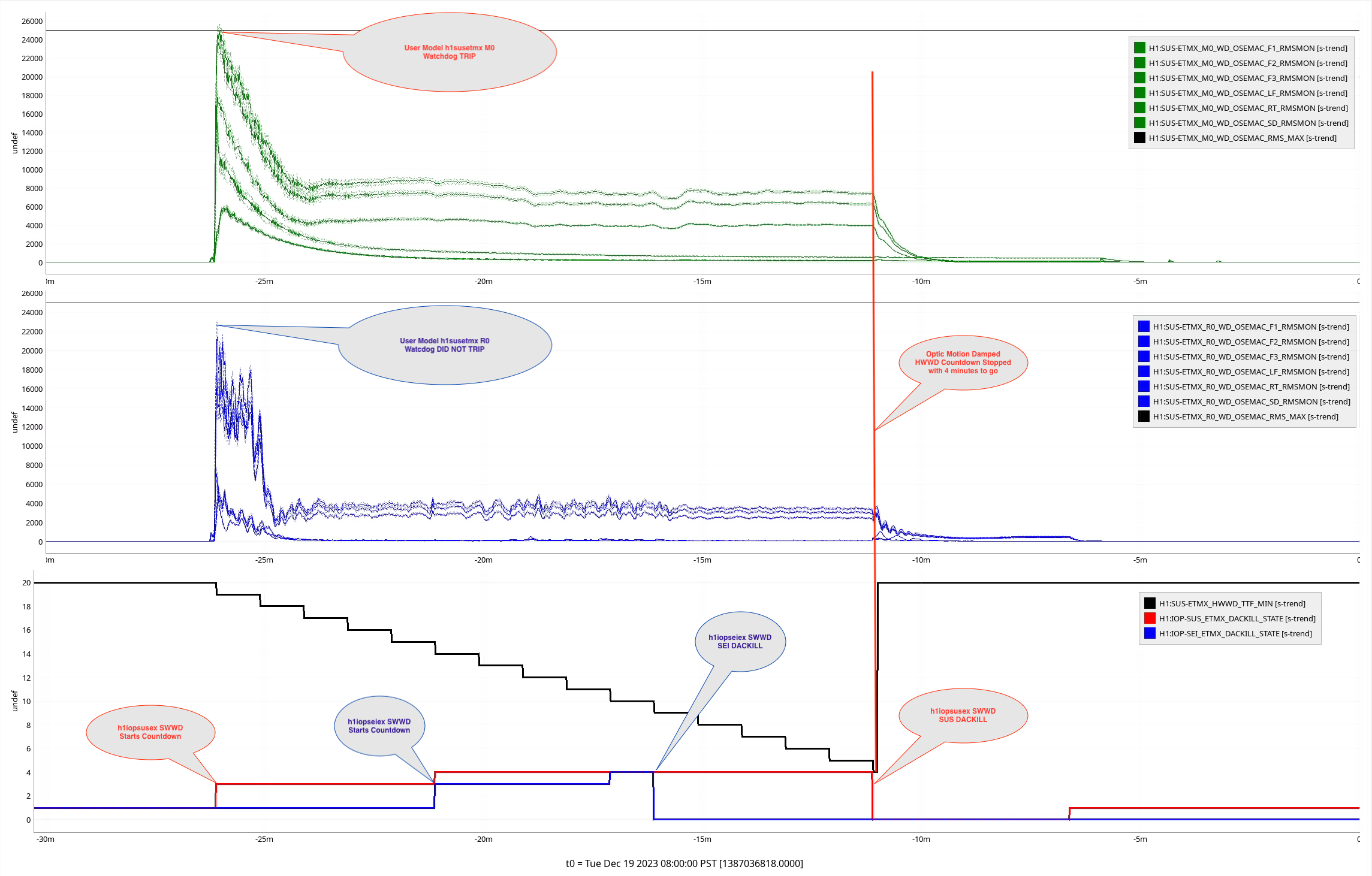
The attached time plot shows the details of today's watchdog events.
The top plot (green) is h1susetmx user-model's M0 watchdog input RMS channels, and the trigger level (black) of 25000
The second plot (blue) is h1susetmx user-model's R0 watchdog input RMS channels, and the trigger level (black) of 25000
The lower plot shows the HWWD countdown minutes (black), the SUS SWWD state (red) and the SEI SWWD state (blue)
The timeline is:
07:33 ETMX is rang up, M0 watchdog exceeds its trigger level and trips, R0 watchdog almost reaches its trigger level, but does not trip.
At this point we have a driven R0 and undriven M0, which was also the case on 02 Dec which keeps ETMX rung up above the SWWD and HWWD trigger levels
The HWWD starts its 20 minute countdown
The SWWD starts its 5/15 minute countdown
+5min: SEI SWWD starts its 5 minute countdown
+10min: SEI SWWD issues DACKILL, no change to motion
+15min: SUS SWWD issues DACKILL, R0 drive is removed which resolves the motion
HWWD stops its count down with almost 5 minutes to spare.
We have opened a workpermit to reduce the sus quad models' RO trigger level to hopefully always have M0 and R0 trip together which will prevent this is the short term. Longer term solution requires a model change to alter the DACKILL logic.
During this timeline I also cleared filter history on L2_LOCK_L (very high counts before clearing) and M0_DAMP_L (no difference after clearing) details in 74889.
The channels used for the calibration measurement injections are listed in LHO:74919.
Dave, Rahul
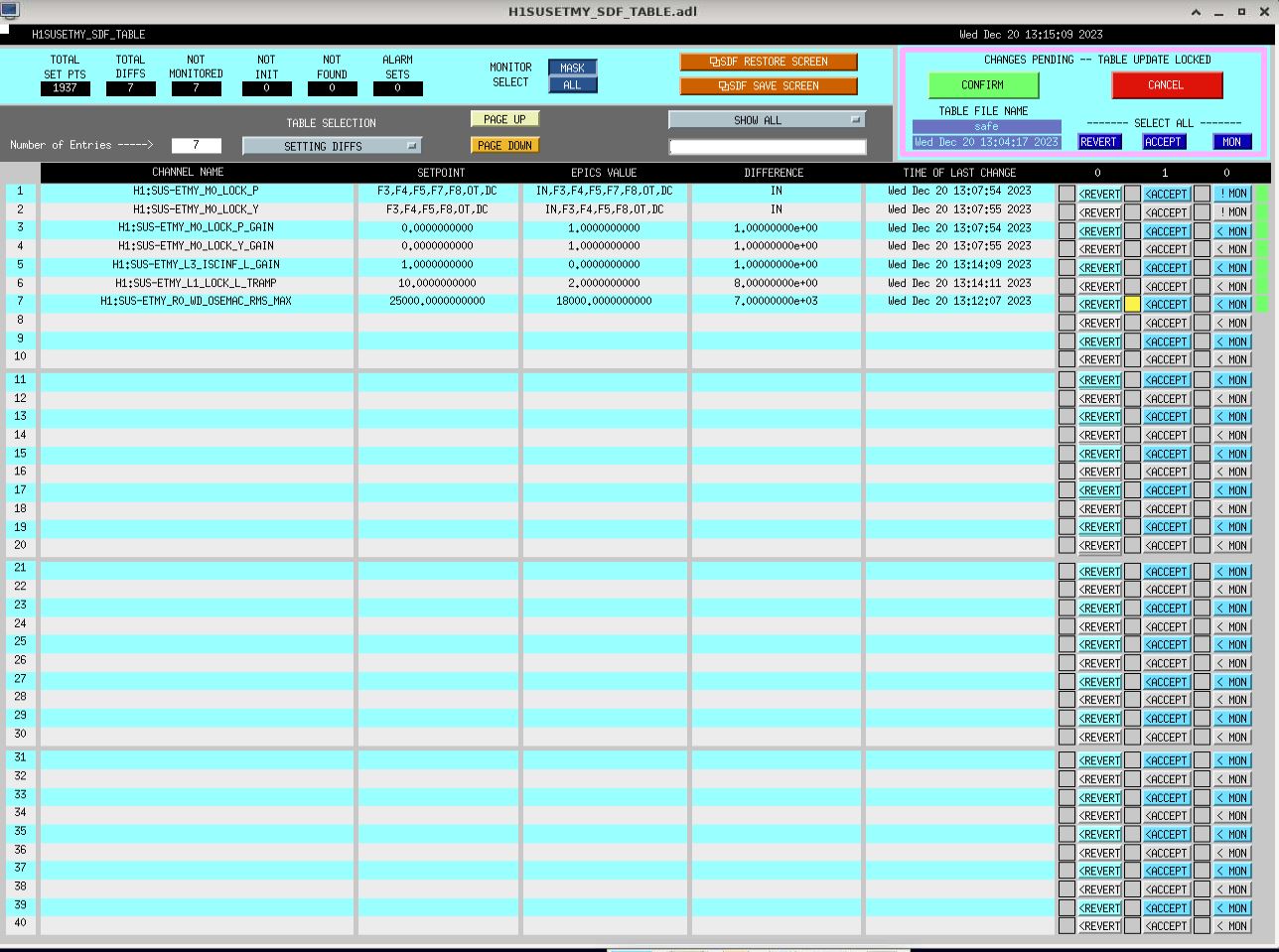
We lost lock this afternoon and I took this opportunity to quickly implement the R0 watchdog changes. The new thresholds are given below,
ITMX R0 chain WD rms threshold - 20k counts
ITMY R0 chain WD rms threshold - 20k counts
ETMX R0 chain WD rms threshold - 18k counts
ETMY R0 chain WD rms threshold - 18k counts
I have accepted the above changes in the SDF and posted the screenshot below.
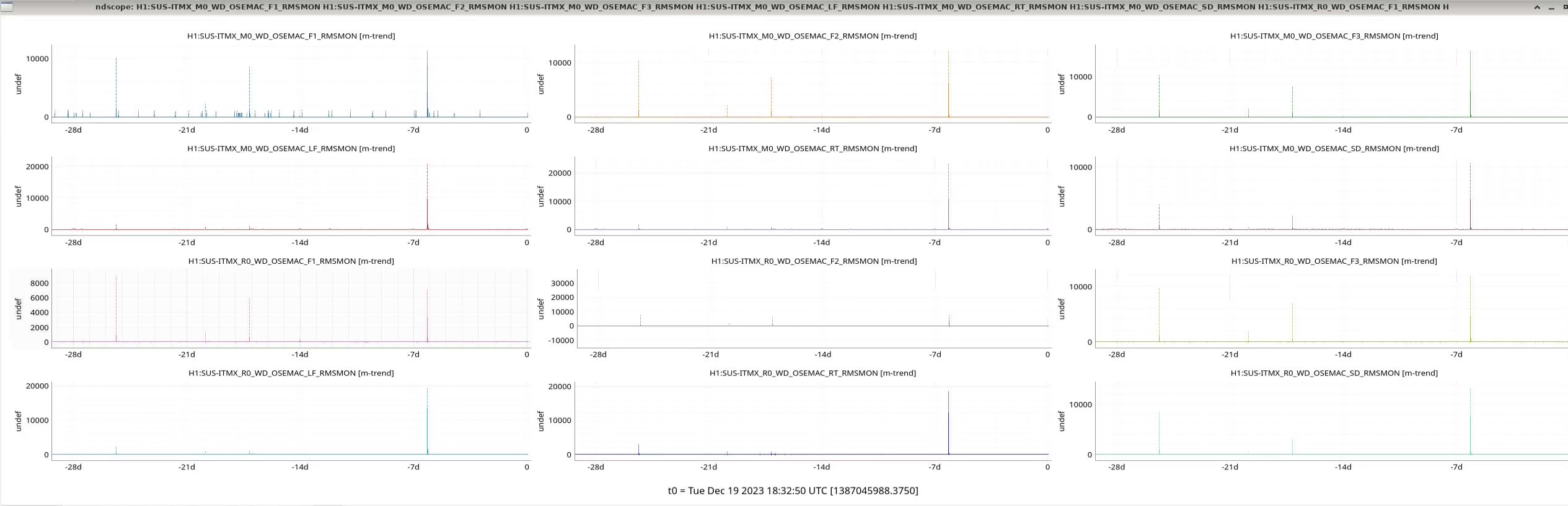
The threshold limit for ETMs is lower than that of ITMs based on the ndscope trends for the last 30days. The safety limit for ITMs seems to be around 20k and for ETMs 18k.
A more long term safety fix will be implemented in January 2024 by making some model changes.
WP 11587 Closed.
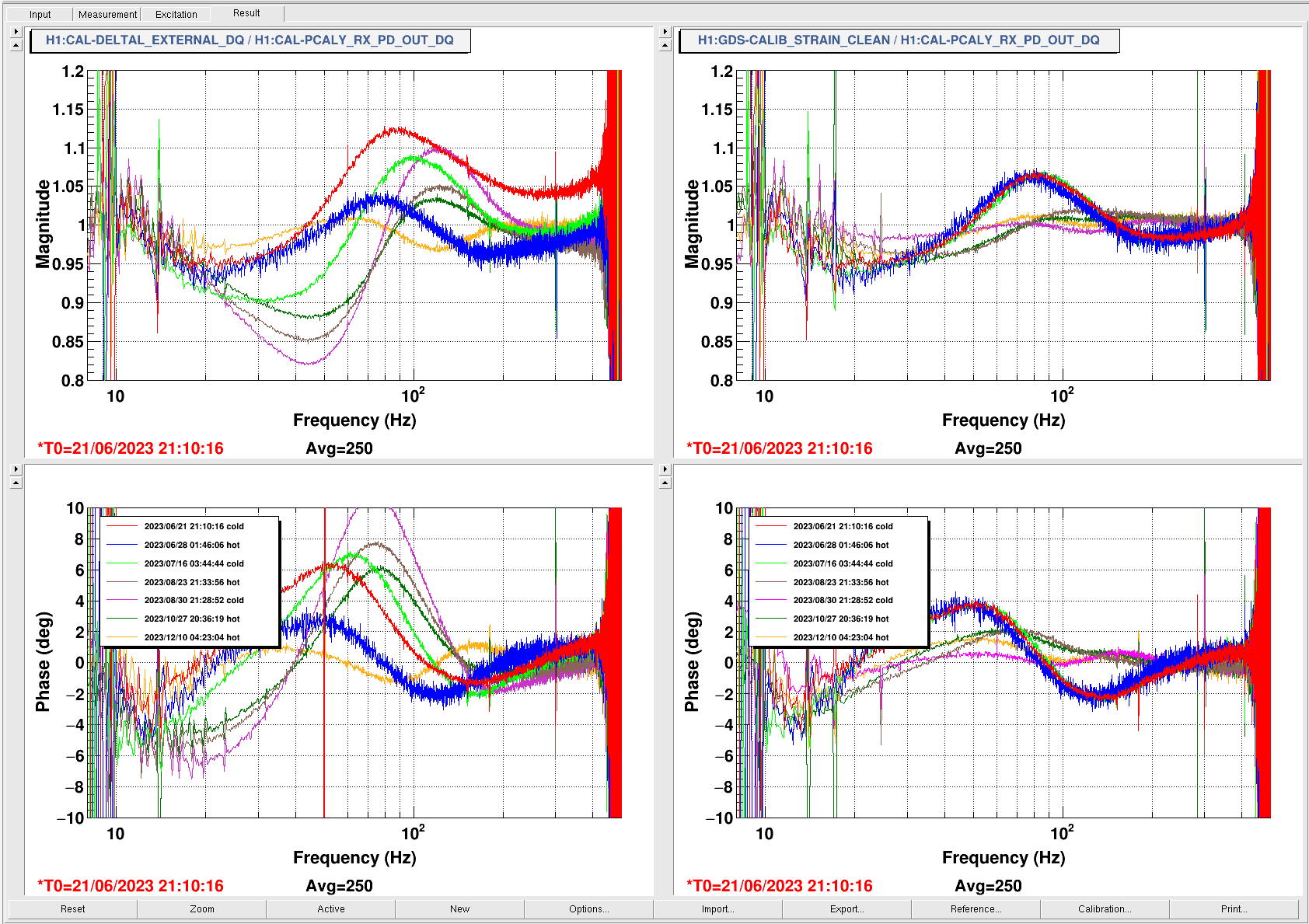
Here's a comparison of Pcal to DeltaL External and GDS Calib Strain broadband measurements with OM2 hot and cold.
File path to DTT template: /ligo/home/dana.jones/Documents/OM2_heating/OM2_hot_v_cold.xml
Dana, Louis
These broadband measurements were taken as part of the regular calibration sweeps when H1 was fully thermalized. To get the measurements, I used this command (for a sample report ID):
pydarm ls -r 20230802T000812Z | grep PCALY2DARM_BB | grep pcal
which returned:
>> pcal: /ligo/groups/cal/H1/reports/20230802T000812Z/PCALY2DARM_BB_20230727T161527Z.xml
Then to get the exact start time of the injection I used:
grep TestTime /ligo/groups/cal/H1/reports/20230802T000812Z/PCALY2DARM_BB_20230727T161527Z.xml
See this link for a list of calibration measurements. To calibrate the Delta L External and Pcal measurements I used the following files found in /ligo/home/dana.jones/Documents/OM2_heating/:
deltal_external_calib_dtt_20230621T211522Z.txt
deltal_external_calib_dtt_20230628T015112Z.txt
deltal_external_calib_dtt_20230716T034950Z.txt
deltal_external_calib_dtt_20230823T213958Z.txt
deltal_external_calib_dtt_20230830T213653Z.txt
deltal_external_calib_dtt_20231027T203619Z.txt
pcal_calib_dtt_20230621T211522Z.txt
pcal_calib_dtt_20230628T015112Z.txt
pcal_calib_dtt_20230716T034950Z.txt
pcal_calib_dtt_20230823T213958Z.txt
pcal_calib_dtt_20230830T213653Z.txt
pcal_calib_dtt_20231027T203619Z.txt
These files were generated using the following two commands (again, for a sample report ID):
pydarm export -r 20230802T000812Z --deltal_external_calib_dtt
and
pydarm export -r 20230802T000812Z --pcal_calib_dtt.
Note: For the most recent curve (23/12/10), I applied the 23/10/27 calibration TF as this was the latest valid one available.
In addition, for GDS_CALIB_STRAIN I applied a gain of 3995 in the Poles/zeros tab to convert to meters (see .xml file).
User note for calibration tab in DTT: Make sure when applying different calibration transfer functions to each curve that you set the start time appropriately—you can’t just use the same time for all of them or the system won’t know which one to choose. For each measurement, set the corresponding calibration start time to, say, 1 day before.
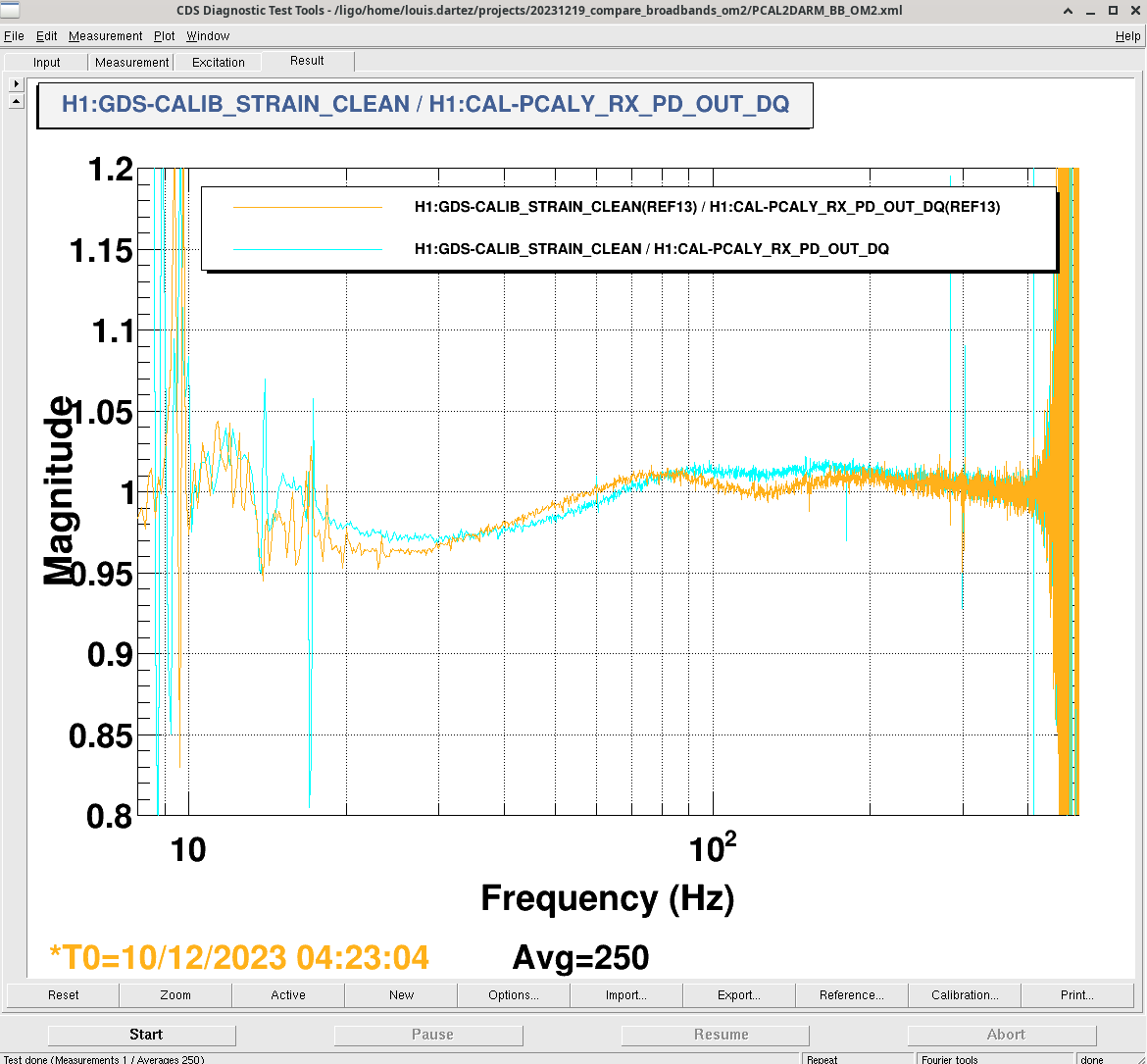
Here's a PCALY-to-GDS_CALIB_STRAIN broadband comparison with the OM2 in the hot state (gold trace, 2023-12-10) and in the cold state (cyan trace, 2023-12-18), see bb_hot_cold_om2.png. Both measurements were taken while the IFO was thermalized. Pcal corrections have been applied to PCALY_RX_PD_OUT. The two traces don't line up exactly but their differences are down to the percent level. Sheila is pulling up GDS_CALIB_STRAIN spectra from before and after the OM2 cooling for comparison purposes. This plot suggests that she will be able to overlay the two and compare them as long as we're not interested in making any determinations close to ~few percent level.