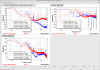
TITLE: 12/16 Eve Shift: 00:00-08:00 UTC (16:00-00:00 PST), all times posted in UTC
STATE of H1: Observing at 160Mpc
INCOMING OPERATOR: Ryan C
SHIFT SUMMARY:
- Went out of commissioning for no sqz time while LLO was down
- EX saturation @ 3:58
- 6:27 - inc 5.4 EQ from Fiji
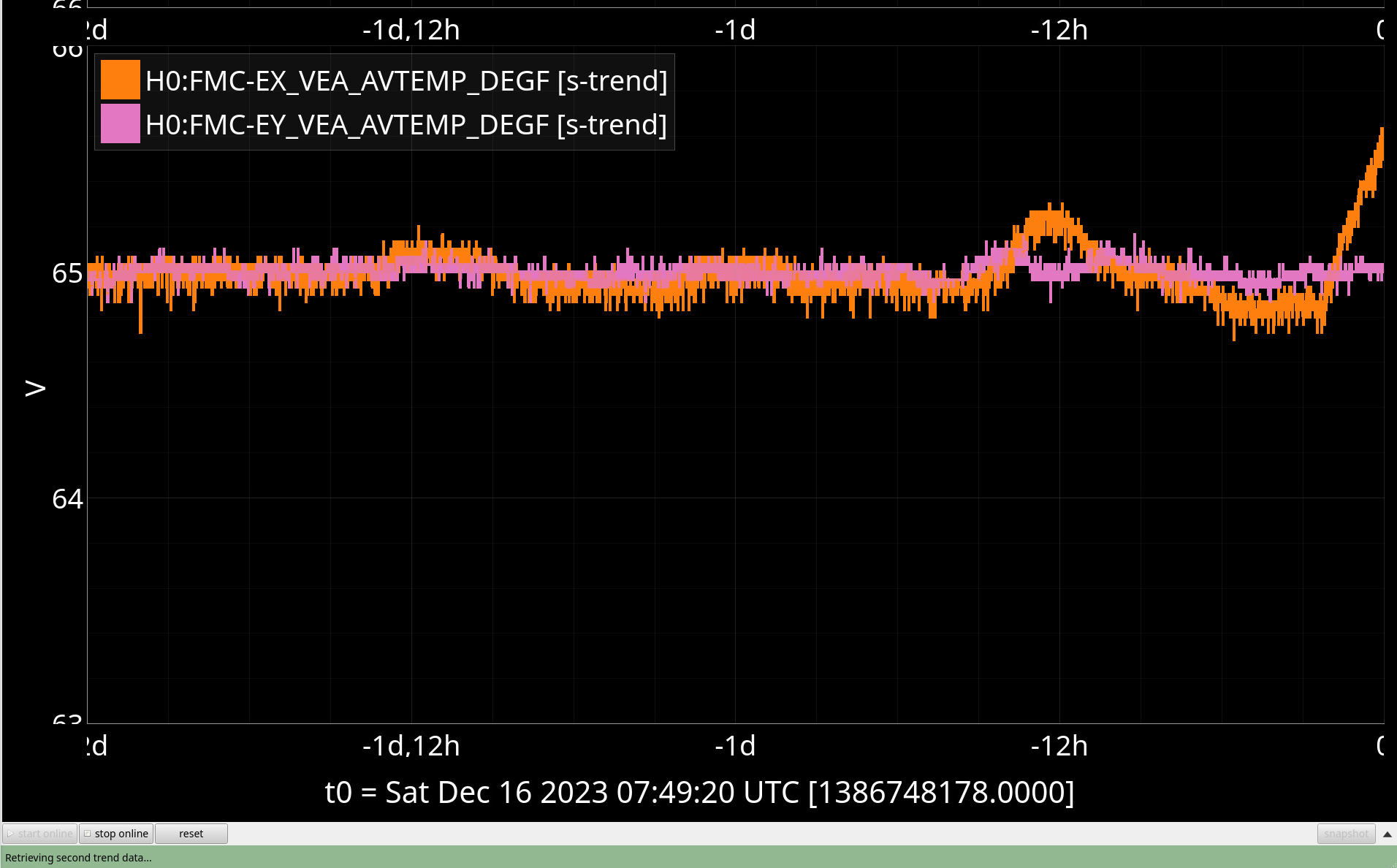
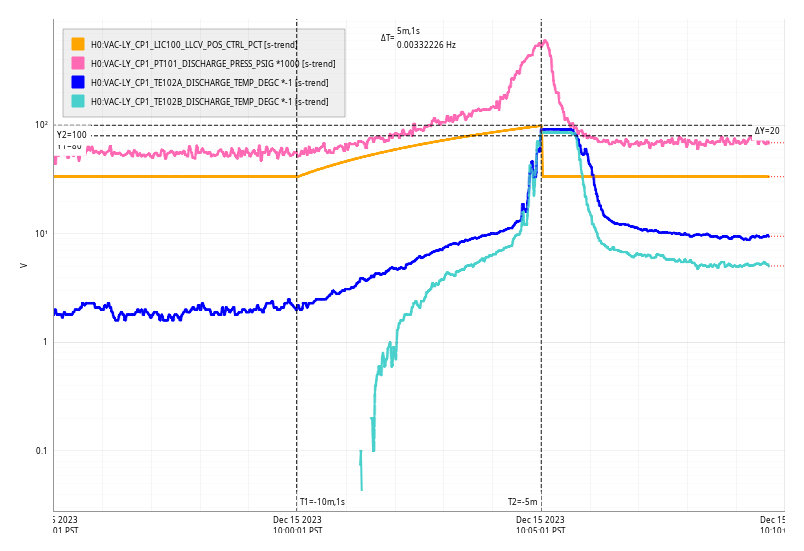
- Looks like the EX VEA temperature has started to rise over the past couple hours (currently ~0.5 degrees higher than nominal). Hopefully just a temp fluctuation, but Tagging FMCS just to cover all bases - scope attached
- Quiet night otherwise, H1 currently holding a 24 hour lock
LOG:
No log for this shift.
H1 still locked, going on 20 hours. Nothing of note, all systems appear stable.
Late entry, work done last tuesday. The corner station, filter cavity end station and the X-End station purge air systems were operated and tested, this work was done in preparation for the upcoming vents.
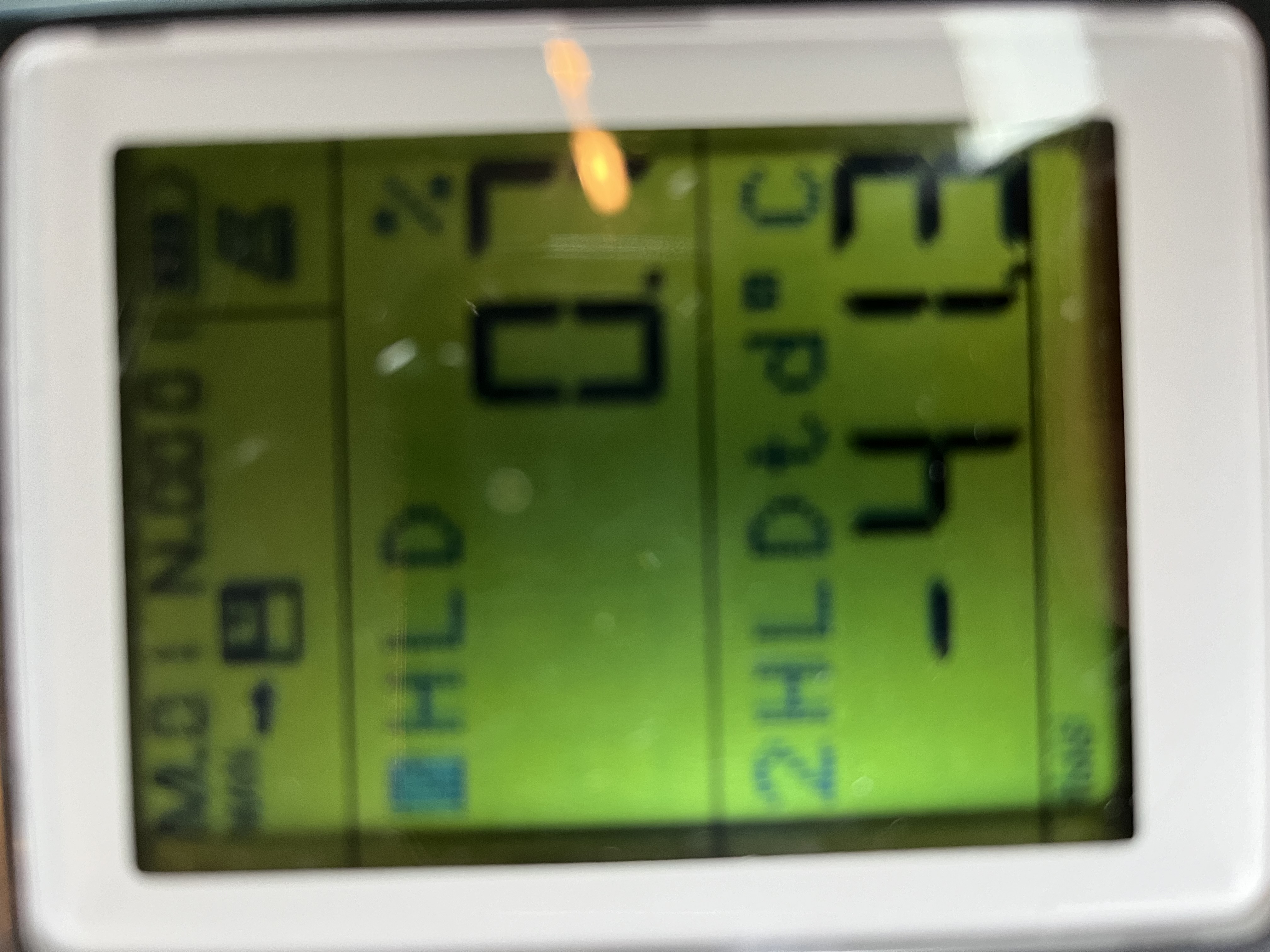
The corner station system was turned on and ran for 3 hours, then the dry air was sampled, the output at the drying towers produced a dew point of -41.3 deg C, a good reading. No other issues were noted with the compressor or the drying towers. The compressor (Kobelco) unit is to have a yearly maintenance done in the next couple of weeks.
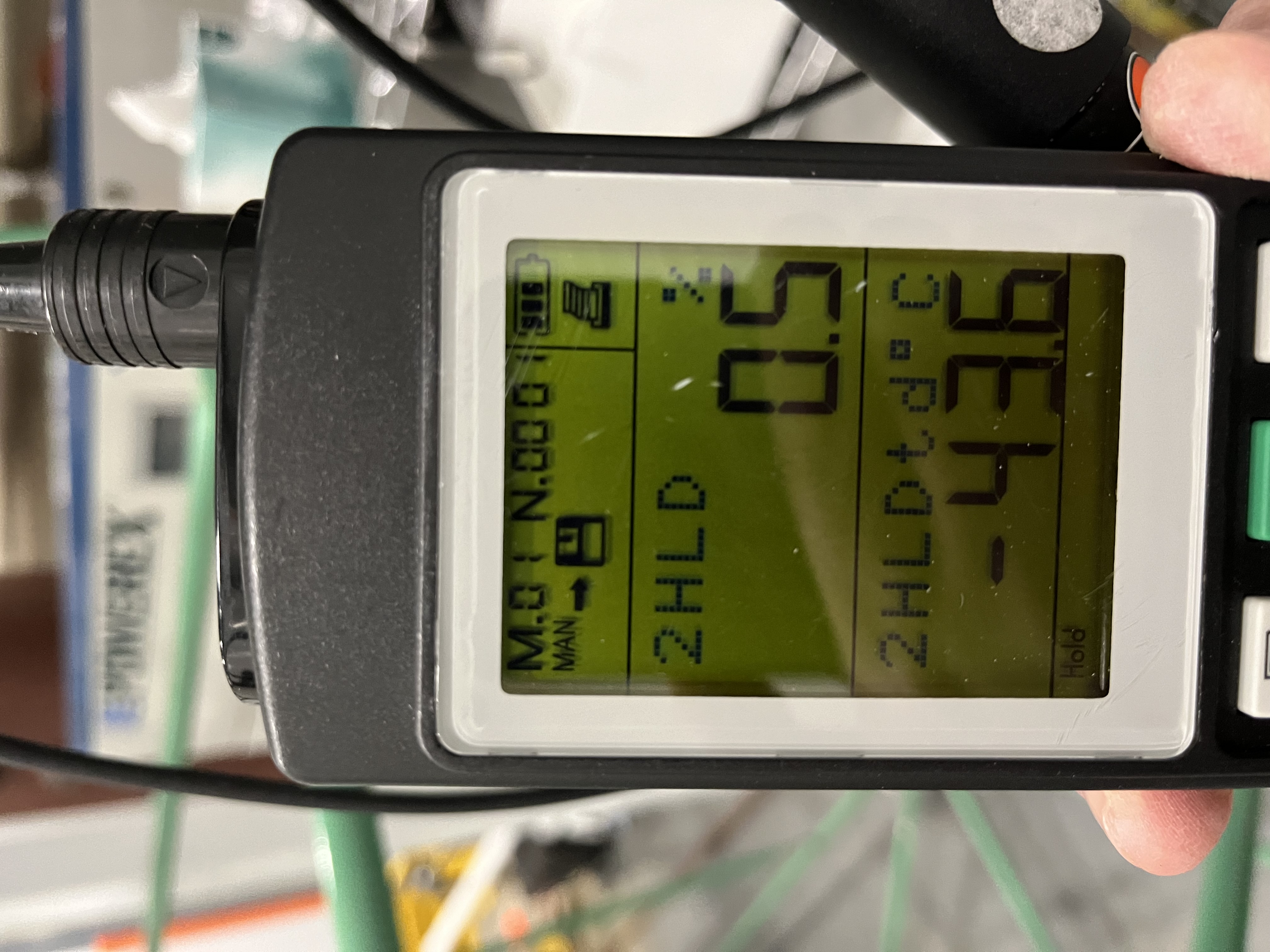
The filter cavity end station system also ran for 3 hours, the dry air was tested, this system produced a dew point of -43.6 deg C. No real issues with the system were encountered, compressor and drying towers. However, the system requires power to run the drying tower, one automatic drain for the receiver tank, and a second automatic drain for the compressor all 115 AC power, we have an outlet with 4 dedicated plugs for such process, however the day of the test, 3 out of the 4 outlets were being used by other non vacuum systems.
The test at the X-End was terminated when the aftercooler fan failed to start, after 3 different tries. The system was powered off and troubleshooted with help from Filiberto, the fan motor was dead. A new fan motor for the aftercooler was ordered. FRS ticket opened, see 29978.
X-End issue resolved, see here 74989.
We took NO SQZ time with hot OM2 for 30 minutes as follows.
Start
UTC: 2023-12-15 23:37:36 UTC
GPS: 1386718674
End
UTC: 2023-12-16 00:08:09 UTC
GPS: 1386720507
TITLE: 12/16 Day Shift: 16:00-00:00 UTC (08:00-16:00 PST), all times posted in UTC
STATE of H1: Observing at 162Mpc
INCOMING OPERATOR: Austin
SHIFT SUMMARY: Currently Observing and have been Locked for 16.5 hours. Quiet day with just the No Squeezing data time between 23:37 and 00:09.
LOG:
23:37 Purposefully dropped Observing and went into Commissioning for some opportunistic 30 minutes of NO_SQUEEZING time since LLO lost lock.
00:09 Back to Frequency Dependant Squeezing and Observing
| Start Time | System | Name | Location | Lazer_Haz | Task | Time End |
|---|---|---|---|---|---|---|
| 22:05 | EE | Camilla | Optics Lab | Local | Checking | 23:05 |
| 22:46 | Nutsinee | Optics Lab | Local | Unpacking PMC | 23:46 | |
| 19:43 | EE | Ali, Camilla | Optics Lab | Local | iLIGO RF readout tests | 21:11 |
| 18:12 | Nutsinee | Optics Lab | Local | Tests | 19:12 | |
| 16:14 | FAC | Karen | Optics Lab | N | Technical Cleaning | 16:31 |
TITLE: 12/16 Eve Shift: 00:00-08:00 UTC (16:00-00:00 PST), all times posted in UTC
STATE of H1: Commissioning
OUTGOING OPERATOR: Ibrahim
CURRENT ENVIRONMENT:
SEI_ENV state: CALM
Wind: 9mph Gusts, 5mph 5min avg
Primary useism: 0.03 μm/s
Secondary useism: 0.23 μm/s
QUICK SUMMARY:
- H1 is in commissioning, no sqz test while LLO is down
- SEI ok
- CDS/DMs good
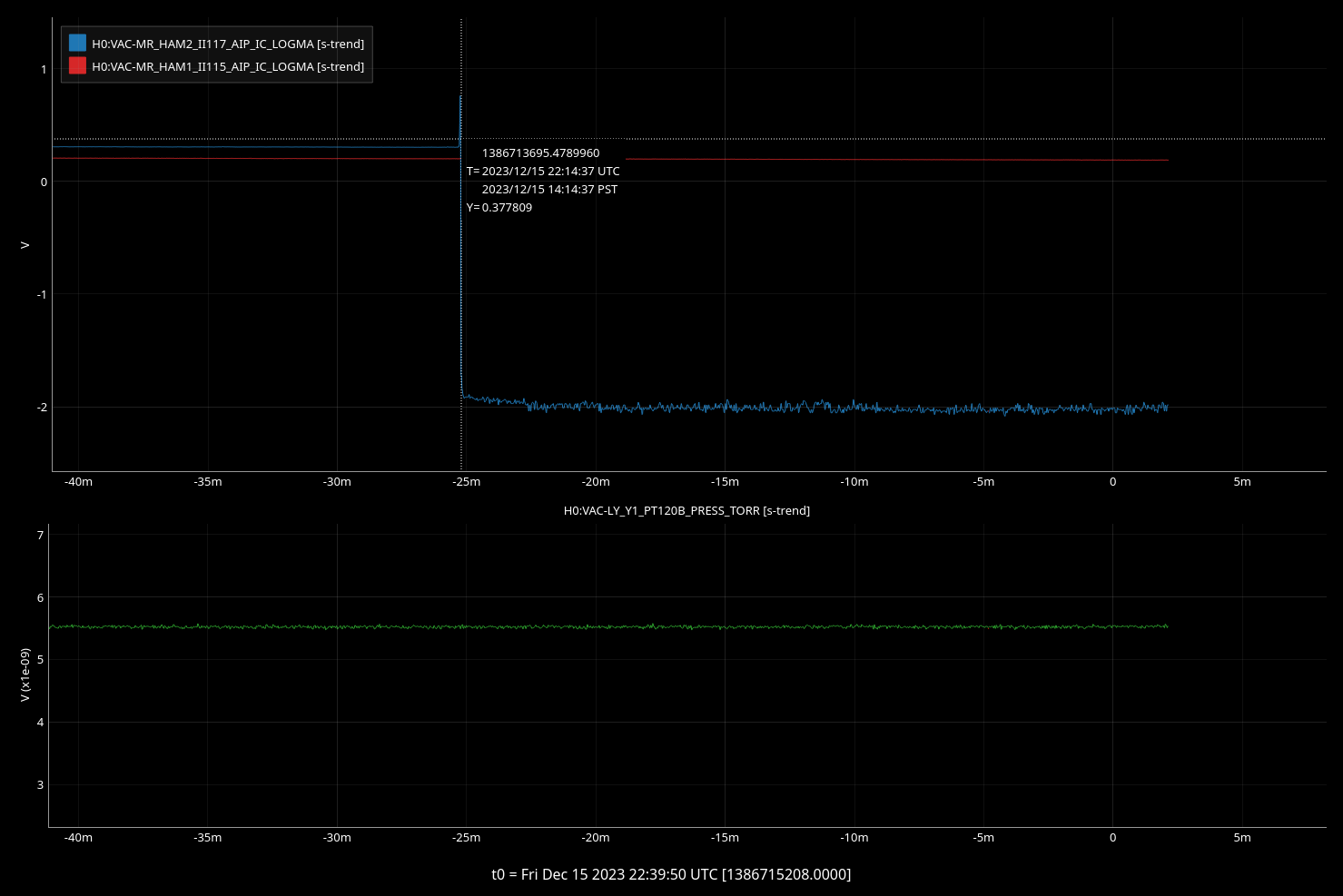
At ~2:13pm PST the annulus ion pump on HAM2 reported red on the overview MEDM screen.
The main volume pressure remains unchanged. We will continue to monitor and investigate the issue at the next Tuesday maintenance.
IFO is still in NLN and OBSERVING (12.5 hr lock).
Nothing else of note.
Fri Dec 15 10:05:01 2023 INFO: Fill completed in 4min 58secs
TITLE: 12/15 Day Shift: 16:00-00:00 UTC (08:00-16:00 PST), all times posted in UTC
STATE of H1: Observing at 162Mpc
OUTGOING OPERATOR: Ryan C
CURRENT ENVIRONMENT:
SEI_ENV state: CALM
Wind: 6mph Gusts, 5mph 5min avg
Primary useism: 0.02 μm/s
Secondary useism: 0.21 μm/s
QUICK SUMMARY:
IFO is in NLN and OBSERVING (8 hr 30 min lock)
TITLE: 12/15 Eve Shift: 00:00-08:00 UTC (16:00-00:00 PST), all times posted in UTC
STATE of H1: Observing at 154Mpc
INCOMING OPERATOR: Ryan C
SHIFT SUMMARY:
6:04 UTC Unknown Lockloss see alog https://alog.ligo-wa.caltech.edu/aLOG/index.php?callRep=74824
Initial alignment started after 3 locklosses before DRMI_1F>
Initial Alignment completed without issue.
OBSERVING reached at 7:42 UTC
LOG:
no log
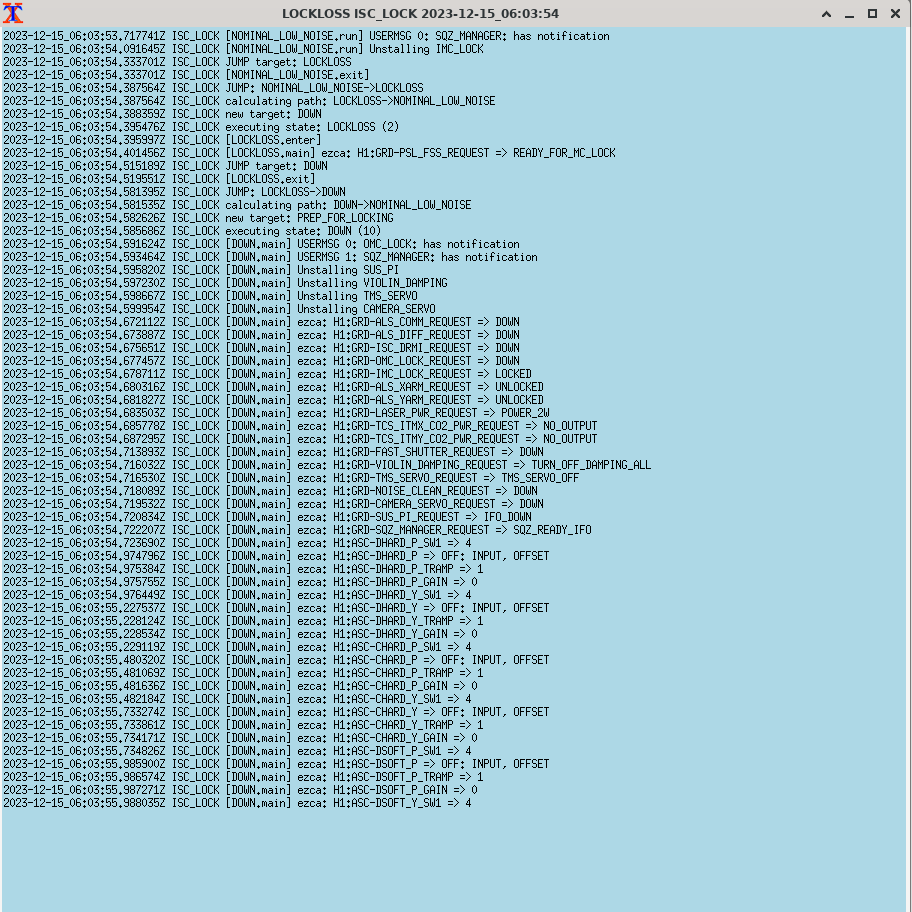
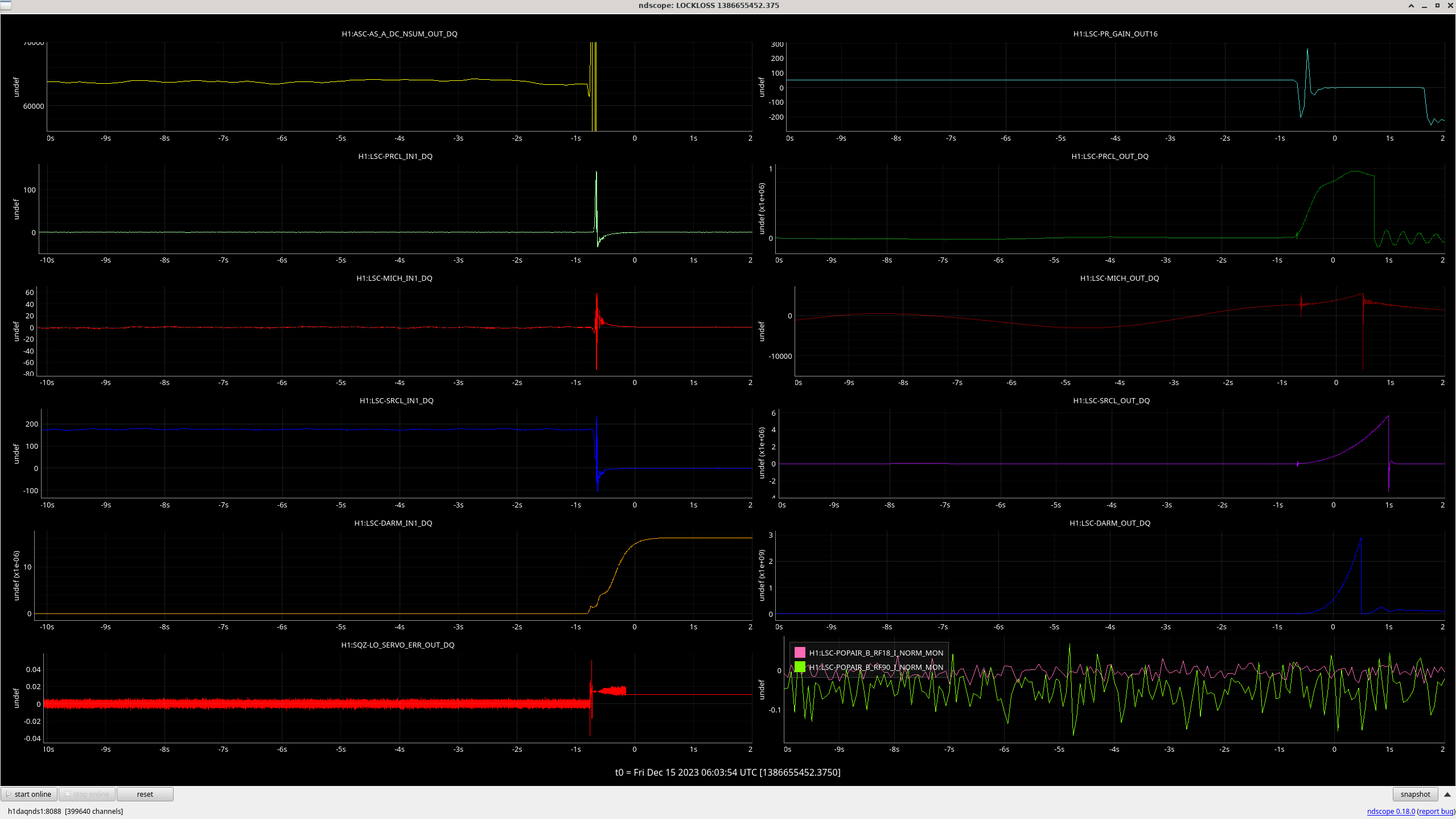
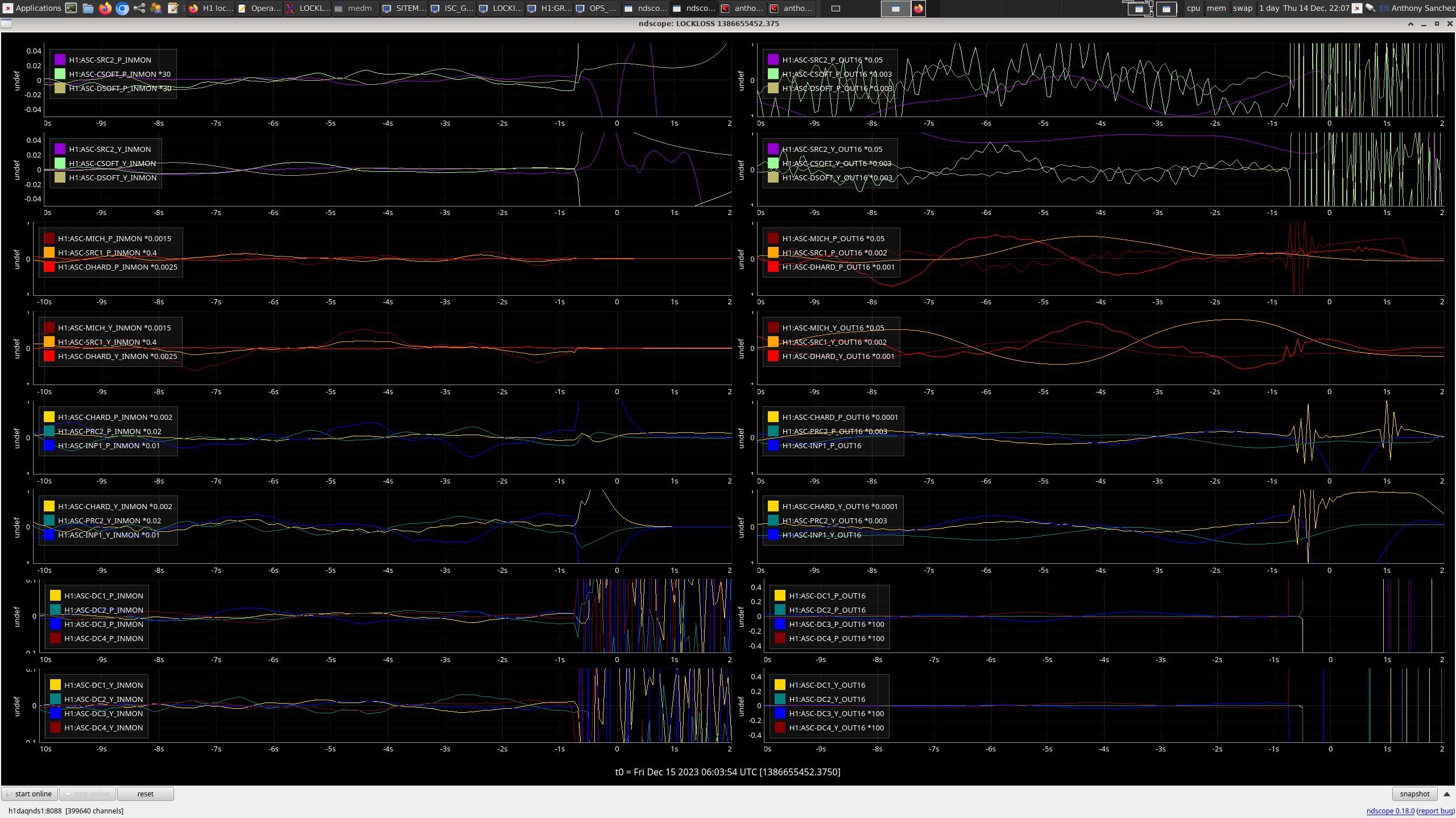
Lockloss for an unknown reason.
https://ldas-jobs.ligo-wa.caltech.edu/~lockloss/index.cgi?event=1386655452
The Wind and groud motion seem to be ok. there wasn't a PI node that was ringing up. But the scope seem to fit the description of this lockloss from yesterday.
STATE of H1: Observing at 159Mpc
OUTGOING OPERATOR: Ibrahim
CURRENT ENVIRONMENT:
SEI_ENV state: CALM
Wind: 5mph Gusts, 4mph 5min avg
Primary useism: 0.03 μm/s
Secondary useism: 0.22 μm/s
QUICK SUMMARY:
Everything seems to be running smoothly, Everything is very quiet.
Jonathan, Dave:
The file copy completed yesterday. Today we reconfigured nds0 to serve the past 6 months of raw minute trends from its new permanent location. I restarted nds0 daqd at 13:23 PST when H1 was out of lock.
The deletion of the files from tw0's SSD-RAID took from 14:18 to 16:28 (2hr 10min). Final cleanup was to delete the temporary directories under /rawtrends/minute_raw_deleteme on tw0.
TITLE: 12/15 Eve Shift: 00:00-08:00 UTC (16:00-00:00 PST), all times posted in UTC
STATE of H1: Observing at 160Mpc
OUTGOING OPERATOR: Ibrahim
CURRENT ENVIRONMENT:
SEI_ENV state: CALM
Wind: 2mph Gusts, 1mph 5min avg
Primary useism: 0.03 μm/s
Secondary useism: 0.23 μm/s
QUICK SUMMARY:
Currently H1 is Locked in NOMINAL_LOW_NOISE and OBSERVING.
TITLE: 12/14 Day Shift: 16:00-00:00 UTC (08:00-16:00 PST), all times posted in UTC
STATE of H1: Commissioning
INCOMING OPERATOR: Tony
SHIFT SUMMARY:
IFO is in NLN and COMMISSIONING
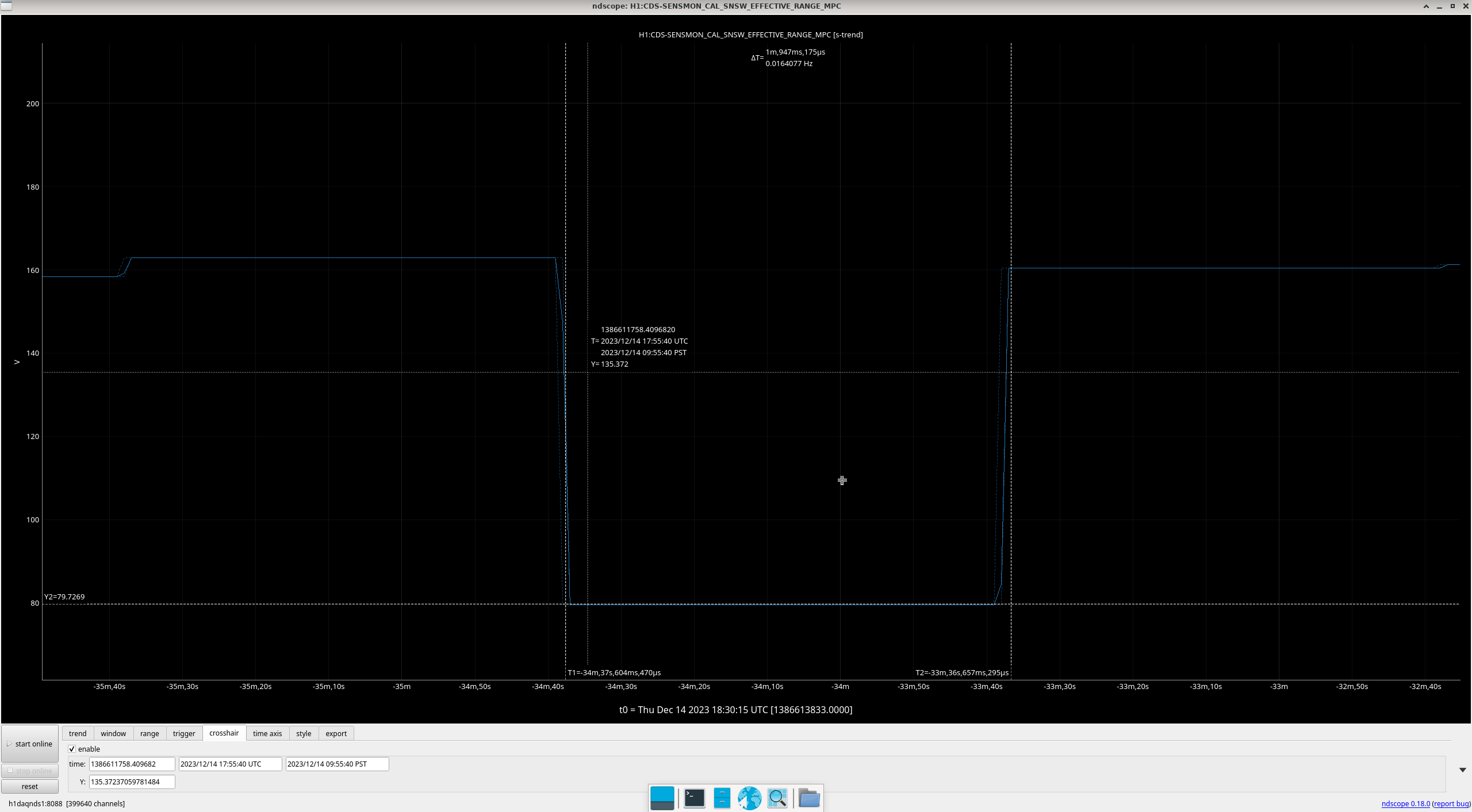
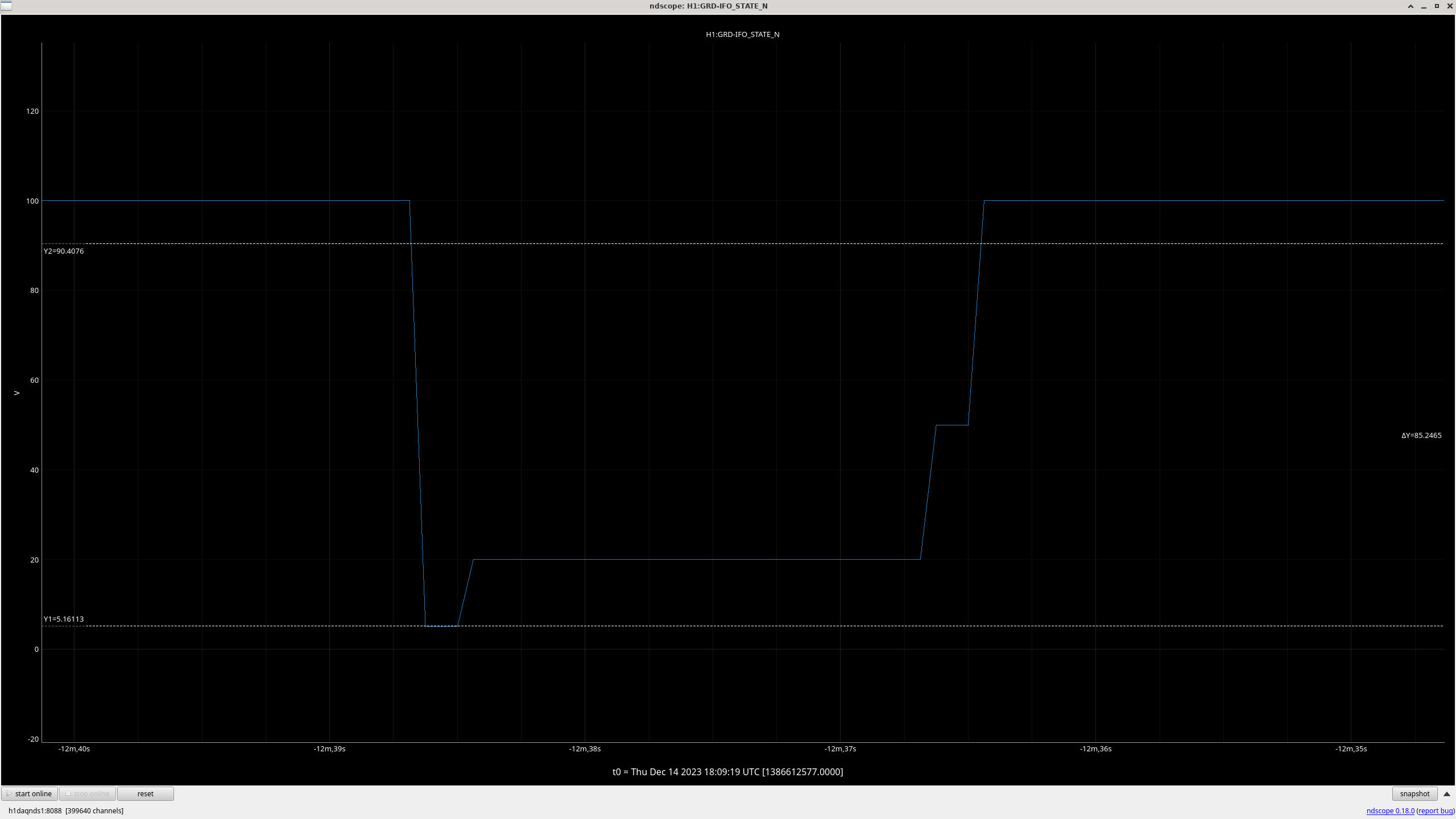
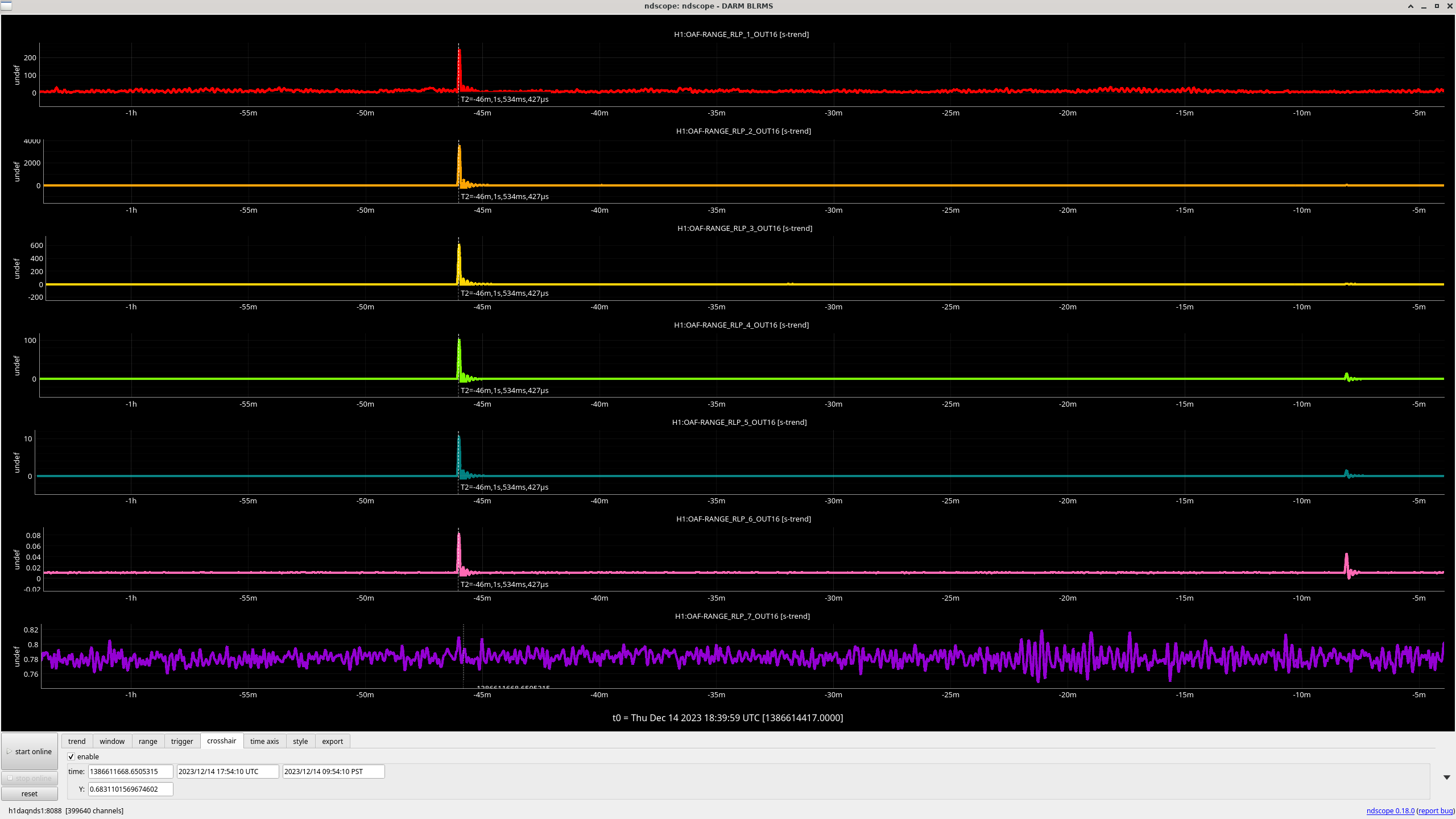
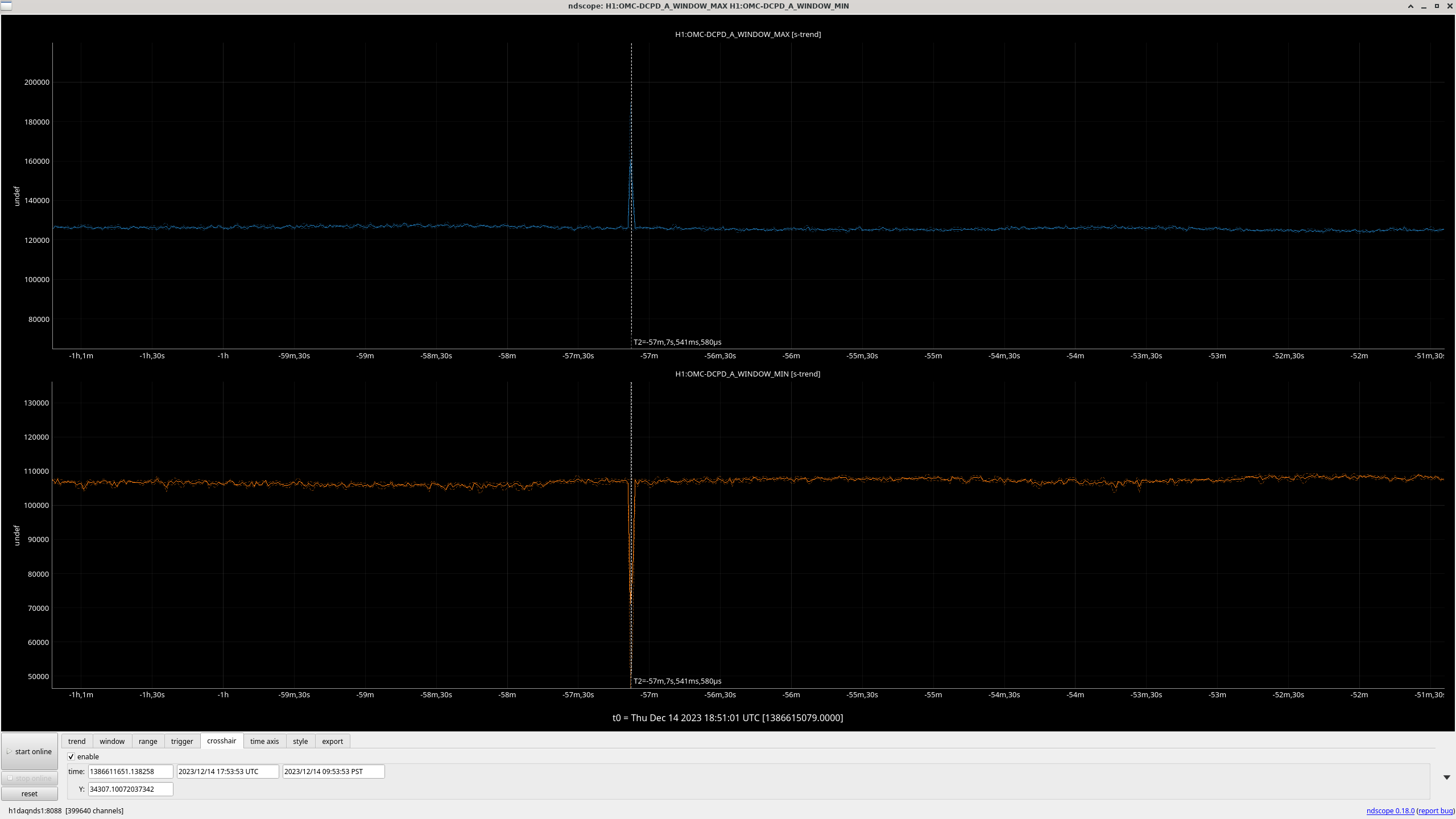
17:56:40: Range Loss Investigation
(4 Screenshots)
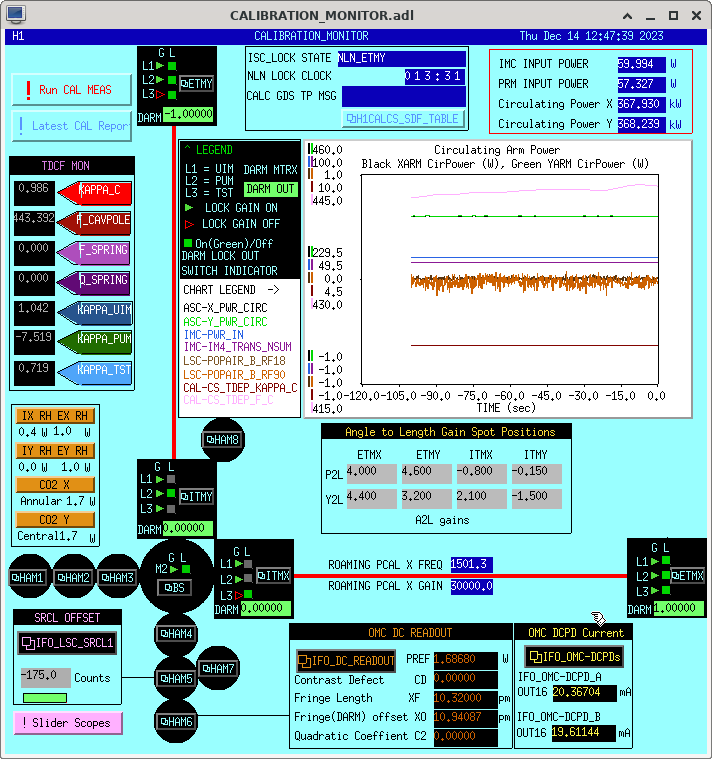
20:45 UTC - Started running calibration measurements (1 screenshot)
20:50 UTC - Broadband calibration measurement started
21:18- UTC - Next calibration (simuLines) started.
21:19 - UTC - lost lock (alog 74814)
21:20 UTC - Relocking
21:27 UTC - Nds0 daqd restarted by Dave right after lockloss - caused all ndscopes to stall and require resetting.
22:37 UTC - Air handler red alarm started blaring. Eric was the last person in there earlier to check on these. I called him and he’s investigating. Trends show that it was off for about 15 minutes. Alarm is back to normal as of 14:50 UTC.
23:08 - Reached NLN - Resumed commissioning.
LOG:
| Start Time | System | Name | Location | Lazer_Haz | Task | Time End |
|---|---|---|---|---|---|---|
| 22:11 | FAC | Eric | CS | N | Check air handlers | 22:21 |
| 19:45 | FAC | Kim | LVEA External Rollup Door | N | Cardboard Haul | 20:45 |
| 19:45 | FAC | Karen | Woodshop | N | Technical Cleaning | 19:55 |
| 18:38 | FAC | Karen | Vac Prep | N | Technical Cleaning | 19:38 |
| 17:41 | FAC | Cindi | Wood shop area | N | Laundry | 18:41 |
| 17:42 | Nutsinee | Optics Lab | Local | Testing | 18:38 | |
| 16:43 | FAC | Karen, Kim, Randy | Garb Storage | N | Assessing inventory | 16:43 |
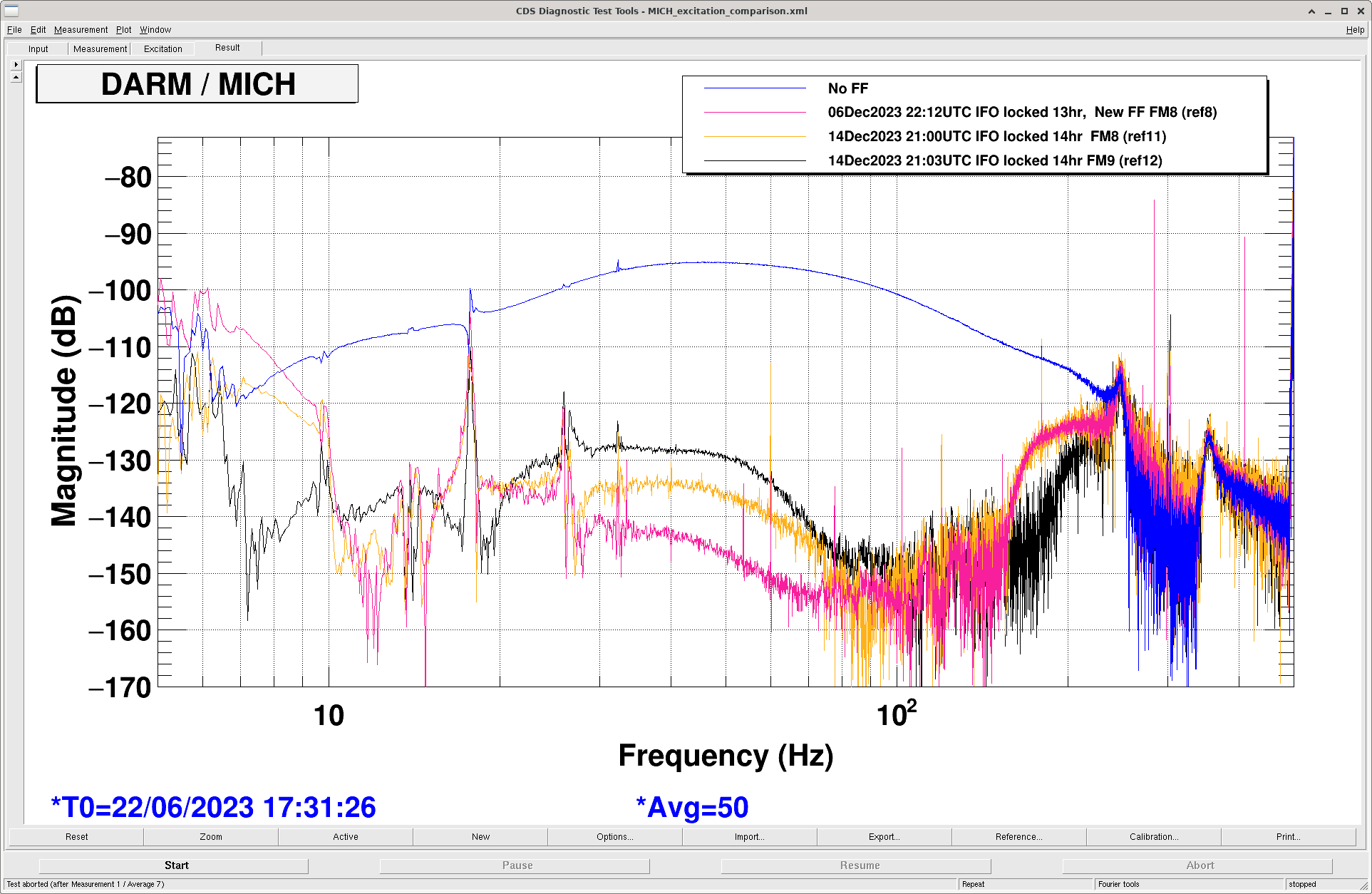
With different iteration than yesterday of DARM offloading configuration, I checked MICH with the current MICHFF FM8 orange and the MICH FF fitted from yesterday's data FM9 black 74791, plot attached. Surprising that in our 20-70Hz band the new FF was worse. Maybe as the data was taken when the IFO was thermalizing yesterday (2h30) rather than today after 14hr in lock.
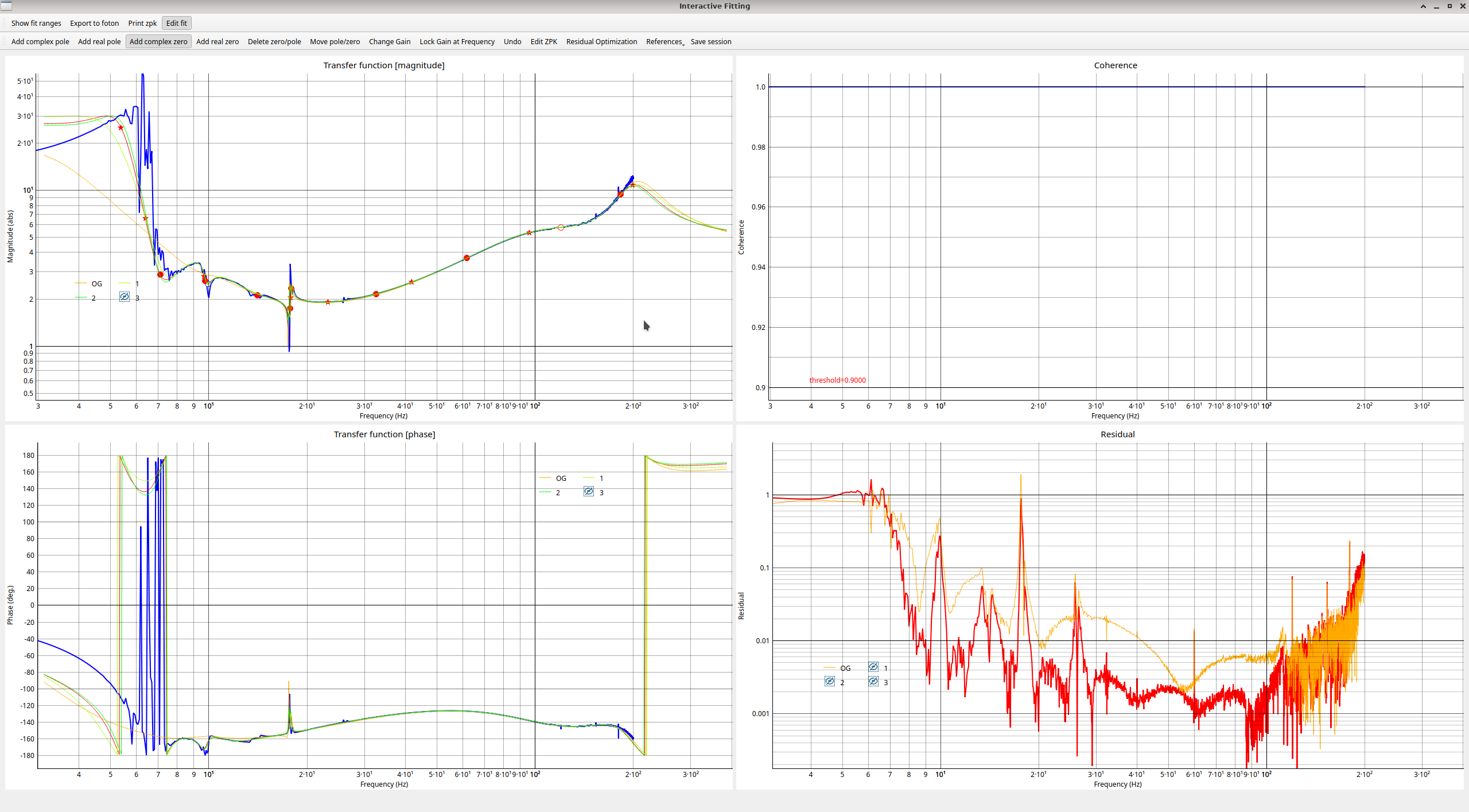
Retook the MICH excitations at ~21:20UTC using FM8 and fit using Gabriele's InteractiveFitting GUI. Results attached. Loaded this fit into FM1 as '12-14-23' ready for when we next use the new DARM filters. Lost lock before we could test the new fit.
21:18- UTC - Calibration Measurement (simuLines) started.
21:19 - UTC - Lost Lock
Potentially (but unlikely) related - Oli also lost lock during Simulines during their shift - alog 74716
Relocking Now as of 21:20 UTC.
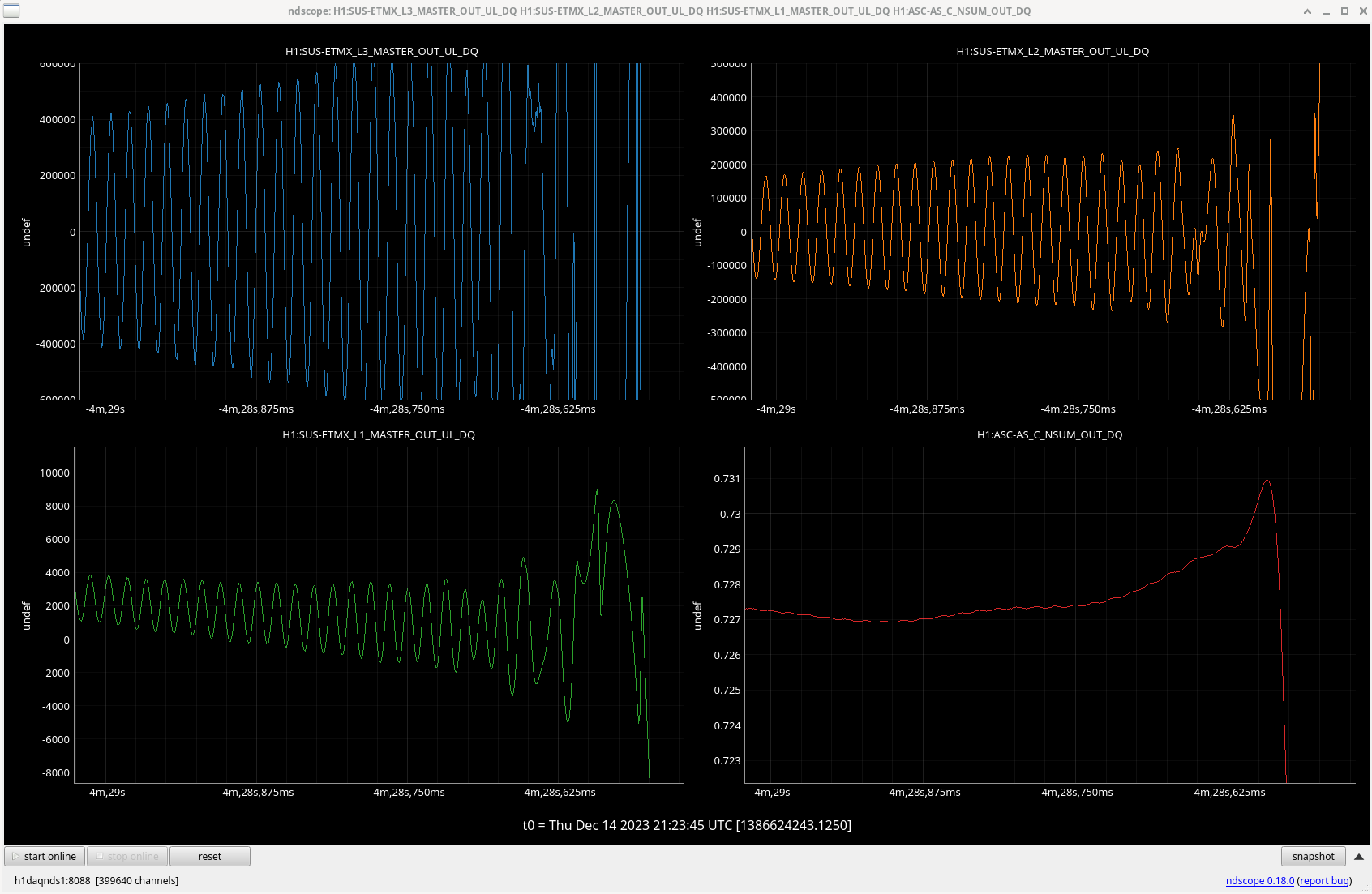
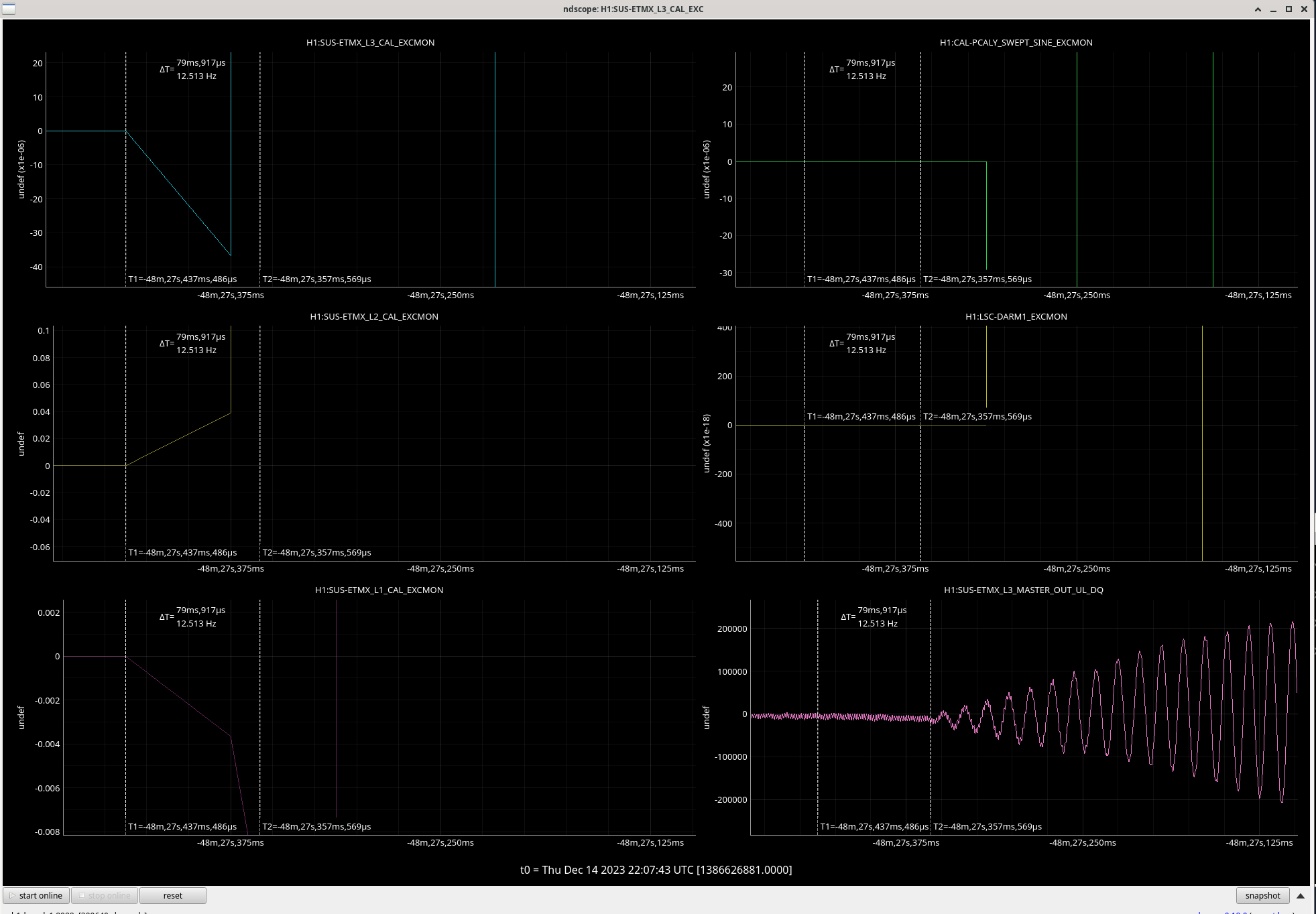
Attached shows that the sus excitations began shortly before the oscillation begain, but that the DARM1 and SWEPTSINE excitations began after the oscillation. Investigation still ongoing as to what caused the lockloss though.
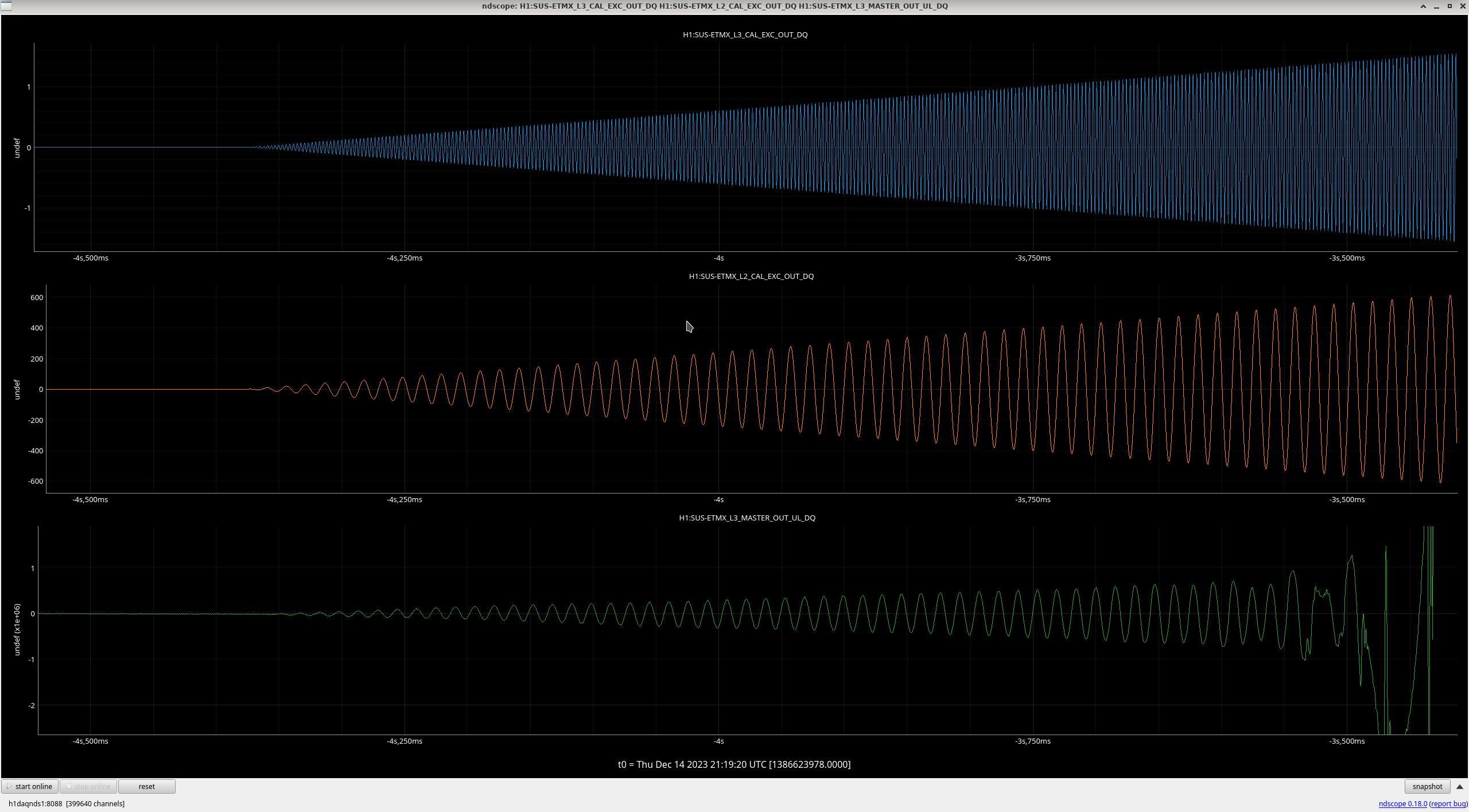
We plotted the fast 16kHz channel of H1:SUS-ETMX_L2_CAL_EXC_OUT_DQ and can see this excitation caused the ETMX oscillation and lockloss. Sheila/Jenne state this is not that surprising as the gains have been changed the ETMX filters. Plot attached.
After our clipping saga and moving PR3 to un-clip, we wondered where are we on PR2. The spot on PR3 should always be in the same position lock-to-lock, because it is in roughly the same Gouy phase as the ITMs, and we servo to the spot position on the ITMs. However, the pointing of PR3 is free to drift, which would make the spot on PR2 (and PRM I suppose) be free to be different. The pointing of PR2, PRM, and IM4 would follow any such PR3 drift to ensure that the cavity axis is normal to the PRM, since that's a requirement for resonance. This indicates that the spot position on PR2 could be a witness of sorts for PR3 pointing, since we seem to not be able to trust either the top mass PR3 OSEMs or the PR3 oplev over long periods.
I found that Gabriele and Elenna had most recently checked the spot position on PR2 in April 2023 (alog 69025) and minimized the lines in PRCL_IN1. The PR2 A2L gains have not changed since that time (until I temporarily changed them today). I'll note that, just to make it easy to re-find the link, around that time there was also some PR3 dithering done in alog 69026.
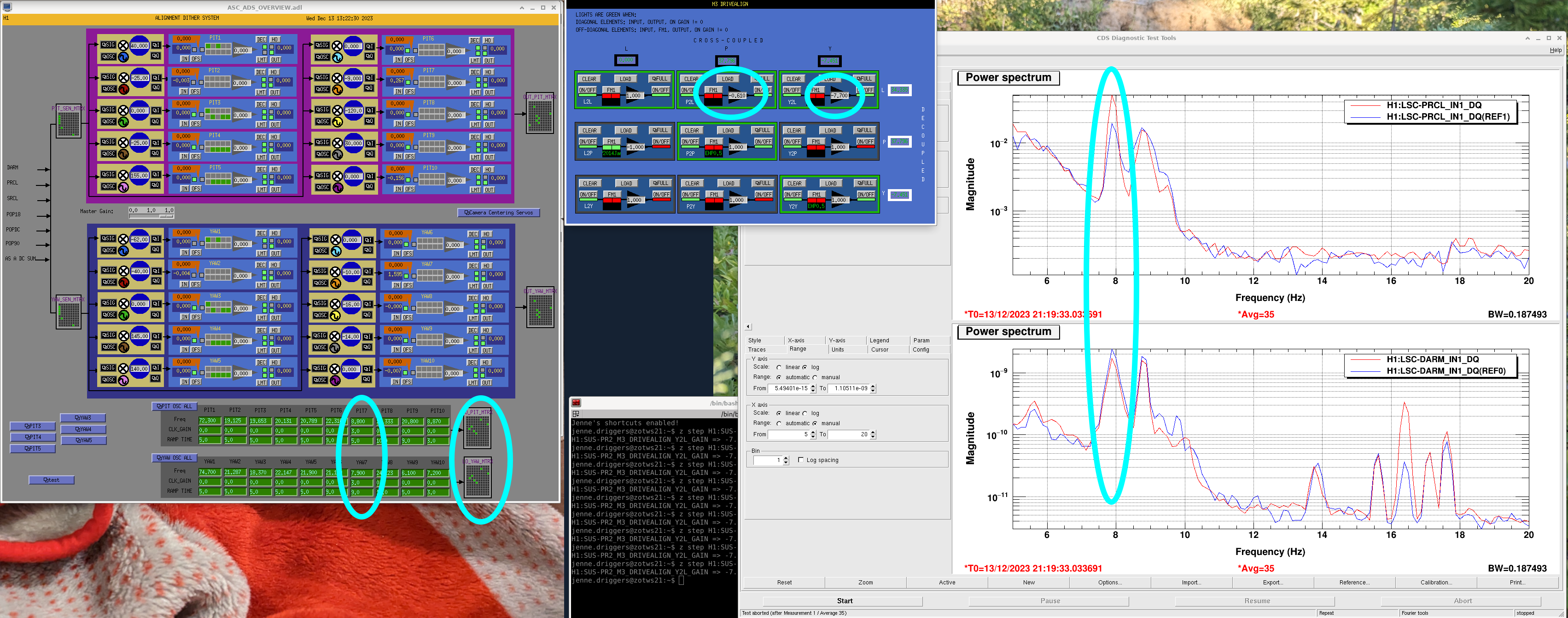
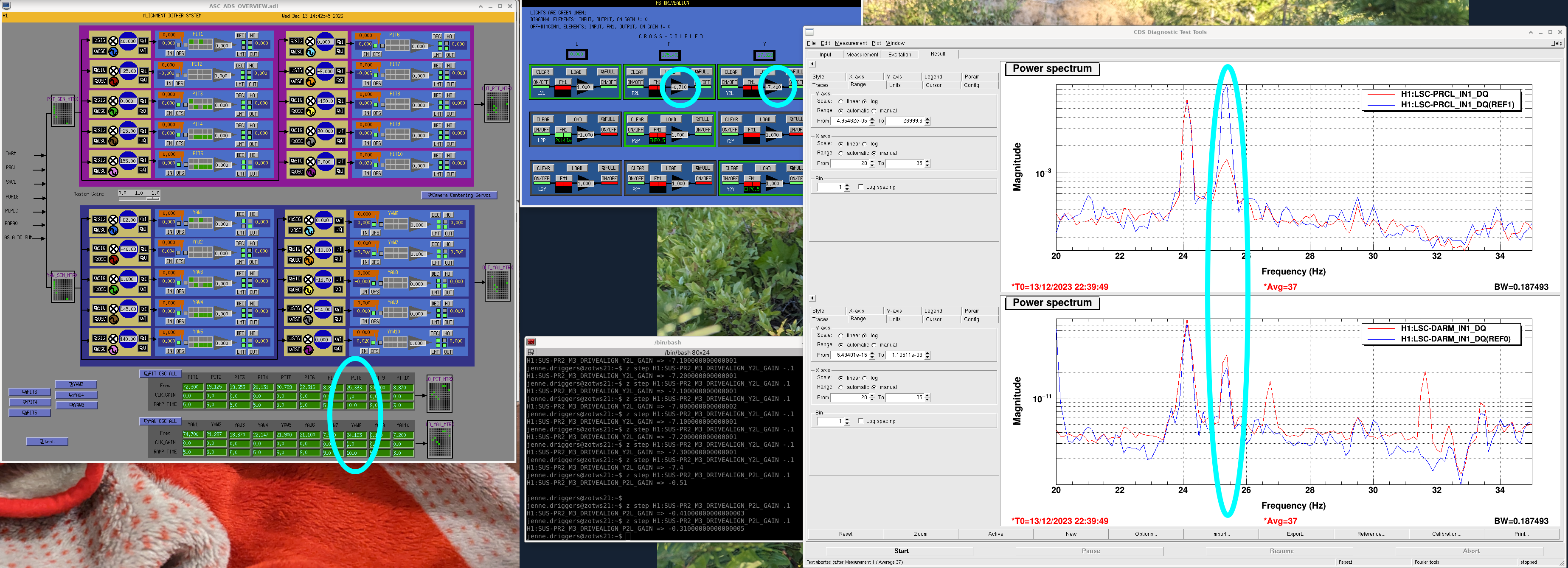
I dithered PR2 in yaw at 7.9 Hz, and looked at the peaks in both PRCL_IN1 and DARM_IN1. Just in case it matters, this first measurement was taken *before* Sheila changed the DARM offloading, but with all LSC FF off, and also quite early in the lock (so not fully thermalized). Somewhat confusingly, the yaw line heights seem to do *different things* in DARM vs PRCL when I change the Y2L gain. In the first attached screenshot, I've changed the Y2L gain from nominal -7.4 (blue trace in DTT) to further-from-center -7.7 (red trace in DTT), and the peak in PRCL (top panel of DTT) has increased while the peak in DARM (lower panel of DTT) has gone down. I would think that PRCL is the thing to trust, since that sould be a more direct measure of A2L coupling. But, overall, we probably want to be minimizing the effect in DARM (although, we don't really care in DARM at this low a frequency). Perhaps this is somewhat similar to the phenomenon we've seen where A2L gains for the test masses have to be set for DARM around 20 Hz to be effective, since the A2L values one would chose by looking at DARM below 10 Hz aren't good.
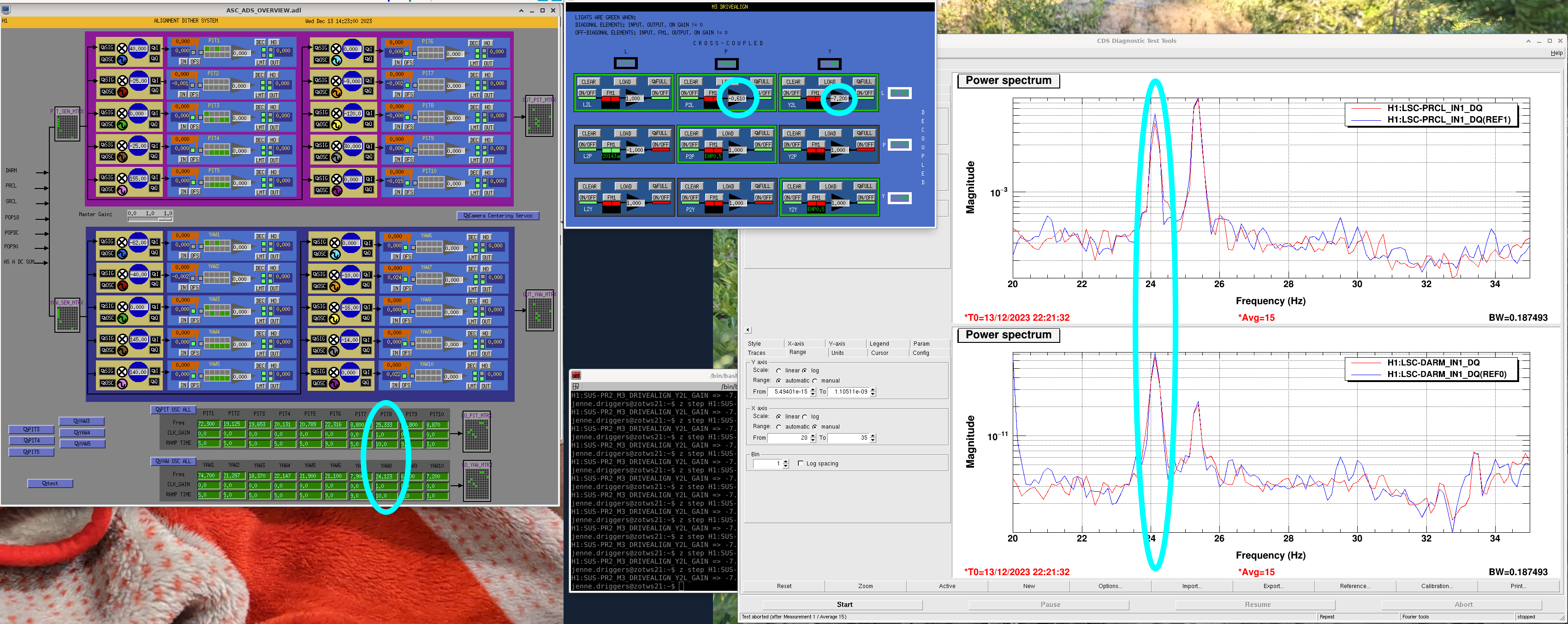
In the second attachment, I instead make a Y2L change when dithering PR2 at 24.1 Hz, and (moving PR2's Y2L gain closer to zero) both PRCL and DARM agree that moving closer to center of the optic makes the peak go down slightly. Also notable though is that we already seemed to be fairly close to the minimum peak height I could get with making Y2L step sizes of 0.1 for PR2. This means that the best place for the Y2L gain of PR2 has only changed by about 0.2 from April 2023 to Dec 2023. I'll have to look up what that means in mm, but it's going to be small. We don't have a measurement of where it was at any time between those times though, and in particular we don't know what value of A2L would minimize the coupling during the time when we had clipping issues.
In the third attachment, I had put the Y2L gain back to its nominal value of -7.4, and instead change the P2L value. Even though this measurement is at about 25 Hz, PRCL and DARM's responses are back to being opposite of each other. There was a dramatic lowering of the peak height in PRCL, but the peak got a bit bigger in DARM. Again, overall not a big change though.
Next steps: re-find the conversion between A2L units and mm for triples like PR2. Potentially could try small move of PR3, to see what is the effect on optimal A2L values, to see if PR2's A2L values can be used even as a rough reference for PR3 pointing.
I did a little more of this today, while LLO was relocking.
One thing I noticed was that today while we were early in the lock (so still thermalizing), I could make pretty dramatic changes in the peak height of the pitch PR2 dither peak in PRCL, but there was very little change in the peak in DARM. I'm not really sure what that means, but PRCL is certainly where I expected it to show up more strongly, so maybe that's fine.
While dithering PR2 in pitch at ~25 Hz, I found that the optimal P2L value was again about -0.310 (same as yesterday). I then moved PR3 by about 0.5 urad in pitch, in steps of 0.03 urad, and tried to re-optimize the PR2 P2L gain, and found that it was more optimal at about -0.36 (when taking P2L steps of 0.05). So, there is a bit of an effect when moving PR3, although I can't promise that the effect was due to thermalization or something else.
When finished, I put the PR2 A2L values back to their nominals, and walked PR3 back to its nominal slider position. I'll note that I didn't see any glitches or anything 'bad' when moving PR3 in steps of 0.03 (which is already 3x larger than I was doing in Observe last week), so we can probably take slightly larger steps next time we do this, to make things go faster.
Louis and I have been looking at increasing the offloading of the signal from the ESD to the PUM and UIM, in light of 73913.
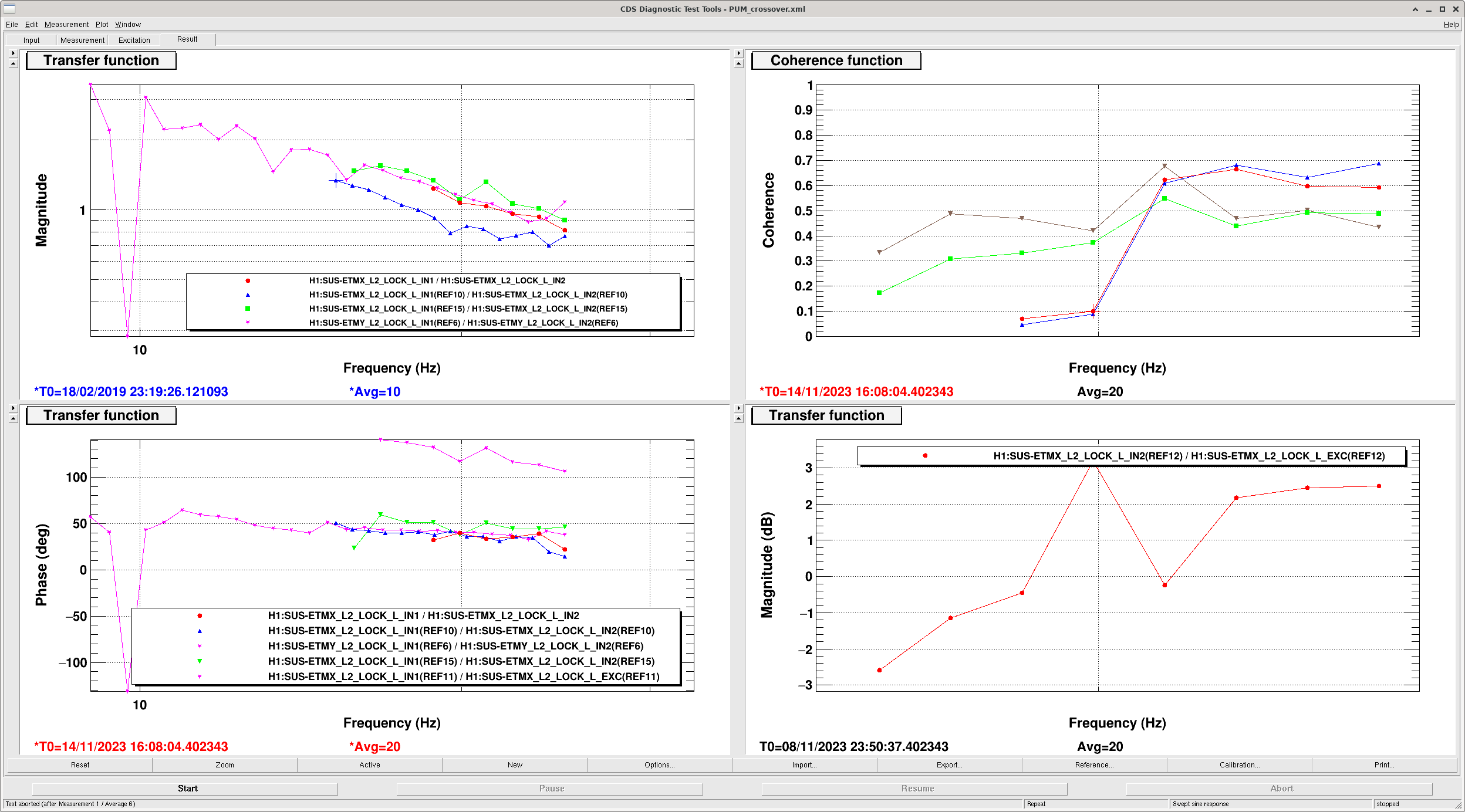
I have attempted a few times to make measurements by exciting at the L2 LOCK L filter, this results in poor coherence even for amplitudes that are quite large in DARM, and turning up the amplitude slightly has caused a lockloss by saturating the ESD.
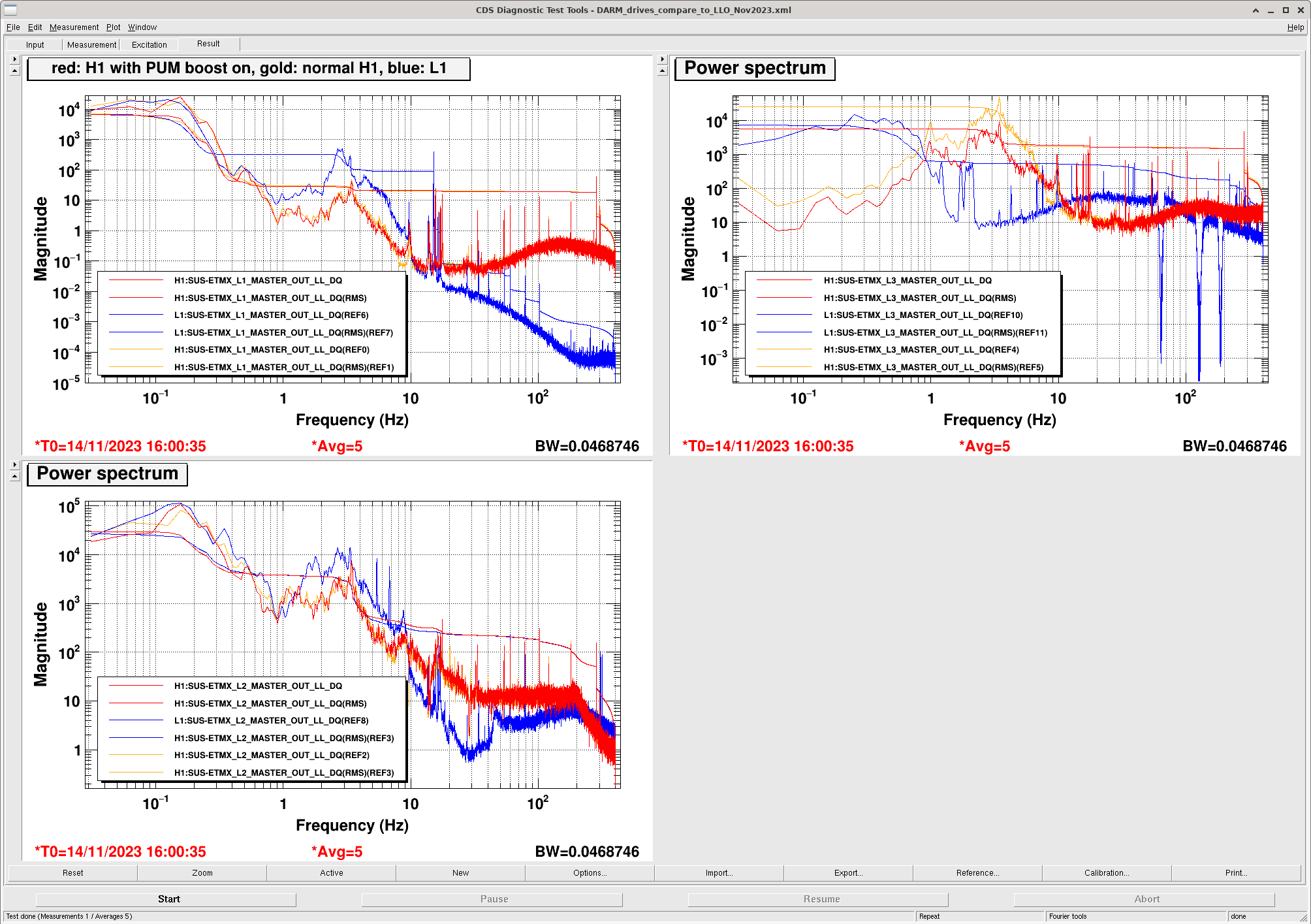
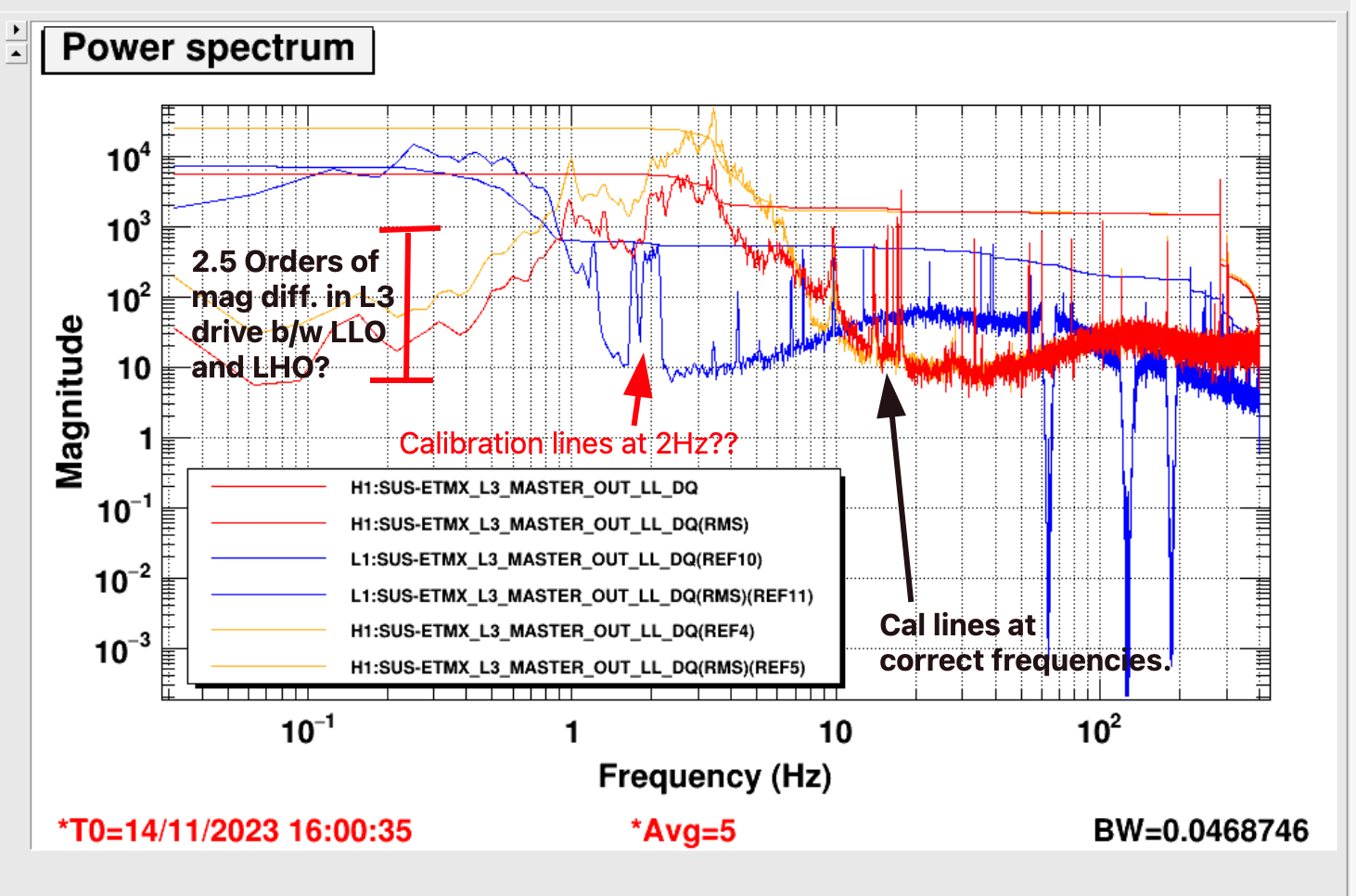
On Tuesday morning I engaged the PUM boost (L2 LOCKL FM2, boost4.5 which is a boost with a little resG aaround 4.5Hz). Some history (with links to old alogs about this filter is here: 48767) we used to run with this boost but turned it off in early O3 because angle to length cross couplings were causing instabilities of the DARM loop. On Tuesday morning I engaged this boost, and we stayed locked. The first attachment shows a comparison of our ETMX drives to LLO's (LLO also uses ETMY L1 for DARM control, but I haven't plotted that here), H1's usual configuration is in gold and the time with the PUM boost engaged is in red. The ESD drive RMS is reduced by more than a fator of 2 with the PUM boost engaged. I quickly tried a swept sine injection, and saw that the coherence was somewhat better than earlier measurements with a very small amplitude injection, so it seemed promising that we might be able to get a better measurement of the cross over with the PUM boost engaged.
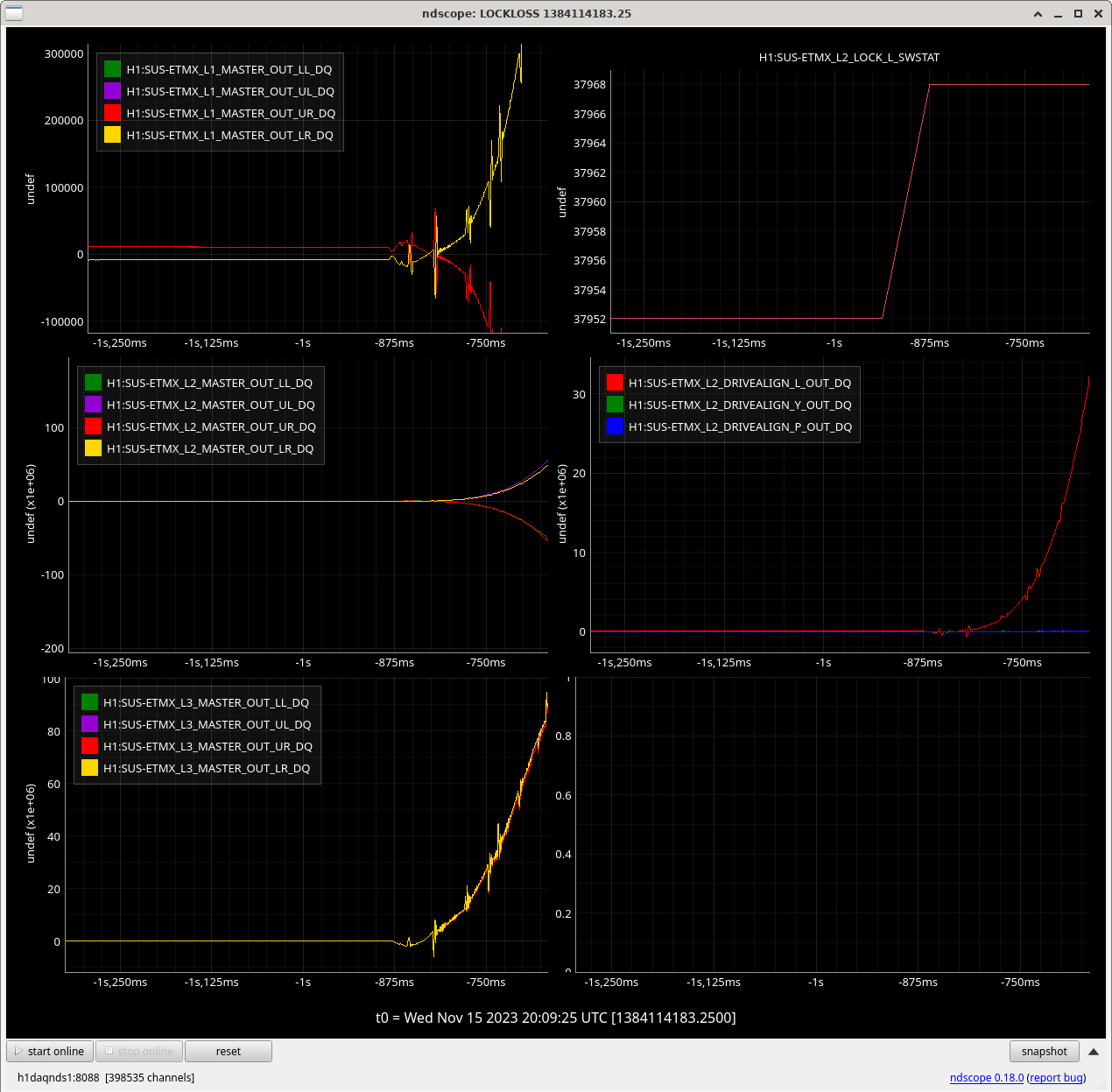
Today I engaged this boost again during commisoning time and we immediately lost lock. The third attachment shows that turning on the boost certainly seems to be the cause of the lockloss.
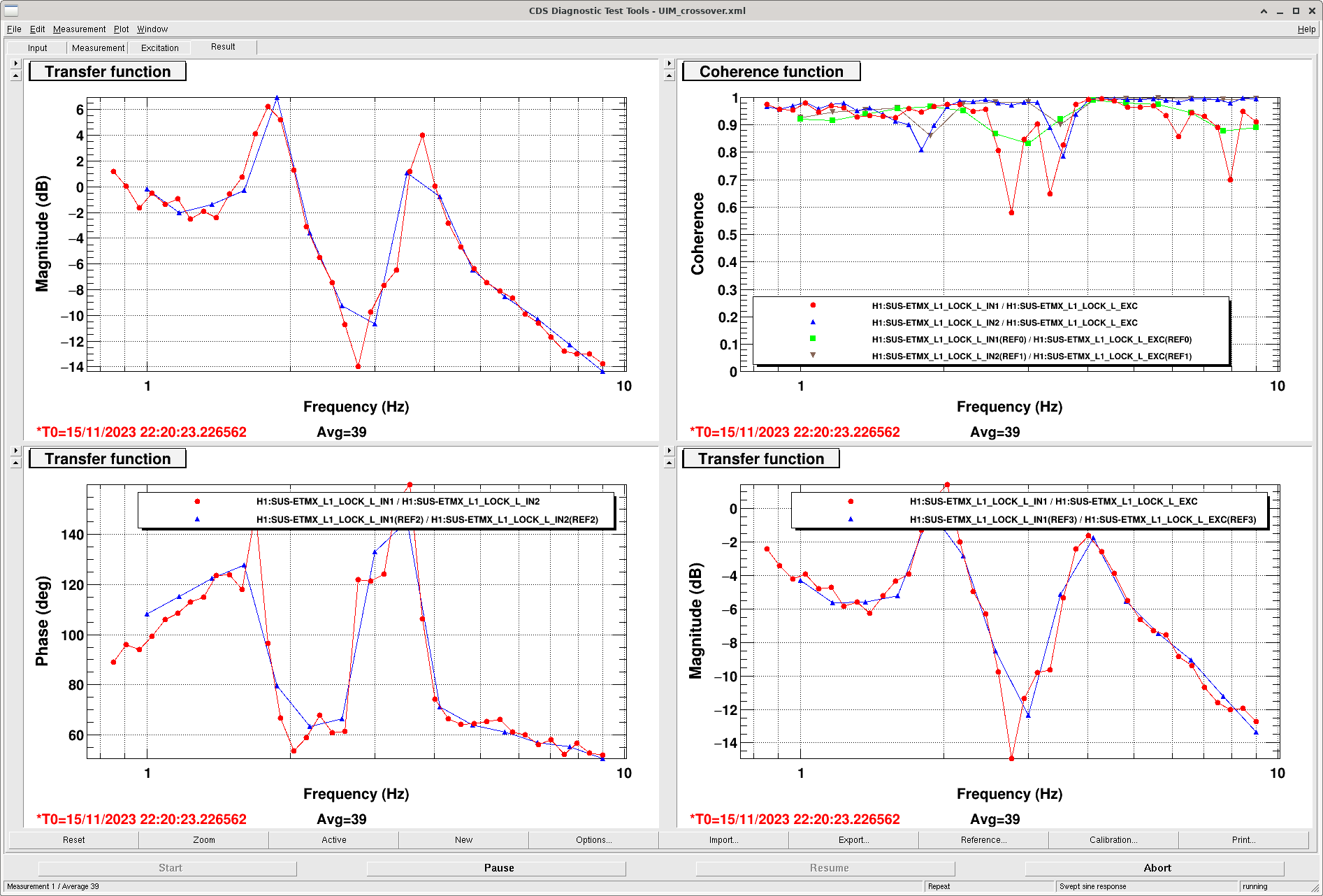
We can probably rely on the pyDARM model for the PUM crossover, since the calibration measurements validate the model above 10Hz. Today I was able to make a measurement of the UIM crossover, which Louis can use to compare to pyDARM from 1-10Hz.
this is discussed in LHO:74771
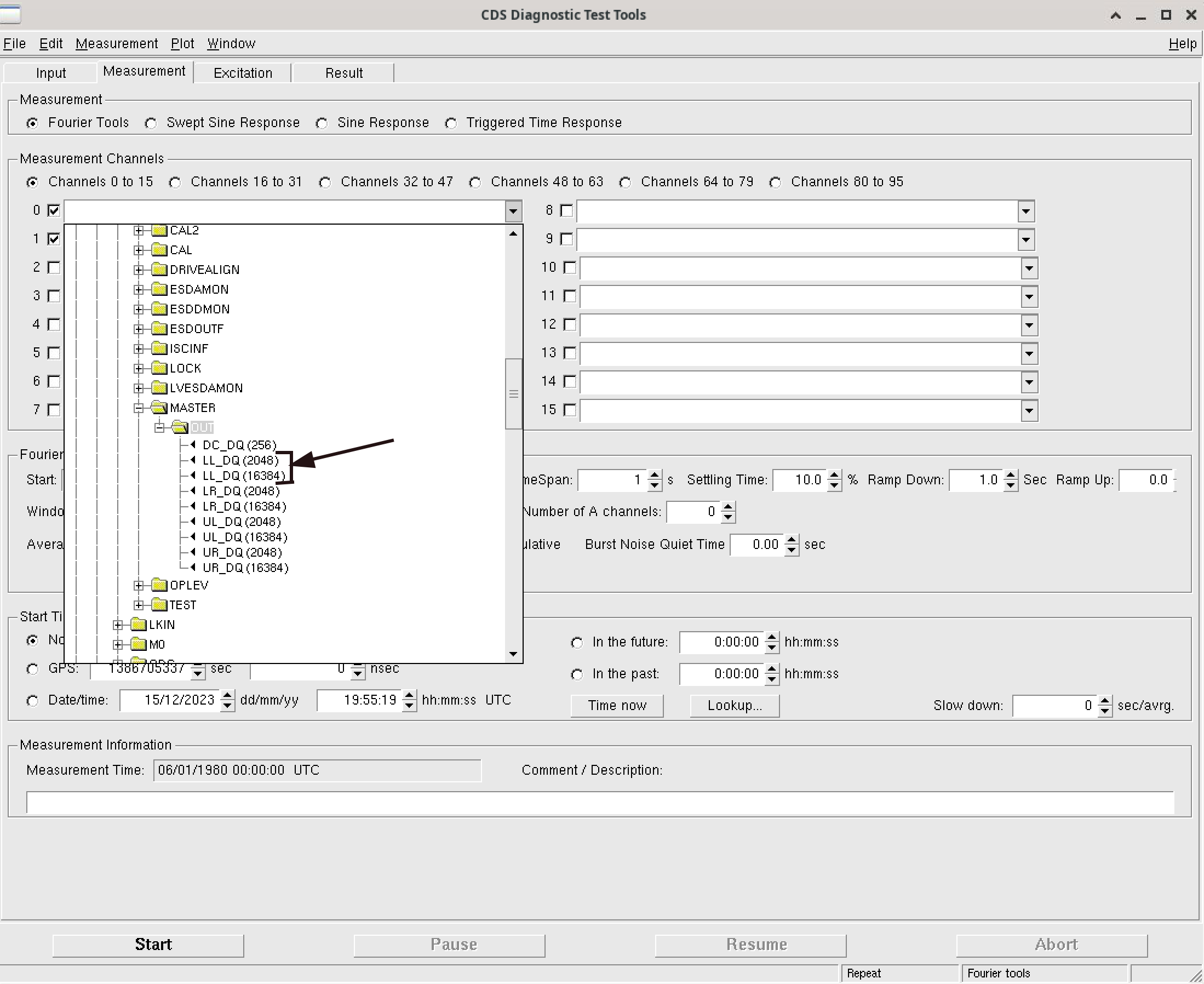
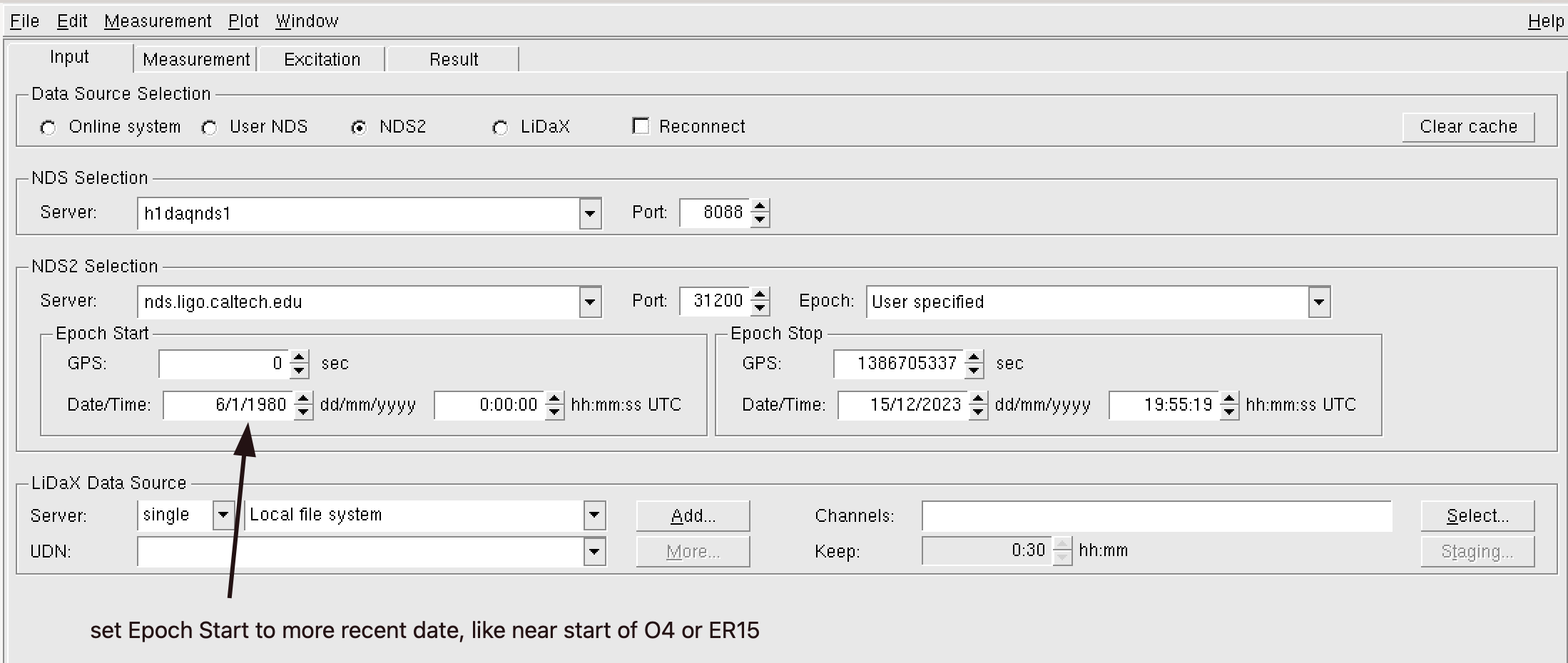
Gabriele, Louis The comparison between LLO's and LHO's ETMX L3 drive above (fist attachment in Sheila's post) confused us. The difference between the two LHO traces makes sense. But there are several things wrong with the channel from LLO (blue trace in top right hand plot). First of all, we do not have 2 orders of magnitude in difference between the L3 MASTER OUT drives at LLO vs LHO. Also, the calibration lines show up at the wrong frequencies in the LLO trace.It turns out that if you use NDS2 and leave the Epoch Start date at the default 6/1/1980, DTT sees two of some channels with the same name (but different sampling frequencies!), see DTT_NDS_issue.png. The result in this case was confusion of what DTT was plotting in Sheila's alog. We think that DTT got confused by having multiple channels with the same name but differing sampling frequencies in its lookup list, leading to DTT plotting the 16kHz channel but somehow applying the wrong sampling frequency. To avoid this, we had to re-remember to be careful when copying and pasting similar channel names from one text box to another within DTT and to set the Epoch Start field to something more reasonable than 1980.