TITLE: 11/21 Day Shift: 16:00-00:00 UTC (08:00-16:00 PST), all times posted in UTC
STATE of H1: Preventive Maintenance
INCOMING OPERATOR: Corey
SHIFT SUMMARY: Busy maintenance day; SQZ cabling (PMC, OMC), PSL Refcav alignment, ISS 2nd loop, VAC turbopump checks, valves and gauges added to FCT, ALS laser adjustments at EX, HWS work also at EX, cleanroom building at EY, and camera fibers reseeded in the MSR. Back to NLN at 06:00UTC! Lockloss 12 seconds later :(
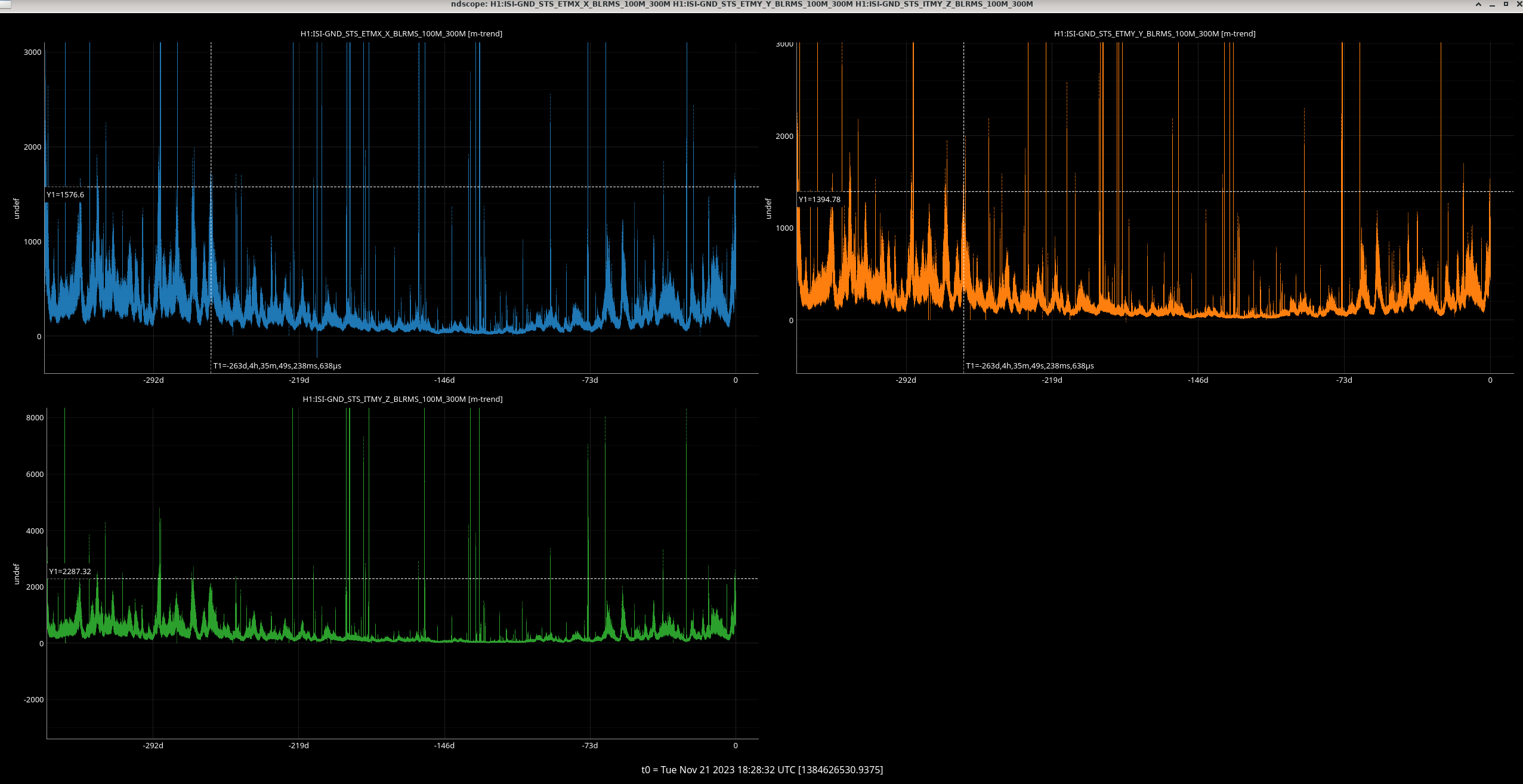
HAM7 ISI tripped at 17:59 and 18:03 presumably from the SQZ rack work, HAM2 ISI tripped at 18:19 from the measurements being run on HAM2/3. Picket-fence plot died around 18:05 but was able to restart itself after 2 tries and ~5 minutes. Microseism is the highest its been in ~265 days, above the 90th percentile for the past ~12 hours.
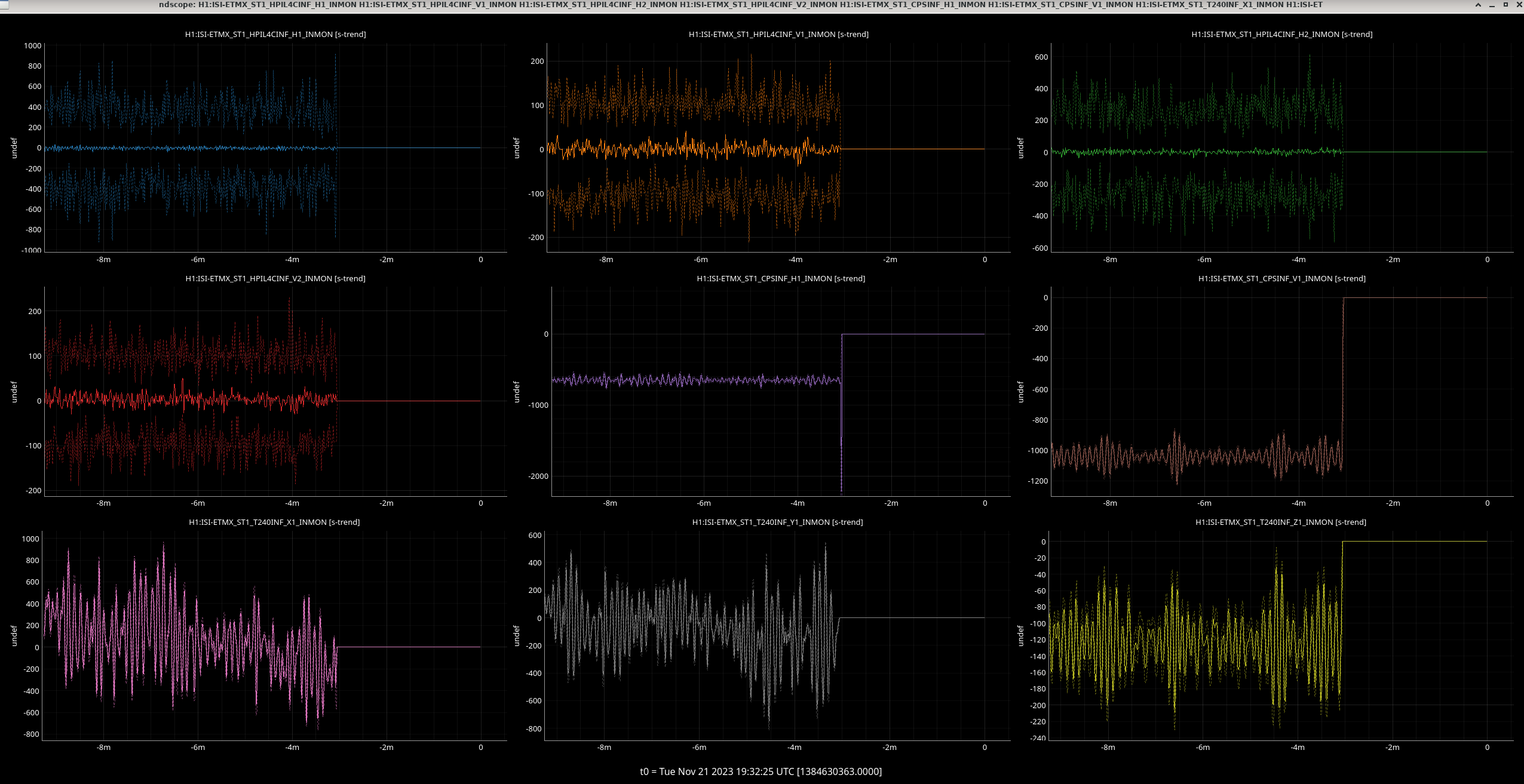
Something happened at EndX at 19:29:21, the ISIs state1&2 tripped and so did the HEPI, not sure why, there was no one down there at the time and a DAQ restart was underway. All the sei signals went to zero, the SUS seems fine. After lots of checks and other restarts Erik went down to EX to physically powercycle some chassis, AA, IOP, Fil later joined him, the -18V DC Kepco power supply was found to have failed. FRS ticket 29752, alog74341
21:18 Started to relock
LOG:
| Start Time | System | Name | Location | Lazer_Haz | Task | Time End |
|---|---|---|---|---|---|---|
| 16:05 | FAC | Tyler, Chris, Eric | Yarm/FCES | N | Tumbleweed clearing | 16:55 |
| 16:12 | SUS | RyanC | CR | N | ETMY OPLEV Charge measurement | 17:21 |
| 16:14 | FAC | Ibrahim, Randy | LVEA | N | Prep and start Craning | 17:43 |
| 16:16 | TCS | TJ | LVEA | N | TCS cabinets, parts search | 16:29 |
| 16:21 | VAC | Janos | EX, LVEA, Mids, EY | N | Filter bodies for turbo stations | 19:23 |
| 16:21 | EE | Fil | EX | N | SUS HWD checks | 16:51 |
| 16:22 | VAC | Jordan, Gerardo | LVEA/FCES | N | Add valves and gauges to FCT | 19:47 |
| 16:25 | VAC | Travis | MidX, EX | N | Turbopump checks | 19:26 |
| 16:10 | FAC | Karen | EX | N | Tech clean | 16:38 |
| 16:38 | FAC | Karen | EY | N | Tech clean | 17:21 |
| 16:40 | PSL | RyanS, Jason | PSL | N | Ref caf alignment | 19:23 |
| 16:48 | ALS | TJ, Sheila, Dana, Daniel | EX | N | Readjust laser | 17:53 |
| 16:52 | CDS | Dave | Remote | N | Camera work | 17:37 |
| 16:54 | EE | Fil | CER | N | HAM4 ISI coil driver checks | 17:18 |
| 17:16 | FAC | Tyler | 3IFO | N | Checks | 17:33 |
| 17:18 | EE | Fil | LVEA | N | Optical lever measurements | 17:37 |
| 17:27 | FAC | Tyler | Corner | N | Walkthrough with contractors | 18:22 |
| 17:30 | FAC | Karen | LVEA | N | Tech clean, out @ 17:45, back in at 18:05 | 19:19 |
| 17:46 | LAS | EX is LASER HAZARD | EX | Y | EX is LASER HAZARD | 19:29 |
| 17:51 | SQZ | Daniel | SQZ racks | N | Cabling | 18:58 |
| 17:53 | TCS | TJ, Camilla | EX | N | HWS work | 19:23 |
| 17:54 | SEI | Jim | LVEA, HAM1 | N | Take off a piece of foam | 17:58 |
| 17:56 | FAC | Randy, Ibrahim | EY | N | Cleanroom vent prep | 19:48 |
| 17:59 | SEI | Jim | CR | N | HAM2/3 measurements | 19:13 |
| 17:59 | FAC | Cindi | FCES | N | Tech clean | 18:56 |
| 18:04 | EE | Fil | LVEA, SQZ racks | N | Join Daniel with cabling | 18:58 |
| 18:08 | CDS | Jonathon | MSR | N | Camera connections | 19:08 |
| 18:10 | EE | Marc, Fernando | EY | N | Check out cabling | 19:17 |
| 18:23 | FAC | Tyler, Carolyn, Contractor | MidY, EY | N | Walkthrough | 19:42 |
| 18:36 | FAC | Chris +1 | Site | N | Changing locks around site | 20:03 |
| 18:56 | FAC | Cindi | High bay | N | Tech clean | 19:12 |
| 19:12 | FAC | Cindi | OSB receiving | N | Cardboard | 19:24 |
| 19:38 | PSL | RyanS | CR | N | ISS 2nd loop | 20:15 |
| 19:54 | CDS | Erik | EX | N | Powercycle AA, IOP, ... chassis | 20:58 |
| 19:54 | SQZ | Sheila | LVEA | N | OMC cabling | 19:54 |
| 20:02 | OPS | Camilla | LVEA | N | Sweep | 20:18 |
| 20:07 | TCS | TJ | CER then Optics lab | N | Parts search, laptop dropoff | 20:26 |
| 20:20 | EE | FIl | EX | N | Join Erik, checks | 20:58 |
| 21:11 | EE | Fil | EX | N | Bring over a spare power supply | 21:35 |
| 22:57 | VAC | Gerardo, Jordan, Mitchel | LVEA, HAM6 | N | Checks | 23:05 |
I changed the H1:PSL-ISS_REFSIGNAL from -1.97 to -1.98 after we lost lock which brought the Diff power back to tolerance (between 2 and 2.5)
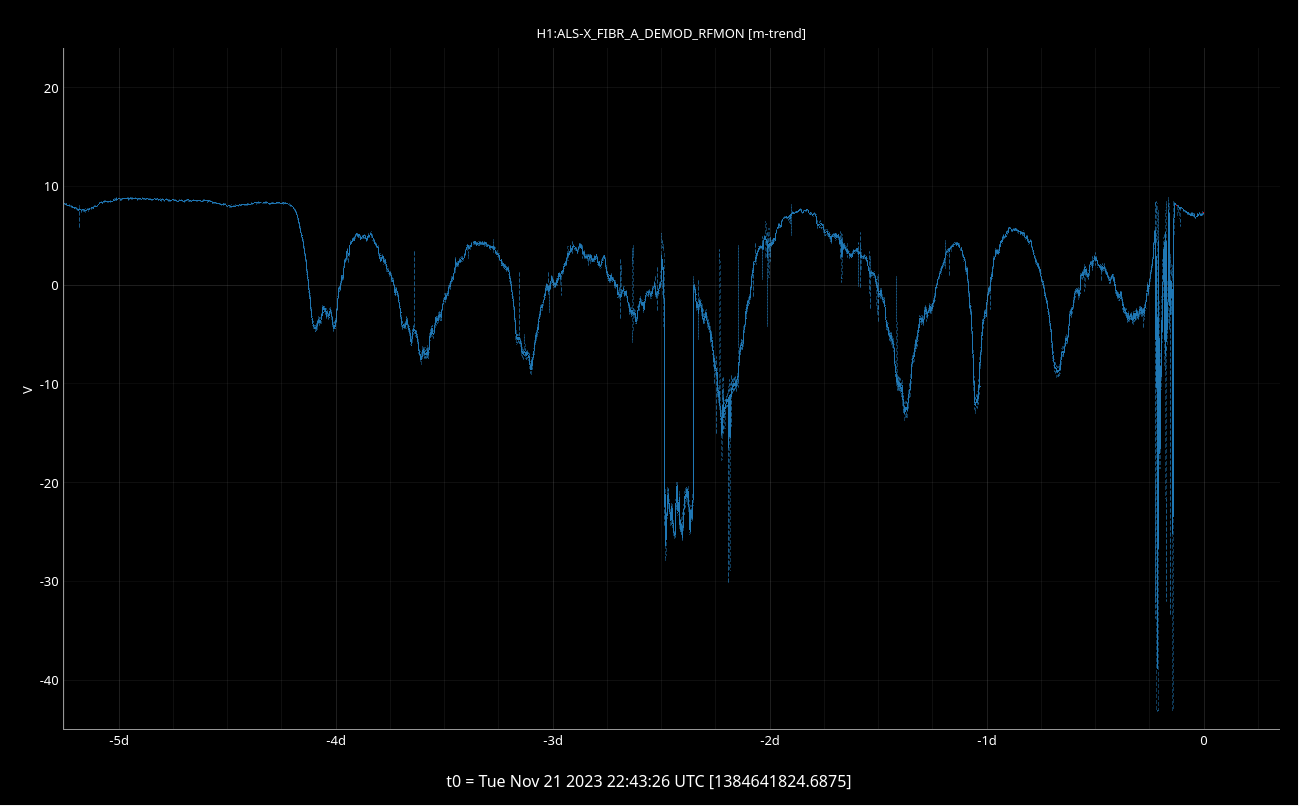
Today Daniel, Sheila, Dana, and myself went to EX to look further into the ALS system to hopefully fix the locking trouble that we've had (summary in alog74323). We hooked up a spectrum analyzer before the phase frequency discriminator and verified that we saw the 40MHz signal that should be there. We then checked on table to make sure that there was no clipping on the beatnote path (table layout - D1800270). The two beams looked decently co-aligned after ALS-BS3, and while it wasn't perfect it was deemed good enough. The beam on the ALS-M3 mirror was on the very far edge of the optic, but seemed to be fully making it to the BBPD ALS-PD7.
While we were looking at the beam on the table, Daniel tried tuning the temperature and current of the laser and ended up back at the settings we started with (June 30th alog70976).
There was no obvious reason for any of the locking troubles we've seen recently, and now the beatnote power (H1:ALS-X_FIBR_A_DEMOD_RFMON) seems to be back up to where it has been even though we didn't make any changes. I guess we'll revisit this in 6 months when it happens again...
R. Short, J. Oberling
As we've been seeing the FSS RefCav TPD dropping over the past couple of weeks, this morning Jason and I did a proper tune-up of the RefCav alignment. We started by remotely aligning the beam into the RefCav from the control room using the two picomotor-controlled mirrors in the FSS path. With the ISS on and the IMC unlocked, the signal on the TPD started and ended at:
Only seeing a slight improvement in the RefCav TPD signal with the picomotors, we then proceeded to head into the PSL enclosure to touch up the FSS path alignment. We started with a power budget on the FSS path (done with the ISS on and both PSL Guardians paused):
The most obvious issue appeared to be the double pass through the AOM, as Jason had left the diffraction efficiency at around 73.8% after the last on-table FSS alignment, but we decided to start from the highest point upstream and make adjustments at each point. We adjusted WP05 to improve AOM IN, the AOM (mostly upwards in height) to improve single pass diffraction, and mirror M21 to improve double pass diffraction. Our results:
Good improvements all around, and although neither diffraction efficiency ended as high as after the last alignment, with an unlimited maintenance window I suspect we would see more gains. We then checked the alignment through the EOM; seeing it was good with no clipping and measuring 158.4 mW out, we moved on to recovering the RefCav using the iris mounted in front of it. With the RefCav now locked, we touched up the alignment using the picomotor-controlled mirrors while watching the signal on the TPD:
Excellent. Using a multimeter to watch the DC voltage, we then touched up the alignment onto the RefCav RFPD by adjusting mirror M25:
To finish off our activities in the enclosure, we measured the RefCav's visibility:
After returning to the control room, we resumed the PSL Guardians, turned the ISS back on, and adjusted the ISS RefSignal to -1.97 V to keep the diffracted power around 2.5%. I have not accepted this value in SDF as it will likely need to be adjusted periodically this evening/tomorrow as the enclosure comes to thermal equilibrium. This closes WP 11537.
WP 11533
Checked the HAM4 ISI Coil Driver Chassis. Issue reported last week of noisy fan. Fan is spinning and noise reported last week has not returned. Will leave WP open another week.
Second week of monitoring fan. No issues, closing work permit.
WP 11532
Functionality of the ETMX SUS Hardware Watchdog was tested this morning. System had reported no triggers over the past few months. One of the DB37 field cables was disconnected. Both the software and front panel LEDs went into alarm. Field cable was reconnected and system returned to nominal state.
D. Barker, F. Clara
TJ, Camilla
After swapping to the old ETMX HWS 530nm diode source and seeing that the HWS signal was not good in 73717, TJ and I this morning confirmed that the mode matching does not match the design. We think we need to adjust the position if the initial collimating lenses, but didn't finish doing this. As we misaligned the beam by movng the fiber assembly D1800125, we left the HWS powered off. Accepted in sdf.
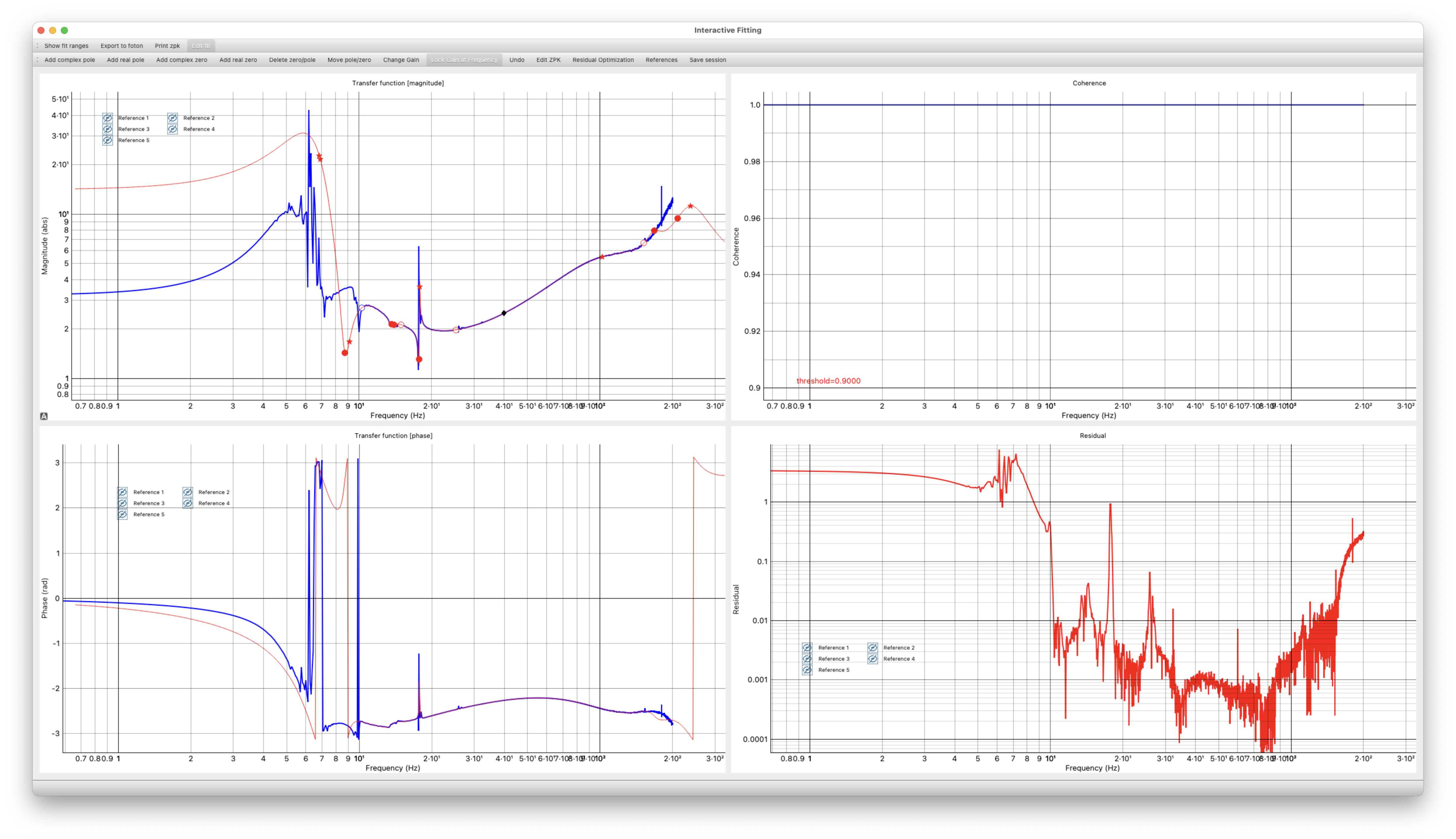
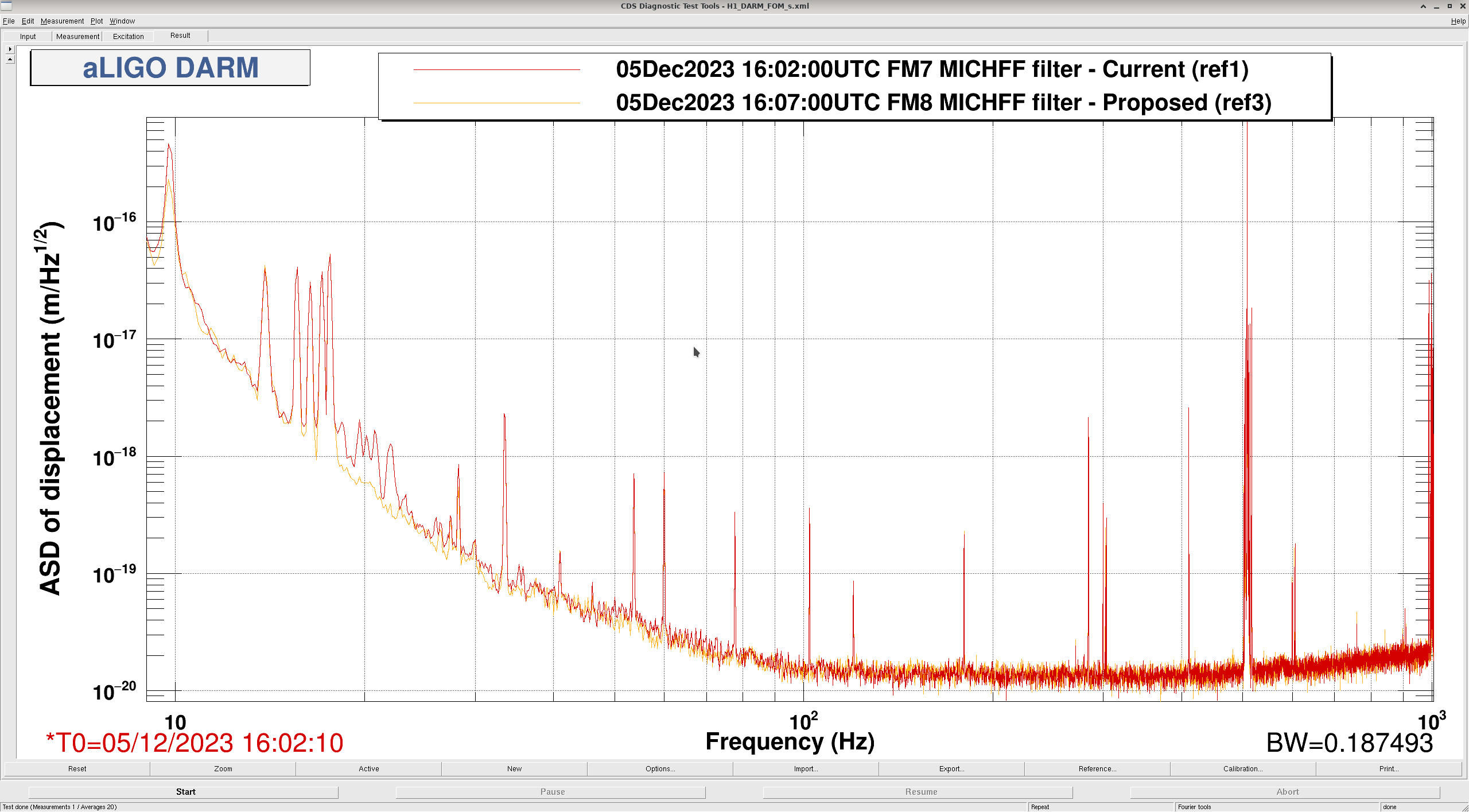
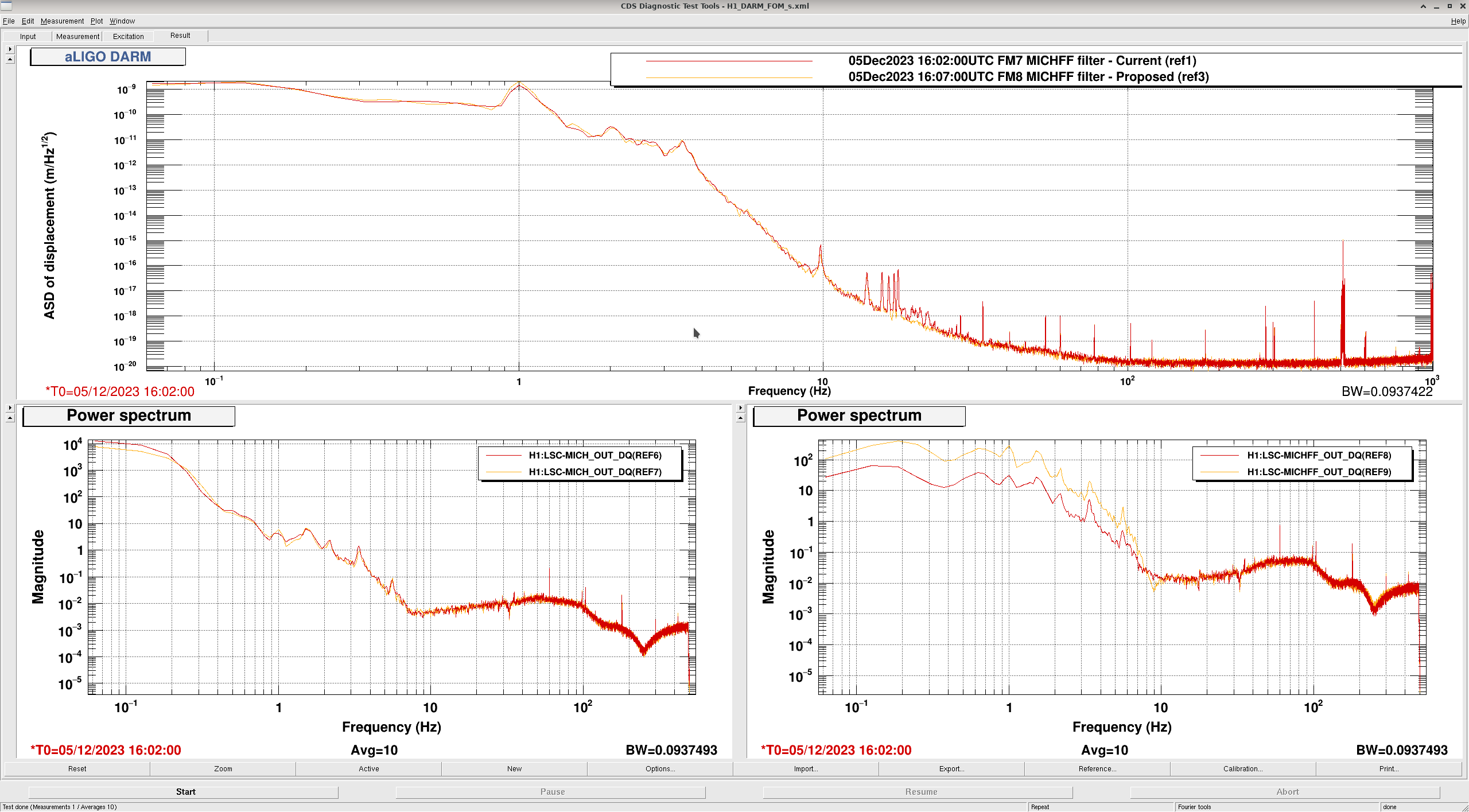
Gabriele refit the 11/15 LSC FF data 74220, allowing a higher magnitude at low frequency to give us a better fit, fit attached. I lowered the Q of the 17.7Hz feature and added this filter to MICHFF FM8 as "11-15-23B". We'll want to turn this FF slowly or before Tuesday Maintenance, as the excess low frequency could cause instability.
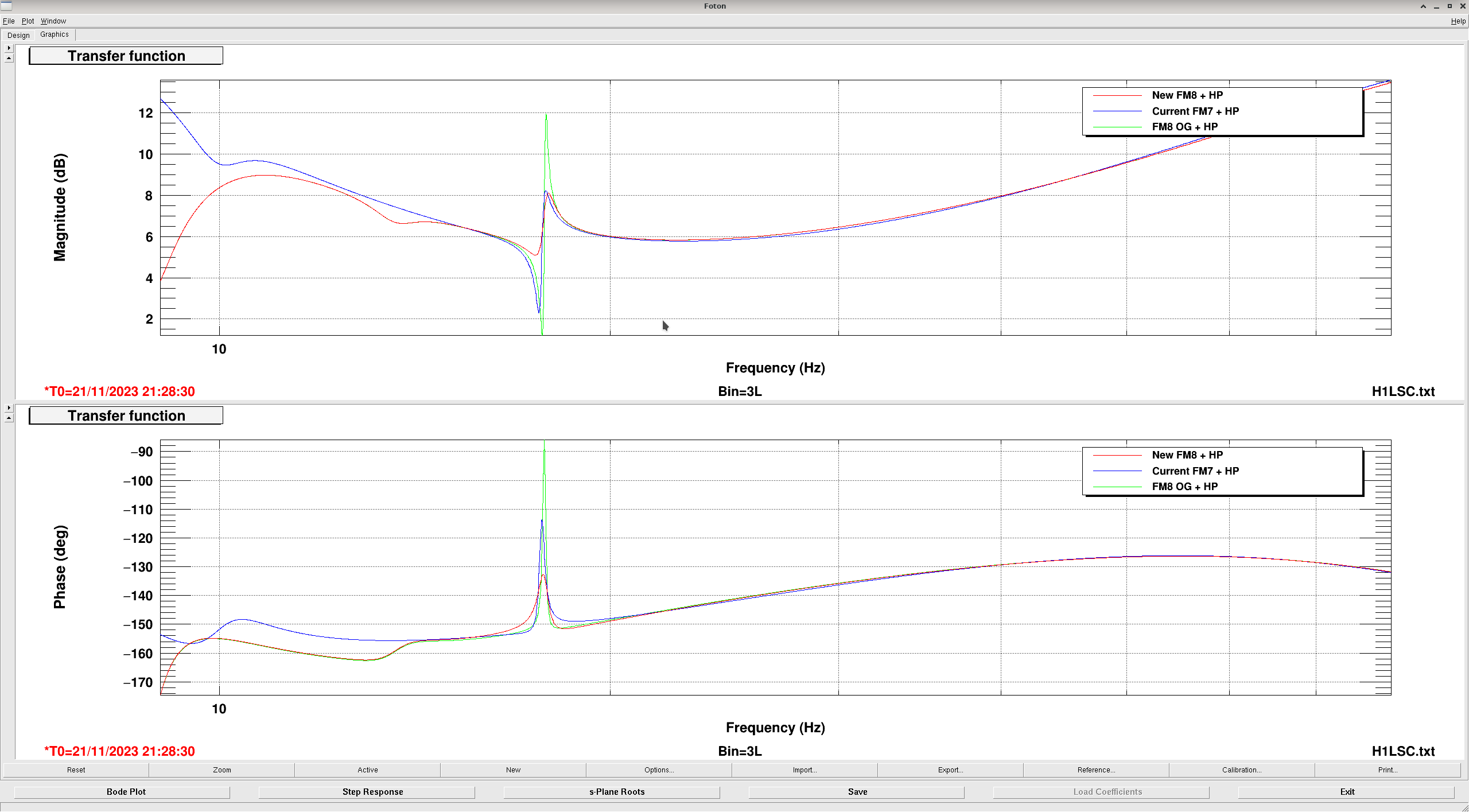
Plot attached, red is current MICHFF FM7, blue is new FM8 (double the strength of current FF <8Hz), green is Gabirele's original design before adjusting Q of 17.7Hz feature (all including the high pass filter in FM10).
I lowered the 17.7Hz Q's by a factor of 4 from the original design, to minimize effect on KAPPA_TST error 74259:
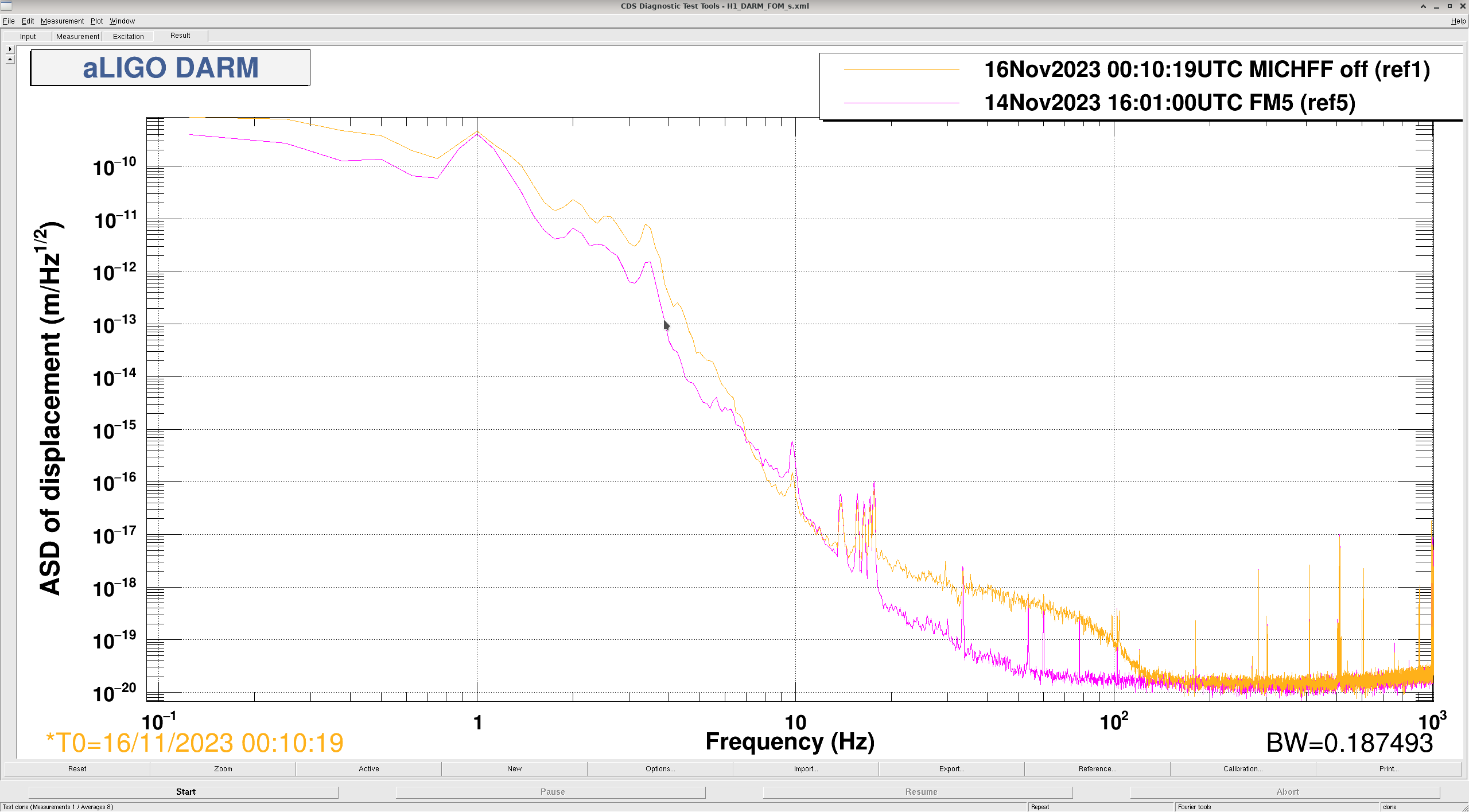
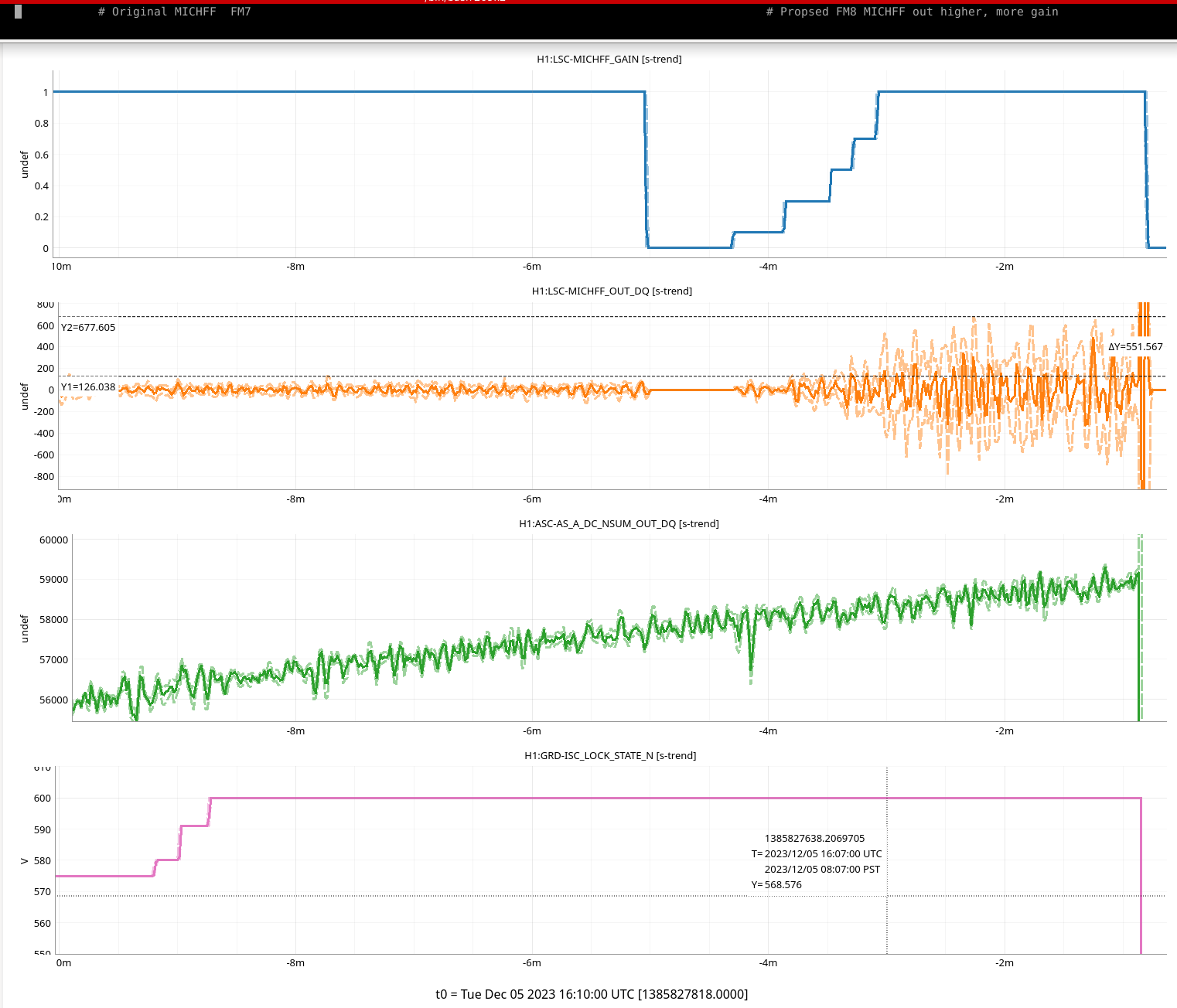
Turning this FM8 MICHFF on 2023/12/05 16:07:00 UTC to 2023/12/05 16:09:00 UTC, did not cause a lockloss. Comparing to 2 minutes before with current MICHFF FM7 16:02:00 UTC to 2023/12/05 16:04:00 UTC, DARM looks better with new FF but this was only a couple of minutes into NLN when the ADS lines were turning off, low frequency DARM shows no obvious change. As this new FF has higher gain at low frequency, you can see this as a factor of ~5 higher output on MICHFF_OUT, trend attached.
R. Short, with guidance from K. Kawabe and J. Oberling
I've made some updates to the 'CLOSE_ISS' state in the IMC_LOCK Guardian, which handles the closing of the ISS second loop, that should make the closing of the second loop more consistent.
When the second loop is engaged, the DC working point of the ISS is determined by the output of the second loop's digital AC coupling (H1:PSL-ISS_SECONDLOOP_AC_COUPLING_DRIVE). This output is held when the second loop is closed, but it can occasionally be held far from the average of its oscillations before the second loop is engaged, which in the past has caused locklosses and was mitigated earlier this year (see alog 67347). While the second loop isn't causing locklosses anymore (that I can recall), we do still see the digital AC coupling output being held slightly off from the mean, causing the diffracted power to jump. I've expanded upon Georgia's logic by changing the way the output of the AC coupling drive is held to be more consistent. Instead of waiting to hold the output until it's near the mean over the past 10 seconds (a calculation that itself can take several seconds), the process is now as follows:
I was able to test this logic during the maintenance period today, both with the IMC locked at 2W and 60W, with great success. We'll run with this for a while to see if over several lock acquisitions the second loop is being engaged with a more consistent digital AC coupling drive. The updated IMC_LOCK Guardian code is loaded and committed to SVN.
I added roughly 5 meters of LMR 195 to the cable sending the 3MHz local oscillator to the demod for the OMC 3MHz signal. This should add roughly 21ns of delay, or roughly 23 degrees of phase for the 3MHz signal.
We are hoping that this will shift the turn around point of the ADF sqz angle readback so that our operating point is at a better place to use this readback to adjust the sqz angle. (for background see 74256
This means we will need to retune the SQZ angle before we to observing today.
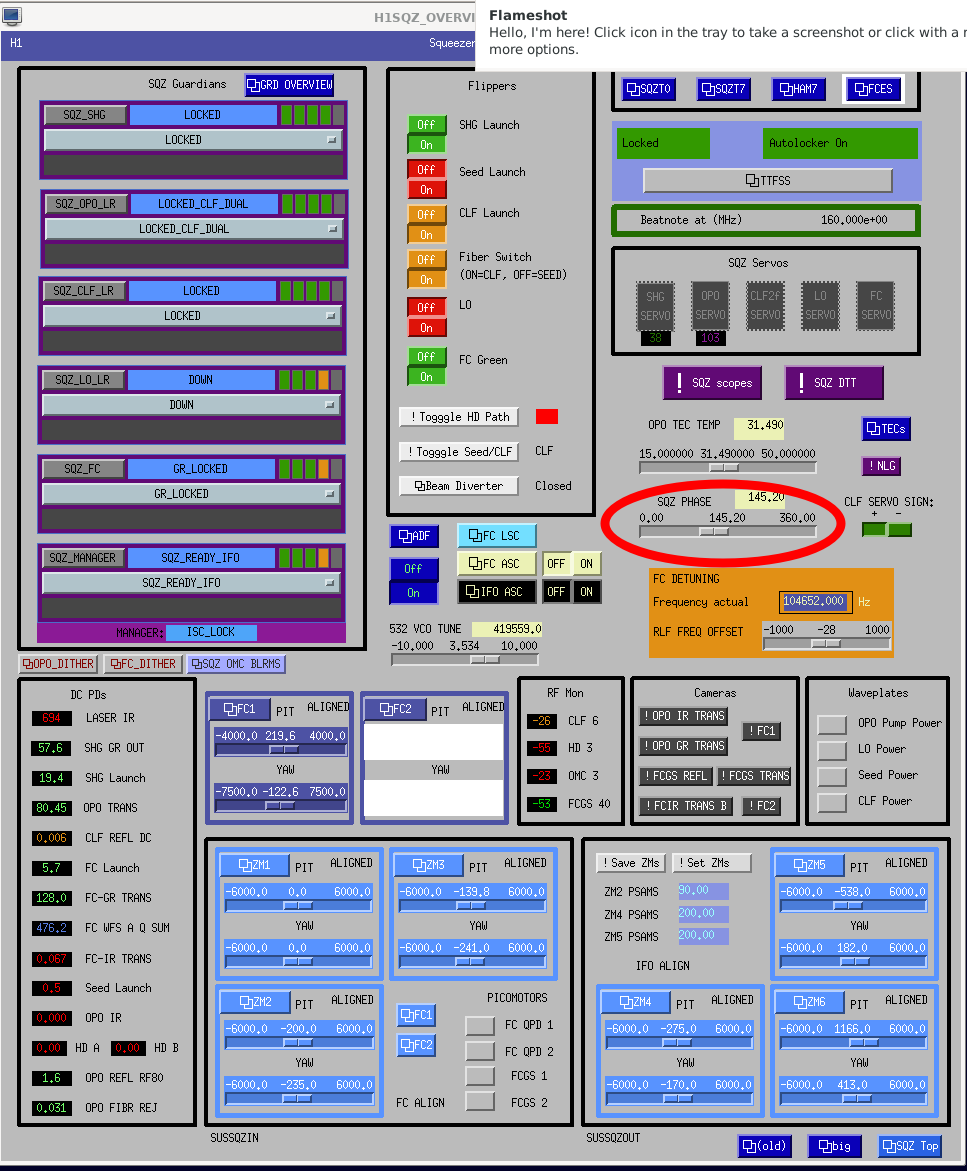
The SQZ angle will have to be retuned when we relock today. To do this, from the sitemap choose SQZ > SQZ overview to pull up the scren shown in the screenshot. You can then adjust the slider circled in red (H1:SQZ-CLF_REFL_RF6_PHASE_PHASEDEG) looking at the FOMs on NUC33 to tune the squeezing. Try to minimize the black trace on the spectrum on the bottom of NUC33.
Maintenance tasks have wrapped up but team CDS and SEI are trying to solve a problem that showed up at 19:29UTC on EndX where we lost all SEI signals (went to exactly zero). Microseis remains elevated, above the 90th percentile for the past ~16 hours and based on its trend visually it will probably take another 6 hours to get fully below that mark.
Once this issue is resolved we will resume attempting to lock.
Fil Daniel
PMC install preparation:
Auxiliary Signals Concentrator 11 PD Monitors (D2300326) installed in SQZ-R2, slot U3.
Serial Number: S2300254
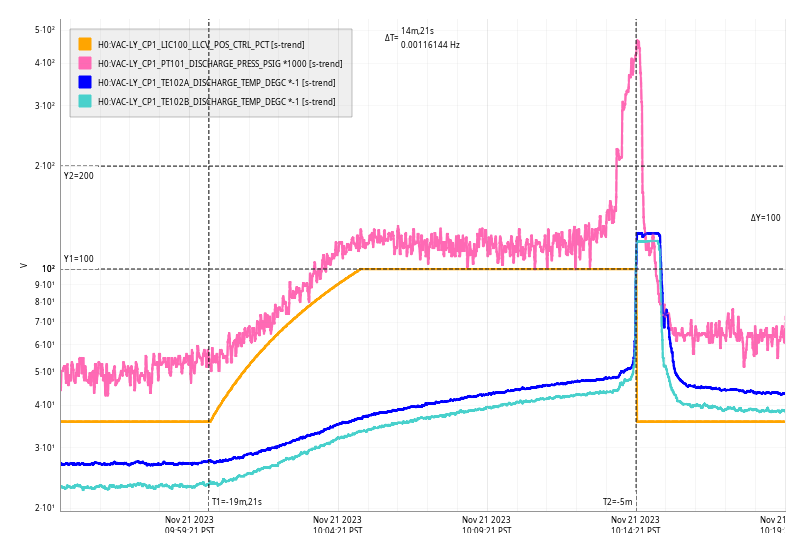
Tue Nov 21 10:14:21 2023 INFO: Fill completed in 14min 16secs
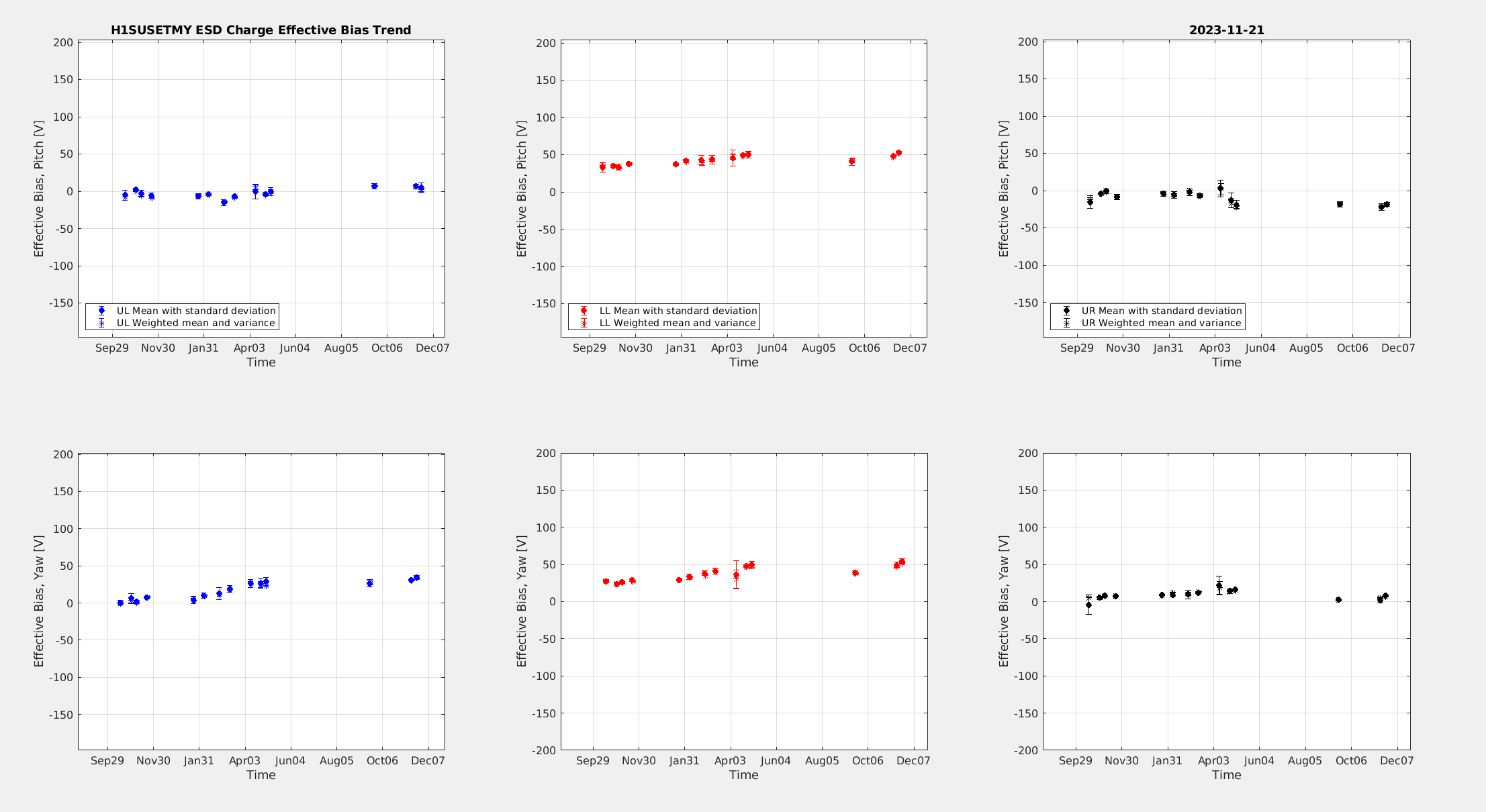
I grabbed an ETMY OPLEV charge measurement this morning before the cleanroom work started.
Naoki, Sheila
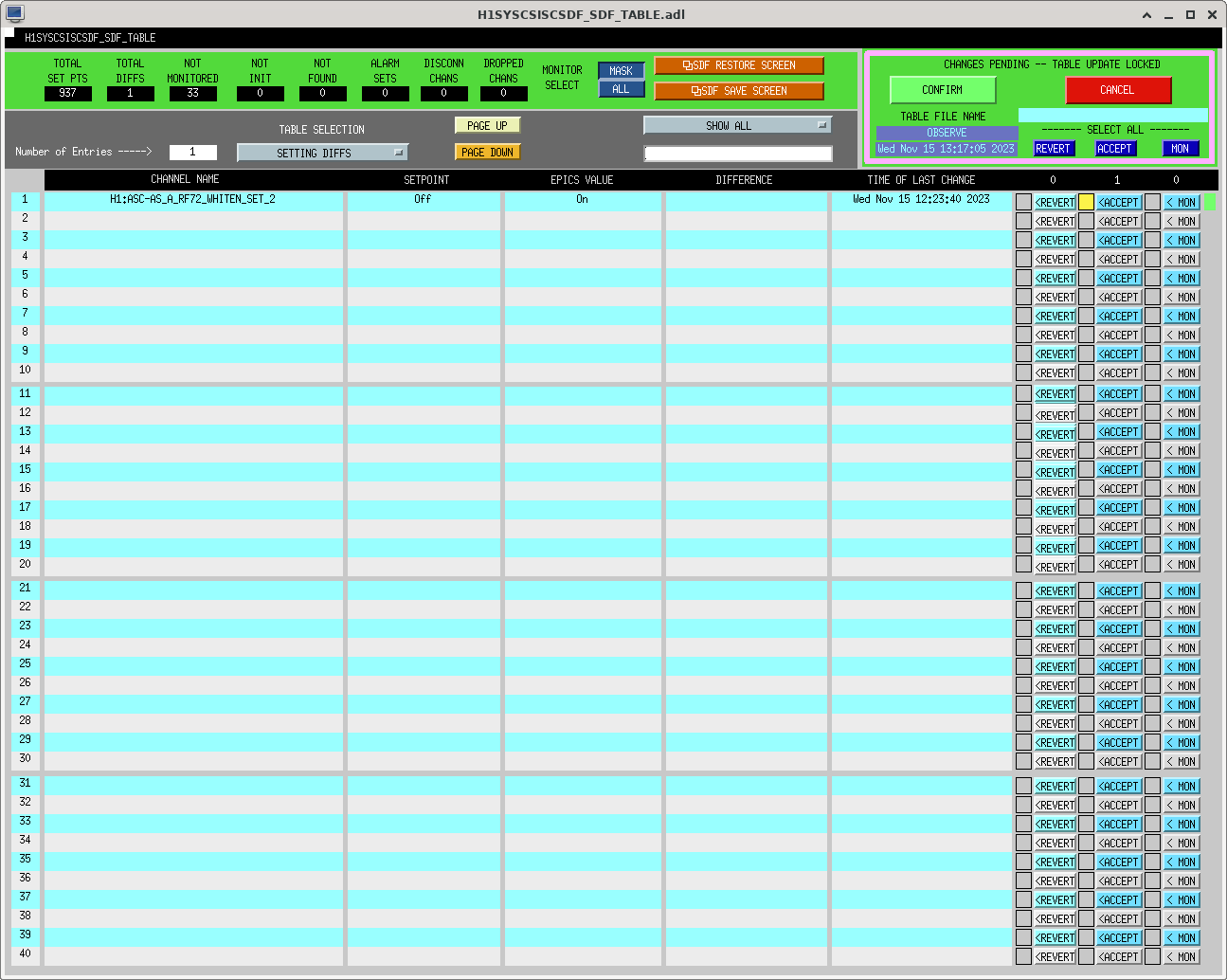
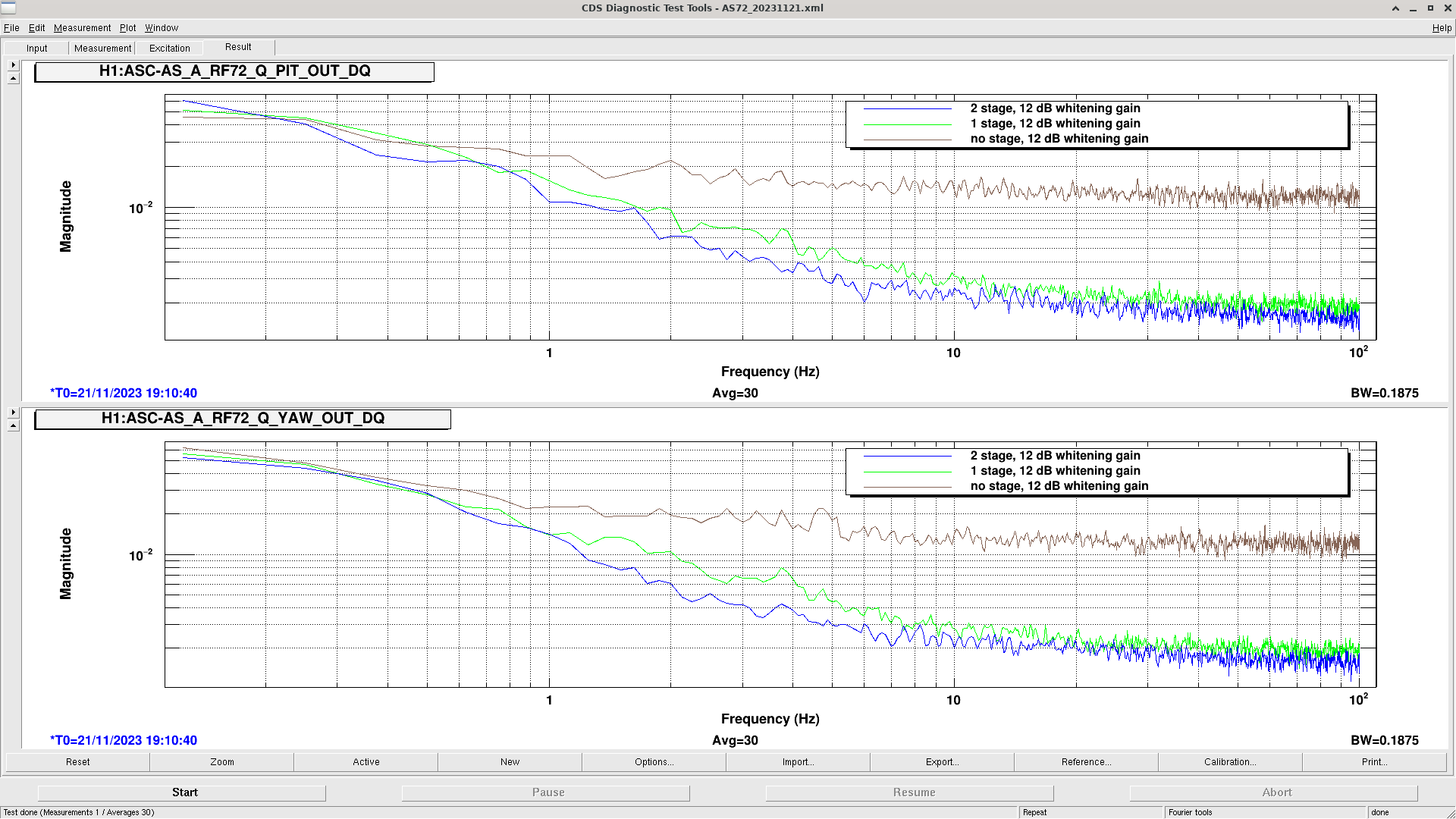
In the AS72 sensing matrix measurement in alog74106, Daniel suggested to increase the whitening gain of AS72 since it could be limited by ADC noise. We checked the whitening filter of AS72 A and B. Both of them have 12dB whitening gain, but one stage whitening is engaged for AS72 A, while two stage whitening is engaged for AS72 B. We decided to engage the 2 stage whitening for AS72 A, which is used in SRC1. The IFO locks without any problem with this additional whitening. We accepted some SDFs as shown in the attached figures. We will try to increase the whitening gain later.
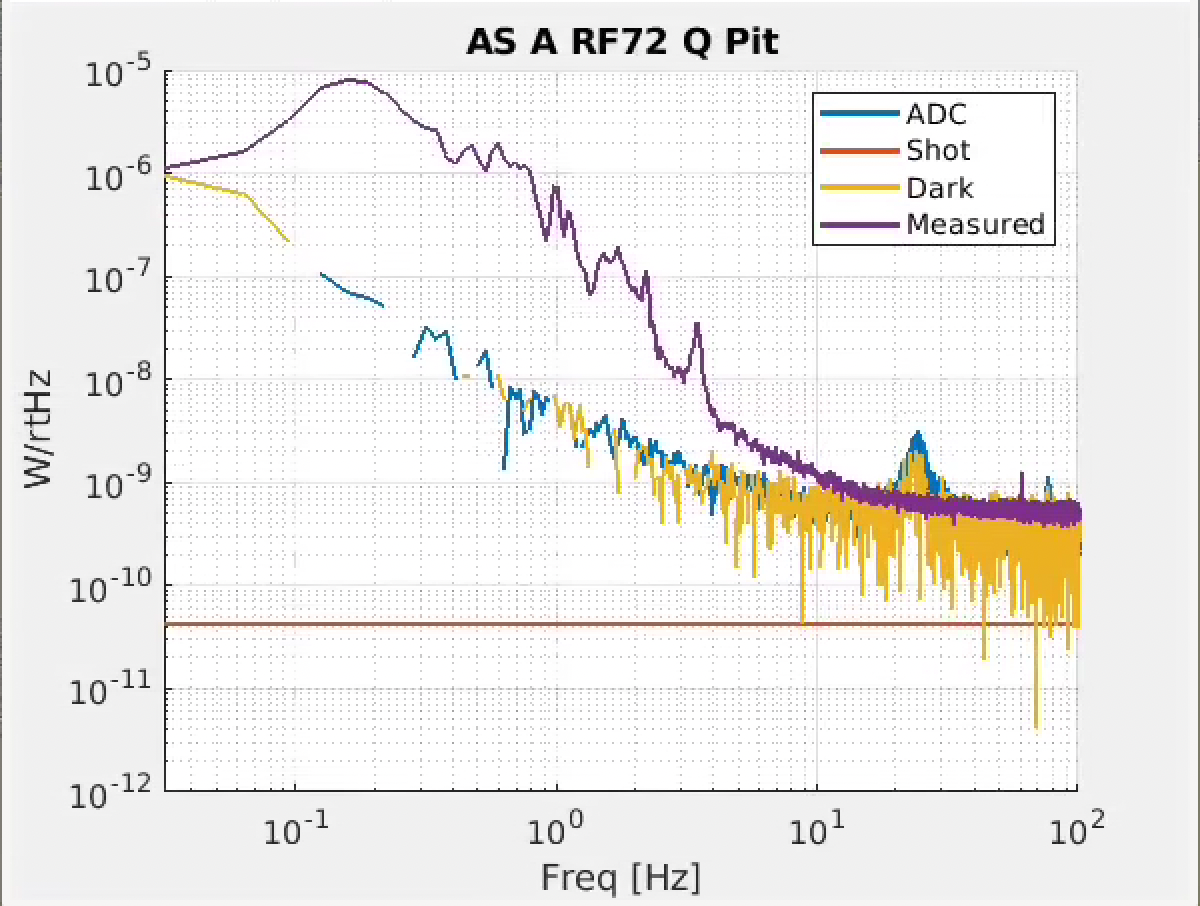
I think the attached plot shows this was a good idea. I have some old data measuring whitening and no whitening on at RF72, but I never posted it because I couldn't figure out the correct RF72 transimpedance. The attached plot shows an estimation of the ADC noise level comparison with the noise spectrum in lock. Naoki and Daniel were kind enough to help me figure out the proper transimpedance for the RF72 (see 37065).
The measurement procedure and calculation procedure is detailed in alog 66734. At the time, RF72 was using 1 stage of whitening with 12 dB whitening gain.
I think it's likely my shot noise calculation here is incorrect. Correcting that calcuation is in progress...
During Tuesday maintenance and IMC_LOCK is OFFLINE, I measured the AS72 dark noise with different whitening setting. The attached figure shows the dark noise of AS72 A Q PIT/YAW, which are used in SRC1. The 2 stage whitening and 12 dB whitening gain are the current nominal setting. In the previous Elenna's measurement, there was a bump around 25 Hz, but there is no bump in today's measurement.
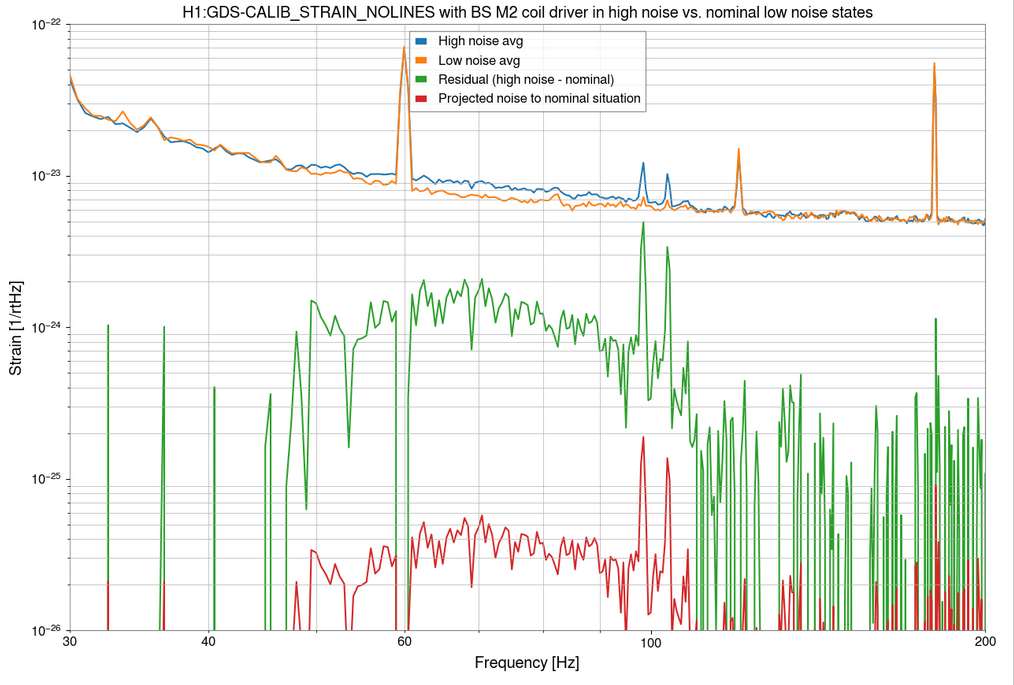
I went back and forth (~5 mins each) with the BS M2 coil drivers between their nominal low noise state, and their higher noise higher range state.
When in the higher noise state (state 2), there seems to be consistently higher noise between about 55 Hz up to 100 Hz. In the attached plot the blue / green is the nominal low noise state, while red / pink is the high noise state.
I'll work on making this an actual noise projection that we can include in the noise budget, using Craig's code for quad PUM noise as a guide.
We were in the high noise state 2 from 20:56:45 - 21:04:00. Then in low noise state from 21:06:10 - 21:11:15 (there's a glitch during this time). Back to high noise from 21:13:20 - 21:19:40 (there's a small glitch during this time). Back to low noise from 21:21:50 - 21:28:00. All times UTC on 8 Nov 2023. After this I handed back to Robert.
I've finally had a look at projecting this noise to what it looks like in our nominal state.
I'm 'following along' the philosophy of Craig's quad coil driver noise projections in https://git.ligo.org/aligo_commissioning/labutils/-/blob/master/coil_drivers_state_switch/plot_all_quad_pum_switch.py
I take an average of the ASDs of the noisy time (blue trace), and an average of the nominal quiet time (orange trace), then subtract them to get the excess power (green trace). I then take the residual excess power, and divide by the ratio of filters that are different between the two times, and that gives the projection of this excess power to our nominal state (red trace).
The attached plot shows that the projected noise (red) is more than a factor of 100x below our nominal sensitivity (orange), so BS M2 coil driver noise should not be an (immediate) issue for us.
The notebook is in /ligo/home/jenne.driggers/LHO_work/2023_11_21_BS_coil_driver_noise_budget/BS_coil_driver_noise_projection.ipynb