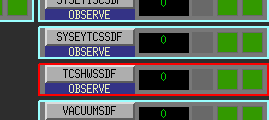
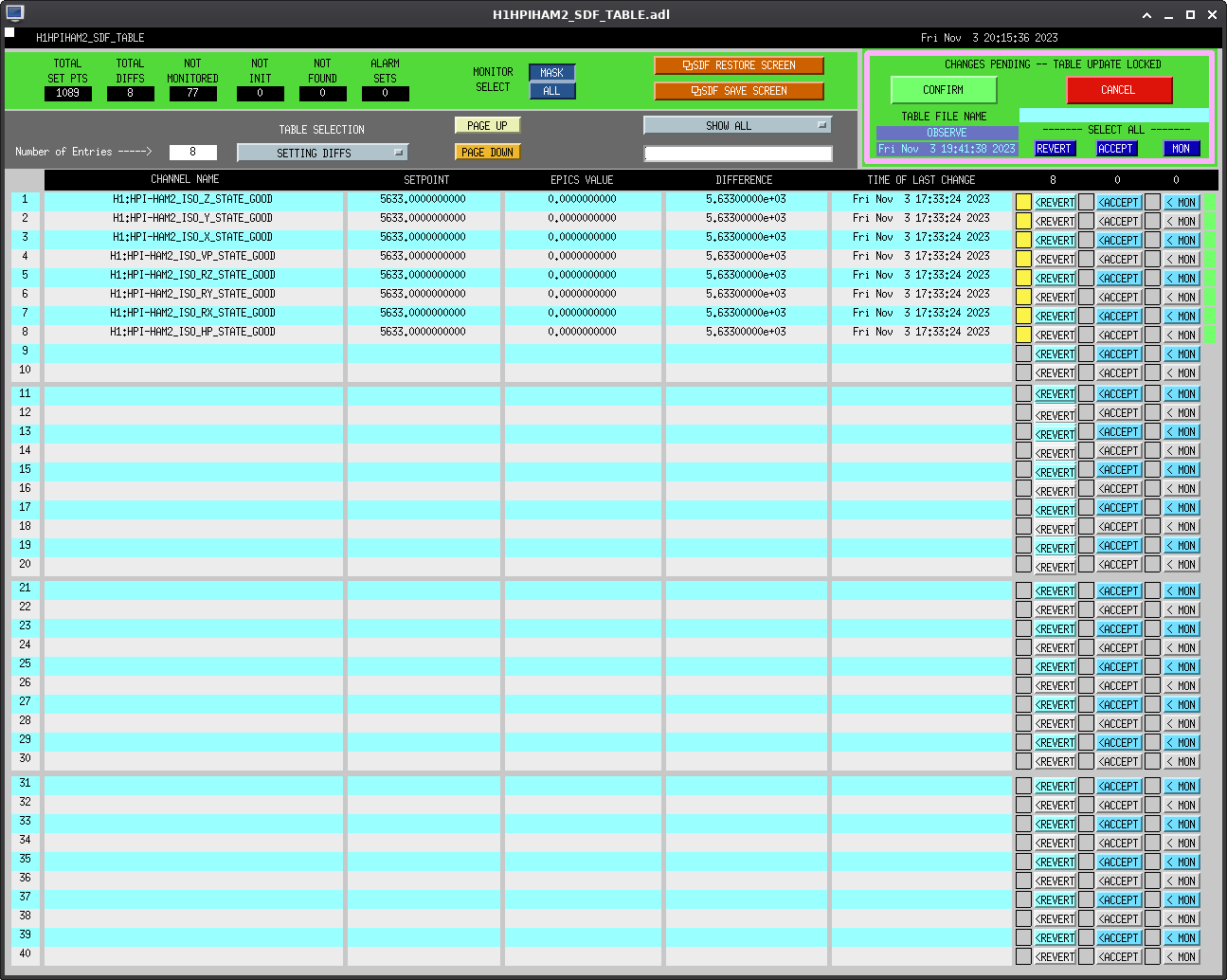
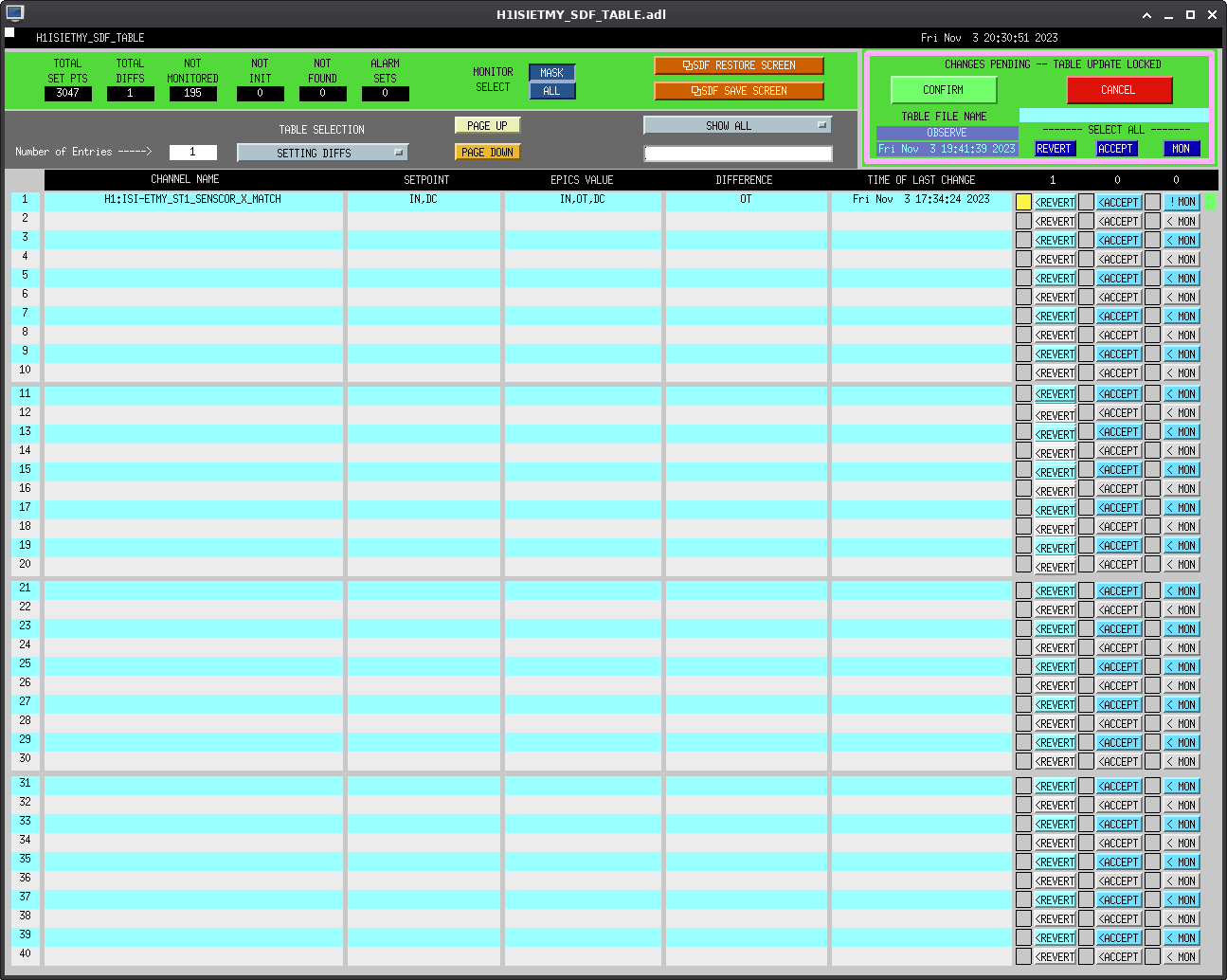
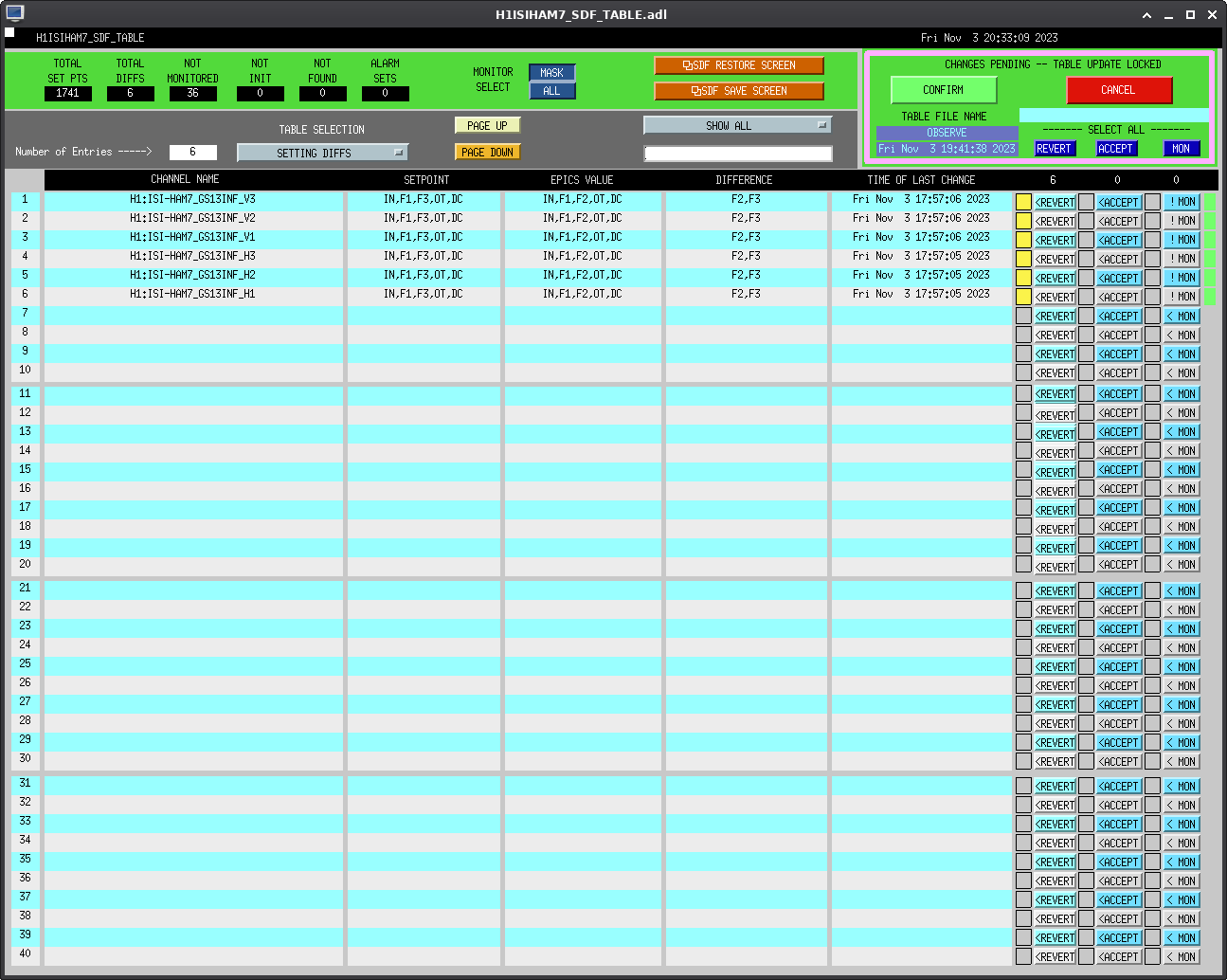
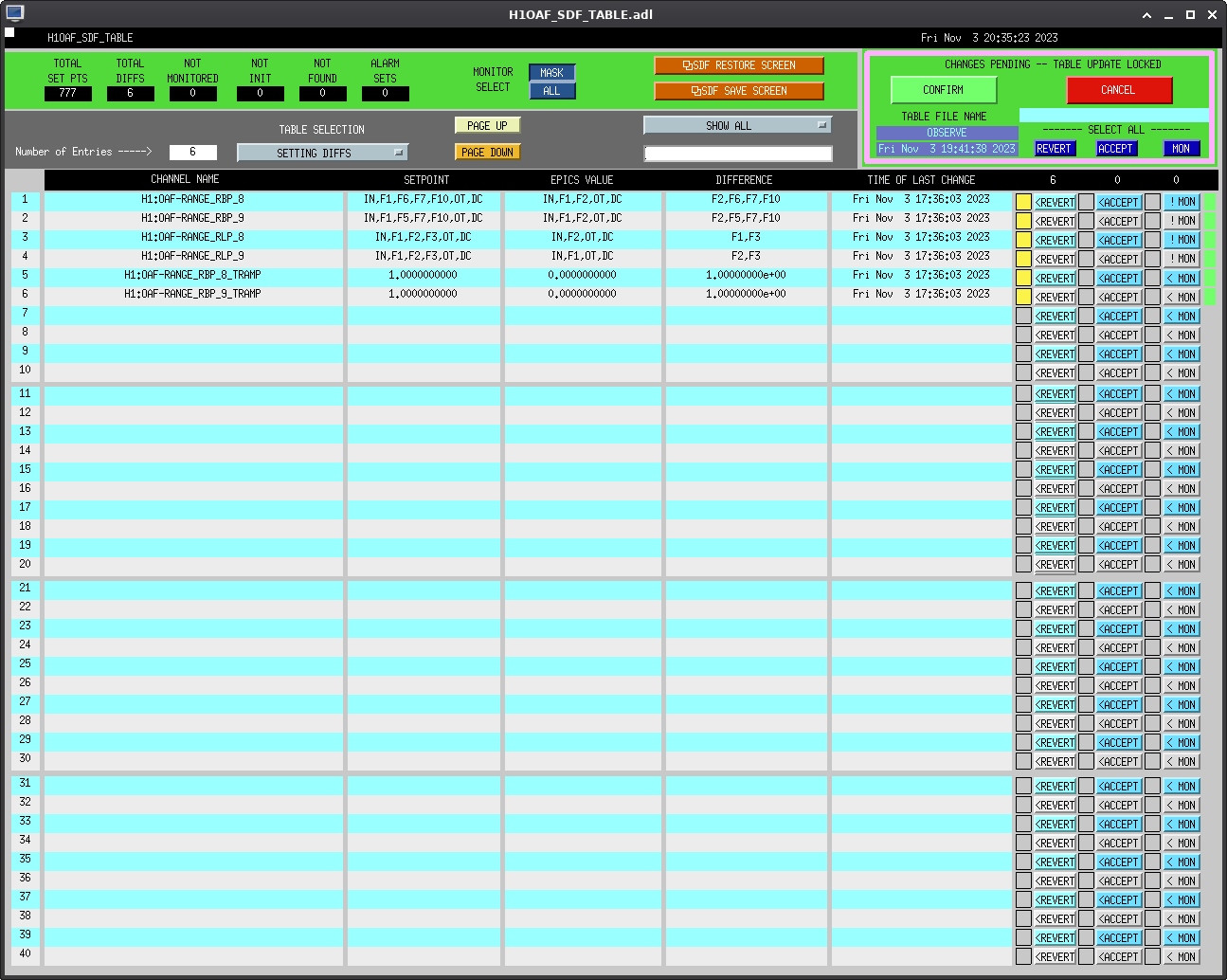
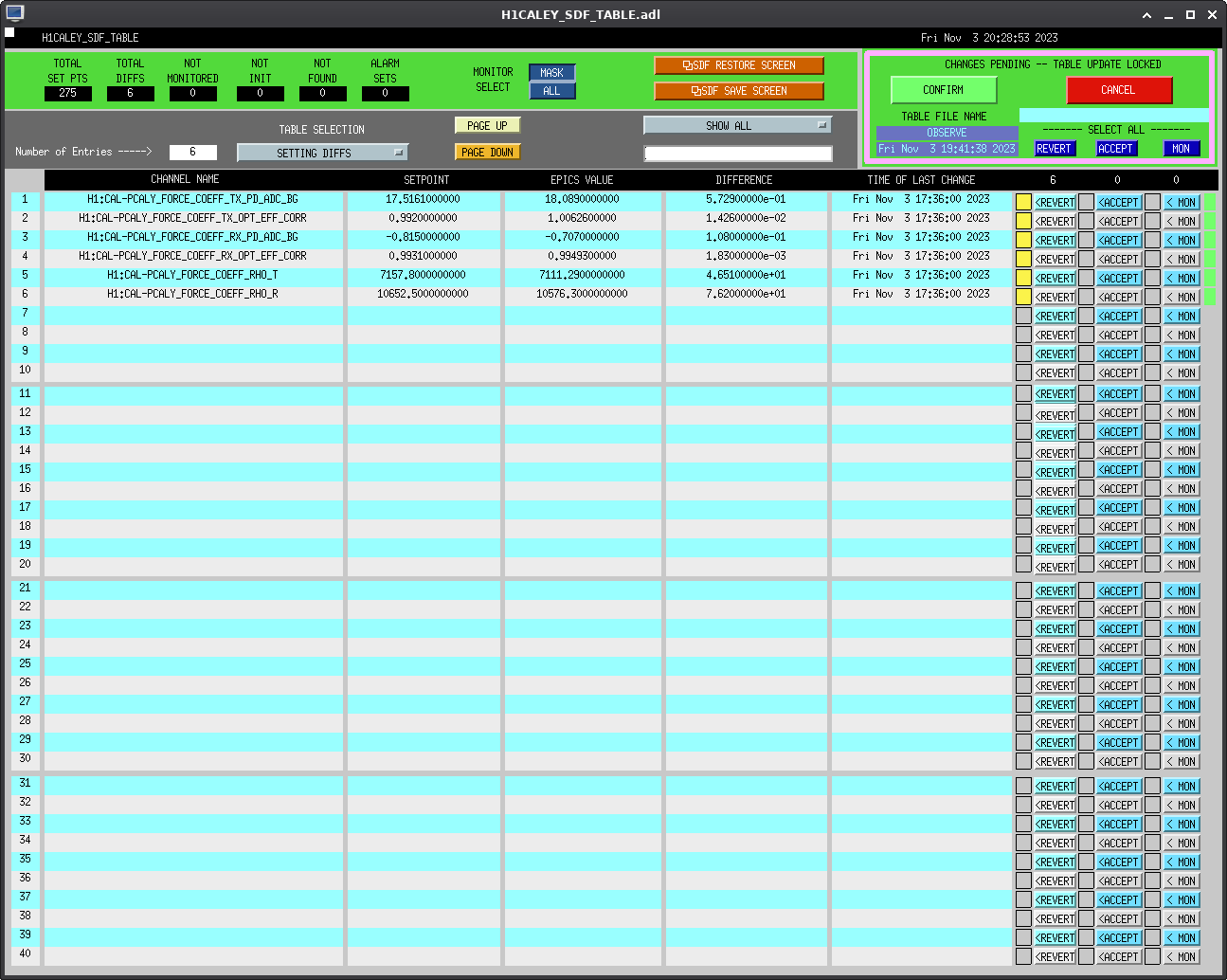
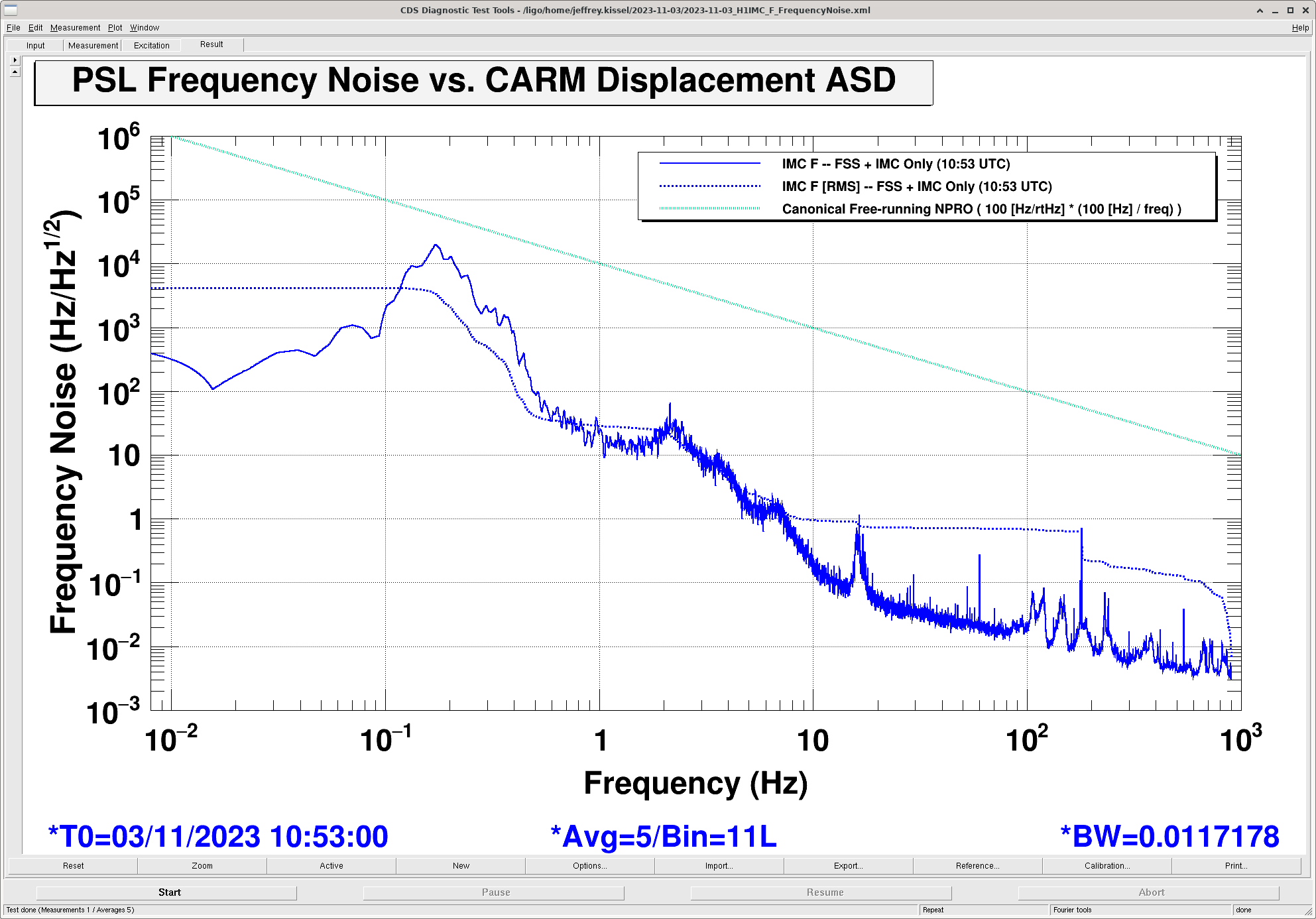
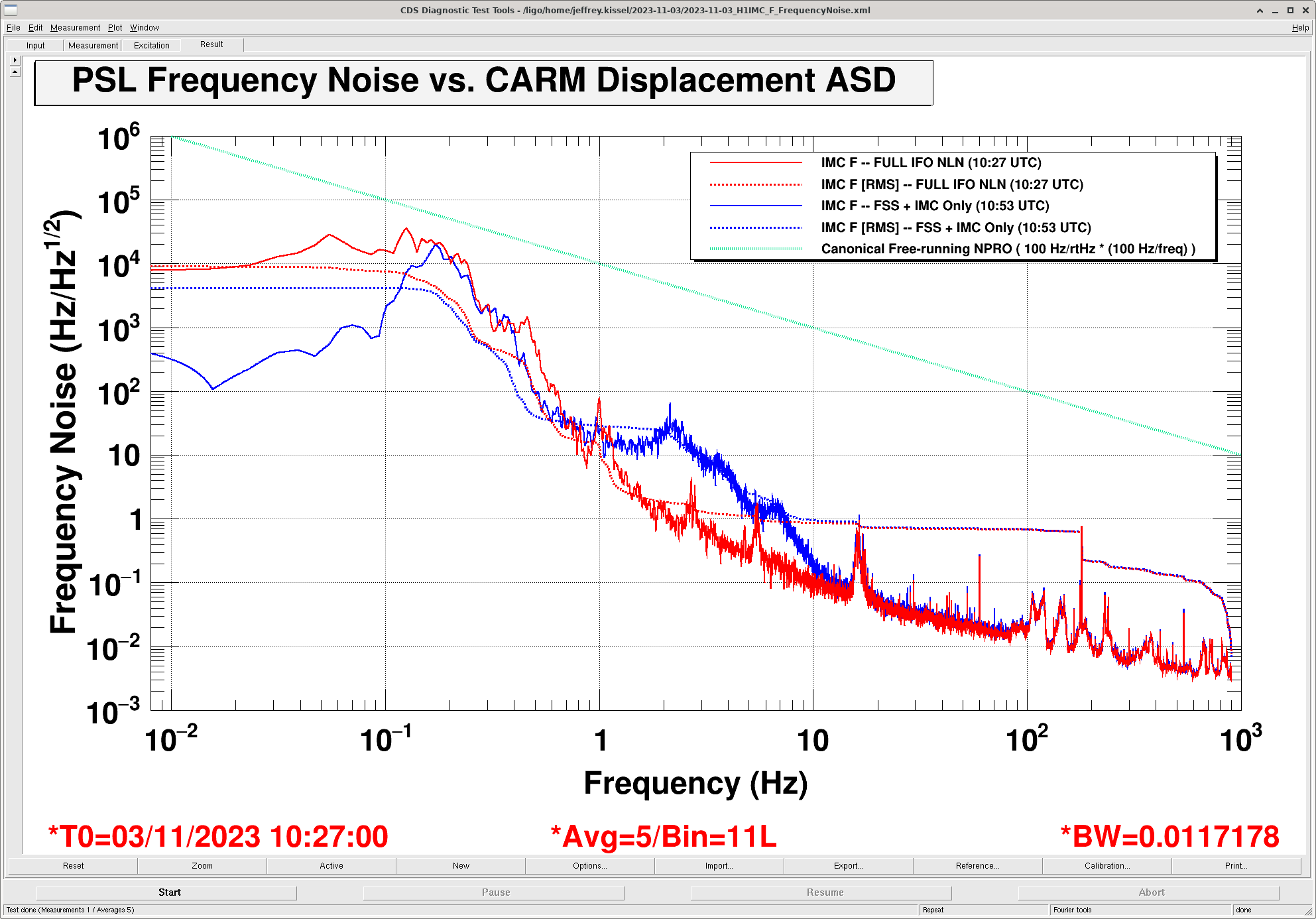
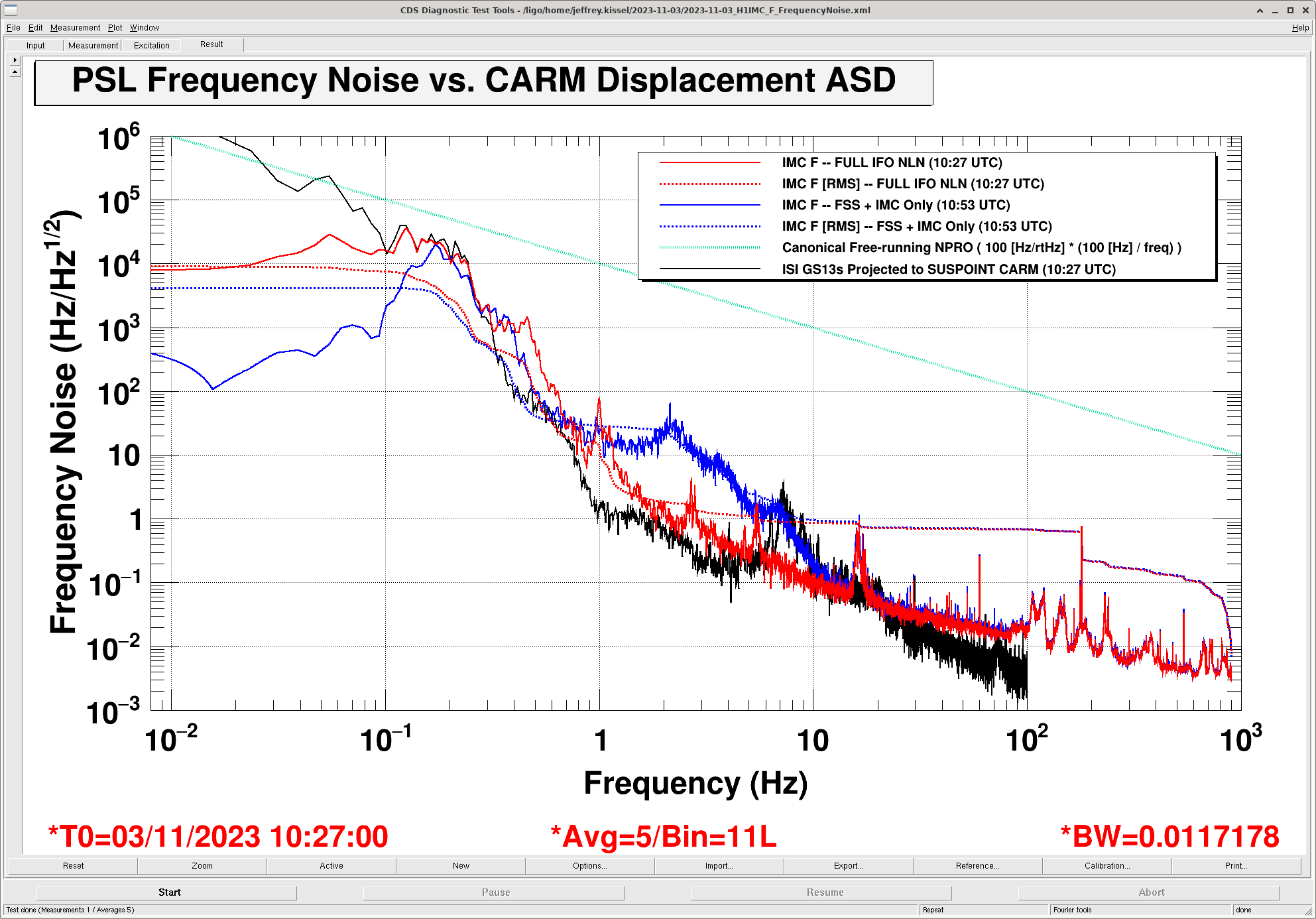
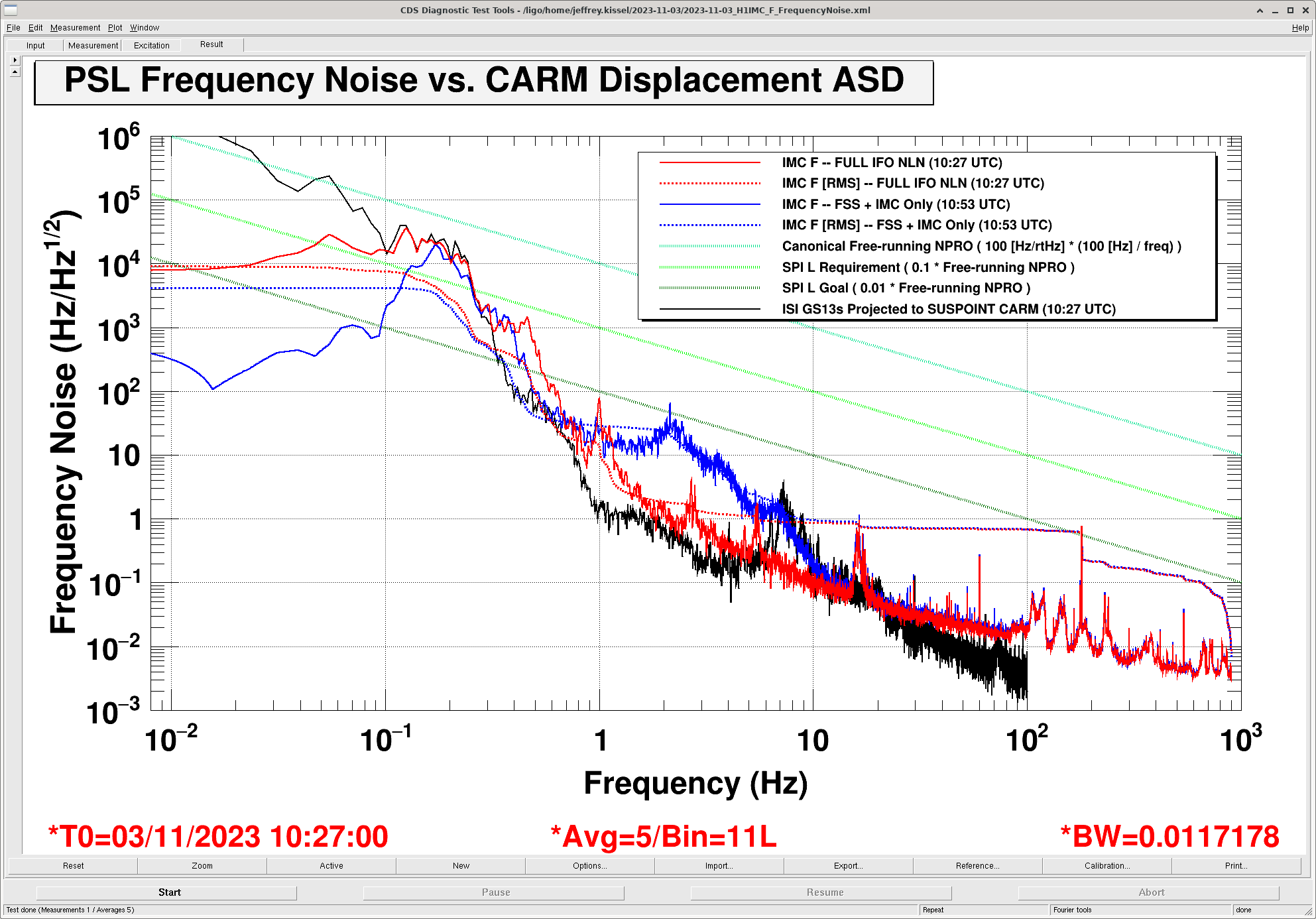
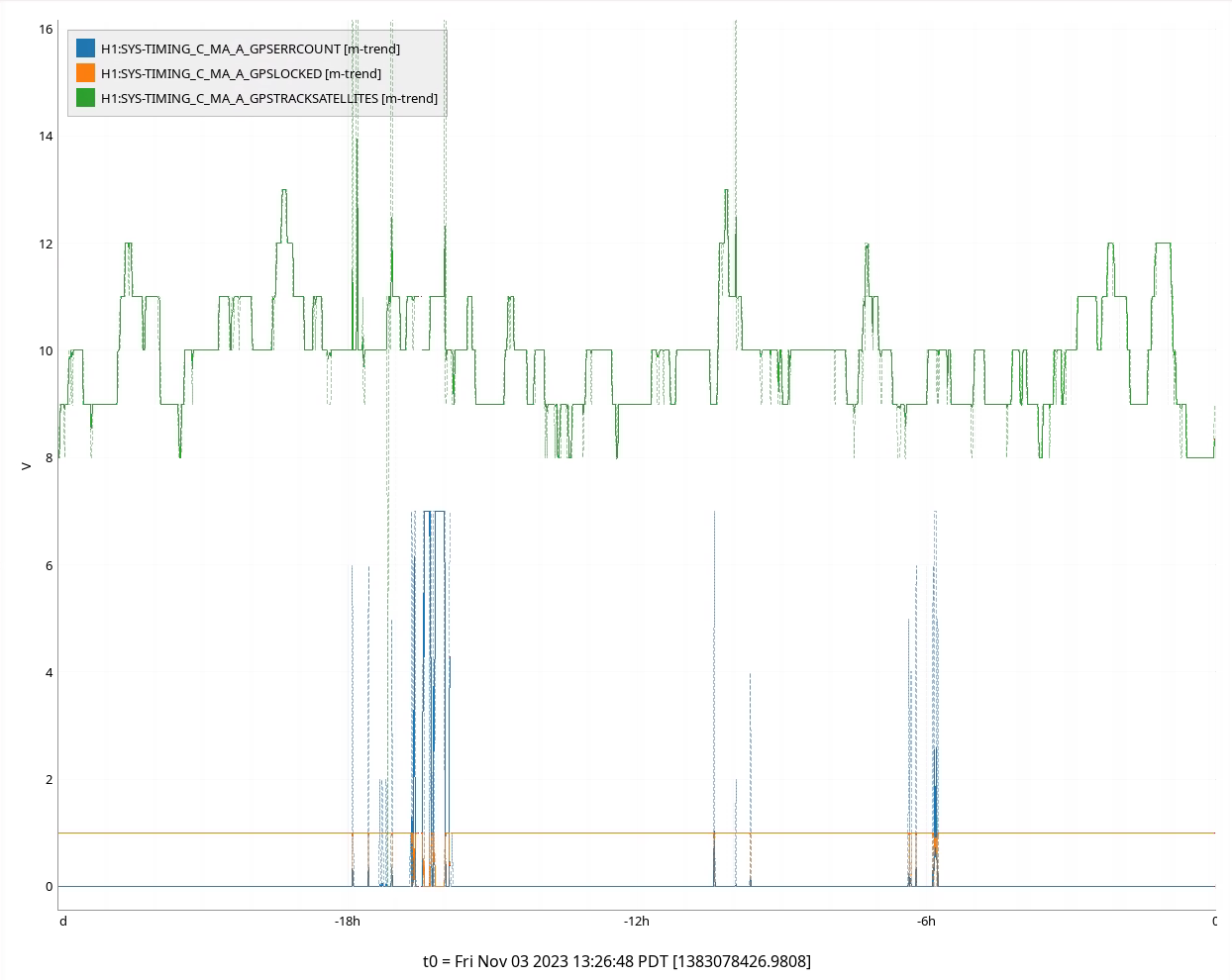
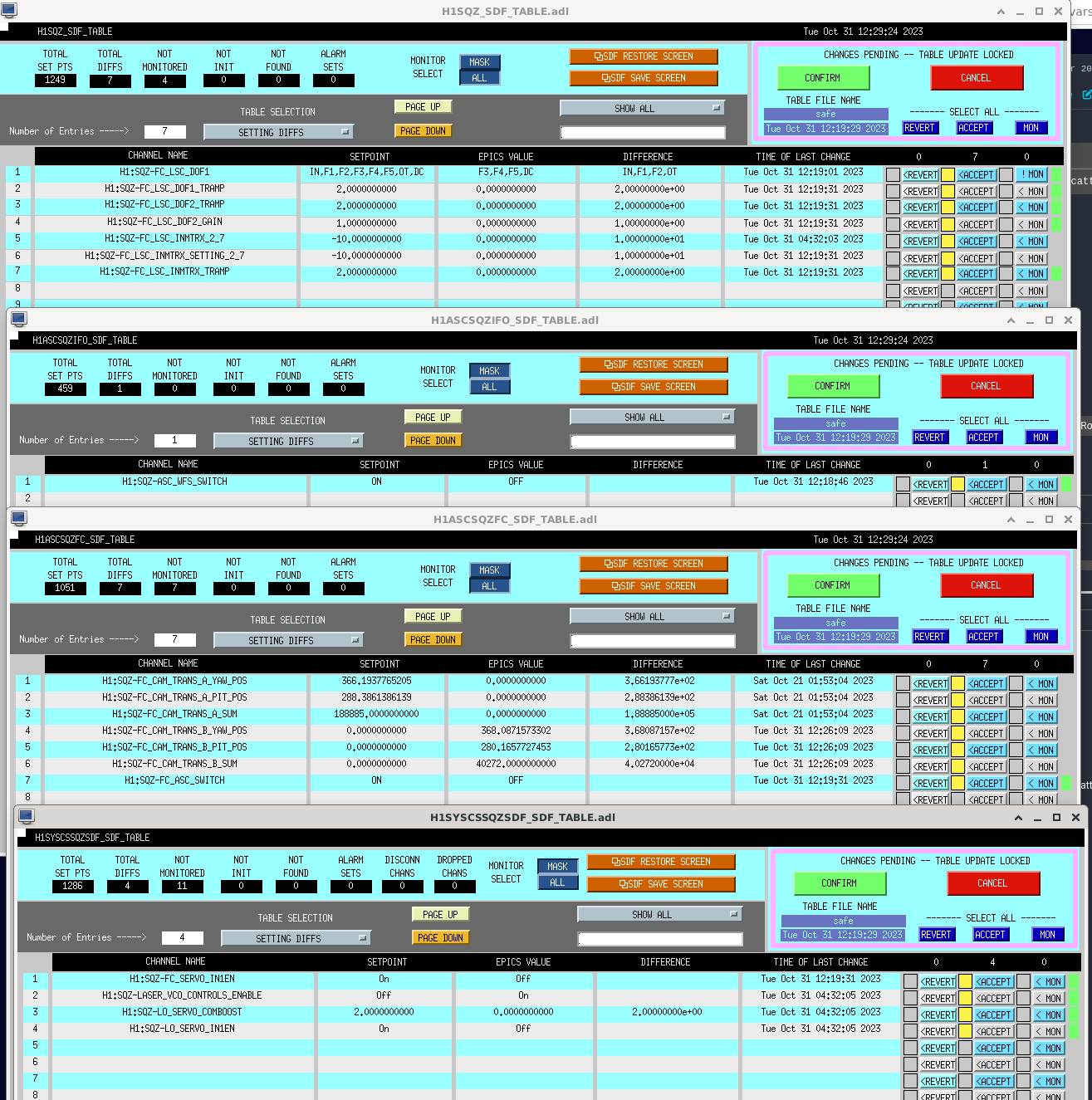
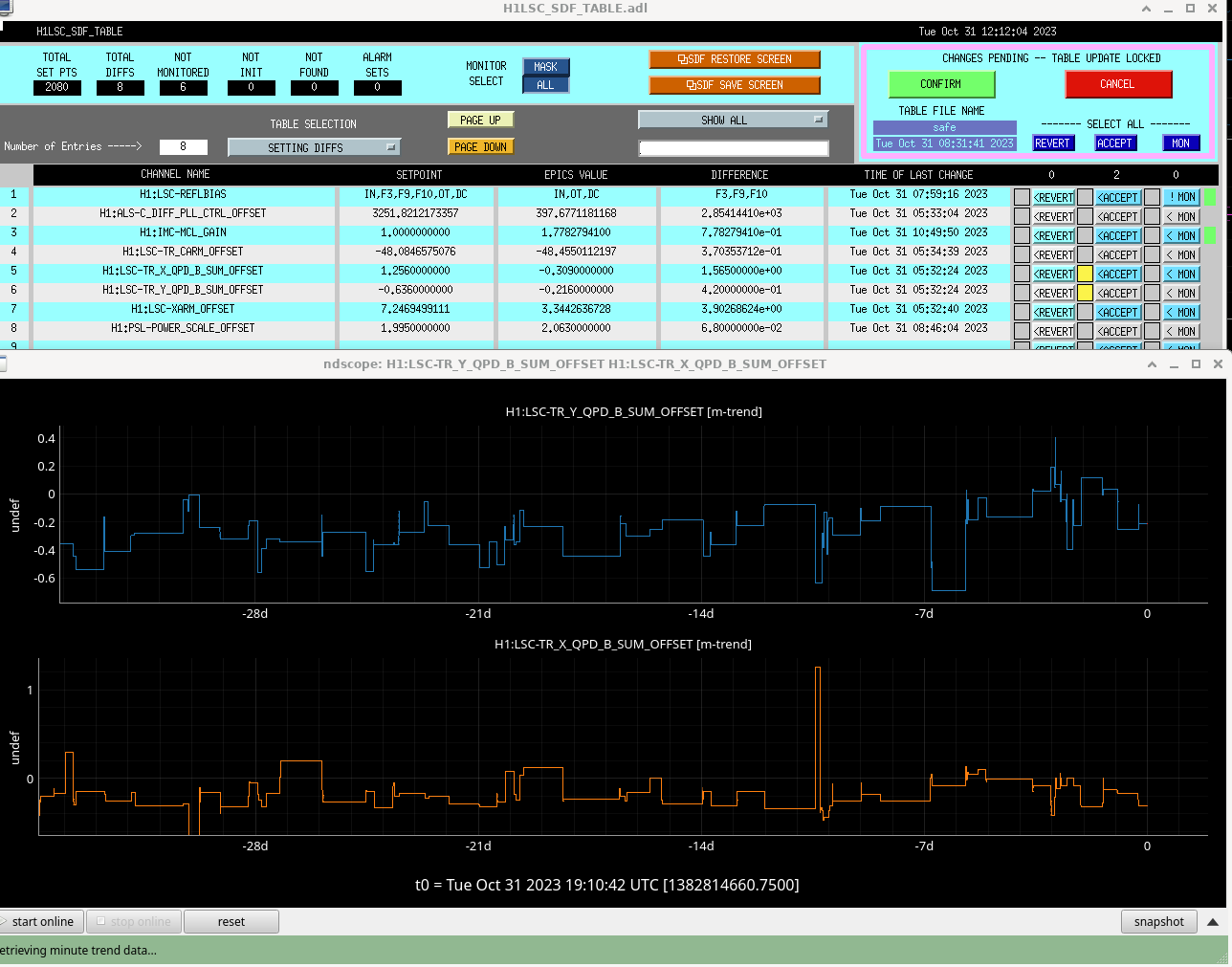
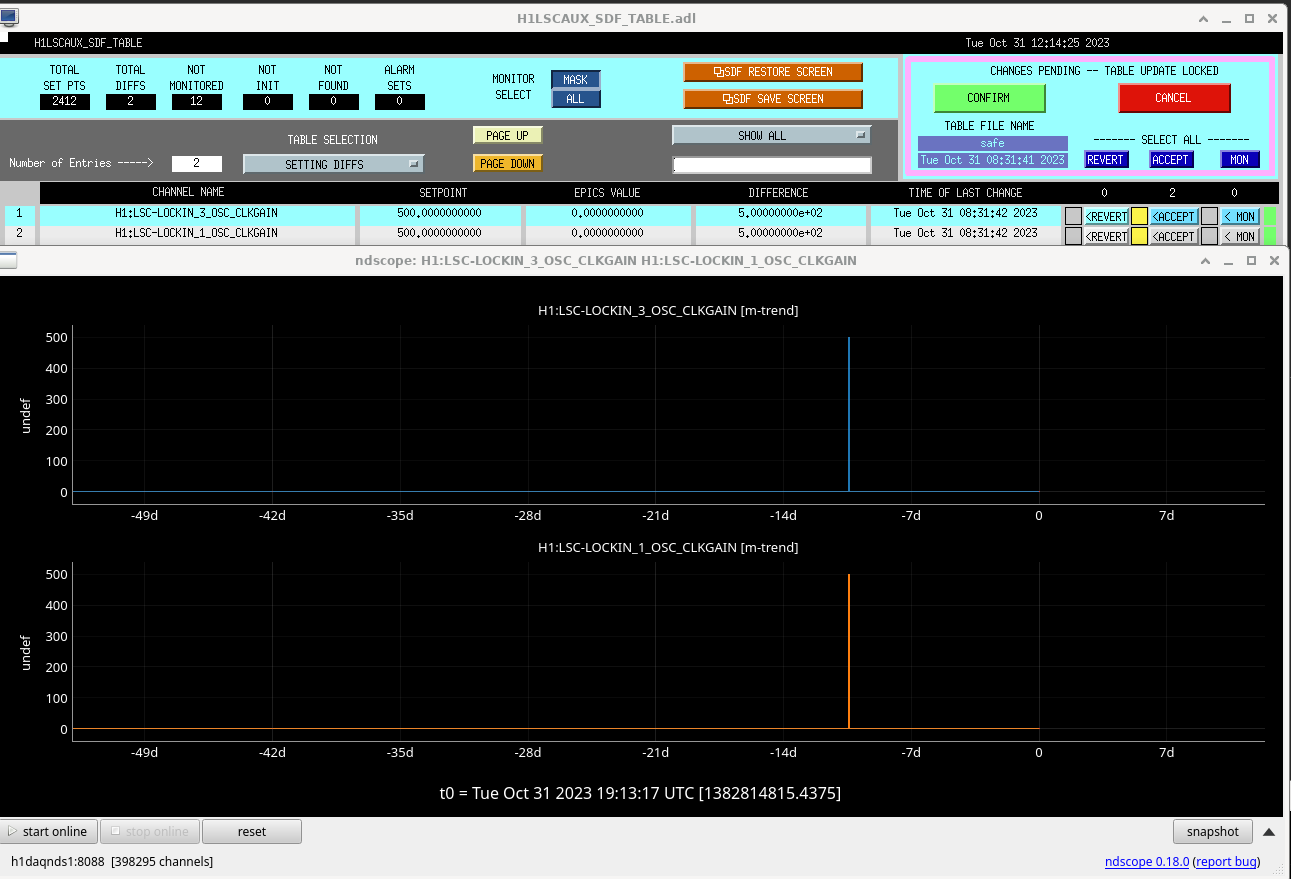
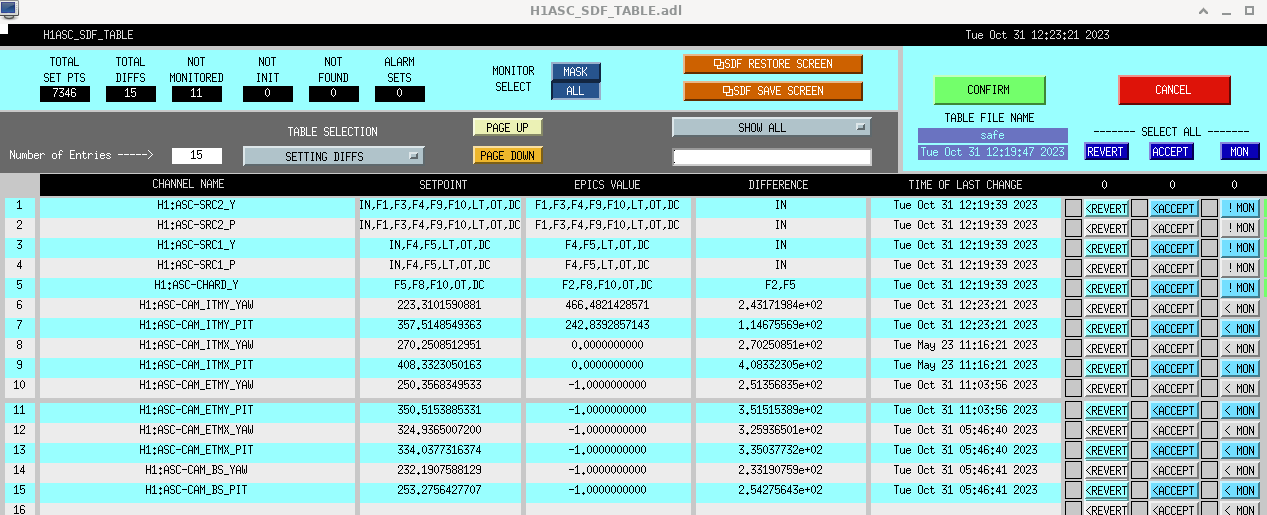
Spoke to Gabriele about these SDF Diffs and we are accepting them now.
Current IFO Status:
Since Livingston is down for Logging, H1 Has intentionally dropped into commissioning.
TITLE: 08/10 Day Shift: 15:00-23:00 UTC (08:00-16:00 PST), all times posted in UTC
STATE of H1: Observing at 145Mpc
OUTGOING OPERATOR: Corey
CURRENT ENVIRONMENT:
SEI_ENV state: CALM
Wind: 4mph Gusts, 2mph 5min avg
Primary useism: 0.01 μm/s
Secondary useism: 0.08 μm/s
QUICK SUMMARY:
IFO H1 is locked in NOMINAL_LOW_NOISE and OBSERVING
Following up on 71969, here are two examples of times where the bumps at multiples of 10 Hz were very visible. This seems to be the largest source of non-stationary noise and glitches at low frequency.
H1 had a lockloss at 7:05utc (1205amPT)---which was fairly close to lockloss with L1 which had all the earmarks of an earthquake, but did not see any signs on the SEI FOM.
Automation tried to bring H1 back, but unfortunately, it did not look good, so an Initial Alignment was automatically run from 733-759. From 800-850 H1 worked on getting to NLN (received operator alert at 851utc)---because H1 was waiting for the CAMERA SERVO to get to OBSERVING. At 910utc the CAMERA SERVO completed and H1 automatically taken to OBSERVING with little fanfare.
TITLE: 08/10 Eve Shift: 23:00-07:00 UTC (16:00-00:00 PST), all times posted in UTC
STATE of H1: Observing at 151Mpc
INCOMING OPERATOR: Corey
SHIFT SUMMARY:
Lock#1:
Relocking from the lockloss right before I arrived, couldn't get DRMI or PRMI (No good flashes), went through CHECK_MICH then back to PRMI which loss lock, we then ran an initial alignment which went very smoothly. Back up to NLN at 00:16.
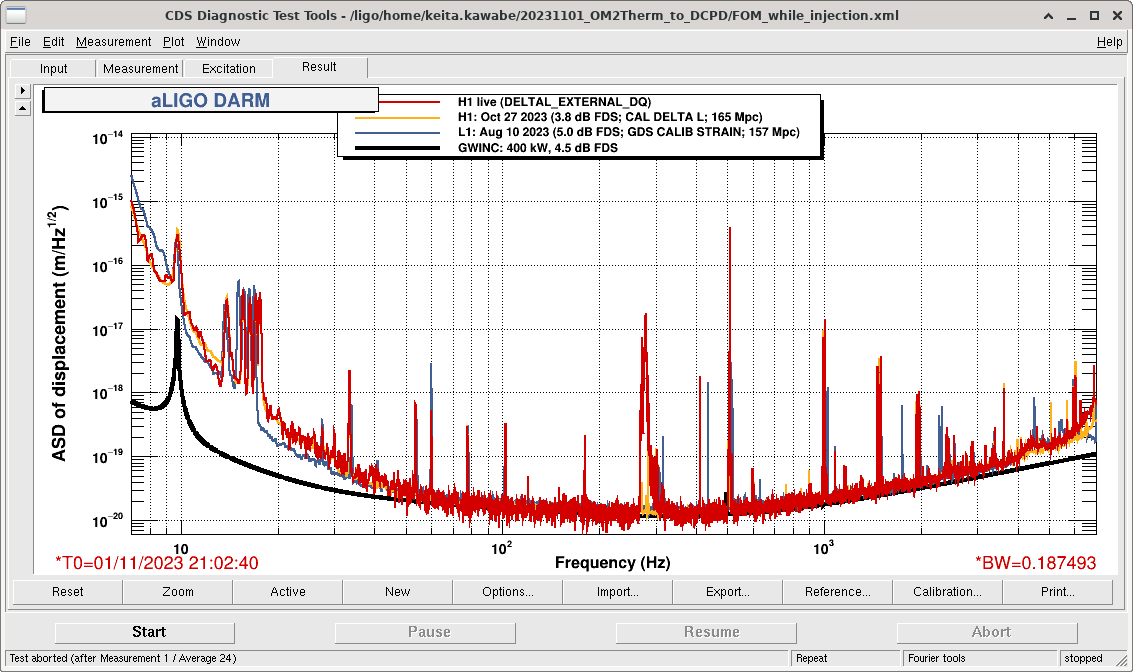
We noticed there was a large line at 102.1Hz upon getting to NLN which seemed to be lowering our range by 5-15 Mpc. It's shrinking as time goes on and our range is increasing as it comes down. There's also something on the 100-450Hz BLRMs during the same time frame, also decreasing. After 2 hours it was back down around if not below the reference
We had a range of 159.15 Mpc for a minute!
We dropped out of Observing due to the squeezer losing lock at 03:47UTC, back into Observing 03:50UTC.
The ISS diffracted power is low, DIAG_MAIN flashes a message about it every few minutes
LOG:
| Start Time | System | Name | Location | Lazer_Haz | Task | Time End |
|---|---|---|---|---|---|---|
| 23:38 | PEM | Robert | LVEA ->EX | N | Move an amplifier | 00:00 |
| 00:22 | ASC | Elenna | CR | N | Measurement | 00:48 |
Closes FAMIS 25078
The charge measurements were not run this past Tuesday the 8th due to a lockloss and ALS-X issue, alog72054.
STATE of H1: Observing at 144Mpc
Wind: 29mph Gusts, 23mph 5min avg
We've been locked for 2:45, we reached 159.15 Mpc for a minute! The wind and accompanying ground motion has been increasing the past 2 hours.
Dropped out of observing at 03:47UTC from the squeezer losing lock, back into observing 03:50UTC after it relocked
This SQZ lockloss was because the OPO PZT bottomed out ~40V, so this is an known/expected reason for the squeezer to relock. See attached trends of squeezer relocking.
Today I took "unbiased" OLGs of MICH P and MICH Y (see 67187 for a discussion of unbiased measurements and methods). These loops have not been measured since Gabriele and I updated the loop design in May (69370).
The templates for the these measurements are saved in [userapps]/asc/h1/templates/MICH as 'MICH_{P,Y}_olg_broadband_shaped.xml'. I obtained 40 averages at a 0.015 Hz bandwidth, so it took about 20 minutes to run each measurement.
I have plotted the open loop gain with error shading in the attached plots. You can find the same measurement templates, exported data, and processing code in '/ligo/home/elenna.capote/DRMI_ASC/MICH'.
MICH P appears to have a UGF of 1 Hz with a phase margin of 46 deg. MICH Y appears to have a UGF of 0.55 Hz with a phase margin of 35 deg.
I believe Gabriele and I sought to reduce the UGF of MICH Y more than MICH P because at the time, MICH Y contributed more to the ASC subbudget from 10-30 Hz. However, we are now seeing significant upconversion of low frequency motion in DARM that limits the sensitivity from 20-40 Hz. I will revisit this loop design and prioritize more low frequency suppression to see if we can reduce the DARM RMS further.
Based on this measurement of MICH Y, it appeared the loop is stable for a 13 dB increase in gain, which would put the UGF closer to 1 Hz like MICH P. I raised the gain by a factor of 4, and the loop is stable and there doesn't appear to be excess noise in DARM. I ran a quick injection to check the level of MICH Y relative to DARM.
MICH Y gain is now -2.4 (was -0.6). This is updated in the guardian (lownoise ASC) and SDFed.
A few minutes after posting, Sheila and I noticed CSOFT Y motion increased significantly and the noise in DARM between 20-30 Hz worsened. This extra noise and motion reduced as I reduced the MICH Y gain back to -0.6. Looking at the spectra and RMS of both MICH Y IN1 and LSC DARM IN1, it appears that although the overall RMS of both decreases with the higher gain, the higher gain also increases a 1.3 Hz peak in both MICH Y and DARM. I am undoing these changes and keeping the MICH Y gain nominal (-0.6).
The changes in environmental coupling with the change from 75W to 60W ( https://alog.ligo-wa.caltech.edu/aLOG/index.php?callRep=70808 ) require that we re-measure some of the coupling functions that were measured in the pre-run set of PEM injections in May. Today I began those injections by injecting acoustically in the LVEA, as well as shaking HAM6 and the ITMY cryopump. I also set up for acoustic injections at EX.
In addition Sheila and I did some bias manipulation for ETMX. I injected currents onto the EX building ground and swept the ETMX bias as I had in January (https://alog.ligo-wa.caltech.edu/aLOG/index.php?callRep=67075). The figure shows that there has not been much change in the bias setting that minimizes grounding noise.
TITLE: 08/09 Day Shift: 15:00-23:00 UTC (08:00-16:00 PST), all times posted in UTC
STATE of H1: Commissioning
OUTGOING OPERATOR: Tony
INCOMING OPERATOR: Ryan C
CURRENT ENVIRONMENT:
SEI_ENV state: CALM
Wind: 17mph Gusts, 13mph 5min avg
Primary useism: 0.02 μm/s
Secondary useism: 0.08 μm/s
QUICK SUMMARY:
Comissioners started running test and injections early this morning.
RO Alarm from H0:FMC-CS_WS_RO_ALARM 16:26 UTC
FIRE DRILL Lockloss 17:00 UTC
https://alog.ligo-wa.caltech.edu/aLOG/index.php?callRep=72097
Relocking started while everyone was out side 17:02 UTC
NOMINAL_LOW_NOISE reached at 17:58 UTC
Camera servos finished at 18:11 UTC
Comissioners spent most of the day doing PEM Injections and ASC Open loop measurements.
22:51 UTC Lockloss Unknown cause 10 minutes before Hand off to Ryan C.
https://alog.ligo-wa.caltech.edu/aLOG/index.php?callRep=72112
Current IFO Status relocking in AQUIRE_PRMI
| Start Time | System | Name | Location | Lazer_Haz | Task | Time End |
|---|---|---|---|---|---|---|
| 15:52 | PEM | Robert | Ctrl Rm | N | PEM Injections | 17:54 |
| 15:56 | PEM | Robert | LVEA | N | PEM Injection setup | 16:33 |
| 16:41 | Electric | Ken | Mid Y | n | Replacing lights | 22:02 |
| 16:42 | FAC | Cindy | MEchanical Room | N | technical cleaning. | 17:54 |
| 19:07 | FAC | Cindi | H2 | N | Technical cleaning | 19:20 |
| 19:20 | PEM | Robert | Ctrl Rm | N | PEM Injections | 21:20 |
| 19:55 | ASC | Elena | Ctrl Rm | N | ASC Open Loop Gain Measurements | 20:27 |
| 20:11 | EE | Fil | PCAL Lab | Local | Installing a Laser stop button | 22:11 |
| 21:09 | Tour | jenne & Co. | Roof | n | Tour which includes a View from the roof. | 21:39 |
| 21:53 | PEM | Robert | EX | N | Setting up PEM Injections | 22:53 |
TITLE: 08/09 Day Shift: 15:00-23:00 UTC (08:00-16:00 PST), all times posted in UTC
STATE of H1: Commissioning
OUTGOING OPERATOR: Tony
CURRENT ENVIRONMENT:
SEI_ENV state: CALM
Wind: 18mph Gusts, 10mph 5min avg
Primary useism: 0.03 μm/s
Secondary useism: 0.08 μm/s
QUICK SUMMARY:
I've used the attached "script", which is also in userapps/lsc/h1/scripts/DARM_transitions, to transition DARM control from the ETMX ESD to ITMX, leaving the upper stage control on EX.
The attached screenshot shows the DARM OLG in the normal configuration (EX bias 130V, drivealign gain 184.65) and in the current configuration (IX bias -428V drivealign gain -108.4V).
Robert did a ground injection while sweeping the EX bias.
I then switched the ESD bias back to -125V, and started to switch the DARM control back to EX starting with the settings in 66751. This matched the DARM gain pretty well, with a discrepancy in the OLG measured at 200 Hz of .15%. I didn't have time to do a broadband pcal measurement before we lost lock, but this should have kept the calibration OK. Interestingly, the increase in DARM noise seen in 66751 and 66814, as shown in the attached screenshot.
We were in this configuration starting at around 22:45:30 UTC August 9th, until a lockloss at 22:49:24 UTC. I'm not sure why we lost lock, we were sitting at -125V for 5 minutes for some quiet data when it happened.
22:51 UTC Lockloss from NOMINAL_LOW_NOISE from Unknown cause.
https://ldas-jobs.ligo-wa.caltech.edu/~lockloss/index.cgi?event=1375656582
Reducing the SR2 M1 DAMP P gain from -0.5 to -0.2 and the SRM M1 DAMP L gain from -0.5 to -0.25 did reduce the noise in SRCL and DARM between 3 and 8 Hz.
The main improvement was obtained reducing SR2 damping gain, When reducing the SRM L gain, the 1.3 Hz line appears to get larger. It's worth taking a look at the SRM damping loop and its interaction with the ASC and LSC loops to ttry to track donw the 1.3 Hz peak.
So SRCL and DARM are limited by SR2 P damping noise between 3 and 8 Hz. This change reduced DARM RMS by 20%.
I SDFed the SR2 P gain to -0.2 in observe.snap. I tried to update this in the safe.snap file by changing to the "SDF to safe" guardian state, however, it did not show an SDF diff. This is something to keep an eye out for just in case it gets reverted in safe. Tagging OpsInfo so operators are aware.
Confirmed during this relock that the SR2 M1 DAMP P gain was set to -0.2 in both safe and observe, and SRM M1 DAMP L gain was set to -0.5 in both safe and observe.
The SR2 SAFE and OBSERVE tables are the same, as seen in this table of SDF_REVERT models; alog 69140. As far as I know, no changes have been made since this table was created, except for Daniel's comment.
Tagging OpsInfo to remind people of its existence.
After the SR2_P gain reduction, it looks like the SRCL RMS between 2 and 8 Hz is now equally limited by SR2_M1_DAMP_P and SR3_M1_DAMP_L. Below 2 Hz and in particular at the 1.3 Hz peak SRCL is coherrent wiith SRM_M1_DAMP_L, however that could be recoil from the SRCL lock to M1.