Displaying reports 16861-16880 of 86679.Go to page Start 840 841 842 843 844 845 846 847 848 End
Reports until 10:28, Thursday 03 August 2023
H1 ISC (SQZ)
sheila.dwyer@LIGO.ORG - posted 10:28, Thursday 03 August 2023 - last comment - 11:38, Thursday 03 August 2023(71913)
contrast defect measurement, OMC trans camera image

Editing: Daniel pointed out that I got the wrong pdf of the results, and reported the contrast defect from the wrong measurement. Corrected homodyne angle and the correct PDF are attached now.

I used Craig's scripts from labutils (also in gitcommon/labutils) to change the pcal lines and to sweep the darm offset for a contrast defect measurement.  I added an additional DARM offset step of 11 (40mA) to the list of steps that was in the code. 

to run this:

Attached is a screenshot of the OMC trans camera when the DARM offset was at it's lowest setting, with 8.3mA on teh DCPDs.  It does not look like a 00 mode.  This camera was realigned a few weeks ago 70875, which may explain why we didn't notice this before, it could be a camera artifact.

The contrast defect seems to be 1.6 mW. Following Vicky and Craig's alogs 68870:

contrast_defect = 1.6 mW
total_dcpd_light = 46.6 mW
darm_offset_power = total_dcpd_light - contrast_defect = 45 mW

homodyne_angle = arctan2(sqrt(contrast_defect), sqrt(darm_offset_power))
homodyne_angle = 10.7 deg
Images attached to this report
Non-image files attached to this report
Comments related to this report
daniel.sigg@LIGO.ORG - 19:02, Wednesday 02 August 2023 (71923)

deleted

koji.arai@LIGO.ORG - 11:38, Thursday 03 August 2023 (71932)

This OMC (Serial 003) does not have a low-order HOM "near miss" until 9th-order, according to the past tabletop test at CIT.

- If it's one of the 2nd order modes as the CCD image indicates, it requires a huge amount of 2nd order to be incident on the OMC (see Attachment). The 2nd order modes are almost at the anti-resonance regardless of the carrier or a sideband. The transmission of the 2nd-order modes are expected to be 30~100ppm. If this had the transmitted power of 1.6mA (i.e. ~2mW), it'd have the incident power of tens of W. So it's impossible.

- If it's 9th order and the mode seen in the image is an artifact somehow, I'd say it's possible. Indeed, Jenne already saw a 9th-order mode transmission on the OMC trans cam back in 2016. [LHO ALOG 29395]

- How about the 0th-order 45MHz sidebands, which are the strongest at the OMC incident? They are +/-0.17 FSR away from the carrier TEM00 and expected to have the transmission of ~200ppm. Assuming the incident power is the order of 100~200mW, we expect to see them as 20~40uW. So it's too small to explain 2mW transmission.

Images attached to this comment
H1 ISC (DetChar, ISC)
gabriele.vajente@LIGO.ORG - posted 09:36, Thursday 03 August 2023 - last comment - 16:28, Thursday 03 August 2023(71927)
Low frequency noise improved with new CHARD_Y controller and reduced TM damping

In summary, the low frequency noise is improved and more stationary with the new CHARD_Y higher gain controller and reduced test mass damping gain in yaw. Also, the glitch rate is largely reduced.

Effect of new CHARD_Y controller

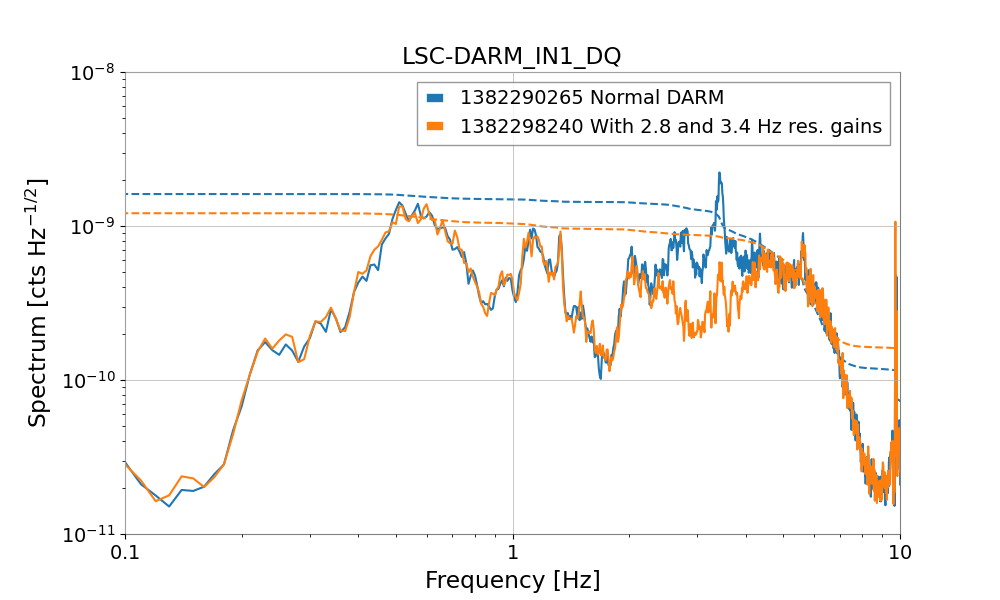
A new controller was designed based on the previous measurement of the CHARD_Y plant. This controller is implemented in FM9 (as an additional module that can be switched on with the other modeles). This can be engaged with the nominal gain of 60, and then the gain can be increased up to a factor 3 to 180. After a few tests I found that a gain of 100 seems ok, higher gain increase the amplification of a 3.4 Hz narrow peak. The amplification is expected due to a broad gain peaking of the new controller. However, the peak itself is already there and not related to the CHARD_Y controller. If we manage to track down the origin of this peak and improve it, we could increase the CHARD_Y gain even more. As it is now, more gain doesn't improve much the CHARD_Y RMS because of this 3.4 Hz peak.

With this new configuration, the CHARD_Y RMS is significantly reduced around 1 Hz (no more gain peaking) and 2-3 Hz (more suppression).

Effect of reducing the test mass damping gain

With the new controller in place, I repeated the old test of reducing the test mass damping gain in yaw. I realized that the 1 Hz oscillation I saw in my previous attempt was due to the CHARD_Y gain peaking at 1 Hz getting worse. the new controller solved this problem. Indeed, I could reduce all test mass damping gains from -1.0 to -0.5 without problems. This improves a bit the CHARD_Y motion, and improves significantly the DHARD_Y motion. So it's a good change to have.

I also tried to reduce the PR3 M1 yaw damping gain, since CHARD_Y was coherent with PR3 damping, but I did not see much of an improvement.

Noise improvements

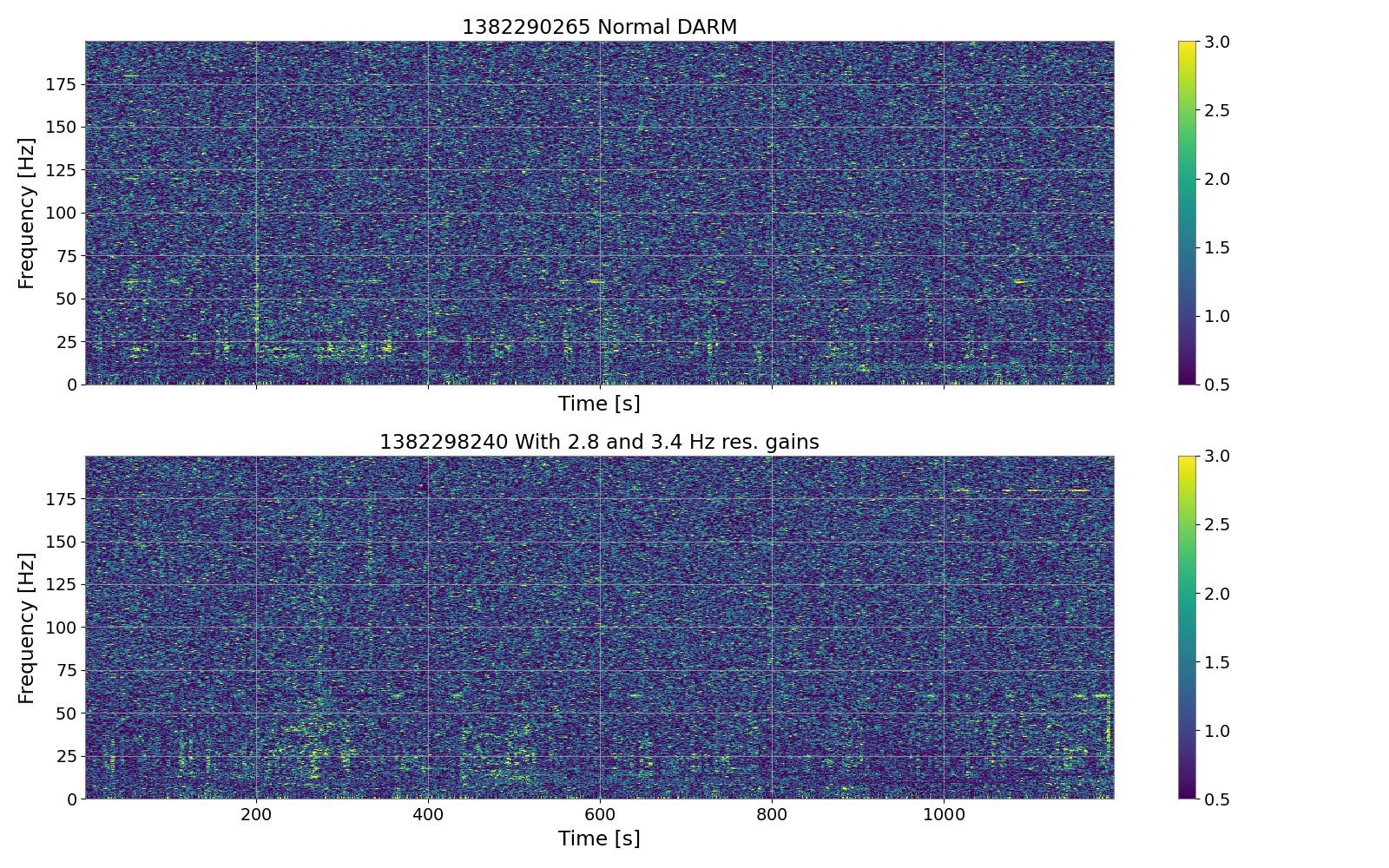
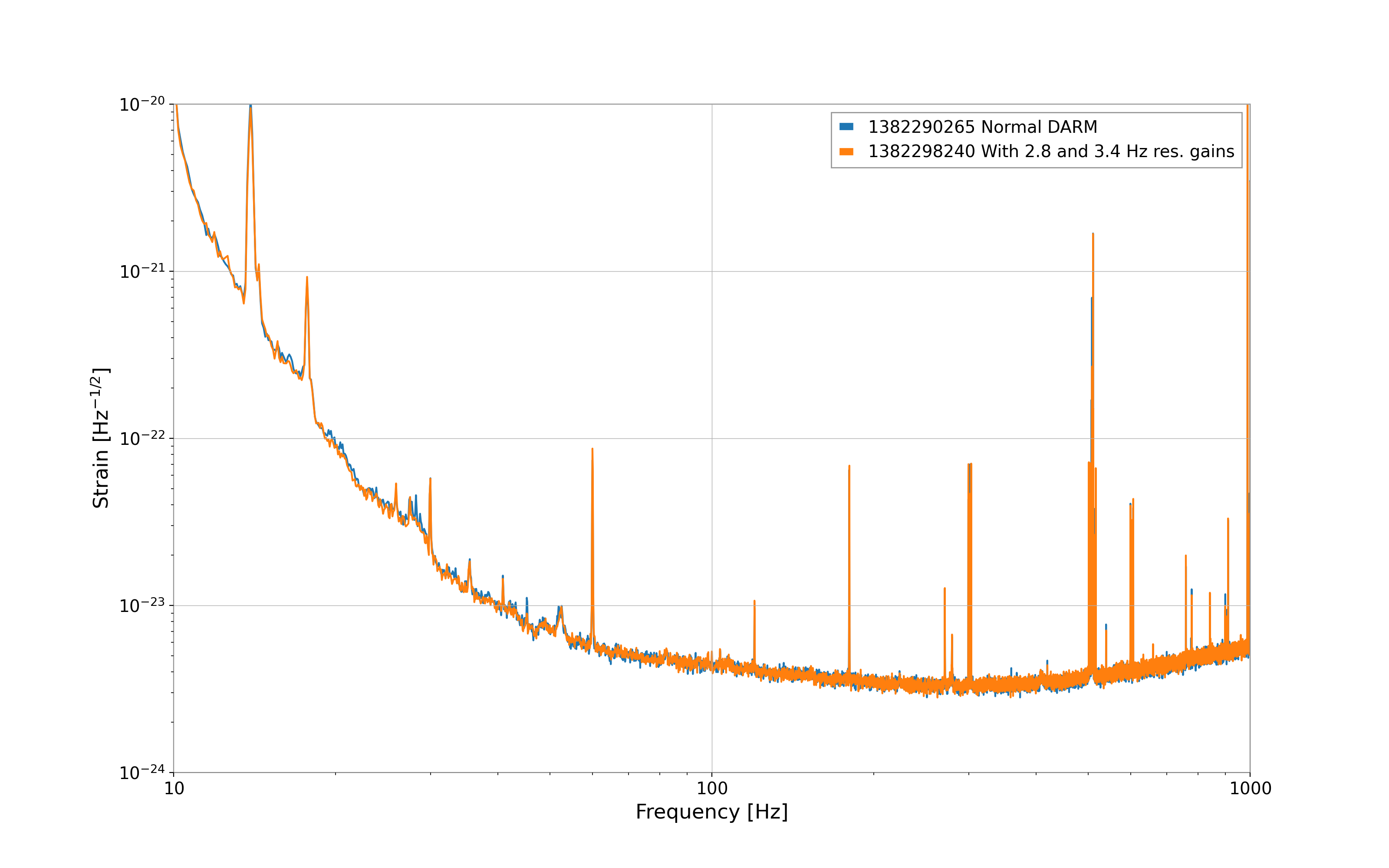
Those changes were left overnight, and the noise was much better. On average, the DARM noise below a few tens of Hz is lower. The main difference is the disappearence of most of the non-stationay noise, as visible in a spectrogram. Comparing the omicron glitch plots from before and after the change, the number of glitches in the 20-50 Hz region is much lower.

Next steps

I suggest we leave the new CHARD_Y controller with a gain of 100 as the default configuration. I also suggest that we run with reduced test mass yaw damping. I would leave the PR3 damping at -1. I would also keep the current value of -1.50 for ITMY Y2L gain.

Next things to check:

Images attached to this report
Comments related to this report
gabriele.vajente@LIGO.ORG - 09:57, Thursday 03 August 2023 (71928)

Right before the lock loss yesterday, I managed to snap a quick CHARD_Y plant measurement. It's not good enough to fit a new plant model, but it hints at small changes in the plant due to the reduced test mass damping.
It's worth doing again a careful measurement of both CHARD_Y and DHARD_Y with the reduced test mass dampng, and fine tune filters accordingly.

Images attached to this comment
gabriele.vajente@LIGO.ORG - 10:03, Thursday 03 August 2023 (71929)

Here's a better plot showing how the coupling from CHARD_Y to DARM changes with the ITMY Y2L gain.

For now it doesn't look like CHARD_Y is limiting DARM, but we should investigate this behavior more if we need to further reduce the coupling to increse the DHARD and CHARD gains

Images attached to this comment
jane.glanzer@LIGO.ORG - 11:39, Thursday 03 August 2023 (71933)DetChar
I did a quick check into the Omicron glitches before and after these changes to see the difference. I grabbed Omicron triggers with SNR > 7.5 and frequency between 10-1024 Hz on August 2nd 0-14 UTC and August 3rd 0-14 UTC. 

The first plot attached shows a comparison of the glitch rate per hour. During the period on the 2nd, the glitch rate per hour was around 51, whereas on the 3rd after these changes it's at about 7 per hour. The second plot shows the glitch rate as a function of SNR. Below an SNR of 50, we see a large reduction in the glitch rate, suggesting a large reduction of this low frequency noise.
Images attached to this comment
gabriele.vajente@LIGO.ORG - 14:15, Thursday 03 August 2023 (71940)

The new configuration has been implemented in the ISC_LOCK guardian, in the LOWNOISE_ASC state:

class LOWNOISE_ASC(GuardState):
    [...]
    def run(self):
        [...]
        elif self.counter == 2 and self.timer['LoopShapeRamp']:
            ezca.get_LIGOFilter('ASC-CHARD_Y').ramp_gain(100, ramp_time=10, wait=False) # increased to 100 again on August 3, see below
            ezca.switch('ASC-CHARD_Y', 'FM3', 'FM9', 'ON') # new chard Y high power controller with LP built in, should be engaged with low power controller FM2, more useism with FM3
            # FM9 is the controller to improve low frequnecy noise (August 2, see alog 71927)
            self.counter += 1
            self.timer['LoopShapeRamp'] = 10
       [...]
        elif self.counter== 9 and self.timer['LoopShapeRamp']:
            # reduce test masses M0 DAMP yaw gains
            ezca['SUS-ITMX_M0_DAMP_Y_TRAMP'] = 10
            ezca['SUS-ETMX_M0_DAMP_Y_TRAMP'] = 10
            ezca['SUS-ITMY_M0_DAMP_Y_TRAMP'] = 10
            ezca['SUS-ETMY_M0_DAMP_Y_TRAMP'] = 10
            ezca['SUS-ITMX_M0_DAMP_Y_GAIN'] = -0.5
            ezca['SUS-ETMX_M0_DAMP_Y_GAIN'] = -0.5
            ezca['SUS-ITMY_M0_DAMP_Y_GAIN'] = -0.5
            ezca['SUS-ETMY_M0_DAMP_Y_GAIN'] = -0.5
            self.counter +=1
            self.timer['LoopShapeRamp'] = 10
            
        elif self.counter==10 and self.timer['LoopShapeRamp']:
            return True

jenne.driggers@LIGO.ORG - 16:28, Thursday 03 August 2023 (71943)

This gave the expected SDF diff in the PR3 damping gain.  I have accepted it, as attached.

Images attached to this comment
H1 General
ryan.crouch@LIGO.ORG - posted 08:04, Thursday 03 August 2023 (71926)
OPS Thursday day shift start

TITLE: 08/03 Day Shift: 15:00-23:00 UTC (08:00-16:00 PST), all times posted in UTC
STATE of H1: Observing at 145Mpc
CURRENT ENVIRONMENT:
    SEI_ENV state: CALM
    Wind: 3mph Gusts, 2mph 5min avg
    Primary useism: 0.01 μm/s
    Secondary useism: 0.04 μm/s
QUICK SUMMARY:

LHO General
corey.gray@LIGO.ORG - posted 23:57, Wednesday 02 August 2023 (71915)
Wed EVE Ops Summary

TITLE: 08/02 Eve Shift: 23:00-07:00 UTC (16:00-00:00 PST), all times posted in UTC
STATE of H1: Commissioning
SHIFT SUMMARY:

Most of the action was at the beginning of the shift.  Commissioning work ending, a lockloss, recovery, and then sorting out post-comissioning items as well as calibration issues.  Happily handing off a nicer H1 to Tony tonight!  (Also saw/heard group of 5 coyotes at "lunch" time.)
LOG:

LHO General
corey.gray@LIGO.ORG - posted 19:59, Wednesday 02 August 2023 (71925)
Mid Shift Status

After a lockloss and more Commissioning time, then needed assistance from Louis & JeffK to restor Calibration Lines (i.e PCal x&y).  Once all of this was complete H1 rode out an earthquake and has been observing for just over 1hr (and been locked 2+hrs).

H1 General
corey.gray@LIGO.ORG - posted 19:08, Wednesday 02 August 2023 (71924)
After All The Commissioning & Restoration Of Calibration Lines (& stuff) H1 Is Back To OBSERVING......

....Back to OBSERVING just as a M5.9 Panamanian earthquake rumbles!

H1 AOS
corey.gray@LIGO.ORG - posted 18:52, Wednesday 02 August 2023 - last comment - 10:04, Thursday 03 August 2023(71920)
Missing Cal Lines For Current Lock....So Louis & Kissel Helped To Restore...here's my diary...

(Louis, Jeff K, Corey)

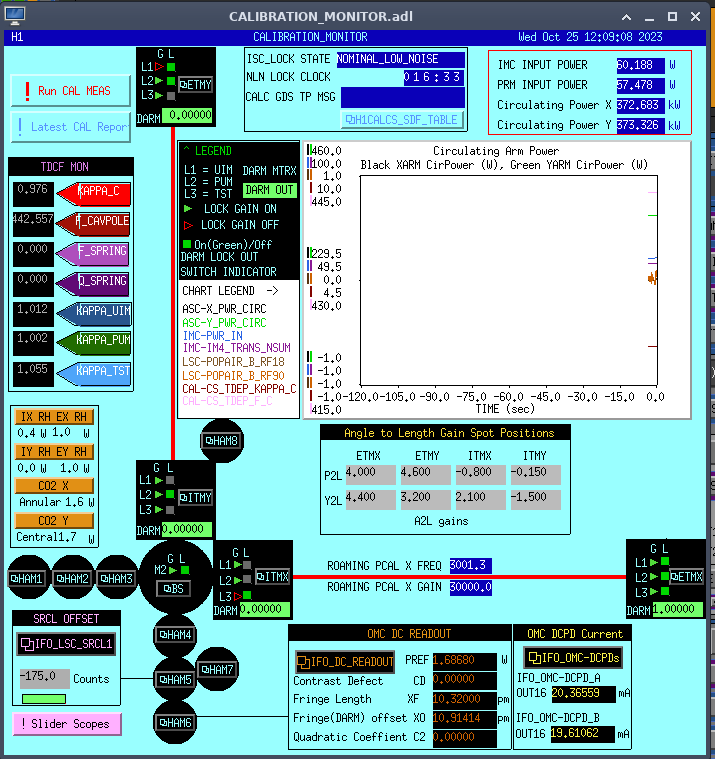
After addressing Gabriele overnight test SDF Diffs, now had alot of SDF diffs for CALEX & CALEY (basically PCAL channels).  And on the DARM FOM, could not see any (green) PCALy lines or (pink) PCALx lines.  At this point, started working with Louis on TeamSpeak and he started texting Kissel.  Below is what I did (via Louis instructions) for the CALEY & CALEX SDF nodes:

H1CALEY:

H1CALEX:


Images attached to this report
Comments related to this report
sheila.dwyer@LIGO.ORG - 10:04, Thursday 03 August 2023 (71930)

THis was because I made changes to pcal for the DARM offset sweep, I thought that moving to NLN CAL MEAS and back to observe would fix that but that wasn't the case.

H1 ISC
gabriele.vajente@LIGO.ORG - posted 17:28, Wednesday 02 August 2023 - last comment - 18:56, Wednesday 02 August 2023(71918)
Commissioning tests

Several CHARD_Y tests today during the commissioning time. A more detailed analysis will follow.
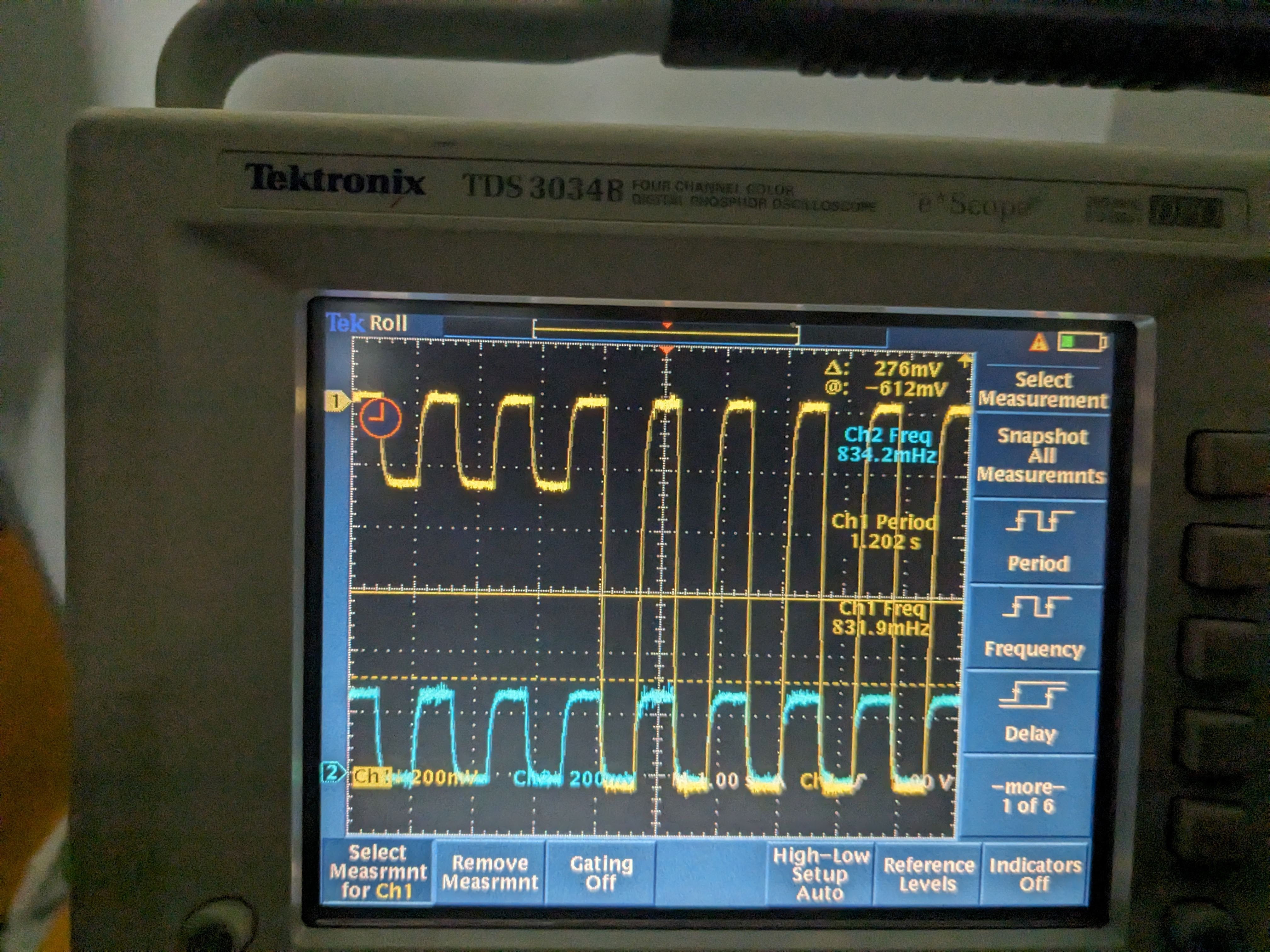
Went go to NLN_CAL_MEAS

## Test new CHARD_Y ##
- load new filter OK
- engage with gain 60 OK
- gain increase to 100 looks OK: what is that big peak at 3.x Hz? It's not gain peaking of the CHARD_Y loop

## Check A2L ##
- inject line at 22.1 Hz and check demodulation of DARM. Large fluctaations, hard to tune
- inject noise [CHARD_Y noise ampl 20  butter("BandPass",6,10,100)]
  coupling at low frequency changes differently than high frequency (-1.50 is a good compromise). Also, 22 Hz is right at the transition between the two noise coupling regions

## Test Mass damping ##
- reduce gain looking at TM signals and also CHARD_Y DHARD_Y

all test mass M0 Y gains to -0.5
from PDT: 2023-08-02 16:23:37.085598 PDT
     UTC: 2023-08-02 23:23:37.085598 UTC
     GPS: 1375053835.085598
to   PDT: 2023-08-02 16:32:40.068152 PDT
     UTC: 2023-08-02 23:32:40.068152 UTC
     GPS: 1375054378.068152

left gains at -0.5

## PR3 damping gain reduction ##
M1 Y damping gain to -0.5
from PDT: 2023-08-02 16:33:56.677335 PDT
     UTC: 2023-08-02 23:33:56.677335 UTC
     GPS: 1375054454.677335
to   PDT: 2023-08-02 16:44:18.190283 PDT
     UTC: 2023-08-02 23:44:18.190283 UTC
     GPS: 1375055076.190283

     
Lowering the damping gains might have changed a bit the plant? Measured another CHARD_Y plant [saved CHARD_Y_shaped_exc_2023_08_02.xml]

Images attached to this report
Comments related to this report
gabriele.vajente@LIGO.ORG - 18:11, Wednesday 02 August 2023 (71919)

When we got back to NLN, I implemented the changes below to test overnight
- CHARD_Y engage FM9, increase gain to 100
- ITMY Y2L to -1.500
- test mass M0 Y damp reduced to -0.5
- PR3 M1 Y damp reduced to -0.5

In case of a lock loss, all those changes will be reverted

gabriele.vajente@LIGO.ORG - 18:53, Wednesday 02 August 2023 (71921)

At a first glance there is some good improvement at low frequency.

Images attached to this comment
corey.gray@LIGO.ORG - 18:56, Wednesday 02 August 2023 (71922)ISC, SUS

Here are the SDF Diffs which needed to be ACCEPTED for Gabriele's overnight test.  These are for diffs for ASC, PR3 and all 4 Test Masses.

NOTE:  For next lock, Guardian will take all these values to their "usual" values.  So we'll have to ACCEPT all the diffs which come up to get us back to the "usual" state.
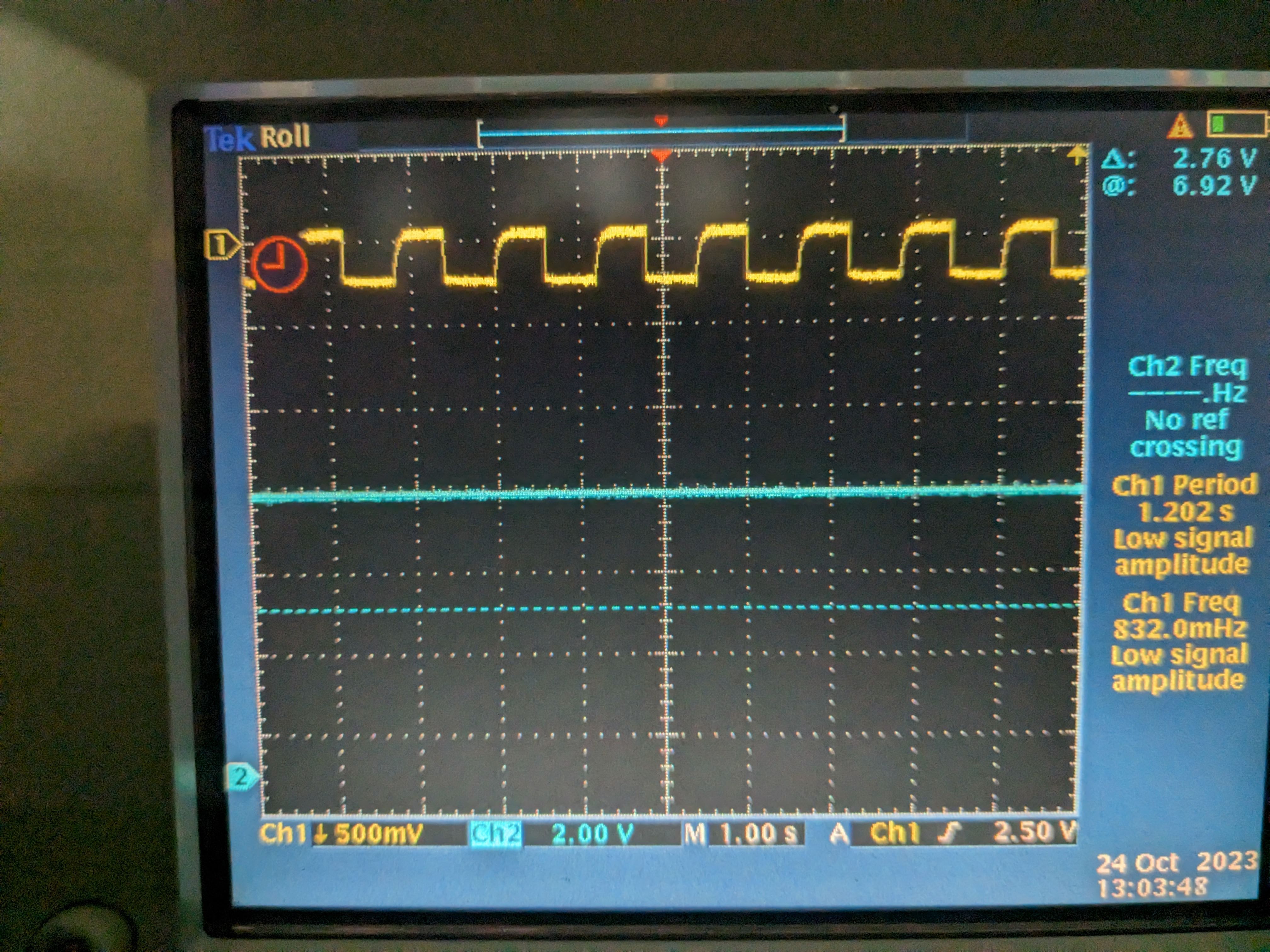
Images attached to this comment
H1 SEI
jim.warner@LIGO.ORG - posted 16:29, Wednesday 02 August 2023 (71916)
Leaving HAM1 3D feedforward on overnight

I've spent a little more time working on the HAM1 ground to HEPI feedforward and did another test. I can get pretty good improvement on the HEPI L4Cs, but it doesn't make much of an improvement on the interferometer. DARM doesn't see any improvement, but CHARD P sees a bit of an improvement over 5-10hz, see attached plot. Top is the table HEPI Z L4Cs, middle is the tabletop L4Cs,  bottom is CHARD P. For each, red is with the FF on, blue is with the FF off. The HEPI and table top L4Cs see some reinjection 1-2hz, but this doesn't show up in CHARD. CHARD P does see a not quite factor 2 improvement at 8hz.
I haven't had a chance to see how this interacts with the HAM1 TT to ASC feedforward, but that, I think, is generally a bit higher in frequency.

I've talked to Jenne and Sheila, I'm going to leave it on overnight to get some good low frequency measurements.

If there is concern this is somehow causing problems (it really shouldn't!) it can be turned off by setting the gain to 0, in a terminal :

caput H1:HPI-HAM1_3DL4C_FF_Z_GAIN 0

The new gain would then need to be accepted in SDF. But, this really shouldn't hurt anything.

Images attached to this report
LHO General
corey.gray@LIGO.ORG - posted 16:17, Wednesday 02 August 2023 (71914)
Wed EVE Ops Transition

TITLE: 08/02 Eve Shift: 23:00-07:00 UTC (16:00-00:00 PST), all times posted in UTC
STATE of H1: Commissioning
CURRENT ENVIRONMENT:
    SEI_ENV state: CALM
    Wind: 16mph Gusts, 14mph 5min avg
    Primary useism: 0.02 μm/s
    Secondary useism: 0.04 μm/s
QUICK SUMMARY:

Arriving to an H1 still locked from lockloss recovery I handed over to Tony at the end of my shift.  And Ryan C filled me in on H1 also currently being in COMMISSIONING (mainly while L1 was out for logging & storms...but they appear to be back to NLN now though).

Jim also mentioned there is a changed status for HAM1's HEPI for a new L4C servo he is testing out (it will be kept in and he ACCEPTED sdfs).

94degF and mild (under15mph) winds.

Now to catch up on chat to see how things are looking/going.

H1 General (DetChar)
ryan.crouch@LIGO.ORG - posted 16:00, Wednesday 02 August 2023 (71905)
OPS Wednesday day shift summary

TITLE: 08/02 Day Shift: 15:00-23:00 UTC (08:00-16:00 PST), all times posted in UTC
STATE of H1: Commissioning
SHIFT SUMMARY: Lots of squeeze work today, and some other comissioning items (HAM1FF, CHARD_Y controller, contrast defect...), handing off to Corey with a locktime of 15:06

From 15:00 to 16:00 there was some work going on in the MSR, including moving items and cables (tagging DetChar). The MSR racks' 1 & 2 temperatures saw an increase in temperatures seeming to correspond with the times the work was being done, rack2 had a sharp increase, but it was colder than nominal beforehand and now seems to have settled around its nominal temperature (22C).

LOG:            

Start Time System Name Location Lazer_Haz Task Time End
17:05 FAC Cindy MidX N Tech clean 18:23
18:10 FAC Karen Vac prep N Tech clean 18:50
18:16 FAC Ken MidY N Change light bulbs 22:31
16:00 SQZ Vicky, Sheila, Naoki CR/Remote N SQZ work started at 1600 20:13
19:48 PCAL Tony PCAL LAB Local PS5_PS1(TSA)  Responsivity Ratio measurement 22:20
21:34 VAC Gerardo & Richard MidY N Take a picture of CP4 22:07
22:04 SEI Jim CR N HAM1 FF 22:14
22:13 SUS Rahul Remote N 1.5kHz  modes 23:02
22:39 CAL Gabriele Remote N CHARD_Y controller, and other measurements Ongoing
Images attached to this report
H1 SQZ (DetChar)
victoriaa.xu@LIGO.ORG - posted 13:21, Wednesday 02 August 2023 - last comment - 14:54, Wednesday 06 September 2023(71902)
SQZ data GPS times

Sheila, Naoki, Vicky -- SQZ data with FIS and FDS.

NLG~11.0 (Gen SQZ=14.7dB), according to calibration from OPO_TRANS = 80 uW (this calibration is reasonably accurate).

Started 8:05 hours into lock. 3-4 hour set of measurements. Data times in bold.

sqz_config

DTT reference 

gps_start

clf_phase 

duration

Notes

No SQZ

Ref 0

1375027288

--

1800

8:05 hours into lock. Start @ 16:01:10 UTC

-- misalign FC
@ 16:33:32 UTC

--16:33:32 UTC

--1375029230

--

--

ADF ON @ 16:36:37 UTC. There is 1.3 kHz ADF line in the data.
ADF OFF @ 19:51:30 UTC. Tagging DetChar for this squeezer line.

Start in FIS & check if AS42
has alignment shifts 


(opened bdiv @ 1375029851)


→ we offloaded + froze ASC. Sheila walked ZM5/6 to optimize ASQZ alignment. 

FIS test asc ref

Ref 3

1375029757

145.20

250

End = 1375030007. 

FIAS

Ref 2

1375030889

234.06

900

Start @ 17:01:11 UTC, End = 1375031821, 17:16:44

FIS 

Ref 4

1375032085

150.21

900

Start @ 17:21:07 UTC, End @ 1375033006, 17:36:28
Glitch @ 1375032660 - 1375032705

FIS +mid sqz

Ref 5

1375033520

196.94

900

Start @ 17:21:07 UTC, End @ 1375033006, 17:36:28

FIS -mid sqz

Ref 6

1375034605

0

900

Start @ 18:03:07 UTC, End @ 1375035601

-- relock FC


--

Using FIS, sqz looks like CLF demod phase @ 150.76 deg

FDAS

Ref 7

1375036671

239.07

900

Start @ 18:37:33 UTC, End = 1375037577, 18:52:39
Sheila checked alignment (FC ASC turned on); looks OK

FDS +mid

Ref 8

1375037596

196.94

900

Start @ 18:52:58 UTC, End = 1375038540, 19:08:42

FDS -mid

Ref 9

1375038782

0

900

Start @ 19:12:44 UTC, End = 1375039746, 19:28:48

FDS (no asc)

Ref 10

1375040208

150.21

~5min

Start @ 19:36:30 UTC, End = 1375040749, 19:45:31

FDS (with asc ON)

Ref 11

1375041161 

(sqz asc has settled)

150.21

900

Start @ 19:52:23 UTC, End = 20:07
(Looks basically same with/without SQZ AS42 ASC ON)
1375040815 turned SQZ AS42 ASC ON

Total change in squeezer configuration: SQZ angle has changed from 145.2 --> 150.2 deg. 

Images attached to this report
Comments related to this report
victoriaa.xu@LIGO.ORG - 16:34, Wednesday 02 August 2023 (71917)

Attached the data times as a .py, for easier analysis.

Non-image files attached to this comment
victoriaa.xu@LIGO.ORG - 14:54, Wednesday 06 September 2023 (72565)ISC, SQZ

Kevin, Sheila, Daniel, Vicky

Here is the squeezing dB data from this time, which shows the quantum noise reduction with squeezing, relative to a model of quantum noise without squeezing. To sanity check IFO parameters, here is the no-sqz quantum noise model (dashed purple) is plotted alongside the full budget (solid red), plotting CTN (the -. and -- green lines), and the technical non-quantum noise estimate (grey), using the no-sqz times taken in this dataset. IFO & SQZ parameters used for modelling are shown in the title.

Note: this squeezing subtraction (estimated quantum noise w/sqz - quantum noise model w/o sqz) is model-dependent. We are still working to use a cross-correlation estimate of the technical noise, so we can calculate the quantum noise without squeezing w/o relying on a shot noise model (b/c the model depends on optical gain / ifo readout losses). In this analysis, the method this is reversed: we use the quantum noise model to get an estimate of technical noise, then subtract that technical noise estimate from squeezed darm, to see the quantum noise reduction with squeezing. Specifically, in PSD here we do the following:

     - tech noise = (meas darm no sqz) - (qn model no sqz)    --> this is better to get it from the dcpds correlated noise (but correlated noise includes QRPN, need to account for that accurately)
     - quantum noise w/sqz = (meas darm w/sqz - tech noise)
     - sqz dB = 10*log10( (quantum noise w/sqz) / (gwinc qn model no sqz) )

How I set the IFO modeling parameters:

1) Homodyne / readout angle = - 10.7 degrees. This is constrainted to < -10.7deg from sheila's recent contrast defect measurement 71913.
2) SRCL detuning =0.  It is likely small, though possibly non-zero; anyways, setting it to 0 for this analysis, while working with Louis to see the SRCL detuning from calibration measurements.
3) IFO readout efficiency - based on sqz wiki, expect ~13% broadband optical readout losses of the IFO signal, without squeezing. Based on no-sqz measured DARM, circulating arm powers in the 370-380kW range, homodyne angle < -10.7 deg, and negligible SRCL detuning -- here it is estimating 73% output efficiency (27% loss) to reconcile shot noise sensitivity with measured DARM at 1 kHz. With the no-sqz quantum noise model and 73% output efficiency, the estimated technical noise level is ~0.9e-20 m/rtHz at 1 kHz. This 1kHz technical noise estimate lands somewhere between Craig's correlated noise estimate 71333 (like 0.5-1e-20 m/rtHz @ 1kHz), Sheila's measurement of correlated dcpd noise 70891 (like 1.2e-20 m/rtHz @ 1kHz), recent noise budget projections, 72245, and a lil higher than Jenne's NonSENS noise budget 72578 (considering laser frequency noise ~0.3e-20m/rtHz at 1kHz). Given that subtracting the shot noise model suggests technical noise within a factor of 2-3 of other metrics, it lends at least some some confidence to the no-sqz quantum noise model w/excess output losses that impact optical gain.

Next question:  How well constrained is the breakdown between readout / injection losses? Not all the IFO readout losses that affect optical gain have to be SQZ readout losses (two beams could have different alignments/mode-matchings through the IFO / AS port). But to look for sqz losses, it'd be helpful to have a hint of where to look, if we can find whether losses are IFO side or else SQZ side. I don't see a clear sign in our measurements either way.
--> I considered 3 scenarios:
1) Equal IFO readout losses 20% + SQZ injection losses 20%,
2) Using same IFO readout losses (71%) for SQZ, then rest is SQZ injection losses (9%),
3) All SQZ injection losses (35%) and perfect readout efficiency (100%).
Noticeable features that could distinguish between the two scenarios (high readout losses vs. high injection losses) are mostly the low frequency QRPN SQZ rotation+gain from the arm cavities optomechanics. If more quantum noise is injected to the IFO (so injection losses * gen sqz dB are higher), then the arm cavities have more sqz to rotate, and so we see the squeezing efficiencies increase at low freqencies as a result. Kevin has nice plots that show this (squeezing efficiency within the arm cavity bandwidth decreases w/injection losses but not with readout losses; or like Kevin says, injection losses source QRPN and shot noise, while readout losses only source shot noise.

Some next steps to understand in the analysis/models:
1) How is the squeezing relatively flat given the known mode-mismatches of both IFO-OMC and SQZ-IFO/OMC? It seems that hot OM2 curvature leads to ~10% IFO-OMC mode mismatch, while the SQZ PSAMS are railed without yet optimizing SQZ-OMC mode-matching, so SQZ-OMC is clearly not perfectly mode-matched either. What is the scenario where we get flat squeezing given the known mode mismatch?
2) Use cross-correlation to calculate squeezing dBs. Is the squeezing definitely flat, or is that an artifact of how we compare to a quantum noise model?

Small notes about this analysis:
-- for 8/2 data: for calibration, I am using GDS-CALIB_STRAIN_CLEAN, with the text-file magnitude correction from Vlad's alog 71787.
-- for no-sqz noise budgeting, I am plotting both what gwinc has as CTN, and a trace that is 1.3e-20m/rtHz at 100 Hz. Reminder of this alog from Kevin K. and Evan H. regarding the CTN gwinc noise budget update 68499, which dropped the CTN estimate from ~1.3e-20 m/rtHz previously (green -. trace) to the ~1.13e-20 m/rtHz calculated in gwinc now (green, -- dashed line).

Images attached to this comment
Displaying reports 16861-16880 of 86679.Go to page Start 840 841 842 843 844 845 846 847 848 End