Displaying reports 16921-16940 of 86679.Go to page Start 843 844 845 846 847 848 849 850 851 End
Reports until 13:44, Tuesday 01 August 2023
H1 SEI
jim.warner@LIGO.ORG - posted 13:44, Tuesday 01 August 2023 (71873)
ISI model update to add cart drive dq channels and remove fast coil driver mon channels

 Today all ISI models were restarted to implement a couple ECRs. Changes added 2048 rate dq channels to the HAM ISI models for their cartesian basis drive signals. We store the local basis channels, but those can be hard to trace back to the cartesian basis controls. Also removed fast dq channels for the voltage and current for the ISI coil drivers. The 4k test points are still available, but I haven't really found a need for the high rate data, so they got cut to save some mb/s. Channels are still in the dq table in the model master parts, but commented out, in case someone decides we need them back.

Example differences below for BS and HAM2 from check_model_daq_status:

jim.warner@opslogin0:~ 0$ check_model_daq_configuration h1isibs
--------------------- file times ----------------------
Mon Jul 31 11:07:52 2023 = Model build time

Tue Jul 25 11:30:47 2023 = Current configuration load time


DAQ configuration is changed, processing...

--: fast channel H1:ISI-BS_CDMON_ST1_H1_I_IN1_DQ removed from DAQ 
--: fast channel H1:ISI-BS_CDMON_ST1_H1_V_IN1_DQ removed from DAQ 
--: fast channel H1:ISI-BS_CDMON_ST1_H2_I_IN1_DQ removed from DAQ 
--: fast channel H1:ISI-BS_CDMON_ST1_H2_V_IN1_DQ removed from DAQ 
--: fast channel H1:ISI-BS_CDMON_ST1_H3_I_IN1_DQ removed from DAQ 
--: fast channel H1:ISI-BS_CDMON_ST1_H3_V_IN1_DQ removed from DAQ 
--: fast channel H1:ISI-BS_CDMON_ST1_V1_I_IN1_DQ removed from DAQ 
--: fast channel H1:ISI-BS_CDMON_ST1_V1_V_IN1_DQ removed from DAQ 
--: fast channel H1:ISI-BS_CDMON_ST1_V2_I_IN1_DQ removed from DAQ 
--: fast channel H1:ISI-BS_CDMON_ST1_V2_V_IN1_DQ removed from DAQ 
--: fast channel H1:ISI-BS_CDMON_ST1_V3_I_IN1_DQ removed from DAQ 
--: fast channel H1:ISI-BS_CDMON_ST1_V3_V_IN1_DQ removed from DAQ 
--: fast channel H1:ISI-BS_CDMON_ST2_H1_I_IN1_DQ removed from DAQ 
--: fast channel H1:ISI-BS_CDMON_ST2_H1_V_IN1_DQ removed from DAQ 
--: fast channel H1:ISI-BS_CDMON_ST2_H2_I_IN1_DQ removed from DAQ 
--: fast channel H1:ISI-BS_CDMON_ST2_H2_V_IN1_DQ removed from DAQ 
--: fast channel H1:ISI-BS_CDMON_ST2_H3_I_IN1_DQ removed from DAQ 
--: fast channel H1:ISI-BS_CDMON_ST2_H3_V_IN1_DQ removed from DAQ 
--: fast channel H1:ISI-BS_CDMON_ST2_V1_I_IN1_DQ removed from DAQ 
--: fast channel H1:ISI-BS_CDMON_ST2_V1_V_IN1_DQ removed from DAQ 
--: fast channel H1:ISI-BS_CDMON_ST2_V2_I_IN1_DQ removed from DAQ 
--: fast channel H1:ISI-BS_CDMON_ST2_V2_V_IN1_DQ removed from DAQ 
--: fast channel H1:ISI-BS_CDMON_ST2_V3_I_IN1_DQ removed from DAQ 
--: fast channel H1:ISI-BS_CDMON_ST2_V3_V_IN1_DQ removed from DAQ 
Total number of DAQ changes = 24
(0 additions, 24 deletions)


And HAM2:

jim.warner@opslogin0:~ 0$ check_model_daq_configuration h1isiham2
--------------------- file times ----------------------
Mon Jul 31 10:21:45 2023 = Model build time

Tue Jul 25 11:30:47 2023 = Current configuration load time


DAQ configuration is changed, processing...

++: fast channel H1:ISI-HAM2_DRIVE_RX_DQ added to the DAQ
++: fast channel H1:ISI-HAM2_DRIVE_RY_DQ added to the DAQ
++: fast channel H1:ISI-HAM2_DRIVE_RZ_DQ added to the DAQ
++: fast channel H1:ISI-HAM2_DRIVE_X_DQ added to the DAQ
++: fast channel H1:ISI-HAM2_DRIVE_Y_DQ added to the DAQ
++: fast channel H1:ISI-HAM2_DRIVE_Z_DQ added to the DAQ
--: fast channel H1:ISI-HAM2_CDMON_H1_I_IN1_DQ removed from DAQ 
--: fast channel H1:ISI-HAM2_CDMON_H1_V_IN1_DQ removed from DAQ 
--: fast channel H1:ISI-HAM2_CDMON_H2_I_IN1_DQ removed from DAQ 
--: fast channel H1:ISI-HAM2_CDMON_H2_V_IN1_DQ removed from DAQ 
--: fast channel H1:ISI-HAM2_CDMON_H3_I_IN1_DQ removed from DAQ 
--: fast channel H1:ISI-HAM2_CDMON_H3_V_IN1_DQ removed from DAQ 
--: fast channel H1:ISI-HAM2_CDMON_V1_I_IN1_DQ removed from DAQ 
--: fast channel H1:ISI-HAM2_CDMON_V1_V_IN1_DQ removed from DAQ 
--: fast channel H1:ISI-HAM2_CDMON_V2_I_IN1_DQ removed from DAQ 
--: fast channel H1:ISI-HAM2_CDMON_V2_V_IN1_DQ removed from DAQ 
--: fast channel H1:ISI-HAM2_CDMON_V3_I_IN1_DQ removed from DAQ 
--: fast channel H1:ISI-HAM2_CDMON_V3_V_IN1_DQ removed from DAQ 
--: fast channel H1:ISI-HAM2_ISORAMP_X_IN_DQ removed from DAQ 
--: fast channel H1:ISI-HAM2_ISORAMP_X_OUT_DQ removed from DAQ 
Total number of DAQ changes = 20
(6 additions, 14 deletions)
LHO General
filiberto.clara@LIGO.ORG - posted 13:27, Tuesday 01 August 2023 (71872)
LVEA Access System - Highbay and FCES Beamtube Doors

WP 11330

APS contractor onsite to work on access control system in the LVEA. Both the highbay and FCES beamtube card readers are now operational. The highbay door requires scanning of FOB for both entry and exit. The FCES beamtube door only has a card reader on the beamtube enclosure side. Scanning of FOB is not required when exiting the LVEA. The beamtube door requires some adjustments so it can close properly. Please ensure door is closed correctly until this can be corrected. Report any issues with new scanners to Richard McCarthy or Filiberto Clara.

LHO VE
jordan.vanosky@LIGO.ORG - posted 13:08, Tuesday 01 August 2023 - last comment - 16:11, Tuesday 01 August 2023(71871)
Functionality Test Performed on Corner Turbo Pumps

We ran the functionality test on the main turbopumps in the corner during Tuesday Maintenance (8/1/23). The scroll pump is started to take pressure down to low 10^-02 Torr, at which time the turbo pump is started, the system reaches low 10^-08 Torr after a few minutes, then the turbo pump system is left ON for about 1 hour, after the hour the system goes through a shut down sequence.
No issues were encountered while performing the functionality test on this 3 stations.

Output Tube Turbo: Note: The flex hose connecting the turbo exhaust to the WTCB1 header line has been physically disconnected.

Bearing Life:100%

Turbo Hours: 5617

Scroll Pump Hours: 5558 - Needs Tip Seal Swap

XBM Turbo: Note: The flex hose connecting the turbo exhaust to the WTCB1 header line has been physically disconnected.

Bearing Life:100%

Turbo Hours: 782

Scroll Pump Hours: 780.5

YBM Turbo:

Bearing Life:100%

Turbo Hours: 599

Scroll Pump Hours: 1875


Closes WP 11340

Comments related to this report
gerardo.moreno@LIGO.ORG - 16:11, Tuesday 01 August 2023 (71891)VE

This work closes the following FAMIS tasks:

23521

23593

23641


H1 ISC (ISC)
keita.kawabe@LIGO.ORG - posted 12:23, Tuesday 01 August 2023 - last comment - 16:06, Tuesday 01 August 2023(71870)
OMC finesse measurement using frequency scan (Daniel, Keita)

Summary:

Scanned the frequency of the PSL instead of the OMC PZT to measure the OMC finesse.

The idea is to inject into IMC servo (i.e. ultimately AOM) while the OMC pzt voltage was left close to the 00 mode resonance. We cannot do this very quick (1.6Hz pole in the VCO), unfortunately, but if the OMC length doesn't change much during the injection this is a good alternative to the PZT scan.

The analysis will come later.

What was done:

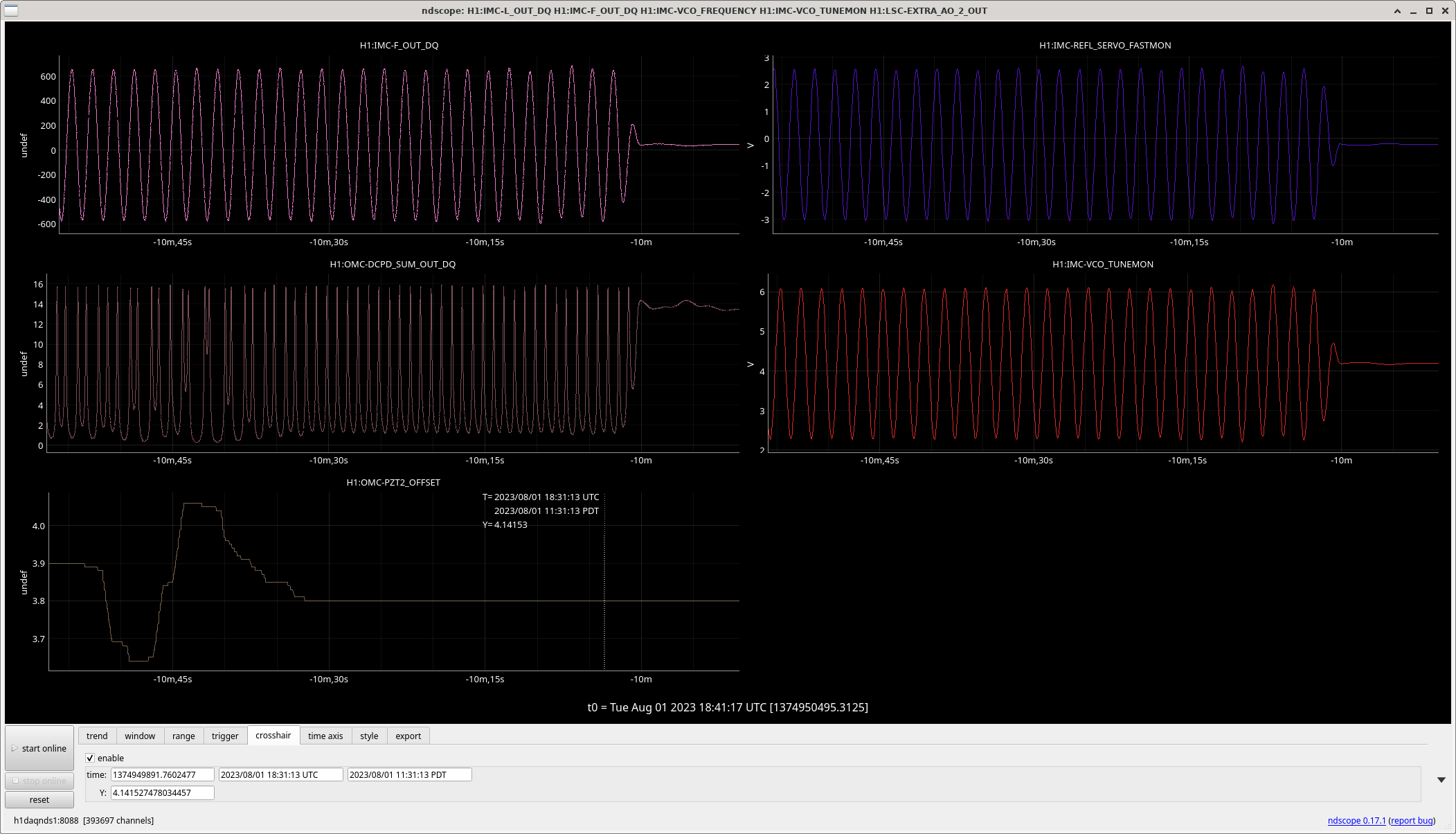
Injected into H1:IMC-L_EXC at 0.5Hz, 40000cts_pp. (At first we connected H1:LSC-EXTRA_AO_2_EXC to the EXCB on the IMC board to inject into the fast path , but we didn't have much range because of 1/10 attenuation in the EXC input. IMC_L was better).

H1:IMC-F_OUT_DQ calibration is 59.97dB Hz/cts (i.e. F_OUT is already pretty well calibrated in kHz).

This was measured by injecting at very low frequency (0.05Hz) so we can use the counter (H1:IMC-VCO_FREQUENCY) as our frequency readback. The dtt template used is /ligo/home/keita.kawabe/PSL_VCO_CAL_20230801.xml.

We used the single bounce beam from ITMY. ASC-AS_A and ASC-AS_B DC centering was turned on (DC3 and DC4). OMC ASC was on OMC QPDs.

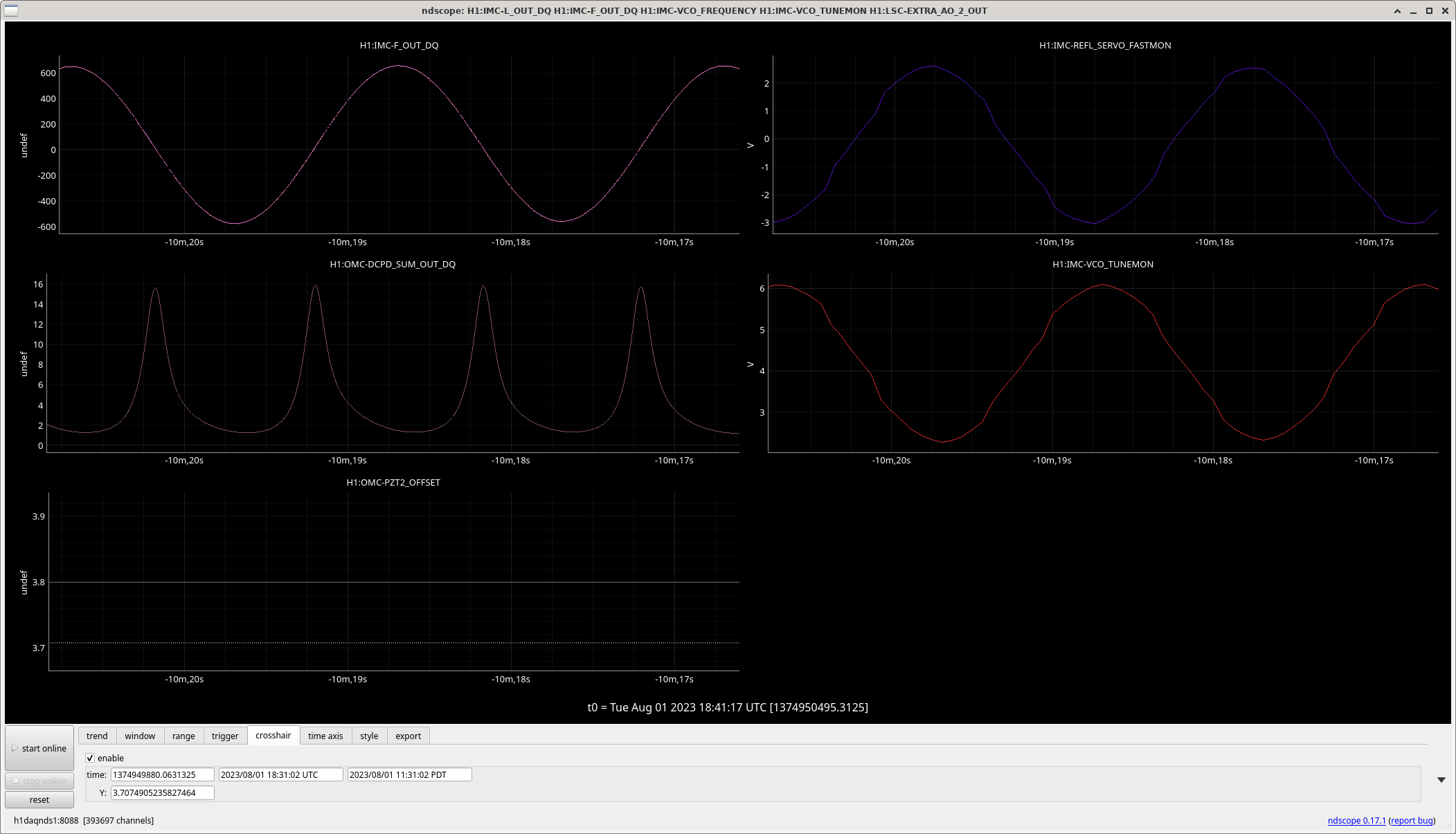
We adjusted H1:OMC-PZT2_OFFSET to bring the OMC roughly to its 00 carrier resonance (1st attachment).

After everything was adjusted properly we left it from 11:30:50 to 11:31:15 local time (2023/08/01/18:30:50 - 18:31:15 UTC).

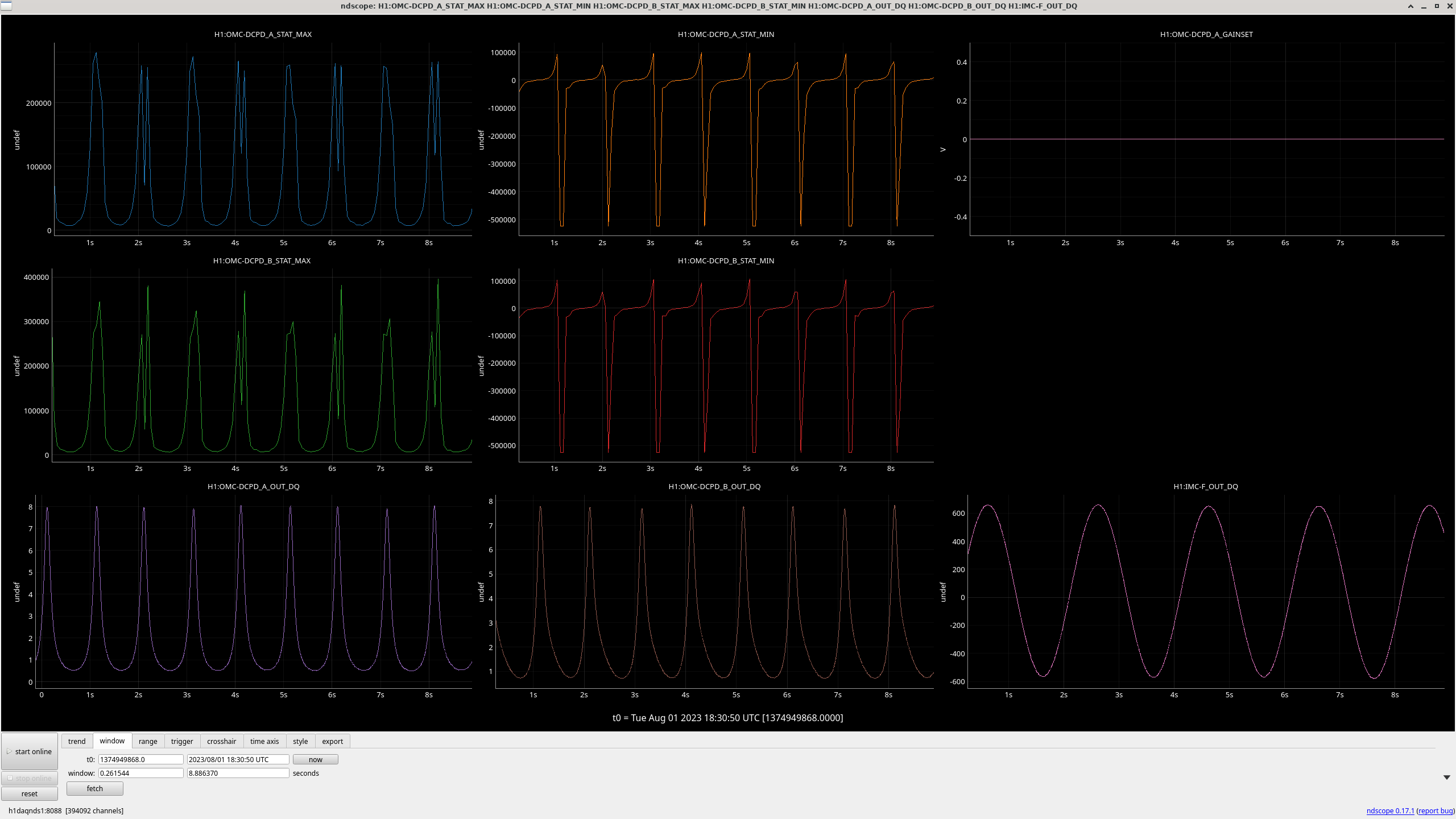
Just by looking at the close up (2nd attachment), the scan might have been a bit too fast, but not terribly so, as the transmission peaks in DCPD_SUM always rose faster than they fell regardless of the sign of e.g. the slope of the IMC_F_OUT_DQ.

Images attached to this report
Comments related to this report
daniel.sigg@LIGO.ORG - 15:24, Tuesday 01 August 2023 (71882)

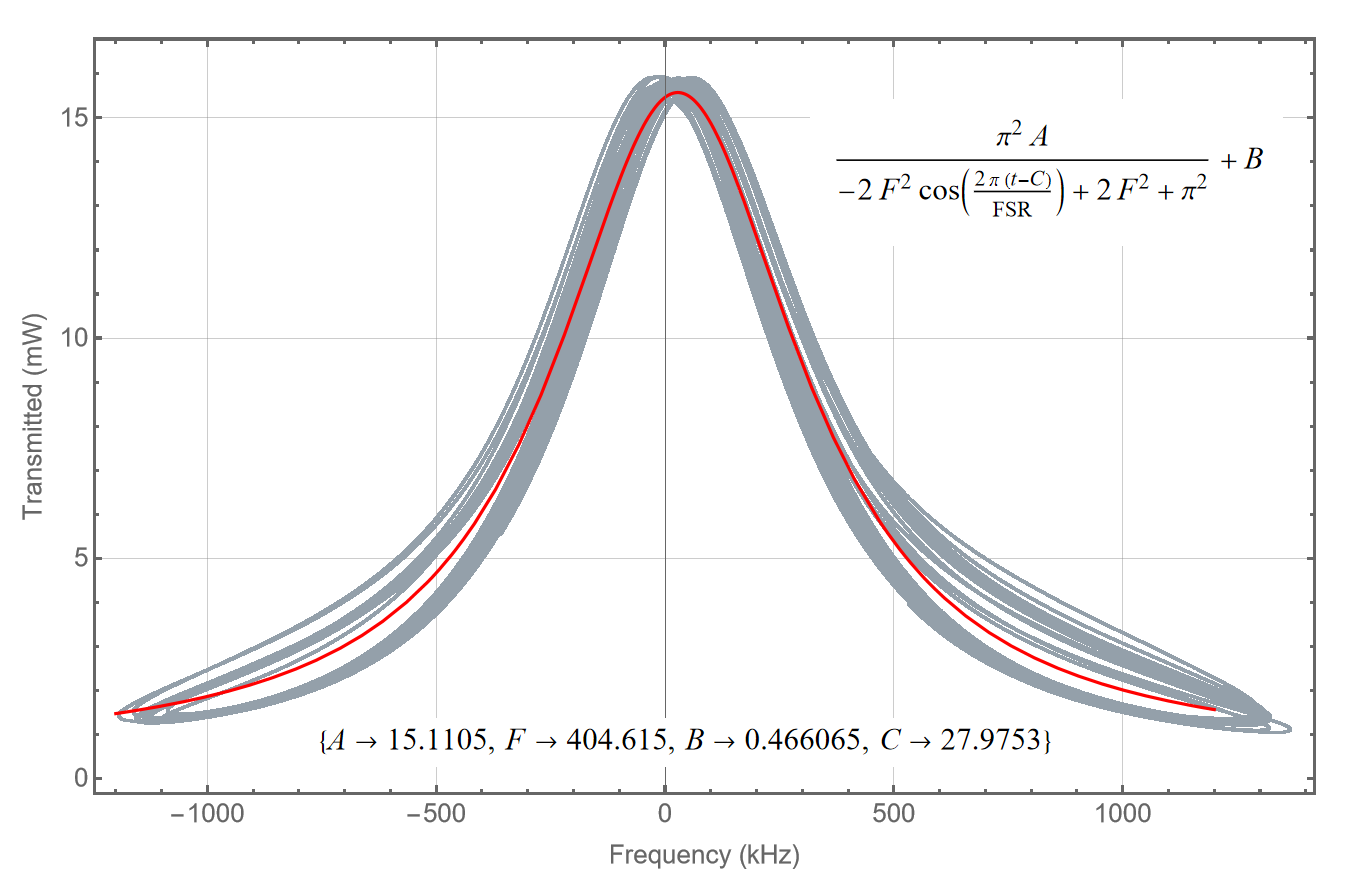
Multiplying the frequency by 2 to account for the AOM double path, and fitting the XY-data gets us a finesse of 405. The fit error is small, the systematic probably less so.

Images attached to this comment
keita.kawabe@LIGO.ORG - 16:06, Tuesday 01 August 2023 (71888)

It seems that both DCPDs were railing (B was worse), and that's why the peaks are not symmetric around the resonance.

H1:OMC-DCPD_A_GAINSET=0 (and H1:OMC-DCPD_B_GAINSET=0) means HIGH gain. We must repeat this with LOW gain.

Images attached to this comment
LHO VE
david.barker@LIGO.ORG - posted 10:29, Tuesday 01 August 2023 (71869)
Tue CP1 Fill

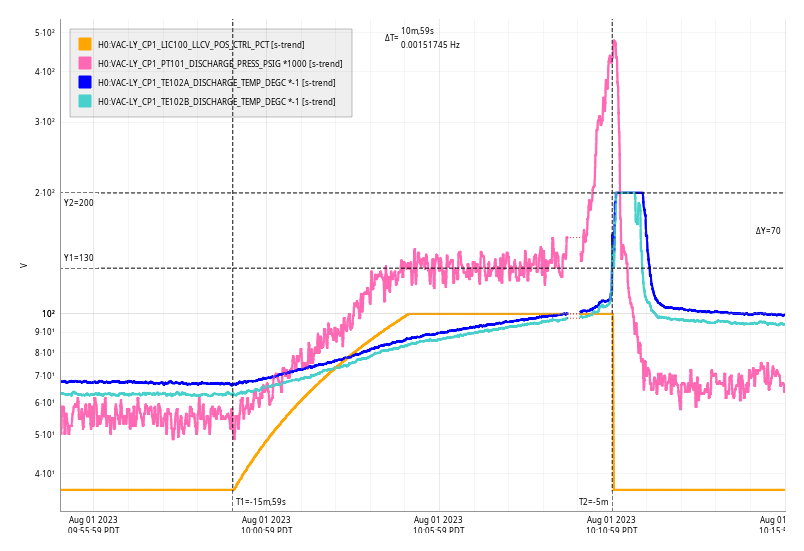
Tue Aug 01 10:10:59 2023 INFO: Fill completed in 10min 55secs

Gerardo confirmed a good fill curbside.

Images attached to this report
LHO VE
david.barker@LIGO.ORG - posted 09:14, Tuesday 01 August 2023 (71867)
Added new CP1 thermocouple to overfill MEDM

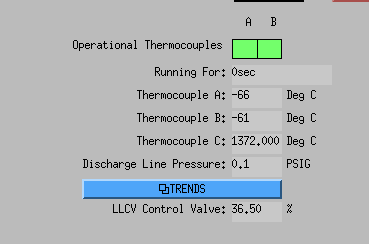
I have added the REGEN thermocouple to the H1CDS_VAC_CP1_OVERFILL_OVERVIEW_CUST.adl in the TC block. It is currently disconnected and is reading high.

Images attached to this report
H1 General
ryan.crouch@LIGO.ORG - posted 07:37, Tuesday 01 August 2023 - last comment - 07:59, Tuesday 01 August 2023(71861)
OPS Tuesday day shift start

TITLE: 08/01 Day Shift: 15:00-23:00 UTC (08:00-16:00 PST), all times posted in UTC
STATE of H1: Lock Acquisition
CURRENT ENVIRONMENT:
    SEI_ENV state: CALM
    Wind: 4mph Gusts, 2mph 5min avg
    Primary useism: 0.01 μm/s
    Secondary useism: 0.05 μm/s
QUICK SUMMARY:


Comments related to this report
ryan.crouch@LIGO.ORG - 07:40, Tuesday 01 August 2023 (71862)

Injections finished at 14:39UTC

ryan.crouch@LIGO.ORG - 07:45, Tuesday 01 August 2023 (71863)

Inlock charge measurements start at 14:45UTC

ryan.crouch@LIGO.ORG - 07:59, Tuesday 01 August 2023 (71864)CDS, SUS

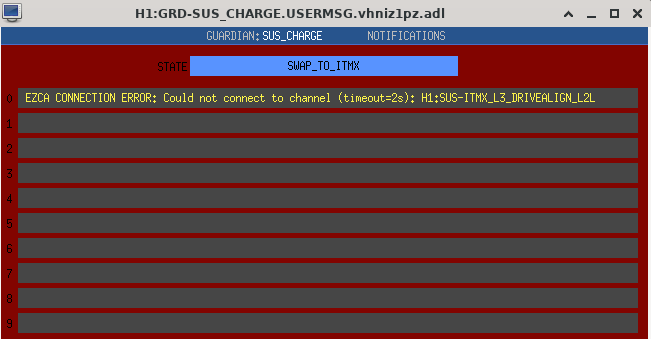
Inlock charges are having an ezca connection error, can't connect to H1:SUS-ITMX_L3_DRIVEALIGN_L2L. I've stopped to OP STOP and EXEC as suggested by the log but it gets the same error everytime. The inlock charge measurements were not able to be completed

Images attached to this comment
H1 CDS
erik.vonreis@LIGO.ORG - posted 06:54, Tuesday 01 August 2023 (71860)
Workstations rebooted

Workstations were updated and rebooted.  The update was only to OS packages.  Conda packages were not updated.

LHO General
ryan.short@LIGO.ORG - posted 00:00, Tuesday 01 August 2023 (71859)
Ops Eve Shift Summary

TITLE: 08/01 Eve Shift: 23:00-07:00 UTC (16:00-00:00 PST), all times posted in UTC
STATE of H1: Observing at 147Mpc
SHIFT SUMMARY: H1 has been locked and observing for 13 hours.

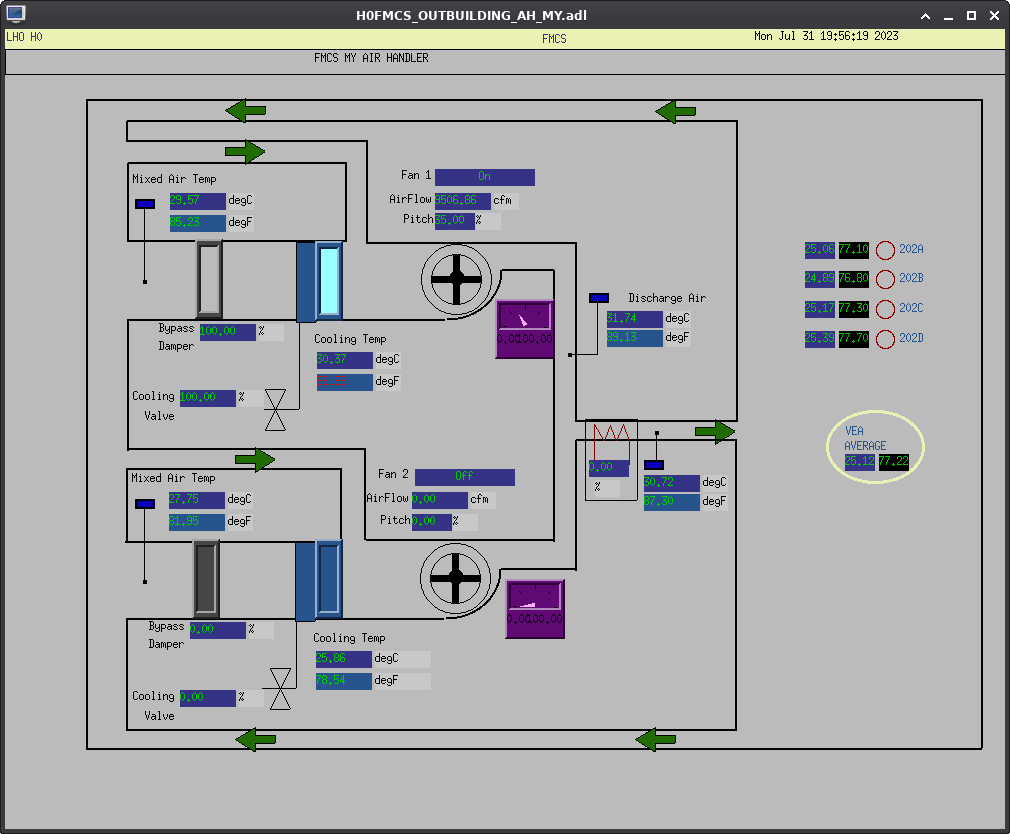
Noted in my mid-shift report that the MY AHU alarm started around 23:40; the AHU temperature has started to come down and has now dropped below 85 degrees so the alarm has stopped. Very quiet shift otherwise.

Incoming owl shift operator: TJ

LOG:

No log for this shift.

LHO General (FMP)
ryan.short@LIGO.ORG - posted 20:01, Monday 31 July 2023 (71858)
Ops Eve Mid Shift Report

State of H1: Observing at 147Mpc

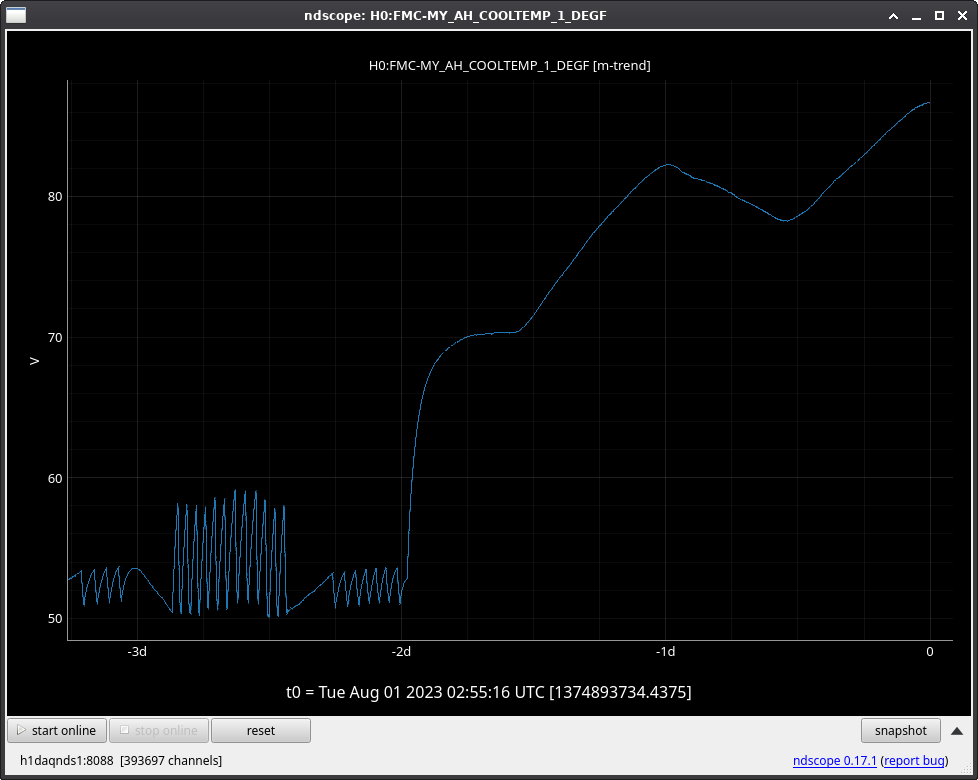
H1 has been locked for 9 hours. The MY air handler alarm started around two hours ago; checking the medm it shows the cooling temp is around 86 degF and has been climbing over the past two days. Since the IFO doesn't much care about the mid station temperatures and a contractor will be out to check it tomorrow, this is not an urgent cause for concern (but I've notified Bubba and am tagging facilities anyway).

Images attached to this report
H1 PSL
ryan.short@LIGO.ORG - posted 17:56, Monday 31 July 2023 (71857)
PSL 10-Day Trends

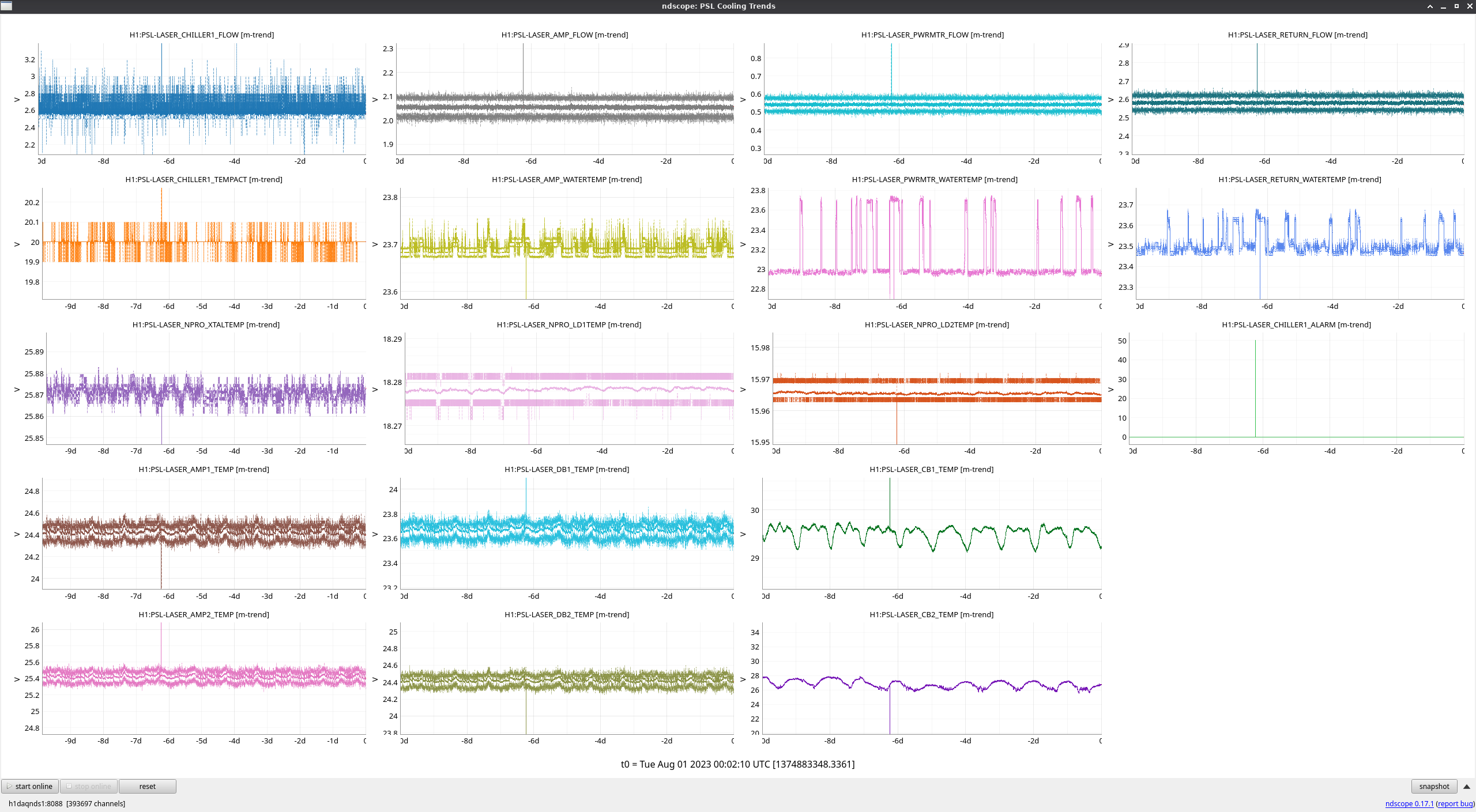
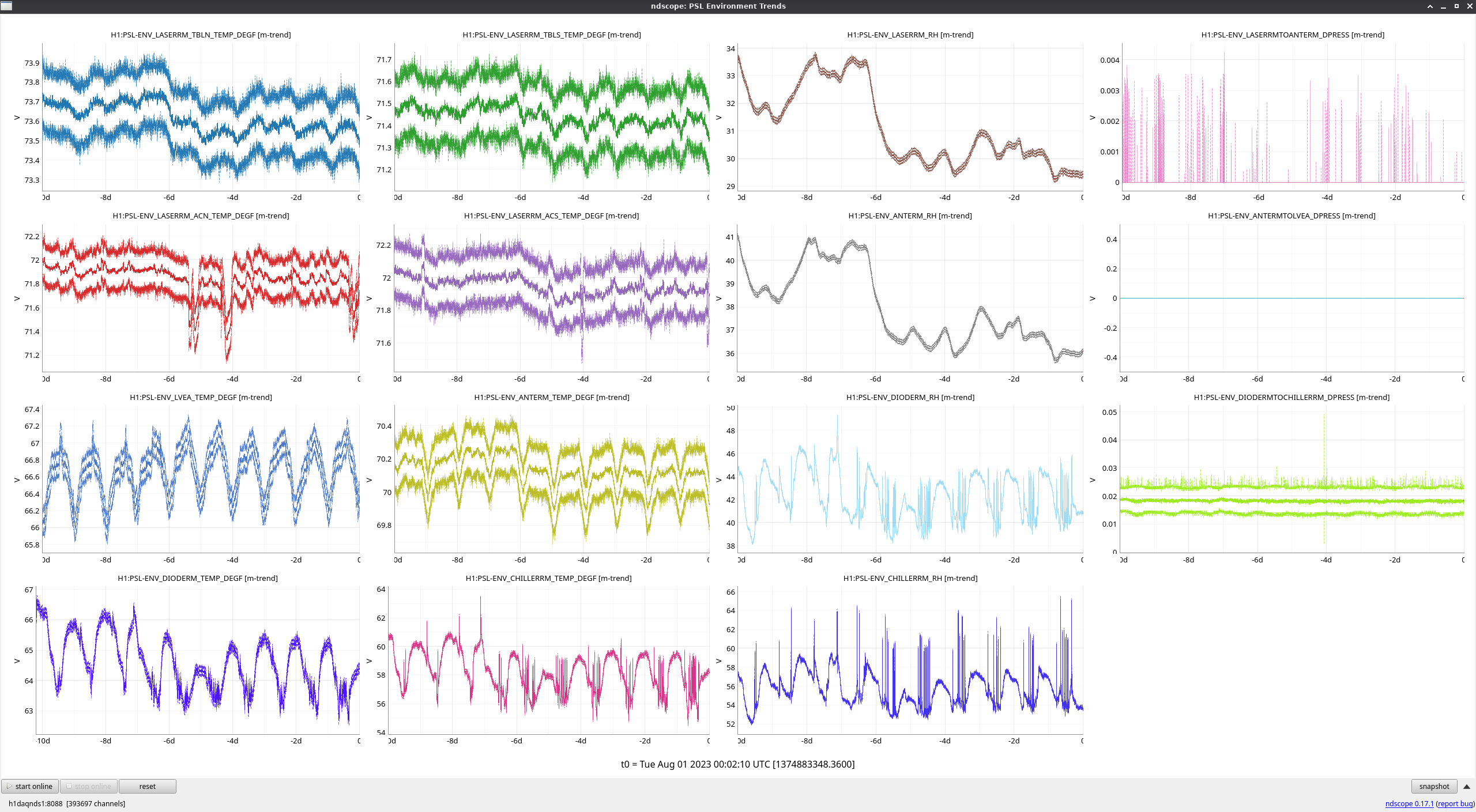
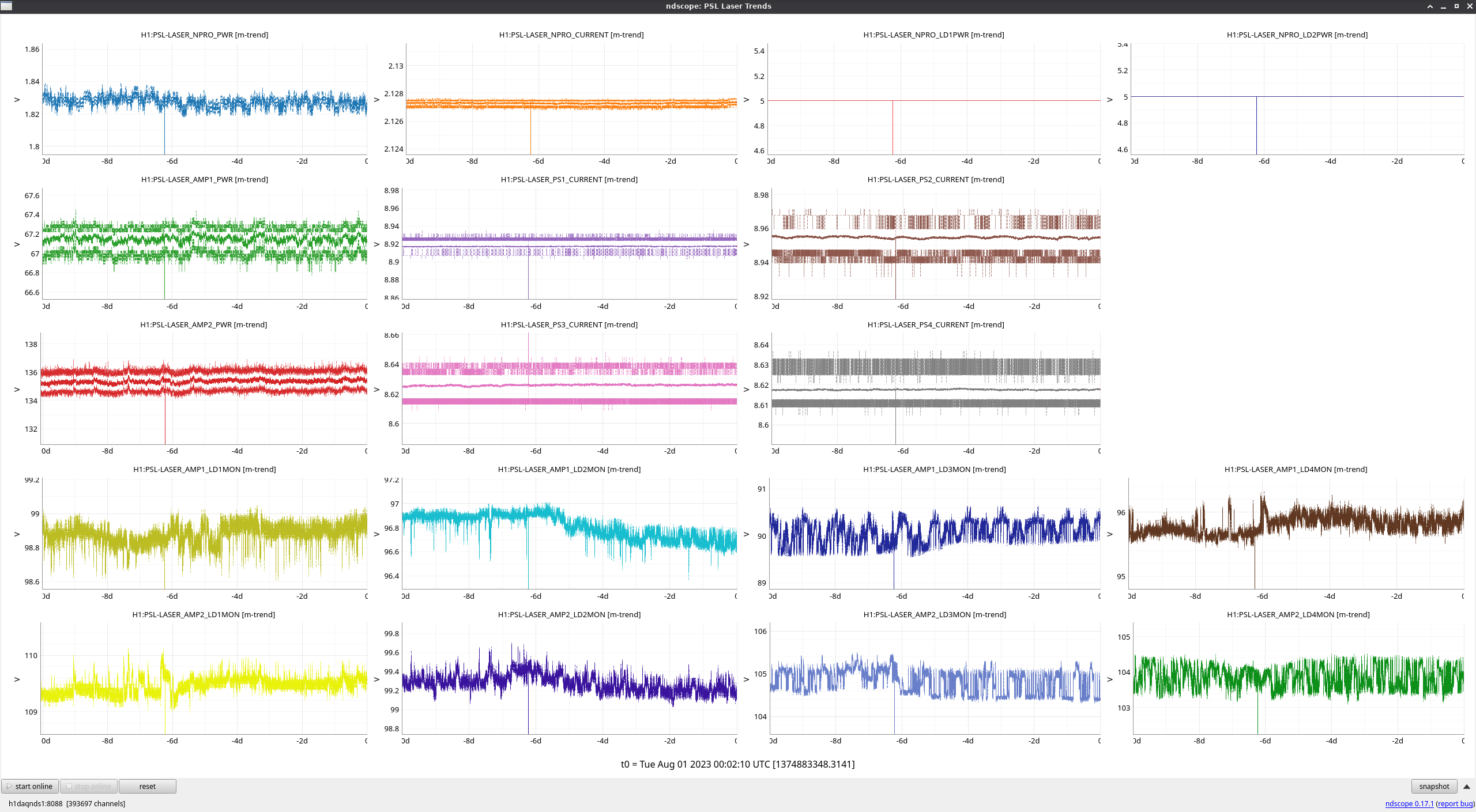
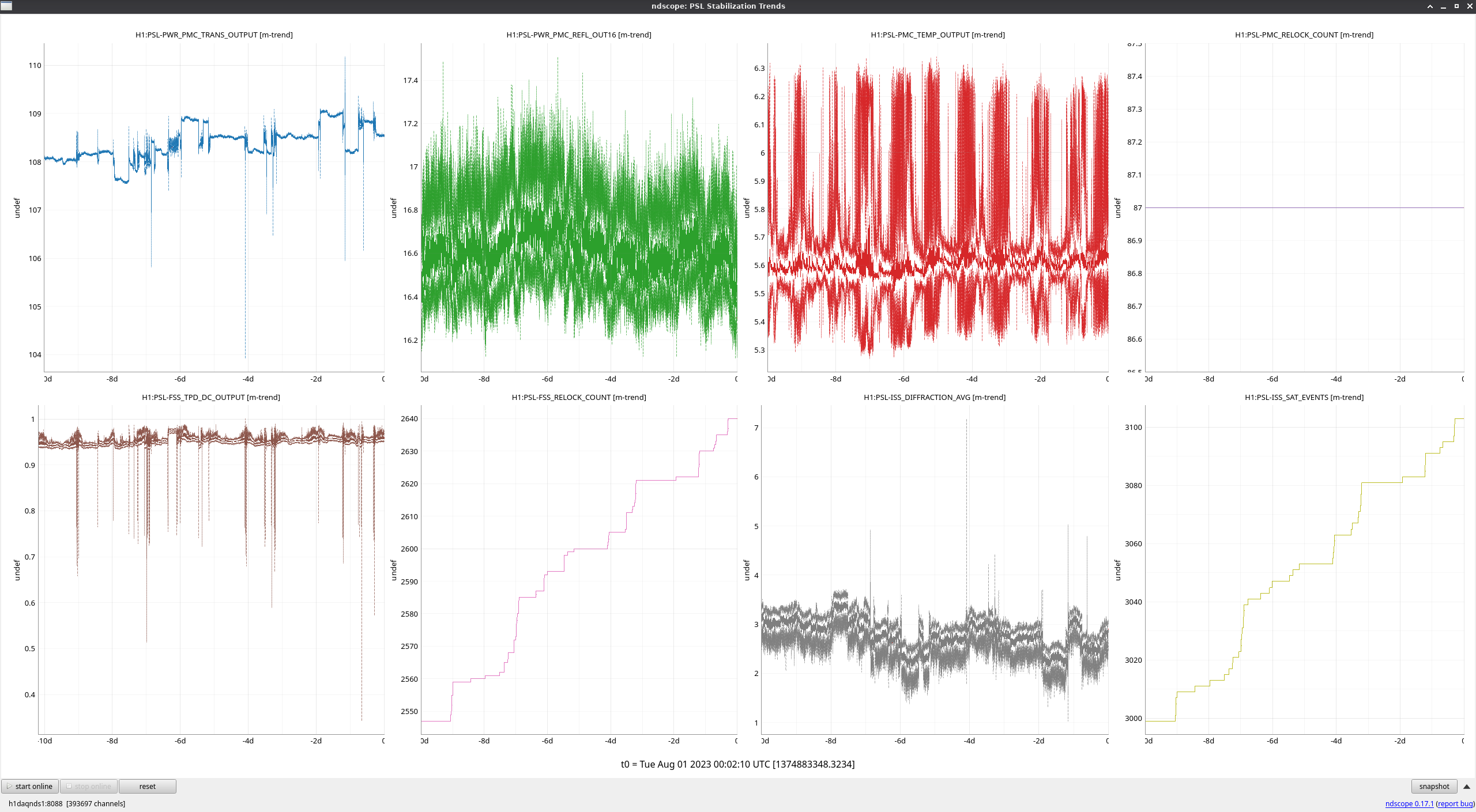
FAMIS 19987

No major events of note.

Images attached to this report
H1 PSL
ryan.short@LIGO.ORG - posted 16:30, Monday 31 July 2023 (71856)
PSL Cooling Water pH Test

FAMIS 19964

pH of PSL chiller water was measured to be between 10.0 and 10.5 according to the color of the test strip.

H1 TCS
thomas.shaffer@LIGO.ORG - posted 16:12, Monday 31 July 2023 (71854)
TCS Chiller Water Level Top-Off

FAMIS 21126

I added no water to either chiller, they both were at or very near the values from the previous check on the 21st. Filters looked good and I saw no water in the leak-detecting Dixie cup.

LHO General
ryan.short@LIGO.ORG - posted 16:06, Monday 31 July 2023 (71852)
Ops Eve Shift Start

TITLE: 07/31 Eve Shift: 23:00-07:00 UTC (16:00-00:00 PST), all times posted in UTC
STATE of H1: Observing at 142Mpc
CURRENT ENVIRONMENT:
    SEI_ENV state: CALM
    Wind: 17mph Gusts, 13mph 5min avg
    Primary useism: 0.03 μm/s
    Secondary useism: 0.06 μm/s
QUICK SUMMARY: Taking over from Ryan C. H1 has been locked and observing for 5 hours.

H1 ISC
gabriele.vajente@LIGO.ORG - posted 14:00, Monday 31 July 2023 - last comment - 08:27, Tuesday 01 August 2023(71848)
CHARD_Y open-loop gain measurement

Today between 19:25 UTC and 20:45 UTC I measured the CHARD_Y open-loop gain with two broadband noise injections (different shapes). The result is a pretty good measurement that will enable a better design of the CHARD_Y controller.

Right now: the controller has little gain at 2.6 Hz, and a very large (10 dB) gain peaking at 1 Hz.

The template is available in /ligo/home/gabriele.vajente/ASC/CHARD_Y_shaped_exc_2023_07_31b.xml

Images attached to this report
Comments related to this report
gabriele.vajente@LIGO.ORG - 14:58, Monday 31 July 2023 (71850)

Here's a fit of the CHARD_Y plant (open loop gain divide by controller, including gain 60). zeros and poles in s-domain below (rad/s)

z = [-4.27268475+16.14989614j, -4.27268475-16.14989614j,
        -0.84677811+11.7910939j , -0.84677811-11.7910939j ,
        -0.15001959 +3.1577398j , -0.15001959 -3.1577398j ,
        -0.14073526 +2.60978661j, -0.14073526 -2.60978661j,
        -0.89432965 +1.06440904j, -0.89432965 -1.06440904j]
p = [-1.26172189+18.71400182j, -1.26172189-18.71400182j,
        -0.42125296+16.04217932j, -0.42125296-16.04217932j,
        -1.88894857+14.52668064j, -1.88894857-14.52668064j,
        -0.17624191 +6.42823571j, hisproduces -0.17624191 -6.42823571j,
        -0.08126954 +3.12803462j, -0.08126954 -3.12803462j,
        -0.33177813 +2.74361234j, -0.33177813 -2.74361234j,
        -1.01199783 +0.j        , -0.20377166 +0.j        ]
k = -2608.840762444897

Using this model too predict the closed-loop gain underestimates a bit the gain peaking observed at about 1 Hz. So I did a refinement of the fit to better model the little gain and phase wiggles at 1.4 Hz:

z = [-4.27268475+16.14989614j, -4.27268475-16.14989614j,
        -0.84677811+11.7910939j , -0.84677811-11.7910939j ,
        -0.15001959 +3.1577398j , -0.15001959 -3.1577398j ,
        -0.14073526 +2.60978661j, -0.14073526 -2.60978661j,
        -0.89432965 +1.06440904j, -0.89432965 -1.06440904j,
        -0.55930335 +8.32753387j, -0.55930335 -8.32753387j,
        -0.13681604 +6.53617672j, -0.13681604 -6.53617672j,
        -0.75698522 +6.05299388j, -0.75698522 -6.05299388j]
p = [-1.26172189+18.71400182j, -1.26172189-18.71400182j,
        -0.42125296+16.04217932j, -0.42125296-16.04217932j,
        -1.88894857+14.52668064j, -1.88894857-14.52668064j,
        -0.17624191 +6.42823571j, -0.17624191 -6.42823571j,
        -0.08126954 +3.12803462j, -0.08126954 -3.12803462j,
        -0.33177813 +2.74361234j, -0.33177813 -2.74361234j,
        -1.01199783 +0.j        , -0.20377166 +0.j        ,
        -0.53443931 +8.46054777j, -0.53443931 -8.46054777j,
        -0.12110921 +6.58734716j, -0.12110921 -6.58734716j,
        -0.59423727 +5.96287439j, -0.59423727 -5.96287439j]
k = -2557.795730924652)

This reproduces pretty well the closed loop transfer function. So we can be confident that it will model well the performance of a new controller design. We'll include the refined fit in the model

Images attached to this comment
gabriele.vajente@LIGO.ORG - 16:04, Monday 31 July 2023 (71853)

Here's a compariison of the fit from the previous measurement and from the new measurement from today. They are quite different, and that explains why the previous controller design failed

Images attached to this comment
gabriele.vajente@LIGO.ORG - 08:27, Tuesday 01 August 2023 (71866)

Based on the measured CHARD_Y plant, I designed a new controller that would give us more supression at 2.6 Hz, and avooid gain peaking at 1 Hz. This comes at the price of about 10 times large noise injection at 10 Hz and above. This might be too much at 10-15 Hz, but ok above 15-20 Hz. Hopefully once the new controller is engaged and we have a more stable CHARD_Y, we should be able to fine tune the A2L to gain back some noise coupling at frequencies below 20 Hz.

Comparison of current controller with nominal gain at 60, current controller with higher gain at 180 and the new controller.

Comparison of the open-loop gain in the same three configurations

Comparison of the loop suppression in the same three configurations

The new controller can be engaged with the nominal gain of 60, and it is stable for an increased gain of 180. Even with a gain of 60, it removes completely the gain peaking at 1 Hz, and provides 3 dB of suppression at 2.6 Hz.

Images attached to this comment
Non-image files attached to this comment
H1 SQZ
victoriaa.xu@LIGO.ORG - posted 18:58, Wednesday 19 July 2023 - last comment - 16:53, Monday 31 July 2023(71533)
Collecting sqz / no-sqz times at hot, warm, cold, OM2 for quantum noise budgeting

Logging for Brina, who collected a bunch of relevant times to compare sqz vs. no-sqz at different OM2 settings. We aim to do some quantum noise budgeting with these times, to see whether/how much quantum noise is a contributor between 50-150 Hz, and to use the no-sqz data to look at ifo output losses for different OM2 settings. Looking at correlated noise budget from Craig recently, LHO:71333, hopefully we can understand what's going on with quantum noise ~30-200 Hz.. 

Date OM2 temp   gps_start gps_stop UTC   alog
2023/06/27 ~56 C no-sqz 1371910278 1371910578 14:11 to 14:16   1st hot OM2, LHO:70849
    sqz 1371910698 1371910698 14:18 to 14:22    
2023/06/28   no-sqz 1372017274 1372021147 19:54:16 - 20:58:49    70930 1-hour no-sqz, hot OM2, xcorr
    sqz 1372042818 1372046418 3:00 - 4:00 (6/29)    
               
2023/07/13 ~22 C no-sqz 1373320175 1373320818 21:49:17- 22:00:00   cold OM2, LHO:71302 ifo alignment tests
    sqz 1373322138 1373322738 22:22 - 22:32   sqz on, AS 36 Q yaw 50,000
               
2023/07/19 ~47 C no-sqz 1373812338 1373812938 14:32 - 14:42   warm OM2 (during pump iss failure, 71497)
    sqz 1373813118 1373813118 14:45 - 15:00   (should be more sqz times available)
               
2023/07/19 ~57 C no-sqz 1373839430 1373840398 22:03:32 - 22:19:40   2nd hot OM2, LHO:71518
    sqz 1373843778 1373844498 23:16 - 23:28    
Comments related to this report
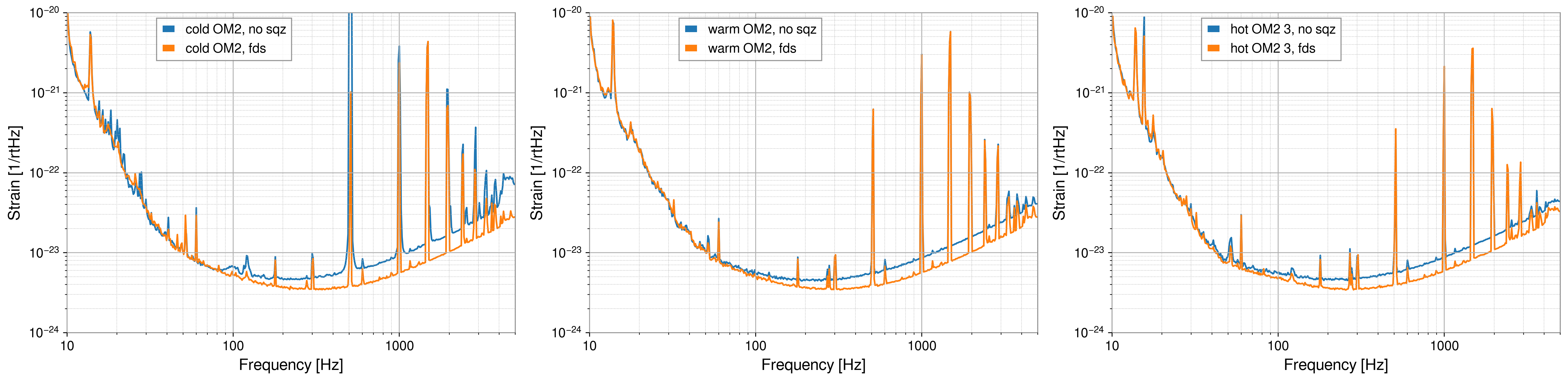
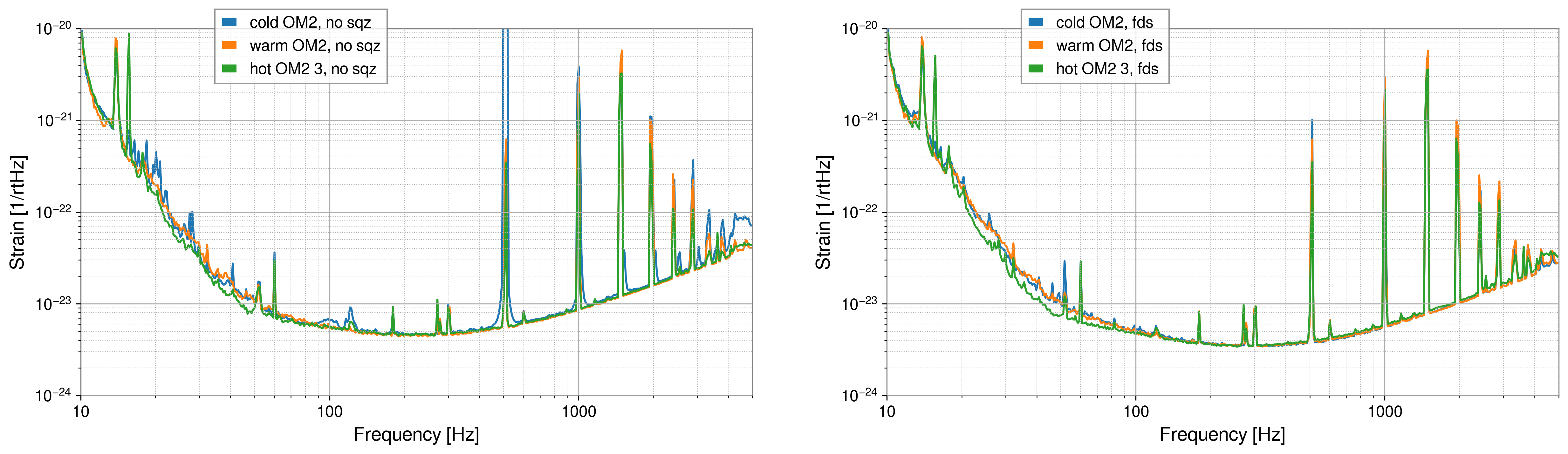
victoriaa.xu@LIGO.ORG - 16:20, Friday 21 July 2023 (71598)ISC

So far I've just started comparing darm spectra (using GDS-CALIB_STRAIN_NOLINES) between the following times, some from the above table:
-- 'cold OM2' uses no-sqz = 1373320175 - 1373320818, fds = 1373322138 - 1373322738
-- 'warm OM2' uses no-sqz = 1373812338 - 1373812938, fds = 1373813118 - 1373814018
-- 'hot OM2 3' uses the recent hot OM2 no-sqz = 1374004600 - 1374005215 (LHO:71591), and fds = 1373984483 - 1373985483 from when range was ~150 this morning. Note FC detuning is -25 Hz for this trace, and many LSC FFs have been retuned here, compared to previous traces.

To start, I looked at compared both the DARM difference with squeezing for different OM2 settings (sqz compared to OM2), and also un-squeezed / squeezed DARMs for different OM2 settings (OM2_compared_to_sqz).

From this second pdf, OM2_compared_to_sqz, a few quick things I notice:
  - Hot OM2, >1 kHz (in the shot-noise-limited region at high frequencies), darm looks a bit worse; this is consistent with the decrease in optical gain at hot OM2.
  - Hot OM2, ~100 Hz, squeezing seems to give some noticeable improvement around and just above 100 Hz (??). This improvement is not that clear without squeezing. Unclear to me if related to FC detuning or OM2, but I wonder if this ~100Hz noise is in part related to quantum noise..
  - Hot OM2, < 100 Hz, low-frequency noise looks much better; the LSC FF tuning seems very effective at improving noise in this configuration.
  - At warm OM2, maybe low-frequencies < 100 Hz see some scatter shelves (?), but I might just be seeing things, not totally clear. 

Next I'll try to compare this with the quantum noise budget without squeezing, starting by comparing the no-sqz traces to look at IFO shot-noise based output losses, for different OM2s (as Sheila suggested). Ideally this will require independent knowledge of some IFO parameters like the readout angle and the SRCL detuning. Once it makes sense with no-sqz darm, I'll continue to work on making sense of both the full and the semi-classical quantum noise budgets with squeezing injected, and budgeting out the quantum noise contributions to get a sense of whether low-frequency quantum noise (e.g. from sqz misrotations) are plausibly showing up in darm, and what knobs we could turn if so.

Non-image files attached to this comment
victoriaa.xu@LIGO.ORG - 16:53, Monday 31 July 2023 (71849)

Edit: indeed the cold OM2 time had a glitch. Updated plots with the following cold OM2 no-sqz time (different day, early in lock.. but looks more reasonable).

Updated plots: effect of sqz at different OM2s, and sqz vs. no-sqz at different OM2s.

Times used:
cold OM2, no sqz, gps start = 1373371323 (2023-07-14, 12:01:45 UTC)
cold OM2, no sqz, gps stop = 1373372668 (2023-07-14, 12:24:10 UTC)

Images attached to this comment
Displaying reports 16921-16940 of 86679.Go to page Start 843 844 845 846 847 848 849 850 851 End