Displaying reports 16981-17000 of 88572.Go to page Start 846 847 848 849 850 851 852 853 854 End
Reports until 17:39, Wednesday 25 October 2023
H1 SQZ
camilla.compton@LIGO.ORG - posted 17:39, Wednesday 25 October 2023 - last comment - 15:00, Monday 20 November 2023(73747)
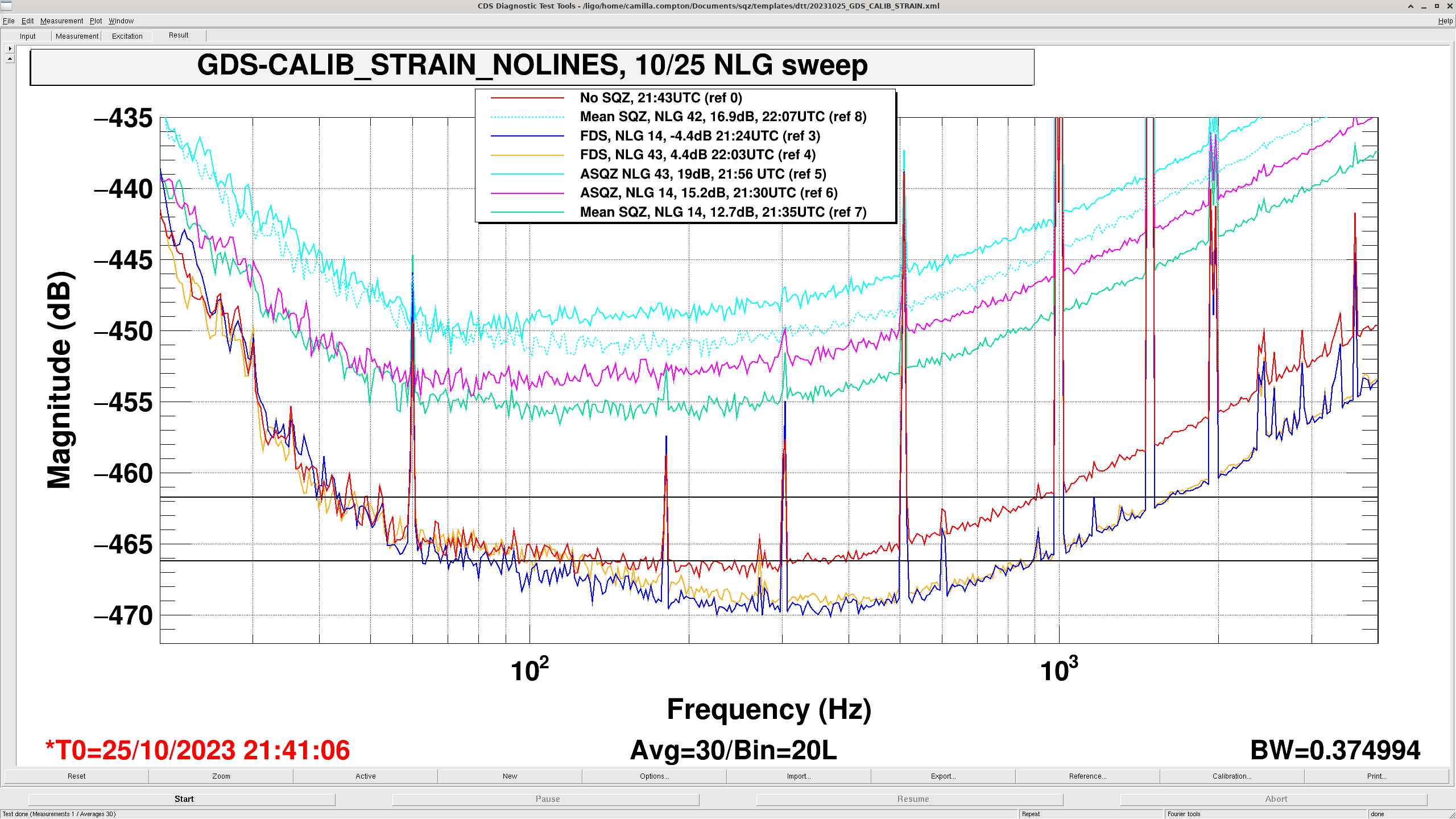
NLG Sweep with IFO

Sheila, Naoki, Camilla

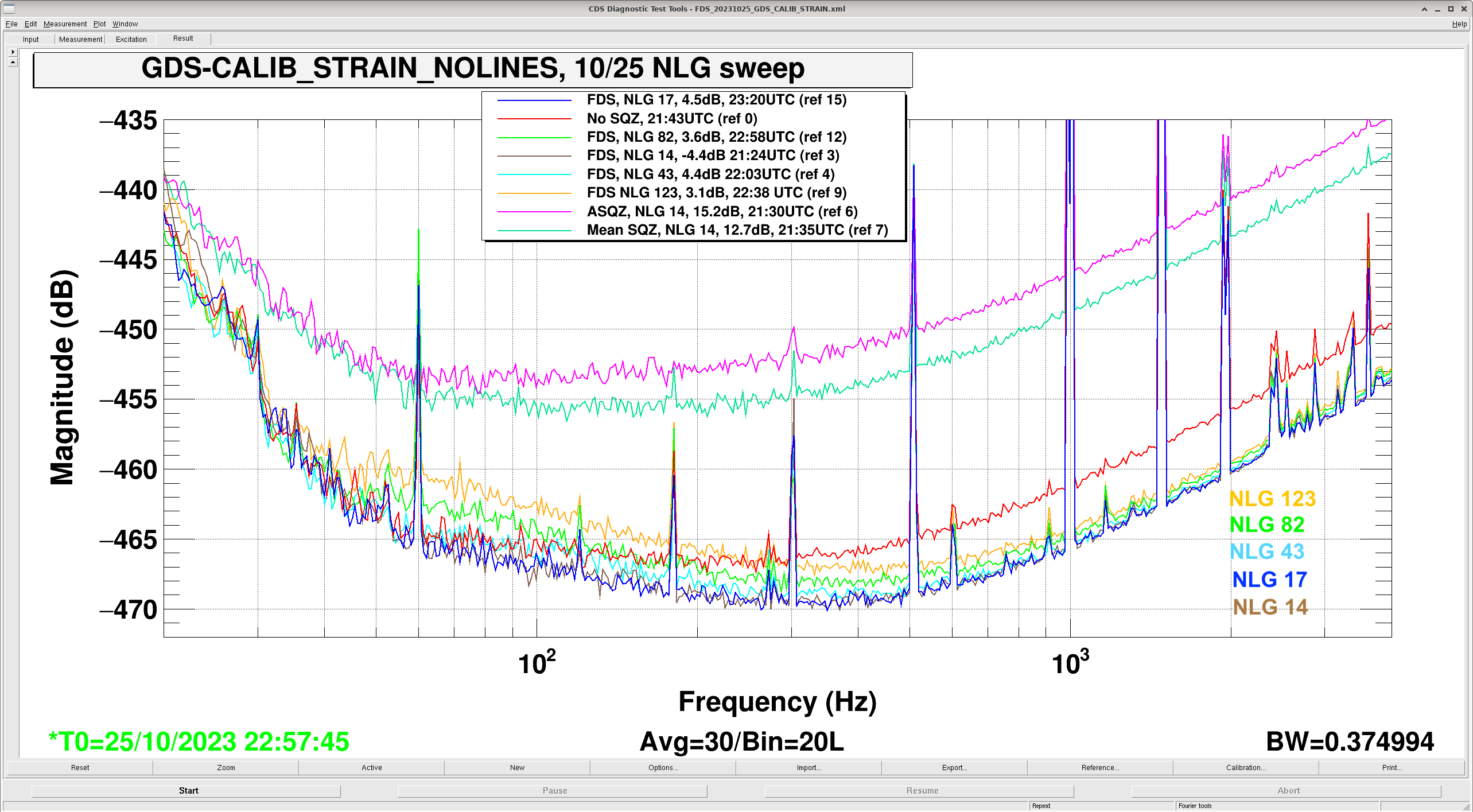
We took FDS, Anti-SQZ and Mean SQZ data at different NLGs: 14, 17, 43, 82 and 123. We think we see evidence of frequency noise. We see less squeezing at high NLGs: around 4.5dB of SQZ at NLG < 43.1 but at NLG 81.9 and 122.8, squeezing at 1kHz reduced to 3.6 and 3.1dB. Attached Plot.

Each time we optimized SQZ angle around 1kHz. Because of this, the low frequency increased noise at high NLGs could be due to incorrect rotation, rather than phase noise. 

 
Time (UTC)
Demod phase
DTT ref#
NLG
SQZ dB at 900Hz
FDS
21:23:40-21:26:00
152.25
3
13.9
-4.3
FDAS
21:27:30- 21:32:30
228.10
6
13.9
15.2
Mean
21:33:47- 21:38:00
-
7
13.9
12.7
No SQZ
21:40:00 -21:44:50
-
0
-
 
FDS (not optimized) 
21:51:20 -21:54:30
164.57
Deleted
43.1
-4
FDAS (Left ASC off) 
21:56:00 -21:59:45
226.2
5
43.1
19.1
FDS (retake)
22:03:00 -22:06:13
167.42
4
43.1
-4.3
Mean
22:06:45 -22:09:52
-
8
43.1
16.9
FDS
22:37:50- 22:41:00
172.16
9
122.8
-3.1
FDAS
22:42:43-22:45:45
217.67
10
122.8
24.7
Mean
22:46:35 - 22:49:55
-
11
122.8
 
FDS
22:57:30- 22:59:40
169.31
12
81.9
-3.6
FDAS
23:01:20 - 23:02:55
219.56
13
81.9
22.7
Mean sqz
23:03:26 - 23:05:45
-
14
81.9
20
FDS (left IFO here)
23:19:38
154.14
15
17.1
-4.5

Data saved in /camilla.compton/Documents/sqz/templates/dtt/20231025_GDS_CALIB_STRAIN.xml

Time (UTC)
Unamplified OPO OPO_IR_PD_LF
(Scan Seed)
 
OPO trans (uW)
OPO Temp (degC)
Amplified (maxium) H1:OPO_IR_PD_LF
(Scan OPO PZT)
NLG 
(Amplified / (Unamplified Peak Max - Unamplified Dark Offset))
Peak Maximum Dark Offset
21:15
786e-6
-16e-6
80.54 uW
31.446
0.0112
13.9
21:44
 
 
100.52
31.414
0.0346
43.1
22:17
 
 
120.56
31.402
0.160
199.5 (SQZ loops went unstable) 
22:30
 
 
110.5
31.407
0.06617
82 (didn't use) 
22:36
 
 
115.46
31.405
0.09853
122.8
22:52
 
 
110.5
31.407
0.0657
81.9
22:09
769e-6
-15e-6
80.5
31.424
0.0137
17.1

Vicky and Naoki did an NLG sweep on the Homodyne in 73562.
Images attached to this report
Comments related to this report
camilla.compton@LIGO.ORG - 10:49, Sunday 29 October 2023 (73801)

Edits to NLG table in above alog: Last measurement was at 22:09 23:09 UTC. For measuring unamplified we scanned OPO PZT and for amplified we scanned SEED PZT. 

Setup for each SQZ Measurement:

For FDS: Took SQZ_MANAGER guardian to FREQ_DEP_SQZ and rotate SQZ angle to give best squeezing at 900Hz. 
For ASQZ: Turn off IFO ASC and FC ASC, rotate SQZ angle to give worst squeezing at 900Hz. 
For Mean SQZ: Took SQZ_MANAGER guardian to FREQ_INDEP_SQZ and SQZ_LO_LR to DOWN. 
 
To measure unampilifed signal for NLG:
  • SQZ_MANAGER to NO_SQUEEZING and SQZ_OPO to DOWN
  • Scan the OPO PZT with PZT_1 Enable, Use trigger: No (via SQZ Overview > HAM7 > OPO IR > OPO PZT1)
  • Should see mode scan on H1: SQZ-OPO_IR_PD_LF_OUT. Measure the highest peak as "Unamplified" and the zero level as "Unamplified Dark Offset".
  • Only need to this once (we did at start and end)
To change to another NLG:
  • SQZ_MANAGER to NO_SQUEEZING
  • Change opo_grTrans_setpoint_uW in sqzparams.py (higher power = higher NLG)
  • Reload SQZ_OPO
  • SQZ_OPO to LOCKED_CLF_DUAL_NO_ISS  then LOCKED_CLF_DUAL
    • Check it locks with correct OPO TRANS power, may need to adjust SHG power with waveplate
  • SQZ_OPO to LOCKED_SEED_NLG
  • SQZ_CLF to DOWN
  • Adjust temperature to maximize SQZ-OPO_IR_PD_LF_OUT (with SEED_PZT scanning enabled)
  • Record SQZ-OPO_IR_PD_LF_OUT maximum it is "Amplified" signal.
    • Can now calculate NLG = Amplified / (Unamplified - Unamplified Dark Offset).
  • SQZ_MANAGER to SQZ_READY_IFO (with swap back from SEED to CLF)
victoriaa.xu@LIGO.ORG - 15:00, Monday 20 November 2023 (74318)

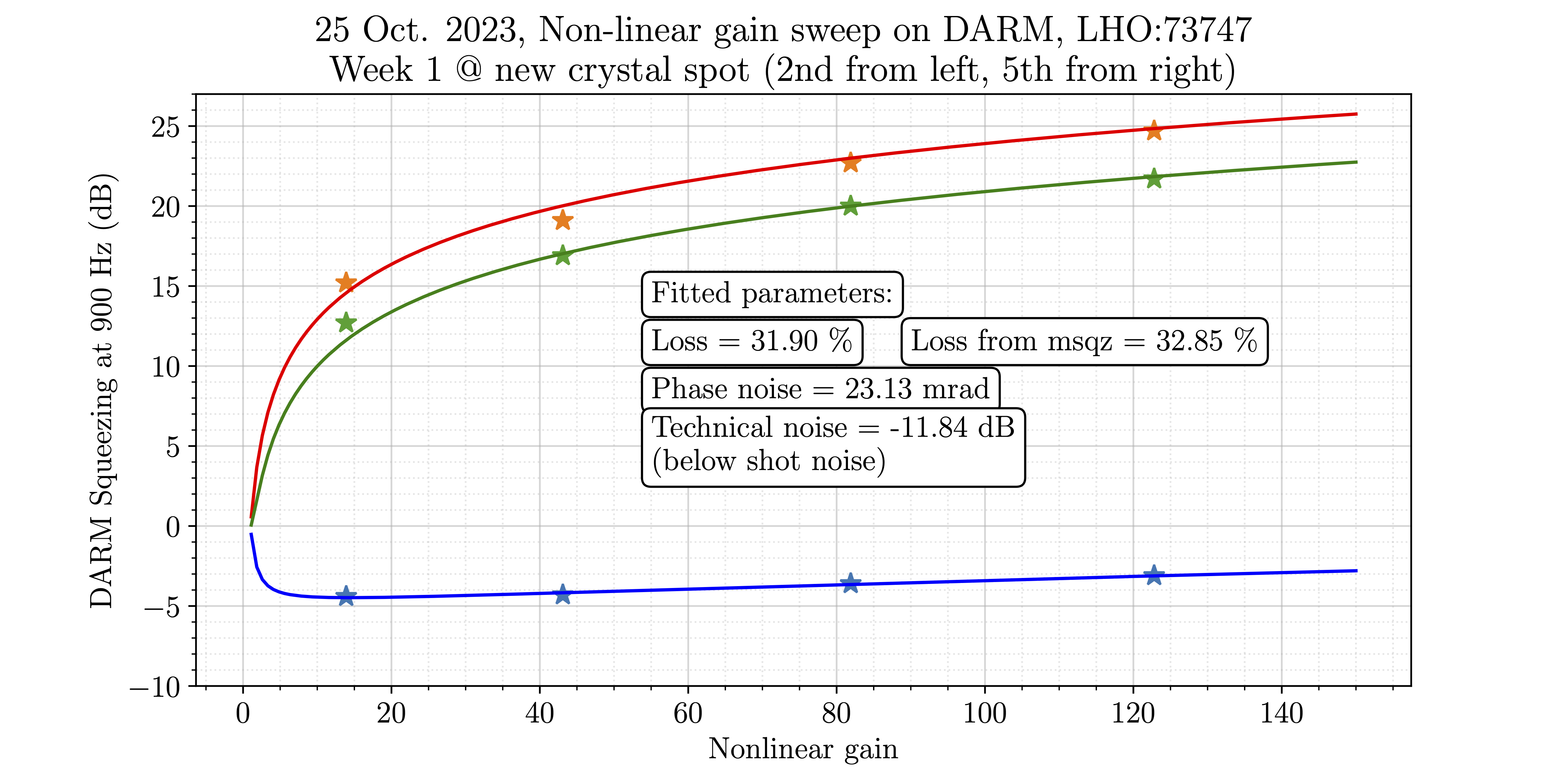
Attached are fits of squeezing loss, phase noise, and technical noise to this NLG sweep on DARM: we can infer 25-30% total SQZ losses, ~25 mrad rms phase noise, with technical noise almost -12 dB below shot noise.

Losses are tracked in the SQZ wiki and gsheet. Of the 30% total inferred loss, we expect 20%: that is 7.5% injection loss, and 13.7% readout loss.

Remaining ~10% mystery loss is compatible with mode-mismatch: in sqz-omc single bounce mode scans, LHO:73696, we estimate 8-15% mismatch, and we observe the frequency-dependence of the mismatch as we vary squeezer beam profile using PSAMS: 73400, 73621.

In the fits, [loss, phase noise, technical noise] are fit to the measured SQZ and Anti-SQZ, given the measured NLG, using equations from the aoki paper. "Loss from mean sqz" is the calculated loss from the measured NLG and measured mean-sqz dB; it is not a fit, but depends on the calibration from NLG to generated SQZ dB.

Some summary slides here show the progression of our loss hunting, which are so far lining up with Sheila's projections from 73395.
Images attached to this comment
Non-image files attached to this comment
H1 SUS
anthony.sanchez@LIGO.ORG - posted 17:30, Wednesday 25 October 2023 (73748)
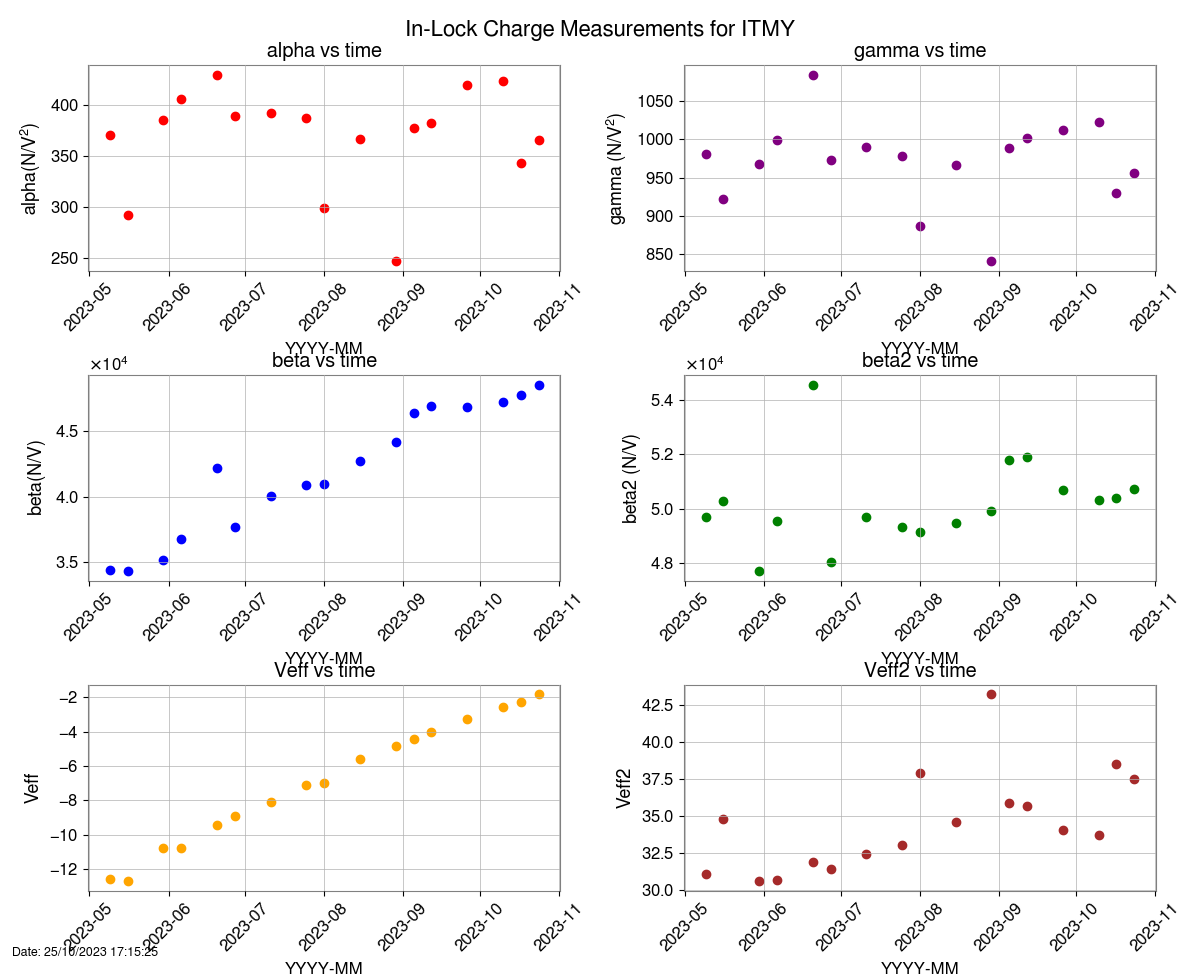
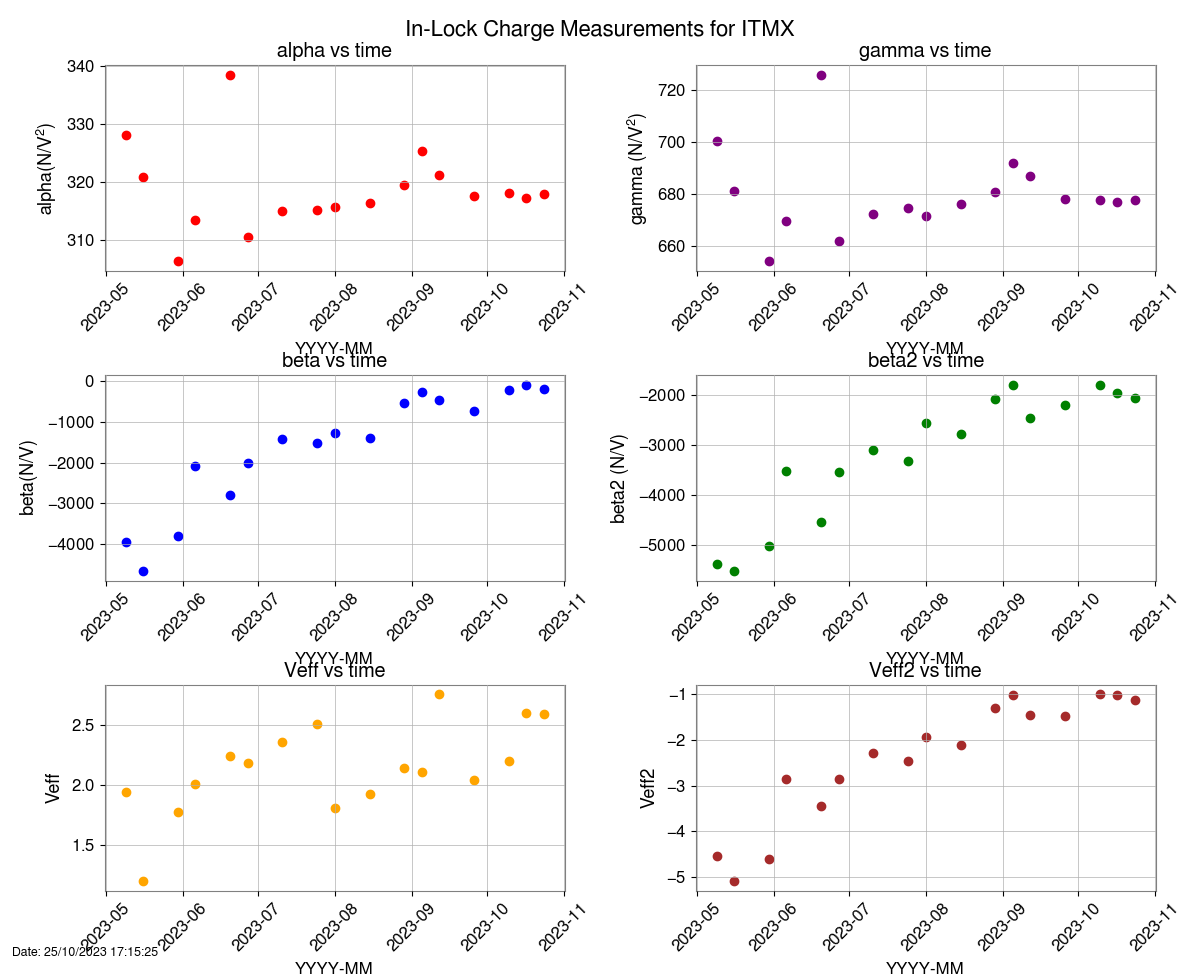
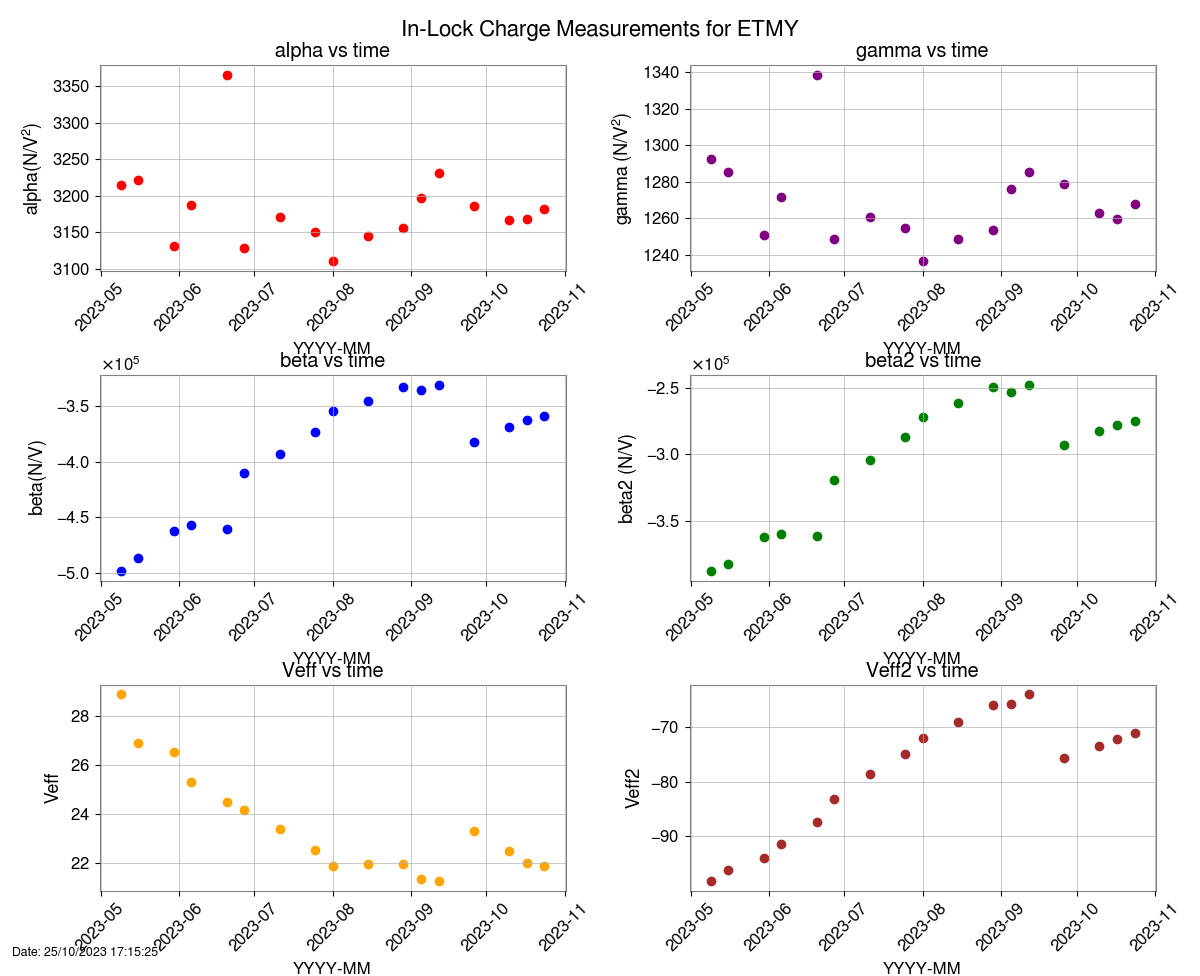
In Lock Charge Measurement

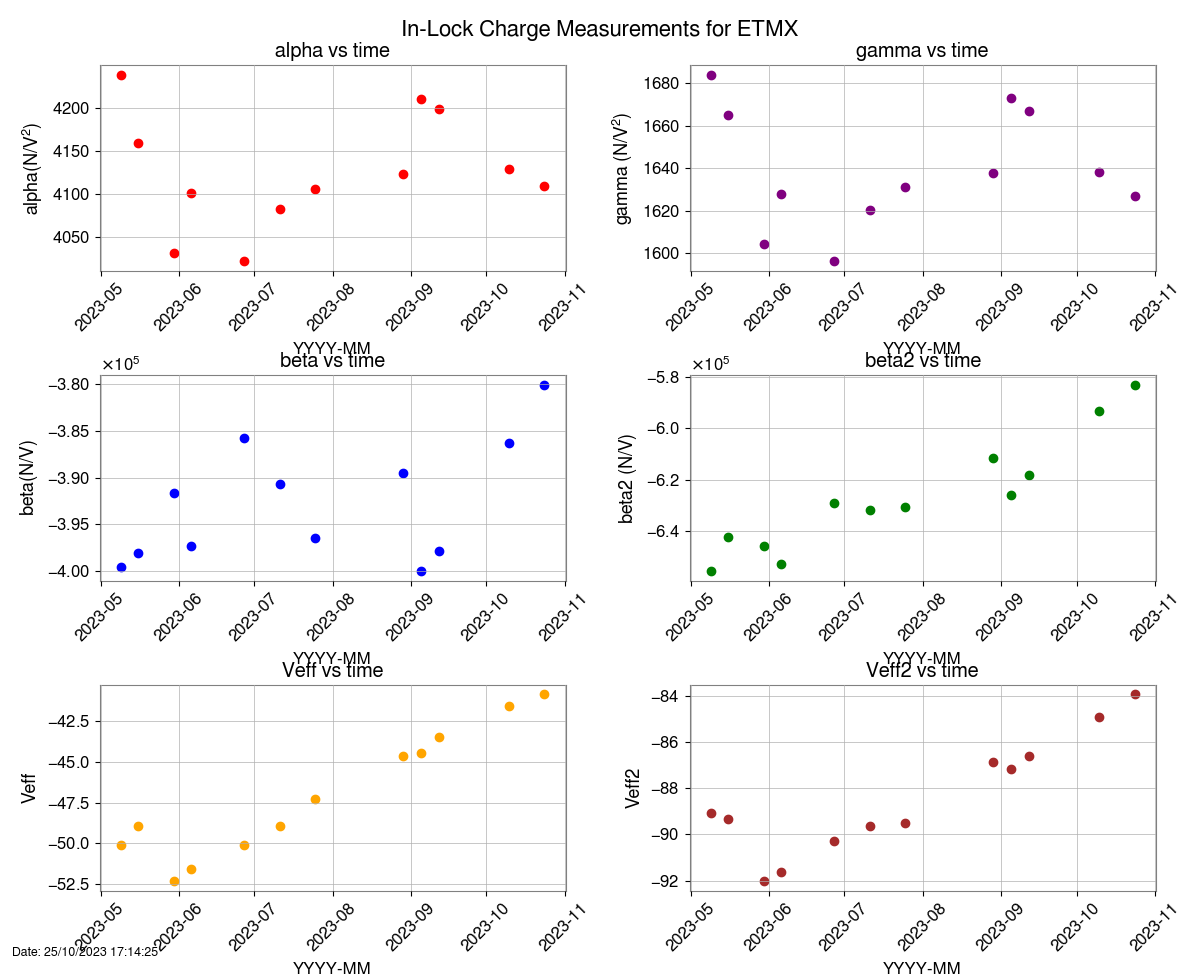
Famis 26063

In Lock charge measurements ran yesterday, and everything went smoothly up until the the line python3 coeffiencentplots.py . Ryan has an ALOG 73432 which Camilla pointed me to, This worked out well!
 

Images attached to this report
H1 ISC
vladimir.bossilkov@LIGO.ORG - posted 16:29, Wednesday 25 October 2023 (73746)
80.3 kHz PI Mechanical Q

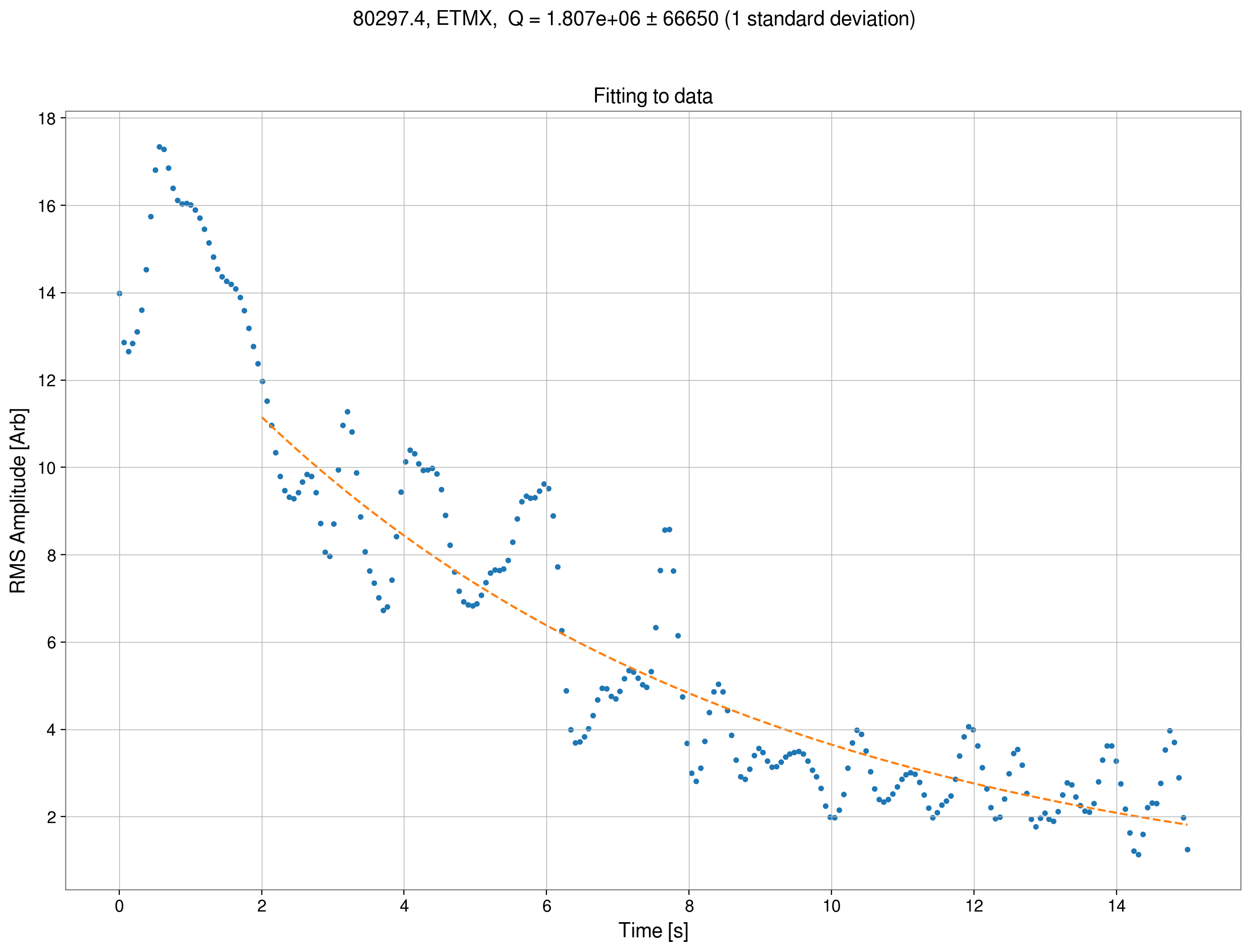
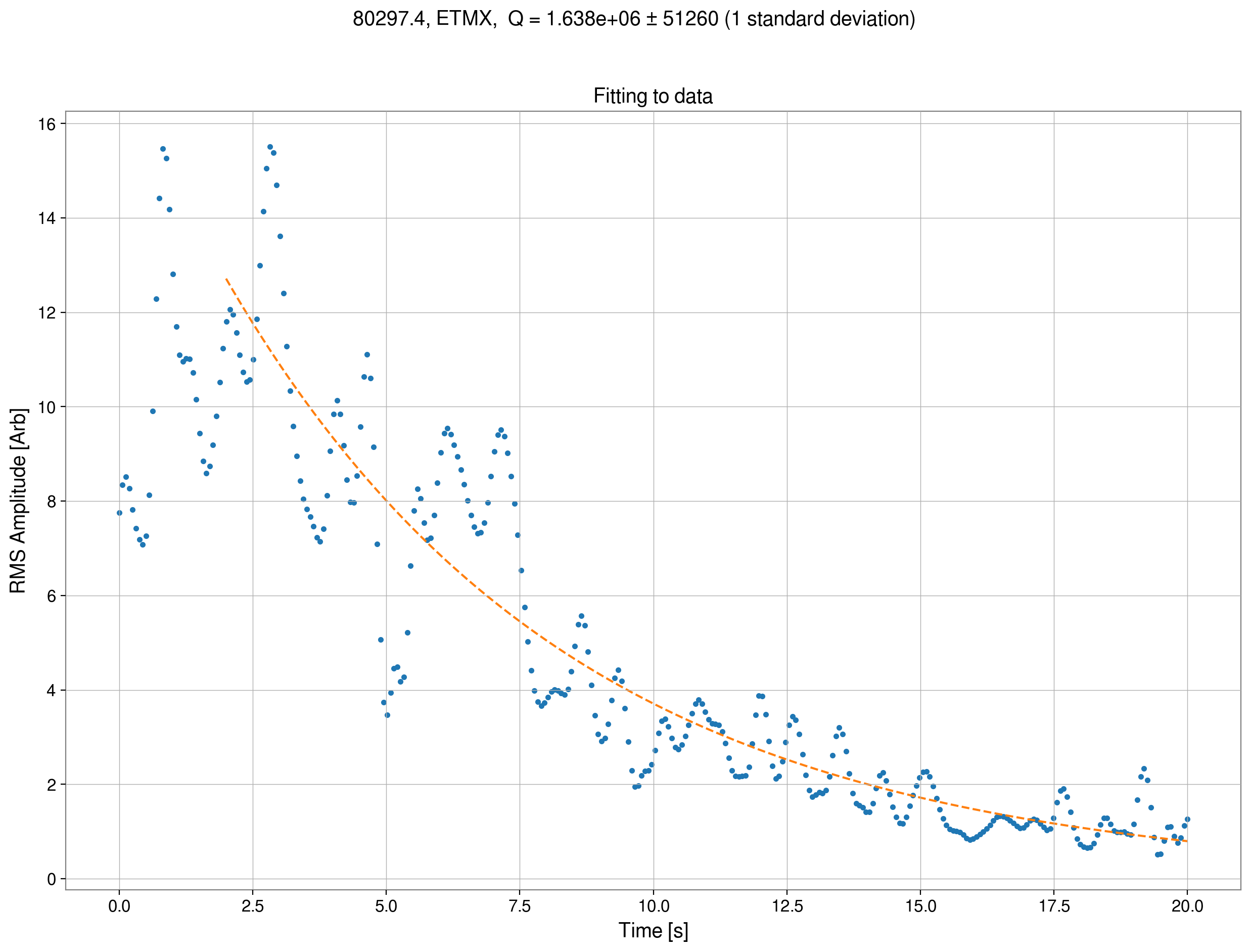
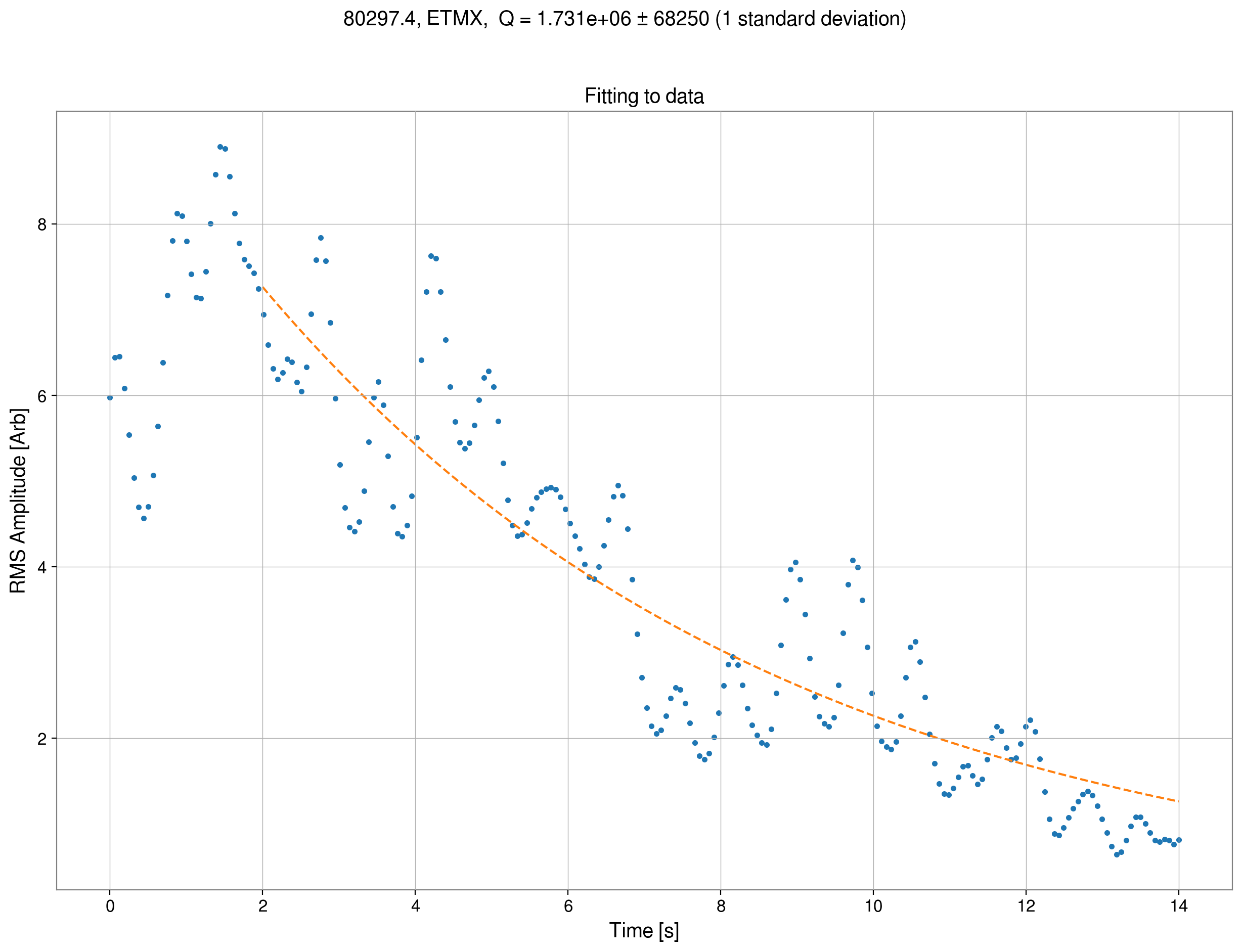
I made measurements of ringdown constants of the of this mechanical mode to get a measurement of the Q factor.

The measurements were admittendly quite ratty, and often the PLL would lock to some oscillation that it itself creates, giving many occasions where the oscillation vanishes immidiately as the injectoin ends.
This is largely due to the mechancial mode not being significantly larger than the noisefloor, causing PLL to lock to garbage.

Of the times I was able to excite the mechanical mode itself, I measured Q-factors of through the locked PLL amplitude signal:

So the Q-factor is approximately 1.7 million.

At the time of measurement, the frequency difference between the optical mode and the mechanical mode was 14.55 Hz.
Given the optical linewidth is roughly 1 Hz, this is "far" enough away to neglect optomechanical coupling and trust this as a true estimate of mechanical Q.

Images attached to this report
H1 General
anthony.sanchez@LIGO.ORG - posted 16:08, Wednesday 25 October 2023 (73742)
Wednesday Eve Shift Start

TITLE: 10/25 Eve Shift: 23:00-07:00 UTC (16:00-00:00 PST), all times posted in UTC
STATE of H1: Commissioning
OUTGOING OPERATOR: Oli
CURRENT ENVIRONMENT:
    SEI_ENV state: CALM
    Wind: 16mph Gusts, 11mph 5min avg
    Primary useism: 0.04 μm/s
    Secondary useism: 0.20 μm/s 
QUICK SUMMARY: 
H1 is in NOMINAL_LOW_NOISE, but ....
Comissioning is still in progress for a few more minutes so the SQueeZrs can do some Anti-SQZin with different Non Linear Gains(NLG). 

H1 General
oli.patane@LIGO.ORG - posted 16:04, Wednesday 25 October 2023 (73743)
Ops DAY Shift End

TITLE: 10/25 Day Shift: 15:00-23:00 UTC (08:00-16:00 PST), all times posted in UTC
STATE of H1: Commissioning
INCOMING OPERATOR: Tony
SHIFT SUMMARY: Now Locked for 20.5 hours. Had commissioning today starting at 19:07UTC and is ongoing but wrapping up soon.
LOG:

15:00UTC Detector Locked for 12.5hours

--Commissioning Start--
19:07 Out of Observing for Commissioning
19:09 To NLN_CAL_MEAS for Calibration measurements
    - bb measurements: 1382296233 - 1382296559
    - simulines measurements: 1382296585 - 1382297917
19:39 Back to NOMINAL_LOW_NOISE
19:44 - 20:05 DARM Boost
20:08 COMM Gain
    12: 20:08:17 - 20:10:17
     6: 20:10:29 - 20:12:29
    12: 20:12:44 - 20:14:44
     6: 20:14:58 - 20:16:58
    
20:20 - PRESENT SQZ ASQZ w/different NLG      

Start Time System Name Location Lazer_Haz Task Time End
15:04 FAC Karen OpticLab/VacPrep n Tech clean 15:32
15:09 FAC Randy EY/EX n Moving boxes from EY to EX 17:09
15:32 FAC Karen MY n Tech clean 16:48
19:10 CAL Louis, Oli CR n Running calibration 19:38
19:49 OPT Jason OpticsLab y(local) Oplev work 20:15
19:44 ISC Camilla, Sheila CR n DARM Boost 20:06
20:07 ISC Oli CR n CARM gain 20:17
19:10 PI Vlad, Naoki CR n 80k PI work 21:34
20:29 FAC Eric, Tyler MX n Looking at air handler 21:59
20:20 SQZ Sheila, Camilla CR n SQZ ASQZ w/different NLG ongoing
21:23 OPT Jason, Austin Optics Lab n Oplevs 22:37
H1 CAL
oli.patane@LIGO.ORG - posted 14:26, Wednesday 25 October 2023 (73741)
Calibration BB and Simulines Measurements 2023-10-25

Ran a BB measurement followed by Simulines:

    - bb measurements: 1382296233 - 1382296559 (2023-10-25 19:10:15 - 19:15:41)
    - simulines measurements: 1382296585 - 1382297917 (2023-10-25 19:16:09 - 19:38:19)

Output files:

BB:
/ligo/groups/cal/H1/measurements/PCALY2DARM_BB/PCALY2DARM_BB_20231025T191015Z.xml

Simulines:
/ligo/groups/cal/H1/measurements/DARMOLG_SS/DARMOLG_SS_20231025T191609Z.hdf5
/ligo/groups/cal/H1/measurements/PCALY2DARM_SS/PCALY2DARM_SS_20231025T191609Z.hdf5
/ligo/groups/cal/H1/measurements/SUSETMX_L1_SS/SUSETMX_L1_SS_20231025T191609Z.hdf5
/ligo/groups/cal/H1/measurements/SUSETMX_L2_SS/SUSETMX_L2_SS_20231025T191609Z.hdf5
/ligo/groups/cal/H1/measurements/SUSETMX_L3_SS/SUSETMX_L3_SS_20231025T191609Z.hdf5

Images attached to this report
H1 ISC
gabriele.vajente@LIGO.ORG - posted 13:52, Wednesday 25 October 2023 - last comment - 16:40, Wednesday 25 October 2023(73740)
Improving DARM RMS with resonant gains

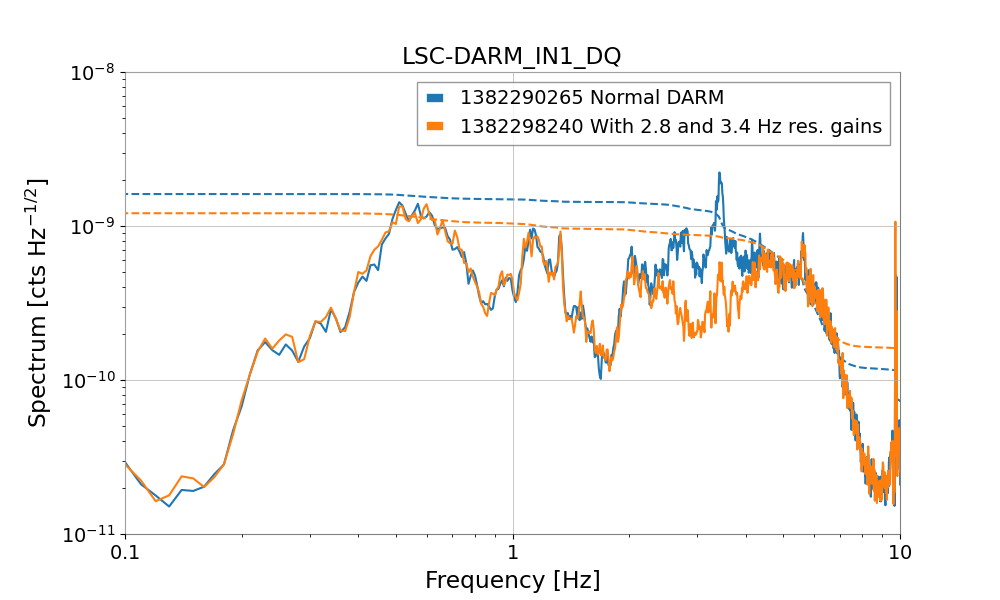
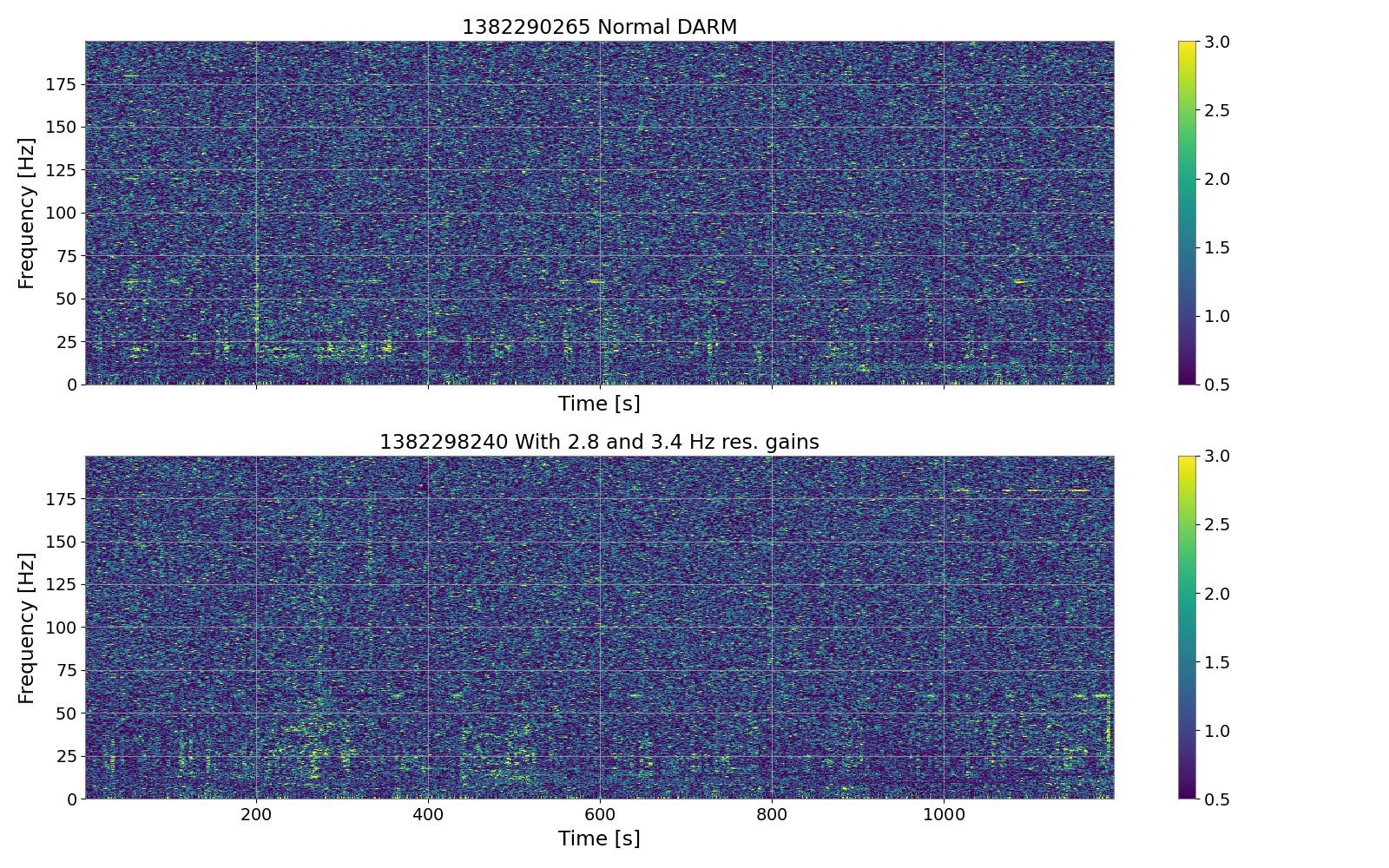
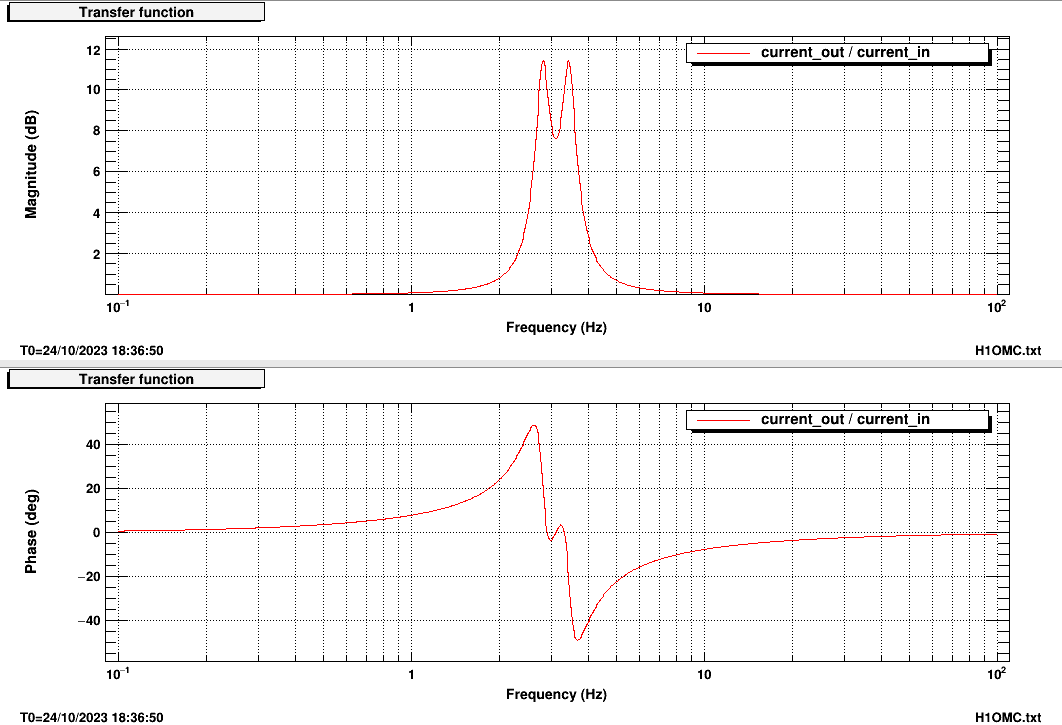
Today we tested the effect on DARM of additional resonant gains at 2.8 and 3.4 Hz, as described in 73698.

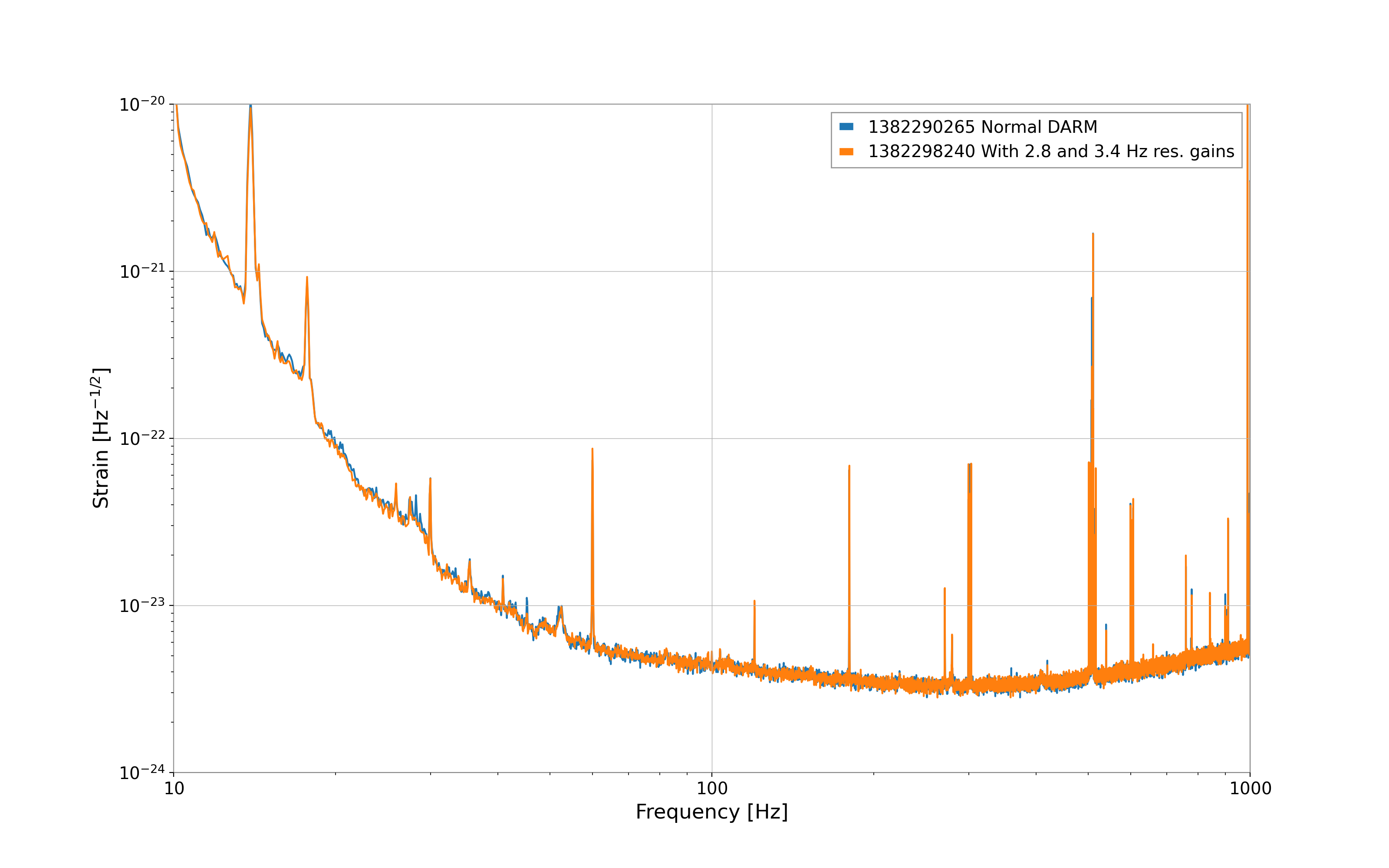
DARM RMS was reduced as expected from 1.6e-9 to 1.2e-9.

Looking at DARM spectrograms, there is no evident difference in the level of non-stationary noise.

Comapring the DARM PSD during two times, there seems to be a small improvement, but that might be a fluctuation.

In summary: the resonant gains improve the DARM RMS, but we don't see a clear improvement in noise; they don't hurt though 

Images attached to this report
Comments related to this report
jenne.driggers@LIGO.ORG - 16:40, Wednesday 25 October 2023 (73745)

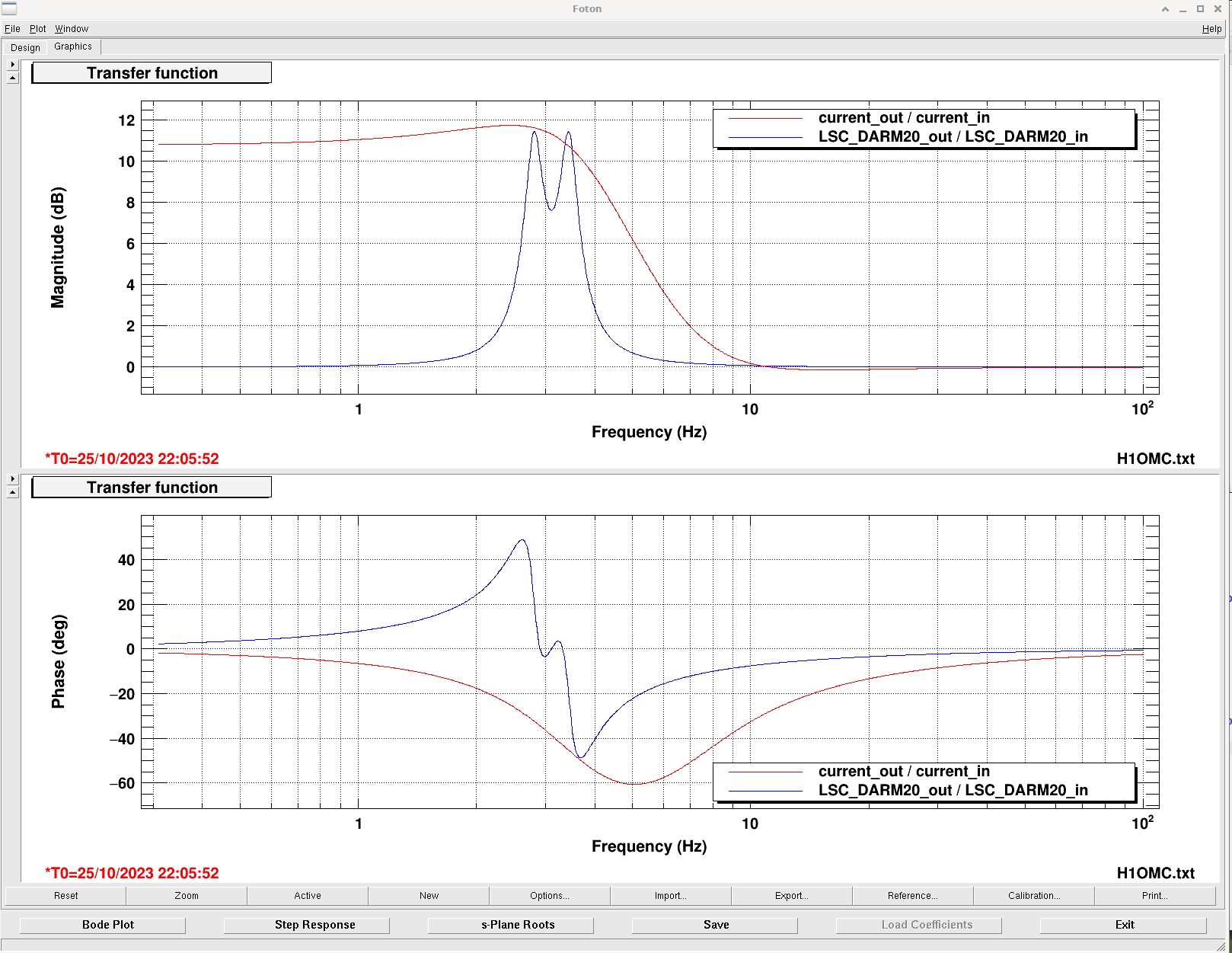
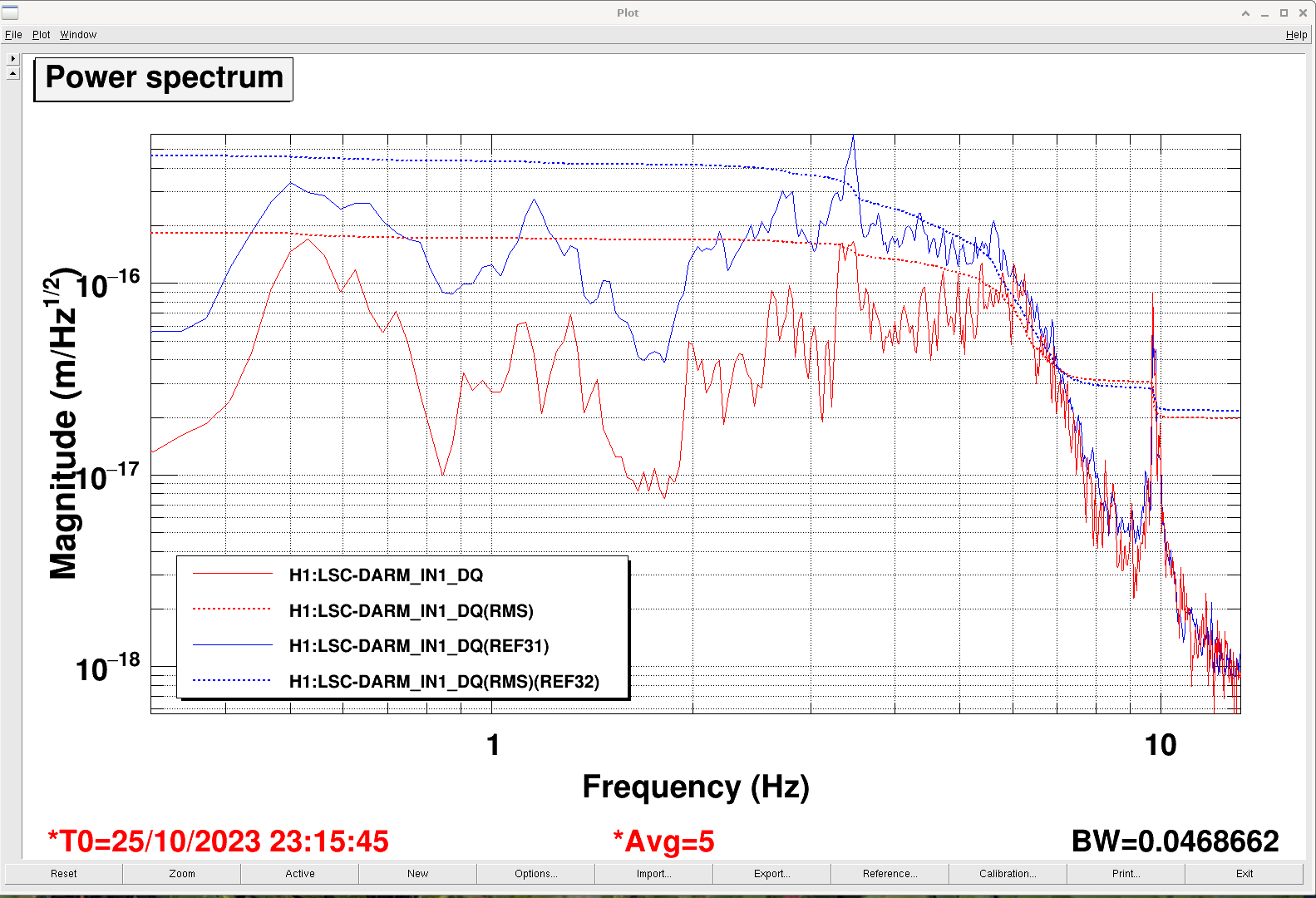
I've created a low frequency boost that generally gives more gain at low freq, rather than just having the resGs. I turned it on starting at 23:11:00 UTC.  Until 23:19:38, the squeezers were working.  Then around 23:26:00 I changed the CARM gain.  So, maybe this isn't such great 'quiet time' to evaluate whether we've improved our nonstationarity, but it certainly does seem fine, and it also does nicely reduce the low frequency DARM_IN1 and its RMS.  The filter was back off around 23:31:00 UTC so we could go back to Obsering.

In the first plot, the blue filter is the one that Gabriele had created, and we tried early in the commissioning period today.  Red is my new proposed filter.

In the second plot, the blue is DARM_IN1 under nominal circumstances (so, no resG or boost), and red is with my version of the boost filter.  As noted in my 'timeline' above, there isn't really a lot of good quiet time to evaluate its effect on the nonstationarity, but the significant reduction in RMS seems like a good thing.  If we want to leave this filter on, Louis will need to do some work to prepare the calibration pipeline, and we'll need to restart the GDS pipeline during the same commissioning window that we turn on the new boost.

EDIT: please disregard the y-axis label on the DARM_IN1 specra plot.  I don't think that should be there.

Images attached to this comment
H1 ISC
oli.patane@LIGO.ORG - posted 13:27, Wednesday 25 October 2023 - last comment - 16:26, Wednesday 25 October 2023(73738)
Alternating CARM Gain

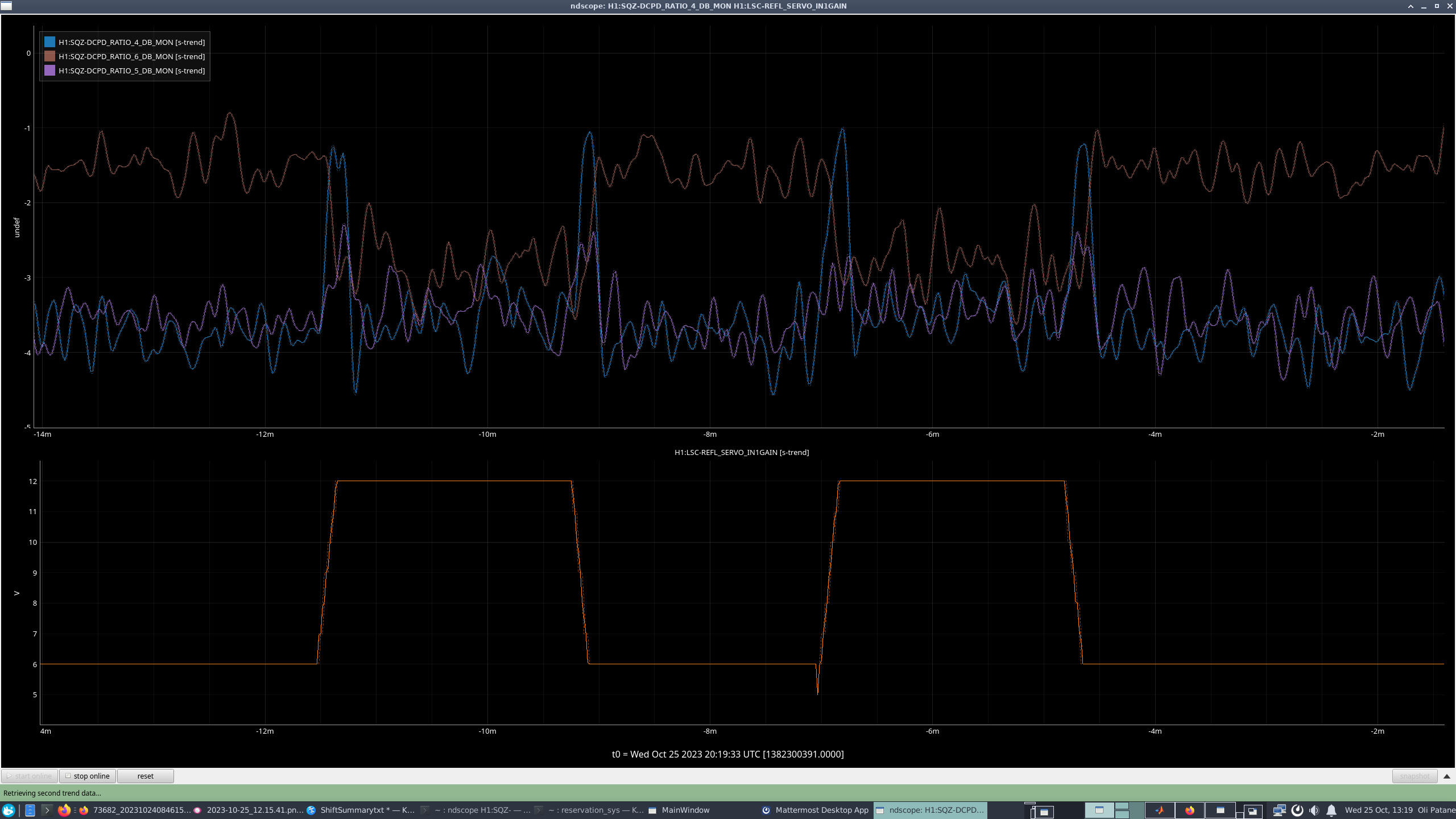
In a follow-up to what TJ did yesterday(73685), I alternated the CARM gains (H1:LSC-REFL_SERVO_IN{1, 2}GAIN) between 6 (what it was nominally at) and 12 every two minutes.

Times when we were at each gain setting (in UTC):

   12: 20:08:17 - 20:10:17
    6: 20:10:29 - 20:12:29
   12: 20:12:44 - 20:14:44
    6: 20:14:58 - 20:16:58

Attached is an ndscope over this timeframe looking at the CARM gain and SQZ BLRMS channels (same as the channels that TJ and Camilla had been looking at yesterday(73682)).

Images attached to this report
Comments related to this report
jenne.driggers@LIGO.ORG - 13:50, Wednesday 25 October 2023 (73739)

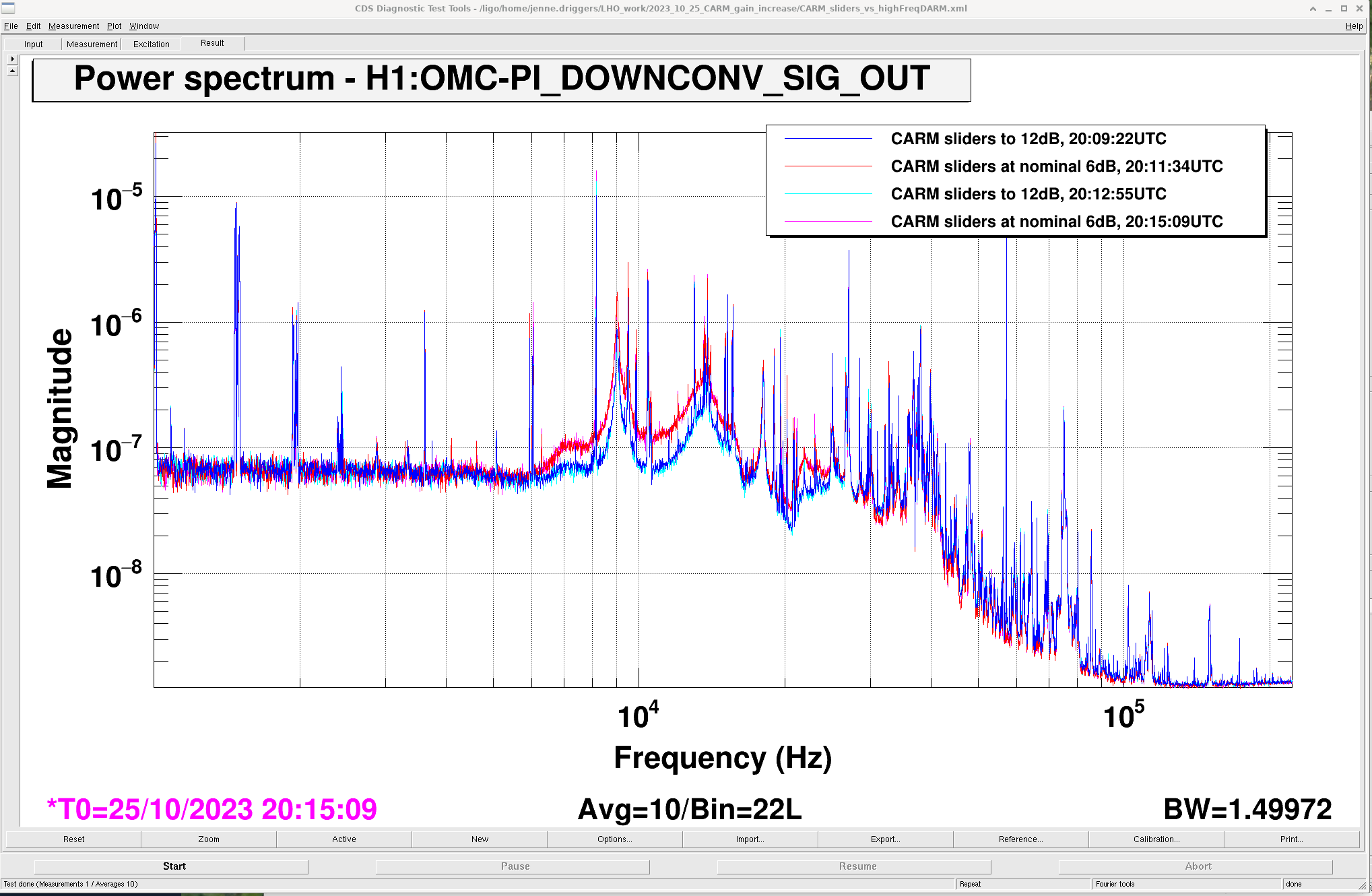
Attached is our very high frequency monitor of the DCPDs. (Since this channel is not saved, I also upload the DTT file).

The red / pink traces are at our nominal CARM gains of 6dB on each slider (H1:LSC-REFL_SERVO_IN1GAIN and IN2GAIN), and the blue / teal traces are the higher values of 12dB on each slider.  All data is 10 avgs at 1 Hz BW, 25th Oct 2023.  Times of the data are in the legend for each trace. 

It seems that increasing the CARM gain is beneficial to our noise between 6 kHz to about 25 kHz.  From about 25 kHz to a little above 100 kHz it increase our noise a bit.  Above 100 kHz we're limited by some other noise, and so not seeing the effect of frequency noise.

I think it seems fine to leave CARM with the higher gain.

Images attached to this comment
Non-image files attached to this comment
jenne.driggers@LIGO.ORG - 16:26, Wednesday 25 October 2023 (73744)

I've just modified LASER_NOISE_SUPRESSION to increase the sliders to 12dB (it used to increase them up to the previous nominal of 6dB at the end of the state).  I've just increased the sliders before we go back to Observe, so we'll have lower frequency noise for all our upcoming locks.

H1 CAL
louis.dartez@LIGO.ORG - posted 12:34, Wednesday 25 October 2023 (73736)
Corrections to modeled response function since start of O4a
Here is a list of the _known_ corrections to the systematic error that need to be accounted for when regenerating the O4a uncertainty budgets.


IssueStartEndStatus
3.2 kHz ESD Driver Pole in CAL-CS Model (LHO:72043)2023/04/26 (ER15)2023/08/08 00:15 UTCRough fit exists. LHO:71787
Spoiled TDCFs due to noise in Kappa_UIM (LHO:71790, LHO:71846) 2023/07/20 2023/08/03 In progress. Pending correction file.
Thermalization effects seen in sensing function at 75W ER15 2023/06/21 In progress by Cal group.
Thermalization effects seen in sensing function at 60W 2023/06/21 Now In progress by Cal group.
There may be other corrections that are needed by additional unmodeled effects including OM2 hot/cold, drifting Kappa_T, and Pcal error that hasn't been accounted for (if any). Useful reference: Record of Real-time Calibration Pipeline Parameter Changes: O4 (and ER15) -- H1 (DCC T2300297)
H1 General
oli.patane@LIGO.ORG - posted 11:57, Wednesday 25 October 2023 (73734)
Ops DAY Midshift Update

Observing at 157Mpc and Locked for 16.5hours.

We're right about to start some Commissioning for the next four hours.

H1 ISC
vladimir.bossilkov@LIGO.ORG - posted 11:12, Wednesday 25 October 2023 (73733)
Mapping (questionably) easily visible 1st order optical mode spacing to 1st order optical mode spacing 2 FSR's away (relevant for the 80.3 kHz PI)

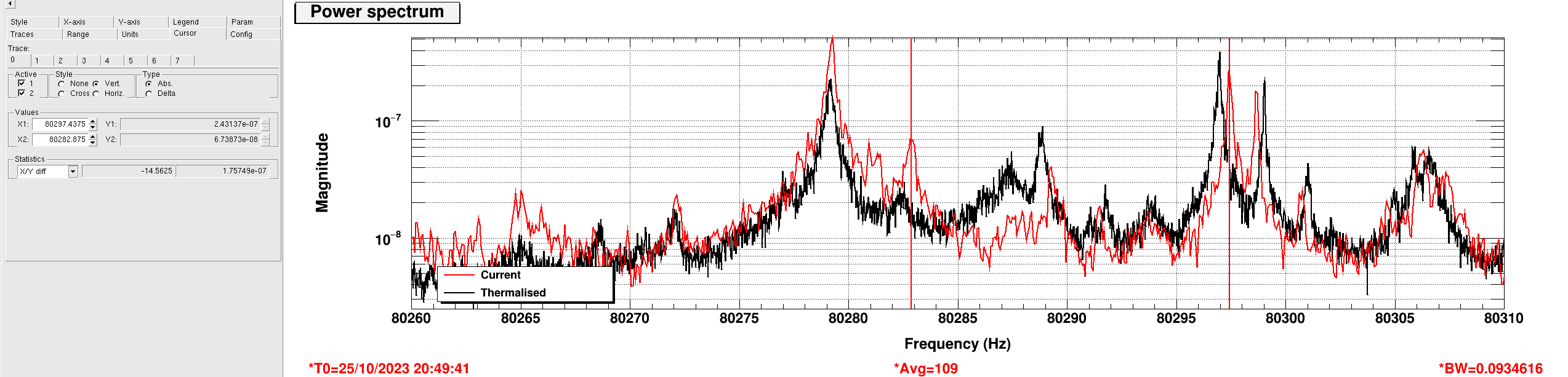
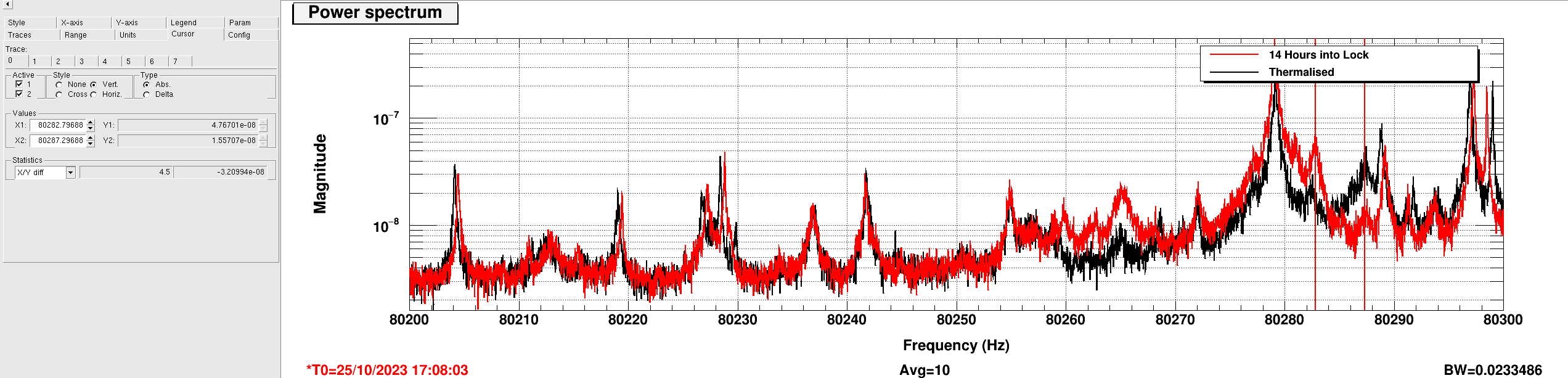
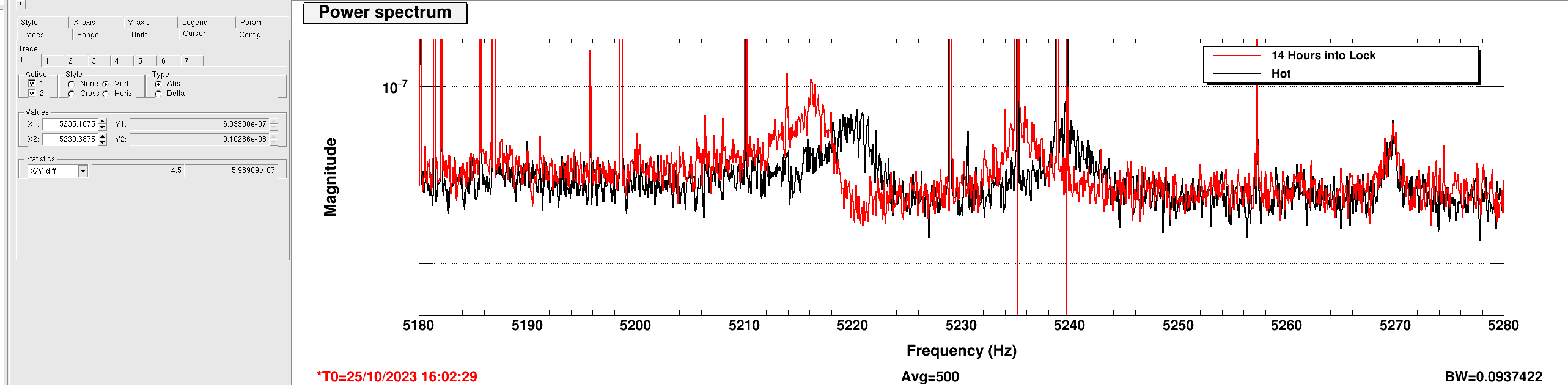
I measured the optical modes moving in the OMC-DCPD-SUM signal where, with A LOT of averaging (when the optical modes are pseudo stable), the optical high order mode (HOM) spacing can be observed as its changing through a lock stretch.
I look at the spectrum visible in the 5.2kHz range; and the spectrum visible in the 80.3 kHz range.
There are 2 sets of optical modes easily visible. Currently I assume the one I need to worry about is the higher one that is substantially closer to 80297 kHz of the PI.

The 2 two times plotted correspond to:

This should, in principle, correspond to 2*FSRx + HOM_spacing, but there is a slight discrepancy at both LLO and LHO (roughly 4 Hz by my estimates), which may be related to the small Gouy phase impact of the PRC, but I'm not sure exactly how.

For these measurements, the difference in frequency is 75047.61 Hz
For completeness,  2*FSRx = 75051.87 Hz (X-arm length is 3994.4704 m)

This is relevant to being able to track how far away we are in terms of optical mode spacing, from the mechanical mode Frequency in a DQ channel for post processing.

Images attached to this report
LHO VE
david.barker@LIGO.ORG - posted 10:21, Wednesday 25 October 2023 (73731)
Wed CP1 Fill

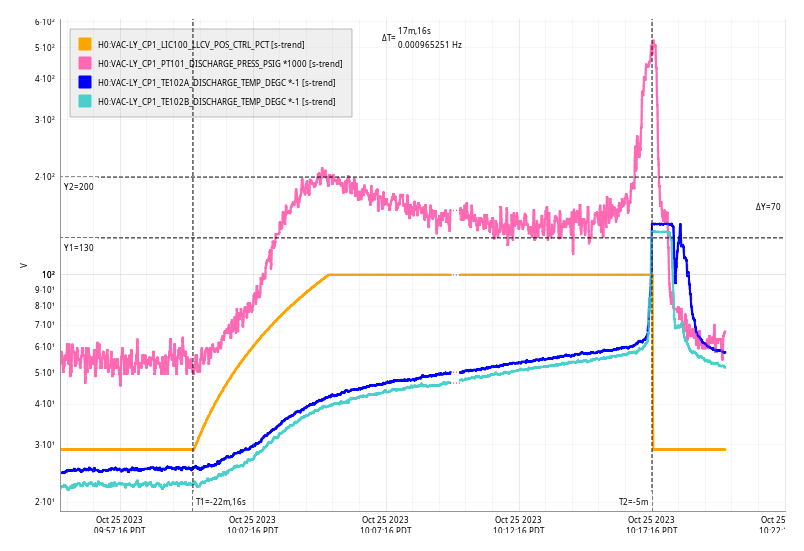
Wed Oct 25 10:17:16 2023 INFO: Fill completed in 17min 11secs

Jordan confirmed a good fill curbside. Note TCs only just cleared the trip level, outside temp was 45F at time of fill.

Images attached to this report
H1 CDS
david.barker@LIGO.ORG - posted 10:06, Wednesday 25 October 2023 (73730)
New HOFT and NOLINES H1 Effective Range Channels

A follow up on the two new IFO range channels which were added to the DMT2EPICS_IOC and the DAQ yesterday.

Attachment shows a new MEDM I created which shows all four range channels, along with their GPS. This MEDM can be opened from SITEMAP -> OPS -> H1 IFO RANGES.

The ndscope second-trend plot shows that CAL has the largest range, HOFT the lowest, CLEAN and NOLINES are inbetween and are phase shifted versions of the same channel.

Images attached to this report
H1 General
oli.patane@LIGO.ORG - posted 08:02, Wednesday 25 October 2023 (73728)
Ops DAY Shift Start

TITLE: 10/25 Day Shift: 15:00-23:00 UTC (08:00-16:00 PST), all times posted in UTC
STATE of H1: Observing at 159Mpc
OUTGOING OPERATOR: TJ
CURRENT ENVIRONMENT:
    SEI_ENV state: CALM
    Wind: 10mph Gusts, 7mph 5min avg
    Primary useism: 0.02 μm/s
    Secondary useism: 0.20 μm/s
QUICK SUMMARY:

In Observing and Locked for 12.5 hours.

H1 TCS
camilla.compton@LIGO.ORG - posted 17:09, Tuesday 24 October 2023 - last comment - 15:17, Wednesday 01 November 2023(73717)
Reverted ETMX HWS to old LED Source, Realigned and Restarted Code.

TJ, Camilla. WP #11483.

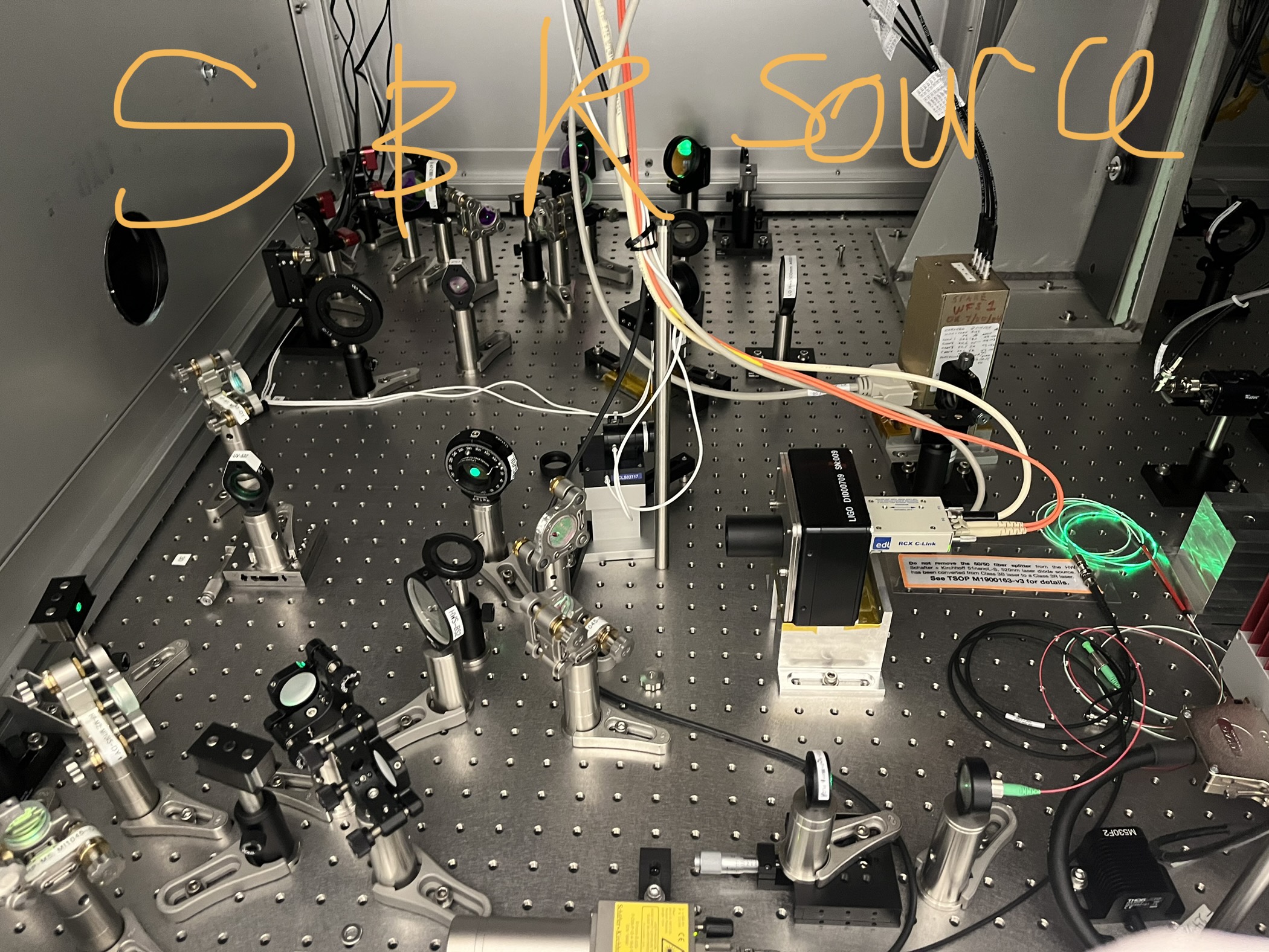
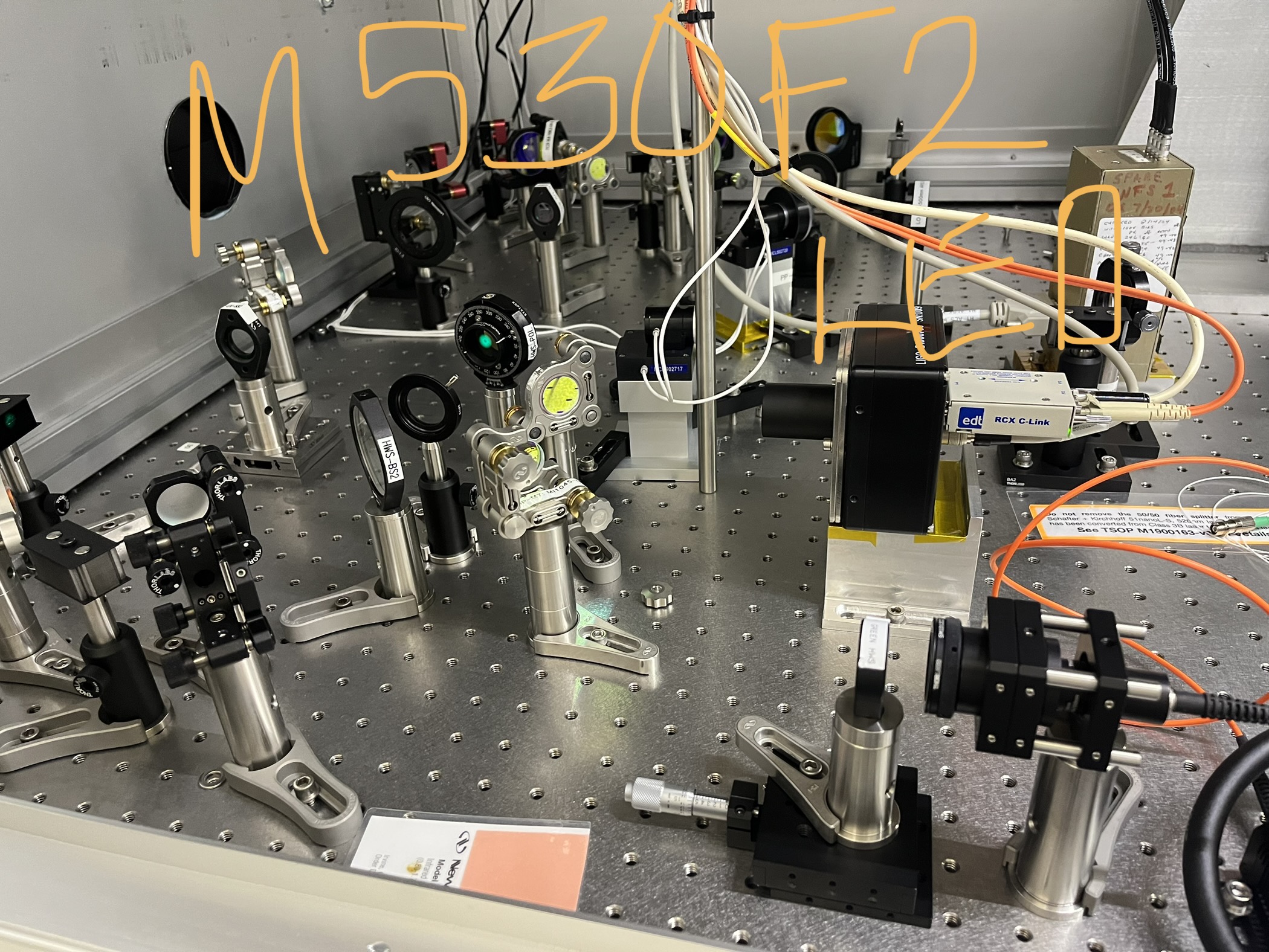
Uninstalled the "new" S&K HWS laser (TSOP M1900163) from the ALS table, stored it in it's case in the LVEA TCS cabinets. Removed fiber and fiber launcher.  This was installed in 62089.

Reinstalled the "old"  diode source M530F2 (eye safe). Using M92L02 20um multi-mode fiber and original D1800125 fiber launcher. Reduced length of the tube of D1800125 fiber launcher as we thought we need to bring the F=125mm lens closer to the launcher.  

Realigned the path to get a retro-reflected beam off ETMX and checked this by mis-aligning ETMX. Took new references on EX, and ITMs at 00:08UTC.


Photos before and after attached. Decision made to swap back to original source in T2300336. Will update FRS 14310 with Aidan. 

Images attached to this report
Comments related to this report
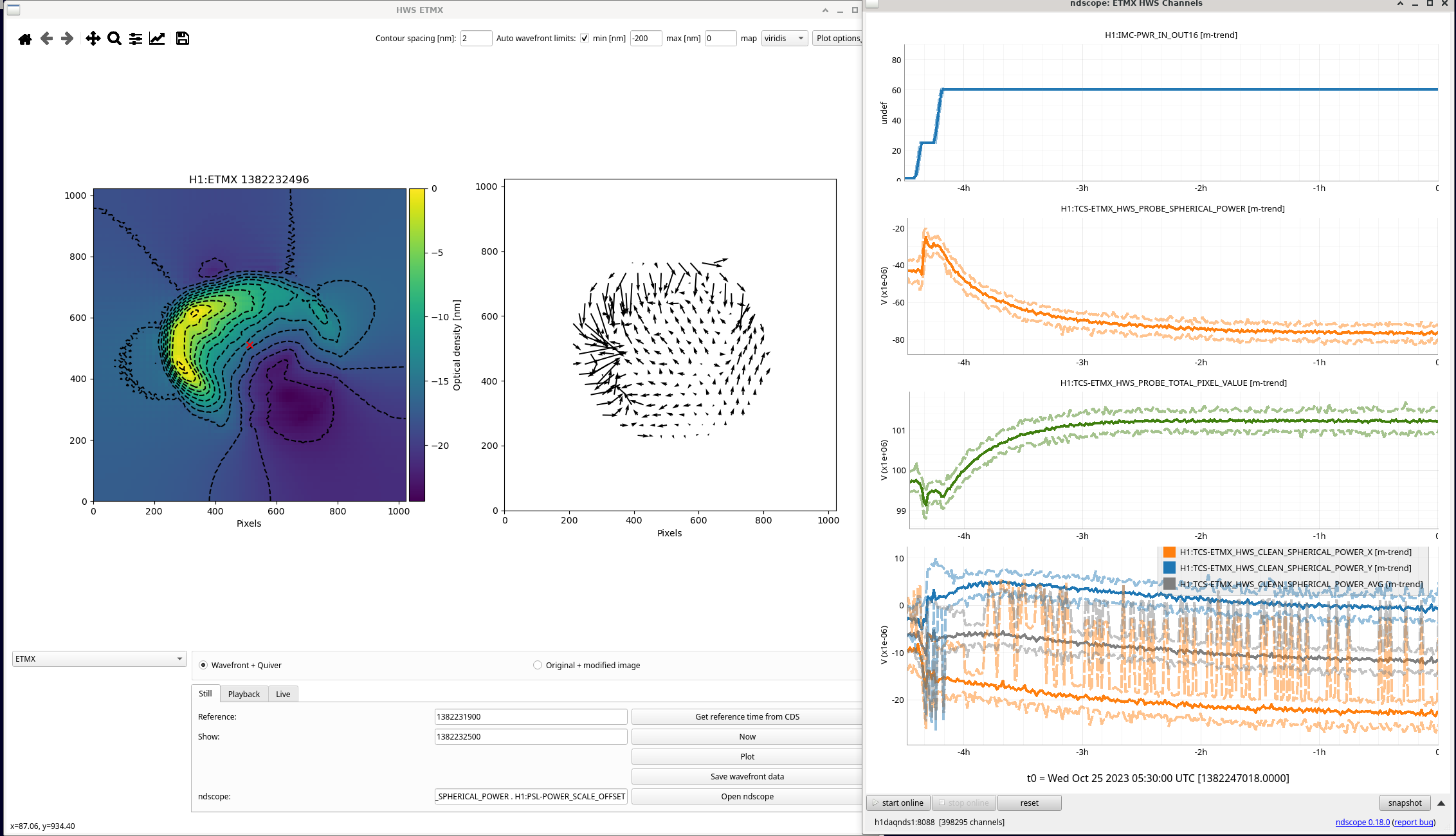
camilla.compton@LIGO.ORG - 10:42, Wednesday 25 October 2023 (73732)

We are getting data, see attached, but the TOTAL_PIXEL_VALUE is changing as we thermalize, which we don't want. There is some clipping happening which we can work to minimize on table.

Images attached to this comment
camilla.compton@LIGO.ORG - 15:17, Wednesday 01 November 2023 (73919)

TJ and I repeated the laser swap EY 73878 but struggled to get an unclipped beam. We went back to EX ~3pm Oct 31st to understand if the EX beam was clipping somewhere to get the bad HWS data above. We saw the beam was clipping on the edges of BS2 and M2 and then after clipping L1 (1" optic), the beam appears round again. Layout D1800270.

In 42171 and T1000717 there is mode matching solutions of this path showing the beam should remain under 10mm diameter until the Transmon telescope. We don't remember this ever being the case. The beam starts around 10mm and then diverges to >1" after L3, rather than converging.  

We think we should revisit this mode matching to understand what our input optics should be and check all the lenses are correct (they are labeled as in D1800270).

H1 TCS
thomas.shaffer@LIGO.ORG - posted 16:27, Tuesday 24 October 2023 - last comment - 09:04, Wednesday 25 October 2023(73704)
Swapped TCSX chiller for new chiller

Summary - Camilla and I removed the running TCSX chiller and replaced it with a new ThermoFlex 1400 SN#1153600201231003.

We've been having some issues with the TCSX laser relocking itself during Observing (ex: alog73331). This seems to be due to inconsistent water temperature from two of our three chilers, causing the temperature of the laser to shift slightly. We've swapped out SN#0110193301120813 for the new chiller and sent off the spare chiller for service. We input the settings from the CO2Y chiller and it the new chiller fired right up and seems to be outputing correct flow and pressure. We'll keep an eye on it the next few days.

Comments related to this report
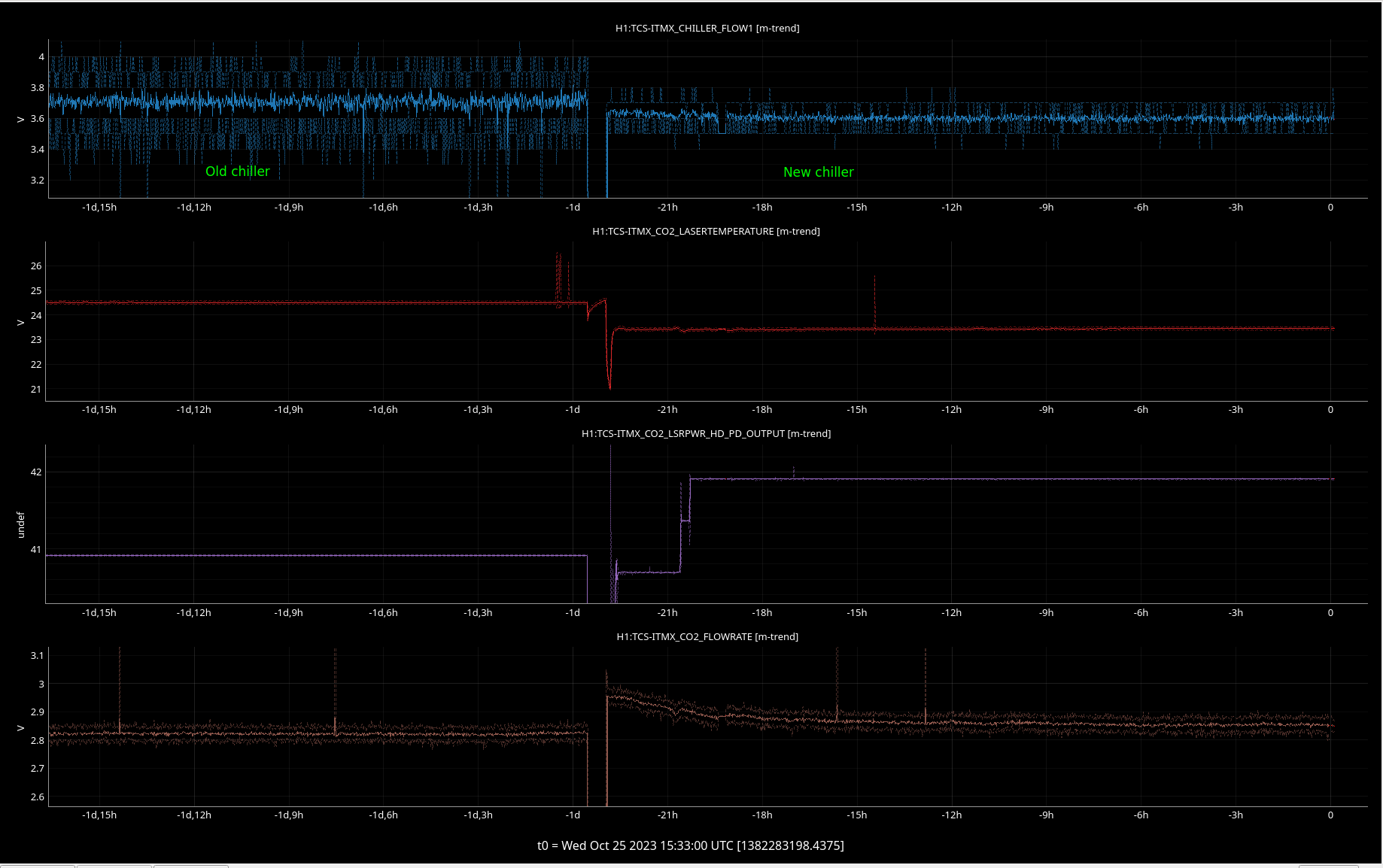
thomas.shaffer@LIGO.ORG - 09:04, Wednesday 25 October 2023 (73729)

Flow with the new chiller seems much more stable and the laser is operating at a slightly lower temperature (23.4C vs 24.5C) and a slightly higher output power (41.9W vs 40.9W). In the attached shot I'm unsure why the flow rate, as seen by the flow meter under the BSC, starts a bit higher and then over the course of ~4hours settles back to where it is now. I'd expect the system to settle much faster than that. For reference alog72267 is the last time we swapped the chillers and SN813 didn't show this.

When packing up our old spare chiller (SN#822) to be sent in for service, we found a small piece of metal, about the size of a bb in the outlet quick disconnect. This clearly wasn't helping the flow, but this chiller also had a refrigerant leak. Definitely time to be sent in.

Images attached to this comment
H1 ISC
gabriele.vajente@LIGO.ORG - posted 11:39, Tuesday 24 October 2023 - last comment - 12:45, Wednesday 25 October 2023(73698)
Resonant gains in DARM2

I prepared a new filter module with resonant gains at 2.8 Hz and 3.4 Hz. This can be tried tomorrow (on during some commissioning time) to reduce the DARM RMS and see if it helps the non-stationary noise.

The new FM is loaded into DARM2 FM1 "RG2.8-3.4". It is not engaged now.


For future reference, here are the FMs that are used during lock acquisition:

DARM1: FM1 FM2 FM3 FM4 FM7 FM9 FM10

DARM2: FM3 FM4 FM5 FM6 FM7 FM8 FM9 FM10

leaving DARM1 FM5,6,8 and DARM2 FM1,2 unused

Images attached to this report
Comments related to this report
sheila.dwyer@LIGO.ORG - 12:45, Wednesday 25 October 2023 (73737)

Camilla and I turned on DAM2 FM1 from 19:43:37 to 20:05:50 UTC October 25

Displaying reports 16981-17000 of 88572.Go to page Start 846 847 848 849 850 851 852 853 854 End