Displaying reports 17321-17340 of 86762.Go to page Start 863 864 865 866 867 868 869 870 871 End
Reports until 11:30, Thursday 20 July 2023
H1 ISC
jenne.driggers@LIGO.ORG - posted 11:30, Thursday 20 July 2023 - last comment - 14:25, Thursday 20 July 2023(71549)
Potential discrepancy between GDS-CALIB_STRAIN_NOLINES and GDS-CALIB_STRAIN_CLEAN

Derek noticed (via the summary pages) that there seems to potentially be an occasional discrepancy between CALIB_STRAIN_NOLINES and CALIB_STRAIN_CLEAN.

The NonSENS subtraction should be off.  The first attachment shows that indeed the noise estimate output by the front end NonSENS is zeros to the 1e-27 level (these are in the same strain units as GDS-CALIB, and I just didn't bother scrolling in more to see how 'zero' I can make the y-axis) during a time when the discrepancies are visible on the summary page. 

A next step is likely to try to zoom in on the time axis of the spectrograms from the summary page to see when these things are happening, and see what other things might be changing around those times (eg, are those the beginning of Observe segments or going in/out of NLN_CAL_MEAS?).  Since the output of the noise estimate from the front end is zeros, _NOLINES and _CLEAN *should* be identially the same. 

Images attached to this report
Comments related to this report
derek.davis@LIGO.ORG - 14:25, Thursday 20 July 2023 (71558)DetChar

I investigated this issue further by looking at the data for the NOLINES and CLEAN strain channel between 6 and 8 UTC. This time period contained multiple times where the summary pages indicated that NOLINES and CLEAN were not identical (see attached plot).

When directly comparing the data for these channels saved in the H1_HOFT_C00 frames, I find no differences between the two channels. The difference noted on the summary pages appears to be a summary page issue/bug, and not an issue with the strain data. 

The earliest day these anamolous features appeared on the either the L1 or H1 summary pages is June 5, which is the same day as a summary page update that included changes to the strain channels.

Images attached to this comment
H1 General
anthony.sanchez@LIGO.ORG - posted 09:27, Thursday 20 July 2023 (71546)
SDF Diff accepted

Gabriele updated the H1:LSC-MICHFF Channel and asked me to accept the SDF Diff.

Images attached to this report
H1 General
anthony.sanchez@LIGO.ORG - posted 08:08, Thursday 20 July 2023 (71541)
Thursday Ops Day Shift Start

TITLE: 07/20 Day Shift: 15:00-23:00 UTC (08:00-16:00 PST), all times posted in UTC
STATE of H1: Observing at 147Mpc
CURRENT ENVIRONMENT:
    SEI_ENV state: CALM
    Wind: 8mph Gusts, 5mph 5min avg
    Primary useism: 0.01 μm/s
    Secondary useism: 0.03 μm/s
QUICK SUMMARY:

Current State of of IFO : LOCKED in NOMINAL_LOW_NOISE and Observing for almost 11.5 hours with a nice bump in range!

LHO General
ryan.short@LIGO.ORG - posted 08:05, Thursday 20 July 2023 (71539)
Ops Owl Shift Summary

TITLE: 07/20 Owl Shift: 07:00-15:00 UTC (00:00-08:00 PST), all times posted in UTC
STATE of H1: Observing at 145Mpc
SHIFT SUMMARY: Quiet shift, locked at low noise for the whole duration with some times out of observing for quick commissioning.

Handing off to Tony for the day.

LOG:
Start Time System Name Location Lazer_Haz Task Time End
13:46 ISC Ryan S CR - MICHFF measurement 13:55
14:40 ISC Gabriele Remote - MICHFF filter change 15:00
15:01 FAC Ken OSB Rec - Lights (scissor lift) Ongoing
H1 ISC
ryan.short@LIGO.ORG - posted 06:56, Thursday 20 July 2023 - last comment - 11:48, Thursday 20 July 2023(71538)
TOO - MICHFF Measurement

While LLO was relocking this morning, I dropped observing from 13:44 to 13:54 UTC to run Gabriele's MICH FF template with 35 averages.

The measurement is saved in /ligo/home/ryan.short/MICH_excitation_2023_07_20.xml

Images attached to this report
Comments related to this report
gabriele.vajente@LIGO.ORG - 07:58, Thursday 20 July 2023 (71540)

Using this measurement, I retuned the MICH FF. The new filter is FM6 '7-20-23'. The attached plots show the fit and a comparison of the performance of the new filter and the old. There's a lot of improvement above 60 Hz, and a few db improvement below 60 Hz

Images attached to this comment
ryan.short@LIGO.ORG - 08:14, Thursday 20 July 2023 (71542)

I've accepted the new FM6 filter in SDF as well as updated and loaded ISC_LOCK to use this filter when locking.

gabriele.vajente@LIGO.ORG - 08:25, Thursday 20 July 2023 (71544)

Here's a plot showing the DARM improvement with the new MICH FF, that gave us about +6 Mpc

Images attached to this comment
gabriele.vajente@LIGO.ORG - 09:30, Thursday 20 July 2023 (71547)

Here's a second iteration of the MICH FF, with much better performance below 60 Hz and marginally worse above 60 Hz. I think this is a better FF, so we'll leave it running as FM7 '7-20b-23'. ISC_LOCK has been updated

Images attached to this comment
jenne.driggers@LIGO.ORG - 11:48, Thursday 20 July 2023 (71550)

Here is a different view of the impact of Gabriele's MICH FF tuning this morning.  Seafoam and purple are the same as in alog 71529, and red is today after the MICH FF tuning.  All of these are with hot OM2 and no MICH ASC offsets. Seafoam is late June, purple is yesteray, and red is today.  Red only has 94 averages because there were other commissioning tasks ongoing, but the other two both have 200 avgs.

The MICH FF tuning got us all the way back to where we were in June, with the excellent ~70 Hz sensitivity.  There is still some jitter-like noise, but that is unchanged from yesterday.

Images attached to this comment
H1 PEM
ryan.short@LIGO.ORG - posted 05:46, Thursday 20 July 2023 - last comment - 08:24, Thursday 20 July 2023(71537)
EX VEA Slight Temperature Fluctuation

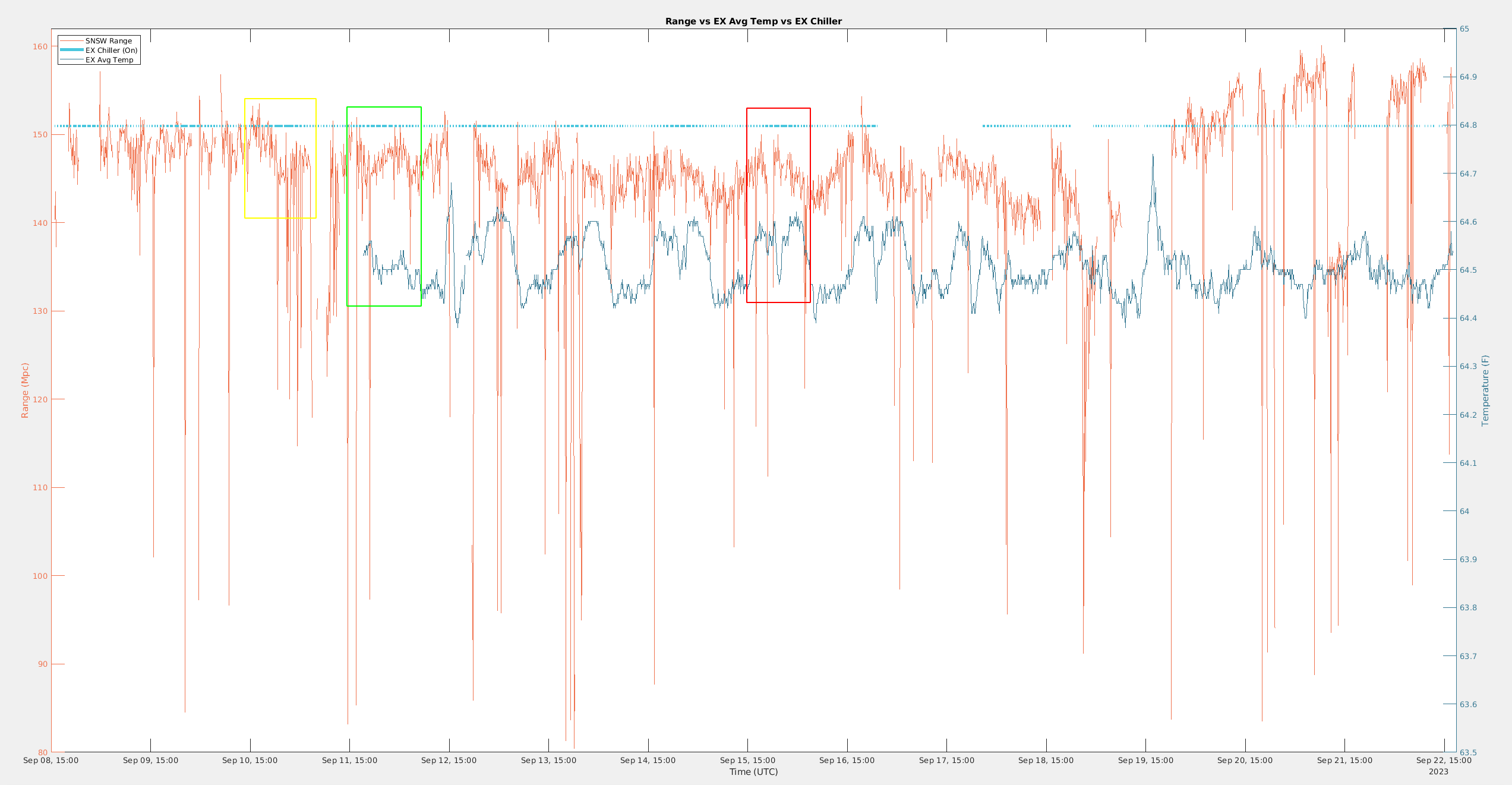
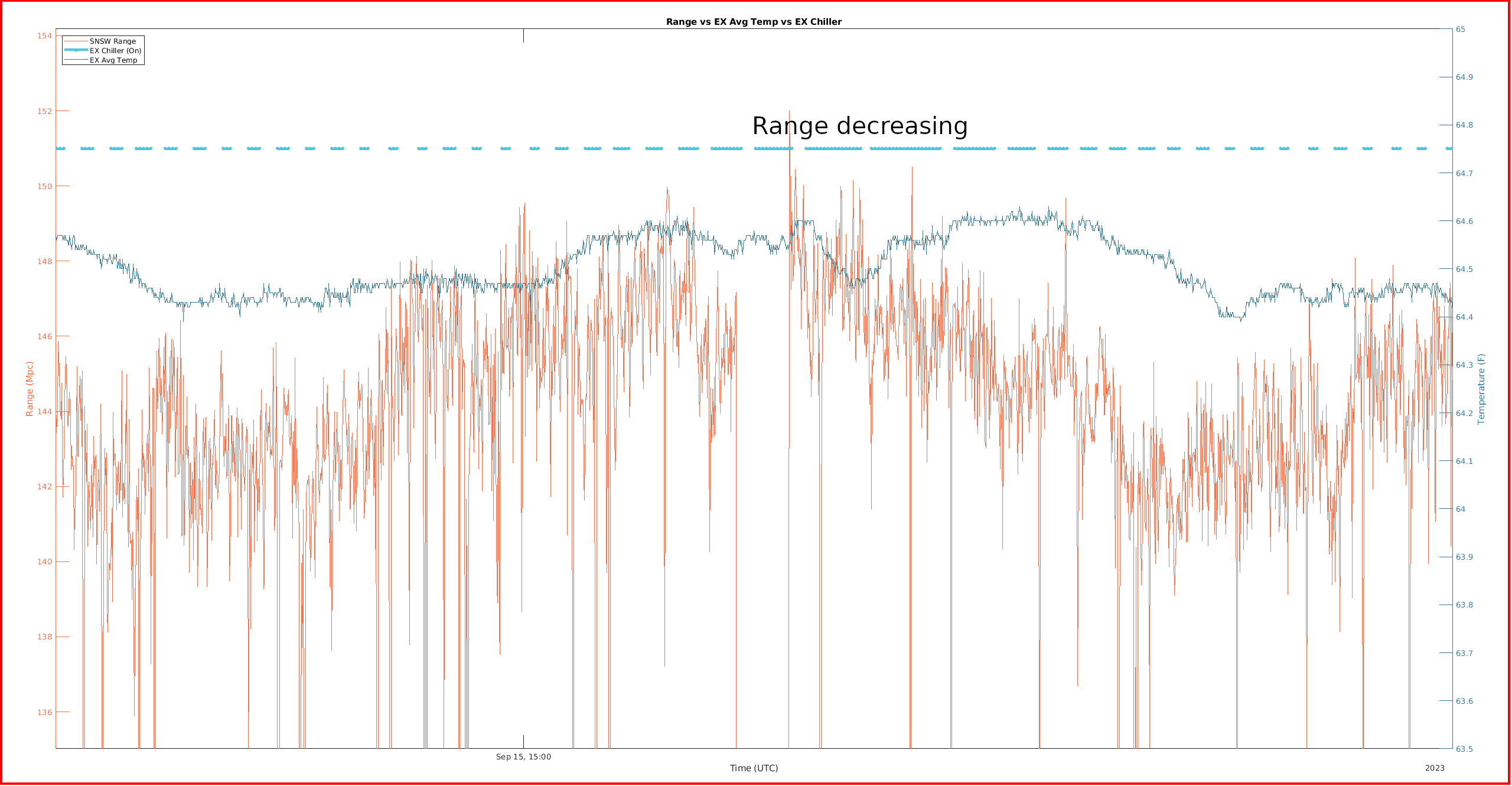
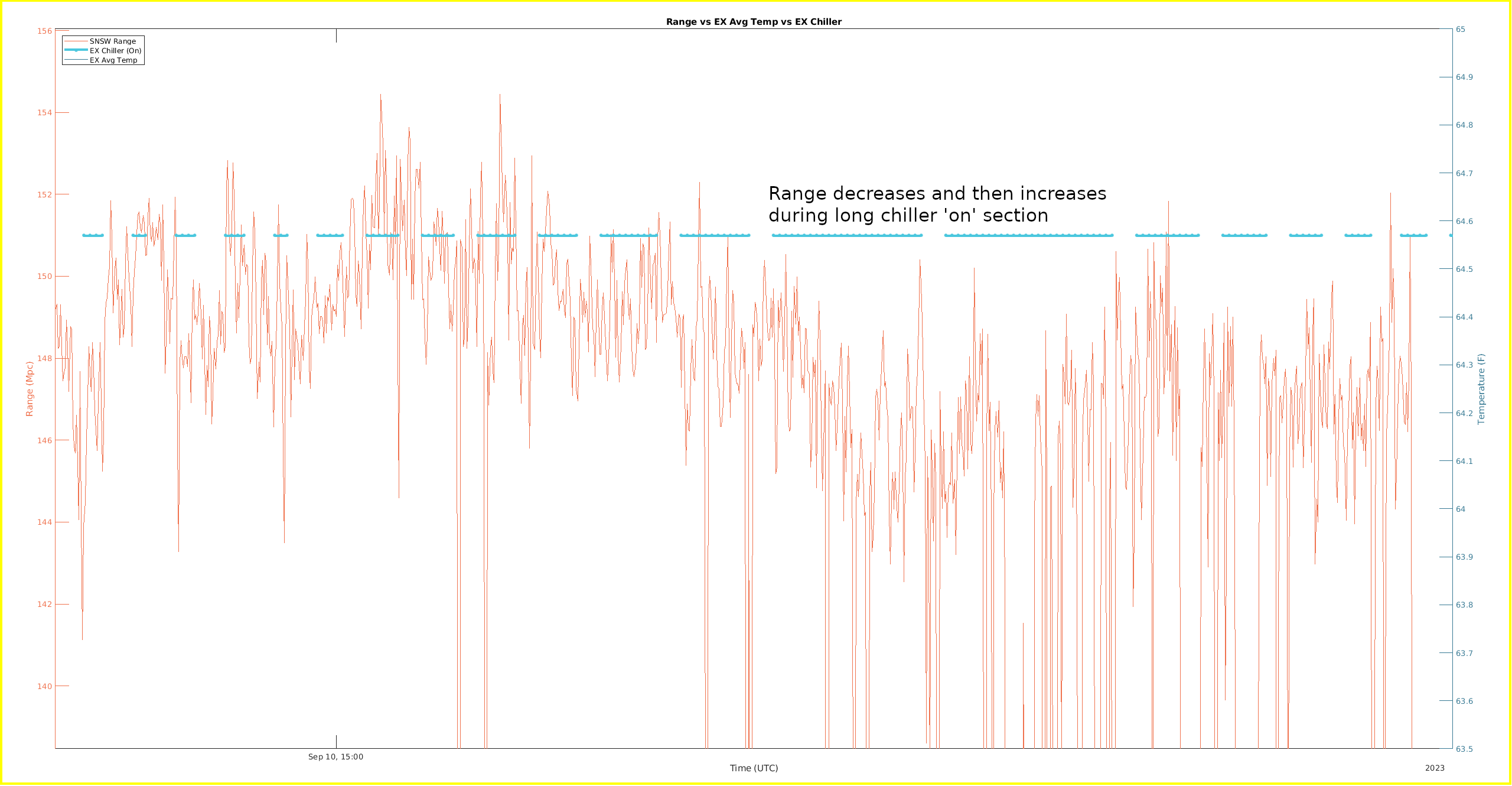
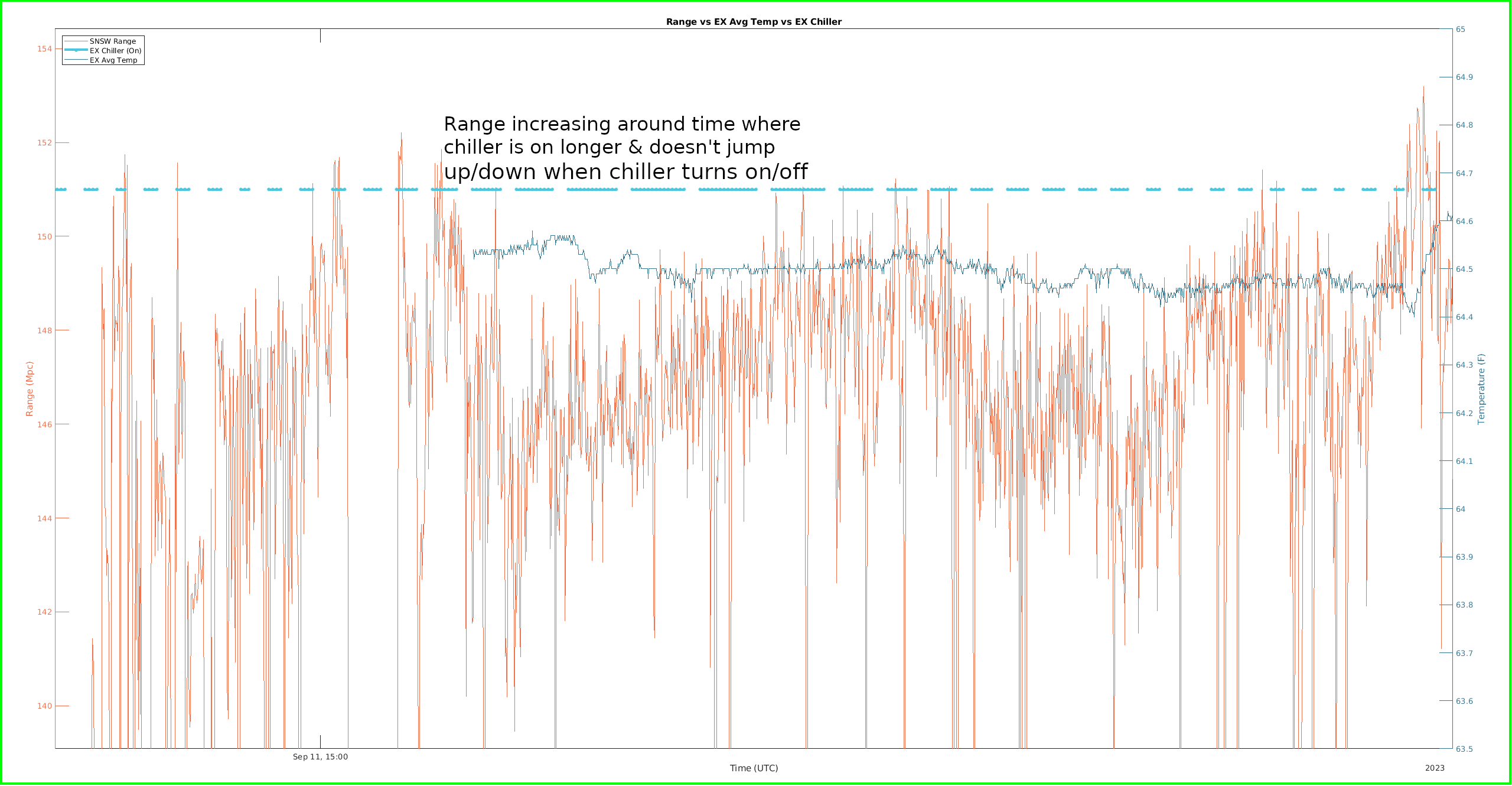
The EX VEA appears to have been having a temperature fluctuation of 0.5 degF for ~12 hours the past two days (two day and one week trends attached). I don't believe we've seen impact of this on H1, but worth noting.

Images attached to this report
Comments related to this report
bubba.gateley@LIGO.ORG - 08:24, Thursday 20 July 2023 (71543)
This was likely due to switching fans after the quarterly lubrication. This trend should continue to stabilize. I will continue to monitor. 
LHO General
ryan.short@LIGO.ORG - posted 04:00, Thursday 20 July 2023 (71536)
Ops Owl Mid Shift Report

State of H1: Observing at 136Mpc

H1 has been locked for 7 hours. Quiet night so far.

LHO General
ryan.short@LIGO.ORG - posted 00:09, Thursday 20 July 2023 (71535)
Ops Owl Shift Start

TITLE: 07/20 Owl Shift: 07:00-15:00 UTC (00:00-08:00 PST), all times posted in UTC
STATE of H1: Observing at 138Mpc
CURRENT ENVIRONMENT:
    SEI_ENV state: CALM
    Wind: 6mph Gusts, 4mph 5min avg
    Primary useism: 0.01 μm/s
    Secondary useism: 0.04 μm/s
QUICK SUMMARY: Taking over from Austin. H1 has been locked for over 3 hours.

LHO General (ISC)
austin.jennings@LIGO.ORG - posted 00:00, Thursday 20 July 2023 (71528)
Wednesday Eve Shift Summary

TITLE: 07/19 Eve Shift: 23:00-07:00 UTC (16:00-00:00 PST), all times posted in UTC
STATE of H1: Observing at 138Mpc
SHIFT SUMMARY:

- 0:13 - inc 5.0 EQ from Alaska

- Lockloss @ 1:01 - cause unknown

- DRMI locking failed 2x at CHECK MICH FRINGES, so I will try running an initial alignment

- Acquired NLN/OBSERVING @ 3:45 after accepting an OMC SDF diff leftover from yesterdays OM2 test - Tagging ISC

- 5:27 went into COMMISSIONING due to freezing of ETM cameras (which led to the CAMERA SERVO guardian failing), it fixed, then got stuck a few times before it fixed itself permanently, contacted Dave - scope attached

- Other than the camera hiccup, overall was a quiet night, leaving H1 to Ryan S. going on a 3 hour stretch

LOG:

No log for this shift.


Images attached to this report
LHO General
austin.jennings@LIGO.ORG - posted 19:56, Wednesday 19 July 2023 (71534)
Mid Shift Eve Report

Following a lockloss (caused by unknown reasons) and a subsequent intiial alignment, H1 is at OMC WHITENING waiting for violins to damp before going back to low noise.

H1 SQZ
victoriaa.xu@LIGO.ORG - posted 18:58, Wednesday 19 July 2023 - last comment - 16:53, Monday 31 July 2023(71533)
Collecting sqz / no-sqz times at hot, warm, cold, OM2 for quantum noise budgeting

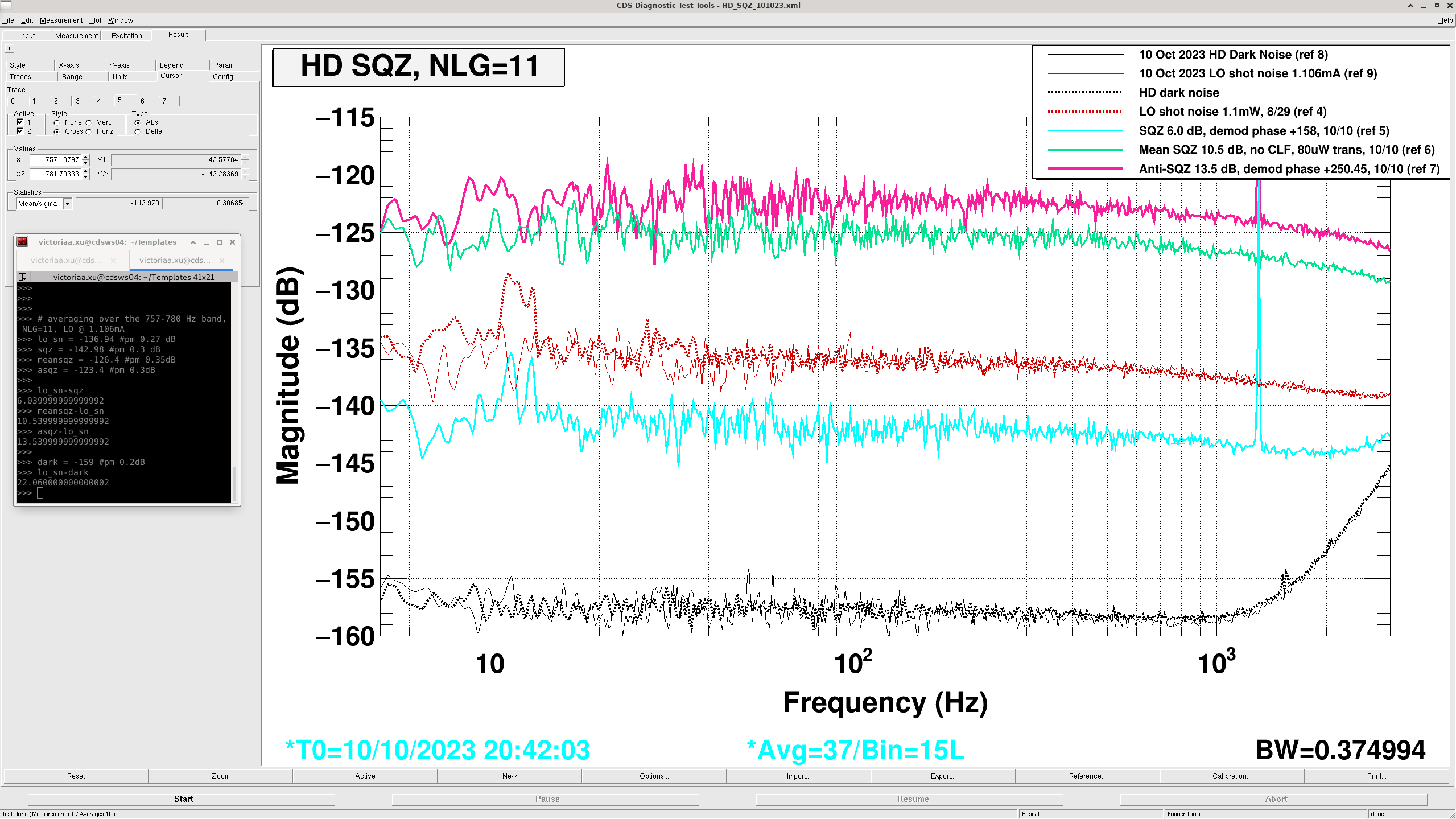
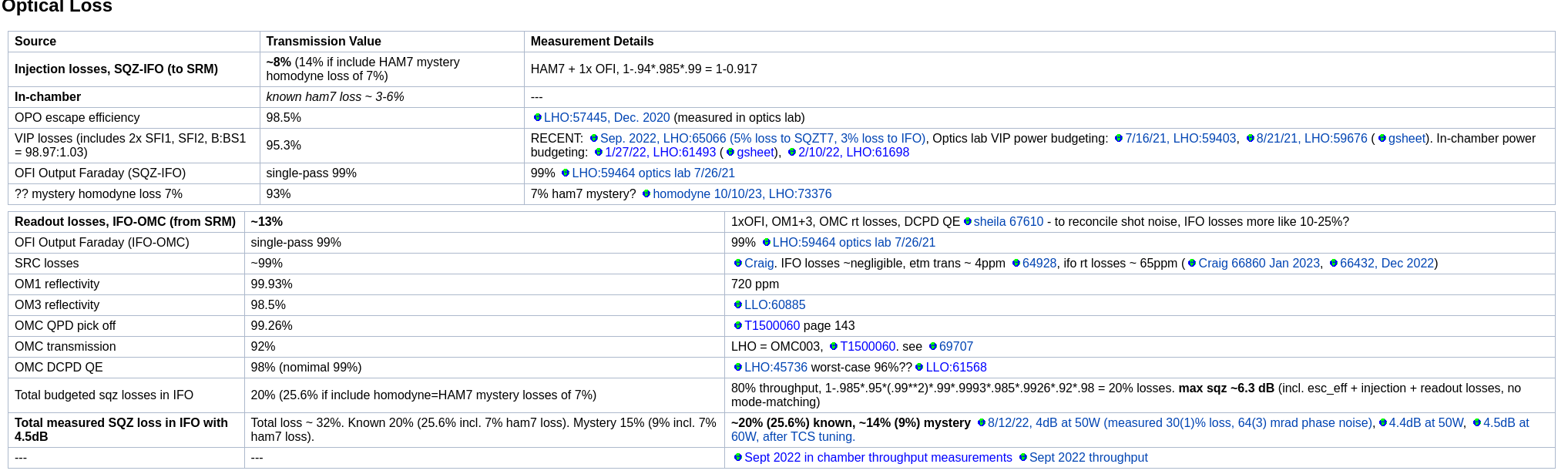
Logging for Brina, who collected a bunch of relevant times to compare sqz vs. no-sqz at different OM2 settings. We aim to do some quantum noise budgeting with these times, to see whether/how much quantum noise is a contributor between 50-150 Hz, and to use the no-sqz data to look at ifo output losses for different OM2 settings. Looking at correlated noise budget from Craig recently, LHO:71333, hopefully we can understand what's going on with quantum noise ~30-200 Hz.. 

Date OM2 temp   gps_start gps_stop UTC   alog
2023/06/27 ~56 C no-sqz 1371910278 1371910578 14:11 to 14:16   1st hot OM2, LHO:70849
    sqz 1371910698 1371910698 14:18 to 14:22    
2023/06/28   no-sqz 1372017274 1372021147 19:54:16 - 20:58:49    70930 1-hour no-sqz, hot OM2, xcorr
    sqz 1372042818 1372046418 3:00 - 4:00 (6/29)    
               
2023/07/13 ~22 C no-sqz 1373320175 1373320818 21:49:17- 22:00:00   cold OM2, LHO:71302 ifo alignment tests
    sqz 1373322138 1373322738 22:22 - 22:32   sqz on, AS 36 Q yaw 50,000
               
2023/07/19 ~47 C no-sqz 1373812338 1373812938 14:32 - 14:42   warm OM2 (during pump iss failure, 71497)
    sqz 1373813118 1373813118 14:45 - 15:00   (should be more sqz times available)
               
2023/07/19 ~57 C no-sqz 1373839430 1373840398 22:03:32 - 22:19:40   2nd hot OM2, LHO:71518
    sqz 1373843778 1373844498 23:16 - 23:28    
Comments related to this report
victoriaa.xu@LIGO.ORG - 16:20, Friday 21 July 2023 (71598)ISC

So far I've just started comparing darm spectra (using GDS-CALIB_STRAIN_NOLINES) between the following times, some from the above table:
-- 'cold OM2' uses no-sqz = 1373320175 - 1373320818, fds = 1373322138 - 1373322738
-- 'warm OM2' uses no-sqz = 1373812338 - 1373812938, fds = 1373813118 - 1373814018
-- 'hot OM2 3' uses the recent hot OM2 no-sqz = 1374004600 - 1374005215 (LHO:71591), and fds = 1373984483 - 1373985483 from when range was ~150 this morning. Note FC detuning is -25 Hz for this trace, and many LSC FFs have been retuned here, compared to previous traces.

To start, I looked at compared both the DARM difference with squeezing for different OM2 settings (sqz compared to OM2), and also un-squeezed / squeezed DARMs for different OM2 settings (OM2_compared_to_sqz).

From this second pdf, OM2_compared_to_sqz, a few quick things I notice:
  - Hot OM2, >1 kHz (in the shot-noise-limited region at high frequencies), darm looks a bit worse; this is consistent with the decrease in optical gain at hot OM2.
  - Hot OM2, ~100 Hz, squeezing seems to give some noticeable improvement around and just above 100 Hz (??). This improvement is not that clear without squeezing. Unclear to me if related to FC detuning or OM2, but I wonder if this ~100Hz noise is in part related to quantum noise..
  - Hot OM2, < 100 Hz, low-frequency noise looks much better; the LSC FF tuning seems very effective at improving noise in this configuration.
  - At warm OM2, maybe low-frequencies < 100 Hz see some scatter shelves (?), but I might just be seeing things, not totally clear. 

Next I'll try to compare this with the quantum noise budget without squeezing, starting by comparing the no-sqz traces to look at IFO shot-noise based output losses, for different OM2s (as Sheila suggested). Ideally this will require independent knowledge of some IFO parameters like the readout angle and the SRCL detuning. Once it makes sense with no-sqz darm, I'll continue to work on making sense of both the full and the semi-classical quantum noise budgets with squeezing injected, and budgeting out the quantum noise contributions to get a sense of whether low-frequency quantum noise (e.g. from sqz misrotations) are plausibly showing up in darm, and what knobs we could turn if so.

Non-image files attached to this comment
victoriaa.xu@LIGO.ORG - 16:53, Monday 31 July 2023 (71849)

Edit: indeed the cold OM2 time had a glitch. Updated plots with the following cold OM2 no-sqz time (different day, early in lock.. but looks more reasonable).

Updated plots: effect of sqz at different OM2s, and sqz vs. no-sqz at different OM2s.

Times used:
cold OM2, no sqz, gps start = 1373371323 (2023-07-14, 12:01:45 UTC)
cold OM2, no sqz, gps stop = 1373372668 (2023-07-14, 12:24:10 UTC)

Images attached to this comment
H1 General (Lockloss)
austin.jennings@LIGO.ORG - posted 18:04, Wednesday 19 July 2023 (71532)
Lockloss @ 1:01

Lockloss @ 1:01 - DCPD saturation, can probably rule out an ASC ringup from the locklost tool, but there is potential suspicious LSC movement in PRCL, MICH, and SRCL.

H1 ISC
jenne.driggers@LIGO.ORG - posted 13:08, Wednesday 19 July 2023 - last comment - 11:49, Thursday 20 July 2023(71510)
Range improves with AS36Q offset removed when OM2 is hot

Last night and this morning, we've turned the OM2 heater back on.  Our range didn't improve, however.  We still had in place the AS36Q yaw offset from last Thursday (alog 71309).  At the start of our Wed commissioning period, I turned that offset off.  This improved our range back to ~140 Mpc according to CAL-DELTAL on the wall, but our range is still not back to where it was the last time we had OM2 hot. We may need to think about more alignment changes / checks.

Comments related to this report
jenne.driggers@LIGO.ORG - 13:26, Wednesday 19 July 2023 (71511)

Naoki just reminded me that we probably need to revert the MICH LSC feedforward to the hot OM2 setting.  We'll do that once the PEM team is between tests.

jenne.driggers@LIGO.ORG - 13:52, Wednesday 19 July 2023 (71512)

I've just removed the AS36Q offset from ISC_LOCK's ADS_to_camera state and reloaded. I've accepted the SDF with the offset of 0.  I've also accepted the TRAMP of 10 sec, which is what it should come back to when the safe.snap is reverted.  So, hopefully operators won't see any SDF diffs that they need to address.

naoki.aritomi@LIGO.ORG - 14:04, Wednesday 19 July 2023 (71513)

The MICH FF change between cold and hot OM2 is written in alog71285. We switched the MICH FF filter from FM5 to FM3 while NLN. We also implemented it in the ISC LOCK guardian and reloaded it following alog71285.

jenne.driggers@LIGO.ORG - 14:21, Wednesday 19 July 2023 (71514)

Unfortunately, I'm not so sure that we like this version of MICH FF. In the attachment, the green dashed trace is what we have right now (LSC MICH FF is FM3 and FM10, the hot OM2 settings), and the red trace is what we had before Naoki reverted to the hot OM2 settings (FM5 and FM10, nominally the cold OM2 settings).  The hot OM2 FF has increased our coherence with LSC MICH today.

It's possible that OM2 isn't all the way thermalized yet and that matters, or more likely, we have some other unknown alignment change that has caused this to be less effective than it was in the past.

Images attached to this comment
oli.patane@LIGO.ORG - 16:15, Wednesday 19 July 2023 (71524)

LSC-MICHFF diff accepted

Images attached to this comment
jenne.driggers@LIGO.ORG - 16:42, Wednesday 19 July 2023 (71529)

Here are two quick plots comparing today's hot OM2 configuration versus late June when we had excellent 70 Hz noise. The traces and data are the same, just the x-axis is different.

The seafoam is June 28th at 08:00:00 UTC, hot OM2, no deliberate ASC offsets.  Brown is today's hot OM2 (19 July 2023 18:15:27 UTC) before I removed the AS36Q offset, and purple is after removing that offset (19 July 2023 19:41:09 UTC).  So, purple should be the same as seafoam since in principle the configuration is all the same, but clearly it's not.

One suggestion is that perhaps there are some squeezer adjustments that could affect the 70 Hz region; I believe that Sheila and Naoki were discussing some potential tests. 

We should double check, but I don't think the residual LSC MICH coherence explains the whole difference. 

Its' certainly interesting to note that the brown trace (hot OM2, but with the AS36Q MICH ASC offset that we had found while OM2 was cold) seems to have very little jitter coupling, and also a relatively small amount of laser noise at high frequency.  It does however have lots of excess noise below 60 Hz, which is consistent with what Marissa had been seeing earlier today.

Images attached to this comment
jenne.driggers@LIGO.ORG - 11:49, Thursday 20 July 2023 (71551)

Indeed most of the sensitivity around 70 Hz was recoveredy by MICH FF: See alog 71550.

H1 DetChar (DetChar)
taylor.starkman@LIGO.ORG - posted 10:24, Wednesday 19 July 2023 - last comment - 10:07, Thursday 20 July 2023(71501)
Effect of violin mode amplitude on narrow lines near the violin modes

We conducted a study using data from the Fscan pipeline that shows when the violin modes are rung up, there is a dramatic increase in the number of narrow lines (of the type problematic for CW searches) in the regions around the violin modes and harmonics. This increase in the number of narrow lines is visible both in daily and weekly plots since June 29th when the violin modes and its harmonics are known to have rung up. 

Figure 1 shows how the number of lines jumped significantly in the 300-600Hz and 900-1200Hz bands from June 29th to June 30th, and again from July 9th to July 10th without much change in the other frequency bands. Figures 2 and 3 show the averaged spectrum for the 29th and 30th respectively, demonstrating just how dramatic the increase in the number of lines is. Figure 4 shows how visible and persistent the lines are in the weekly data. 

Figures 5, 6, and 7 show the max amplitude of the violin modes vs number of lines per the square root number of SFTs in three different frequency bands surrounding the violin modes and its harmonics. To remove the effect of the duty cycle on the number of lines counted, the total number of lines counted is divided by the square root of the number of SFTs produced in a day because the number of SFTs produced in a day is directly proportional to the amount of time spent observing on that particular day. From here on out, I will refer to the number of lines per square root of the number of SFTs as the number of lines.

Looking at all the O4 data so far, it is obvious that the number of lines increases with the max amplitude violin modes in the bands surrounding the violin modes and its harmonics. The most dramatic effect is visible in the 300-600Hz band (Figure 5) where the number of lines seems to increase approximately linearly with the max amplitude of the violin modes between amplitudes of 10-20-10-18 strain/√Hz. Between 10-18-10-17 strain/√Hz, the number of lines increases significantly with no clear pattern. Multiple days after the June 29th ring up appear in this region, showing that these long ring ups can greatly increase the number of lines and decrease CW data quality for a significant period of time. Around the 1000Hz (Figure 6) and 1500Hz (Figure 7) harmonics, the number of lines increases approximately linearly with the max amplitude of the violin modes without displaying the jump present in the 300-600Hz band. This might be because the amplitude of the violin modes has a much smaller range of 10-19-10-18 strain/√Hz during the ring up. 


Images attached to this report
Comments related to this report
camilla.compton@LIGO.ORG - 10:07, Thursday 20 July 2023 (71545)OpsInfo, SUS

Nice alog Taylor. This shows how important it is for us to understand and stop these violin ring ups, which started 29th June, links in alog71404. They decreased over July 5/6/7th as we had a long 40+hr lock where we were able to nicely damp them (overflows plot from 71129). Tagging OpsInfo and SUS. 

This could also be a good opportunity, while the lines are large, for CW to tag these lines as caused by violins if not yet done.  

Displaying reports 17321-17340 of 86762.Go to page Start 863 864 865 866 867 868 869 870 871 End