Displaying reports 17361-17380 of 86760.Go to page Start 865 866 867 868 869 870 871 872 873 End
Reports until 12:30, Wednesday 19 July 2023
H1 General (TCS)
oli.patane@LIGO.ORG - posted 12:30, Wednesday 19 July 2023 - last comment - 12:59, Thursday 20 July 2023(71506)
Pushed out of Observing by TCS-ITMX SDF Diff

At 18:50, we were briefly pushed out of observing when the ITMX CO2 laser lost lock, and the resulting SDF differences in H1:TCS-ITMX_CO2_CHILLER_SERVO_GAIN & H1:TCS-ITMX_CO2_PZT_SERVO_GAIN (see attached). The SDF differences disappeared on their own about a minute later as the CO2 laser locked back on, and we observed that the power in H1:TCS-ITMX_CO2_LSRPWR_HD_PD_OUTPUT went down slightly from 46.7W before it lost lock to 46.4W after it locked back on.

At 18:53 we put the detector back into Observing

Images attached to this report
Comments related to this report
camilla.compton@LIGO.ORG - 12:59, Thursday 20 July 2023 (71554)

This is the third time this has happened in 1 month, see 7121370910. We should investigate what the issue is. We had seen similar behavior with CO2Y in the past and blamed the CO2 chiller, 54980

H1 ISC
gabriele.vajente@LIGO.ORG - posted 11:53, Wednesday 19 July 2023 - last comment - 12:41, Wednesday 19 July 2023(71505)
DHARD_Y motion upconvert noise into DARM

Yesterday I did a DHARD_Y noise injection that had band-limited noise between 1.5 and 3.5 Hz. In the first plot I compare ASC-DHARD_Y and LSC-DARM in quiet times and during the injection.

There are several interestiing observations:

This is good evidence that DHARD_Y is causing some non-linear noise coupling in DARM. This is also visible in the bicoherence of DARM with itself or of DHARD_Y and DARM.

It would be interesting to repeat similar noise injections, but with shaped noise and amplitudes such to increase only slighlty the DHARD_Y signal: in this way we might be able to estimate the efffect on DARM in normal conditions.

Images attached to this report
Comments related to this report
peter.fritschel@LIGO.ORG - 12:41, Wednesday 19 July 2023 (71508)

Given this finding, I was curious to see how CHARD_Y compared between H1 and L1. Attached are comparison spectra from an Observe mode lock a couple of days ago. There's nothing really suspiciously different between the two. There's a 1.5 Hz peak prominent in H1 but not L1, and the L1 noise above 15 Hz is much lower due to the more aggressive low-pass filtering.

Images attached to this comment
H1 General (ISC)
oli.patane@LIGO.ORG - posted 10:50, Wednesday 19 July 2023 (71504)
Out of Observing Briefly for OM2

17:06 Moved out of Observing and into Commissioning so Sheila's OM2 script could finish running.

17:16 Back into Observing

   - SDF Diffs (See attachment):

       H1:AWC-OM2_TSAMS_POWER_SET - ACCEPTED

       H1:OMC-READOUT_XO_TRAMP - ACCEPTED (accidentally but okay)

Images attached to this report
H1 ISC
peter.fritschel@LIGO.ORG - posted 10:37, Wednesday 19 July 2023 (71503)
How much does the OMC move?

Gabriele's log entry 71205  pointed out that the OMC is moved a lot (at least in comparison to the LLO OMC) when it is receiving OMC ASC feedback. This observation led to the test of turning of the OMC ASC for some time to look for any effects, see 71422. Although no effect on DARM noise was seen, I was still curious to know: how much is the OMC moving under ASC control?

The attached plots show time series of the 6 BOSEM sensors that sense the upper/top mass of the OMC suspension (relative to the OMC suspension cage). The 5 minutes of data is during the 'OMC pause' test, so in the first half of each plot the OMC is receiving ASC feedback, and in the second half this feedback if off. The plots show:

So, even though the OMC is moving a lot compared to that at LLO (which has a different OMC alignment feedbak scheme), the motion is still small compared to the beam, which has: 500 um radius, 680 urad divergence angle.

Images attached to this report
H1 DetChar (DetChar)
taylor.starkman@LIGO.ORG - posted 10:24, Wednesday 19 July 2023 - last comment - 10:07, Thursday 20 July 2023(71501)
Effect of violin mode amplitude on narrow lines near the violin modes

We conducted a study using data from the Fscan pipeline that shows when the violin modes are rung up, there is a dramatic increase in the number of narrow lines (of the type problematic for CW searches) in the regions around the violin modes and harmonics. This increase in the number of narrow lines is visible both in daily and weekly plots since June 29th when the violin modes and its harmonics are known to have rung up. 

Figure 1 shows how the number of lines jumped significantly in the 300-600Hz and 900-1200Hz bands from June 29th to June 30th, and again from July 9th to July 10th without much change in the other frequency bands. Figures 2 and 3 show the averaged spectrum for the 29th and 30th respectively, demonstrating just how dramatic the increase in the number of lines is. Figure 4 shows how visible and persistent the lines are in the weekly data. 

Figures 5, 6, and 7 show the max amplitude of the violin modes vs number of lines per the square root number of SFTs in three different frequency bands surrounding the violin modes and its harmonics. To remove the effect of the duty cycle on the number of lines counted, the total number of lines counted is divided by the square root of the number of SFTs produced in a day because the number of SFTs produced in a day is directly proportional to the amount of time spent observing on that particular day. From here on out, I will refer to the number of lines per square root of the number of SFTs as the number of lines.

Looking at all the O4 data so far, it is obvious that the number of lines increases with the max amplitude violin modes in the bands surrounding the violin modes and its harmonics. The most dramatic effect is visible in the 300-600Hz band (Figure 5) where the number of lines seems to increase approximately linearly with the max amplitude of the violin modes between amplitudes of 10-20-10-18 strain/√Hz. Between 10-18-10-17 strain/√Hz, the number of lines increases significantly with no clear pattern. Multiple days after the June 29th ring up appear in this region, showing that these long ring ups can greatly increase the number of lines and decrease CW data quality for a significant period of time. Around the 1000Hz (Figure 6) and 1500Hz (Figure 7) harmonics, the number of lines increases approximately linearly with the max amplitude of the violin modes without displaying the jump present in the 300-600Hz band. This might be because the amplitude of the violin modes has a much smaller range of 10-19-10-18 strain/√Hz during the ring up. 


Images attached to this report
Comments related to this report
camilla.compton@LIGO.ORG - 10:07, Thursday 20 July 2023 (71545)OpsInfo, SUS

Nice alog Taylor. This shows how important it is for us to understand and stop these violin ring ups, which started 29th June, links in alog71404. They decreased over July 5/6/7th as we had a long 40+hr lock where we were able to nicely damp them (overflows plot from 71129). Tagging OpsInfo and SUS. 

This could also be a good opportunity, while the lines are large, for CW to tag these lines as caused by violins if not yet done.  

LHO VE
david.barker@LIGO.ORG - posted 10:15, Wednesday 19 July 2023 (71500)
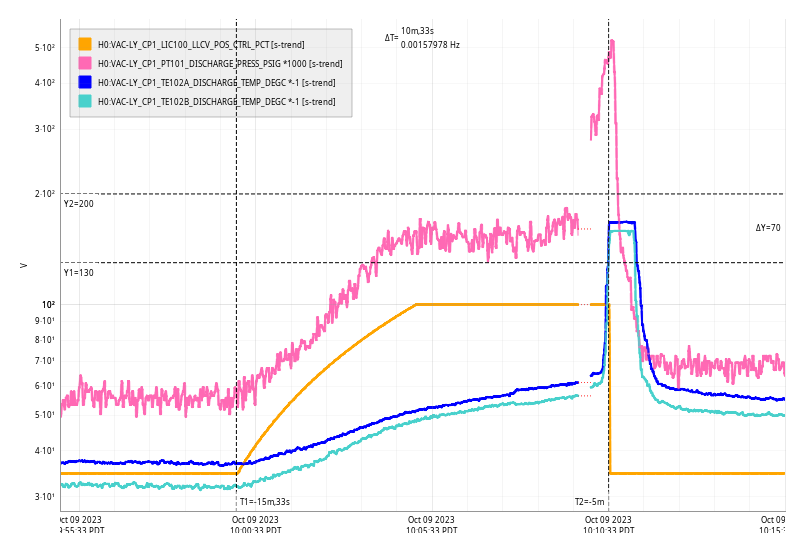
Wed CP1 Fill

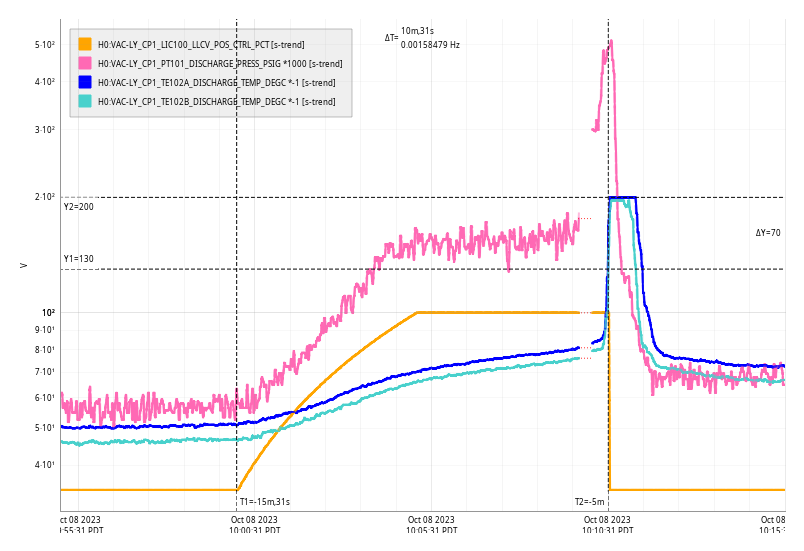
Wed Jul 19 10:06:31 2023 INFO: Fill completed in 6min 27secs

Robert confirmed a good fill curbside.

Images attached to this report
LHO VE (VE)
adam.branch@LIGO.ORG - posted 09:22, Wednesday 19 July 2023 (71499)
HEPTA and Turbo work
Adam and Janos

I inspected all installed HEPTA controllers and found all but the Y-mid to be satisfactory. We ran a test on the X-mid to verify thermal switch operated correctly by letting the pump heat up to ~100c. 

The corner station controller that the failed HEPTA was installed on passed all electrical tests. It is my belief that the failure was due to a mechanical defect inside the pump its self.

I inspected the "OMC" turbo controller that was having a issue with indicating lights and identified the issue of a missing component on the back of the indicating light. See address below

https://www.digikey.com/en/products/detail/siemens/3SU14001CK101AA0/15237249


Lastly, I inspected the Y-mid controller and prior to opening the panel I already found red flags such as an electrical connector for a solenoid operated gate valve that does not exist at the HEPTA stations wired into the panel. After opening the panel I noticed an entire relay added to the left side of the panel and wired in that is not part of any wiring diagram and a third small CPC drilled and added in to the bottom of the panel for GV indication which was not necessary as one of the originals is now spared. The extra relay was being used to detect the status of the small solenoid that controlled air flow to the pneumatic gate valve at the HEPTA inlet. We don't care about the status of the solenoid only the status of the GV which is already measured directly from the internal contacts of the GV. This relay only added another failure point for the opening of the GV and has since been removed. I found about 7 wires that were not secured and either pulled out or fell out of their terminals. I found one relay with a normally open and a normally closed contact wired in parallel. This is a logical fallacy as it will always conduct and provides no more control that just a straight wire.

I reconfigured the Controller per the wiring diagram and ran a stop work approved test and all systems that were available to test passed. I was not able to test the complete functionality of the GV as there was no instrument air available but the controlling solenoid did function so i have no reason to believe that the GV would not function. Lastly the thermal switch could not be tested as the pump could not run in the appendix configuration.


H1 SQZ (SQZ)
victoriaa.xu@LIGO.ORG - posted 08:25, Wednesday 19 July 2023 (71497)
Minor tweaks to re-engage SQZ OPO pump ISS, not a full fix

Range drop seemed to coincide with pump ISS tripping off; we haven't had this issue since re-aligning the pump AOM a while back (LHO:70190). But since the SQZT0 table fan got turned on yesterday, SHG power trends show that while the input IR power seems stable (bottom 2 plots), the SHG output power (top) has dropped ~15% and still not recovered yet. So, we are having the same pump iss issues again. The control voltage is now hovering again around 2V (2nd plot), which is just marginally stable. 

To get back to the 85uW pump power we've been running with (NLG~12.7), I tried several things, summarized in this trend/screenshot
   1. (top green trend) re-aligned pump fiber polarizations (starting w/the "! fiber pol" button on sqzt0 medm), by pico-ing waveplates before the pump fiber. this brought in-chamber fiber rejected from ~0.16 to ~0.03.
   2. (4th pink trend)   re-direct all the light after the pump aom into the fiber path with pico-waveplate
   3. (bottom gray trend)  checked SHG input alignment w/picos, most change on input pico mirror #1 in pitch. bumped SHG temperature from 36.00 to 36.05C. This SHG temp change was accepted in SDF. Combined, this all barely improved SHG output power from 47mW to 48mW. Nominal has been ~55mW, before the recent table+fan incursion to SQZT0. 

If SHG output powers go back to solidly over 50mW (sometimes has taken ~24 hours..), we should be safe from further pump ISS issues. If SHG output power drops any more, given that we are pretty marignal on the ISS now, it'll require more intervention and maybe turning down the pump power until we solve it. We'll watch how the sitation goes, and we'll consider how SQZ_MANAGER can handle pump_iss issues.

Images attached to this report
H1 General
oli.patane@LIGO.ORG - posted 08:13, Wednesday 19 July 2023 (71498)
Ops DAY Shift Start

TITLE: 07/19 Day Shift: 15:00-23:00 UTC (08:00-16:00 PST), all times posted in UTC
STATE of H1: Observing at 133Mpc
CURRENT ENVIRONMENT:
    SEI_ENV state: CALM
    Wind: 6mph Gusts, 4mph 5min avg
    Primary useism: 0.01 μm/s
    Secondary useism: 0.04 μm/s
QUICK SUMMARY:

Detector Locked and in Observing for 5hr 24min.

NUC26 both ETM cameras have been closing themselves and all cameras on that nuc changed to static a couple times each within a small timeframe. Computer has been restarted and all cameras restarted.

Today's Plans:

Planned commissioning today between noon-4 Pacific.


LHO General (ISC)
ryan.short@LIGO.ORG - posted 08:04, Wednesday 19 July 2023 (71493)
Ops Owl Shift Summary

TITLE: 07/19 Owl Shift: 07:00-15:00 UTC (00:00-08:00 PST), all times posted in UTC
STATE of H1: Observing at 135Mpc
SHIFT SUMMARY: One lockloss from a nearby earthquake, but a quick recovery followed with an hour of violin damping. Range was diminished for about 2.5 hours, now fixed.

Lock #1:

Lock #2:

Handing off to Tony for the day.


LOG:

Start Time System Name Location Lazer_Haz Task Time End
14:38 FAC Tyler MX, MY - Fire panel circuit checks 16:38
14:51 FAC Ken OSB Rec - Lights (scissor lift) 16:51
14:30 SQZ Vicky Remote - Fixing SQZ ISS 14:50
Images attached to this report
H1 ISC
gabriele.vajente@LIGO.ORG - posted 07:25, Wednesday 19 July 2023 (71496)
CHARD_Y plant measurement

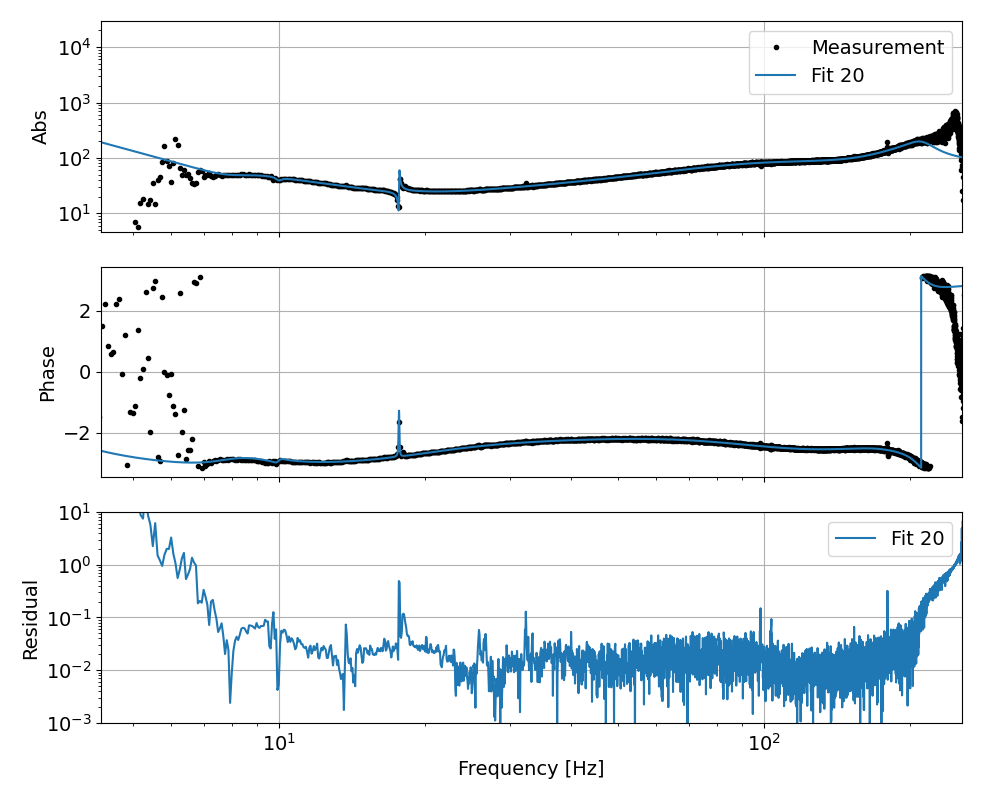
Austin ran a CHARD_Y injection while we were waiting for the violin modes to be damped. The measurement could be improved at high frequency, but it's a good start. See attached plots and the fit in s-domain below of the optics plus suspension (plant)

z = [-1.89361201+5.8381431j , -1.89361201-5.8381431j ,
        -0.09640395+5.84691435j, -0.09640395-5.84691435j,
         3.20330258+4.44616445j,  3.20330258-4.44616445j,
        -0.15279235+1.84732571j, -0.15279235-1.84732571j,
        -1.26520672+0.j        , -0.02927838+0.43904034j,
        -0.02927838-0.43904034j, -0.26944611+0.j        ]
p = [-0.14766306+5.84793096j, -0.14766306-5.84793096j,
        -3.04921633+0.j        , -0.21088202+2.7609525j ,
        -0.21088202-2.7609525j , -0.07400573+2.48088453j,
        -0.07400573-2.48088453j, -0.03291084+1.03014283j,
        -0.03291084-1.03014283j, -0.0342948 +0.4742311j ,
        -0.0342948 -0.4742311j , -0.02178038+0.j        ]
k = -307334.1901230435)
Images attached to this report
LHO General
ryan.short@LIGO.ORG - posted 04:00, Wednesday 19 July 2023 - last comment - 04:47, Wednesday 19 July 2023(71494)
Ops Owl Mid Shift Report

State of H1: Observing at 136Mpc for 1 hour

Automatic lock acquisition following earthquake, waited in OMC_WHITENING for an hour damping violins.

Comments related to this report
rahul.kumar@LIGO.ORG - 04:47, Wednesday 19 July 2023 (71495)SUS

I manually ramped up the gains for some of the modes (while carefully looking at the output) for faster damping.

H1 General (ISC, Lockloss, SEI)
ryan.short@LIGO.ORG - posted 00:44, Wednesday 19 July 2023 (71492)
Lockloss @ 07:38 UTC

Lockloss @ 07:38 UTC - 4.9 magnitude earthquake from central Nevada. The quake hit very quickly; seismon warned of it then a minute later EQ mode activated and H1 lost lock.

I've stopped the OM2 heating script on cdsws04 (tagging ISC).

LHO General
ryan.short@LIGO.ORG - posted 00:01, Wednesday 19 July 2023 (71491)
Ops Owl Shift Start

TITLE: 07/19 Owl Shift: 07:00-15:00 UTC (00:00-08:00 PST), all times posted in UTC
STATE of H1: Observing at 127Mpc
CURRENT ENVIRONMENT:
    SEI_ENV state: CALM
    Wind: 6mph Gusts, 5mph 5min avg
    Primary useism: 0.01 μm/s
    Secondary useism: 0.04 μm/s
QUICK SUMMARY: Taking over from Austin. H1 has been locked for 3.5 hours.

LHO General (CDS, ISC)
austin.jennings@LIGO.ORG - posted 00:00, Wednesday 19 July 2023 (71482)
Tuesday Eve Shift Summary

TITLE: 07/18 Eve Shift: 23:00-07:00 UTC (16:00-00:00 PST), all times posted in UTC
STATE of H1: Observing at 135Mpc
SHIFT SUMMARY:

- Acquired NLN @ 23:32, OBSERVING @ 0:00 (waited in NLN w/ WHITENING off due to DCPD saturations), held in OMC WHITENING for ~45 minutes

- Sheila is running a OM2 heater script that will occassionally take us out of obseving, will note times and accepted SDFs

- EQ mode activated @ 0:30, seeing motion in ASC and in SEI overview, no alert from USGS so this might have been local ground motion

- Relocking was unaided, waiting at OMC WHITENING to damp violins

- 2:59 - inc 5.0 EQ from El Salvador - successfully rode this one out

- Acquired NLN @ 3:29/OBSERVE @ 3:34

- Restarted Sheila's OM2 test (script is running on cdsws04) @ 1373779900 - in COMMISSIONING - attached are accepted screenshots from the OM2 test

- The ETM cameras have both been crashing on nuc 26 - Tagging CDS

- Leaving H1 to Ryan S. going on a 3.5 hour lock stretch

LOG:

No log for this shift.

Images attached to this report
LHO General
austin.jennings@LIGO.ORG - posted 19:58, Tuesday 18 July 2023 (71490)
Mid Shift Eve Report

Following the lockloss from an EQ, H1 is currently sitting in OMC WHITENING waiting for the violins to damp before we go back into NLN.

H1 ISC
gabriele.vajente@LIGO.ORG - posted 18:46, Tuesday 18 July 2023 (71489)
Another measurement of the DHARD_Y plant

This time focusing on the 1.5 to 3.5 Hz band to resolve the structure around 2.6 Hz.

The noise injection ran between 1373756179 (2023/07/18 22:56 UTC) and 1373758142 (2023/07/18 23:28 UTC)

Not sure if what we see is real, but here's a fit, in s-domain, of the plant (optics plus suspension, with the controller divided out)

z = [-0.33515061+16.35437768j, -0.33515061-16.35437768j,
        -0.88008293+11.64561682j, -0.88008293-11.64561682j,
        -0.60031816 +3.15253939j, -0.60031816 -3.15253939j,
        -0.74195821 +2.5870795j , -0.74195821 -2.5870795j ,
        -0.70804008 +0.43354112j, -0.70804008 -0.43354112j]
p = [-0.57517567+17.98772839j, -0.57517567-17.98772839j,
        -0.11588748+16.31442876j, -0.11588748-16.31442876j,
        -0.55863455+15.02245062j, -0.55863455-15.02245062j,
        -0.19628544 +6.5741992j , -0.19628544 -6.5741992j ,
        -1.37239773 +2.79248047j, -1.37239773 -2.79248047j,
        -0.33923225 +2.70011481j, -0.33923225 -2.70011481j,
        -1.05551599 +0.j        , -0.12652314 +0.j        ]
k = -126469.31513966424
Images attached to this report
H1 ISC (DetChar, OpsInfo)
sheila.dwyer@LIGO.ORG - posted 16:45, Tuesday 18 July 2023 - last comment - 14:48, Tuesday 29 August 2023(71484)
script running to increase om2 heat, step darm offsets overnight

on cdsws04, there is a script running that will step the darm offset up and down for a few minutes, then step up the heat on om2, wait two hours for the thermal transient, and repeat this process 4 times.

The DARM offset steps will cause an SDF diff that will knock H1 out of observing, after it finishes each set of darm offset steps and move om2 the operators can take us back to observing.  the om2 heater will cause some SDF diffs which can be accepted for tonight. 

If the operators need to stop the script (if there is a reason to stand down or if H1 losses lock) you can hit control c on the terminal on cdsws04. 

This script also sets the DARM offset TRAMP to 5seconds, I've accepted this in SDF for now but it will go back to 1 second next lock.

Comments related to this report
sheila.dwyer@LIGO.ORG - 10:19, Wednesday 19 July 2023 (71502)

Because of EQ locklosses the operators stopped this script twice, 71493 and 71492.  Just now I've started it for the last step.  Hopefully it is not overly confusing that we got this data set in three different locks, we may want to re-run this sometime.

jeffrey.kissel@LIGO.ORG - 14:48, Tuesday 29 August 2023 (72523)CAL, DetChar, ISC
This aLOG marks the start of the OM2 heater being ON and "HOT" permanently from July 19 2023 17:16:16 UTC (10:16:16 PDT) until now (2023-08-29 and in to the forseeable future).

Below, I document the OM2 TSAMS heater's "step period" cross-referenced against the observation intent bit being set high, using the channels
    - H1:AWC-OM2_TSAMS_POWER_SET
    - H1:AWC-OM2_TSAMS_THERMISTOR_1_TEMPERATURE
    - H1:AWC-OM2_TSAMS_THERMISTOR_2_TEMPERATURE
 
as the channels which indicates the requested voltage applied to the TSAMS heater, and the corresponding temperature of the TSAMS heater.


2023-07-18 10:33:28 UTC (2023-07-18 03:33:28 PDT) [lock loss]        0.00 V   # End of last Observation Stretch with OM2 COLD 

2023-07-19 00:00:37 UTC (2023-07-18 17:00:37 PDT) OBSERVING          1.15 V      
           00:32:08 UTC (           17:32:08 PDT) [lock loss]                    
                                                                                 
           03:34:55 UTC (           20:34:55 PDT) OBSERVING                     
           05:31:22 UTC (           22:31:22 PDT) out of observe                 
                                                                                 
           05:35:24 UTC (           22:35:24 PDT)                    2.30 V     
           05:38:28 UTC (           22:38:28 PDT) OBSERVING                     
           07:38:51 UTC (2023-07-19 00:38:51 PDT) [lock loss]                    
                                                                                
           07:39:24 UTC (           00:39:24 PDT)                    3.35 V

           10:01:30 UTC (           03:01:30 PDT) OBSERVING 

           17:06:31 UTC (           10:06:31 PDT) out of observe     
           17:10:35 UTC (           10:10:35 PDT)                    4.60 V
           17:16:16 UTC (           10:16:16 PDT) OBSERVING

Thus, as of 2023-07-19 17:16:16 UTC (10:16:16 PDT), the OM2 Ring heater has been "ON" and "HOT" (with 4.6 V requested, with a temperature of 33.1 and 56.7 [deg C] on thermistor 1 and 2 respectively.)

Note -- as of 2023-08-15 20:15:55 UTC (13:15:55 PDT), Keita disconnected the Beckhoff system that monitored the TSAMS temperature -- see LHO:72241.
H1 DetChar (DetChar)
ansel.neunzert@LIGO.ORG - posted 10:45, Thursday 06 July 2023 - last comment - 09:12, Wednesday 26 July 2023(71108)
1.6611 Hz comb re-appeared June 27

Perhaps unsurprisingly given its previous history, the strong 1.6611 Hz comb that disappeared (alog 69791) in late May has resurfaced. It shows up clearly in Fscans; I did some additional digging and it looks like the first traces appear on June 27th in the 12:00-14:00 UTC range. This corresponds in time with some of the work described in alog 70849, but OM2 heater changes don't account for the previous disappearance of the comb; Sheila confirms that heater wasn't on earlier in May. So it's still not clear what's going on.

Comments related to this report
ansel.neunzert@LIGO.ORG - 14:31, Friday 07 July 2023 (71144)

Update: it's coherent with H1_PEM-EX_VMON_ETMX_ESDPOWER48_DQ and H1_PEM-EX_VMON_ETMX_ESDPOWER18_DQ, and *not* with CS or EY VMON channels.

(Last time we tried to hunt this comb down, I think we didn't have high resolution coherence plots generated to high enough frequencies for these channels.)

Plots attached. The gray dots are harmonics of a separate 99.9989 Hz comb.

Images attached to this comment
evan.goetz@LIGO.ORG - 12:34, Wednesday 19 July 2023 (71507)DetChar
It looks like the behaviour of this comb changed again on July 13, shifting slightly in frequency, before then disappearing again on July 14. It is as yet unclear what caused the changes.

The attached weekly average Fscan From July 12 - 19 shows these changes around 280 Hz especially.
Images attached to this comment
evan.goetz@LIGO.ORG - 09:12, Wednesday 26 July 2023 (71726)
This comb seems to reappear between 7:30 and 9:00 UTC on July 19, 2023. Hopefully this time range can point to something that specifically changes. See attached daily Fscan image
Images attached to this comment
Displaying reports 17361-17380 of 86760.Go to page Start 865 866 867 868 869 870 871 872 873 End