Displaying reports 17381-17400 of 86764.Go to page Start 866 867 868 869 870 871 872 873 874 End
Reports until 00:01, Wednesday 19 July 2023
LHO General
ryan.short@LIGO.ORG - posted 00:01, Wednesday 19 July 2023 (71491)
Ops Owl Shift Start

TITLE: 07/19 Owl Shift: 07:00-15:00 UTC (00:00-08:00 PST), all times posted in UTC
STATE of H1: Observing at 127Mpc
CURRENT ENVIRONMENT:
    SEI_ENV state: CALM
    Wind: 6mph Gusts, 5mph 5min avg
    Primary useism: 0.01 μm/s
    Secondary useism: 0.04 μm/s
QUICK SUMMARY: Taking over from Austin. H1 has been locked for 3.5 hours.

LHO General (CDS, ISC)
austin.jennings@LIGO.ORG - posted 00:00, Wednesday 19 July 2023 (71482)
Tuesday Eve Shift Summary

TITLE: 07/18 Eve Shift: 23:00-07:00 UTC (16:00-00:00 PST), all times posted in UTC
STATE of H1: Observing at 135Mpc
SHIFT SUMMARY:

- Acquired NLN @ 23:32, OBSERVING @ 0:00 (waited in NLN w/ WHITENING off due to DCPD saturations), held in OMC WHITENING for ~45 minutes

- Sheila is running a OM2 heater script that will occassionally take us out of obseving, will note times and accepted SDFs

- EQ mode activated @ 0:30, seeing motion in ASC and in SEI overview, no alert from USGS so this might have been local ground motion

- Relocking was unaided, waiting at OMC WHITENING to damp violins

- 2:59 - inc 5.0 EQ from El Salvador - successfully rode this one out

- Acquired NLN @ 3:29/OBSERVE @ 3:34

- Restarted Sheila's OM2 test (script is running on cdsws04) @ 1373779900 - in COMMISSIONING - attached are accepted screenshots from the OM2 test

- The ETM cameras have both been crashing on nuc 26 - Tagging CDS

- Leaving H1 to Ryan S. going on a 3.5 hour lock stretch

LOG:

No log for this shift.

Images attached to this report
LHO General
austin.jennings@LIGO.ORG - posted 19:58, Tuesday 18 July 2023 (71490)
Mid Shift Eve Report

Following the lockloss from an EQ, H1 is currently sitting in OMC WHITENING waiting for the violins to damp before we go back into NLN.

H1 ISC
gabriele.vajente@LIGO.ORG - posted 18:46, Tuesday 18 July 2023 (71489)
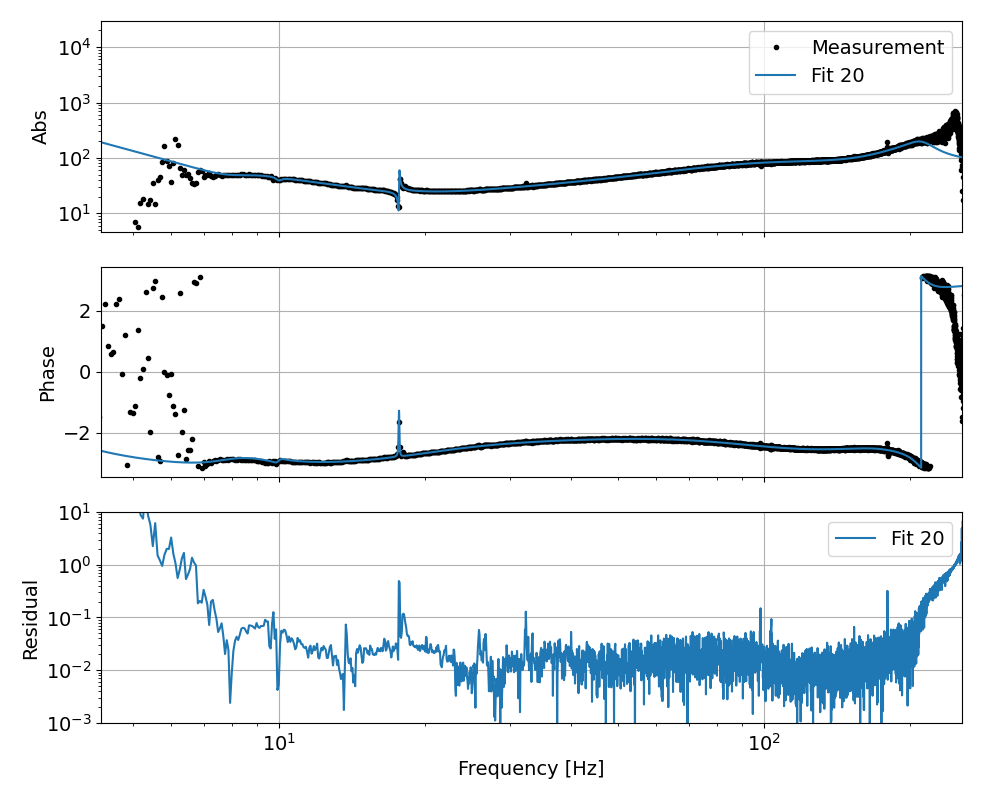
Another measurement of the DHARD_Y plant

This time focusing on the 1.5 to 3.5 Hz band to resolve the structure around 2.6 Hz.

The noise injection ran between 1373756179 (2023/07/18 22:56 UTC) and 1373758142 (2023/07/18 23:28 UTC)

Not sure if what we see is real, but here's a fit, in s-domain, of the plant (optics plus suspension, with the controller divided out)

z = [-0.33515061+16.35437768j, -0.33515061-16.35437768j,
        -0.88008293+11.64561682j, -0.88008293-11.64561682j,
        -0.60031816 +3.15253939j, -0.60031816 -3.15253939j,
        -0.74195821 +2.5870795j , -0.74195821 -2.5870795j ,
        -0.70804008 +0.43354112j, -0.70804008 -0.43354112j]
p = [-0.57517567+17.98772839j, -0.57517567-17.98772839j,
        -0.11588748+16.31442876j, -0.11588748-16.31442876j,
        -0.55863455+15.02245062j, -0.55863455-15.02245062j,
        -0.19628544 +6.5741992j , -0.19628544 -6.5741992j ,
        -1.37239773 +2.79248047j, -1.37239773 -2.79248047j,
        -0.33923225 +2.70011481j, -0.33923225 -2.70011481j,
        -1.05551599 +0.j        , -0.12652314 +0.j        ]
k = -126469.31513966424
Images attached to this report
H1 ISC
naoki.aritomi@LIGO.ORG - posted 18:38, Tuesday 18 July 2023 (71488)
Lockloss triggers are installed in PI damping models

Jenne, Naoki

As reported in alog71412, the lockloss triggers were not installed in PI damping models so we installed them in the PI damping models following the violin damping model. The first and second attached figures show the updated h1susetmxpi and h1susitmpi models. The h1susetmypi model is also updated in the same way as the h1susetmxpi model. The models were successfully built and Dave will restart them in the next Tuesday maintenance.

What we did:

Images attached to this report
H1 General (Lockloss)
austin.jennings@LIGO.ORG - posted 17:35, Tuesday 18 July 2023 (71486)
Lockloss @ 0:32

Lockloss @ 0:32, most likely due to local ground motion/EQ (was not reported on USGS).

H1 General
oli.patane@LIGO.ORG - posted 17:04, Tuesday 18 July 2023 (71485)
End-of-Maintainance VEA Sweep

Ibrahim A, Oli P.

Following the end of Tuesday maintainance, conducted a sweep of the LVEA. During walk around, noted (but did not unplug) the extension cord for the clean room lights/filter located outside of the PSL (photo).

We found two dead crickets and heard one cricket chirping under one of the ITM's, but couldn't see it.

Images attached to this report
H1 ISC (DetChar, OpsInfo)
sheila.dwyer@LIGO.ORG - posted 16:45, Tuesday 18 July 2023 - last comment - 14:48, Tuesday 29 August 2023(71484)
script running to increase om2 heat, step darm offsets overnight

on cdsws04, there is a script running that will step the darm offset up and down for a few minutes, then step up the heat on om2, wait two hours for the thermal transient, and repeat this process 4 times.

The DARM offset steps will cause an SDF diff that will knock H1 out of observing, after it finishes each set of darm offset steps and move om2 the operators can take us back to observing.  the om2 heater will cause some SDF diffs which can be accepted for tonight. 

If the operators need to stop the script (if there is a reason to stand down or if H1 losses lock) you can hit control c on the terminal on cdsws04. 

This script also sets the DARM offset TRAMP to 5seconds, I've accepted this in SDF for now but it will go back to 1 second next lock.

Comments related to this report
sheila.dwyer@LIGO.ORG - 10:19, Wednesday 19 July 2023 (71502)

Because of EQ locklosses the operators stopped this script twice, 71493 and 71492.  Just now I've started it for the last step.  Hopefully it is not overly confusing that we got this data set in three different locks, we may want to re-run this sometime.

jeffrey.kissel@LIGO.ORG - 14:48, Tuesday 29 August 2023 (72523)CAL, DetChar, ISC
This aLOG marks the start of the OM2 heater being ON and "HOT" permanently from July 19 2023 17:16:16 UTC (10:16:16 PDT) until now (2023-08-29 and in to the forseeable future).

Below, I document the OM2 TSAMS heater's "step period" cross-referenced against the observation intent bit being set high, using the channels
    - H1:AWC-OM2_TSAMS_POWER_SET
    - H1:AWC-OM2_TSAMS_THERMISTOR_1_TEMPERATURE
    - H1:AWC-OM2_TSAMS_THERMISTOR_2_TEMPERATURE
 
as the channels which indicates the requested voltage applied to the TSAMS heater, and the corresponding temperature of the TSAMS heater.


2023-07-18 10:33:28 UTC (2023-07-18 03:33:28 PDT) [lock loss]        0.00 V   # End of last Observation Stretch with OM2 COLD 

2023-07-19 00:00:37 UTC (2023-07-18 17:00:37 PDT) OBSERVING          1.15 V      
           00:32:08 UTC (           17:32:08 PDT) [lock loss]                    
                                                                                 
           03:34:55 UTC (           20:34:55 PDT) OBSERVING                     
           05:31:22 UTC (           22:31:22 PDT) out of observe                 
                                                                                 
           05:35:24 UTC (           22:35:24 PDT)                    2.30 V     
           05:38:28 UTC (           22:38:28 PDT) OBSERVING                     
           07:38:51 UTC (2023-07-19 00:38:51 PDT) [lock loss]                    
                                                                                
           07:39:24 UTC (           00:39:24 PDT)                    3.35 V

           10:01:30 UTC (           03:01:30 PDT) OBSERVING 

           17:06:31 UTC (           10:06:31 PDT) out of observe     
           17:10:35 UTC (           10:10:35 PDT)                    4.60 V
           17:16:16 UTC (           10:16:16 PDT) OBSERVING

Thus, as of 2023-07-19 17:16:16 UTC (10:16:16 PDT), the OM2 Ring heater has been "ON" and "HOT" (with 4.6 V requested, with a temperature of 33.1 and 56.7 [deg C] on thermistor 1 and 2 respectively.)

Note -- as of 2023-08-15 20:15:55 UTC (13:15:55 PDT), Keita disconnected the Beckhoff system that monitored the TSAMS temperature -- see LHO:72241.
H1 General (OpsInfo)
thomas.shaffer@LIGO.ORG - posted 16:26, Tuesday 18 July 2023 (71483)
H1_MANAGER Guardian node testing

I did some testing of the H1_MANAGER node today with some good successes. The node tried to lock as normal after maintenance, got to DRMI locking and then the (shortened for test) timer expired so it started to run an initial alignment. Initial alignment was automatic until the last step (SRC alignment, where we had to step in). We weren't able to get SRY to lock even by hand, so I manualed INIT_ALIGN to compete which then triggered H1_MANAGER to start normal locking again. Overall, I think this node is ready to test while monitored by an operator for a few days. Perhaps we will try tomorrow.

More details - In the past the transition between locking and initial alignment ran into a few issues with ISC_LOCK stalling and the reviving by H1_MANAGER got tricky. I wrote a new decorator to request a particular state the ISC_LOCK node whenever it stalls. This is a bit constraining, but works for this case. I also reorganized the state graph a bit to make it a bit easier to be turned off or on as needed. Currently, it's only looking at timers to trigger an initial alignment, but I'd like to add something smarter eventually and at least we should have it trigger if it's run CHECK_MICH fringes more than once or similar.

LHO General
austin.jennings@LIGO.ORG - posted 16:15, Tuesday 18 July 2023 (71481)
Ops Eve Shift Start

TITLE: 07/18 Eve Shift: 23:00-07:00 UTC (16:00-00:00 PST), all times posted in UTC
STATE of H1: Preventive Maintenance
CURRENT ENVIRONMENT:
    SEI_ENV state: CALM
    Wind: 14mph Gusts, 12mph 5min avg
    Primary useism: 0.02 μm/s
    Secondary useism: 0.04 μm/s 
QUICK SUMMARY:

- IFO currently waiting in OMC WHITENING while the violin modes damp

- CDS/SEI/DMs ok

H1 General
anthony.sanchez@LIGO.ORG - posted 16:06, Tuesday 18 July 2023 (71479)
Tuesday Ops Shift End


TITLE: 07/18 Day Shift: 15:00-23:00 UTC (08:00-16:00 PST), all times posted in UTC
STATE of H1: Preventive Maintenance
CURRENT ENVIRONMENT:
    SEI_ENV state: CALM
    Wind: 12mph Gusts, 10mph 5min avg
    Primary useism: 0.02 μm/s
    Secondary useism: 0.04 μm/s 
QUICK SUMMARY:

Greasing Fans  Bubba & Chris Completed

Ken VPW & OSB installing lights.

OMC Scans done by Kieta & Danielle completed

4 IPS Teacher Tours completed , by TJ, Camilla, Jenne, and Fred.

CDS ETMX Digial CAM Moved , Completed by Patrick required DAQ Restart.

Beam Splitter Loop Charactization was completed by Jeff.  

DAQ Restarts were completed at 18:52 UTC

Sei Ham8 ISI restarts started but but wiped the values in the safe.snap. That has now been resolved. 18:54 UTC

PSL tuning Completed by Jason & Oli

LVEA LASER HAZARD!! for HWFS work with Camilla and PEM Guilotine work 18:31 UTC

PSL tuning Completed by Jason & Oli In Box work complete 20:02UTC  finished working on ISS and may need target of oppertunity to adjust after the PSL comes to Thermal eq. later 20:21UTC

LVEA LASER SAFE !

PEM Guilotine work has been completed 20:15 UTC

Relocking started at 20:35 UTC

Mid Y HEPTA Pump turned on for a few minutes during Lock acquisition.

VAC HEPTA started early this morning and is still ongoing and will last until 4pm.

Locking Notes:
We used H1 Manager to do most of an Initial Alignment, but we got stuck in ALIGN_IFO - SRC_ALIGN.

Optimized ASC-AS_A_DC_NSUM_OUT16 for maximum Peaks and Valleys.
And used AS Air to get a good looking spot.

21:48 UTC
TJ then tried a work around to trick the gaurdians into locking.  
 
Check violins at 22:08 UTC

OMC_WHITENING @ 22:44 UTC


Start Time System Name Location Lazer_Haz Task Time End
12:15 ISC Ryan S CR - DHARD_Y measurement 13:01
13:29 CDS Erik Remote - Rebooting workstations, opslogin0, cdsssh 13:49
14:02 FAC Ken VPW - Conduit installation, & moving Scissor lift to OSB rec 16:56
14:21 PEM PEM_MAG_INJ GRD CR - Magnetic injection suite 14:40
15:00 FAC Tyler, Chris, Bubba Outbuildings - Fan checks 16:48
15:04 FAC Cindi OSB Receiving n Supplies 15:54
15:06 - Jeff LVEA n Taking photos 15:26
15:09 VAC Gerardo LVEA - Check turbopumps 15:50
15:15 FAC Kim, Karen LVEA N Tech Cleaning 17:04
15:37 VAC Janos LVEA n Vacuum Pump Systems Check 15:41
15:38 FAC Christina FTCE n Property Tag Management Inventory 15:54
15:42 VAC Janos MX/MY/EX/EY N Check Vacuums 18:37
15:43 PEM Robert LVEA N Pulling laser safe guillotine bolts 17:13
15:45 OMC Danielle, Sheila Ctrl Rm N OMC Scans 17:24
15:46 Tour TJ & 25 EX N Giving a tour to IPA Teachers 16:31
15:54 Tour Jenny + 10 Ctrl Rm N Heading to LVEA for IPA Tour 17:12
15:54 FAC Cindi Ham Shack N Tech Cleaning 17:45
16:14 EE Marc CER n Thermal probing chassis 16:42
16:28 EE Fil EX N Terminating new HEPI cables. 17:41
16:42 VAC Gerardo LVEA N VAC pump shutdown 17:05
16:45 Tour Camilla LVEA N tour 17:15
16:45 PSL Jason, Christina H2 N Inventory 16:59
16:49 EE Jim HAM8 N Feedthrough protection 17:30
17:04 FAC Kim & Karen Ham Shaq N Technical Cleaning 17:45
17:21 VAC Gerardo X2, Y2 N Checking VAC System near solar panels 17:53
17:23 PSL Jason, Olie remote Yes Headin to PSL 19:35
17:25 CE Jeff Ctrl Rm N Loop Char BS  measurements 18:47
17:31 FAC McCarthy LVEA N Checking on LVEA Maintence progress. 17:50
17:39 PEM Robert LVEA EX N getting ready for Guilotine work 17:56
17:42 EE Fil LVEA HAM6 N HAM6 Cabling and getting tools 18:25
17:54 VAC Janos Mid Y N HEPTA Pump Work until 4pm 21:14
17:58 PEM Robert, Genevive, Lance LVEA yes PEM Work on Guilotines. 20:14
18:13 HWFS Camilla, Marissa LVEA Yes Laser Transition , HWFS SLEDs Work 20:07
18:21 SQZ Naoki LVEA SQZ T Yes Working on SQZr adjustments. 19:03
18:41 CDS Dave B Remote N DAQ Restarts 19:07
18:47 Electric Ken FCES N Getting a Ladder from FTCE 19:03
19:00 SEI Jim CtrlRm N Rebuilding Safe.snap for BS ISI 20:00
19:01 FAC Karen, Kim End stations N Technical cleaning 19:06
22:57 injection Gabriele Remote N DHARD injection tests 23:57


H1 TCS
camilla.compton@LIGO.ORG - posted 15:33, Tuesday 18 July 2023 - last comment - 16:25, Friday 21 July 2023(71476)
ITM HWS SLEDs swapped

Camilla, Marissa, WP11308

Cao noticed that the ITM HWS SLEDs had decayed in 71328. This morning Marissa and I swapped both following procedure T1500193. There was no measurable power out of the old sleds ~3mW out of the new ones. 

ITMX: Old S/N 07.14.255, New: QSDM-790-5 S/N 05.21.346 (2.5mW = 120mA, trimpot to 480mW)

ITMY Old: S/N 11.17.127, New: QSDM-840-5 S/N 11.21.303 (2.5mW = 115mA, trimpot to 460mW)

SLED inventory in 66832, SLEDs last swapped in Dec 2022 66179. Still need to check that there is the correct amount of light on the HWS cameras and maybe update the camera frame rate.

At 19:25UTC, while we were at the chassis, the CO2X laser tripped off with the "temp" warning light. This warning light didn't go away until I power cycled the chassis. CO2X then turned on and locked fine.

Comments related to this report
camilla.compton@LIGO.ORG - 16:25, Friday 21 July 2023 (71600)

Checked on HWS signals after SLED swap, all look good. See attached for spherical powers changing over last lock, ITMY, ITMX 1m30 after 60W power up during this lock. Same point absorber on ITMX only.

When I looked a the two minutes during power up from 25W to 60W, I can see 4 distinct point absorbers on ITMX, nothing on ITMY. I hope this is a strange transient left over from MOVE_SPOTS but I can see it on the last two power ups. Should look into whether this was present last year.

Images attached to this comment
H1 PSL (OpsInfo)
jason.oberling@LIGO.ORG - posted 14:41, Tuesday 18 July 2023 - last comment - 15:00, Tuesday 18 July 2023(71474)
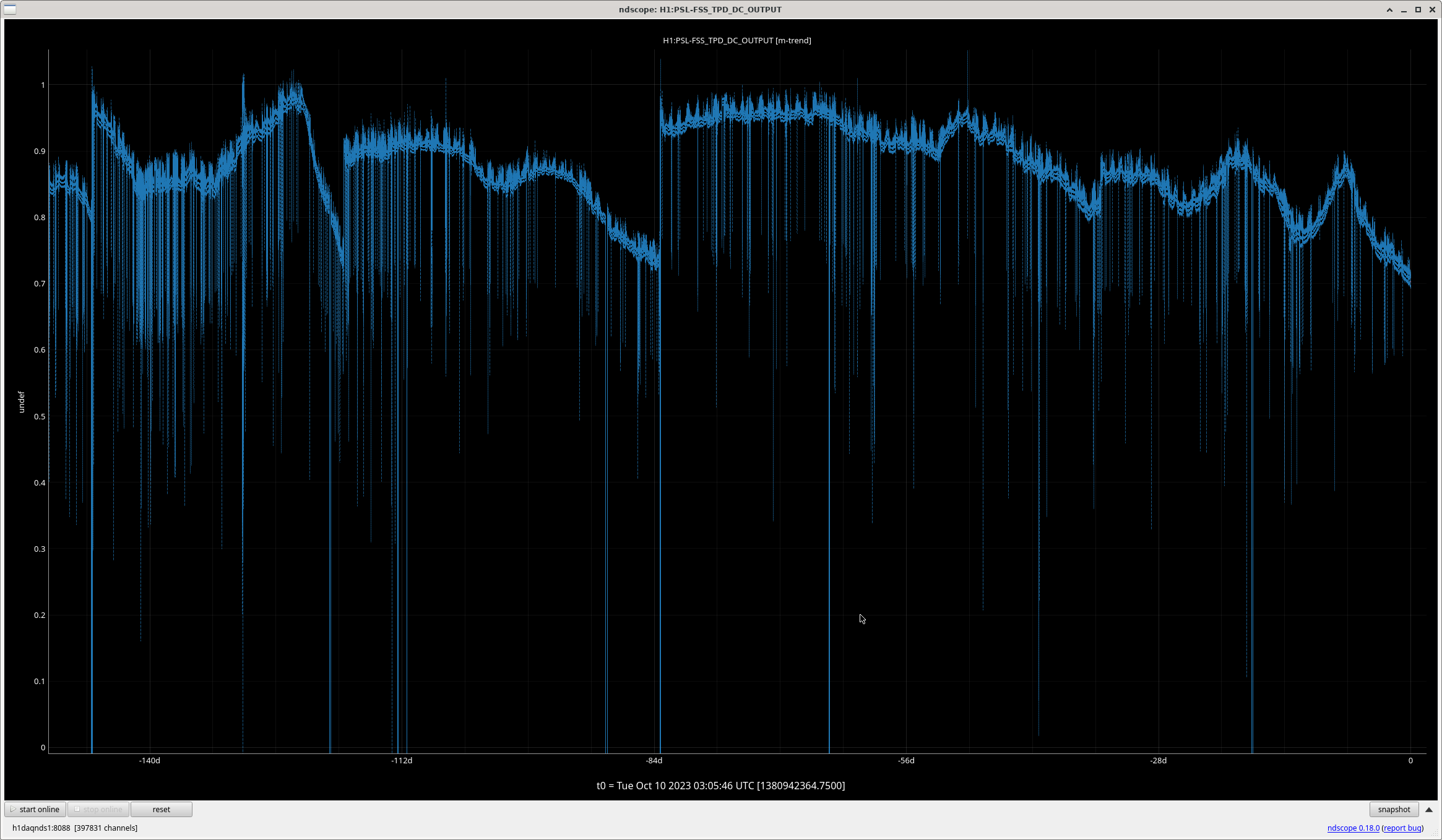
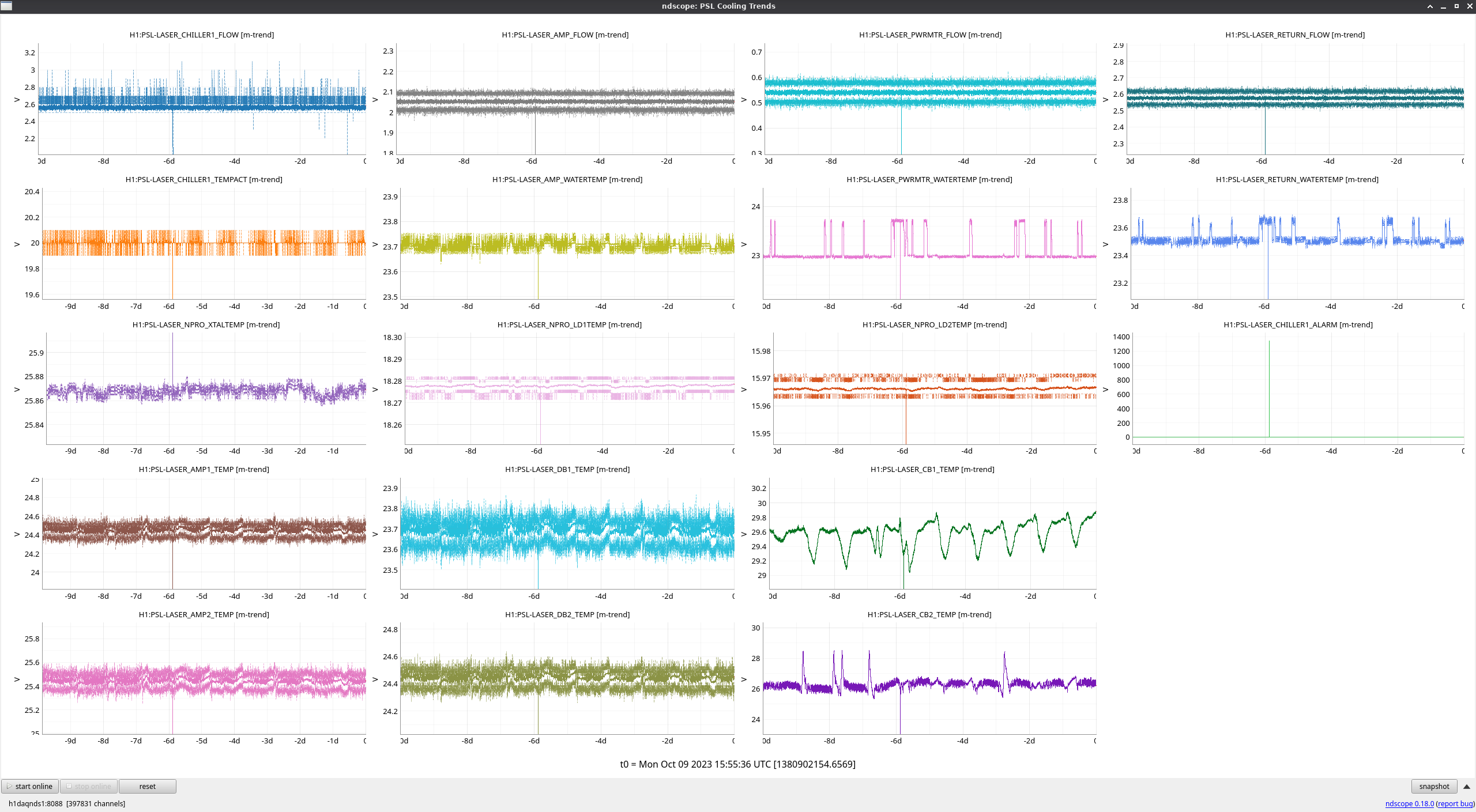
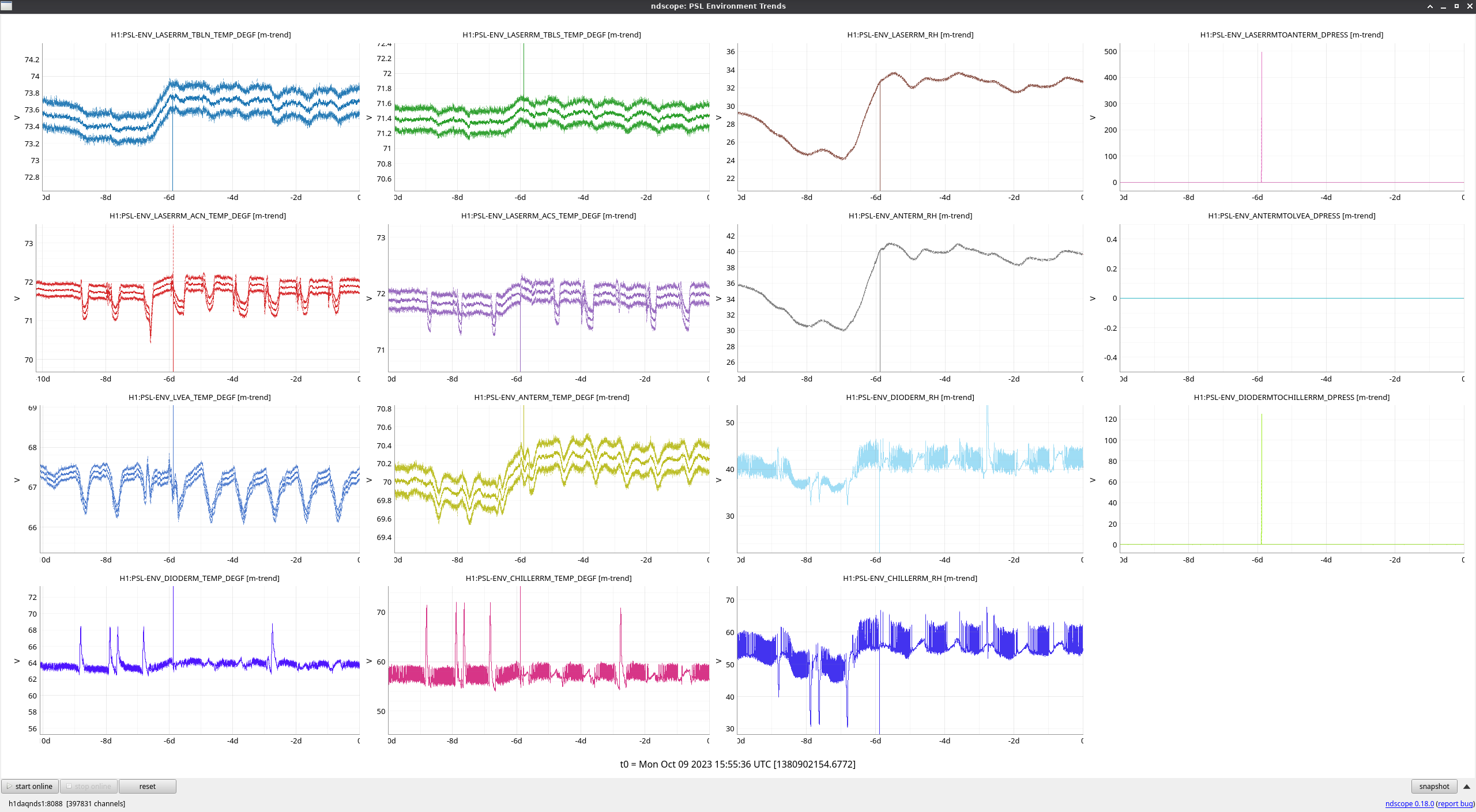
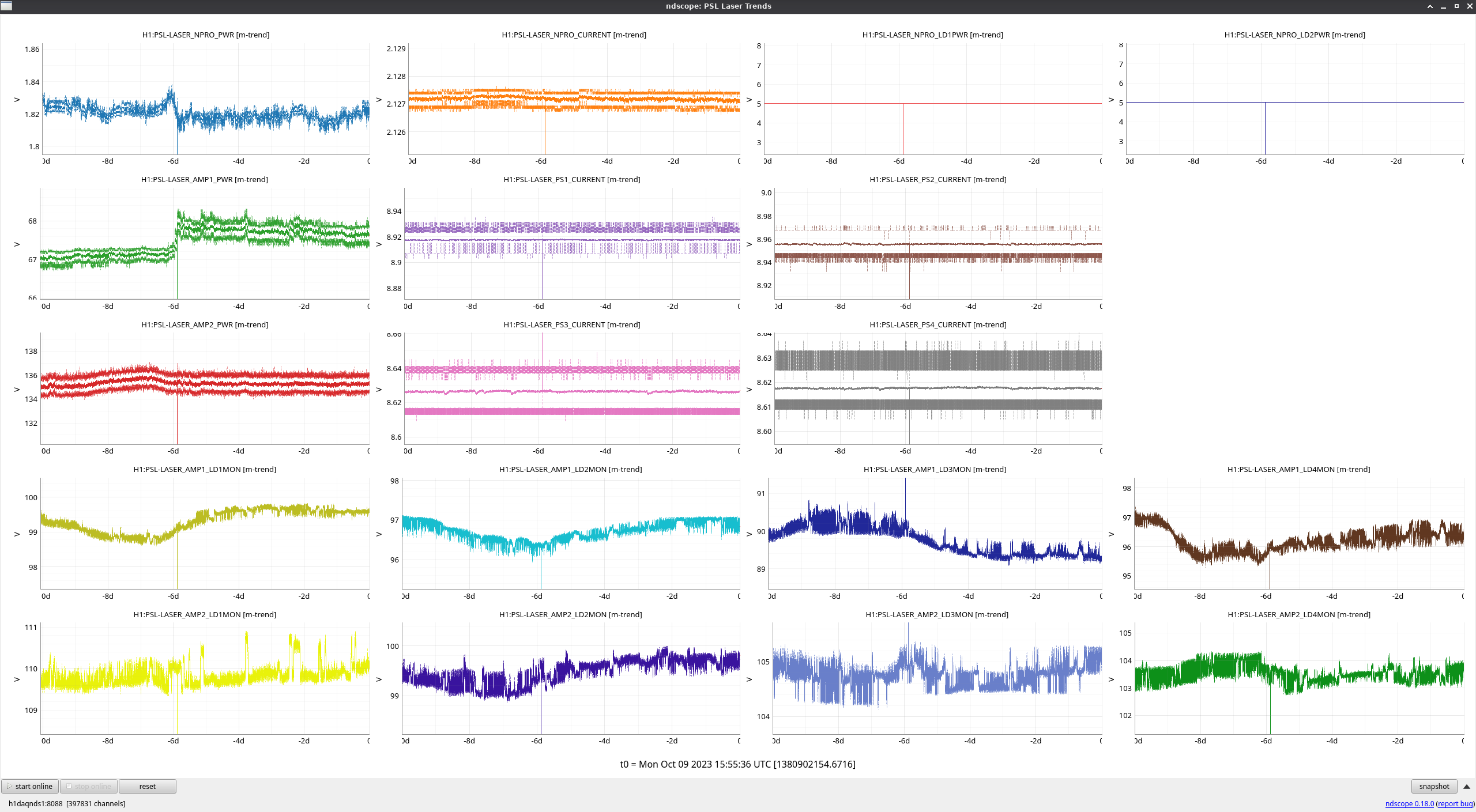
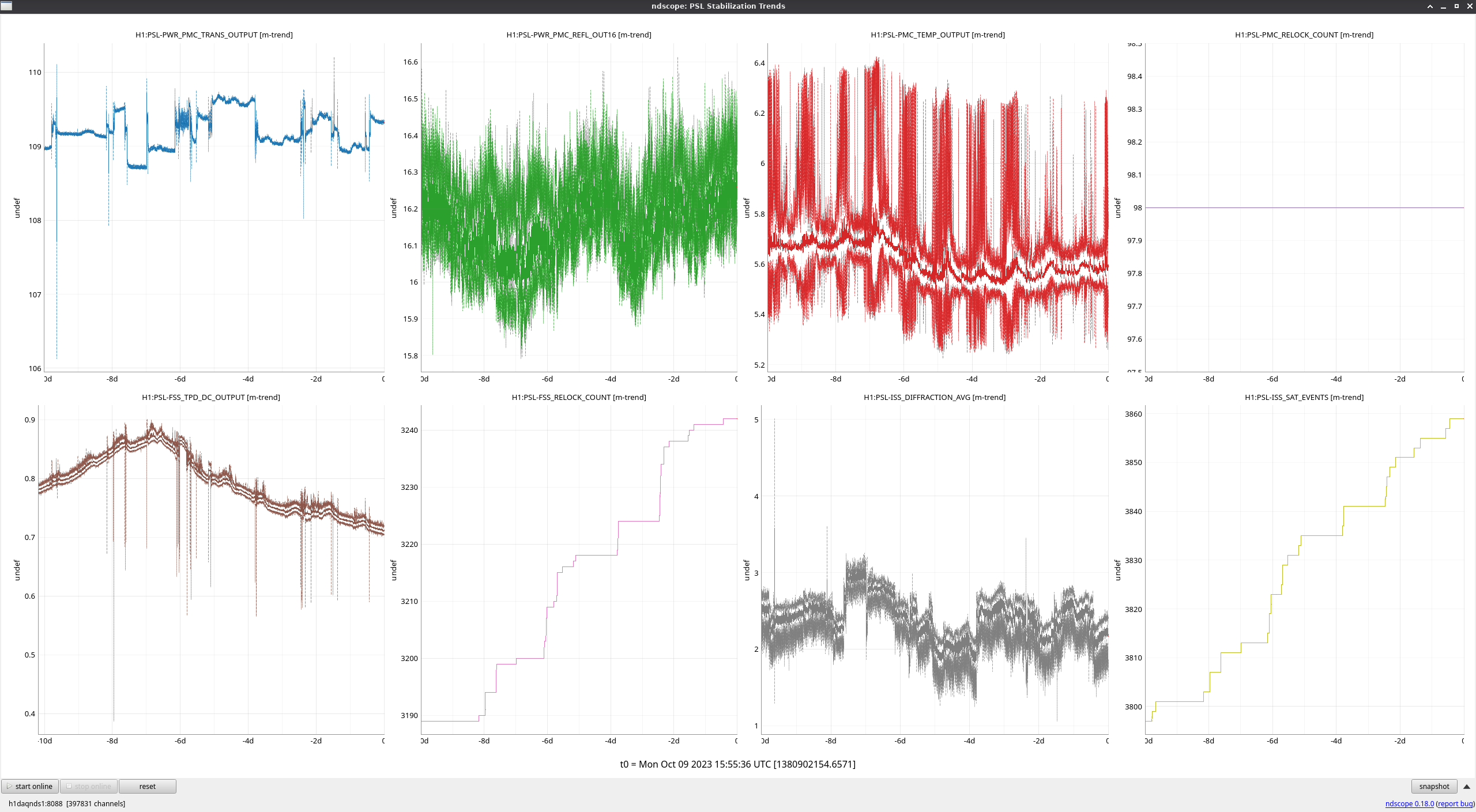
PSL Remote PMC and On-Table FSS RefCav Alignment Tweaks (WP 11309)

J. Oberling, O. Patane

Today we did some alignment tweaks for the PMC and FSS RefCav.

Before going into the PSL enclosure (and disrupting its thermal equilibrium), I remotely tweaked the beam alignment into the PMC.  This was done with the ISS OFF (as otherwise the ISS sees any change in PMC Trans as something it needs to correct for, and we do not want this).  Results:

So some improvement, but not quite as much as I had hoped (we've been under 16.0 W on PMC Refl in the past), so it may be time to increase the amplifier injection currents a little.  Will continue to monitor the PMC.

That done, Oli and I went into the PSL enclosure to manually tweak the on-table FSS RefCav alignment.  After a safety overview of the PSL table (as it was Olli's first time in the enclosure), we began by taking a power budget of the FSS beam path.  This was done with the ISS ON.

Both the single and double pass diffraction efficiency are lower than usual, which makes sense as at last remote alignment I was unable to return the RefCav TPD to its normal levels.  We adjusted the AOM alignment to improve the single pass diffraction, and mirror M21 to improve the double pass diffraction.  Results:

Much better.  We then had to slightly adjust the EOM position to ensure the entrance and exit apertures were centered on the beam (to prevent any internal clipping), and then proceeded to recover the RefCav.  The alignment was far enough off that we needed to use the iris mounted in front of the RefCav to recover the alignment, then locked the RefCav and used the picomotor-controlled mirrors to tweak the alignment and improve the TPD.  At the end the TPD was ~0.94V.  To finish, we aligned the beam onto the RefCav RFPD, and measured the RefCav's visibility.

This is roughly where we had it last time the on-table alignment was tweaked back in May.  We then turned the ISS OFF and left the enclosure and returned it to Science Mode.

Back in the Control Room I turned the ISS back ON, at its usual RefSignal value of -2.01V, and the diffracted power % dove to almost 0%.  I had to increase the RefSignal to -1.97V to get the diffracted power % to ~2.0% (I did not accept this in SDF yet, as it will likely need to be adjusted soon as the enclosure warms up).  In addition, the PMC Refl power had increased over the course of the incursion to ~18.3 W, almost 2 W higher than when we went in.  This was all expected as an enclosure incursion disrupts the internal thermal equilibrium of the enclosure (and why we like to do these as early in the maintenance window as possible).  As the thermal environment equalizes I expect the diffracted power % to go up and PMC Refl to go down; both may need to be adjusted as a T.O.O. in the coming days, or next Tuesday, whichever comes first.  I'll keep an eye on the PSL over the coming days and adjust things as necessary (most likely ISS RefSignal adjustments, as those are quick during a lockloss recovery; any necessary PMC tweaks may likely wait until next Tuesday).  I've tagged OpsInfo so the EVE and OWL shift operators are aware of this.  This closes WP 11309.

Comments related to this report
jason.oberling@LIGO.ORG - 15:00, Tuesday 18 July 2023 (71475)

Checking on things ~2 hours after we left the enclosure, and the enclosure continues to thermalize: PMC Refl has decreased to ~17.0W, ISS diffracted power % increased to ~2.5%, and FSS RefCav TPD has increased to ~0.96 V.  Things are trending in the expected direction as enclosure thermalization continues.

LHO VE
david.barker@LIGO.ORG - posted 14:33, Tuesday 18 July 2023 (71456)
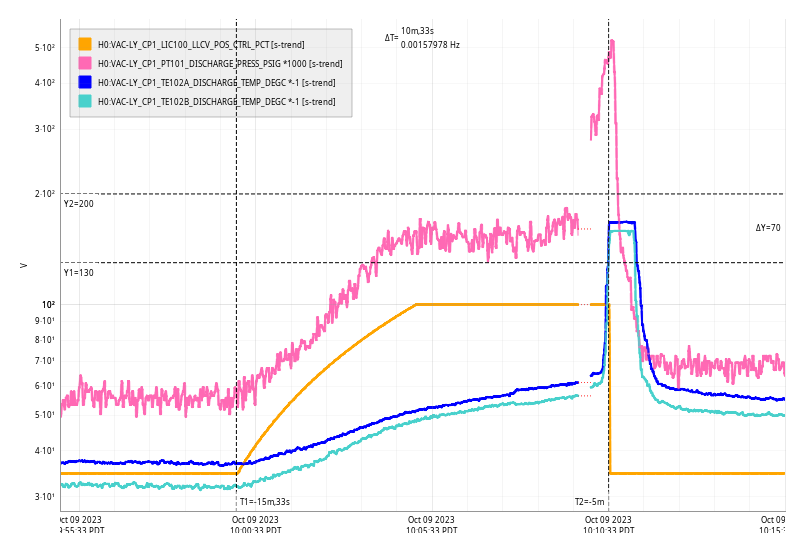
Compare ramped fill with unramped

Comparing the new ramped fill, where the LLCV is opened linearly from its operational value to 100% over 5 minutes, with the unramped opening (takes about 5 seconds) the main difference is the removal of the sudden jump in discharge line pressure and temperatures at the start of the fill.

Log and linear comparison plots are attached showing today's and Sunday's fills.

Images attached to this report
LHO VE (VE)
gerardo.moreno@LIGO.ORG - posted 14:33, Tuesday 18 July 2023 (71473)
FAMIS Task for Corner Station Turbo Pumps

Notes below:

Output mode cleaner tube turbo station;
     Scroll pump hours: 5556.6
     Turbo pump hours: 5600.6
     Crash bearing life is at 100%

X beam manifold turbo station;
     Scroll pump hours: 779.0
     Turbo pump hours: 774.1
     Crash bearing life is at 100%

Y beam manifold turbo station;
     Scroll pump hours: 1873.9
     Turbo pump hours: 592.6
     Crash bearing life is at 100%

Images attached to this report
H1 ISC (ISC)
keita.kawabe@LIGO.ORG - posted 11:15, Tuesday 18 July 2023 - last comment - 11:24, Friday 04 August 2023(71457)
ITMY single bounce, cold OM2, OMC scan with ITM central heating OFF/ON (Sheila, Daniel, Keita)

Summary:

This is a continuation of single bounce beam analysis. In the past we've done OM2 hot/cold measurements for ITMX in alog 70502 and 71100, this time we've done a different thing (OM2 cold, ITM CO2 off/on for ITMY beam).

When ITM CO2 was off, the OMC scan looked like the first attached (for Jennie: about 16:46:35 - 16:47:58 UTC). 20 peak is ~1.0 while 00 peak is ~16 (off the scale in the plot).

With CO2 heating of 1W (started ~16:51:13) , the 20 peak started decreasing but it was much, much slower than we expected.

At around 17:25:00 UTC we had to stop due to other maintenance tasks. The last usable scan before this (for Jennie: 17:23:08-17:24:38 UTC) is shown in the second attachment. 20 peak was still slowly decreasing, but anyway at that moment 20 peak was down to 0.6.

Given this slow time constant, Daniel points out that maybe we should have waited longer after the IFO unlocked before starting the single bounce scan (both for today and for the past measurements). FYI IFO was unlocked at about 15:07 UTC.

I'll do my mode matching simulation as soon as Jennie gets the 20/(20+00) numbers.

What was done:

10W into IMC, ITMY single bounce. ASC-AS_A and AS_B DC centering (DC3 and DC4) were on. RF sidebands were turned off.

Manually locked OMC (OMC guardian auto, asked for prep-omc-scan, then go manual, scan the OMC-PZT2_EXC to find 00 peak, stop scan and adjust the PZT2_OFFSET so we're on the 00 resonance, ask for OMC_LSC_ON, then OMC_Locked and go AUTO, that's what I kind of remember).

Manually refined the alignment using OM3 and OMCS. Disabled the OMC LSC, OMC guardian DOWN, and started scanning. We ended up using 0.01Hz Ramp signal with 110V amplitude (PZT2_OFFSET zero) to make sure to use the full range of the PZT.

OM2 was cold throughout the scan (H1:AWC-OM2_TSAMS_THERMISTOR_1_TEMPERATURE=21.748 to 21.749, H1:AWC-OM2_TSAMS_THERMISTOR_2_TEMPERATURE= 22.149 to 22.147)

TCS was off at first. The first scan (16:45:35-16:47:58) was about 1h 40min after the lock loss.

TCS central heating of 1W was turned on at about 16:51:13.

Daniel restored the RF SBs and brought all settings back.

Images attached to this report
Comments related to this report
keita.kawabe@LIGO.ORG - 11:22, Tuesday 18 July 2023 (71461)

How to turn off RFSBs.

Disconnect the cable for 118MHz on the patch panel at the bottom of the PSL rack (1st picture).

On top of the patch panel there's a 24MHz amplifier, don't turn it off.

On top of the 24MHz thing, there are amplifiers for 9MHz and 45MHz. You will turn off the output of both (2nd picture showing the 45MHz unit with the RF output switch in OFF position).

Images attached to this comment
keita.kawabe@LIGO.ORG - 16:11, Tuesday 18 July 2023 (71480)

If we just believe TCS frontend simulation, H1:TCS-SIM_ITMY_SUB_DEFOCUA_FULL_SINGLE_PASS_OUTPUT was ~17.05uD during the last OMC scan before we gave up.

We might be able to use this to distinguish between the two patches in the MM parameter space (update in https://alog.ligo-wa.caltech.edu/aLOG/index.php?callRep=71477) but I'll wait for the OMC scan fitting results.

Images attached to this comment
jennifer.wright@LIGO.ORG - 18:12, Tuesday 25 July 2023 (71716)SQZ

Executive Summary: The mode mis-match with no central heating on the ITM is 8.2%, the mode mis-match with central heating on the ITM is 3.6%.

For the first scan:

T0 = 1373734011

delta T = 87s

OMC scan is shown in the first png image.

Fitted C20/02 peak is shown in the first pdf.

We expect the HOM spacing to be 0.588 MHz as per this entry and DCC T1500060 Table 25.

The mode spacing is 148.796 - 149.388 = 0.592 MHz.

The ratio of second order to zeroth order carrier is (0.575 + 0.853)/(0.575 + 0.853 + 15.90) = 0.082 = 8.2 % mode mis-match

To run the code checkout git branch /dev of labutils and run measurement.

python OMCscan_nosidebands3.py 1373734011 87 "Sidebands off, 10W input, cold ITM + OM2" "single bounce" --verbose -m -o 2

and for the split peak fitting:

python fit_two_peaks_no_sidebands3.py


For the second scan:

T0 = 1373736206

delta T = 90s

OMC scan is shown in second png image.

Fitted C20/02 peak is shown in the second pdf.

The mode spacing is 148.741 - 149.338 = 0.597 MHz.

The ratio of second order to zeroth order carrier is (0.201 + 0.428)/(0.201 + 0.428 + 17.02) = 0.036 = 3.6 % mode mis-match

Run the following on the same git branch.

python OMCscan_nosidebands4.py 1373736206 90 "Sidebands off, 10W input, hot ITM + cold OM2" "single bounce" --verbose -m -o 2 -p 0.01

and for the split peak fitting:

python fit_two_peaks_no_sidebands4.py

data is in labutils/omc_scan/data/2023-07-18

files in labutils/omc_scan

figures in labutils/omc_scan/figures/2023-07-18

Images attached to this comment
Non-image files attached to this comment
keita.kawabe@LIGO.ORG - 11:24, Friday 04 August 2023 (71951)

Summary:

Incorporated the fit results and updated the plot. Original analysis is in alog 71145.

In the attached, there are two pairs of patches, each pair comprising yellow and lighter blue, that represent the previous measurement (alog 71145 where ITMX single bounce was used with no TCS, OM2 hot/cold) and two pairs, each pair comprising greenish blue and darker blue, that represent the measurent done this time (ITMY single bounce, cold OM2, TCS ON/OFF).

Since it's impossible that the beam parameters of ITMX single bounce beam on the OMC are totally different from those of ITMY single bounce, you can just look at the distance between pairs and judge which ones represent the reality. In this case, the patches in the left half plane are the clear winners.

Details and caveats:

Calculation done for the ITMY single bounce is exactly the same as ITMX except that the measured losses are different and the mode actuator is ITMY central TCS instead of OM2.

As for the TCS optical power I  used H1:TCS-SIM_ITMY_SUB_DEFOCUS_FULL_SINGLE_PASS_OUTPUT~17uD for the central heating (zero for no heating). I simply doubled the number for double-pass effect. If this is grossly off the result might look different.

Since 1st order HOM power was not negligible in ITMY single bouncer scan, as a first order approximation, I used P2/(P0+P1+P2) as the measured mode matching loss where P0, P1 and P2 are the power of 00, 1st order and 2nd order mode (for the 2nd order mode, 20 and 02 were resolved by the fit code). I've done this to ITMX single bounce scan too just for consistency.

If the model is perfect and has everything, the difference between yellow "X, OM2" and greenish-blue "Y, OM2 Cold/TCS OFF" should be explained by the difference in the ITM ROC, substrate lensing/heating including the TCS (and IFO heating prior to lock loss, since we haven't waited for hours and hours after the IFO was unlocked). It would be interesting to see if ITM difference will make the plot look any different.

However, the model doesn't have ITMX and ITMY, it's just a single ITM at the average location. Though it's easy to implement that feature in principle, I have a suspicion that the numbers used for ITM substrate lens effect in the past could be off, and I've contacted GariLynn. Wait for the conclusion of that discussion.

A big caveat is that you cannot quickly draw conclusion about the full IFO mode matching from this. At the very least, you have to take into account that the arm mode is primarily determined by the HR and that the carrier coming to OMC from inside the arms only experience the ITM lensing once (-ish).

Another big caveat is that the ADC was railing for the 00 mode peak. Look at the 2nd attachment bottom where H1:OMC-DCPD_B_STAT_MIN=-(2^19). It's not as bad as the finesse measurement (alog 71888) as the scan was slower, but if we want a better data we need to redo it with lower power or w/o x10 gain.

Last attachment shows what happens when you change OM2 (left, 1 step in the plot = maximum range of the T-SAMS) or ITM heating (right, 1 step = 10uD single pass).

Images attached to this comment
H1 CDS
patrick.thomas@LIGO.ORG - posted 11:14, Tuesday 18 July 2023 - last comment - 17:53, Tuesday 18 July 2023(71460)
ETMY camera moved to h1digivideo3
WP 11315.

Dave, Erik, Patrick

The ETMY camera has been moved from h1digivideo2 to the new code running on h1digivideo3.

Note that the cameras running on this code (all those on h1digivideo3) have an additional channel:
{channel_prefix}VALID: 1 if and only if there has been a successful iteration through the image grab loop and the last iteration through the image grab loop succeeded. (read only)

Monitoring this channel should be a better way to check for image freezes than monitoring the centroid positions.

The full list of channels is in the wiki.

Erik has updated the script that starts the camera client on the control room wall screens.

Dave is updating the DAQ.
Comments related to this report
patrick.thomas@LIGO.ORG - 11:19, Tuesday 18 July 2023 (71462)
It appears that the VALID channel had not been added to the DAQ for the cameras migrated prior to this one. I told Dave and he is adding it now.
naoki.aritomi@LIGO.ORG - 17:53, Tuesday 18 July 2023 (71487)

After the change of ETMY camera server, the sign of camera servo PIT3, which uses the ETMY camera, seems flipped. I changed the PIT3 gain from 300 to -400 in lscparams.

H1 CDS (PEM)
filiberto.clara@LIGO.ORG - posted 12:57, Tuesday 11 July 2023 - last comment - 15:42, Tuesday 18 July 2023(71235)
HAM6 Floor Acceleromter

HAM6 floor accelerometer reported as not working, alog 71133. Cable located in CER connected to the new LIGO accelerometer chassis, channel 12. Other end of cable located on east door of HAM6. Cable previously repaired, short found in cable by HAM6. Cable cut a few feet to eliminate the short. New cable length does not reach the HAM6 floor accelerometer. A short patch cable will be made and installed next Tuesday.

Comments related to this report
filiberto.clara@LIGO.ORG - 15:42, Tuesday 18 July 2023 (71478)

A short patch cable was installed to extend cabling to the HAM6 floor accelerometer. In the CER the accelerometer is connected to the LIGO accelerometer chassis, channel 12.

H1 ISC
keita.kawabe@LIGO.ORG - posted 17:49, Friday 07 July 2023 - last comment - 15:13, Monday 21 April 2025(71145)
Constraining single bounce beam mismatching parameters using single bounce OMC scans

Mode matching of the single bounce beam to the OMC is really bad and we don't know why. We don't even know the beam shape of the single bounce beam hitting the OMC. I constrained the beam shape by looking at the OMC scan data.

There are many OMC single bounce scans but the most recent two w/o RF SBs, one with cold and the other with hot OM2, were carefully analyzed by Jennie to resolve 02 and 20 mode as separate peaks (alogs 70502 and 71100), so I used them here.

If you just want to see the results, look at the third panel of the first attachment.

X-axis is the normalized waist position difference, Y-axis is the normalized waist radius difference. From the measured cold mode matching loss of 11.5%(!!) and hot loss of 6.2%, and the fact that the loss changed by only changing the ROC of OM2, the beam parameters hitting the OMC were constrained to two patches per each OM2 ROC. Yellow is when OM2 is cold, blue is when OM2 is hot. Arrows show how cold (yellow) patches are transformed to hot (blue) patches when OM2 ROC is changed by heating.

Note that we're talking about inconceivably huge mismatching parameters. For example, about -0.3 normalized waist position difference (left yellow patch) means that the waist of the beam is ~43cm upstream of the OMC waist. Likewise, about +0.3 normalized waist radius difference  means that the beam waist radius is 690um when it should be 490um.

We cannot tell (yet) which patch is closer to reality, but in general we can say that:

There are many caveats. The first one is important. Others will have limited impact on the analysis.

Moving forward:

Images attached to this report
Comments related to this report
keita.kawabe@LIGO.ORG - 16:34, Friday 07 July 2023 (71147)

Here's a brief explanation of what was done.

Top left panel of the 1st attachment is the mode matching loss contour plot. loss=0 when [posDiffNormalized, sizeDiffNormalized]=[0.0]. Contours are not circular because the loss is calculated analitically, not by quadratic approximation.

Top right panel of the 1st attachment only shows the region close to the measured losses. Yelllow ring is when OM2 is cold, blue is when hot. Each and every point on these rings represent a unique waist size and waist position combination (relative to the OMC waist).

Since we are supposed to know the OMC-OM2 distance and ROC of the cold and hot OM2, you can choose any point on the yellow (cold) ring, back-propagate the beam to the upstream of OM2 (assuming the cold ROC), "heat" the OM2 by changing the ROC to the hot number, propagate it again to the OMC waist position, and see where the beam lands on the plot. If it's on the blue ring, it's consistent with the measured hot loss. If not, it's inconsistent.

Just for plotting, I chose 9 such points on the cold ring and connected them with their hot landing points on the top right panel. If you for example look at the point at ~[0, 0.4] on the plot ("beam too big but position is perfect when cold"), after heating OM2 the beam becomes smaller but the beam position doesn't change meaningfully, therefore the matching becomes better. In this case the improvement is much better than the measured (i.e the landing point is inside the blue ring), so we can conclude that this ~[0, 0.4] for cold is inconsistent with the measured hot loss.

By doing this for each and every point on the yellow ring we end up with a patch or two that are consistent with reality.

If you cannot visualize what's going on, see the 2nd attachment. Here I'm ploting the beam propagation of "beam too big but position is perfect when cold" case in the top panel. The beam between the OM2 and OMC is directly defined by the initial (cold) parameters. The beam upstream of the OM2 is back-propagation of that beam. On the bottom panel is the propagation diagram of when OM2 becomes hot. The beam upstream of OM2 is the same as the cold case. You propagate that beam to the OMC position using hot ROC. In this case the loss, which was ~12% when cold, was improved to 4.3%, that's inconsistent with the measured hot loss of (1+-0.1)*6.2%.

keita.kawabe@LIGO.ORG - 17:32, Friday 14 July 2023 (71340)

Further summary:

We can probably down-select the patch by 30uD single-path thermal lensing in ITM comp plate relative to the thermal lensing we had in previous scans (alogs 70502 and 71100). Start by a hot OM2. If we see a significant reduction in MM loss after ITM TCS, the actual beam parameters are on the patches in the left half plane.

Details 1:

In the 1st attachment, I took two representative points on the hot patches indicated by little green circles, which define the beam shape at the OMC waist position. I then back propagated the beam to the upstream of ITM (i.e., in this model, optics are correctly placed with correct ROC and things, but the input beam is bad). ITM is at the average ITM position. The  only lensing in the ITM is the nominal diversing lens due to ITM's curvature on the HR.

Then I added the thermal lens, once to the beam impinging the ITM HR and once to the beam reflected, and see what happens to the beam parameter at the OMC waist location. These parameters are represented by tiny crosses. Blue means negative diopters (annular heating) and red means positive (central heating). I changed the thermal lensing by 10uD steps (single-path number).

As you can see, if you start from the left half plane patch, central heating will bring you close to ~(-0.04, 0) with 30uD single-path (or 60uD double-path).

OTOH if you start from the right half plane, ITM heating only makes things worse both ways.

FYI, 2nd plot shows, from the left to the right, good mode matching, hot patch in the left half plane and in the right half plane. The beam size on the ITM is ~5.3cm nominally, 5.1cm if in the left half plane (sounds plausible), 6.8cm in the right (sounds implausible). From this alone, right half plane seems almost impossible, but of course the problem might not be the bad input beam.

Details 2:

Next, I start with (almost) perfectly mode-matched beam and change the optics (either change ROC/lens or move) to see what happens. We already expect from the previous plots that ITM negative thermal lensing will bring us from perfect to the hot patch in the left half plane, but what about other optics?

3rd attachment shows twice the Gouy phase separation between ITM and other optics. Double because we're thinking about mode matching, not misalignment. As is expected, there's really no difference between ITM, SR3 and SR2. OM1 is almost the opposite of ITM (172 deg), so this is the best optic to compensate for the ITM heating, but the sign is opposite. OM2 is about -31 deg, SRM ~36 deg. From this, you can expect that SR3 and SR2 are mostly the same as ITM as actuators.

4th attachment shows a bunch of plots, each representing the change of one DOF of one optic. (One caveat is that I expected that the green circles, which repsent the beam perfectly mode matched to the arm propagated to the OMC waist position, will come very close to (0, 0) with zero MM loss, but in this model it's ~(-0.4, 0.1) with ~1.2% loss. Is this because we need a certain amount of ITM self-heating to perfectly mode match?)

Anyway, as expected, ITM, SR3, SR2 all look the same. It doesn't matter if you move the position of SR3 and SR2 or change the ROC, the trajectory of the beam parameter points on these plots are quite similar. These optics all can transform the perfectly matched system to the blue patch in the left half plane.What is kind of striking, though not surprising, is that 0.025% error in SR3 ROC seem to matter, but this also means that that particular error is easily compensated by ITM TCS.

SRM, OM1 and OM2 are different (again as expected). Somewhat interesting is that if you move OM2, the waist size only goes smaller regardless of the direction of the physical motion.

From these plot, one can conclude that if you start from perfectly matched beam, you cannot just change one optic to reach the hot patch in the right half plane. You have to make HUGE changes in multiple optics at the same time e.g. SRM ROC and ITM thermal lensing.

Both Details 1 and 2 above suggest that, regardless of what's wrong as of now (input beam or the optics ROC/position), if you apply the central heating on ITM TCS and see an improvement in the MM loss, it's more likely that the reality is more like the patches on the left, not right.

Images attached to this comment
keita.kawabe@LIGO.ORG - 14:49, Monday 17 July 2023 (71411)

Dan pointed me to their SRC single-path Gouy phase measurement for the completely cold IFO, which was 19.5+-0.4 deg (alog 66211).

In my model, 2*Gouy(ITM-SRM single path) was ~36deg, i.e. the SRC single-path Gouy phase is about 18 degrees. Seems like they're cosistent with each other.

keita.kawabe@LIGO.ORG - 15:33, Tuesday 18 July 2023 (71477)

ITM central heating plot was updated. See attached left. Now there are four points as the "starting points" without any additional TCS corresponding to both hot and cold patches.

According to this, starting with cold OM2, if the heating diopter (single path) is [0, 10, 20, 30, 40]uD, the loss will be [11.5, 7.1, 3.5, 1.1, 0.1]% if the reality is in the left half plane (attached right, blue), or [11.5, 9.9, 10.5, 13.1, 17.3] % if in the right half plane (attached right, red).


Images attached to this comment
keita.kawabe@LIGO.ORG - 11:34, Friday 04 August 2023 (71960)

Updated to add cold OM2, ITMY single bounce, central CO2 OFF/ON case in alog 71457.

sheila.dwyer@LIGO.ORG - 15:13, Monday 21 April 2025 (84033)

Jennie Wright, Keita Kawabe, Sheila Dwyer

Above Keita says "I assumed that the distance between OM2 and OMC waist is as designed (~37cm). "  37 cm is a typo here, the code actually uses 97 cm, which is also the value listed for OMC waist to OM2 in T1200410

Displaying reports 17381-17400 of 86764.Go to page Start 866 867 868 869 870 871 872 873 874 End