Finally had enough time on a Tuesday to finish.
Over the last couple weeks I have been fitting in SEI to DARM injections on the input side HAM chambers, like the series of injections Huyen did here. I generally followed the excitations that Huyen put in that alog, but for the HAM2&3 ISI injections I used slightly smaller drives in places, because I wasn't sure how hard I could push without breaking the lock. For each chamber I drove in the cavity length, vertical, table pitch and yaw, or X,Z,RY & RZ for each of the input hams. For each excitation, I used the feedforward paths available , like HEPI to ISI for HAM2&3 or the never yet used 3d l4c FF path for HAM1, after turning off the inputs and disengaging any filters. This bypasses the ISO filters and meant I didn't have to do any compensating for loop gain.
I then talked with Sheila about how the DARM projections were done, because it was faster for me reinvent the wheel for myself in matlab than it would be for me to figure it out in python. After getting calibrated asds for each of my excitation I used:
coupling = sqrt ( darm excited ^2 - darm quiet^2) / (witness excited ^2 - witness quiet ^2)
estimated ambient = witness quiet * coupling
where the "witness" was the GS13 or L4C in the direction of the excitation. One thing I'm not 100% sure of is the calibration for the CAL_DELTAL channel in matlab.
Three attached plots are the results for HAM1. First compares the injections for each DOF (X,Z,RY & RZ) for HAM1 as seen in DARM and the witness, to a quiet time on Jul 5. The second attachment shows the estimated ambient coupling to DARM for each of the DOFS. Third attached plot shows the estimated ambient coupling for RX on top and the noise injection vs quiet on bottom, just couldn't fit it in with the other DOFs.
Results seem mostly similar to LLO. But it does seem like our HAM1 is maybe a little closer to DARM than LLO. I would like to try the Z excitation again, I think that I probably wasn't driving hard enough 10-20hz and that is making it look like HAM1 HEPI Z is closer to darm here that it really is. I should also try including the tabletop L4Cs, but that will take a little more time, and the HEPI excitations I did won't exactly line up with the tabletop motion.
I'll attach the HAM2&3 couplings as comments to this alog.
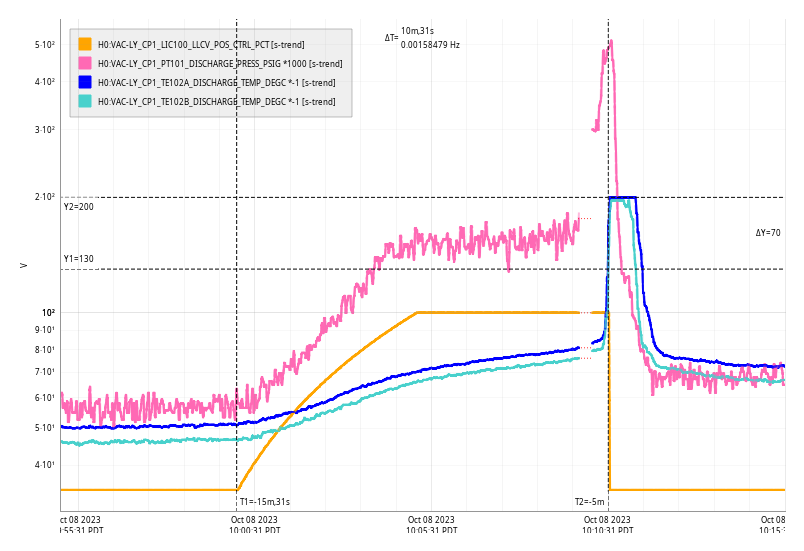
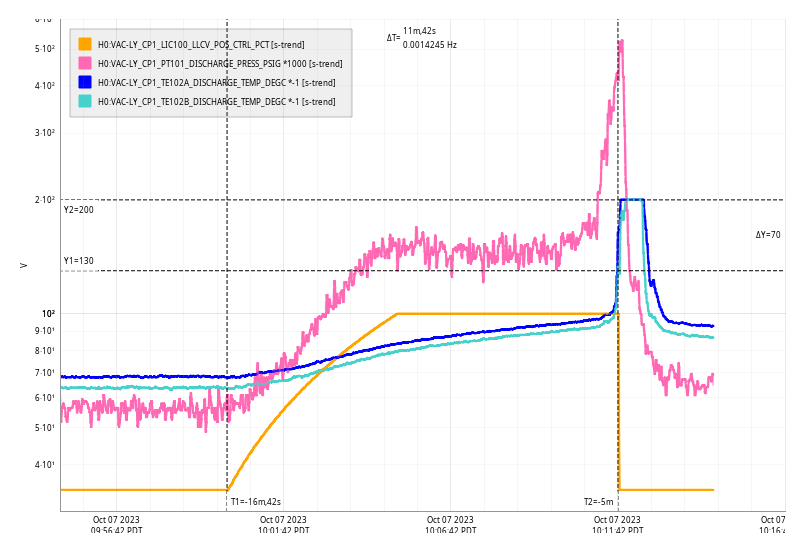
Tue Jul 18 10:06:44 2023 INFO: Fill completed in 6min 40secs
Gerardo confirmed a good fill curbside.
This was the second ramped to 100% over 5 minutes fill, H1 was not locked (Tuesday Maintenance)
J. Kissel
Here's an inventory of the (W)HAM1 feedthrus as they stand on July 18 2023. Comments will show pictures of each feedthru, separated (and labeled) by feedthru.
As we consider
- changing the seismic isolation system in HAM1 from an iLIGO stack with an aLIGO HAM ISI,
- whether we should keep the second LSC REFL detector
- including a jitter attenuation cavity
- more or less suspended optics
for the future of HAM1 at both sites, it's important to get an up-to-date inventory of what feedthrus are available.
Also, a good portion of the WHAM1 integration issues relate to drawing updates (see IIET:5118 Ticket Tree), for which this inventory will help as well.
Here're the pertinent drawings
Systems Layout (as it stands at -v4): D0901821
Flange Layout (as it stands at -v8): D1002872
In-vac Cable Routing (as it stands at -v4): D1300075
One can see some further discussion in T2300221.
Here's pictures of WHAM1-D4
Here's pictures of WHAM1-D5
Here's pictures of WHAM1-D6
Here's pictures of WHAM1-D1
Here's pictures of WHAM1-D2 (which is in-between and beneath HAM1 and HAM2 which butt up against each other, so the pictures kinda stink. Sorry! But, it looks like there's quite litte on this feedthru anyways).
Here's pictures of WHAM1-D3
Here's pictures of WHAM1 "East" (-Y) door
Here's pictures of WHAM1 "South" (-X) door
Here's pictures of WHAM1 "West" (+Y) door (with a lot of bellows going to ISCT1.)
Thanks Jeff for those pictures. I added a link to this alog from the WHAM1 flange layout: https://dcc.ligo.org/D1002872-v8 for reference.
If you spot any additional redlines from the posted -v8 'D1002872-v7-redline.pdf', please add them to the DCC.
Here's pictures of the feedthrus on the top WHAM1 The first three pictures (619-621) are viewed on a ladder in front of the "East" (-Y) door, looking toward the +Y direction. The second two pictures (622-623) are viewed on a ladder in front of the the "South" (-X) door, looking toward the +X direction.
TITLE: 07/18 Day Shift: 15:00-23:00 UTC (08:00-16:00 PST), all times posted in UTC
STATE of H1: Preventive Maintenance
CURRENT ENVIRONMENT:
SEI_ENV state: MAINTENANCE
Wind: 5mph Gusts, 3mph 5min avg
Primary useism: 0.01 μm/s
Secondary useism: 0.04 μm/s
QUICK SUMMARY:
Current IFO Status: IDLE for Preventative Maintenance.
Continuing Gabriele's investigation from alog 71406
While damping violin modes in OMC_WHITENING this morning, I ran a DHARD_Y noise injection with a higher amplitude of 1.5 from 12:16 to 12:46 UTC:
/ligo/home/ryan.short/DHARD_Y_olg_shaped_exc_20230718.pngHere's the measurement of the DHARD_Y plant, together with a fit. The peak at 2.6 Hz is not yet well resolved, so we should target it with some additional noise injections.
Z, P, K of the fir in s-domain:
z = [-0.95136101+11.64945547j, -0.95136101-11.64945547j,
-0.36478703 +3.20366341j, -0.36478703 -3.20366341j,
-1.14203036 +0.27714772j, -1.14203036 -0.27714772j]
p = [-0.59076912+17.94263255j, -0.59076912-17.94263255j,
-0.52161196+15.28151683j, -0.52161196-15.28151683j,
-0.18999281 +6.5798622j , -0.18999281 -6.5798622j ,
-0.41593773 +2.9252335j , -0.41593773 -2.9252335j ,
-2.64441872 +0.j , -0.0852773 +0.j ]
k = -129105.8425258189
Sheila, RyanC
We did 3 rounds of setting the H1:OMC-ASC_MASTERGAIN to zero waiting 5 minutes then setting it back to its nominal 0.02.
23:31:39 H1:OMC-ASC_MASTERGAIN = 0
23:36:55 H1:OMC-ASC_MASTERGAIN = 0.02
We noticed that ADS turned off during this test, specifically H1:ASC-ADS_PIT4_OSC_CLKGAIN = 0 at 23:37:11 UTC
23:41:53 H1:OMC-ASC_MASTERGAIN = 0
23:47:09 H1:OMC-ASC_MASTERGAIN = 0.02
23:52:23 H1:OMC-ASC_MASTERGAIN = 0
23:58:01 H1:OMC-ASC_MASTERGAIN = 0.02
Here is a scope showing some OMC ASC signals during this test.
The bottom left 4 plots show the output of the OMC ASC loops, so you can use these to judge when the OMC ASC was off. The third column bottom 4 plots show witness sensors for OMC and OM3 motion, they move a lot less when the ASC is off. Please ignore the plots of the error signals (4th row, POS and ANG INMONs), these are after the MASTERGAIN so they were zero when Ryan turned off the ASC. The top row right two plots show the QPD signals that are used as error signals, no clear change in their rms with the ASC on or off, but tomorow we should plot their spectra.
Here's a comparison of several channels with the OMC ASC on and off. Conclusions: the OMC shakes a lot more when the OMC ASC is on, but this has no effect on DHARD or DARM at low frequency (below a few Hz).
So the OMC ASC loops are not responsible for the 2.6 Hz peak
There's also no evidence at this point that the OMC moving more is having an effect on DARM noise.
I attach here the omicron transients during this test from 2023-07-17 23:31:39 to 2023-7-18 00:03:01. The first figure is the time-frequency plot and second figure shows the rate of these transients per 300 seconds.
We do not see any noticeable change during this on/off test in the rate of these transients.
P.S. Thanks to Joe Areeda for running Omicron on this data.
Daniel, Sheila
We turned off the 9 Mhz, 45 MHz, and 117 MHz sidebands in order to do an OMC loss measurement. We used a single bounce beam off of ITMX, with 10W input from the PSL. We spent some time trying to improve the alignment before making OMC scans.
locked: 1370711576 (OMC REFL avg 3.51mW, OMC DCPD sum 15.23mA)
unlocked: 1370711782 (OMC REFL avg 24.73 mW, OMC DCPD sum 0.078 mA)
OMC scan start: 1370712036 duration 100 seconds (2nd order modes are roughly 8% of the 00 mode).
shutter blocked: 1370712337 (OMC REFL avg -0.030 DCPD SUM 8e-4 mA).
Jennie Wright plans to analyze this data to estimate OMC losses.
Here are the plots of ASC-AS_C_NSUM, OMC-QPD_A_NSUM, OMC-QPD_B_NSUM and OMC-REFL_A_LF, during these measurements. ASC-AS_C_NSUM shows between 22.8 and 32.1mW, OMC-QPD_A_NSUM 23.4mW, OMC-QPD_B_NSUM 23.0mW, and OMC-REFL_A_LF 24.8mW. According to Keita OMC-REFL_A_DC has an incorrect calibration and shows 25.2mW. The average of the 2 QPDs would be 23.2mW, which is about 6.5% lower than 24.8mW.
Second screen shots shows a time when the IMC was unlocked. The DC offsets are in the 10s of uW at most.
Using data from the scan I adapted labutils/OMCscan class to plot the fitted scan and adapted labutils/fit_two_peaks.py to fit a sum of two lorentzians functions for distinguishing carrier 20/02 modes.
The first graph is the OMC scan plot, the second is the curvefit for the second order carrier modes.
We expect the HOM spacing to be 0.588 MHz as per this entry and DCC T1500060 Table 25.
The spacing for the modes measured is 0.592 MHz.
From the heights of the two peaks this suggests mode-mismatch of the OMC to be C02+C20/C00 = (0.83+1.158)/(15.32+0.83+1.158) = 11.0% mode mis-match.
From the locked/unlocked powers on the OMC REFL PD the visibility on resonance is 1-(3.51+0.03/24.73+0.03) = 85.7% visibility.
If the total loss is 14.3%, this implies that the other non mode-matching losses are roughly 1.3%.
To run the OMC scan code go to
/ligo/gitcommon/labutils/omc_scan/ and run
python OMCscan_nosidebands.py 1370712036 100 "Sidebands off, 10W input" "single bounce" --verbose --make_plot -o 2
in the labutils conda environment and on git branch dev.
To do the double peak fitting run:
python fit_two_peaks_no_sidebands.py
in the labutils conda environment and on git branch dev.
These scans were done with OM2 cold.
For comparison with new OMC measurements I used Sheila's code to process the visibility, but updated dit to use nds2utils instead of gwpy as I was having trouble using it to get data.
The code is attached and should be run in the nds2utils conda environment on the CDS workstations.
Power on refl diode when cavity is off resonance: 24.757 mW
Incident power on OMC breadboard (before QPD pickoff): 25.239 mW
Power on refl diode on resonance: 3.525 mW
Measured effiency (DCPD current/responsivity if QE=1)/ incident power on OMC breadboard: 70.4 %
assumed QE: 100 %
power in transmission (for this QE) 17.760 mW
HOM content infered: 13.472 %
Cavity transmission infered: 82.111 %
predicted efficiency () (R_inputBS * mode_matching * cavity_transmission * QE): 70.367 %
omc efficency for 00 mode (including pick off BS, cavity transmission, and QE): 81.323 %
round trip loss: 1605 (ppm)
Finesse: 371.769