Displaying reports 17521-17540 of 86768.Go to page Start 873 874 875 876 877 878 879 880 881 End
Reports until 12:01, Saturday 15 July 2023
H1 General
camilla.compton@LIGO.ORG - posted 12:01, Saturday 15 July 2023 (71352)
OPS Day Mid-shift Summary

STATE of H1: Observing at 134Mpc. IFO has been locked for 18h24

LHO VE
david.barker@LIGO.ORG - posted 10:11, Saturday 15 July 2023 (71351)
Sat CP1 Fill

Sat Jul 15 10:05:35 2023 INFO: Fill completed in 5min 35secs

Images attached to this report
LHO General
corey.gray@LIGO.ORG - posted 08:09, Saturday 15 July 2023 (71346)
Sat OWL Ops Summary

TITLE: 07/15 Owl Shift: 07:00-15:00 UTC (00:00-08:00 PST), all times posted in UTC
STATE of H1: Observing at 132Mpc
SHIFT SUMMARY:

H1 & L1 were up the entire shift (so I did not get a chance to run the quick broadband calibration measurement---a good problem to have with such well-behaved instruments!).   Passed this info on to Camilla in case she gets a chance to run the short measurement (i.e. "pydarm measure --run-headless bb"

Oh, and it's almost 80degF outside!!!!
LOG:

H1 General
camilla.compton@LIGO.ORG - posted 08:03, Saturday 15 July 2023 - last comment - 08:26, Saturday 15 July 2023(71348)
OPS Day Shift Start

TITLE: 07/15 Day Shift: 15:00-23:00 UTC (08:00-16:00 PST), all times posted in UTC
STATE of H1: Observing at 133Mpc
CURRENT ENVIRONMENT:
    SEI_ENV state: CALM
    Wind: 3mph Gusts, 3mph 5min avg
    Primary useism: 0.01 μm/s
    Secondary useism: 0.04 μm/s
QUICK SUMMARY: Locked in NLN for 14h22. Range been between 132-136MPc over the last hour.

Corey notes if LLO goes down we should run the pydarm measure --run-headless bb command following the Taking Calibration Measurements Wiki

Comments related to this report
camilla.compton@LIGO.ORG - 08:26, Saturday 15 July 2023 (71349)CDS

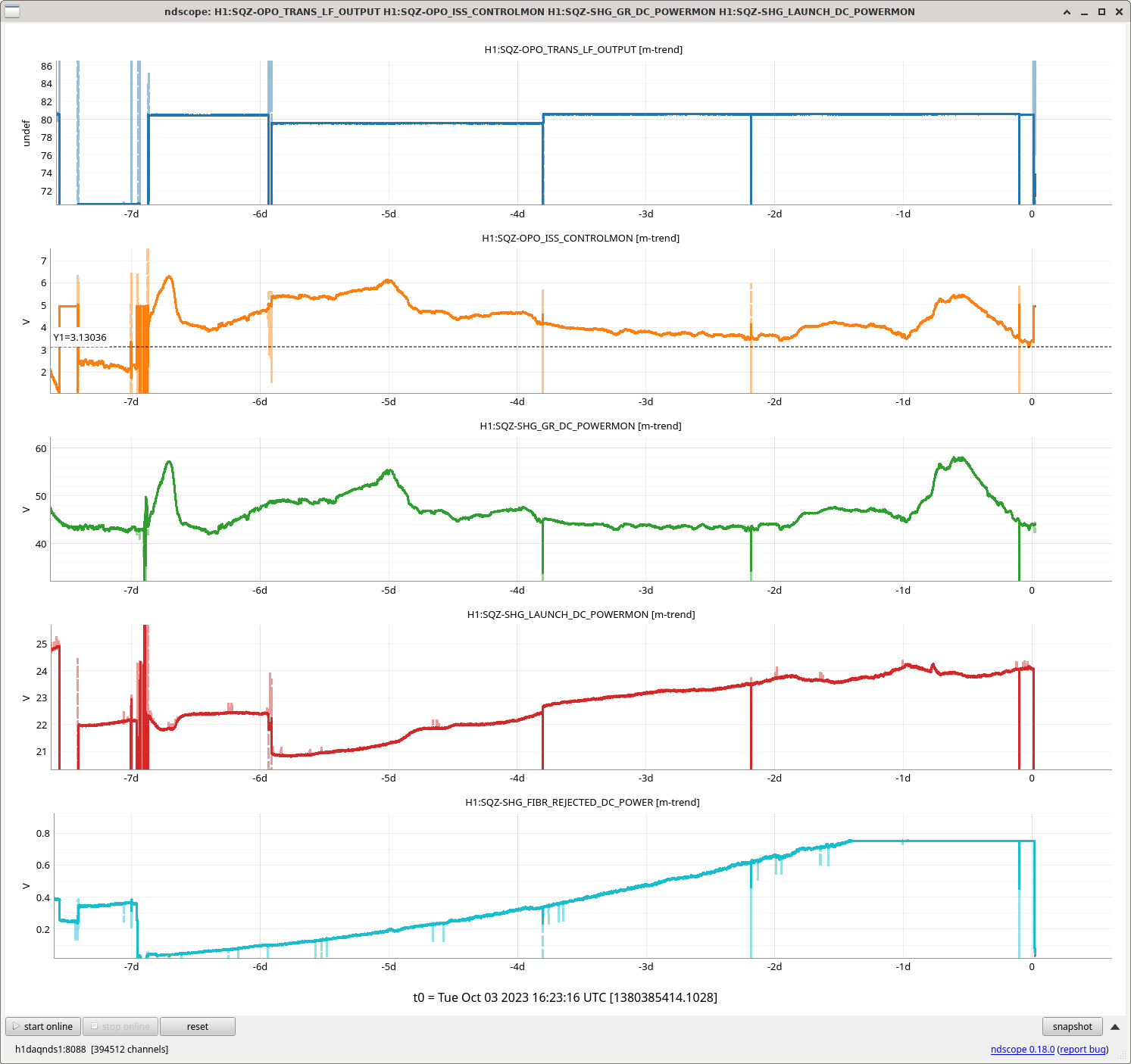
I restarted the frozen out-building wind channels following 66769 (also noted in the wiki),Tagging CDS. SEI, SUS, VAC, CDS , dust monitors okay. Known issue that PSL ISS diffracted power is low, attached plot.

Images attached to this comment
LHO General
corey.gray@LIGO.ORG - posted 04:01, Saturday 15 July 2023 (71347)
Owl Mid-Shift Update

Smooth sailing for H1 (& L1) with summer twilight skies & outside temp of 71degF.  Just had a huge glitch a couple minutes ago, but no biggie.  

LHO General
corey.gray@LIGO.ORG - posted 00:08, Saturday 15 July 2023 (71345)
Sat OWL Ops Transition Status

TITLE: 07/15 Owl Shift: 07:00-15:00 UTC (00:00-08:00 PST), all times posted in UTC
STATE of H1: Observing at 134Mpc
CURRENT ENVIRONMENT:
    SEI_ENV state: CALM
    Wind: 6mph Gusts, 4mph 5min avg
    Primary useism: 0.01 μm/s
    Secondary useism: 0.04 μm/s
QUICK SUMMARY:

Receiving a nicely locked (6.5+hrs) H1 from RC.  Received notice of possible calib meas I can run (if L1 drops), and notice of alsx pll autolocker toggle needed for Camilla's last lock.  Balmy 78degF out.

H1 General
ryan.crouch@LIGO.ORG - posted 00:00, Saturday 15 July 2023 (71341)
OPS Friday eve shift summary

TITLE: 07/14 Eve Shift: 23:00-07:00 UTC (16:00-00:00 PST), all times posted in UTC
STATE of H1: Observing at 132Mpc
SHIFT SUMMARY:

DIAG_MAIN flashes the messages PSL ISS difracted power is low every few minutes, this is known and will be fixed soon by Jason

Back into NLN at 0:34UTC in Observing at 00:44UTC, LLO was relocking around the time so Robert went out to do some PEM scatter work in the LVEA while we waited for them to get back and we damped violins.

GRB_Short E417374 01:44 UTC

LOG:                                                                                                                          

Start Time System Name Location Lazer_Haz Task Time End
 
00:16 PEM Robert LVEA N Look for scattering 00:42
H1 General
ryan.crouch@LIGO.ORG - posted 21:58, Friday 14 July 2023 (71344)
OPS Friday Eve shift midshift update

STATE of H1: Observing at 132Mpc

Back into NLN at 0:34UTC in Observing at 00:44UTC. Everything has been stable and calm. (Forgot to click post)

LHO FMCS (PEM)
ryan.crouch@LIGO.ORG - posted 18:16, Friday 14 July 2023 (71343)
HVAC Fan Vibrometers (FAMIS 25590)

Closes FAMIS 25590

CS:

Fan5_170_2 is a little noisy and Fan_5_170_1 is the highest in the CS at just under 0.4

OUT:

EY_Fan1_470_1 looks like something happened to it yesterday, it has dropped a bit since but is still the highest for the OUTs at around 0.3. MY_FAN2_270_1 is quite noisy.

Images attached to this report
H1 ISC
jenne.driggers@LIGO.ORG - posted 17:45, Friday 14 July 2023 - last comment - 08:52, Monday 17 July 2023(71332)
Alignment tests

[Jenne, Naoki, Brina, Caden, Robert, Lance, Camilla]

Since alignment changes were so impactful yesterday (alog 71302) and we still have higher noise than when OM2 was hot last week, and also higher noise than our April 60W times with cold OM2 (eg, Elenna's alog 71284 yesterday), we tried some alignment shifts today with some PEM vibration injections going, to see if we could find a better alignment.  For now, we've left the IFO with the same settings it had last night since there's nothing that's significantly better.  Nothing we've found comes close to matching the broadband (good) noise level of the April 60W time, or the last week hot OM2 times.

The first attachment shows a big-picture of the moves we made today. 

Daniel points out that the time with OM2 hot may have been some of our best-ever sensitivity around 70 Hz.  It would be helpful to have a plot like alog 71309, but including Elenna's time from April 6th, to see if pre-O4 we ever had as good of sensitivity around 70 Hz. 

It's also a little tricky to compare our HWS data using our plotter to what Elenna and Cao posted yesterday.  It would be helpful to either have the times from Cao's plot, or have Cao plot where it looks like our ITMX spot was at 21:50 UTC today. 

Images attached to this report
Comments related to this report
camilla.compton@LIGO.ORG - 15:16, Sunday 16 July 2023 (71385)TCS
70Hz sensitivity in April
Couldn't get data from April for H1:GDS-CALIB_STRAIN or _NOLINES so remade the alog 71309 plot Jenne points to with H1:CAL-DELTAL_EXTERNAL_DQ including April 5th 60W time, see attached.
April 70Hz sensitivity looks as good as hot OM2 sensitivity. Hot OM2 was maybe better around 100-200Hz but worse at 20Hz.
 
HWS images at 21:50UTC
The HWS sensitivity isn't good enough to see where the spot is at a specific time. To make the alog 71284 plots, Cao would have looked at times just after the power up when the optic and point absorber is heating up quickly (21:50 is 4h40m after powerup). I think we would want to power up with the spot location to see if it has moved and illuminates the point absorber differently.
I have attached the HWS comparing just after power up 17:10UTC to 21:50UTC but the point absorber isn't visible after this much thermalization time and I'm not sure this is a valid method of beam spot locating.
It might be possible to compare before the spot moves (20:20UTC) to 21:50UTC. see attached, but I couldn't get HWS images of anything.
In an unrelated and different test 66171, Mitchell and I found we couldn't resolve a 7.5mm A2L gain change by dithering the HWS.
Images attached to this comment
daniel.sigg@LIGO.ORG - 08:52, Monday 17 July 2023 (71398)

Looks to me the big difference is in the frequency region from 50 to 100Hz. The excess noise in this band has been rather stubern since O3 and its origin is unknown.

H1 SUS (ISC, SUS)
oli.patane@LIGO.ORG - posted 17:30, Friday 14 July 2023 (71342)
Rung up violins not related to H1:LSC-IFO_TRIG_INMON lower threshold

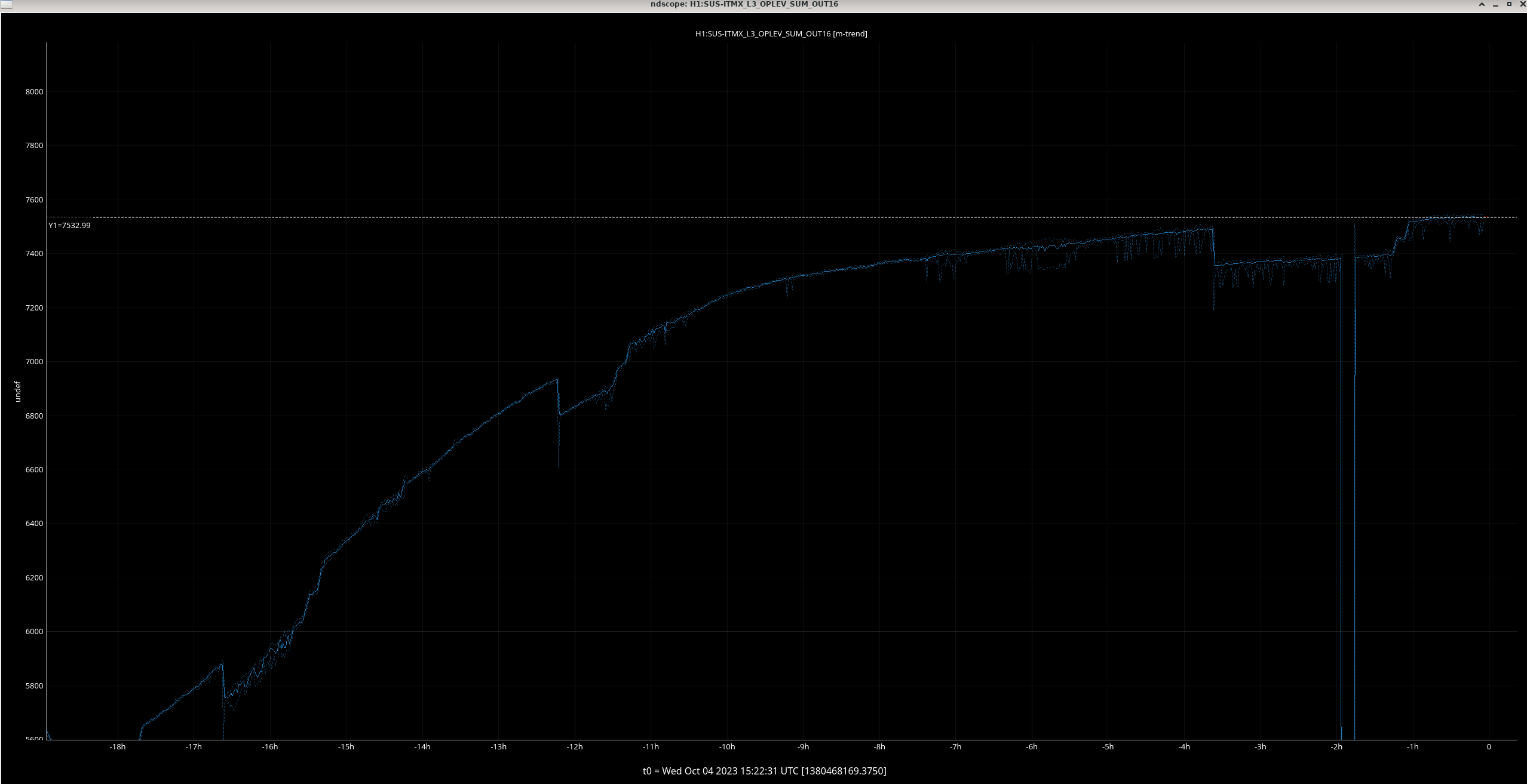
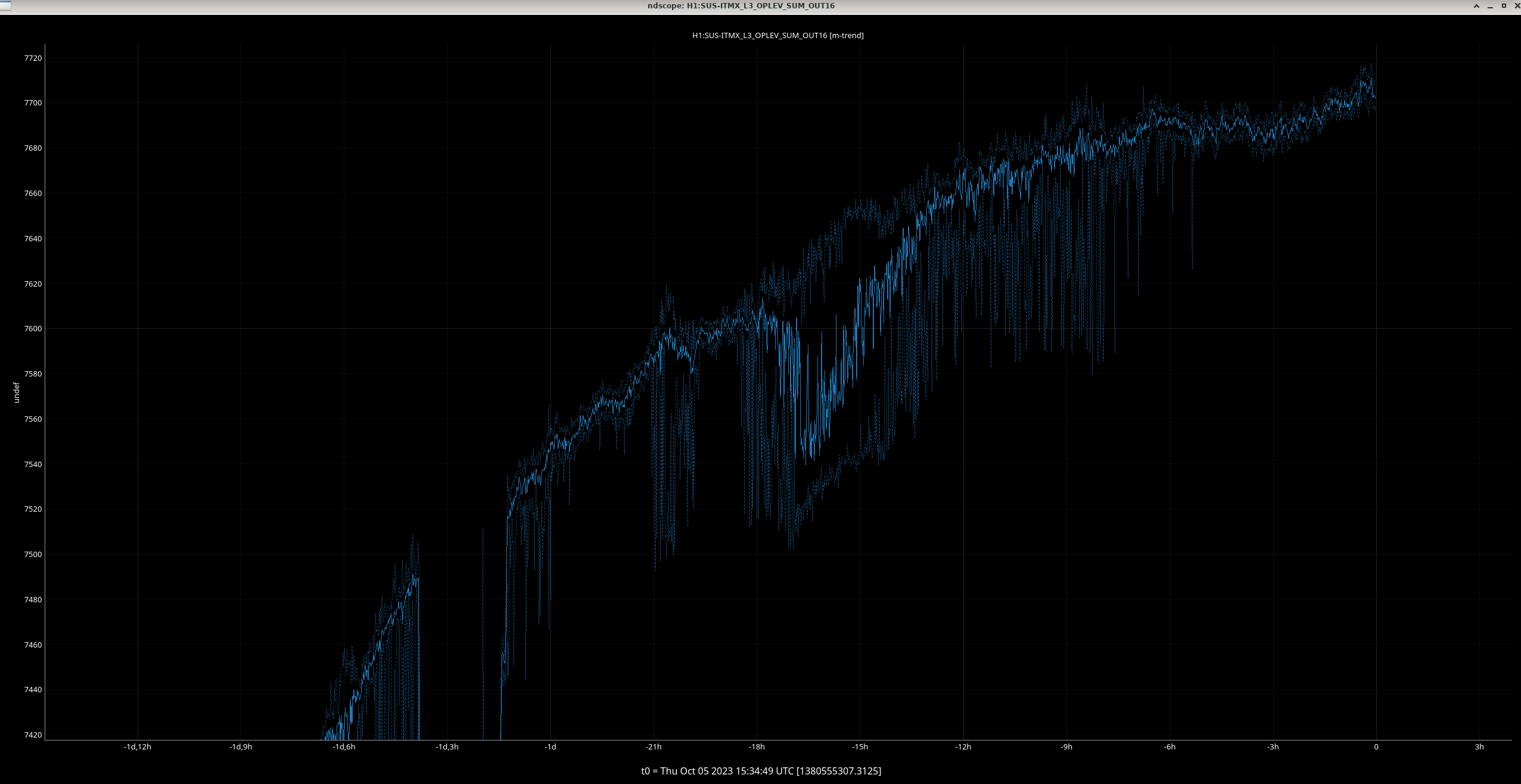
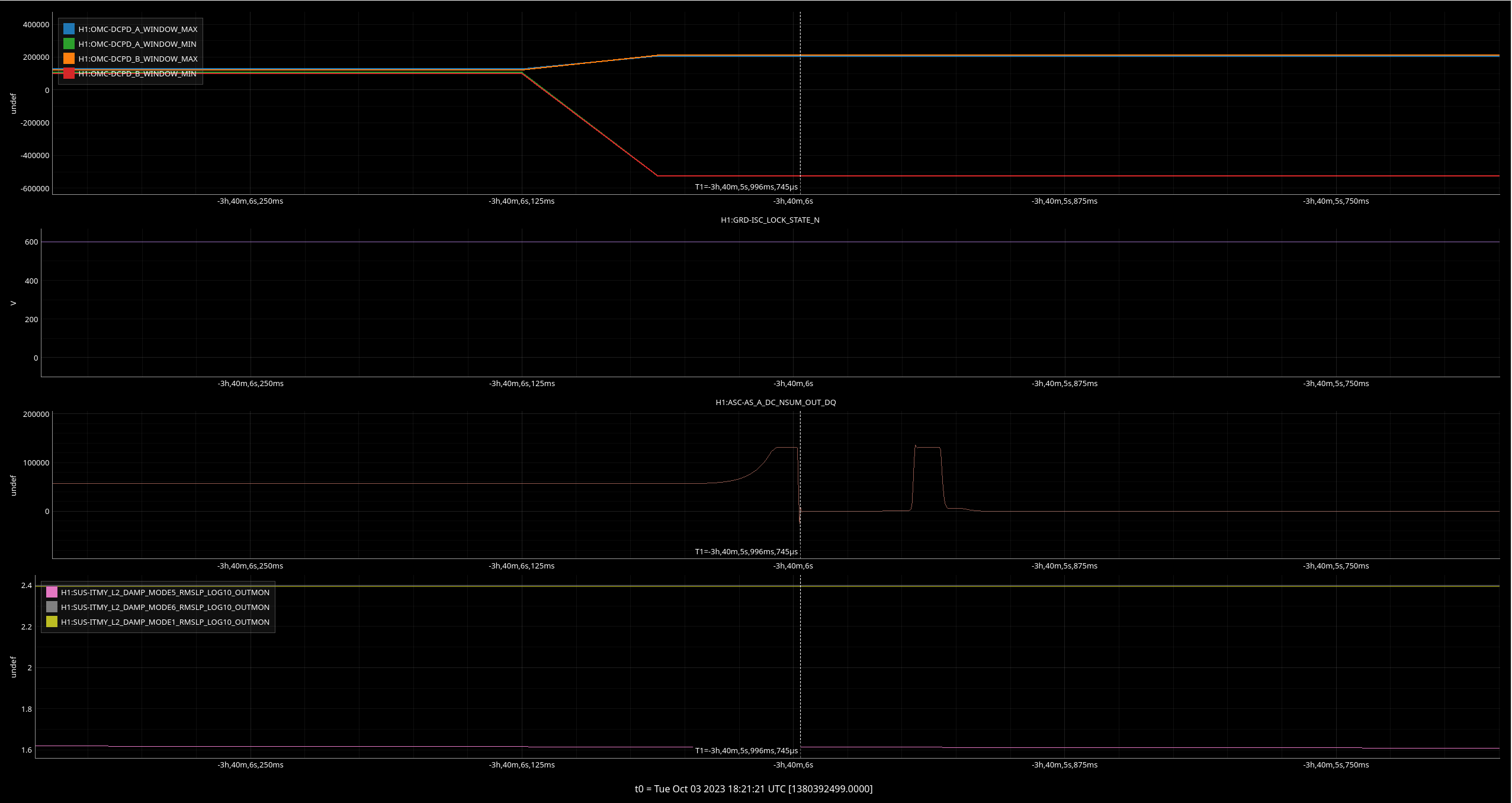
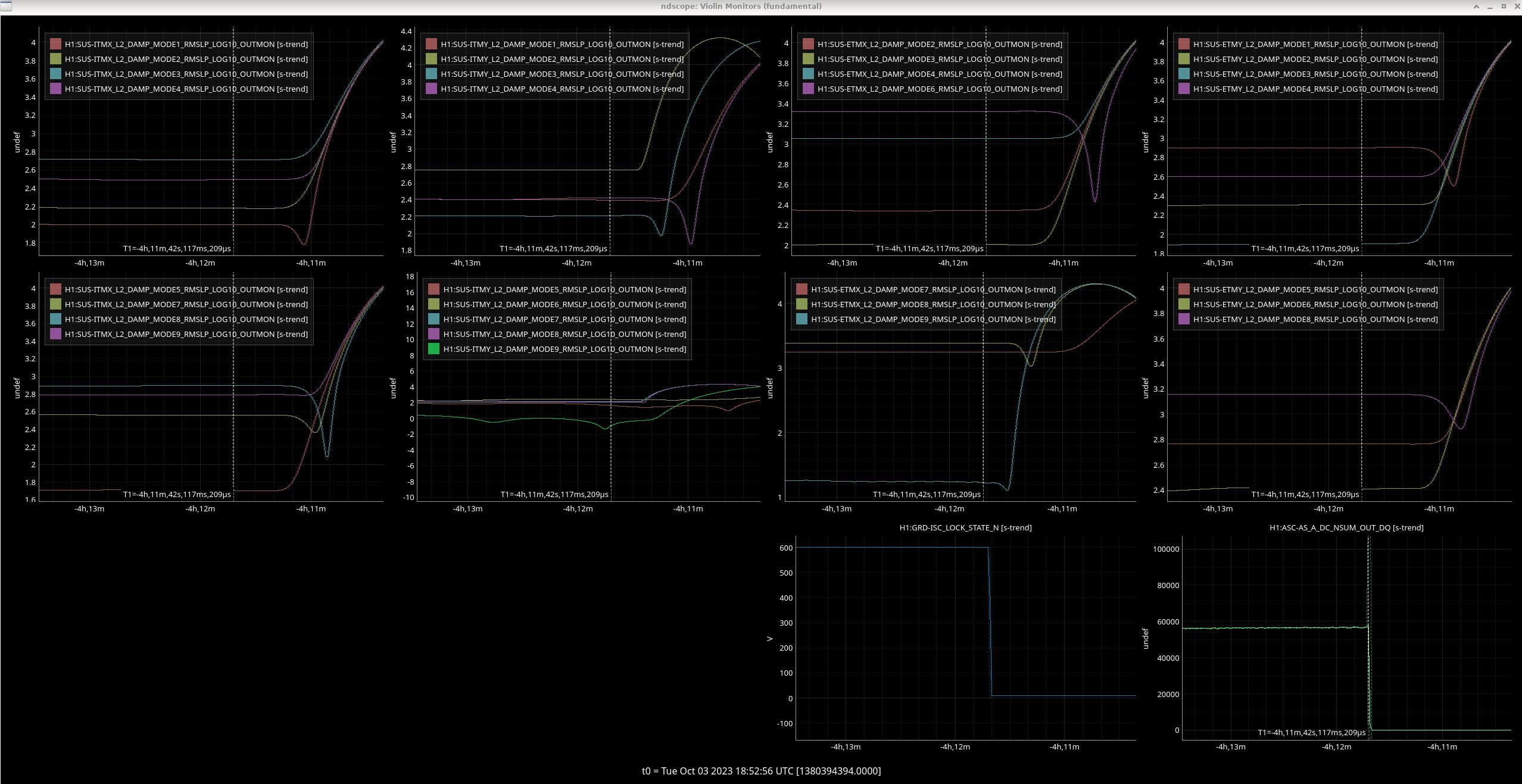
We wanted to check if the value of the H1:LSC-IFO_TRIG_INMON lower threshold was possibly too low. If once the detector lost lock the IFO_TRIG_INMON channel took too long to reach its minimum trigger value (325), the violin damping gains would stay on too long and could be the cause of the violins ringing up so high, which started happening after the June 27 maintainance (71063).

(Uploads 1+2) I took the channel H1:ASC-AS_A_DC_NSUM_OUT16 to pinpoint when the detector lost lock, and plotted it alongside H1:LSC-IFO_TRIG_INMON. When the H1:LSC-IFO_TRIG_INMON channel value drops below 325, the damping for L2 and L3 should turn off. Comparing a lock loss before June 27 to after, both of which were from long lock stretches, it looks like for both times (and for the other lock losses I looked at), the time between the lock loss occuring and the damping turning off was about the same, between 1-1.5 seconds.

(Upload 3) There is also a clear difference pre- and post- June 27th in the amount of gain used to damp the violins.

Images attached to this report
H1 General
ryan.crouch@LIGO.ORG - posted 16:06, Friday 14 July 2023 (71338)
OPS Friday eve shift start

TITLE: 07/14 Eve Shift: 23:00-07:00 UTC (16:00-00:00 PST), all times posted in UTC
STATE of H1: Lock Acquisition
CURRENT ENVIRONMENT:
    SEI_ENV state: CALM
    Wind: 13mph Gusts, 9mph 5min avg
    Primary useism: 0.02 μm/s
    Secondary useism: 0.05 μm/s
QUICK SUMMARY:

H1 General
oli.patane@LIGO.ORG - posted 16:03, Friday 14 July 2023 (71337)
Ops DAY Shift End

TITLE: 07/14 Day Shift: 15:00-23:00 UTC (08:00-16:00 PST), all times posted in UTC
STATE of H1: Commissioning
SHIFT SUMMARY:

15:06 Took over from Corey, detector Locked and in Observing for 1:50

16:16 Moved out of Observing to change ACS channel value

16:18 Lost lock (71324)

18:27 Back into Observing (stuck damping violins in OMC_WHITENING for 1 hour 8 mins)

20:01 Moved out of Observing for Commissioning (71331)

22:29 Lost lock during commssioning due to possible local earthquake (71336) - commissioning ended early due to lockloss


LOG:                                                                                                                                                                                                                                                                                                                                                                                                                                                                                                                                                                                                         

Start Time System Name Location Lazer_Haz Task Time End
15:03 FAC Karen Optics and PCAL Lab N Technical Cleaning 15:25
17:22 VAC Travis, Janos Vac Prep Lab n VAC 17:49
17:53 - Randy MY n Inventory 19:23
20:09 COMM Jenne, Naoki, Brina, Caden CR N Alignment changes 22:09
20:26 PEM Robert LVEA n Turning amp on (acoustic injections) off 22:35 21:56
20:32 CDS Dave, Erik Remote N Restar cw code to stop memory leak 20:32
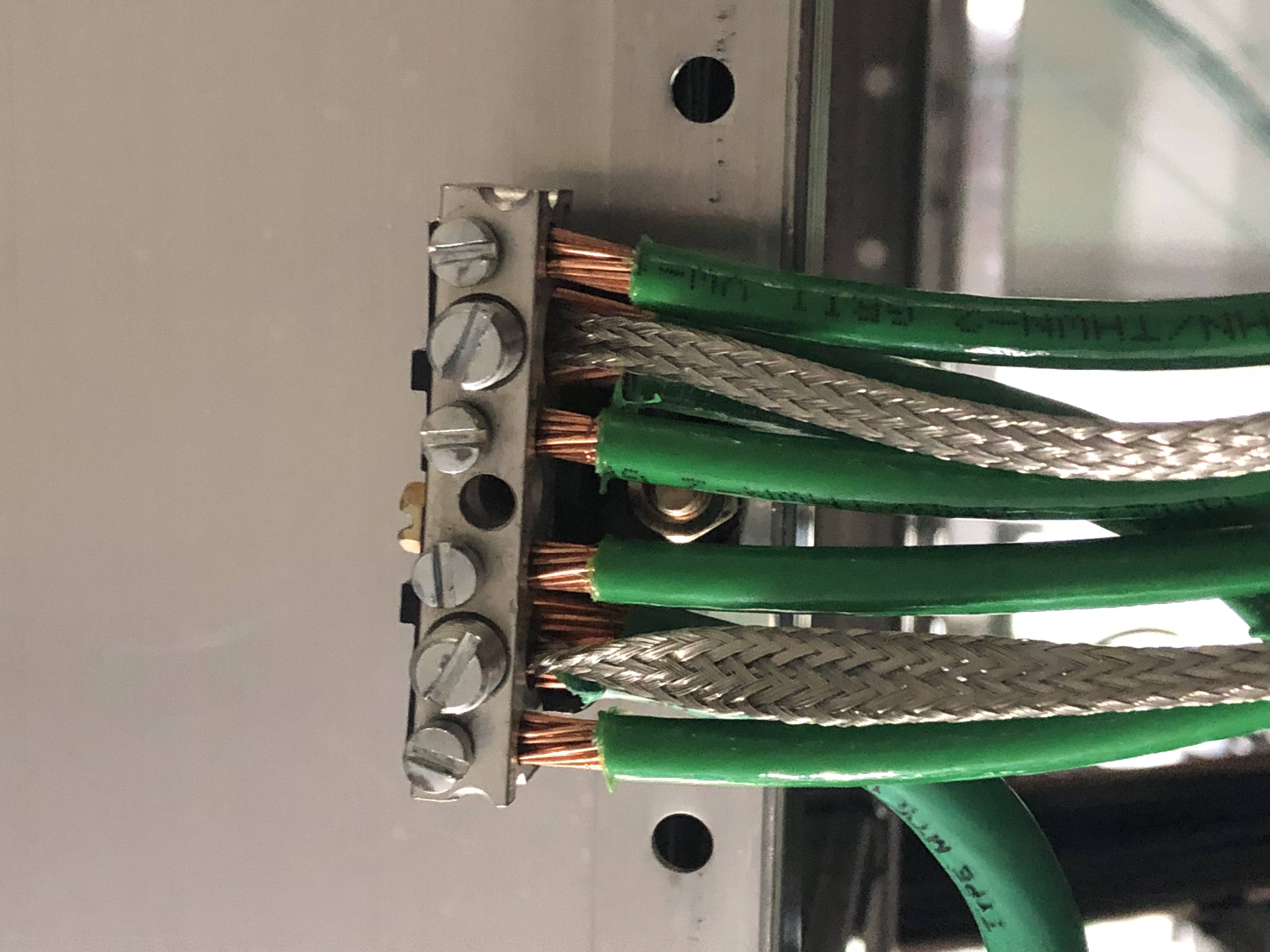
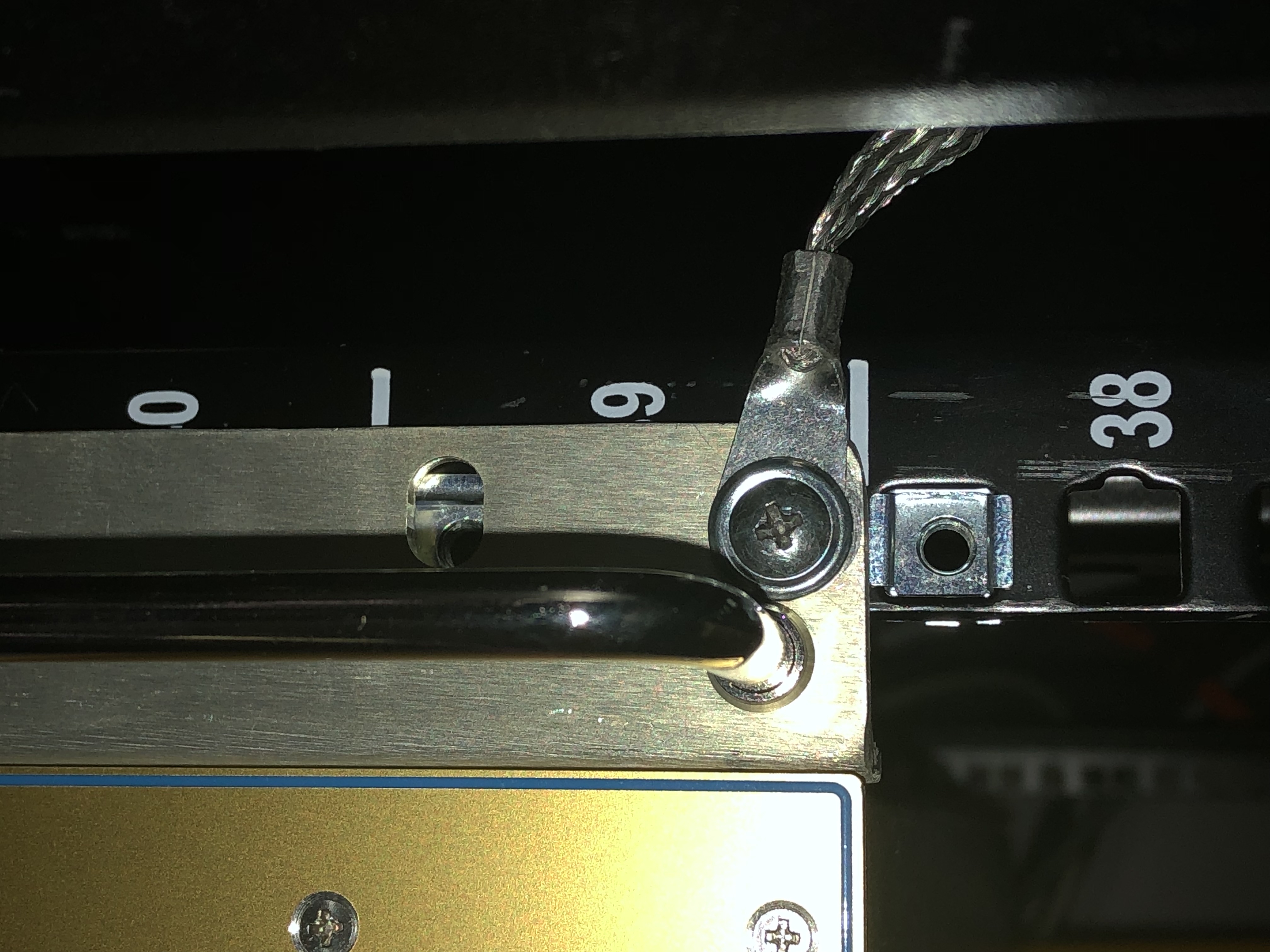
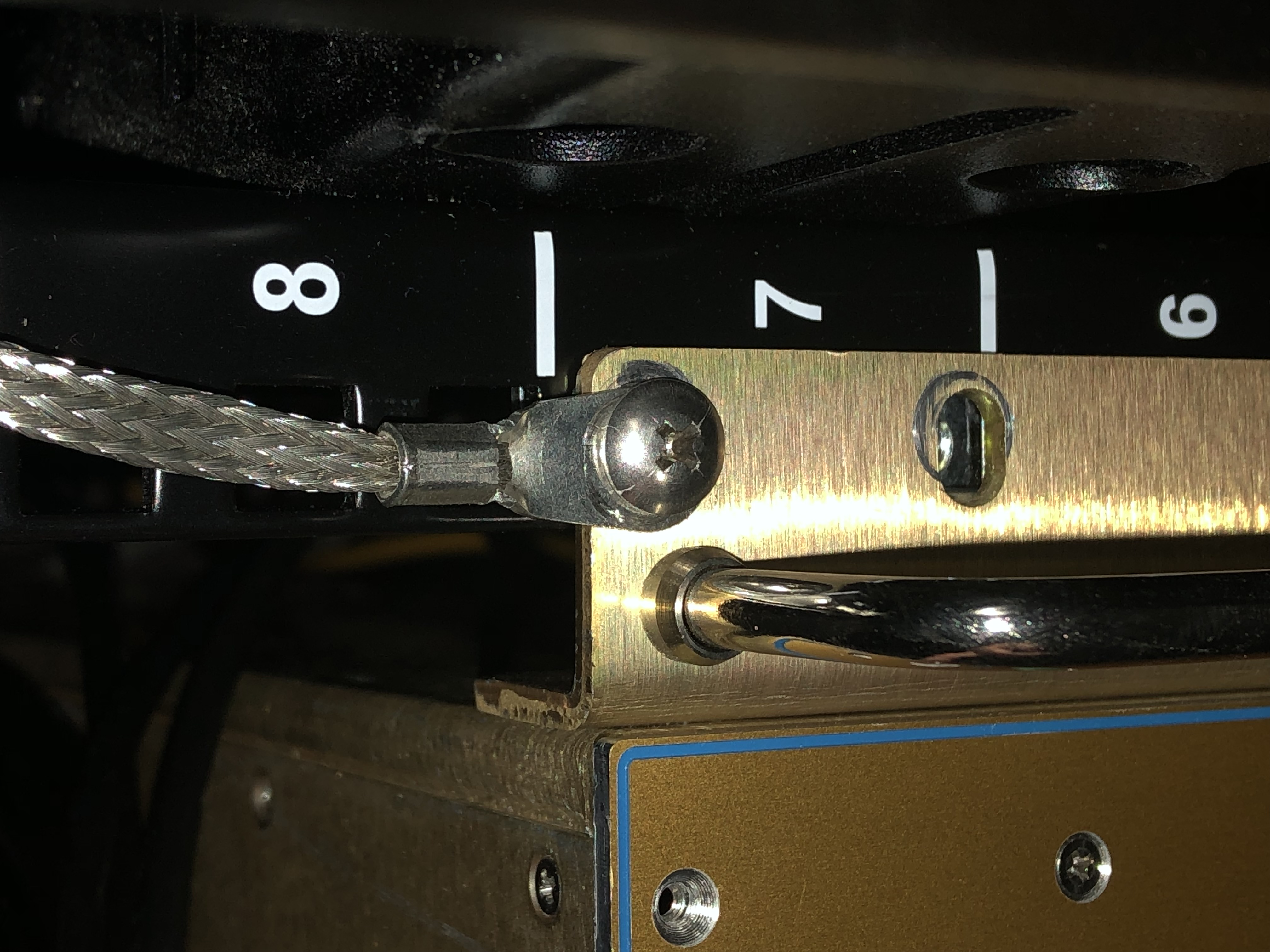
21:10 LVEA Jeff HAM6 n Photos of rack 21:17
22:34 PEM Robert LVEA N Turn off amp and LVEA sweep 23:34
22:45 CDS Richard LVEA n Taking photos 23:15
H1 General (Lockloss, SEI)
oli.patane@LIGO.ORG - posted 15:43, Friday 14 July 2023 (71336)
Lockloss

Lockloss at 22:29: Lockloss tool

Most likely due to local earthquake but PeakMon (attached) didn't get above 800.

Occurred during Commissioning while PEM acoustic injections were happening.


Images attached to this report
H1 CDS
david.barker@LIGO.ORG - posted 15:06, Friday 14 July 2023 - last comment - 10:08, Saturday 15 July 2023(71335)
Restart of psinject on h1hwinj1 at 13:21 PDT, memory leak fixed

WP11290 Revert LALAPPS to fix memory leak

Erik, Dave:

At 13:21 PDT Erik restarted the psinject CW process on h1hwinj1 after downgrading the libSIStr,so library file. This has fixed the memory leak h1hwinj1 has had since its upgrade when tconvert was replaced by gpstime.

Between 13:21 and 14:48 there has been no additional memory allocated, before memory was used at a rate of 3.5MB/min.

We will run with this over the weekend and if it all looks good I will revert the h1calinj SDF change make to permit INJ_CW GAIN and TRAMP changes while in observation (WP11304)

6 hour trent of INJ_CW with restart shown in attachment.

Images attached to this report
Comments related to this report
david.barker@LIGO.ORG - 10:08, Saturday 15 July 2023 (71350)

Memory usage unchanged overnight, looks like leak has definitely been fixed.

H1 General
camilla.compton@LIGO.ORG - posted 13:04, Friday 14 July 2023 - last comment - 16:02, Friday 14 July 2023(71331)
H1 into Commissioning for next 3 hours

Have scheduled commissioning work this afternoon from 20:00UTC to 23:00UTC. Mainly PEM and alignment work.

Comments related to this report
camilla.compton@LIGO.ORG - 16:02, Friday 14 July 2023 (71339)

Commissioning was cut short due to a 22:29UTC lockloss from a seismic event  71336

H1 ISC (ISC, TCS)
elenna.capote@LIGO.ORG - posted 22:00, Thursday 13 July 2023 - last comment - 14:47, Friday 14 July 2023(71284)
Current 60W thermal/mode matching state different from April 60W

Dan Brown, Cao, Kevin K., Elenna

I made a plot comparing the high frequency DARM spectrum around 10 kHz comparing our current 60W configuration to the configuration we had the last time we were at 60W, specifically April 6. These plots were both made well into each lock, so the thermal transients had settled. I believe they are an apples-to-apples comparison of the high frequency region for these two locks and IFO configurations. Three features stand out as different between the two spectra: the 2nd order HOM peaks are not in the same location, they are not the same height, and the overall DARM spectrum is lower in the blue trace (April), than the red trace (now). This indicates that the arm modes are not as well matched now as they were in April, and the frequency noise noise now is higher by a factor of 1.7 than it was in April.

If nothing else had changed in the IFO, we should have been able to successfully revert to the blue trace by powering down and reverting all other settings.

I think the reason we haven't been able to revert to the previous 60W state is related to the mysterious changes that occurred on and after May 19 when the HVAC caused many issues. Whatever changed in May caused us to ring up a PI, increased the jitter noise, and changed our mode matching. My hypothesis is that the alignment shifted in some way. Unfortunately none of the suspension, oplev or ISC signals indicate an alignment shift.

I asked Cao to take a look at the ITMX hartmann wavefront sensor. Cao made the following two plots: one showing the center of the beam position in x (yaw) and y (pitch), and the other showing a heat map of ITMX. The two times they compare are the two locks I compare in my DARM plot: the blue "old" trace from April 6, 60W, and the orange "new" trace showing now at 60W. The beam position has changed, and the heat map shows that we are heating the ITMX point absorber more than we did previously.

If the spot has moved closer to a point absorber, this would explain our increase in jitter. If the spots on the test masses are shifting, this could also affect PIs like the 80 kHz that may be spot dependent. A spot position change could also aggravate the point absorber to where the radius of curvature and substrate lensing would change enough that our mode matching solution via the ring heaters would no longer be sufficient. We only have evidence that the spot has changed on ITMX, but there is a chance that it could have changed on the ETMs as well, where we know the 80 kHz acoustic mode is located. Unfortunately, we don't seem to have any good signals that could track this on the ETMs, so we are flying blind.

Overall, one of our goals (especially in powering down) is to get the IFO mode matched well enough that we can reduce frequency noise and be able to achieve a good level of squeezing. I think we should consider moving the spots on the test masses, especially ITMX. Those who remember, you might be thinking "we already tried this and saw no effect!" However, we have a different IFO now, and I think it is worthwhile to try moving further away from our point absorbers.

Images attached to this report
Comments related to this report
victoriaa.xu@LIGO.ORG - 12:21, Friday 14 July 2023 (71329)SQZ

From 70263, see screenshot comparing DCPD spectra at the 4.5dB sqz times from 3/29 -- H1 was more shot-noise-limited in that configuration, aka technical noise was lower, so squeezing quantum noise was more effective at reducing total noise. At e.g. 10 kHz around 2xHOM spacing, ignoring the 3dB difference b/c we are at 40mA vs. 20mA then, and comparing noise levels at 10.1 kHz near 2xHOM,
   ~ 2e-8, on 3/29 for 4.5dB sqz (20mA on dcpd's);
   ~ 6e-8, from elenna's plot on 4/6, assuming the channel is also H1:OMC-PI_DCPD_64KHZ_AHF_DQ, and still 20mA on dcpd's;
   ~ 8.5e-8, today 7/14 from CR screenshots (I think still 40mA vs. 20mA on dcpds; so over 4x as high as the best squeezing time at 60W, but only ~2x higher is kinda expected)

Since the HVAC changes, at least the disaggrated temperature trends at EX VEA do see an overall change, see individual sensor temp trends at EX from 70518; I looked into it then to see if anything has changed for the 80.3kHz ETMX PI that started ringing up. While the "average VEA" trends show almost no total change over the last few months, the individual sensors have seen considerable changes between March/April and now.

camilla.compton@LIGO.ORG - 14:47, Friday 14 July 2023 (71334)

Nice plots Elenna. I was concerned that we did a lot of CO2 changes 6th April but get the same result remaking Elenna's plot using April 5th data. The HWS beam can move if SR3 moves (HWS beams reflected off SR3) but SR3 has the same position between the 2 times to < 2urad. All TCS settings and ITMX A2L the same in both times. See attached plots comparing 04/05 and 07/13.

Images attached to this comment
H1 ISC
keita.kawabe@LIGO.ORG - posted 17:49, Friday 07 July 2023 - last comment - 15:13, Monday 21 April 2025(71145)
Constraining single bounce beam mismatching parameters using single bounce OMC scans

Mode matching of the single bounce beam to the OMC is really bad and we don't know why. We don't even know the beam shape of the single bounce beam hitting the OMC. I constrained the beam shape by looking at the OMC scan data.

There are many OMC single bounce scans but the most recent two w/o RF SBs, one with cold and the other with hot OM2, were carefully analyzed by Jennie to resolve 02 and 20 mode as separate peaks (alogs 70502 and 71100), so I used them here.

If you just want to see the results, look at the third panel of the first attachment.

X-axis is the normalized waist position difference, Y-axis is the normalized waist radius difference. From the measured cold mode matching loss of 11.5%(!!) and hot loss of 6.2%, and the fact that the loss changed by only changing the ROC of OM2, the beam parameters hitting the OMC were constrained to two patches per each OM2 ROC. Yellow is when OM2 is cold, blue is when OM2 is hot. Arrows show how cold (yellow) patches are transformed to hot (blue) patches when OM2 ROC is changed by heating.

Note that we're talking about inconceivably huge mismatching parameters. For example, about -0.3 normalized waist position difference (left yellow patch) means that the waist of the beam is ~43cm upstream of the OMC waist. Likewise, about +0.3 normalized waist radius difference  means that the beam waist radius is 690um when it should be 490um.

We cannot tell (yet) which patch is closer to reality, but in general we can say that:

There are many caveats. The first one is important. Others will have limited impact on the analysis.

Moving forward:

Images attached to this report
Comments related to this report
keita.kawabe@LIGO.ORG - 16:34, Friday 07 July 2023 (71147)

Here's a brief explanation of what was done.

Top left panel of the 1st attachment is the mode matching loss contour plot. loss=0 when [posDiffNormalized, sizeDiffNormalized]=[0.0]. Contours are not circular because the loss is calculated analitically, not by quadratic approximation.

Top right panel of the 1st attachment only shows the region close to the measured losses. Yelllow ring is when OM2 is cold, blue is when hot. Each and every point on these rings represent a unique waist size and waist position combination (relative to the OMC waist).

Since we are supposed to know the OMC-OM2 distance and ROC of the cold and hot OM2, you can choose any point on the yellow (cold) ring, back-propagate the beam to the upstream of OM2 (assuming the cold ROC), "heat" the OM2 by changing the ROC to the hot number, propagate it again to the OMC waist position, and see where the beam lands on the plot. If it's on the blue ring, it's consistent with the measured hot loss. If not, it's inconsistent.

Just for plotting, I chose 9 such points on the cold ring and connected them with their hot landing points on the top right panel. If you for example look at the point at ~[0, 0.4] on the plot ("beam too big but position is perfect when cold"), after heating OM2 the beam becomes smaller but the beam position doesn't change meaningfully, therefore the matching becomes better. In this case the improvement is much better than the measured (i.e the landing point is inside the blue ring), so we can conclude that this ~[0, 0.4] for cold is inconsistent with the measured hot loss.

By doing this for each and every point on the yellow ring we end up with a patch or two that are consistent with reality.

If you cannot visualize what's going on, see the 2nd attachment. Here I'm ploting the beam propagation of "beam too big but position is perfect when cold" case in the top panel. The beam between the OM2 and OMC is directly defined by the initial (cold) parameters. The beam upstream of the OM2 is back-propagation of that beam. On the bottom panel is the propagation diagram of when OM2 becomes hot. The beam upstream of OM2 is the same as the cold case. You propagate that beam to the OMC position using hot ROC. In this case the loss, which was ~12% when cold, was improved to 4.3%, that's inconsistent with the measured hot loss of (1+-0.1)*6.2%.

keita.kawabe@LIGO.ORG - 17:32, Friday 14 July 2023 (71340)

Further summary:

We can probably down-select the patch by 30uD single-path thermal lensing in ITM comp plate relative to the thermal lensing we had in previous scans (alogs 70502 and 71100). Start by a hot OM2. If we see a significant reduction in MM loss after ITM TCS, the actual beam parameters are on the patches in the left half plane.

Details 1:

In the 1st attachment, I took two representative points on the hot patches indicated by little green circles, which define the beam shape at the OMC waist position. I then back propagated the beam to the upstream of ITM (i.e., in this model, optics are correctly placed with correct ROC and things, but the input beam is bad). ITM is at the average ITM position. The  only lensing in the ITM is the nominal diversing lens due to ITM's curvature on the HR.

Then I added the thermal lens, once to the beam impinging the ITM HR and once to the beam reflected, and see what happens to the beam parameter at the OMC waist location. These parameters are represented by tiny crosses. Blue means negative diopters (annular heating) and red means positive (central heating). I changed the thermal lensing by 10uD steps (single-path number).

As you can see, if you start from the left half plane patch, central heating will bring you close to ~(-0.04, 0) with 30uD single-path (or 60uD double-path).

OTOH if you start from the right half plane, ITM heating only makes things worse both ways.

FYI, 2nd plot shows, from the left to the right, good mode matching, hot patch in the left half plane and in the right half plane. The beam size on the ITM is ~5.3cm nominally, 5.1cm if in the left half plane (sounds plausible), 6.8cm in the right (sounds implausible). From this alone, right half plane seems almost impossible, but of course the problem might not be the bad input beam.

Details 2:

Next, I start with (almost) perfectly mode-matched beam and change the optics (either change ROC/lens or move) to see what happens. We already expect from the previous plots that ITM negative thermal lensing will bring us from perfect to the hot patch in the left half plane, but what about other optics?

3rd attachment shows twice the Gouy phase separation between ITM and other optics. Double because we're thinking about mode matching, not misalignment. As is expected, there's really no difference between ITM, SR3 and SR2. OM1 is almost the opposite of ITM (172 deg), so this is the best optic to compensate for the ITM heating, but the sign is opposite. OM2 is about -31 deg, SRM ~36 deg. From this, you can expect that SR3 and SR2 are mostly the same as ITM as actuators.

4th attachment shows a bunch of plots, each representing the change of one DOF of one optic. (One caveat is that I expected that the green circles, which repsent the beam perfectly mode matched to the arm propagated to the OMC waist position, will come very close to (0, 0) with zero MM loss, but in this model it's ~(-0.4, 0.1) with ~1.2% loss. Is this because we need a certain amount of ITM self-heating to perfectly mode match?)

Anyway, as expected, ITM, SR3, SR2 all look the same. It doesn't matter if you move the position of SR3 and SR2 or change the ROC, the trajectory of the beam parameter points on these plots are quite similar. These optics all can transform the perfectly matched system to the blue patch in the left half plane.What is kind of striking, though not surprising, is that 0.025% error in SR3 ROC seem to matter, but this also means that that particular error is easily compensated by ITM TCS.

SRM, OM1 and OM2 are different (again as expected). Somewhat interesting is that if you move OM2, the waist size only goes smaller regardless of the direction of the physical motion.

From these plot, one can conclude that if you start from perfectly matched beam, you cannot just change one optic to reach the hot patch in the right half plane. You have to make HUGE changes in multiple optics at the same time e.g. SRM ROC and ITM thermal lensing.

Both Details 1 and 2 above suggest that, regardless of what's wrong as of now (input beam or the optics ROC/position), if you apply the central heating on ITM TCS and see an improvement in the MM loss, it's more likely that the reality is more like the patches on the left, not right.

Images attached to this comment
keita.kawabe@LIGO.ORG - 14:49, Monday 17 July 2023 (71411)

Dan pointed me to their SRC single-path Gouy phase measurement for the completely cold IFO, which was 19.5+-0.4 deg (alog 66211).

In my model, 2*Gouy(ITM-SRM single path) was ~36deg, i.e. the SRC single-path Gouy phase is about 18 degrees. Seems like they're cosistent with each other.

keita.kawabe@LIGO.ORG - 15:33, Tuesday 18 July 2023 (71477)

ITM central heating plot was updated. See attached left. Now there are four points as the "starting points" without any additional TCS corresponding to both hot and cold patches.

According to this, starting with cold OM2, if the heating diopter (single path) is [0, 10, 20, 30, 40]uD, the loss will be [11.5, 7.1, 3.5, 1.1, 0.1]% if the reality is in the left half plane (attached right, blue), or [11.5, 9.9, 10.5, 13.1, 17.3] % if in the right half plane (attached right, red).


Images attached to this comment
keita.kawabe@LIGO.ORG - 11:34, Friday 04 August 2023 (71960)

Updated to add cold OM2, ITMY single bounce, central CO2 OFF/ON case in alog 71457.

sheila.dwyer@LIGO.ORG - 15:13, Monday 21 April 2025 (84033)

Jennie Wright, Keita Kawabe, Sheila Dwyer

Above Keita says "I assumed that the distance between OM2 and OMC waist is as designed (~37cm). "  37 cm is a typo here, the code actually uses 97 cm, which is also the value listed for OMC waist to OM2 in T1200410

Displaying reports 17521-17540 of 86768.Go to page Start 873 874 875 876 877 878 879 880 881 End