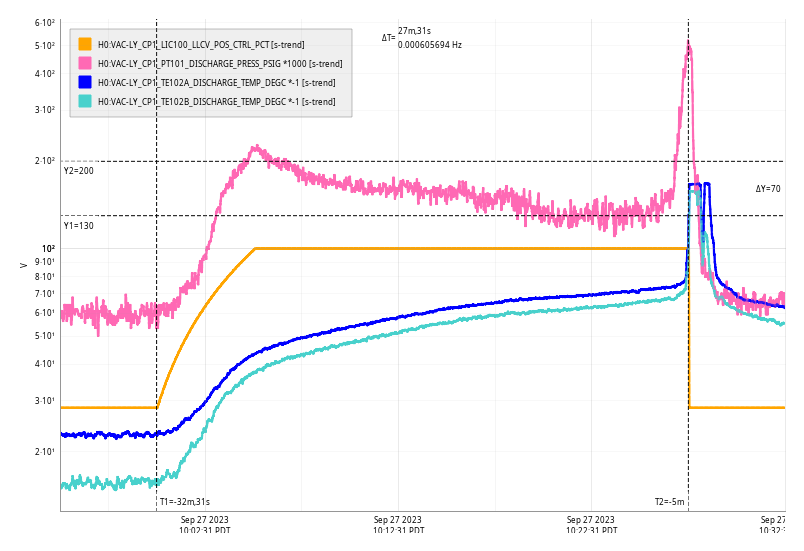
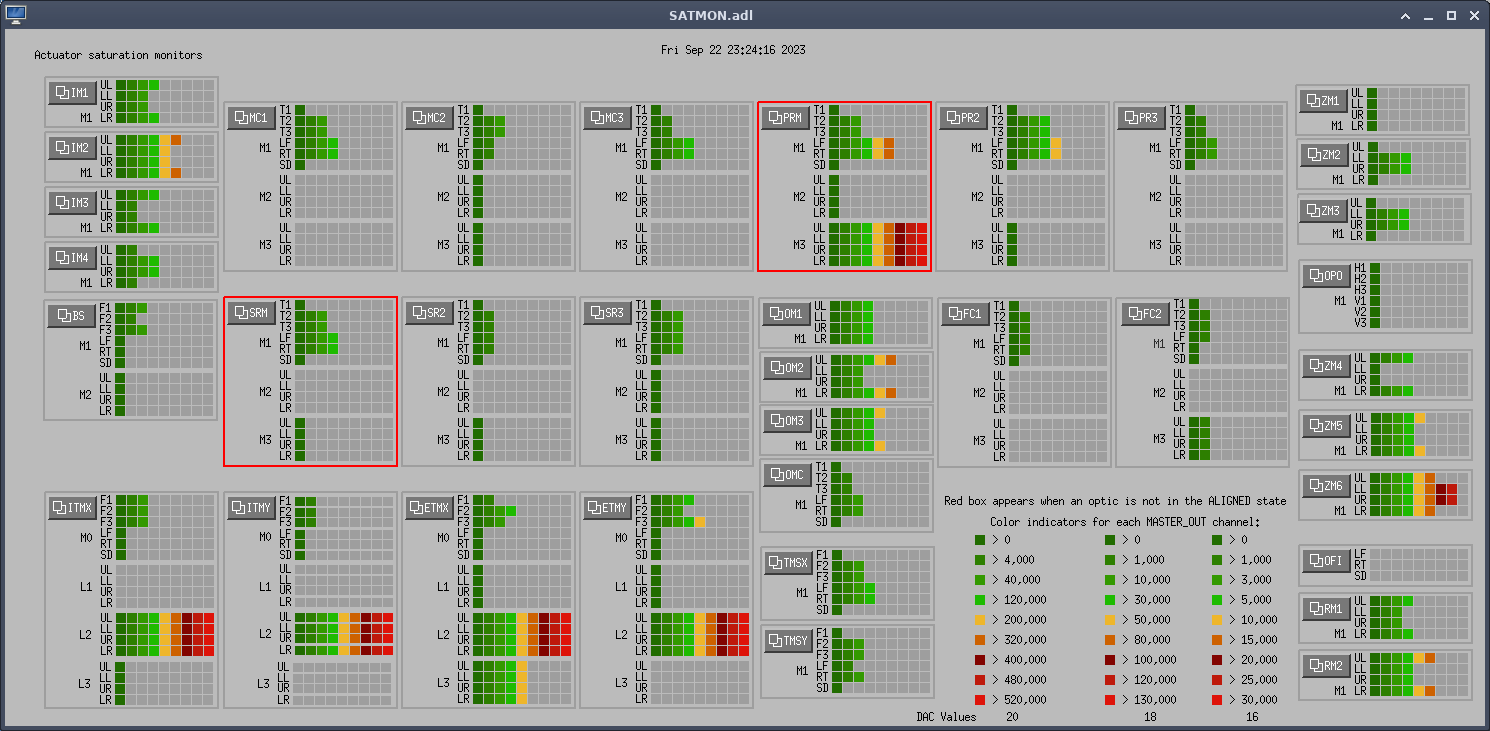
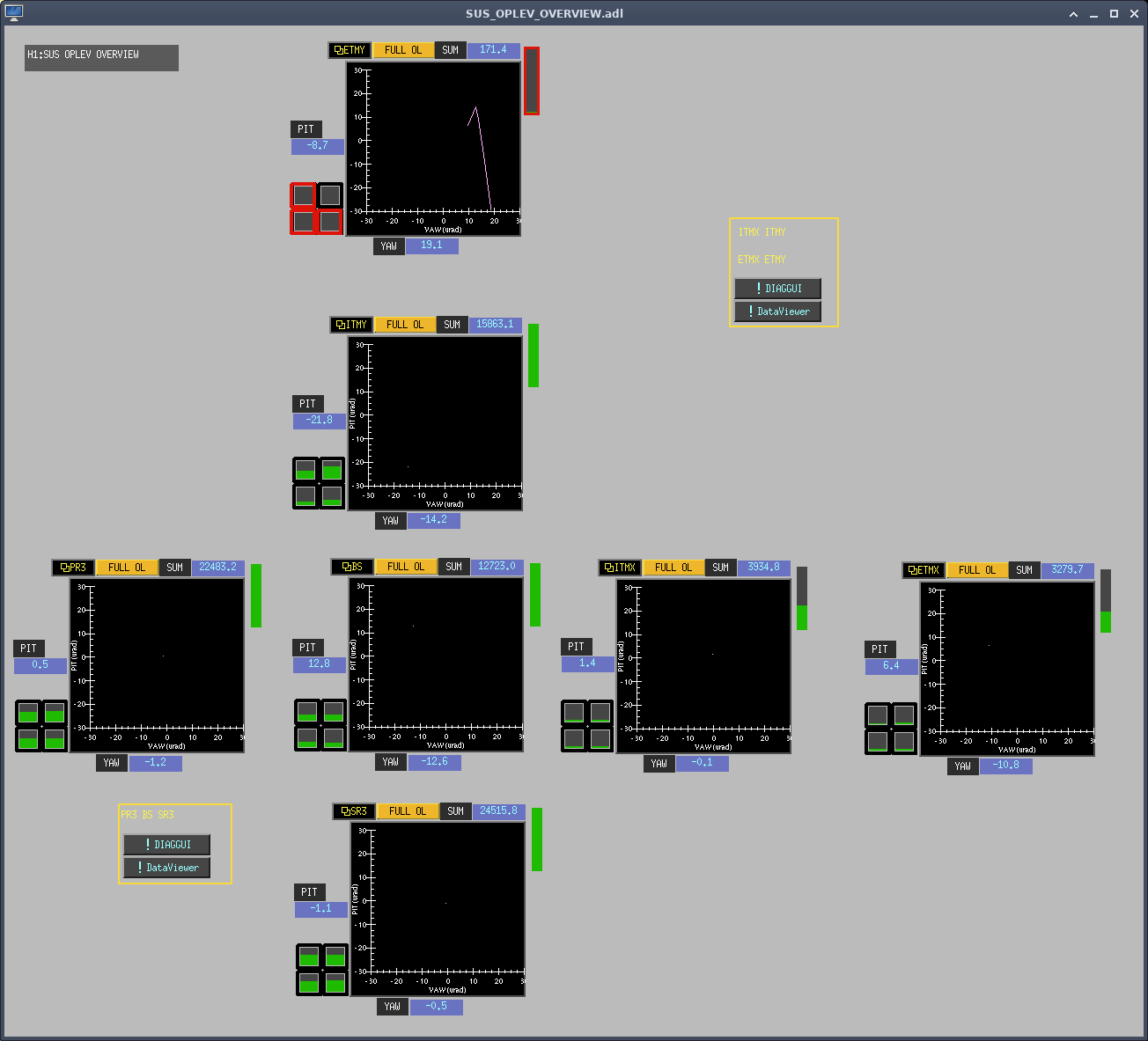
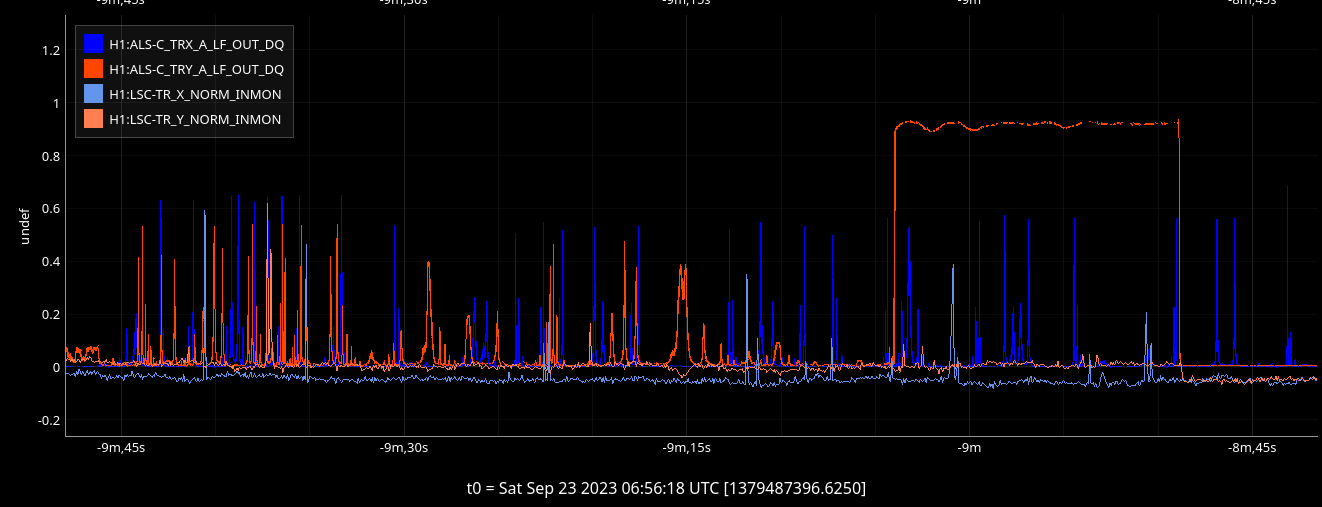
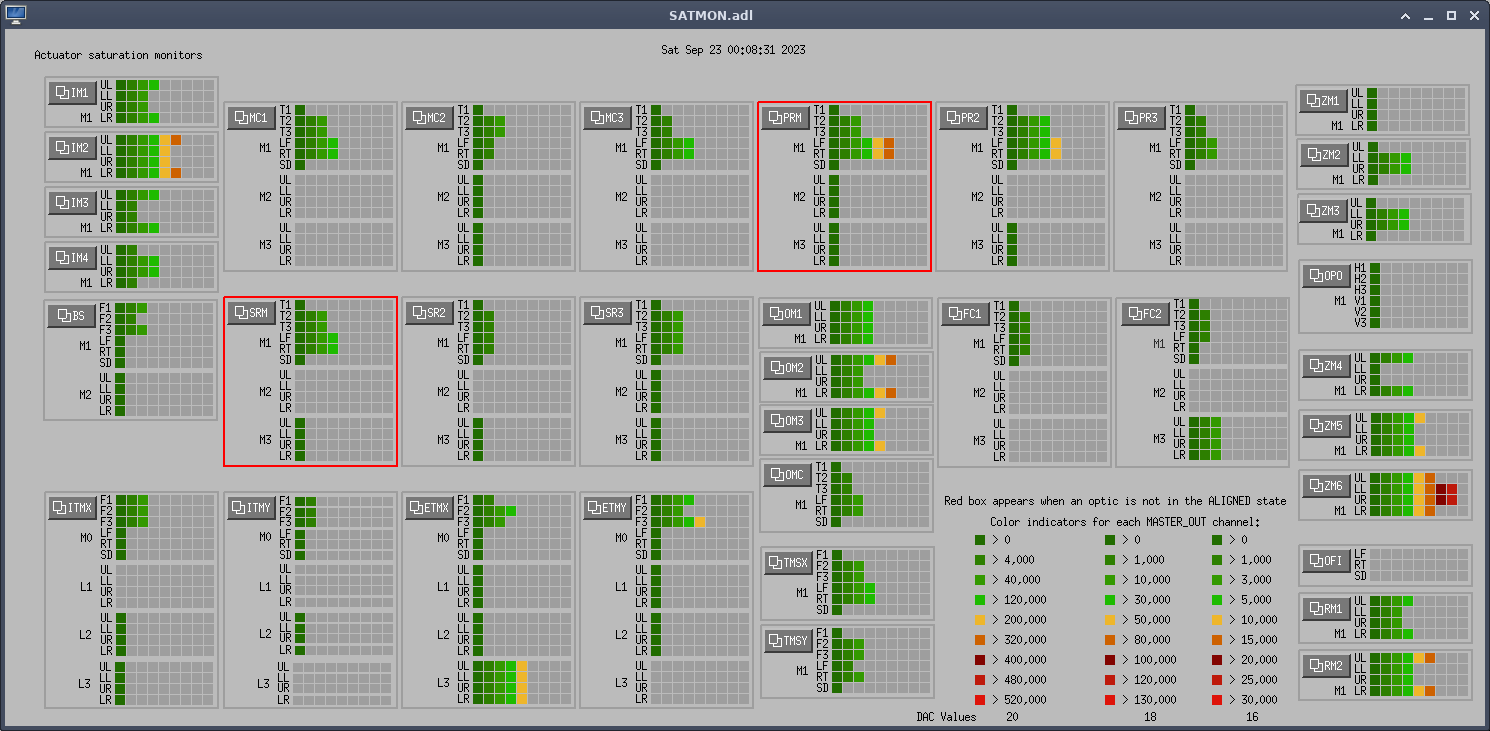
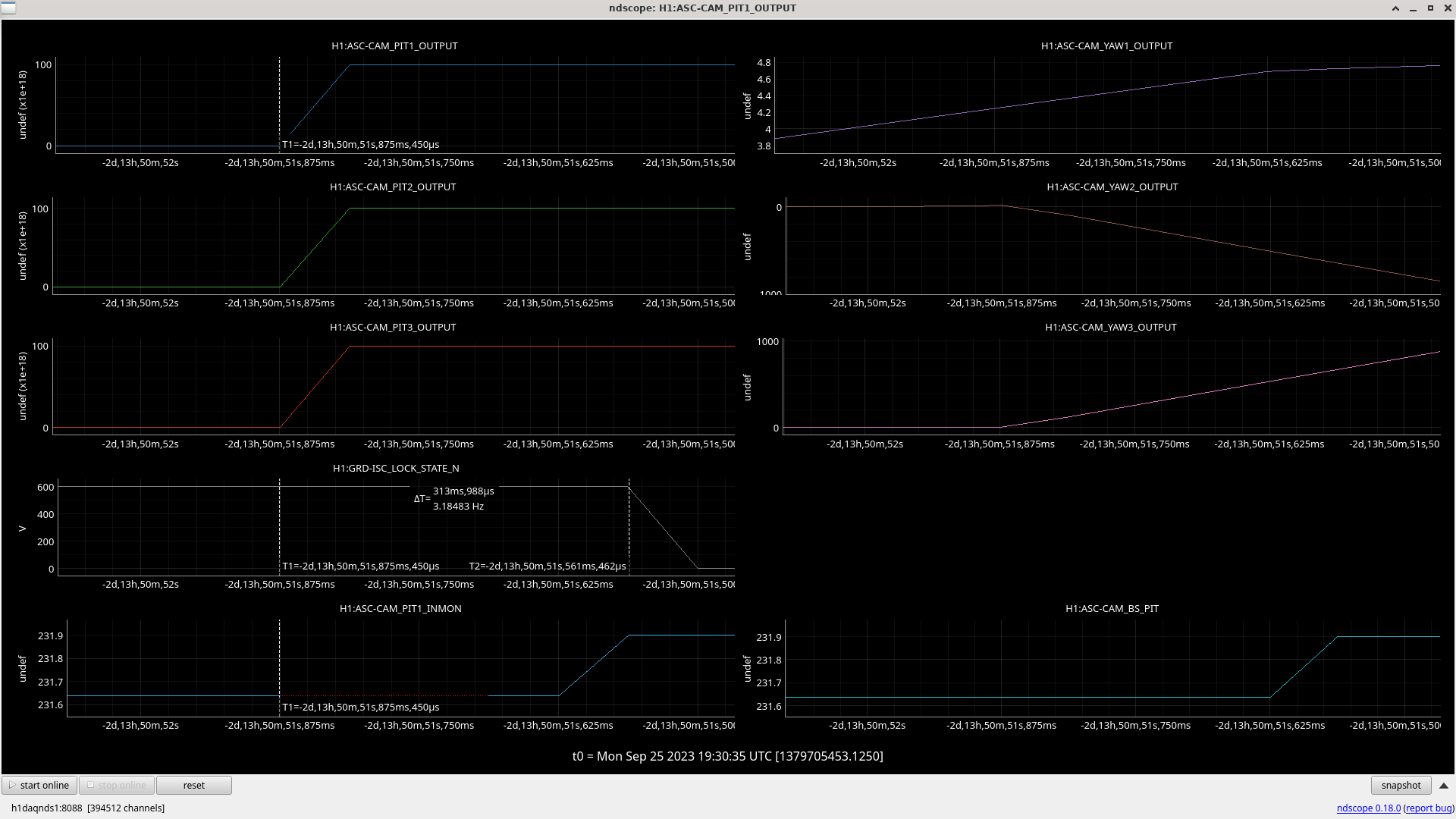
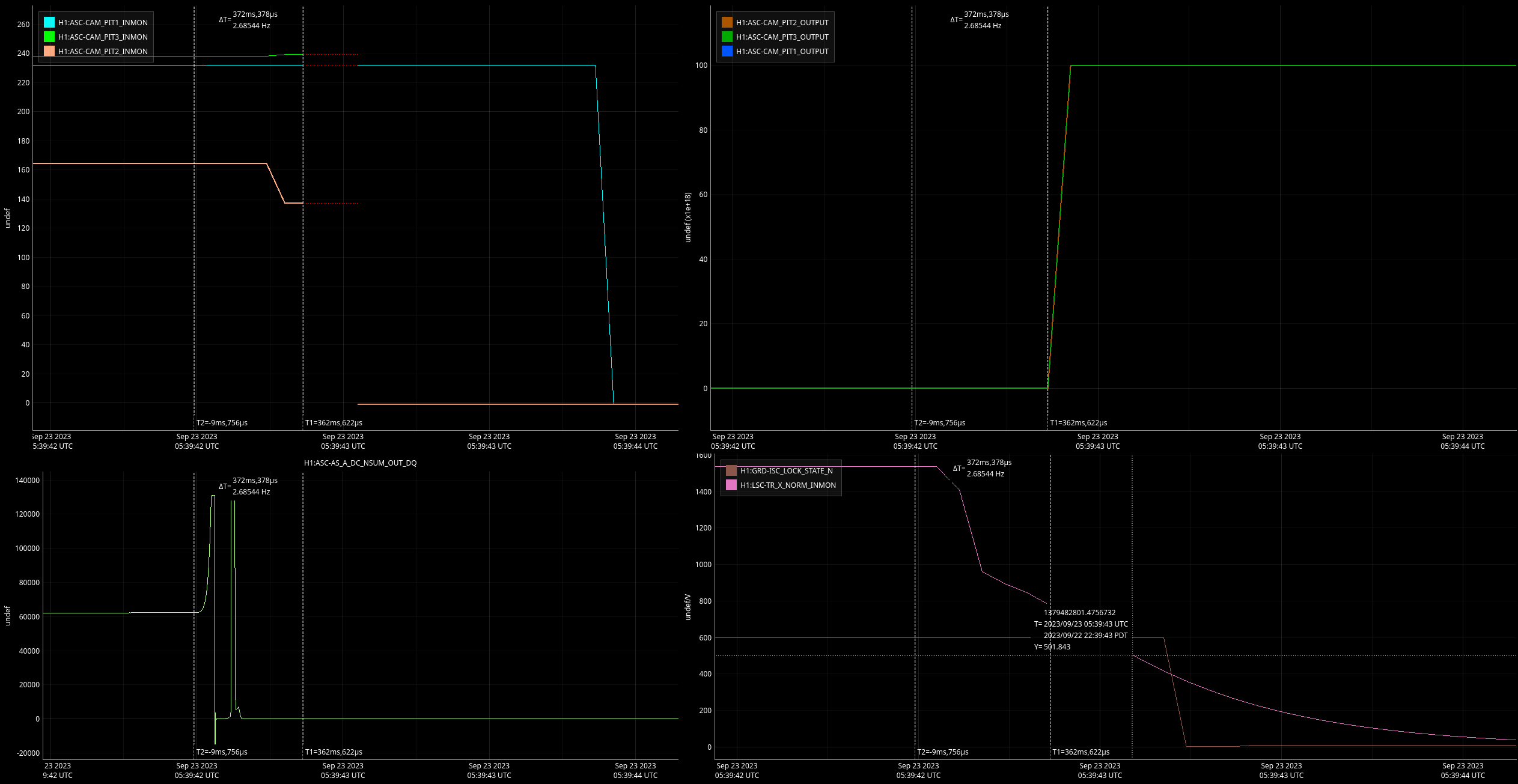
Patrick, Filiberto, Fernando The diode room exit estop channel needed to be reset, but there was no indication of it on the medm screen. The diode room entrance estop reset button should be copied to a diode room exit estop reset button. The only difference should be to change the DIODE ROOM ENTRANCE text display to DIODE ROOM EXIT and ENTRANCE to EXIT in the channel name. The same for the estop indicator in the bottom left. There is no physical diode room exit estop at present, but there is a signal for it in TwinSAFE.
Naoki, Sheila
We scanned ZM4/5 PSAMS with hot OM2. The 200V/200V of ZM4/5 PSAMS is already optimal value as shown in the attached figure. To optimize the PSAMS, we turned on ADF at 1.3kHz and monitored the ADF OMC trans.
Before changing the PSAMS, we changed squeezing angle to make sure that the ADF OMC trans is minimized with original squeezing angle. For any PSAMS change from 200V, the ADF OMC trans only got worse so we did not change the squeezing angle after the PSAMS change and concluded that the 200V/200V of PSAMS is already optimal.
J. Kissel Mostly because I got a demand from LLO for BSFM open loop gain transfer function templates (see their related work in, e.g. LLO:65891), and also because the H1 IFO's laser were down, I made the time useful by creating them. Data lives in /ligo/svncommon/SusSVN/sus/trunk/BSFM/H1/BS/SAGM1/Data/ 2023-07-12_2000_H1SUSBS_M1_CDBIOState_1_WhiteNoise_L_0p01to50Hz_OpenLoopGainTF.xml 2023-07-12_2000_H1SUSBS_M1_CDBIOState_1_WhiteNoise_P_0p01to50Hz_OpenLoopGainTF.xml 2023-07-12_2000_H1SUSBS_M1_CDBIOState_1_WhiteNoise_R_0p01to50Hz_OpenLoopGainTF.xml 2023-07-12_2000_H1SUSBS_M1_CDBIOState_1_WhiteNoise_T_0p01to50Hz_OpenLoopGainTF.xml 2023-07-12_2000_H1SUSBS_M1_CDBIOState_1_WhiteNoise_V_0p01to50Hz_OpenLoopGainTF.xml 2023-07-12_2000_H1SUSBS_M1_CDBIOState_1_WhiteNoise_Y_0p01to50Hz_OpenLoopGainTF.xml The data was taken with the M1 coil driver state in State 1 (LP OFF, in its highest range), and with the optical lever damping turned OFF. The M1 damping loop filters and configuration are shown in the attachment. Actual answers from these measurements to come. It'll also be interesting to compare oplev damping ON vs. OFF.
Sheila, Naoki
Before cooling down OM2, we aligned OMC by walking the OMC QPD offset. After the alignment, we could reduce the pitch jitter coupling by a factor of 3-5. The top left and top right plot in the first attached figure shows the DARM and the jitter coupling with original (green) and final (orange) QPD offset, respectively. The pitch jitter injection is between 80-90 Hz and yaw jitter injection is between 95-105 Hz. The pitch jitter coupling reduced by a factor of 3-5 with final QPD offset, while the yaw jitter coupling is almost the same.
The original and final OMC QPD offset are as follows.
| OMC A P | OMC A Y | OMC B P | OMC B Y | |
| original QPD offset | -0.01 | 0.05 | 0 | 0 |
| final QPD offset | 0.15 | 0.09 | 0.19 | -0.12 |
We injected the jitter noise and tried to minimize it by walking the OMC QPD offset. We injected the gaussian noise between 80-90 Hz for pitch (IMC-PZT_PIT_EXC) and between 95-105 Hz for yaw (IMC-PZT_YAW_EXC). We are not sure why, but the pitch and yaw excitation appear both in WFS DC PIT and YAW signals.
The second attached figure shows the jitter coupling from WFS A DC YAW to DARM with original (green) and final (orange) QPD offset.
The third attached figure shows the related signals including the optical gain (KAPPA_C). The optical gain before and after OMC alignment is 0.978 and 0.964, respectively.
If we keep changing the QPD offset around the optimal OMC alignment, we should see the sign flip of jitter coupling. Although we could not change the OMC alignment much due to optical gain drop, we did not see the sign flip of pitch jitter coupling and this might indicate that there are multiple jitter coupling path for pitch.
After the QPD alignment and before cooling down OM2, we took 5 minutes quiet time as follows.
2023/7/12 16:53-16:58 UTC
Sheila, Naoki, Brina,
Took a look at how DARM was before the OMC was aligned (14:40 UTC), when the OMC was aligned (16:53 UTC) and 5 minutes after the OMC settled down (16:58 UTC) today (06/12/23) and it seems that the jitter was not improved as thought. (shown in plot attached).
I will be making a few coherence plots to follow this and get a better understanding how the pitch and yaw look for the IMC channels and will attach them soon.
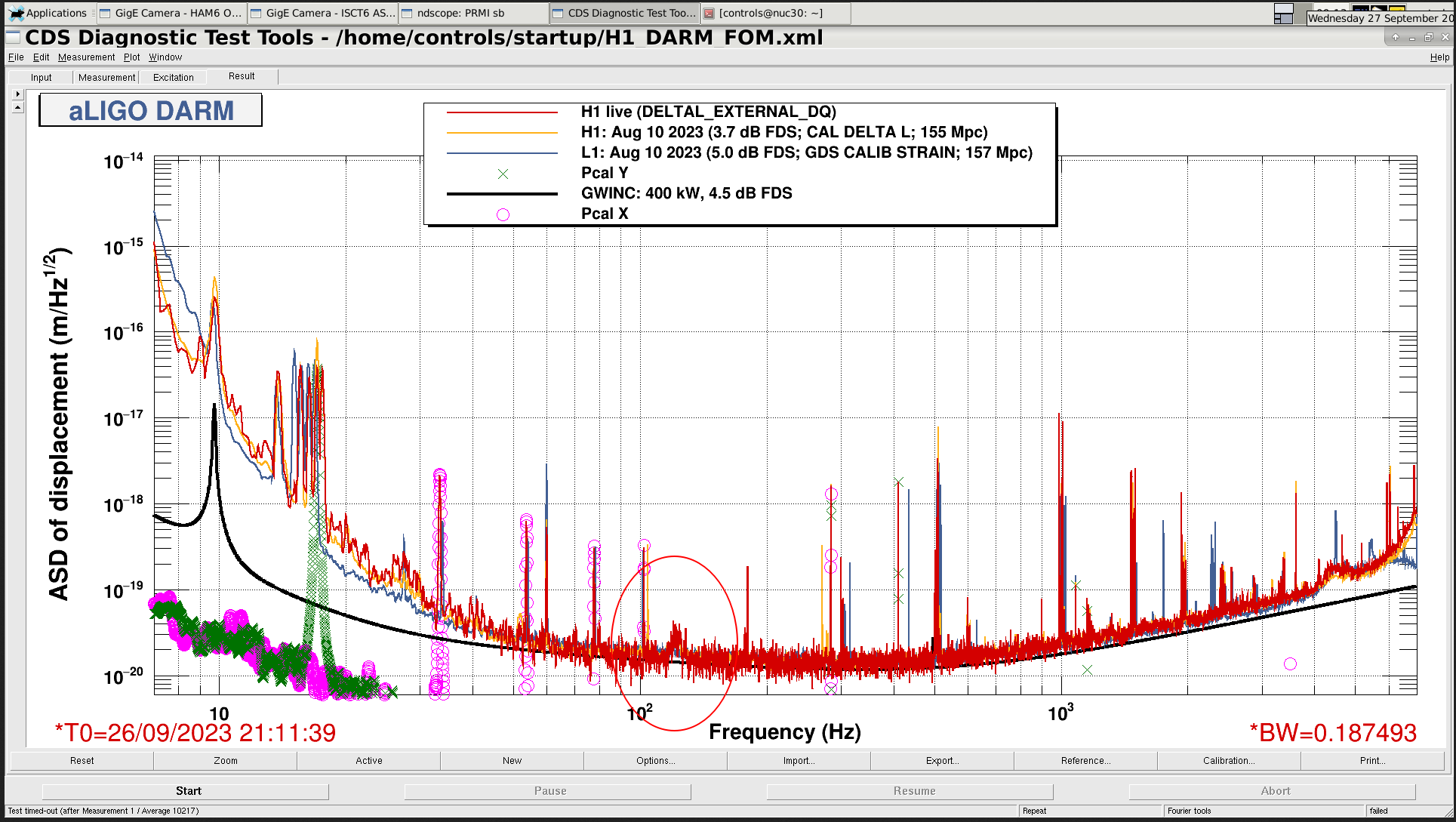
At approximately the exact moment that OM2 TSMAS temperature was raised, the H1 range jumped but then began a downward trend and did not sustain this range in the subsequent days. (The actual max range during this period seemed to spike during the downward trend). The following are plots are of two ndscope channels during a 72 hour period around this temp raising, the DARM power spectrum and transfer functions (magnitude and phase) at 3 different times during this period(before heating, near the peak range prior to the downward trend, and around 13 hours after the peak range). We have a coherence from from 4 IMC channels but we used this to choose the WFS_A_DC_PIT channel vs the CAL_DELTAL for the transfer function plots. Perhaps less importantly, I also attached a gwpy plot from the ndscope data that overlays the range changes with the temperature changes, pinpointing the moment of max range of 150.19, which was at 2023-06-27 13:57:42 UTC, but again this was a quick spike during the downward trend.
Julianna Lewis, RickS
Yesterday, during the Tuesday maintenance period, we turned off all Pcal excitations, both Xend and Yend, at approximately 8:33 local time. Just before noon, we found that Pcal periodic excitaitons had been enabled. We then also enabled the HW injections via the "Master switch" on the CAL_INJ_CONTROL2.adl screen.
After the PSL was shut off today from work on the interlock system (currently relevant alog), Jason and I were looking at how a few of ther autolockers were turned off and noticed that the ISS autolocker was not turned off. Digging into the LASER_PWR node we saw that this is where the FSS & PMC autolockers were turned off, but not the ISS. There was a comment saying that we don't need to turn it off, but Jason says this is not correct. We added it in to be turned off and also noticed that the channel that it checks before turning these off is out of date. Updated. Below is the svn diffs of our changes. These changes are committed and loaded in.
- if ezca['PSL-PWR_HPL_DC_LP_OUTPUT'] < 1:
+ if ezca['PSL-LASER_AMP2_PWR'] < 1:
# Turn off the auto lockers so the pzts are working while there is no light
ezca['PSL-FSS_AUTOLOCK_ON'] = 0
ezca['PSL-PMC_LOCK_ON'] = 0
ezca['PSL-PMC_RAMP_ON'] = 0
- ezca['PSL-ISS_AUTOLOCK_ON'] = 1
+ ezca['PSL-ISS_AUTOLOCK_ON'] = 0
ezca['PSL-ISS_LOOP_STATE_REQUEST'] = 0
- # With no output the autolocker doesnt need to be turned off
ezca['PSL-ISS_SECONDLOOP_OUTPUT_SWITCH'] = 0
Wed Jul 12 10:05:32 2023 INFO: Fill completed in 5min 31secs
Travis confirms a good fill curbside.
TITLE: 07/12 Day Shift: 15:00-23:00 UTC (08:00-16:00 PST), all times posted in UTC
STATE of H1: Commissioning
CURRENT ENVIRONMENT:
SEI_ENV state: CALM
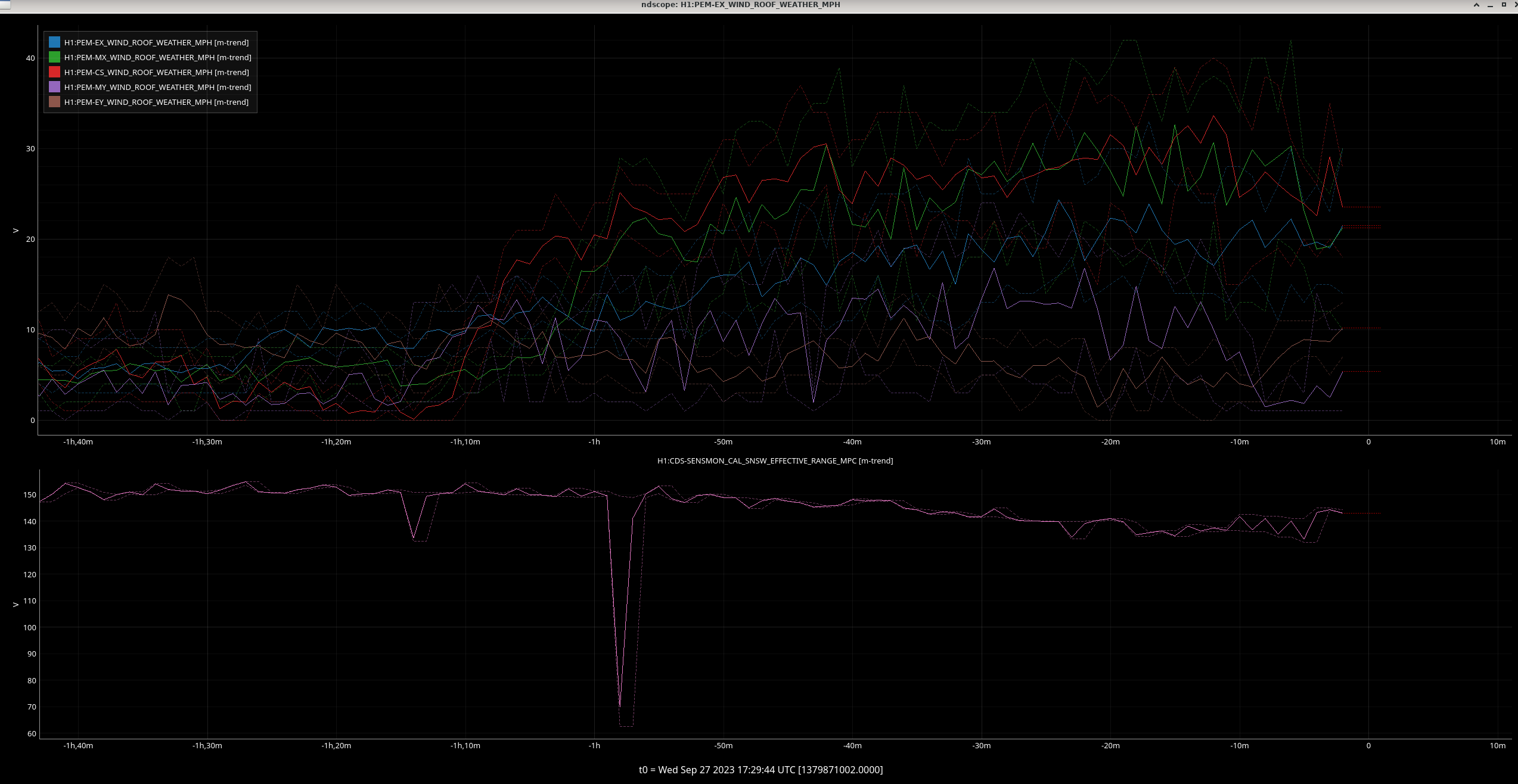
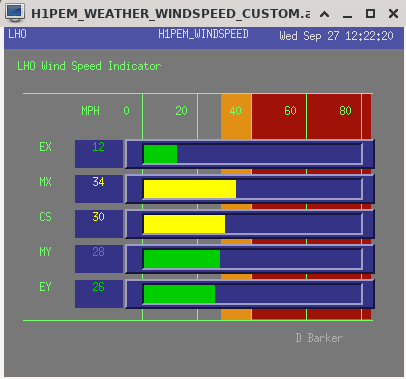
Wind: 5mph Gusts, 4mph 5min avg
Primary useism: 0.01 μm/s
Secondary useism: 0.05 μm/s
QUICK SUMMARY:
Currently locked, out of Observing for some OMC Commissioning.
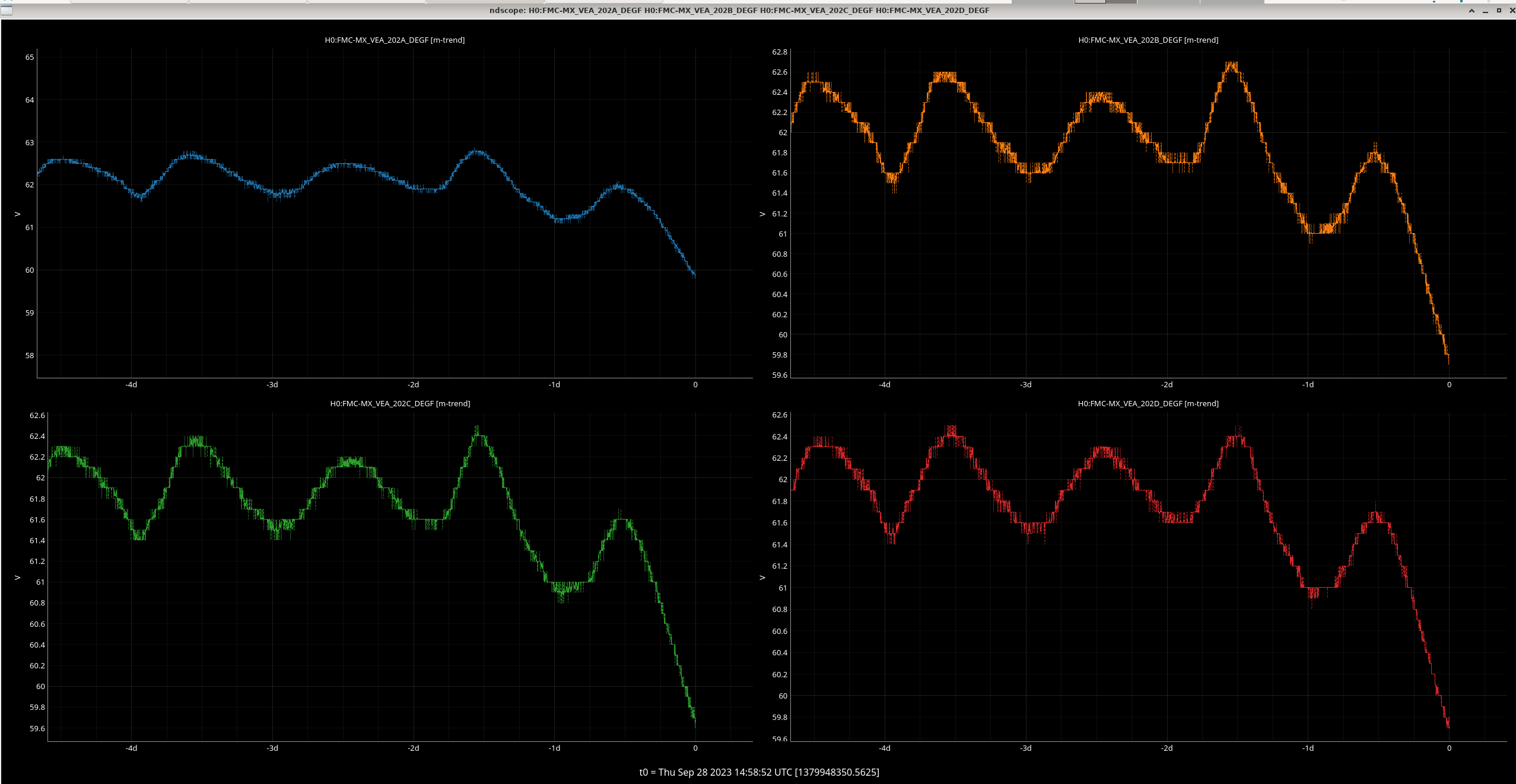
PCALX and ALSX Laser are down. If we lose lock we will go and look into troubleshooting. Not sure about going back into Observing until we have this figured out.
Tagging CAL -- between the following times, we did *not* have a live estimate of the systematic error and/or CW injections.
2023-07-12
13:23:41 UTC 06:23:41 PDT 1373203439 Lasers fail
14:48:48 UTC 07:48:48 PDT 1373208546 Out of observing for commissioning
5107 seconds == 1.42 hours.
For future reference, we should *not* be in observing if *either* PCAL systems go down in anyway. New for O4, BOTH PCAL lasers are critical to providing low latency calibration information that's critical for the now, new, low latency astrophysics.
Tagging DetChar -- in case y'all can help us create a data quality flag for this time.
(note, the loss of the ALS laser is unimportant during observing, since it's only used during lock acquisition and otherwise shuttered during nominal low noise / observing)
Current plan - As soon as Naoki and Sheila are done with their commissioning work, around 10am, Fil wil head to EX to troubleshoot the interlock system failure. There is a large possibility that this will bring all lasers down on site and we will need to recover at that point.
TITLE: 07/12 Owl Shift: 07:00-15:00 UTC (00:00-08:00 PST), all times posted in UTC
STATE of H1: Commissioning
CURRENT ENVIRONMENT:
SEI_ENV state: CALM
Wind: 6mph Gusts, 4mph 5min avg
Primary useism: 0.01 μm/s
Secondary useism: 0.04 μm/s
QUICK SUMMARY:
8:52 UTC GRB-Short Candidate E416867
ALSX and PCALX Laser Voltage went down IFO Still Locked.
14:48 UTC Went to comissioning for some OMC Alignment work.
| Start Time | System | Name | Location | Lazer_Haz | Task | Time End |
|---|---|---|---|---|---|---|
| 14:50 | OMC | Sheila & Naoki | CtrlRm | N | OMC Alignment work | 15:50 |
| 14:52 | FAC | Randy | Mid Y | N | Inventory of HAM Equipment | 16:52 |
Following up on the possible cause of the 2.6 peak (71205, 71092, 71005), note that CHARD_Y and DHARD_Y have large peaks at 2.6 Hz, that contribute to most of the loop RMS. Looking at the control filters, there are dips at 2.6 Hz, probably due a mild plant inversion in the design. Both CHARD_Y and DHARD_Y plant models have broad peaks at about 2.6 Hz. So it is possible that the 2.6 Hz peak in CHARD and DHARD is due to a poorly controlled plant resonance. A new OLG measurement of the two loops at 60 W would be useful.
We did some tests by changing the loop gains by a few dbs up and down and did not see a significant change in the 2.6 Hz peak. This is consistent with the origin being a plant resonance.
Additionally, CHARD_Y has a large peak at 1.06 Hz. looking at the model of the OLG, it looks like thsi could be a point of marginal stabiility where the phase approaches 180 degrees. It's possible that we are seeing some large gain peaking there. Again, a measurement of the OLG would be helpful. A similar peak is at 1.35 Hz for DHARD_Y
Both ALS X and PCAL X have been taken off line about a half hour ago. still troubleshooting.
It seems as if there is a power issue that is stopping voltage from getting to the ALSX laser and PCAL Laser.
After speaking to Richard, he suggested troubleshooting the Phoenix relay that connects both of those systems to the Safety System
ETMY mode 20 had no damping settings in the Guardian and the mode was rung up. I applied the following settings and it has worked during this lock stretch. I will add it to the Guardian and accept them in the SDF once I am confident that the settings work consistently.
FM1 FM4 FM10 Gain -1.0
The above filters were already engaged, hence I only had to look for an appropriate gain and this didn't kick us out of Observing.
Also, Jenne wanted some of the higher order modes to be looked into and damped (see her alog 71212). I took high resolution spectra for modes between 1500Hz and 2000Hz and have been working on identifying (frequencies and which optic it belongs to) the top few rung up modes. Once identified, I will start looking for damping settings for the same.
8:52 UTC GRB-Short Candidate E416867
Other than that and a number of these messages that popup in DIAG -Main every few minutes:
2023-07-12_10:07:30.392076Z DIAG_MAIN [RUN_TESTS.run] USERMSG 0: PSL_ISS: Diffracted power is low
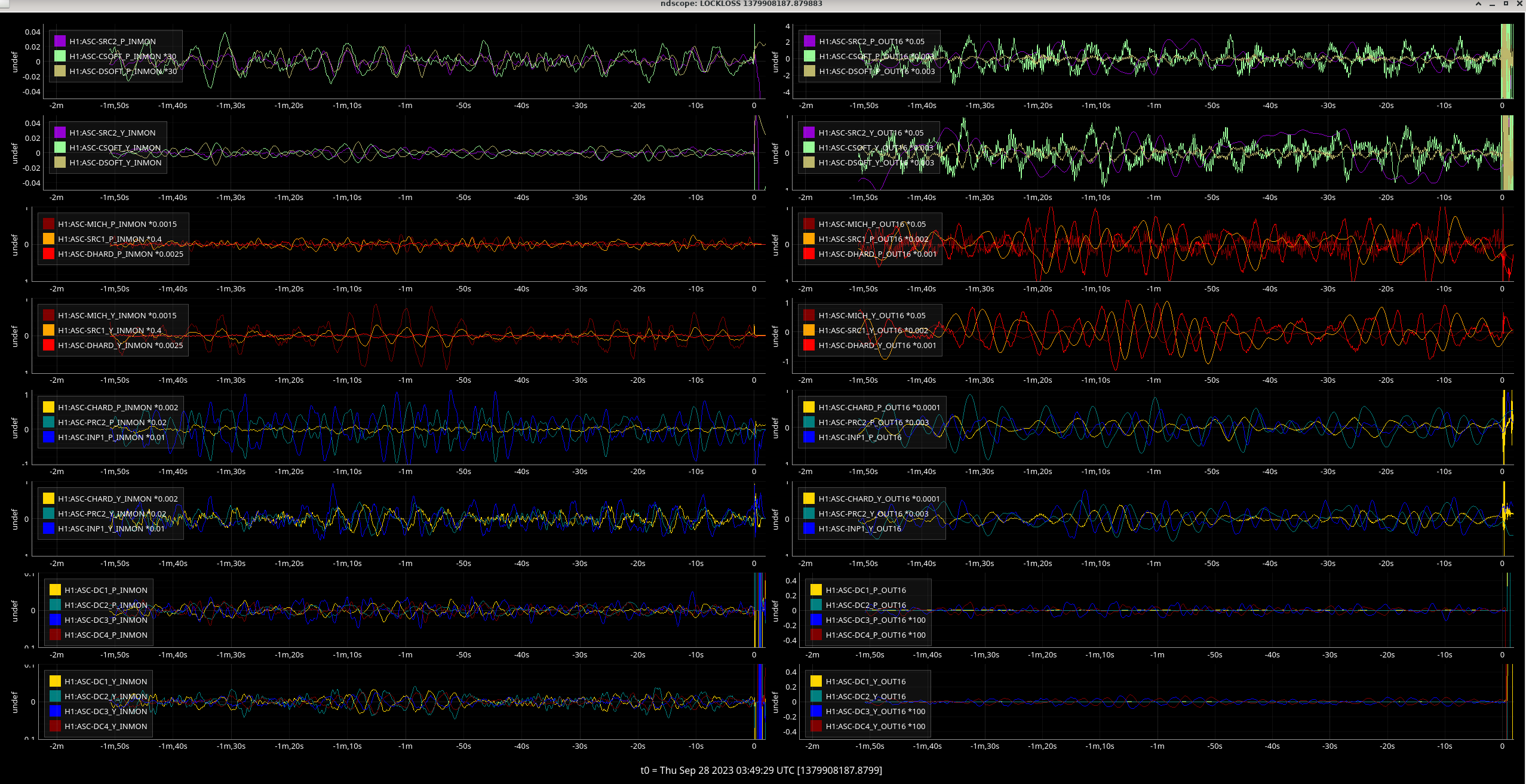
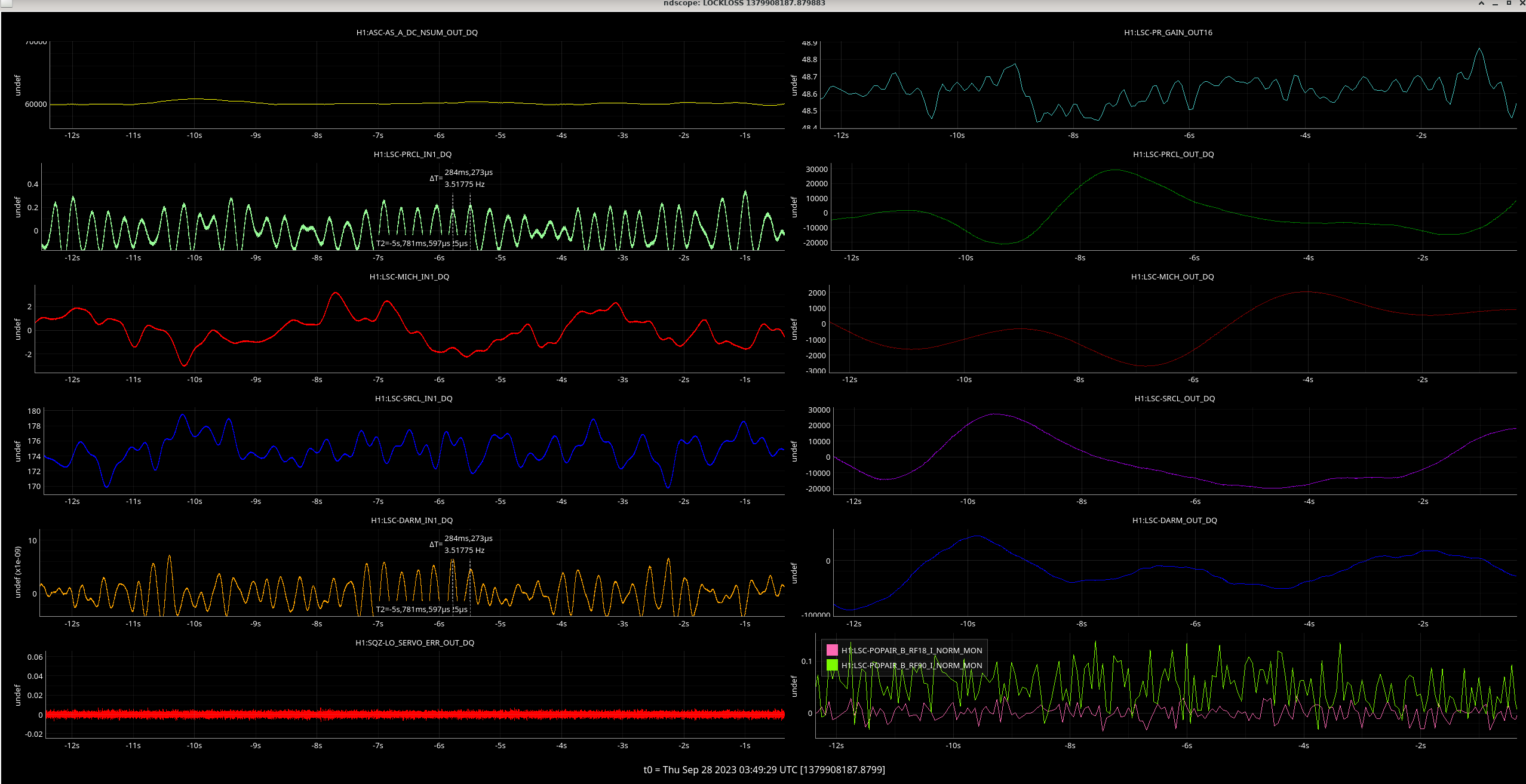
But they go away immediatley, Ndscope attached.
Rahul has been actively working on Violin Damping and seems to have found a good setting for ETMY M2.
FAMIS 19666
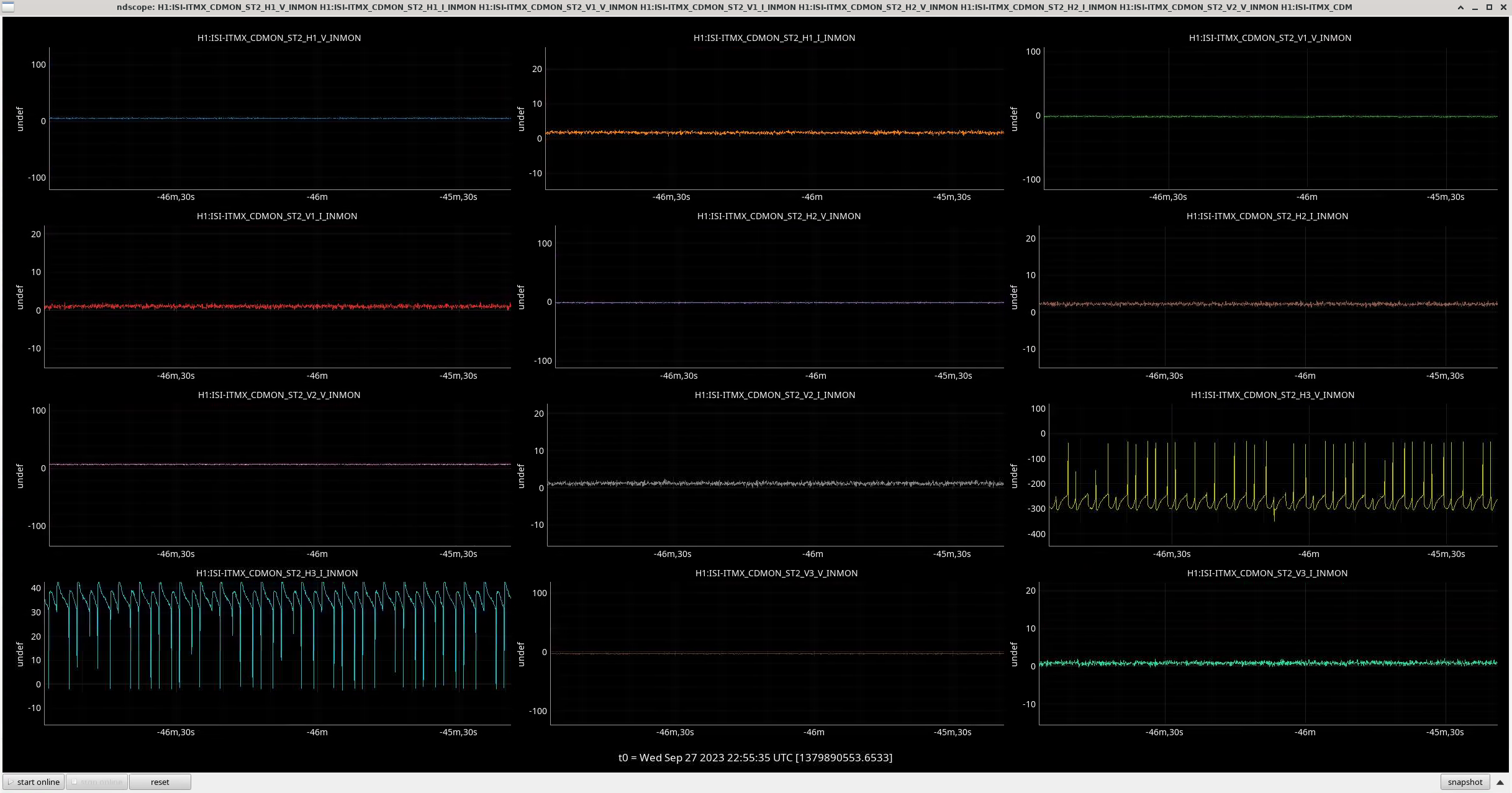
ITMX_ST2_CPSINF_H1 high freq noise is high!
ITMX_ST2_CPSINF_H3 high freq noise is high!
I've added DIODE_ROOM_EXIT_ESTOP indicator and reset button back per Patrick's suggestion. Changes updated in svn.