TITLE: 07/10 Eve Shift: 23:00-07:00 UTC (16:00-00:00 PST), all times posted in UTC
STATE of H1: Lock Acquisition
CURRENT ENVIRONMENT:
SEI_ENV state: CALM
Wind: 15mph Gusts, 13mph 5min avg
Primary useism: 0.06 μm/s
Secondary useism: 0.05 μm/s
QUICK SUMMARY:
IFO is LOCKING at Lownoise_Coil_Drivers
TITLE: 07/10 Day Shift: 15:00-23:00 UTC (08:00-16:00 PST), all times posted in UTC
STATE of H1: Relocking
SHIFT SUMMARY:
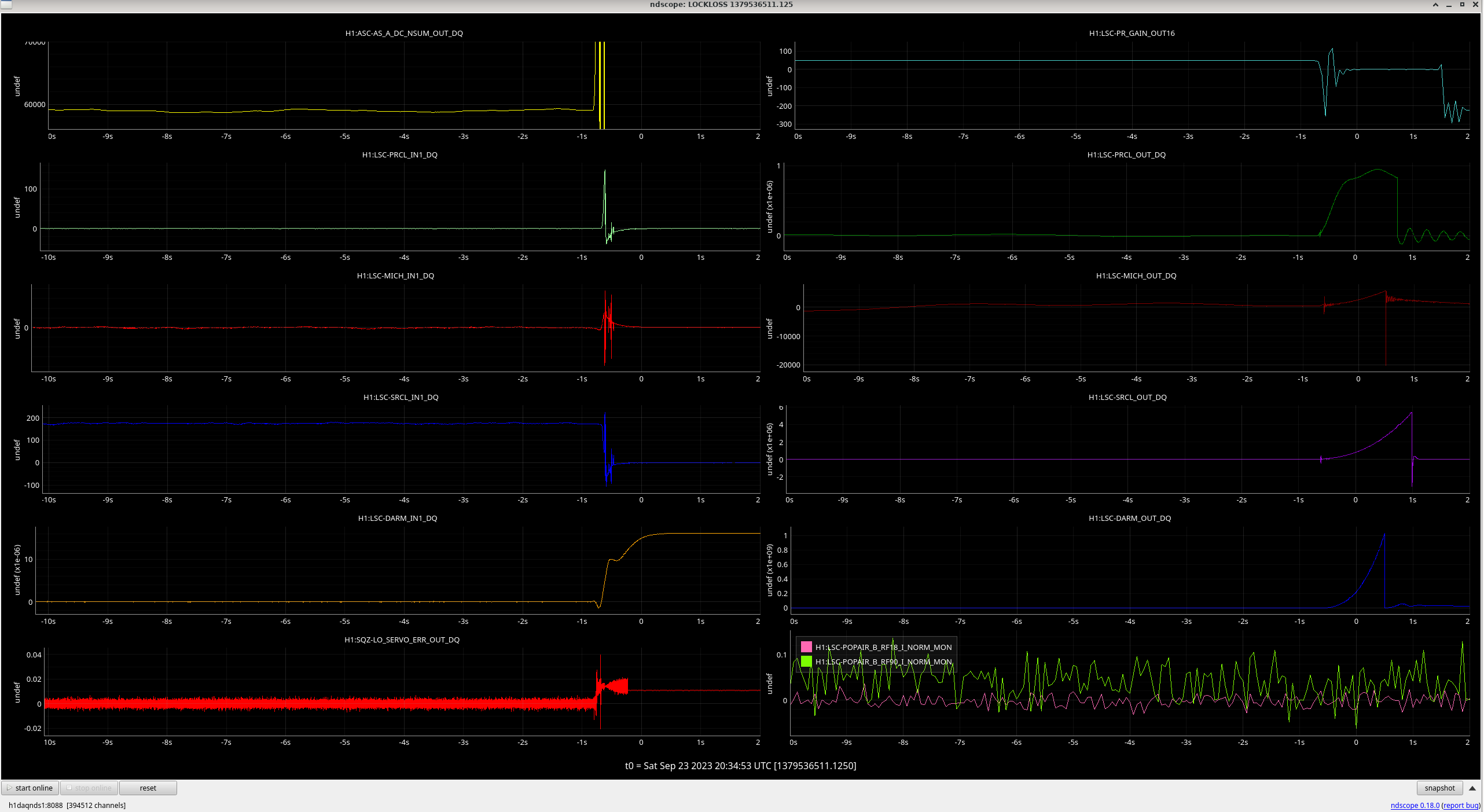
- Lockloss @ 15:57 - unknown cause
- Had to touch ALS Y slightly as INCREASE FLASHES failed twice and had to hit FORCE on the ALS X PLL overview to get the beatnote to 39 MHz, rest of locking was automated
- Held at OMC WHITENING to damp violins (~1 hour)
- Acquired NLN/OBSERVING @ 18:00
- 20:34 - 6.6 EQ from Antigua, 20:37 EQ mode activated, back to CALM @ 22:31
- Currently relocking, fully automated so far @ OFFLOAD_DRMI_ASC
LOG:
| Start Time | System | Name | Location | Lazer_Haz | Task | Time End |
|---|---|---|---|---|---|---|
| 15:21 | FAC | Karen | Optics Lab | N | Tech clean | 15:53 |
| 15:54 | FAC | Karen | Mid Y | n | tech cleaning | 17:10 |
| 17:45 | FAC | Karen | mid Y | n | tech cleaning | 18:10 |
| 20:56 | VAC | Gerardo/Travis | MY | N | Drill holes | 22:11 |
| 22:03 | SQZ | Vicky | remote | n | Sqz polarization alignment tweaks | 22:55 |
| 22:31 | PCAL | Rick/Dripta | PCAL Lab | Y (LOCAL) | Measurements | ?? |
Trying to track down the origin of the 2.6 Hz peak, I looked at times during the lock acquisiton when the IFO is down, when only OMC ASC is on and when the IFO ASC is on. The first plot shows a compariison of OMC M1 damping signal, OMC ASC and IFO ISC in diffeerent configuurations. Some observations:
The second plot compares the OMC damping signal when the IFO is down vs nominal low noise: the OMC suspension is moving up to 100 times more when the IFO is in nominal low noise
Finally, I compared the OMC motion at LLO and LHO during the same nominal low noise time. The LHO OMC moves a lot more than the LLO OMC.
Althouhg there is no evidence that the 2.6 Hz peak is generated by the OMC controls, it is very prominent in the OMC damping signals. It seems that the OMC ASC at LHO has too large bandwitdh: it would be worth investigating if a low bandwidth control like at LLO would work, and whether it can also improve the 2.6 Hz situation: it is possible that the 2.6 Hz motion is residual IFO angular control, but the OMC ASC makes it problematic for DARM by moving the OMC
@Gabriele -- this (loud OMC SUS signals that are different from LHO and LLO) is a known, and long-standing consequence of the two sites different choices for OMC ASC. LLO drives OM2 and OM3 (or maybe OM1 and OM2? I forget), where LHO drives OM3 and the OMC. The LHO drive to the OMC shows up in the OMC damping loops as you've found.
That being said, 2.625 Hz is the modeled first Transverse / Yaw mode of the OMCS, see OMCS Model. A reminder of the coordinate systems in HAM6 can be found here: G1300086.
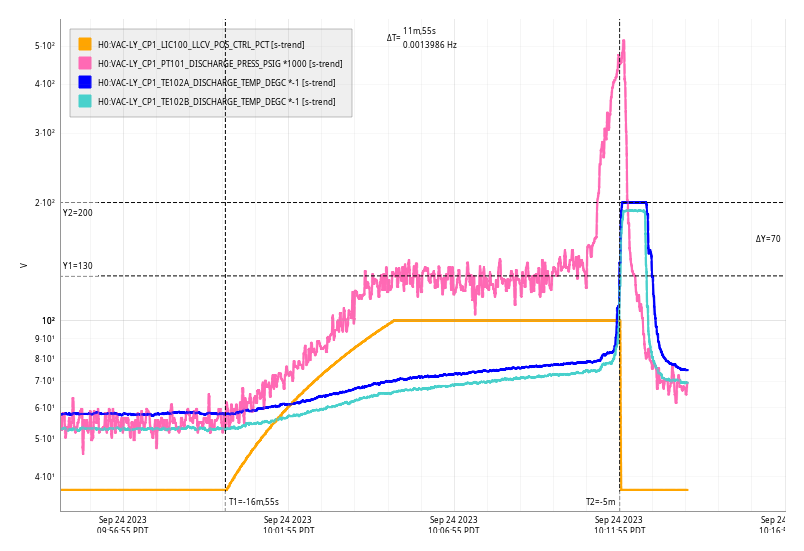
Mon Jul 10 10:07:23 2023 INFO: Fill completed in 7min 22secs
Travis confirmed a good fill curbside.
Below is the summary of the DQ shift for the week of 2023-07-03 to 2023-07-09
The full DQ shift report with day by day details is available at https://wiki.ligo.org/DetChar/DataQuality/DQShiftLHO20230703
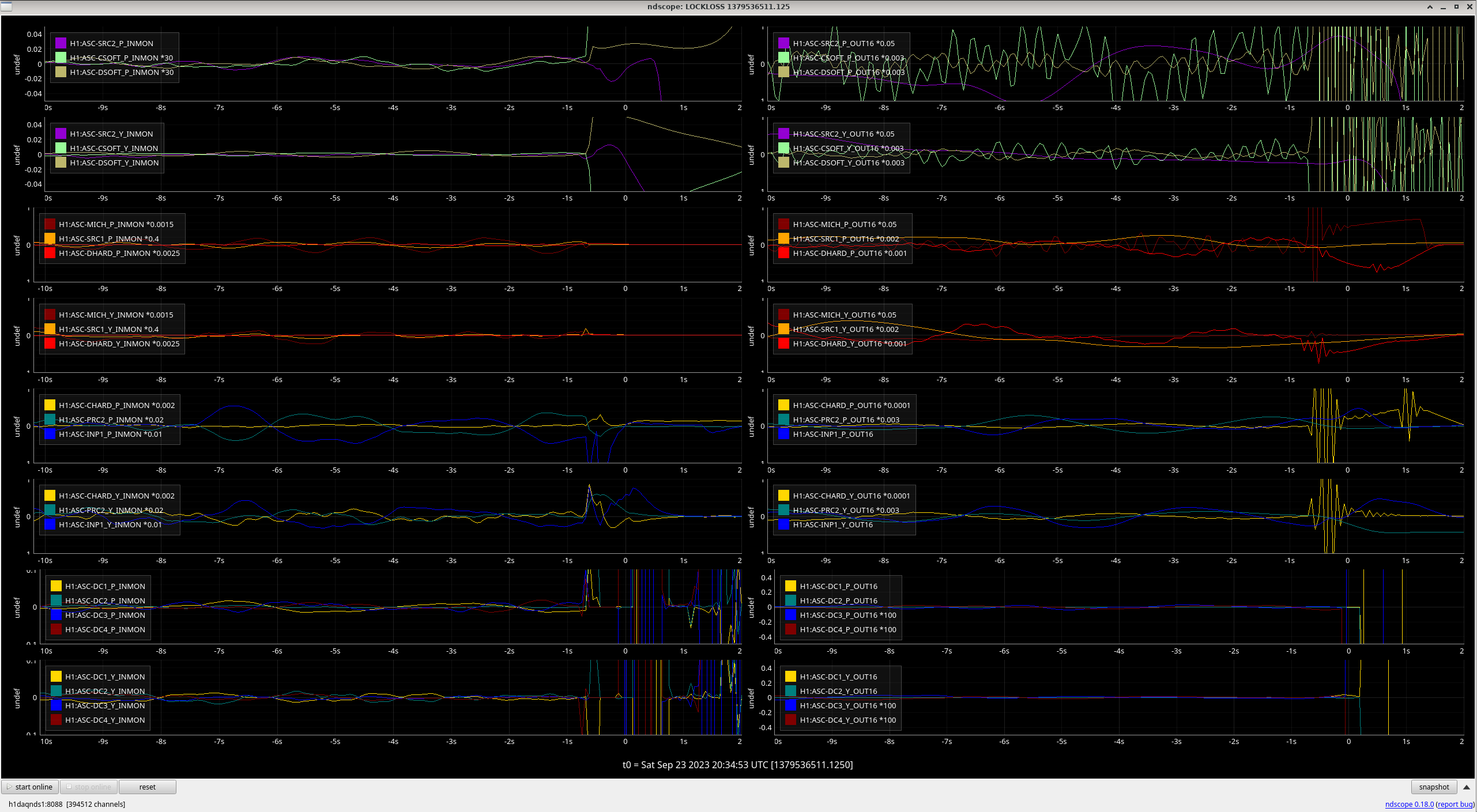
Lockloss @ 15:57, DCPD saturations right before. SEI and wind motion is low. No evidence of any LSC/ASC ringups.
At the request of Louis Dartez and Jenne Driggers, we carried out a quick study on the impact of additional calibration lines added to H1 (https://alog.ligo-wa.caltech.edu/aLOG/index.php?callRep=69284). To avoid confusion by extraneous effects, we studied the impact of a simple 1Hz "notch" (i.e. a chunk of data removed in the analysis) centred at 24.5Hz (based on Louis' suggestion). We took the design sensitivity O4 PSD and simulated a high-SNR BBH signal. The full script and results can be found here: https://ldas-jobs.ligo.caltech.edu/~gregory.ashton/O4/calibration_lines/, but the key result is in this comparison plot (https://ldas-jobs.ligo.caltech.edu/~gregory.ashton/O4/calibration_lines/outdir_bbh_simulated_o4_data/combined_notch_False_notch_True.png) which shows the posterior distributions and matched-filter SNR with and without the notch. From this, it is clear that any differences are below the typical level of sampling uncertainty. Therefore, I do not foresee any negative impact from the addition of calibration lines to events observed during lock stretches where they are present.
Tagging CAL.
TITLE: 07/10 Day Shift: 15:00-23:00 UTC (08:00-16:00 PST), all times posted in UTC
STATE of H1: Observing at 141Mpc
CURRENT ENVIRONMENT:
SEI_ENV state: CALM
Wind: 13mph Gusts, 10mph 5min avg
Primary useism: 0.02 μm/s
Secondary useism: 0.06 μm/s
QUICK SUMMARY:
- IFO has been locked for 4 hours
- CDS/SEI/DMs ok
TITLE: 07/10 Owl Shift: 07:00-15:00 UTC (00:00-08:00 PST), all times posted in UTC
STATE of H1: Observing at 141Mpc
SHIFT SUMMARY:
Lock#1:
Locked upon arrival, LL at 07:57UTC with a DCPD saturation. This LL isn't showing up on H1locklosses, lock time of 2:27.
Lock#2:
Xarm was failing increase flashes repeatedly and complaining about PLL beatnote running out of range, it wasn't able to get a good H1:ALS-X_FIBR_LOCK_BEAT_FREQUENCY. I simply turned on the autolocker by clicking "Force" on the Xend PLL medm and within 30 seconds it locked at a good beatnote and power. I then turned it off by clicking "No Force".
Went through PRMI which locked fairly quickly, then back to DRMI which also caught quickly.
While in OMC_WHITENING damping violins I noticed the SQZ manager was reporting "SQZ ASC AS42 not on??" around 10:00UTC, So I followed Vicky's instructions from LHO alog71083 and went to RESET_SQZ_ASC then back to FREQ_DEP_SQZ and it fixed it.
The wind has been increasing over the past few hours, gusts up to 45mph as of 12:30UTC but its calming down
LOG:
No log for this shift
We had a lockloss at 07:57, relocking was mostly automated I only had to intervene to help Xarms PLL lock. I had to hold in OMC_WHITENING for about 1.5 hours for the violins to damp. Back in NLN and Observing as of 11:00 UTC.
I ramped up the gains for many of the rung up modes (see screenshot of the DARM spectra for 500Hz and kHz modes), however it still needed around 1-2hrs of before DCPD counts were below 500K counts (for Nominal Low Noise state). All gains are currently set to their nominal values.
IFO is still not locked. Daniel and Austin (during and post-shift) and thankfully now, Camilla have all tried helping but so far we don't know what the problem is. Here are some of the leads.
Initial Alignment is not, and has not been working since 12PM today (and from last week's initial alignment, this seems to be a known issue). Firstly, MICH_BRIGHT and MICH_DARK do not lock according to guardian (but they seem to lock according to Austin and Daniel at the start of the shift). The behavior of the MICH trace is oscillating between the threshold (4000 cts) and 0, which is odd. After getting MICH "as locked as possible", we (Daniel, Austin and I) manualled over to SRC locking, which also failed in a similar way. Initial alignment did not work at all. According to Daniel, the gain had to be bumped 10x to lock MICH but then the init_alignment just failed completely afterwards (everything swinging). I tried touching the various documents' manual alignment sliders (BS, SRM, SR2) to no avail. Even during SRC manual locking, the differential in the "high highs" and "low lows" was nowhere near what it trended as. With zero indications of the problem after parsing through the code and attempting to call other people, Camilla offered help.
With this help, we could not get locked still so we thought to try normal locking without any confirmation that initial alignment works. Somehow, this worked. IFO is currently powering up. DRMI locked easily while bumping the BS during Engage_DRMI to better the usual signal traces.
In diagnosing the issues with the help of past alogs and trends, the last time MICH offloaded successfuly was June 26th. It failed on the 1st, 3rd and today. While the locking issue seems to have been fixed, we still have not fixed the initial (incl. manual) alignment locking problems. Expecting to be locked within the next 30 minutes now.
Special thanks to Austin, Daniel and Camilla for volunteering their time to assist with this eventful eve.
Summary:
ASC-AS_A seems to have been badly clipping, but the LSC signal came from the two quadrants on which only a tiny fraction of the beam power was falling. A bad recipe as alignment-length sensing coupling is maximized.
Details:
In the 1st attachment (same time window as Daniel's plot, but more channels), the right-most column shows the AS_A_DC_NSUM was about half of AS_B_DC_NSUM. (FYI this is never the case in e.g. full lock.)
The second column from the right shows AS_A_DC_PIT_OUT16 was basically 1 except some transient responses (circled in red), which means that all of the power was on quadrants 1 and 2. If you look at AS_B_DC_PIT and YAW on the same column you can see that the beam was not clipping on AS_B.
2nd and 3rd column from show that most of the signal was in quadrants 1 and 2 (unsurprising, but they were in I phase not Q as was pointed out by Daniel). However, for whatever reason, quadrants 3 and 4 seem to have somewhat better (but not much better) demod phase, therefore Q3 and Q4 were actually larger than Q1 and Q2.
This resulted in AS_A_RF45_Q_SUM signal mostly coming from Q3 and Q4 (circled in cyan).
I cannot remember if any kind of DC centering is done during initial alignment, but if not, we need one.
Also measure AS_A and B RF45 phase in full lock (maybe we can check this using calline or violin?).
Here some traces when we tried to lock the bright Michelson. A couple observations:
Turns out that there's no DC centering on AS WFS during BRIGHT MICH in the initial alignment. See the first attachment.
45MHz demod phase was OK for full lock with 60W power for both AS_A and AS_B. 2nd and 3rd attachment. I don't know if that's the case for lower power. But the demod phase is clearly off for initial alignment, and I don't want to bump up the LSC gain by a factor of 10 to compensate.
What we need is:
I came in to investigate the ITMX ISI troubles. Seems like the problem was (is?) an issue with the ISI coil drivers, which is a new one for me.
What I tried so far this morning:
1. Killing all requested drives in the model, turned off masterswitch.
2. Checked rack, all of the chassis seemed to be in a normal state, no missing lights.
3. Power cycled ISI interface chassis, T240 chassis. No change.
4. Turned off all the coil drivers. Boom, oscillation goes away. See attached trend. L4Cs go to 0 when I turn off ISI interface chassis, but come back in oscillating state. The ring down is when I powered off the coil drivers.
5. Turned each coil driver one at a time to see if it comes back. All quiet, but there is a kick each time a chassis gets turned on. Must be some offset somewhere in the electronics? Model is still requesting 0. I haven't seen that before, worth doing some more testing.
6. Turned on damping loops, everything is still quiet.
7-? Start bringing ISI back. Get sidetracked by blend settings not being INIT'd in SDF....
Sunday morning ISI ITMX problem started around 06:00:50 PDT. I checked the MAINS_DQ channels around that time, did not see any AC power issues.
Following along Gabriele's work to understand noise from modulation of low frequency lines in DARM, I made a noise comparison today using DARM with no calibration lines. We stayed in NLN CAL MEAS (all cal lines off) long enough to get a good measurement of GDS CALIB STRAIN with no calibration lines. I compared this with GDS CALIB STRAIN NOLINES during times when the calibration lines were on. See attached plot. The difference is small, but I think it is evidence that we are seeing some of these low frequency peaks like the 2.6 Hz modulating the calibration lines and causing excess noise. Even though the NOLINES channel has the calibration lines subtracted, we do not subtract any bilinear effects from the calibration lines. I grabbed a couple different random times from recent locks to make sure I wasn't getting fooled by transient noise.
Our range jumped up to 147-151 Mpc during times when the calibration lines were off, which I think is a combined effect of the additional sensitivity from no lines and also no other peaks from line modulations. Usually our range is around 145 Mpc.
Since the low-frequency noise is now lower at the new lower operating power, the calibration line amplitudes can be turned down proportionally and still achieve the same SNR. Has this been done?