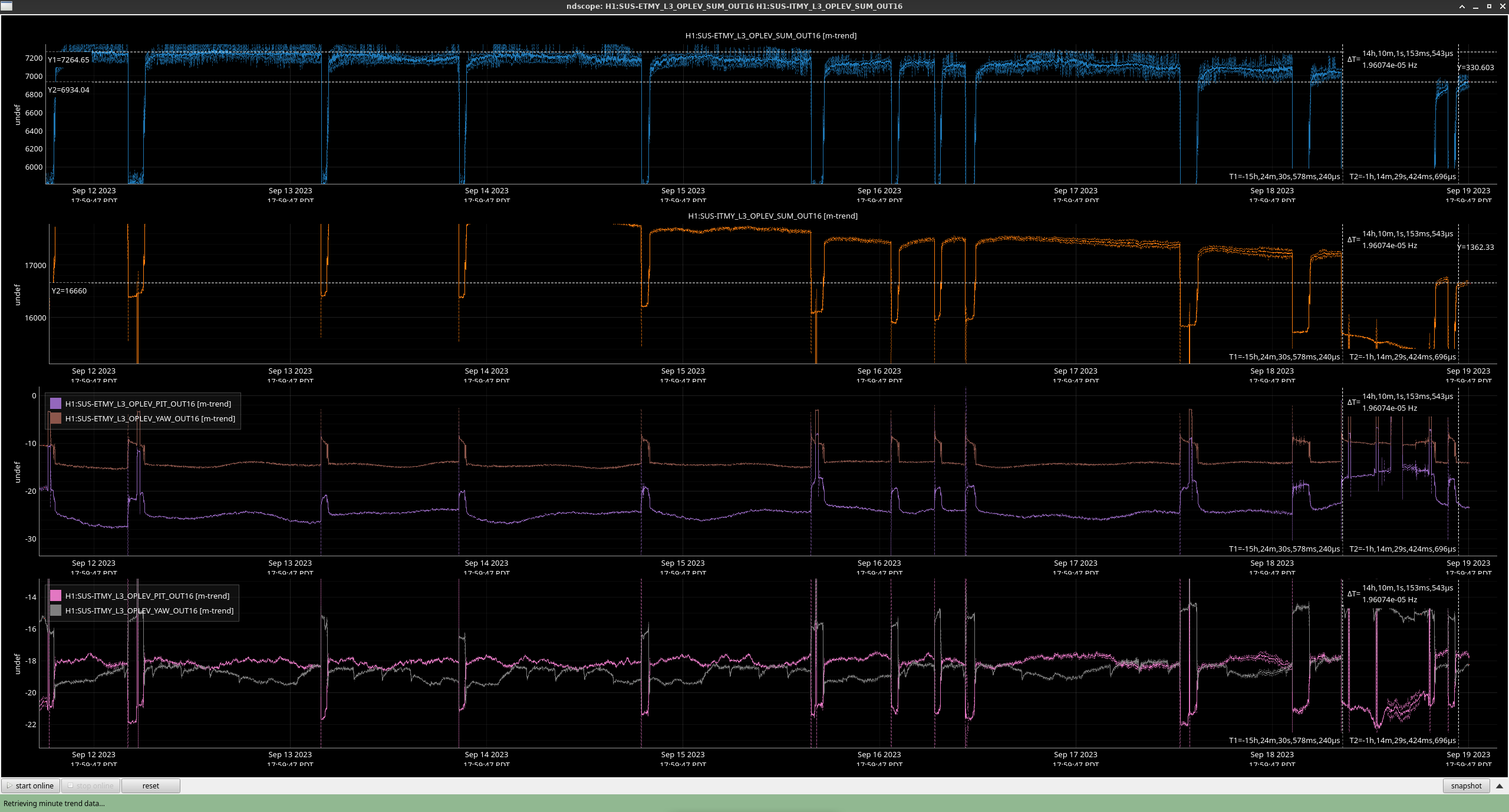
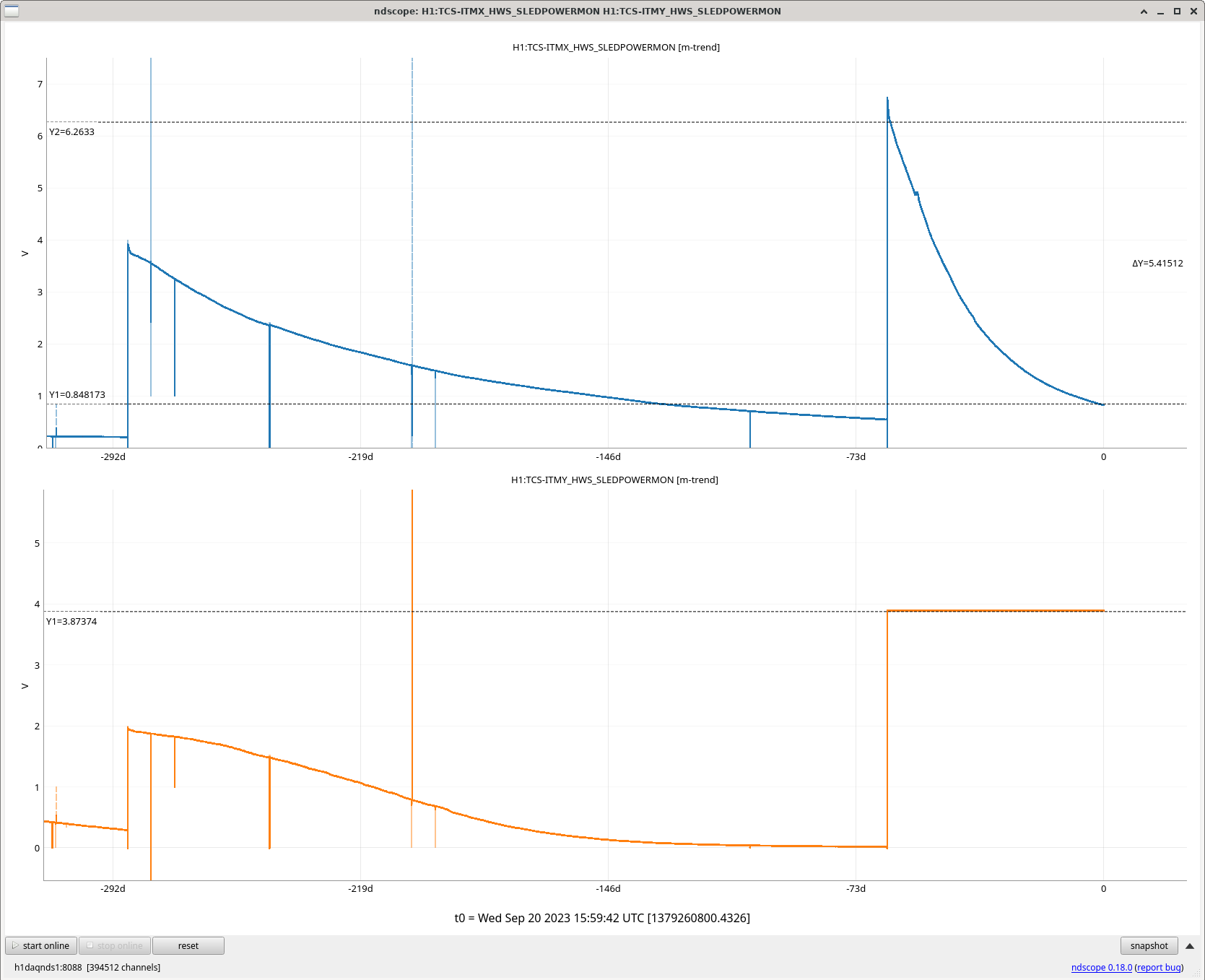
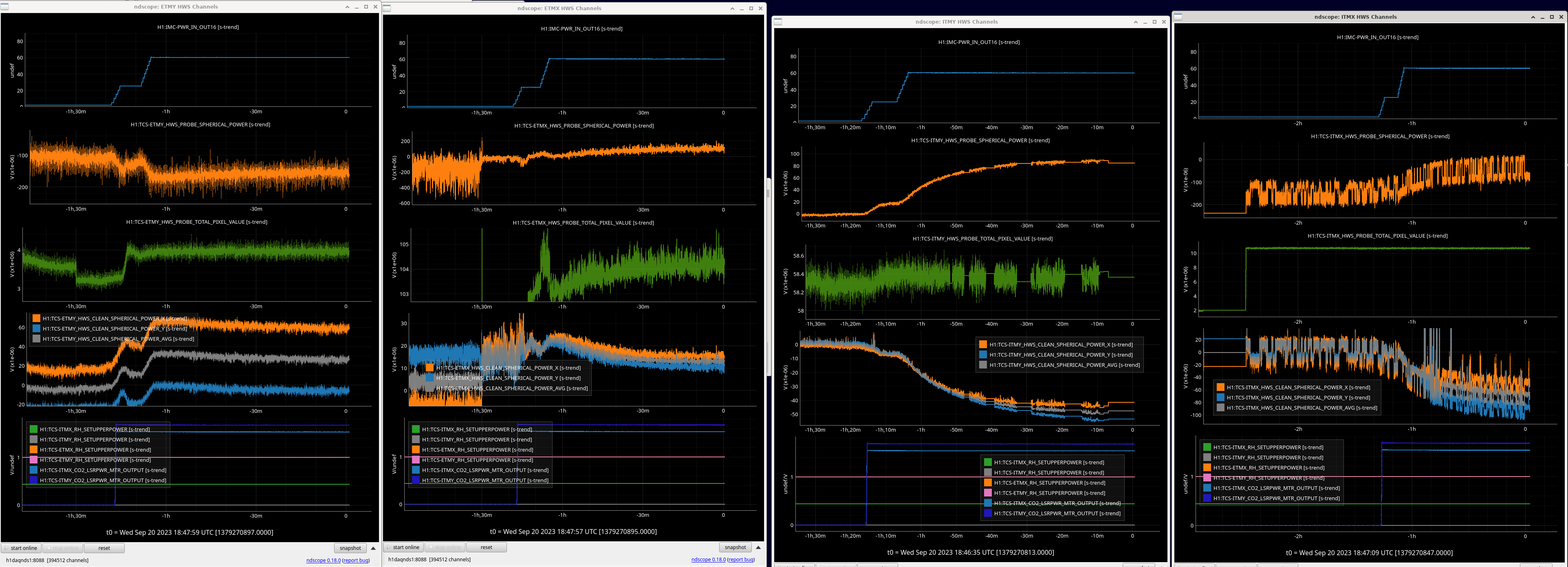
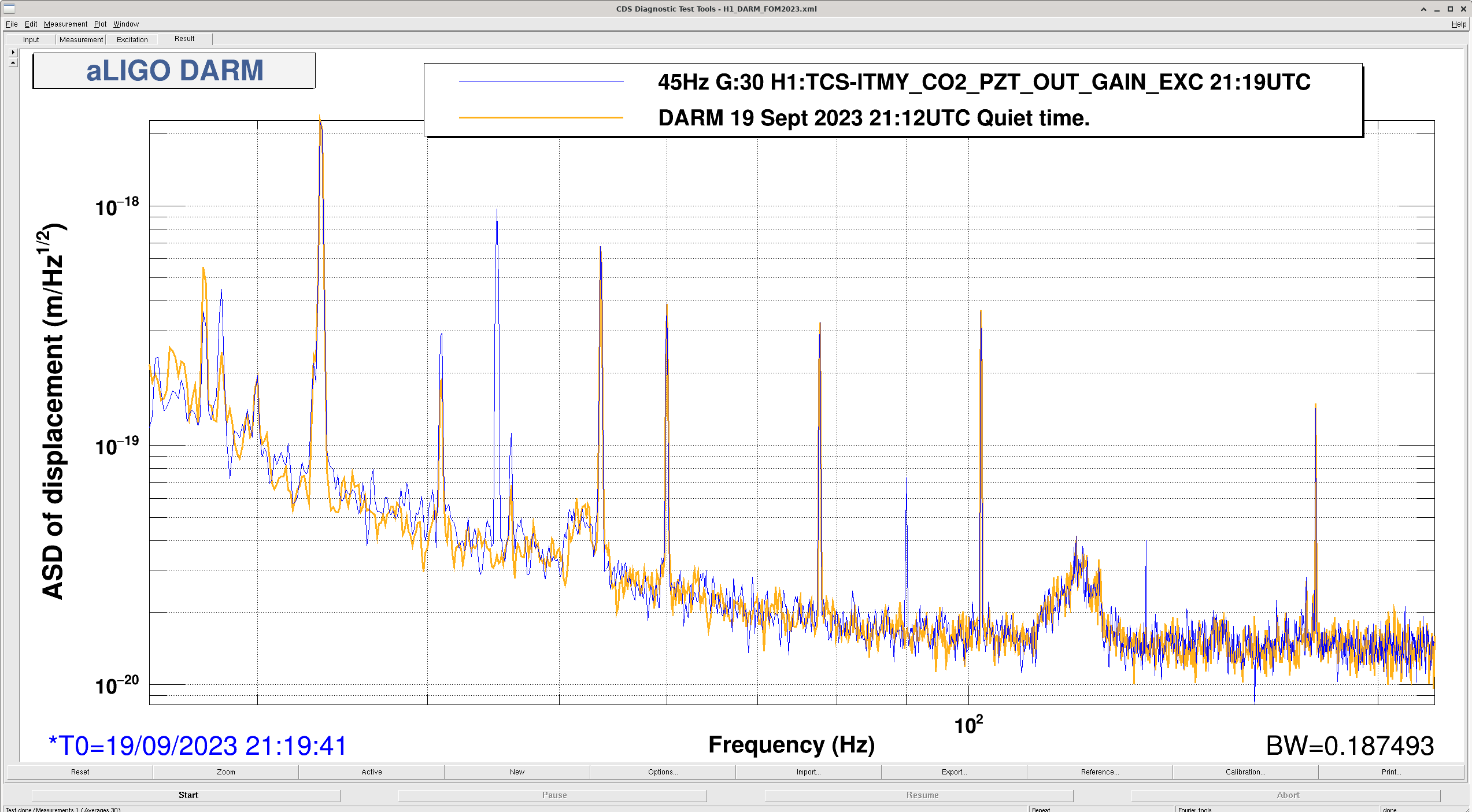
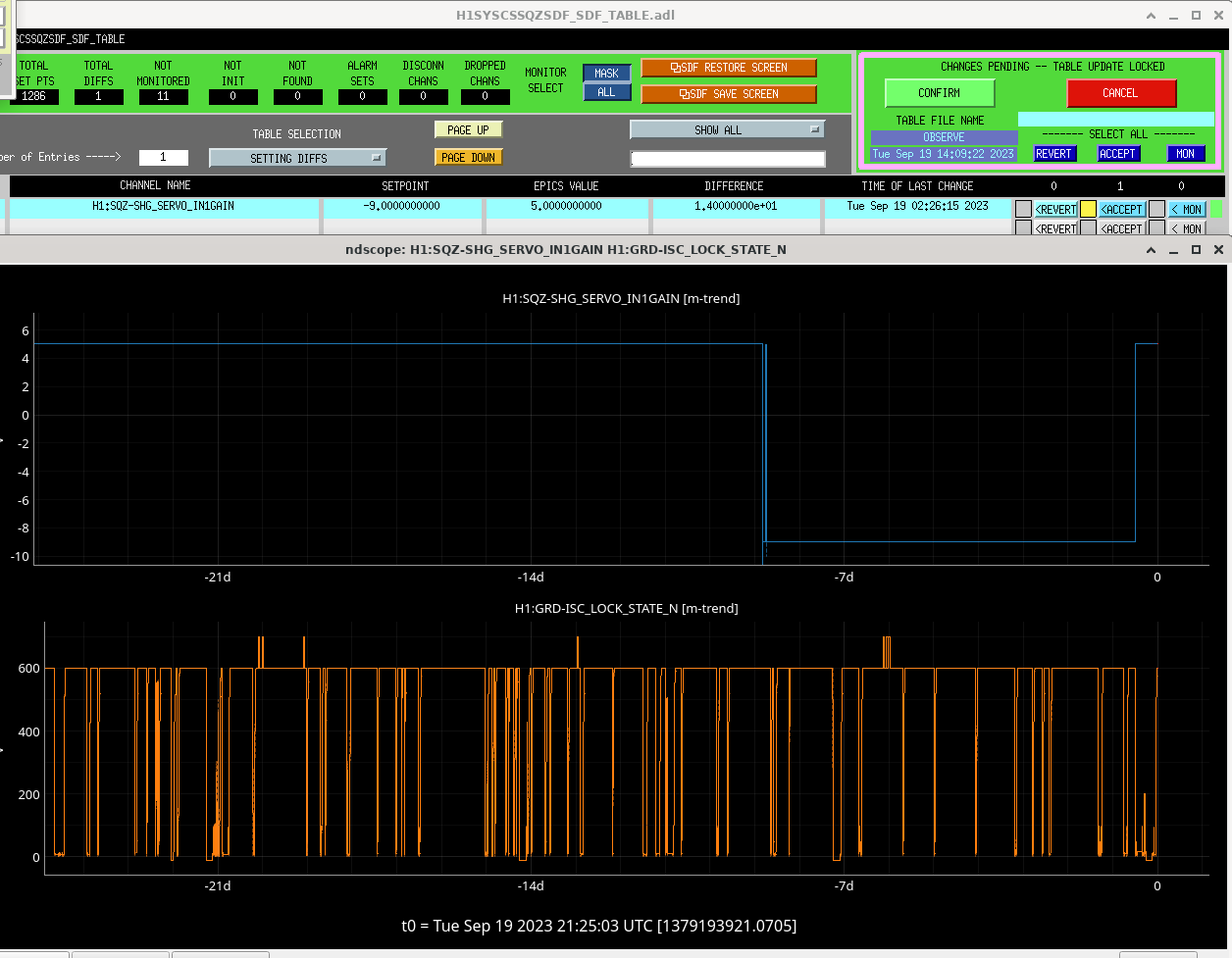
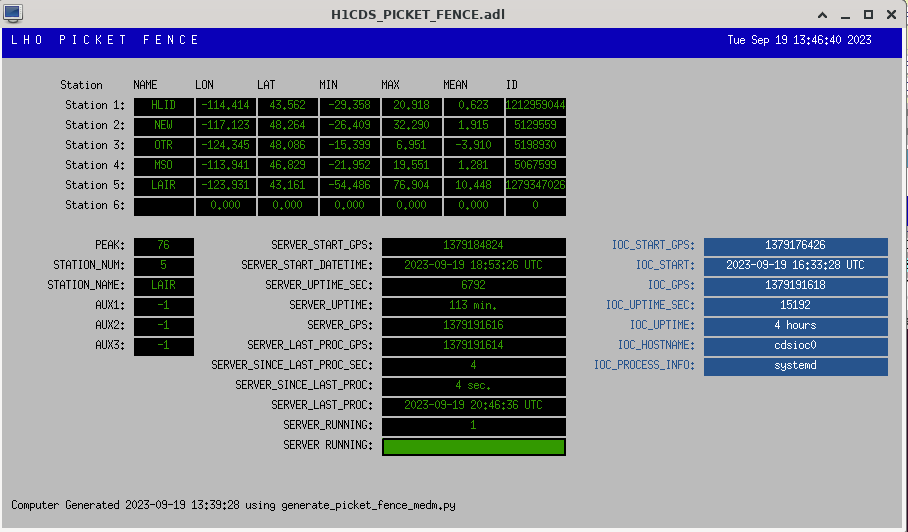
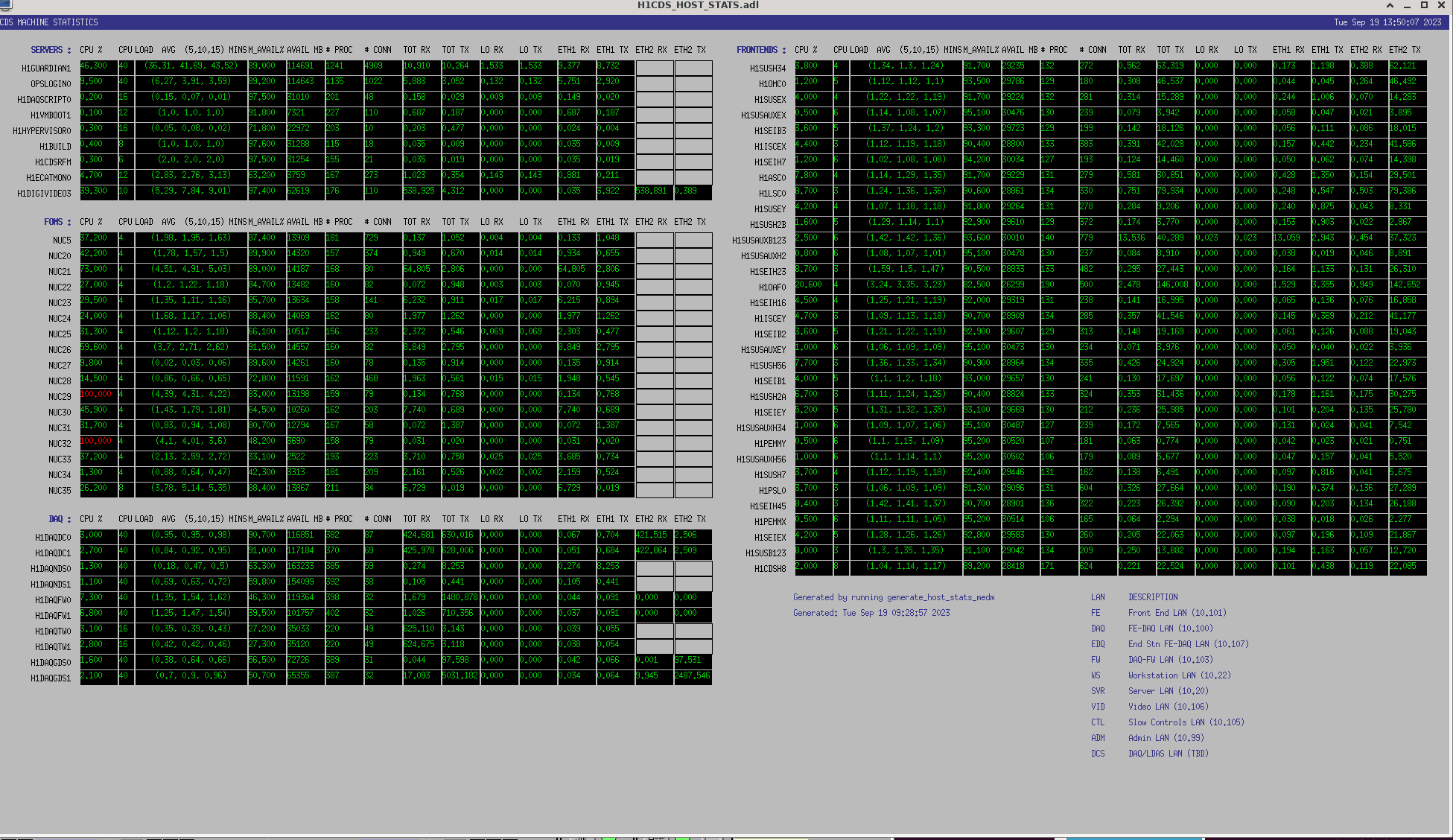
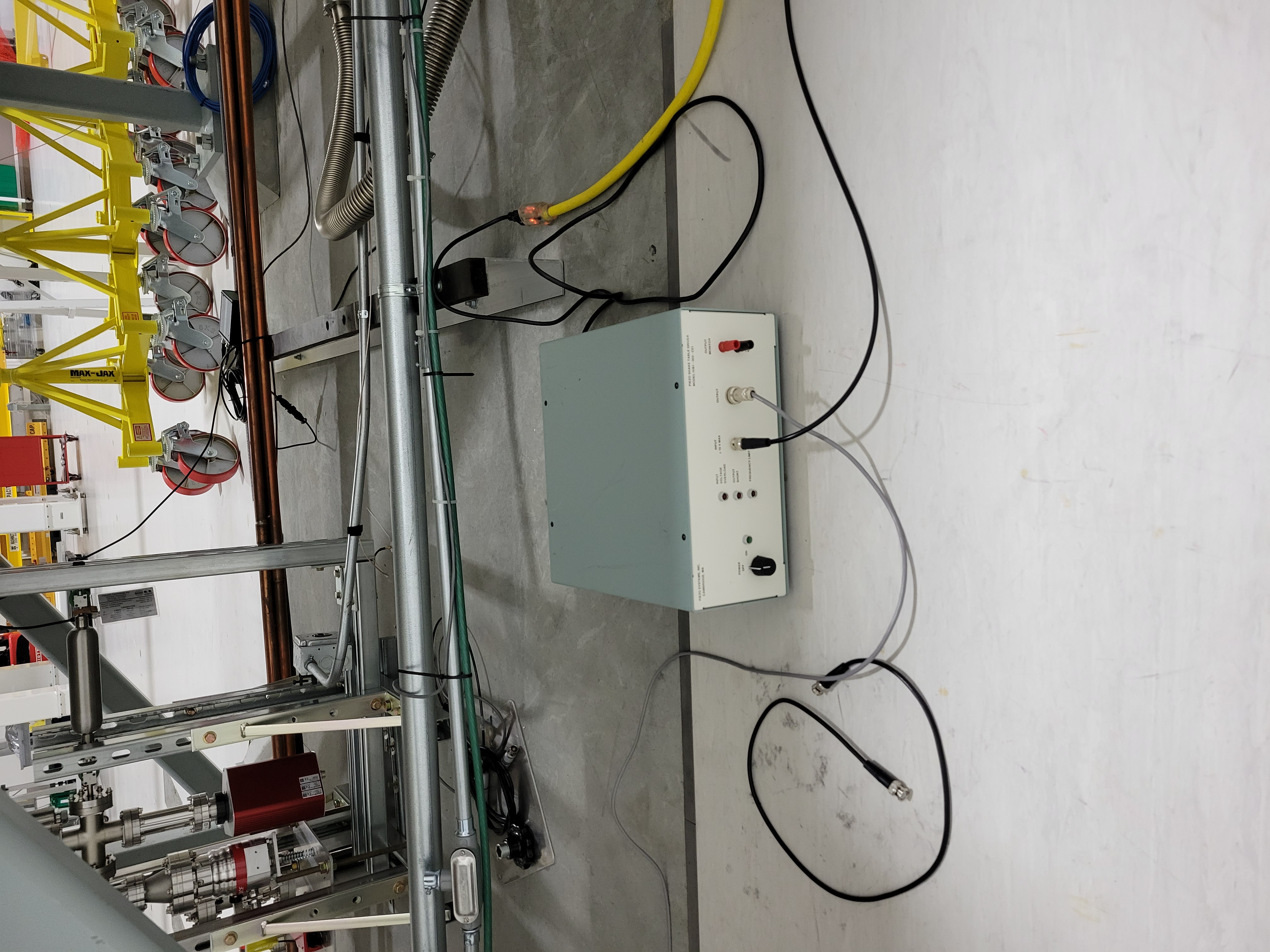
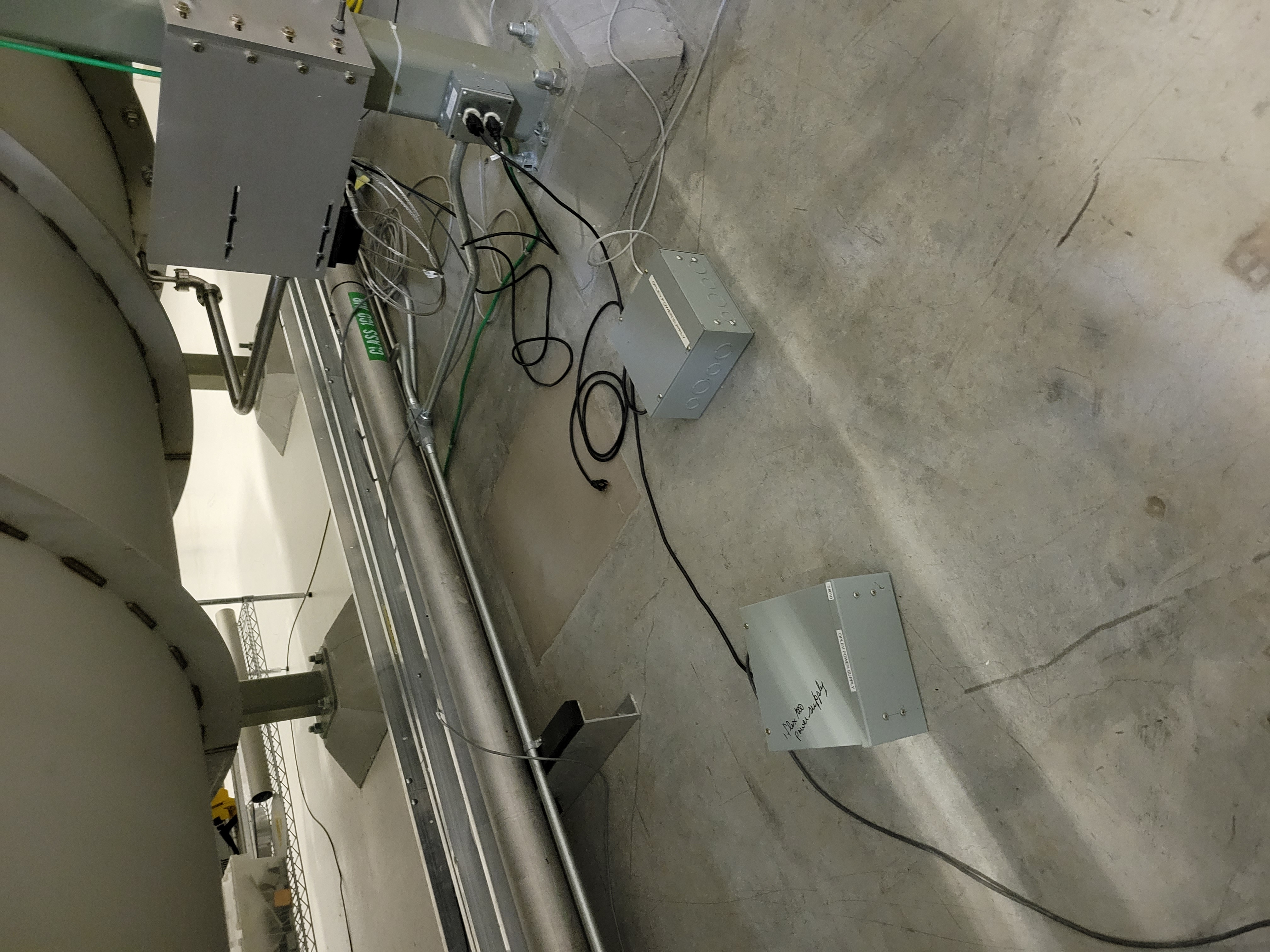
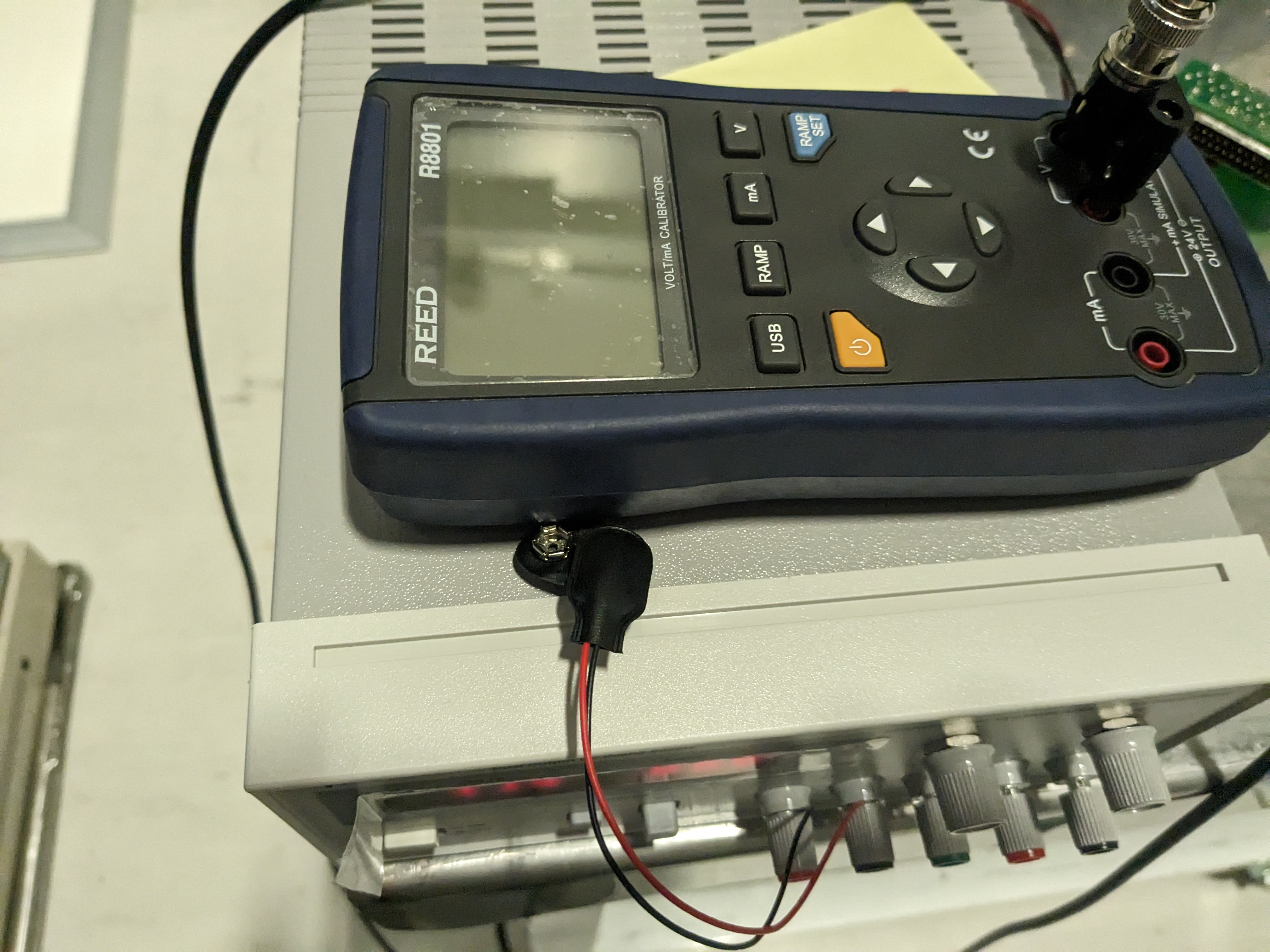
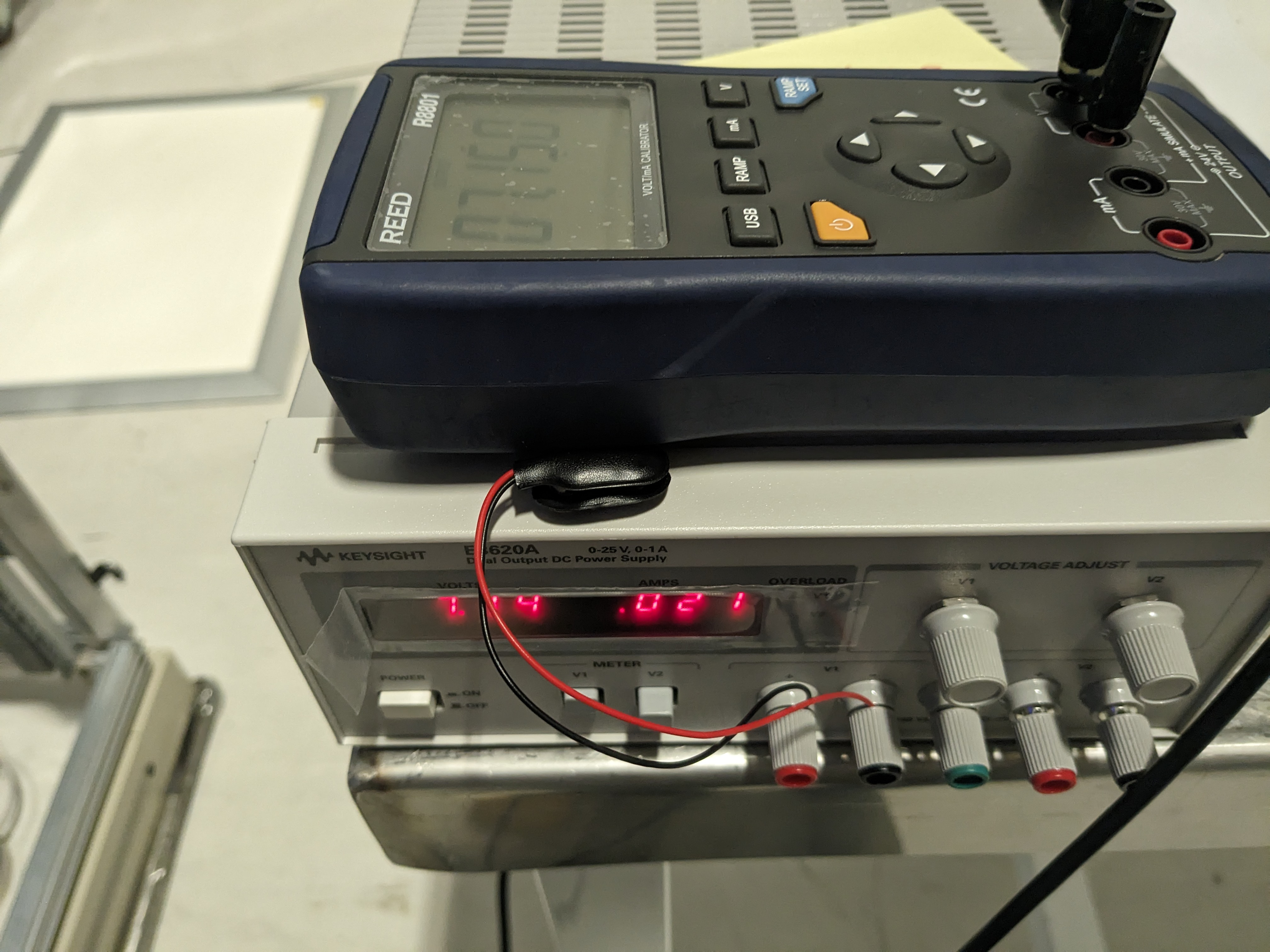
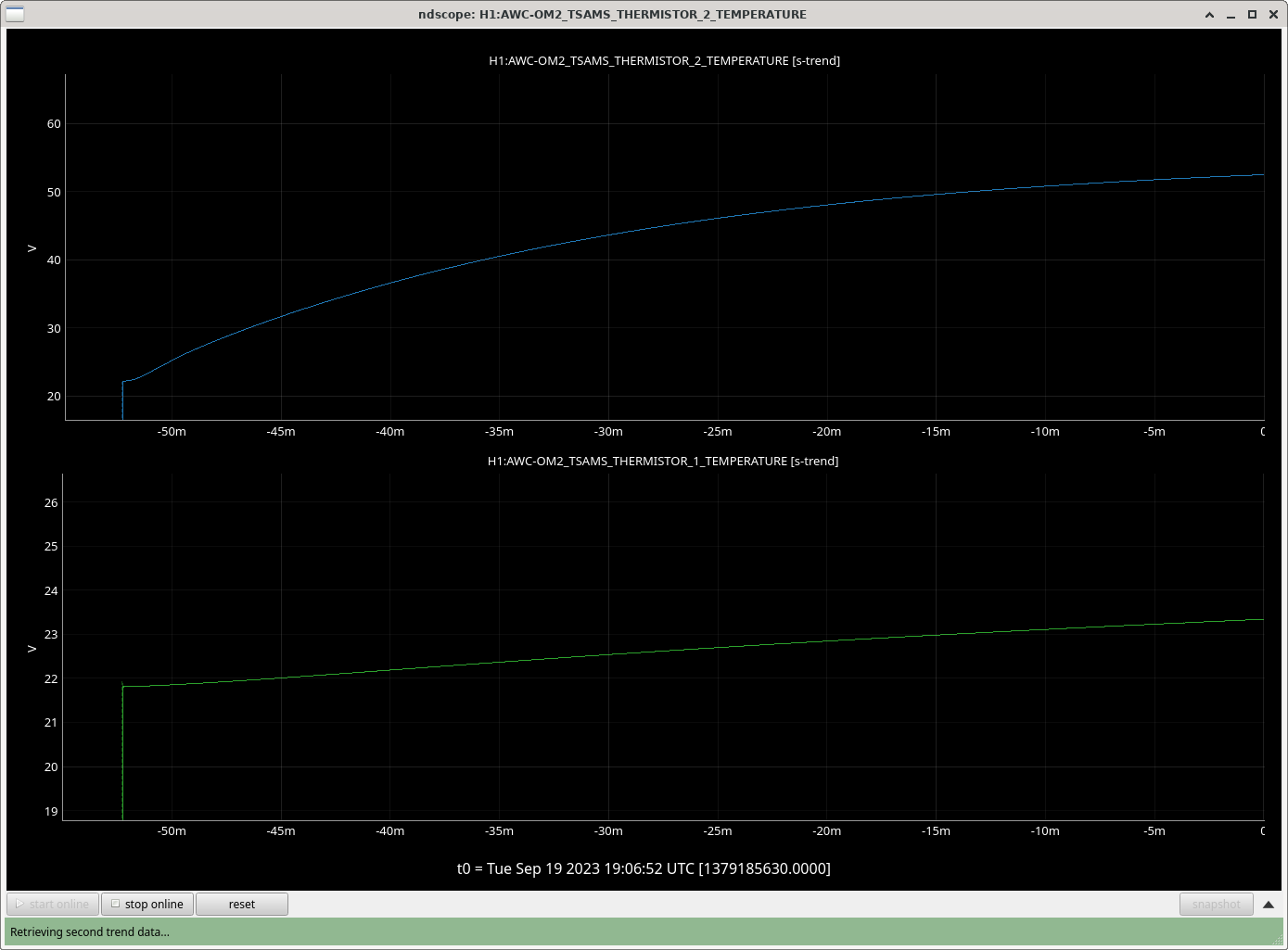
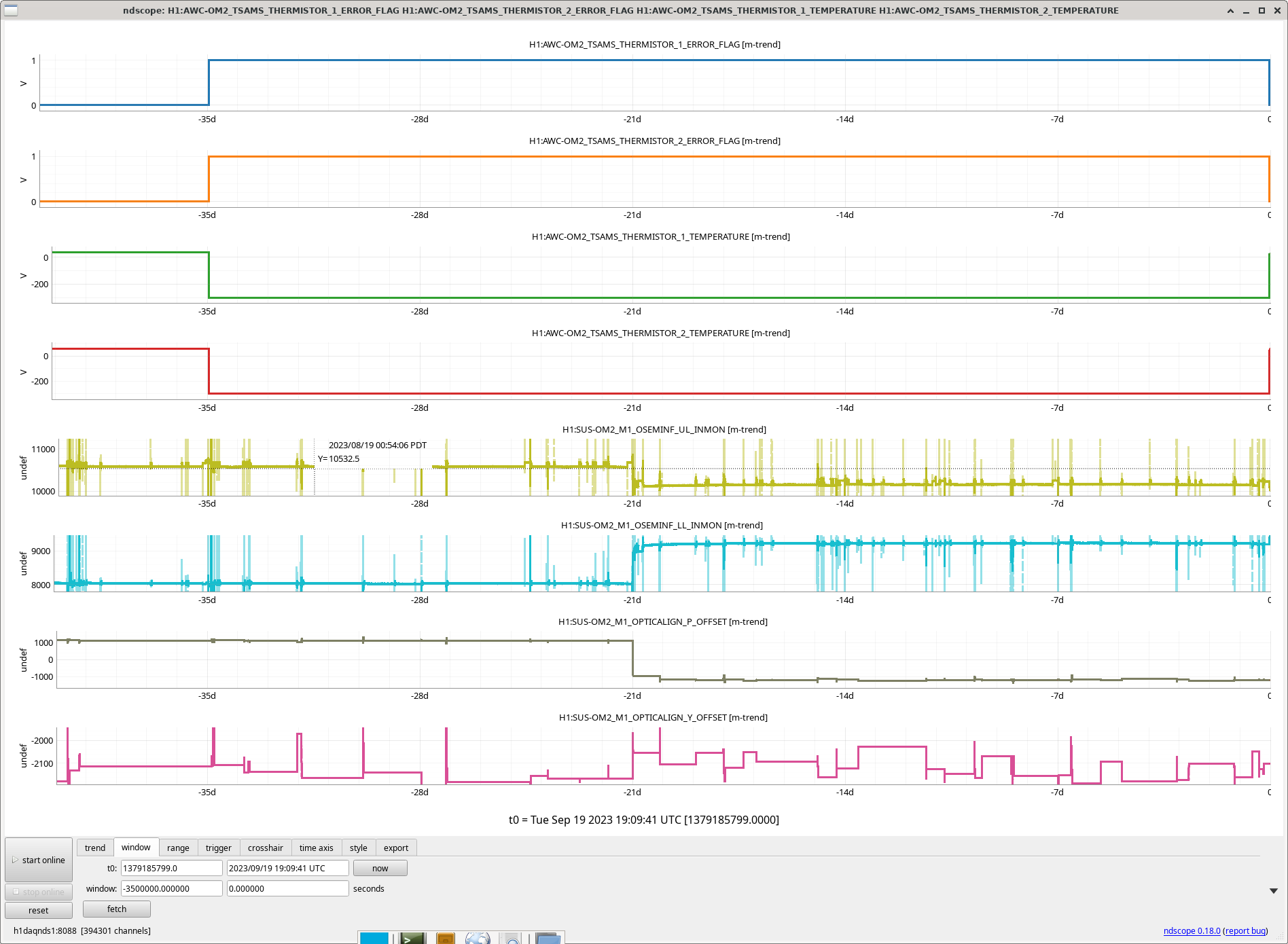
This is the last dewar jacket to be pumped. - it's been started on 7/5; 11:26, pressure: 22 microns - last measurement: 7/6; 09:52, pressure: 9 microns The pumping will stop on Friday afternoon. The possibility to pump the dewar jackets during run times was already justified with some simple experiments, see it here: https://alog.ligo-wa.caltech.edu/aLOG/index.php?callRep=70178
Thu Jul 06 10:05:35 2023 INFO: Fill completed in 5min 35secs
Travis confirmed a good fill from curbside
Edit: I made an error in calibrating mA to mW, changes to this alog are coming soon.
Last Tuesday we stepped up the ring heater and did a couple of DARM offset steps before and after the change.
The first attachment shows the trends of the two sets of DARM offset steps and the two hour transitent of OM2, in that time the power on OMC refl increased by 3%. The next plots show the DARM offset steps, each was for 1 minute and the steps were larger than in 69653 to help make a small change more easily measureable. With OM2 cold, the refl diode still doesn't seem like it makes a nice measurement of the darm offset light reflected by the OMC, with OM2 hot it is clear that we can see the change in OMC refl when the DARM offset steps.
change in HAM6 throughput estimated by AS_C
For both hot and cold OM2, we can use the power change on AS_C to estimate the HAM6 throughput. Calibrating DCPD sum into Watts using 0.858e-3 A/W gives 63% HAM6 throughput for cold OM2 with 60W input power, and 57% throughput for the hot OM2. (A 9.6% decrease in HAM6 throughput from heating OM2) This can be compared to 69653, done with 75W input power (430kW in arms) where Jennie W found 82% throughput of HAM6 (Jennie also used 0.858AW for the DCPD responsivity).
change in darm offset infered by power on AS_C
The power incident on HAM6 (measured by AS_C) increased while OM2 was heating up, as can be seen in the first attachment. The estimate of the amount of sideband/carrier junk light on AS_C with OM2 cold is 627mW/628mW and with OM2 hot it is 634mW/635mW. Of the 15mW increase in power on AS_C, 7.4mW is DARM offset light while 8mW is sidebands/contrast defect light. The DARM offset light at AS_C increased from 54mW to 60.6mW, this should be caused by the change in DARM offset needed to keep the power on the OMC DCPDs constant while the HAM6 throughput changed, so the darm offset increased by sqrt(60.6/54) =6% . This implies a decrease in HAM6 throughput of throughput_cold/throughput_hot = (darm_offset_hot/darm_offset_cold)^2 = 60.6/54 = 1.12 , or 11% decrease in HAM6 throughput from heating up OM2.
OMC mode matching from OMC refl diode
The light which is insensitive to DARM in OMC reflection increased from 623.3/624mW to 634.4mW . Similar to llo 60885, the darm offset light on AS_C times 0.985*0.993 to account for the reflectivity of OM3 and the OMC QPD pickoff, means that there is 53mW/52.6mW of darm offset light incident on the OMC for cold OM2 and 59.3mW for hot OM2. We can estimate the mode matching of the OMC (which could include misalignment) as 1-reflected darm offset light/ incident darm offset light which gives 96% mode matching for the cold OM2 (where the measurement may be suspect) and 85.6% or 85.2% mode matching for the hot OM2. This would imply an 11% decrease in HAM6 throughput from heating OM2.
Optical gain change
The normalized optical gain (kappa c) dropped from 1 to 0.98 while OM2 was heating up. Since the power on the DCPDs is kept constant, the DARM offset changes when the HAM6 throughput changes, and the optical gain should be proportional to the sqrt(HAM6 throughput), which would imply a 4% decrease in HAM6 throughput from heating OM2.
| DCPD sum (mW) | AS_C sum (W incident on HAM6) | OMC refl (mW) | om2 |
| 4.58 | 0.634 | 624 | cold |
| 34.3 | 0.6801 | 626 | |
| 4.58 |
0.635 |
624 | |
| 34.3 | 0.682 | 626 | |
| 4.58 | 0.643 | 636 | hot |
| 34.3 | 0.696 | 643 | |
| 4.58 | 0.643 | 636 | |
| 34.3 | 0.696 | 643 |
gps times:
# DARM offset OM2 scan log file, gps start, gps stop
Please ignore the alog above, I will reproduce it here with corrected numbers with the responsivity used correctly.
Summary: With a cold OM2 we estimate 11% unknown HAM6 losess (including OMC losses, modemismatch, DCPD QE), with hot OM2 that goes to 21%. We can estimate the change in HAM6 throughput 4 ways, three methods that depend on the DARM offset steps agree that the HAM6 throughput with hot OM2 is 90% of what it is with cold OM2. The optical gain suggests that the throughput only dropped to 96% of what it was for cold OM2.
Details:
Last Tuesday we stepped up the ring heater and did a couple of DARM offset steps before and after the change. The first attachment shows the trends of the two sets of DARM offset steps and the two hour transitent of OM2. The next plots zoom in on the DARM offset steps, each step was for 1 minute and the steps were larger than in 69653 to help make a small change more easily measureable. With OM2 cold, the refl diode still doesn't seem like it makes a nice measurement of the darm offset light reflected by the OMC, with OM2 hot it is clear that we can see the change in OMC refl when the DARM offset steps.
change in HAM6 throughput estimated by AS_C
For both hot and cold OM2, we can use the power change on AS_C to estimate the HAM6 throughput. Calibrating DCPD sum into Watts using 0.858e-3 A/W gives 86% HAM6 throughput for cold OM2 with 60W input power, and 77% throughput for the hot OM2. This can be compared to 69653, done with 75W input power (430kW in arms) where Jennie W found 82% throughput of HAM6 (Jennie also used 0.858AW for the DCPD responsivity). We can add up known HAM6 losses from the SQZ loss wiki, 0.993(OM1)*0.985(OM3)*0.9926(OMC QPD) = 97% HAM6 transmission if OMC mode matching, losses and QE were perfect. This means that we have 11% additional HAM6 losses for a cold OM2, and 21% for the hot OM2. (The HAM6 throughput with OM2 hot is 90% of what it is with OM2 cold)
change power on AS_C from darm offset and sidebands/contrast defect
The estimate of the amount of sideband/carrier junk light entering HAM6 based on AS_C is 623mW/624mW with OM2 cold and with OM2 hot it is 634mW. This 10-11mW increase might be due to the alignment shift in the SRC that Elenna plotted 70886 which could be due to the change in gouy phase on the AS WFS when OM2 changes. The total power incident on HAM6 increased by 15mW during the OM2 thermal transient, the light from the DARM offset increased by 6-6.6mW. When the HAM6 throughput changes from cold (eta) to hot (eta') the darm offset has to change from cold X to hot X' = X* sqrt(eta/eta') to keep the power on the DCPDs the same, which increases the DARM offset light on AS_C by eta/eta' (so, as_darm_power_hot/as_darm_power_cold = HAM6 througput cold/ HAM6 throughput cold). This implies that the HAM6 throughput with OM2 hot is 89% of the HAM6 throughput with a cold OM2.
OMC mode matching from OMC refl diode
The light which is insensitive to DARM in OMC reflection increased from 623.3/624mW to 634.4mW . We can estimate the OMC mode matching with an approach like llo 60885: there is 53mW of darm offset light incident on the OMC for cold OM2 and 59mW for hot OM2 (taking into account known HAM6 losses). We can estimate the mode matching of the OMC (which could include misalignment) as 1-reflected darm offset light/ incident darm offset light which gives 96% mode matching for the cold OM2 (where the measurement may be suspect) and 85.4% or 85.2% mode matching for the hot OM2. This implies that the OMC mode matching with OM2 hot is 89% of what it is with OM2 cold.
Optical gain change
The normalized optical gain (kappa c) dropped from 1 to 0.98 while OM2 was heating up. Since the power on the DCPDs is kept constant, the DARM offset changes when the HAM6 throughput changes, and the optical gain hot/optical gain cold = sqrt(throughput hot/throughput cold). Kappa c of 0.98 implies that HAM6 throughput with OM2 hot is 96% of the throughput with OM2 cold.
| DCPD sum (mW) | AS_C sum (W incident on HAM6) | OMC refl (mW) | om2 |
| 6.2 | 0.634 | 624 | cold |
| 46.6 | 0.6801 | 626 | |
| 6.2 |
0.635 |
624 | |
| 46.6 | 0.682 | 626 | |
| 6.2 | 0.643 | 636 | hot |
| 46.6 | 0.696 | 643 | |
| 6.2 | 0.643 | 636 | |
| 46.6 | 0.696 | 643 |
# DARM offset OM2 scan log file, gps start, gps stop
TITLE: 07/06 Day Shift: 15:00-23:00 UTC (08:00-16:00 PST), all times posted in UTC
STATE of H1: Observing at 147Mpc
CURRENT ENVIRONMENT:
SEI_ENV state: CALM
Wind: 5mph Gusts, 3mph 5min avg
Primary useism: 0.01 μm/s
Secondary useism: 0.10 μm/s
QUICK SUMMARY:
Inherited an IFO thats been locked for 33 hours and Observing! YAY!
TITLE: 07/06 Owl Shift: 07:00-15:00 UTC (00:00-08:00 PST), all times posted in UTC
STATE of H1: Observing at 145Mpc
SHIFT SUMMARY: Quiet night, observing for the entire shift. H1 has now been locked and observing for 33.5 hours. Some small earthquakes and one GW candidate: S230706ah
LOG:
| Start Time | System | Name | Location | Lazer_Haz | Task | Time End |
|---|---|---|---|---|---|---|
| 14:53 | FAC | Karen | MY | - | Technical cleaning | Ongoing |
| 14:54 | FAC | Kim | MX | - | Technical cleaning | Ongoing |
FAMIS 19963
pH of PSL chiller water was measured to be between 10.0 and 10.5 according to the color of the test strip.
State of H1: Observing at 143Mpc
H1 has been locked and observing for almost 30 hours. Another quiet night on site; SEI_ENV just moved back to CALM a few minutes ago after being in SEISMON_ALERT and the EQ not showing.
TITLE: 07/06 Owl Shift: 07:00-15:00 UTC (00:00-08:00 PST), all times posted in UTC
STATE of H1: Observing at 143Mpc
CURRENT ENVIRONMENT:
SEI_ENV state: CALM
Wind: 5mph Gusts, 4mph 5min avg
Primary useism: 0.01 μm/s
Secondary useism: 0.09 μm/s
QUICK SUMMARY: H1 has been locked for 25.5 hours. Things are quiet; ground motion, wind, and violins are low.
TITLE: 07/06 Eve Shift: 23:00-07:00 UTC (16:00-00:00 PST), all times posted in UTC
STATE of H1: Observing at 146Mpc
SHIFT SUMMARY:
LOG:
We had a small 4.6mg EQ from Argentina that was coming in (seen in ASC and PEAK_MON but not in seismon), I tired to manually take SEI_ENV to SEISMON_ALERT but there was no path so I took the request back to CALM. Tagging SEI.
Violins: Turned of EX19 damping 71093. Currently only violins rung up (3.5-4 on OUTMON channels) EX18, EX19 and EY06, EY18, EY20. They are very slowly damping themselves and the spreadsheet shows damping them can ring up other modes so I haven't changed anything.
The TRANSITION_BACK_TO_ETMX state of the SUS_CHARGE guardian has been causing the majority of our locklosses prior to Tuesday Maintenance, e.g. 69437, 70861.
I looked into this again and found that the ITMX LOCK_L gain is being turned off before the ITMX to ETMX transition has completed. The ramp time of the swap is 20 seconds but the code only waits 15 seconds before moving on, see attached plot and code.
We are using a ezca.get_LIGOFilter and the wait=True parameter isn't waiting the full ramp_time specified, created Issue 15. I've changed the wait to be False and added a 20s sleep timer. The SUS_CHARGE guardian will need to be reloaded when we are out of observing.
Once I remembered that SUS_CHARGE is not one of the guardian nodes monitored for the observation intent bit (although its subordinate nodes are), I reloaded it this morning at 14:02 UTC so Camilla's changes are pushed in.
This fixed the SUS_CHARGE code and we successfully stayed locked throughout both ESD transitions on Tuesday.
Total time taken is 18 minutes, this is longer than the 15 minute target. I've reduced the slowy_ramp_on_bias() ramptime back from 60 to 20 seconds, as I've reverted some of 68987 changes I was blaming for the looklosses. ESD_EXC_{QUAD} will need to be reloaded for each quad for this to take effect.
Currently the SUS_CHARGE code is taking 16m45s. We could look at further decreasing some tramps.
TJ noticed this morning that the L2L tramps for ITMX and ETMX weren't reverted by the code. I've added lines to SUS_CHARGE to save and revert these after the ESD transitions and also save adn reset the ITMX_L2L gain so it's not hard-coded.
I just turned off the EX19 damping Ryan and I turned on last night (FM1,2,10 Gain -30 71066) as the mode seemed to be very slowly turning around and the damping was so slow anyway, see attached. Tagging SUS.
Following up on the DARM bicoherence observation and the non-stationarity of low frequency noise: the noise in DARM between 20 and 40 Hz is correlated with the amplitude of the 2.6 Hz peak
The attached plot is an histogram of the DARM RMS in the 20-37 Hz region (computed by summing bins in a whitenend spectrogram) and the DARM RMS around the 2.6 Hz peak (computed with a band-pass filter between 2.4 and 2.7 Hz).
There is a clear correlation between the DARM noise in the 20-40 Hz region and the RMS in the 2.6 Hz region.
An exploration of where the 2.6 Hz peak is visible and coherent with DARM
The ETMX M0 / R0 / TMSX are interesting signals, maybe something isn't working properly in the R0 tracking loop?
The usual ASC suspects, especially CHARD_Y.
Several DC centering loops.
Some OMC signals.
No smoking gun
I have some evidence that could indicate that this peak is related to some instability in the HARD loops.
First, we noticed this 2.6 Hz peak is very prevalent in the OMC and OM3 suspensions. Evan was tracking the presence of the peak in OM3 yaw and noted it appeared sometime around April 9-14. This was a tricky time because many things happened: we powered up, we adjusted the compensation plates and OMC to reduce scatter, etc. Evan also noticed it doubled in size on June 22, which corresponds to when we went down in power. I used the OMC SUS master out channels as an indicator of when this peak appeared. I noticed it was not present April 7th and then appeared on April 8th, UTC time. More specifically, it appeared in the Lownoise ASC guardian state. This was around the time I was working on removing RPC completely from the ASC control and working with Dan and others on increasing the power. It appears that the peak pops up right when I turned off the RPC and transitioned all the HARD loops to the new high power controllers.
The fact that the peak height doubled when we went down in power also bolsters this theory: if there was something a bit marginal in the loop at higher power, the shift in the radiation pressure plant could have worsened the marginality. To further confirm, I looked at spectra of the HARD and SOFT loops, and the 2.6 Hz peak becomes prominent around the time I changed the loop control and turned off RPC.
As a test, Gabriele and I would like to make small changes in the HARD loop gains and see if we can pinpoint which loop is marginal. If we're lucky, the peak could be fixed with a gain change. If we're less lucky, maybe we need to redo one or more loop controllers.
First attachment is an ndscope screenshot. I plotted the guardian state, RPC gains, and the SWSTATs for all the HARD loops. The cursor is on the time when I hard turned off all the RPC gains and switched the loop controllers. GPStime: 1364955781. This also corresponds to when the peak appears in the OMC suspension channels.
Second attachment is a dtt screenshot of a plot comparing the OMC sus master out spectra now (blue refs) with the spectra on April 7 before the ASC change (red live).
Edit to add: Gabriele and I tested raising and lowering various ASC loop gains but we saw no difference in the peak.
We also hypothesized that this is related to the reaction chain tracking and/or damping. We turned off the reaction chain tracking of ETMX for L, P and R and saw no change in the peak.
Summary of the report:
Link to the full report: Report
V. Bossilkov, L. DartezSummary We gave the simulines calibration injection scheme another go at LHO during this week's commissioning window. In short, the commissioning endeavor was partially successful: we did not lose lock and we were able to gather useful data for the actuation stages and the DARM OLG. However, additional commissioning time is required before we can fully adopt simulines for the regular calibration measurements at LHO.
Objective
The goal of today's session included the following: 1.) Determine whether we can run simulines at LHO reliably without losing lock, 2.) assess the data quality of the recorded simulines hdf5 files and confirm that they can be read and post-processed 3.) evaluate the spacing of the common frequency vector that is used for all measurements 4.) tweak the injection amplitudes and integration length to get a good enough SNR while keeping the amplitudes and integration lengths as low as possibleCode Execution
We ran two trials with injections at different amplitudes: 0.5*A and 0.1*A, where A is the corresponding amplitude typically used for the same injections in DTT. Simulines uses a configuration file in.INIformat to inform the various injections of their frequency vectors, amplitudes, and other settings. The two files we used, both of which are located in/ligo/groups/cal/src/simulines/h1_test_settings, are named as follows: Half the DTT amplitude:settings_h1_0.5.iniOne tenth the DTT amplitude:settings_h1_0.1.iniThese files are contained within the simulines repo as of commit bf25b1b4. The simulines code was run using the following command from within the repo'ssimulinesdirectory:python simulines.py -i ../h1_test_settings/settings_h1_0.5.iniThe terminal output for both runs is attached here. All measurements were placed in/ligo/groups/cal/H1/measurementsas they would during a normalpydarm measureexecution. Once recorded, we ran a quick script that Vlad wrote to take a look at each measurement's uncertainty as it compares to those taken with DTT. The script used lives at/ligo/home/louis.dartez/projects/20230705/simulines_commissioning/simulinesUncert_H1.py. This script compares each simulines injection with a corresponding DTT injection. The exact DTT injections used for this initial test run are listed in the script source code (uploaded to this alog for redundancy).Results
We were able to successfully run simulines for all of the normal calibration measurement sweeps (we did not take any broadband measurements). The table below contains plots comparing the uncertainty from the simulines (SL) injections vs the same using diaggui (DTT). The top plot in each figure shows an overlay of the uncertainty from the SL injection and the DTT injection. The bottom plot contains the residual (SL_unc / DTT_unc). The left and right columns correspond to the 0.5*"DTT Amplitude" and 0.1*"DTT Amplitude", respectively. Each actuation stage is displayed on its own row.
| 0.5*Ampl | 0.1*Ampl | |
|---|---|---|
| ETMX L1 | ![]() | ![]() |
| ETMX L2 | ![]() | ![]() |
| ETMX L3 | ![]() | ![]() |
The two simulines injections were at the following GPS times: Trial 1 Start: 2023-07-05 19:02:04.672 UTC GPS 1372618942.672165 Trial 2 Start: 2023-07-05 19:25:27.781 UTC GPS 1372620345.781883 Each simulines suite ran for approximately 23 minutes.
Naoki, Sheila, Vicky. B/c of recent issues with SQZ_ASC not engaging (eg 71057, 70890), range can hover ~120 instead of >145 (!!). So, we added a state to SQZ_MANAGER that operators can use to clear asc, "RESET_SQZ_ASC". See new guardian graph (vs old graph).
Tagging OpsInfo: If range hovers low ~120 and SQZ_MANAGER has the yellow notification like "SQZ ASC AS42 not on?? Please RESET_SQZ_ASC", can do the following (~10 seconds):
If this doesn't work, the following is a longer solution (~5 min) which includes resets the squeezer ASC offsets, in case that's the problem:
Usually our ASC offsets don't change much, unless IFO output alignment or beam changes. SVN code diffs attached, and committed to version 25949.
It seems that the OMC single bounce mode matching is better with hot OM2 than it was with the similar measurement 70409
Daniel turned off the sidebands and manually aligned the locked OMC.
I used an adpated version of the OMCscan class to fit the spectrum up to 20/02 carrier modes. The scan went through two free spectral ranges so I just used the first 60s to make the analysis easier, and assuming that within this 60s of data the third smallest clear peak was 20, and the fourth one was 10 mode.
The fitted spectra is attached.
Then I used an adapted version of fit_two_peaks.py to fit a sum of two lorentzians to the 20 and 02 carrier modes, the fit is shown in the second graph.
We expect the HOM spacing to be 0.588 MHz as per this entry and DCC T1500060 Table 25.
The spacing for the modes measured is 0.549 MHz.
From the heights of the two peaks this suggests mode-mismatch of the OMC to be C02+C20/C00 = (0.457mA+0.629mA)/(16.39mA+0.457mA+0.629mA) = 6.2% mode mis-match.
From the locked/unlocked powers on the OMC REFL PD the visibility on resonance is 1-(1.84mW/22.6mW) = 92% visibility.
If the total loss is 8%, this implies that the other non-mode-matching losses are roughly 1.4%.
To run the OMC scan code go to
/ligo/gitcommon/labutils/omc_scan/ and run
python OMCscan_nosidebands2.py 1371921531 60 "Sidebands off, 10W input, hot OM2" "single bounce" --verbose --make_plot -o 2
in the labutils conda environment and on git branch dev.
To do the double peak fitting run:
python fit_two_peaks_no_sidebands2.py
in the labutils conda environment and on git branch dev.
This was a single bounce scan off ITMX, with 0.44W on the ring heater upper and lower segments, and no CO2.
Using Jennie's mode mismatch of 6.2%, we can use the ratio of locked vs unlocked reflected power to estimate the OMC losses, finesse and transmission for a perfectly mode matched beam.
I've used a time when the fast shutter was blocked from 70409 to subtract the dark offset the refl diodes, this gives reflected power on resonance of 22.61mW, reflected power off resonance of 1.85mW.
The power in the mode mismatch is reflected_power_off_resonance * 6.2% = P_mm 1.4mW
Visibility for the 00 mode is (refl_on_resonance - P_mm)/(refl_off_resonance - P_mm) = 2.1%
The attached script uses this visibility to find the loss using:
def Refl_fraction(r_loss):
on_res = (r1 - (t1**2 * r1 * r_loss)/(1-r1**2*r_loss))**2
off_res = (r1 + (t1**2 * r1 * r_loss)/(1+r1**2*r_loss) )**2
return on_res/off_res
with r1 = sqrt(reflectivity of the input output mirrors) = sqrt(1-7690e-6) from T1500060 page 143, and r_loss = sqrt(1-round trip losses). With a visibilty of 2.1% this gives us a round trip loss of 2616ppm. If true this level of loss would imply a finesse of 351, well lower than previous measurements: 69707. This would imply that the transmission of the OMC cavity for a 00 mode is 73%.
Koji pointed out that infering losses from the visibility as I did above is very sensitive to the HOM content, and including the first order modes above would have resulted in a different value of OMC losses.
As an alternative approach, I adapted a mathematica notebook that Koji shared to use the transmitted power along with the visibility, and infer higher order mode content and cavity transmission by making an assumption about the DCPD QE.
One confusing point about using these reflected power measurements is that we have to correctly take into account that the beam which arrives at the OMC REFL path has reflected twice off the QPD pick off beamsplitter. (So, the incident power on the REFL diode = incident power on OMC breadboard/ R_pick_off^2)
The results we get for cavity losses (and higher order mode content) depend on what we assume for DCPD QE with this method. Below are the results of the attached script run with a QE of 1 and a QE of 96%, this only makes a small change in the higher order mode content we infer, and that small change in HOM also causes a small change in what we infer for the total efficiency of the OMC breadboard in the two cases.
Power on refl diode when cavity is off resonance: 22.612 mW
Incident power on OMC breadboard (before QPD pickoff): 23.052 mW
Power on refl diode on resonance: 1.848 mW
Measured effiency (DCPD current/responsivity if QE=1)/ incident power on OMC breadboard: 81.6 %
assumed QE: 96.0 %
power in transmission (for this QE) 19.598 mW
HOM content infered: 8.069 %
Cavity transmission infered: 93.376 %
predicted efficiency () (R_inputBS * mode_matching * cavity_transmission * QE): 81.616 %
omc efficency for 00 mode (including pick off BS, cavity transmission, and QE): 88.780 %
round trip loss: 540 (ppm)
Finesse: 396.346
assumed QE: 100 %
power in transmission (for this QE) 18.814 mW
HOM content infered: 7.903 %
Cavity transmission infered: 89.479 %
predicted efficiency () (R_inputBS * mode_matching * cavity_transmission * QE): 81.616 %
omc efficency for 00 mode (including pick off BS, cavity transmission, and QE): 88.620 %
round trip loss: 886 (ppm)
Finesse: 388.021
Daniel, Sheila
We turned off the 9 Mhz, 45 MHz, and 117 MHz sidebands in order to do an OMC loss measurement. We used a single bounce beam off of ITMX, with 10W input from the PSL. We spent some time trying to improve the alignment before making OMC scans.
locked: 1370711576 (OMC REFL avg 3.51mW, OMC DCPD sum 15.23mA)
unlocked: 1370711782 (OMC REFL avg 24.73 mW, OMC DCPD sum 0.078 mA)
OMC scan start: 1370712036 duration 100 seconds (2nd order modes are roughly 8% of the 00 mode).
shutter blocked: 1370712337 (OMC REFL avg -0.030 DCPD SUM 8e-4 mA).
Jennie Wright plans to analyze this data to estimate OMC losses.
Here are the plots of ASC-AS_C_NSUM, OMC-QPD_A_NSUM, OMC-QPD_B_NSUM and OMC-REFL_A_LF, during these measurements. ASC-AS_C_NSUM shows between 22.8 and 32.1mW, OMC-QPD_A_NSUM 23.4mW, OMC-QPD_B_NSUM 23.0mW, and OMC-REFL_A_LF 24.8mW. According to Keita OMC-REFL_A_DC has an incorrect calibration and shows 25.2mW. The average of the 2 QPDs would be 23.2mW, which is about 6.5% lower than 24.8mW.
Second screen shots shows a time when the IMC was unlocked. The DC offsets are in the 10s of uW at most.
Using data from the scan I adapted labutils/OMCscan class to plot the fitted scan and adapted labutils/fit_two_peaks.py to fit a sum of two lorentzians functions for distinguishing carrier 20/02 modes.
The first graph is the OMC scan plot, the second is the curvefit for the second order carrier modes.
We expect the HOM spacing to be 0.588 MHz as per this entry and DCC T1500060 Table 25.
The spacing for the modes measured is 0.592 MHz.
From the heights of the two peaks this suggests mode-mismatch of the OMC to be C02+C20/C00 = (0.83+1.158)/(15.32+0.83+1.158) = 11.0% mode mis-match.
From the locked/unlocked powers on the OMC REFL PD the visibility on resonance is 1-(3.51+0.03/24.73+0.03) = 85.7% visibility.
If the total loss is 14.3%, this implies that the other non mode-matching losses are roughly 1.3%.
To run the OMC scan code go to
/ligo/gitcommon/labutils/omc_scan/ and run
python OMCscan_nosidebands.py 1370712036 100 "Sidebands off, 10W input" "single bounce" --verbose --make_plot -o 2
in the labutils conda environment and on git branch dev.
To do the double peak fitting run:
python fit_two_peaks_no_sidebands.py
in the labutils conda environment and on git branch dev.
These scans were done with OM2 cold.
For comparison with new OMC measurements I used Sheila's code to process the visibility, but updated dit to use nds2utils instead of gwpy as I was having trouble using it to get data.
The code is attached and should be run in the nds2utils conda environment on the CDS workstations.
Power on refl diode when cavity is off resonance: 24.757 mW
Incident power on OMC breadboard (before QPD pickoff): 25.239 mW
Power on refl diode on resonance: 3.525 mW
Measured effiency (DCPD current/responsivity if QE=1)/ incident power on OMC breadboard: 70.4 %
assumed QE: 100 %
power in transmission (for this QE) 17.760 mW
HOM content infered: 13.472 %
Cavity transmission infered: 82.111 %
predicted efficiency () (R_inputBS * mode_matching * cavity_transmission * QE): 70.367 %
omc efficency for 00 mode (including pick off BS, cavity transmission, and QE): 81.323 %
round trip loss: 1605 (ppm)
Finesse: 371.769