Naoki, Sheila
We measured the sqz, asqz, and mean sqz with current NLG as shown in the attached figure. The current OPO green trans is 85 and it corresponds to NLG of 12.6 and generated sqz of 15.5dB according to the calibration done on 2/3/23.
To measure the mean sqz, we paused the SQZ MANAGER guardian and turned off SQZ ASC and took LO guardian down.
At 1kHz, squeezing is 3.7dB, mean squeezing is 10.4dB, and anti squeezing is 13.3dB.
We will measure the NLG with seed and try high NLG tomorrow.
Naoki, Sheila
After the OM2 change, the output alignment seems to change shown in alog70886 and this might have caused the SQZ ASC running away yesterday in alog70890. The last time we measured the SQZ ASC sensing matrix was 75W, cold OM2 in alog70308. So we measured the SQZ ASC sensing matrix again with 60W, hot OM2.
We kept the SQZ ASC WFS switch ON and turned off the input switch of the SQZ ASC filter bank. We measured the sensing matrix by stepping ZM5/6 P/Y by 100 count as shown in the first attached figure.
| ZM5 P | ZM6 P | |
| AS A RF42 P | -0.4 | 0.49 |
| AS B RF42 P | -0.23 |
| ZM5 Y | ZM6 Y | |
| AS A RF42 Y | 0.37 | 0.46 |
| AS B RF42 Y | 0.3 |
The sensing matrix changed a lot compared to previous sensing matrix. We calculated the inverse matrix and decided the new input matrix by multiplying the inverse matrix by -10 as follows.
| AS A RF42 P | AS B RF42 P | |
| ZM5 P | 43 | |
| ZM6 P | -20 | 35 |
| AS A RF42 Y | AS B RF42 Y | |
| ZM5 Y | -33 | |
| ZM6 Y | -22 | 27 |
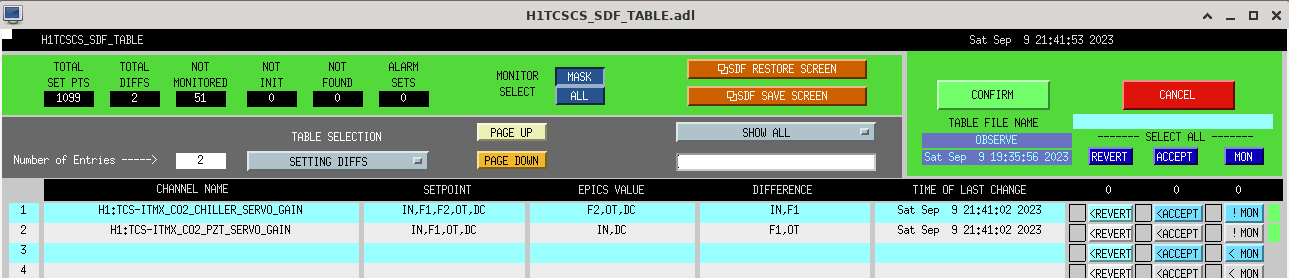
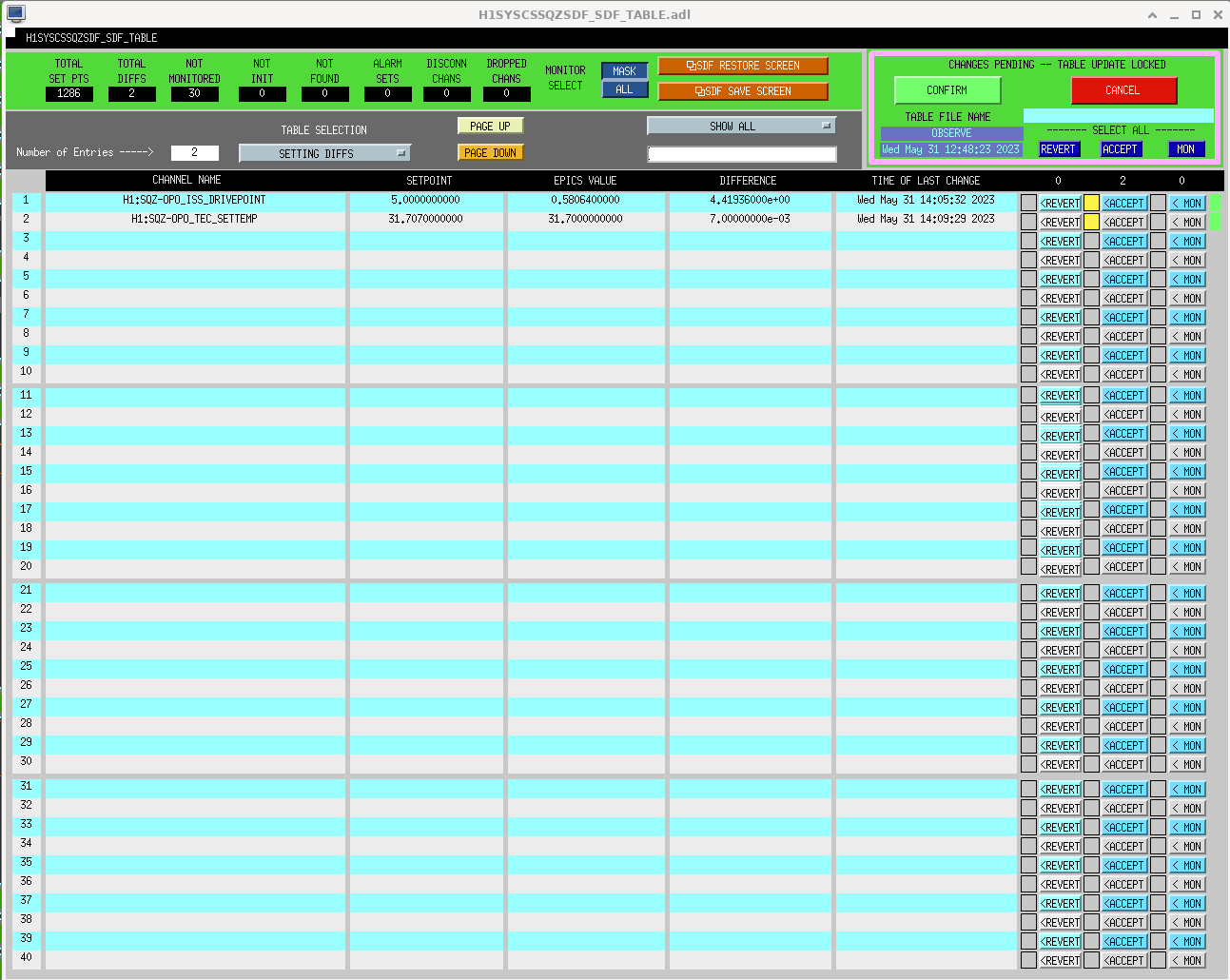
The SQZ ASC works well with new input matrix. We accepted the new input matrix in SDF as shown in the second attached figure.
For cross correlation with 60W, hot OM2, we removed squeezing for 1 hour.
start: 1372017274 (2023/6/28 19:54:16 UTC)
end: 1372021147 (2023/6/28 20:58:49 UTC)
Plots for this time are here: 70978
Today I tried to add in new CHARD P and DHARD Y loop cutoffs. We have seen some coherence from both of these loops with DARM, 70758.
The CHARD P loop failed because as soon as I engaged it, I saw CSOFT Y start to ring up. The DHARD Y loop failed because I designed it hoping to reduce noise from 10-30 Hz, but with a sacrifice of more noise at 40 Hz. I was hoping that wouldn't matter, but I did see more noise at 40 Hz and very little improvement at 20 Hz. Gabriele had designed a much more dramatic DHARD Y cutoff that I tried a few days ago, but it rung up quickly at 3.8 Hz. I think DHARD Y as currently designed cannot afford much more of a cutoff. I don't understand why CHARD P causes a problem for CSOFT Y.
This might be the best we can do without a bigger overhaul of the loop design. However, we just overhauled the loop design pre-O4 to improve mircoseism suppression and reduce coupling above 10 Hz. I am not confident we can win much more right now.
TITLE: 06/28 Eve Shift: 23:00-07:00 UTC (16:00-00:00 PST), all times posted in UTC
STATE of H1: Observing at 144Mpc
CURRENT ENVIRONMENT:
SEI_ENV state: CALM
Wind: 9mph Gusts, 6mph 5min avg
Primary useism: 0.02 μm/s
Secondary useism: 0.07 μm/s
QUICK SUMMARY:
Inherited IFO H1 Lock in NOMINAL_LOW_NOISE & OBSERVING.
TITLE: 06/28 Day Shift: 15:00-23:00 UTC (08:00-16:00 PST), all times posted in UTC
STATE of H1: Observing
SHIFT SUMMARY: Locked for 26 hours. We have been out of observing for stocastic injections and comissioning time today, and just went back to observing.
LOG:
| Start Time | System | Name | Location | Lazer_Haz | Task | Time End |
|---|---|---|---|---|---|---|
| 14:36 | VAC | Janos | EY | n | Turn off pump for dewar | 15:01 |
| 17:23 | VAC | Janos | EY | n | Turning pump back on for dewar | 17:45 |
| 19:11 | ISC | Commissioners | CR | n | Commissioning time | 23:11 |
| 19:59 | - | Jeff, Others | optics lab | n | Optic lab tour | 20:21 |
Daniel was asking for a high frequency intensity noise excitation, so we made one.
The excitation time was 21:52:41 June 28 UTC.
xml is saved in /ligo/home/sheila.dwyer/Noise/Intensity Noise/ISS_excitation_HF.xml
Elenna, Gabriele
We retuned the MICH and SRCL feedforward. This time we injected MICH and SRCL noise with the LSC FF on, and measured the residual coupling. We then used that residual as a correction for the running FF filter, and refit the result. In this way we could improve the SRCL feedforwad by up to 10 dB. We did not see a consistent improvement over all frequencies with the new MICH, so we reverted to the old filter. In any case MICH had little coherence with DARM, so we're ok.
The attached plots show the coupling of MICH and SRCL to DARM without FF (blue), with the old feedforward (green) and with the new (red).
All changes are in the guardian
J. Kissel, J. Driggers, for C. Compton Belated aLOG entry in support of the recent OM2 TSAMs heater change (LHO:70849) -- briefly, during the "NO SQZ" time (and therefore not in Observing) between Jun 27 2023 14:10:29 UTC - 14:18:05 UTC (and totally off by 14:18:18 UTC), Camilla had turned on the extra 8 calibration lines with the CAL_AWG_LINES guardian (see list of frequencies in LHO:69284). The idea for this "injection" was that this would be a "snapshot of the answer in time" rather than the long, 4 hour duration studying of IFO thermaliztion. In the fullness of time, I'll see if this is time period was long enough to show any interesting information.
Since we've gone down in power, Anamaria reminded me that we ought to check and tune our LSC input matrix that subtracts the PRCL contribution from SRCL. Sheila reminded me that first I should check and tune the POP phasing, and then do the input matrix tuning.
POP phasing
LSC input matrix for PRCL / SRCL subtraction
Attached is a cross correlation plot for 20 minutes of no sqz time taken June 21st (70668) after first reducing the input power to 60W (366kW circulating power), this was before the LSC feedforward was retuned improving the sensitivity below 50Hz. The first plot is in loop corrected mA, you can compare the correlated noise estimate by the cross correlation and by subtracting the shot noise. At high frequencies the shot noise subtraction doesn't work well, I believe this is due to imperfections in how the DCPD sum mA channel is calibrated into actual mA. At low frequencies the cross correlation is overestimating the DCPD sum PSD, this isn't due to an error in the OLG measurement. See alog 70453 for some information about checks of the cross correlation and this low frequency problem. In mid frequencies the two methods seem to agree. The second attachment is the same data calibrated into displacement, with a model of quantum raditation pressure noise included and subtracted from the two estimates. For this time the DARM OLG model from pyDARM was underestimating the OLG by 2% at 24Hz, so I've scaled it up by 2%.
The next set of attachments are the same two plots made for 2 hour of no sqz time from June 4th when the HAM7 ISI had a problem (70117), in DCPD mA and in displacement . We don't have a DARM OLG measurement from this time, so we are just using the pyDARM model without any scaling.
Evan H pointed out that the calibration into displacement for the plots above were incorrect. This is because I used pyDARM to get the calibration from DARM err to displacement, but forgot to update my hardcoded scalar to translate mA to DARM err. I also changed the ini file that is pointed to, for 75W I'm using '/ligo/home/jeffrey.kissel/2023-05-10/20230506T182203Z_pydarm_H1.ini' for times after June 22nd (60W) I'm using '/ligo/groups/cal/H1/reports/20230621T211522Z/pydarm_H1_site.ini' When I use pydarm to calibrate mA into meters, I am not applying corrections for the kappas here, which GDS does. In all the attached calibrated plots, GDS_STRAIN shows higher noise from 60-90 Hz, which might be consitent with the fairly large GDS calibration error which has been mostly consistent throughout these configuration changes (see 70907 and 70705)
We also took another set of cross correlation data for 1 hour with the hot om2 on Wed, 70930, those plots are attached here as the last two attachments. It is interesting to open all three of these plots in a browser and look back and forth between them. The most obvious change is the jitter peaks, and the improvement at low frequency from the power reduction. But there also seems to be a broad change in noise from 60-100Hz, which should probably be confirmed by looking at other times and double checking the calibrations.
JoeB and I picked a time, and we're running /opt/rtcds/userapps/release/pem/h1/scripts$ python inject_mag_10to40.py (attached here with the current gps time we used).
I also made sure that our amplifiers were on (I think / hope) via the medm screen, which I've also attached.
In case it's helpful, here's the state of the filter bank.
Injection was succesfull.
Fig1 &2: Hx magnetometer - Lx magnetometer: Coherence/CSD, before, during and after injection
Fig3 &4: H strain - Lstrain: Coherence/CSD, before, during and after injection
Channels used:
Hx mag = H1:PEM-CS_MAG_LVEA_VERTEX_X_DQ
Lx mag = L1:PEM-CS_MAG_LVEA_VERTEX_X_DQ
H strain =H1:GDS-CALIB_STRAIN
L strain = L1:GDS-CALIB_STRAIN
Times used:
Before: start: 900sec before injection - duration: 300 sec, 10 sec fft, 50% overlap
Injection: start gps = 1372010416 (June 28 - 17:59:58 UTC) - duration: 300 sec, 10 sec fft, 50% overlap
After: start: 600sec after injection - duration: 300 sec, 10 sec fft, 50% overlap
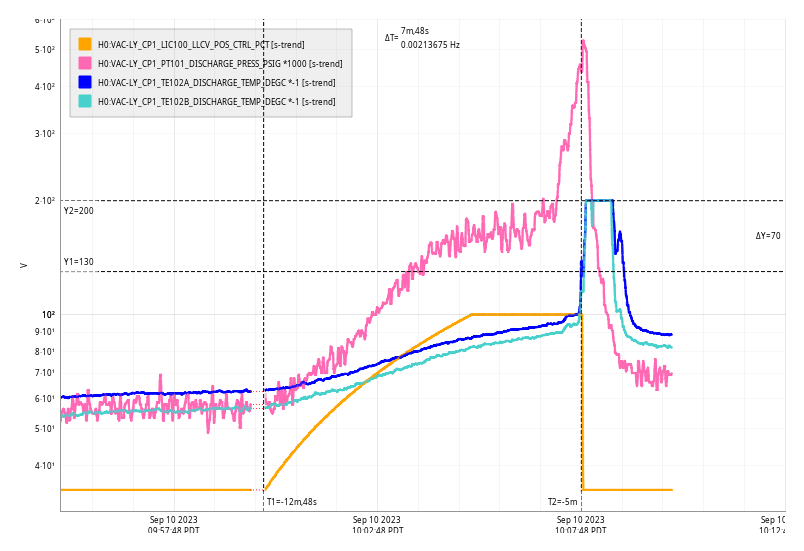
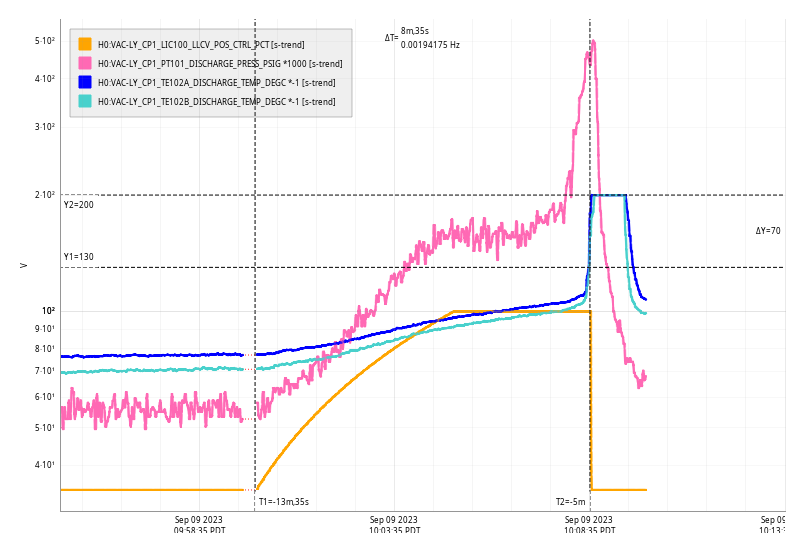
Wed Jun 28 10:11:47 2023 INFO: Fill completed in 11min 46secs
Jordan confirmed that this was not a good fill from curbside. The TC Temps slowly dropped to the -120C trip point with no noticable increase in the discharge line pressure.
Gerardo will perform a manual fill later today after all the temperatures have normalized.
Ran stochastic short and long hardware injections, in coincidence with LLO. These are of the style described in alog 69723.
hwinj stochastic short --gps 1371592362 --run
hwinj stochastic long --gps 1371593299 --run (Interrupted by earthquake. LLO lost lock, so I ctrl-c'd)
It turns out that those awg scripts don't release their exitations nicely, which means that we weren't going to be able to go to Observe until they were cleared. In clearing them, I accidentally stopped the CW hardware injections. Once those were back in place, we're back to Observing.
The rest of this alog is some details, in case we need to refer to them long-term.
When trying to figure out how to stop an individual excitation (the Transient hardware excitation point) I misunderstood the meaning of the channel numbers on the GDS TABLE from the calinj's GDS screen (see attachment), and inadvertently stopped the CW injection rather than the Transient injection path. Those numbers are for *testpoints*, not awg slots (which is consistent with what the top row of the table says, but it didn't click for me). Erik reminded me later that I could have checked awg slots with diag> awg show 42 (where 42 is h1calinj's number), but it's still not clear that you can selectively clear a single excitation. Jamie and the CDS folks are going to follow this up.
In the end, I did an awg clear 42 * and also tp clear 42 *, and that released all the excitations (since we already had to restart the CW injections).
Apparently there is a 'monit' process that should automatically restart the CW injections if they are stopped for some reason like this. However, Dave found that since tconvert has an output (due to a warning), that monit process was not being successful. Dave worked some magic, and tconvert no longer gave a warning, which meant that the monit process was able to restart the CW injections. After that was done, we were able to go back to Observe long term.
Until we understood the issue with the startup script, I had been holding us out of Observe since we didn't have the CW injections. Keith let me know that they have monitoring downstream for when those are or are not in place, so it would have been fine if the CW injections were not in place for a few hours to a ~day, until we were able to debug. I tried to set us to Observing, however every few minutes the auto-startup-process was trying to start the injection, which begins with setting a gain to zero (so that it can later be ramped on), so that SDF diff kept popping us out of Observe. Dave stopped the monit process, so we went back to Observe and stayed there for a few minutes. By then, Dave had fixed the tconvert warning issue, and we went back out of Observe one last time, Dave restarted the monit process, and it restarted the CW injections. Now we're *really* back in Observe.
EDIT: Dave's alog about the magic: alog 70775
It seems that the --gps option has been removed and no longer works (it did work last Fri). We successfully used the --time option to give it the gps time.
I retuned the ITMY A2L gains today to reduce CHARD coupling to DARM. I followed the same process Gabriele and I followed when we did this at 76W, alog 69082.
- I turned on all ASC 8.125 Hz notches
- I turned on the ADS lines (out of an abundance of caution, I probably didn't need to do this)
- I injected an 8.125 Hz line into CHARD P SM EXC using awggui
- I adjusted the ITMY P2L gain to reduce the height of that peak in DARM
- I turned off this excitation and then repeated the process with CHARD Y and the Y2L gain
- I turned off the notches and took us back to camera servos when finished
New gains:
P2L: 0.1
Y2L: -0.2
Old gains:
P2L: -0.05
Y2L: -1.7
I was able to reduce the CHARD P line height in DARM by about a factor of 4, and the CHARD Y line height in DARM by about a factor of 10. These are similar to the values that Gabriele achieved at 76W. See attached plot, OMC DCPD SUM reference was the starting point, live trace was the end point with new A2Ls.
I updated the guardian to use these new A2L gains. These gains will be engaged in the move spots state when we adjust all the other A2Ls (as usual). I loaded the guardian after the change. I did not see any SDF diffs related to this change in observe, so I guess these channels are not monitored? There is no need to SDF in safe as these are guardian controlled.
I gave the A2L gains another look, still injecting a CHARD line at 8 Hz. I made some improvement to both pitch and yaw with P2L = -0.1, and Y2L = -0.15. I think we see a small reduction in noise below 10 Hz from this change. The CHARD P coherence is also slightly reduced as a result. The new gains are in the guardian. I gave these another look because we have evidence of an alignment change from the new OM2 TSAMS setting, and we did see the ASC coherence change with the OM2 setting.
This lock we will change the IFO input power to 60W, see alog 70497.
Already done:
Thermalization guardian commented out of ISC_LOCK for now.
Reverted the change to ITMY A2L gains from 69082
NOISE_CLEAN will not turn on any NonSENS cleaning. This means that GDS-CALIB_STRAIN_CLEAN will be the same as GDS-CALIB_STRAIN_NOLINES.
I've turned *ON* the "thermalization" calibration lines, via the CAL_AWG_LINES guardian for this power up, in order to track the thermalization of the sensing function during a 60W power up (we did not turn on these lines until we were regularly at 75W, so we don't really have as clear of an analysis [e.g. LHO:69593] of the thermalization behavior during 60W) Recall, the eight line frequencies (the highest at 24.5 Hz) are listed in LHO:69284. They've been on and running since 2023-06-21 15:18:04 UTC. Note, I have *not* recoded this up to be turned on automatically in ISC_LOCK, as I hope that we'll get a few thermalization runs during these next two 8 hour periods, and I'll be present for them.
As per discussion in LHO:70650, I've edited /opt/rtcds/userapps/release/isc/h1/guardian/ lscparams.py in order to change the hard-coded value to which we set the SRCL offset, changing it from -265 [ct] that we've been using at 75/76W PSL input power, to -175 [ct] which we'd used at 60W PSL input power. This is line 526 (at the time I edited the params): offset = {'SRCL_MODEHOP':-800, 'SRCL_RETUNE':-175 # updated 20230621 } While we're not confident this is the perfect value, it's certainly a fine place to start.
Reverted LSC FF filters, as noted by Elenna's config alog.
SRCLFF1 again uses FM2. MICHFF again uses FM6-9. PRCLFF gain is commented out (so, should be left at zero from Down).
PRCL OLG measured after the loop changes in LOWNOISE_LENGTH_CONTROL
Sheila measured the PRCL OLG, having left the 'new' filters in place, and letting lownoise_length_control set PRCL1 gain to 6, and not using the thermalization guardian.
Our UGF is about 25 Hz, so a little lower than the target of 30 Hz, but stable and fine. We'll re-check after a while of having been at full power.
Lowered CARM gain by hand by 6dB (lowered H1:LSC-REFL_SERVO_IN1GAIN and H1:LSC-REFL_SERVO_IN2GAIN by 1dB each, alternating, until I was down on each slider by 6dB).
When we just ran through LaserNoiseSuppression, we saw lots of excess noise, and Sheila measured the highest CARM UGF to be around 27 kHz, which is too high. We the lowered the overall gain by 6dB. Not yet in guardian.
EDIT: Lowering by 6dB brought our lowest UGF to ~12kHz, too low. We re-increased by 3dB, so that in the end we've only reverted the 3dB increase that Elenna mentioned in the config alog.
EDIT2: this is now in guardian.
PRCL OLG remeasured longer into the lock, and the UGF was quite low. I increased the PRCL1 gain to 10 (from the nominal, without-thermalization-guardian, 6), and the UGF is back to 30 Hz.
We can likely afford to just put this gain of 10 into lownoise_length_control, but that would put our UGF at the beginning of the lock at 37 Hz with 24 deg of phase margin. Probably fine, but much higher starts to be not fine.
I increased the gain of the SRCL FF (and measured that I did not need to change the gain of MICH FF).
Attached shows the reduction in coherence with SRCL when the gain of the SRCLFF1 filter bank is set to 2.1 (rather than 1.0). Blue is the old coherence, green is the updated coherence. You can see that if we want to keep the coherence reduced at lower frequencies, we'll have to make a frequency-dependent change to the feedforward, but so far this at least helps.
I did this by injecting noise into SRCL (by just using the SRCL OLG measurement template's excitation, just set to exponential rather than fixed averages), and changed the feedforward gain until the noise in DARM seemed minimized above 30 Hz. I did the same also for MICH, but found that the existing gain value of 0.97 was already the best.
This means that I incidentally got SRCL and MICH olg measurements, which are the second and third attachments.
Accepted FF-related SDFs. Also accepted PRCL1 gain at 2 sec, since the thermalization guardian is off and won't set it to 30 sec.
Not shown, I also accepted the OAF-WHITENING gain at zero (which means that there's no NonSENS cleaning going forward).
Another PRCL measurement, UGF is just a bit under 30 Hz.
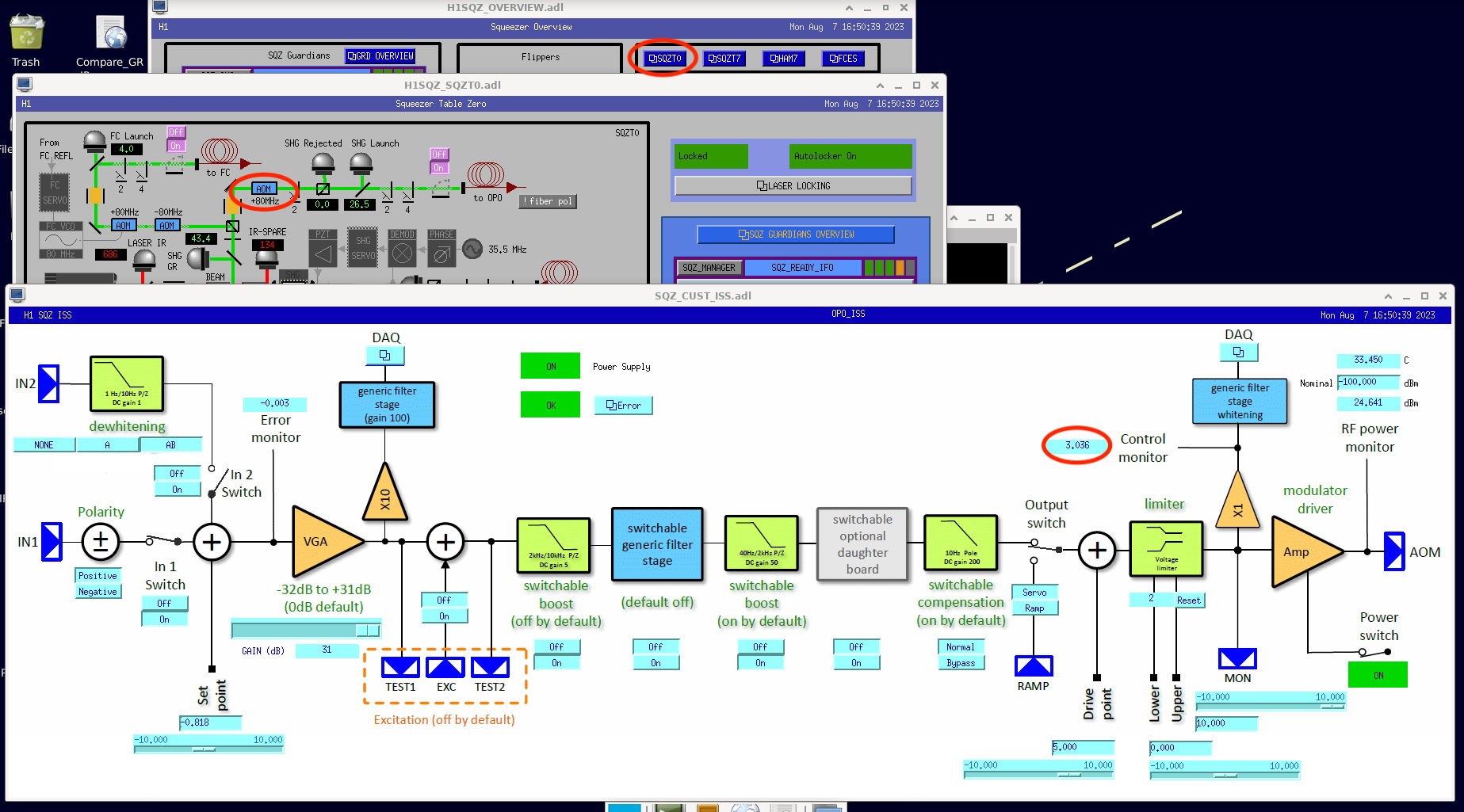
Sheila plugged in the SR785 to the ISS second loop chassis similar to the photo in alog 61721.
Keita confirmed that Err1Mon is equivalent to our digital filter banks' In1 (so, before the excitation), and Err2Mon is equivalent to In2 (so, after the excitation). The excitation BNC is likely the one plugged into the port under Err1Mon on the photo.
And, since the two monitor points have different gains, the UGF of the loop should be read off of the TF at the -20dB line.
With the ISS second loop gain H1:PSL-ISS_SECONDLOOP_GAIN at the 75W value of -5 dB, Sheila measured that we had a UGF of about 17kHz. With the gain increased to -2dB, we have a UGF of about 21.7kHz. I've accepted the value of -2dB into SDF.
Attached is a photo of the SR785 with the IFO at 60W and the ISS second loop gain at -2dB.
We've changed the PRCL1 gain in lownoise_length_control to be 10. Since this means that we don't need the Thermalization guardian, we'll just leave that in IDLE, and TJ has set it's nominal to be IDLE (see alog 70694).
Sheila has written a separate alog 70692 for what to do if this is too much gain for PRCL at the beginning of the lock.
I did a simple caget to find out what the values of H1:LSC-SRCLFF1_GAIN & H1:LSC-SRCLFF1_TRAMP and a caput to change the gain to 2.1.
After the change I saw a noticable increase in SENSMON Range.
IFO Current Status : NOMINAL_LOW_NOISE & OBSERVING with a range of 140.6 Mpc
This is a photo of the CARM OLG measurement refered to in 70662