[M. Wade, L. Wade]
The CalMonitor git repository contains a tool that can be used to plot the systematic error line transfer function measurements (see aLOG 69285) alongside a given calibration uncertainty estimate. This tool has been used to plot the transfer function of PCAL/GDS-CALIB_STRAIN at each line frequency alongside the uncertainty estimate, but it can now also be used to plot the transfer function of PCAL/CAL-DELTAL_EXTERNAL_DQ (which is the inverse of what is computed in the front-end channels referenced in aLOG 69285) as well.
In order to plot the transfer function of PCAL/CAL-DELTAL_EXTERNAL_DQ alongside an uncertainty estimate, you will need access to the data via NDS, which can be obtained on any of the LDAS machines. The script for producing the plot is called calunc_consistency_monitor and can be run with the following command line:
$ python /path/to/calmonitor/bin/calunc_consistency_monitor --cal-consistency-config /path/to/calmonitor/config/calunc_consistency_configs_CALCS_H1.ini --start-time GPSSTARTTIME --end-time GPSENDTIME --uncertainty-file /path/to/file/uncertaintyfile.txt --output-dir /path/to/output/directory
In order to plot the transfer function of PCAL/GDS-CALIB_STRAIN alongside an uncertainty estimate, you will need access to the data stored in InfluxDB on the respective site clusters. Please reach out to Maddie if you would like to know how to obtain these credentials. The command for producing this plot is:
$ python /path/to/calmonitor/bin/calunc_consistency_monitor --scald-config /path/to/calmonitor/config/scald_config.yml --cal-consistency-config /path/to/calmonitor/config/calunc_consistency_configs_H1.ini --start-time GPSSTARTTIME --end-time GPSENDTIME --uncertainty-file /path/to/file/uncertaintyfile.txt --output-dir /path/to/file/uncertaintyfile.txt
The IFO environment variable must be set outside of the launching of the script. This can be done with
$ export IFO=H1
The config files in the git repository referenced above (GDS strain config file and CALCS strain config file) have configuration set to only include transfer function measurements at a given line frequency when the uncertainty of the measurements, as derived from the coherence, is less than 2%.
The script will write a plot to the specified output directory with the filename convention uncertinaty_consistency_check_GPSSTARTTIME_GPSENDTIME_STRAINCHANNLENAME.png. Attached are plots for the PCAL/STRAIN transfer function measurements at the systematic error lines for both the CAL-DELTAL_EXTERNAL_DQ strain channel, with corrections applied, and the GDS-CALIB_STRAIN channel for GPS times 1371391575-1371395175, alongside the uncertainty budget found in calibration_uncertainty_H1_1371405027.txt.
The shaded dots on top of the uncertainy envelope are the transfer function meausrements at each measured line frequency. If the dots are colored red, this indicates that less than 68% of the measurements lay inside of the 68% confidence interval for this time period. If the dots are colored green, this indicates that at least 68% of the measurements lay inside of the 68% confidence interval for this time period.
Just fixing a typo in the above alog for the records. Corrected lines below:
In order to plot the transfer function of PCAL/GDS-CALIB_STRAIN alongside an uncertainty estimate, you will need access to the data stored in InfluxDB on the respective site clusters. Please reach out to Maddie if you would like to know how to obtain these credentials. The command for producing this plot is:
$ python /path/to/calmonitor/bin/calunc_consistency_monitor --scald-config /path/to/calmonitor/config/scald_config.yml --cal-consistency-config /path/to/calmonitor/config/calunc_consistency_configs_H1.ini --start-time GPSSTARTTIME --end-time GPSENDTIME --uncertainty-file /path/to/file/uncertaintyfile.txt --output-dir /path/to/file/output/directory
J. Kissel, S. Dwyer (others) We're ~2 hours after achieving stable lock at 60W (see LHO:70648), and we were interested to see how our power recycling gain is doing vs. 75W earlier today, and 60W back in March / April 2023. Attached is screenshot of two trends of three channels -- the power recycling gain (PRG. dimensionless W/W), the power on the LSC POP diode in HAM1 (in [uW]) and the arm cavity powers (in [kW]). The left shot shows how things were in March / April, and the right shot shows the past ~10 hours. The PRG looks to be successfully restored to ~50-51 after thermalization, similar to the best of times in March / April 2023 at 60W. Where at 75W, we had been running with a PRG of ~47 after thermalization.
Comparing today's lock to yesterday, we have 80.4% of the input power, 86% of the circulating power, and the optical gain is 1.04% of yesterday's.
The power on the DCPDs is alpha x^2, with x the DARM offset and alpha should be proportional to the square root of power on the beamsplitter. Since we have kept the power on the DCPDs at 40mA, we would expect the DARM offset to be increased by the ratio of circulating powers to the 1/4th power, so we should expect a 4% increase in DARM offset. The optical gain should scale as alpha* darm offset, so we would expect it to scale as the power ratio ^(1/4). This means that we should have expected the optical gain to be 96% of what it was at 430kW circulating power, so we have 8% more optical gain than would be expected if only the circulating power were changing.
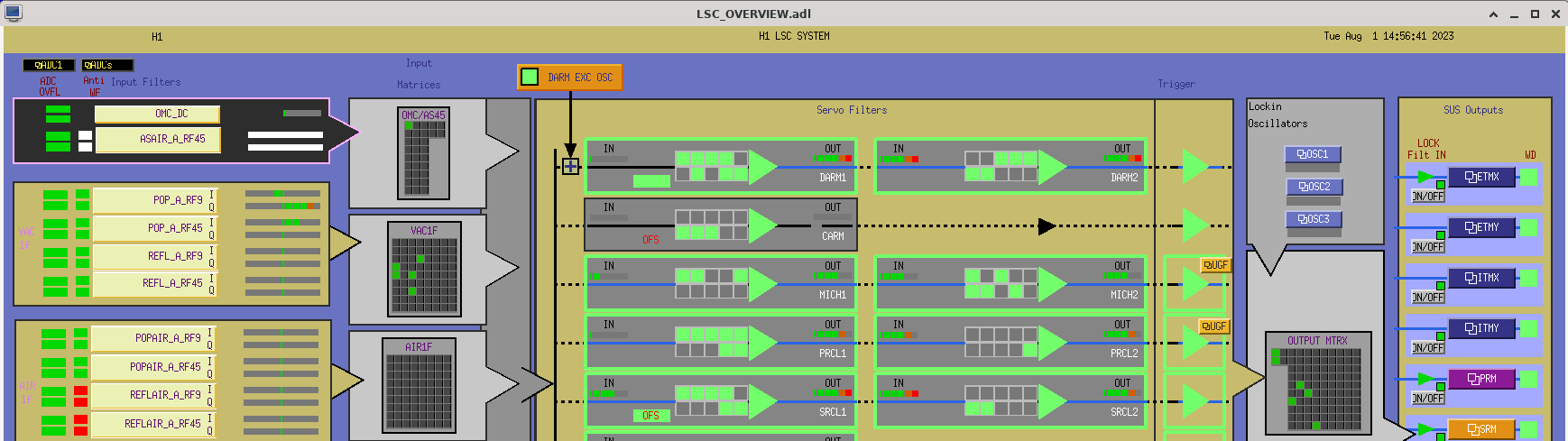
J. Kissel While Sheila and Jenne were commissioning the settings for the CARM loop (LHO:70662) as we revert to 60W PSL input power (see LHO:70648), we noticed that the DARM ASD on the front wall (8 sec FFT, 75% overlap, 3 averages) showed a lot of excess noise and comb-like behavior, especially while Sheila was measuring the open loop gain of the CARM loop by injection SR785 voltage into the analog CARM servo, injecting a 100 Hz to 100 kHz swept sine excitation around the UGF of the CARM loop. We figure this ~10 minute stretch of data might be interesting to compare against the list of combs that Ansel sees (e.g. LHO:70219), in case there are clues that some of the combs seen are due to this loop. The approximate times of injection/gain steps/commissioning are between 16:40 UTC and 16:50 UTC, with combs definitely seen at 16:45 UTC (on June 21 2023). One can confirm the times by trending the CARM gains listed in Jenne's aLOG (again, LHO:70662).
Unfortunately, it doesn't look like these combs are the same ones we've been tracking. I looked at 200s FFTs averaged over the 10-minute period and made a few plots. There's a clear ~12.5 Hz comb and a stronger overlapping ~50 Hz comb, but these are new and not persistent as far as I'm aware.
Figure 1 shows this time period overlaid with known combs-- it's a messy plot, intended to show all locations where comb peaks would be. The only one that sticks up above the background is a 99.99864 Hz comb, which overlaps roughly with every other harmonic of the 50 Hz. But zooming in (figure 2) shows that the alignment is not great, and that the feature in this data set is actually fairly broad. Contrast with figure 3, showing the same frequency range in an Fscan weekly data set, where this comb and another ~99.99 Hz comb are both visible, narrow, and offset from zero (and we don't see peaks between them).
FAMIS 25071
The In-Lock Charge Measurements did indeed run yesterday.
In-Lock Charge Measurement Analysis Results attached.
TITLE: 06/21 Owl Shift: 07:00-15:00 UTC (00:00-08:00 PST), all times posted in UTC
STATE of H1: Lock Acquisition
CURRENT ENVIRONMENT:
SEI_ENV state: CALM
Wind: 6mph Gusts, 4mph 5min avg
Primary useism: 0.01 μm/s
Secondary useism: 0.07 μm/s
QUICK SUMMARY:
Inherited H1 that was already locked for almost 5 hours.
With reference to alog 70616 I changed
H1:TCS-ETMX_RH_SETUPPERPOWER
H1:TCS-ETMX_RH_SETLOWERPOWER
&&
H1:TCS-ETMY_RH_SETUPPERPOWER
H1:TCS-ETMY_RH_SETLOWERPOWER
all to 1W from 1.2W. Change made at 11:00 UTC.
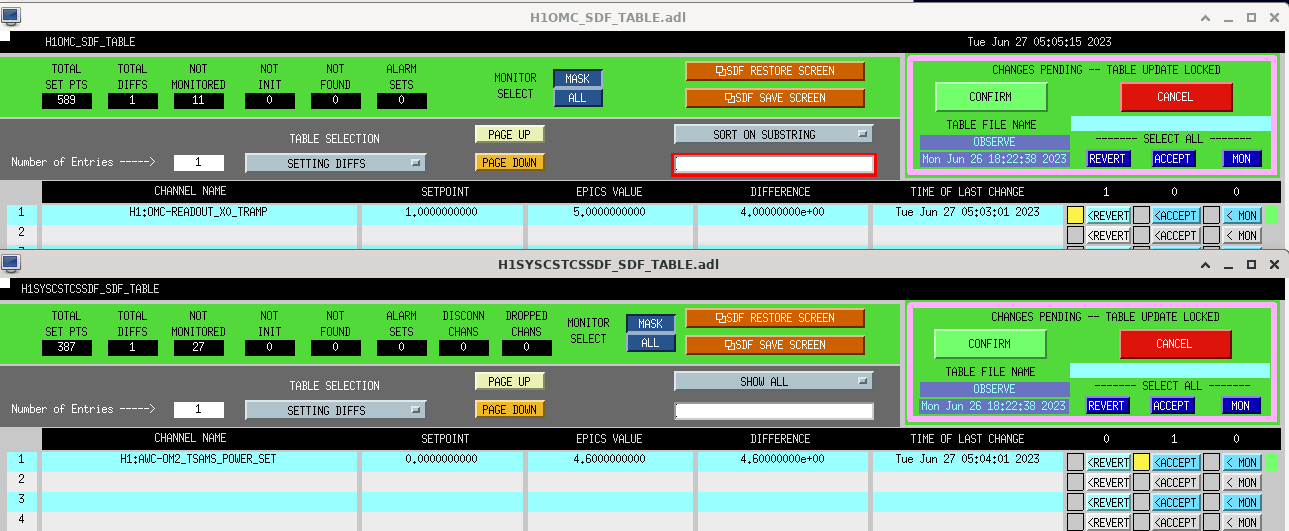
Changes excepted in SDF at 11:02 UTC.
11:22 Lockloss alog
https://ldas-jobs.ligo-wa.caltech.edu/~lockloss/index.cgi?event=1371381773
Relocking without Initial Alignment
NOMINAL_LOW_NOISE reached at 12:17UTC
Observing reached at 12:29 UTC
13:18 Lockloss alog
https://ldas-jobs.ligo-wa.caltech.edu/~lockloss/index.cgi?event=1371388721
Relocking without Initial Alignment
NOMINAL_LOW_NOISE Reached at 14:08 UTC
Observing reached by 14:15 UTC
15:05 UTC Lockloss
https://ldas-jobs.ligo-wa.caltech.edu/~lockloss/index.cgi?event=1371395177
Current IFO Status: Relocking
This lock we will change the IFO input power to 60W, see alog 70497.
Already done:
Thermalization guardian commented out of ISC_LOCK for now.
Reverted the change to ITMY A2L gains from 69082
NOISE_CLEAN will not turn on any NonSENS cleaning. This means that GDS-CALIB_STRAIN_CLEAN will be the same as GDS-CALIB_STRAIN_NOLINES.
I've turned *ON* the "thermalization" calibration lines, via the CAL_AWG_LINES guardian for this power up, in order to track the thermalization of the sensing function during a 60W power up (we did not turn on these lines until we were regularly at 75W, so we don't really have as clear of an analysis [e.g. LHO:69593] of the thermalization behavior during 60W) Recall, the eight line frequencies (the highest at 24.5 Hz) are listed in LHO:69284. They've been on and running since 2023-06-21 15:18:04 UTC. Note, I have *not* recoded this up to be turned on automatically in ISC_LOCK, as I hope that we'll get a few thermalization runs during these next two 8 hour periods, and I'll be present for them.
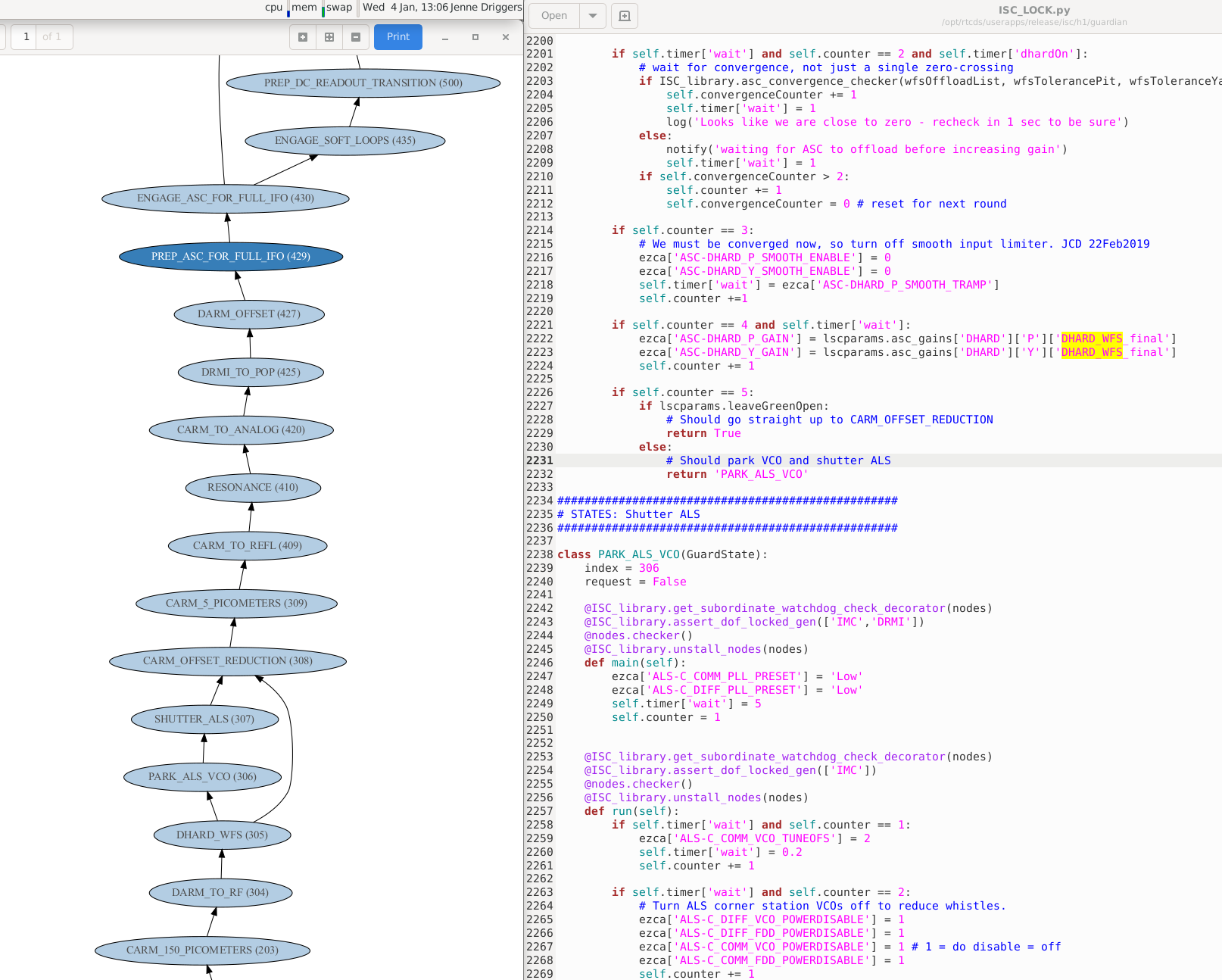
As per discussion in LHO:70650, I've edited /opt/rtcds/userapps/release/isc/h1/guardian/ lscparams.py in order to change the hard-coded value to which we set the SRCL offset, changing it from -265 [ct] that we've been using at 75/76W PSL input power, to -175 [ct] which we'd used at 60W PSL input power. This is line 526 (at the time I edited the params): offset = {'SRCL_MODEHOP':-800, 'SRCL_RETUNE':-175 # updated 20230621 } While we're not confident this is the perfect value, it's certainly a fine place to start.
Reverted LSC FF filters, as noted by Elenna's config alog.
SRCLFF1 again uses FM2. MICHFF again uses FM6-9. PRCLFF gain is commented out (so, should be left at zero from Down).
PRCL OLG measured after the loop changes in LOWNOISE_LENGTH_CONTROL
Sheila measured the PRCL OLG, having left the 'new' filters in place, and letting lownoise_length_control set PRCL1 gain to 6, and not using the thermalization guardian.
Our UGF is about 25 Hz, so a little lower than the target of 30 Hz, but stable and fine. We'll re-check after a while of having been at full power.
Lowered CARM gain by hand by 6dB (lowered H1:LSC-REFL_SERVO_IN1GAIN and H1:LSC-REFL_SERVO_IN2GAIN by 1dB each, alternating, until I was down on each slider by 6dB).
When we just ran through LaserNoiseSuppression, we saw lots of excess noise, and Sheila measured the highest CARM UGF to be around 27 kHz, which is too high. We the lowered the overall gain by 6dB. Not yet in guardian.
EDIT: Lowering by 6dB brought our lowest UGF to ~12kHz, too low. We re-increased by 3dB, so that in the end we've only reverted the 3dB increase that Elenna mentioned in the config alog.
EDIT2: this is now in guardian.
PRCL OLG remeasured longer into the lock, and the UGF was quite low. I increased the PRCL1 gain to 10 (from the nominal, without-thermalization-guardian, 6), and the UGF is back to 30 Hz.
We can likely afford to just put this gain of 10 into lownoise_length_control, but that would put our UGF at the beginning of the lock at 37 Hz with 24 deg of phase margin. Probably fine, but much higher starts to be not fine.
I increased the gain of the SRCL FF (and measured that I did not need to change the gain of MICH FF).
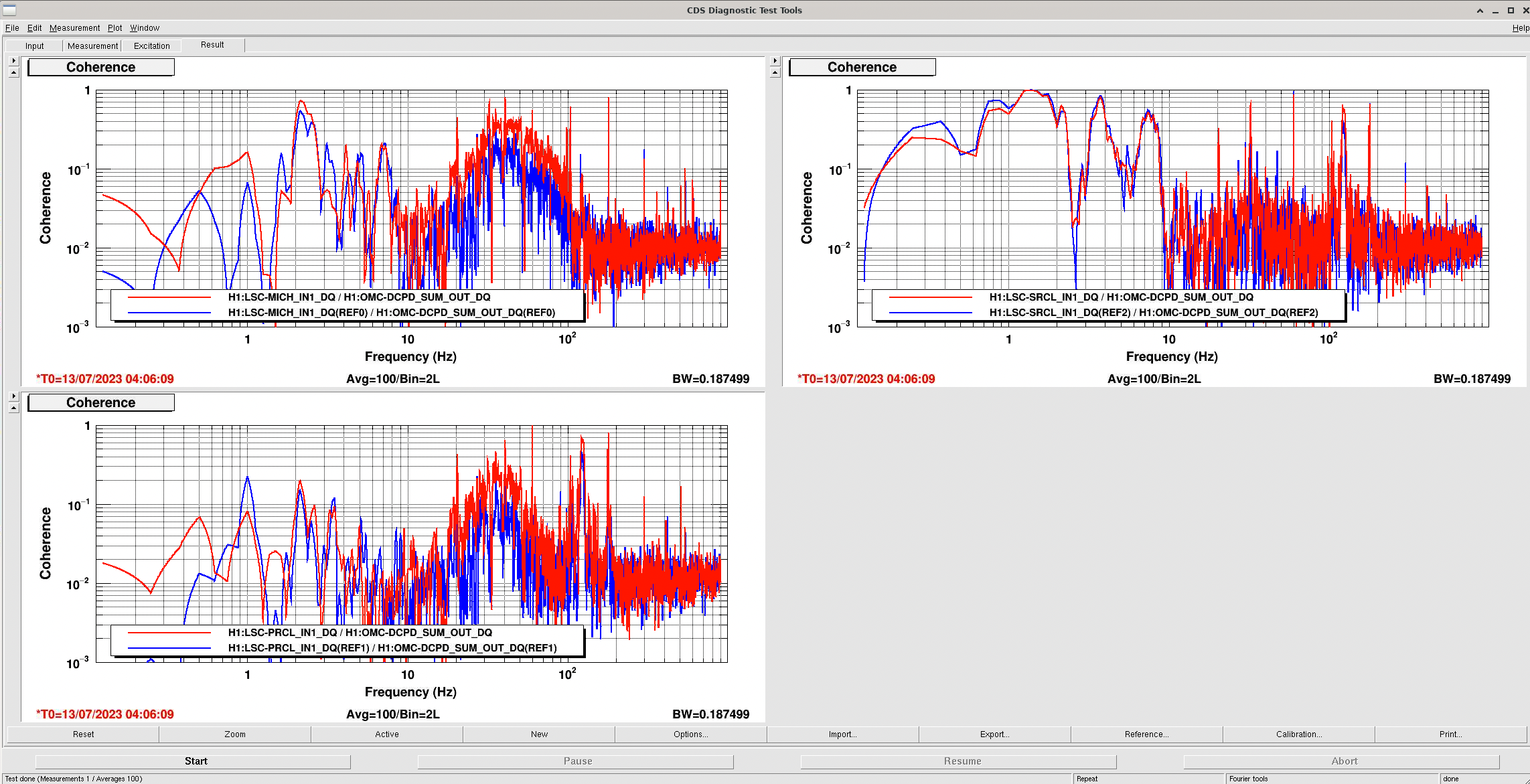
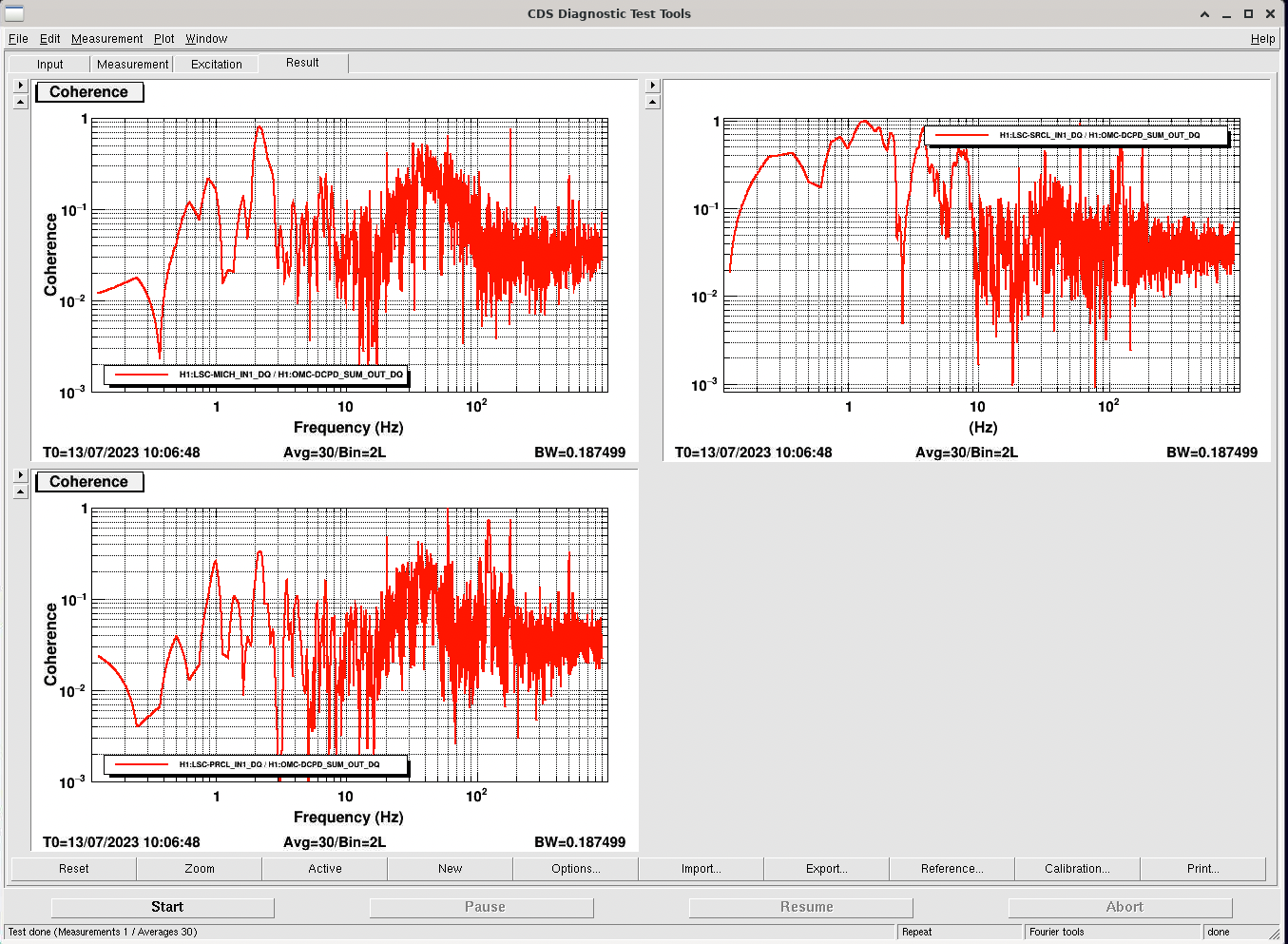
Attached shows the reduction in coherence with SRCL when the gain of the SRCLFF1 filter bank is set to 2.1 (rather than 1.0). Blue is the old coherence, green is the updated coherence. You can see that if we want to keep the coherence reduced at lower frequencies, we'll have to make a frequency-dependent change to the feedforward, but so far this at least helps.
I did this by injecting noise into SRCL (by just using the SRCL OLG measurement template's excitation, just set to exponential rather than fixed averages), and changed the feedforward gain until the noise in DARM seemed minimized above 30 Hz. I did the same also for MICH, but found that the existing gain value of 0.97 was already the best.
This means that I incidentally got SRCL and MICH olg measurements, which are the second and third attachments.
Accepted FF-related SDFs. Also accepted PRCL1 gain at 2 sec, since the thermalization guardian is off and won't set it to 30 sec.
Not shown, I also accepted the OAF-WHITENING gain at zero (which means that there's no NonSENS cleaning going forward).
Another PRCL measurement, UGF is just a bit under 30 Hz.
Sheila plugged in the SR785 to the ISS second loop chassis similar to the photo in alog 61721.
Keita confirmed that Err1Mon is equivalent to our digital filter banks' In1 (so, before the excitation), and Err2Mon is equivalent to In2 (so, after the excitation). The excitation BNC is likely the one plugged into the port under Err1Mon on the photo.
And, since the two monitor points have different gains, the UGF of the loop should be read off of the TF at the -20dB line.
With the ISS second loop gain H1:PSL-ISS_SECONDLOOP_GAIN at the 75W value of -5 dB, Sheila measured that we had a UGF of about 17kHz. With the gain increased to -2dB, we have a UGF of about 21.7kHz. I've accepted the value of -2dB into SDF.
Attached is a photo of the SR785 with the IFO at 60W and the ISS second loop gain at -2dB.
We've changed the PRCL1 gain in lownoise_length_control to be 10. Since this means that we don't need the Thermalization guardian, we'll just leave that in IDLE, and TJ has set it's nominal to be IDLE (see alog 70694).
Sheila has written a separate alog 70692 for what to do if this is too much gain for PRCL at the beginning of the lock.
I did a simple caget to find out what the values of H1:LSC-SRCLFF1_GAIN & H1:LSC-SRCLFF1_TRAMP and a caput to change the gain to 2.1.
After the change I saw a noticable increase in SENSMON Range.
IFO Current Status : NOMINAL_LOW_NOISE & OBSERVING with a range of 140.6 Mpc
This is a photo of the CARM OLG measurement refered to in 70662
Just lost lock at 15:05UTC, 1371395177. Looks like LSC-PRCL rang up in te ~3seconds before lockloss, see attached. Note that we are in a different thermal configuration while we prepare to lower input power, 70646.
11:22 UTC Lockloss 22 minutes after turning the ring heaters down.
https://ldas-jobs.ligo-wa.caltech.edu/~lockloss/index.cgi?event=1371381773
While referencing alog 70616 I changed
H1:TCS-ETMX_RH_SETUPPERPOWER
H1:TCS-ETMX_RH_SETLOWERPOWER
&&
H1:TCS-ETMY_RH_SETUPPERPOWER
H1:TCS-ETMY_RH_SETLOWERPOWER
all to 1W from 1.2W. Change made at 11:00 UTC.
Changes accepted in SDF at 11:02 UTC.
Tagging CAL, as we expect a cavity pole change from this ring heater change.
Here is a list of the things we need to change to return as closely as possible to a desirable 60W configuration.
If you are looking for a timestamp to determine when the power change occurred, the last full lock at 60W was on April 6 from about 17:00 UTC to April 7 3:30 UTC.
Under LSC controls, I claimed that we should revert the PRCL loop design, however Gabriele reminded me that the new PRCL design has better suppression, see alog 68817. We should keep this new design, but we should still determine how/if we need to change the gain to ensure the loop UGF is around 30 Hz.
Under LSC feedforward, I forgot to mention that we did not run with PRCL feedforward at 60W, so we can turn that back off at 60W.
I have also recovered the old MICH FF filter that was in FM9, called "May_d". At 60W, we will need to engage FM6-9. labeled May a-d.
We will need to update the violin mode threshhold checker. The counts value for the DARM offset was hard coded, and will be different at 60W.This value will only need to change if we change the DARM offset.
Tagging a lot of the teams who will either need to be involved in these changes, or at least be impacted by these changes when/while we revert.
J. Kissel, J. Driggers, N. Aritomi, S. Dwyer
Just FYI I brought up the open question in Elenna's aLOG about
DARM offset: 20 mA, not sure if we want to revert this value
The quick consensus (without agreeing to write it in stone) is that we "plan" to *not* revert the DARM offset, leaving us with 40 mA of current on the DCPDs, as has been the case since May 05 2023 (see LHO:69358).
J. Kissel, J. Driggers, S. Dwyer
Regarding the following setting suggestions in this bullet point,
SRCL offset: we had been running with an offset of -175.
This was also with the previous LSC-POP_RF45 whitening at 21 dB.
We could revert the whitening change as well if we think it's better
for noise considerations
The plan is to *definitely* go to the -175 ct SRCL offset, however -- upon discussion this morning -- we've decided *not* to revert the reduction in POP A RF45 whitening gain from +21 dB to +15 dB. Said with all positives to avoid confusion, we'll continue to reduce the gain to +15 dB rather than revert to +21 dB.
We think
- the extra ADC range head room is nice,
- the sacrifice in SRCL / PRCL sensing noise is minimal, and/or has minimal impact***
- for now, today, when we power down, we want to change as little as is need to achieve stability, rather than revert absolutely everything.
***One may find the assessment of the noise impact in LHO:69350.
I forgot to include this in this alog, but the CSOFT P gain should probably be reduced to 20 again. This was a change made late last week.