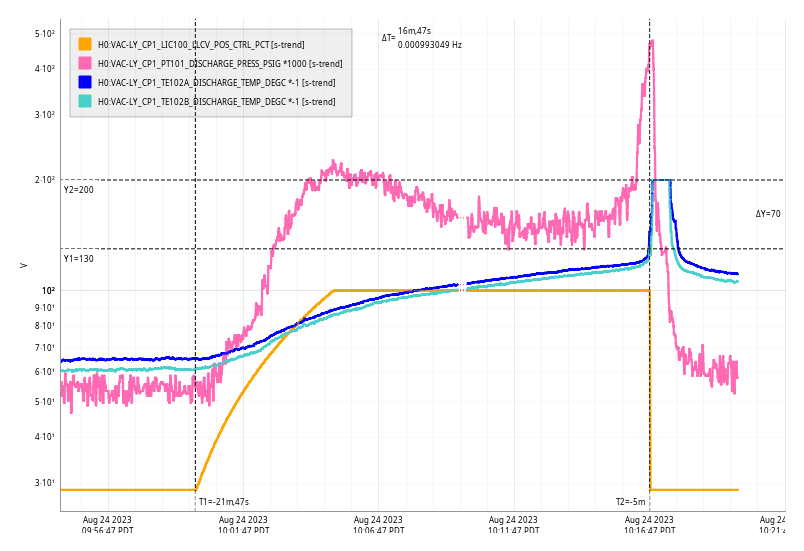
We ran the functionality test on the main turbopumps in MY and EY during Tuesday Maintenance (6/20/23). The scroll pump is started to take pressure down to low 10^-02 Torr, at which time the turbo pump is started, the system reaches low 10^-08 Torr after a few minutes, then the turbo pump system is left ON for about 1 hour, after the hour the system goes through a shut down sequence.
No issues were encountered while performing the functionality test on these 2 stations.
MY Turbo:
Bearing Life:100%
Turbo Hours: 200
Scroll Pump Hours: 11389 - Needs tip seal replacement
EY Turbo:
Bearing Life:100%
Turbo Hours: 1267
Scroll Pump Hours: 200
Closes WP 11262 FAMIS 24936
As Elenna states in alog 70497, changing TCS settings for the IFO to be stable at 60W should only be a reduction of ETM ring heaters down to 1.0W/segment.
We've not historically had locking issues while changing the ETM ring heaters. I expect the bulk of the heating change should happen in the first ~3-4 hours (65113) and then we'll have a slow transient as the TM cools over the following 24 hours. Suggest a 4am ring heater reduction will leave us in a mostly steady state by 8am .
We will want to watch the violins while this change is happening as ring heater changes do effect the violin damping settings, alog 67176. Tagging SUS.
|
Power In
|
Ring Heater /segment |
CO2X
@25W |
CO2Y
@25W |
Notes
|
|||
|
IX
|
IY
|
EX
|
EY
|
||||
| 75W Current 70078 |
0.44
|
0.0
|
1.2
|
1.2
|
1.7
|
1.7
|
Start of O4 settings
|
| 60W Old Stable 68491 |
0.44
|
0.0
|
1.0
|
1.0
|
1.7
|
1.7
|
Used @60W from 2023/03/3 |
Tue Jun 20 10:04:56 2023 INFO: Fill completed in 4min 55secs
Gerardo confirmed a good fill curbside.
LVEA Swept following T1500386. Unplugged W-bay forklift and one extension cord.
There is an unnecessary extension cord over SQZT0, tuned off but didn't unplug (only used for SQZ laptop/monitor).
Maintenance day activities have finished an VEAs have been swept. Beginning the locking process and starting with initial alignment.
FCES VEA temperature cycled rapidly between 68 deg F and 71.5 deg F over the last month, through hot and cold weeks.
Plot 1 shows the dark noise in LSC-REFL_A_LF and REFL_B_LF (yellow/black), with 10W laser input with ISS second loop (red/blue) and w/o ISS second loop (magenta/cyan). The photocurrent in REFL_A and REFL_B was about 16mW each for the 10W measurements. It will turn to about 10mW in full lock. So, we are now about a factor 4 above dark noise.
Plot 2 shows the RIN of the 2 REFL PDs and their average, together with the ISS second loop sensors. The ISS inner and outer sensors have about 7-8mW of light each, so the measurements are limited by the shot noise of the inner PD. In full lock these sensors see about 60mW.
Here are 2 plots when the interferometer is locked. The ISS second loop sensors see about 60mW of light, whereas for this time LSC-REFL_A/B see about 8mW each.
The first plot shows a large excess in REFL power fluctuations below ~200Hz. EVen the flat part 300Hz shows some excess. It should be about 70% of the 16mW measurements, but shows a very similar level. Looking at the coherence between REFL_A and B indicates that this is a real signal and not noise.
The second plot shows relative intensity noise. To get the curves calibrated correctly one should match the peak near 4.5kHz since this seems rela intensit noise from the laser. (There is a factor of 0.3 in the calibrations of the RIN of REFL_A/B to acocunt for the interferometer reflectivity at DC. This factor should be 1 when the interferometer isn;t locked.)
Here is comparison between early in the lock and after 4 hours.
The hump in the reflected power is clearly getting larger as time progresses, and is its coherence with PRCL. The input power as measured by the ISS second loop outer sensor doesn't have a large correlection with the reflected power (some is expected due to the shot noise of the inner sensor).
Q1: Why is PRCL coherent with the power in reflection? If theer is a couplinh, shouldn't it be at least second order?
Q2: What's the flat noise above 300Hz that we see in the reflection power?
Here is the power trend during this lock.
And these are the plots more than 7 hours into a 60W lock. The REFL PD now seems to be shot noise limited above 100Hz.
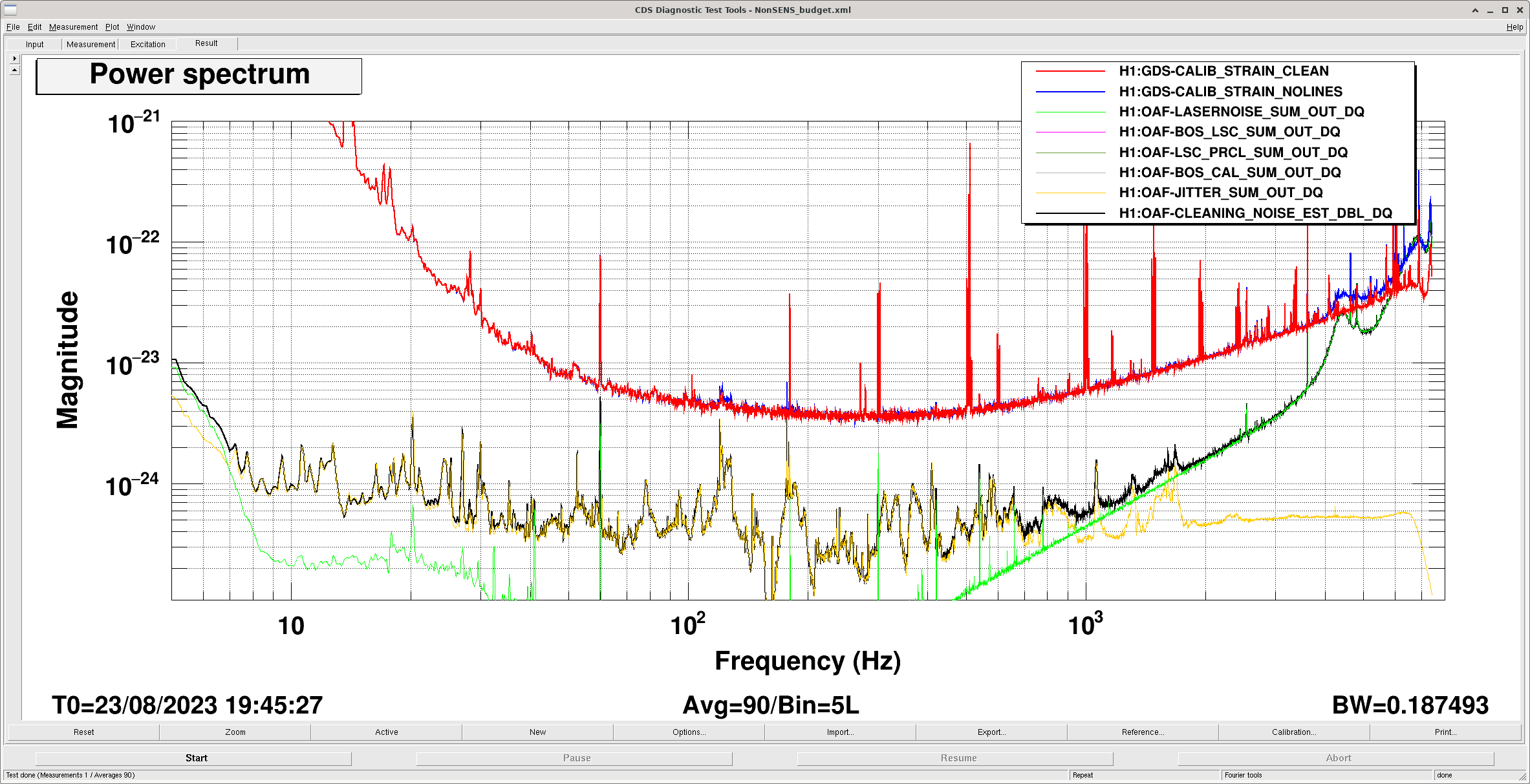
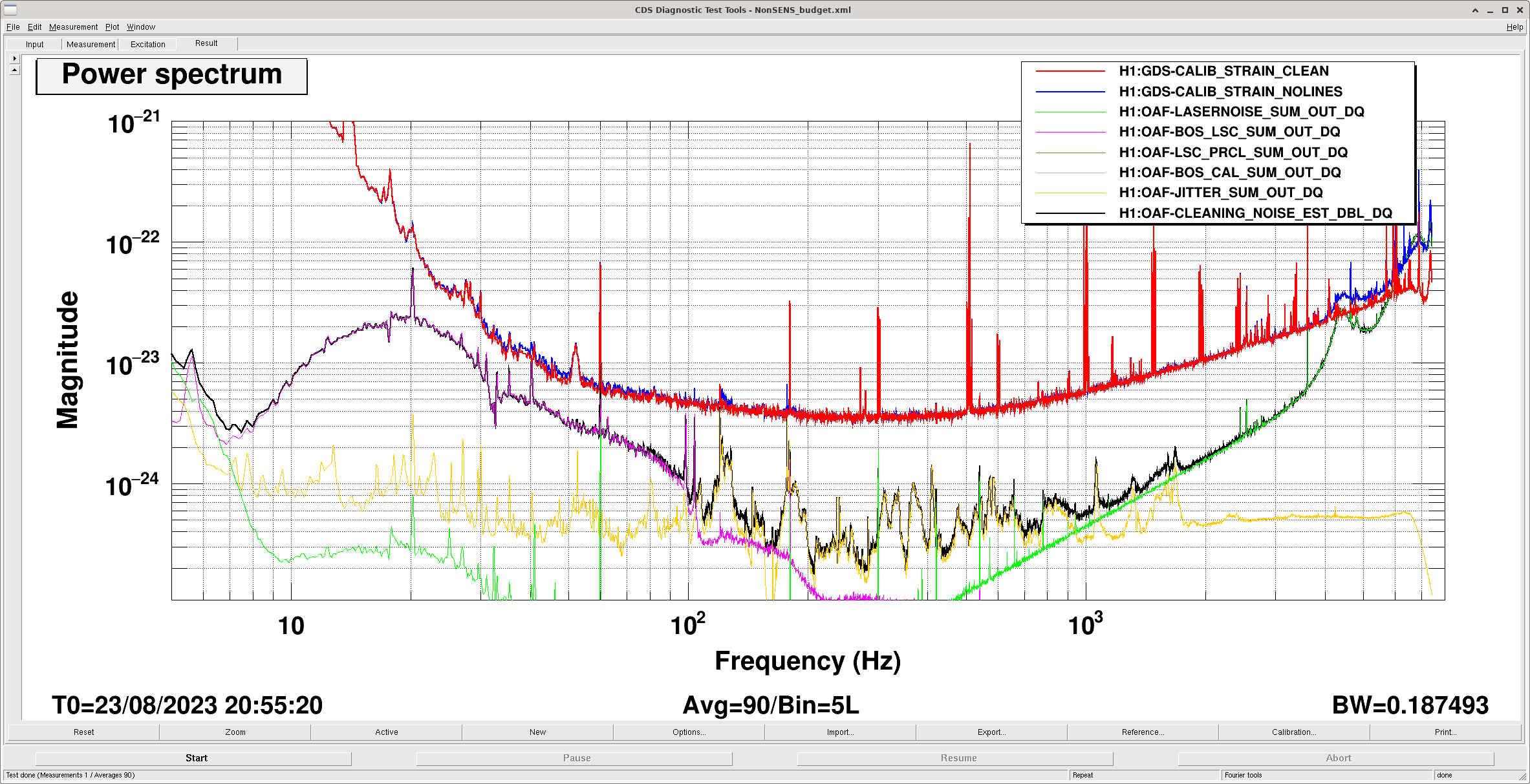
Here is a comparison between the noise measured in reflection at 75W and 60W and against the dark noise. Some observations:
The outer loop RIN is always reported about 8% higher than the innner loop one. This is not real. In the PSL ISS model of the second loop ISS both detector values are divided by the DC value of the inner loop detector. Since the outer loop detector sees about 8% more light, the RIN in the outer loop detector is overestimated by this amount. To get a better value multiply by 0.922. With this correction both RIN spectra agree with each other.
A better calibration of the REFL/ISS PDs measured with 10W input and all TMs misaligned.
| Measured | Calibration | |
| IMC-PWR_IN | 9.855 W | 1 W/W |
| PDSUMINNER | 7.477 mA | 0.7588 mA/W |
| PDSUMOUTER | 8.115 mA | 0.8235 mA/W |
| REFL_A_LF | 16.70 mW | 1.694 mW/W |
| REFL_B_LF | 15.59 mW | 1.582 mW/W |
Here is a 60W trend for completness.
Sheila, Brina,
We made a plot using the OMC refl PD's between LHO and LLO to see how they compare to eachother. (image attached below)
The DC routdout of the 2 LSC REFL RF detectors were ADC noise limited above ~200Hz. Today we improved the whitening filters to give us 10x higher gain above 30Hz.
In detail: D1102079, R20s were changed to 499Ohm from 1.58kOhm to extend the whitening filters from 1:10 to 1:30. Channel 4 was modified in ISC-R4 (LSC-REFL_A), and channel 2 in ISC-R1 (LSC-REFL_B).
Serial numbers:
| Old | New | Channel | Modified | |
| ISC-R4 | S1200460 | S1200450 | LSC-REFL_A | Channel 4 |
| ISC-R1 | S1200450 | S1200452 | LSC-REFL_B | Channel 2 |
The LSC model was modified to add the average of the 2 REFL RIN channels: LSC-REFL_RIN = (LSC-REFL_A_RIN + LSC-REFL_B_RIN) / 2.
Quick links as an add-on to the documentation: Chassis assembly drawing which Daniel cites: D1102079 Actually sub-assembly board drawing to which "R20" exists: D1102060 -- see page 3. e-Traveler information on the serial numbers of these aLIGO LSC RFPD Interface chassis (not the of the board that's actually changed) S1200450 S1200452 Work permits for the changes: WP 11272 -- electronics change WP 11273 -- front-end model changes Measurement results that were possible as a result of these changes: LHO:70611. My interpretation of verbal conversation with Daniel on 2023-06-22 about those measurement results: "Improving the electronics didn't seem to help making the measurement better, but I'm not going to revert it 'cause its doesn't matter whether it's in or not. #somewords #somewords L1 doesn't care about this. (a) This is a standard whitening chassis used for almost all ISC PDs, so we're not going to change the generic drawing, and (b) other than the OMC DCPDs [which have their own whitening design], most ISC PDs are not shot noise limited, so this change wouldn't help them." Or something. The above e-travelers on this particular whitening are therefore the sustained documentation about this deviation from design.
Filiberto, Jim, Patrick The end Y HEPI pump control has been migrated to Beckhoff PLC control. The PLC code is at commit 6f28513d7348758424e485d99c9ece5a79edb593 at https://git.ligo.org/cds/ifo/beckhoff/hepi-pump-ctrl/h1-hepi-pump-ctrl-ey. It is currently running on PID control and maintaining ~ 70 psi differential pressure.
The following Beckhoff electronics were installed:
Mechanical Room
VEA
A 12U open frame rack was mounted on the HEPI cage. The Beckhoff computer and terminals were mounted to the frame rack via a Din rail kit.
The EK1101 coupler and EL3602-0010 in the VEA were installed half rack between BSC10 and BSC6. Same rack that houses the BRS Heater Beckhoff modules.
The old HEPI Pump Servo Chassis in mechanical room and both HEPI Preamps (next to BSC10) were left installed and powered off. Old units will be removed after new system runs for a few weeks.
J. Oberling, R. Short
Robert requested that we lower the PSL chiller flow rate in an attempt to lower the vibration on the PSL table. Ryan and I did this at ~17:02 UTC (10:02 PDT); we lowered the flow by slightly adjusting the chiller's internal bypass, it changed from ~3.2 lpm to ~2.6 lpm (roughly half-way between our old operating flow and our observed minimum). The laser was fine with this change; we did see an expected slow increase in the water temperature and in the Amp/DB temperature. We are monitoring the PSL as it thermalizes with this new cooling flow rate and will update if anything adverse occurs (we will keep a close eye on air bubbles). I am leaving WP 11209 open for now as we may need to adjust the flow rate again, depending on what Robert finds with this first change.
WP11273
Daniel's latest h1lsc model was installed and restarted, followed by a DAQ restart to add a fast channel to the frame.
I thought I was setting the output of the end Y pump controller to 0, but it was end X.
TITLE: 06/20 Day Shift: 15:00-23:00 UTC (08:00-16:00 PST), all times posted in UTC
STATE of H1: Preventive Maintenance
CURRENT ENVIRONMENT:
SEI_ENV state: MAINTENANCE
Wind: 11mph Gusts, 10mph 5min avg
Primary useism: 0.01 μm/s
Secondary useism: 0.13 μm/s
QUICK SUMMARY: Starting Tuesday Maintenance Day. Currently have VAC team starting turbo pump tests at EY and MY. It should be a light-ish day.
VAC, SEI, SUS, CDS, dust monitors okay.
TITLE: 06/20 Owl Shift: 07:00-15:00 UTC (00:00-08:00 PST), all times posted in UTC
STATE of H1: Preventive Maintenance
CURRENT ENVIRONMENT:
SEI_ENV state: MAINTENANCE
Wind: 11mph Gusts, 9mph 5min avg
Primary useism: 0.01 μm/s
Secondary useism: 0.13 μm/s
QUICK SUMMARY:
Inherited an IFO that was locked for 8 hours.
LockLoss 7:21 UTC https://ldas-jobs.ligo-wa.caltech.edu/~lockloss/index.cgi?event=1371280926
Relocking: trying to relock without Initial alignment.
Got up to CARM_150_PICOMETERS before a lockloss.
Increase Flashes seems to be having trouble getting the flashes for Y arm above 0.7.
Switching to Green Arms manual. Trying to get the flashes above 0.7 manually.
Still having troubles manually getting the Y arm flashes above 0.7.
Restored slider values back to 1371280888 which was right after the last NLN Lockloss.
Still had to touch up Y arm some more, but now Initial Alignment is running.
NOMINAL_LOW_NOISE Reached at 10:16 UTC
Observing state reached at 10:24 UTC
14:20 UTC MAgnetic Injections started running, which has taken us out of Observing.
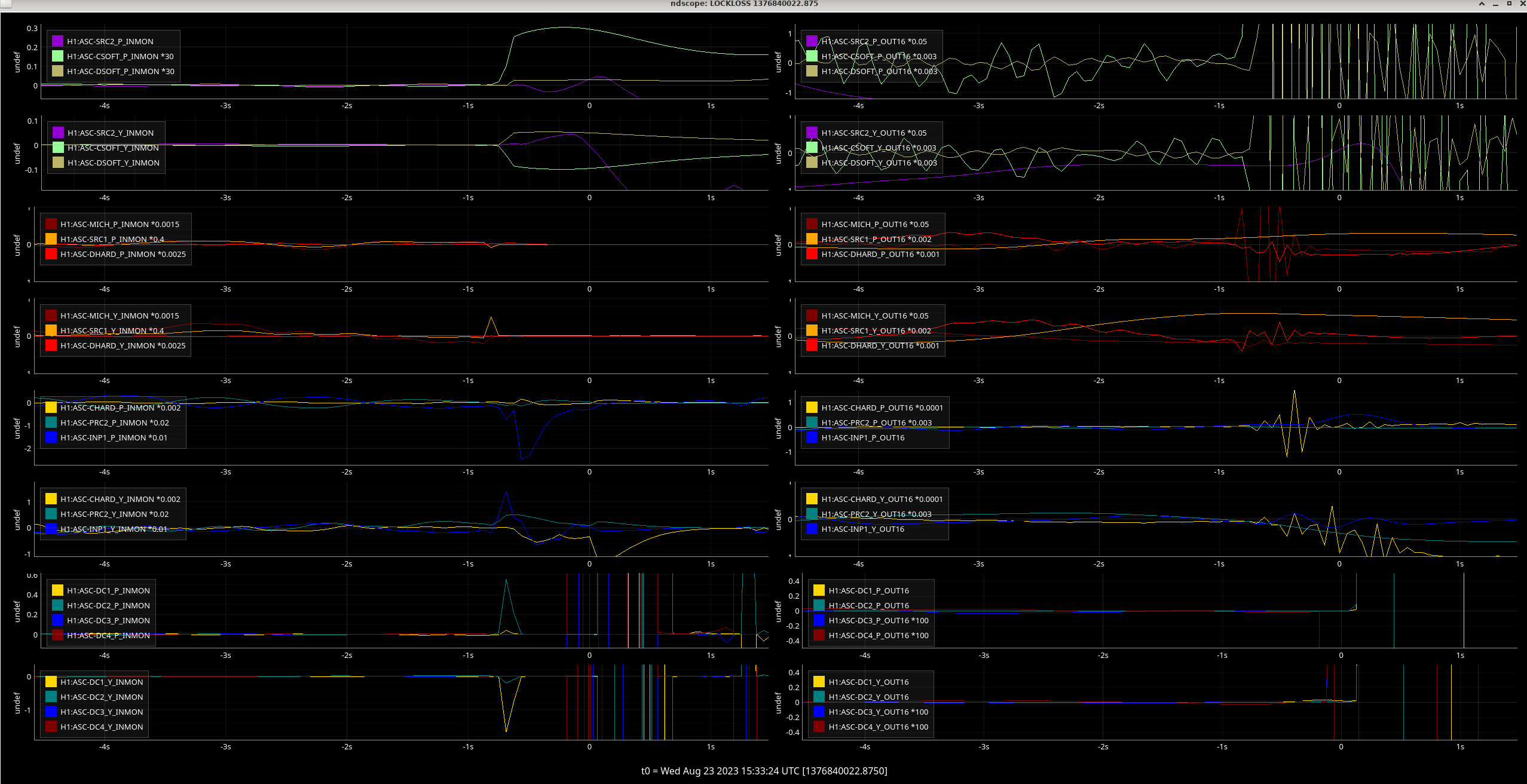
LockLoss at 15:00:47 UTC https://ldas-jobs.ligo-wa.caltech.edu/~lockloss/index.cgi?event=1371308465
Likely caused by in lock charge measurements.
| Start Time | System | Name | Location | Lazer_Haz | Task | Time End |
|---|---|---|---|---|---|---|
| 15:05 | VAC | Jordan | Mid Y , & EY | N | Vacuum work | 17:05 |
| 15:06 | FAC | Karen | EY | N | Technical Cleaning | 17:06 |
| 15:07 | FAC | FAC | LVEA | N | 3 IFO Storage | 17:07 |
| 15:10 | FAC | Kim | EX | N | Technical Cleaning | 17:10 |
| 15:12 | FAC | Christi | Mids & LVEA | N | 3 IFO Inventory | 17:12 |
LockLoss at 15:00:47 UTC
https://ldas-jobs.ligo-wa.caltech.edu/~lockloss/index.cgi?event=1371308465
Very likely caused by In Lock Charge measurements, though I have not confirmed this yet,
Control room workstations were updated and rebooted. The update was to os-packages only. Conda environments were not updated.
Camilla, Dave:
nuc26:
nuc26 had an OS issue overnight which caused it to transition its root filesystem to read-only mode. I rebooted it at 08:11 PDT and it is operating correctly now.
nuc30:
The camera image for cam15, HAM6 OMC TRANS, went blue screen at 07:56 PDT this morning. I restarted the camera server on h1digivideo1 and then power cycled the camera by POE toggling on sw-lvea-aux to no avail, h1cam15 still does not respond to pings. Further investigation is needed.
FRS28295 opened for h1cam15 not responding issue.
Erik and Jonathan unplugged and plugged in the cam15 cable at the switch during a lock loss (about 1pm localtime). No change on the camera. Next step is sending someone to the camera itself, likely with a spare.
Connected to camera via laptop, no response. Camera will need to be replaced but requires laser hazard. Camera not required for relocking. Working with commissioners to find time to replace/align camera. Patrick T. will update serial number and mac address of new camera.
WP11274 including laser hazards submitted: https://services2.ligo-la.caltech.edu/LHO/workpermits/view.php?permit_id=11274